


ASTM B700-08(2014)
(Specification)Standard Specification for Electrodeposited Coatings of Silver for Engineering Use
Standard Specification for Electrodeposited Coatings of Silver for Engineering Use
ABSTRACT
This specification establishes the requirements for electrodeposited silver coatings that may be mat, bright, or semibright, and are usually employed as solderable surfaces and for their electrical contact characteristics, high electrical and thermal conductivity, thermocompression bonding, wear resistance on load-bearing surfaces, and spectral reflectivity. Coatings shall be classified into types according to minimum purity, grade according to surface appearance (bright, semibright, or mat), and class according to whether any surface treatment has been applied. Coatings shall undergo preplating operations such as stress relief treatment, strike, and underplating, as well as post-plating embrittlement relief. Coatings shall be sampled, tested, and conform accordingly to specified requirements as to nature, purity, appearance, defects, adhesion, solderability, hardness, spectral reflectance, electrical conductivity, hydrogen embrittlement relief, and thickness (measured either nondestructively by beta backscatter, X-ray spectrometry, or magnetic method, or destructively by coulometric technique or microscopical cross-sectioning procedure).
SCOPE
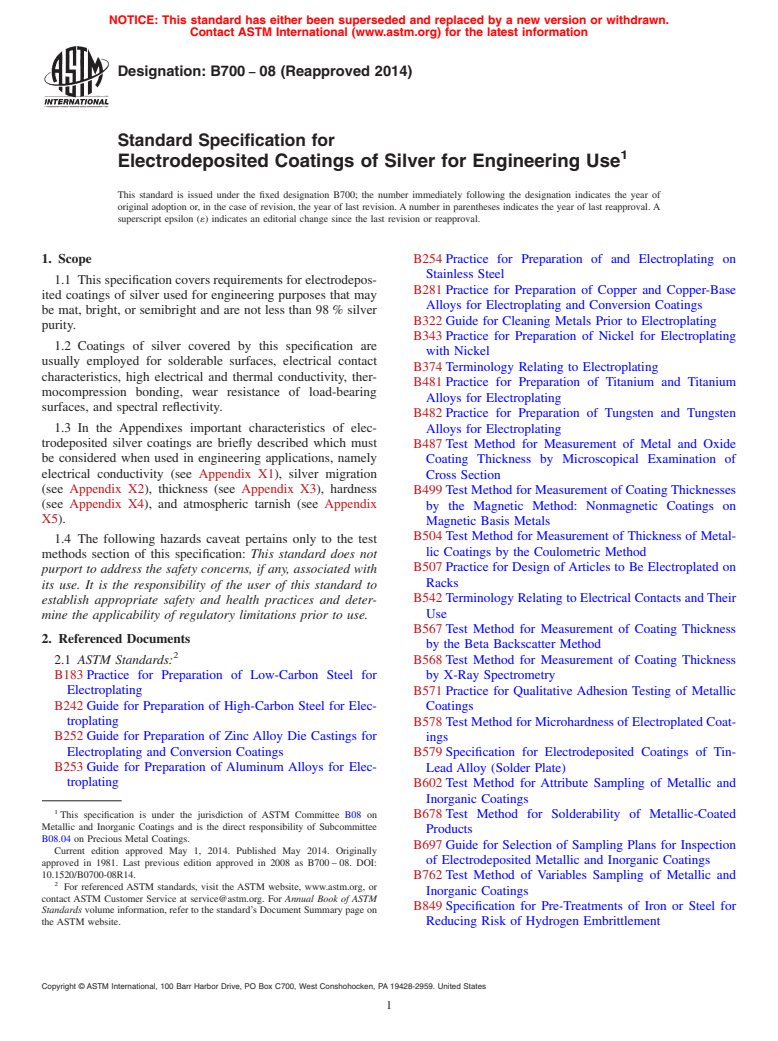
1.1 This specification covers requirements for electrodeposited coatings of silver used for engineering purposes that may be mat, bright, or semibright and are not less than 98 % silver purity.
1.2 Coatings of silver covered by this specification are usually employed for solderable surfaces, electrical contact characteristics, high electrical and thermal conductivity, thermocompression bonding, wear resistance of load-bearing surfaces, and spectral reflectivity.
1.3 In the Appendixes important characteristics of electrodeposited silver coatings are briefly described which must be considered when used in engineering applications, namely electrical conductivity (see Appendix X1), silver migration (see Appendix X2), thickness (see Appendix X3), hardness (see Appendix X4), and atmospheric tarnish (see Appendix X5).
1.4 The following hazards caveat pertains only to the test methods section of this specification: This standard does not purport to address the safety concerns, if any, associated with its use. It is the responsibility of the user of this standard to establish appropriate safety and health practices and determine the applicability of regulatory limitations prior to use.
General Information
Standards Content (Sample)
NOTICE: This standard has either been superseded and replaced by a new version or withdrawn.
Contact ASTM International (www.astm.org) for the latest information
Designation:B700 −08 (Reapproved 2014)
Standard Specification for
Electrodeposited Coatings of Silver for Engineering Use
This standard is issued under the fixed designation B700; the number immediately following the designation indicates the year of
original adoption or, in the case of revision, the year of last revision. A number in parentheses indicates the year of last reapproval. A
superscript epsilon (´) indicates an editorial change since the last revision or reapproval.
1. Scope B254 Practice for Preparation of and Electroplating on
Stainless Steel
1.1 This specification covers requirements for electrodepos-
B281 Practice for Preparation of Copper and Copper-Base
ited coatings of silver used for engineering purposes that may
Alloys for Electroplating and Conversion Coatings
be mat, bright, or semibright and are not less than 98 % silver
B322 Guide for Cleaning Metals Prior to Electroplating
purity.
B343 Practice for Preparation of Nickel for Electroplating
1.2 Coatings of silver covered by this specification are
with Nickel
usually employed for solderable surfaces, electrical contact
B374 Terminology Relating to Electroplating
characteristics, high electrical and thermal conductivity, ther-
B481 Practice for Preparation of Titanium and Titanium
mocompression bonding, wear resistance of load-bearing
Alloys for Electroplating
surfaces, and spectral reflectivity.
B482 Practice for Preparation of Tungsten and Tungsten
1.3 In the Appendixes important characteristics of elec- Alloys for Electroplating
trodeposited silver coatings are briefly described which must
B487 Test Method for Measurement of Metal and Oxide
be considered when used in engineering applications, namely
Coating Thickness by Microscopical Examination of
electrical conductivity (see Appendix X1), silver migration
Cross Section
(see Appendix X2), thickness (see Appendix X3), hardness
B499 Test Method for Measurement of Coating Thicknesses
(see Appendix X4), and atmospheric tarnish (see Appendix
by the Magnetic Method: Nonmagnetic Coatings on
X5).
Magnetic Basis Metals
B504 Test Method for Measurement of Thickness of Metal-
1.4 The following hazards caveat pertains only to the test
lic Coatings by the Coulometric Method
methods section of this specification: This standard does not
B507 Practice for Design of Articles to Be Electroplated on
purport to address the safety concerns, if any, associated with
Racks
its use. It is the responsibility of the user of this standard to
B542 Terminology Relating to Electrical Contacts and Their
establish appropriate safety and health practices and deter-
Use
mine the applicability of regulatory limitations prior to use.
B567 Test Method for Measurement of Coating Thickness
2. Referenced Documents
by the Beta Backscatter Method
2.1 ASTM Standards: B568 Test Method for Measurement of Coating Thickness
B183 Practice for Preparation of Low-Carbon Steel for
by X-Ray Spectrometry
Electroplating B571 Practice for Qualitative Adhesion Testing of Metallic
B242 Guide for Preparation of High-Carbon Steel for Elec-
Coatings
troplating B578 Test Method for Microhardness of Electroplated Coat-
B252 Guide for Preparation of Zinc Alloy Die Castings for
ings
Electroplating and Conversion Coatings B579 Specification for Electrodeposited Coatings of Tin-
B253 Guide for Preparation of Aluminum Alloys for Elec-
Lead Alloy (Solder Plate)
troplating
B602 Test Method for Attribute Sampling of Metallic and
Inorganic Coatings
This specification is under the jurisdiction of ASTM Committee B08 on
B678 Test Method for Solderability of Metallic-Coated
Metallic and Inorganic Coatings and is the direct responsibility of Subcommittee
Products
B08.04 on Precious Metal Coatings.
B697 Guide for Selection of Sampling Plans for Inspection
Current edition approved May 1, 2014. Published May 2014. Originally
of Electrodeposited Metallic and Inorganic Coatings
approved in 1981. Last previous edition approved in 2008 as B700 – 08. DOI:
10.1520/B0700-08R14.
B762 Test Method of Variables Sampling of Metallic and
For referenced ASTM standards, visit the ASTM website, www.astm.org, or
Inorganic Coatings
contact ASTM Customer Service at service@astm.org. For Annual Book of ASTM
B849 Specification for Pre-Treatments of Iron or Steel for
Standards volume information, refer to the standard’s Document Summary page on
the ASTM website. Reducing Risk of Hydrogen Embrittlement
Copyright © ASTM International, 100 Barr Harbor Drive, PO Box C700, West Conshohocken, PA 19428-2959. United States
B700−08 (2014)
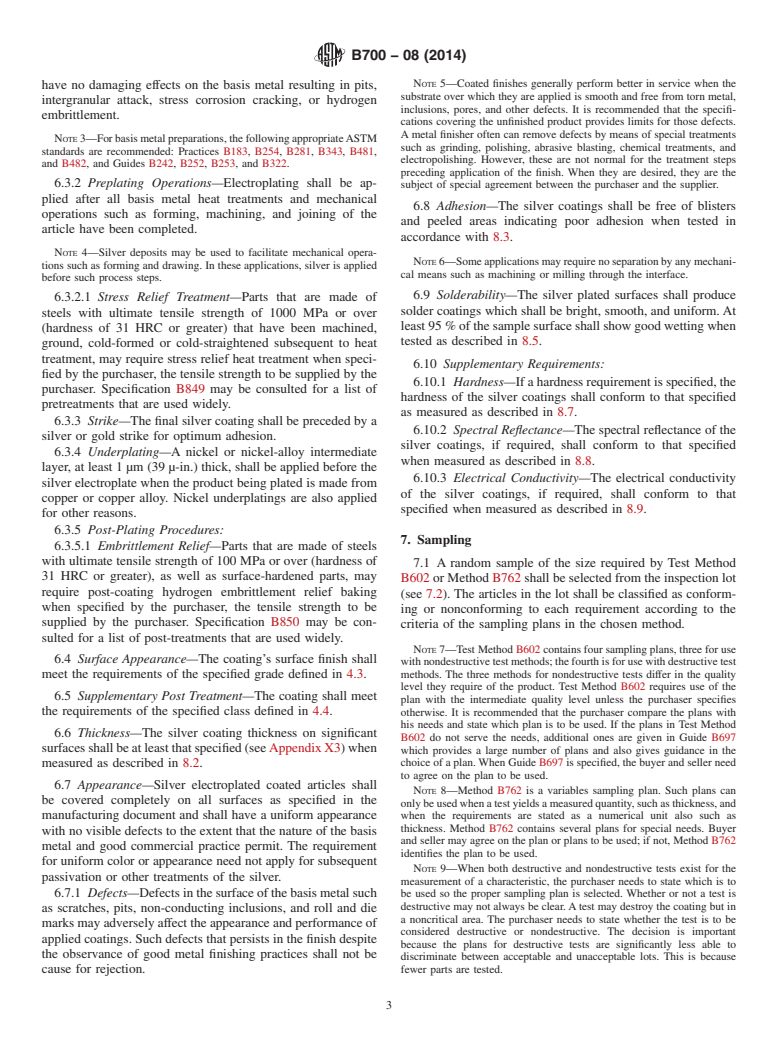
stated function of the coating and are acceptable to the purchaser (see
B850 GuideforPost-CoatingTreatmentsofSteelforReduc-
Appendix X1).
ing the Risk of Hydrogen Embrittlement
D3951 Practice for Commercial Packaging
4.3 SurfaceAppearance—SpecifybyGradeinlettercodeas
E1004 Test Method for Determining Electrical Conductivity follows:
Using the Electromagnetic (Eddy-Current) Method
Grade A, Mat—Electrodeposits without luster, obtained
F519 Test Method for Mechanical Hydrogen Embrittlement from electroplating solutions operated without the use of
Evaluation of Plating/Coating Processes and Service En-
brighteners.
vironments
Grade B, Bright—Electrodeposits obtained by the use of
brighteners in the electroplating bath.
3. Terminology
Grade C, Bright—Electrodeposits obtained by mechanical
3.1 Definitions—Many of the terms used in this specifica- or chemical polishing of Grade A silver coatings.
tion are defined in Terminologies B374 or B542.
Grade D, Semibright— Semi-lustrous electrodeposits ob-
tained by the use of addition agents in the electroplating bath.
3.2 Definitions of Terms Specific to This Standard:
3.2.1 rack-plating—an electrodeposition process in which
4.4 Supplementary Surface Treatment—Specify by Class in
articles to be coated are mounted on racks or other fixtures
letter code as follows:
during the process.
Class N—A finish that has had no supplementary tarnish
resistant (that is, chromate) treatment (see Appendix X5).
3.2.2 significant surfaces—surfaces that are normally
Class S—A finish that has had a supplementary tarnish
visible, directly or by reflection, or that are essential to the
resistant (that is, chromate) treatment.
serviceability or function of the article or which can be the
source of corrosion products or tarnish films that interfere with
NOTE 2—Class S is not suitable for food service applications.
the function or desirable appearances of the article. When
necessary, the significant surfaces shall be indicated on the
5. Ordering Information
drawings of the parts, or by the provisions of suitably marked
5.1 To make application of this standard complete, the
samples.
purchaser needs to supply the following information to the
3.2.2.1 Discussion—Variation in the coating thickness from
seller in the purchase order or other governing document:
point-to-pointonacoatedarticleisaninherentcharacteristicof
5.1.1 Name, designation, and year of issue of this standard.
electroplating processes. Therefore, the coating thickness will
5.1.2 Type (see 4.2), Grade (see 4.3), Class (see 4.4) and
have to exceed the specified value at some points on the
Thickness (see 6.6 and Appendix X3).
significant surfaces to ensure that the thickness equals or
5.1.3 Nature of Substrate—If, for example, it is high
exceeds the specified value at all points. The average coating
strength steel, the need for stress relief (see 6.3.2.1) and
thickness on the article usually will be greater than that
embrittlement relief (see 6.3.5.1). If it is copper, an undercoat
specified; how much greater is largely determined by the shape
is needed (see S1.3) for some applications.
of the article (see Practice B507) and the characteristics of the
5.1.4 Significant Surfaces (see section 3.2.2).
electroplating process.Additionally, the average coating thick-
5.1.5 Appearance (see 6.7).
ness on an article will vary from article to article within a
5.1.6 Underplates (see 6.3.4 and S1.3).
production lot. If all the articles in a production lot are to meet
5.1.7 Requirements and methods of testing for one or more
the thickness requirement, the average coating thickness of a
production lot as a whole will be greater than the average of the following: need for and type of test specimens (see 8.1),
thickness (see 6.6, 8.2, and Appendix X3), adhesion (see 6.8
necessary to ensure that a single article meets requirements.
and 8.3), hardness (see 6.10.1 and 8.7), absence of embrittle-
3.2.3 strike or flash—a thin, typically less than 0.25-µm (10
ment (see 8.4), solderability (see 6.9 and 8.5), spectral reflec-
µ-in.) metallic coating layer between metallic coatings to
tance(see6.10.2and8.8),orelectricalconductivity(see6.10.3
improve adhesion.
and 8.9).
3.2.4 underplating—an application of a metallic coating
5.1.8 Sampling Plans and Quality Assurance (see Section 7
layer between the basis metal or substrate and the topmost
and S1.2).
metallic coating or coatings (see 6.3.4).
6. Coating Requirements
4. Classification
6.1 Nature of Coating—The coating essentially shall be
4.1 Electrodepositedcoatingsofsilvershallbeclassifiedfor
silver, considering the type specified, produced by electrode-
Type based on minimum purity, Grade whether bright,
position from aqueous electrolytes.
semibright, or mat, Class if supplementary surface treatment is
applied, and thickness in micrometers.
6.2 Purity of Coating—The coating shall meet the chemical
composition requirements of the specified type as defined in
4.2 Purity—Specify by Type as follows:
4.2 and measured as described in 8.6.
Type 1—99.9 % min
Type 2—99.0 % min
6.3 Process:
Type 3—98.0 % min
6.3.1 The basis metal shall be subjected to such cleaning
procedures as are necessary to ensure a surface satisfactory for
NOTE 1—Metallic or organic brighteners used for grain refinement may
be present in the electrodeposit so long as they do not interfere with the subsequent electroplating. Materials used for cleaning shall
B700−08 (2014)
NOTE 5—Coated finishes generally perform better in service when the
have no damaging effects on the basis metal resulting in pits,
substrate over which they are applied is smooth and free from torn metal,
intergranular attack, stress corrosion cracking, or hydrogen
inclusions, pores, and other defects. It is recommended that the specifi-
embrittlement.
cations covering the unfinished product provides limits for those defects.
Ametal finisher often can remove defects by means of special treatments
NOTE3—Forbasismetalpreparations,thefollowingappropriateASTM
such as grinding, polishing, abrasive blasting, chemical treatments, and
standards are recommended: Practices B183, B254, B281, B343, B481,
electropolishing. However, these are not normal for the treatment steps
and B482, and Guides B242, B252, B253, and B322.
preceding application of the finish. When they are desired, they are the
6.3.2 Preplating Operations—Electroplating shall be ap-
subject of special agreement between the purchaser and the supplier.
plied after all basis metal heat treatments and mechanical
6.8 Adhesion—The silver coatings shall be free of blisters
operations such as forming, machining, and joining of the
and peeled areas indicating poor adhesion when tested in
article have been completed.
accordance with 8.3.
NOTE 4—Silver deposits may be used to facilitate mechanical opera-
NOTE6—Someapplicationsmayrequirenoseparationbyanymechani-
tions such as forming and drawing. In these applications, silver is applied
cal means such as machining or milling through the interface.
before such process steps.
6.9 Solderability—The silver plated surfaces shall produce
6.3.2.1 Stress Relief Treatment—Parts that are made of
solder coatings which shall be bright, smooth, and uniform.At
steels with ultimate tensile strength of 1000 MPa or over
least95 %ofthesamplesurfaceshallshowgoodwettingwhen
(hardness of 31 HRC or greater) that have been machined,
tested as described in 8.5.
ground, cold-formed or cold-straightened subsequent to heat
treatment, may require stress relief heat treatment when speci-
6.10 Supplementary Requirements:
fied by the purchaser, the tensile strength to be supplied by the
6.10.1 Hardness—Ifahardnessrequirementisspecified,the
purchaser. Specification B849 may be consulted for a list of
hardness of the silver coatings shall conform to that specified
pretreatments that are used widely.
as measured as described in 8.7.
6.3.3 Strike—The final silver coating shall be preceded by a
6.10.2 Spectral Reflectance—The spectral reflectance of the
silver or gold strike for optimum adhesion.
silver coatings, if required, shall conform to that specified
6.3.4 Underplating—A nickel or nickel-alloy intermediate
when measured as described in 8.8.
layer, at least 1 µm (39 µ-in.) thick, shall be applied before the
6.10.3 Electrical Conductivity—The electrical conductivity
silver electroplate when the product being plated is made from
of the silver coatings, if required, shall conform to that
copper or copper alloy. Nickel underplatings are also applied
specified when measured as described in 8.9.
for other reasons.
6.3.5 Post-Plating Procedures:
7. Sampling
6.3.5.1 Embrittlement Relief—Parts that are made of steels
with ultimate tensile strength of 100 MPa or over (hardness of
7.1 A random sample of the size required by Test Method
31 HRC or greater), as well as surface-hardened parts, may
B602 or Method B762 shall be selected from the inspection lot
require post-coating hydrogen embrittlement relief baking
(see 7.2). The articles in the lot shall be classified as conform-
when specified by the purchaser, the tensile strength to be
ing or nonconforming to each requirement according to the
supplied by the purchaser. Specification B850 may be con-
criteria of the sampling plans in the chosen method.
sulted for a list of post-treatments that are used widely.
NOTE 7—Test Method B602 contains four sampling plans, three for use
6.4 Surface Appearance—The coating’s surface finish shall
withnondestructivetestmethods;thefourthisforusewithdestructivetest
methods. The three methods for nondestructive tests differ in the quality
meet the requirements of the specified grade defined in 4.3.
level they require of the product. Test Method B602 requires use of the
6.5 Supplementary Post Treatment—The coating shall meet
plan with the intermediate quality level unless the purchaser specifies
the requirements of the specified class defined in 4.4.
otherwise. It is recommended that the purchaser compare the plans with
his needs and state which plan is to be used. If the plans in Test Method
6.6 Thickness—The silver coating thickness on significant
B602 do not serve the needs, additional ones are given in Guide B697
surfacesshallbeatleastthatspecified(seeAppendixX3)when
w
...
Questions, Comments and Discussion
Ask us and Technical Secretary will try to provide an answer. You can facilitate discussion about the standard in here.