

ASTM A672/A672M-19
(Specification)Standard Specification for Electric-Fusion-Welded Steel Pipe for High-Pressure Service at Moderate Temperatures
General Information
- Abstract
ABSTRACT
This specification covers electrical-fusion-welded steel pipe for high-pressure service at moderate temperatures. Heat treatment may or may not be required to attain the desired properties or to comply with applicable code requirements. An analysis of each mill heat of plate material shall be made, also, an analysis of the finished deposited weld material from each 500 ft or fraction thereof shall be made. The mechanical test requirements includes one tension test specimen to represent each lot of finished pipe, and one transverse-guided-weld-bend test (two specimens) to represent each lot of finished pipe. Also, radiographic examination shall be made on the full length of each weld.
SCOPE
1.1 This specification2 covers steel pipe: electric-fusion-welded with filler metal added, fabricated from pressure-vessel quality plate of any of several analyses and strength levels and suitable for high-pressure service at moderate temperatures. Heat treatment may or may not be required to attain the desired properties or to comply with applicable code requirements. Supplementary requirements are provided for use when additional testing or examination is desired.
1.2 The specification nominally covers pipe 16 in. [400 mm] in outside diameter or larger with wall thicknesses up to 3 in. [75 mm], inclusive. Pipe having other dimensions may be furnished provided it complies with all other requirements of this specification.
1.3 Several grades and classes of pipe are provided.
1.3.1 Grade designates the type of plate used.
1.3.2 Class designates the type of heat treatment performed during manufacture of the pipe, whether the weld is radiographically examined, and whether the pipe has been pressure tested as listed in 1.3.3.
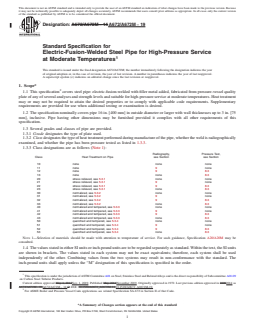
1.3.3 Class designations are as follows (Note 1):
Class
Heat Treatment on Pipe
Radiography,
see Section
Pressure Test,
see Section
10
none
none
none
11
none
9
none
12
none
9
8.3
13
none
none
8.3
20
stress relieved, see 5.3.1
none
none
21
stress relieved, see 5.3.1
9
none
22
stress relieved, see 5.3.1
9
8.3
23
stress relieved, see 5.3.1
none
8.3
30
normalized, see 5.3.2
none
none
31
normalized, see 5.3.2
9
none
32
normalized, see 5.3.2
9
8.3
33
normalized, see 5.3.2
none
8.3
40
normalized and tempered, see 5.3.3
none
none
41
normalized and tempered, see 5.3.3
9
none
42
normalized and tempered, see 5.3.3
9
8.3
43
normalized and tempered, see 5.3.3
none
8.3
50
quenched and tempered, see 5.3.4
none
none
51
quenched and tempered, see 5.3.4
9
none
52
quenched and tempered, see 5.3.4
9
8.3
53
quenched and tempered, see 5.3.4
none
8.3
Note 1: Selection of materials should be made with attention to temperature of service. For such guidance, Specification A20/A20M may be consulted.
1.4 The values stated in either SI units or inch-pound units are to be regarded separately as standard. Within the text, the SI units are shown in brackets. The values stated in each system may not be exact equivalents; therefore, each system shall be used independently of the other. Combining values from the two systems may result in non-conformance with the standard. The inch-pound units shall apply unless the “M” designation of this specification is specified in the order.
1.5 This international standard was developed in accordance with internationally recognized principles on standardization established in the Decision on Principles for the Development of International Standards, Guides and Recommendations issued by the World Trade Organization Technical Barriers to Trade (TBT) Committee.
- Status
- Published
- Publication Date
- 31-Oct-2019
- Technical Committee
- A01 - Steel, Stainless Steel and Related Alloys
- Drafting Committee
- A01.09 - Carbon Steel Tubular Products
Buy Documents
ASTM A672/A672M-19 - Standard Specification for Electric-Fusion-Welded Steel Pipe for High-Pressure Service at Moderate Temperatures
REDLINE ASTM A672/A672M-19 - Standard Specification for Electric-Fusion-Welded Steel Pipe for High-Pressure Service at Moderate Temperatures
Overview
ASTM A672/A672M-19: Standard Specification for Electric-Fusion-Welded Steel Pipe for High-Pressure Service at Moderate Temperatures is an internationally recognized standard published by ASTM International. This specification covers the requirements for electric-fusion-welded steel pipe, designed for use in high-pressure applications at moderate temperatures. The pipe is created from pressure-vessel quality plate using filler metal and must meet strict testing, analysis, and quality requirements, making it suitable for critical infrastructure and industrial projects.
Key features of ASTM A672/A672M-19 include:
- Coverage for pipes with nominal diameters starting at 16 inches (400 mm) and wall thicknesses up to 3 inches (75 mm)
- Multiple grades and classes that specify the type of steel plate, heat treatment, radiographic examination, and pressure testing required
- Separate compliance for both SI and inch-pound units
Key Topics
- Material and Manufacturing: Specifies pressure-vessel quality plate as the base material. Welds must be completed using electric-fusion with added filler metal, and procedures must be qualified per the ASME Boiler and Pressure Vessel Code.
- Grades and Classes: The grade indicates the type of plate, while the class outlines heat treatment processes, radiography, and pressure test requirements.
- Testing and Examination:
- Chemical Analysis: Mandatory for each mill heat of plate and for weld metal at every 500 feet of pipe.
- Mechanical Testing: Includes tension tests and transverse-guided-weld-bend tests for every lot.
- Radiographic Examination: Required on the full length of each weld for certain pipe classes.
- Supplementary Options: Additional tests such as Charpy V-Notch, hardness, magnetic particle, and ultrasonic examination may be requested.
- Dimensional Tolerances: Strict controls on outside diameter, wall thickness, alignment, and out-of-roundness to ensure consistency.
- Workmanship & Marking: Pipes must be free of injurious defects and clearly marked for traceability, with options for bar coding.
Applications
ASTM A672/A672M-19 pipes are extensively used in:
- Power Generation: For steam, feedwater, and condensate lines in power plants operating under high pressure.
- Petrochemical and Chemical Processing: In piping systems requiring reliable performance at moderate temperatures and high pressures.
- Infrastructure Projects: Oil and gas transmission pipelines, water transportation, and large-scale industrial installations.
- Boiler and Pressure Vessel Construction: Where compliance with ASME codes and pressure-vessel-quality standards is crucial.
The specification's robust mechanical, chemical, and non-destructive testing requirements ensure reliability, safety, and long service life in demanding environments.
Related Standards
ASTM A672/A672M-19 is closely linked with several other standards that define material, testing, and performance requirements for steel pipes and plates:
- ASTM A20/A20M: General requirements for steel plates for pressure vessels.
- ASTM A370: Methods for mechanical testing of steel products.
- ASTM A530/A530M: General requirements for specialized carbon and alloy steel pipe.
- ASTM A516/A516M, A515/A515M, A204/A204M, and others: Material specifications for pressure vessel plates used in manufacturing these pipes.
- ASME Boiler and Pressure Vessel Code (Sections II, III, VIII, IX): Relevant for applications in boiler and pressure vessel construction requiring certified manufacturing and testing practices.
By complying with ASTM A672/A672M-19, stakeholders ensure their steel piping systems meet rigorous performance, safety, and traceability criteria essential for high-pressure, moderate-temperature industrial services.
Relations
- Effective Date
- 01-Nov-2019
- Effective Date
- 01-Mar-2024
- Effective Date
- 01-Mar-2024
- Effective Date
- 01-Nov-2023
- Effective Date
- 01-Nov-2023
- Effective Date
- 01-Nov-2023
- Effective Date
- 01-May-2020
- Effective Date
- 01-Jul-2019
- Effective Date
- 01-Mar-2019
- Effective Date
- 01-Mar-2018
- Refers
ASTM A370-17a - Standard Test Methods and Definitions for Mechanical Testing of Steel Products - Effective Date
- 15-Nov-2017
- Effective Date
- 15-Nov-2017
- Effective Date
- 01-Nov-2017
- Effective Date
- 01-Jan-2017
- Effective Date
- 01-May-2016
Buy Documents
ASTM A672/A672M-19 - Standard Specification for Electric-Fusion-Welded Steel Pipe for High-Pressure Service at Moderate Temperatures
REDLINE ASTM A672/A672M-19 - Standard Specification for Electric-Fusion-Welded Steel Pipe for High-Pressure Service at Moderate Temperatures
Get Certified
Connect with accredited certification bodies for this standard

Institut za varilstvo d.o.o. (Welding Institute)
Slovenia's leading welding institute since 1952. ISO 3834, EN 1090, pressure equipment certification, NDT personnel, welder qualification. Only IIW Au
Sponsored listings
Frequently Asked Questions
ASTM A672/A672M-19 is a technical specification published by ASTM International. Its full title is "Standard Specification for Electric-Fusion-Welded Steel Pipe for High-Pressure Service at Moderate Temperatures". This standard covers: ABSTRACT This specification covers electrical-fusion-welded steel pipe for high-pressure service at moderate temperatures. Heat treatment may or may not be required to attain the desired properties or to comply with applicable code requirements. An analysis of each mill heat of plate material shall be made, also, an analysis of the finished deposited weld material from each 500 ft or fraction thereof shall be made. The mechanical test requirements includes one tension test specimen to represent each lot of finished pipe, and one transverse-guided-weld-bend test (two specimens) to represent each lot of finished pipe. Also, radiographic examination shall be made on the full length of each weld. SCOPE 1.1 This specification2 covers steel pipe: electric-fusion-welded with filler metal added, fabricated from pressure-vessel quality plate of any of several analyses and strength levels and suitable for high-pressure service at moderate temperatures. Heat treatment may or may not be required to attain the desired properties or to comply with applicable code requirements. Supplementary requirements are provided for use when additional testing or examination is desired. 1.2 The specification nominally covers pipe 16 in. [400 mm] in outside diameter or larger with wall thicknesses up to 3 in. [75 mm], inclusive. Pipe having other dimensions may be furnished provided it complies with all other requirements of this specification. 1.3 Several grades and classes of pipe are provided. 1.3.1 Grade designates the type of plate used. 1.3.2 Class designates the type of heat treatment performed during manufacture of the pipe, whether the weld is radiographically examined, and whether the pipe has been pressure tested as listed in 1.3.3. 1.3.3 Class designations are as follows (Note 1): Class Heat Treatment on Pipe Radiography, see Section Pressure Test, see Section 10 none none none 11 none 9 none 12 none 9 8.3 13 none none 8.3 20 stress relieved, see 5.3.1 none none 21 stress relieved, see 5.3.1 9 none 22 stress relieved, see 5.3.1 9 8.3 23 stress relieved, see 5.3.1 none 8.3 30 normalized, see 5.3.2 none none 31 normalized, see 5.3.2 9 none 32 normalized, see 5.3.2 9 8.3 33 normalized, see 5.3.2 none 8.3 40 normalized and tempered, see 5.3.3 none none 41 normalized and tempered, see 5.3.3 9 none 42 normalized and tempered, see 5.3.3 9 8.3 43 normalized and tempered, see 5.3.3 none 8.3 50 quenched and tempered, see 5.3.4 none none 51 quenched and tempered, see 5.3.4 9 none 52 quenched and tempered, see 5.3.4 9 8.3 53 quenched and tempered, see 5.3.4 none 8.3 Note 1: Selection of materials should be made with attention to temperature of service. For such guidance, Specification A20/A20M may be consulted. 1.4 The values stated in either SI units or inch-pound units are to be regarded separately as standard. Within the text, the SI units are shown in brackets. The values stated in each system may not be exact equivalents; therefore, each system shall be used independently of the other. Combining values from the two systems may result in non-conformance with the standard. The inch-pound units shall apply unless the “M” designation of this specification is specified in the order. 1.5 This international standard was developed in accordance with internationally recognized principles on standardization established in the Decision on Principles for the Development of International Standards, Guides and Recommendations issued by the World Trade Organization Technical Barriers to Trade (TBT) Committee.
ABSTRACT This specification covers electrical-fusion-welded steel pipe for high-pressure service at moderate temperatures. Heat treatment may or may not be required to attain the desired properties or to comply with applicable code requirements. An analysis of each mill heat of plate material shall be made, also, an analysis of the finished deposited weld material from each 500 ft or fraction thereof shall be made. The mechanical test requirements includes one tension test specimen to represent each lot of finished pipe, and one transverse-guided-weld-bend test (two specimens) to represent each lot of finished pipe. Also, radiographic examination shall be made on the full length of each weld. SCOPE 1.1 This specification2 covers steel pipe: electric-fusion-welded with filler metal added, fabricated from pressure-vessel quality plate of any of several analyses and strength levels and suitable for high-pressure service at moderate temperatures. Heat treatment may or may not be required to attain the desired properties or to comply with applicable code requirements. Supplementary requirements are provided for use when additional testing or examination is desired. 1.2 The specification nominally covers pipe 16 in. [400 mm] in outside diameter or larger with wall thicknesses up to 3 in. [75 mm], inclusive. Pipe having other dimensions may be furnished provided it complies with all other requirements of this specification. 1.3 Several grades and classes of pipe are provided. 1.3.1 Grade designates the type of plate used. 1.3.2 Class designates the type of heat treatment performed during manufacture of the pipe, whether the weld is radiographically examined, and whether the pipe has been pressure tested as listed in 1.3.3. 1.3.3 Class designations are as follows (Note 1): Class Heat Treatment on Pipe Radiography, see Section Pressure Test, see Section 10 none none none 11 none 9 none 12 none 9 8.3 13 none none 8.3 20 stress relieved, see 5.3.1 none none 21 stress relieved, see 5.3.1 9 none 22 stress relieved, see 5.3.1 9 8.3 23 stress relieved, see 5.3.1 none 8.3 30 normalized, see 5.3.2 none none 31 normalized, see 5.3.2 9 none 32 normalized, see 5.3.2 9 8.3 33 normalized, see 5.3.2 none 8.3 40 normalized and tempered, see 5.3.3 none none 41 normalized and tempered, see 5.3.3 9 none 42 normalized and tempered, see 5.3.3 9 8.3 43 normalized and tempered, see 5.3.3 none 8.3 50 quenched and tempered, see 5.3.4 none none 51 quenched and tempered, see 5.3.4 9 none 52 quenched and tempered, see 5.3.4 9 8.3 53 quenched and tempered, see 5.3.4 none 8.3 Note 1: Selection of materials should be made with attention to temperature of service. For such guidance, Specification A20/A20M may be consulted. 1.4 The values stated in either SI units or inch-pound units are to be regarded separately as standard. Within the text, the SI units are shown in brackets. The values stated in each system may not be exact equivalents; therefore, each system shall be used independently of the other. Combining values from the two systems may result in non-conformance with the standard. The inch-pound units shall apply unless the “M” designation of this specification is specified in the order. 1.5 This international standard was developed in accordance with internationally recognized principles on standardization established in the Decision on Principles for the Development of International Standards, Guides and Recommendations issued by the World Trade Organization Technical Barriers to Trade (TBT) Committee.
ASTM A672/A672M-19 is classified under the following ICS (International Classification for Standards) categories: 23.040.10 - Iron and steel pipes. The ICS classification helps identify the subject area and facilitates finding related standards.
ASTM A672/A672M-19 has the following relationships with other standards: It is inter standard links to ASTM A672/A672M-14, ASTM A370-24, ASTM A533/A533M-24, ASTM A435/A435M-17(2023), ASTM A577/A577M-17(2023), ASTM A578/A578M-17(2023), ASTM A537/A537M-20, ASTM A370-19, ASTM A537/A537M-13(2019), ASTM A20/A20M-18, ASTM A370-17a, ASTM A20/A20M-17, ASTM A578/A578M-17, ASTM A370-17, ASTM A533/A533M-16. Understanding these relationships helps ensure you are using the most current and applicable version of the standard.
ASTM A672/A672M-19 is available in PDF format for immediate download after purchase. The document can be added to your cart and obtained through the secure checkout process. Digital delivery ensures instant access to the complete standard document.
Standards Content (Sample)
This international standard was developed in accordance with internationally recognized principles on standardization established in the Decision on Principles for the
Development of International Standards, Guides and Recommendations issued by the World Trade Organization Technical Barriers to Trade (TBT) Committee.
Designation:A672/A672M −19
Standard Specification for
Electric-Fusion-Welded Steel Pipe for High-Pressure Service
at Moderate Temperatures
This standard is issued under the fixed designationA672/A672M; the number immediately following the designation indicates the year
of original adoption or, in the case of revision, the year of last revision.Anumber in parentheses indicates the year of last reapproval.
A superscript epsilon (´) indicates an editorial change since the last revision or reapproval.
1. Scope*
41 normalized and tempered, see 5.3.3 9 none
42 normalized and tempered, see 5.3.3 9 8.3
1.1 This specification covers steel pipe: electric-fusion-
43 normalized and tempered, see 5.3.3 none 8.3
weldedwithfillermetaladded,fabricatedfrompressure-vessel 50 quenched and tempered, see 5.3.4 none none
51 quenched and tempered, see 5.3.4 9 none
quality plate of any of several analyses and strength levels and
52 quenched and tempered, see 5.3.4 9 8.3
suitable for high-pressure service at moderate temperatures.
53 quenched and tempered, see 5.3.4 none 8.3
Heattreatmentmayormaynotberequiredtoattainthedesired
NOTE 1—Selection of materials should be made with attention to
properties or to comply with applicable code requirements.
temperature of service. For such guidance, Specification A20/A20M may
Supplementary requirements are provided for use when addi-
be consulted.
tional testing or examination is desired.
1.4 The values stated in either SI units or inch-pound units
1.2 The specification nominally covers pipe 16 in. [400
are to be regarded separately as standard. Within the text, the
mm] in outside diameter or larger with wall thicknesses up to SI units are shown in brackets. The values stated in each
3in.[75mm],inclusive.Pipehavingotherdimensionsmaybe
system may not be exact equivalents; therefore, each system
furnished provided it complies with all other requirements of shall be used independently of the other. Combining values
this specification.
from the two systems may result in non-conformance with the
standard. The inch-pound units shall apply unless the “M”
1.3 Several grades and classes of pipe are provided.
designation of this specification is specified in the order.
1.3.1 Grade designates the type of plate used.
1.5 This international standard was developed in accor-
1.3.2 Class designates the type of heat treatment performed
during manufacture of the pipe, whether the weld is radio- dance with internationally recognized principles on standard-
ization established in the Decision on Principles for the
graphically examined, and whether the pipe has been pressure
tested as listed in 1.3.3. Development of International Standards, Guides and Recom-
1.3.3 Class designations are as follows (Note 1): mendations issued by the World Trade Organization Technical
Barriers to Trade (TBT) Committee.
Radiography, Pressure Test,
Class Heat Treatment on Pipe see Section see Section
2. Referenced Documents
10 none none none
11 none 9 none
2.1 ASTM Standards:
12 none 98.3
A20/A20MSpecificationforGeneralRequirementsforSteel
13 none none 8.3
Plates for Pressure Vessels
20 stress relieved, see 5.3.1 none none
21 stress relieved, see 5.3.1 9 none
A370Test Methods and Definitions for Mechanical Testing
22 stress relieved, see 5.3.1 9 8.3
of Steel Products
23 stress relieved, see 5.3.1 none 8.3
A435/A435MSpecification for Straight-Beam Ultrasonic
30 normalized, see 5.3.2 none none
31 normalized, see 5.3.2 9 none
Examination of Steel Plates
32 normalized, see 5.3.2 9 8.3
A530/A530MSpecification for General Requirements for
33 normalized, see 5.3.2 none 8.3
40 normalized and tempered, see 5.3.3 none none Specialized Carbon and Alloy Steel Pipe
A577/A577MSpecification for Ultrasonic Angle-Beam Ex-
amination of Steel Plates
A578/A578MSpecification for Straight-Beam Ultrasonic
This specification is under the jurisdiction ofASTM Committee A01 on Steel,
Stainless Steel and RelatedAlloysand is the direct responsibility of Subcommittee
A01.09 on Carbon Steel Tubular Products.
Current edition approved Nov. 1, 2019. Published November 2019. Originally
approved in 1972. Last previous edition approved in 2014 as A672/A672M–14. For referenced ASTM standards, visit the ASTM website, www.astm.org, or
DOI: 10.1520/A0672_A0672M-19. contact ASTM Customer Service at service@astm.org. For Annual Book of ASTM
For ASME Boiler and Pressure Vessel Code applications see related Specifi- Standards volume information, refer to the standard’s Document Summary page on
cation SA-672 in Section II of that Code. the ASTM website.
*A Summary of Changes section appears at the end of this standard
Copyright © ASTM International, 100 Barr Harbor Drive, PO Box C700, West Conshohocken, PA 19428-2959. United States
A672/A672M−19
Examination of Rolled Steel Plates for Special Applica- 4.1.6 Length (specific or random),
tions 4.1.7 End finish (11.4),
E109Method for Dry Powder Magnetic Particle Inspection; 4.1.8 Purchase options, if any (see 5.2.3, 11.3, 14.1 and
Replaced by E709 (Withdrawn 1981) Sections 16, 20.1, 21, 22 of Specification A530/A530M), and
E138Method for Wet Magnetic Particle Inspection; Re- 4.1.9 Supplementary requirements, if any (refer to S1
placed by E709 (Withdrawn 1981) through S15).
E110Test Method for Rockwell and Brinell Hardness of
5. Materials and Manufacture
Metallic Materials by Portable Hardness Testers
E165Practice for Liquid Penetrant Testing for General
5.1 Materials—The steel plate material shall conform to the
Industry
requirements of the applicable plate specification for pipe
E709Guide for Magnetic Particle Testing
grade ordered as listed in Table 1.
2.1.1 Plate Steel Specifications (Table 1)
5.2 Welding:
A204/A204MSpecificationforPressureVesselPlates,Alloy
5.2.1 The joints shall be double-welded, full-penetration
Steel, Molybdenum
welds made in accordance with procedures and by welders or
A285/A285MSpecification for Pressure Vessel Plates, Car-
welding operators qualified in accordance with the ASME
bon Steel, Low- and Intermediate-Tensile Strength
Boiler and Pressure Vessel Code, Section IX.
A299/A299MSpecification for Pressure Vessel Plates, Car-
5.2.2 The welds shall be made either manually or automati-
bon Steel, Manganese-Silicon
cally by an electric process involving the deposition of filler
A302/A302MSpecificationforPressureVesselPlates,Alloy
metal.
Steel, Manganese-Molybdenum and Manganese-
5.2.3 The welded joint shall have positive reinforcement at
Molybdenum-Nickel
the center of each side of the weld, but not more than ⁄8in. [3
A515/A515MSpecification for Pressure Vessel Plates, Car-
mm]. This reinforcement may be removed at the manufactur-
bon Steel, for Intermediate- and Higher-Temperature Ser-
er’s option or by agreement between the manufacturer and
vice
purchaser. The contour of the reinforcement shall be smooth,
A516/A516MSpecification for Pressure Vessel Plates, Car-
andthedepositedmetalshallbefusedsmoothlyanduniformly
bon Steel, for Moderate- and Lower-Temperature Service
into the plate surface.
A533/A533MSpecificationforPressureVesselPlates,Alloy
5.2.4 When radiographic examination in accordance with
Steel, Quenched andTempered, Manganese-Molybdenum
9.1 is to be used, the weld reinforcement shall be governed by
and Manganese-Molybdenum-Nickel
the more restrictive provisions of UW–51 of Section VIII of
A537/A537MSpecificationforPressureVesselPlates,Heat-
theASME Boiler and Pressure Vessel Code instead of 5.2.3 of
Treated, Carbon-Manganese-Silicon Steel
this specification.
2.2 ASME Boiler and Pressure Vessel Code:
5.3 Heat Treatment—All classes other than 10, 11, 12 and
Section II
13 shall be heat treated in furnace controlled to 625 °F [15
Section III
°C] and equipped with a recording pyrometer so that heating
Section VIII
records are available. Heat treating after forming and welding
Section IX
shall be to one of the following:
3. Terminology
5.3.1 Classes 20, 21, 22, and 23 pipe shall be uniformly
heated within the post-weld heat-treatment temperature range
3.1 Definitions of Terms Specific to This Standard:
indicated in Table 2 for a minimum of 1 h/in. [0.4 hr/cm] of
3.1.1 A lot shall consist of 200 ft [60 m] or fraction thereof
thickness or 1 h, whichever is greater.
of pipe from the same heat of steel.
5.3.2 Classes 30, 31, 32, and 33 pipe shall be uniformly
3.1.2 The description of a lot may be further restricted by
heated to a temperature in the austenitizing range and not
use of Supplementary Requirement S14.
exceeding the maximum normalizing temperature indicated in
Table 2 and subsequently cooled in air at room temperature.
4. Ordering Information
5.3.3 Classes 40, 41, 42, and 43 pipe shall be normalized in
4.1 The inquiry and order for material under this specifica-
accordance with 5.3.2. After normalizing, the pipe shall be
tion should include the following information:
reheatedtothetemperingtemperatureindicatedinTable2asa
4.1.1 Quantity (feet, metres, or number of lengths),
minimum and held at temperature for a minimum of ⁄2h⁄in.
4.1.2 Name of material (steel pipe, electric-fusionwelded),
[0.2 hr/cm] of thickness or ⁄2h, whichever is greater, and air
4.1.3 Specification number,
cooled.
4.1.4 Grade and class designations (see 1.3),
5.3.4 Classes 50, 51, 52, and 53 pipe shall be uniformly
4.1.5 Size (inside or outside diameter, nominal or minimum
heated to a temperature in the austenitizing range, and not
wall thickness),
exceeding the maximum quenching temperature indicated in
Table 2 and subsequently quenched in water or oil. After
The last approved version of this historical standard is referenced on
quenchingthepipeshallbereheatedtothetemperingtempera-
www.astm.org.
tureindicatedinTable2asaminimumandheldattemperature
Available from American Society of Mechanical Engineers (ASME), ASME
1 1
for a minimum of ⁄2h⁄in. [0.2 hr/cm] of thickness or ⁄2h,
International Headquarters, Two Park Ave., New York, NY 10016-5990, http://
www.asme.org. whichever is greater, and air cooled.
A672/A672M−19
TABLE 1 Plate Specification
8.1.1 Requirements—Transverse tensile properties of the
ASTM Specification weldedjointshallmeettheminimumrequirementsforultimate
Pipe Grade Type of Steel
No. Grade tensile strength of the specified plate material. In addition for
A 45 plain carbon A285/A285M A Grades Dxx, Hxx, Jxx, and Nxx in Classes 3x, 4x, and 5x
A 50 plain carbon A285/A285M B
transverse tensile properties of the base plate, shall be deter-
A 55 plain carbon A285/A285M C
mined on specimens cut from the heat-treated pipe. These
B 60 plain carbon, killed A515/A515M 60 properties shall meet the mechanical test requirements of the
B 65 plain carbon, killed A515/A515M 65
plate specification.
B 70 plain carbon, killed A515/A515M 70
8.1.2 Number of Tests—One test specimen shall be made to
C 55 plain carbon, killed, fine grain A516/A516M 55
represent each lot of finished pipe.
C 60 plain carbon, killed, fine grain A516/A516M 60
8.1.3 Test Specimen Location and Orientation—The test
C 65 plain carbon, killed, fine grain A516/A516M 65
specimens shall be taken transverse to the weld at the end of
C 70 plain carbon, killed, fine grain A516/A516M 70
the finished pipe and may be flattened cold before final
D 70 manganese-silicon— A537/A537M Cl-1
machining to size.
normalized
A 8.1.4 Test Method—The test specimen shall be made in
D80 manganese-silicon—Q&T A537/A537M Cl-2
accordance with QW-150 in Section IX of the ASME Boiler
H 75 manganese-molybdenum— A302/A302M A
and Pressure Vessel Code. The test specimen shall be tested at
normalized
room temperature in accordance with Test Methods and Defi-
H 80 manganese-molybdenum— A302/A302M B, C or D
normalized
nitions A370.
B
8.2 Transverse-Guided-Weld-Bend Tests:
J 80 manganese-molybdenum— A533/A533M Cl-1
A
Q&T
8.2.1 Requirements—The bend test shall be acceptable if no
B
J 90 manganese-molybdenum— A533/A533M Cl-2
cracksorotherdefectsexceeding ⁄8in.[3mm]inanydirection
A
Q&T
B
J 100 manganese-molybdenum— A533/A533M Cl-3 are present in the weld metal or between the weld and the base
A
Q&T
metal after bending. Cracks that originate along the edges of
the specimen during testing, and that are less than
L 65 molybdenum A204/A204M A
L 70 molybdenum A204/A204M B ⁄4in. [6 mm] measured in any direction shall not be consid-
L 75 molybdenum A204/A204M C
ered.
8.2.2 Number of Tests—One test (two specimens) shall be
N 75 manganese-silicon A299/A299M A
made to represent each lot of finished pipe.
A
Q&T = quenched and tempered.
B
8.2.3 Test Specimen Location and Orientation—Two bend
Any grade may be furnished.
test specimens shall be taken transverse to the weld at the end
of the finished pipe. As an alternative by agreement between
6. General Requirements the purchaser and the manufacturer, the test specimens may be
takenfromatestplateofthesamematerialasthepipe,thetest
6.1 Material furnished to this specification shall conform to
plate being attached to the end of the cylinder and welded as a
the applicable requirements of the current edition of Specifi-
prolongation of the pipe longitudinal seam.
cation A530/A530M unless otherwise provided herein.
8.2.4 Test Method—The test requirements of Test Methods
and Definitions A370, paragraph A2.5.1.7 shall be met. For
7. Chemical Composition
3 3
wallthicknessover ⁄8in.[10mm]butlessthan ⁄4in.[19mm]
7.1 Product Analysis of Plate—The pipe manufacturer shall
side-bend tests may be made instead of the face and root-bend
make an analysis of each mill heat of plate material. The
tests. For wall thicknesses ⁄4in. [19 mm] and over both
product analysis so determined shall meet the requirements of
specimens shall be subjected to the side-bend test.
the plate specification to which the material was ordered.
8.3 PressureTest—ClassesX2andX3pipeshallbetestedin
7.2 Product Analysis of Weld—The pipe manufacturer shall
accordance with Specification A530/A530M, Hydrostatic Test
make an analysis of the finished deposited weld material from
Requirements.
each500ft[150m]orfractionthereof.Analysisshallconform
to the welding procedure for deposited weld metal.
9. Radiographic Examination
7.3 Analysis may be taken from the mechanical test speci-
9.1 ThefulllengthofeachweldofClassesX1andX2shall
mens. The results of the analyses shall be reported to the
be radiographically examined in accordance with and meet the
purchaser.
requirements of the ASME Boiler and Pressure Vessel Code,
Section VIII, paragraph UW–51.
7.4 If the analysis of one of the tests specified in 7.1 or 7.2
does not conform to the requirements specified, analyses shall
9.2 Radiographic examination may be performed prior to
be made on additional pipes of double the original number
heat treatment.
from the same lot, each of which shall conform to the
10. Rework
requirements specified. Nonconforming pipe shall be rejected.
10.1 Elimination of Surface Imperfections—Unacceptable
8. Mechanical Properties
surfaceimperfectionsshallberemovedbygrindingormachin-
8.1 Tension Test: ing.Theremainingthicknessofthesectionshallbenolessthan
A672/A672M−19
A
TABLE 2 Heat Treatment Parameters
Quenching Tem- Tempering
Normalizing Tem-
Specification and Post-Weld Heat-Treat perature, max, Temperature, min,
B
Pipe Grade perature, max,
C
Grade Temperature Range, °F (°C) °F (°C) °F (°C)
°F (°C)
A 45 A 285A 1100–1250 [590–680] 1700 [925] . . .
...
This document is not an ASTM standard and is intended only to provide the user of an ASTM standard an indication of what changes have been made to the previous version. Because
it may not be technically possible to adequately depict all changes accurately, ASTM recommends that users consult prior editions as appropriate. In all cases only the current version
of the standard as published by ASTM is to be considered the official document.
Designation: A672/A672M − 14 A672/A672M − 19
Standard Specification for
Electric-Fusion-Welded Steel Pipe for High-Pressure Service
at Moderate Temperatures
This standard is issued under the fixed designation A672/A672M; the number immediately following the designation indicates the year
of original adoption or, in the case of revision, the year of last revision. A number in parentheses indicates the year of last reapproval.
A superscript epsilon (´) indicates an editorial change since the last revision or reapproval.
1. Scope*
1.1 This specification covers steel pipe: electric-fusion-welded with filler metal added, fabricated from pressure-vessel quality
plate of any of several analyses and strength levels and suitable for high-pressure service at moderate temperatures. Heat treatment
may or may not be required to attain the desired properties or to comply with applicable code requirements. Supplementary
requirements are provided for use when additional testing or examination is desired.
1.2 The specification nominally covers pipe 16 in. [400 mm] in outside diameter or larger with wall thicknesses up to 3 in. [75
mm], inclusive. Pipe having other dimensions may be furnished provided it complies with all other requirements of this
specification.
1.3 Several grades and classes of pipe are provided.
1.3.1 Grade designates the type of plate used.
1.3.2 Class designates the type of heat treatment performed during manufacture of the pipe, whether the weld is radiographically
examined, and whether the pipe has been pressure tested as listed in 1.3.3.
1.3.3 Class designations are as follows (Note 1):
Radiography, Pressure Test,
Class Heat Treatment on Pipe see Section see Section
10 none none none
11 none 9 none
12 none 9 8.3
13 none none 8.3
20 stress relieved, see 5.3.1 none none
21 stress relieved, see 5.3.1 9 none
22 stress relieved, see 5.3.1 9 8.3
23 stress relieved, see 5.3.1 none 8.3
30 normalized, see 5.3.2 none none
31 normalized, see 5.3.2 9 none
32 normalized, see 5.3.2 9 8.3
33 normalized, see 5.3.2 none 8.3
40 normalized and tempered, see 5.3.3 none none
41 normalized and tempered, see 5.3.3 9 none
42 normalized and tempered, see 5.3.3 9 8.3
43 normalized and tempered, see 5.3.3 none 8.3
50 quenched and tempered, see 5.3.4 none none
51 quenched and tempered, see 5.3.4 9 none
52 quenched and tempered, see 5.3.4 9 8.3
53 quenched and tempered, see 5.3.4 none 8.3
NOTE 1—Selection of materials should be made with attention to temperature of service. For such guidance, Specification A20/A20M may be
consulted.
1.4 The values stated in either SI units or inch-pound units are to be regarded separately as standard. Within the text, the SI units
are shown in brackets. The values stated in each system may not be exact equivalents; therefore, each system shall be used
independently of the other. Combining values from the two systems may result in non-conformance with the standard. The
inch-pound units shall apply unless the “M” designation of this specification is specified in the order.
This specification is under the jurisdiction of ASTM Committee A01 on Steel, Stainless Steel and Related Alloys and is the direct responsibility of Subcommittee A01.09
on Carbon Steel Tubular Products.
Current edition approved May 1, 2014Nov. 1, 2019. Published May 2014November 2019. Originally approved in 1972. Last previous edition approved in 20092014 as
ε1
A672/A672M – 09A672/A672M – 14. . DOI: 10.1520/A0672_A0672M-14.10.1520/A0672_A0672M-19.
For ASME Boiler and Pressure Vessel Code applications see related Specification SA-672 in Section II of that Code.
*A Summary of Changes section appears at the end of this standard
Copyright © ASTM International, 100 Barr Harbor Drive, PO Box C700, West Conshohocken, PA 19428-2959. United States
A672/A672M − 19
1.5 This international standard was developed in accordance with internationally recognized principles on standardization
established in the Decision on Principles for the Development of International Standards, Guides and Recommendations issued
by the World Trade Organization Technical Barriers to Trade (TBT) Committee.
2. Referenced Documents
2.1 ASTM Standards:
A20/A20M Specification for General Requirements for Steel Plates for Pressure Vessels
A370 Test Methods and Definitions for Mechanical Testing of Steel Products
A435/A435M Specification for Straight-Beam Ultrasonic Examination of Steel Plates
A530/A530M Specification for General Requirements for Specialized Carbon and Alloy Steel Pipe
A577/A577M Specification for Ultrasonic Angle-Beam Examination of Steel Plates
A578/A578M Specification for Straight-Beam Ultrasonic Examination of Rolled Steel Plates for Special Applications
E109 Method for Dry Powder Magnetic Particle Inspection; Replaced by E 709 (Withdrawn 1981)
E138 Method for Wet Magnetic Particle Inspection; Replaced by E 709 (Withdrawn 1981)
E110 Test Method for Rockwell and Brinell Hardness of Metallic Materials by Portable Hardness Testers
E165 Practice for Liquid Penetrant Testing for General Industry
E709 Guide for Magnetic Particle Testing
2.1.1 Plate Steel Specifications (Table 1)
A204/A204M Specification for Pressure Vessel Plates, Alloy Steel, Molybdenum
A285/A285M Specification for Pressure Vessel Plates, Carbon Steel, Low- and Intermediate-Tensile Strength
A299/A299M Specification for Pressure Vessel Plates, Carbon Steel, Manganese-Silicon
A302/A302M Specification for Pressure Vessel Plates, Alloy Steel, Manganese-Molybdenum and Manganese-Molybdenum-
Nickel
A515/A515M Specification for Pressure Vessel Plates, Carbon Steel, for Intermediate- and Higher-Temperature Service
A516/A516M Specification for Pressure Vessel Plates, Carbon Steel, for Moderate- and Lower-Temperature Service
A533/A533M Specification for Pressure Vessel Plates, Alloy Steel, Quenched and Tempered, Manganese-Molybdenum and
Manganese-Molybdenum-Nickel
A537/A537M Specification for Pressure Vessel Plates, Heat-Treated, Carbon-Manganese-Silicon Steel
2.2 ASME Boiler and Pressure Vessel Code:
Section II
Section III
Section VIII
Section IX
3. Terminology
3.1 Definitions of Terms Specific to This Standard:
3.1.1 A lot shall consist of 200 ft [60 m] or fraction thereof of pipe from the same heat of steel.
3.1.2 The description of a lot may be further restricted by use of Supplementary Requirement S14.
4. Ordering Information
4.1 The inquiry and order for material under this specification should include the following information:
4.1.1 Quantity (feet, metres, or number of lengths),
4.1.2 Name of material (steel pipe, electric-fusionwelded),
4.1.3 Specification number,
4.1.4 Grade and class designations (see 1.3),
4.1.5 Size (inside or outside diameter, nominal or minimum wall thickness),
4.1.6 Length (specific or random),
4.1.7 End finish (11.4),
4.1.8 Purchase options, if any (see 5.2.3, 11.3, 14.1 and Sections 16, 20.1, 21, 22 of Specification A530/A530M), and
4.1.9 Supplementary requirements, if any,any (refer to S1 through S14).S15).
5. Materials and Manufacture
5.1 Materials—The steel plate material shall conform to the requirements of the applicable plate specification for pipe grade
ordered as listed in Table 1.
For referenced ASTM standards, visit the ASTM website, www.astm.org, or contact ASTM Customer Service at service@astm.org. For Annual Book of ASTM Standards
volume information, refer to the standard’s Document Summary page on the ASTM website.
The last approved version of this historical standard is referenced on www.astm.org.
Available from American Society of Mechanical Engineers (ASME), ASME International Headquarters, Two Park Ave., New York, NY 10016-5990, http://
www.asme.org.
A672/A672M − 19
5.2 Welding:
5.2.1 The joints shall be double-welded, full-penetration welds made in accordance with procedures and by welders or welding
operators qualified in accordance with the ASME Boiler and Pressure Vessel Code, Section IX.
5.2.2 The welds shall be made either manually or automatically by an electric process involving the deposition of filler metal.
5.2.3 The welded joint shall have positive reinforcement at the center of each side of the weld, but not more than ⁄8 in. [3 mm].
This reinforcement may be removed at the manufacturer’s option or by agreement between the manufacturer and purchaser. The
contour of the reinforcement shall be smooth, and the deposited metal shall be fused smoothly and uniformly into the plate surface.
5.2.4 When radiographic examination in accordance with 9.1 is to be used, the weld reinforcement shall be governed by the
more restrictive provisions of UW–51 of Section VIII of the ASME Boiler and Pressure Vessel Code instead of 5.2.3 of this
specification.
TABLE 1 Plate Specification
ASTM Specification
Pipe Grade Type of Steel
No. Grade
A 45 plain carbon A285/A285M A
A 50 plain carbon A285/A285M B
A 55 plain carbon A285/A285M C
B 60 plain carbon, killed A515/A515M 60
B 65 plain carbon, killed A515/A515M 65
B 70 plain carbon, killed A515/A515M 70
C 55 plain carbon, killed, fine grain A516/A516M 55
C 60 plain carbon, killed, fine grain A516/A516M 60
C 65 plain carbon, killed, fine grain A516/A516M 65
C 70 plain carbon, killed, fine grain A516/A516M 70
D 70 manganese-silicon— A537/A537M Cl-1
normalized
A
D80 manganese-silicon—Q&T A537/A537M Cl-2
H 75 manganese-molybdenum— A302/A302M A
normalized
H 80 manganese-molybdenum— A302/A302M B, C or D
normalized
B
J 80 manganese-molybdenum— A533/A533M Cl-1
A
Q&T
B
J 90 manganese-molybdenum— A533/A533M Cl-2
A
Q&T
B
J 100 manganese-molybdenum— A533/A533M Cl-3
A
Q&T
L 65 molybdenum A204/A204M A
L 70 molybdenum A204/A204M B
L 75 molybdenum A204/A204M C
N 75 manganese-silicon A299/A299M A
A
Q&T = quenched and tempered.
B
Any grade may be furnished.
5.3 Heat Treatment—All classes other than 10, 11, 12 and 13 shall be heat treated in furnace controlled to 6 25 °F [15 °C] and
equipped with a recording pyrometer so that heating records are available. Heat treating after forming and welding shall be to one
of the following:
5.3.1 Classes 20, 21, 22, and 23 pipe shall be uniformly heated within the post-weld heat-treatment temperature range indicated
in Table 2 for a minimum of 1 h/in. [0.4 hr/cm] of thickness or 1 h, whichever is greater.
5.3.2 Classes 30, 31, 32, and 33 pipe shall be uniformly heated to a temperature in the austenitizing range and not exceeding
the maximum normalizing temperature indicated in Table 2 and subsequently cooled in air at room temperature.
5.3.3 Classes 40, 41, 42, and 43 pipe shall be normalized in accordance with 5.3.2. After normalizing, the pipe shall be reheated
to the tempering temperature indicated in Table 2 as a minimum and held at temperature for a minimum of ⁄2 h ⁄in. [0.2 hr/cm]
of thickness or ⁄2 h, whichever is greater, and air cooled.
5.3.4 Classes 50, 51, 52, and 53 pipe shall be uniformly heated to a temperature in the austenitizing range, and not exceeding
the maximum quenching temperature indicated in Table 2 and subsequently quenched in water or oil. After quenching the pipe
shall be reheated to the tempering temperature indicated in Table 2 as a minimum and held at temperature for a minimum of
1 1
⁄2 h ⁄in. [0.2 hr/cm] of thickness or ⁄2 h, whichever is greater, and air cooled.
A672/A672M − 19
6. General Requirements
6.1 Material furnished to this specification shall conform to the applicable requirements of the current edition of Specification
A530/A530M unless otherwise provided herein.
7. Chemical Composition
7.1 Product Analysis of Plate—The pipe manufacturer shall make an analysis of each mill heat of plate material. The product
analysis so determined shall meet the requirements of the plate specification to which the material was ordered.
7.2 Product Analysis of Weld—The pipe manufacturer shall make an analysis of the finished deposited weld material from each
500 ft [150 m] or fraction thereof. Analysis shall conform to the welding procedure for deposited weld metal.
7.3 Analysis may be taken from the mechanical test specimens. The results of the analyses shall be reported to the purchaser.
7.4 If the analysis of one of the tests specified in 7.1 or 7.2 does not conform to the requirements specified, analyses shall be
made on additional pipes of double the original number from the same lot, each of which shall conform to the requirements
specified. Nonconforming pipe shall be rejected.
A
TABLE 2 Heat Treatment Parameters
Quenching Tem- Tempering
Normalizing Tem-
Specification and Post-Weld Heat-Treat perature, max, Temperature, min,
B
Pipe Grade perature, max,
C
Grade Temperature Range, °F (°C) °F (°C) °F (°C)
°F (°C)
A 45 A 285A 1100–1250 [590–680] 1700 [925] . . . . . .
A 50 A 285B 1100–1250 [590–680] 1700 [925] . . . . . .
A 55 A 285C 1100–1250 [590–680] 1700 [925] . . . . . .
B 60 A515-60 1100–1200 [590–650] 1750 [950] . . . . . .
B 65 A515-65 1100–1200 [590–650] 1750 [950] . . . . . .
B 70 A515-70 1100–1200 [590–650] 1750 [950] . . . . . .
C 55 A516-55 1100–1200 [590–650] 1700 [925] 1650 [900] 1100 [590]
C 60 A516-60 1100–1200 [590–650] 1700 [925] 1650 [900] 1100 [590]
C 65 A516-65 1100–1200 [590–650] 1700 [925] 1650 [900] 1100 [590]
C 70 A516-70 1100–1200 [590–650] 1700 [925] 1650 [900] 1100 [590]
D 70 A537-Cl 1 1100–1250 [590–680] 1700 [925] . . . . . .
D 80 A537-Cl 2 1100–1250 [590–680] . . . 1650 [900] 1100 [590]
H 75 A 302-A 1100–1250 [590–680] 1800 [980] . . . 1100 [590]
H 80 A 302-B, C or D 1100–1250 [590–680] 1800 [980] . . . 1100 [590]
C
J 80 A 533-C1 1 1100–1250 [590–680] . . . 1800 [980] 1100 [590]
C
J 90 A 533-C1 2 1100–1250 [590–680] . . . 1800 [980] 1100 [590]
C
J 100 A 533-C1 3 1100–1250 [590–680] . . . 1800 [980] 1100 [590]
L 65 A 204A 1100–1200 (590–650) . . . . . . . . .
L 70 A 204B 1100–1200 (590–650) . . . . . . . . .
L 75 A 204C 1100–1200 (590–650) . . . . . . . . .
N 75 A299 A 1100–1200 [590–650] 1700 [925] . . . . . .
A
Where ellipses (.) appear in this table, there is no requirement.
B
Numbers indicate minimum tensile strength in ksi.
C
Any grade may be used.
8. Mechanical Properties
8.1 Tension Test:
8.1.1 Requirements—Transverse tensile properties of the welded joint shall meet the minimum requirements for ultimate tensile
strength of the specified plate material. In addition for Grades Dxx, Hxx, Jxx, and Nxx in Classes 3x, 4x, and 5x transverse tensile
properties of the base plate, shall be determined on specimens cut from the heat-treated pipe. These properties shall meet the
mechanical test requirements of the plate specification.
8.1.2 Number of Tests—One test specimen shall be made to represent each lot of finished pipe.
8.1.3 Test Specimen Location and Orientation—The test specimens shall be taken transverse to the weld at the end of the
finished pipe and may be flattened cold before final machining to size.
8.1.4 Test Method—The test specimen shall be made in accordance with QW-150 in Section IX of the ASME Boiler and
Pressure Vessel Code. The test specimen shall be tested at room temperature in accordance with Test Methods and Definitions
A370.
A672/A672M − 19
8.2 Transverse-Guided-Weld-Bend Tests:
8.2.1 Requirements—The bend test shall be acceptable if no cracks or other defects exceeding ⁄8 in. [3 mm] in any direction
are present in the weld metal or between the weld and the base metal after bending. Cracks that originate along the edges of the
specimen during testing, and that are less than
⁄4 in. [6 mm] measured in any direction shall not be considered.
8.2.2 Number of Tests—One test (two specimens) shall be made to represent each lot of finished pipe.
8.2.3 Test Specimen Location and Orientation—Two bend test specimens shall be taken transverse to the weld at the end of the
finished pipe. As an alternative by agreement between the purchaser and
...