


ASTM D7599-16(2017)
(Test Method)Standard Test Method for Determination of Diethanolamine, Triethanolamine, N-Methyldiethanolamine and N-Ethyldiethanolamine in Water by Single Reaction Monitoring Liquid Chromatography/Tandem Mass Spectrometry (LC/MS/MS)
Standard Test Method for Determination of Diethanolamine, Triethanolamine, <emph type="ital">N</emph>-Methyldiethanolamine and <emph type="ital">N</emph >-Ethyldiethanolamine in Water by Single Reaction Monitoring Liquid Chromatography/Tandem Mass Spectrometry (LC/MS/MS)
SIGNIFICANCE AND USE
5.1 N-Ethyldiethanolamine, N-methyldiethanolamine and triethanolamine are Schedule 3 compounds under the Chemical Weapons Convention (CWC). Schedule 3 chemicals include those that have been produced, stockpiled or used as a chemical weapon, poses otherwise a risk to the object and purpose of the CWC because they possess such lethal or incapacitating toxicity as well as other properties that might enable it to be used as a chemical weapon, poses otherwise a risk to the object and purpose of the CWC by virtue of it’s importance in the production of one or more chemicals listed in Schedules 1 or 2, or it may be produced in large commercial quantities for purposes not prohibited under the CWC.4 Ethanolamines have a broad spectrum of applications. They are used to produce adhesives, agricultural products, cement grinding aids, concrete additives, detergents, specialty cleaners, personal care products, gas treatments, metalwork, oil well chemicals, packaging and printing inks, photographic chemicals, rubber, textile finishing, urethane coatings, textile lubricants, polishes, pesticides, and pharmaceuticals. Ethanolamines are readily dissolved in water, biodegradable and the bio-concentration potential is low.5
5.2 This test method has been investigated for use with reagent and surface water.
SCOPE
1.1 This procedure covers the determination of diethanolamine, triethanolamine, N-methyldiethanolamine and N-ethyldiethanolamine (referred to collectively as ethanolamines in this test method) in surface water by direct injection using liquid chromatography (LC) and detected with tandem mass spectrometry (MS/MS). These analytes are qualitatively and quantitatively determined by this test method. This test method adheres to single reaction monitoring (SRM) mass spectrometry.
1.2 This test method has been developed by U.S. EPA Region 5 Chicago Regional Laboratory (CRL).
1.3 The values stated in SI units are to be regarded as standard. No other units of measurement are included in this standard.
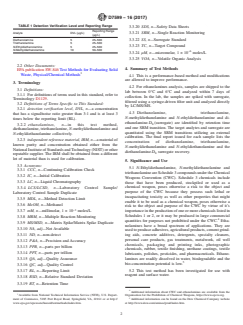
1.4 The Detection Verification Level (DVL) and Reporting Range for the ethanolamines are listed in Table 1.
TABLE 1 Detection Verification Level and Reporting Range
Analyte
DVL (μg/L)
Reporting Range (μg/L)
Diethanolamine
5
25–500
Triethanolamine
5
25–500
N-Ethyldiethanolamine
5
25–500
N-Methyldiethanolamine
10
50–500
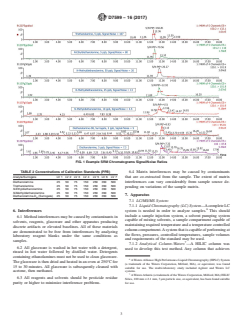
1.4.1 The DVL is required to be at a concentration at least 3 times below the Reporting Limit (RL) and have a signal/noise ratio greater than 3:1. Fig. 1 displays the signal/noise ratios at the DVLs and at higher concentrations for N-methyldiethanolamine.
FIG. 1 Example SRM Chromatograms Signal/Noise Ratios
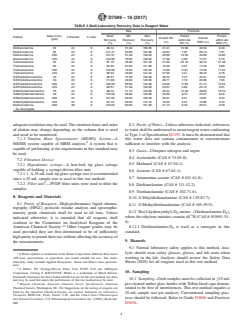
1.4.2 The reporting limit is the concentration of the Level 1 calibration standard as shown in Table 2 for diethanolamine, triethanolamine, and N-ethyldiethanolamine and Level 2 for N-methyldiethanolamine. The reporting limit for N-methyldiethanolamine is set at 50 μg/L due to poor sensitivity at a 5 μg/L concentration which did not meet the DVL criteria. The DVL for N-methyldiethanolamine is at 10 μg/L, which forces a raised reporting limit (chromatograms are shown in Fig. 1). However, the multi-laboratory validation required a spike of all target analytes at 25 μg/L. The mean recovery for N-methyldiethanolamine at this level was 88 % as shown in Table 3. If your instrument’s sensitivity can meet the requirements in this test method, N-methyldiethanolamine may have a 25 μg/L reporting limit.
TABLE 2 Concentrations of Calibration Standards (PPB)
Analyte/Surrogate
LV 1
LV 2
LV 3
LV 4
LV 5
LV 6
LV 7
Diethanolamine
25
50
75
150
250
350
500
Triethanolamine
25
50
75
150
250
350
500
N-Ethyldiethanolamine
25
50
75
150
250
350
500
N-Methyldiethanolamine
25
50
75
150
250
350
500
Diethanolamine-D8 (Su...
General Information
- Status
- Published
- Publication Date
- 14-Jun-2017
- Technical Committee
- D19 - Water
- Drafting Committee
- D19.06 - Methods for Analysis for Organic Substances in Water
Relations
- Effective Date
- 15-Jun-2017
- Effective Date
- 01-Apr-2024
- Effective Date
- 01-May-2020
- Effective Date
- 01-Apr-2018
- Effective Date
- 01-Apr-2018
- Effective Date
- 01-Apr-2013
- Effective Date
- 15-Jun-2012
- Refers
ASTM D3856-11 - Standard Guide for Management Systems in Laboratories Engaged in Analysis of Water - Effective Date
- 15-Nov-2011
- Effective Date
- 01-May-2011
- Effective Date
- 01-Mar-2010
- Effective Date
- 15-Jan-2008
- Effective Date
- 01-May-2007
- Effective Date
- 01-Sep-2006
- Effective Date
- 01-Sep-2006
- Effective Date
- 15-Aug-2006
Overview
ASTM D7599-16(2017) is a standard test method established by ASTM International for the determination of four key ethanolamines-diethanolamine, triethanolamine, N-methyldiethanolamine, and N-ethyldiethanolamine-in water. This method employs single reaction monitoring (SRM) liquid chromatography tandem mass spectrometry (LC/MS/MS) for the qualitative and quantitative analysis of these compounds, which are significant both environmentally and from a regulatory perspective. The method was developed under the guidance of the U.S. Environmental Protection Agency (EPA) and complies with internationally recognized standardization principles, ensuring acceptance in global water quality monitoring programs.
Key Topics
- Target Compounds: Diethanolamine, triethanolamine, N-methyldiethanolamine, N-ethyldiethanolamine (collectively referred to as ethanolamines).
- Analytical Technique: Utilizes direct injection LC with MS/MS detection operated in SRM mode.
- Detection and Reporting Limits:
- Diethanolamine, triethanolamine, N-ethyldiethanolamine: Detection limit 5 μg/L, reporting range 25–500 μg/L
- N-methyldiethanolamine: Detection limit 10 μg/L, reporting range 50–500 μg/L
- Sample Types: Suitable for both surface water and reagent water.
- Quality Assurance: Includes rigorous calibration, method blank, laboratory control, and matrix spike protocols to ensure accurate and reproducible results.
- Schedule 3 Chemicals: Some ethanolamines are listed under the Chemical Weapons Convention (CWC) due to their potential misuse, highlighting the importance of their monitoring in environmental samples.
Applications
The ASTM D7599-16(2017) method is widely applicable in:
- Environmental Monitoring: Essential for laboratories and agencies conducting water quality assessments, especially to identify contamination by industrial chemicals.
- Regulatory Compliance: Supports requirements related to the Chemical Weapons Convention and national water quality standards, allowing for the legal monitoring of Schedule 3 chemicals.
- Industrial Sectors: Critical for industries that utilize ethanolamines in the manufacture of adhesives, detergents, agricultural products, personal care items, cement, and concrete additives, among others. Facilities can use this test method to monitor effluent and ensure environmental stewardship.
- Research and Public Health: Useful for academic and public health research examining the occurrence, fate, and effects of ethanolamines in aquatic systems.
Related Standards
For comprehensive water analysis and laboratory management, the following related ASTM and EPA standards are frequently referenced alongside ASTM D7599-16(2017):
- ASTM D1129 – Terminology Relating to Water
- ASTM D1193 – Specification for Reagent Water
- ASTM D2777 – Practice for Determination of Precision and Bias of Applicable Test Methods of Committee D19 on Water
- ASTM D3694 – Practices for Preparation of Sample Containers and for Preservation of Organic Constituents
- ASTM D3856 – Guide for Management Systems in Laboratories Engaged in Analysis of Water
- ASTM D5847 – Practice for Writing Quality Control Specifications for Standard Test Methods for Water Analysis
- ASTM E2554 – Practice for Estimating and Monitoring the Uncertainty of Test Results of a Test Method Using Control Chart Techniques
- EPA SW-846 – Test Methods for Evaluating Solid Waste, Physical/Chemical Methods
Practical Value
- High Sensitivity: The method achieves low detection and reporting limits required for environmental monitoring.
- Robust QA/QC: Extensive quality control ensures data integrity and regulatory acceptance.
- Versatility: Capable of analyzing various types of water samples, supporting diverse monitoring needs across environmental, industrial, and regulatory contexts.
Implementing ASTM D7599-16(2017) promotes standardized water quality analysis, environmental protection, and compliance with international chemical safety agreements-making it a valuable tool for laboratories and industries worldwide.
Buy Documents
ASTM D7599-16(2017) - Standard Test Method for Determination of Diethanolamine, Triethanolamine, <emph type="ital">N</emph>-Methyldiethanolamine and <emph type="ital">N</emph >-Ethyldiethanolamine in Water by Single Reaction Monitoring Liquid Chromatography/Tandem Mass Spectrometry (LC/MS/MS)
Get Certified
Connect with accredited certification bodies for this standard
NSF International
Global independent organization facilitating standards development and certification.

CIS Institut d.o.o.
Personal Protective Equipment (PPE) certification body. Notified Body NB-2890 for EU Regulation 2016/425 PPE.

Kiwa BDA Testing
Building and construction product certification.
Sponsored listings
Frequently Asked Questions
ASTM D7599-16(2017) is a standard published by ASTM International. Its full title is "Standard Test Method for Determination of Diethanolamine, Triethanolamine, <emph type="ital">N</emph>-Methyldiethanolamine and <emph type="ital">N</emph >-Ethyldiethanolamine in Water by Single Reaction Monitoring Liquid Chromatography/Tandem Mass Spectrometry (LC/MS/MS)". This standard covers: SIGNIFICANCE AND USE 5.1 N-Ethyldiethanolamine, N-methyldiethanolamine and triethanolamine are Schedule 3 compounds under the Chemical Weapons Convention (CWC). Schedule 3 chemicals include those that have been produced, stockpiled or used as a chemical weapon, poses otherwise a risk to the object and purpose of the CWC because they possess such lethal or incapacitating toxicity as well as other properties that might enable it to be used as a chemical weapon, poses otherwise a risk to the object and purpose of the CWC by virtue of it’s importance in the production of one or more chemicals listed in Schedules 1 or 2, or it may be produced in large commercial quantities for purposes not prohibited under the CWC.4 Ethanolamines have a broad spectrum of applications. They are used to produce adhesives, agricultural products, cement grinding aids, concrete additives, detergents, specialty cleaners, personal care products, gas treatments, metalwork, oil well chemicals, packaging and printing inks, photographic chemicals, rubber, textile finishing, urethane coatings, textile lubricants, polishes, pesticides, and pharmaceuticals. Ethanolamines are readily dissolved in water, biodegradable and the bio-concentration potential is low.5 5.2 This test method has been investigated for use with reagent and surface water. SCOPE 1.1 This procedure covers the determination of diethanolamine, triethanolamine, N-methyldiethanolamine and N-ethyldiethanolamine (referred to collectively as ethanolamines in this test method) in surface water by direct injection using liquid chromatography (LC) and detected with tandem mass spectrometry (MS/MS). These analytes are qualitatively and quantitatively determined by this test method. This test method adheres to single reaction monitoring (SRM) mass spectrometry. 1.2 This test method has been developed by U.S. EPA Region 5 Chicago Regional Laboratory (CRL). 1.3 The values stated in SI units are to be regarded as standard. No other units of measurement are included in this standard. 1.4 The Detection Verification Level (DVL) and Reporting Range for the ethanolamines are listed in Table 1. TABLE 1 Detection Verification Level and Reporting Range Analyte DVL (μg/L) Reporting Range (μg/L) Diethanolamine 5 25–500 Triethanolamine 5 25–500 N-Ethyldiethanolamine 5 25–500 N-Methyldiethanolamine 10 50–500 1.4.1 The DVL is required to be at a concentration at least 3 times below the Reporting Limit (RL) and have a signal/noise ratio greater than 3:1. Fig. 1 displays the signal/noise ratios at the DVLs and at higher concentrations for N-methyldiethanolamine. FIG. 1 Example SRM Chromatograms Signal/Noise Ratios 1.4.2 The reporting limit is the concentration of the Level 1 calibration standard as shown in Table 2 for diethanolamine, triethanolamine, and N-ethyldiethanolamine and Level 2 for N-methyldiethanolamine. The reporting limit for N-methyldiethanolamine is set at 50 μg/L due to poor sensitivity at a 5 μg/L concentration which did not meet the DVL criteria. The DVL for N-methyldiethanolamine is at 10 μg/L, which forces a raised reporting limit (chromatograms are shown in Fig. 1). However, the multi-laboratory validation required a spike of all target analytes at 25 μg/L. The mean recovery for N-methyldiethanolamine at this level was 88 % as shown in Table 3. If your instrument’s sensitivity can meet the requirements in this test method, N-methyldiethanolamine may have a 25 μg/L reporting limit. TABLE 2 Concentrations of Calibration Standards (PPB) Analyte/Surrogate LV 1 LV 2 LV 3 LV 4 LV 5 LV 6 LV 7 Diethanolamine 25 50 75 150 250 350 500 Triethanolamine 25 50 75 150 250 350 500 N-Ethyldiethanolamine 25 50 75 150 250 350 500 N-Methyldiethanolamine 25 50 75 150 250 350 500 Diethanolamine-D8 (Su...
SIGNIFICANCE AND USE 5.1 N-Ethyldiethanolamine, N-methyldiethanolamine and triethanolamine are Schedule 3 compounds under the Chemical Weapons Convention (CWC). Schedule 3 chemicals include those that have been produced, stockpiled or used as a chemical weapon, poses otherwise a risk to the object and purpose of the CWC because they possess such lethal or incapacitating toxicity as well as other properties that might enable it to be used as a chemical weapon, poses otherwise a risk to the object and purpose of the CWC by virtue of it’s importance in the production of one or more chemicals listed in Schedules 1 or 2, or it may be produced in large commercial quantities for purposes not prohibited under the CWC.4 Ethanolamines have a broad spectrum of applications. They are used to produce adhesives, agricultural products, cement grinding aids, concrete additives, detergents, specialty cleaners, personal care products, gas treatments, metalwork, oil well chemicals, packaging and printing inks, photographic chemicals, rubber, textile finishing, urethane coatings, textile lubricants, polishes, pesticides, and pharmaceuticals. Ethanolamines are readily dissolved in water, biodegradable and the bio-concentration potential is low.5 5.2 This test method has been investigated for use with reagent and surface water. SCOPE 1.1 This procedure covers the determination of diethanolamine, triethanolamine, N-methyldiethanolamine and N-ethyldiethanolamine (referred to collectively as ethanolamines in this test method) in surface water by direct injection using liquid chromatography (LC) and detected with tandem mass spectrometry (MS/MS). These analytes are qualitatively and quantitatively determined by this test method. This test method adheres to single reaction monitoring (SRM) mass spectrometry. 1.2 This test method has been developed by U.S. EPA Region 5 Chicago Regional Laboratory (CRL). 1.3 The values stated in SI units are to be regarded as standard. No other units of measurement are included in this standard. 1.4 The Detection Verification Level (DVL) and Reporting Range for the ethanolamines are listed in Table 1. TABLE 1 Detection Verification Level and Reporting Range Analyte DVL (μg/L) Reporting Range (μg/L) Diethanolamine 5 25–500 Triethanolamine 5 25–500 N-Ethyldiethanolamine 5 25–500 N-Methyldiethanolamine 10 50–500 1.4.1 The DVL is required to be at a concentration at least 3 times below the Reporting Limit (RL) and have a signal/noise ratio greater than 3:1. Fig. 1 displays the signal/noise ratios at the DVLs and at higher concentrations for N-methyldiethanolamine. FIG. 1 Example SRM Chromatograms Signal/Noise Ratios 1.4.2 The reporting limit is the concentration of the Level 1 calibration standard as shown in Table 2 for diethanolamine, triethanolamine, and N-ethyldiethanolamine and Level 2 for N-methyldiethanolamine. The reporting limit for N-methyldiethanolamine is set at 50 μg/L due to poor sensitivity at a 5 μg/L concentration which did not meet the DVL criteria. The DVL for N-methyldiethanolamine is at 10 μg/L, which forces a raised reporting limit (chromatograms are shown in Fig. 1). However, the multi-laboratory validation required a spike of all target analytes at 25 μg/L. The mean recovery for N-methyldiethanolamine at this level was 88 % as shown in Table 3. If your instrument’s sensitivity can meet the requirements in this test method, N-methyldiethanolamine may have a 25 μg/L reporting limit. TABLE 2 Concentrations of Calibration Standards (PPB) Analyte/Surrogate LV 1 LV 2 LV 3 LV 4 LV 5 LV 6 LV 7 Diethanolamine 25 50 75 150 250 350 500 Triethanolamine 25 50 75 150 250 350 500 N-Ethyldiethanolamine 25 50 75 150 250 350 500 N-Methyldiethanolamine 25 50 75 150 250 350 500 Diethanolamine-D8 (Su...
ASTM D7599-16(2017) is classified under the following ICS (International Classification for Standards) categories: 13.060.50 - Examination of water for chemical substances. The ICS classification helps identify the subject area and facilitates finding related standards.
ASTM D7599-16(2017) has the following relationships with other standards: It is inter standard links to ASTM D7599-16, ASTM D3694-96(2024), ASTM D1129-13(2020)e2, ASTM E2554-18, ASTM E2554-18e1, ASTM E2554-13, ASTM D2777-12, ASTM D3856-11, ASTM D3694-96(2011), ASTM D1129-10, ASTM D2777-08, ASTM E2554-07, ASTM D1129-06a, ASTM D1129-06ae1, ASTM D2777-06. Understanding these relationships helps ensure you are using the most current and applicable version of the standard.
ASTM D7599-16(2017) is available in PDF format for immediate download after purchase. The document can be added to your cart and obtained through the secure checkout process. Digital delivery ensures instant access to the complete standard document.
Standards Content (Sample)
This international standard was developed in accordance with internationally recognized principles on standardization established in the Decision on Principles for the
Development of International Standards, Guides and Recommendations issued by the World Trade Organization Technical Barriers to Trade (TBT) Committee.
Designation:D7599 −16 (Reapproved 2017)
Standard Test Method for
Determination of Diethanolamine, Triethanolamine,
N-Methyldiethanolamine and N-Ethyldiethanolamine in Water
by Single Reaction Monitoring Liquid Chromatography/
Tandem Mass Spectrometry (LC/MS/MS)
This standard is issued under the fixed designation D7599; the number immediately following the designation indicates the year of
original adoption or, in the case of revision, the year of last revision.Anumber in parentheses indicates the year of last reapproval.A
superscript epsilon (´) indicates an editorial change since the last revision or reapproval.
1. Scope shown in Fig. 1). However, the multi-laboratory validation
required a spike of all target analytes at 25 µg/L. The mean
1.1 This procedure covers the determination of
recoveryfor N-methyldiethanolamineatthislevelwas88%as
diethanolamine, triethanolamine, N-methyldiethanolamine and
shown in Table 3. If your instrument’s sensitivity can meet the
N-ethyldiethanolamine (referred to collectively as ethano-
requirementsinthistestmethod, N-methyldiethanolaminemay
laminesinthistestmethod)insurfacewaterbydirectinjection
have a 25 µg/L reporting limit.
using liquid chromatography (LC) and detected with tandem
1.5 This standard does not purport to address all of the
mass spectrometry (MS/MS). These analytes are qualitatively
safety concerns, if any, associated with its use. It is the
and quantitatively determined by this test method. This test
responsibility of the user of this standard to establish appro-
method adheres to single reaction monitoring (SRM) mass
priate safety and health practices and determine the applica-
spectrometry.
bility of regulatory limitations prior to use.
1.2 This test method has been developed by U.S. EPA
1.6 This international standard was developed in accor-
Region 5 Chicago Regional Laboratory (CRL).
dance with internationally recognized principles on standard-
1.3 The values stated in SI units are to be regarded as
ization established in the Decision on Principles for the
standard. No other units of measurement are included in this
Development of International Standards, Guides and Recom-
standard.
mendations issued by the World Trade Organization Technical
Barriers to Trade (TBT) Committee.
1.4 The Detection Verification Level (DVL) and Reporting
Range for the ethanolamines are listed in Table 1.
2. Referenced Documents
1.4.1 The DVL is required to be at a concentration at least
2.1 ASTM Standards:
3 times below the Reporting Limit (RL) and have a signal/
D1129Terminology Relating to Water
noise ratio greater than 3:1. Fig. 1 displays the signal/noise
D1193Specification for Reagent Water
ratios at the DVLs and at higher concentrations for
D2777Practice for Determination of Precision and Bias of
N-methyldiethanolamine.
Applicable Test Methods of Committee D19 on Water
1.4.2 The reporting limit is the concentration of the Level 1
D3856Guide for Management Systems in Laboratories
calibration standard as shown in Table 2 for diethanolamine,
Engaged in Analysis of Water
triethanolamine, and N-ethyldiethanolamine and Level 2 for
D3694Practices for Preparation of Sample Containers and
N-methyldiethanolamine. The reporting limit for
for Preservation of Organic Constituents
N-methyldiethanolamine is set at 50 µg/L due to poor sensi-
D5847Practice for Writing Quality Control Specifications
tivity at a 5 µg/L concentration which did not meet the DVL
for Standard Test Methods for Water Analysis
criteria. The DVL for N-methyldiethanolamine is at 10 µg/L,
E2554Practice for Estimating and Monitoring the Uncer-
which forces a raised reporting limit (chromatograms are
tainty of Test Results of a Test Method Using Control
Chart Techniques
This test method is under the jurisdiction ofASTM Committee D19 on Water
andisthedirectresponsibilityofSubcommitteeD19.06onMethodsforAnalysisfor
Organic Substances in Water. For referenced ASTM standards, visit the ASTM website, www.astm.org, or
Current edition approved June 15, 2017. Published July 2017. Originally contact ASTM Customer Service at service@astm.org. For Annual Book of ASTM
approved in 2009. Last previous edition approved in 2016 as D7599 – 16. DOI: Standards volume information, refer to the standard’s Document Summary page on
10.1520/D7599-16R17. the ASTM website.
Copyright © ASTM International, 100 Barr Harbor Drive, PO Box C700, West Conshohocken, PA 19428-2959. United States
D7599−16 (2017)
TABLE 1 Detection Verification Level and Reporting Range
3.3.20 SDS, n—Safety Data Sheets
Reporting Range
Analyte DVL (µg/L) 3.3.21 SRM, n—Single Reaction Monitoring
(µg/L)
3.3.22 SS, n—Surrogate Standard
Diethanolamine 5 25–500
Triethanolamine 5 25–500
3.3.23 TC, n—Target Compound
N-Ethyldiethanolamine 5 25–500
N-Methyldiethanolamine 10 50–500 –6
3.3.24 µM, n—micromolar,1×10 moles/L
3.3.25 VOA, n—Volatile Organic Analysis
2.2 Other Documents:
4. Summary of Test Methods
EPApublication SW-846Test Methods for Evaluating Solid
Waste, Physical/Chemical Methods
4.1 This is a performance-based method and modifications
are allowed to improve performance.
3. Terminology
4.2 For ethanolamines analysis, samples are shipped to the
3.1 Definitions:
lab between 0°C and 6°C and analyzed within 7 days of
3.1.1 For definitions of terms used in this standard, refer to
collection. In the lab, the samples are spiked with surrogate,
Terminology D1129.
filtered using a syringe-driven filter unit and analyzed directly
3.2 Definitions of Terms Specific to This Standard:
by LC/MS/MS.
3.2.1 detection verification level, DVL, n—a concentration
4.3 Diethanolamine, triethanolamine,
that has a signal/noise ratio greater than 3:1 and is at least 3
N-methyldiethanolamine and N-ethyldiethanolamine and di-
times below the reporting limit (RL).
ethanolamine-D (surrogate) are identified by retention time
3.2.2 ethanolamines, n—in this test method,
and one SRM transition. The target analytes and surrogate are
diethanolamine, triethanolamine, N-methyldiethanolamine and
quantitated using the SRM transitions utilizing an external
N-ethyldiethanolamine collectively.
calibration. The final report issued for each sample lists the
3.2.3 independent reference material, IRM, n—amaterialof
concentration of diethanolamine, triethanolamine,
known purity and concentration obtained either from the
N-methyldiethanolamine and N-ethyldiethanolamine and the
NationalInstituteofStandardsandTechnology(NIST)orother
diethanolamine-D surrogate recovery.
reputable supplier. The IRM shall be obtained from a different
lot of material than is used for calibration.
5. Significance and Use
3.3 Acronyms:
5.1 N-Ethyldiethanolamine, N-methyldiethanolamine and
3.3.1 CCC, n—Continuing Calibration Check
triethanolamineareSchedule3compoundsundertheChemical
3.3.2 IC, n—Initial Calibration
Weapons Convention (CWC). Schedule 3 chemicals include
3.3.3 LC, n—Liquid Chromatography those that have been produced, stockpiled or used as a
chemical weapon, poses otherwise a risk to the object and
3.3.4 LCS/LCSD, n—Laboratory Control Sample/
purpose of the CWC because they possess such lethal or
Laboratory Control Sample Duplicate
incapacitating toxicity as well as other properties that might
3.3.5 MDL, n—Method Detection Limit
enable it to be used as a chemical weapon, poses otherwise a
3.3.6 MeOH, n—Methanol
risk to the object and purpose of the CWC by virtue of it’s
–3
3.3.7 mM, n—millimolar,1×10 moles/L importanceintheproductionofoneormorechemicalslistedin
Schedules 1 or 2, or it may be produced in large commercial
3.3.8 MRM, n—Multiple Reaction Monitoring
quantities for purposes not prohibited under the CWC. Etha-
3.3.9 MS/MSD, n—Matrix Spike/Matrix Spike Duplicate
nolamines have a broad spectrum of applications. They are
3.3.10 NA, adj—Not Available
usedtoproduceadhesives,agriculturalproducts,cementgrind-
ing aids, concrete additives, detergents, specialty cleaners,
3.3.11 ND, n—non-detect
personal care products, gas treatments, metalwork, oil well
3.3.12 P&A, n—Precision and Accuracy
chemicals, packaging and printing inks, photographic
3.3.13 PPB, n—parts per billion
chemicals, rubber, textile finishing, urethane coatings, textile
3.3.14 PPT, n—parts per trillion
lubricants, polishes, pesticides, and pharmaceuticals. Ethano-
lamines are readily dissolved in water, biodegradable and the
3.3.15 QA, adj—Quality Assurance
bio-concentration potential is low.
3.3.16 QC, adj—Quality Control
5.2 This test method has been investigated for use with
3.3.17 RL, n—Reporting Limit
reagent and surface water.
3.3.18 RSD, n—Relative Standard Deviation
3.3.19 RT, n—Retention Time
Additional information about CWC and ethanolamines are available from the
Available from National Technical Information Service (NTIS), U.S. Depart- Organisation for the Prohibition of Chemical Weapons, https://www.opcw.org.
ment of Commerce, 5285 Port Royal Road, Springfield, VA, 22161 or at http:// Additional information can be found on the Dow Chemical Company website
www.epa.gov/epawaste/hazard/testmethods/index.htm. at http://www.dow.com/amines/prod/index.htm.
D7599−16 (2017)
FIG. 1Example SRM Chromatograms Signal/Noise Ratios
TABLE 2 Concentrations of Calibration Standards (PPB)
6.4 Matrix interferences may be caused by contaminants
Analyte/Surrogate LV 1 LV 2 LV 3 LV 4 LV 5 LV 6 LV 7 that are co-extracted from the sample. The extent of matrix
Diethanolamine 25 50 75 150 250 350 500 interferences can vary considerably from sample source de-
Triethanolamine 25 50 75 150 250 350 500
pending on variations of the sample matrix.
N-Ethyldiethanolamine 25 50 75 150 250 350 500
N-Methyldiethanolamine 25 50 75 150 250 350 500
7. Apparatus
Diethanolamine-D (Surrogate) 25 50 75 150 250 350 500
7.1 LC/MS/MS System:
7.1.1 LiquidChromatography(LC)System—AcompleteLC
6. Interferences system is needed in order to analyze samples. This should
include a sample injection system, a solvent pumping system
6.1 Methodinterferencesmaybecausedbycontaminantsin
capable of mixing solvents, a sample compartment capable of
solvents, reagents, glassware and other apparatus producing
maintaining required temperature and a temperature controlled
discrete artifacts or elevated baselines. All of these materials
columncompartment.Asystemthatiscapableofperformingat
are demonstrated to be free from interferences by analyzing
the flows, pressures, controlled temperatures, sample volumes
laboratory reagent blanks under the same conditions as
and requirements of the standard may be used.
samples.
7.1.2 Analytical Column-Waters —A HILIC column was
6.2 All glassware is washed in hot water with a detergent,
used to develop this test method. Any column that achieves
rinsed in hot water followed by distilled water. Detergents
containing ethanolamines must not be used to clean glassware.
AWatersAlliance High Performance Liquid Chromatography (HPLC) System
Theglasswareisthendriedandheatedinanovenat250°Cfor
(a trademark of the Waters Corporation, Milford, MA), or equivalent, was found
15 to 30 minutes. All glassware is subsequently cleaned with
suitable for use. The multi-laboratory study included Agilent and Waters LC
acetone, then methanol. systems.
AWatersAtlantis(atrademarkoftheWatersCorporation,Milford,MA)HILIC
6.3 All reagents and solvents should be pesticide residue
Silica,100mm×2.1mm,3µmparticlesize,orequivalent,hasbeenfoundsuitable
purity or higher to minimize interference problems. for use.
D7599−16 (2017)
TABLE 3 Multi-Laboratory Recovery Data in Reagent Water
Bias Precision
Spike Conc.
Mean Min Max Pooled Pooled
Analyte # Results # Labs
Overall SD Overall
(ppb)
Recovery Recovery Recovery within-lab within-lab
(%) RSD (%)
(%) (%) (%) SD (%) RSD (%)
Diethanolamine 25 24 6 96.34 51.00 156.96 31.31 10.96 32.50 9.49
Diethanolamine 50 24 6 101.41 54.00 154.80 29.54 7.97 29.13 7.91
Diethanolamine 200 24 6 101.57 61.00 138.00 20.98 10.50 20.66 10.85
Diethanolamine 425 24 6 102.06 70.00 138.82 17.98 5.90 17.61 5.70
Triethanolamine 25 24 6 87.70 35.96 157.20 27.00 25.18 30.79 27.48
Triethanolamine 50 24 6 94.95 67.00 121.66 16.39 9.57 17.26 9.66
Triethanolamine 200 22 6 105.00 79.50 132.00 14.06 11.81 13.39 11.52
Triethanolamine 425 24 6 96.94 40.00 144.94 27.56 4.41 28.43 5.76
N-Ethyldiethanolamine 25 24 6 90.61 31.00 132.00 39.42 7.47 43.51 10.42
N-Ethyldiethanolamine 50 23 6 111.88 49.00 146.00 28.71 7.19 25.66 7.56
N-Ethyldiethanolamine 200 24 6 106.20 60.00 134.00 23.09 11.96 21.74 12.23
N-Ethyldiethanolamine 425 24 6 99.67 51.00 130.00 23.07 4.68 23.15 6.01
N-Methyldiethanolamine 25 24 6 88.43 41.72 133.60 25.24 13.29 28.55 16.70
N-Methyldiethanolamine 50 24 6 102.28 56.00 153.80 25.85 8.73 25.27 8.22
N-Methyldiethanolamine 200 24 6 101.02 59.00 136.50 20.07 9.51 19.87 9.54
N-Methyldiethanolamine 425 24 6 94.75 63.00 115.76 15.02 3.34 15.85 3.72
Diethanolamine- 200 96 6 103.02 60.00 151.95 21.13 9.40 20.51 9.25
D (Surrogate)
adequateresolutionmaybeused.Theretentiontimesandorder 8.2 Purity of Water—Unless otherwise indicated, references
of elution may change depending on the column that is used towatershallbeunderstoodtomeanreagentwaterconforming
and need to be monitored. toType1ofSpecificationD1193.Itmustbedemonstratedthat
7.1.3 Tandem Mass Spectrometer (MS/MS) System—A this water does not contain contaminants at concentrations
MS/MS system capable of MRM analysis. A system that is sufficient to interfere with the analysis.
capableofperformingattherequirementsinthisstandardmay
8.3 Gases—Ultrapure nitrogen and argon.
be used.
8.4 Acetonitrile (CAS # 75-05-8).
7.2 Filtration Device:
8.5 Methanol (CAS # 67-56-1).
7.2.1 Hypodermic syringe—A luer-lock tip glass syringe
capable of holding a syringe-driven filter unit.
8.6 Acetone (CAS # 67-64-1).
7.2.1.1 A25-mLlocktipglasssyringesizeisrecommended
8.7 Ammonium acetate (CAS # 631-61-8).
since a 25-mL sample size is used in this test method.
7.2.2 Filter unit —PVDF filter units were used to filter the
8.8 Diethanolamine (CAS # 111-42-2).
samples.
8.9 Triethanolamine (CAS # 102-71-6).
8. Reagents and Materials
8.10 N-Ethyldiethanolamine (CAS # 139-87-7).
8.1 Purity of Reagents—High-performance liquid chroma-
8.11 N-Methyldiethanolamine (CAS # 105-59-9).
tography (HPLC) pesticide residue analysis and spectropho-
8.12 Bis(2-hydroxyethyl)-D -amine; (Diethanolamine-D ),
8 8
tometry grade chemicals shall be used in all tests. Unless
wheretheethylenemoietiescontainall H(CAS#103691-51-
indicated otherwise, it is intended that all reagents shall
6).
conform to the Committee on Analytical Reagents of the
8.12.1 Diethanolamine-D is used as a surrogate in this
American Chemical Society. Other reagent grades may be 8
standard.
used provided they are first determined to be of sufficiently
highpuritytopermittheirusewithoutaffectingtheaccuracyof
9. Hazards
the measurements.
9.1 Normal laboratory safety applies to this method. Ana-
lysts should wear safety glasses, gloves, and lab coats when
AWaters Quattro (a trademark of theWaters Corporation, Milford, MA) micro
working in the lab. Analysts should review the Safety Data
API mass spectrometer, or equivalent, was found suitable for use. The multi-
laboratory study included Applied Biosystems, Varian and Waters mass spectrom-
Sheets (SDS) for all reagents used in this test method.
eters.
A Millex HV Syringe-Driven Filter Unit PVDF 0.45 µm (Millipore
10. Sampling
Corporation, Catalog # SLHV033NS; Millex is a trademark of Merck KGAA,
Darmstadt,Germany)hasbeenfoundsuitableforuseforthistestmethod,anyfilter
10.1 Sampling—Grabsamplesmustbecollectedin≥25-mL
unit may be used that meets the performance of this test method may be used.
pre-cleaned amber glass bottles withTeflon-lined caps demon-
Reagent Chemicals, American Chemical Society Specifications, American
Chemical Society, Washington, DC. For Suggestions on the testing of reagents not
strated to be free of interferences. This test method requires a
listed by the American Chemical Society, see Annual Standards for Laboratory
25-mL sample size per analysis. Conventional sampling prac-
Chemicals, BDH Ltd., Poole, Dorset, U.K., and the United States Pharmacopeia
tices should be followed. Refer to Guide D3856 and Practices
and National Formulary, U.S. Pharmacopeial Convention, Inc. (USPC), Rockville,
MD. D3694.
D7599−16 (2017)
10.2 Preservation—Store samples between 0°C and 6°C
The instrument is set in the Electrospray (+) positive setting.
Capillary Voltage: 0.5 kV
from the time of collection until analysis.Analyze the sample
Cone: Variable depending on analyte (Table 5)
within 7 days of collection.
Extractor: 2 Volts
RF Lens: 0.2 Volts
Source Temperature: 120°C
11. Preparation of LC/MS/MS
Desolvation Temperature: 300°C
Desolvation Gas Flow: 500 L/hr
11.1 LC Chromatograph Operating Conditions:
Cone Gas Flow: 25 L/hr
11.1.1 Injection volumes of all calibration standards and
Low Mass Resolution 1: 14.5
samples are 25 µL. The first sample analyzed after the
High Mass Resolution 1: 14.5
calibrationcurveisablanktoensurethereisnocarry-over.The Ion Energy 1: 0.5
Entrance Energy: –1
gradient conditions for the liquid chromatograph are shown in
Collision Energy: Variable depending on analyte (Table 5)
Table 4.
Exit Energy: 2
Low Mass Resolution 2: 15
11.1.2 Temperatures—Column, 30°C; Sample
High Mass resolution 2: 15
compartment, 15°C.
Ion Energy 2: 0.5
11.1.3 Seal Wash—Solvent: 50% Acetonitrile/50% Water;
Multiplier: 650
–3
Gas Cell Pirani Gauge: 3.3 × 10 Torr
Time: 5 minutes.
Inter-Channel Delay: 0.02 seconds
11.1.4 Needle Wash—Solvent: 50% Acetonitrile/50% Wa-
Inter-Scan Delay: 0.1 seconds
ter; Normal wash, approximately 13 second wash time.
Repeats: 1
Span: 0 Daltons
11.1.5 Autosampler Purge—Three loop volumes.
Dwell: 0.1 Seconds
11.1.6 Specific instrument manufacturer wash/purge speci-
fications should be followed in order to eliminate sample
12. Calibration and Standardization
carry-over in the analysis of ethanolamines.
12.1 The mass spectrometer must be calibrated per manu-
11.2 Mass Spectrometer Parameters:
facturer specifications before analysis. In order that analytical
11.2.1 In order to acquire the maximum number of data
values obtained using this test method are valid and accurate
points per SRM channel while maintaining adequate
within the confidence limits of the test method, the following
sensitivity, the tune parameters may be optimized according to
proceduresmustbefollowedwhenperformingthetestmethod.
your instrument. Each peak requires at least 10 scans per peak
12.2 Calibration and Standardization—To calibrate the
for adequate quantitation. This standard contains only one
instrument, analyze seven calibration standards containing the
surrogate and four target compounds which are located in the
seven concentration levels of the ethanolamines and
same multiple reaction monitoring (MRM) experiment win-
diethanolamine-D surrogate prior to analysis as shown in
dow. Variable parameters regarding retention times, SRM
Table 2.Acalibration stock standard solution is prepared from
Transitions and cone and collision energies are shown in Table
standard materials or purchased as certified solutions. Stock
5.
standard solution A (Level 7) containing diethanolamine,
triethanolamine, N-methyldiethanolamine and
N-ethyldiethanolamine and diethanolamine-D is prepared at
Level 7 concentration and aliquots of that solution are diluted
TABLE 4 Gradient Conditions for Liquid Chromatography
toprepareLevels1through6.Thefollowingstepswillproduce
Percent
standards with the concentration values shown in Table 2. The
Time Flow Percent Percent 200 mmolar
(min) (µL/min) CH CN Water Ammonium analyst is responsible for recording initial component weights
Acetate
carefully when working with pure materials and correctly
0 400 95 0 5
carrying the weights through the dilution calculations.
1 400 95 0 5
12.2.1 Prepare stock standard solution A (Level 7) by
2 400 90 0 10
4 300 90 0 10 adding, to a 100 mL volumetric flask, individual methanol
10 300 60 30 10
solutions of the following: 50 µL of diethanolamine,
13 300 60 30 10
triethanolamine, N-methyldiethanolamine,
15 300 40 50 10
18 300 30 60 10 N-ethyldiethanolamine and diethanolamine-D each at 1 g/L
20 300 30 60 10
concentration, dilute to 100 mLwith water.The preparation of
25 300 95 0 5
the Level 7 standard can be accomplished using different
27 300 95 0 5
volumesandconcentrationsofstocksolutionsasisaccustomed
D7599−16 (2017)
TABLE 5 Retention Times, SRM Ions, and Analyte-Specific Mass Spectrometer Parameters
SRM Mass Transition Retention Time Cone Voltage Collision Energy
Analyte
(Parent > Product) (min) (Volts) (eV)
Diethanolamine 106 > 87.8 13.0 25 11
Triethanolamine 150.2 > 132.1 12.3 25 14
N-Ethyldiethanolamine 134.2 > 116 12.4 25 13
N-Methyldiethanolamine 120.1 > 101.9 12.8 25 13
Diethanolamine-D (Surrogate) 114 > 95.8 13.0 25 12
in the individual laboratory. Depending on stock concentra- 12.2.7 The retention time window of the SRM transitions
tions prepared, the solubility at that concentration will have to must be within 5% of the retention time of the analyte in a
be ensured. midpointcalibrationstandard.Ifthisisnotthecase,re-analyze
12.2.2 Aliquots of SolutionAare then diluted with water to the calibration curve to determine if there was a shift in
prepare the desired calibration levels in 2-mL amber glass LC retention time during the analysis and the sample needs to be
vials. The calibration vials must be used within 24 hours to re-injected. If the retention time is still incorrect in the sample,
ensure optimum results. Stock calibration standards are rou- refer to the analyte as an unknown.
tinelyreplace
...
Questions, Comments and Discussion
Ask us and Technical Secretary will try to provide an answer. You can facilitate discussion about the standard in here.
Loading comments...