


ASTM D5801-24
(Test Method)Standard Test Method for Toughness and Tenacity of Asphalt Materials
Standard Test Method for Toughness and Tenacity of Asphalt Materials
SIGNIFICANCE AND USE
4.1 This test method is useful in confirming that an asphalt cement has been modified with a material that provides a significant elastomeric component. Elastomer-modified asphalts can be characterized by their ability to be stretched to a large elongation while at the same time resisting further stretching. Toughness and tenacity are two parameters for measuring this ability.
Note 1: The quality of the results produced by this standard are dependent on the competence of the personnel performing the procedure and the capability, calibration, and maintenance of the equipment used. Agencies that meet the criteria of Specification D3666 are generally considered capable of competent and objective testing, sampling, inspection, etc. Users of this standard are cautioned that compliance with Specification D3666 alone does not completely ensure reliable results. Reliable results depend on many factors; following the suggestions of Specification D3666 or some similar acceptable guideline provides a means of evaluating and controlling some of those factors.
SCOPE
1.1 This test method describes the procedure for measuring the toughness and tenacity of asphalt materials. Typically, the test method has been used to characterize elastomer-modified asphalts, although values for toughness and tenacity may be obtained for any type of polymer-modified or non-modified asphalt.
1.2 The values stated in inch-pound units are to be regarded as standard. The values given in parentheses are mathematical conversions to SI units that are provided for information only and are not considered standard.
1.2.1 Exception—Sample mass is given only in SI units. Sample mass as given in SI units should be regarded as standard. No other units of sample mass are included in this standard.
1.3 Warning—Mercury has been designated by the United States Environmental Protection Agency and many state agencies as a hazardous material that can cause central nervous system, kidney, and liver damage. Mercury, or its vapor, may be hazardous to health and corrosive to materials. Caution should be taken when handling mercury and mercury-containing products. See the applicable Material Safety Data Sheet (MSDS) for details and EPA’s website—http://www.epa.gov/mercury/index.htm—for additional information. Users should be aware that selling mercury and/or mercury-containing products in your state may be prohibited by state law.
1.4 The text of this standard references notes and footnotes which provide explanatory material. These notes and footnotes (excluding those in tables and figures) shall not be considered as requirements of the standard.
1.5 This standard does not purport to address all of the safety concerns, if any, associated with its use. It is the responsibility of the user of this standard to establish appropriate safety, health, and environmental practices and determine the applicability of regulatory limitations prior to use.
1.6 This international standard was developed in accordance with internationally recognized principles on standardization established in the Decision on Principles for the Development of International Standards, Guides and Recommendations issued by the World Trade Organization Technical Barriers to Trade (TBT) Committee.
General Information
- Status
- Published
- Publication Date
- 14-Jan-2024
- Technical Committee
- D04 - Road and Paving Materials
- Drafting Committee
- D04.44 - Rheological Tests
Relations
- Effective Date
- 15-Jan-2024
- Effective Date
- 15-Jan-2024
Overview
ASTM D5801-24, "Standard Test Method for Toughness and Tenacity of Asphalt Materials," establishes a reliable procedure for measuring the toughness and tenacity of asphalt cements and related materials. This test method is widely applied to evaluate both elastomer-modified and polymer-modified asphalt, but it is also applicable to non-modified asphalt binders. Through a controlled tensile test, the standard enables users to determine key performance metrics critical for assessing an asphalt’s ability to sustain stretching and resist further deformation, which are important factors in road durability and resilience.
ASTM D5801-24 is published by ASTM International and developed in accordance with international standardization principles as outlined by the World Trade Organization Technical Barriers to Trade (TBT) Committee. It is a vital component in quality control and verification for asphalt materials used in paving, infrastructure, and construction industries worldwide.
Key Topics
- Toughness and Tenacity Defined:
- Toughness is the total work required to fully separate a sample under specified tensile conditions.
- Tenacity measures the work required to further stretch the asphalt after the initial peak resistance is overcome, reflecting the material's elastomeric or polymer content.
- Test Procedure:
- A tensile tester pulls a tension head from within a cylindrical sample at a controlled rate.
- The force versus elongation is continuously recorded and analyzed.
- Equipment and Conditions:
- Requires a tensile tester, temperature-controlled oven and water bath, precision thermometers, and calibrated sample containers.
- Testing is conducted at specified temperatures and rates for consistent results.
- Precision Assurance:
- Results depend on operator competence, proper calibration, and equipment maintenance.
- Testing agencies meeting ASTM D3666 are generally qualified to ensure valid and repeatable results.
- Safety Considerations:
- The standard highlights specific hazards, such as those associated with mercury, and directs users to relevant safety documentation and regulatory guidance.
Applications
- Asphalt Binder Evaluation:
ASTM D5801-24 is primarily used to determine the effectiveness of elastomer or polymer modification in asphalt binders. These modifications enhance the material’s ability to withstand deformation, crucial for modern flexible pavements. - Durability Assessment:
Measurements of asphalt toughness and tenacity guide material selection for road projects exposed to high mechanical stresses, heavy traffic, and temperature fluctuations. - Quality Control in Manufacturing:
Asphalt producers and laboratories use this test to ensure that their modified asphalts meet required specifications for performance. - Research and Development:
The method is valuable for the comparative analysis of new asphalt formulations and for benchmarking against existing materials in innovation-driven environments.
Related Standards
The ASTM D5801-24 standard references and complements several other key standards, ensuring a comprehensive approach to asphalt material testing:
- ASTM D5/D5M - Test Method for Penetration of Bituminous Materials
- ASTM D1754/D1754M - Test Method for Effects of Heat and Air on Asphaltic Materials (Thin-Film Oven Test)
- ASTM D2872 - Test Method for Effect of Heat and Air on a Moving Film of Asphalt Binder (Rolling Thin-Film Oven Test)
- ASTM D3666 - Specification for Minimum Requirements for Agencies Testing and Inspecting Road and Paving Materials
- ASTM E1, E77, E644, E1137/E1137M, E2251 - Thermometer and temperature measurement equipment standards
- AASHTO M 231 - Standard Specification for Weighing Devices Used in the Testing of Materials
Practical Value
Utilizing ASTM D5801-24 supports consistent performance evaluation of asphalt materials, promoting pavement longevity and cost-effective infrastructure development. The method’s focus on toughness and tenacity directly correlates with the service life and maintenance needs of roadways. Laboratories, producers, and regulatory agencies trust this standard to meet project specifications, research needs, and quality assurance programs for asphalt cement and binders.
Buy Documents
ASTM D5801-24 - Standard Test Method for Toughness and Tenacity of Asphalt Materials
REDLINE ASTM D5801-24 - Standard Test Method for Toughness and Tenacity of Asphalt Materials
Get Certified
Connect with accredited certification bodies for this standard

ABS Quality Evaluations Inc.
American Bureau of Shipping quality certification.

Element Materials Technology
Materials testing and product certification.

ICC Evaluation Service
Building products evaluation and certification.
Sponsored listings
Frequently Asked Questions
ASTM D5801-24 is a standard published by ASTM International. Its full title is "Standard Test Method for Toughness and Tenacity of Asphalt Materials". This standard covers: SIGNIFICANCE AND USE 4.1 This test method is useful in confirming that an asphalt cement has been modified with a material that provides a significant elastomeric component. Elastomer-modified asphalts can be characterized by their ability to be stretched to a large elongation while at the same time resisting further stretching. Toughness and tenacity are two parameters for measuring this ability. Note 1: The quality of the results produced by this standard are dependent on the competence of the personnel performing the procedure and the capability, calibration, and maintenance of the equipment used. Agencies that meet the criteria of Specification D3666 are generally considered capable of competent and objective testing, sampling, inspection, etc. Users of this standard are cautioned that compliance with Specification D3666 alone does not completely ensure reliable results. Reliable results depend on many factors; following the suggestions of Specification D3666 or some similar acceptable guideline provides a means of evaluating and controlling some of those factors. SCOPE 1.1 This test method describes the procedure for measuring the toughness and tenacity of asphalt materials. Typically, the test method has been used to characterize elastomer-modified asphalts, although values for toughness and tenacity may be obtained for any type of polymer-modified or non-modified asphalt. 1.2 The values stated in inch-pound units are to be regarded as standard. The values given in parentheses are mathematical conversions to SI units that are provided for information only and are not considered standard. 1.2.1 Exception—Sample mass is given only in SI units. Sample mass as given in SI units should be regarded as standard. No other units of sample mass are included in this standard. 1.3 Warning—Mercury has been designated by the United States Environmental Protection Agency and many state agencies as a hazardous material that can cause central nervous system, kidney, and liver damage. Mercury, or its vapor, may be hazardous to health and corrosive to materials. Caution should be taken when handling mercury and mercury-containing products. See the applicable Material Safety Data Sheet (MSDS) for details and EPA’s website—http://www.epa.gov/mercury/index.htm—for additional information. Users should be aware that selling mercury and/or mercury-containing products in your state may be prohibited by state law. 1.4 The text of this standard references notes and footnotes which provide explanatory material. These notes and footnotes (excluding those in tables and figures) shall not be considered as requirements of the standard. 1.5 This standard does not purport to address all of the safety concerns, if any, associated with its use. It is the responsibility of the user of this standard to establish appropriate safety, health, and environmental practices and determine the applicability of regulatory limitations prior to use. 1.6 This international standard was developed in accordance with internationally recognized principles on standardization established in the Decision on Principles for the Development of International Standards, Guides and Recommendations issued by the World Trade Organization Technical Barriers to Trade (TBT) Committee.
SIGNIFICANCE AND USE 4.1 This test method is useful in confirming that an asphalt cement has been modified with a material that provides a significant elastomeric component. Elastomer-modified asphalts can be characterized by their ability to be stretched to a large elongation while at the same time resisting further stretching. Toughness and tenacity are two parameters for measuring this ability. Note 1: The quality of the results produced by this standard are dependent on the competence of the personnel performing the procedure and the capability, calibration, and maintenance of the equipment used. Agencies that meet the criteria of Specification D3666 are generally considered capable of competent and objective testing, sampling, inspection, etc. Users of this standard are cautioned that compliance with Specification D3666 alone does not completely ensure reliable results. Reliable results depend on many factors; following the suggestions of Specification D3666 or some similar acceptable guideline provides a means of evaluating and controlling some of those factors. SCOPE 1.1 This test method describes the procedure for measuring the toughness and tenacity of asphalt materials. Typically, the test method has been used to characterize elastomer-modified asphalts, although values for toughness and tenacity may be obtained for any type of polymer-modified or non-modified asphalt. 1.2 The values stated in inch-pound units are to be regarded as standard. The values given in parentheses are mathematical conversions to SI units that are provided for information only and are not considered standard. 1.2.1 Exception—Sample mass is given only in SI units. Sample mass as given in SI units should be regarded as standard. No other units of sample mass are included in this standard. 1.3 Warning—Mercury has been designated by the United States Environmental Protection Agency and many state agencies as a hazardous material that can cause central nervous system, kidney, and liver damage. Mercury, or its vapor, may be hazardous to health and corrosive to materials. Caution should be taken when handling mercury and mercury-containing products. See the applicable Material Safety Data Sheet (MSDS) for details and EPA’s website—http://www.epa.gov/mercury/index.htm—for additional information. Users should be aware that selling mercury and/or mercury-containing products in your state may be prohibited by state law. 1.4 The text of this standard references notes and footnotes which provide explanatory material. These notes and footnotes (excluding those in tables and figures) shall not be considered as requirements of the standard. 1.5 This standard does not purport to address all of the safety concerns, if any, associated with its use. It is the responsibility of the user of this standard to establish appropriate safety, health, and environmental practices and determine the applicability of regulatory limitations prior to use. 1.6 This international standard was developed in accordance with internationally recognized principles on standardization established in the Decision on Principles for the Development of International Standards, Guides and Recommendations issued by the World Trade Organization Technical Barriers to Trade (TBT) Committee.
ASTM D5801-24 is classified under the following ICS (International Classification for Standards) categories: 75.140 - Waxes, bituminous materials and other petroleum products; 91.100.50 - Binders. Sealing materials. The ICS classification helps identify the subject area and facilitates finding related standards.
ASTM D5801-24 has the following relationships with other standards: It is inter standard links to ASTM D5801-17, ASTM D7405-20. Understanding these relationships helps ensure you are using the most current and applicable version of the standard.
ASTM D5801-24 is available in PDF format for immediate download after purchase. The document can be added to your cart and obtained through the secure checkout process. Digital delivery ensures instant access to the complete standard document.
Standards Content (Sample)
This international standard was developed in accordance with internationally recognized principles on standardization established in the Decision on Principles for the
Development of International Standards, Guides and Recommendations issued by the World Trade Organization Technical Barriers to Trade (TBT) Committee.
Designation: D5801 − 24
Standard Test Method for
Toughness and Tenacity of Asphalt Materials
This standard is issued under the fixed designation D5801; the number immediately following the designation indicates the year of
original adoption or, in the case of revision, the year of last revision. A number in parentheses indicates the year of last reapproval. A
superscript epsilon (´) indicates an editorial change since the last revision or reapproval.
1. Scope 1.6 This international standard was developed in accor-
dance with internationally recognized principles on standard-
1.1 This test method describes the procedure for measuring
ization established in the Decision on Principles for the
the toughness and tenacity of asphalt materials. Typically, the
Development of International Standards, Guides and Recom-
test method has been used to characterize elastomer-modified
mendations issued by the World Trade Organization Technical
asphalts, although values for toughness and tenacity may be
Barriers to Trade (TBT) Committee.
obtained for any type of polymer-modified or non-modified
asphalt.
2. Referenced Documents
1.2 The values stated in inch-pound units are to be regarded
2.1 ASTM Standards:
as standard. The values given in parentheses are mathematical
D5/D5M Test Method for Penetration of Bituminous Mate-
conversions to SI units that are provided for information only
rials
and are not considered standard.
D1754/D1754M Test Method for Effects of Heat and Air on
1.2.1 Exception—Sample mass is given only in SI units.
Asphaltic Materials (Thin-Film Oven Test)
Sample mass as given in SI units should be regarded as
D2872 Test Method for Effect of Heat and Air on a Moving
standard. No other units of sample mass are included in this
Film of Asphalt Binder (Rolling Thin-Film Oven Test)
standard.
D3666 Specification for Minimum Requirements for Agen-
1.3 Warning—Mercury has been designated by the United
cies Testing and Inspecting Road and Paving Materials
States Environmental Protection Agency and many state agen-
E1 Specification for ASTM Liquid-in-Glass Thermometers
cies as a hazardous material that can cause central nervous
E77 Test Method for Inspection and Verification of Ther-
system, kidney, and liver damage. Mercury, or its vapor, may
mometers
be hazardous to health and corrosive to materials. Caution
E644 Test Methods for Testing Industrial Resistance Ther-
should be taken when handling mercury and mercury-
mometers
containing products. See the applicable Material Safety Data
E1137/E1137M Specification for Industrial Platinum Resis-
Sheet (MSDS) for details and EPA’s website—http://
tance Thermometers
www.epa.gov/mercury/index.htm—for additional information.
E2251 Specification for Liquid-in-Glass ASTM Thermom-
Users should be aware that selling mercury and/or mercury-
eters with Low-Hazard Precision Liquids
containing products in your state may be prohibited by state
2.2 AASHTO Standards:
law.
M 231 Standard Specification for Weighing Devices Used in
1.4 The text of this standard references notes and footnotes
the Testing of Materials
which provide explanatory material. These notes and footnotes
(excluding those in tables and figures) shall not be considered
3. Summary of Test Method
as requirements of the standard.
3.1 A tension head of specified size and shape is pulled from
1.5 This standard does not purport to address all of the
an asphalt sample at a rate of 20 in./min (50 cm/min). A
safety concerns, if any, associated with its use. It is the
continuous record of the force-versus-elongation curve is made
responsibility of the user of this standard to establish appro-
and used to calculate the toughness and the tenacity of the
priate safety, health, and environmental practices and deter-
mine the applicability of regulatory limitations prior to use.
For referenced ASTM standards, visit the ASTM website, www.astm.org, or
This test method is under the jurisdiction of ASTM Committee D04 on Road contact ASTM Customer Service at service@astm.org. For Annual Book of ASTM
and Paving Materials and is the direct responsibility of Subcommittee D04.44 on Standards volume information, refer to the standard’s Document Summary page on
Rheological Tests. the ASTM website.
Current edition approved Jan. 15, 2024. Published January 2024. Originally Available from American Association of State Highway and Transportation
approved as Proposal P 243 in 1994. Last previous edition approved in 2017 as Officials (AASHTO), 555 12th St., NW, Suite 1000, Washington, DC 20004,
D5801 – 17. DOI: 10.1520/D5801-24. http://www.transportation.org.
Copyright © ASTM International, 100 Barr Harbor Drive, PO Box C700, West Conshohocken, PA 19428-2959. United States
D5801 − 24
sample. The test is run at room temperature 77 6 5 °F (25 6 tension head in the sample container. Details of the spider
3 °C), after the sample has been subjected to a specified construction are shown in Fig. 2.
temperature history.
5.4 Testing Machine—Any tensile tester capable of pulling
3.2 Toughness is defined in this procedure as the total work the tension head at a uniform rate of 20 in./min (50 cm/min)
and recording the force-versus-elongation curve may be used.
required to completely separate the tension head from the
sample under the specified test conditions. Tenacity is a The accuracy of the pull rate shall be 62 % or better. The
maximum load capacity shall be at least 100 lb (45.4 kg). If
measure of the increasing force as the sample is stretched past
the initial peak, and may indicate the type and amount of polymer-modified asphalts are to be tested after conditioning in
the thin-film oven per Test Method D1754/D1754M or the
polymer used to modify the asphalt. It is defined as the work
required to stretch the material after the initial resistance is rolling thin-film oven per Test Method D2872, higher load
overcome. capacities are needed. A maximum load capacity of 200 lb
(90.7 kg) is suggested for age-conditioned asphalt binder.
5.4.1 The tensile tester must be equipped to hold the sample
4. Significance and Use
container firmly in place while the tension head is pulled away.
4.1 This test method is useful in confirming that an asphalt
The details of this sample holder will vary with the type of
cement has been modified with a material that provides a
tester used. The tester must have a minimum effective pull
significant elastomeric component. Elastomer-modified as-
length of 30 in. (76 cm) after installing the sample holder.
phalts can be characterized by their ability to be stretched to a
5.5 Water Bath—A bath capable of maintaining a tempera-
large elongation while at the same time resisting further
ture of 77 6 0.2 °F (25 6 0.1 °C) is required. The bath shall
stretching. Toughness and tenacity are two parameters for
have a perforated shelf supported in a position not less than
measuring this ability.
2 in. (50.8 mm) from the bottom and not less than 4 in.
NOTE 1—The quality of the results produced by this standard are
(101.6 mm) below the liquid level.
dependent on the competence of the personnel performing the procedure
and the capability, calibration, and maintenance of the equipment used.
5.6 Oven—An oven capable of maintaining a temperature of
Agencies that meet the criteria of Specification D3666 are generally
325 6 10 °F (162.8 6 5.6 °C) shall be used to heat the
considered capable of competent and objective testing, sampling,
samples.
inspection, etc. Users of this standard are cautioned that compliance with
Specification D3666 alone does not completely ensure reliable results.
5.7 Thermometer—A thermometer for monitoring the tem-
Reliable results depend on many factors; following the suggestions of
perature of the water bath. The thermometer shall be one of the
Specification D3666 or some similar acceptable guideline provides a
following:
means of evaluating and controlling some of those factors.
5.7.1 A liquid-in-glass thermometer of suitable range with
subdivisions and maximum scale error of 0.2 °F (0.1 °C) which
5. Apparatus
conforms to the requirements of Specification E1. The ther-
5.1 Sample Container—A metal, cylindrical, flat-bottom
mometer shall be standardized in accordance with one of the
container with a nominal inside diameter of 2 ⁄8 in. (54.0 mm)
methods in Test Method E77.
and a nominal depth of 1 ⁄8 in. (35 mm) shall be used to hold
5.7.2 A liquid-in-glass thermometer of suitable range with
the sample. Containers known as tin boxes or seamless
subdivisions and maximum scale error of 0.2 °F (0.1 °C) which
ointment boxes with a 3 oz capacity meet these requirements.
conforms to the requirements of Specification E2251. The
5.2 Tension Head—The tension head shall consist of a thermometer shall be standardized in accordance with one of
polished metal hemispherical head with a ⁄16 in. (11.1 mm)
the methods in Test Method E77.
radius, which is integrally connected to a ⁄4 in. (6.4 mm) 5.7.3 A platinum resistance thermometer (PRT) with a probe
diameter stem approximately 2 ⁄16 in. (52.4 mm) long. The
which conforms to the requirements of Specification E1137/
stem shall be threaded and fitted with a knurled lowering screw E1137M. The PRT shall have a three or four-wire configuration
to allow for accurate adjustment of
...
This document is not an ASTM standard and is intended only to provide the user of an ASTM standard an indication of what changes have been made to the previous version. Because
it may not be technically possible to adequately depict all changes accurately, ASTM recommends that users consult prior editions as appropriate. In all cases only the current version
of the standard as published by ASTM is to be considered the official document.
Designation: D5801 − 17 D5801 − 24
Standard Test Method for
Toughness and Tenacity of Asphalt Materials
This standard is issued under the fixed designation D5801; the number immediately following the designation indicates the year of
original adoption or, in the case of revision, the year of last revision. A number in parentheses indicates the year of last reapproval. A
superscript epsilon (´) indicates an editorial change since the last revision or reapproval.
1. Scope
1.1 This test method describes the procedure for measuring the toughness and tenacity of asphalt materials. Typically, the test
method has been used to characterize elastomer modified elastomer-modified asphalts, although values for toughness and tenacity
may be obtained for any type of polymer-modified or non-modified asphalt.
1.2 The values stated in inch-pound units are to be regarded as standard. The values given in parentheses are mathematical
conversions to SI units that are provided for information only and are not considered standard.
1.2.1 Exception—Sample mass is given only in SI units. Sample mass as given in SI units should be regarded as standard. No other
units of sample mass are included in this standard.
1.3 Warning—Mercury has been designated by the United States Environmental Protection Agency and many state agencies as
a hazardous material that can cause central nervous system, kidney, and liver damage. Mercury, or its vapor, may be hazardous
to health and corrosive to materials. Caution should be taken when handling mercury and mercury containing mercury-containing
products. See the applicable Material Safety Data Sheet (MSDS) for details and EPA’s website – http://www.epa.gov/mercury/
index.htm – for website—http://www.epa.gov/mercury/index.htm—for additional information. Users should be aware that selling
mercury and/or mercury-containing products in your state may be prohibited by state law.
1.4 The text of this standard references notes and footnotes which provide explanatory material. These notes and footnotes
(excluding those in tables and figures) shall not be considered as requirements of the standard.
1.5 This standard does not purport to address all of the safety concerns, if any, associated with its use. It is the responsibility
of the user of this standard to establish appropriate safety and healthsafety, health, and environmental practices and determine
the applicability of regulatory limitations prior to use.
1.6 This international standard was developed in accordance with internationally recognized principles on standardization
established in the Decision on Principles for the Development of International Standards, Guides and Recommendations issued
by the World Trade Organization Technical Barriers to Trade (TBT) Committee.
2. Referenced Documents
2.1 ASTM Standards:
D5D5/D5M Test Method for Penetration of Bituminous Materials
This test method is under the jurisdiction of ASTM Committee D04 on Road and Paving Materials and is the direct responsibility of Subcommittee D04.44 on Rheological
Tests.
Current edition approved June 1, 2017Jan. 15, 2024. Published June 2017January 2024. Originally approved as Proposal P 243 in 1994. Last previous edition approved
in 20122017 as D5801 – 12.D5801 – 17. DOI: 10.1520/D5801-17.10.1520/D5801-24.
For referenced ASTM standards, visit the ASTM website, www.astm.org, or contact ASTM Customer Service at service@astm.org. For Annual Book of ASTM Standards
volume information, refer to the standard’s Document Summary page on the ASTM website.
Copyright © ASTM International, 100 Barr Harbor Drive, PO Box C700, West Conshohocken, PA 19428-2959. United States
D5801 − 24
D1754D1754/D1754M Test Method for Effects of Heat and Air on Asphaltic Materials (Thin-Film Oven Test)
D2872 Test Method for Effect of Heat and Air on a Moving Film of Asphalt Binder (Rolling Thin-Film Oven Test)
D3666 Specification for Minimum Requirements for Agencies Testing and Inspecting Road and Paving Materials
E1 Specification for ASTM Liquid-in-Glass Thermometers
E77 Test Method for Inspection and Verification of Thermometers
E644 Test Methods for Testing Industrial Resistance Thermometers
E1137/E1137M Specification for Industrial Platinum Resistance Thermometers
E2251 Specification for Liquid-in-Glass ASTM Thermometers with Low-Hazard Precision Liquids
2.2 AASHTO Standards:
M 231 Standard Specification for Weighing Devices Used in the Testing of Materials
3. Summary of Test Method
3.1 A tension head of specified size and shape is pulled from an asphalt sample at a rate of 20 in./min (508 mm/min).(50 cm/min).
A continuous record of the force-versus-elongation curve is made and used to calculate the toughness and the tenacity of the
sample. The test is run at room temperature 77 6 5 °F (25 6 3 °C), after the sample has been subjected to a specified temperature
history.
3.2 Toughness is defined in this procedure as the total work required to completely separate the tension head from the sample
under the specified test conditions. Tenacity is a measure of the increasing force as the sample is stretched past the initial peak,
and may indicate the type and amount of polymer used to modify the asphalt. It is defined as the work required to stretch the
material after the initial resistance is overcome.
4. Significance and Use
4.1 This test method is useful in confirming that an asphalt cement has been modified with a material that provides a significant
elastomeric component. Elastomer-modified asphalts can be characterized by their ability to be stretched to a large elongation
while at the same time resisting further stretching. Toughness and tenacity are two parameters for measuring this ability.
NOTE 1—The quality of the results produced by this standard are dependent on the competence of the personnel performing the procedure and the
capability, calibration, and maintenance of the equipment used. Agencies that meet the criteria of Specification D3666 are generally considered capable
of competent and objective testing, sampling, inspection, etc. Users of this standard are cautioned that compliance with Specification D3666 alone does
not completely ensure reliable results. Reliable results depend on many factors:factors; following the suggestions of Specification D3666 and or some
similar acceptable guideline provides a means of evaluating and controlling some of those factors.
5. Apparatus
5.1 Sample Container—A metal, cylindrical, flat-bottom container with a nominal inside diameter of 2 ⁄8 in. (54.0 mm) and a
nominal depth of 1 ⁄8 in. (34.9(35 mm) shall be used to hold the sample. Containers known as tin boxes or seamless ointment boxes
with a 3-oz3 oz capacity meet these requirements.
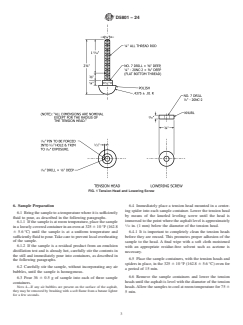
5.2 Tension Head—The tension head shall consist of a polished metal,metal hemispherical head with a ⁄16 in. (11.1 mm) radius,
1 1
which is integrally connected to a ⁄4 in. (6.4 mm) diameter stem approximately 12 ⁄16 in. (33.3(52.4 mm) long. The stem shall be
threaded and fitted with a knurled lowering screw to allow for accurate adjustment of the tension head height in the sample
container. The stem of the tension head shall be fitted with a small pin to prevent twisting of the head while adjusting the height.
Dimensions of the tension head are shown in Fig. 1.
NOTE 2—Brass and stainless steel are acceptable metals for constructing tension heads. Aluminum scratches easily and steel rusts, so these metals should
not be used.
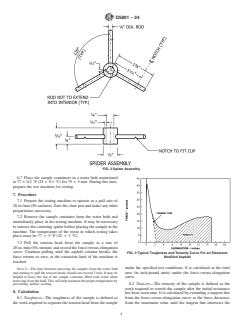
5.3 Spider—The support for the tension head shall consist of a cylindrical center section through which the stem of the tension
head may freely move parallel to the axis of the cylinder. The inner wall of the cylinder shall be grooved to receive the pin mounted
on the stem of the tension head. The spider cylinder shall be fitted with three arms, equally spaced at 120°, extending from the
Available from American Association of State Highway and Transportation Officials (AASHTO), 555 12th St., NW, Suite 1000, Washington, DC 20004,
http://www.transportation.org.
D5801 − 24
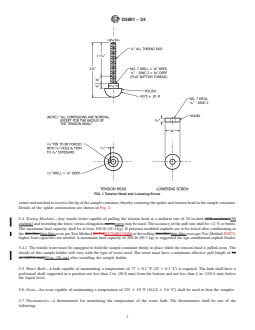
FIG. 1 Tension Head and Lowering Screw
center and notched to receive the lip of the sample container, thereby centering the spider and tension head in the sample container.
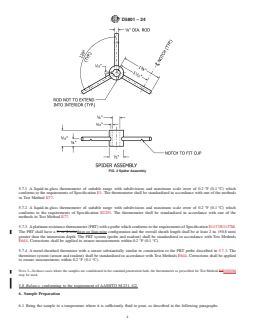
Details of the spider construction are shown in Fig. 2.
5.4 Testing Machine—Any tensile tester capable of pulling the tension head at a uniform rate of 20 in./min (508 mm/min),(50
cm/min) and recording the force-versus-elongation curve,curve may be used. The accuracy of the pull rate shall be 62 % or better.
The maximum load capacity shall be at least 100 lb (45.4 kg). If polymer-modified asphalts are to be tested after conditioning in
the thin film thin-film oven per Test Method D1754D1754/D1754M or the rolling thin film thin-film oven per Test Method D2872,
higher load capacities are needed. A maximum load capacity of 200 lb (90.7 kg) is suggested for age-conditioned asphalt binder.
5.4.1 The tensile tester must be equipped to hold the sample container firmly in place while the tension head is pulled away. The
details of this sample holder will vary with the type of tester used. The tester must have a minimum effective pull length of 24
in. (609.6 mm)30 in. (76 cm) after installing the sample holder.
5.5 Water Bath—A bath capable of maintaining a temperature of 77 6 0.2 °F (25 6 0.1 °C) is required. The bath shall have a
perforated shelf supported in a position not less than 2 in
...
Questions, Comments and Discussion
Ask us and Technical Secretary will try to provide an answer. You can facilitate discussion about the standard in here.
Loading comments...