


ASTM E905-87(2021)
(Test Method)Standard Test Method for Determining Thermal Performance of Tracking Concentrating Solar Collectors
Standard Test Method for Determining Thermal Performance of Tracking Concentrating Solar Collectors
SIGNIFICANCE AND USE
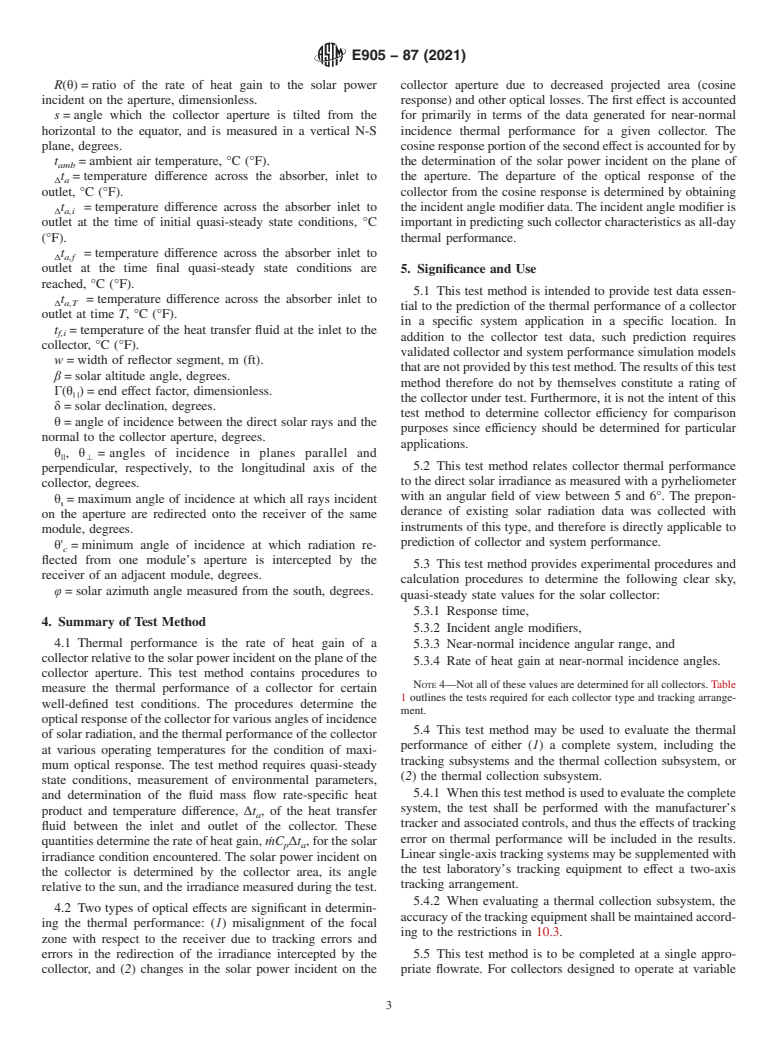
5.1 This test method is intended to provide test data essential to the prediction of the thermal performance of a collector in a specific system application in a specific location. In addition to the collector test data, such prediction requires validated collector and system performance simulation models that are not provided by this test method. The results of this test method therefore do not by themselves constitute a rating of the collector under test. Furthermore, it is not the intent of this test method to determine collector efficiency for comparison purposes since efficiency should be determined for particular applications.
5.2 This test method relates collector thermal performance to the direct solar irradiance as measured with a pyrheliometer with an angular field of view between 5 and 6°. The preponderance of existing solar radiation data was collected with instruments of this type, and therefore is directly applicable to prediction of collector and system performance.
5.3 This test method provides experimental procedures and calculation procedures to determine the following clear sky, quasi-steady state values for the solar collector:
5.3.1 Response time,
5.3.2 Incident angle modifiers,
5.3.3 Near-normal incidence angular range, and
5.3.4 Rate of heat gain at near-normal incidence angles.
Note 4: Not all of these values are determined for all collectors. Table 1 outlines the tests required for each collector type and tracking arrangement.
× = Required.
⊗ = Required but method may not be practicable for point focus collectors—Safety precautions and technical precautions must be followed because of potential damage to equipment and subsequent damage to personnel due to high levels of solar irradiance on the receiver support structure.
** = Optional test that may provide useful information on the effect of the accuracy of the manufacturer's tracking equipment on thermal performance.
5.4 This test method may be used to evaluate...
SCOPE
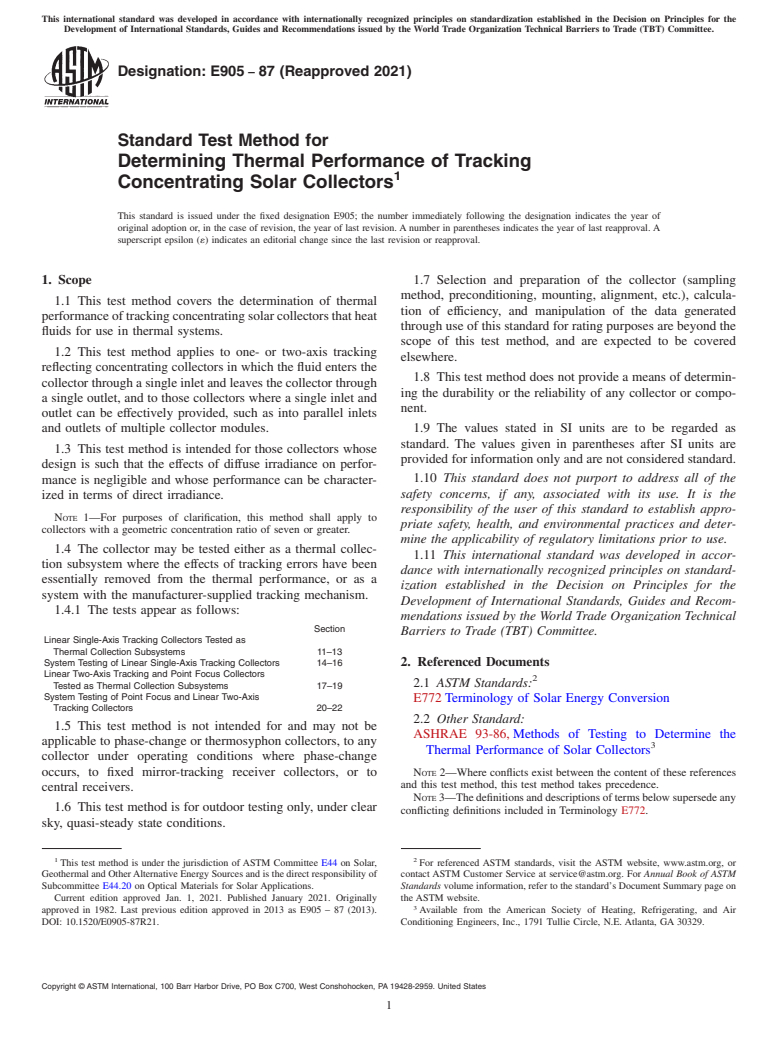
1.1 This test method covers the determination of thermal performance of tracking concentrating solar collectors that heat fluids for use in thermal systems.
1.2 This test method applies to one- or two-axis tracking reflecting concentrating collectors in which the fluid enters the collector through a single inlet and leaves the collector through a single outlet, and to those collectors where a single inlet and outlet can be effectively provided, such as into parallel inlets and outlets of multiple collector modules.
1.3 This test method is intended for those collectors whose design is such that the effects of diffuse irradiance on performance is negligible and whose performance can be characterized in terms of direct irradiance.
Note 1: For purposes of clarification, this method shall apply to collectors with a geometric concentration ratio of seven or greater.
1.4 The collector may be tested either as a thermal collection subsystem where the effects of tracking errors have been essentially removed from the thermal performance, or as a system with the manufacturer-supplied tracking mechanism.
1.4.1 The tests appear as follows:
Section
Linear Single-Axis Tracking Collectors Tested as
Thermal Collection Subsystems
11–13
System Testing of Linear Single-Axis Tracking Collectors
14–16
Linear Two-Axis Tracking and Point Focus Collectors
Tested as Thermal Collection Subsystems
17–19
System Testing of Point Focus and Linear Two-Axis
Tracking Collectors
20–22
1.5 This test method is not intended for and may not be applicable to phase-change or thermosyphon collectors, to any collector under operating conditions where phase-change occurs, to fixed mirror-tracking receiver collectors, or to central receivers.
1.6 This test method is for outdoor testing only, under clear sky, quasi-steady state conditions.
1.7 Selection and preparation of the collector (sampling m...
General Information
Standards Content (Sample)
This international standard was developed in accordance with internationally recognized principles on standardization established in the Decision on Principles for the
Development of International Standards, Guides and Recommendations issued by the World Trade Organization Technical Barriers to Trade (TBT) Committee.
Designation: E905 − 87 (Reapproved 2021)
Standard Test Method for
Determining Thermal Performance of Tracking
1
Concentrating Solar Collectors
This standard is issued under the fixed designation E905; the number immediately following the designation indicates the year of
original adoption or, in the case of revision, the year of last revision.Anumber in parentheses indicates the year of last reapproval.A
superscript epsilon (´) indicates an editorial change since the last revision or reapproval.
1. Scope 1.7 Selection and preparation of the collector (sampling
method, preconditioning, mounting, alignment, etc.), calcula-
1.1 This test method covers the determination of thermal
tion of efficiency, and manipulation of the data generated
performanceoftrackingconcentratingsolarcollectorsthatheat
through use of this standard for rating purposes are beyond the
fluids for use in thermal systems.
scope of this test method, and are expected to be covered
1.2 This test method applies to one- or two-axis tracking
elsewhere.
reflecting concentrating collectors in which the fluid enters the
1.8 This test method does not provide a means of determin-
collectorthroughasingleinletandleavesthecollectorthrough
ing the durability or the reliability of any collector or compo-
a single outlet, and to those collectors where a single inlet and
nent.
outlet can be effectively provided, such as into parallel inlets
and outlets of multiple collector modules. 1.9 The values stated in SI units are to be regarded as
standard. The values given in parentheses after SI units are
1.3 This test method is intended for those collectors whose
provided for information only and are not considered standard.
design is such that the effects of diffuse irradiance on perfor-
1.10 This standard does not purport to address all of the
mance is negligible and whose performance can be character-
safety concerns, if any, associated with its use. It is the
ized in terms of direct irradiance.
responsibility of the user of this standard to establish appro-
NOTE 1—For purposes of clarification, this method shall apply to
priate safety, health, and environmental practices and deter-
collectors with a geometric concentration ratio of seven or greater.
mine the applicability of regulatory limitations prior to use.
1.4 The collector may be tested either as a thermal collec-
1.11 This international standard was developed in accor-
tion subsystem where the effects of tracking errors have been
dance with internationally recognized principles on standard-
essentially removed from the thermal performance, or as a
ization established in the Decision on Principles for the
system with the manufacturer-supplied tracking mechanism.
Development of International Standards, Guides and Recom-
1.4.1 The tests appear as follows:
mendations issued by the World Trade Organization Technical
Section
Barriers to Trade (TBT) Committee.
Linear Single-Axis Tracking Collectors Tested as
Thermal Collection Subsystems 11–13
System Testing of Linear Single-Axis Tracking Collectors 14–16 2. Referenced Documents
Linear Two-Axis Tracking and Point Focus Collectors
2
2.1 ASTM Standards:
Tested as Thermal Collection Subsystems 17–19
System Testing of Point Focus and Linear Two-Axis
E772Terminology of Solar Energy Conversion
Tracking Collectors 20–22
2.2 Other Standard:
1.5 This test method is not intended for and may not be
ASHRAE 93-86,Methods of Testing to Determine the
applicable to phase-change or thermosyphon collectors, to any
3
Thermal Performance of Solar Collectors
collector under operating conditions where phase-change
occurs, to fixed mirror-tracking receiver collectors, or to NOTE 2—Where conflicts exist between the content of these references
and this test method, this test method takes precedence.
central receivers.
NOTE3—Thedefinitionsanddescriptionsoftermsbelowsupersedeany
1.6 This test method is for outdoor testing only, under clear
conflicting definitions included in Terminology E772.
sky, quasi-steady state conditions.
1 2
This test method is under the jurisdiction of ASTM Committee E44 on Solar, For referenced ASTM standards, visit the ASTM website, www.astm.org, or
GeothermalandOtherAlternativeEnergySourcesandisthedirectresponsibilityof contact ASTM Customer Service at service@astm.org. For Annual Book of ASTM
Subcommittee E44.20 on Optical Materials for Solar Applications. Standards volume information, refer to the standard’s Document Summary page on
Current edition approved Jan. 1, 2021. Published January 2021. Originally the ASTM website.
3
approved in 1982. Last previous edition approved in 2013 as E905 – 87 (2013). Available from the American Society of Heating, Refri
...
Questions, Comments and Discussion
Ask us and Technical Secretary will try to provide an answer. You can facilitate discussion about the standard in here.