


ASTM F2609-11(2015)
(Test Method)Standard Test Method for Litter-Cleaning Effectiveness of Vacuum Cleaners
Standard Test Method for Litter-Cleaning Effectiveness of Vacuum Cleaners
SIGNIFICANCE AND USE
3.1 This test method will provide an indication of the effectiveness of the vacuum cleaner in removing litter from carpet. No data exist to determine if the cleaning effectiveness in the laboratory will be the same as in home cleaning; however, in most cases, a vacuum cleaner that cleans well in the laboratory will clean well in a home.
3.2 To provide a uniform basis for measuring the performance described in 1.1, standardized test carpet and standardized test litter are used.
SCOPE
1.1 This test method covers a laboratory test for determining the relative carpet litter-cleaning effectiveness of household vacuum cleaners when tested under standard conditions.
1.2 This test method is applicable to household types of upright, canister, combination, and stick vacuum cleaners intended for cleaning carpeted floors as a primary or secondary function.
1.3 This test method applies only to the cleaning of litter from carpet, not the removal of embedded dirt. Litter is defined as material that typically clings to the surface of the carpet, such as pet or human hair, thread, and so forth.
1.4 The values stated in inch-pound units are to be regarded as standard. The values given in parentheses are mathematical conversions to SI units that are provided for information only and are not considered standard.
1.5 This standard does not purport to address all of the safety concerns, if any, associated with its use. It is the responsibility of the user of this standard to establish appropriate safety and health practices and determine the applicability of regulatory limitations prior to use.
General Information
Buy Standard
Standards Content (Sample)
NOTICE: This standard has either been superseded and replaced by a new version or withdrawn.
Contact ASTM International (www.astm.org) for the latest information
Designation: F2609 − 11 (Reapproved 2015) An American National Standard
Standard Test Method for
Litter-Cleaning Effectiveness of Vacuum Cleaners
This standard is issued under the fixed designation F2609; the number immediately following the designation indicates the year of
original adoption or, in the case of revision, the year of last revision. A number in parentheses indicates the year of last reapproval. A
superscript epsilon (´) indicates an editorial change since the last revision or reapproval.
1. Scope F884 Test Method for Motor Life Evaluation of a Built-In
(Central Vacuum) Vacuum Cleaner
1.1 Thistestmethodcoversalaboratorytestfordetermining
F922 Test Method for Motor Life Evaluation of an Electric
the relative carpet litter-cleaning effectiveness of household
Motorized Nozzle
vacuum cleaners when tested under standard conditions.
F1038 Test Method for Motor Life Evaluation of a Canister,
1.2 This test method is applicable to household types of
Hand-held, Stick, and Utility Type Vacuum Cleaner With-
upright, canister, combination, and stick vacuum cleaners
out a Driven Agitator
intended for cleaning carpeted floors as a primary or secondary
F1334 Test Method for Determining A-Weighted Sound
function.
Power Level of Vacuum Cleaners
F1409 Test Method for Straight Line Movement of Vacuum
1.3 This test method applies only to the cleaning of litter
from carpet, not the removal of embedded dirt. Litter is defined Cleaners While Cleaning Carpets
as material that typically clings to the surface of the carpet,
such as pet or human hair, thread, and so forth. 3. Significance and Use
1.4 The values stated in inch-pound units are to be regarded
3.1 This test method will provide an indication of the
as standard. The values given in parentheses are mathematical
effectiveness of the vacuum cleaner in removing litter from
conversions to SI units that are provided for information only
carpet. No data exist to determine if the cleaning effectiveness
and are not considered standard.
in the laboratory will be the same as in home cleaning;
however, in most cases, a vacuum cleaner that cleans well in
1.5 This standard does not purport to address all of the
the laboratory will clean well in a home.
safety concerns, if any, associated with its use. It is the
responsibility of the user of this standard to establish appro-
3.2 To provide a uniform basis for measuring the perfor-
priate safety and health practices and determine the applica-
mance described in 1.1, standardized test carpet and standard-
bility of regulatory limitations prior to use.
ized test litter are used.
2. Referenced Documents
4. Apparatus
2.1 ASTM Standards:
4.1 LED Timer Bar, or other type of equipment capable of
E177 Practice for Use of the Terms Precision and Bias in
establishing the specified rate of movement of the cleaner.
ASTM Test Methods
F555 Test Method for Motor Life Evaluation of an Upright 4.2 Voltmeter, to measure input voltage to the cleaner and
Vacuum Cleaner
provide measurements accurate to within 61%.
F608 Test Method for Evaluation of Carpet Embedded Dirt
4.3 Voltage-Regulator System, to control the input voltage
Removal Effectiveness of Household/Commercial
to the cleaner. The regulator shall be capable of maintaining
Vacuum Cleaners
120 6 1 % V root mean square (RMS), 60 Hz, with a
F655 Specification for Test Carpets and Pads for Vacuum
waveform that is essentially sinusoidal with 3 % maximum
Cleaner Testing
harmonic distortion for the duration of the test.
4.4 Test Carpets, Wilton Wool; specification and source to
1 be added.
This test method is under the jurisdiction ofASTM Committee F11 on Vacuum
Cleaners and is the direct responsibility of Subcommittee F11.21 on Cleanability.
4.5 Test Padding, Sponge rubber type of waffle construction
Current edition approved Nov. 1, 2015. Published November 2015. Originally
approved in 2007. Last previous edition approved in 2011 as F2609 – 11. DOI: as described in Specification F655.
10.1520/F2609-11R15.
4.6 Psychrometer, for measuring temperature and humidity.
For referenced ASTM standards, visit the ASTM website, www.astm.org, or
contact ASTM Customer Service at service@astm.org. For Annual Book of ASTM
4.7 Rake,forlightlyembeddingthelitterintothetestcarpet.
Standards volume information, refer to the standard’s Document Summary page on
the ASTM website. See Fig. 1 and Fig. 2.
Copyright © ASTM International, 100 Barr Harbor Drive, PO Box C700, West Conshohocken, PA 19428-2959. United States
F2609 − 11 (2015)
FIG. 1 Rake Head
FIG. 2 Rake Handle
4.8 Supporting Surface—Aflat surface consisting of a piece 4.9 Test Area Template—Cardboard or plastic sheet or
of ⁄4-in. (19-mm) thick exterior grade plywood with the “A”
equivalent with a 7- by 7-in. (178- by 178-mm) square
surface upward to support the test carpet and pad. The test opening. The opening defines the litter area and is to be
carpet and pad may be fastened to the supporting surface, but
centered within the 18-in. (457-mm) long cleaning stroke.
only the four corners by any acceptable means.
F2609 − 11 (2015)
5. Reagents and Materials 8.1.1.2 Preconditioning a Straight-Air-Type Vacuum
Cleaner—Operatethevacuumcleanerfor1hwithawide-open
5.1 Test Litter—Uncarded cut viscose rayon tow, 1.5 denier,
inlet.
⁄4-in. (19-mm) length, SN TN-79, unbleached, hard finish.
8.1.2 Test Vacuum Cleaner Settings—Tests shall be con-
6. Sampling
ducted using the same settings (nozzle, motor speed, suction
regulator, and so forth) for the specific carpet as used for
6.1 A minimum of three units of the same model vacuum
straight line movement (Test Method F1409), sound power
cleaner selected at random in accordance with good statistical
(Test Method F1334), cleaning (Test Method F608), and motor
practice shall constitute the population sample.
life evaluation (Test Methods F555, F884, F922, and F1038).
6.2 To determine the best estimate of cleaning ability for the
8.1.3 Before each test run (cleaning of one square litter
population of the vacuum cleaner model being tested, the
area), thoroughly remove excess rayon tow from the underside
arithmetic mean of the cleaning ability rating of the sample
of the nozzle and brush area. For vacuum cleaners using
from the population shall be established by testing it to a 90 %
disposable bags, use a clean bag for each test series (six test
confidence level within 65 % of the mean value of the
runs). For vacuum cleaners using nondisposable receptacles,
cleaning ability rating.
empty after each test series (six test runs) and clean the
7. Conditioning
receptacle until all traces of rayon tow are removed.
8.1.4 Mark the litter area on the test carpet or use the
7.1 Test Room—Maintain the test room in which all condi-
tioning and vacuum cleaner testing is done at 70 6 5°F (21 6 template.
3°C) and 45 to 55 % relative humidity.
8.1.5 To spread the rayon tow, start with a ball approxi-
mately 3 in. (8 cm) in diameter dabbing it lightly (do not rub
7.2 All components involved in the test shall remain and be
in) and randomly over the prescribed area using a vertical
exposed in the controlled environment for at least 16 h before
motion of the hand. Any concentrated excess material shall be
the start of the test.
removed. All six test areas may be prepared at the same time,
8. Procedure
spaced evenly over the test carpet (see Figs. 3-6). Ensure the
spacing between litter areas can accommodate the 18 in. (46
8.1 Preparation of Test Vacuum Cleaners:
cm) stroke with the 7 in. (18 cm) litter area centered within it.
8.1.1 New Test Vacuum Cleaners—Run the vacuum cleaner
in at rated voltage 61 % and rated frequency with filters in 8.1.6 Embedtherayontowintothetestcarpetbypullingthe
rake once over the litter area in the direction of carpet lay
place.
8.1.1.1 Preconditioning a Rotating Agitator-Type Vacuum followed by pulling the rake once across the carpet perpen-
dicular to the direction of carpet lay. Do not apply any
Cleaner—In a stationary position, operate the vacuum c
...
This document is not an ASTM standard and is intended only to provide the user of an ASTM standard an indication of what changes have been made to the previous version. Because
it may not be technically possible to adequately depict all changes accurately, ASTM recommends that users consult prior editions as appropriate. In all cases only the current version
of the standard as published by ASTM is to be considered the official document.
Designation: F2609 − 11 F2609 − 11 (Reapproved 2015) An American National Standard
Standard Test Method for
Litter-Cleaning Effectiveness of Vacuum Cleaners
This standard is issued under the fixed designation F2609; the number immediately following the designation indicates the year of
original adoption or, in the case of revision, the year of last revision. A number in parentheses indicates the year of last reapproval. A
superscript epsilon (´) indicates an editorial change since the last revision or reapproval.
1. Scope
1.1 This test method covers a laboratory test for determining the relative carpet litter-cleaning effectiveness of household
vacuum cleaners when tested under standard conditions.
1.2 This test method is applicable to household types of upright, canister, combination, and stick vacuum cleaners intended for
cleaning carpeted floors as a primary or secondary function.
1.3 This test method applies only to the cleaning of litter from carpet, not the removal of embedded dirt. Litter is defined as
material that typically clings to the surface of the carpet, such as pet or human hair, thread, and so forth.
1.4 The values stated in inch-pound units are to be regarded as standard. The values given in parentheses are mathematical
conversions to SI units that are provided for information only and are not considered standard.
1.5 This standard does not purport to address all of the safety concerns, if any, associated with its use. It is the responsibility
of the user of this standard to establish appropriate safety and health practices and determine the applicability of regulatory
limitations prior to use.
2. Referenced Documents
2.1 ASTM Standards:
E177 Practice for Use of the Terms Precision and Bias in ASTM Test Methods
F555 Test Method for Motor Life Evaluation of an Upright Vacuum Cleaner
F608 Test Method for Evaluation of Carpet Embedded Dirt Removal Effectiveness of Household/Commercial Vacuum Cleaners
F655 Specification for Test Carpets and Pads for Vacuum Cleaner Testing
F884 Test Method for Motor Life Evaluation of a Built-In (Central Vacuum) Vacuum Cleaner
F922 Test Method for Motor Life Evaluation of an Electric Motorized Nozzle
F1038 Test Method for Motor Life Evaluation of a Canister, Hand-held, Stick, and Utility Type Vacuum Cleaner Without a
Driven Agitator
F1334 Test Method for Determining A-Weighted Sound Power Level of Vacuum Cleaners
F1409 Test Method for Straight Line Movement of Vacuum Cleaners While Cleaning Carpets
3. Significance and Use
3.1 This test method will provide an indication of the effectiveness of the vacuum cleaner in removing litter from carpet. No
data exist to determine if the cleaning effectiveness in the laboratory will be the same as in home cleaning; however, in most cases,
a vacuum cleaner that cleans well in the laboratory will clean well in a home.
3.2 To provide a uniform basis for measuring the performance described in 1.1, standardized test carpet and standardized test
litter are used.
4. Apparatus
4.1 LED Timer Bar, or other type of equipment capable of establishing the specified rate of movement of the cleaner.
4.2 Voltmeter, to measure input voltage to the cleaner and provide measurements accurate to within 61 %.
This test method is under the jurisdiction of ASTM Committee F11 on Vacuum Cleaners and is the direct responsibility of Subcommittee F11.21 on Cleanability.
Current edition approved Nov. 1, 2011Nov. 1, 2015. Published January 2012November 2015. Originally approved in 2007. Last previous edition approved in 20072011
as F2609 – 07.F2609 – 11. DOI: 10.1520/F2609-11.10.1520/F2609-11R15.
For referenced ASTM standards, visit the ASTM website, www.astm.org, or contact ASTM Customer Service at service@astm.org. For Annual Book of ASTM Standards
volume information, refer to the standard’s Document Summary page on the ASTM website.
Copyright © ASTM International, 100 Barr Harbor Drive, PO Box C700, West Conshohocken, PA 19428-2959. United States
F2609 − 11 (2015)
4.3 Voltage-Regulator System, to control the input voltage to the cleaner. The regulator shall be capable of maintaining 120 6
1 % V root mean square (RMS), 60 Hz, with a waveform that is essentially sinusoidal with 3 % maximum harmonic distortion for
the duration of the test.
4.4 Test Carpets, Wilton Wool; specification and source to be added.
4.5 Test Padding, Sponge rubber type of waffle construction as described in Specification F655.
4.6 Psychrometer, for measuring temperature and humidity.
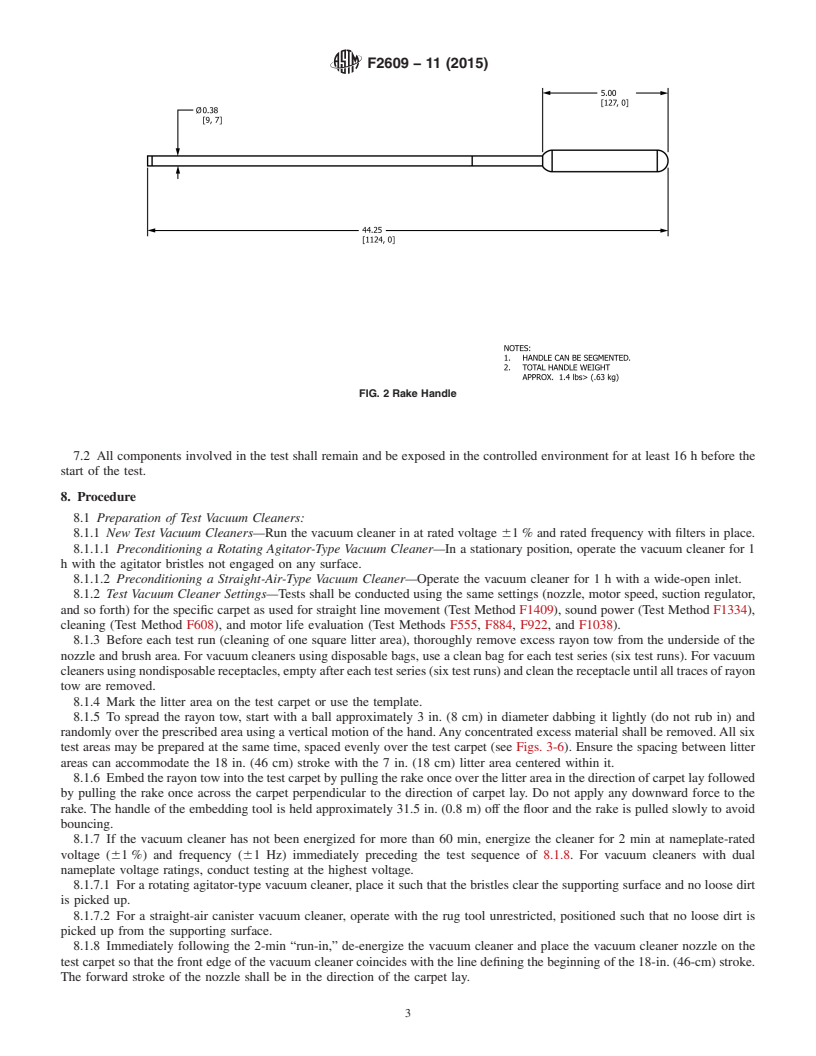
4.7 Rake, for lightly embedding the litter into the test carpet. See Fig. 1 and Fig. 2.
4.8 Supporting Surface—A flat surface consisting of a piece of ⁄4-in. (19-mm) thick exterior grade plywood with the “A”
surface upward to support the test carpet and pad. The test carpet and pad may be fastened to the supporting surface, but only the
four corners by any acceptable means.
4.9 Test Area Template—Cardboard or plastic sheet or equivalent with a 7- by 7-in. (178- by 178-mm) square opening. The
opening defines the litter area and is to be centered within the 18-in. (457-mm) long cleaning stroke.
5. Reagents and Materials
5.1 Test Litter—Uncarded cut viscose rayon tow, 1.5 denier, ⁄4-in. (19-mm) length, SN TN-79, unbleached, hard finish.
6. Sampling
6.1 A minimum of three units of the same model vacuum cleaner selected at random in accordance with good statistical practice
shall constitute the population sample.
6.2 To determine the best estimate of cleaning ability for the population of the vacuum cleaner model being tested, the
arithmetic mean of the cleaning ability rating of the sample from the population shall be established by testing it to a 90 %
confidence level within 65 % of the mean value of the cleaning ability rating.
7. Conditioning
7.1 Test Room—Maintain the test room in which all conditioning and vacuum cleaner testing is done at 70 6 5F°5°F (21 6
3C°)3°C) and 45 to 55 % relative humidity.
FIG. 1 Rake Head
F2609 − 11 (2015)
FIG. 2 Rake Handle
7.2 All components involved in the test shall remain and be exposed in the controlled environment for at least 16 h before the
start of the test.
8. Procedure
8.1 Preparation of Test Vacuum Cleaners:
8.1.1 New Test Vacuum Cleaners—Run the vacuum cleaner in at rated voltage 61 % and rated frequency with filters in place.
8.1.1.1 Preconditioning a Rotating Agitator-Type Vacuum Cleaner—In a stationary position, operate the vacuum cleaner for 1
h with the agitator bristles not engaged on any surface.
8.1.1.2 Preconditioning a Straight-Air-Type Vacuum Cleaner—Operate the vacuum cleaner for 1 h with a wide-open inlet.
8.1.2 Test Vacuum Cleaner Settings—Tests shall be conducted using the same settings (nozzle, motor speed, suction regulator,
and so forth) for the specific carpet as used for straight line movement (Test Method F1409), sound power (Test Method F1334),
cleaning (Test Method F608), and motor life evaluation (Test Methods F555, F884, F922, and F1038).
8.1.3 Before each test run (cleaning of one square litter area), thoroughly remove excess rayon tow from the underside of the
nozzle and brush area. For vacuum cleaners using disposable bags, use a clean bag for each test series (six test runs). For vacuum
cleaners using nondisposable receptacles, empty after each test series (six test runs) and clean the receptacle until all traces of rayon
tow are removed.
8.1.4 Mark the litter area on the test carpet or use the template.
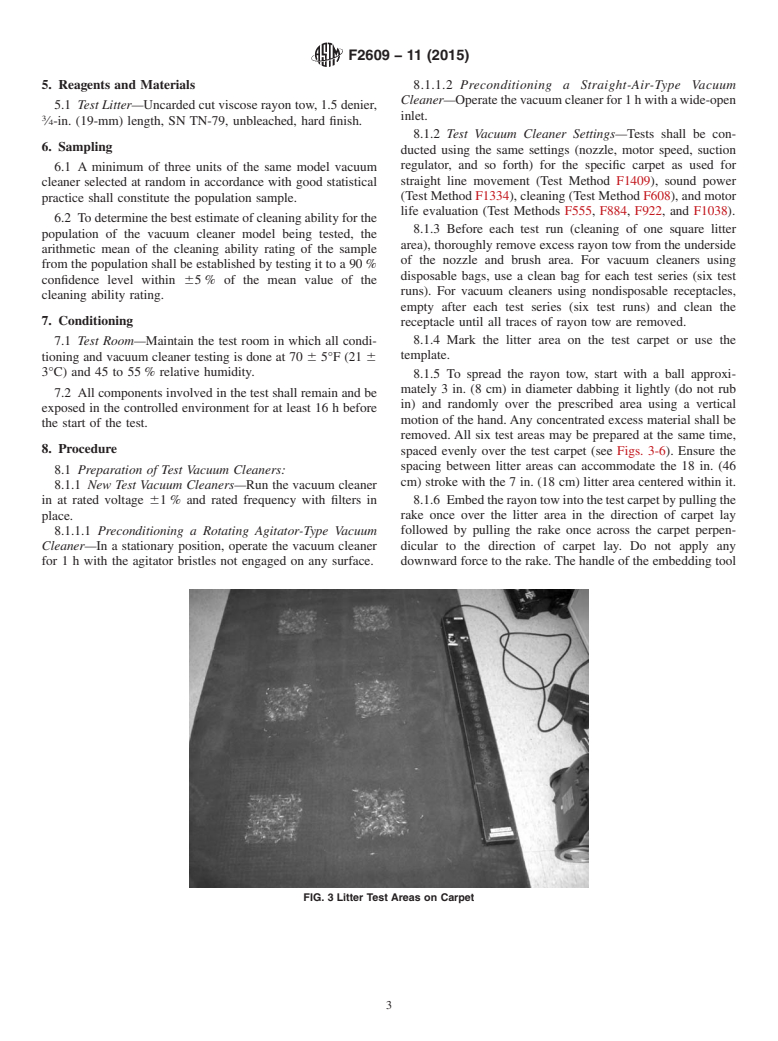
8.1.5 To spread the rayon tow, start with a ball approximately 3 in. (8 cm) in diameter dabbing it lightly (do not rub in) and
randomly over the prescribed area using a vertical motion of the hand. Any concentrated excess material shall be removed. All six
test areas may be prepared at the same time, spaced evenly over the test carpet (see Figs. 3-6). Ensure the spacing between litter
areas can accommodate the 18 in. (46 cm) stroke with the 7 in. (18 cm) litter area centered within it.
8.1.6 Embed the ra
...
Questions, Comments and Discussion
Ask us and Technical Secretary will try to provide an answer. You can facilitate discussion about the standard in here.