

ASTM B662/B662M-20
(Specification)Standard Specification for Silver-Molybdenum Electrical Contact Material
General Information
- Abstract
ABSTRACT
This specification covers electrical contact components made from silver-molybdenum by powder metallurgical procedures. Chemical analysis of the samples shall be done to determine their chemical composition. The material shall be finished by different methods like braze alloy backing, tumbling to polish surfaces, special surface finish, and cleaning.
SCOPE
1.1 This specification covers electrical contact components made from silver-molybdenum by powder metallurgical procedures.
1.2 This specification covers compositions within the silver-molybdenum system for electrical contact applications.
1.3 The values stated in either SI units or inch-pound units are to be regarded separately as standard. The values stated in each system are not necessarily exact equivalents; therefore, to ensure conformance with the standard, each system shall be used independently of the other, and values from the two systems shall not be combined.
1.4 This standard does not purport to address all of the safety concerns, if any, associated with its use. It is the responsibility of the user of this standard to become familiar with all hazards including those identified in the appropriate Material Safety Data Sheet (MSDS) for this product/material as provided by the manufacturer, to establish appropriate safety, health, and environmental practices, and determine the applicability of regulatory limitations prior to use.
1.5 This international standard was developed in accordance with internationally recognized principles on standardization established in the Decision on Principles for the Development of International Standards, Guides and Recommendations issued by the World Trade Organization Technical Barriers to Trade (TBT) Committee.
- Status
- Published
- Publication Date
- 31-Mar-2020
- Technical Committee
- B02 - Nonferrous Metals and Alloys
Buy Documents

ASTM B662/B662M-20 - Standard Specification for Silver-Molybdenum Electrical Contact Material
REDLINE ASTM B662/B662M-20 - Standard Specification for Silver-Molybdenum Electrical Contact Material
Overview
ASTM B662/B662M-20: Standard Specification for Silver-Molybdenum Electrical Contact Material establishes requirements for electrical contact components manufactured from silver-molybdenum using powder metallurgical processes. This international standard, developed by ASTM, details the composition, physical properties, and finishing methods relevant to silver-molybdenum materials intended for applications demanding reliable electrical performance. The specification supports manufacturers and end users in achieving consistent quality and performance in electrical contact materials, while also emphasizing the importance of safety, conformance, and mutual agreement on specification details.
Key Topics
- Material Composition: The standard covers a range of compositions within the silver-molybdenum system. Typical classes include alloys containing 33-52% silver by weight, with the balance being molybdenum and controlled levels of impurities.
- Powder Metallurgy Process: Silver-molybdenum electrical contact materials are produced via powder metallurgical techniques, which affect their final properties such as density, hardness, and conductivity.
- Physical and Mechanical Properties: Requirements for hardness, density, electrical conductivity, tensile strength, modulus of rupture, coefficient of expansion, and thermal conductivity are included as guidelines for manufacturers and purchasers.
- Quality Assessment: The standard prescribes procedures for chemical analysis and physical tests. Qualification testing is recommended to ensure materials meet performance needs for intended electrical contact applications.
- Finishing Operations: Components may undergo braze alloy backing, tumbling for surface polish, special surface finishes, cleaning, or the provision of a silver-rich surface layer as agreed upon between supplier and user.
- Order and Certification Requirements: Purchasers should specify dimensions, composition, physical properties, certifications, and any additional mutually agreed requirements.
Applications
Silver-molybdenum electrical contact materials standardized under ASTM B662/B662M-20 are used extensively in various electrical and electronic devices that require high-performance contact components, such as:
- Switchgear and Circuit Breakers: Providing high arc resistance and low contact resistance for reliable current interruption and switching operations.
- Electrical Relays and Contactors: Enhancing durability and operational life in repetitive switching environments.
- Industrial Controls: Supporting stable electrical transfer in environments with varying mechanical and electrical stresses.
- Power Distribution Equipment: Serving as critical conductive elements where reliable transmission and distribution are essential.
Typical end users include manufacturers of electrical equipment, component fabricators, and original equipment manufacturers (OEMs), all seeking dependable electrical contact performance and consistent material characteristics.
Related Standards
For comprehensive implementation and interoperability, the following ASTM standards and documents are relevant:
- ASTM B542 - Terminology Relating to Electrical Contacts and Their Use
- ASTM B328 (Withdrawn) - Test Method for Density, Oil Content, and Interconnected Porosity of Sintered Metal Structural Parts and Oil-Impregnated Bearings
It is advisable to consult the latest edition of referenced standards and the relevant Material Safety Data Sheet (MSDS) for safe handling and compliance with environmental and regulatory guidelines.
Keywords: Silver-molybdenum electrical contacts, ASTM B662/B662M-20, powder metallurgy, electrical contact material, arc resistance, contact resistance, industrial contacts, switchgear materials, electrical standards, quality assurance in electrical components
Relations
- Replaces
ASTM B662-94(2012) - Standard Specification for Silver-Molybdenum Electrical Contact Material - Effective Date
- 01-Apr-2020
- Effective Date
- 01-Nov-2019
- Effective Date
- 01-Feb-2013
- Effective Date
- 01-May-2007
- Effective Date
- 01-May-2004
- Effective Date
- 10-Apr-2003
- Effective Date
- 10-Apr-2003
- Effective Date
- 10-Oct-2000
- Effective Date
- 10-Sep-1996
Buy Documents
ASTM B662/B662M-20 - Standard Specification for Silver-Molybdenum Electrical Contact Material
REDLINE ASTM B662/B662M-20 - Standard Specification for Silver-Molybdenum Electrical Contact Material
Get Certified
Connect with accredited certification bodies for this standard

Element Materials Technology
Materials testing and product certification.

Inštitut za kovinske materiale in tehnologije
Institute of Metals and Technology. Materials testing, metallurgical analysis, NDT.
Sponsored listings
Frequently Asked Questions
ASTM B662/B662M-20 is a technical specification published by ASTM International. Its full title is "Standard Specification for Silver-Molybdenum Electrical Contact Material". This standard covers: ABSTRACT This specification covers electrical contact components made from silver-molybdenum by powder metallurgical procedures. Chemical analysis of the samples shall be done to determine their chemical composition. The material shall be finished by different methods like braze alloy backing, tumbling to polish surfaces, special surface finish, and cleaning. SCOPE 1.1 This specification covers electrical contact components made from silver-molybdenum by powder metallurgical procedures. 1.2 This specification covers compositions within the silver-molybdenum system for electrical contact applications. 1.3 The values stated in either SI units or inch-pound units are to be regarded separately as standard. The values stated in each system are not necessarily exact equivalents; therefore, to ensure conformance with the standard, each system shall be used independently of the other, and values from the two systems shall not be combined. 1.4 This standard does not purport to address all of the safety concerns, if any, associated with its use. It is the responsibility of the user of this standard to become familiar with all hazards including those identified in the appropriate Material Safety Data Sheet (MSDS) for this product/material as provided by the manufacturer, to establish appropriate safety, health, and environmental practices, and determine the applicability of regulatory limitations prior to use. 1.5 This international standard was developed in accordance with internationally recognized principles on standardization established in the Decision on Principles for the Development of International Standards, Guides and Recommendations issued by the World Trade Organization Technical Barriers to Trade (TBT) Committee.
ABSTRACT This specification covers electrical contact components made from silver-molybdenum by powder metallurgical procedures. Chemical analysis of the samples shall be done to determine their chemical composition. The material shall be finished by different methods like braze alloy backing, tumbling to polish surfaces, special surface finish, and cleaning. SCOPE 1.1 This specification covers electrical contact components made from silver-molybdenum by powder metallurgical procedures. 1.2 This specification covers compositions within the silver-molybdenum system for electrical contact applications. 1.3 The values stated in either SI units or inch-pound units are to be regarded separately as standard. The values stated in each system are not necessarily exact equivalents; therefore, to ensure conformance with the standard, each system shall be used independently of the other, and values from the two systems shall not be combined. 1.4 This standard does not purport to address all of the safety concerns, if any, associated with its use. It is the responsibility of the user of this standard to become familiar with all hazards including those identified in the appropriate Material Safety Data Sheet (MSDS) for this product/material as provided by the manufacturer, to establish appropriate safety, health, and environmental practices, and determine the applicability of regulatory limitations prior to use. 1.5 This international standard was developed in accordance with internationally recognized principles on standardization established in the Decision on Principles for the Development of International Standards, Guides and Recommendations issued by the World Trade Organization Technical Barriers to Trade (TBT) Committee.
ASTM B662/B662M-20 is classified under the following ICS (International Classification for Standards) categories: 77.120.99 - Other non-ferrous metals and their alloys. The ICS classification helps identify the subject area and facilitates finding related standards.
ASTM B662/B662M-20 has the following relationships with other standards: It is inter standard links to ASTM B662-94(2012), ASTM B542-13(2019), ASTM B542-13, ASTM B542-07, ASTM B542-04, ASTM B328-96(2003), ASTM B328-96(2003)e1, ASTM B542-00, ASTM B328-96. Understanding these relationships helps ensure you are using the most current and applicable version of the standard.
ASTM B662/B662M-20 is available in PDF format for immediate download after purchase. The document can be added to your cart and obtained through the secure checkout process. Digital delivery ensures instant access to the complete standard document.
Standards Content (Sample)
This international standard was developed in accordance with internationally recognized principles on standardization established in the Decision on Principles for the
Development of International Standards, Guides and Recommendations issued by the World Trade Organization Technical Barriers to Trade (TBT) Committee.
Designation: B662/B662M −20
Standard Specification for
Silver-Molybdenum Electrical Contact Material
This standard is issued under the fixed designation B662/B662M; the number immediately following the designation indicates the year
of original adoption or, in the case of revision, the year of last revision. A number in parentheses indicates the year of last reapproval.
A superscript epsilon (´) indicates an editorial change since the last revision or reapproval.
1. Scope* B542 Terminology Relating to Electrical Contacts and Their
Use
1.1 This specification covers electrical contact components
made from silver-molybdenum by powder metallurgical pro-
3. Terminology
cedures.
3.1 For terms related to electrical contacts and their use,
1.2 Thisspecificationcoverscompositionswithinthesilver-
refer to Terminology B542.
molybdenum system for electrical contact applications.
4. Ordering Information
1.3 The values stated in either SI units or inch-pound units
are to be regarded separately as standard. The values stated in
4.1 Include the following information when placing orders
each system are not necessarily exact equivalents; therefore, to
for product under this specification:
ensure conformance with the standard, each system shall be
4.1.1 Dimensions and tolerances,
used independently of the other, and values from the two
4.1.2 Alloy composition,
systems shall not be combined.
4.1.3 Physical properties,
4.1.4 Certification, and
1.4 This standard does not purport to address all of the
safety concerns, if any, associated with its use. It is the 4.1.5 Otherrequirementsasagreeduponbetweenthemanu-
facturer and purchaser.
responsibility of the user of this standard to become familiar
with all hazards including those identified in the appropriate
5. Materials and Manufacture
Material Safety Data Sheet (MSDS) for this product/material
as provided by the manufacturer, to establish appropriate
5.1 The materials shall be of such purity and soundness so
safety, health, and environmental practices, and determine the
as to be suitable for the intended application.
applicability of regulatory limitations prior to use.
NOTE 1—Proprietary methods for the manufacture of these materials
1.5 This international standard was developed in accor-
vary significantly among suppliers, and these methods influence such
dance with internationally recognized principles on standard-
properties as arc erosion, contact resistance, and the tendency to weld in
ization established in the Decision on Principles for the
service. Since the performance of contacts in a device depends on
numerous factors outside the contact itself (opening speed, closing speed,
Development of International Standards, Guides and Recom-
contact pressure, contact bounce, environmental variations, assembly
mendations issued by the World Trade Organization Technical
technique and variations, etc.), it is recommended that, as part of the
Barriers to Trade (TBT) Committee.
qualification on initial samples, the user should functionally and electri-
callytestthematerialsforalldevicesapplicabletothematerial’suse.This
2. Referenced Documents
specification provides a means for the contact manufacturer and contact
user to reach agreement on the details of the material to be supplied for a
2.1 ASTM Standards:
specific use, and reasonable assurance that future lots will be similar in
B328 Test Method for Density, Oil Content, and Intercon-
properties and microstructure to the initial test or sample contacts
nected Porosity of Sintered Metal Structural Parts and
supplied.
Oil-Impregnated Bearings (Withdrawn 2009)
6. Chemical Composition
6.1 Thematerialshallconformtochemicalcompositionand
This specification is under the jurisdiction of ASTM Committee B02 on
Nonferrous Metals and Alloys and is the direct responsibility of Subcommittee
impurity limits as agreed upon between the manufacturer and
B02.05 on Precious Metals and Electrical Contact Materials.
the purchaser.
Current edition approved April 1, 2020. Published April 2020. Originally
approved in 1979. Last previous edition approved in 2012 as B662 – 94 (2012).
6.2 Thecompositionalrequirementsareaffectedbyprocess-
DOI: 10.1520/B0662_B0662M-20.
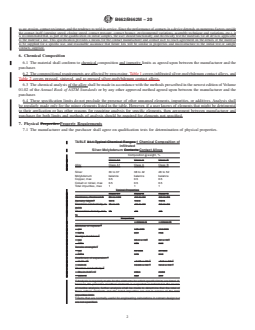
ing. Table 1 covers infiltrated silver-molybdenum contact
For referenced ASTM standards, visit the ASTM website, www.astm.org, or
alloys, and Table 2 covers pressed, sintered, and re-pressed
contact ASTM Customer Service at service@astm.org. For Annual Book of ASTM
Standards volume information, refer to the standard’s Document Summary page on silver-molybdenum contact alloys.
the ASTM website.
6.3 The chemical analysis of the alloy shall be made in
The last approved version of this historical standard is referenced on
www.astm.org. accordance with the methods prescribed in the newest edition
*A Summary of Changes section appears at the end of this standard
Copyright © ASTM International, 100 Barr Harbor Drive, PO Box C700, West Conshohocken, PA 19428-2959. United States
B662/B662M − 20
TABLE 1 Chemical Composition of Infiltrated
backing, tumbling to polish surfaces, special surface finish,
Silver-Molybdenum Contact Alloys
silver-rich surface layer, cleaning, etc.).
Composition, weight, %
8.2 The parts shall be free of defects in material or process-
Alloy Class A1 Class A Class B
ing that would seriously affect their performance.
Silver 33 to 37 38 to 42 48 to 52
9. Dimensions, Mass, and Permissible Variations
Molybdenum balance balance balance
Copper, max 0.5 0.5 0.5
9.1 Permissible variations in dimensions shall be within the
Cobalt or nickel, max 0.5 0.5 0.5
Total impurities, max 1 1 1
limits specified on drawings describing the contacts and
accompanying the order; or shall be within the limits specified
in the purchase order.
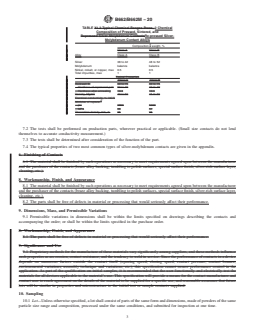
TABLE 2 Chemical Composition of Pressed, Sintered, and
Re-pressed Silver-Molybdenum Contact Alloys
10. Sampling
Composition, weight, %
10.1 Lot—Unless otherwise specified, a lot shall consist of
Alloy Class A Class B
partsofthesameformanddimensions,madeofpowdersofthe
same particle size range and composition, processed under the
Silver 38 to 42 48 to 52
Molybdenum balance balance
same conditions, and submitted for inspection at one time.
Nickel, cobalt, or copper, max 0.5 0.5
Total impurities, max 1 1 10.2 Sampling for Chemical Analysis:
10.2.1 Aminimum of one sample for analysis shall be taken
from each lot. A representative sample of chips may be
obtained by milling, drilling, or crushing at least two pieces
of Volume 01.02 of the Annual Book of ASTM Standards or by
any other approved method agreed upon between the manu- with dry t
...
This document is not an ASTM standard and is intended only to provide the user of an ASTM standard an indication of what changes have been made to the previous version. Because
it may not be technically possible to adequately depict all changes accurately, ASTM recommends that users consult prior editions as appropriate. In all cases only the current version
of the standard as published by ASTM is to be considered the official document.
Designation: B662 − 94 (Reapproved 2012) B662/B662M − 20
Standard Specification for
Silver-Molybdenum Electrical Contact Material
This standard is issued under the fixed designation B662;B662/B662M; the number immediately following the designation indicates the
year of original adoption or, in the case of revision, the year of last revision. A number in parentheses indicates the year of last
reapproval. A superscript epsilon (´) indicates an editorial change since the last revision or reapproval.
1. Scope Scope*
1.1 This specification covers electrical contact components made from silver-molybdenum by powder metallurgical procedures.
1.2 This specification covers compositions within the silver-molybdenum system normally specified by users of contacts.for
electrical contact applications.
1.3 The values stated in either SI units or inch-pound units are to be regarded as standard. No other units of measurement are
included in this standard.separately as standard. The values stated in each system are not necessarily exact equivalents; therefore,
to ensure conformance with the standard, each system shall be used independently of the other, and values from the two systems
shall not be combined.
1.4 This standard does not purport to address all of the safety concerns, if any, associated with its use. It is the responsibility
of the user of this standard to become familiar with all hazards including those identified in the appropriate Material Safety Data
Sheet (MSDS) for this product/material as provided by the manufacturer, to establish appropriate safety safety, health, and
healthenvironmental practices, and determine the applicability of regulatory limitations prior to use.
1.5 This international standard was developed in accordance with internationally recognized principles on standardization
established in the Decision on Principles for the Development of International Standards, Guides and Recommendations issued
by the World Trade Organization Technical Barriers to Trade (TBT) Committee.
2. Referenced Documents
2.1 ASTM Standards:
B328 Test Method for Density, Oil Content, and Interconnected Porosity of Sintered Metal Structural Parts and Oil-Impregnated
Bearings (Withdrawn 2009)
B542 Terminology Relating to Electrical Contacts and Their Use
3. Terminology
3.1 For terms related to electrical contacts and their use, refer to Terminology B542.
4. Ordering Information
4.1 Orders for this material under this specification shall include the following information:Include the following information
when placing orders for product under this specification:
4.1.1 Dimensions (see Section and tolerances,10),
4.1.2 Chemical composition (see tables in the appendix as a guideline),Alloy composition,
4.1.3 Physical properties (see Section properties,5 and the appendix as a guideline),
4.1.4 Certification (see Section Certification, 13), and
4.1.5 Other featuresrequirements as agreed upon between the manufacturer and purchaser.
5. Materials and Manufacture
5.1 The materials shall be of such purity and soundness so as to be suitable for the intended application.
NOTE 1—Proprietary methods for the manufacture of these materials vary significantly among suppliers, and these methods influence such properties
This specification is under the jurisdiction of ASTM Committee B02 on Nonferrous Metals and Alloys and is the direct responsibility of Subcommittee B02.05 on
Precious Metals and Electrical Contact Materials.
Current edition approved May 1, 2012April 1, 2020. Published May 2012April 2020. Originally approved in 1979. Last previous edition approved in 20062012 as
B662 – 94 (2006).(2012). DOI: 10.1520/B0662-94R12.10.1520/B0662_B0662M-20.
For referenced ASTM standards, visit the ASTM website, www.astm.org, or contact ASTM Customer Service at service@astm.org. For Annual Book of ASTM Standards
volume information, refer to the standard’s Document Summary page on the ASTM website.
The last approved version of this historical standard is referenced on www.astm.org.
*A Summary of Changes section appears at the end of this standard
Copyright © ASTM International, 100 Barr Harbor Drive, PO Box C700, West Conshohocken, PA 19428-2959. United States
B662/B662M − 20
as arc erosion, contact resistance, and the tendency to weld in service. Since the performance of contacts in a device depends on numerous factors outside
the contact itself (opening speed, closing speed, contact pressure, contact bounce, environmental variations, assembly technique and variations, etc.), it
is recommended that, as part of the qualification on initial samples, the user should functionally and electrically test the materials for all devices applicable
to the material’s use. This specification provides a means for the contact manufacturer and contact user to reach agreement on the details of the material
to be supplied for a specific use, and reasonable assurance that future lots will be similar in properties and microstructure to the initial test or sample
contacts supplied.
6. Chemical Composition
6.1 The material shall conform to chemical composition and impurity limits as agreed upon between the manufacturer and the
purchaser.
6.2 The compositional requirements are affected by processing. Table 1 covers infiltrated silver-molybdenum contact alloys, and
Table 2 covers pressed, sintered, and re-pressed silver-molybdenum contact alloys.
6.3 The chemical analysis of the alloy shall be made in accordance with the methods prescribed in the newest edition of Volume
01.02 of the Annual Book of ASTM Standards or by any other approved method agreed upon between the manufacturer and the
purchaser.
6.4 These specification limits do not preclude the presence of other unnamed elements, impurities, or additives. Analysis shall
be regularly made only for the minor elements listed in the table. However, if a user knows of elements that might be detrimental
to their application or has other reasons for requiring analysis for specific elements, then agreement between manufacturer and
purchaser for both limits and methods of analysis should be required for elements not specified.
7. Physical Properties Property Requirements
7.1 The manufacturer and the purchaser shall agree on qualification tests for determination of physical properties.
TABLE X1.1 Typical Chemical Ranges 1 Chemical Composition of
Infiltrated
Silver-Molybdenum Contacts Contact Alloys
A
Composition, weight, %
Class A1 Class A Class B
Alloy Class A1 Class A Class B
Silver 33 to 37 38 to 42 48 to 52
Molybdenum balance balance balance
Copper, max 0.5 0.5 0.5
Cobalt or nickel, max 0.5 0.5 0.5
Total impurities, max 1 1 1
Typical Properties
Class A1 Class A Class B
Hardness, Rockwell B 80 to 100 72 to 92 60 to 85
Density, Mg/m 10.3 10.3 10.3
Electrical conductivity, % 35 to 45 45 to 50 50 to 55
IACS
Theoretical density, min, 96 96 96
%
Properties
Class A Class B
B
Modulus of rupture:
psi 135 000 110 000
MPa 931 758
B
Young’s modulus:
6 6
psi 36.4 × 10 32 × 10
GPa 250 220
B
Tensile strength:
psi 55 000 45 000
MPa 379 310
B
Coefficient of expansion:
−6 −6
in./in.·°F 7.75 × 10 6.9 × 10
−6 −6
m/m·K 13.95 × 10 12.4 × 10
B
Thermal conductivity:
Btu·in./h·ft ·°F 2664 2988
W/m·K 384 431
A
Analysis is regularly made for the elements for which specific limits are listed. If,
however, the presence of “other” elements is suspected or indicated in the course
of routine analysis, further analysis shall be made to determine that the total of
these “other” elements and the listed impurities are not in excess of the total
impurities limit.
B
Items that are normally useful for engineering calculations in contact design but
are not specified.
B662/B662M − 20
TABLE X1.2 Typical Chemical Ranges Press, 2 Chemical
Composition of Pressed, Sintered, and
Repressed Silver-Molybdenum ContactsRe-pressed Silver-
Molybdenum Contact Alloys
A
Composition, weight, %
Class A Class B
Alloy Class A Class B
Silver 38 to 42 48 to 52
Molybdenum balance balance
Nickel, cobalt, or copper, max 0.5 0.5
Total impurities, max 1 1
Typical Properties
Class A Class B
Rockwell B: 60 to 75 60 to 75
Hardness of repressed part 50 to 70 40 to 70
Hardness after annealing 10.3 10.3
Density, Mg/m 40 to 50 45 to 55
Electrical conductivity, % IACS
B
Modulus of rupture:
psi 9800 8300
MPa 68 57
Theoretical density, min, % 95 95
7.2 The tests shall be performed on production parts, wherever practical or applicable. (Small size contacts do not lend
themselves to accurate conductivity measurement.)
7.3 The tests shall be determined after consideration of the function of the part.
7.4 The typical properties of two most common types of silver-molybdenum contacts are given in the appendix.
6. Finishing of Contacts
6.1 The material shall be finished by such operations as necessary to meet requi
...