


ASTM E2295-13
(Practice)Standard Practice for Fire Assay Silver Corrections in Analysis of Metal Bearing Ores, Concentrates, and Related Metallurgical Materials by Silver Determination in Slags and Cupels
Standard Practice for Fire Assay Silver Corrections in Analysis of Metal Bearing Ores, Concentrates, and Related Metallurgical Materials by Silver Determination in Slags and Cupels
SIGNIFICANCE AND USE
5.1 These methods are primarily intended to be used for the determination of silver correction in the fire assay silver determination. Silver assays are determined by fire assay for the purpose of metallurgical exchange between seller and buyer.
5.2 It is assumed that all who use this method will be trained analysts capable of performing skillfully and safely. It is expected that work will be performed in a properly equipped laboratory under appropriate quality control practices such as those described in Guide E882.
SCOPE
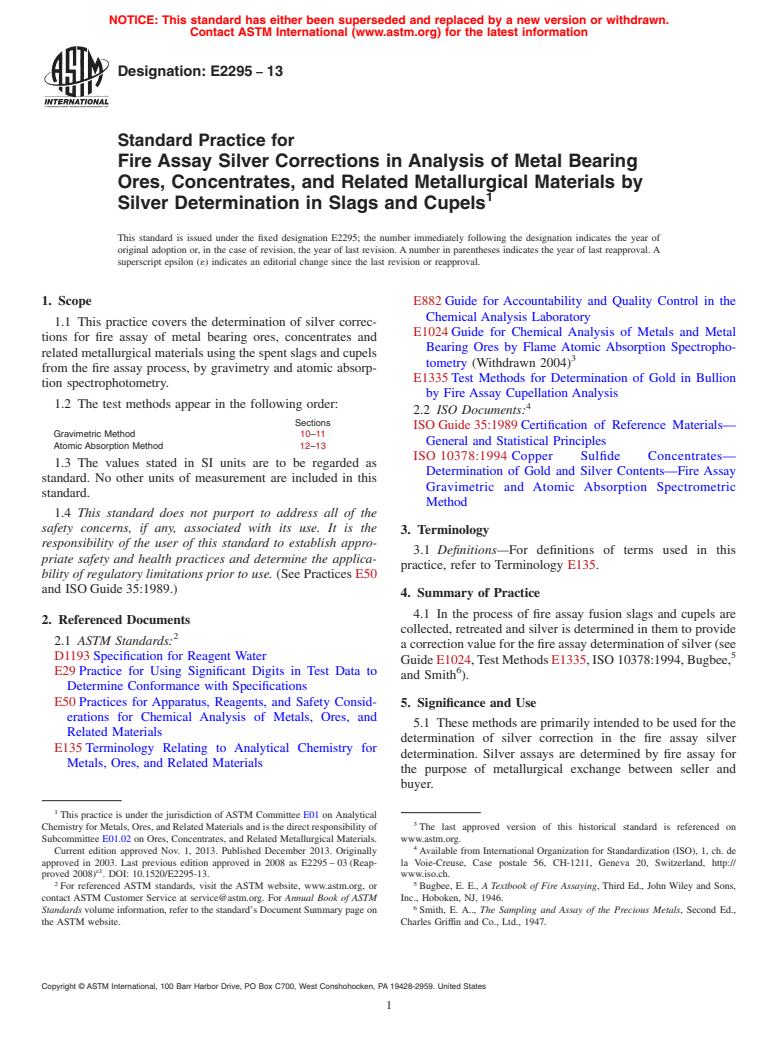
1.1 This practice covers the determination of silver corrections for fire assay of metal bearing ores, concentrates and related metallurgical materials using the spent slags and cupels from the fire assay process, by gravimetry and atomic absorption spectrophotometry.
1.2 The test methods appear in the following order:
Sections
Gravimetric Method
10–11
Atomic Absorption Method
12–13
1.3 The values stated in SI units are to be regarded as standard. No other units of measurement are included in this standard.
1.4 This standard does not purport to address all of the safety concerns, if any, associated with its use. It is the responsibility of the user of this standard to establish appropriate safety and health practices and determine the applicability of regulatory limitations prior to use. (See Practices E50 and ISO Guide 35:1989.)
General Information
Buy Standard


Standards Content (Sample)
NOTICE: This standard has either been superseded and replaced by a new version or withdrawn.
Contact ASTM International (www.astm.org) for the latest information
Designation: E2295 − 13
Standard Practice for
Fire Assay Silver Corrections in Analysis of Metal Bearing
Ores, Concentrates, and Related Metallurgical Materials by
1
Silver Determination in Slags and Cupels
This standard is issued under the fixed designation E2295; the number immediately following the designation indicates the year of
original adoption or, in the case of revision, the year of last revision. A number in parentheses indicates the year of last reapproval. A
superscript epsilon (´) indicates an editorial change since the last revision or reapproval.
1. Scope E882 Guide for Accountability and Quality Control in the
Chemical Analysis Laboratory
1.1 This practice covers the determination of silver correc-
E1024 Guide for Chemical Analysis of Metals and Metal
tions for fire assay of metal bearing ores, concentrates and
Bearing Ores by Flame Atomic Absorption Spectropho-
related metallurgical materials using the spent slags and cupels
3
tometry (Withdrawn 2004)
from the fire assay process, by gravimetry and atomic absorp-
E1335 Test Methods for Determination of Gold in Bullion
tion spectrophotometry.
by Fire Assay Cupellation Analysis
1.2 The test methods appear in the following order: 4
2.2 ISO Documents:
Sections
ISO Guide 35:1989 Certification of Reference Materials—
Gravimetric Method 10–11
General and Statistical Principles
Atomic Absorption Method 12–13
ISO 10378:1994 Copper Sulfide Concentrates—
1.3 The values stated in SI units are to be regarded as
Determination of Gold and Silver Contents—Fire Assay
standard. No other units of measurement are included in this
Gravimetric and Atomic Absorption Spectrometric
standard.
Method
1.4 This standard does not purport to address all of the
safety concerns, if any, associated with its use. It is the
3. Terminology
responsibility of the user of this standard to establish appro-
3.1 Definitions—For definitions of terms used in this
priate safety and health practices and determine the applica-
practice, refer to Terminology E135.
bility of regulatory limitations prior to use. (See Practices E50
and ISO Guide 35:1989.)
4. Summary of Practice
4.1 In the process of fire assay fusion slags and cupels are
2. Referenced Documents
collected, retreated and silver is determined in them to provide
2
2.1 ASTM Standards:
a correction value for the fire assay determination of silver (see
5
D1193 Specification for Reagent Water
GuideE1024,TestMethodsE1335,ISO 10378:1994,Bugbee,
6
E29 Practice for Using Significant Digits in Test Data to
and Smith ).
Determine Conformance with Specifications
E50 Practices for Apparatus, Reagents, and Safety Consid-
5. Significance and Use
erations for Chemical Analysis of Metals, Ores, and
5.1 These methods are primarily intended to be used for the
Related Materials
determination of silver correction in the fire assay silver
E135 Terminology Relating to Analytical Chemistry for
determination. Silver assays are determined by fire assay for
Metals, Ores, and Related Materials
the purpose of metallurgical exchange between seller and
buyer.
1
This practice is under the jurisdiction of ASTM Committee E01 on Analytical
3
Chemistry for Metals, Ores, and Related Materials and is the direct responsibility of The last approved version of this historical standard is referenced on
Subcommittee E01.02 on Ores, Concentrates, and Related Metallurgical Materials. www.astm.org.
4
Current edition approved Nov. 1, 2013. Published December 2013. Originally Available from International Organization for Standardization (ISO), 1, ch. de
approved in 2003. Last previous edition approved in 2008 as E2295 – 03 (Reap- la Voie-Creuse, Case postale 56, CH-1211, Geneva 20, Switzerland, http://
ε1
proved 2008) . DOI: 10.1520/E2295-13. www.iso.ch.
2 5
For referenced ASTM standards, visit the ASTM website, www.astm.org, or Bugbee, E. E., A Textbook of Fire Assaying, Third Ed., John Wiley and Sons,
contact ASTM Customer Service at service@astm.org. For Annual Book of ASTM Inc., Hoboken, NJ, 1946.
6
Standards volume information, refer to the standard’s Document Summary page on Smith, E. A., The Sampling and Assay of the Precious Metals, Second Ed.,
the ASTM website. Charles Griffin and Co., Ltd., 1947.
Copyright © ASTM International, 100 Barr Harbor Drive, PO Box C700, West Conshohocken, PA 19428-2959. United States
1
---------------------- Page: 1 ----------------------
E2295 − 13
5.2 Itisassumedthatallwhousethismethodwillbetrained 9.2 Place the weighed slags and cupels (7.6) into a ring
analysts capable of performing skillfully and safely. It is grinder and pulverize for about 20 s. This should reduce the
expected that work will be performed in a properly equipped material to pass a 150-µm sieve.This is the retreatment sample
laboratory under appropriate quality control practices such as that corresponds to the duplica
...
This document is not an ASTM standard and is intended only to provide the user of an ASTM standard an indication of what changes have been made to the previous version. Because
it may not be technically possible to adequately depict all changes accurately, ASTM recommends that users consult prior editions as appropriate. In all cases only the current version
of the standard as published by ASTM is to be considered the official document.
´1
Designation: E2295 − 03 (Reapproved 2008) E2295 − 13
Standard Practice for
Fire Assay Silver Corrections in Analysis of Metal Bearing
Ores, Concentrates, and Related Metallurgical Materials by
1
Silver Determination in Slags and Cupels
This standard is issued under the fixed designation E2295; the number immediately following the designation indicates the year of
original adoption or, in the case of revision, the year of last revision. A number in parentheses indicates the year of last reapproval. A
superscript epsilon (´) indicates an editorial change since the last revision or reapproval.
1
ε NOTE—Editorial and warning note changes were made throughout in December 2008.
1. Scope
1.1 This practice covers the determination of silver corrections for fire assay of metal bearing ores, concentrates and related
metallurgical materials using the spent slags and cupels from the fire assay process, by gravimetry and atomic absorption
spectrophotometry.
1.2 The test methods appear in the following order:
Sections
Gravimetric Method 10–11
Atomic Absorption Method 12–13
1.3 The values stated in SI units are to be regarded as standard. No other units of measurement are included in this standard.
1.4 This standard does not purport to address all of the safety concerns, if any, associated with its use. It is the responsibility
of the user of this standard to establish appropriate safety and health practices and determine the applicability of regulatory
limitations prior to use. (See Practices E50 and ISO Guide 35:1989.)
2. Referenced Documents
2
2.1 ASTM Standards:
D1193 Specification for Reagent Water
E29 Practice for Using Significant Digits in Test Data to Determine Conformance with Specifications
E50 Practices for Apparatus, Reagents, and Safety Considerations for Chemical Analysis of Metals, Ores, and Related Materials
E135 Terminology Relating to Analytical Chemistry for Metals, Ores, and Related Materials
E882 Guide for Accountability and Quality Control in the Chemical Analysis Laboratory
E1024 Guide for Chemical Analysis of Metals and Metal Bearing Ores by Flame Atomic Absorption Spectrophotometry
3
(Withdrawn 2004)
E1335 Test Methods for Determination of Gold in Bullion by Fire Assay Cupellation Analysis
4
2.2 ISO Documents:
ISO Guide 35:1989 Certification of Reference Materials—General and Statistical Principles
ISO 10378:1994 Copper Sulfide Concentrates—Determination of Gold and Silver Contents—Fire Assay Gravimetric and
Atomic Absorption Spectrometric Method
3. Terminology
3.1 Definitions—For definitions of terms used in this practice, refer to Terminology E135.
1
This practice is under the jurisdiction of ASTM Committee E01 on Analytical Chemistry for Metals, Ores, and Related Materials and is the direct responsibility of
Subcommittee E01.02 on Ores, Concentrates, and Related Metallurgical Materials.
Current edition approved Dec. 15, 2008Nov. 1, 2013. Published January 2009December 2013. Originally approved in 2003. Last previous edition approved in 20032008
ε1
as E2295 – 03.E2295 – 03 (Reapproved 2008) . DOI: 10.1520/E2295-03R08E01.10.1520/E2295-13.
2
For referenced ASTM standards, visit the ASTM website, www.astm.org, or contact ASTM Customer Service at service@astm.org. For Annual Book of ASTM Standards
volume information, refer to the standard’s Document Summary page on the ASTM website.
3
The last approved version of this historical standard is referenced on www.astm.org.
4
Available from International Organization for Standardization (ISO), 1, ch. de la Voie-Creuse, Case postale 56, CH-1211, Geneva 20, Switzerland, http://www.iso.ch.
Copyright © ASTM International, 100 Barr Harbor Drive, PO Box C700, West Conshohocken, PA 19428-2959. United States
1
---------------------- Page: 1 ----------------------
E2295 − 13
4. Summary of Practice
4.1 In the process of fire assay fusion slags and cupels are collected, retreated and silver is determined in them to provide a
5
correction value for the fire assay determination of silver (see Guide E1024, Test Methods E1335, ISO 10378:1994, Bugbee, and
6
Smith ).
5. Significance and Use
5.1 These methods are primarily intended to be used for the determination of silver correction in the fire assay silver
determination. Silver assays are determined by fire assay for the purpose of metallurgical exchange between seller and buyer.
5.2 It is assumed that all who use this method will be trained analysts capable of performing skillfully and safely. It is expected
that work will be performed in a properly equipped laboratory under appropriate quali
...
Questions, Comments and Discussion
Ask us and Technical Secretary will try to provide an answer. You can facilitate discussion about the standard in here.