


ASTM G180-13(2019)
(Test Method)Standard Test Method for Corrosion Inhibiting Admixtures for Steel in Concrete by Polarization Resistance in Cementitious Slurries
Standard Test Method for Corrosion Inhibiting Admixtures for Steel in Concrete by Polarization Resistance in Cementitious Slurries
SIGNIFICANCE AND USE
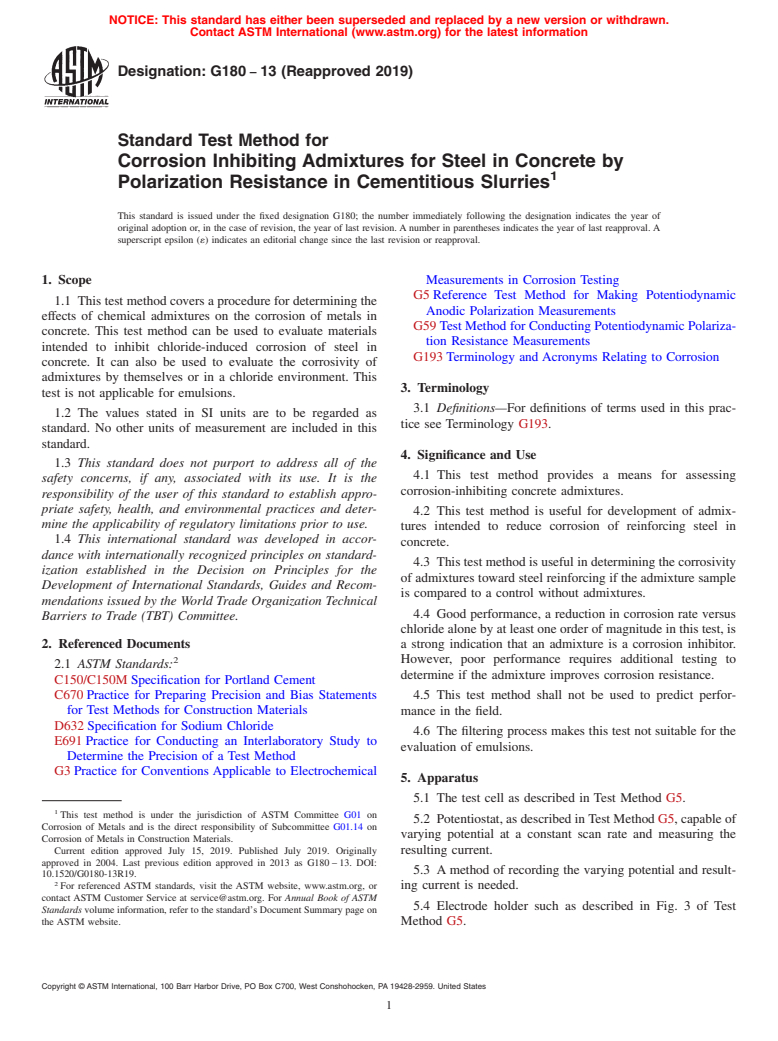
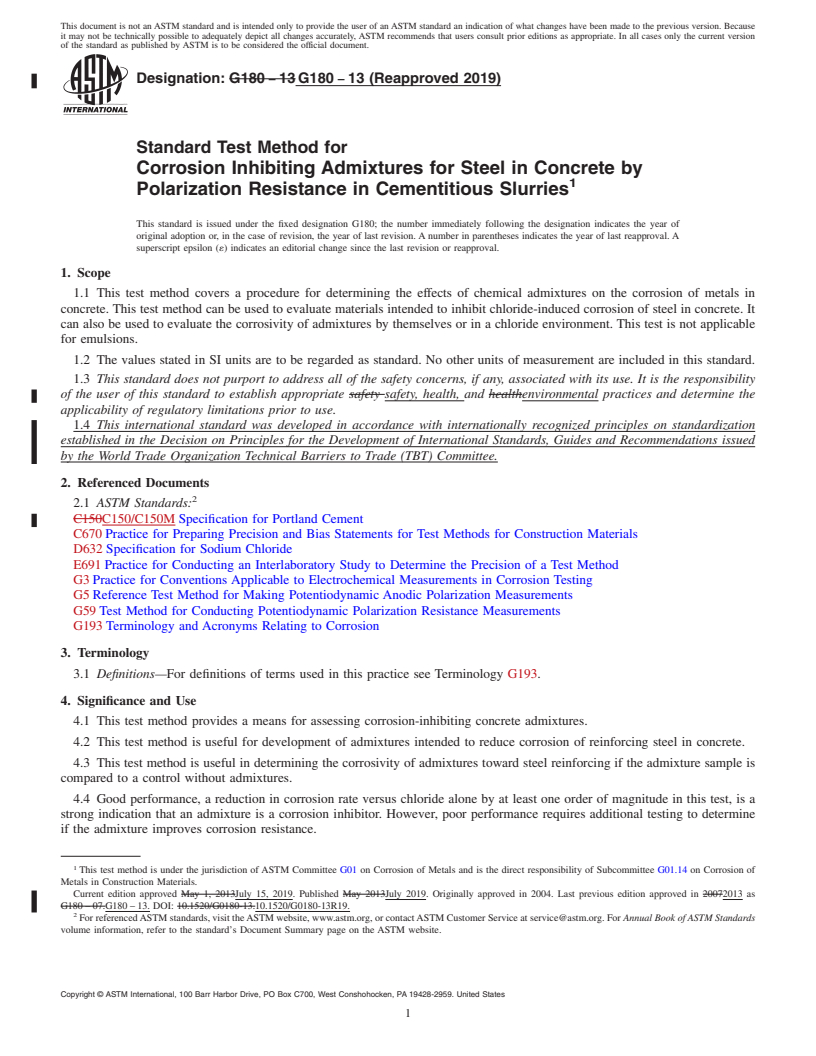
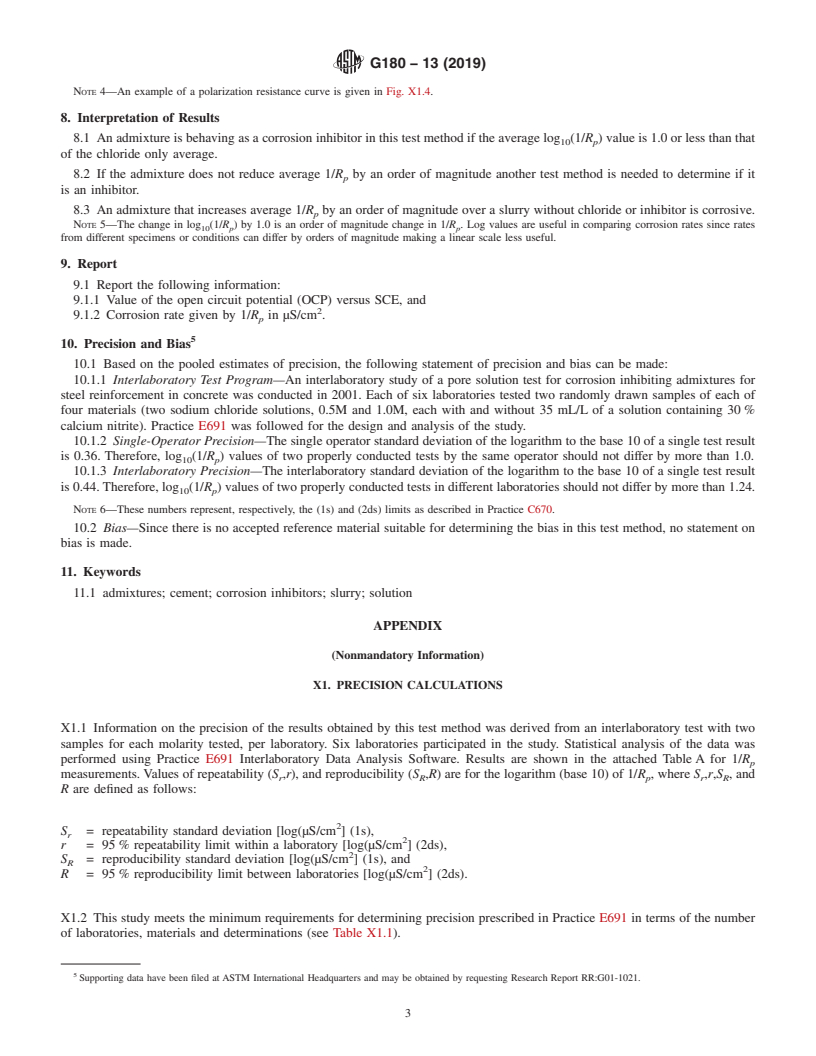
4.1 This test method provides a means for assessing corrosion-inhibiting concrete admixtures.
4.2 This test method is useful for development of admixtures intended to reduce corrosion of reinforcing steel in concrete.
4.3 This test method is useful in determining the corrosivity of admixtures toward steel reinforcing if the admixture sample is compared to a control without admixtures.
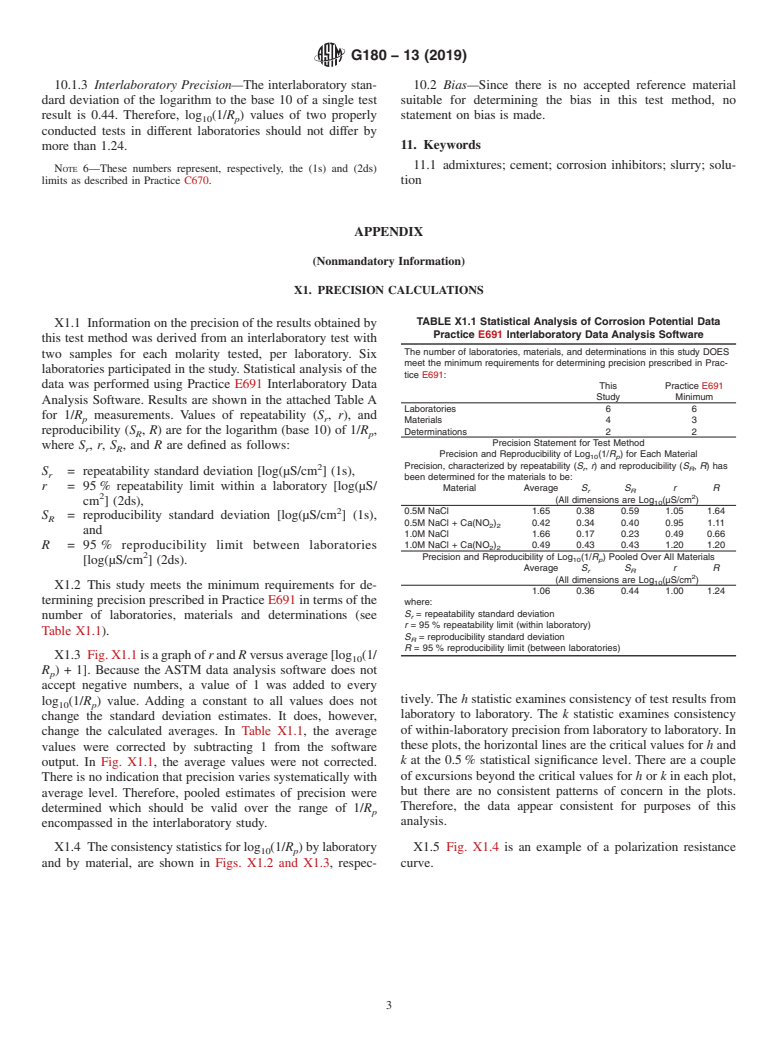
4.4 Good performance, a reduction in corrosion rate versus chloride alone by at least one order of magnitude in this test, is a strong indication that an admixture is a corrosion inhibitor. However, poor performance requires additional testing to determine if the admixture improves corrosion resistance.
4.5 This test method shall not be used to predict performance in the field.
4.6 The filtering process makes this test not suitable for the evaluation of emulsions.
SCOPE
1.1 This test method covers a procedure for determining the effects of chemical admixtures on the corrosion of metals in concrete. This test method can be used to evaluate materials intended to inhibit chloride-induced corrosion of steel in concrete. It can also be used to evaluate the corrosivity of admixtures by themselves or in a chloride environment. This test is not applicable for emulsions.
1.2 The values stated in SI units are to be regarded as standard. No other units of measurement are included in this standard.
1.3 This standard does not purport to address all of the safety concerns, if any, associated with its use. It is the responsibility of the user of this standard to establish appropriate safety, health, and environmental practices and determine the applicability of regulatory limitations prior to use.
1.4 This international standard was developed in accordance with internationally recognized principles on standardization established in the Decision on Principles for the Development of International Standards, Guides and Recommendations issued by the World Trade Organization Technical Barriers to Trade (TBT) Committee.
General Information
Buy Standard
Standards Content (Sample)
NOTICE: This standard has either been superseded and replaced by a new version or withdrawn.
Contact ASTM International (www.astm.org) for the latest information
Designation: G180 − 13 (Reapproved 2019)
Standard Test Method for
Corrosion Inhibiting Admixtures for Steel in Concrete by
Polarization Resistance in Cementitious Slurries
This standard is issued under the fixed designation G180; the number immediately following the designation indicates the year of
original adoption or, in the case of revision, the year of last revision. A number in parentheses indicates the year of last reapproval. A
superscript epsilon (´) indicates an editorial change since the last revision or reapproval.
1. Scope Measurements in Corrosion Testing
G5 Reference Test Method for Making Potentiodynamic
1.1 This test method covers a procedure for determining the
Anodic Polarization Measurements
effects of chemical admixtures on the corrosion of metals in
G59 Test Method for Conducting Potentiodynamic Polariza-
concrete. This test method can be used to evaluate materials
tion Resistance Measurements
intended to inhibit chloride-induced corrosion of steel in
G193 Terminology and Acronyms Relating to Corrosion
concrete. It can also be used to evaluate the corrosivity of
admixtures by themselves or in a chloride environment. This
3. Terminology
test is not applicable for emulsions.
3.1 Definitions—For definitions of terms used in this prac-
1.2 The values stated in SI units are to be regarded as
tice see Terminology G193.
standard. No other units of measurement are included in this
standard.
4. Significance and Use
1.3 This standard does not purport to address all of the
4.1 This test method provides a means for assessing
safety concerns, if any, associated with its use. It is the
corrosion-inhibiting concrete admixtures.
responsibility of the user of this standard to establish appro-
priate safety, health, and environmental practices and deter-
4.2 This test method is useful for development of admix-
mine the applicability of regulatory limitations prior to use.
tures intended to reduce corrosion of reinforcing steel in
1.4 This international standard was developed in accor-
concrete.
dance with internationally recognized principles on standard-
4.3 This test method is useful in determining the corrosivity
ization established in the Decision on Principles for the
of admixtures toward steel reinforcing if the admixture sample
Development of International Standards, Guides and Recom-
is compared to a control without admixtures.
mendations issued by the World Trade Organization Technical
4.4 Good performance, a reduction in corrosion rate versus
Barriers to Trade (TBT) Committee.
chloride alone by at least one order of magnitude in this test, is
2. Referenced Documents a strong indication that an admixture is a corrosion inhibitor.
However, poor performance requires additional testing to
2.1 ASTM Standards:
determine if the admixture improves corrosion resistance.
C150/C150M Specification for Portland Cement
C670 Practice for Preparing Precision and Bias Statements
4.5 This test method shall not be used to predict perfor-
for Test Methods for Construction Materials mance in the field.
D632 Specification for Sodium Chloride
4.6 The filtering process makes this test not suitable for the
E691 Practice for Conducting an Interlaboratory Study to
evaluation of emulsions.
Determine the Precision of a Test Method
G3 Practice for Conventions Applicable to Electrochemical
5. Apparatus
5.1 The test cell as described in Test Method G5.
This test method is under the jurisdiction of ASTM Committee G01 on
5.2 Potentiostat, as described inTest Method G5, capable of
Corrosion of Metals and is the direct responsibility of Subcommittee G01.14 on
varying potential at a constant scan rate and measuring the
Corrosion of Metals in Construction Materials.
Current edition approved July 15, 2019. Published July 2019. Originally resulting current.
approved in 2004. Last previous edition approved in 2013 as G180 – 13. DOI:
5.3 A method of recording the varying potential and result-
10.1520/G0180-13R19.
For referenced ASTM standards, visit the ASTM website, www.astm.org, or ing current is needed.
contact ASTM Customer Service at service@astm.org. For Annual Book of ASTM
5.4 Electrode holder such as described in Fig. 3 of Test
Standards volume information, refer to the standard’s Document Summary page on
the ASTM website. Method G5.
Copyright © ASTM International, 100 Barr Harbor Drive, PO Box C700, West Conshohocken, PA 19428-2959. United States
G180 − 13 (2019)
5.5 Electrodes: solution, and continue to stir and purge for a further 4 h.After
5.5.1 Workingelectrode,preparedfroma12.7mmlengthof 4 h, stop stirring and continue purging for a another 20 h.
9.5 mm diameter rod stock. Carbon steel C1215 should be
NOTE 3—The multi-laboratory test was run at the two different chloride
used.
levels to develop the precision statement. The higher chloride level would
be representative of a more severe exposure.
NOTE 1—If specimen forms are used other than those called for by this
test method, for example flat sheet specimens, care should be taken not to
7.5.2 Measure the open circuit potential.
introduce crevices which can lead to erroneous results.
7.5.3 Measure the polarization resistance (R ) by recording
p
5.6 Auxiliary Electrodes—Two graphite rods or platinized- the potentiodynamic polarization curve at a scan rate of
niobium or platinum mesh. 0.167 mV⁄s, from –20 mV to +20 mV versus open circuit
potential.
5.7 Reference Electrodes—A saturated calomel electrode
7.5.4 Plot the polarization resistance curve as a linear
with a controlled rate of leakage (about 3 µL/h) is recom-
potential-current density plot as shown in Practice G3.
mended.
7.5.5 Determine the polarization resistance R , as the tan-
p
gentofthecurveat i=0,asdescribedinTestMethodG59.The
6. Reagents and Materials
corrosion rate is expressed as 1/R in µS/cm .
p
6.1 Type I/II cement (C3A content between 6 and 10 %),
NOTE 4—An example of a polarization resistance curve is given in Fig.
according to Specification C150/C150M.
X1.4.
6.2 Filter paper with 1.1 µm retention.
8. Interpretation of Results
6.3 PTFE stir bars.
8.1 An admixture is behaving as a corrosion inhibitor in this
6.4 Carbon steel C1215 samples, cylindrical in shape, with
test method if the average log (1/R ) value is 1.0 or less than
2 3
10 p
5.1 cm exposed area.
that of the chloride only average.
6.5 Sodium chloride, reagent grade, according to Specifica-
8.2 If the admixture does not reduce average 1/R by an
p
tion D632.
order of magnitude another test method is needed to determine
6.6 Calcium hydroxide, reagent grade.
if it is an inhibitor.
6.7 Admixtures to be tested.
8.3 An admixture that increases average 1/R by an order of
p
magnitude over a slurry without chloride or inhibitor is
6.8 Carbon dioxide free compressed air.
corrosive.
NOTE 5—The change in log (1/R ) by 1.0 is an order of magnitude
10 p
7. Experimental Procedure
change in 1/R . Log values are useful in comparing corrosion rates since
p
rates from different specimens or conditions can differ by orders of
7.1 Prepare a cement slurry consisting of 1000 g of water
magnitude making a linear scale less useful.
and 200 g cement. Mix thoroughly, stir for 60 min and filter.
NOTE2—Anadmixtureshouldbeaddedataquantityconsistentwithits
9. Report
addition rate in concrete. Water measured at 35 to 965 mLis equivalent to
5 L/m in concrete. If other dosages are desired, proportion them based on
9.1 Report the following information:
this ratio.
9.1.1 Value of the open circuit potential (OCP) versus SCE,
7.2 Filter,andadd4g/Lcalciumhydroxideandstirafurther
and
30 min.
9.1.2 Corrosion rate given by 1/R in µS/cm .
p
7.3 Setup a standard electrochemical cell according to Test
10. Precision and Bias
Method G5 and fill it with 900 mL of filtered slurry solution.
10.1 Based on the pooled estimates of precision, the follow-
Purge the cell with carbon dioxide free air.Air flow rate should
ing statement of precision and
...
This document is not an ASTM standard and is intended only to provide the user of an ASTM standard an indication of what changes have been made to the previous version. Because
it may not be technically possible to adequately depict all changes accurately, ASTM recommends that users consult prior editions as appropriate. In all cases only the current version
of the standard as published by ASTM is to be considered the official document.
Designation: G180 − 13 G180 − 13 (Reapproved 2019)
Standard Test Method for
Corrosion Inhibiting Admixtures for Steel in Concrete by
Polarization Resistance in Cementitious Slurries
This standard is issued under the fixed designation G180; the number immediately following the designation indicates the year of
original adoption or, in the case of revision, the year of last revision. A number in parentheses indicates the year of last reapproval. A
superscript epsilon (´) indicates an editorial change since the last revision or reapproval.
1. Scope
1.1 This test method covers a procedure for determining the effects of chemical admixtures on the corrosion of metals in
concrete. This test method can be used to evaluate materials intended to inhibit chloride-induced corrosion of steel in concrete. It
can also be used to evaluate the corrosivity of admixtures by themselves or in a chloride environment. This test is not applicable
for emulsions.
1.2 The values stated in SI units are to be regarded as standard. No other units of measurement are included in this standard.
1.3 This standard does not purport to address all of the safety concerns, if any, associated with its use. It is the responsibility
of the user of this standard to establish appropriate safety safety, health, and healthenvironmental practices and determine the
applicability of regulatory limitations prior to use.
1.4 This international standard was developed in accordance with internationally recognized principles on standardization
established in the Decision on Principles for the Development of International Standards, Guides and Recommendations issued
by the World Trade Organization Technical Barriers to Trade (TBT) Committee.
2. Referenced Documents
2.1 ASTM Standards:
C150C150/C150M Specification for Portland Cement
C670 Practice for Preparing Precision and Bias Statements for Test Methods for Construction Materials
D632 Specification for Sodium Chloride
E691 Practice for Conducting an Interlaboratory Study to Determine the Precision of a Test Method
G3 Practice for Conventions Applicable to Electrochemical Measurements in Corrosion Testing
G5 Reference Test Method for Making Potentiodynamic Anodic Polarization Measurements
G59 Test Method for Conducting Potentiodynamic Polarization Resistance Measurements
G193 Terminology and Acronyms Relating to Corrosion
3. Terminology
3.1 Definitions—For definitions of terms used in this practice see Terminology G193.
4. Significance and Use
4.1 This test method provides a means for assessing corrosion-inhibiting concrete admixtures.
4.2 This test method is useful for development of admixtures intended to reduce corrosion of reinforcing steel in concrete.
4.3 This test method is useful in determining the corrosivity of admixtures toward steel reinforcing if the admixture sample is
compared to a control without admixtures.
4.4 Good performance, a reduction in corrosion rate versus chloride alone by at least one order of magnitude in this test, is a
strong indication that an admixture is a corrosion inhibitor. However, poor performance requires additional testing to determine
if the admixture improves corrosion resistance.
This test method is under the jurisdiction of ASTM Committee G01 on Corrosion of Metals and is the direct responsibility of Subcommittee G01.14 on Corrosion of
Metals in Construction Materials.
Current edition approved May 1, 2013July 15, 2019. Published May 2013July 2019. Originally approved in 2004. Last previous edition approved in 20072013 as
G180 – 07.G180 – 13. DOI: 10.1520/G0180-13.10.1520/G0180-13R19.
For referenced ASTM standards, visit the ASTM website, www.astm.org, or contact ASTM Customer Service at service@astm.org. For Annual Book of ASTM Standards
volume information, refer to the standard’s Document Summary page on the ASTM website.
Copyright © ASTM International, 100 Barr Harbor Drive, PO Box C700, West Conshohocken, PA 19428-2959. United States
G180 − 13 (2019)
4.5 This test method shall not be used to predict performance in the field.
4.6 The filtering process makes this test not suitable for the evaluation of emulsions.
5. Apparatus
5.1 The test cell as described in Test Method G5.
5.2 Potentiostat, as described in Test Method G5, capable of varying potential at a constant scan rate and measuring the resulting
current.
5.3 A method of recording the varying potential and resulting current is needed.
5.4 Electrode holder such as described in Fig. 3 of Test Method G5.
5.5 Electrodes:
5.5.1 Working electrode, prepared from a 12.7 mm length of 9.5 mm diameter rod stock. Carbon steel C1215 should be used.
NOTE 1—If specimen forms are used other than those called for by this test method, for example flat sheet specimens, care should be taken not to
introduce crevices which can lead to erroneous results.
5.6 Auxiliary Electrodes—Two graphite rods or platinized-niobium or platinum mesh.
5.7 Reference Electrodes—A saturated calomel electrode with a controlled rate of leakage (about 3 μL/h) is recommended.
6. Reagents and Materials
6.1 Type I/II cement (C3A content between 6 and 10 %), according to Specification C150C150/C150M.
6.2 Filter paper with 1.1 μm retention.
6.3 PTFE stir bars.
2 3
6.4 Carbon steel C1215 samples, cylindrical in shape, with 5.1 cm exposed area.
6.5 Sodium chloride, reagent grade, according to Specification D632.
6.6 Calcium hydroxide, reagent grade.
6.7 Admixtures to be tested.
6.8 Carbon dioxide free compressed air.
7. Experimental Procedure
7.1 Prepare a cement slurry consisting of 1000 g of water and 200 g cement. Mix thoroughly, stir for 60 min and filter.
NOTE 2—An admixture should be added at a quantity consistent with its addition rate in concrete. Water measured at 35 to 965 mL is equivalent to
5 L/m in concrete. If other dosages are desired, proportion them based on this ratio.
7.2 Filter, and add 4 g/L calcium hydroxide and stir a further 30 min.
7.3 Setup a standard electrochemical cell according to Test Method G5 and fill it with 900 mL of filtered slurry solution. Purge
the cell with carbon dioxide free air. Air flow rate should be at least 300 cc/min.
7.4 Degrease the metal sample by cleaning ultrasonically in hexane for 2 min. If an ultrasonic bath is not available, soak the
samples in hexane and wipe dry. Make sure the sample is thoroughly dried before mounting it on the electrode holder.
7.5 While purging the cell with carbon dioxide free air, precondition the electrode in the solution for 24 h.
7.5.1 Add NaCl to the solution obtained in 7.3 (having been purged for 24 h with CO -free air), to obtain a 0.5 or a 1M solution,
and continue to stir and purge for a further 4 h. After 4 h, stop stirring and continue purging for a another 20 h.
NOTE 3—The multi-laboratory test was run at the two different chloride levels to develop the precision statement. The higher chloride level would be
representative of a more severe exposure.
7.5.2 Measure the open circuit potential.
7.5.3 Measure the polarization resistance (R ) by recording the potentiodynamic polarization curve at a scan rate of 0.167 mV ⁄s,
p
from –20 mV to +20 mV versus open circuit potential.
7.5.4 Plot the polarization resistance curve as a linear potential-current density plot as shown in Practice G3.
7.5.5 Determine the polarization resistance R , as the tangent of the curve at i = 0, as described in Test Method G59. The
p
corrosion rate is expressed as 1/R in μS/cm .
p
The sole source of supply of the apparatus known to the committee at this time is Metal Samples, AL, sample type P/N410. If you are aware of alternative suppliers,
please provide this information to ASTM International Headquarters. Your comments will receive careful consideration at a meeting of the responsible technical committee,
which you may attend.
A CO free air gas generator (typically used for FT-IR equipment) can be used.
--------------
...
Questions, Comments and Discussion
Ask us and Technical Secretary will try to provide an answer. You can facilitate discussion about the standard in here.