

EN 13445-11:2026
(Main)Unfired pressure vessels - Part 11: Additional requirements for pressure vessels of titanium and titanium alloys
General Information
- Abstract
This document specifies requirements for unfired pressure vessels and their parts made of titanium and titanium alloys in addition to the general requirements for unfired pressure vessels under EN 13445-1:2026 to EN 13445-5:2026.
NOTE 1 Cast materials, HIP and additive manufacturing are not included in this version. Details regarding such materials will be subject to an amendment to or a revision of this European Standard.
NOTE 2 Materials in Groups 51.4 and 54 are not included in this version.
- Status
- Published
- Publication Date
- 30-Jun-2026
- Technical Committee
- CEN/TC 54 - Unfired pressure vessels
- Current Stage
- 6060 - Definitive text made available (DAV) - Publishing
- Start Date
- 01-Jul-2026
- Due Date
- 05-Sep-2028
- Completion Date
- 01-Jul-2026

Overview
EN 13445-11:2026 is a European Standard formulated by CEN, specifying additional requirements for the design, manufacture, and inspection of unfired pressure vessels made of titanium and titanium alloys. Intended to be used in conjunction with the general requirements defined in EN 13445-1:2026 through EN 13445-5:2026, this standard targets safety, reliability, and durability in processes where titanium’s unique resilience to corrosion and high strength-to-weight ratio are essential. EN 13445-11:2026 does not address cast materials, hot isostatically pressed (HIP) materials, or additive manufacturing components-these will be included in future updates.
Key Topics
Key technical and procedural requirements covered:
- Material Specifications: Details on suitable titanium and titanium alloys, including minimum elongation and toughness for safe pressure vessel construction. Only wrought materials with specified mechanical properties and proper material documentation are permitted.
- Material Grouping System: Utilizes a grouping system based on EN ISO 15608:2025, with only certain grades deemed suitable for welded construction, specifically excluding Groups 51.4 and 54.
- Design Considerations: Guidelines on corrosion resistance, joint coefficients, nominal design stress, elastic limits, creep design, and fatigue-life considerations tailored for titanium and titanium alloy vessels.
- Manufacturing Requirements: Recommendations and obligations for welding practices, filler metals, welding procedure qualifications, joint preparation and cleanliness, as well as forming and post-weld heat treatment processes.
- Inspection and Testing: Procedures for both destructive (impact, tensile) and non-destructive testing, along with acceptance criteria relevant to titanium pressure parts, focused on qualities like toughness and structural soundness.
- Exclusions and Limitations: This version excludes cast, HIP, and additively manufactured titanium parts, as well as certain material groups.
Applications
EN 13445-11:2026 is applicable to industries requiring high-performance unfired pressure vessels, especially where corrosion resistance, low weight, and reliable mechanical integrity are critical.
Common industrial sectors benefiting from this standard:
- Chemical and Petrochemical Processing: For storage and transportation of aggressive or corrosive fluids.
- Offshore and Marine Engineering: Pressure vessels exposed to saline environments, demanding robust anti-corrosion properties.
- Pharmaceutical and Food Industry: Where hygiene, resistance to cleaning agents, and non-contamination are paramount.
- Power Generation: Equipment such as heat exchangers and condensers working under variable pressures and temperatures.
- High-Purity Processing: Applications requiring non-reactivity, such as semiconductor manufacturing or ultra-pure water systems.
Adopting EN 13445-11:2026 ensures operators meet stringent European legislative and safety requirements, enhances global market access, and supports quality assurance in titanium pressure vessel fabrication.
Related Standards
EN 13445-11:2026 functions as an extension to the main suite of EN 13445 standards. The following standards should be consulted in parallel for comprehensive compliance:
- EN 13445-1:2026 – General requirements for unfired pressure vessels
- EN 13445-2:2026 – Materials
- EN 13445-3:2026 – Design
- EN 13445-4:2026 – Fabrication
- EN 13445-5:2026 – Inspection and testing
Additionally, relevant welding and materials standards include:
- EN ISO 15614-5:2024 – Welding procedure tests for titanium and its alloys
- EN ISO 9606-5:2000 – Welder qualifications for titanium alloys
- EN 10204:2004 – Inspection documents for metallic products
By referencing and applying EN 13445-11:2026 with these interconnected standards, manufacturers and engineers can achieve the necessary safety, consistency, and regulatory conformity for titanium pressure vessel projects across Europe and beyond.
Relations
- Effective Date
- 29-Apr-2026
- Effective Date
- 29-Jul-2026
- Effective Date
- 29-Jul-2026
- Effective Date
- 29-Jul-2026
- Effective Date
- 29-Jul-2026
- Effective Date
- 29-Jul-2026
- Effective Date
- 29-Jul-2026
- Effective Date
- 29-Jul-2026
- Effective Date
- 29-Jul-2026
- Effective Date
- 29-Jul-2026
- Effective Date
- 29-Jul-2026
- Effective Date
- 15-Jul-2026
- Effective Date
- 29-Jul-2026
- Effective Date
- 08-Jul-2026
- Effective Date
- 08-Jul-2026
Get Certified
Connect with accredited certification bodies for this standard

Institut za varilstvo d.o.o. (Welding Institute)
Slovenia's leading welding institute since 1952. ISO 3834, EN 1090, pressure equipment certification, NDT personnel, welder qualification. Only IIW Au
Sponsored listings
Frequently Asked Questions
EN 13445-11:2026 is a standard published by the European Committee for Standardization (CEN). Its full title is "Unfired pressure vessels - Part 11: Additional requirements for pressure vessels of titanium and titanium alloys". This standard covers: This document specifies requirements for unfired pressure vessels and their parts made of titanium and titanium alloys in addition to the general requirements for unfired pressure vessels under EN 13445-1:2026 to EN 13445-5:2026. NOTE 1 Cast materials, HIP and additive manufacturing are not included in this version. Details regarding such materials will be subject to an amendment to or a revision of this European Standard. NOTE 2 Materials in Groups 51.4 and 54 are not included in this version.
This document specifies requirements for unfired pressure vessels and their parts made of titanium and titanium alloys in addition to the general requirements for unfired pressure vessels under EN 13445-1:2026 to EN 13445-5:2026. NOTE 1 Cast materials, HIP and additive manufacturing are not included in this version. Details regarding such materials will be subject to an amendment to or a revision of this European Standard. NOTE 2 Materials in Groups 51.4 and 54 are not included in this version.
EN 13445-11:2026 is classified under the following ICS (International Classification for Standards) categories: 23.020.30 - Pressure vessels, gas cylinders. The ICS classification helps identify the subject area and facilitates finding related standards.
EN 13445-11:2026 has the following relationships with other standards: It is inter standard links to EN 13445-11:2024, EN ISO 148-1:2016, EN ISO 15614-8:2016, EN ISO 15614-5:2024, EN 13445-5:2026, EN 13445-4:2026, EN ISO 15608:2025, EN 13445-3:2026, EN ISO 9606-5:2000, EN 10204:2004, EN 764-5:2014, EN 13445-2:2026, EN 13445-1:2026, EN 13565-1:2019+A1:2025, EN 1473:2021. Understanding these relationships helps ensure you are using the most current and applicable version of the standard.
EN 13445-11:2026 is associated with the following European legislation: EU Directives/Regulations: 2014/68/EU; Standardization Mandates: M/601. When a standard is cited in the Official Journal of the European Union, products manufactured in conformity with it benefit from a presumption of conformity with the essential requirements of the corresponding EU directive or regulation.
EN 13445-11:2026 is available in PDF format for immediate download after purchase. The document can be added to your cart and obtained through the secure checkout process. Digital delivery ensures instant access to the complete standard document.
Standards Content (Sample)
SLOVENSKI STANDARD
01-september-2026
Nadomešča:
SIST EN 13445-11:2024
Nekurjene tlačne posode - 11. del: Dodatne zahteve za tlačne posode iz titana in
titanovih zlitin
Unfired pressure vessels - Part 11: Additional requirements for pressure vessels of
titanium and titanium alloys
Unbefeuerte Druckbehälter - Teil 11: Zusätzliche Anforderungen an Druckbehälter aus
Titan und Titanlegierungen
Récipients sous pression non soumis à la flamme - Partie 11 : Exigences
supplémentaires pour les récipients sous pression en titane et alliage de titane
Ta slovenski standard je istoveten z: EN 13445-11:2026
ICS:
23.020.32 Tlačne posode Pressure vessels
77.150.50 Titanovi izdelki Titanium products
2003-01.Slovenski inštitut za standardizacijo. Razmnoževanje celote ali delov tega standarda ni dovoljeno.
EN 13445-11
EUROPEAN STANDARD
NORME EUROPÉENNE
July 2026
EUROPÄISCHE NORM
ICS 23.020.30 Supersedes EN 13445-11:2024
English Version
Unfired pressure vessels - Part 11: Additional
requirements for pressure vessels of titanium and
titanium alloys
Récipients sous pression non soumis à la flamme - Unbefeuerte Druckbehälter - Teil 11: Zusätzliche
Partie 11 : Exigences supplémentaires pour les Anforderungen an Druckbehälter aus Titan und
récipients sous pression en titane et alliage de titane Titanlegierungen
This European Standard was approved by CEN on 24 June 2026.
CEN members are bound to comply with the CEN/CENELEC Internal Regulations which stipulate the conditions for giving this
European Standard the status of a national standard without any alteration. Up-to-date lists and bibliographical references
concerning such national standards may be obtained on application to the CEN-CENELEC Management Centre or to any CEN
member.
This European Standard exists in three official versions (English, French, German). A version in any other language made by
translation under the responsibility of a CEN member into its own language and notified to the CEN-CENELEC Management
Centre has the same status as the official versions.
CEN members are the national standards bodies of Austria, Belgium, Bulgaria, Croatia, Cyprus, Czech Republic, Denmark, Estonia,
Finland, France, Germany, Greece, Hungary, Iceland, Ireland, Italy, Latvia, Lithuania, Luxembourg, Malta, Netherlands, Norway,
Poland, Portugal, Republic of North Macedonia, Romania, Serbia, Slovakia, Slovenia, Spain, Sweden, Switzerland, Türkiye and
United Kingdom.
EUROPEAN COMMITTEE FOR STANDARDIZATION
COMITÉ EUROPÉEN DE NORMALISATION
EUROPÄISCHES KOMITEE FÜR NORMUNG
CEN-CENELEC Management Centre: Rue de la Science 23, B-1040 Brussels
© 2026 CEN All rights of exploitation in any form and by any means reserved Ref. No. EN 13445-11:2026 E
worldwide for CEN national Members.
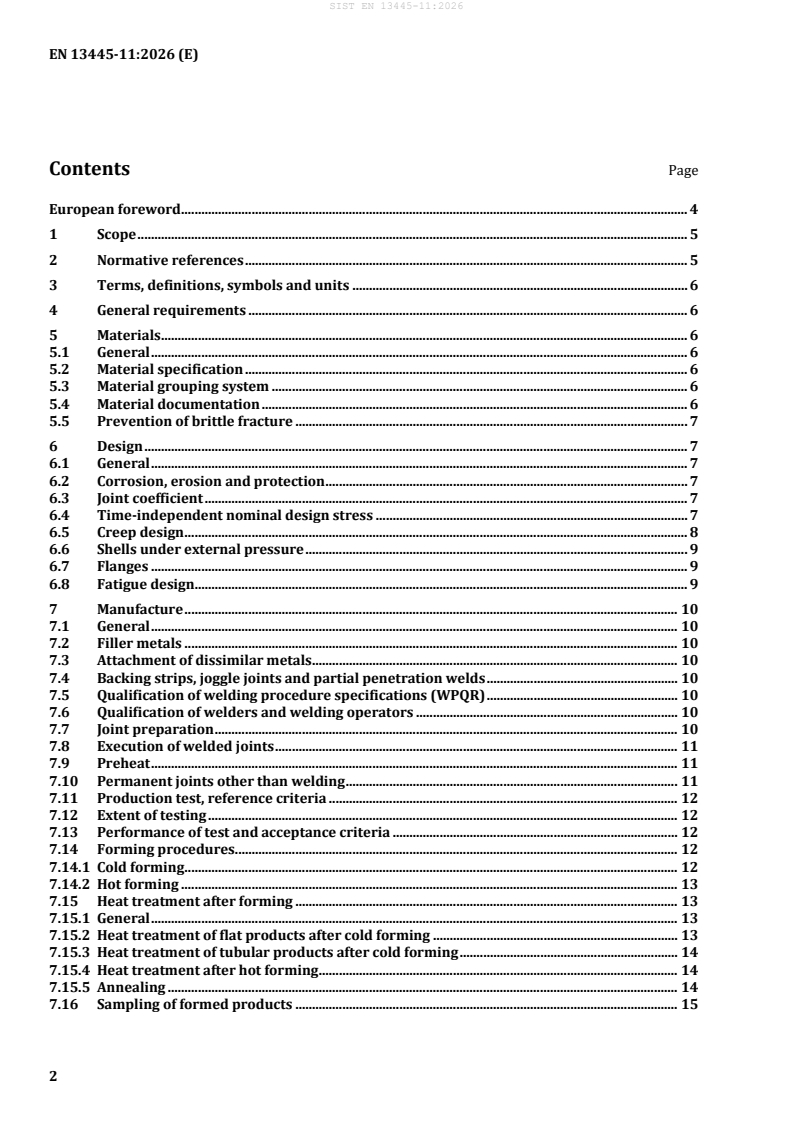
Contents Page
European foreword . 4
1 Scope . 5
2 Normative references . 5
3 Terms, definitions, symbols and units . 6
4 General requirements . 6
5 Materials . 6
5.1 General . 6
5.2 Material specification . 6
5.3 Material grouping system . 6
5.4 Material documentation . 6
5.5 Prevention of brittle fracture . 7
6 Design . 7
6.1 General . 7
6.2 Corrosion, erosion and protection . 7
6.3 Joint coefficient . 7
6.4 Time-independent nominal design stress . 7
6.5 Creep design . 8
6.6 Shells under external pressure . 9
6.7 Flanges . 9
6.8 Fatigue design . 9
7 Manufacture . 10
7.1 General . 10
7.2 Filler metals . 10
7.3 Attachment of dissimilar metals . 10
7.4 Backing strips, joggle joints and partial penetration welds . 10
7.5 Qualification of welding procedure specifications (WPQR) . 10
7.6 Qualification of welders and welding operators . 10
7.7 Joint preparation . 10
7.8 Execution of welded joints . 11
7.9 Preheat . 11
7.10 Permanent joints other than welding . 11
7.11 Production test, reference criteria . 12
7.12 Extent of testing . 12
7.13 Performance of test and acceptance criteria . 12
7.14 Forming procedures . 12
7.14.1 Cold forming . 12
7.14.2 Hot forming . 13
7.15 Heat treatment after forming . 13
7.15.1 General . 13
7.15.2 Heat treatment of flat products after cold forming . 13
7.15.3 Heat treatment of tubular products after cold forming . 14
7.15.4 Heat treatment after hot forming . 14
7.15.5 Annealing . 14
7.16 Sampling of formed products . 15
7.16.1 Cold formed products without heat treatment . 15
7.16.2 Hot formed or cold formed products with heat treatment . 15
7.17 Tests . 16
7.17.1 Base material . 16
7.17.2 Butt welds . 16
7.18 Post weld heat treatment (PWHT) . 16
7.19 Repairs . 16
8 Inspection and testing . 16
8.1 General . 16
8.2 Non-destructive testing of welded joints . 16
8.2.1 General . 16
8.2.2 Demonstration of satisfactory experience for testing group 3 . 17
8.3 Determination of extent of non-destructive testing . 18
8.4 Selection of non destructive testing methods for internal imperfections . 21
8.5 Selection of non destructive testing methods for surface imperfections . 21
8.6 Assessment of defects . 21
8.7 Standard hydrostatic test . 22
9 Finishing operations . 22
Annex A (normative) Grouping system for titanium and titanium alloys . 23
Annex B (informative) Designation of some titanium and titanium alloy materials . 24
Annex C (informative) Materials . 25
C.1 General . 25
C.2 ISO material specifications . 25
C.3 ASME and ASTM material specifications . 26
C.4 DIN material specifications . 27
Annex D (informative) Physical properties of titanium and titanium alloys. 28
D.1 Definitions . 28
D.1.1 Density . 28
D.1.2 Poisson’s ratio . 28
D.2 Physical properties of titanium and titanium alloys . 28
D.2.1 General . 28
D.2.2 Polynomial coefficients . 28
D.2.3 Figures for physical properties of titanium and titanium alloys . 29
Annex E (informative) Creep data for unalloyed titanium . 31
Annex Y (informative) History of EN 13445-11 . 32
Y.1 Differences between EN 13445-11:2024 and EN 13445-11:2026 . 32
Annex ZA (informative) Relationship between this European Standard and the Essential
Requirements of Directive 2014/68/EU aimed to be covered. 33
Bibliography . 35
European foreword
This document (EN 13445-11:2026) has been prepared by Technical Committee CEN/TC 54 “Unfired
pressure vessels”, the secretariat of which is held by BSI.
This European Standard shall be given the status of a national standard, either by publication of an
identical text or by endorsement, at the latest by December 2026, and conflicting national standards shall
be withdrawn at the latest by December 2026.
Attention is drawn to the possibility that some of the elements of this document may be the subject of
patent rights. CEN shall not be held responsible for identifying any or all such patent rights.
This document supersedes EN 13445-11:2024.
Annex Y provides details of corrections and changes between this European Standard and the previous
edition.
This document has been prepared under a standardization request addressed to CEN by the European
Commission. The Standing Committee of the EFTA States subsequently approves these requests for its
Member States.
For the relationship with EU Legislation, see informative Annex ZA, which is an integral part of this
document.
A list of all parts in the EN 13445 series can be found on the CEN website.
Although these Parts may be obtained separately, it should be recognized that the Parts are
interdependent. As such, the manufacture of unfired pressure vessels requires the application of all the
relevant Parts in order for the requirements of the Standard to be satisfactorily fulfilled.
Corrections to the standard interpretations where several options seem possible are conducted through
the Migration Help Desk (MHD). Information related to the Help Desk can be found at
https://unm.fr/en/maintenance-agencies/maintenance-agency-en-13445/. A form for submitting
questions can be downloaded from the link to the MHD website. After subject experts have agreed an
answer, the answer will be communicated to the questioner. Corrected pages will be given specific issue
number and issued by CEN according to CEN Rules. Interpretation sheets will be posted on the website
of the MHD.
Any feedback and questions on this document should be directed to the users’ national standards body.
A complete listing of these bodies can be found on the CEN website.
According to the CEN-CENELEC Internal Regulations, the national standards organizations of the
following countries are bound to implement this European Standard: Austria, Belgium, Bulgaria, Croatia,
Cyprus, Czech Republic, Denmark, Estonia, Finland, France, Germany, Greece, Hungary, Iceland, Ireland,
Italy, Latvia, Lithuania, Luxembourg, Malta, Netherlands, Norway, Poland, Portugal, Republic of North
Macedonia, Romania, Serbia, Slovakia, Slovenia, Spain, Sweden, Switzerland, Türkiye and the United
Kingdom.
1 Scope
This document specifies requirements for unfired pressure vessels and their parts made of titanium and
titanium alloys in addition to the general requirements for unfired pressure vessels under
EN 13445-1:2026 to EN 13445-5:2026.
NOTE 1 Cast materials, HIP and additive manufacturing are not included in this version. Details regarding such
materials will be subject to an amendment to or a revision of this European Standard.
NOTE 2 Materials in Groups 51.4 and 54 are not included in this version.
2 Normative references
The following documents are referred to in the text in such a way that some or all of their content
constitutes requirements of this document. For dated references, only the edition cited applies. For
undated references, the latest edition of the referenced document (including any amendments) applies.
EN 764-5:2014, Pressure equipment - Part 5: Inspection documentation of metallic materials and
compliance with the material specification
EN 10204:2004, Metallic products — Types of inspection documents
EN 13445-1:2026, Unfired pressure vessels — Part 1: General
EN 13445-2:2026, Unfired pressure vessels — Part 2: Materials
EN 13445-3:2026, Unfired pressure vessels — Part 3: Design
EN 13445-4:2026, Unfired pressure vessels — Part 4: Fabrication
EN 13445-5:2026, Unfired pressure vessels — Part 5: Inspection and testing
EN ISO 148-1:2016, Metallic materials — Charpy pendulum impact test — Part 1: Test method
(ISO 148-1:2016)
EN ISO 9606-5:2000, Approval testing of welders — Fusion welding — Part 5: Titanium and titanium alloys,
zirconium and zirconium alloys (ISO 9606-5:2000)
EN ISO 15614-5:2024, Specification and qualification of welding procedures for metallic materials —
Welding procedure test — Part 5: Arc welding of titanium, zirconium and their alloys (ISO 15614-5:2024)
EN ISO 15614-8:2016, Specification and qualification of welding procedures for metallic materials —
Welding procedure test — Part 8: Welding of tubes to tube-plate joints (ISO 15614-8:2016)
EN ISO 15608:2025, Welding — Grouping system for metallic materials (ISO 15608:2025)
3 Terms, definitions, symbols and units
For the purposes of this document, the terms, definitions, symbols and units given in EN 13445-1:2026
to EN 13445-5:2026 apply.
ISO and IEC maintain terminology databases for use in standardization at the following addresses:
— IEC Electropedia: available at http://www.electropedia.org/
— ISO Online browsing platform: available at http://www.iso.org/obp
4 General requirements
The general requirements of EN 13445-1:2026 shall apply.
5 Materials
5.1 General
The general requirements of EN 13445-2:2026 shall apply with the following additions/exclusions in 5.2
to 5.5.
There are presently no European Standards or European Approval of Materials (EAMs) specifically for
titanium and titanium alloys for pressure purposes. This document is therefore limited to the use of
Particular Materials Appraisal (PMA).
5.2 Material specification
The material specification shall specify the composition limits for all constituents, heat treatment and the
appropriate mechanical properties for acceptance and other purposes.
Only material having a minimum elongation after fracture of not less than 10 %, in its final fabricated
state, shall be used for construction of pressure vessels. The specified minimum elongation after fracture
shall be measured on a gauge length as defined in EN 13445-2:2026, 4.1.4.
NOTE To achieve this it can be necessary to start with a higher elongation after fracture, e.g. 14 %, prior to cold
forming.
5.3 Material grouping system
EN 13445-2:2026, Annex A, is not applicable to pressure vessels of titanium and titanium alloys and is
replaced by Annex A of this document.
The grouping system for titanium and titanium alloys shown in Table A.1 of this document is based on
EN ISO 15608:2025. However, only the grades included in Annex B of this document are considered
suitable for welded pressure vessel construction.
5.4 Material documentation
Materials for pressure bearing parts compliant with the requirements of this document shall be
accompanied by inspection documentation in accordance with EN 10204:2004.
The type of inspection document shall be in accordance with EN 764-5:2014 and include an affirmation
of compliance to the material specification.
5.5 Prevention of brittle fracture
There are no general requirements for titanium and titanium alloys at temperatures down to
— −100 °C for group 51.1 and 51.2, and
— −60 °C for all other Groups.
Below these temperatures adequate toughness shall be demonstrated by impact testing of a Charpy-V-
notch test specimen (according to EN ISO 148-1:2016) at a temperature not higher than the minimum
metal temperature T achieving a mean impact energy KV of 27 J in the base material, welds, and heat
M
affected zones. The impact tests shall be carried out in accordance with the requirements of
EN 13445-2:2026, B.3.
NOTE For practical reasons, a test temperature of −196 °C is commonly used for all impact testing of titanium
and titanium alloys for any minimum metal temperature below –100 °C.
Alternatively, a fracture mechanics approach in line with EN 13445-2:2026, Annex B method 3 may be
employed.
6 Design
6.1 General
All the requirements included in EN 13445-3:2026 shall apply, with the following amendments, given in
6.2 to 6.7.
Physical properties of titanium and titanium alloys are given in Annex D of this document.
6.2 Corrosion, erosion and protection
Unalloyed titanium and titanium alloys have outstanding resistance to a wide range of reducing, neutral
and oxidizing corrosive media. As a general rule no allowance is required for pitting or general corrosion.
Caution is required in the design of joints and the selection of gasket materials where crevice corrosion
could occur.
6.3 Joint coefficient
For normal operating load cases the value of joint coefficient z is given in Table 6.3-1. It is related to the
testing group of the governing welded joints.
Testing groups are specified in 8.2 of this document.
Table 6.3-1 — Joint coefficient and corresponding testing group
z 1 0,8
Testing group 1 3
Testing groups 2 and 4 are not permitted for pressure vessels made of titanium and titanium alloys.
6.4 Time-independent nominal design stress
The design stress for titanium and titanium alloy materials entering service in the annealed condition
following removal of test coupons at the material manufacturer’s works, shall be derived in accordance
with Table 6.4-1.
Table 6.4-1 — Maximum allowed values of the nominal design stress for titanium and titanium
alloy materials for pressure parts
Grade/group Design stress for normal Design stress for testing and
operating load cases exceptional load cases
RR R
p1,0/T m/T p1,0/T
test
f = min ;
f =
51.1 and 51.2
d
test
1,5 3 1,05
RR R
p0,2/T m/T p0,2/T
test
f = min ; f =
All others
d test
1,5 3 1,05
For design temperatures not exceeding 50 °C, the value of the design stress derived at 20 °C may be used.
NOTE In case values of Rp 1.0/T are not available, Rp 0,2/T values can be used.
Tensile and other strength values at room temperature may be used at temperatures below 20 °C.
6.5 Creep design
Where guaranteed creep rupture data are available for the intended life of the vessel from the material
specification or the material manufacturer, design stresses for normal operating load cases shall be
obtained from Table 6.5-1.
Table 6.5-1 — Maximum allowed values of the nominal design stress for titanium and titanium
alloy materials for pressure parts for creep design when guaranteed creep rupture data are
available
Grade/group Design stress for normal operating load cases
RR
p0,2/T m/Tt/
f = min ;
All
d
1,5 1,5
R is the mean creep rupture strength at calculation temperature T and lifetime t (EN 13445-3:2026,
m/T/t
19.3).
Where creep data are not available, a safe design for a life of up to 100,000 h can be achieved by using the
design stresses obtained from Table 6.4-1 but taking R in place of R .
p0,2/T p 1,0/T
Unalloyed titanium and titanium alloys can exhibit time dependent deformation when loads are sustained
for long periods near the proof stress value. Informative Annex E of this document gives typical
properties.
NOTE Time-dependent deformation is particularly relevant where the design conditions result in R /3
m/T/t
exceeding 70 % of Rp0,2/T. In such circumstances, in order for the designer to consider the effect of those properties
which influence time dependent deformation, it can be appropriate to take specialist metallurgical advice.
6.6 Shells under external pressure
The requirements in EN 13445-3:2026, Clause 8 shall apply with the following modifications as shown in
Table 6.6-1:
Table 6.6-1 — Nominal elastic limit
Grade/group Elastic limit for shells Elastic limit for stiffeners
R R
p1,0/T p1,0/T ,s
σ = σ =
51.1 and 51.2
e es
1,25 1,25
R R
p0,2/T p0,2/T ,s
σ = σ =
All others
e es
1,25 1,25
NOTE In case values of Rp 1,0/T are not available, Rp 0,2/T values can be used.
Values of the modulus of elasticity E as a function of the temperature can be found in Annex D of this
document.
6.7 Flanges
The requirements of EN 13445-3:2026, Clause 11 or Annex G shall apply with the following
modifications:
Gaskets made from or containing polymers which could release fluoride on thermal or acid
decomposition shall not be used.
NOTE 1 Due to the high elastic deformations of titanium and titanium alloys, to ensure leak tightness of flanges
made of such materials the use of EN 13445-3:2026, Annex G is preferred to EN 13445-3:2026, Clause 11.
NOTE 2 Current European Standards for pipework flanges do not contain rating tables for titanium and titanium
alloys and therefore the use of standard flanges without calculation is not possible.
6.8 Fatigue design
For loads up to 500 equivalent full pressure cycles no fatigue analysis is required. Above 500 cycles the
requirements of EN 13445-3:2026, Clause 17, shall apply with the following modifications:
The application of Clause 17 (see EN 13445-3:2026, 17.4.4) to titanium and titanium alloys shall be
limited to temperatures not exceeding 150 °C.
The correction factor to account for the influence of temperature on fatigue resistance (see
EN 13445-3:2026, 17.6.2.2) is:
For T* ≥ 100 °C:
−5 −7 2
C = 0,518 − 9,41 × 10 T* − 8,46 × 10 (T*) (6.7-1)
T
For T* < 100 °C, C = 0,5.
T
The requirements of EN 13445-3:2026, Clause 18, shall apply with the following modifications:
The application of Clause 18 (see EN 13445-3:2026, 18.4.3) to titanium and titanium alloys shall be
limited to temperatures not exceeding 150 °C.
The correction factor to account for the influence of temperature on fatigue resistance, f (see
T*
EN 13445-3:2026, 18.10.5.2) is given by:
For T* ≥ 100 °C:
−5 −7 2
f = 0,518 − 9,41 × 10 T* − 8,46 × 10 (T*) (6.7-2)
T*
For T* < 100 °C, f = 0,5.
T*
7 Manufacture
7.1 General
EN 13445-4:2026 shall apply, with the following amendments, given in 7.2 to 7.19.
NOTE Not all welding processes are suitable for all titanium alloys.
7.2 Filler metals
In all cases where the filler metals do not match parent metal combinations the filler metal used shall be
suitable for the service conditions.
NOTE Welding consumables can be selected from EN ISO 24034:2020.
7.3 Attachment of dissimilar metals
Dissimilar metal attachments are generally incompatible by fusion welding with most commercially
available titanium alloy materials.
7.4 Backing strips, joggle joints and partial penetration welds
Permanent backing strips, and joggle joints shall not be used. Partial penetration welds shall not be used
on longitudinal and circumferential welds in the pressure containing parts.
7.5 Qualification of welding procedure specifications (WPQR)
The requirements of EN 13445-4:2026, 8.3 shall apply with the following modifications:
Approval testing of fusion welding procedures shall be conducted, recorded and reported in accordance
with EN ISO 15614-5:2024 or EN ISO 15614-8:2016 as appropriate.
Impact testing is not normally required for pressure vessels of titanium and titanium alloys at
temperatures down to −100 °C for group 51.1 and 51.2 and −60 °C for all other Groups. Below these
temperatures adequate toughness shall be demonstrated by impact testing as specified in 5.5.
7.6 Qualification of welders and welding operators
The requirements of EN 13445-4:2026, 8.4 shall apply with the following modifications:
Replace reference to EN ISO 9606-1 with EN ISO 9606-5:2000.
7.7 Joint preparation
In addition to the requirements of EN 13445-4:2026, 8.6, the following shall apply for pressure vessels of
titanium and titanium alloys:
All material shall be cut to size and shape preferably by non-thermal processes like machining, or water
jet cutting.
Surfaces cut by shear cutting or by thermal processes like flame cutting, plasma arc cutting and laser
cutting shall be mechanically dressed.
Edges to be welded shall be dressed back for a distance of 1,5 mm for edges that have been cut by laser
cutting or shear cutting and 5 mm for edges that have been cut by any other process, unless the
manufacturer can demonstrate that the material has not been adversely affected by the cutting process.
NOTE It is important that fire safety procedures are applied for the handling and control of titanium fines and
turnings.
All surfaces to be welded shall be thoroughly cleaned, on both sides of the joint, for a distance of 50 mm
from each welding edge. Cleaning shall be by degreasing using a suitable solvent such as acetone on a
lint-free cloth, before and after wire brushing. Brushes shall be of either stainless steel or titanium, and
shall only be used on titanium and titanium alloys. Surfaces shall be dry before welding commences.
Methyl alcohol or sulphur-containing cleaning fluids shall not be used.
7.8 Execution of welded joints
In addition to the requirements of EN 13445-4:2026, 8.7, the following shall apply for pressure vessels of
titanium and titanium alloys:
Each run of weld metal shall be thoroughly cleaned before the next run is deposited. Brushes shall be of
either stainless steel or titanium, and shall only be used on titanium and titanium alloys.
Where the welding procedure requires removal of the root, before welding the second side of double
sided joints the metal at the bottom of the first side shall be cut back to sound metal by machining or
filing.
Where arc strikes show a rejectable oxide discolouration (see Table 8.6-1) the offending area shall be
removed and, where necessary, repaired to an approved welding procedure.
To avoid contamination of heated surfaces by oxygen, hydrogen or nitrogen, welding shall be carried out
either:
a) in a suitable chamber containing argon; or
b) by using trailing and purging argon gas shields.
The weld bead and surrounding area shall be protected until it has cooled below 250 °C.
Filler wire shall be thoroughly degreased prior to welding. When the filler wire is removed from the gas
shield during or after welding, the first 20 mm of wire shall be discarded before welding re-commences.
After welding has been stopped for any reason, care shall be taken on re-starting to ensure satisfactory
gas coverage of the welding zone together with satisfactory fusion and penetration with the parent
material.
7.9 Preheat
Preheating of titanium and titanium alloys is not required for metallurgical reasons and is therefore not
mandatory. Preheating may be applied by the manufacturer for practical reasons, e.g. a heating at about
50 °C can facilitate the elimination of traces of water.
7.10 Permanent joints other than welding
The requirements of EN 13445-4:2026, 8.10.3 are not applicable to titanium and titanium alloys.
7.11 Production test, reference criteria
The requirements of EN 13445-4:2026, 9.2, shall apply with the following modifications:
For temperatures not lower than −100 °C for group 51.1 and 51.2 and −60 °C for all other Groups, the
requirements for impact testing of production control test plates are not applicable to titanium and
titanium alloys; 9.2 a) of EN 13445-4:2026 is not applicable.
Below these temperatures impact tests shall be carried out on production test plates in accordance with
the requirements of EN 13445-2:2026, B.3 at a temperature not higher than the minimum metal
temperature T achieving a mean impact energy KV of 27 J in the base material, weld, and heat affected
M
zone.
NOTE For practical reasons, a test temperature of −196 °C is commonly used for all impact testing of titanium
and titanium alloys for any minimum metal temperature below –100 °C.
Production control test plates for titanium and titanium alloys vessels in Group 51 shall be carried out in
accordance with EN 13445-4:2026, 9.2 d). In the case of longitudinal welds with joint coefficient 0,8 the
requirements given in EN 13445-4:2026, 9.2 d) 2) and 5) for longitudinal welds with a joint coefficient
0,85 shall be applied.
Production control test plates for titanium and titanium alloys vessels in Groups 52 and 53 shall be
carried out in accordance with EN 13445-4:2026, 9.2 e). In the case of longitudinal welds with joint
coefficient 0,8 the requirements given in EN 13445-4:2026, 9.2 e) 2) and 5), for longitudinal welds with
a joint coefficient 0,85 shall be applied.
7.12 Extent of testing
The requirements of EN 13445-4:2026, 9.3 shall apply with the following modifications:
Table 9.3-1 shall be replaced by Table 7.12-1 below:
Table 7.12-1 — Testing of production test plates
a b
Material Group Thickness of test plate e Test specimens
mm
All e ≤ 12 1 FB, 1 RB, 1 TT, 1 Ma
c
12 < e 2 SB , 1 TT, 1Ma
a
Thinner plate thickness.
b
The symbols for Table 7.12-1 are given in Table 9.3-2 of EN 13445-4:2026.
c
SB = side bends.
7.13 Performance of test and acceptance criteria
The requirements of EN 13445-4:2026, 9.4.1, 9.4.2, 9.4.5, 9.4.6, 9.4.9 and 9.4.10 shall apply, except that
references to EN ISO 15614-1:2017 shall be replaced by EN ISO 15614-5:2024.
7.14 Forming procedures
7.14.1 Cold forming
The requirements of EN 13445-4:2026, 10.3.1 are not applicable for pressure vessels made of titanium
and titanium alloys.
Cold forming of titanium and titanium alloy materials shall be carried out at temperatures below 200 °C.
Cleanliness of tooling and selection of correct lubrication are of particular importance. Suitable interface
material shall be used between the forming equipment and the workpiece.
All cold forming methods may be used.
7.14.2 Hot forming
The requirements of EN 13445-4:2026, 10.3.2 are not applicable for pressure vessels made of titanium
and titanium alloys.
Hot forming of titanium and titanium alloy materials shall be carried out in accordance with the material
manufacturer's recommendations. The procedures shall include information such as material
preparation for heating, heating times and temperatures, inspection and quality controls and any
subsequent heat treatment and cleaning procedures.
The material shall be heated uniformly in a furnace to a maximum temperature of 600 °C, using a slightly
oxidizing or inert atmosphere. Soaking times shall not exceed one hour per 50 mm of section thickness,
and shall be kept to a minimum.
The material shall be heated uniformly without flame impingement.
NOTE Most fuels can be used provided that detrimental impurities, such as sulphur, are kept at low levels.
Titanium and titanium alloys shall be cleaned before heating.
Care shall be taken to avoid contact with any foreign substances, such as marking materials, die
lubricants, pickling liquids, and any waste products encountered during the manufacturing process,
which can be taken into the surface of the material at elevated temperatures.
7.15 Heat treatment after forming
7.15.1 General
Heat treatment after hot or cold forming shall be carried out in accordance with the requirements of
7.15.2, 7.15.3 or 7.15.4.
NOTE When using titanium and titanium alloys attention is drawn to the effect of heat treatment on the
materials and in particular the formation of the brittle alpha case when an oxidizing atmosphere is used. A stress
relieving post-weld heat treatment is not normally required for unalloyed titanium.
7.15.2 Heat treatment of flat products after cold forming
The requirements of EN 13445-4:2026, 10.4.2 are not applicable for pressure vessels made of titanium
and titanium alloys.
Heat treatment of flat products after cold forming shall be carried out in accordance with 7.15.5, when
required by Table 7.15-1. The ratio of deformation F is defined in EN 13445-4:2026, 10.2.
Table 7.15-1 — Heat treatment of flat products after cold forming
Material groups Ratio of deformation F Heat treatment
51.1 and 51.2 F ≤ 12,5 % No
51.1 and 51.2 F > 12,5 % Yes, annealing
All others F ≤ 10 % No
All others F > 10 % Yes, annealing
Heat treatment after forming of dished ends is not required when the minimum elongation after
fracture from the material test certificate is not less than 25 %.
7.15.3 Heat treatment of tubular products after cold forming
The requirements of EN 13445-4:2026, 10.4.3 are not applicable for pressure vessels made of titanium
and titanium alloys.
Heat treatment of tubular products after cold forming shall be carried out in accordance with 7.15.5,
when required by Table 7.15-2. The bending radius for the tube R is defined in EN 13445-4:2026, 10.2.4.
Table 7.15-2 — Heat treatment of tubular products after cold forming
Material groups Bending radius for the tube R Heat treatment
51.1 and 51.2 R ≥ 3,0 D No
e
51.1 and 51.2 R < 3,0 D Yes, annealing
e
All others R ≥ 4,0 D No
e
All others R < 4,0 D Yes, annealing
e
7.15.4 Heat treatment after hot forming
The requirements of EN 13445-4:2026, 10.4.5 and 10.4.6 are not applicable to pressure vessels made of
titanium and titanium alloys.
Heat treatment of titanium and titanium alloys in groups 51.1, 51.2 and 52 is not required after hot
forming. For materials in groups 51.3 and 53, heat treatment is recommended after hot forming and shall
be carried out in accordance with 7.15.5.
7.15.5 Annealing
Following any hot forming operation, or when specified after cold forming, the material shall be given an
annealing treatment in accordance with Table 7.15-3. The annealing hold time shall be determined by the
manufacturer and is dependent on the material thickness, the amount of forming and the manufacturer’s
processing route.
Precautions shall be taken to avoid contamination and embrittlement. After annealing the surfaces might
require a descaling treatment.
Table 7.15-3 — Heat treatment temperatures for unalloyed titanium and titanium alloys
Anneal
Group
Temperature
Time
hr
°C
51 650 – 730 1/2 – 4
52 and 53 700 – 780 1/2 – 4
When heat treatment in an oxidizing atmosphere is used sandblasting and/or pickling and passivation
after heat treatment is required. Heat treatment should preferably be carried out in argon or helium, or
in a vacuum.
NOTE Heat treatment in a reducing atmosphere results in hydrogen absorption and causes embrittlement.
7.16 Sampling of formed products
7.16.1 Cold formed products without heat treatment
The requirements of EN 13445-4:2026, 10.5.1 are not applicable to pressure vessels made of titanium
and titanium alloys.
If heat treatment is not required by Tables 7.15-1 or 7.15-2 after cold forming, mechanical testing is not
required.
7.16.2 Hot formed or cold formed products with heat treatment
The requirements of EN 13445-4:2026, 10.5.2 are not applicable to pressure vessels made of titanium
and titanium alloys.
Compliance with material specifications shall be verified by means of one of the following:
— test coupons taken from excess length of formed part;
— alternatively separately formed test coupons heat treated together with the formed parts;
— separately formed test coupons simulated heat treated.
The following number of test coupons shall be taken from each cast of material:
a) one test coupon from a batch of up to 10 parts;
b) two test coupons from a batch of up to 25 parts;
c) three test coupons from a batch of up to 100 parts;
d) one test coupon for every further 100 parts.
These requirements are also applicable when formed products are supplied in accordance with a fitting
specification or standard.
7.17 Tests
7.17.1 Base material
The requirements of EN 13445-4:2026, 10.6.1 are not applicable to pressure vessels made of titanium
and titanium alloys.
For pressur
...