


EN ISO 9202:2019
(Main)Jewellery and precious metals - Fineness of precious metal alloys (ISO 9202:2019)
Jewellery and precious metals - Fineness of precious metal alloys (ISO 9202:2019)
This document specifies a range of fineness of precious metal alloys (excluding solders) recommended for use in the field of jewellery.
NOTE There is a possibility that national legal requirements for the designation, marking, and stamping of finished articles exist in the respective countries.
Schmuck und Edelmetalle - Feingehalt von Edelmetalllegierungen (ISO 9202:2019)
Dieses Dokument legt Feingehalte für Edelmetalllegierungen (ausgenommen Lote) fest, die für die Anwen-dung im Schmuckbereich empfohlen werden.
ANMERKUNG Es besteht die Möglichkeit, dass nationale gesetzliche Anforderungen für die Bezeichnung, Kennzeichnung und Prägung von Erzeugnissen in dem jeweiligen Land existieren.
Joaillerie, bijouterie et métaux précieux - Titre des alliages de métaux précieux (ISO 9202:2019)
Le présent document spécifie les titres des alliages de métaux précieux (à l'exception des soudures) d'usage recommandé en joaillerie.
NOTE Il peut exister des exigences légales nationales relatives à la désignation, au marquage et au poinçonnage des articles finis dans les pays en question.
Nakit in plemenite kovine - Čistine zlitin plemenitih kovin (ISO 9202:2019)
Ta dokument določa razpon čistosti zlitin plemenitih kovin (brez spajk), uporaba katerih je priporočena na področju zlatarstva.
OPOMBA: Morda obstajajo nacionalne zakonske zahteve za označevanje in vtiskavanje končnih izdelkov v posameznih državah.
General Information
Relations
Overview - EN ISO 9202:2019 (Jewellery and precious metals - Fineness)
EN ISO 9202:2019 specifies recommended fineness of precious metal alloys (excluding solders) for use in jewellery. It defines fineness as the minimum content of the named precious metal, expressed in parts per thousand (‰), and requires that the stated fineness is a minimum value with no minus tolerance. The standard also references accepted analytical methods for determining fineness and alerts users that national legal requirements for designation, marking and stamping may apply.
Key topics and technical requirements
- Scope: Recommended range of fineness values for gold, silver, platinum and palladium alloys used in jewellery (solders excluded).
- Definition of fineness: Minimum content of the precious metal in parts per thousand (‰) by weight.
- No minus tolerance: The fineness number is a minimum; manufacturers must not state values below that minimum.
- Analytical methods: Determination must use one of the ISO test methods cited in the standard, including:
- ISO 11426 - gold (cupellation fire assay)
- ISO 15093 - ICP‑OES difference method (for 999 alloys)
- ISO 11210 - platinum (gravimetric)
- ISO 11490 / ISO 11495 - palladium (gravimetric/ICP‑OES)
- ISO 11427 / ISO 13756 / ISO 15096 - silver (volumetric/potentiometric or ICP‑OES)
- ISO 11494 - platinum (ICP‑OES)
- Specified fineness values (min., ‰):
- Gold: 333, 375, 417, 585, 750, 916, 990, 999
- Platinum: 850, 900, 950, 990, 999
- Palladium: 500, 950, 990, 999
- Silver: 800, 925, 958, 990, 999
Practical applications and users
- Who uses it: jewellery manufacturers, assay offices, testing laboratories, hallmarking authorities, retailers, importers/exporters, procurement/specification teams, and standards authors.
- How it's used:
- Setting product specifications and quality controls for jewellery and precious metal products.
- Guiding laboratory methods for accurate fineness determination and certification.
- Supporting hallmarking and compliance with national marking laws (where applicable).
- Informing purchasing contracts, technical sheets, and consumer product labelling.
Related standards
EN ISO 9202:2019 references multiple normative methods used to determine fineness - key related ISO standards include:
- ISO 11210, ISO 11426, ISO 11427, ISO 11490, ISO 11494, ISO 11495, ISO 13756, ISO 15093, ISO 15096.
Note: EN ISO 9202:2019 supersedes EN ISO 9202:2016. Always check for national legal rules on hallmarking and marking in the destination country when applying this standard.

Standards Content (Sample)
SLOVENSKI STANDARD
01-september-2019
Nadomešča:
SIST EN ISO 9202:2016
Nakit in plemenite kovine - Čistine zlitin plemenitih kovin (ISO 9202:2019)
Jewellery and precious metals - Fineness of precious metal alloys (ISO 9202:2019)
Schmuck und Edelmetalle - Feingehalt von Edelmetalllegierungen (ISO 9202:2019)
Joaillerie, et métaux précieux - Titre des alliages de métaux précieux (ISO 9202:2019)
Ta slovenski standard je istoveten z: EN ISO 9202:2019
ICS:
39.060 Nakit Jewellery
2003-01.Slovenski inštitut za standardizacijo. Razmnoževanje celote ali delov tega standarda ni dovoljeno.
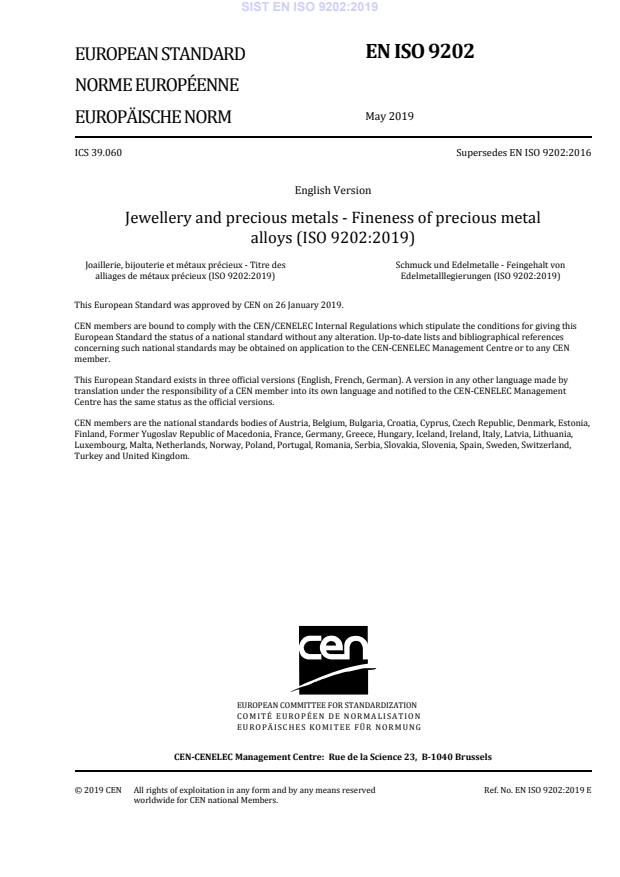
EN ISO 9202
EUROPEAN STANDARD
NORME EUROPÉENNE
May 2019
EUROPÄISCHE NORM
ICS 39.060 Supersedes EN ISO 9202:2016
English Version
Jewellery and precious metals - Fineness of precious metal
alloys (ISO 9202:2019)
Joaillerie, bijouterie et métaux précieux - Titre des Schmuck und Edelmetalle - Feingehalt von
alliages de métaux précieux (ISO 9202:2019) Edelmetalllegierungen (ISO 9202:2019)
This European Standard was approved by CEN on 26 January 2019.
CEN members are bound to comply with the CEN/CENELEC Internal Regulations which stipulate the conditions for giving this
European Standard the status of a national standard without any alteration. Up-to-date lists and bibliographical references
concerning such national standards may be obtained on application to the CEN-CENELEC Management Centre or to any CEN
member.
This European Standard exists in three official versions (English, French, German). A version in any other language made by
translation under the responsibility of a CEN member into its own language and notified to the CEN-CENELEC Management
Centre has the same status as the official versions.
CEN members are the national standards bodies of Austria, Belgium, Bulgaria, Croatia, Cyprus, Czech Republic, Denmark, Estonia,
Finland, Former Yugoslav Republic of Macedonia, France, Germany, Greece, Hungary, Iceland, Ireland, Italy, Latvia, Lithuania,
Luxembourg, Malta, Netherlands, Norway, Poland, Portugal, Romania, Serbia, Slovakia, Slovenia, Spain, Sweden, Switzerland,
Turkey and United Kingdom.
EUROPEAN COMMITTEE FOR STANDARDIZATION
COMITÉ EUROPÉEN DE NORMALISATION
EUROPÄISCHES KOMITEE FÜR NORMUNG
CEN-CENELEC Management Centre: Rue de la Science 23, B-1040 Brussels
© 2019 CEN All rights of exploitation in any form and by any means reserved Ref. No. EN ISO 9202:2019 E
worldwide for CEN national Members.
Contents Page
European foreword . 3
European foreword
This document (EN ISO 9202:2019) has been prepared by Technical Committee ISO/TC 174 "Jewellery
and precious metals" in collaboration with Technical Committee CEN/SS M21 “Precious metals -
Applications in jewellery and associated products” the secretariat of which is held by CCMC.
This European Standard shall be given the status of a national standard, either by publication of an
identical text or by endorsement, at the latest by November 2019, and conflicting national standards
shall be withdrawn at the latest by November 2019.
Attention is drawn to the possibility that some of the elements of this document may be the subject of
patent rights. CEN shall not be held responsible for identifying any or all such patent rights.
This document supersedes EN ISO 9202:2016.
According to the CEN-CENELEC Internal Regulations, the national standards organizations of the
following countries are bound to implement this European Standard: Austria, Belgium, Bulgaria,
Croatia, Cyprus, Czech Republic, Denmark, Estonia, Finland, Former Yugoslav Republic of Macedonia,
France, Germany, Greece, Hungary, Iceland, Ireland, Italy, Latvia, Lithuania, Luxembourg, Malta,
Netherlands, Norway, Poland, Portugal, Romania, Serbia, Slovakia, Slovenia, Spain, Sweden, Switzerland,
Turkey and the United Kingdom.
Endorsement notice
The text of ISO 9202:2019 has been approved by CEN as EN ISO 9202:2019 without any modification.
INTERNATIONAL ISO
STANDARD 9202
Third edition
2019-04
Jewellery and precious metals —
Fineness of precious metal alloys
Joaillerie, bijouterie et métaux précieux — Titre des alliages de
métaux précieux
Reference number
ISO 9202:2019(E)
©
ISO 2019
ISO 9202:2019(E)
© ISO 2019
All rights reserved. Unless otherwise specified, or required in the context of its implementation, no part of this publication may
be reproduced or utilized otherwise in any form or by any means, electronic or mechanical, including photocopying, or posting
on the internet or an intranet, without prior written permission. Permission can be requested from either ISO at the address
below or ISO’s member body in the country of the requester.
ISO copyright office
CP 401 • Ch. de Blandonnet 8
CH-1214 Vernier, Geneva
Phone: +41 22 749 01 11
Fax: +41 22 749 09 47
Email: copyright@iso.org
Website: www.iso.org
Published in Switzerland
ii © ISO 2019 – All rights reserved
ISO 9202:2019(E)
Contents Page
Foreword .iv
1 Scope . 1
2 Normative references . 1
3 Terms and definitions .
...
Frequently Asked Questions
EN ISO 9202:2019 is a standard published by the European Committee for Standardization (CEN). Its full title is "Jewellery and precious metals - Fineness of precious metal alloys (ISO 9202:2019)". This standard covers: This document specifies a range of fineness of precious metal alloys (excluding solders) recommended for use in the field of jewellery. NOTE There is a possibility that national legal requirements for the designation, marking, and stamping of finished articles exist in the respective countries.
This document specifies a range of fineness of precious metal alloys (excluding solders) recommended for use in the field of jewellery. NOTE There is a possibility that national legal requirements for the designation, marking, and stamping of finished articles exist in the respective countries.
EN ISO 9202:2019 is classified under the following ICS (International Classification for Standards) categories: 39.060 - Jewellery. The ICS classification helps identify the subject area and facilitates finding related standards.
EN ISO 9202:2019 has the following relationships with other standards: It is inter standard links to EN ISO 9202:2016, prEN ISO 9202. Understanding these relationships helps ensure you are using the most current and applicable version of the standard.
You can purchase EN ISO 9202:2019 directly from iTeh Standards. The document is available in PDF format and is delivered instantly after payment. Add the standard to your cart and complete the secure checkout process. iTeh Standards is an authorized distributor of CEN standards.
SIST EN ISO 9202:2019 문서는 주얼리 분야에서 사용되는 귀금속 합금의 순도를 규명하는 중요한 기준으로, 귀금속 합금의 순도 범위를 명확히 정의하고 있습니다. 이 표준은 주얼리 제작에 있어 귀금속 합금의 품질을 위한 필수적인 정보를 제공하며, 소비자에게도 고품질의 제품을 보장하는 역할을 합니다. 표준의 강점 중 하나는 귀금속 합금에 대한 명확한 기술적 세부 사항을 제공함으로써 제조업체가 국제적으로 일관된 품질 기준에 따라 제품을 생산할 수 있도록 돕는다는 점입니다. 또한, 표준은 주얼리 업계의 전문성을 높이며, 소비자에게 제품의 신뢰성을 보장합니다. EN ISO 9202:2019의 범위는 귀금속 합금에 대한 국제적 기준을 설정하는 데 초점을 맞추고 있으며, 이는 주얼리 제작자 및 소비자 모두에게 중요한 가치 있습니다. 특히, 최종 제품의 표시, 마킹 및 스탬핑에 대한 각국의 법적 요구사항을 반영할 수 있는 유연성을 제공하는 점 또한 매우 긍정적입니다. 이러한 법적 요건들은 소비자 보호 측면에서도 중요한 역할을 합니다. 결론적으로, SIST EN ISO 9202:2019 표준은 주얼리 산업 내에서 귀금속 합금의 순도에 대한 일관적인 기준을 제공함으로써 해당 분야의 전문성과 신뢰성을 무엇보다 강조하고, 현재와 미래의 시장 요구에 효과적으로 대응할 수 있는 중요한 프레임워크를 구축합니다.
The standard EN ISO 9202:2019 is an essential document that delineates the fineness of precious metal alloys specifically in the jewellery sector. By providing clear specifications regarding the composition of these alloys, the standard ensures that manufacturers can produce high-quality jewellery that meets universally recognized benchmarks. One of the strengths of this standard lies in its comprehensive coverage of the range of fineness, which is crucial for ensuring that artisans and manufacturers deliver products that not only adhere to legal requirements but also meet consumer expectations for quality and durability. Furthermore, the relevance of EN ISO 9202:2019 is particularly notable in a market where consumer trust and product authenticity are paramount. By focusing on the fineness of precious metal alloys, the standard helps to maintain the integrity of jewellery products, thereby enhancing consumer confidence in the authenticity of their purchases. The specification of fineness also aids in informing consumers about the value of the jewellery they are buying, which is significant in an industry that is often scrutinized for its transparency. Additionally, the note regarding possible national legal requirements for the designation, marking, and stamping of finished articles highlights the importance of compliance at both the international and local levels. This further illustrates the standard's robustness, advocating for adherence to legal guidelines while allowing for flexibility based on regional regulations. Overall, EN ISO 9202:2019 serves as a pivotal reference point in the jewellery industry, striking a balance between quality assurance and regulatory compliance. Its clear guidelines on the fineness of precious metal alloys make it an invaluable resource for jewellery manufacturers looking to uphold standards and deliver exceptional products to their customers.
EN ISO 9202:2019は、宝飾品における貴金属合金の純度に関する国際標準を定めた重要な文書です。この標準は、宝飾品の分野で使用される貴金属合金の純度範囲を明確にし、製品の品質向上に寄与します。 このスタンダードの強みは、貴金属合金に対する具体的な仕様を提供することで、製造者と消費者の双方にとっての信頼性を確保している点です。特に、合金に使用される金、銀、プラチナなどの貴金属の純度に関する基準は、業界全体での一貫した適用を促進し、消費者に対する透明性を向上させます。また、標準は異なる国での法的要件にも配慮しており、各国の法律に基づく表示や刻印、スタンプの要件に対応することが可能です。 さらに、この標準は、ジュエリー産業の持続可能性に寄与する側面を持ち、リサイクル可能な素材としての貴金属使用を推進することにも寄与しています。このように、EN ISO 9202:2019は、宝飾品業界において必要不可欠な指針を提供するものであり、業界の品質保証と消費者保護に貢献する重要な役割を果たしています。
Die EN ISO 9202:2019 ist ein grundlegendes Dokument, das sich mit der Feinheit von Edelmetalllegierungen im Schmuckbereich befasst. Der Standard bietet eine klar definierte Übersicht über die verschiedenen Feinheiten, die in der Schmuckherstellung verwendet werden können, abgesehen von Loten. Dies stellt sicher, dass Hersteller und Verbraucher klare Ansichten über die Qualität des verwendeten Materials haben. Ein herausragendes Merkmal der EN ISO 9202:2019 ist ihre Relevanz für die Schmuckindustrie. Da sie spezifische Feinheitsstandards festlegt, ermöglicht sie es Herstellern, robuste Qualitätskontrollen zu implementieren und das Vertrauen der Verbraucher zu stärken. Dies ist besonders wichtig in einem Markt, in dem die Authentizität und Qualität von Edelmetallen entscheidend sind. Zudem erkennt der Standard die Möglichkeit nationaler gesetzlicher Anforderungen an, die hinsichtlich der Kennzeichnung, Markierung und Stempelung fertiger Erzeugnisse bestehen können. Dies zeigt, dass die EN ISO 9202:2019 nicht nur auf internationaler Ebene relevant ist, sondern auch an lokale Gegebenheiten und Vorschriften angepasst werden kann, was ihre Anwendbarkeit und Nützlichkeit weiter erhöht. Die Stärkung der Transparenz durch die Festlegung von Feinheitsstandards positioniert den Standard als wesentliches Werkzeug für die Qualitätssicherung im Schmucksektor. Insgesamt trägt die EN ISO 9202:2019 dazu bei, die Integrität des Marktes für Schmuck und Edelmetalle zu fördern und die Erwartungen der Konsumenten an die Qualität von Edelmetalllegierungen zu erfüllen.
La norme EN ISO 9202:2019, intitulée "Bijoux et métaux précieux - Pureté des alliages de métaux précieux", joue un rôle essentiel dans le secteur de la bijouterie en spécifiant une gamme de pureté des alliages de métaux précieux. Cette norme se concentre exclusivement sur les alliages précieux, excluant les brasures, ce qui permet une clarification utile pour les fabricants et les consommateurs. L’étendue de la norme EN ISO 9202:2019 est pertinente car elle répond aux besoins croissants d’harmonisation dans le domaine des bijoux. En définissant les niveaux de pureté, cette norme aide à garantir que les produits répondent à des critères de qualité et de sécurité reconnus internationalement. Cela est particulièrement important dans un marché global où les consommateurs exigent des produits authentiques et de haute qualité. Parmi les forces notables de cette norme, on retrouve sa capacité à promouvoir la transparence et la confiance envers les consommateurs. En établissant des standards clairs pour le marquage et l'identification des alliages de métaux précieux, la norme contribue à prévenir la fraude et à garantir que les clients obtiennent des produits correspondant aux caractéristiques annoncées. De plus, cette norme peut servir de référence pour les exigences légales nationales relatives à la désignation et au marquage des articles finis, ce qui renforce son importance sur le marché. La pertinence de la norme EN ISO 9202:2019 s’étend également à la durabilité de l’industrie de la bijouterie. En favorisant l'utilisation de métaux précieux de qualité, elle soutient un environnement de production éthique et responsable. Les fabricants sont ainsi encouragés à respecter des pratiques durables, tout en répondant aux attentes des consommateurs contemporains en matière de responsabilité sociale et environnementale. En somme, la norme EN ISO 9202:2019 est un document fondamental qui établit des lignes directrices claires pour la pureté des alliages de métaux précieux dans le secteur de la bijouterie, offrant des avantages significatifs tant pour les producteurs que pour les consommateurs.
Questions, Comments and Discussion
Ask us and Technical Secretary will try to provide an answer. You can facilitate discussion about the standard in here.
Loading comments...