

EN 17736:2022
(Main)Entertainment technology - Specifications for design and manufacture of aluminium stage decks and frames
- Abstract
This document specifies the requirements for the design and manufacture of aluminium decks and frames used in the entertainment industry.
This document does not apply to scaffolding used as substructures in stage and studio environments in accordance with the EN 12810 series and the EN 12811 series or fairground rides in accordance with EN 13814-1.
- Status
- Published
- Publication Date
- 15-Nov-2022
- Technical Committee
- CEN/TC 433 - Entertainment technology - Equipment, technical installations and machinery used on stages and other production areas within the entertainment industry
- Drafting Committee
- CEN/TC 433/WG 2 - Working materials
- Current Stage
- 6060 - Definitive text made available (DAV) - Publishing
- Start Date
- 16-Nov-2022
- Due Date
- 21-Feb-2023
- Completion Date
- 16-Nov-2022

Overview
EN 17736:2022 - Entertainment technology - Specifications for design and manufacture of aluminium stage decks and frames - is a CEN European Standard that defines minimum requirements for the engineering, production and testing of aluminium-stage decking systems used across the entertainment industry. Approved by CEN in September 2022 and adopted nationally by CEN members, the standard aims to ensure safety, structural integrity and consistent documentation for stage decks, frames and associated accessories.
Key topics and technical requirements
- Scope and exclusions: Applies to aluminium decks and frames used in theatres, studios, concert halls, exhibition spaces and similar venues. It explicitly excludes scaffolding substructures covered by EN 12810 / EN 12811 and fairground rides per EN 13814-1.
- Design and engineering: Requires design in accordance with Eurocodes (EN 1990, EN 1991 series, EN 1993, EN 1999) and execution standards (EN 1090 parts). Physical testing may support but not replace structural calculations.
- Materials and manufacturing: Sets requirements for aluminium materials, surface condition and fire behaviour; addresses welding quality (references EN ISO 3834 and EN ISO 9606 series) and traceability (EN 10204).
- Hazard analysis and safety: Identifies significant hazards (mechanical strength, instability, trip/slip risks, edge sharpness, weather and corrosion) and links required mitigations to design and manufacture clauses.
- Stairs, ramps and guardrails: Provides additional design criteria for stairs, ramps and guardrails including configurations for public access.
- Testing and inspection: Defines test procedures (uniformly distributed loads, point loads, horizontal loads), verification and documentation of results. Annexes include example test setups, test and inspection report templates.
- Documentation: Requires engineering documentation, manufacturing records, user documentation and a technical data sheet (informative Annex A example).
Applications and users
This standard is practical for:
- Manufacturers and fabricators of aluminium stage decks and frames - for compliant design and production processes.
- Structural and stage engineers - to ensure designs meet Eurocode-aligned criteria and test/inspection expectations.
- Event production and rental companies - to verify safety, performance and traceability of modular decks and frames.
- Safety inspectors and certifiers - for conformity checks, test verification and documentation review.
- Venue operators and technical managers - to evaluate suitability, installation and maintenance requirements.
Related standards
Relevant referenced standards include EN 1990 / EN 1991 / EN 1999 (Eurocodes), EN 1090 (execution of aluminium structures), EN 17115 (aluminium & steel trusses), EN 17206 (stage machinery safety), and welding quality standards EN ISO 3834 / EN ISO 9606.
EN 17736 delivers a practical, safety-focused framework for designing, manufacturing and testing aluminium stage decking systems used throughout entertainment technology.
Relations
- Effective Date
- 17-Sep-2026
- Effective Date
- 25-Mar-2026
- Refers
EN 1991-3:2026 - Eurocode 1 - Actions on structures - Part 3: Actions induced by cranes and machines - Effective Date
- 25-Mar-2026
- Effective Date
- 25-Mar-2026
- Effective Date
- 25-Mar-2026
- Effective Date
- 25-Mar-2026
- Effective Date
- 25-Mar-2026
- Effective Date
- 25-Mar-2026
- Refers
EN 1993-6:2026 - Eurocode 3 - Design of steel structures - Part 6: Crane supporting structures - Effective Date
- 25-Mar-2026
- Effective Date
- 25-Mar-2026
- Effective Date
- 25-Mar-2026
- Effective Date
- 25-Mar-2026
- Effective Date
- 25-Mar-2026
- Effective Date
- 09-Feb-2026
- Effective Date
- 28-Jan-2026
Frequently Asked Questions
EN 17736:2022 is a standard published by the European Committee for Standardization (CEN). Its full title is "Entertainment technology - Specifications for design and manufacture of aluminium stage decks and frames". This standard covers: This document specifies the requirements for the design and manufacture of aluminium decks and frames used in the entertainment industry. This document does not apply to scaffolding used as substructures in stage and studio environments in accordance with the EN 12810 series and the EN 12811 series or fairground rides in accordance with EN 13814-1.
This document specifies the requirements for the design and manufacture of aluminium decks and frames used in the entertainment industry. This document does not apply to scaffolding used as substructures in stage and studio environments in accordance with the EN 12810 series and the EN 12811 series or fairground rides in accordance with EN 13814-1.
EN 17736:2022 is classified under the following ICS (International Classification for Standards) categories: 97.200.10 - Theatre, stage and studio equipment. The ICS classification helps identify the subject area and facilitates finding related standards.
EN 17736:2022 has the following relationships with other standards: It is inter standard links to EN 1993-7:2026, EN 1993-2:2026, EN 1991-3:2026, EN 1993-4-2:2026, EN 1991-4:2026, EN 1991-1-6:2026, EN 1993-1-11:2026, EN 1993-4-1:2026, EN 1993-6:2026, EN 1995-2:2026, EN 1991-1-8:2026, EN 1993-3:2026, EN 1991-1-4:2026, EN IEC/IEEE 82079-1:2020, EN 1995-2:2004. Understanding these relationships helps ensure you are using the most current and applicable version of the standard.
EN 17736:2022 is available in PDF format for immediate download after purchase. The document can be added to your cart and obtained through the secure checkout process. Digital delivery ensures instant access to the complete standard document.
Standards Content (Sample)
SLOVENSKI STANDARD
01-januar-2023
Razvedrilna tehnologija - Specifikacije za projektiranje in izdelavo aluminijastih
odrov in okvirjev
Entertainment technology - Specifications for design and manufacture of aluminium
stage decks and frames
Veranstaltungstechnik - Anforderungen an die Bemessung und Herstellung von
Podesten und Zargen aus Aluminium
Technologies du spectacle - Spécifications pour la conception et la fabrication de
praticables de scène en aluminium
Ta slovenski standard je istoveten z: EN 17736:2022
ICS:
91.080.17 Aluminijaste konstrukcije Aluminium structures
97.200.10 Gledališka, odrska in Theatre, stage and studio
studijska oprema ter delovne equipment
postaje
2003-01.Slovenski inštitut za standardizacijo. Razmnoževanje celote ali delov tega standarda ni dovoljeno.
EN 17736
EUROPEAN STANDARD
NORME EUROPÉENNE
November 2022
EUROPÄISCHE NORM
ICS 97.200.10
English Version
Entertainment technology - Specifications for design and
manufacture of aluminium stage decks and frames
Technologies du spectacle - Spécifications pour la Veranstaltungstechnik - Anforderungen an die
conception et la fabrication de praticables de scène en Bemessung und Herstellung von Podesten und Zargen
aluminium aus Aluminium
This European Standard was approved by CEN on 12 September 2022.
CEN members are bound to comply with the CEN/CENELEC Internal Regulations which stipulate the conditions for giving this
European Standard the status of a national standard without any alteration. Up-to-date lists and bibliographical references
concerning such national standards may be obtained on application to the CEN-CENELEC Management Centre or to any CEN
member.
This European Standard exists in three official versions (English, French, German). A version in any other language made by
translation under the responsibility of a CEN member into its own language and notified to the CEN-CENELEC Management
Centre has the same status as the official versions.
CEN members are the national standards bodies of Austria, Belgium, Bulgaria, Croatia, Cyprus, Czech Republic, Denmark, Estonia,
Finland, France, Germany, Greece, Hungary, Iceland, Ireland, Italy, Latvia, Lithuania, Luxembourg, Malta, Netherlands, Norway,
Poland, Portugal, Republic of North Macedonia, Romania, Serbia, Slovakia, Slovenia, Spain, Sweden, Switzerland, Türkiye and
United Kingdom.
EUROPEAN COMMITTEE FOR STANDARDIZATION
COMITÉ EUROPÉEN DE NORMALISATION
EUROPÄISCHES KOMITEE FÜR NORMUNG
CEN-CENELEC Management Centre: Rue de la Science 23, B-1040 Brussels
© 2022 CEN All rights of exploitation in any form and by any means reserved Ref. No. EN 17736:2022 E
worldwide for CEN national Members.
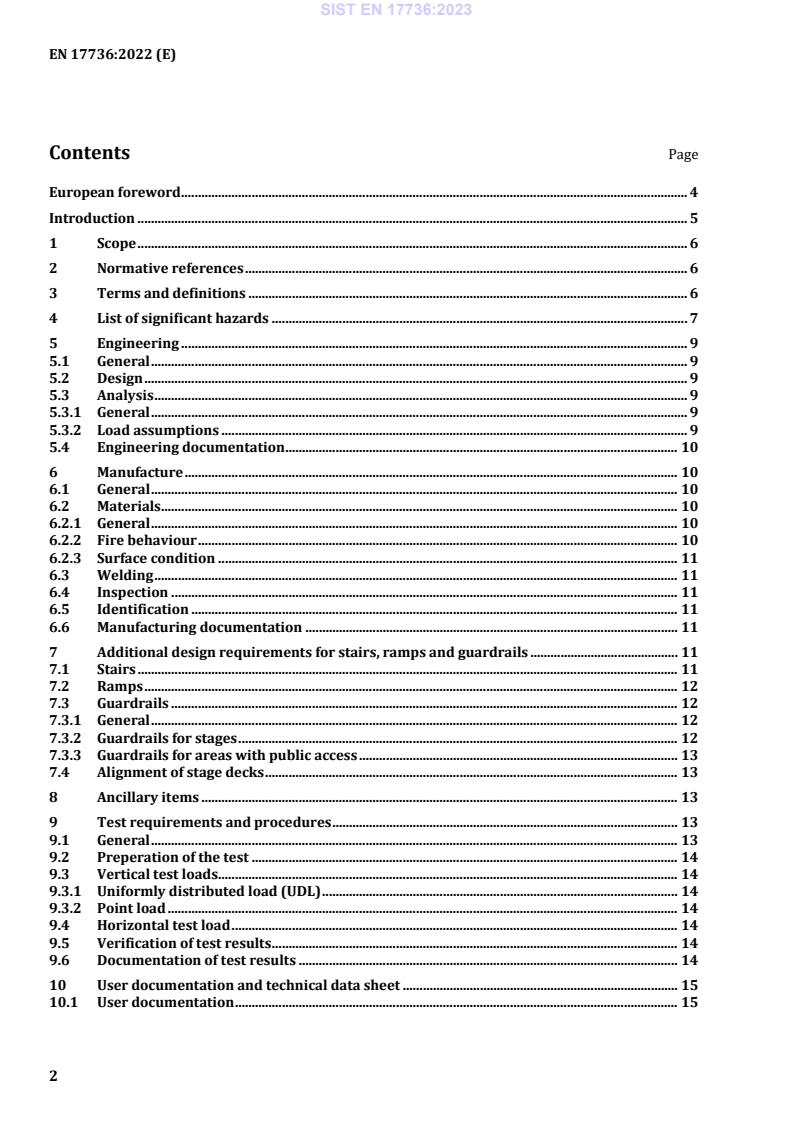
Contents Page
European foreword . 4
Introduction . 5
1 Scope . 6
2 Normative references . 6
3 Terms and definitions . 6
4 List of significant hazards . 7
5 Engineering . 9
5.1 General . 9
5.2 Design . 9
5.3 Analysis . 9
5.3.1 General . 9
5.3.2 Load assumptions . 9
5.4 Engineering documentation . 10
6 Manufacture . 10
6.1 General . 10
6.2 Materials . 10
6.2.1 General . 10
6.2.2 Fire behaviour . 10
6.2.3 Surface condition . 11
6.3 Welding . 11
6.4 Inspection . 11
6.5 Identification . 11
6.6 Manufacturing documentation . 11
7 Additional design requirements for stairs, ramps and guardrails . 11
7.1 Stairs . 11
7.2 Ramps . 12
7.3 Guardrails . 12
7.3.1 General . 12
7.3.2 Guardrails for stages . 12
7.3.3 Guardrails for areas with public access . 13
7.4 Alignment of stage decks . 13
8 Ancillary items . 13
9 Test requirements and procedures . 13
9.1 General . 13
9.2 Preperation of the test . 14
9.3 Vertical test loads . 14
9.3.1 Uniformly distributed load (UDL) . 14
9.3.2 Point load . 14
9.4 Horizontal test load . 14
9.5 Verification of test results . 14
9.6 Documentation of test results . 14
10 User documentation and technical data sheet . 15
10.1 User documentation . 15
10.2 Technical data sheet . 15
Annex A (informative) Technical data sheet example. 16
Annex B (informative) Example of test setups for testing aluminium stage decks and
frames . 18
B.1 General . 18
B.2 Application of test loads . 18
Annex C (informative) Test report examples . 20
C.1 Example of test report for stage decks or frames . 20
C.2 Example of test report for guardrails . 21
Annex D (informative) Inspection report example . 23
Bibliography . 24
European foreword
This document (EN 17736:2022) has been prepared by Technical Committee CEN/TC 433
“Entertainment Technology - Machinery, equipment and installations”, the secretariat of which is held by
DIN.
This European Standard shall be given the status of a national standard, either by publication of an
identical text or by endorsement, at the latest by May 2023, and conflicting national standards shall be
withdrawn at the latest by May 2023.
Attention is drawn to the possibility that some of the elements of this document may be the subject of
patent rights. CEN shall not be held responsible for identifying any or all such patent rights.
This is a type C standard as specified in EN ISO 12100.
Any feedback and questions on this document should be directed to the users’ national standards body.
A complete listing of these bodies can be found on the CEN website.
According to the CEN-CENELEC Internal Regulations, the national standards organisations of the
following countries are bound to implement this European Standard: Austria, Belgium, Bulgaria, Croatia,
Cyprus, Czech Republic, Denmark, Estonia, Finland, France, Germany, Greece, Hungary, Iceland, Ireland,
Italy, Latvia, Lithuania, Luxembourg, Malta, Netherlands, Norway, Poland, Portugal, Republic of North
Macedonia, Romania, Serbia, Slovakia, Slovenia, Spain, Sweden, Switzerland, Türkiye and the United
Kingdom.
Introduction
The object of this document is to achieve a minimum level of quality in the design and manufacture of
aluminium stage decks and frames in the entertainment industry.
Entertainment technology is an interdisciplinary field with specific technology and unique safety
requirements. Entertainment technology is used in places of assembly, staging and production areas for
events and theatrical productions. Such locations include but are not limited to theatres, multi-purpose
halls, exhibition halls, film-, television-, photography- and radio-studios as well as facilities in concert
halls, museums, schools, bars, discotheques, open-air stages and other places for shows and events. In
some cases, atypical non-performance places are also used.
This document has been developed based on the previous requirements of DIN 15921:2015-09.
This document has been drawn up according to past experience and risk analysis.
1 Scope
This document specifies the requirements for the design and manufacture of aluminium decks and frames
used in the entertainment industry.
This document does not apply to scaffolding used as substructures in stage and studio environments in
accordance with the EN 12810 series and the EN 12811 series or fairground rides in accordance with
EN 13814-1.
2 Normative references
The following documents are referred to in the text in such a way that some or all of their content
constitutes requirements of this document. For dated references, only the edition cited applies. For
undated references, the latest edition of the referenced document (including any amendments) applies.
EN 1090 (all parts), Execution of steel structures and aluminium structures
EN 1990, Eurocode - Basis of structural design
EN 1991 (all parts), Eurocode 1: Actions on structures
EN 1993 (all parts), Eurocode 3: Design of steel structures
EN 1995 (all parts), Eurocode 5: Design of timber structures
EN 1999 (all parts), Eurocode 9 - Design of aluminium structures
EN 10204, Metallic products - Types of inspection documents
EN 17115, Entertainment technology - Specifications for design and manufacture of aluminium and steel
trusses
EN 17206, Entertainment technology - Machinery for stages and other production areas - Safety
requirements and inspections
EN ISO 3834 (all parts), Quality requirements for fusion welding of metallic materials (ISO 3834 (all parts))
EN ISO 9606-1, Qualification testing of welders - Fusion welding - Part 1: Steels (ISO 9606-1)
EN ISO 9606-2, Qualification test of welders - Fusion welding - Part 2: Aluminium and aluminium alloys (ISO
9606-2)
EN IEC/IEEE 82079-1, Preparation of information for use (instructions for use) of products - Part 1:
Principles and general requirements
3 Terms and definitions
For the purposes of this document, the terms and definitions given in EN 17115 and EN 17206 and the
following apply.
ISO and IEC maintain terminological databases for use in standardization at the following addresses:
— IEC Electropedia: available at https://www.electropedia.org/
— ISO Online browsing platform: available at https://www.iso.org/obp
3.1
stage deck
frame construction predominantly made from aluminium profiles with a load bearing infill
3.2
frame
closed frame construction made of aluminium profiles; depending on model with mounting for legs
and/or substructure (without load bearing infill)
3.3
substructure
structure, independently placed on the market, intended to support decks or frames
EXAMPLE scaffolding, lattice beams, truss.
3.4
plug leg
detachable straight profile generally mounted in the corners of a deck or frame and perpendicular to the
said deck or frame
3.5
foldable leg
generally non-detachable straight profile with a hinging action mounted in the corners of a deck or frame
3.6
scissor leg
generally non-detachable profiles with a scissor-like action mounted on the bottom side of a deck or
frame
3.7
guardrail
physical barrier to protect persons against falling off raised areas
3.8
load bearing infill
load bearing structure, for example timber, metal, polymer, attached to the frame
3.9
toeboard
board placed around the outer edges of stage decks to prevent objects from falling off the deck when
required
4 List of significant hazards
Table 1 contains some examples of typical hazards associated with the application of stage decks and
frames.
Table 1 — List of significant hazards
Relevant
Hazards clause(s) in this
document
1 Mechanical hazards due to:
1.1 Inadequate mechanical strength 5
1.2 Instability 5
1.3 Gravity and stability 5
1.4 Height from the ground 7.3
1.5 Slippery surface 6.2.3, 7.1, 7.2
1.6 Surface geometry 5, 6
1.7 Potential energy 5, 8
1.8 Sharp edges 6.2.3
1.9 Trip hazard 6.2.3
1.10 Transport 5, 8, 10
2 Electrical hazards
Contact of persons with parts which have become live under faulty
2.1 8, 10
conditions
3 Thermal hazards
3.1 Objects or materials with a high or low temperature 5, 10
4 Noise hazards
4.1 Mechanical noise 10
5 Vibration hazards
5.1 Loosening of components due to dynamic actions 5, 10
6 Ergonomic hazards
6.1 Manual handling 5, 10
6.2 Inadequate working light level 10
6.3 Constricted room during assembly 8, 10
Hazards associated with the environment in which the product is
used
7.1 Weather conditions (temperature, wind, rain, ice, lightning, etc.) 6.2.3, 10
7.2 Humidity 6.2, 10
7.3 Corrosion 6.2, 10
7.4 Seismic activity 10
5 Engineering
5.1 General
Stage decks, frames and their accessories shall be engineered in accordance with this document.
5.2 Design
The design of stage decks, frames and their accessories shall be in accordance with EN 1990, the relevant
parts of the EN 1991 series, EN 1993 series, EN 1995 series and EN 1999 series and the related national
application documents as well as EN 1090-2 and EN 1090-3.
Physical testing may be used to support calculation in accordance with the relevant standards. Physical
testing shall not be used to replace structural calculation.
5.3 Analysis
5.3.1 General
Analysis shall include but not be limited to the following:
a) influence of height and type of supports (e.g. legs, scissors, etc.);
b) supporting substructure;
c) connection to supports and supporting substructure;
d) interaction between stage decks and frames with supporting substructure;
e) influence of adjacent stage decks and frames;
f) allowable deflection;
g) welding process.
5.3.2 Load assumptions
5.3.2.1 General
Analysis shall prove the following minimum load assumptions.
5.3.2.2 Uniformly distributed load
A minimum uniformly distributed vertical load of 5 kN/m shall be assumed.
5.3.2.3 Point load
A minimum single vertical point load of 1,5 kN on an area of 2 500 mm in a square or round shape shall
be assumed in all instances.
For deck surfaces exceeding the dimensions of 1 000 mm in any direction, vertical point loads of 1,5 kN
shall be assumed for every additional started meter. The centers of the point loads shall have a maximum
distance of 500 mm to each other.
The point load shall be assumed at the most unfavourable position of the load bearing infill.
NOTE This is necessary to ensure that the load bearing infill is not affected by punching shear or bending of
any supporting profile caused by the point load.
5.3.2.4 Horizontal equivalent loads
To achieve sufficient horizontal stiffness a distributed load acting in a horizontal direction, level with the
load bearing infill, of 1/20 of the uniformly distributed vertical load in all directions shall be assumed.
For stage decks and frames equipped with vertical legs, a build height of at least 1,00 m shall be assumed.
For scissor stage decks, the worst-case deck height shall be assumed.
5.4 Engineering documentation
Engineering documentation of the product designs shall be created, compiled and maintained by the
manufacturer.
Engineering documentation shall include as a minimum, engineering drawings and structural analysis.
...