


EN 16228-3:2014+A1:2021
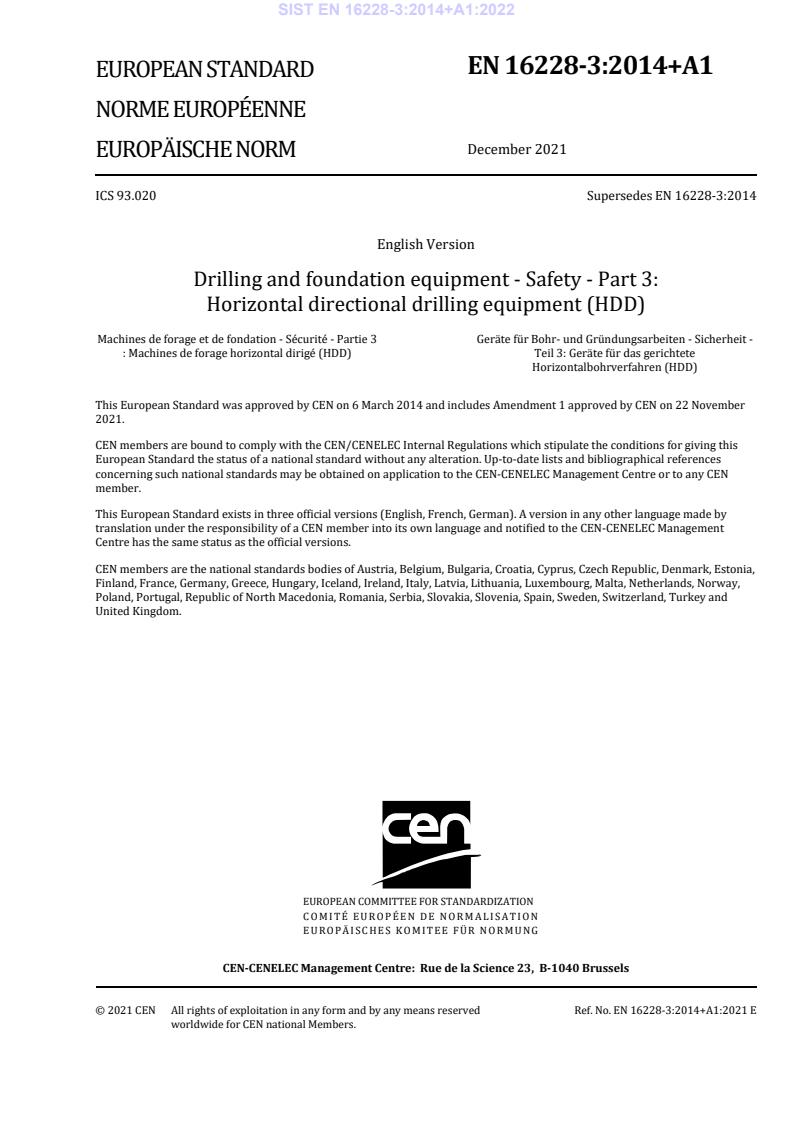
(Main)Drilling and foundation equipment - Safety - Part 3: Horizontal directional drilling equipment (HDD)
Drilling and foundation equipment - Safety - Part 3: Horizontal directional drilling equipment (HDD)
This European Standard, together with part 1, deals with all significant hazards for horizontal directional drilling equipment (HDD) when they are used as intended and under the conditions of misuse which are reasonably foreseeable by the manufacturer associated with the whole life time of the machine (see Clause 4).
The requirements of this part are complementary to the common requirements formulated in EN 16228-1:2014+A1:2021.
This document does not repeat the requirements from EN 16228-1:2014+A1:2021, but adds or replaces the requirements for application for horizontal directional drills.
A machine is considered a horizontal directional drill if it is designed to drill in a shallow arc for the installation of pipes, conduits, and cables and typically has a drill string entry angle of less than 45° relative to the operating surface of the earth.
Geräte für Bohr- und Gründungsarbeiten - Sicherheit - Teil 3: Geräte für das gerichtete Horizontalbohrverfahren (HDD)
Diese Europäische Norm behandelt zusammen mit Teil 1 alle signifikanten Gefährdungen für Geräte für das gerichtete Horizontalbohrverfahren (HDD, en: horizontal directional drilling), wenn sie bestimmungsgemäß und unter den Bedingungen der Fehlanwendung, die vernünftigerweise vom Hersteller vorhersehbar sind und mit der gesamten Lebensdauer der Maschine in Verbindung stehen, verwendet werden (siehe Abschnitt 4).
Die Anforderungen in diesem Teil gelten zusätzlich zu den in !EN 16228 1:2014+A1:2021" gestellten Anforderungen.
Das vorliegende Dokument wiederholt nicht die Anforderungen von !EN 16228 1:2014+A1:2021", sondern ergänzt oder ersetzt die Anforderungen für die Anwendung von Geräten für das gerichtete Horizontalbohrverfahren.
Eine Maschine wird als Gerät für das gerichtete Horizontalbohrverfahren betrachtet, wenn es dafür ausgelegt ist, in einem flachen Bogen für die Installation von Rohren, Kanälen und Kabeln zu bohren, und üblicherweise einen Bohrstrang-Eintrittswinkel von weniger als 45° relativ zur Arbeitsoberfläche auf dem Erdboden hat.
Machines de forage et de fondation - Sécurité - Partie 3 : Machines de forage horizontal dirigé (HDD)
La présente Norme européenne traite, avec la partie 1, de tous les phénomènes dangereux significatifs liées aux machines de forage horizontal dirigé (HDD), lorsqu'elles sont utilisées normalement et dans les conditions de mauvaise utilisation raisonnablement prévisibles par le fabricant, associées à toute la durée de vie des machines (voir Article 4).
Les prescriptions figurant dans la présente partie viennent en complément des prescriptions communes spécifiées dans l'EN 16228 1:2014+A1:2021.
Le présent document ne répète pas les prescriptions de l'EN 16228 1:2014+A1:2021, mais ajoute ou remplace les prescriptions applicables aux machines de forage horizontal dirigé.
Une machine est considérée comme étant une machine de forage horizontal dirigé si elle est conçue pour le forage dans un arc peu profond pour l'installation de tubes, de conduites, et de câbles et a généralement un angle d'entrée de train de tiges inférieur à 45° par rapport à la surface du sol de travail.
Oprema za vrtanje in temeljenje - Varnost - 3. del: Oprema za vodoravno usmerjeno vrtanje (HDD) (vključno z dopolnilom A1)
Ta evropski standard skupaj s 1. delom obravnava vsa večja tveganja za opremo za vodoravno usmerjeno vrtanje (HDD), če se uporablja v skladu s predvidenim namenom in pod pogoji nepravilne uporabe, ki jih je razumno predvidel proizvajalec, v zvezi s celotno življenjsko dobo opreme (glej točko 4).
Zahteve iz tega dela dopolnjujejo splošne zahteve, navedene v standardu EN 16228-1:2014+A1:2021.
Ta dokument ne ponavlja zahtev iz standarda EN 16228-1:2014+A1:2021, temveč dodaja ali nadomešča zahteve za uporabo opreme za vodoravno usmerjeno vrtanje.
Stroj za vodoravno usmerjeno vrtanje je zasnovan za vrtanje v plitvem loku, kar omogoča namestitev cevi, vodov in kablov, ter ima običajno vstopni kot manjši od 45° glede na delovno površino zemlje.
General Information
- Status
- Published
- Publication Date
- 21-Dec-2021
- Withdrawal Date
- 29-Jun-2022
- Technical Committee
- CEN/TC 151 - Construction equipment and building material machines - Safety
- Drafting Committee
- CEN/TC 151/WG 3 - Drilling equipment - Safety
- Current Stage
- 6060 - Definitive text made available (DAV) - Publishing
- Start Date
- 22-Dec-2021
- Completion Date
- 22-Dec-2021
Relations
- Effective Date
- 18-Jan-2023
- Effective Date
- 03-Nov-2021
- Effective Date
- 24-Jan-2024
Overview
EN 16228-3:2014+A1:2021 - Drilling and foundation equipment - Safety - Part 3: Horizontal directional drilling equipment (HDD) - is a CEN Type C standard that specifies safety requirements and protective measures specific to horizontal directional drills. Used together with EN 16228-1:2014+A1:2021 (common requirements), this part covers significant hazards associated with HDD machines over their whole life, including foreseeable misuse. The standard supports conformity with machinery directives (see Annex ZA) and aligns with the risk-based approach of EN ISO 12100.
Key Topics
The standard focuses on machine safety elements unique to HDD and supplements the common rules in Part 1. Major technical topics include:
- Stability and ground pressure considerations for safe setup and operation
- Braking systems (travel and slewing) and immobilisation systems
- Winches, draw-works, ropes, chains and related guarding requirements
- Indicating devices for inclination and other operator information systems
- Operator positions, cabins and FOPS (Falling Object Protection)
- Access, servicing and maintenance points to reduce intervention risk
- Retrieval, transportation, lifting and towing of HDD units and parts
- Control devices and protective measures for stopping rotation/feed
- Warning and indicating devices, including signage and audible alarms
- Guards, foot barriers and danger-zone controls (rear of machine, breakout clamps, drill frame)
- Noise: test code, measurement and documentation (Annex B)
- Verification and fitness-for-purpose testing procedures
- Information for use: operator’s manual, warning signs and symbols (Annex A)
Applications
EN 16228-3 is practical for:
- Manufacturers and designers of HDD rigs to design compliant machines and prepare technical files
- Safety engineers and risk assessors conducting machine-specific hazard assessments
- Compliance and certification bodies verifying conformity with EU machinery requirements and CE marking
- Procurement and fleet managers specifying safe HDD equipment for civil works, utilities installation, and trenchless pipe/cable installation
- Operators and maintenance teams using the standard to create or review operator manuals, maintenance procedures and onsite safety controls
- Training providers building curricula for safe HDD operation and emergency procedures
Related Standards
- EN 16228-1:2014+A1:2021 - Common requirements for drilling and foundation equipment (complementary)
- EN ISO 12100 - General principles for risk assessment and machine safety (Type C standard designation)
- EU Directive 2006/42/EC - essential health and safety requirements addressed in Annex ZA
EN 16228-3:2014+A1:2021 is a focused, practical resource for ensuring the safety and compliance of horizontal directional drilling operations and equipment.

Frequently Asked Questions
EN 16228-3:2014+A1:2021 is a standard published by the European Committee for Standardization (CEN). Its full title is "Drilling and foundation equipment - Safety - Part 3: Horizontal directional drilling equipment (HDD)". This standard covers: This European Standard, together with part 1, deals with all significant hazards for horizontal directional drilling equipment (HDD) when they are used as intended and under the conditions of misuse which are reasonably foreseeable by the manufacturer associated with the whole life time of the machine (see Clause 4). The requirements of this part are complementary to the common requirements formulated in EN 16228-1:2014+A1:2021. This document does not repeat the requirements from EN 16228-1:2014+A1:2021, but adds or replaces the requirements for application for horizontal directional drills. A machine is considered a horizontal directional drill if it is designed to drill in a shallow arc for the installation of pipes, conduits, and cables and typically has a drill string entry angle of less than 45° relative to the operating surface of the earth.
This European Standard, together with part 1, deals with all significant hazards for horizontal directional drilling equipment (HDD) when they are used as intended and under the conditions of misuse which are reasonably foreseeable by the manufacturer associated with the whole life time of the machine (see Clause 4). The requirements of this part are complementary to the common requirements formulated in EN 16228-1:2014+A1:2021. This document does not repeat the requirements from EN 16228-1:2014+A1:2021, but adds or replaces the requirements for application for horizontal directional drills. A machine is considered a horizontal directional drill if it is designed to drill in a shallow arc for the installation of pipes, conduits, and cables and typically has a drill string entry angle of less than 45° relative to the operating surface of the earth.
EN 16228-3:2014+A1:2021 is classified under the following ICS (International Classification for Standards) categories: 93.020 - Earthworks. Excavations. Foundation construction. Underground works. The ICS classification helps identify the subject area and facilitates finding related standards.
EN 16228-3:2014+A1:2021 has the following relationships with other standards: It is inter standard links to EN 16228-3:2014/FprA1, EN 16228-3:2014, prEN ISO 23224. Understanding these relationships helps ensure you are using the most current and applicable version of the standard.
EN 16228-3:2014+A1:2021 is associated with the following European legislation: EU Directives/Regulations: 2006/42/EC; Standardization Mandates: M/396. When a standard is cited in the Official Journal of the European Union, products manufactured in conformity with it benefit from a presumption of conformity with the essential requirements of the corresponding EU directive or regulation.
You can purchase EN 16228-3:2014+A1:2021 directly from iTeh Standards. The document is available in PDF format and is delivered instantly after payment. Add the standard to your cart and complete the secure checkout process. iTeh Standards is an authorized distributor of CEN standards.
Standards Content (Sample)
SLOVENSKI STANDARD
01-marec-2022
Oprema za vrtanje in temeljenje - Varnost - 3. del: Oprema za vodoravno
usmerjeno vrtanje (HDD) (vključno z dopolnilom A1)
Drilling and foundation equipment - Safety - Part 3: Horizontal directional drilling
equipment (HDD)
Geräte für Bohr- und Gründungsarbeiten - Sicherheit - Teil 3: Geräte für das gerichtete
Horizontalbohrverfahren (HDD)
Machines de forage et de fondation - Sécurité - Partie 3 : Machines de forage horizontal
dirigé (HDD)
Ta slovenski standard je istoveten z: EN 16228-3:2014+A1:2021
ICS:
25.080.40 Vrtalniki Drilling machines
53.100 Stroji za zemeljska dela Earth-moving machinery
93.020 Zemeljska dela. Izkopavanja. Earthworks. Excavations.
Gradnja temeljev. Dela pod Foundation construction.
zemljo Underground works
2003-01.Slovenski inštitut za standardizacijo. Razmnoževanje celote ali delov tega standarda ni dovoljeno.
EN 16228-3:2014+A1
EUROPEAN STANDARD
NORME EUROPÉENNE
December 2021
EUROPÄISCHE NORM
ICS 93.020 Supersedes EN 16228-3:2014
English Version
Drilling and foundation equipment - Safety - Part 3:
Horizontal directional drilling equipment (HDD)
Machines de forage et de fondation - Sécurité - Partie 3 Geräte für Bohr- und Gründungsarbeiten - Sicherheit -
: Machines de forage horizontal dirigé (HDD) Teil 3: Geräte für das gerichtete
Horizontalbohrverfahren (HDD)
This European Standard was approved by CEN on 6 March 2014 and includes Amendment 1 approved by CEN on 22 November
2021.
CEN members are bound to comply with the CEN/CENELEC Internal Regulations which stipulate the conditions for giving this
European Standard the status of a national standard without any alteration. Up-to-date lists and bibliographical references
concerning such national standards may be obtained on application to the CEN-CENELEC Management Centre or to any CEN
member.
This European Standard exists in three official versions (English, French, German). A version in any other language made by
translation under the responsibility of a CEN member into its own language and notified to the CEN-CENELEC Management
Centre has the same status as the official versions.
CEN members are the national standards bodies of Austria, Belgium, Bulgaria, Croatia, Cyprus, Czech Republic, Denmark, Estonia,
Finland, France, Germany, Greece, Hungary, Iceland, Ireland, Italy, Latvia, Lithuania, Luxembourg, Malta, Netherlands, Norway,
Poland, Portugal, Republic of North Macedonia, Romania, Serbia, Slovakia, Slovenia, Spain, Sweden, Switzerland, Turkey and
United Kingdom.
EUROPEAN COMMITTEE FOR STANDARDIZATION
COMITÉ EUROPÉEN DE NORMALISATION
EUROPÄISCHES KOMITEE FÜR NORMUNG
CEN-CENELEC Management Centre: Rue de la Science 23, B-1040 Brussels
© 2021 CEN All rights of exploitation in any form and by any means reserved Ref. No. EN 16228-3:2014+A1:2021 E
worldwide for CEN national Members.
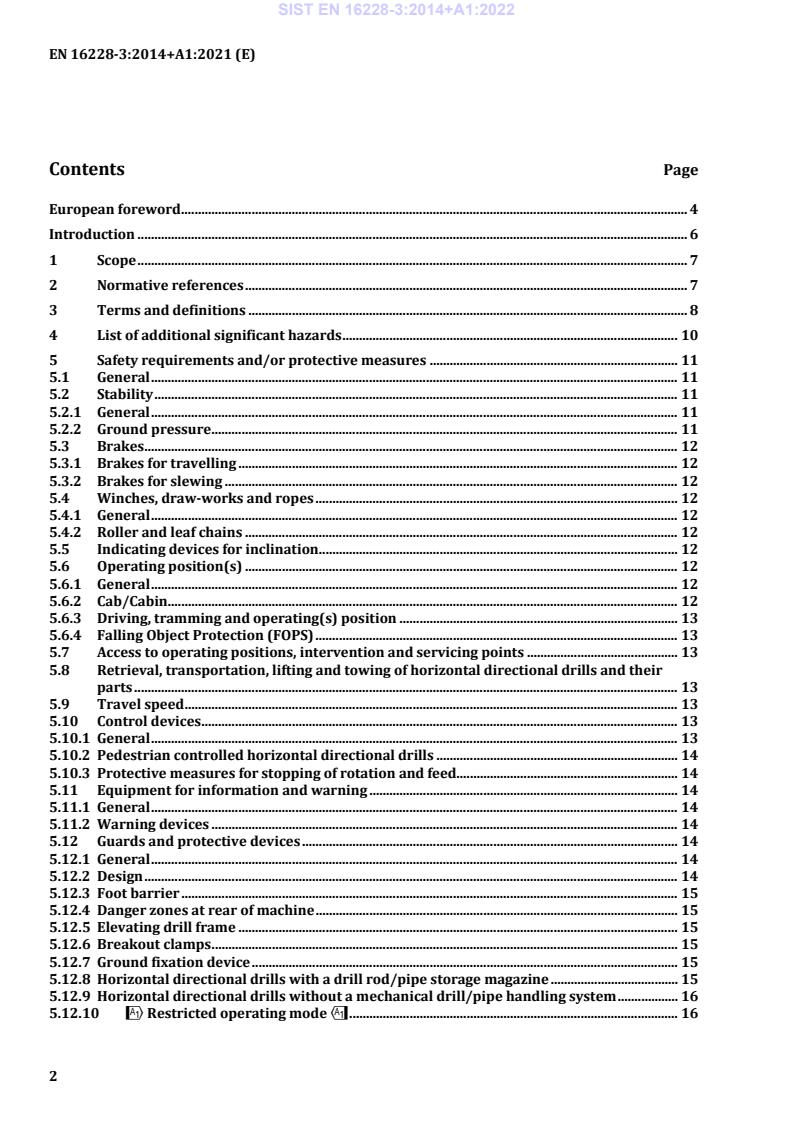
Contents Page
European foreword . 4
Introduction . 6
1 Scope . 7
2 Normative references . 7
3 Terms and definitions . 8
4 List of additional significant hazards . 10
5 Safety requirements and/or protective measures . 11
5.1 General . 11
5.2 Stability . 11
5.2.1 General . 11
5.2.2 Ground pressure . 11
5.3 Brakes. 12
5.3.1 Brakes for travelling . 12
5.3.2 Brakes for slewing . 12
5.4 Winches, draw-works and ropes . 12
5.4.1 General . 12
5.4.2 Roller and leaf chains . 12
5.5 Indicating devices for inclination . 12
5.6 Operating position(s) . 12
5.6.1 General . 12
5.6.2 Cab/Cabin . 12
5.6.3 Driving, tramming and operating(s) position . 13
5.6.4 Falling Object Protection (FOPS) . 13
5.7 Access to operating positions, intervention and servicing points . 13
5.8 Retrieval, transportation, lifting and towing of horizontal directional drills and their
parts . 13
5.9 Travel speed . 13
5.10 Control devices . 13
5.10.1 General . 13
5.10.2 Pedestrian controlled horizontal directional drills . 14
5.10.3 Protective measures for stopping of rotation and feed. 14
5.11 Equipment for information and warning . 14
5.11.1 General . 14
5.11.2 Warning devices . 14
5.12 Guards and protective devices . 14
5.12.1 General . 14
5.12.2 Design . 14
5.12.3 Foot barrier . 15
5.12.4 Danger zones at rear of machine . 15
5.12.5 Elevating drill frame . 15
5.12.6 Breakout clamps . 15
5.12.7 Ground fixation device . 15
5.12.8 Horizontal directional drills with a drill rod/pipe storage magazine . 15
5.12.9 Horizontal directional drills without a mechanical drill/pipe handling system . 16
5.12.10 !Restricted operating mode" . 16
5.13 Immobilisation system . 16
5.14 Drill frame extensions . 17
5.15 !Noise" . 17
6 Verification of the safety requirements and/or protective measures . 17
6.1 General . 17
6.2 Fitness for purpose testing . 20
7 Information for use . 20
7.1 General . 20
7.2 Operator’s manual . 20
7.3 Warning signs . 21
Annex A (informative) Symbols and signs . 22
A.1 General . 22
A.2 Symbols for base machine and drilling rack . 22
A.3 Symbols for front vice . 23
A.4 Symbols for rod cradle . 24
A.5 Symbols for drill head . 25
A.6 Symbols for earth anchor. 26
A.7 Symbols for rod clamp . 27
A.8 Symbols for rod loader . 29
A.9 Symbols for Drilling Fluid Supply . 31
Annex B (normative) Noise test code . 35
B.1 General . 35
B.2 Operating conditions . 35
Annex ZA (informative) !Relationship between this European Standard and the essential
requirements of Directive2006/42/EC aimed to be covered" . 36
Bibliography . 40
European foreword
This document (EN 16228-3:2014+A1:2021) has been prepared by Technical Committee CEN/TC 151
“Construction equipment and building material machines - Safety”, the secretariat of which is held by
DIN.
This European Standard shall be given the status of a national standard, either by publication of an
identical text or by endorsement, at the latest by June 2022 and conflicting national standards shall be
withdrawn at the latest by June 2022.
Attention is drawn to the possibility that some of the elements of this document may be the subject of
patent rights. CEN shall not be held responsible for identifying any or all such patent rights.
This document supersedes !EN 16228-3:2014".
This document includes Amendment 1 approved by CEN on 22 November 2021.
The start and finish of text introduced or altered by amendment is indicated in the text by tags !".
This document has been prepared under a Standardization Request given to CEN by the European
Commission and the European Free Trade Association, and supports essential requirements of EU
Directive(s) / Regulation(s).
For relationship with EU Directive(s) / Regulation(s), see informative Annex ZA, which is an integral
part of this document.
This European Standard is divided into several parts and covers drilling and foundation equipment.
Part 1 contains requirements that are/may be common to all drilling and foundation equipment. Other
parts contain additional requirements for specific machines that supplement or modify the
requirements of part 1. Compliance with the clauses of part 1 together with those of a relevant specific
part of this standard giving requirements for a particular machine provides one means of conforming
with the essential health and safety requirements of the Directive concerned.
When a relevant specific part does not exist, part 1 can help to establish the requirements for the
machine, but will not by itself provide a means of conforming to the relevant essential health and safety
requirements of the Directive.
This European Standard, EN 16228, Drillling and foundation equipment – Safety, consists of the
following parts:
Part 1: Common requirements
!Part 2: Mobile drill rigs for civil and geotechnical engineering in soil or soil and rock mixture"
Part 3: Horizontal directional drilling equipment (HDD)
Part 4: Foundation equipment
Part 5: Diaphragm walling equipment
Part 6: Jetting, grouting and injection equipment
Part 7: Interchangeable auxiliary equipment
Any feedback and questions on this document should be directed to the users’ national standards body.
A complete listing of these bodies can be found on the CEN website.
According to the CEN-CENELEC Internal Regulations, the national standards organisations of the
following countries are bound to implement this European Standard: Austria, Belgium, Bulgaria,
Croatia, Cyprus, Czech Republic, Denmark, Estonia, Finland, France, Germany, Greece, Hungary, Iceland,
Ireland, Italy, Latvia, Lithuania, Luxembourg, Malta, Netherlands, Norway, Poland, Portugal, Republic of
North Macedonia, Romania, Serbia, Slovakia, Slovenia, Spain, Sweden, Switzerland, Turkey and the
United Kingdom.
Introduction
This document is a type C standard as stated in EN ISO 12100.
The machinery concerned and the extent to which hazards, hazardous situations and events are
covered are indicated in the scope of this document.
When provisions of this type C document are different from those, which are stated in type A or B
documents, the provisions of this type C document take precedence over the provisions of the other
documents, for machines that have been designed and built according to the provisions of this type C
document.
1 Scope
This European Standard, together with part 1, deals with all significant hazards for horizontal
directional drilling equipment (HDD) when they are used as intended and under the conditions of
misuse which are reasonably foreseeable by the manufacturer associated with the whole life time of the
machine (see Clause 4).
The requirements of this part are complementary to the common requirements formulated in !EN
16228-1:2014+A1:2021".
This document does not repeat the requirements from !EN 16228-1:2014+A1:2021", but adds or
replaces the requirements for application for horizontal directional drills.
A machine is considered a horizontal directional drill if it is designed to drill in a shallow arc for the
installation of pipes, conduits, and cables and typically has a drill string entry angle of less than 45°
relative to the operating surface of the earth.
2 Normative references
The following documents, in whole or in part, are normatively referenced in this document and are
indispensable for its application. For dated references, only the edition cited applies. For undated
references, the latest edition of the referenced document (including any amendments) applies.
!EN 474-1:2006+A6:2019", Earth-moving machinery — Safety — Part 1: General requirements
!EN 12999:2011+A2:2018", Cranes — Loader cranes
!EN 16228-1:2014+A1:2021", Drilling and foundation equipment — Safety — Part 1: Common
requirements
EN ISO 2867:2011, Earth-moving machinery — Access systems (ISO 2867:2011)
EN ISO 3411:2007, Earth-moving machinery — Physical dimensions of operators and minimum operator
space envelope (ISO 3411:2007)
EN ISO 3449:2008, Earth-moving machinery — Falling-object protective structures — Laboratory tests
and performance requirements (ISO 3449:2005)
EN ISO 3471:2008, Earth-moving machinery — Roll-over protective structures — Laboratory tests and
performance requirements (ISO 3471:2008)
EN ISO 5353:1998, Earth-moving machinery, and tractors and machinery for agriculture and forestry —
Seat index point (ISO 5353:1995)
EN ISO 6682:2008, Earth-moving machinery — Zones of comfort and reach for controls (ISO 6682:1986,
including Amd 1:1989)
EN ISO 7731:2008, Ergonomics — Danger signals for public and work areas — Auditory danger signals
(ISO 7731:2003)
EN ISO 12100:2010, Safety of machinery — General principles for design — Risk assessment and risk
reduction (ISO 12100:2010)
!EN ISO 14120:2015, Safety of machinery — Guards — General requirements for the design and
construction of fixed and movable guards (ISO 14120:2015)"
ISO 9244:2008, Earth-moving machinery — Machine safety labels — General principles
ISO 9533:2010, Earth-moving machinery — Machine-mounted audible travel alarms and forward
horns — Test methods and performance criteria
1 )
ISO 11112:1995, Earth-moving machinery — Operator’s seat — Dimensions and requirements
!ISO 15818:2017", Earth-moving machinery — Lifting and tying-down attachment points —
Performance requirements
ISO 16754:2008, Earth-moving machinery — Determination of average ground contact pressure for
crawler machines
ISO 17063:2003, Earth-moving machinery — Braking systems of pedestrian-controlled machines —
Performance requirements and test procedures
3 Terms and definitions
For the purposes of this document, the terms and definitions given in EN ISO 12100:2010, !EN
16228-1:2014+A1:2021" and the following apply.
NOTE Terminology for horizontal directional drills is specified in ISO 21467.
3.1
horizontal directional drill
machine that uses a steerable cutting head attached to the end of a drill string for creating a bore
through the earth in a horizontal direction
Note 1 to entry: Drilling can include fluid injection through the drill string to the cutting head, tracking of the
bore by use of sensors or a transponder near the cutting head and subsequent enlargement of the bore by back-
reaming.
3.2
drill string for HDD
length of rods joined together which transmit forces from the drill frame to the cutting head or back-
reamer that cuts the earth and which is also used to rotate the cutting head to position it for steering
Note 1 to entry: This terms is herafter referred to as "drill string".
3.3
drill frame
structure on the horizontal directional drill that transmits rotational and linear forces to the drill string
3.4
ground fixation device
device by which the horizontal directional drill is secured to the ground
3.5
exit side
location remote from the base machine where the drill string exits the ground
) This document is impacted by Amendment 1 published in 2001.
3.6
back-reaming
process of enlarging the bore by pulling back a tool of larger diameter than that previously used to form
the bore
3.7
back-reamer
tool of larger diameter than that previously used to form the bore
3.8
hose track
carrier that protects, guides, and maintains proper bend radius of hydraulic hoses, electrical cables, and
air hoses during movement between the stationary and moving portion of the horizontal directional
drill
3.9
drill rod/pipe receiver
structure or a method that supports the drill rod/pipe on horizontal directional drills that are not
equipped with mechanical drill rod/pipe loaders
3.10
operator zone of control
visible length of the drill pipe when seated in the operator’s seat with a profile of 60° each side based on
the nasal binocular field of vision assuming a fixed head and fixed eyes measured from the central
position with respect to the head but the length extends only to the inside edge of the drill rod/pipe
storage magazine and not beyond
Note 1 to entry: See Figure 1.
Key
A seat index point
B operator zone of control
Figure 1 — Operator zone of control
4 List of additional significant hazards
Clause 4 of !EN 16228-1:2014+A1:2021" applies with the following Table 1.
Table 1 of !EN 16228-1:2014+A1:2021" and Table 1 of this document contain all hazards,
hazardous situations and events, identified by risk assessments as significant for horizontal directional
drilling equipment and which require action to eliminate or reduce risk.
Hazards generally occur under the following conditions:
a) in transportation to and from the work site;
b) in rigging and dismantling on the work site;
c) in service on the work site;
d) when tramming between working positions on the job site;
e) out of service on the work site;
f) maintenance;
g) in storage at the plant depot or on the work site.
Table 1 — List of additional significant hazards and associated requirements
No. Hazard Relevant clause(s) in this
standard
1 Mechanical Hazards 5.10.3
1.1 Drawing in or trapping 5.3
1.2 Entanglement 5.10.3, 5.12.3, 5.13
1.3 Crushing due to machine operation 5.6, 5.7, 5.9, 5.10.2
1.4 Crushing due to product movement 5.6
1.5 Crushing during rod/pipe connection operation 5.12.8, 5.12.9.1
1.6 Crushing during manual drill rod handling 5.12.9
2 Hazardous events due to unexpected movement 5.3
2.1 Movement of drill string/tooling at Exit side 5.13
2.2 Movement of product connected to drill string at exit 5.13
side
2.3 Movement of machine from anchored position 5.2
2.4 Movement of machine (tramming) while in drilling 5.6, 5.8
position
3 Hazards due to electrical contact 5.11
4 Hazards generated by noise, resulting in:
4.1 Hearing losses and physiological disorders !5.15," Annex B
4.2 Accidents due to interference with speech !5.15," Annex B
communication and warning signals
5 Visibility of work area 5.6.2.2, 5.11.2, 5.12.5
5 Safety requirements and/or protective measures
5.1 General
Horizontal directional drills shall comply with the requirements of !EN 16228-1:2014+A1:2021",
as far as not modified or replaced by the requirements of this part.
5.2 Stability
5.2.1 General
!EN 16228-1:2014+A1:2021, 5.2.3" applies with the following modification(s).
The stability angle shall not be less than 10° in any direction when tramming and not less than 5° under
any other conditions. !This shall be achieved by having a sufficiently heavy machine and a sufficient
weight distribution (centre of gravity) and/or by the use of ground fixation devices." Stability shall be
determined by calculation or by physical test.
5.2.2 Ground pressure
!EN 16228-1:2014+A1:2021, 5.2.3.7" applies with following modification.
For crawler mounted horizontal directional drills, the ground pressure while tramming shall be
calculated according to !EN 16228-1:2014+A1:2021, Annex F" or ISO 16754:2008.
5.3 Brakes
5.3.1 Brakes for travelling
!EN 16228-1:2014+A1:2021, 5.7.1" applies with the following addition.
Brake systems of pedestrian controlled horizontal directional drills shall meet the requirements of
ISO 17063:2003.
5.3.2 Brakes for slewing
!EN 16228-1:2014+A1:2021, 5.7.2" applies with the following modification.
Only horizontal directional drills equipped with a slewing mechanism shall comply.
5.4 Winches, draw-works and ropes
5.4.1 General
!EN 16228-1:2014+A1:2021, 5.8" does not apply.
NOTE Horizontal directional drills do not have winches used for the purpose of lifting.
5.4.2 Roller and leaf chains
!EN 16228-1:2014+A1:2021, 5.8.5" applies with the following exception:
Roller and leaf chains used on horizontal directional drills for linear feeding of the drill string with a
force of 200 kN or less may be selected with a safety factor of at least 1,5.
5.5 Indicating devices for inclination
!EN 16228-1:2014+A1:2021, 5.10" does not apply.
NOTE Horizontal directional drill stability is not affected by the position of the drill frame !when
drilling".
5.6 Operating position(s)
5.6.1 General
!EN 16228-1:2014+A1:2021, 5.14.1" does not apply.
Where there is a risk of horizontally ejected objects, an appropriate protection shall be provided.
Required space, leg space etc. shall be in accordance with EN ISO 3411:2007 and EN ISO 6682:2008.
5.6.2 Cab/Cabin
5.6.2.1 Horizontal directional drills with a mass less than 8 000 kg
Horizontal directional drills with an operating mass less than 8 000 kg are not required to have a cab.
5.6.2.2 Horizontal drills with a mass greater than 8 000 kg
Horizontal directional drills with an operating mass greater than or equal to 8 000 kg shall be equipped
with a cab/cabin. The cab shall meet the requirements of !EN 474-1:2006+A6:2019, 5.3.2, 5.20.1,
5.22.5 and Annex D".
!deleted text" The dimensions for operator envelope shall meet the requirements of
EN ISO 3411:2007.
5.6.3 Driving, tramming and operating(s) position
Horizontal directional drills that allow the operator to ride the machine during tramming, shall be
provided with a seat and a roll-over protective structure (ROPS) in accordance with EN ISO 3471:2008.
Horizontal directional drills that allow the operator to realign the machine from a seated operator’s
position during the drilling operation that are not equipped with a ROPS structure shall have a
maximum tramming operation time of 10 s. The 10 s tramming limitation shall be provided by a hold to
run switch.
Horizontal directional drills (excluding types designed to work from a pit, or to be controlled remotely)
shall be fitted with a seat from which the operator can comfortably operate the machine controls during
operation of the machine. The seat dimensions and horizontal adjustment ranges shall be in accordance
with ISO 11112:1995.
5.6.4 Falling Object Protection (FOPS)
Horizontal directional drills shall be fitted with falling object protective structure (FOPS) level II of
EN ISO 3449:2008 if they are equipped with lifting devices where there is a capability to lift drill rod or
tooling over the operator station.
5.7 Access to operating positions, intervention and servicing points
!EN 162
...
The standard EN 16228-3:2014+A1:2021 is a critical document in enhancing safety protocols in the use of horizontal directional drilling (HDD) equipment. Its scope is dedicated to identifying and addressing significant hazards associated with HDD equipment, ensuring that such machines are utilized as intended while taking into account foreseeable conditions of misuse. This comprehensive approach underscores the importance of safety throughout the entire lifecycle of the machinery, making it a vital addition to the regulations governing drilling and foundation equipment. One of the strengths of this standard is its complementary nature to EN 16228-1:2014+A1:2021. Instead of reiterating the common requirements, EN 16228-3 introduces specific requirements that are unique to horizontal directional drilling operations. This focused approach enables manufacturers and users of HDD equipment to implement tailored safety measures while maintaining compliance with broader safety standards in the drilling industry. The standard's well-defined parameters for horizontal directional drills, which require a drill string entry angle of less than 45° relative to the operating surface, illustrate its relevance in practical applications. This operational guideline helps ensure that users are fully aware of the specific characteristics and design elements of HDD equipment, enabling safer and more efficient operations. Overall, EN 16228-3:2014+A1:2021 effectively addresses the unique safety concerns associated with horizontal directional drilling equipment. Its precise scope, robust requirements, and alignment with overarching safety standards make it an essential reference for manufacturers, operators, and safety professionals in the field. The focus on both the intended use and foreseeable misuse scenarios adds an additional layer of safety, reinforcing its relevance in the ongoing efforts to promote safe practices within the drilling industry.
SIST EN 16228-3:2014+A1:2022 표준은 수평 방향 굴착 장비(Horizontal Directional Drilling, HDD)의 안전성을 다루고 있으며, 이 표준은 특히 장비의 의도된 사용뿐만 아니라 제조업체가 예측 가능한 오용 조건에서 발생할 수 있는 모든 주요 위험을 포괄적으로 다룹니다. 이 문서는 EN 16228-1:2014+A1:2021에서 제시된 일반 요구 사항과 보완적인 관계를 가지고 있으며, 수평 방향 굴착 드릴(HDD)에 대한 특정 적용 요구 사항을 추가하거나 대체합니다. 이 표준의 주된 강점 중 하나는 기계의 수명 전반에 걸쳐 고려되는 위험 요소의 식별 및 관리에 있어 철저함입니다. 또한, 수평 방향 굴착 장비의 설계적 정의를 제공하여, 드릴링 스트링 진입 각도가 지구의 작동 표면에 대해 45° 미만인 경우를 명확히 하고 있습니다. 이는 장비의 안전한 운영을 보장하는 데 중요한 요소입니다. SIST EN 16228-3:2014+A1:2022 문서는 수평 방향 굴착 장비와 관련된 안전 요구 사항을 명확히 하여, 제조업체와 사용자 모두에게 큰 가치를 제공합니다. 특히 이 표준은 전반적인 HDD의 사용 안전성을 향상시키며, 공사 현장에서 발생할 수 있는 사고를 줄이는 데 기여할 수 있는 점에서 그 중요성이 더욱 강조됩니다. 이러한 이유로, 이 표준은 수평 방향 굴착 기술이 지속적으로 발전하는 현대 건설 환경에서 매우 관련성이 높은 문서로 평가됩니다.
La norme SIST EN 16228-3:2014+A1:2022 se concentre sur les équipements de forage et de fondations, en mettant l'accent sur la sécurité des appareils de forage directionnel horizontal (HDD). Son champ d'application est crucial, car il aborde tous les dangers significatifs liés à l'utilisation de ces équipements, tant dans des conditions d'utilisation normales que dans des situations d'abus raisonnablement prévisibles par le fabricant. Ce document propose des exigences complémentaires aux normes générales établies dans EN 16228-1:2014+A1:2021, sans toutefois répéter celles-ci, ce qui le rend particulièrement pertinent pour les opérateurs de machines HDD. La norme se distingue par sa capacité à détailler les risques associés au forage directionnel, offrant ainsi des lignes directrices précises pour garantir la sécurité tout au long du cycle de vie de la machine. En définissant ce qu'est un appareil de forage directionnel horizontal, notamment par rapport à l'angle d'entrée du tube de forage, la norme facilite également une meilleure compréhension et application des exigences spécifiques à ces machines. Les forces de cette norme résident dans sa portée exhaustive, sa complémentarité avec d'autres documents normatifs et son adaptation aux conditions réelles d'utilisation. Cela témoigne d'un effort considérable pour améliorer non seulement la sécurité des opérations de forage, mais aussi pour promouvoir les meilleures pratiques au sein de l'industrie. En substance, la norme SIST EN 16228-3:2014+A1:2022 s'affirme comme un outil essentiel pour les professionnels impliqués dans le domaine du forage directionnel horizontal, garantissant une approche systématique et sécuritaire des travaux d'installation de conduites, de câbles et de canalisations.
Die Norm EN 16228-3:2014+A1:2021 ist ein bedeutendes Dokument für die Sicherheit von Horizontalbohrgeräten (HDD), das wichtige Aspekte der Gefahrenbewertung und Risikominderung abdeckt. Der Anwendungsbereich dieser Norm ist klar definiert und konzentriert sich auf die signifikanten Gefahren, die bei der Nutzung von horizontalen Bohrgeräten auftreten können. Dabei werden sowohl die vorgesehenen Einsatzbedingungen als auch die rechtmäßig vorhersehbaren Missbrauchsszenarien berücksichtigt, was für die Lebensdauer der Maschine von großer Bedeutung ist. Ein hervorstechendes Merkmal der Norm ist ihre Komplementarität zu den allgemeinen Anforderungen aus EN 16228-1:2014+A1:2021. Sie wiederholt nicht die bereits bestehenden Anforderungen, sondern ergänzt sie gezielt für die Anwendung auf horizontale Bohrgeräte. Dies stellt sicher, dass die spezifischen Bedürfnisse und Risiken dieser Maschinen angemessen adressiert werden, was zu einer höheren Sicherheit und Effizienz im Betrieb führt. Die Relevanz der EN 16228-3:2014+A1:2021 zeigt sich besonders in der klaren Definition, was ein horizontales Bohrgerät ausmacht, einschließlich des spezifischen Bohrwinkelbereichs. Dies ist entscheidend für die korrekte Klassifizierung und den sicheren Einsatz dieser Maschinen. Die Norm trägt somit nicht nur zur Sicherheit der Geräte und ihrer Bediener bei, sondern unterstützt auch die Einhaltung von gesetzlichen Vorschriften und Branchenstandards, was für Hersteller und Betreiber gleichermaßen von bedeutender Wichtigkeit ist. Zusammenfassend lässt sich sagen, dass die EN 16228-3:2014+A1:2021 eine wesentliche Richtlinie für die Sicherheit von horizontalen Bohrgeräten darstellt und durch ihre gezielte Ergänzung der bestehenden Normen einen klaren Mehrwert bietet.
標準文書SIST EN 16228-3:2014+A1:2022は、水平界面掘削装置(HDD)に関する安全性を確保するための重要な指針を提供しています。この標準は、意図された使用条件および製造者が予見可能な利用条件下でのすべての重要な危険を対象としています。また、標準はその構造上、EN 16228-1:2014+A1:2021で定められた一般要求に補完的であり、水平方向掘削機器に特化した要求を追加または置き換えています。 この標準の強みは、HDD機器の使用に伴うリスクを詳細に評価している点にあります。特に、機器が地表面に対して45°未満の入射角で掘削するよう設計されている場合、その安全基準が明確にされているため、業界関係者にとって非常に役立つ内容です。また、全ライフサイクルにわたり考えられる誤用の条件にも言及しているため、製造者は製品の設計段階から安全性を重視する必要があります。 さらに、HDD装置の安全性における総合的なガイドラインとして、活用される具体的な要求事項が盛り込まれているため、現場での作業者の安全性を高める役割も果たしています。これにより、作業環境の安全性を向上させつつ、効率的な作業を可能にするための基盤が整備されています。 この標準は、掘削と基礎設備の分野における安全基準の確立において中心的な役割を果たしており、業界の普遍的なニーズに対応していることから、非常に重要な文書と言えるでしょう。HDD機器を扱うすべての企業や技術者にとって、遵守すべき重要な情報が含まれています。
Questions, Comments and Discussion
Ask us and Technical Secretary will try to provide an answer. You can facilitate discussion about the standard in here.
Loading comments...