

EN 13375:2019
(Main)Flexible sheets for waterproofing - Waterproofing of concrete bridge decks and other concrete surfaces trafficable by vehicles - Specimen preparation
- Abstract
This document is one of a series of documents applicable to flexible sheets for waterproofing of concrete bridge decks and other concrete surfaces trafficable by vehicles.
This document specifies:
- the composition, the characteristics and the preparation procedure of the base specimen concrete slabs;
- the composition, the characteristics and the preparation procedure of different bituminous mixtures for the asphalt layer;
- the rules for the preparation of specimens.
This document outlines the specimen preparation for tests on the waterproofing systems which are referred to in the different test standards.
- Status
- Published
- Publication Date
- 16-Apr-2019
- Withdrawal Date
- 30-Oct-2019
- Technical Committee
- CEN/TC 254 - Flexible sheets for water proofing
- Drafting Committee
- CEN/TC 254/WG 6 - Bridge deck waterproofing
- Current Stage
- 9093 - Decision to confirm - Review Enquiry
- Start Date
- 20-Jun-2025
- Completion Date
- 21-Oct-2026


Overview
EN 13375:2019 (CEN) defines the rules and specifications for preparing test specimens used to evaluate flexible sheets for waterproofing of concrete bridge decks and other concrete surfaces trafficable by vehicles. The standard ensures reproducible, comparable test conditions by specifying the composition and preparation of concrete base slabs, the bituminous overlay materials and laying procedures, and the types of specimens required for performance testing.
Key practical points:
- Base specimen slabs: minimum thickness 40 mm, concrete type MC (0,45) per EN 1766 with the option to use CEM I 52.5 N (EN 197‑1). Surface must be clean, dry and free from laitance.
- Surface texture: macrotexture depth 0.5 mm to 1.0 mm measured per EN 13036‑1; grit‑blasting or high‑pressure water jetting can be used to achieve this.
- Specimen types: Type 1 (base specimen + waterproofing), Type 2 (waterproofing applied with asphalt layer), Type 3 (base specimen + waterproofing + asphalt layer).
Key Topics
Concrete base specimen requirements
- Composition, curing and storage follow EN 1766 reference concretes.
- Uniform quality across slabs to ensure consistent test sampling.
Asphalt and bituminous overlays
- Mastic asphalt (MA / LMA) per EN 13108‑6: MA laying temperature 220–250 °C; thickness (40 ± 5) mm. LMA uses lower laying temperatures (below 220 °C up to <250 °C).
- Asphalt concrete (AC) per EN 13108‑1: laying at (160 ± 10) °C; thickness (40 ± 5) mm (or (60 ± 5) mm for EN 14692 tests).
- Porous asphalt (PA) per EN 13108‑7: laying at (125 ± 10) °C.
- Laying and compaction rules are specified to avoid vibration effects and ensure consistent overlay performance.
Application of waterproofing systems
- Systems shall be applied according to manufacturer instructions; primers and adhesive bitumen must be within manufacturer ranges.
- Special attention for torch‑on systems (uniform welding wave) and pour‑and‑roll systems (control adhesive temperature to avoid overheating polymer bitumen).
Applications
EN 13375:2019 is intended for laboratories, manufacturers and specifiers involved in:
- Performance testing of flexible waterproofing sheets for bridge decks and trafficked concrete surfaces.
- Preparing standardized specimens for bond, shear, crack‑bridging and compaction resistance tests.
- Verifying material and installation compatibility between waterproofing membranes and asphalt protection layers.
Benefits include consistent, repeatable specimen preparation and clearer comparison across products and test methods.
Related Standards
The document is part of a test series and cross‑references standards such as:
- EN 1766 (reference concretes)
- EN 13036‑1 (macrotexture measurement)
- EN 13108‑1, EN 13108‑6, EN 13108‑7 (bituminous mixture specifications)
- EN 13596, EN 13653, EN 14224, EN 14692, EN 14693 (performance test methods)
For practical implementation, follow manufacturer application instructions and the referenced EN test methods to produce compliant, traceable specimens for laboratory evaluation.
Relations
- Effective Date
- 24-Apr-2019
- Effective Date
- 28-Jan-2026
- Effective Date
- 28-Jan-2026
- Effective Date
- 28-Jan-2026
- Effective Date
- 28-Jan-2026
- Effective Date
- 28-Jan-2026
- Effective Date
- 28-Jan-2026
- Effective Date
- 28-Jan-2026
- Effective Date
- 28-Jan-2026
- Effective Date
- 28-Jan-2026
- Effective Date
- 28-Jan-2026
- Effective Date
- 28-Jan-2026
- Effective Date
- 28-Jan-2026
- Effective Date
- 28-Jan-2026
- Effective Date
- 28-Jan-2026
Get Certified
Connect with accredited certification bodies for this standard

DIBt (Deutsches Institut für Bautechnik)
German Institute for Building Technology.
DIN CERTCO
DIN Group product certification.

Aboma Certification B.V.
Specialized in construction, metal, and transport sectors.
Sponsored listings
Frequently Asked Questions
EN 13375:2019 is a standard published by the European Committee for Standardization (CEN). Its full title is "Flexible sheets for waterproofing - Waterproofing of concrete bridge decks and other concrete surfaces trafficable by vehicles - Specimen preparation". This standard covers: This document is one of a series of documents applicable to flexible sheets for waterproofing of concrete bridge decks and other concrete surfaces trafficable by vehicles. This document specifies: - the composition, the characteristics and the preparation procedure of the base specimen concrete slabs; - the composition, the characteristics and the preparation procedure of different bituminous mixtures for the asphalt layer; - the rules for the preparation of specimens. This document outlines the specimen preparation for tests on the waterproofing systems which are referred to in the different test standards.
This document is one of a series of documents applicable to flexible sheets for waterproofing of concrete bridge decks and other concrete surfaces trafficable by vehicles. This document specifies: - the composition, the characteristics and the preparation procedure of the base specimen concrete slabs; - the composition, the characteristics and the preparation procedure of different bituminous mixtures for the asphalt layer; - the rules for the preparation of specimens. This document outlines the specimen preparation for tests on the waterproofing systems which are referred to in the different test standards.
EN 13375:2019 is classified under the following ICS (International Classification for Standards) categories: 91.100.50 - Binders. Sealing materials. The ICS classification helps identify the subject area and facilitates finding related standards.
EN 13375:2019 has the following relationships with other standards: It is inter standard links to EN 13375:2004, EN 1766:2017, EN 13036-1:2010, FprEN 17048, EN 13108-6:2016, EN 13596:2004, EN 13108-1:2016, EN 14224:2010, EN 13108-7:2016, EN 14695:2010, CEN/TS 17048:2024, EN 14692:2017, EN ISO 13143-1:2016, EN ISO 17575-3:2016, EN 13653:2017. Understanding these relationships helps ensure you are using the most current and applicable version of the standard.
EN 13375:2019 is associated with the following European legislation: EU Directives/Regulations: 305/2011; Standardization Mandates: M/124. When a standard is cited in the Official Journal of the European Union, products manufactured in conformity with it benefit from a presumption of conformity with the essential requirements of the corresponding EU directive or regulation.
EN 13375:2019 is available in PDF format for immediate download after purchase. The document can be added to your cart and obtained through the secure checkout process. Digital delivery ensures instant access to the complete standard document.
Standards Content (Sample)
SLOVENSKI STANDARD
01-julij-2019
Nadomešča:
SIST EN 13375:2005
Hidroizolacijski trakovi - Hidroizolacija betonskih premostitvenih objektov in
drugih betonskih povoznih površin - Priprava preskušancev
Flexible sheets for waterproofing - Waterproofing of concrete bridge decks and other
concrete surfaces trafficable by vehicles - Specimen preparation
Abdichtungsbahnen - Abdichtung für Betonbrücken und andere Verkehrsflächen aus
Beton - Probenvorbereitung
Feuilles souples d'étanchéité - Étanchéité des tabliers de ponts en béton et autres
surfaces en béton circulables par les véhicules - Préparation des éprouvettes
Ta slovenski standard je istoveten z: EN 13375:2019
ICS:
91.100.30 Beton in betonski izdelki Concrete and concrete
products
91.100.50 Veziva. Tesnilni materiali Binders. Sealing materials
93.080.20 Materiali za gradnjo cest Road construction materials
2003-01.Slovenski inštitut za standardizacijo. Razmnoževanje celote ali delov tega standarda ni dovoljeno.
EN 13375
EUROPEAN STANDARD
NORME EUROPÉENNE
April 2019
EUROPÄISCHE NORM
ICS 91.100.50 Supersedes EN 13375:2004
English Version
Flexible sheets for waterproofing - Waterproofing of
concrete bridge decks and other concrete surfaces
trafficable by vehicles - Specimen preparation
Feuilles souples d'étanchéité - Étanchéité des tabliers Abdichtungsbahnen - Abdichtung für Betonbrücken
de ponts en béton et autres surfaces en béton und andere Verkehrsflächen aus Beton -
circulables par les véhicules - Préparation des Probenvorbereitung
éprouvettes
This European Standard was approved by CEN on 18 February 2019.
CEN members are bound to comply with the CEN/CENELEC Internal Regulations which stipulate the conditions for giving this
European Standard the status of a national standard without any alteration. Up-to-date lists and bibliographical references
concerning such national standards may be obtained on application to the CEN-CENELEC Management Centre or to any CEN
member.
This European Standard exists in three official versions (English, French, German). A version in any other language made by
translation under the responsibility of a CEN member into its own language and notified to the CEN-CENELEC Management
Centre has the same status as the official versions.
CEN members are the national standards bodies of Austria, Belgium, Bulgaria, Croatia, Cyprus, Czech Republic, Denmark, Estonia,
Finland, Former Yugoslav Republic of Macedonia, France, Germany, Greece, Hungary, Iceland, Ireland, Italy, Latvia, Lithuania,
Luxembourg, Malta, Netherlands, Norway, Poland, Portugal, Romania, Serbia, Slovakia, Slovenia, Spain, Sweden, Switzerland,
Turkey and United Kingdom.
EUROPEAN COMMITTEE FOR STANDARDIZATION
COMITÉ EUROPÉEN DE NORMALISATION
EUROPÄISCHES KOMITEE FÜR NORMUNG
CEN-CENELEC Management Centre: Rue de la Science 23, B-1040 Brussels
© 2019 CEN All rights of exploitation in any form and by any means reserved Ref. No. EN 13375:2019 E
worldwide for CEN national Members.
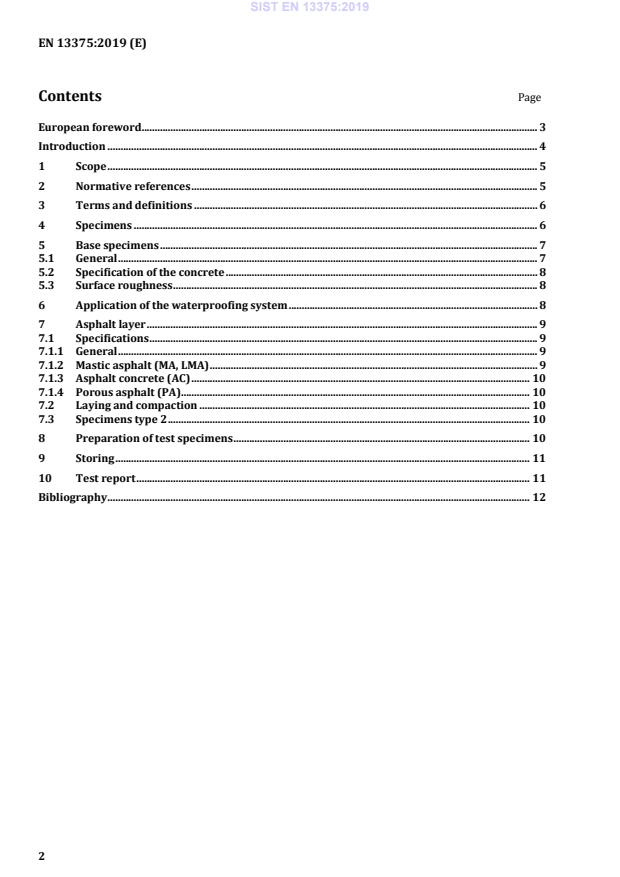
Contents Page
European foreword . 3
Introduction . 4
1 Scope . 5
2 Normative references . 5
3 Terms and definitions . 6
4 Specimens . 6
5 Base specimens . 7
5.1 General . 7
5.2 Specification of the concrete . 8
5.3 Surface roughness . 8
6 Application of the waterproofing system . 8
7 Asphalt layer . 9
7.1 Specifications . 9
7.1.1 General . 9
7.1.2 Mastic asphalt (MA, LMA) . 9
7.1.3 Asphalt concrete (AC) . 10
7.1.4 Porous asphalt (PA). 10
7.2 Laying and compaction . 10
7.3 Specimens type 2 . 10
8 Preparation of test specimens . 10
9 Storing . 11
10 Test report . 11
Bibliography . 12
European foreword
This document (EN 13375:2019) has been prepared by Technical Committee CEN/TC 254 “Flexible sheets for
waterproofing”, the secretariat of which is held by NEN.
This document shall be given the status of a national standard, either by publication of an identical text or by
endorsement, at the latest by October 2019, and conflicting national standards shall be withdrawn at the latest
by October 2019.
Attention is drawn to the possibility that some of the elements of this document may be the subject of patent
rights. CEN shall not be held responsible for identifying any or all such patent rights.
This document supersedes EN 13375:2004.
— Change of Foreword into European Foreword;
— Clause 2, Normative references has been updated with citation of Bituminous mixtures specifications
EN13108-1, and -6 and -7; prEN17048 has been introduced;
— Clause 4, Table 1 has been updated with citation of EN numbers at each test method;
— Subclause 5.2 updated with the use of CEM I 52.5 N;
— Clause 6, Note 1 has been split into Note 1 and Note 2;
— Section 7.1.2, Mastic asphalt has been updated to EN13108-6 standard, and Grading (Figure 3) has been
deleted;
— Section 7.1.3, now “Asphalt Concrete", has been updated according to EN 13108-1 (previous title was
"Coarse bituminous mixture”);
— Section 7.1.4 “Porous Asphalt“ has been introduced as new section, according to EN13108-7.
According to the CEN-CENELEC Internal Regulations, the national standards organisations of the following
countries are bound to implement this document: Austria, Belgium, Bulgaria, Croatia, Cyprus, Czech Republic,
Denmark, Estonia, Finland, Former Yugoslav Republic of Macedonia, France, Germany, Greece, Hungary,
Iceland, Ireland, Italy, Latvia, Lithuania, Luxembourg, Malta, Netherlands, Norway, Poland, Portugal, Romania,
Serbia, Slovakia, Slovenia, Spain, Sweden, Switzerland, Turkey and the United Kingdom.
Introduction
The purpose of this document is to give rules for the preparation of specimens for performance related tests
on waterproofing systems. This document also includes specifications for the base specimen concrete and for
the bituminous mixes for the asphalt layer in contact with the waterproofing and used for the test.
1 Scope
This document is one of a series of documents applicable to flexible sheets for waterproofing of concrete
bridge decks and other concrete surfaces trafficable by vehicles.
This document specifies:
— the composition, the characteristics and the preparation procedure of the base specimen concrete slabs;
— the composition, the characteristics and the preparation procedure of different bituminous mixtures for
the asphalt layer;
— the rules for the preparation of specimens.
This document outlines the specimen preparation for tests on the waterproofing systems which are referred
to in the different test standards.
2 Normative references
The following documents are referred to in the text in such a way that some or all of their content constitutes
requirements of this document. For dated references, only the edition cited applies. For undated references,
the latest edition of the referenced document (including any amendments) applies.
EN 1766:2017, Products and systems for the protection and repair of concrete structures — Test methods —
Reference concretes for testing
EN 13036-1, Road and airfield surface characteristics — Test methods — Part 1: Measurement of pavement
surface macrotexture depth using a volumetric patch technique
EN 13108-1, Bituminous mixtures — Material specifications — Part 1: Asphalt Concrete
EN 13108-6, Bituminous mixtures — Material specifications — Part 6: Mastic Asphalt
EN 13108-7, Bituminous mixtures — Material specifications — Part 7: Porous Asphalt
EN 13596, Flexible sheets for waterproofing
...