

CWA 16926-65:2023
(Main)Extensions for Financial Services (XFS) interface specification Release 3.50 - Part 65: PIN Keypad Device Class Interface - Programmer's Reference - Migration from Version 3.40 (CWA 16926:2020) to Version 3.50 (this CWA)
- Abstract
This specification shows the modifications made to version 3.40 of CWA 16926-6 in version 3.50.
- Status
- Withdrawn
- Publication Date
- 24-Jan-2023
- Withdrawal Date
- 06-Oct-2026
- Technical Committee
- CEN/WS XFS - Extensions for financial services (XFS) interface specification
- Current Stage
- 9960 - Withdrawal effective - Withdrawal
- Start Date
- 29-Apr-2026
- Completion Date
- 07-Oct-2026

Overview
CWA 16926-65:2023 - Extensions for Financial Services (XFS) interface specification Release 3.50, Part 65 - is the Programmer’s Reference documenting the migration from Version 3.40 (CWA 16926:2020) to Version 3.50 for the PIN Keypad Device Class Interface. The CWA describes the modifications introduced in Release 3.50 and provides the authoritative guidance developers and integrators need when upgrading device drivers, middleware and ATM/POS software to the new XFS release.
Key topics and technical requirements
- Scope of migration: clear mapping of changes between XFS PIN Keypad v3.40 and v3.50 to support smooth upgrades and backward compatibility.
- Device capabilities and status info: updated Info commands such as WFS_INF_PIN_STATUS, WFS_INF_PIN_CAPABILITIES and extended key/detail queries.
- Execute commands: comprehensive list covering PIN operations - encryption, import/derive key, get PIN, create offsets, generate KCV, PIN block handling and device initialization.
- Remote Key Loading (RKL): support for signature-based and certificate-based RKL methods, including RSA operations, PKCS#7 import, certificate load/get/replace and TR-34 key transport references.
- Hardware Security Module (HSM) integration: HSM transactional data commands (HSM_TDATA), logical HSM setting and secure key handling.
- EMV and payment-specific flows: commands for EMV public key import and related digest operations.
- Secure input devices: handling of PIN keypads and Encrypting Touch Screens (ETS), layout definitions and keypress/feedback events.
- Events and logging: extended event model (initialized, illegal key access, certificate change, power save, PIN entry events) and journal/get-log commands.
- Backward-compatibility entries: legacy 3.40 commands retained (e.g., _340 variants) and migration guidance in appendices.
Practical applications - who should use this standard
- ATM and POS application developers migrating to XFS Release 3.50
- Device vendor engineers implementing PIN keypad and ETS drivers
- Middleware and terminal integrators ensuring HSM and RKL interoperability
- Banks, payment processors and security teams validating PIN-entry and key-management workflows
- Certification labs and maintainers of deployment toolchains for compliance testing
Related standards and references
- CWA 16926-6:2020 (XFS PIN Keypad v3.40) - baseline for migration
- TR-34, PKCS#7 and standard EMV key/certificate practices referenced in RKL and certificate handling sections
- XFS overall interface specification (Release 3.50) for service-specific programming context
This document is essential for teams implementing secure PIN entry, key management and remote key loading while ensuring compatibility with XFS Release 3.50. Keywords: XFS, PIN Keypad, device class interface, migration, Release 3.50, HSM, remote key loading, EMV, Encrypting Touch Screen, TR-34.
Get Certified
Connect with accredited certification bodies for this standard

BSI Group
BSI (British Standards Institution) is the business standards company that helps organizations make excellence a habit.

NYCE
Mexican standards and certification body.
Sponsored listings
Frequently Asked Questions
CWA 16926-65:2023 is a technical report published by the European Committee for Standardization (CEN). Its full title is "Extensions for Financial Services (XFS) interface specification Release 3.50 - Part 65: PIN Keypad Device Class Interface - Programmer's Reference - Migration from Version 3.40 (CWA 16926:2020) to Version 3.50 (this CWA)". This standard covers: This specification shows the modifications made to version 3.40 of CWA 16926-6 in version 3.50.
This specification shows the modifications made to version 3.40 of CWA 16926-6 in version 3.50.
CWA 16926-65:2023 is classified under the following ICS (International Classification for Standards) categories: 35.200 - Interface and interconnection equipment; 35.240.15 - Identification cards. Chip cards. Biometrics; 35.240.40 - IT applications in banking. The ICS classification helps identify the subject area and facilitates finding related standards.
CWA 16926-65:2023 is available in PDF format for immediate download after purchase. The document can be added to your cart and obtained through the secure checkout process. Digital delivery ensures instant access to the complete standard document.
Standards Content (Sample)
SLOVENSKI STANDARD
01-april-2023
Specifikacija vmesnika razširitev za finančne storitve (XFS), izdaja 3.50 - 65. del:
Vmesnik razreda naprave s tipkovnico PIN - Referenca za programerje - Prehod z
različice 3.40 (CWA 16926:2020) na različico 3.50 (ta CWA)
Extensions for Financial Services (XFS) interface specification Release 3.50 - Part 65:
PIN Keypad Device Class Interface - Programmer's Reference - Migration from Version
3.40 (CWA 16926:2020) to Version 3.50 (this CWA)
Ta slovenski standard je istoveten z: CWA 16926-65:2023
ICS:
35.200 Vmesniška in povezovalna Interface and interconnection
oprema equipment
35.240.15 Identifikacijske kartice. Čipne Identification cards. Chip
kartice. Biometrija cards. Biometrics
35.240.40 Uporabniške rešitve IT v IT applications in banking
bančništvu
2003-01.Slovenski inštitut za standardizacijo. Razmnoževanje celote ali delov tega standarda ni dovoljeno.
CEN
CWA 16926-65
WORKSHOP
January 2023
AGREEMENT
ICS 35.200; 35.240.15; 35.240.40
English version
Extensions for Financial Services (XFS) interface
specification Release 3.50 - Part 65: PIN Keypad Device
Class Interface - Programmer's Reference - Migration from
Version 3.40 (CWA 16926:2020) to Version 3.50 (this
CWA)
This CEN Workshop Agreement has been drafted and approved by a Workshop of representatives of interested parties, the
constitution of which is indicated in the foreword of this Workshop Agreement.
The formal process followed by the Workshop in the development of this Workshop Agreement has been endorsed by the
National Members of CEN but neither the National Members of CEN nor the CEN-CENELEC Management Centre can be held
accountable for the technical content of this CEN Workshop Agreement or possible conflicts with standards or legislation.
This CEN Workshop Agreement can in no way be held as being an official standard developed by CEN and its Members.
This CEN Workshop Agreement is publicly available as a reference document from the CEN Members National Standard Bodies.
CEN members are the national standards bodies of Austria, Belgium, Bulgaria, Croatia, Cyprus, Czech Republic, Denmark, Estonia, Finland, France,
Germany, Greece, Hungary, Iceland, Ireland, Italy, Latvia, Lithuania, Luxembourg, Malta, Netherlands, Norway, Poland, Portugal, Republic of North
Macedonia, Romania, Serbia, Slovakia, Slovenia, Spain, Sweden, Switzerland, Türkiye and United Kingdom.
EUROPEAN COMMITTEE FOR STANDARDIZATION
COMITÉ EUROPÉEN DE NORMALISATION
EUROPÄISCHES KOMITEE FÜR NORMUNG
CEN-CENELEC Management Centre: Rue de la Science 23, B-1040 Brussels
© 2023 CEN All rights of exploitation in any form and by any means reserved worldwide for CEN national Members.
Ref. No.:CWA 16926-65:2023 E
CWA XXXXXX-6:2019 (E) CWA 16926-65:2023 (E)
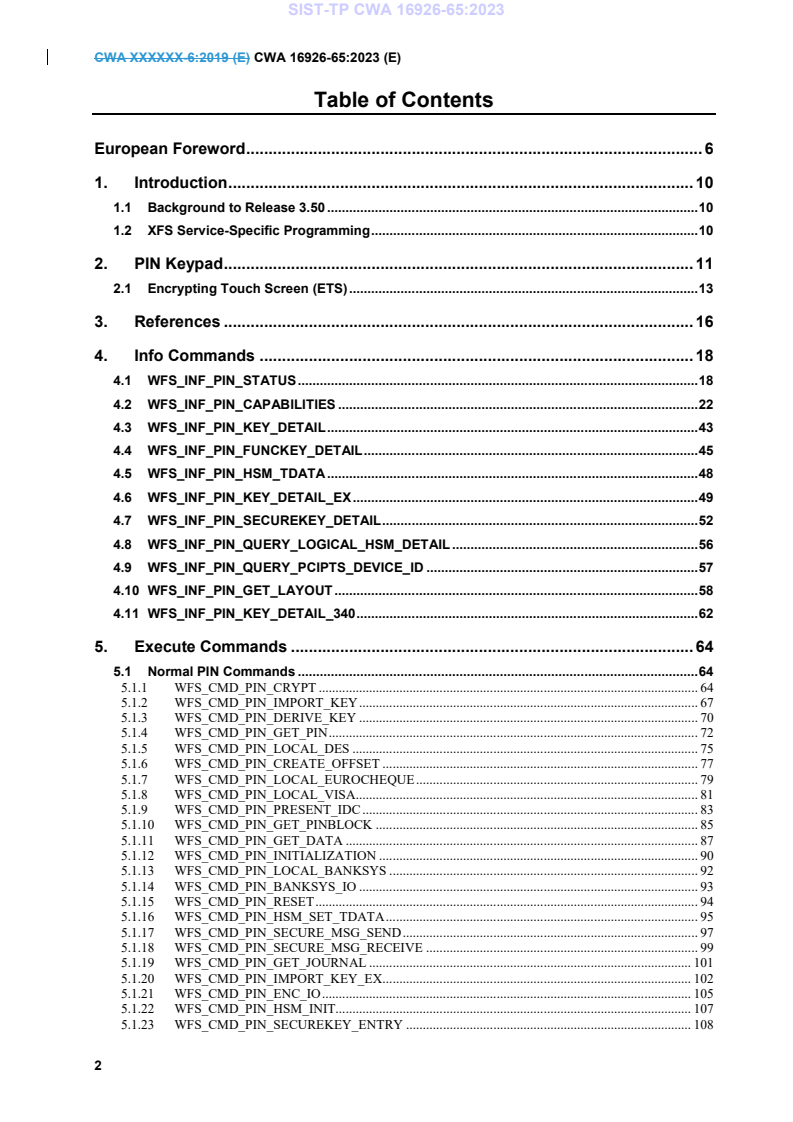
Table of Contents
European Foreword . 6
1. Introduction . 10
1.1 Background to Release 3.50 . 10
1.2 XFS Service-Specific Programming . 10
2. PIN Keypad . 11
2.1 Encrypting Touch Screen (ETS) . 13
3. References . 16
4. Info Commands . 18
4.1 WFS_INF_PIN_STATUS . 18
4.2 WFS_INF_PIN_CAPABILITIES . 22
4.3 WFS_INF_PIN_KEY_DETAIL . 43
4.4 WFS_INF_PIN_FUNCKEY_DETAIL . 45
4.5 WFS_INF_PIN_HSM_TDATA . 48
4.6 WFS_INF_PIN_KEY_DETAIL_EX . 49
4.7 WFS_INF_PIN_SECUREKEY_DETAIL . 52
4.8 WFS_INF_PIN_QUERY_LOGICAL_HSM_DETAIL . 56
4.9 WFS_INF_PIN_QUERY_PCIPTS_DEVICE_ID . 57
4.10 WFS_INF_PIN_GET_LAYOUT . 58
4.11 WFS_INF_PIN_KEY_DETAIL_340 . 62
5. Execute Commands . 64
5.1 Normal PIN Commands . 64
5.1.1 WFS_CMD_PIN_CRYPT . 64
5.1.2 WFS_CMD_PIN_IMPORT_KEY . 67
5.1.3 WFS_CMD_PIN_DERIVE_KEY . 70
5.1.4 WFS_CMD_PIN_GET_PIN . 72
5.1.5 WFS_CMD_PIN_LOCAL_DES . 75
5.1.6 WFS_CMD_PIN_CREATE_OFFSET . 77
5.1.7 WFS_CMD_PIN_LOCAL_EUROCHEQUE . 79
5.1.8 WFS_CMD_PIN_LOCAL_VISA . 81
5.1.9 WFS_CMD_PIN_PRESENT_IDC . 83
5.1.10 WFS_CMD_PIN_GET_PINBLOCK . 85
5.1.11 WFS_CMD_PIN_GET_DATA . 87
5.1.12 WFS_CMD_PIN_INITIALIZATION . 90
5.1.13 WFS_CMD_PIN_LOCAL_BANKSYS . 92
5.1.14 WFS_CMD_PIN_BANKSYS_IO . 93
5.1.15 WFS_CMD_PIN_RESET . 94
5.1.16 WFS_CMD_PIN_HSM_SET_TDATA . 95
5.1.17 WFS_CMD_PIN_SECURE_MSG_SEND . 97
5.1.18 WFS_CMD_PIN_SECURE_MSG_RECEIVE . 99
5.1.19 WFS_CMD_PIN_GET_JOURNAL . 101
5.1.20 WFS_CMD_PIN_IMPORT_KEY_EX . 102
5.1.21 WFS_CMD_PIN_ENC_IO . 105
5.1.22 WFS_CMD_PIN_HSM_INIT. 107
5.1.23 WFS_CMD_PIN_SECUREKEY_ENTRY . 108
5.1.24 WFS_CMD_PIN_GENERATE_KCV . 111
5.1.25 WFS_CMD_PIN_SET_GUIDANCE_LIGHT . 112
5.1.26 WFS_CMD_PIN_MAINTAIN_PIN . 114
5.1.27 WFS_CMD_PIN_KEYPRESS_BEEP . 115
5.1.28 WFS_CMD_PIN_SET_PINBLOCK_DATA . 116
5.1.29 WFS_CMD_PIN_SET_LOGICAL_HSM . 117
5.1.30 WFS_CMD_PIN_IMPORT_KEYBLOCK . 118
5.1.31 WFS_CMD_PIN_POWER_SAVE_CONTROL . 119
5.1.32 WFS_CMD_PIN_DEFINE_LAYOUT . 120
5.1.33 WFS_CMD_PIN_START_AUTHENTICATE . 121
5.1.34 WFS_CMD_PIN_AUTHENTICATE . 123
5.1.35 WFS_CMD_PIN_GET_PINBLOCK_EX . 126
5.1.36 WFS_CMD_PIN_SYNCHRONIZE_COMMAND . 128
5.1.37 WFS_CMD_PIN_CRYPT_340 . 129
5.1.38 WFS_CMD_PIN_GET_PINBLOCK_340. 133
5.1.39 WFS_CMD_PIN_IMPORT_KEY_340 . 135
5.2 Common commands for Remote Key Loading Schemes . 138
5.2.1 WFS_CMD_PIN_START_KEY_EXCHANGE. 138
5.3 Remote Key Loading Using Signatures . 139
5.3.1 WFS_CMD_PIN_IMPORT_RSA_PUBLIC_KEY . 139
5.3.2 WFS_CMD_PIN_EXPORT_RSA_ISSUER_SIGNED_ITEM . 142
5.3.3 WFS_CMD_PIN_IMPORT_RSA_SIGNED_DES_KEY . 144
5.3.4 WFS_CMD_PIN_GENERATE_RSA_KEY_PAIR . 147
5.3.5 WFS_CMD_PIN_EXPORT_RSA_EPP_SIGNED_ITEM . 149
5.4 Remote Key Loading with Certificates . 151
5.4.1 WFS_CMD_PIN_LOAD_CERTIFICATE . 151
5.4.2 WFS_CMD_PIN_GET_CERTIFICATE . 152
5.4.3 WFS_CMD_PIN_REPLACE_CERTIFICATE . 153
5.4.4 WFS_CMD_PIN_IMPORT_RSA_ENCIPHERED_PKCS7_KEY . 154
5.4.5 WFS_CMD_PIN_LOAD_CERTIFICATE_EX . 156
5.4.6 WFS_CMD_PIN_IMPORT_RSA_ENCIPHERED_PKCS7_KEY_EX . 158
5.5 EMV . 162
5.5.1 WFS_CMD_PIN_EMV_IMPORT_PUBLIC_KEY . 162
5.5.2 WFS_CMD_PIN_DIGEST . 165
5.6 Entering and Changing a Password . 166
5.6.1 WFS_CMD_PIN_PASSWORD_ENTRY . 166
6. Events . 170
6.1 WFS_EXEE_PIN_KEY . 170
6.2 WFS_SRVE_PIN_INITIALIZED . 171
6.3 WFS_SRVE_PIN_ILLEGAL_KEY_ACCESS . 172
6.4 WFS_SRVE_PIN_OPT_REQUIRED . 173
6.5 WFS_SRVE_PIN_CERTIFICATE_CHANGE . 174
6.6 WFS_SRVE_PIN_HSM_TDATA_CHANGED . 175
6.7 WFS_SRVE_PIN_HSM_CHANGED . 176
6.8 WFS_EXEE_PIN_ENTERDATA . 177
6.9 WFS_SRVE_PIN_DEVICEPOSITION . 178
6.10 WFS_SRVE_PIN_POWER_SAVE_CHANGE . 179
6.11 WFS_EXEE_PIN_LAYOUT . 180
6.12 WFS_EXEE_PIN_DUKPT_KSN . 181
6.13 WFS_SRVE_PIN_PASSWORD_CLEARED . 182
CWA XXXXX16926-65:20192023 (E)
7. C - Header File . 183
8. Appendix-A . 206
8.1 Remote Key Loading Using Signatures . 207
8.1.1 RSA Data Authentication and Digital Signatures . 207
8.1.2 RSA Secure Key Exchange using Digital Signatures . 208
8.1.3 Initialization Phase – Signature Issuer and ATM PIN . 210
8.1.4 Initialization Phase – Signature Issuer and Host . 211
8.1.5 Key Exchange – Host and ATM PIN . 212
8.1.6 Key Exchange (with random number) – Host and ATM PIN . 213
8.1.7 Enhanced RKL, Key Exchange (with random number) – Host and ATM PIN . 216
8.1.8 Default Keys and Security Item loaded during manufacture . 217
8.2 Remote Key Loading Using Certificates . 218
8.2.1 Certificate Exchange and Authentication . 218
8.2.2 Remote Key Exchange . 220
8.2.3 Replace Certificate . 221
8.2.4 Primary and Secondary Certificates . 222
8.2.5 TR34 BIND To Host . 223
8.2.6 TR34 Key Transport. 224
8.2.7 TR34 REBIND To New Host . 227
8.2.8 TR34 Force REBIND To New Host . 228
8.2.9 TR34 UNBIND From Host . 229
8.2.10 TR34 Force UNBIND From Host . 230
8.3 German ZKA GeldKarte (Deutsche Kreditwirtschaft). 231
8.3.1 How to use the SECURE_MSG commands . 231
8.3.2 Protocol WFS_PIN_PROTISOAS . 232
8.3.3 Protocol WFS_PIN_PROTISOLZ . 233
8.3.4 Protocol WFS_PIN_PROTISOPS . 234
8.3.5 Protocol WFS_PIN_PROTCHIPZKA . 235
8.3.6 Protocol WFS_PIN_PROTRAWDATA . 236
8.3.7 Protocol WFS_PIN_PROTPBM . 237
8.3.8 Protocol WFS_PIN_PROTHSMLDI . 238
8.3.9 Protocol WFS_PIN_PROTGENAS . 239
8.3.10 Protocol WFS_PIN_PROTCHIPINCHG . 243
8.3.11 Protocol WFS_PIN_PROTPINCMP . 244
8.3.12 Protocol WFS_PIN_PROTISOPINCHG . 246
8.3.13 Command Sequence . 247
8.4 EMV Support . 254
8.4.1 Keys loading. 254
8.4.2 PIN Block Management . 256
8.4.3 SHA-1 Digest . 257
8.5 French Cartes Bancaires . 258
8.5.1 Data Structure for WFS_CMD_PIN_ENC_IO . 258
8.5.2 Command Sequence . 260
8.6 Secure Key Entry . 262
8.6.1 Keyboard Layout . 262
8.6.2 Command Usage - WFS_CMD_PIN_SECUREKEY_DETAIL and
WFS_CMD_PIN_IMPORT_KEY . 266
8.6.3 Command Usage - WFS_INF_PIN_GET_LAYOUT and WFS_CMD_PIN_IMPORT_KEY_340 267
8.7 WFS_PIN_USERESTRICTEDKEYENCKEY key usage . 268
8.7.1 Command Usage . 268
8.8 WFS_CMD_PIN_IMPORT_KEY_340 command Input/Output Parameters . 273
8.8.1 Importing a 3DES 16-byte terminal master key using signature-based remote key loading (SRKL):
8.8.2 Importing a 16-byte DES key for PIN encryption with a key check value in the input . 276
8.8.3 Importing a 16-byte DES key for MACing (MAC Algorithm 3) . 278
8.8.4 Importing a 2048-bit Host RSA public key . 280
8.8.5 Importing a 24-byte DES symmetric data encryption key via X9.143 keyblock . 282
8.9 Entering passwords using the WFS_CMD_PIN_PASSWORD_ENTRY command. . 283
8.9.1 Entering passwords individually to allow secure key parts to be loaded . 283
8.9.2 Entering and changing a password . 283
9. Appendix-B (Country Specific WFS_CMD_PIN_ENC_IO protocols) . 285
9.1 Luxemburg Protocol . 285
9.1.1 WFS_CMD_ENC_IO_LUX_LOAD_APPKEY . 287
9.1.2 WFS_CMD_ENC_IO_LUX_GENERATE_MAC . 289
9.1.3 WFS_CMD_ENC_IO_LUX_CHECK_MAC . 290
9.1.4 WFS_CMD_ENC_IO_LUX_BUILD_PINBLOCK . 291
9.1.5 WFS_CMD_ENC_IO_LUX_DECRYPT_TDES . 292
9.1.6 WFS_CMD_ENC_IO_LUX_ENCRYPT_TDES . 293
9.1.7 Luxemburg-specific Header File . 294
9.2 China Protocol . 296
9.2.1 WFS_CMD_ENC_IO_CHN_DIGEST . 299
9.2.2 WFS_CMD_ENC_IO_CHN_SET_SM2_PARAM . 300
9.2.3 WFS_CMD_ENC_IO_CHN_IMPORT_SM2_PUBLIC_KEY . 301
9.2.4 WFS_CMD_ENC_IO_CHN_SIGN . 303
9.2.5 WFS_CMD_ENC_IO_CHN_VERIFY . 305
9.2.6 WFS_CMD_ENC_IO_CHN_EXPORT_SM2_ISSUER_SIGNED_ITEM . 306
9.2.7 WFS_CMD_ENC_IO_CHN_GENERATE_SM2_KEY_PAIR . 308
9.2.8 WFS_CMD_ENC_IO_CHN_EXPORT_SM2_EPP_SIGNED_ITEM . 310
9.2.9 WFS_CMD_ENC_IO_CHN_IMPORT_SM2_SIGNED_SM4_KEY . 312
9.2.10 China-specific Header File . 315
10. Appendix–C (Standardized lpszExtra fields) . 320
10.1 WFS_INF_PIN_STATUS . 320
10.2 WFS_INF_PIN_CAPABILITIES . 321
11. Appendix–D (X9.143 Key Use) . 324
12. Appendix-E (DUKPT) . 327
12.1 Default Key Name. 327
13. Appendix-F Diagram Source . 328
European Foreword
This CEN Workshop Agreement has been developed in accordance with the CEN-CENELEC Guide 29
“CEN/CENELEC Workshop Agreements – The way to rapid consensus” and with the relevant provisions of
CEN/CENELEC Internal Regulations – Part 2. It was approved by a Workshop of representatives of interested parties
on 2022-11-08, the constitution of which was supported by CEN following several public calls for participation, the
first of which was made on 1998-06-24. However, this CEN Workshop Agreement does not necessarily include all
relevant stakeholders.
The final text of this CEN Workshop Agreement was provided to CEN for publication on 2022-11-18.
The following organizations and individuals developed and approved this CEN Workshop Agreement:
• AURIGA SPA
• CIMA SPA
• DIEBOLD NIXDORF SYSTEMS GMBH
• FIS BANKING SOLUTIONS UK LTD (OTS)
• FUJITSU TECHNOLOGY SOLUTIONS
• GLORY LTD
• GRG BANKING EQUIPMENT HK CO LTD
• HITACHI CHANNEL SOLUTIONS CORP
• HYOSUNG TNS INC
• JIANGSU GUOGUANG ELECTRONIC INFORMATION TECHNOLOGY
• KAL
• KEBA HANDOVER AUTOMATION GMBH
• NCR FSG
• NEXUS SOFTWARE
• OBERTHUR CASH PROTECTION
• OKI ELECTRIC INDUSTRY SHENZHEN
• SALZBURGER BANKEN SOFTWARE
• SECURE INNOVATION
• SIGMA SPA
It is possible that some elements of this CEN/CWA may be subject to patent rights. The CEN-CENELEC policy on
patent rights is set out in CEN-CENELEC Guide 8 “Guidelines for Implementation of the Common IPR Policy on
Patents (and other statutory intellectual property rights based on inventions)”. CEN shall not be held responsible for
identifying any or all such patent rights.
The Workshop participants have made every effort to ensure the reliability and accuracy of the technical and non-
technical content of CWA 16926-6, but this does not guarantee, either explicitly or implicitly, its correctness. Users
of CWA 16926-6 should be aware that neither the Workshop participants, nor CEN can be held liable for damages
or losses of any kind whatsoever which may arise from its application. Users of CWA 16926-6 do so on their own
responsibility and at their own risk.
The CWA is published as a multi-part document, consisting of:
Part 1: Application Programming Interface (API) – Service Provider Interface (SPI) – Programmer’s Reference
Part 2: Service Classes Definition – Programmer’s Reference
Part 3: Printer and Scanning Device Class Interface – Programmer’s Reference
Part 4: Identification Card Device Class Interface – Programmer’s Reference
Part 5: Cash Dispenser Device Class Interface – Programmer’s Reference
Part 6: PIN Keypad Device Class Interface – Programmer’s Reference
Part 7: Check Reader/Scanner Device Class Interface – Programmer’s Reference
Part 8: Depository Device Class Interface – Programmer’s Reference
Part 9: Text Terminal Unit Device Class Interface – Programmer’s Reference
Part 10: Sensors and Indicators Unit Device Class Interface – Programmer’s Reference
Part 11: Vendor Dependent Mode Device Class Interface – Programmer’s Reference
Part 12: Camera Device Class Interface – Programmer’s Reference
Part 13: Alarm Device Class Interface – Programmer’s Reference
Part 14: Card Embossing Unit Device Class Interface – Programmer’s Reference
Part 15: Cash-In Module Device Class Interface – Programmer’s Reference
Part 16: Card Dispenser Device Class Interface – Programmer’s Reference
Part 17: Barcode Reader Device Class Interface – Programmer’s Reference
Part 18: Item Processing Module Device Class Interface – Programmer’s Reference
Part 19: Biometrics Device Class Interface – Programmer’s Reference
Parts 20 – 28: Reserved for future use.
Parts 29 through 47 constitute an optional addendum to this CWA. They define the integration between the SNMP
standard and the set of status and statistical information exported by the Service Providers.
Part 29: XFS MIB Architecture and SNMP Extensions – Programmer’s Reference
Part 30: XFS MIB Device Specific Definitions – Printer Device Class
Part 31: XFS MIB Device Specific Definitions – Identification Card Device Class
Part 32: XFS MIB Device Specific Definitions – Cash Dispenser Device Class
Part 33: XFS MIB Device Specific Definitions – PIN Keypad Device Class
Part 34: XFS MIB Device Specific Definitions – Check Reader/Scanner Device Class
Part 35: XFS MIB Device Specific Definitions – Depository Device Class
Part 36: XFS MIB Device Specific Definitions – Text Terminal Unit Device Class
Part 37: XFS MIB Device Specific Definitions – Sensors and Indicators Unit Device Class
Part 38: XFS MIB Device Specific Definitions – Camera Device Class
Part 39: XFS MIB Device Specific Definitions – Alarm Device Class
Part 40: XFS MIB Device Specific Definitions – Card Embossing Unit Class
Part 41: XFS MIB Device Specific Definitions – Cash-In Module Device Class
Part 42: Reserved for future use.
Part 43 : XFS MIB Device Specific Definitions – Vendor Dependent Mode Device Class
Part 44 : XFS MIB Application Management
Part 45 : XFS MIB Device Specific Definitions – Card Dispenser Device Class
Part 46 : XFS MIB Device Specific Definitions – Barcode Reader Device Class
Part 47: XFS MIB Device Specific Definitions – Item Processing Module Device Class
Part 48: XFS MIB Device Specific Definitions – Biometrics Device Class
Parts 49 – 60 are reserved for future use.
Part 61: Application Programming Interface (API) - Migration from Version 3.40 (CWA 16296:2020) to Version
3.50 (this CWA) - Service Provider Interface (SPI) - Programmer's Reference
Part 62: Printer and Scanning Device Class Interface - Migration from Version 3.40 (CWA 16296:2020) to Version
3.50 (this CWA) - Programmer's Reference
Part 63: Identification Card Device Class Interface - Migration from Version 3.40 (CWA 16296:2020) to Version
3.50 (this CWA) - Programmer's Reference
Part 64: Cash Dispenser Device Class Interface - Migration from Version 3.40 (CWA 16296:2020) to Version 3.50
(this CWA) - Programmer's Reference
Part 65: PIN Keypad Device Class Interface - Migration from Version 3.40 (CWA 16296:2020) to Version 3.50 (this
CWA) - Programmer's Reference
Part 66: Check Reader/Scanner Device Class Interface - Migration from Version 3.40 (CWA 16296:2020) to Version
3.50 (this CWA) - Programmer's Reference
Part 67: Depository Device Class Interface - Migration from Version 3.40 (CWA 16296:2020) to Version 3.50 (this
CWA) - Programmer's Reference
Part 68: Text Terminal Unit Device Class Interface - Migration from Version 3.40 (CWA 16296:2020) to Version
3.50 (this CWA) - Programmer's Reference
Part 69: Sensors and Indicators Unit Device Class Interface - Migration from Version 3.40 (CWA 16296:2020) to
Version 3.50 (this CWA) - Programmer's Reference
Part 70: Vendor Dependent Mode Device Class Interface - Migration from Version 3.40 (CWA 16296:2020) to
Version 3.50 (this CWA) - Programmer's Reference
Part 71: Camera Device Class Interface - Migration from Version 3.40 (CWA 16296:2020) to Version 3.50 (this
CWA) - Programmer's Reference
Part 72: Alarm Device Class Interface - Migration from Version 3.40 (CWA 16296:2020) to Version 3.50 (this CWA)
- Programmer's Reference
Part 73: Card Embossing Unit Device Class Interface - Migration from Version 3.40 (CWA 16296:2020) to Version
3.50 (this CWA) - Programmer's Reference
Part 74: Cash-In Module Device Class Interface - Migration from Version 3.40 (CWA 16296:2020) to Version 3.50
(this CWA) - Programmer's Reference
Part 75: Card Dispenser Device Class Interface - Migration from Version 3.40 (CWA 16296:2020) to Version 3.50
(this CWA) - Programmer's Reference
Part 76: Barcode Reader Device Class Interface - Migration from Version 3.40 (CWA 16296:2020) to Version 3.50
(this CWA) - Programmer's Reference
Part 77: Item Processing Module Device Class Interface - Migration from Version 3.40 (CWA 16296:2020) to
Version 3.50 (this CWA) - Programmer's Reference
Part 78: Biometric Device Class Interface - Migration from Version 3.40 (CWA 16296:2020) to Version 3.50 (this
CWA) - Programmer's Reference
In addition to these Programmer's Reference specifications, the reader of this CWA is also referred to a
complementary document, called Release Notes. The Release Notes contain clarifications and explanations on the
CWA specifications, which are not requiring functional changes. The current version of the Release Notes is available
online from: https://www.cencenelec.eu/areas-of-work/cen-sectors/digital-society-cen/cwa-download-area/.
The information in this document represents the Workshop’s current views on the issues discussed as of the date of
publication. It is provided for informational purposes only and is subject to change without notice. CEN makes no
warranty, express or implied, with respect to this document.
Revision History:
3.00 October 18, 2000 Initial Release.
3.10 November 29, 2007 For a description of changes from version 3.00 to version
3.10 see the PIN 3.10 Migration document.
3.20 March 2, 2011 For a description of changes from version 3.10 to version
3.20 see the PIN 3.20 Migration document.
3.30 March 19, 2015 For a description of changes from version 3.20 to version
3.30 see the PIN 3.30 Migration document.
3.40 December 06, 2019 For a description of changes from version 3.30 to version
3.40 see the PIN 3.40 Migration document.
3.50 November 18, 2022 For a description of changes from version 3.40 to version
3.50 see the PIN 3.50 Migration document.
1. Introduction
1.1 Background to Release 3.50
The CEN/XFS Workshop aims to promote a clear and unambiguous specification defining a multi-vendor software
interface to financial peripheral devices. The XFS (eXtensions for Financial Services) specifications are developed
within the CEN (European Committee for Standardization/Information Society Standardization System) Workshop
environment. CEN Workshops aim to arrive at a European consensus on an issue that can be published as a CEN
Workshop Agreement (CWA).
The CEN/XFS Workshop encourages the participation of both banks and vendors in the deliberations required to
create an industry standard. The CEN/XFS Workshop achieves its goals by focused sub-groups working
electronically and meeting quarterly.
Release 3.50 of the XFS specification is based on a C API and is delivered with the continued promise for the
protection of technical investment for existing applications. This release of the specification extends the
functionality and capabilities of the existing devices covered by the specification:
• Addition of E2E security
• PIN Password Entry
1.2 XFS Service-Specific Programming
The service classes are defined by their service-specific commands and the associated data structures, error codes,
messages, etc. These commands are used to request functions that are specific to one or more classes of Service
Providers, but not all of them, and therefore are not included in the common API for basic or administration
functions.
When a service-specific command is common among two or more classes of Service Providers, the syntax of the
command is as similar as possible across all services, since a major objective of XFS is to standardize function
codes and structures for the broadest variety of services. For example, using the WFSExecute function, the
commands to read data from various services are as similar as possible to each other in their syntax and data
structures.
In general, the specific command set for a service class is defined as a superset of the specific capabilities likely to
be provided by the developers of the services of that class; thus any particular device will normally support only a
subset of the defined command set.
There are three cases in which a Service Provider may receive a service-specific command that it does not support:
The requested capability is defined for the class of Service Providers by the XFS specification, the particular vendor
implementation of that service does not support it, and the unsupported capability is not considered to be
fundamental to the service. In this case, the Service Provider returns a successful completion, but does no operation.
An example would be a request from an application to turn on a control indicator on a passbook printer; the Service
Provider recognizes the command, but since the passbook printer it is managing does not include that indicator, the
Service Provider does no operation and returns a successful completion to the application.
The requested capability is defined for the class of Service Providers by the XFS specification, the particular vendor
implementation of that service does not support it, and the unsupported capability is considered to be fundamental
to the service. In this case, a WFS_ERR_UNSUPP_COMMAND error for Execute commands or
WFS_ERR_UNSUPP_CATEGORY error for Info commands is returned to the calling application. An example
would be a request from an application to a cash dispenser to retract items where the dispenser hardware does not
have that capability; the Service Provider recognizes the command but, since the cash dispenser it is managing is
unable to fulfil the request, returns this error.
The requested capability is not defined for the class of Service Providers by the XFS specification. In this case, a
WFS_ERR_INVALID_COMMAND error for Execute commands or WFS_ERR_INVALID_CATEGORY error
for Info commands is returned to the calling application.
This design allows implementation of applications that can be used with a range of services that provide differing
subsets of the functionalities that are defined for their service class. Applications may use the WFSGetInfo and
WFSAsyncGetInfo commands to inquire about the capabilities of the service they are about to use, and modify
their behavior accordingly, or they may use functions and then deal with error returns to make decisions as to how
to use the service.
2. PIN Keypad
This section describes the application program interface for personal identification number keypads (PIN pads) and
other encryption/decryption devices. This description includes definitions of the service-specific commands that
can be issued, using the WFSAsyncExecute, WFSExecute, WFSGetInfo and WFSAsyncGetInfo functions.
This section describes the general interface for the following functions:
• Administration of encryption devices
• Loading of encryption keys
• Encryption / decryption
• Entering Personal Identification Numbers (PINs)
• PIN verification
• PIN block generation (encrypted PIN)
• Clear text data handling
• Function key handling
• PIN presentation to chipcard
• Read and write safety critical Terminal Data from/to HSM
• HSM and Chipcard Authentication
• EMV 4.0 PIN blocks, EMV 4.0 public key loading, static and dynamic data verification
If the PIN pad device has local display capability, display handling should be handled using the Text Terminal Unit
(TTU) interface.
The adoption of this specification does not imply the adoption of a specific security standard.
Important Notes:
• This revision of this specification does not define all key management procedures; some key management
is still vendor-specific.
• Key space management is customer-specific, and is therefore handled by vendor-specific mechanisms.
• Only numeric PIN pads are handled in this specification.
This specification also supports the Hardware Security Module (HSM), which is necessary for the German ZKA
Electronic Purse transactions. Furthermore the HSM stores terminal specific data.
This data will be compared against the message data fields (Sent and Received ISO8583 messages) prior to HSM-
MAC generation/verification. HSM-MACs are generated/verified only if the message fields match the data stored.
Keys used for cryptographic HSM functions are stored separate from other keys. This must be considered when
importing keys.
This version of PIN pad complies to the current ZKA specification 3.0. It supports loading and unloading against
card account for both card types (Type 0 and Type 1) of the ZKA electronic purse. It also covers the necessary
functionality for ‘Loading against other legal tender’.
Key values are passed to the API as binary hexadecimal values, for example:
0123456789ABCDEF = 0x01 0x23 0x45 0x67 0x89 0xAB 0xCD 0xEF
When hex values are passed to the API within strings, the hex digits 0xA to 0xF can be represented by characters in
the ranges ‘a’ to ‘f’ or ‘A’ to ‘F’.
The following commands and events were initially added to support the German ZKA standard, but may also be
used for other national standards:
• WFS_INF_PIN_HSM_TDATA
• WFS_CMD_PIN_HSM_SET_TDATA
• WFS_CMD_PIN_SECURE_MSG_SEND
• WFS_CMD_PIN_SECURE_MSG_RECEIVE
• WFS_CMD_PIN_GET_JOURNAL
• WFS_SRVE_PIN_OPT_REQUIRED
• WFS_CMD_PIN_HSM_INIT
• WFS_SRVE_PIN_HSM_TDATA_CHANGED
Certain levels of the PCI EPP security standards specify that if a key encryption key is deleted or replaced, then all
keys in the hierarchy under that key encryption key are also removed. Key encryption keys have the
WFS_PIN_USEKEYENCKEY type of access. Applications can check impact of key deletion using
WFS_INF_PIN_KEY_DETAIL or WFS_INF_PIN_KEY_DETAIL_EX.
2.1 Encrypting Touch Screen (ETS)
An encrypting touch screen device is a touch screen securely attached to a cryptographic device. It can be used as
an alternative to an encrypting pin pad (EPP). It supports key management, encryption and decryption.
It i
...