

EN 13377:2002
(Main)Prefabricated timber formwork beams - Requirements, classification and assessment
- Abstract
This European Standard specifies classification, requirements and assessment procedures for prefabricated timber formwork beams. It also gives information on production control requirements.
Prefabricated timber formwork beams are intended for use in falsework and formwork and to be loaded in the direction of the beam depth.
They are of glued I-shaped construction consisting of two identical flange members of solid timber connected by a single web of wood based material with beam depths of 160 mm, 200 mm and 240 mm, connected by or a lattice of solid timber members with a beam depth of 240 mm beam depth.
- Status
- Published
- Publication Date
- 27-Aug-2002
- Withdrawal Date
- 27-Feb-2003
- Technical Committee
- CEN/TC 53 - Temporary works equipment
- Drafting Committee
- CEN/TC 53/WG 11 - Prefabricated formwork beams
- Current Stage
- 9093 - Decision to confirm - Review Enquiry
- Start Date
- 04-Mar-2024
- Completion Date
- 21-Oct-2026

Overview
EN 13377:2002 is a CEN product standard for prefabricated timber formwork beams used in falsework and formwork. It specifies the classification, requirements and assessment procedures for I‑shaped glued timber beams loaded in the direction of the beam depth. The standard also provides guidance on production control, prototype assessment, conformity evaluation and marking.
Key facts:
- Beam types: panel web (Type P) and lattice web (Type L).
- Typical beam depths: 160 mm, 200 mm and 240 mm (240 mm also used for lattice web).
- Construction: two identical solid‑timber flanges joined by a wood‑based panel web or a lattice of solid timber struts.
- Annexes include normative test and calculation methods (A–D) and informative guidance on site use and production inspection (E–F).
Key topics and technical requirements
- Classification by web construction (P or L) and nominal depth (two digits = cm).
- Material requirements
- Solid timber flanges: minimum strength class C24 (EN 338).
- Web materials: plywood to EN 636‑3, solid‑wood panels (prEN 13353) or other wood‑based materials that pass the wet–dry cyclic test (Annex D).
- Adhesives: type I according to EN 301; glued finger joints to EN 385.
- Dimensional tolerances for length, depth, flange width and web thickness; moisture content target ~12 ±2 %.
- Structural properties: characteristic bending, shear and bearing resistances and stiffness (defined per class and verified by testing in Annex A and statistical evaluation in Annex B).
- Prototype assessment & conformity: procedures for testing representative beams, statistical determination of characteristic values (5 % quantile, 75 % confidence) and issuing a statement of conformity.
- Production control: minimum ongoing inspection requirements (Annex C) and procedures for batch testing and marking.
Applications
EN 13377 applies to the manufacture, design verification and procurement of prefabricated timber formwork beams used in:
- Building and civil engineering formwork and falsework systems
- Temporary works where loads act in the depth direction
- Modular formwork suppliers and contractors seeking standardized performance
Who uses this standard
- Beam manufacturers and quality managers (production control)
- Structural and temporary works engineers (specification and design checks)
- Test laboratories and conformity assessment bodies (prototype testing)
- Contractors, procurement teams and site engineers (product selection and marking)
Related standards
Relevant cross‑references cited in EN 13377 include EN 338, EN 301, EN 385, EN 636‑3, EN 310, EN 319, EN 323, EN 408 and ENV 1995‑1‑1 (Eurocode 5) for design factors and material properties.
Keywords: EN 13377, prefabricated timber formwork beams, panel web, lattice web, classification, production control, prototype assessment, CEN.
Relations
- Effective Date
- 22-Jul-2026
- Effective Date
- 18-Mar-2026
- Effective Date
- 28-Jan-2026
- Effective Date
- 28-Jan-2026
- Effective Date
- 28-Jan-2026
- Effective Date
- 28-Jan-2026
- Effective Date
- 28-Jan-2026
- Refers
EN 14080:2013 - Timber structures - Glued laminated timber and glued solid timber - Requirements - Effective Date
- 28-Jan-2026
- Effective Date
- 28-Jan-2026
- Effective Date
- 28-Jan-2026
- Effective Date
- 28-Jan-2026
- Effective Date
- 28-Jan-2026
- Effective Date
- 28-Jan-2026
- Effective Date
- 28-Jan-2026
- Effective Date
- 28-Jan-2026
Get Certified
Connect with accredited certification bodies for this standard

DIBt (Deutsches Institut für Bautechnik)
German Institute for Building Technology.
DIN CERTCO
DIN Group product certification.

Aboma Certification B.V.
Specialized in construction, metal, and transport sectors.
Sponsored listings
Frequently Asked Questions
EN 13377:2002 is a standard published by the European Committee for Standardization (CEN). Its full title is "Prefabricated timber formwork beams - Requirements, classification and assessment". This standard covers: This European Standard specifies classification, requirements and assessment procedures for prefabricated timber formwork beams. It also gives information on production control requirements. Prefabricated timber formwork beams are intended for use in falsework and formwork and to be loaded in the direction of the beam depth. They are of glued I-shaped construction consisting of two identical flange members of solid timber connected by a single web of wood based material with beam depths of 160 mm, 200 mm and 240 mm, connected by or a lattice of solid timber members with a beam depth of 240 mm beam depth.
This European Standard specifies classification, requirements and assessment procedures for prefabricated timber formwork beams. It also gives information on production control requirements. Prefabricated timber formwork beams are intended for use in falsework and formwork and to be loaded in the direction of the beam depth. They are of glued I-shaped construction consisting of two identical flange members of solid timber connected by a single web of wood based material with beam depths of 160 mm, 200 mm and 240 mm, connected by or a lattice of solid timber members with a beam depth of 240 mm beam depth.
EN 13377:2002 is classified under the following ICS (International Classification for Standards) categories: 91.220 - Construction equipment. The ICS classification helps identify the subject area and facilitates finding related standards.
EN 13377:2002 has the following relationships with other standards: It is inter standard links to EN 13183-2:2002, EN 301:2023+A1:2026, EN 14081-1:2016+A1:2019, EN 319:1993, EN 338:1995, EN 636:2012+A1:2015, EN 301:2023, EN 14080:2013, EN 1995-1-1:2025, EN 310:1993, EN 408:2010+A1:2012, EN 14081-3:2022, EN 13354:2008, EN 13353:2022, EN 14081-2:2018+A1:2022. Understanding these relationships helps ensure you are using the most current and applicable version of the standard.
EN 13377:2002 is available in PDF format for immediate download after purchase. The document can be added to your cart and obtained through the secure checkout process. Digital delivery ensures instant access to the complete standard document.
Standards Content (Sample)
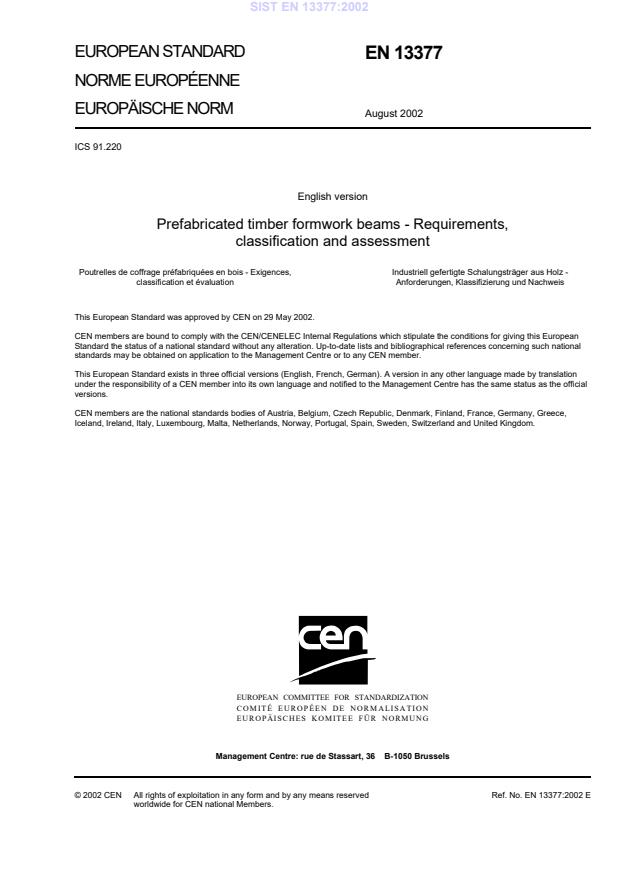
2003-01.Slovenski inštitut za standardizacijo. Razmnoževanje celote ali delov tega standarda ni dovoljeno.]RYDQMHIndustriell gefertigte Schalungsträger aus Holz - Anforderungen, Klassifizierung und NachweisPoutrelles de coffrage préfabriquées en bois - Exigences, classification et évaluationPrefabricated timber formwork beams - Requirements, classification and assessment91.220Gradbena opremaConstruction equipmentICS:Ta slovenski standard je istoveten z:EN 13377:2002SIST EN 13377:2002en01-december-2002SIST EN 13377:2002SLOVENSKI
STANDARD
EUROPEAN STANDARDNORME EUROPÉENNEEUROPÄISCHE NORMEN 13377August 2002ICS 91.220English versionPrefabricated timber formwork beams - Requirements,classification and assessmentPoutrelles de coffrage préfabriquées en bois - Exigences,classification et évaluationIndustriell gefertigte Schalungsträger aus Holz -Anforderungen, Klassifizierung und NachweisThis European Standard was approved by CEN on 29 May 2002.CEN members are bound to comply with the CEN/CENELEC Internal Regulations which stipulate the conditions for giving this EuropeanStandard the status of a national standard without any alteration. Up-to-date lists and bibliographical references concerning such nationalstandards may be obtained on application to the Management Centre or to any CEN member.This European Standard exists in three official versions (English, French, German). A version in any other language made by translationunder the responsibility of a CEN member into its own language and notified to the Management Centre has the same status as the officialversions.CEN members are the national standards bodies of Austria, Belgium, Czech Republic, Denmark, Finland, France, Germany, Greece,Iceland, Ireland, Italy, Luxembourg, Malta, Netherlands, Norway, Portugal, Spain, Sweden, Switzerland and United Kingdom.EUROPEAN COMMITTEE FOR STANDARDIZATIONCOMITÉ EUROPÉEN DE NORMALISATIONEUROPÄISCHES KOMITEE FÜR NORMUNGManagement Centre: rue de Stassart, 36
B-1050 Brussels© 2002 CENAll rights of exploitation in any form and by any means reservedworldwide for CEN national Members.Ref. No. EN 13377:2002 ESIST EN 13377:2002
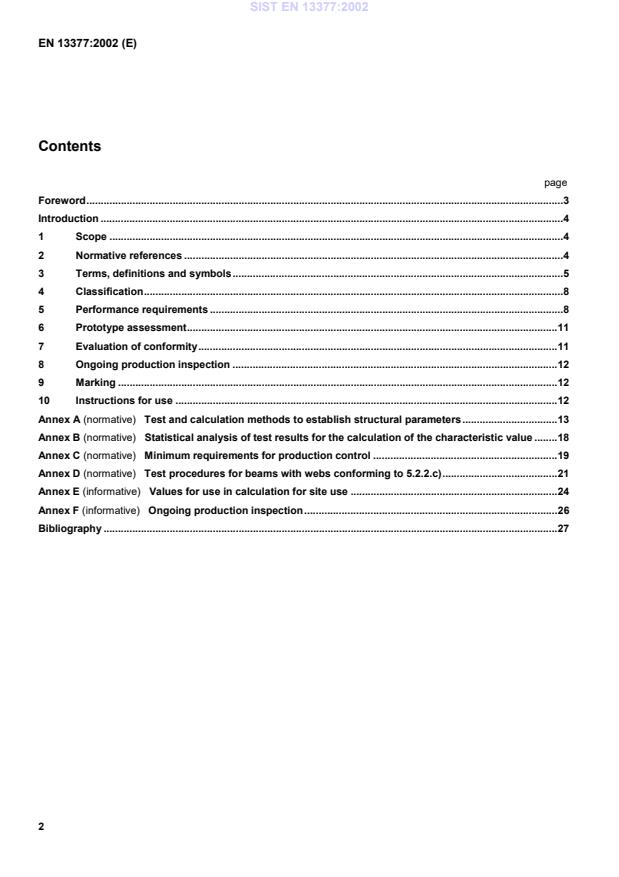
Test and calculation methods to establish structural parameters.13Annex B (normative)
Statistical analysis of test results for the calculation of the characteristic value.18Annex C (normative)
Minimum requirements for production control.19Annex D (normative)
Test procedures for beams with webs conforming to 5.2.2.c).21Annex E (informative)
Values for use in calculation for site use.24Annex F (informative)
Ongoing production inspection.26Bibliography.27SIST EN 13377:2002
inaccordance with EN 338:1995 shall be used.5 Performance requirements5.1 GeneralBeams shall conform to the requirements of this clause according to their class. Conformity with the requirementsshall be verified, see clauses 6 and 7, and manufacturing shall be subject to production control, see clause 8 andannex C.SIST EN 13377:2002
...