

EN 1097-9:2014
(Main)Tests for mechanical and physical properties of aggregates - Part 9: Determination of the resistance to wear by abrasion from studded tyres - Nordic test
- Abstract
This European Standard describes the reference method, used for type testing and in case of dispute, for determination of the resistance of coarse aggregate to wear by abrasion from studded tyres. For other purposes, in particular production control, other methods may be used, provided that an appropriate working relationship with the reference method has been established.
The test is applicable to aggregates with a size fraction of 11,2 mm to 16 mm.
NOTE An alternative size fraction 8/11,2 mm for different end uses is given in Annex A.
- Status
- Published
- Publication Date
- 07-Jan-2014
- Withdrawal Date
- 30-Jul-2014
- Technical Committee
- CEN/TC 154 - Aggregates
- Drafting Committee
- CEN/TC 154 - Aggregates
- Current Stage
- 9060 - Closure of 2 Year Review Enquiry - Review Enquiry
- Start Date
- 04-Jun-2025
- Completion Date
- 04-Jun-2025



Overview
EN 1097-9:2014 is a European Standard published by the Comité Européen de Normalisation (CEN) that specifies the reference method for testing the resistance of coarse aggregates to wear caused by abrasion from studded tyres – commonly known as the Nordic test. This standard is critical for assessing the durability and mechanical performance of aggregates utilized in road construction and other infrastructure projects, especially in Nordic countries where studded tyres are frequently used during winter. The standard applies mainly to coarse aggregates in the size range of 11.2 mm to 16 mm, with an alternative size fraction of 8 mm to 11.2 mm provided for different applications.
Key Topics
Scope and Application
EN 1097-9:2014 outlines a reliable procedure primarily for type testing and dispute cases regarding the abrasion resistance of aggregates against studded tyre wear. While other testing methods can be applied for production control, these must be correlated with the reference method defined in this standard.Test Principle
The test involves rotating a sample of single-sized aggregate combined with steel balls and water inside a sealed steel drum fitted with three internal ribs. The rotation produces abrasion between aggregate particles and steel balls, replicating the wear caused by studded tyres on pavements. After a fixed number of revolutions, the material is sieved to determine the percentage of wear based on mass loss.Specimen Preparation
Test specimens must meet specific grading and dry mass criteria determined by particle density according to EN 1097-6:2013. The sample undergoes washing, drying to constant mass, and sieving to achieve the correct size fractions before testing.Apparatus Requirements
The test mandates the use of calibrated equipment, including:- Steel drum with controlled dimensions and three removable hard steel ribs
- Steel balls (15 mm diameter) with prescribed hardness and uniformity
- Motor to provide consistent drum rotation speed at 90 ± 3 revolutions per minute
- Sieves conforming to EN 933-2 for particle size separation
- Oven with controlled drying temperature (110 ± 5°C)
Test Procedure
A standard charge of 7,000 g steel balls, the prepared aggregate sample, and 2 liters of water are placed in the drum. The machine is rotated for exactly 5,400 revolutions. Afterward, the material is washed, sieved on a 2 mm sieve, dried, and weighed to determine the mass loss percentage.Result Calculation and Precision
The Nordic abrasion value (AN) is calculated as the mass loss percentage of particles greater than 2 mm. Testing two specimens is standard; if results differ by more than 10%, two additional specimens are tested. The mean value, after proper statistical analysis including Dixon’s test for outliers, is reported as the final abrasion resistance value.
Applications
EN 1097-9:2014 is essential for:
Road Construction Quality Control
Ensuring that aggregates used in asphalt pavements or other road layers can withstand wear from studded tyre abrasion, critical for regions with winter traction requirements.Material Type Testing
Validating new sources or batches of coarse aggregate for performance before acceptance or use.Dispute Resolution
Providing an authoritative reference testing procedure in case of material performance conflicts.Research and Development
Supporting the development of more wear-resistant aggregate materials tailored to withstand aggressive abrasion environments caused by studded tyres.
Related Standards
EN 1097-9:2014 forms part of a comprehensive suite of standards covering mechanical and physical properties of aggregates, including:
- EN 1097-1 – Resistance to wear (Micro-Deval test)
- EN 1097-2 – Resistance to fragmentation
- EN 1097-6 – Particle density and water absorption
- EN 933-1 & EN 933-2 – Particle size distribution and sieve requirements
- EN 932-2 & EN 932-5 – Sampling methods and equipment calibration
Additional related standards cover thermal, chemical, and geometrical aggregate properties for comprehensive material characterization in civil engineering.
By following EN 1097-9:2014, engineers and quality controllers can ensure that aggregates meet stringent durability requirements specific to harsh Nordic conditions, optimizing pavement longevity and performance under studded tyre traffic. This standard is a vital reference for aggregate producers, road authorities, and testing laboratories focused on abrasion resistance testing.
Relations
- Effective Date
- 15-Jan-2014
- Effective Date
- 15-Jan-2014
- Effective Date
- 09-Feb-2026
- Effective Date
- 09-Feb-2026
- Effective Date
- 28-Jan-2026
- Effective Date
- 28-Jan-2026
- Effective Date
- 28-Jan-2026
- Effective Date
- 28-Jan-2026
- Effective Date
- 28-Jan-2026
- Effective Date
- 28-Jan-2026
- Referred By
EN 12697-5:2018 - Bituminous mixtures - Test methods - Part 5: Determination of the maximum density - Effective Date
- 28-Jan-2026
- Effective Date
- 28-Jan-2026
- Referred By
EN 13055:2016 - Lightweight aggregates - Effective Date
- 28-Jan-2026
- Effective Date
- 28-Jan-2026
- Referred By
EN 12620:2013 - Aggregates for concrete - Effective Date
- 28-Jan-2026
Get Certified
Connect with accredited certification bodies for this standard

DIBt (Deutsches Institut für Bautechnik)
German Institute for Building Technology.
DIN CERTCO
DIN Group product certification.

Aboma Certification B.V.
Specialized in construction, metal, and transport sectors.
Sponsored listings
Frequently Asked Questions
EN 1097-9:2014 is a standard published by the European Committee for Standardization (CEN). Its full title is "Tests for mechanical and physical properties of aggregates - Part 9: Determination of the resistance to wear by abrasion from studded tyres - Nordic test". This standard covers: This European Standard describes the reference method, used for type testing and in case of dispute, for determination of the resistance of coarse aggregate to wear by abrasion from studded tyres. For other purposes, in particular production control, other methods may be used, provided that an appropriate working relationship with the reference method has been established. The test is applicable to aggregates with a size fraction of 11,2 mm to 16 mm. NOTE An alternative size fraction 8/11,2 mm for different end uses is given in Annex A.
This European Standard describes the reference method, used for type testing and in case of dispute, for determination of the resistance of coarse aggregate to wear by abrasion from studded tyres. For other purposes, in particular production control, other methods may be used, provided that an appropriate working relationship with the reference method has been established. The test is applicable to aggregates with a size fraction of 11,2 mm to 16 mm. NOTE An alternative size fraction 8/11,2 mm for different end uses is given in Annex A.
EN 1097-9:2014 is classified under the following ICS (International Classification for Standards) categories: 91.100.15 - Mineral materials and products. The ICS classification helps identify the subject area and facilitates finding related standards.
EN 1097-9:2014 has the following relationships with other standards: It is inter standard links to EN 1097-9:1998, EN 1097-9:1998/A1:2005, ISO 9329-4:1997, ISO 3290-1:2008, EN ISO 4788:2005, EN 932-5:2012, EN 1097-6:2013, EN 933-2:2020, EN 933-1:2012, EN ISO 105-C10:2007, EN 12697-5:2018, EN 13043:2013, EN 13055:2016, EN 13863-4:2012, EN 12620:2013. Understanding these relationships helps ensure you are using the most current and applicable version of the standard.
EN 1097-9:2014 is available in PDF format for immediate download after purchase. The document can be added to your cart and obtained through the secure checkout process. Digital delivery ensures instant access to the complete standard document.
Standards Content (Sample)
2003-01.Slovenski inštitut za standardizacijo. Razmnoževanje celote ali delov tega standarda ni dovoljeno.Preskusi mehanskih in fizikalnih lastnosti agregatov - 9. del: Ugotavljanje odpornosti proti obrabi zaradi gum ježevk - Nordijski preskusPrüfverfahren für mechanische und physikalische Eigenschaften von Gesteinskörnungen - Teil 9: Bestimmung des Widerstandes gegen Verschleiß durch Spikereifen - Nordische PrüfungEssais pour déterminer les propriétés mécaniques et physiques des granulats - Partie 9: Méthode pour la détermination dela résistance à l'usure par abrasion provoquée par les pneusà crampons - Essai scandinaveTests for mechanical and physical properties of aggregates - Part 9: Determination of the resistance to wear by abrasion from studded tyres - Nordic test91.100.15Mineralni materiali in izdelkiMineral materials and productsICS:Ta slovenski standard je istoveten z:EN 1097-9:2014SIST EN 1097-9:2014en,fr,de01-april-2014SIST EN 1097-9:2014SLOVENSKI
STANDARDSIST EN 1097-9:1999/A1:2005SIST EN 1097-9:19991DGRPHãþD
EUROPEAN STANDARD NORME EUROPÉENNE EUROPÄISCHE NORM
EN 1097-9
January 2014 ICS 91.100.15 Supersedes EN 1097-9:1998
English Version
Tests for mechanical and physical properties of aggregates - Part 9: Determination of the resistance to wear by abrasion from studded tyres - Nordic test
Essais pour déterminer les propriétés mécaniques et physiques des granulats - Partie 9: Détermination de la résistance à l'usure par abrasion provoquée par les pneus à crampons - Essai scandinave
Prüfverfahren für mechanische und physikalische Eigenschaften von Gesteinskörnungen - Teil 9: Bestimmung des Widerstandes gegen Verschleiß durch Spikereifen - Nordische Prüfung This European Standard was approved by CEN on 3 November 2013.
CEN members are bound to comply with the CEN/CENELEC Internal Regulations which stipulate the conditions for giving this European Standard the status of a national standard without any alteration. Up-to-date lists and bibliographical references concerning such national standards may be obtained on application to the CEN-CENELEC Management Centre or to any CEN member.
This European Standard exists in three official versions (English, French, German). A version in any other language made by translation under the responsibility of a CEN member into its own language and notified to the CEN-CENELEC Management Centre has the same status as the official versions.
CEN members are the national standards bodies of Austria, Belgium, Bulgaria, Croatia, Cyprus, Czech Republic, Denmark, Estonia, Finland, Former Yugoslav Republic of Macedonia, France, Germany, Greece, Hungary, Iceland, Ireland, Italy, Latvia, Lithuania, Luxembourg, Malta, Netherlands, Norway, Poland, Portugal, Romania, Slovakia, Slovenia, Spain, Sweden, Switzerland, Turkey and United Kingdom.
EUROPEAN COMMITTEE FOR STANDARDIZATION
COMITÉ EUROPÉEN DE NORMALISATION
EUROPÄISCHES KOMITEE FÜR NORMUNG
CEN-CENELEC Management Centre:
Avenue Marnix 17,
B-1000 Brussels © 2014 CEN All rights of exploitation in any form and by any means reserved worldwide for CEN national Members. Ref. No. EN 1097-9:2014 E SIST EN 1097-9:2014
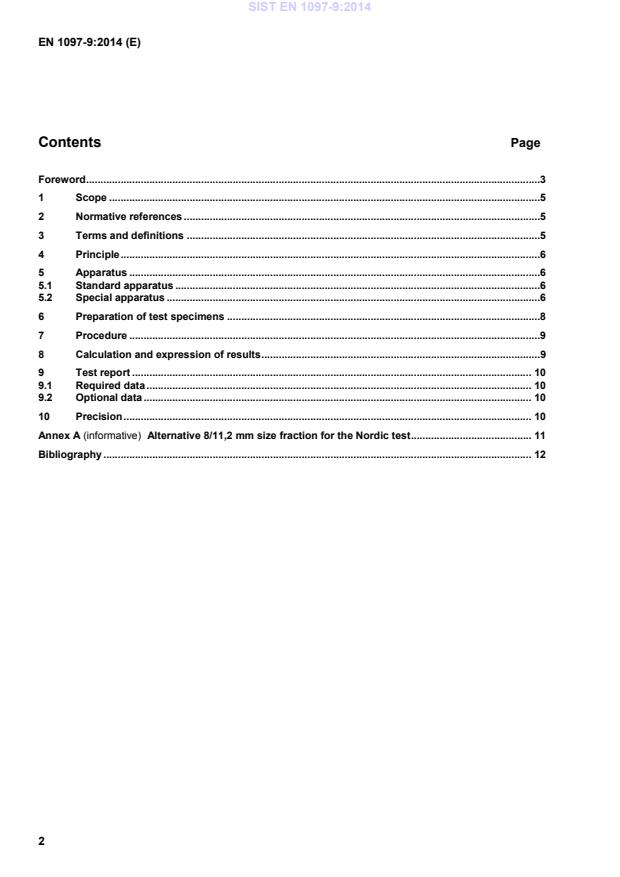
Alternative 8/11,2 mm size fraction for the Nordic test . 11 Bibliography . 12
1 Scope This European Standard describes the reference method, used for type testing and in case of dispute, for determination of the resistance of coarse aggregate to wear by abrasion from studded tyres. For other purposes, in particular factory production control, other methods may be used, provided that an appropriate working relationship with the reference method has been established. The test is applicable to aggregates with a size fraction of 11,2 mm to 16 mm. NOTE An alternative size fraction 8/11,2 mm for different end uses is given in Annex A. 2 Normative references The following documents, in whole or in part, are normatively referenced in this document and are indispensable for its application. For dated references, only the edition cited applies. For undated references, the latest edition of the referenced document (including any amendments) applies. EN 932-2:1999, Tests for general properties of aggregates - Part 2: Methods for reducing laboratory samples EN 932-5, Tests for general properties of aggregates - Part 5: Common equipment and calibration EN 933-1, Tests for geometrical properties of aggregates - Part 1: Determination of particle size distribution - Sieving method EN 933-2, Tests for geometrical properties of aggregates - Part 2: Determination of particle size distribution - Test sieves, nominal size of apertures EN 1097-6:2013, Tests for mechanical and physical properties of aggregates - Part 6: Determination of particle density and water absorption EN ISO 4788, Laboratory glassware - Graduated measuring cylinders (ISO 4788) ISO 3290-1, Rolling bearings — Balls — Part 1: Steel balls ISO 9329-4, Seamless steel tubes for pressure purposes — Technical delivery conditions — Part 4: Austenitic stainless steels 3 Terms and definitions For the purposes of this document, the following terms and definitions apply. 3.1 test specimen sample used in a single determination when a test method requires more than one determination of a property 3.2 laboratory sample sample intended for laboratory testing 3.3 constant mass mass determined after successive weighings
...