


ETSI EN 304 132 V1.1.1 (2026-09)
Environmental Engineering (EE); Mobile ICT devices (M-ICT); Product Specific Requirements for Life Cycle Assessment (LCA) of Smartphones
General Information
- Abstract
DEN/EE-MICT6
- Status
- Not Published
- Technical Committee
- EE M-ICT - Mobile ICT devices
- Current Stage
- 12 - Citation in the OJ (auto-insert)
- Due Date
- 10-Sep-2026
- Completion Date
- 10-Sep-2026
Buy Documents
ETSI EN 304 132 V1.1.0 (2026-05) - Environmental Engineering (EE); Mobile ICT devices (M-ICT); Product Specific Requirements for Life Cycle Assessment (LCA) of Smartphones
ETSI EN 304 132 V1.1.1 (2026-09) - Environmental Engineering (EE); Mobile ICT devices (M-ICT); Product Specific Requirements for Life Cycle Assessment (LCA) of Smartphones


Buy Documents
ETSI EN 304 132 V1.1.0 (2026-05) - Environmental Engineering (EE); Mobile ICT devices (M-ICT); Product Specific Requirements for Life Cycle Assessment (LCA) of Smartphones
ETSI EN 304 132 V1.1.1 (2026-09) - Environmental Engineering (EE); Mobile ICT devices (M-ICT); Product Specific Requirements for Life Cycle Assessment (LCA) of Smartphones
Frequently Asked Questions
ETSI EN 304 132 V1.1.1 (2026-09) is a standard published by the European Telecommunications Standards Institute (ETSI). Its full title is "Environmental Engineering (EE); Mobile ICT devices (M-ICT); Product Specific Requirements for Life Cycle Assessment (LCA) of Smartphones". This standard covers: DEN/EE-MICT6
DEN/EE-MICT6
ETSI EN 304 132 V1.1.1 (2026-09) is available in PDF format for immediate download after purchase. The document can be added to your cart and obtained through the secure checkout process. Digital delivery ensures instant access to the complete standard document.
Standards Content (Sample)
Draft ETSI EN 304 132 V1.1.0 (2026-05)
EUROPEAN STANDARD
Environmental Engineering (EE);
Mobile ICT devices (M-ICT);
Product Specific Requirements for
Life Cycle Assessment (LCA) of Smartphones
2 Draft ETSI EN 304 132 V1.1.0 (2026-05)
Reference
DEN/EE-MICT6
Keywords
LCA, smartphone
ETSI
650 Route des Lucioles
F-06921 Sophia Antipolis Cedex - FRANCE
Tel.: +33 4 92 94 42 00 Fax: +33 4 93 65 47 16
Siret N° 348 623 562 00017 - APE 7112B
Association à but non lucratif enregistrée à la
Sous-Préfecture de Grasse (06) N° w061004871
Important notice
The present document can be downloaded from the
ETSI Search & Browse Standards application.
The present document may be made available in electronic versions and/or in print. The content of any electronic and/or
print versions of the present document shall not be modified without the prior written authorization of ETSI. In case of any
existing or perceived difference in contents between such versions and/or in print, the prevailing version of an ETSI
deliverable is the one made publicly available in PDF format on ETSI deliver repository.
Users should be aware that the present document may be revised or have its status changed,
this information is available in the Milestones listing.
If you find errors in the present document, please send your comments to
the relevant service listed under Committee Support Staff.
If you find a security vulnerability in the present document, please report it through our
Coordinated Vulnerability Disclosure (CVD) program.
Notice of disclaimer & limitation of liability
The information provided in the present deliverable is directed solely to professionals who have the appropriate degree of
experience to understand and interpret its content in accordance with generally accepted engineering or
other professional standard and applicable regulations.
No recommendation as to products and services or vendors is made or should be implied.
In no event shall ETSI be held liable for loss of profits or any other incidental or consequential damages.
Any software contained in this deliverable is provided "AS IS" with no warranties, express or implied, including but not
limited to, the warranties of merchantability, fitness for a particular purpose and non-infringement of intellectual property
rights and ETSI shall not be held liable in any event for any damages whatsoever (including, without limitation, damages
for loss of profits, business interruption, loss of information, or any other pecuniary loss) arising out of or related to the use
of or inability to use the software.
Copyright Notification
No part may be reproduced or utilized in any form or by any means, electronic or mechanical, including photocopying and
microfilm except as authorized by written permission of ETSI.
The content of the PDF version shall not be modified without the written authorization of ETSI.
The copyright and the foregoing restriction extend to reproduction in all media.
© ETSI 2026.
All rights reserved.
ETSI
3 Draft ETSI EN 304 132 V1.1.0 (2026-05)
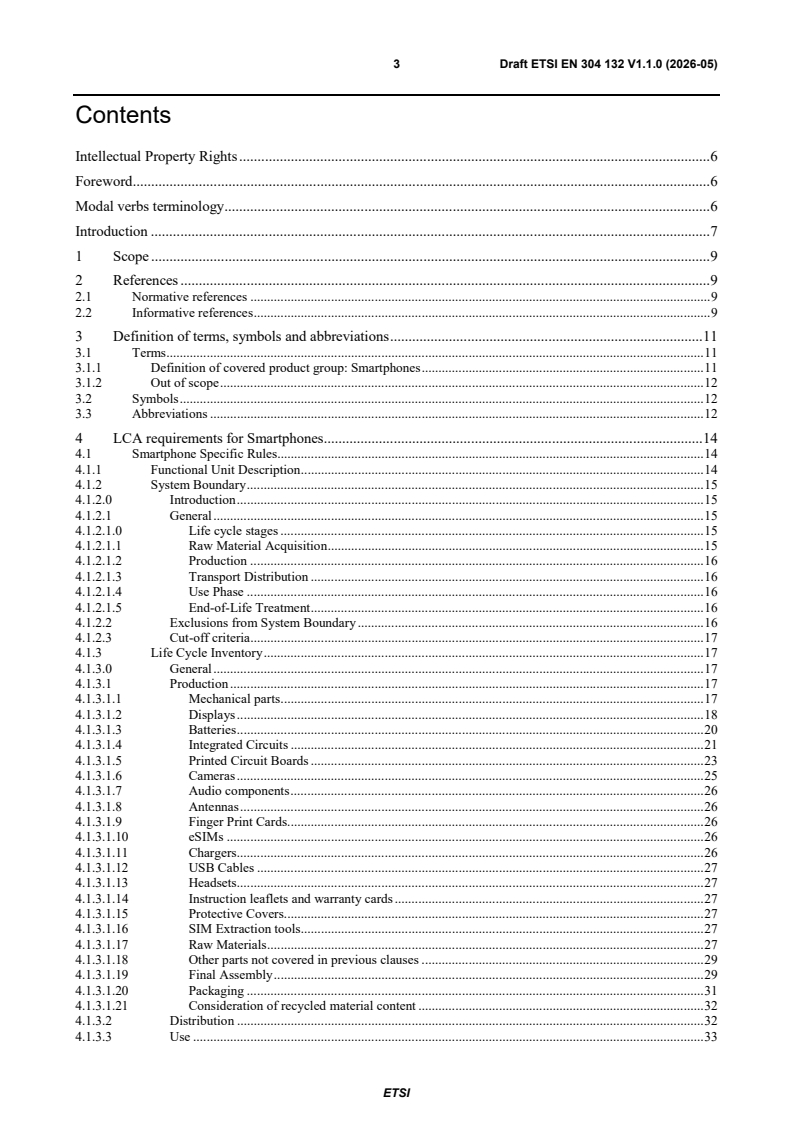
Contents
Intellectual Property Rights . 6
Foreword . 6
Modal verbs terminology . 6
Introduction . 7
1 Scope . 9
2 References . 9
2.1 Normative references . 9
2.2 Informative references . 9
3 Definition of terms, symbols and abbreviations . 11
3.1 Terms . 11
3.1.1 Definition of covered product group: Smartphones . 11
3.1.2 Out of scope . 12
3.2 Symbols . 12
3.3 Abbreviations . 12
4 LCA requirements for Smartphones . 14
4.1 Smartphone Specific Rules. 14
4.1.1 Functional Unit Description . 14
4.1.2 System Boundary . 15
4.1.2.0 Introduction . 15
4.1.2.1 General . 15
4.1.2.1.0 Life cycle stages . 15
4.1.2.1.1 Raw Material Acquisition . 15
4.1.2.1.2 Production . 16
4.1.2.1.3 Transport Distribution . 16
4.1.2.1.4 Use Phase . 16
4.1.2.1.5 End-of-Life Treatment . 16
4.1.2.2 Exclusions from System Boundary . 16
4.1.2.3 Cut-off criteria . 17
4.1.3 Life Cycle Inventory . 17
4.1.3.0 General . 17
4.1.3.1 Production . 17
4.1.3.1.1 Mechanical parts . 17
4.1.3.1.2 Displays . 18
4.1.3.1.3 Batteries . 20
4.1.3.1.4 Integrated Circuits . 21
4.1.3.1.5 Printed Circuit Boards . 23
4.1.3.1.6 Cameras . 25
4.1.3.1.7 Audio components . 26
4.1.3.1.8 Antennas . 26
4.1.3.1.9 Finger Print Cards. 26
4.1.3.1.10 eSIMs . 26
4.1.3.1.11 Chargers. 26
4.1.3.1.12 USB Cables . 27
4.1.3.1.13 Headsets. 27
4.1.3.1.14 Instruction leaflets and warranty cards . 27
4.1.3.1.15 Protective Covers. 27
4.1.3.1.16 SIM Extraction tools . 27
4.1.3.1.17 Raw Materials . 27
4.1.3.1.18 Other parts not covered in previous clauses . 29
4.1.3.1.19 Final Assembly . 29
4.1.3.1.20 Packaging . 31
4.1.3.1.21 Consideration of recycled material content . 32
4.1.3.2 Distribution . 32
4.1.3.3 Use . 33
ETSI
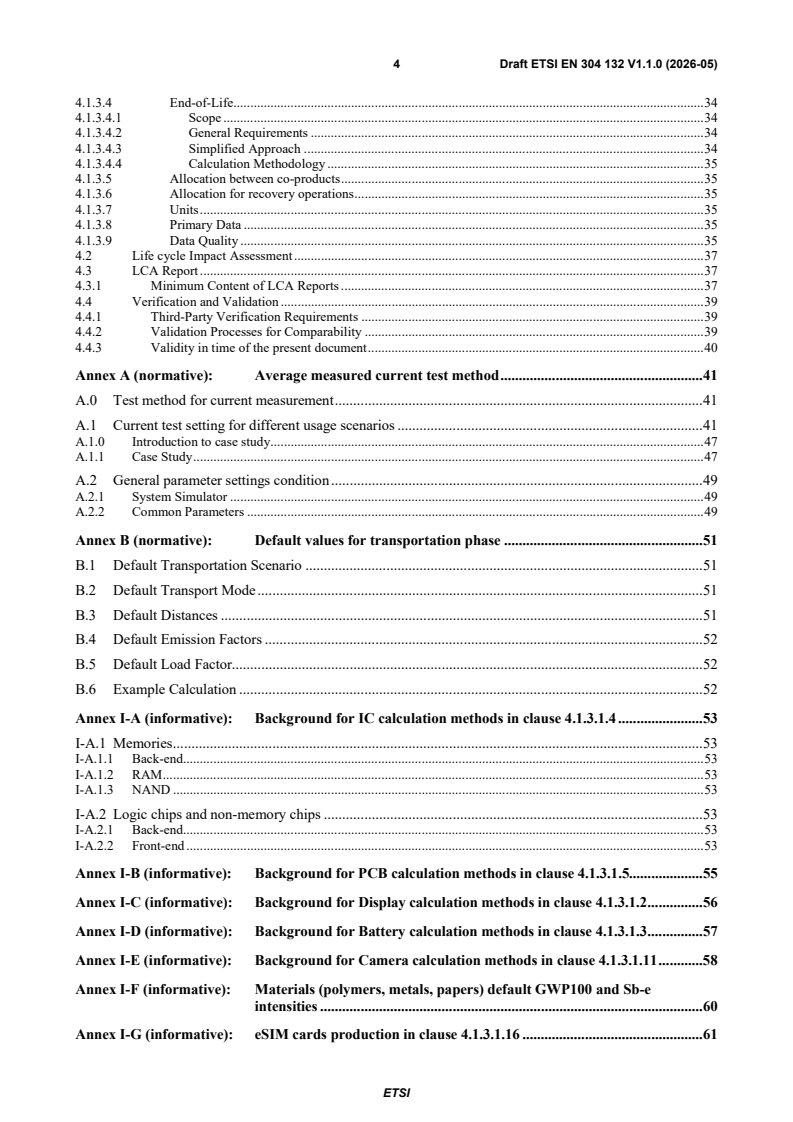
4 Draft ETSI EN 304 132 V1.1.0 (2026-05)
4.1.3.4 End-of-Life. 34
4.1.3.4.1 Scope . 34
4.1.3.4.2 General Requirements . 34
4.1.3.4.3 Simplified Approach . 34
4.1.3.4.4 Calculation Methodology . 35
4.1.3.5 Allocation between co-products . 35
4.1.3.6 Allocation for recovery operations . 35
4.1.3.7 Units . 35
4.1.3.8 Primary Data . 35
4.1.3.9 Data Quality . 35
4.2 Life cycle Impact Assessment . 37
4.3 LCA Report . 37
4.3.1 Minimum Content of LCA Reports . 37
4.4 Verification and Validation . 39
4.4.1 Third-Party Verification Requirements . 39
4.4.2 Validation Processes for Comparability . 39
4.4.3 Validity in time of the present document . 40
Annex A (normative): Average measured current test method . 41
A.0 Test method for current measurement . 41
A.1 Current test setting for different usage scenarios . 41
A.1.0 Introduction to case study . 47
A.1.1 Case Study . 47
A.2 General parameter settings condition . 49
A.2.1 System Simulator . 49
A.2.2 Common Parameters . 49
Annex B (normative): Default values for transportation phase . 51
B.1 Default Transportation Scenario . 51
B.2 Default Transport Mode . 51
B.3 Default Distances . 51
B.4 Default Emission Factors . 52
B.5 Default Load Factor. 52
B.6 Example Calculation . 52
Annex I-A (informative): Background for IC calculation methods in clause 4.1.3.1.4 . 53
I-A.1 Memories . 53
I-A.1.1 Back-end. 53
I-A.1.2 RAM . 53
I-A.1.3 NAND . 53
I-A.2 Logic chips and non-memory chips . 53
I-A.2.1 Back-end. 53
I-A.2.2 Front-end . 53
Annex I-B (informative): Background for PCB calculation methods in clause 4.1.3.1.5. 55
Annex I-C (informative): Background for Display calculation methods in clause 4.1.3.1.2 . 56
Annex I-D (informative): Background for Battery calculation methods in clause 4.1.3.1.3 . 57
Annex I-E (informative): Background for Camera calculation methods in clause 4.1.3.1.11 . 58
Annex I-F (informative): Materials (polymers, metals, papers) default GWP100 and Sb-e
intensities . 60
Annex I-G (informative): eSIM cards production in clause 4.1.3.1.16 . 61
ETSI
5 Draft ETSI EN 304 132 V1.1.0 (2026-05)
Annex I-H (informative): Mechanical part production in clause 4.1.3.1.1 . 62
Annex I-I (informative): Example of result generation code for result presentation . 63
History . 66
ETSI
6 Draft ETSI EN 304 132 V1.1.0 (2026-05)
Intellectual Property Rights
Essential patents
IPRs essential or potentially essential to normative deliverables may have been declared to ETSI. The declarations
pertaining to these essential IPRs, if any, are publicly available for ETSI members and non-members, and can be
found in ETSI SR 000 314: "Intellectual Property Rights (IPRs); Essential, or potentially Essential, IPRs notified to
ETSI in respect of ETSI standards", which is available from the ETSI Secretariat. Latest updates are available on the
ETSI IPR online database.
Pursuant to the ETSI Directives including the ETSI IPR Policy, no investigation regarding the essentiality of IPRs,
including IPR searches, has been carried out by ETSI. No guarantee can be given as to the existence of other IPRs not
referenced in ETSI SR 000 314 (or the updates on the ETSI Web server) which are, or may be, or may become,
essential to the present document.
Trademarks
The present document may include trademarks and/or tradenames which are asserted and/or registered by their owners.
ETSI claims no ownership of these except for any which are indicated as being the property of ETSI, and conveys no
right to use or reproduce any trademark and/or tradename. Mention of those trademarks in the present document does
not constitute an endorsement by ETSI of products, services or organizations associated with those trademarks.
DECT™, PLUGTESTS™, UMTS™ and the ETSI logo are trademarks of ETSI registered for the benefit of its
Members. 3GPP™, LTE™ and 5G™ logo are trademarks of ETSI registered for the benefit of its Members and of the
3GPP Organizational Partners. oneM2M™ logo is a trademark of ETSI registered for the benefit of its Members and of ®
the oneM2M Partners. GSM and the GSM logo are trademarks registered and owned by the GSM Association. ®
BLUETOOTH is a trademark registered and owned by Bluetooth SIG, Inc.
Foreword
This draft European Standard (EN) has been produced by ETSI Technical Committee Environmental Engineering (EE),
and is now submitted for the combined Public Enquiry and Vote phase of the ETSI EN Approval Procedure (ENAP).
Proposed national transposition dates
Date of latest announcement of this EN (doa): 3 months after ETSI publication
Date of latest publication of new National Standard
or endorsement of this EN (dop/e): 6 months after doa
Date of withdrawal of any conflicting National Standard (dow): 6 months after doa
Modal verbs terminology
In the present document "shall", "shall not", "should", "should not", "may", "need not", "will", "will not", "can" and
"cannot" are to be interpreted as described in clause 3.2 of the ETSI Drafting Rules (Verbal forms for the expression of
provisions).
"must" and "must not" are NOT allowed in ETSI deliverables except when used in direct citation.
ETSI
7 Draft ETSI EN 304 132 V1.1.0 (2026-05)
Introduction
The present document defines Product Specific Requirements (PSR) for the Life Cycle Assessment (LCA) of
smartphones to ensure that LCA studies conducted on smartphone models, including at the SKU level (e.g. different
memory configurations and form factors such as foldables) are comparable, objective, and transparent.
Based on the LCA framework outlined in [1] and [i.1], as well as ideas and results presented in [i.2] and [i.3], the
present document provides methodology guidance specific to smartphones, enhancing harmonization and
communication of LCA results. It applies to all types of smartphones and sets requirements for conducting LCAs that
allow valid comparisons between different device models.
The goals of the present document are to:
• Establish smartphone-specific LCA method and standard that builds upon and enhances existing general LCA
standards by providing more specific and targeted guidelines for smartphones.
• Ensure consistent and comparable LCA studies across the industry.
• Improve the transparency and interpretation of smartphone LCA studies.
• Facilitate clear and standardized communication of LCA results at the SKU level for both manufacturers and
distributors as part of their sustainability reporting, but not restricted to this application.
In addition, the present document should allow impact forecast and simulation already in the device design phase to
help make conscious decisions in material and part/component selection for the reduction of the ecological footprint.
Background
The earth climate is affected by a human-caused climate change, which results in global warming. Global warming will
have severe effects, even affecting possibly habitability in some parts, unless serious efforts are undertaken to limit the
rise of the global temperatures.
The earth is in a radiation equilibrium given by the radiation it receives from the sun (149,6 million km average
distance) and the radiation back into space, which leads to an equilibrium temperature. Unfortunately, this counter
radiation happens predominantly in wavelength ranges where certain gases absorb, such as Carbon Dioxide or Methane
(collectively Greenhouse Gases (GHG)), reducing the energy that is radiated back into space and thereby increasing the
level of energy kept on the earth surface and atmosphere. The concentration of such gases has thus an immediate impact
on that equilibration temperature. Mankind is using fossil carbon for energy generation and as a raw material for a
multitude of applications. This activity causes the concentration of GHG to rise in the atmosphere which in turn fuels
global warming.
To limit global warming and its associated negative consequences, the emissions of GHG should be limited. Therefore,
many nations have come together to limit global warming to 1,5 °C in the Paris Climate Agreement. This requires a
vigorous decarbonization of continents, nations and industries alike.
The manufacturing, transportation, use and disposal of smartphones are inevitably associated with GHG emissions.
Seen globally the impact of Smartphone production and use is substantial. In 2023 alone, more than 1,3 billion
smartphones were sold globally. This is only the number that is accumulated year on year into the connected base.
Counting all smartphones in use, around 580 million tonnes of GHG are emitted annually which is ca. 1 % of all
worldwide emissions. These should be reduced. The first step to the reduction of emissions is an inventory of what is
currently emitted to define the basis from which emissions need to be reduced, and then a reliable measure is required to
gauge the progress of emission reduction beyond effects of just different ways to calculate. This requires a standard for
the calculation of emissions on a common basis that allows a fair comparison of emissions of the players in the industry
and credible tracking of successes in reductions.
ETSI
8 Draft ETSI EN 304 132 V1.1.0 (2026-05)
However, GHG emissions are only one of several impact categories considered in an LCA. A relevant category for
Smartphones is also resource use. Resources are limited and conservation as well as recycling is paramount. Most
elements of the periodic table are represented in smartphones. These elements need to be taken out of the soil unless
taken from secondary (recycled sources). Mining of minerals and their subsequent processing in turn consumes land and
causes the risk of pollution and natural habitat impediment or even destruction. Likewise, the resource use needs to be
reduced, and primary sources replaced by secondary ones wherever that is possible. There is also a commercial and
supply chain related side-effect to this. Some of the elements used in Smartphones are only available from a very few
countries or with limited deposits which has an impact on supply risks and future price development. The present
document will allow a comparable assessment of the resources used for any particular Smartphone design. By way of
such comparison the progress of the industry in resource conservation will be made transparent.
Exemplified by two of the impact categories analogous considerations are also applicable and valid for the other impact
categories.
Corporations in the ICT sector do not live in a societal vacuum. Their success depends on a friendly societal
environment in which to operate. Modern societies increasingly demand corporate responsibility and a positive
contribution to communities. Perception and acceptance of industry players is more and more influenced by these
factors. Commitment to climate protection is an important, if not the most important element of it. A widely accepted
standard for emission calculation associated with Smartphones is needed to serve as a fair, transparent and credible way
to show to the public the industry contribution to climate protection.
Existing standards today are either not smartphone specific or allow a variance in methodology so that comparability is
not possible. The present document closes this gap by creating Product Specific Requirements for Life Cycle
Assessment (LCA) of smartphones.
Objectives of the present document
The present document allows performing LCA for Smartphones according to a common methodology. The results will
allow an inventory of existing emissions for multi-vendor portfolios without the uncertainty of interpretation caused by
variances in methodology application by different vendors or sources. Also, the results can directly be usable for
financial statements, business and sustainability or any other reporting in relation to climate or environmental protection
which may be legally mandatory in some jurisdictions. The present document will be readily acceptable to third parties
auditing such reports.
The present document will also make emission reductions transparent achieved by players in the industry. These
achievements will not disappear into differences in results just caused by different methodology application or
calculations. If the latter were to happen no conclusion would be possible if a low emission value is due to real
reduction or just a result of "optimized" calculation. Therefore, the present document will contribute to increased trust
in the public that any reported emission reduction is real and not just apparent by different ways of calculation. Players
achieving real emission reductions will be rewarded by making it transparent, as unambiguously as this is reasonably
possible, and others encouraged to follow. Therein, the present document will already account for the coming
Empowering the Consumer and Green Claims directives.
However, due to fundamentals of nature, no measurement and no calculation is completely free of uncertainties.
Nevertheless, the ambition is to keep those as small as possible to allow valid comparisons between and/or predictions
for different Smartphone models and portfolios to help making optimizations for emission reductions. Therefore, the
present document also contains a semi-quantitative assessment of the uncertainty margin based on the expectable
variance in input parameters.
Relationship to Existing LCA Standards
The present document is more specific than the "PCR" [1] (but reuses some its terminology for life cycle stages), the
PCR guidance for electrical products [i.1] and the application of [1] to a mobile phone, [i.3]. The present PSR document
is the first of its kind in the ICT industry.
ETSI
9 Draft ETSI EN 304 132 V1.1.0 (2026-05)
1 Scope
The present document defines Product Specific Requirements for Life Cycle Assessment (LCA) of Smartphones so that
it is possible to compare the LCA between different smartphone models on SKU level (e.g. considering different
memory configurations). The present document provides a methodology for evaluating the environmental impact of
smartphones objectively and transparently and is based upon the Life Cycle Assessment (LCA) framework standardized
in ETSI ES 203 199 [1] and IEC 63366 [i.1]. The purpose of the present document is to:
• Provide smartphone-specific requirements, i.e. Product Specific Rules (PSR), in addition to those of ETSI
ES 203 199 [1] and IEC 63366 [i.1] to ensure comparability of LCA studies of smartphones on SKU level.
• Harmonize the LCAs of smartphones.
• Increase the transparency and facilitate the interpretation of LCA studies of smartphones.
• Facilitate the communication of LCA studies of smartphones on SKU level.
The present document is valid for all types of smartphones. Moreover, the present document defines a set of
requirements for which the LCA practitioners will comply. Comparisons of results from LCA studies of smartphones
which belong to the same product family, including assessments which have been performed by different organizations,
are within the scope of the present document.
2 References
2.1 Normative references
References are either specific (identified by date of publication and/or edition number or version number) or
non-specific. For specific references, only the cited version applies. For non-specific references, the latest version of the
referenced document (including any amendments) applies.
Referenced documents which are not found to be publicly available in the expected location might be found in the
ETSI docbox.
NOTE: While any hyperlinks included in this clause were valid at the time of publication, ETSI cannot guarantee
their long-term validity.
The following referenced documents are necessary for the application of the present document.
[1] ETSI ES 203 199 (V1.4.1): "Environmental Engineering (EE); Methodology for environmental
Life Cycle Assessment (LCA) of Information and Communication Technology (ICT) goods,
networks and services".
[2] GSMA™ TS.09 v13.0: "Battery Life Measurement and Current Consumption Technique".
[3] ISO 14083:2023: "Greenhouse gases — Quantification and reporting of greenhouse gas emissions
arising from transport chain operations".
[4] Global Logistics Emissions Council (GLEC) Framework v3.2.
2.2 Informative references
References are either specific (identified by date of publication and/or edition number or version number) or
non-specific. For specific references, only the cited version applies. For non-specific references, the latest version of the
referenced document (including any amendments) applies.
NOTE: While any hyperlinks included in this clause were valid at the time of publication, ETSI cannot guarantee
their long-term validity.
ETSI
10 Draft ETSI EN 304 132 V1.1.0 (2026-05)
The following referenced documents may be useful in implementing an ETSI deliverable or add to the reader's
understanding, but are not required for conformance to the present document.
[i.1] IEC 63366:2025: "Product category rules for life cycle assessment of electrical and electronic
product and systems".
[i.2] ETSI TR 103 679 (V1.1.1): "Environmental Engineering (EE); Explore the challenges of
developing product group-specific Product Environmental Footprint Category Rules (PEFCRs) for
smartphones".
[i.3] ETSI TR 104 080 (V1.1.1): "Environmental Engineering (EE); Example of a Life Cycle
Assessment (LCA) of a mobile phone".
[i.4] M. Billaud, C. Clemm, D. Sánchez, M. Proske, M. Jügel, L. Stobbe, N. F. Nissen, M. Schneider-
Ramelow: "ICs as drivers of ICT carbon footprint: an approach to more accurate die size
assessment".
[i.5] Eynard U., Ardente F., Gama Caldas M., Spiliotopoulos C. and Mathieux F.: "Ecoreport tool -
Manual", Publications Office of the European Union, Luxembourg, 2024.
[i.6] Commission Recommendation C(2021)9332 on the use of the Environmental Footprint methods to
measure and communicate the life cycle environmental performance of products and
organisations. Sections 4.4.8 and 4.4.9 in Annex I.
[i.7] Weltweite und europäische Kunststoffproduktion in den Jahren von 1950 bis 2024.
[i.8] Aktuelle Zahlen zur Kunststoffproduktion - Anteil fossiler Rohstoffe in Kunststoffproduktion
rückläufig.
[i.9] Developer Environmental Footprint (EF).
[i.10] "Ecoreport tool - Manual", Publications Office of the European Union, 2024.
[i.11] ETSI TS 104 134 (V1.1.1): "Environmental Engineering (EE); Simplified Method for including
Uncertainty and Sensitivity Aspects in Calculations of the Avoided Environmental Impact of
Information and Communication Technology Solutions".
[i.12] GSMATerminals - Battery-Life-Measurement-Test-Files-Public.
[i.13] imec.netzero.
[i.14] Vanhouche, B., Cardinael, P., Boakes, L., Ragnarsson, L. Å., Rolin, C., Raskin, J. P., & Parvais,
B. (2024, June): "Environmental Analysis of RF Substrates". In 2024 Electronics Goes Green
2024+(EGG) (pp. 1-8). IEEE™.
[i.15] Andrae, A. S., & Vaija, M. S. (2017): "Precision of a streamlined life cycle assessment approach
used in eco-rating of mobile phones". Challenges, 8(2), 21.
[i.16] How Sustainable are Our OLED Lighting Panels? LCA Study Shows Benefits.
[i.17] A. Holo, C. Dubarry, J.-C. Lopes Barbosa, M. Dupont, S. Chabaud, F. Templier: "45‐4:
MicroLED Display Life Cycle Assessment".
[i.18] Ellingsen, L. A. W., Majeau‐Bettez, G., Singh, B., Srivastava, A. K., Valøen, L. O., & Strømman,
A. H.: "Life cycle assessment of a lithium‐ion battery vehicle pack". Journal of Industrial
Ecology, 18(1), pp. 113-124, 2014.
[i.19] Peters, J. F., Baumann, M., Zimmermann, B., Braun, J., & Weil, M.: "The environmental impact
of Li-Ion batteries and the role of key parameters-A review". Renewable and Sustainable Energy
Reviews, 67, pp. 491-506, 2017.
[i.20] Romare, M., & Dahllöf, L.: "The life cycle energy consumption and greenhouse gas emissions
from lithium-ion batteries", 2017.
[i.21] Dai, Q., Kelly, J. C., Gaines, L., & Wang, M.: "Life Cycle Analysis of Lithium-Ion Batteries for
Automotive Applications". Batteries, 5(2), p. 48, 2019.
ETSI
11 Draft ETSI EN 304 132 V1.1.0 (2026-05)
[i.22] Sustainability Impact Metrics:"Idemat and Ecoinvent, and eco-costs midpoint tables".
[i.23] Tin Sustainable Production.
[i.24] A.S.G Andrae: "A Comprehensive LCA method Addressing Uncertainty, Sensitivity, Rebound
and Cut-off assumptions", 2025. DOI: 10.13140/RG.2.2.16390.89929.
[i.25] Commission Regulation (EU) 2023/1670 of 16 June 2023 laying down ecodesign requirements for
smartphones, mobile phones other than smartphones, cordless phones and slate tablets pursuant to
Directive 2009/125/EC of the European Parliament and of the Council and amending Commission
Regulation (EU) 2023/826.
[i.26] Salonitis, K., Jolly, M. R., Zeng, B., & Mehrabi, H.: "Improvements in energy consumption and
environmental impact by novel single shot melting process for casting". Journal of Cleaner
Production, 137, pp. 1532-1542, 2016.
[i.27] ETSI ES 204 085 (V1.1.1): "Environmental Engineering (EE); Guidance on simplified Life Cycle
Assessments (LCA) of Information and Communication Technologies (ICT)".
[i.28] Commission Regulation (EU) 2019/1782 of 1 October 2019 laying down ecodesign requirements
for external power supplies pursuant to Directive 2009/125/EC of the European Parliament and of
the Council and repealing Commission Regulation (EC) No 278/2009.
3 Definition of terms, symbols and abbreviations
3.1 Terms
3.1.1 Definition of covered product group: Smartphones
For the purposes of the present document, the terms given in Commission Recommendation C(2021)9332 [i.6] and the
following apply:
A: allocation factor of burdens and credits between supplier and user of recycled materials
B: allocation factor of energy recovery processes: it applies both to burdens and credits
*
E : specific emissions and resources consumed (per functional unit) arising from the acquisition and pre-processing of
v
primary material assumed to be substituted by recyclable materials
E : specific emissions and resources consumed (per functional unit) arising from disposal of waste material at the EoL
D
of the analysed product, without energy recovery
E : specific emissions and resources consumed (per functional unit) arising from the energy recovery process
ER
(e.g. incineration with energy recovery, landfill with energy recovery, etc.)
E : specific emissions and resources consumed (per functional unit) arising from the recycling process of the
recycled
recycled (reused) material, including collection, sorting and transportation process
E : specific emissions and resources consumed (per functional unit) arising from the recycling process at EoL,
recyclingEoL
including collection, sorting and transportation process
E and E : specific emissions and resources consumed (per functional unit) that would have arisen from the
SE,heat SE,elec
specific substituted energy source, heat and electricity respectively
Lower Heating Value (LHV): material in the product that is used for energy recovery
Qsin: quality of the ingoing secondary material, i.e. the quality of the recycled material at the point of substitution
Q : quality of the outgoing secondary material, i.e. the quality of the recyclable material at the point of substitution
sout
Qp: quality of the primary material, i.e. quality of the primary material
ETSI
12 Draft ETSI EN 304 132 V1.1.0 (2026-05)
R : proportion of material in the input to the production that has been recycled from a previous system
R2: proportion of the material in the product that will be recycled (or reused) in a subsequent system. R2 shall therefore
take into account the inefficiencies in the collection and recycling (or reuse) processes. R2 shall be measured at the
output of the recycling plant
R3: proportion of the material in the product that is used for energy recovery at EoL
smartphone: cordless handheld electronic device, which has the following characteristics [i.25]:
• It is designed for long-range voice communication over either a cellular telecommunications network or a
satellite-based telecommunications network, requiring a SIM card, eSIM or similar means to identify the
connected parties.
• It is designed for battery mode usage, while connection to mains via an external power supply and/or wireless
power transmission is mainly for battery charging purposes.
• It is not designed to be worn on the wrist.
• It is characterized by wireless network connection, mobile use of internet services, an operating system
optimized for handheld use and the ability to accept original and third-party software applications.
• It has an integrated touch screen display with a viewable diagonal size of 10,16 centimetres (or 4,0 inches) or
more, but less than 17,78 centimetres (or 7,0 inches).
• Where the device has a foldable display or has more than one display, at least one of the displays falls into the
size range in either opened or closed mode.
XER,heat and XER,elec: efficiency of the energy recovery process for both heat and electricity
3.1.2 Out of scope
All devices that do not comply with clause 3.1 of the present document shall be considered to be out of scope.
Additionally, mobile phones using satellite-based telecommunications network as its primary form of communication
are out of scope.
3.2 Symbols
Void.
3.3 Abbreviations
For the purposes of the present document, the following abbreviations apply:
th
5G 5 Generation
A2DP Advanced Audio Distribution Profile
AAC Advanced Audio Coding
ABS Acrylonitrile Butadiene Styrene
ADP Abiotic Depletion Potential
AP Access Point
BOF Basic Oxygen Furnace
BSI Back-Side Illumination
CED Cumulative Energy Demand
CFF Circular Footprint Formulae
CO Cobalt
COM COMpleteness
CPU Central Processing Unit
DASH Dynamic Adaptive Streaming over HTTP
DQR Data Quality Rating
DUT Device Under Test
EDR Enhanced DataRate
ETSI
13 Draft ETSI EN 304 132 V1.1.0 (2026-05)
EF Elementary File
EoL End of Life
EoLT End of Life Treatment
ErP Energy related Products
eSIM embedded Subscriber Identity Module
EU European Union
E-UTRA Evolved UMTS Terrestrial Radio Access
FPC FingerPrint Cards
GaA Gallium Arsenide
GaN Gallium Nitride
GAN Generic Access Network
GER Geographical Representativeness
GFLOPS Giga Floating Point Operations Per Second
GHG GreenHouse Gas
GLEC Global Logistic Emissions Council
GPRS General Packet Radio Service
GPS Global Positioning System
GPU Graphics Processing Until
GSM Global System for Mobile communications
GVW GROOS Vehicle Weight
GWP Global Warming Potential
GWP100 Global Warming Potential over a century
HDI High Density Interconnector
HDPE High Density PolyEthylene
HTML HyperText Markup Language
HTTP HyperText Transfer Protocol
HVAC Heat Ventilation Air Conditioning
ICT Information Communication Technology
IEA International Energy Agency
IMEC Interuniversity MicroElectronics Centre
IPA IsoPropyl Alcohol
ISO International Organization for Standardization
LCA Life Cycle Assessment
LCD Liquid Crystal DIsplay
LDPE Low Density PolyEthylene
LHV Lower Heating Value
LLDPE Linear Low Density PolyEthylene
LNM Logic
...
EUROPEAN STANDARD
Environmental Engineering (EE);
Mobile ICT devices (M-ICT);
Product Specific Requirements for
Life Cycle Assessment (LCA) of Smartphones
2 ETSI EN 304 132 V1.1.1 (2026-09)
Reference
DEN/EE-MICT6
Keywords
LCA, smartphone
ETSI
650 Route des Lucioles
F-06921 Sophia Antipolis Cedex - FRANCE
Tel.: +33 4 92 94 42 00 Fax: +33 4 93 65 47 16
Siret N° 348 623 562 00017 - APE 7112B
Association à but non lucratif enregistrée à la
Sous-Préfecture de Grasse (06) N° w061004871
Important notice
The present document can be downloaded from the
ETSI Search & Browse Standards application.
The present document may be made available in electronic versions and/or in print. The content of any electronic and/or
print versions of the present document shall not be modified without the prior written authorization of ETSI. In case of any
existing or perceived difference in contents between such versions and/or in print, the prevailing version of an ETSI
deliverable is the one made publicly available in PDF format on ETSI deliver repository.
Users should be aware that the present document may be revised or have its status changed,
this information is available in the Milestones listing.
If you find errors in the present document, please send your comments to
the relevant service listed under Committee Support Staff.
If you find a security vulnerability in the present document, please report it through our
Coordinated Vulnerability Disclosure (CVD) program.
Notice of disclaimer & limitation of liability
The information provided in the present deliverable is directed solely to professionals who have the appropriate degree of
experience to understand and interpret its content in accordance with generally accepted engineering or
other professional standard and applicable regulations.
No recommendation as to products and services or vendors is made or should be implied.
In no event shall ETSI be held liable for loss of profits or any other incidental or consequential damages.
Any software contained in this deliverable is provided "AS IS" with no warranties, express or implied, including but not
limited to, the warranties of merchantability, fitness for a particular purpose and non-infringement of intellectual property
rights and ETSI shall not be held liable in any event for any damages whatsoever (including, without limitation, damages
for loss of profits, business interruption, loss of information, or any other pecuniary loss) arising out of or related to the use
of or inability to use the software.
Copyright Notification
No part of this document may be reproduced in any form, by any means and in any media, without the prior written
authorization of ETSI and except as expressly permitted below.
By way of exception and when the document is a normative deliverable (European Standard (EN),
Technical Specification (TS), Group Specification (GS) or ETSI Standard (ES)), ETSI authorizes to reproduce
and incorporate into products, services and technical documentation only those extracts (e.g. templates) that are strictly
necessary for the technical implementation of the normative deliverable, to ensure compliance with the latter.
Nothing in this notice shall be construed as limiting any mandatory exceptions to copyright provided by applicable law.
© ETSI 2026.
All rights reserved.
ETSI
3 ETSI EN 304 132 V1.1.1 (2026-09)
Contents
Intellectual Property Rights . 6
Foreword . 6
Modal verbs terminology . 6
Introduction . 7
1 Scope . 9
2 References . 9
2.1 Normative references . 9
2.2 Informative references . 9
3 Definition of terms, symbols and abbreviations . 11
3.1 Terms . 11
3.1.1 Definition of covered product group: Smartphones . 11
3.1.2 Out of scope . 12
3.2 Symbols . 12
3.3 Abbreviations . 12
4 LCA requirements for Smartphones . 14
4.1 Smartphone Specific Rules. 14
4.1.1 Functional Unit Description . 14
4.1.2 System Boundary . 15
4.1.2.0 Introduction . 15
4.1.2.1 General . 15
4.1.2.1.0 Life cycle stages . 15
4.1.2.1.1 Raw Material Acquisition . 15
4.1.2.1.2 Production . 16
4.1.2.1.3 Transport Distribution . 16
4.1.2.1.4 Use Phase . 16
4.1.2.1.5 End-of-Life Treatment . 16
4.1.2.2 Exclusions from System Boundary . 16
4.1.2.3 Cut-off criteria . 17
4.1.3 Life Cycle Inventory . 17
4.1.3.0 General . 17
4.1.3.1 Production . 17
4.1.3.1.1 Mechanical parts . 17
4.1.3.1.2 Displays . 18
4.1.3.1.3 Batteries . 20
4.1.3.1.4 Integrated Circuits . 21
4.1.3.1.5 Printed Circuit Boards . 23
4.1.3.1.6 Cameras . 25
4.1.3.1.7 Audio components . 26
4.1.3.1.8 Antennas . 26
4.1.3.1.9 Finger Print Cards. 26
4.1.3.1.10 eSIMs . 26
4.1.3.1.11 Chargers. 26
4.1.3.1.12 USB Cables . 27
4.1.3.1.13 Headsets. 27
4.1.3.1.14 Instruction leaflets and warranty cards . 27
4.1.3.1.15 Protective Covers. 27
4.1.3.1.16 SIM Extraction tools . 27
4.1.3.1.17 Raw Materials . 27
4.1.3.1.18 Other parts not covered in previous clauses . 29
4.1.3.1.19 Final Assembly . 29
4.1.3.1.20 Packaging . 31
4.1.3.1.21 Consideration of recycled material content . 32
4.1.3.2 Distribution . 32
4.1.3.3 Use . 33
ETSI
4 ETSI EN 304 132 V1.1.1 (2026-09)
4.1.3.4 End-of-Life. 34
4.1.3.4.1 Scope . 34
4.1.3.4.2 General Requirements . 34
4.1.3.4.3 Simplified Approach . 34
4.1.3.4.4 Calculation Methodology . 35
4.1.3.5 Allocation between co-products . 35
4.1.3.6 Allocation for recovery operations . 35
4.1.3.7 Units . 35
4.1.3.8 Primary Data . 35
4.1.3.9 Data Quality . 35
4.2 Life cycle Impact Assessment . 37
4.3 LCA Report . 37
4.3.1 Minimum Content of LCA Reports . 37
4.4 Verification and Validation . 39
4.4.1 Third-Party Verification Requirements . 39
4.4.2 Validation Processes for Comparability . 39
4.4.3 Validity in time of the present document . 40
Annex A (normative): Average measured current test method . 41
A.0 Test method for current measurement . 41
A.1 Current test setting for different usage scenarios . 41
A.1.0 Introduction to case study . 47
A.1.1 Case Study . 47
A.2 General parameter settings condition . 49
A.2.1 System Simulator . 49
A.2.2 Common Parameters . 49
Annex B (normative): Default values for transportation phase . 51
B.1 Default Transportation Scenario . 51
B.2 Default Transport Mode . 51
B.3 Default Distances . 51
B.4 Default Emission Factors . 52
B.5 Default Load Factor. 52
B.6 Example Calculation . 52
Annex I-A (informative): Background for IC calculation methods in clause 4.1.3.1.4 . 53
I-A.1 Memories . 53
I-A.1.1 Back-end. 53
I-A.1.2 RAM . 53
I-A.1.3 NAND . 53
I-A.2 Logic chips and non-memory chips . 53
I-A.2.1 Back-end. 53
I-A.2.2 Front-end . 54
Annex I-B (informative): Background for PCB calculation methods in clause 4.1.3.1.5. 55
Annex I-C (informative): Background for Display calculation methods in clause 4.1.3.1.2 . 56
Annex I-D (informative): Background for Battery calculation methods in clause 4.1.3.1.3 . 57
Annex I-E (informative): Background for Camera calculation methods in clause 4.1.3.1.11 . 58
Annex I-F (informative): Materials (polymers, metals, papers) default GWP100 and Sb-e
intensities . 60
Annex I-G (informative): eSIM cards production in clause 4.1.3.1.16 . 61
ETSI
5 ETSI EN 304 132 V1.1.1 (2026-09)
Annex I-H (informative): Mechanical part production in clause 4.1.3.1.1 . 62
Annex I-I (informative): Example of result generation code for result presentation . 63
History . 66
ETSI
6 ETSI EN 304 132 V1.1.1 (2026-09)
Intellectual Property Rights
Essential patents
IPRs essential or potentially essential to normative deliverables (European Standard (EN), Technical Specification (TS),
Group Specification (GS) or ETSI Standard (ES)) may have been declared to ETSI. The declarations pertaining to these
essential IPRs, if any, are publicly available for ETSI members and non-members, and can be found in
ETSI SR 000 314: "Intellectual Property Rights (IPRs); Essential, or potentially Essential, IPRs notified to ETSI in
respect of ETSI standards", which is available from the ETSI Secretariat. Latest updates are available on the
ETSI IPR online database.
Pursuant to the ETSI Directives including the ETSI IPR Policy, no investigation regarding the essentiality of IPRs,
including IPR searches, has been carried out by ETSI. No guarantee can be given as to the existence of other IPRs not
referenced in ETSI SR 000 314 (or the updates on the ETSI Web server) which are, or may be, or may become,
essential to the present document.
Trademarks
The present document may include trademarks and/or tradenames which are asserted and/or registered by their owners.
ETSI claims no ownership of these except for any which are indicated as being the property of ETSI, and conveys no
right to use or reproduce any trademark and/or tradename. Mention of those trademarks in the present document does
not constitute an endorsement by ETSI of products, services or organizations associated with those trademarks.
DECT™, PLUGTESTS™, UMTS™ and the ETSI logo are trademarks of ETSI registered for the benefit of its
Members. 3GPP™, LTE™ and 5G™ logo are trademarks of ETSI registered for the benefit of its Members and of the
3GPP Organizational Partners. oneM2M™ logo is a trademark of ETSI registered for the benefit of its Members and of ®
the oneM2M Partners. GSM and the GSM logo are trademarks registered and owned by the GSM Association. ®
BLUETOOTH is a trademark registered and owned by Bluetooth SIG, Inc.
Foreword
This European Standard (EN) has been produced by ETSI Technical Committee Environmental Engineering (EE).
National transposition dates
Date of adoption of this EN: 24 August 2026
Date of latest announcement of this EN (doa): 30 November 2026
Date of latest publication of new National Standard
or endorsement of this EN (dop/e): 31 May 2027
Date of withdrawal of any conflicting National Standard (dow): 31 May 2027
Modal verbs terminology
In the present document "shall", "shall not", "should", "should not", "may", "need not", "will", "will not", "can" and
"cannot" are to be interpreted as described in clause 3.2 of the ETSI Drafting Rules (Verbal forms for the expression of
provisions).
"must" and "must not" are NOT allowed in ETSI deliverables except when used in direct citation.
ETSI
7 ETSI EN 304 132 V1.1.1 (2026-09)
Introduction
The present document defines Product Specific Requirements (PSR) for the Life Cycle Assessment (LCA) of
smartphones to ensure that LCA studies conducted on smartphone models, including at the SKU level (e.g. different
memory configurations and form factors such as foldables) are comparable, objective, and transparent.
Based on the LCA framework outlined in [1] and [i.1], as well as ideas and results presented in [i.2] and [i.3], the
present document provides methodology guidance specific to smartphones, enhancing harmonization and
communication of LCA results. It applies to all types of smartphones and sets requirements for conducting LCAs that
allow valid comparisons between different device models.
The goals of the present document are to:
• Establish smartphone-specific LCA method and standard that builds upon and enhances existing general LCA
standards by providing more specific and targeted guidelines for smartphones.
• Ensure consistent and comparable LCA studies across the industry.
• Improve the transparency and interpretation of smartphone LCA studies.
• Facilitate clear and standardized communication of LCA results at the SKU level for both manufacturers and
distributors as part of their sustainability reporting, but not restricted to this application.
In addition, the present document should allow impact forecast and simulation already in the device design phase to
help make conscious decisions in material and part/component selection for the reduction of the ecological footprint.
Background
The earth climate is affected by a human-caused climate change, which results in global warming. Global warming will
have severe effects, even affecting possibly habitability in some parts, unless serious efforts are undertaken to limit the
rise of the global temperatures.
The earth is in a radiation equilibrium given by the radiation it receives from the sun (149,6 million km average
distance) and the radiation back into space, which leads to an equilibrium temperature. Unfortunately, this counter
radiation happens predominantly in wavelength ranges where certain gases absorb, such as Carbon Dioxide or Methane
(collectively Greenhouse Gases (GHG)), reducing the energy that is radiated back into space and thereby increasing the
level of energy kept on the earth surface and atmosphere. The concentration of such gases has thus an immediate impact
on that equilibration temperature. Mankind is using fossil carbon for energy generation and as a raw material for a
multitude of applications. This activity causes the concentration of GHG to rise in the atmosphere which in turn fuels
global warming.
To limit global warming and its associated negative consequences, the emissions of GHG should be limited. Therefore,
many nations have come together to limit global warming to 1,5 °C in the Paris Climate Agreement. This requires a
vigorous decarbonization of continents, nations and industries alike.
The manufacturing, transportation, use and disposal of smartphones are inevitably associated with GHG emissions.
Seen globally the impact of Smartphone production and use is substantial. In 2023 alone, more than 1,3 billion
smartphones were sold globally. This is only the number that is accumulated year on year into the connected base.
Counting all smartphones in use, around 580 million tonnes of GHG are emitted annually which is ca. 1 % of all
worldwide emissions. These should be reduced. The first step to the reduction of emissions is an inventory of what is
currently emitted to define the basis from which emissions need to be reduced, and then a reliable measure is required to
gauge the progress of emission reduction beyond effects of just different ways to calculate. This requires a standard for
the calculation of emissions on a common basis that allows a fair comparison of emissions of the players in the industry
and credible tracking of successes in reductions.
ETSI
8 ETSI EN 304 132 V1.1.1 (2026-09)
However, GHG emissions are only one of several impact categories considered in an LCA. A relevant category for
Smartphones is also resource use. Resources are limited and conservation as well as recycling is paramount. Most
elements of the periodic table are represented in smartphones. These elements need to be taken out of the soil unless
taken from secondary (recycled sources). Mining of minerals and their subsequent processing in turn consumes land and
causes the risk of pollution and natural habitat impediment or even destruction. Likewise, the resource use needs to be
reduced, and primary sources replaced by secondary ones wherever that is possible. There is also a commercial and
supply chain related side-effect to this. Some of the elements used in Smartphones are only available from a very few
countries or with limited deposits which has an impact on supply risks and future price development. The present
document will allow a comparable assessment of the resources used for any particular Smartphone design. By way of
such comparison the progress of the industry in resource conservation will be made transparent.
Exemplified by two of the impact categories analogous considerations are also applicable and valid for the other impact
categories.
Corporations in the ICT sector do not live in a societal vacuum. Their success depends on a friendly societal
environment in which to operate. Modern societies increasingly demand corporate responsibility and a positive
contribution to communities. Perception and acceptance of industry players is more and more influenced by these
factors. Commitment to climate protection is an important, if not the most important element of it. A widely accepted
standard for emission calculation associated with Smartphones is needed to serve as a fair, transparent and credible way
to show to the public the industry contribution to climate protection.
Existing standards today are either not smartphone specific or allow a variance in methodology so that comparability is
not possible. The present document closes this gap by creating Product Specific Requirements for Life Cycle
Assessment (LCA) of smartphones.
Objectives of the present document
The present document allows performing LCA for Smartphones according to a common methodology. The results will
allow an inventory of existing emissions for multi-vendor portfolios without the uncertainty of interpretation caused by
variances in methodology application by different vendors or sources. Also, the results can directly be usable for
financial statements, business and sustainability or any other reporting in relation to climate or environmental protection
which may be legally mandatory in some jurisdictions. The present document will be readily acceptable to third parties
auditing such reports.
The present document will also make emission reductions transparent achieved by players in the industry. These
achievements will not disappear into differences in results just caused by different methodology application or
calculations. If the latter were to happen no conclusion would be possible if a low emission value is due to real
reduction or just a result of "optimized" calculation. Therefore, the present document will contribute to increased trust
in the public that any reported emission reduction is real and not just apparent by different ways of calculation. Players
achieving real emission reductions will be rewarded by making it transparent, as unambiguously as this is reasonably
possible, and others encouraged to follow. Therein, the present document will already account for the coming
Empowering the Consumer and Green Claims directives.
However, due to fundamentals of nature, no measurement and no calculation is completely free of uncertainties.
Nevertheless, the ambition is to keep those as small as possible to allow valid comparisons between and/or predictions
for different Smartphone models and portfolios to help making optimizations for emission reductions. Therefore, the
present document also contains a semi-quantitative assessment of the uncertainty margin based on the expectable
variance in input parameters.
Relationship to Existing LCA Standards
The present document is more specific than the "PCR" [1] (but reuses some its terminology for life cycle stages), the
PCR guidance for electrical products [i.1] and the application of [1] to a mobile phone, [i.3]. The present PSR document
is the first of its kind in the ICT industry.
ETSI
9 ETSI EN 304 132 V1.1.1 (2026-09)
1 Scope
The present document defines Product Specific Requirements for Life Cycle Assessment (LCA) of Smartphones so that
it is possible to compare the LCA between different smartphone models on SKU level (e.g. considering different
memory configurations). The present document provides a methodology for evaluating the environmental impact of
smartphones objectively and transparently and is based upon the Life Cycle Assessment (LCA) framework standardized
in ETSI ES 203 199 [1] and IEC 63366 [i.1]. The purpose of the present document is to:
• Provide smartphone-specific requirements, i.e. Product Specific Rules (PSR), in addition to those of ETSI
ES 203 199 [1] and IEC 63366 [i.1] to ensure comparability of LCA studies of smartphones on SKU level.
• Harmonize the LCAs of smartphones.
• Increase the transparency and facilitate the interpretation of LCA studies of smartphones.
• Facilitate the communication of LCA studies of smartphones on SKU level.
The present document is valid for all types of smartphones. Moreover, the present document defines a set of
requirements for which the LCA practitioners will comply. Comparisons of results from LCA studies of smartphones
which belong to the same product family, including assessments which have been performed by different organizations,
are within the scope of the present document.
2 References
2.1 Normative references
References are either specific (identified by date of publication and/or edition number or version number) or
non-specific. For specific references, only the cited version applies. For non-specific references, the latest version of the
referenced document (including any amendments) applies.
Referenced documents which are not found to be publicly available in the expected location might be found in the
ETSI docbox.
NOTE: While any hyperlinks included in this clause were valid at the time of publication, ETSI cannot guarantee
their long-term validity.
The following referenced documents are necessary for the application of the present document.
[1] ETSI ES 203 199 (V1.4.1): "Environmental Engineering (EE); Methodology for environmental
Life Cycle Assessment (LCA) of Information and Communication Technology (ICT) goods,
networks and services".
[2] GSMA™ TS.09 v13.0: "Battery Life Measurement and Current Consumption Technique".
[3] ISO 14083:2023: "Greenhouse gases — Quantification and reporting of greenhouse gas emissions
arising from transport chain operations".
[4] Global Logistics Emissions Council (GLEC) Framework v3.2.
2.2 Informative references
References are either specific (identified by date of publication and/or edition number or version number) or
non-specific. For specific references, only the cited version applies. For non-specific references, the latest version of the
referenced document (including any amendments) applies.
NOTE: While any hyperlinks included in this clause were valid at the time of publication, ETSI cannot guarantee
their long-term validity.
ETSI
10 ETSI EN 304 132 V1.1.1 (2026-09)
The following referenced documents may be useful in implementing an ETSI deliverable or add to the reader's
understanding, but are not required for conformance to the present document.
[i.1] IEC 63366:2025: "Product category rules for life cycle assessment of electrical and electronic
product and systems".
[i.2] ETSI TR 103 679 (V1.1.1): "Environmental Engineering (EE); Explore the challenges of
developing product group-specific Product Environmental Footprint Category Rules (PEFCRs) for
smartphones".
[i.3] ETSI TR 104 080 (V1.1.1): "Environmental Engineering (EE); Example of a Life Cycle
Assessment (LCA) of a mobile phone".
[i.4] M. Billaud, C. Clemm, D. Sánchez, M. Proske, M. Jügel, L. Stobbe, N. F. Nissen, M. Schneider-
Ramelow: "ICs as drivers of ICT carbon footprint: an approach to more accurate die size
assessment".
[i.5] Eynard U., Ardente F., Gama Caldas M., Spiliotopoulos C. and Mathieux F.: "Ecoreport tool -
Manual", Publications Office of the European Union, Luxembourg, 2024. .
[i.6] Commission Recommendation C(2021)9332 on the use of the Environmental Footprint methods to
measure and communicate the life cycle environmental performance of products and
organisations. Sections 4.4.8 and 4.4.9 in Annex I.
[i.7] Weltweite und europäische Kunststoffproduktion in den Jahren von 1950 bis 2024.
[i.8] Aktuelle Zahlen zur Kunststoffproduktion - Anteil fossiler Rohstoffe in Kunststoffproduktion
rückläufig.
[i.9] Developer Environmental Footprint (EF).
[i.10] "Ecoreport tool - Manual", Publications Office of the European Union, 2024.
[i.11] ETSI TS 104 134 (V1.1.1): "Environmental Engineering (EE); Simplified Method for including
Uncertainty and Sensitivity Aspects in Calculations of the Avoided Environmental Impact of
Information and Communication Technology Solutions".
[i.12] GSMATerminals - Battery-Life-Measurement-Test-Files-Public. .
[i.13] imec.netzero.
[i.14] Vanhouche, B., Cardinael, P., Boakes, L., Ragnarsson, L. Å., Rolin, C., Raskin, J. P. & Parvais, B.
(June 2024): "Environmental Analysis of RF Substrates". In 2024 Electronics Goes Green
2024+(EGG) (pp. 1-8). IEEE™.
[i.15] Andrae, A. S. & Vaija, M. S. (2017): "Precision of a streamlined life cycle assessment approach
used in eco-rating of mobile phones". Challenges, 8(2), 21.
[i.16] Fraunhofer Institute for Reliability and Microintegration IZM, Öko-Institut e.V. & Viegand
Maagøe (2020): "Ecodesign preparatory study on mobile phones, smartphones and tablets:
Task 5—Environment and economics". European Commission.
[i.17] A. Holo, C. Dubarry, J.-C. Lopes Barbosa, M. Dupont, S. Chabaud, F. Templier: "45‐4:
MicroLED Display Life Cycle Assessment".
[i.18] Ellingsen, L. A. W., Majeau‐Bettez, G., Singh, B., Srivastava, A. K., Valøen, L. O. & Strømman,
A. H.: "Life cycle assessment of a lithium‐ion battery vehicle pack". Journal of Industrial
Ecology, 18(1), pp. 113-124, 2014.
[i.19] Peters, J. F., Baumann, M., Zimmermann, B., Braun, J. & Weil, M.: "The environmental impact of
Li-Ion batteries and the role of key parameters-A review". Renewable and Sustainable Energy
Reviews, 67, pp. 491-506, 2017.
[i.20] Romare, M. & Dahllöf, L.: "The life cycle energy consumption and greenhouse gas emissions
from lithium-ion batteries", 2017.
ETSI
11 ETSI EN 304 132 V1.1.1 (2026-09)
[i.21] Dai, Q., Kelly, J. C., Gaines, L. & Wang, M.: "Life Cycle Analysis of Lithium-Ion Batteries for
Automotive Applications". Batteries, 5(2), p. 48, 2019.
[i.22] Sustainability Impact Metrics:"Idemat and Ecoinvent, and eco-costs midpoint tables". .
[i.23] Tin Sustainable Production.
[i.24] A.S.G Andrae: "A Comprehensive LCA method Addressing Uncertainty, Sensitivity, Rebound
and Cut-off assumptions", 2025. DOI: 10.13140/RG.2.2.16390.89929. .
[i.25] Commission Regulation (EU) 2023/1670 of 16 June 2023 laying down ecodesign requirements for
smartphones, mobile phones other than smartphones, cordless phones and slate tablets pursuant to
Directive 2009/125/EC of the European Parliament and of the Council and amending Commission
Regulation (EU) 2023/826.
[i.26] Salonitis, K., Jolly, M. R., Zeng, B. & Mehrabi, H.: "Improvements in energy consumption and
environmental impact by novel single shot melting process for casting". Journal of Cleaner
Production, 137, pp. 1532-1542, 2016.
[i.27] ETSI ES 204 085 (V1.1.1): "Environmental Engineering (EE); Guidance on simplified Life Cycle
Assessments (LCA) of Information and Communication Technologies (ICT)".
[i.28] Commission Regulation (EU) 2019/1782 of 1 October 2019 laying down ecodesign requirements
for external power supplies pursuant to Directive 2009/125/EC of the European Parliament and of
the Council and repealing Commission Regulation (EC) No 278/2009.
3 Definition of terms, symbols and abbreviations
3.1 Terms
3.1.1 Definition of covered product group: Smartphones
For the purposes of the present document, the terms given in Commission Recommendation C(2021)9332 [i.6] and the
following apply:
A: allocation factor of burdens and credits between supplier and user of recycled materials
B: allocation factor of energy recovery processes: it applies both to burdens and credits
*
E : specific emissions and resources consumed (per functional unit) arising from the acquisition and pre-processing of
v
primary material assumed to be substituted by recyclable materials
E : specific emissions and resources consumed (per functional unit) arising from disposal of waste material at the EoL
D
of the analysed product, without energy recovery
E : specific emissions and resources consumed (per functional unit) arising from the energy recovery process
ER
(e.g. incineration with energy recovery, landfill with energy recovery, etc.)
E : specific emissions and resources consumed (per functional unit) arising from the recycling process of the
recycled
recycled (reused) material, including collection, sorting and transportation process
E : specific emissions and resources consumed (per functional unit) arising from the recycling process at EoL,
recyclingEoL
including collection, sorting and transportation process
E and E : specific emissions and resources consumed (per functional unit) that would have arisen from the
SE,heat SE,elec
specific substituted energy source, heat and electricity respectively
Lower Heating Value (LHV): material in the product that is used for energy recovery
Qsin: quality of the ingoing secondary material, i.e. the quality of the recycled material at the point of substitution
Q : quality of the outgoing secondary material, i.e. the quality of the recyclable material at the point of substitution
sout
ETSI
12 ETSI EN 304 132 V1.1.1 (2026-09)
Q : quality of the primary material, i.e. quality of the primary material
p
R1: proportion of material in the input to the production that has been recycled from a previous system
R : proportion of the material in the product that will be recycled (or reused) in a subsequent system. R2 shall therefore
take into account the inefficiencies in the collection and recycling (or reuse) processes. R2 shall be measured at the
output of the recycling plant
R : proportion of the material in the product that is used for energy recovery at EoL
smartphone: cordless handheld electronic device, which has the following characteristics according to Commission
Regulation (EU) 2023/1670 [i.25]:
• It is designed for long-range voice communication over either a cellular telecommunications network or a
satellite-based telecommunications network, requiring a SIM card, eSIM or similar means to identify the
connected parties.
• It is designed for battery mode usage, while connection to mains via an external power supply and/or wireless
power transmission is mainly for battery charging purposes.
• It is not designed to be worn on the wrist.
• It is characterized by wireless network connection, mobile use of internet services, an operating system
optimized for handheld use and the ability to accept original and third-party software applications.
• It has an integrated touch screen display with a viewable diagonal size of 10,16 centimetres (or 4,0 inches) or
more, but less than 17,78 centimetres (or 7,0 inches).
• Where the device has a foldable display or has more than one display, at least one of the displays falls into the
size range in either opened or closed mode.
XER,heat and XER,elec: efficiency of the energy recovery process for both heat and electricity
3.1.2 Out of scope
All devices that do not comply with clause 3.1 of the present document shall be considered to be out of scope.
Additionally, mobile phones using satellite-based telecommunications network as its primary form of communication
are out of scope.
3.2 Symbols
Void.
3.3 Abbreviations
For the purposes of the present document, the following abbreviations apply:
th
5G 5 Generation
th
5G-NR 5 Generation New Radio
A2DP Advanced Audio Distribution Profile
AAC Advanced Audio Coding
ABS Acrylonitrile Butadiene Styrene
ADP Abiotic Depletion Potential
AP Access Point
BOF Basic Oxygen Furnace
BSI Back-Side Illumination
CED Cumulative Energy Demand
CFF Circular Footprint Formulae
CO Cobalt
COM COMpleteness
CPU Central Processing Unit
ETSI
13 ETSI EN 304 132 V1.1.1 (2026-09)
DASH Dynamic Adaptive Streaming over HTTP
DQR Data Quality Rating
DUT Device Under Test
EDR Enhanced DataRate
EF Elementary File
EoL End of Life
EoLT End of Life Treatment
ErP Energy related Products
eSIM embedded Subscriber Identity Module
EU European Union
E-UTRA Evolved UMTS Terrestrial Radio Access
FPC FingerPrint Cards
GaA Gallium Arsenide
GaN Gallium Nitride
GAN Generic Access Network
GER Geographical Representativeness
GFLOPS Giga Floating Point Operations Per Second
GHG GreenHouse Gas
GLEC Global Logistic Emissions Council
GPRS General Packet Radio Service
GPS Global Positioning System
GPU Graphics Processing Unit
GSM Global System for Mobile communications
GVW Gross Vehicle Weight
GWP Global Warming Potential
GWP100 Global Warming Potential ove
...
SLOVENSKI STANDARD
oSIST prEN 304 132 V1.1.0:2026
01-julij-2026
Okoljski inženiring (EE) - Mobilne naprave IKT (M-IKT) - Posebne zahteve za oceno
življenjskega cikla (LCA) pametnih telefonov
Environmental Engineering (EE) - Mobile ICT devices (M-ICT) - Product Specific
Requirements for Life Cycle Assessment (LCA) of Smartphones
Ta slovenski standard je istoveten z: ETSI EN 304 132 V1.1.0 (2026-05)
ICS:
13.020.60 Življenjski ciklusi izdelkov Product life-cycles
33.040.01 Telekomunikacijski sistemi Telecommunication systems
na splošno in general
oSIST prEN 304 132 V1.1.0:2026 en
2003-01.Slovenski inštitut za standardizacijo. Razmnoževanje celote ali delov tega standarda ni dovoljeno.
oSIST prEN 304 132 V1.1.0:2026
oSIST prEN 304 132 V1.1.0:2026
Draft ETSI EN 304 132 V1.1.0 (2026-05)
EUROPEAN STANDARD
Environmental Engineering (EE);
Mobile ICT devices (M-ICT);
Product Specific Requirements for
Life Cycle Assessment (LCA) of Smartphones
oSIST prEN 304 132 V1.1.0:2026
2 Draft ETSI EN 304 132 V1.1.0 (2026-05)
Reference
DEN/EE-MICT6
Keywords
LCA, smartphone
ETSI
650 Route des Lucioles
F-06921 Sophia Antipolis Cedex - FRANCE
Tel.: +33 4 92 94 42 00 Fax: +33 4 93 65 47 16
Siret N° 348 623 562 00017 - APE 7112B
Association à but non lucratif enregistrée à la
Sous-Préfecture de Grasse (06) N° w061004871
Important notice
The present document can be downloaded from the
ETSI Search & Browse Standards application.
The present document may be made available in electronic versions and/or in print. The content of any electronic and/or
print versions of the present document shall not be modified without the prior written authorization of ETSI. In case of any
existing or perceived difference in contents between such versions and/or in print, the prevailing version of an ETSI
deliverable is the one made publicly available in PDF format on ETSI deliver repository.
Users should be aware that the present document may be revised or have its status changed,
this information is available in the Milestones listing.
If you find errors in the present document, please send your comments to
the relevant service listed under Committee Support Staff.
If you find a security vulnerability in the present document, please report it through our
Coordinated Vulnerability Disclosure (CVD) program.
Notice of disclaimer & limitation of liability
The information provided in the present deliverable is directed solely to professionals who have the appropriate degree of
experience to understand and interpret its content in accordance with generally accepted engineering or
other professional standard and applicable regulations.
No recommendation as to products and services or vendors is made or should be implied.
In no event shall ETSI be held liable for loss of profits or any other incidental or consequential damages.
Any software contained in this deliverable is provided "AS IS" with no warranties, express or implied, including but not
limited to, the warranties of merchantability, fitness for a particular purpose and non-infringement of intellectual property
rights and ETSI shall not be held liable in any event for any damages whatsoever (including, without limitation, damages
for loss of profits, business interruption, loss of information, or any other pecuniary loss) arising out of or related to the use
of or inability to use the software.
Copyright Notification
No part may be reproduced or utilized in any form or by any means, electronic or mechanical, including photocopying and
microfilm except as authorized by written permission of ETSI.
The content of the PDF version shall not be modified without the written authorization of ETSI.
The copyright and the foregoing restriction extend to reproduction in all media.
© ETSI 2026.
All rights reserved.
ETSI
oSIST prEN 304 132 V1.1.0:2026
3 Draft ETSI EN 304 132 V1.1.0 (2026-05)
Contents
Intellectual Property Rights . 6
Foreword . 6
Modal verbs terminology . 6
Introduction . 7
1 Scope . 9
2 References . 9
2.1 Normative references . 9
2.2 Informative references . 9
3 Definition of terms, symbols and abbreviations . 11
3.1 Terms . 11
3.1.1 Definition of covered product group: Smartphones . 11
3.1.2 Out of scope . 12
3.2 Symbols . 12
3.3 Abbreviations . 12
4 LCA requirements for Smartphones . 14
4.1 Smartphone Specific Rules. 14
4.1.1 Functional Unit Description . 14
4.1.2 System Boundary . 15
4.1.2.0 Introduction . 15
4.1.2.1 General . 15
4.1.2.1.0 Life cycle stages . 15
4.1.2.1.1 Raw Material Acquisition . 15
4.1.2.1.2 Production . 16
4.1.2.1.3 Transport Distribution . 16
4.1.2.1.4 Use Phase . 16
4.1.2.1.5 End-of-Life Treatment . 16
4.1.2.2 Exclusions from System Boundary . 16
4.1.2.3 Cut-off criteria . 17
4.1.3 Life Cycle Inventory . 17
4.1.3.0 General . 17
4.1.3.1 Production . 17
4.1.3.1.1 Mechanical parts . 17
4.1.3.1.2 Displays . 18
4.1.3.1.3 Batteries . 20
4.1.3.1.4 Integrated Circuits . 21
4.1.3.1.5 Printed Circuit Boards . 23
4.1.3.1.6 Cameras . 25
4.1.3.1.7 Audio components . 26
4.1.3.1.8 Antennas . 26
4.1.3.1.9 Finger Print Cards. 26
4.1.3.1.10 eSIMs . 26
4.1.3.1.11 Chargers. 26
4.1.3.1.12 USB Cables . 27
4.1.3.1.13 Headsets. 27
4.1.3.1.14 Instruction leaflets and warranty cards . 27
4.1.3.1.15 Protective Covers. 27
4.1.3.1.16 SIM Extraction tools . 27
4.1.3.1.17 Raw Materials . 27
4.1.3.1.18 Other parts not covered in previous clauses . 29
4.1.3.1.19 Final Assembly . 29
4.1.3.1.20 Packaging . 31
4.1.3.1.21 Consideration of recycled material content . 32
4.1.3.2 Distribution . 32
4.1.3.3 Use . 33
ETSI
oSIST prEN 304 132 V1.1.0:2026
4 Draft ETSI EN 304 132 V1.1.0 (2026-05)
4.1.3.4 End-of-Life. 34
4.1.3.4.1 Scope . 34
4.1.3.4.2 General Requirements . 34
4.1.3.4.3 Simplified Approach . 34
4.1.3.4.4 Calculation Methodology . 35
4.1.3.5 Allocation between co-products . 35
4.1.3.6 Allocation for recovery operations . 35
4.1.3.7 Units . 35
4.1.3.8 Primary Data . 35
4.1.3.9 Data Quality . 35
4.2 Life cycle Impact Assessment . 37
4.3 LCA Report . 37
4.3.1 Minimum Content of LCA Reports . 37
4.4 Verification and Validation . 39
4.4.1 Third-Party Verification Requirements . 39
4.4.2 Validation Processes for Comparability . 39
4.4.3 Validity in time of the present document . 40
Annex A (normative): Average measured current test method . 41
A.0 Test method for current measurement . 41
A.1 Current test setting for different usage scenarios . 41
A.1.0 Introduction to case study . 47
A.1.1 Case Study . 47
A.2 General parameter settings condition . 49
A.2.1 System Simulator . 49
A.2.2 Common Parameters . 49
Annex B (normative): Default values for transportation phase . 51
B.1 Default Transportation Scenario . 51
B.2 Default Transport Mode . 51
B.3 Default Distances . 51
B.4 Default Emission Factors . 52
B.5 Default Load Factor. 52
B.6 Example Calculation . 52
Annex I-A (informative): Background for IC calculation methods in clause 4.1.3.1.4 . 53
I-A.1 Memories . 53
I-A.1.1 Back-end. 53
I-A.1.2 RAM . 53
I-A.1.3 NAND . 53
I-A.2 Logic chips and non-memory chips . 53
I-A.2.1 Back-end. 53
I-A.2.2 Front-end . 53
Annex I-B (informative): Background for PCB calculation methods in clause 4.1.3.1.5. 55
Annex I-C (informative): Background for Display calculation methods in clause 4.1.3.1.2 . 56
Annex I-D (informative): Background for Battery calculation methods in clause 4.1.3.1.3 . 57
Annex I-E (informative): Background for Camera calculation methods in clause 4.1.3.1.11 . 58
Annex I-F (informative): Materials (polymers, metals, papers) default GWP100 and Sb-e
intensities . 60
Annex I-G (informative): eSIM cards production in clause 4.1.3.1.16 . 61
ETSI
oSIST prEN 304 132 V1.1.0:2026
5 Draft ETSI EN 304 132 V1.1.0 (2026-05)
Annex I-H (informative): Mechanical part production in clause 4.1.3.1.1 . 62
Annex I-I (informative): Example of result generation code for result presentation . 63
History . 66
ETSI
oSIST prEN 304 132 V1.1.0:2026
6 Draft ETSI EN 304 132 V1.1.0 (2026-05)
Intellectual Property Rights
Essential patents
IPRs essential or potentially essential to normative deliverables may have been declared to ETSI. The declarations
pertaining to these essential IPRs, if any, are publicly available for ETSI members and non-members, and can be
found in ETSI SR 000 314: "Intellectual Property Rights (IPRs); Essential, or potentially Essential, IPRs notified to
ETSI in respect of ETSI standards", which is available from the ETSI Secretariat. Latest updates are available on the
ETSI IPR online database.
Pursuant to the ETSI Directives including the ETSI IPR Policy, no investigation regarding the essentiality of IPRs,
including IPR searches, has been carried out by ETSI. No guarantee can be given as to the existence of other IPRs not
referenced in ETSI SR 000 314 (or the updates on the ETSI Web server) which are, or may be, or may become,
essential to the present document.
Trademarks
The present document may include trademarks and/or tradenames which are asserted and/or registered by their owners.
ETSI claims no ownership of these except for any which are indicated as being the property of ETSI, and conveys no
right to use or reproduce any trademark and/or tradename. Mention of those trademarks in the present document does
not constitute an endorsement by ETSI of products, services or organizations associated with those trademarks.
DECT™, PLUGTESTS™, UMTS™ and the ETSI logo are trademarks of ETSI registered for the benefit of its
Members. 3GPP™, LTE™ and 5G™ logo are trademarks of ETSI registered for the benefit of its Members and of the
3GPP Organizational Partners. oneM2M™ logo is a trademark of ETSI registered for the benefit of its Members and of ®
the oneM2M Partners. GSM and the GSM logo are trademarks registered and owned by the GSM Association. ®
BLUETOOTH is a trademark registered and owned by Bluetooth SIG, Inc.
Foreword
This draft European Standard (EN) has been produced by ETSI Technical Committee Environmental Engineering (EE),
and is now submitted for the combined Public Enquiry and Vote phase of the ETSI EN Approval Procedure (ENAP).
Proposed national transposition dates
Date of latest announcement of this EN (doa): 3 months after ETSI publication
Date of latest publication of new National Standard
or endorsement of this EN (dop/e): 6 months after doa
Date of withdrawal of any conflicting National Standard (dow): 6 months after doa
Modal verbs terminology
In the present document "shall", "shall not", "should", "should not", "may", "need not", "will", "will not", "can" and
"cannot" are to be interpreted as described in clause 3.2 of the ETSI Drafting Rules (Verbal forms for the expression of
provisions).
"must" and "must not" are NOT allowed in ETSI deliverables except when used in direct citation.
ETSI
oSIST prEN 304 132 V1.1.0:2026
7 Draft ETSI EN 304 132 V1.1.0 (2026-05)
Introduction
The present document defines Product Specific Requirements (PSR) for the Life Cycle Assessment (LCA) of
smartphones to ensure that LCA studies conducted on smartphone models, including at the SKU level (e.g. different
memory configurations and form factors such as foldables) are comparable, objective, and transparent.
Based on the LCA framework outlined in [1] and [i.1], as well as ideas and results presented in [i.2] and [i.3], the
present document provides methodology guidance specific to smartphones, enhancing harmonization and
communication of LCA results. It applies to all types of smartphones and sets requirements for conducting LCAs that
allow valid comparisons between different device models.
The goals of the present document are to:
• Establish smartphone-specific LCA method and standard that builds upon and enhances existing general LCA
standards by providing more specific and targeted guidelines for smartphones.
• Ensure consistent and comparable LCA studies across the industry.
• Improve the transparency and interpretation of smartphone LCA studies.
• Facilitate clear and standardized communication of LCA results at the SKU level for both manufacturers and
distributors as part of their sustainability reporting, but not restricted to this application.
In addition, the present document should allow impact forecast and simulation already in the device design phase to
help make conscious decisions in material and part/component selection for the reduction of the ecological footprint.
Background
The earth climate is affected by a human-caused climate change, which results in global warming. Global warming will
have severe effects, even affecting possibly habitability in some parts, unless serious efforts are undertaken to limit the
rise of the global temperatures.
The earth is in a radiation equilibrium given by the radiation it receives from the sun (149,6 million km average
distance) and the radiation back into space, which leads to an equilibrium temperature. Unfortunately, this counter
radiation happens predominantly in wavelength ranges where certain gases absorb, such as Carbon Dioxide or Methane
(collectively Greenhouse Gases (GHG)), reducing the energy that is radiated back into space and thereby increasing the
level of energy kept on the earth surface and atmosphere. The concentration of such gases has thus an immediate impact
on that equilibration temperature. Mankind is using fossil carbon for energy generation and as a raw material for a
multitude of applications. This activity causes the concentration of GHG to rise in the atmosphere which in turn fuels
global warming.
To limit global warming and its associated negative consequences, the emissions of GHG should be limited. Therefore,
many nations have come together to limit global warming to 1,5 °C in the Paris Climate Agreement. This requires a
vigorous decarbonization of continents, nations and industries alike.
The manufacturing, transportation, use and disposal of smartphones are inevitably associated with GHG emissions.
Seen globally the impact of Smartphone production and use is substantial. In 2023 alone, more than 1,3 billion
smartphones were sold globally. This is only the number that is accumulated year on year into the connected base.
Counting all smartphones in use, around 580 million tonnes of GHG are emitted annually which is ca. 1 % of all
worldwide emissions. These should be reduced. The first step to the reduction of emissions is an inventory of what is
currently emitted to define the basis from which emissions need to be reduced, and then a reliable measure is required to
gauge the progress of emission reduction beyond effects of just different ways to calculate. This requires a standard for
the calculation of emissions on a common basis that allows a fair comparison of emissions of the players in the industry
and credible tracking of successes in reductions.
ETSI
oSIST prEN 304 132 V1.1.0:2026
8 Draft ETSI EN 304 132 V1.1.0 (2026-05)
However, GHG emissions are only one of several impact categories considered in an LCA. A relevant category for
Smartphones is also resource use. Resources are limited and conservation as well as recycling is paramount. Most
elements of the periodic table are represented in smartphones. These elements need to be taken out of the soil unless
taken from secondary (recycled sources). Mining of minerals and their subsequent processing in turn consumes land and
causes the risk of pollution and natural habitat impediment or even destruction. Likewise, the resource use needs to be
reduced, and primary sources replaced by secondary ones wherever that is possible. There is also a commercial and
supply chain related side-effect to this. Some of the elements used in Smartphones are only available from a very few
countries or with limited deposits which has an impact on supply risks and future price development. The present
document will allow a comparable assessment of the resources used for any particular Smartphone design. By way of
such comparison the progress of the industry in resource conservation will be made transparent.
Exemplified by two of the impact categories analogous considerations are also applicable and valid for the other impact
categories.
Corporations in the ICT sector do not live in a societal vacuum. Their success depends on a friendly societal
environment in which to operate. Modern societies increasingly demand corporate responsibility and a positive
contribution to communities. Perception and acceptance of industry players is more and more influenced by these
factors. Commitment to climate protection is an important, if not the most important element of it. A widely accepted
standard for emission calculation associated with Smartphones is needed to serve as a fair, transparent and credible way
to show to the public the industry contribution to climate protection.
Existing standards today are either not smartphone specific or allow a variance in methodology so that comparability is
not possible. The present document closes this gap by creating Product Specific Requirements for Life Cycle
Assessment (LCA) of smartphones.
Objectives of the present document
The present document allows performing LCA for Smartphones according to a common methodology. The results will
allow an inventory of existing emissions for multi-vendor portfolios without the uncertainty of interpretation caused by
variances in methodology application by different vendors or sources. Also, the results can directly be usable for
financial statements, business and sustainability or any other reporting in relation to climate or environmental protection
which may be legally mandatory in some jurisdictions. The present document will be readily acceptable to third parties
auditing such reports.
The present document will also make emission reductions transparent achieved by players in the industry. These
achievements will not disappear into differences in results just caused by different methodology application or
calculations. If the latter were to happen no conclusion would be possible if a low emission value is due to real
reduction or just a result of "optimized" calculation. Therefore, the present document will contribute to increased trust
in the public that any reported emission reduction is real and not just apparent by different ways of calculation. Players
achieving real emission reductions will be rewarded by making it transparent, as unambiguously as this is reasonably
possible, and others encouraged to follow. Therein, the present document will already account for the coming
Empowering the Consumer and Green Claims directives.
However, due to fundamentals of nature, no measurement and no calculation is completely free of uncertainties.
Nevertheless, the ambition is to keep those as small as possible to allow valid comparisons between and/or predictions
for different Smartphone models and portfolios to help making optimizations for emission reductions. Therefore, the
present document also contains a semi-quantitative assessment of the uncertainty margin based on the expectable
variance in input parameters.
Relationship to Existing LCA Standards
The present document is more specific than the "PCR" [1] (but reuses some its terminology for life cycle stages), the
PCR guidance for electrical products [i.1] and the application of [1] to a mobile phone, [i.3]. The present PSR document
is the first of its kind in the ICT industry.
ETSI
oSIST prEN 304 132 V1.1.0:2026
9 Draft ETSI EN 304 132 V1.1.0 (2026-05)
1 Scope
The present document defines Product Specific Requirements for Life Cycle Assessment (LCA) of Smartphones so that
it is possible to compare the LCA between different smartphone models on SKU level (e.g. considering different
memory configurations). The present document provides a methodology for evaluating the environmental impact of
smartphones objectively and transparently and is based upon the Life Cycle Assessment (LCA) framework standardized
in ETSI ES 203 199 [1] and IEC 63366 [i.1]. The purpose of the present document is to:
• Provide smartphone-specific requirements, i.e. Product Specific Rules (PSR), in addition to those of ETSI
ES 203 199 [1] and IEC 63366 [i.1] to ensure comparability of LCA studies of smartphones on SKU level.
• Harmonize the LCAs of smartphones.
• Increase the transparency and facilitate the interpretation of LCA studies of smartphones.
• Facilitate the communication of LCA studies of smartphones on SKU level.
The present document is valid for all types of smartphones. Moreover, the present document defines a set of
requirements for which the LCA practitioners will comply. Comparisons of results from LCA studies of smartphones
which belong to the same product family, including assessments which have been performed by different organizations,
are within the scope of the present document.
2 References
2.1 Normative references
References are either specific (identified by date of publication and/or edition number or version number) or
non-specific. For specific references, only the cited version applies. For non-specific references, the latest version of the
referenced document (including any amendments) applies.
Referenced documents which are not found to be publicly available in the expected location might be found in the
ETSI docbox.
NOTE: While any hyperlinks included in this clause were valid at the time of publication, ETSI cannot guarantee
their long-term validity.
The following referenced documents are necessary for the application of the present document.
[1] ETSI ES 203 199 (V1.4.1): "Environmental Engineering (EE); Methodology for environmental
Life Cycle Assessment (LCA) of Information and Communication Technology (ICT) goods,
networks and services".
[2] GSMA™ TS.09 v13.0: "Battery Life Measurement and Current Consumption Technique".
[3] ISO 14083:2023: "Greenhouse gases — Quantification and reporting of greenhouse gas emissions
arising from transport chain operations".
[4] Global Logistics Emissions Council (GLEC) Framework v3.2.
2.2 Informative references
References are either specific (identified by date of publication and/or edition number or version number) or
non-specific. For specific references, only the cited version applies. For non-specific references, the latest version of the
referenced document (including any amendments) applies.
NOTE: While any hyperlinks included in this clause were valid at the time of publication, ETSI cannot guarantee
their long-term validity.
ETSI
oSIST prEN 304 132 V1.1.0:2026
10 Draft ETSI EN 304 132 V1.1.0 (2026-05)
The following referenced documents may be useful in implementing an ETSI deliverable or add to the reader's
understanding, but are not required for conformance to the present document.
[i.1] IEC 63366:2025: "Product category rules for life cycle assessment of electrical and electronic
product and systems".
[i.2] ETSI TR 103 679 (V1.1.1): "Environmental Engineering (EE); Explore the challenges of
developing product group-specific Product Environmental Footprint Category Rules (PEFCRs) for
smartphones".
[i.3] ETSI TR 104 080 (V1.1.1): "Environmental Engineering (EE); Example of a Life Cycle
Assessment (LCA) of a mobile phone".
[i.4] M. Billaud, C. Clemm, D. Sánchez, M. Proske, M. Jügel, L. Stobbe, N. F. Nissen, M. Schneider-
Ramelow: "ICs as drivers of ICT carbon footprint: an approach to more accurate die size
assessment".
[i.5] Eynard U., Ardente F., Gama Caldas M., Spiliotopoulos C. and Mathieux F.: "Ecoreport tool -
Manual", Publications Office of the European Union, Luxembourg, 2024.
[i.6] Commission Recommendation C(2021)9332 on the use of the Environmental Footprint methods to
measure and communicate the life cycle environmental performance of products and
organisations. Sections 4.4.8 and 4.4.9 in Annex I.
[i.7] Weltweite und europäische Kunststoffproduktion in den Jahren von 1950 bis 2024.
[i.8] Aktuelle Zahlen zur Kunststoffproduktion - Anteil fossiler Rohstoffe in Kunststoffproduktion
rückläufig.
[i.9] Developer Environmental Footprint (EF).
[i.10] "Ecoreport tool - Manual", Publications Office of the European Union, 2024.
[i.11] ETSI TS 104 134 (V1.1.1): "Environmental Engineering (EE); Simplified Method for including
Uncertainty and Sensitivity Aspects in Calculations of the Avoided Environmental Impact of
Information and Communication Technology Solutions".
[i.12] GSMATerminals - Battery-Life-Measurement-Test-Files-Public.
[i.13] imec.netzero.
[i.14] Vanhouche, B., Cardinael, P., Boakes, L., Ragnarsson, L. Å., Rolin, C., Raskin, J. P., & Parvais,
B. (2024, June): "Environmental Analysis of RF Substrates". In 2024 Electronics Goes Green
2024+(EGG) (pp. 1-8). IEEE™.
[i.15] Andrae, A. S., & Vaija, M. S. (2017): "Precision of a streamlined life cycle assessment approach
used in eco-rating of mobile phones". Challenges, 8(2), 21.
[i.16] How Sustainable are Our OLED Lighting Panels? LCA Study Shows Benefits.
[i.17] A. Holo, C. Dubarry, J.-C. Lopes Barbosa, M. Dupont, S. Chabaud, F. Templier: "45‐4:
MicroLED Display Life Cycle Assessment".
[i.18] Ellingsen, L. A. W., Majeau‐Bettez, G., Singh, B., Srivastava, A. K., Valøen, L. O., & Strømman,
A. H.: "Life cycle assessment of a lithium‐ion battery vehicle pack". Journal of Industrial
Ecology, 18(1), pp. 113-124, 2014.
[i.19] Peters, J. F., Baumann, M., Zimmermann, B., Braun, J., & Weil, M.: "The environmental impact
of Li-Ion batteries and the role of key parameters-A review". Renewable and Sustainable Energy
Reviews, 67, pp. 491-506, 2017.
[i.20] Romare, M., & Dahllöf, L.: "The life cycle energy consumption and greenhouse gas emissions
from lithium-ion batteries", 2017.
[i.21] Dai, Q., Kelly, J. C., Gaines, L., & Wang, M.: "Life Cycle Analysis of Lithium-Ion Batteries for
Automotive Applications". Batteries, 5(2), p. 48, 2019.
ETSI
oSIST prEN 304 132 V1.1.0:2026
11 Draft ETSI EN 304 132 V1.1.0 (2026-05)
[i.22] Sustainability Impact Metrics:"Idemat and Ecoinvent, and eco-costs midpoint tables".
[i.23] Tin Sustainable Production.
[i.24] A.S.G Andrae: "A Comprehensive LCA method Addressing Uncertainty, Sensitivity, Rebound
and Cut-off assumptions", 2025. DOI: 10.13140/RG.2.2.16390.89929.
[i.25] Commission Regulation (EU) 2023/1670 of 16 June 2023 laying down ecodesign requirements for
smartphones, mobile phones other than smartphones, cordless phones and slate tablets pursuant to
Directive 2009/125/EC of the European Parliament and of the Council and amending Commission
Regulation (EU) 2023/826.
[i.26] Salonitis, K., Jolly, M. R., Zeng, B., & Mehrabi, H.: "Improvements in energy consumption and
environmental impact by novel single shot melting process for casting". Journal of Cleaner
Production, 137, pp. 1532-1542, 2016.
[i.27] ETSI ES 204 085 (V1.1.1): "Environmental Engineering (EE); Guidance on simplified Life Cycle
Assessments (LCA) of Information and Communication Technologies (ICT)".
[i.28] Commission Regulation (EU) 2019/1782 of 1 October 2019 laying down ecodesign requirements
for external power supplies pursuant to Directive 2009/125/EC of the European Parliament and of
the Council and repealing Commission Regulation (EC) No 278/2009.
3 Definition of terms, symbols and abbreviations
3.1 Terms
3.1.1 Definition of covered product group: Smartphones
For the purposes of the present document, the terms given in Commission Recommendation C(2021)9332 [i.6] and the
following apply:
A: allocation factor of burdens and credits between supplier and user of recycled materials
B: allocation factor of energy recovery processes: it applies both to burdens and credits
*
E : specific emissions and resources consumed (per functional unit) arising from the acquisition and pre-processing of
v
primary material assumed to be substituted by recyclable materials
E : specific emissions and resources consumed (per functional unit) arising from disposal of waste material at the EoL
D
of the analysed product, without energy recovery
E : specific emissions and resources consumed (per functional unit) arising from the energy recovery process
ER
(e.g. incineration with energy recovery, landfill with energy recovery, etc.)
E : specific emissions and resources consumed (per functional unit) arising from the recycling process of the
recycled
recycled (reused) material, including collection, sorting and transportation process
E : specific emissions and resources consumed (per functional unit) arising from the recycling process at EoL,
recyclingEoL
including collection, sorting and transportation process
E and E : specific emissions and resources consumed (per functional unit) that would have arisen from the
SE,heat SE,elec
specific substituted energy source, heat and electricity respectively
Lower Heating Value (LHV): material in the product that is used for energy recovery
Qsin: quality of the ingoing secondary material, i.e. the quality of the recycled material at the point of substitution
Q : quality of the outgoing secondary material, i.e. the quality of the recyclable material at the point of substitution
sout
Qp: quality of the primary material, i.e. quality of the primary material
ETSI
oSIST prEN 304 132 V1.1.0:2026
12 Draft ETSI EN 304 132 V1.1.0 (2026-05)
R : proportion of material in the input to the production that has been recycled from a previous system
R2: proportion of the material in the product that will be recycled (or reused) in a subsequent system. R2 shall therefore
take into account the inefficiencies in the collection and recycling (or reuse) processes. R2 shall be measured at the
output of the recycling plant
R3: proportion of the material in the product that is used for energy recovery at EoL
smartphone: cordless handheld electronic device, which has the following characteristics [i.25]:
• It is designed for long-range voice communication over either a cellular telecommunications network or a
satellite-based telecommunications network, requiring a SIM card, eSIM or similar means to identify the
connected parties.
• It is designed for battery mode usage, while connection to mains via an external power supply and/or wireless
power transmission is mainly for battery charging purposes.
• It is not designed to be worn on the wrist.
• It is characterized by wireless network connection, mobile use of internet services, an operating system
optimized for handheld use and the ability to accept original and third-party software applications.
• It has an integrated touch screen display with a viewable diagonal size of 10,16 centimetres (or 4,0 inches) or
more, but less than 17,78 centimetres (or 7,0 inches).
• Where the device has a foldable display or has more than one display, at least one of the displays falls into the
size range in either opened or closed mode.
XER,heat and XER,elec: efficiency of the energy recovery process for both heat and electricity
3.1.2 Out of scope
All devices that do not comply with clause 3.1 of the present document shall be considered to be out of scope.
Additionally, mobile phones using satellite-based telecommunications network as its primary form of communication
are out of scope.
3.2 Symbols
Void.
3.3 Abbreviations
For the purposes of the present document, the following abbreviations apply:
th
5G 5 Generation
A2DP Advanced Audio Distribution Profile
AAC Advanced Audio Coding
ABS Acrylonitrile Butadiene Styrene
ADP Abiotic Depletion Potential
AP Access Point
BOF Basic Oxygen Furnace
BSI Back-Side Illumination
CED Cumulative Energy Demand
CFF Circular Footprint Formulae
CO Cobalt
COM COMpleteness
CPU Central Processing Unit
DASH Dynamic Adaptive Streaming over HTTP
DQR Data Quality Rating
DUT Device Under Test
EDR Enhanced DataRate
ETSI
oSIST prEN 304 132 V
...
SLOVENSKI STANDARD
SIST EN 304 132 V1.1.0:2026
01-julij-2026
Okoljski inženiring (EE) - Mobilne naprave IKT (M-IKT) - Posebne zahteve za oceno
življenjskega cikla (LCA) pametnih telefonov
Environmental Engineering (EE) - Mobile ICT devices (M-ICT) - Product Specific
Requirements for Life Cycle Assessment (LCA) of Smartphones
Ta slovenski standard je istoveten z: ETSI EN 304 132 V1.1.0 (2026-05)
ICS:
13.020.60 Življenjski ciklusi izdelkov Product life-cycles
33.040.01 Telekomunikacijski sistemi Telecommunication systems
na splošno in general
SIST EN 304 132 V1.1.0:2026 en
2003-01.Slovenski inštitut za standardizacijo. Razmnoževanje celote ali delov tega standarda ni dovoljeno.
SIST EN 304 132 V1.1.0:2026
SIST EN 304 132 V1.1.0:2026
Draft ETSI EN 304 132 V1.1.0 (2026-05)
EUROPEAN STANDARD
Environmental Engineering (EE);
Mobile ICT devices (M-ICT);
Product Specific Requirements for
Life Cycle Assessment (LCA) of Smartphones
SIST EN 304 132 V1.1.0:2026
2 Draft ETSI EN 304 132 V1.1.0 (2026-05)
Reference
DEN/EE-MICT6
Keywords
LCA, smartphone
ETSI
650 Route des Lucioles
F-06921 Sophia Antipolis Cedex - FRANCE
Tel.: +33 4 92 94 42 00 Fax: +33 4 93 65 47 16
Siret N° 348 623 562 00017 - APE 7112B
Association à but non lucratif enregistrée à la
Sous-Préfecture de Grasse (06) N° w061004871
Important notice
The present document can be downloaded from the
ETSI Search & Browse Standards application.
The present document may be made available in electronic versions and/or in print. The content of any electronic and/or
print versions of the present document shall not be modified without the prior written authorization of ETSI. In case of any
existing or perceived difference in contents between such versions and/or in print, the prevailing version of an ETSI
deliverable is the one made publicly available in PDF format on ETSI deliver repository.
Users should be aware that the present document may be revised or have its status changed,
this information is available in the Milestones listing.
If you find errors in the present document, please send your comments to
the relevant service listed under Committee Support Staff.
If you find a security vulnerability in the present document, please report it through our
Coordinated Vulnerability Disclosure (CVD) program.
Notice of disclaimer & limitation of liability
The information provided in the present deliverable is directed solely to professionals who have the appropriate degree of
experience to understand and interpret its content in accordance with generally accepted engineering or
other professional standard and applicable regulations.
No recommendation as to products and services or vendors is made or should be implied.
In no event shall ETSI be held liable for loss of profits or any other incidental or consequential damages.
Any software contained in this deliverable is provided "AS IS" with no warranties, express or implied, including but not
limited to, the warranties of merchantability, fitness for a particular purpose and non-infringement of intellectual property
rights and ETSI shall not be held liable in any event for any damages whatsoever (including, without limitation, damages
for loss of profits, business interruption, loss of information, or any other pecuniary loss) arising out of or related to the use
of or inability to use the software.
Copyright Notification
No part may be reproduced or utilized in any form or by any means, electronic or mechanical, including photocopying and
microfilm except as authorized by written permission of ETSI.
The content of the PDF version shall not be modified without the written authorization of ETSI.
The copyright and the foregoing restriction extend to reproduction in all media.
© ETSI 2026.
All rights reserved.
ETSI
SIST EN 304 132 V1.1.0:2026
3 Draft ETSI EN 304 132 V1.1.0 (2026-05)
Contents
Intellectual Property Rights . 6
Foreword . 6
Modal verbs terminology . 6
Introduction . 7
1 Scope . 9
2 References . 9
2.1 Normative references . 9
2.2 Informative references . 9
3 Definition of terms, symbols and abbreviations . 11
3.1 Terms . 11
3.1.1 Definition of covered product group: Smartphones . 11
3.1.2 Out of scope . 12
3.2 Symbols . 12
3.3 Abbreviations . 12
4 LCA requirements for Smartphones . 14
4.1 Smartphone Specific Rules. 14
4.1.1 Functional Unit Description . 14
4.1.2 System Boundary . 15
4.1.2.0 Introduction . 15
4.1.2.1 General . 15
4.1.2.1.0 Life cycle stages . 15
4.1.2.1.1 Raw Material Acquisition . 15
4.1.2.1.2 Production . 16
4.1.2.1.3 Transport Distribution . 16
4.1.2.1.4 Use Phase . 16
4.1.2.1.5 End-of-Life Treatment . 16
4.1.2.2 Exclusions from System Boundary . 16
4.1.2.3 Cut-off criteria . 17
4.1.3 Life Cycle Inventory . 17
4.1.3.0 General . 17
4.1.3.1 Production . 17
4.1.3.1.1 Mechanical parts . 17
4.1.3.1.2 Displays . 18
4.1.3.1.3 Batteries . 20
4.1.3.1.4 Integrated Circuits . 21
4.1.3.1.5 Printed Circuit Boards . 23
4.1.3.1.6 Cameras . 25
4.1.3.1.7 Audio components . 26
4.1.3.1.8 Antennas . 26
4.1.3.1.9 Finger Print Cards. 26
4.1.3.1.10 eSIMs . 26
4.1.3.1.11 Chargers. 26
4.1.3.1.12 USB Cables . 27
4.1.3.1.13 Headsets. 27
4.1.3.1.14 Instruction leaflets and warranty cards . 27
4.1.3.1.15 Protective Covers. 27
4.1.3.1.16 SIM Extraction tools . 27
4.1.3.1.17 Raw Materials . 27
4.1.3.1.18 Other parts not covered in previous clauses . 29
4.1.3.1.19 Final Assembly . 29
4.1.3.1.20 Packaging . 31
4.1.3.1.21 Consideration of recycled material content . 32
4.1.3.2 Distribution . 32
4.1.3.3 Use . 33
ETSI
SIST EN 304 132 V1.1.0:2026
4 Draft ETSI EN 304 132 V1.1.0 (2026-05)
4.1.3.4 End-of-Life. 34
4.1.3.4.1 Scope . 34
4.1.3.4.2 General Requirements . 34
4.1.3.4.3 Simplified Approach . 34
4.1.3.4.4 Calculation Methodology . 35
4.1.3.5 Allocation between co-products . 35
4.1.3.6 Allocation for recovery operations . 35
4.1.3.7 Units . 35
4.1.3.8 Primary Data . 35
4.1.3.9 Data Quality . 35
4.2 Life cycle Impact Assessment . 37
4.3 LCA Report . 37
4.3.1 Minimum Content of LCA Reports . 37
4.4 Verification and Validation . 39
4.4.1 Third-Party Verification Requirements . 39
4.4.2 Validation Processes for Comparability . 39
4.4.3 Validity in time of the present document . 40
Annex A (normative): Average measured current test method . 41
A.0 Test method for current measurement . 41
A.1 Current test setting for different usage scenarios . 41
A.1.0 Introduction to case study . 47
A.1.1 Case Study . 47
A.2 General parameter settings condition . 49
A.2.1 System Simulator . 49
A.2.2 Common Parameters . 49
Annex B (normative): Default values for transportation phase . 51
B.1 Default Transportation Scenario . 51
B.2 Default Transport Mode . 51
B.3 Default Distances . 51
B.4 Default Emission Factors . 52
B.5 Default Load Factor. 52
B.6 Example Calculation . 52
Annex I-A (informative): Background for IC calculation methods in clause 4.1.3.1.4 . 53
I-A.1 Memories . 53
I-A.1.1 Back-end. 53
I-A.1.2 RAM . 53
I-A.1.3 NAND . 53
I-A.2 Logic chips and non-memory chips . 53
I-A.2.1 Back-end. 53
I-A.2.2 Front-end . 53
Annex I-B (informative): Background for PCB calculation methods in clause 4.1.3.1.5. 55
Annex I-C (informative): Background for Display calculation methods in clause 4.1.3.1.2 . 56
Annex I-D (informative): Background for Battery calculation methods in clause 4.1.3.1.3 . 57
Annex I-E (informative): Background for Camera calculation methods in clause 4.1.3.1.11 . 58
Annex I-F (informative): Materials (polymers, metals, papers) default GWP100 and Sb-e
intensities . 60
Annex I-G (informative): eSIM cards production in clause 4.1.3.1.16 . 61
ETSI
SIST EN 304 132 V1.1.0:2026
5 Draft ETSI EN 304 132 V1.1.0 (2026-05)
Annex I-H (informative): Mechanical part production in clause 4.1.3.1.1 . 62
Annex I-I (informative): Example of result generation code for result presentation . 63
History . 66
ETSI
SIST EN 304 132 V1.1.0:2026
6 Draft ETSI EN 304 132 V1.1.0 (2026-05)
Intellectual Property Rights
Essential patents
IPRs essential or potentially essential to normative deliverables may have been declared to ETSI. The declarations
pertaining to these essential IPRs, if any, are publicly available for ETSI members and non-members, and can be
found in ETSI SR 000 314: "Intellectual Property Rights (IPRs); Essential, or potentially Essential, IPRs notified to
ETSI in respect of ETSI standards", which is available from the ETSI Secretariat. Latest updates are available on the
ETSI IPR online database.
Pursuant to the ETSI Directives including the ETSI IPR Policy, no investigation regarding the essentiality of IPRs,
including IPR searches, has been carried out by ETSI. No guarantee can be given as to the existence of other IPRs not
referenced in ETSI SR 000 314 (or the updates on the ETSI Web server) which are, or may be, or may become,
essential to the present document.
Trademarks
The present document may include trademarks and/or tradenames which are asserted and/or registered by their owners.
ETSI claims no ownership of these except for any which are indicated as being the property of ETSI, and conveys no
right to use or reproduce any trademark and/or tradename. Mention of those trademarks in the present document does
not constitute an endorsement by ETSI of products, services or organizations associated with those trademarks.
DECT™, PLUGTESTS™, UMTS™ and the ETSI logo are trademarks of ETSI registered for the benefit of its
Members. 3GPP™, LTE™ and 5G™ logo are trademarks of ETSI registered for the benefit of its Members and of the
3GPP Organizational Partners. oneM2M™ logo is a trademark of ETSI registered for the benefit of its Members and of ®
the oneM2M Partners. GSM and the GSM logo are trademarks registered and owned by the GSM Association. ®
BLUETOOTH is a trademark registered and owned by Bluetooth SIG, Inc.
Foreword
This draft European Standard (EN) has been produced by ETSI Technical Committee Environmental Engineering (EE),
and is now submitted for the combined Public Enquiry and Vote phase of the ETSI EN Approval Procedure (ENAP).
Proposed national transposition dates
Date of latest announcement of this EN (doa): 3 months after ETSI publication
Date of latest publication of new National Standard
or endorsement of this EN (dop/e): 6 months after doa
Date of withdrawal of any conflicting National Standard (dow): 6 months after doa
Modal verbs terminology
In the present document "shall", "shall not", "should", "should not", "may", "need not", "will", "will not", "can" and
"cannot" are to be interpreted as described in clause 3.2 of the ETSI Drafting Rules (Verbal forms for the expression of
provisions).
"must" and "must not" are NOT allowed in ETSI deliverables except when used in direct citation.
ETSI
SIST EN 304 132 V1.1.0:2026
7 Draft ETSI EN 304 132 V1.1.0 (2026-05)
Introduction
The present document defines Product Specific Requirements (PSR) for the Life Cycle Assessment (LCA) of
smartphones to ensure that LCA studies conducted on smartphone models, including at the SKU level (e.g. different
memory configurations and form factors such as foldables) are comparable, objective, and transparent.
Based on the LCA framework outlined in [1] and [i.1], as well as ideas and results presented in [i.2] and [i.3], the
present document provides methodology guidance specific to smartphones, enhancing harmonization and
communication of LCA results. It applies to all types of smartphones and sets requirements for conducting LCAs that
allow valid comparisons between different device models.
The goals of the present document are to:
• Establish smartphone-specific LCA method and standard that builds upon and enhances existing general LCA
standards by providing more specific and targeted guidelines for smartphones.
• Ensure consistent and comparable LCA studies across the industry.
• Improve the transparency and interpretation of smartphone LCA studies.
• Facilitate clear and standardized communication of LCA results at the SKU level for both manufacturers and
distributors as part of their sustainability reporting, but not restricted to this application.
In addition, the present document should allow impact forecast and simulation already in the device design phase to
help make conscious decisions in material and part/component selection for the reduction of the ecological footprint.
Background
The earth climate is affected by a human-caused climate change, which results in global warming. Global warming will
have severe effects, even affecting possibly habitability in some parts, unless serious efforts are undertaken to limit the
rise of the global temperatures.
The earth is in a radiation equilibrium given by the radiation it receives from the sun (149,6 million km average
distance) and the radiation back into space, which leads to an equilibrium temperature. Unfortunately, this counter
radiation happens predominantly in wavelength ranges where certain gases absorb, such as Carbon Dioxide or Methane
(collectively Greenhouse Gases (GHG)), reducing the energy that is radiated back into space and thereby increasing the
level of energy kept on the earth surface and atmosphere. The concentration of such gases has thus an immediate impact
on that equilibration temperature. Mankind is using fossil carbon for energy generation and as a raw material for a
multitude of applications. This activity causes the concentration of GHG to rise in the atmosphere which in turn fuels
global warming.
To limit global warming and its associated negative consequences, the emissions of GHG should be limited. Therefore,
many nations have come together to limit global warming to 1,5 °C in the Paris Climate Agreement. This requires a
vigorous decarbonization of continents, nations and industries alike.
The manufacturing, transportation, use and disposal of smartphones are inevitably associated with GHG emissions.
Seen globally the impact of Smartphone production and use is substantial. In 2023 alone, more than 1,3 billion
smartphones were sold globally. This is only the number that is accumulated year on year into the connected base.
Counting all smartphones in use, around 580 million tonnes of GHG are emitted annually which is ca. 1 % of all
worldwide emissions. These should be reduced. The first step to the reduction of emissions is an inventory of what is
currently emitted to define the basis from which emissions need to be reduced, and then a reliable measure is required to
gauge the progress of emission reduction beyond effects of just different ways to calculate. This requires a standard for
the calculation of emissions on a common basis that allows a fair comparison of emissions of the players in the industry
and credible tracking of successes in reductions.
ETSI
SIST EN 304 132 V1.1.0:2026
8 Draft ETSI EN 304 132 V1.1.0 (2026-05)
However, GHG emissions are only one of several impact categories considered in an LCA. A relevant category for
Smartphones is also resource use. Resources are limited and conservation as well as recycling is paramount. Most
elements of the periodic table are represented in smartphones. These elements need to be taken out of the soil unless
taken from secondary (recycled sources). Mining of minerals and their subsequent processing in turn consumes land and
causes the risk of pollution and natural habitat impediment or even destruction. Likewise, the resource use needs to be
reduced, and primary sources replaced by secondary ones wherever that is possible. There is also a commercial and
supply chain related side-effect to this. Some of the elements used in Smartphones are only available from a very few
countries or with limited deposits which has an impact on supply risks and future price development. The present
document will allow a comparable assessment of the resources used for any particular Smartphone design. By way of
such comparison the progress of the industry in resource conservation will be made transparent.
Exemplified by two of the impact categories analogous considerations are also applicable and valid for the other impact
categories.
Corporations in the ICT sector do not live in a societal vacuum. Their success depends on a friendly societal
environment in which to operate. Modern societies increasingly demand corporate responsibility and a positive
contribution to communities. Perception and acceptance of industry players is more and more influenced by these
factors. Commitment to climate protection is an important, if not the most important element of it. A widely accepted
standard for emission calculation associated with Smartphones is needed to serve as a fair, transparent and credible way
to show to the public the industry contribution to climate protection.
Existing standards today are either not smartphone specific or allow a variance in methodology so that comparability is
not possible. The present document closes this gap by creating Product Specific Requirements for Life Cycle
Assessment (LCA) of smartphones.
Objectives of the present document
The present document allows performing LCA for Smartphones according to a common methodology. The results will
allow an inventory of existing emissions for multi-vendor portfolios without the uncertainty of interpretation caused by
variances in methodology application by different vendors or sources. Also, the results can directly be usable for
financial statements, business and sustainability or any other reporting in relation to climate or environmental protection
which may be legally mandatory in some jurisdictions. The present document will be readily acceptable to third parties
auditing such reports.
The present document will also make emission reductions transparent achieved by players in the industry. These
achievements will not disappear into differences in results just caused by different methodology application or
calculations. If the latter were to happen no conclusion would be possible if a low emission value is due to real
reduction or just a result of "optimized" calculation. Therefore, the present document will contribute to increased trust
in the public that any reported emission reduction is real and not just apparent by different ways of calculation. Players
achieving real emission reductions will be rewarded by making it transparent, as unambiguously as this is reasonably
possible, and others encouraged to follow. Therein, the present document will already account for the coming
Empowering the Consumer and Green Claims directives.
However, due to fundamentals of nature, no measurement and no calculation is completely free of uncertainties.
Nevertheless, the ambition is to keep those as small as possible to allow valid comparisons between and/or predictions
for different Smartphone models and portfolios to help making optimizations for emission reductions. Therefore, the
present document also contains a semi-quantitative assessment of the uncertainty margin based on the expectable
variance in input parameters.
Relationship to Existing LCA Standards
The present document is more specific than the "PCR" [1] (but reuses some its terminology for life cycle stages), the
PCR guidance for electrical products [i.1] and the application of [1] to a mobile phone, [i.3]. The present PSR document
is the first of its kind in the ICT industry.
ETSI
SIST EN 304 132 V1.1.0:2026
9 Draft ETSI EN 304 132 V1.1.0 (2026-05)
1 Scope
The present document defines Product Specific Requirements for Life Cycle Assessment (LCA) of Smartphones so that
it is possible to compare the LCA between different smartphone models on SKU level (e.g. considering different
memory configurations). The present document provides a methodology for evaluating the environmental impact of
smartphones objectively and transparently and is based upon the Life Cycle Assessment (LCA) framework standardized
in ETSI ES 203 199 [1] and IEC 63366 [i.1]. The purpose of the present document is to:
• Provide smartphone-specific requirements, i.e. Product Specific Rules (PSR), in addition to those of ETSI
ES 203 199 [1] and IEC 63366 [i.1] to ensure comparability of LCA studies of smartphones on SKU level.
• Harmonize the LCAs of smartphones.
• Increase the transparency and facilitate the interpretation of LCA studies of smartphones.
• Facilitate the communication of LCA studies of smartphones on SKU level.
The present document is valid for all types of smartphones. Moreover, the present document defines a set of
requirements for which the LCA practitioners will comply. Comparisons of results from LCA studies of smartphones
which belong to the same product family, including assessments which have been performed by different organizations,
are within the scope of the present document.
2 References
2.1 Normative references
References are either specific (identified by date of publication and/or edition number or version number) or
non-specific. For specific references, only the cited version applies. For non-specific references, the latest version of the
referenced document (including any amendments) applies.
Referenced documents which are not found to be publicly available in the expected location might be found in the
ETSI docbox.
NOTE: While any hyperlinks included in this clause were valid at the time of publication, ETSI cannot guarantee
their long-term validity.
The following referenced documents are necessary for the application of the present document.
[1] ETSI ES 203 199 (V1.4.1): "Environmental Engineering (EE); Methodology for environmental
Life Cycle Assessment (LCA) of Information and Communication Technology (ICT) goods,
networks and services".
[2] GSMA™ TS.09 v13.0: "Battery Life Measurement and Current Consumption Technique".
[3] ISO 14083:2023: "Greenhouse gases — Quantification and reporting of greenhouse gas emissions
arising from transport chain operations".
[4] Global Logistics Emissions Council (GLEC) Framework v3.2.
2.2 Informative references
References are either specific (identified by date of publication and/or edition number or version number) or
non-specific. For specific references, only the cited version applies. For non-specific references, the latest version of the
referenced document (including any amendments) applies.
NOTE: While any hyperlinks included in this clause were valid at the time of publication, ETSI cannot guarantee
their long-term validity.
ETSI
SIST EN 304 132 V1.1.0:2026
10 Draft ETSI EN 304 132 V1.1.0 (2026-05)
The following referenced documents may be useful in implementing an ETSI deliverable or add to the reader's
understanding, but are not required for conformance to the present document.
[i.1] IEC 63366:2025: "Product category rules for life cycle assessment of electrical and electronic
product and systems".
[i.2] ETSI TR 103 679 (V1.1.1): "Environmental Engineering (EE); Explore the challenges of
developing product group-specific Product Environmental Footprint Category Rules (PEFCRs) for
smartphones".
[i.3] ETSI TR 104 080 (V1.1.1): "Environmental Engineering (EE); Example of a Life Cycle
Assessment (LCA) of a mobile phone".
[i.4] M. Billaud, C. Clemm, D. Sánchez, M. Proske, M. Jügel, L. Stobbe, N. F. Nissen, M. Schneider-
Ramelow: "ICs as drivers of ICT carbon footprint: an approach to more accurate die size
assessment".
[i.5] Eynard U., Ardente F., Gama Caldas M., Spiliotopoulos C. and Mathieux F.: "Ecoreport tool -
Manual", Publications Office of the European Union, Luxembourg, 2024.
[i.6] Commission Recommendation C(2021)9332 on the use of the Environmental Footprint methods to
measure and communicate the life cycle environmental performance of products and
organisations. Sections 4.4.8 and 4.4.9 in Annex I.
[i.7] Weltweite und europäische Kunststoffproduktion in den Jahren von 1950 bis 2024.
[i.8] Aktuelle Zahlen zur Kunststoffproduktion - Anteil fossiler Rohstoffe in Kunststoffproduktion
rückläufig.
[i.9] Developer Environmental Footprint (EF).
[i.10] "Ecoreport tool - Manual", Publications Office of the European Union, 2024.
[i.11] ETSI TS 104 134 (V1.1.1): "Environmental Engineering (EE); Simplified Method for including
Uncertainty and Sensitivity Aspects in Calculations of the Avoided Environmental Impact of
Information and Communication Technology Solutions".
[i.12] GSMATerminals - Battery-Life-Measurement-Test-Files-Public.
[i.13] imec.netzero.
[i.14] Vanhouche, B., Cardinael, P., Boakes, L., Ragnarsson, L. Å., Rolin, C., Raskin, J. P., & Parvais,
B. (2024, June): "Environmental Analysis of RF Substrates". In 2024 Electronics Goes Green
2024+(EGG) (pp. 1-8). IEEE™.
[i.15] Andrae, A. S., & Vaija, M. S. (2017): "Precision of a streamlined life cycle assessment approach
used in eco-rating of mobile phones". Challenges, 8(2), 21.
[i.16] How Sustainable are Our OLED Lighting Panels? LCA Study Shows Benefits.
[i.17] A. Holo, C. Dubarry, J.-C. Lopes Barbosa, M. Dupont, S. Chabaud, F. Templier: "45‐4:
MicroLED Display Life Cycle Assessment".
[i.18] Ellingsen, L. A. W., Majeau‐Bettez, G., Singh, B., Srivastava, A. K., Valøen, L. O., & Strømman,
A. H.: "Life cycle assessment of a lithium‐ion battery vehicle pack". Journal of Industrial
Ecology, 18(1), pp. 113-124, 2014.
[i.19] Peters, J. F., Baumann, M., Zimmermann, B., Braun, J., & Weil, M.: "The environmental impact
of Li-Ion batteries and the role of key parameters-A review". Renewable and Sustainable Energy
Reviews, 67, pp. 491-506, 2017.
[i.20] Romare, M., & Dahllöf, L.: "The life cycle energy consumption and greenhouse gas emissions
from lithium-ion batteries", 2017.
[i.21] Dai, Q., Kelly, J. C., Gaines, L., & Wang, M.: "Life Cycle Analysis of Lithium-Ion Batteries for
Automotive Applications". Batteries, 5(2), p. 48, 2019.
ETSI
SIST EN 304 132 V1.1.0:2026
11 Draft ETSI EN 304 132 V1.1.0 (2026-05)
[i.22] Sustainability Impact Metrics:"Idemat and Ecoinvent, and eco-costs midpoint tables".
[i.23] Tin Sustainable Production.
[i.24] A.S.G Andrae: "A Comprehensive LCA method Addressing Uncertainty, Sensitivity, Rebound
and Cut-off assumptions", 2025. DOI: 10.13140/RG.2.2.16390.89929.
[i.25] Commission Regulation (EU) 2023/1670 of 16 June 2023 laying down ecodesign requirements for
smartphones, mobile phones other than smartphones, cordless phones and slate tablets pursuant to
Directive 2009/125/EC of the European Parliament and of the Council and amending Commission
Regulation (EU) 2023/826.
[i.26] Salonitis, K., Jolly, M. R., Zeng, B., & Mehrabi, H.: "Improvements in energy consumption and
environmental impact by novel single shot melting process for casting". Journal of Cleaner
Production, 137, pp. 1532-1542, 2016.
[i.27] ETSI ES 204 085 (V1.1.1): "Environmental Engineering (EE); Guidance on simplified Life Cycle
Assessments (LCA) of Information and Communication Technologies (ICT)".
[i.28] Commission Regulation (EU) 2019/1782 of 1 October 2019 laying down ecodesign requirements
for external power supplies pursuant to Directive 2009/125/EC of the European Parliament and of
the Council and repealing Commission Regulation (EC) No 278/2009.
3 Definition of terms, symbols and abbreviations
3.1 Terms
3.1.1 Definition of covered product group: Smartphones
For the purposes of the present document, the terms given in Commission Recommendation C(2021)9332 [i.6] and the
following apply:
A: allocation factor of burdens and credits between supplier and user of recycled materials
B: allocation factor of energy recovery processes: it applies both to burdens and credits
*
E : specific emissions and resources consumed (per functional unit) arising from the acquisition and pre-processing of
v
primary material assumed to be substituted by recyclable materials
E : specific emissions and resources consumed (per functional unit) arising from disposal of waste material at the EoL
D
of the analysed product, without energy recovery
E : specific emissions and resources consumed (per functional unit) arising from the energy recovery process
ER
(e.g. incineration with energy recovery, landfill with energy recovery, etc.)
E : specific emissions and resources consumed (per functional unit) arising from the recycling process of the
recycled
recycled (reused) material, including collection, sorting and transportation process
E : specific emissions and resources consumed (per functional unit) arising from the recycling process at EoL,
recyclingEoL
including collection, sorting and transportation process
E and E : specific emissions and resources consumed (per functional unit) that would have arisen from the
SE,heat SE,elec
specific substituted energy source, heat and electricity respectively
Lower Heating Value (LHV): material in the product that is used for energy recovery
Qsin: quality of the ingoing secondary material, i.e. the quality of the recycled material at the point of substitution
Q : quality of the outgoing secondary material, i.e. the quality of the recyclable material at the point of substitution
sout
Qp: quality of the primary material, i.e. quality of the primary material
ETSI
SIST EN 304 132 V1.1.0:2026
12 Draft ETSI EN 304 132 V1.1.0 (2026-05)
R : proportion of material in the input to the production that has been recycled from a previous system
R2: proportion of the material in the product that will be recycled (or reused) in a subsequent system. R2 shall therefore
take into account the inefficiencies in the collection and recycling (or reuse) processes. R2 shall be measured at the
output of the recycling plant
R3: proportion of the material in the product that is used for energy recovery at EoL
smartphone: cordless handheld electronic device, which has the following characteristics [i.25]:
• It is designed for long-range voice communication over either a cellular telecommunications network or a
satellite-based telecommunications network, requiring a SIM card, eSIM or similar means to identify the
connected parties.
• It is designed for battery mode usage, while connection to mains via an external power supply and/or wireless
power transmission is mainly for battery charging purposes.
• It is not designed to be worn on the wrist.
• It is characterized by wireless network connection, mobile use of internet services, an operating system
optimized for handheld use and the ability to accept original and third-party software applications.
• It has an integrated touch screen display with a viewable diagonal size of 10,16 centimetres (or 4,0 inches) or
more, but less than 17,78 centimetres (or 7,0 inches).
• Where the device has a foldable display or has more than one display, at least one of the displays falls into the
size range in either opened or closed mode.
XER,heat and XER,elec: efficiency of the energy recovery process for both heat and electricity
3.1.2 Out of scope
All devices that do not comply with clause 3.1 of the present document shall be considered to be out of scope.
Additionally, mobile phones using satellite-based telecommunications network as its primary form of communication
are out of scope.
3.2 Symbols
Void.
3.3 Abbreviations
For the purposes of the present document, the following abbreviations apply:
th
5G 5 Generation
A2DP Advanced Audio Distribution Profile
AAC Advanced Audio Coding
ABS Acrylonitrile Butadiene Styrene
ADP Abiotic Depletion Potential
AP Access Point
BOF Basic Oxygen Furnace
BSI Back-Side Illumination
CED Cumulative Energy Demand
CFF Circular Footprint Formulae
CO Cobalt
COM COMpleteness
CPU Central Processing Unit
DASH Dynamic Adaptive Streaming over HTTP
DQR Data Quality Rating
DUT Device Under Test
EDR Enhanced DataRate
ETSI
SIST EN 304 132 V1.1.0:2026
13 Draft ETSI EN 304 132 V1.1.0 (20
...