


ETSI TR 104 305 V1.1.1 (2026-07)
Satellite Earth Stations and Systems (SES); Study of potential updates to certain harmonised ENs due to technology evolution, methods of measurements and regulatory updates
General Information
- Abstract
DTR/SES-00485
- Status
- Not Published
- Technical Committee
- SES HARM - SES WG on R&TTE dir. 99/5/EC and and RED dir. 2014/53/EU
- Current Stage
- 12 - Citation in the OJ (auto-insert)
- Due Date
- 16-Jul-2026
- Completion Date
- 01-Jul-2026
Frequently Asked Questions
ETSI TR 104 305 V1.1.1 (2026-07) is a standard published by the European Telecommunications Standards Institute (ETSI). Its full title is "Satellite Earth Stations and Systems (SES); Study of potential updates to certain harmonised ENs due to technology evolution, methods of measurements and regulatory updates". This standard covers: DTR/SES-00485
DTR/SES-00485
ETSI TR 104 305 V1.1.1 (2026-07) is available in PDF format for immediate download after purchase. The document can be added to your cart and obtained through the secure checkout process. Digital delivery ensures instant access to the complete standard document.
Standards Content (Sample)
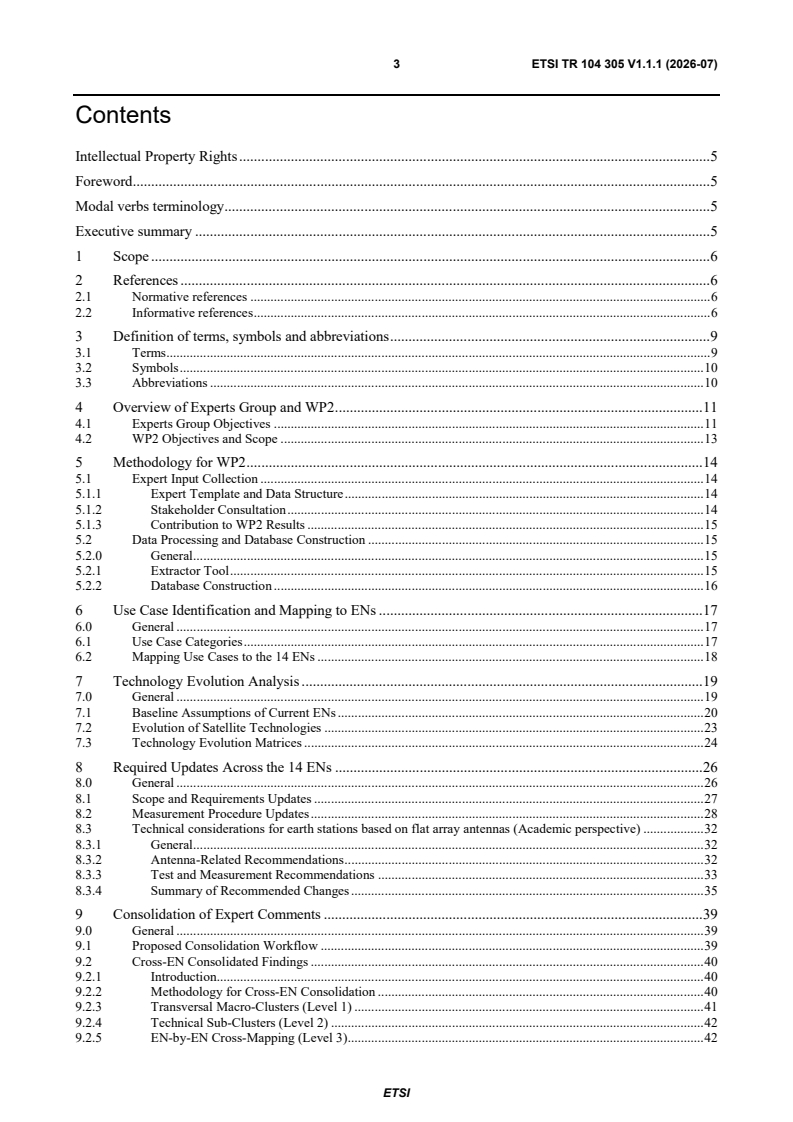
TECHNICAL REPORT
Satellite Earth Stations and Systems (SES);
Study of potential updates to certain harmonised ENs due
to technology evolution, methods of measurements and
regulatory updates
2 ETSI TR 104 305 V1.1.1 (2026-07)
Reference
DTR/SES-00485
Keywords
earth station, measurement, regulation, satellite,
testing
ETSI
650 Route des Lucioles
F-06921 Sophia Antipolis Cedex - FRANCE
Tel.: +33 4 92 94 42 00 Fax: +33 4 93 65 47 16
Siret N° 348 623 562 00017 - APE 7112B
Association à but non lucratif enregistrée à la
Sous-Préfecture de Grasse (06) N° w061004871
Important notice
The present document can be downloaded from the
ETSI Search & Browse Standards application.
The present document may be made available in electronic versions and/or in print. The content of any electronic and/or
print versions of the present document shall not be modified without the prior written authorization of ETSI. In case of any
existing or perceived difference in contents between such versions and/or in print, the prevailing version of an ETSI
deliverable is the one made publicly available in PDF format on ETSI deliver repository.
Users should be aware that the present document may be revised or have its status changed,
this information is available in the Milestones listing.
If you find errors in the present document, please send your comments to
the relevant service listed under Committee Support Staff.
If you find a security vulnerability in the present document, please report it through our
Coordinated Vulnerability Disclosure (CVD) program.
Notice of disclaimer & limitation of liability
The information provided in the present deliverable is directed solely to professionals who have the appropriate degree of
experience to understand and interpret its content in accordance with generally accepted engineering or
other professional standard and applicable regulations.
No recommendation as to products and services or vendors is made or should be implied.
No representation or warranty is made that this deliverable is technically accurate or sufficient or conforms to any law
and/or governmental rule and/or regulation and further, no representation or warranty is made of merchantability or fitness
for any particular purpose or against infringement of intellectual property rights.
In no event shall ETSI be held liable for loss of profits or any other incidental or consequential damages.
Any software contained in this deliverable is provided "AS IS" with no warranties, express or implied, including but not
limited to, the warranties of merchantability, fitness for a particular purpose and non-infringement of intellectual property
rights and ETSI shall not be held liable in any event for any damages whatsoever (including, without limitation, damages
for loss of profits, business interruption, loss of information, or any other pecuniary loss) arising out of or related to the use
of or inability to use the software.
Copyright Notification
Reproduction is only permitted for the purpose of standardization work undertaken within ETSI.
The copyright and the foregoing restrictions extend to reproduction in all media.
© ETSI 2026.
All rights reserved.
ETSI
3 ETSI TR 104 305 V1.1.1 (2026-07)
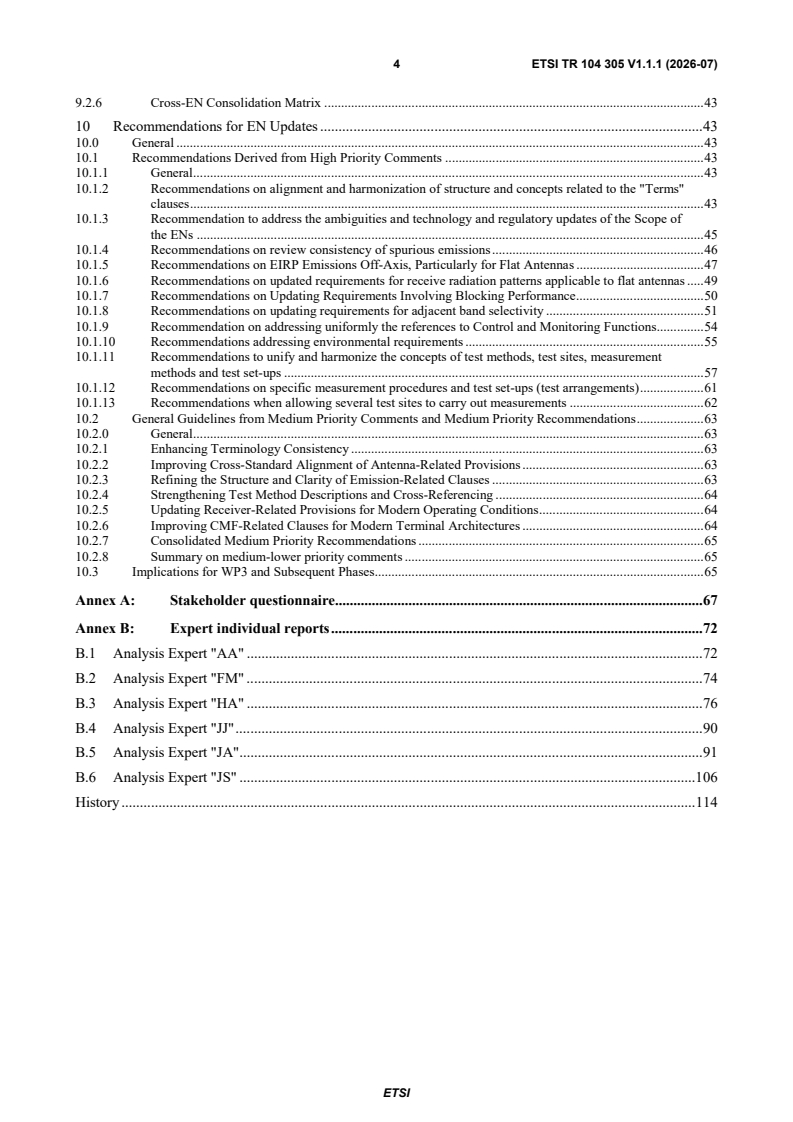
Contents
Intellectual Property Rights . 5
Foreword . 5
Modal verbs terminology . 5
Executive summary . 5
1 Scope . 6
2 References . 6
2.1 Normative references . 6
2.2 Informative references . 6
3 Definition of terms, symbols and abbreviations . 9
3.1 Terms . 9
3.2 Symbols . 10
3.3 Abbreviations . 10
4 Overview of Experts Group and WP2 . 11
4.1 Experts Group Objectives . 11
4.2 WP2 Objectives and Scope . 13
5 Methodology for WP2 . 14
5.1 Expert Input Collection . 14
5.1.1 Expert Template and Data Structure . 14
5.1.2 Stakeholder Consultation . 14
5.1.3 Contribution to WP2 Results . 15
5.2 Data Processing and Database Construction . 15
5.2.0 General . 15
5.2.1 Extractor Tool . 15
5.2.2 Database Construction . 16
6 Use Case Identification and Mapping to ENs . 17
6.0 General . 17
6.1 Use Case Categories . 17
6.2 Mapping Use Cases to the 14 ENs . 18
7 Technology Evolution Analysis . 19
7.0 General . 19
7.1 Baseline Assumptions of Current ENs . 20
7.2 Evolution of Satellite Technologies . 23
7.3 Technology Evolution Matrices . 24
8 Required Updates Across the 14 ENs . 26
8.0 General . 26
8.1 Scope and Requirements Updates . 27
8.2 Measurement Procedure Updates . 28
8.3 Technical considerations for earth stations based on flat array antennas (Academic perspective) . 32
8.3.1 General . 32
8.3.2 Antenna-Related Recommendations . 32
8.3.3 Test and Measurement Recommendations . 33
8.3.4 Summary of Recommended Changes . 35
9 Consolidation of Expert Comments . 39
9.0 General . 39
9.1 Proposed Consolidation Workflow . 39
9.2 Cross-EN Consolidated Findings . 40
9.2.1 Introduction. 40
9.2.2 Methodology for Cross-EN Consolidation . 40
9.2.3 Transversal Macro-Clusters (Level 1) . 41
9.2.4 Technical Sub-Clusters (Level 2) . 42
9.2.5 EN-by-EN Cross-Mapping (Level 3) . 42
ETSI
4 ETSI TR 104 305 V1.1.1 (2026-07)
9.2.6 Cross-EN Consolidation Matrix . 43
10 Recommendations for EN Updates . 43
10.0 General . 43
10.1 Recommendations Derived from High Priority Comments . 43
10.1.1 General . 43
10.1.2 Recommendations on alignment and harmonization of structure and concepts related to the "Terms"
clauses . 43
10.1.3 Recommendation to address the ambiguities and technology and regulatory updates of the Scope of
the ENs . 45
10.1.4 Recommendations on review consistency of spurious emissions . 46
10.1.5 Recommendations on EIRP Emissions Off-Axis, Particularly for Flat Antennas . 47
10.1.6 Recommendations on updated requirements for receive radiation patterns applicable to flat antennas . 49
10.1.7 Recommendations on Updating Requirements Involving Blocking Performance . 50
10.1.8 Recommendations on updating requirements for adjacent band selectivity . 51
10.1.9 Recommendation on addressing uniformly the references to Control and Monitoring Functions . 54
10.1.10 Recommendations addressing environmental requirements . 55
10.1.11 Recommendations to unify and harmonize the concepts of test methods, test sites, measurement
methods and test set-ups . 57
10.1.12 Recommendations on specific measurement procedures and test set-ups (test arrangements) . 61
10.1.13 Recommendations when allowing several test sites to carry out measurements . 62
10.2 General Guidelines from Medium Priority Comments and Medium Priority Recommendations . 63
10.2.0 General . 63
10.2.1 Enhancing Terminology Consistency . 63
10.2.2 Improving Cross-Standard Alignment of Antenna-Related Provisions . 63
10.2.3 Refining the Structure and Clarity of Emission-Related Clauses . 63
10.2.4 Strengthening Test Method Descriptions and Cross-Referencing . 64
10.2.5 Updating Receiver-Related Provisions for Modern Operating Conditions . 64
10.2.6 Improving CMF-Related Clauses for Modern Terminal Architectures . 64
10.2.7 Consolidated Medium Priority Recommendations . 65
10.2.8 Summary on medium-lower priority comments . 65
10.3 Implications for WP3 and Subsequent Phases. 65
Annex A: Stakeholder questionnaire. 67
Annex B: Expert individual reports . 72
B.1 Analysis Expert "AA" . 72
B.2 Analysis Expert "FM" . 74
B.3 Analysis Expert "HA" . 76
B.4 Analysis Expert "JJ" . 90
B.5 Analysis Expert "JA" . 91
B.6 Analysis Expert "JS" . 106
History . 114
ETSI
5 ETSI TR 104 305 V1.1.1 (2026-07)
Intellectual Property Rights
Essential patents
IPRs essential or potentially essential to normative deliverables may have been declared to ETSI. The declarations
pertaining to these essential IPRs, if any, are publicly available for ETSI members and non-members, and can be
found in ETSI SR 000 314: "Intellectual Property Rights (IPRs); Essential, or potentially Essential, IPRs notified to
ETSI in respect of ETSI standards", which is available from the ETSI Secretariat. Latest updates are available on the
ETSI IPR online database.
Pursuant to the ETSI Directives including the ETSI IPR Policy, no investigation regarding the essentiality of IPRs,
including IPR searches, has been carried out by ETSI. No guarantee can be given as to the existence of other IPRs not
referenced in ETSI SR 000 314 (or the updates on the ETSI Web server) which are, or may be, or may become,
essential to the present document.
Trademarks
The present document may include trademarks and/or tradenames which are asserted and/or registered by their owners.
ETSI claims no ownership of these except for any which are indicated as being the property of ETSI, and conveys no
right to use or reproduce any trademark and/or tradename. Mention of those trademarks in the present document does
not constitute an endorsement by ETSI of products, services or organizations associated with those trademarks.
DECT™, PLUGTESTS™, UMTS™ and the ETSI logo are trademarks of ETSI registered for the benefit of its
Members. 3GPP™, LTE™ and 5G™ logo are trademarks of ETSI registered for the benefit of its Members and of the
3GPP Organizational Partners. oneM2M™ logo is a trademark of ETSI registered for the benefit of its Members and of ®
the oneM2M Partners. GSM and the GSM logo are trademarks registered and owned by the GSM Association. ®
BLUETOOTH is a trademark registered and owned by Bluetooth SIG, Inc.
Foreword
This Technical Report (TR) has been produced by ETSI Technical Committee Satellite Earth Stations and Systems
(SES).
Modal verbs terminology
In the present document "should", "should not", "may", "need not", "will", "will not", "can" and "cannot" are to be
interpreted as described in clause 3.2 of the ETSI Drafting Rules (Verbal forms for the expression of provisions).
"must" and "must not" are NOT allowed in ETSI deliverables except when used in direct citation.
Executive summary
The project reviews the contents of several Harmonised European Norms under the purview of ETSI TC-SES to ensure
their requirements remain current amid the rapid expansion of satellite-based services. The study has focused on an
initial list provided by the contractual requirements of ETSI plus additional ENs proposed by the Experts Group, in
summary, assessing 14 HENs for continued compliance with the RED while identifying specific topics requiring further
consideration due to technology evolution since the ENs were initially produced. The study also identifies solutions that
strengthen the applicability and technological relevance of satellite earth stations ENs, enhance their use, and streamline
modern compliance checks for manufacturers and laboratories.
ETSI
6 ETSI TR 104 305 V1.1.1 (2026-07)
1 Scope
The present document as part of the Experts Group activities aims to deliver a comprehensive report detailing the
necessary technological updates and the assessment of currently adopted measurement methods in order to ensure the
validity of the ENs in the current market environment, reducing uncertainties in the interpretation of requirements as
well as facilitating the mechanisms (test methods) to demonstrate conformity with the Harmonised European Norms
requirements.
Overall, it further provides recommendations on the prioritization of updates to the existing hENs, ensuring their
continued relevance, clarity, and alignment with current and emerging satellite earth station technologies. The present
document is the basis for selection of priority hENs which require updates and guide the priority elements which should
be subject of further consideration when reviewing the hENs.
2 References
2.1 Normative references
Normative references are not applicable in the present document.
2.2 Informative references
References are either specific (identified by date of publication and/or edition number or version number) or
non-specific. For specific references, only the cited version applies. For non-specific references, the latest version of the
referenced document (including any amendments) applies.
NOTE: While any hyperlinks included in this clause were valid at the time of publication, ETSI cannot guarantee
their long-term validity.
The following referenced documents may be useful in implementing an ETSI deliverable or add to the reader's
understanding, but are not required for conformance to the present document.
[i.1] ETSI EN 303 699: "Satellite Earth Stations and Systems (SES); Fixed earth stations
communicating with non-geostationary satellite systems in the 20 GHz and 30 GHz FSS bands;
Harmonised Standard for access to radio spectrum".
[i.2] ETSI EN 302 977: "Satellite Earth Stations and Systems (SES); Harmonised Standard for Vehicle-
Mounted Earth Stations (VMES) operating in the 14/12 GHz frequency bands covering the
essential requirements of article 3.2 of the Directive 2014/53/EU".
[i.3] ETSI EN 303 978: "Satellite Earth Stations and Systems (SES); Earth Stations on Mobile
Platforms (ESOMP) communicating with satellites in geostationary orbit, operating in the 27,5
GHz to 30,0 GHz and 17,3 GHz to 20,2 GHz frequency bands; Harmonised Standard for access to
radio spectrum".
[i.4] ETSI EN 303 979: "Satellite Earth Stations and Systems (SES); Harmonised Standard for Earth
Stations on Mobile Platforms (ESOMP) transmitting towards satellites in non-geostationary orbit,
operating in the 27,5 GHz to 29,1 GHz and 29,5 GHz to 30,0 GHz frequency bands covering the
essential requirements of article 3.2 of the Directive 2014/53/EU".
[i.5] ETSI EN 303 980: "Satellite Earth Stations and Systems (SES); Fixed and in-motion Earth
Stations communicating with non-geostationary satellite systems (NEST) in the 11 GHz to 14
GHz frequency bands; Harmonised Standard for access to radio spectrum".
[i.6] ETSI EN 301 427: "Satellite Earth Stations and Systems (SES); Harmonised Standard for low data
rate Mobile satellite Earth Stations (MES) except aeronautical mobile satellite earth stations,
operating in the 11/12/14 GHz frequency bands covering the essential requirements of article 3.2
of the Directive 2014/53/EU".
ETSI
7 ETSI TR 104 305 V1.1.1 (2026-07)
[i.7] ETSI EN 301 442: "Satellite Earth Stations and Systems (SES); NGSO Mobile Earth Stations
(MES) including handheld earth stations, for Satellite Personal Communications Networks
(S-PCN) operating in the 1 980 MHz to 2 010 MHz (earth-to-space) and 2 170 MHz to 2 200 MHz
(space-to-earth) frequency bands under the Mobile Satellite Service (MSS); Harmonised Standard
for access to radio spectrum".
[i.8] ETSI EN 301 443: "Satellite Earth Stations and Systems (SES); Harmonised Standard for Very
Small Aperture Terminal (VSAT); Transmit-only, transmit-and-receive, receive-only satellite
earth stations operating in the 4 GHz and 6 GHz frequency bands covering the essential
requirements of article 3.2 of the Directive 2014/53/EU".
[i.9] ETSI EN 301 447: "Satellite Earth Stations and Systems (SES); Satellite Earth Stations on board
Vessels (ESVs) operating in the 4/6 GHz frequency bands allocated to the Fixed Satellite Service
(FSS); Harmonised Standard for access to radio spectrum".
[i.10] ETSI EN 301 459: "Satellite Earth Stations and Systems (SES); Harmonised Standard for Satellite
Interactive Terminals (SIT) and Satellite User Terminals (SUT) transmitting towards satellites in
geostationary orbit, operating in the 29,5 GHz to 30,0 GHz frequency bands covering the essential
requirements of article 3.2 of the Directive 2014/53/EU".
[i.11] ETSI EN 301 721: "Satellite Earth Stations and Systems (SES); Harmonised Standard for Mobile
Earth Stations (MES) providing Low Bit Rate Data Communications (LBRDC) using Low Earth
Orbiting (LEO) satellites operating below 1 GHz frequency band covering the essential
requirements of article 3.2 of the Directive 2014/53/EU".
[i.12] ETSI EN 302 340: "Satellite Earth Stations and Systems (SES); Harmonised Standard for satellite
Earth Stations on board Vessels (ESVs) operating in the 11/12/14 GHz frequency bands allocated
to the Fixed Satellite Service (FSS) covering the essential requirements of article 3.2 of the
Directive 2014/53/EU".
[i.13] ETSI EN 302 448: "Satellite Earth Stations and Systems (SES); Harmonised Standard for tracking
Earth Stations on Trains (ESTs) operating in the 14/12 GHz frequency bands covering the
essential requirements of article 3.2 of the Directive 2014/53/EU".
[i.14] ETSI EN 302 574 (all parts): "Satellite Earth Stations and Systems (SES); Harmonised Standard
for Mobile Earth Stations (MES) operating in the 1 980 MHz to 2 010 MHz (earth-to-space) and 2
170 MHz to 2 200 MHz (space-to-earth) frequency bands covering the essential requirements of
article 3.2 of the Directive 2014/53/EU".
[i.15] ETSI EN 303 984: "Satellite Earth Stations and Systems (SES); Earth Stations on board Aircraft
(ESOA) communicating with non-geostationary satellite systems in the 10,7 GHz to 12,75 GHz
and 12,75 GHz to 13,25 GHz frequency bands; Harmonised Standard for access to radio
spectrum".
[i.16] ECC/DEC/(17)04 of 30 June 2017 on the harmonised use and exemption from individual licensing
of fixed earth stations operating with NGSO FSS satellite systems in the frequency bands
10.70-12.75 GHz and 14.00-14.50 GHz.
[i.17] ECC/DEC/(18)05 of 6 July 2018 on the harmonised use, exemption from individual licensing and
free circulation and use of Earth Stations In-Motion (ESIM) operating with NGSO FSS satellite
systems in the frequency bands 10.7-12.75 GHz and 14.0-14.5 GHz.
[i.18] ECC/DEC/(09)01 of 13 March 2009 on the harmonised use of the 63.72-65.88 GHz frequency
band for Intelligent Transport Systems (ITS).
[i.19] Recommendation ITU-R SM.1541: "Unwanted emissions in the out-of-band domain".
[i.20] ERC/REC 74-01 of 1998 on unwanted Emissions in the Spurious Domain.
[i.21] ITU Radio Regulations.
[i.22] Recommendation ITU-R SM.329: "Unwanted emissions in the spurious domain".
ETSI
8 ETSI TR 104 305 V1.1.1 (2026-07)
[i.23] Recommendation ITU-R S.465: "Reference radiation pattern of earth station antennas in the fixed-
satellite service for use in coordination and interference assessment in the frequency range from 2
to 31 GHz".
[i.24] Recommendation ITU-R S.580: "Radiation diagrams for use as design objectives for antennas of
earth stations operating with geostationary satellites".
[i.25] Recommendation ITU-R S.524: "Maximum permissible levels of off-axis e.i.r.p. density from
earth stations in geostationary-satellite orbit networks operating in the fixed-satellite service
transmitting in the 6 GHz, 13 GHz, 14 GHz and 30 GHz frequency bands".
[i.26] Reports ITU-R S.2278: "Use of very small aperture terminals (VSATs)".
[i.27] Reports ITU-R S.2223: "Technical and operational requirements for GSO FSS earth stations on
mobile platforms in bands from 17.3 to 30.0 GHz".
[i.28] Recommendation ITU-R S.1503: "Functional description to be used in developing software tools
for determining conformity of non-geostationary-satellite orbit fixed-satellite service systems or
networks with limits contained in Article 22 of the Radio Regulations".
[i.29] Recommendation ITU-R S.1717: "Electronic data file format for earth station antenna patterns".
[i.30] Recommendation ITU-R S.1855: "Alternative reference radiation pattern for earth station antennas
used with satellites in the geostationary-satellite orbit for use in coordination and/or interference
assessment in the frequency range from 2 to 31 GHz".
[i.31] ECC Report 152: "The use of the frequency bands 27.5-30.0 GHz and 17.30-20.2 GHz by satellite
networks".
[i.32] ECC Report 184: "The Use of Earth Stations on Mobile Platforms Operating with GSO Satellite
Networks in the Frequency Range17.3-20.2 GHz and 27.5-30.0 GHz".
[i.33] ECC/DEC/(05)01 of 18 March 2005 on the use of the band 27.5-29.5 GHz by the Fixed Service
and uncoordinated Earth stations of the Fixed-Satellite Service (Earth-to-space).
[i.34] ECC/DEC/(05)08 of 24 June 2005 on the availability of frequency bands for high density
applications in the Fixed-Satellite Service (space-to-Earth and Earth-to-space).
[i.35] ECC/DEC/(06)03 of 24 March 2006 on Exemption from Individual Licensing of high e.i.r.p.
satellite terminals (HEST) operating with geostationary satellites and in the frequency bands
10.70-12.75 GHz or 19.70-20.20 GHz space-to-Earth and 14.00-14.25 GHz or 29.50-30.00 GHz
Earth-to-space.
[i.36] ECC/DEC/(13)01 of 8 March 2013 on the use, free circulation, and exemption from individual
licensing of Earth stations on mobile platforms (ESOMPs) in the frequency bands available for use
by uncoordinated FSS Earth stations within the ranges 17.3-20.2 GHz and 27.5-30.0 GHz.
[i.37] Directive 2014/53/EU of the European Parliament and of the Council of 16 April 2014 on the
harmonisation of the laws of the Member States relating to the making available on the market of
radio equipment and repealing Directive 1999/5/EC.
[i.38] ECC/DEC/(06)09 of 1 December 2006 on the designation of the bands 1980-2010 MHz and 2170-
2200 MHz for use by systems in the Mobile-Satellite Service including those supplemented by a
Complementary Ground Component (CGC).
[i.39] ECC Report 197: "Compatibility studies – MSS terminals transmitting to a satellite in the band
1980-2010 MHz and adjacent channel UMTS services".
[i.40] ECC Report 233: "Adjacent band compatibility studies for aeronautical CGC systems operating in
the bands 1980-2010 MHz and 2170-2200 MHz".
[i.41] Decision No 626/2008/EC of the European Parliament and of the Council of 30 June 2008 on the
selection and authorisation of systems providing mobile satellite services (MSS).
ETSI
9 ETSI TR 104 305 V1.1.1 (2026-07)
[i.42] Commission Decision 2007/98/EC of 14 February 2007 on the harmonised use of radio spectrum
in the 2 GHz frequency bands for the implementation of systems providing mobile satellite
services.
[i.43] Commission Decision 2009/449/EC of 13 May 2009 on the selection of operators of pan-European
systems providing mobile satellite services (MSS).
[i.44] CEPT Report 013: "Report from CEPT to the European Commission in response to the Mandate
on - Harmonised technical conditions for the use of the 2 GHz bands for Mobile Satellite Services
in the European Union".
[i.45] ECC/DEC/(05)11 of 24 June 2005 on the free circulation and use of Aircraft Earth Stations (AES)
in the frequency bands 14-14.5 GHz (Earth-to-space), 10.7-11.7 GHz (space-to-Earth) and 12.5-
12.75 GHz (space-to-Earth).
[i.46] ECC/DEC/(18)04 of 6 July 2018 on the harmonised use, exemption from individual licensing and
free circulation and use of land based Earth Stations In-Motion (ESIM) operating with GSO FSS
satellite systems in the frequency bands 10.7-12.75 GHz and 14.0-14.5 GHz.
[i.47] ECC Report 279: "The Use of Earth Stations In-Motion (ESIM) operating to NGSO Satellite
Systems in the 10.7-12.75 GHz and 14-14.5 GHz Band".
[i.48] ECC Report 271: "Compatibility and sharing studies related to NGSO satellite systems operating
in the FSS bands 10.7-12.75 GHz (space-to-Earth) and 14-14.5 GHz (Earth-to-space)".
[i.49] ECC/DEC/(06)10 of 1 December 2006 on transition of terrestrial service operations from the
Bands 1980-2010 MHz and 2170-2200 MHz in order to facilitate the Harmonised Introduction and
Development of Systems in the mobile-satellite service including those supplemented by a
Complementary Ground Component.
[i.50] Recommendation ITU-T M.1036: "Frequency arrangements for implementation of the terrestrial
component of International Mobile Telecommunications in the bands identified for IMT in the
Radio Regulations".
[i.51] Recommendation ITU-R S.1428: "Reference FSS earth-station radiation patterns for use in
interference assessment involving non-GSO satellites in frequency bands between 10.7 GHz and
30 GHz".
[i.52] ERC/DEC/(00)08 of 19 October 2000 on the use of the band 10.7 - 12.5 GHz by the fixed service
and Earth stations of the broadcasting-satellite and fixed-satellite Service (space-to-Earth).
[i.53] ECC/REC/(25)01 of 14 February 2025 on Emission limit requirements for Wireless Power
Transmission (WPT).
[i.54] Recommendation ITU-R S.728: "Maximum permissible level of off-axis e.i.r.p. density from very
small aperture terminals (VSATs)".
[i.55] Recommendation ITU-R SM.1539: "Variation of the boundary between the out-of-band and
spurious domains required for the application of Recommendations ITU-R SM.1541 and ITU-R
SM.329".
[i.56] ECC Report 322: "Compatibility analysis (inter-service and intra service) for S-PCS below
1 GHz".
[i.57] ECC Report 273: "E.164 Numbering and Over-The-Top (OTT) Communications Services".
3 Definition of terms, symbols and abbreviations
3.1 Terms
Void.
ETSI
10 ETSI TR 104 305 V1.1.1 (2026-07)
3.2 Symbols
Void.
3.3 Abbreviations
For the purposes of the present document, the following abbreviations apply:
ACM Adaptive Coding and Modulation
AES Aeronautical Earth Station
AI Artificial Intelligence
ANFR National Agency of frequencies of France
BER Bit Error Rate
BW Bandwidth
CEPT European Conference of Postal and Telecommunications Administrations
CGC Complementary Ground Component
CMF Control and Monitoring Functions
CW Continuous Wave
DTP Digital Transparent Processor
DUT Device under test
EC European Commission
ECC Electronic Communications Committee
EIRP Equivalent Isotropically Radiated Power
EIS Effective Isotropic Sensitivity
EISMEA European Innovation Council and Small and Medium-sized Enterprises Executive Agency
EMC Electromagnetic Compatibility
EN European Norm
EPFD Equivalent Power Flux Density
ERC Electronic Radiocommuinication Committee
ESA Electronically Steerable Antenna
ESIM Earth Station In Motion
ESOA Earth Stations on board Aircraft
ESOMP Earth Station on Mobile Platform
ESV Earth Station on Vessel
ETSI European Telecommunications Standards Institute
EU European Union
EUT Equipment Under Test
FAR Fully Anechoic Room
FCC Federal Communications Commission USA
FES Fixed Earth Stations
FS Fixed Service
FSS Fixed Satellite Service
GEO Geostationary Earth Orbit
GMDSS Global Maritime Distress and Safety System
GNSS Global Navigation Satellite System
GSO Geostationary Satellite Orbit
hEN harmonised European Norm
HS Harmonised Standard
HTS High Throughput Satellite
IEC International Electrotechnical Committee
IMT International Mobile Telecommunications
IoT Internet of Things
IP Internet Protocol
ITU International Telecommunications Union
LBRDC Low Bit Rate Data Communication
LEO Low Earth Orbit
LMES Land Mobile Earth Station
LNB Low Noise Block
M2M Machine to Machine
MEO Medium Earth Orbit
MES Mobile Earth Station
ETSI
11 ETSI TR 104 305 V1.1.1 (2026-07)
MIL Military
MMES Maritime Mobile Earth Station
MSS Mobile Satellite Service
NCF Network Control Facility
NGSO Non-Geostationary Satellite Orbit
NTN Non Terrestrial Network
OATS Open Area Test Site
OJ Official Journal
OOB Out of Band
OTA Over-the-Air
PCS Personal Communications System
PER Packet Error Rate
RAS Radio Astronomy Service
RED Radio Equipment Directive
RF Radio Frequency
RR Radio Regulations
RSPG Radio Spectrum Policy Group
SAC Semi-Anechoic Chamber
SCADA Supervisory Control and Data Acquisition
SDR Satellite Design Radio
SE Spectrum Engineering
SIM Station in Motion
SINR Signal-to-Interference-plus-Noise Ratio
SIT Satellite Interactive Terminal
SNR Signal-to-Noise Ratio
STD Standard
STE Special Test Equipment
SUT Satellite User Terminal
ToR Terms of Reference
UAV Unmanned Aircraft Vehicle
UE User Equipment
VCM Variable coding and Modulation
VMES Vehicle Mounted Earth Station
VSAT Very Small Aperture Terminal
WP Work Package
WRC World Radiocommunications Conference
XPD Cross Polar Discrimination
4 Overview of Experts Group and WP2
4.1 Experts Group Objectives
The creation of an Experts Group to optimise Harmonised European Norms (hENs) for Satellite Earth Stations, is a
strategic initiative funded under the European Commission's Grant Agreement 101260993. The project addresses the
need to modernize, harmonize, and ensure the long-term applicability of the Harmonised European Standards developed
under the responsibility of ETSI Technical Committee Satellite Earth Stations (TC SES). These standards support
compliance with the Radio Equipment Directive (RED) 2014/53/EU [i.37], enabling manufacturers to demonstrate
conformity with essential requirements related to efficient use of the radio spectrum and electromagnetic compatibility.
The satellite communications sector is undergoing a profound transformation driven by the emergence of multi-orbit
constellations (LEO, MEO, GEO), new antenna architectures such as electronically steerable flat panel arrays,
increasingly dynamic mobility scenarios (ESIMs for maritime, aeronautical, land mobile platforms), and evolving
regulatory frameworks at European and international levels. As highlighted in the Terms of Reference, "there is still a
need to improve the requirements, measurement methods and technology updates, based on new and future use cases,
for satellite earth stations in the new ecosystem of Low Earth Orbit (LEO), Medium Earth Orbit (MEO) and
Geostationary Earth Orbit (GEO) satellite networks". The Expert Group activity responds directly to this need by
providing a structured, expert-driven framework for updating the relevant ENs.
ETSI
12 ETSI TR 104 305 V1.1.1 (2026-07)
The project is implemented through a dedicated Specialist Task Force (Experts Group) composed of technical experts
appointed by ETSI. The Experts Group operates under the supervision of the Technical Committee Satellite Earth
Stations (TC SES), which includes representatives from TC SES leadership and ensures alignment with the broader
standardization roadmap, and works in close collaboration with TC SES Working Groups, particularly WG HARM,
responsible for the maintenance and development of Harmonised Standards. In addition, the project benefits from
voluntary contributions from TC SES members and from interactions with external stakeholders such as manufacturers,
notified bodies, test laboratories, and satellite operators.
The activities of the Experts Group is structured into five Work Packages (WPs), each addressing a specific dimension
of the project:
• WP1 Project Management and Coordination: Ensures administrative and technical coordination, planning,
reporting, and liaison with ETSI and the European Commission. WP1 also oversees risk management, quality
assurance, and the timely delivery of project milestones.
• WP2 Identification of Use Cases and Technology Evolution: The focus of this Technical Report. WP2
analyses the technological, operational, and regulatory evolution affecting satellite earth stations and identifies
the updates required across the targeted ENs. It includes expert input collection, technology evolution analysis,
gap identification, and the formulation of recommendations.
• WP3 Deployment Scenarios and Potential Merging of hENs: Examines overlaps between standards, maps use
cases to ENs and identifies opportunities for consolidation or merging of standards addressing similar
technologies or operational scenarios.
• WP4 Elaboration of Revised hENs: Produces updated versions of at least ten hENs and supports their
examination within TC SES. WP4 ensures that the revised standards are technically robust, aligned with RED
requirements, and suitable for citation in the OJEU.
• WP5 Dissemination: Ensures visibility of project results and promotes adoption by industry, notified bodies,
national standardization organizations, and regulatory authorities worldwide.
The organizational structure of the Experts Group reflects the need for both technical depth and cross-standard
consistency. WP2 plays a central role in this structure by providing the analytical foundation upon which WP3 and WP4
build. Specifically, WP2 delivers:
• A comprehensive review of 14 targeted ENs, including the 10 hENs identified as requiring urgent revision.
• A structured methodology for collecting and consolidating expert input from relevant stakeholders.
• A detailed analysis of technology evolution, including changes in satellite architectures, antenna systems,
waveforms, mobility patterns, and measurement techniques.
• An analysis of the required updates across the ENs identifying inconsistencies, outdated assumptions, missing
requirements, and limitations in current measurement methods.
• Recommendations that guide the revision work in WP4 and inform the strategic decisions in WP3 regarding
potential merging of standards.
The project also recognizes the international relevance of ETSI satellite standards. As stated in the ToR, "the adoption
of ETSI TC SES standards by many countries around the world has brought ETSI and Europe at the front of leadership
regarding satellite communications". Maintaining this leadership requires ensuring that the standards remain technically
robust, internationally aligned, and responsive to emerging technologies and regulatory developments. The Experts
Group work therefore incorporates considerations related to ITU and CEPT decisions, global spectrum allocations, and
cross-border interoperability.
In summary, Experts Group activities provides a coordinated, expert-driven framework to modernize the Harmonised
European Standards for satellite earth stations. WP2, through the technical analysis documented in the present
document, establishes the foundation for the subsequent revision and optimization of the ENs, ensuring their continued
applicability in a rapidly evolving technological environment and supporting the long-term competitiveness of the
European satellite communications sector.
ETSI
13 ETSI TR 104 305 V1.1.1 (2026-07)
4.2 WP2 Objectives and Scope
The methodology adopted in WP2 for collecting, structuring, and validating expert input was designed to ensure
technical completeness, traceability, and consistency across the 14 ENs under review. Given the diversity of satellite
earth station technologies, operational scenarios, and regulatory environments addressed by these standards, the
collection of expert contributions required a structured, multi-stage process capable of capturing detailed clause-level
insights while enabling systematic consolidation and analysis. The approach followed in WP2 is based on four
elements:
• Standardized expert template, ensuring uniformity in the structure and content of contributions.
• Controlled consultation pro
...