


ETSI EN 301 549 V4.1.1 (2026-09)
Accessibility requirements for ICT products and services
General Information
- Abstract
REN/HF-00301561
- Status
- Not Published
- Technical Committee
- HF - Human Factors
- Current Stage
- 12 - Delivery to the EC
- Due Date
- 23-Sep-2026
- Completion Date
- 08-Sep-2026
Buy Documents
ETSI EN 301 549 V4.1.0 (2025-11) - Accessibility requirements for ICT products and services Version 4.1.1 EN 301549
ETSI EN 301 549 V4.1.0 (2026-06) - Accessibility requirements for ICT products and services
ETSI EN 301 549 V4.1.1 (2026-09) - Accessibility requirements for ICT products and services

Buy Documents
ETSI EN 301 549 V4.1.0 (2025-11) - Accessibility requirements for ICT products and services Version 4.1.1 EN 301549
ETSI EN 301 549 V4.1.0 (2026-06) - Accessibility requirements for ICT products and services
ETSI EN 301 549 V4.1.1 (2026-09) - Accessibility requirements for ICT products and services
Frequently Asked Questions
ETSI EN 301 549 V4.1.1 (2026-09) is a standard published by the European Telecommunications Standards Institute (ETSI). Its full title is "Accessibility requirements for ICT products and services". This standard covers: REN/HF-00301561
REN/HF-00301561
ETSI EN 301 549 V4.1.1 (2026-09) is available in PDF format for immediate download after purchase. The document can be added to your cart and obtained through the secure checkout process. Digital delivery ensures instant access to the complete standard document.
Standards Content (Sample)
Draft EN 301 549 V4.1.0 (2025-11)
HARMONISED EUROPEAN STANDARD
Accessibility requirements for ICT products and services
2 Draft EN 301 549 V4.1.0 (2025-11)
Reference
REN/HF-00301561
Keywords
accessibility, HF, ICT, product, service
CEN CENELEC ETSI
Rue de la science, 23 Rue de la science, 23 650 Route des Lucioles
B-1040 Brussels - BELGIUM B-1040 Brussels - BELGIUM F-06921 Sophia Antipolis Cedex - FRANCE
Tel: + 32 2 550 08 11 Tel.: +32 2 519 68 71 Tel.: +33 4 92 94 42 00
Fax: + 32 2 550 08 19 Fax: +32 2 519 69 19 Fax: +33 4 93 65 47 16
Siret N° 348 623 562 00017 - APE 7112B
Association à but non lucratif enregistrée à la
Sous-Préfecture de Grasse (06) N° w061004871
Important notice
The present document can be downloaded from the
ETSI Search & Browse Standards application.
The present document may be made available in electronic versions and/or in print. The content of any electronic and/or
print versions of the present document shall not be modified without the prior written authorization of ETSI. In case of any
existing or perceived difference in contents between such versions and/or in print, the prevailing version of an ETSI
deliverable is the one made publicly available in PDF format on ETSI deliver repository.
Users should be aware that the present document may be revised or have its status changed,
this information is available in the Milestones listing.
If you find errors in the present document, please send your comments to
the relevant service listed under Committee Support Staff.
If you find a security vulnerability in the present document, please report it through our
Coordinated Vulnerability Disclosure (CVD) program.
Notice of disclaimer & limitation of liability
The information provided in the present deliverable is directed solely to professionals who have the appropriate degree of
experience to understand and interpret its content in accordance with generally accepted engineering or
other professional standard and applicable regulations.
No recommendation as to products and services or vendors is made or should be implied.
In no event shall ETSI be held liable for loss of profits or any other incidental or consequential damages.
Any software contained in this deliverable is provided "AS IS" with no warranties, express or implied, including but not
limited to, the warranties of merchantability, fitness for a particular purpose and non-infringement of intellectual property
rights and ETSI shall not be held liable in any event for any damages whatsoever (including, without limitation, damages
for loss of profits, business interruption, loss of information, or any other pecuniary loss) arising out of or related to the use
of or inability to use the software.
Copyright Notification
Reproduction is only permitted for the purpose of standardization work undertaken within ETSI.
The copyright and the foregoing restrictions extend to reproduction in all media.
© ETSI 2025.
© Comité Européen de Normalisation 2025.
© Comité Européen de Normalisation Electrotechnique 2025.
All rights reserved.
ETSI CEN CENELEC
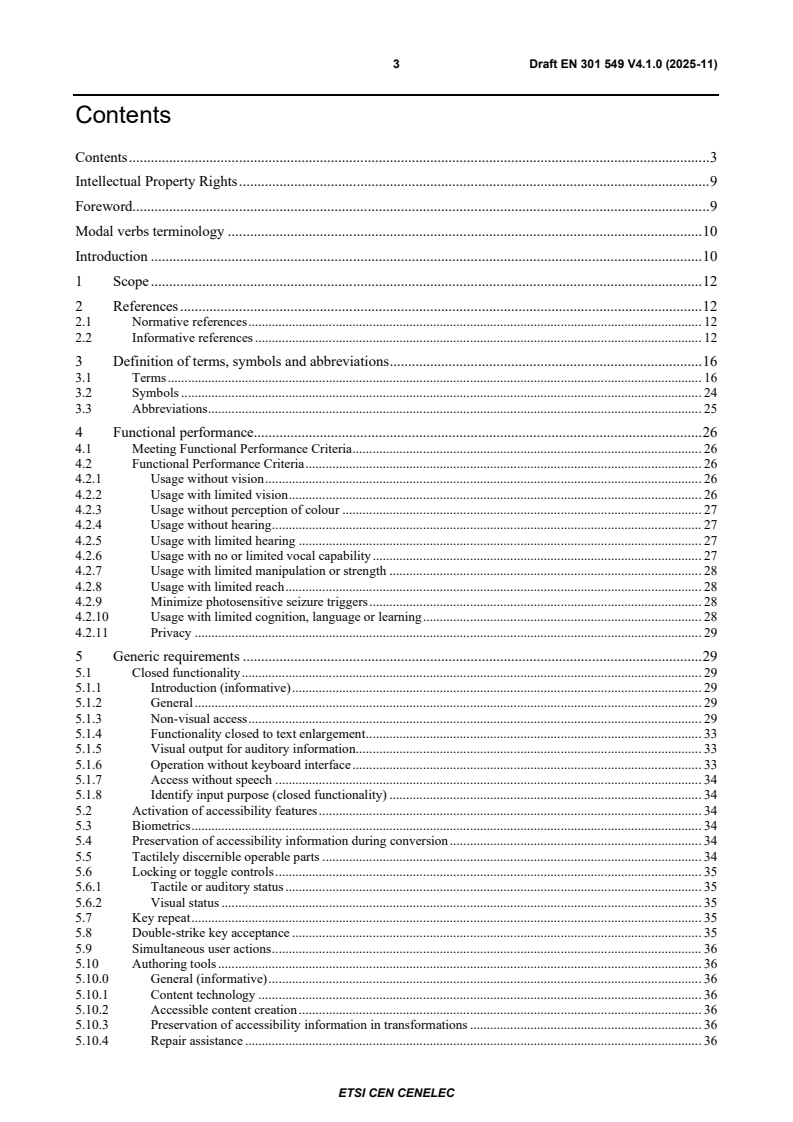
3 Draft EN 301 549 V4.1.0 (2025-11)
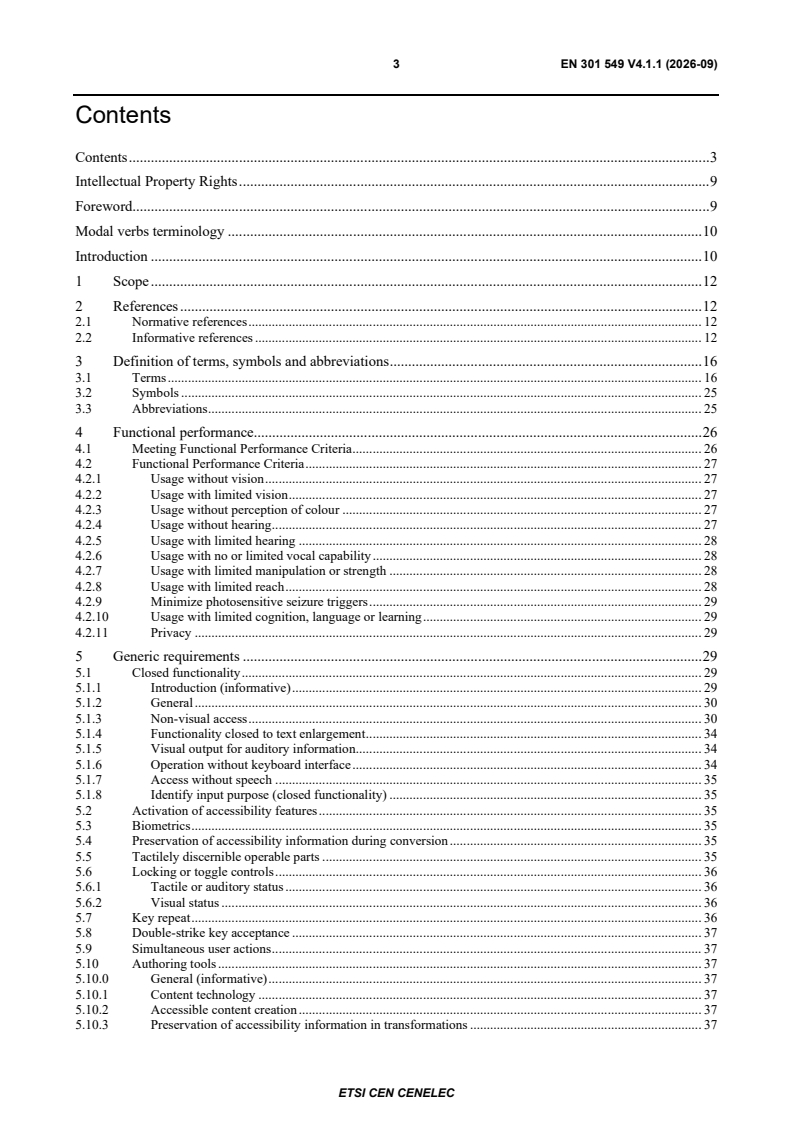
Contents
Contents . 3
Intellectual Property Rights . 9
Foreword. 9
Modal verbs terminology . 10
Introduction . 10
1 Scope . 12
2 References . 12
2.1 Normative references . 12
2.2 Informative references . 12
3 Definition of terms, symbols and abbreviations . 16
3.1 Terms . 16
3.2 Symbols . 24
3.3 Abbreviations . 25
4 Functional performance . 26
4.1 Meeting Functional Performance Criteria . 26
4.2 Functional Performance Criteria . 26
4.2.1 Usage without vision . 26
4.2.2 Usage with limited vision . 26
4.2.3 Usage without perception of colour . 27
4.2.4 Usage without hearing . 27
4.2.5 Usage with limited hearing . 27
4.2.6 Usage with no or limited vocal capability . 27
4.2.7 Usage with limited manipulation or strength . 28
4.2.8 Usage with limited reach . 28
4.2.9 Minimize photosensitive seizure triggers . 28
4.2.10 Usage with limited cognition, language or learning . 28
4.2.11 Privacy . 29
5 Generic requirements . 29
5.1 Closed functionality . 29
5.1.1 Introduction (informative) . 29
5.1.2 General . 29
5.1.3 Non-visual access . 29
5.1.4 Functionality closed to text enlargement . 33
5.1.5 Visual output for auditory information. 33
5.1.6 Operation without keyboard interface . 33
5.1.7 Access without speech . 34
5.1.8 Identify input purpose (closed functionality) . 34
5.2 Activation of accessibility features . 34
5.3 Biometrics . 34
5.4 Preservation of accessibility information during conversion . 34
5.5 Tactilely discernible operable parts . 34
5.6 Locking or toggle controls . 35
5.6.1 Tactile or auditory status . 35
5.6.2 Visual status . 35
5.7 Key repeat . 35
5.8 Double-strike key acceptance . 35
5.9 Simultaneous user actions . 36
5.10 Authoring tools . 36
5.10.0 General (informative) . 36
5.10.1 Content technology . 36
5.10.2 Accessible content creation . 36
5.10.3 Preservation of accessibility information in transformations . 36
5.10.4 Repair assistance . 36
ETSI CEN CENELEC
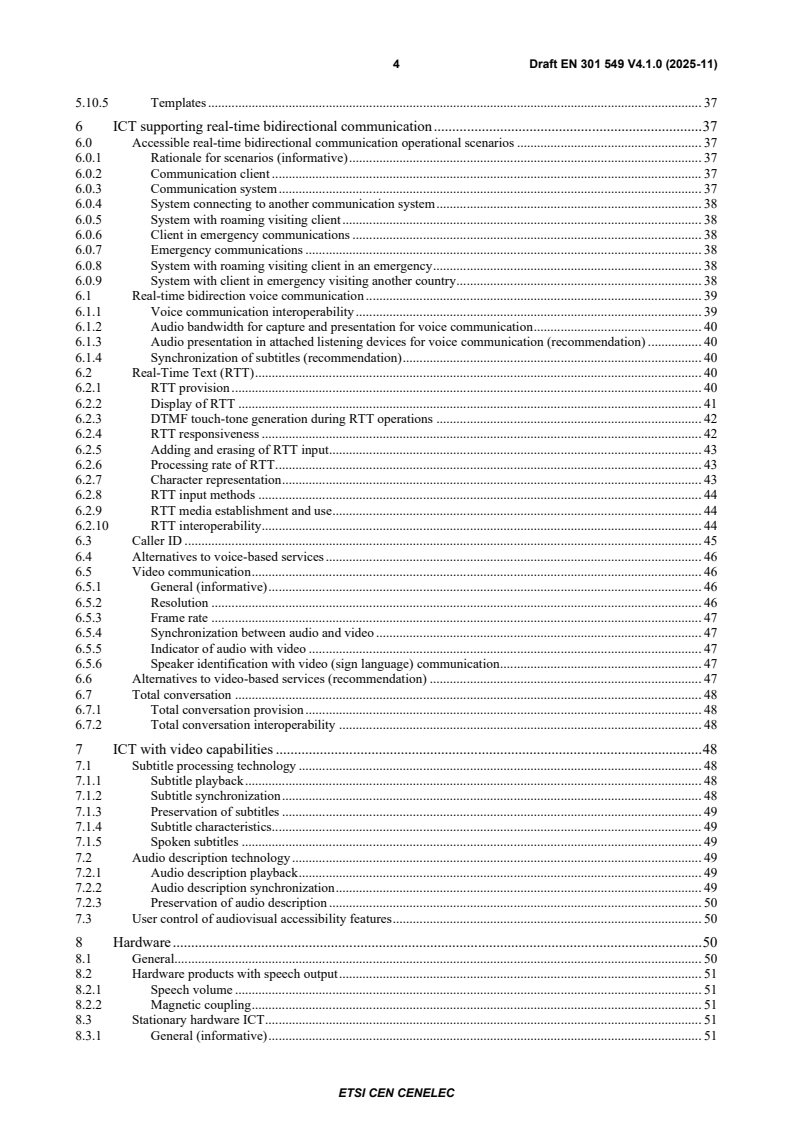
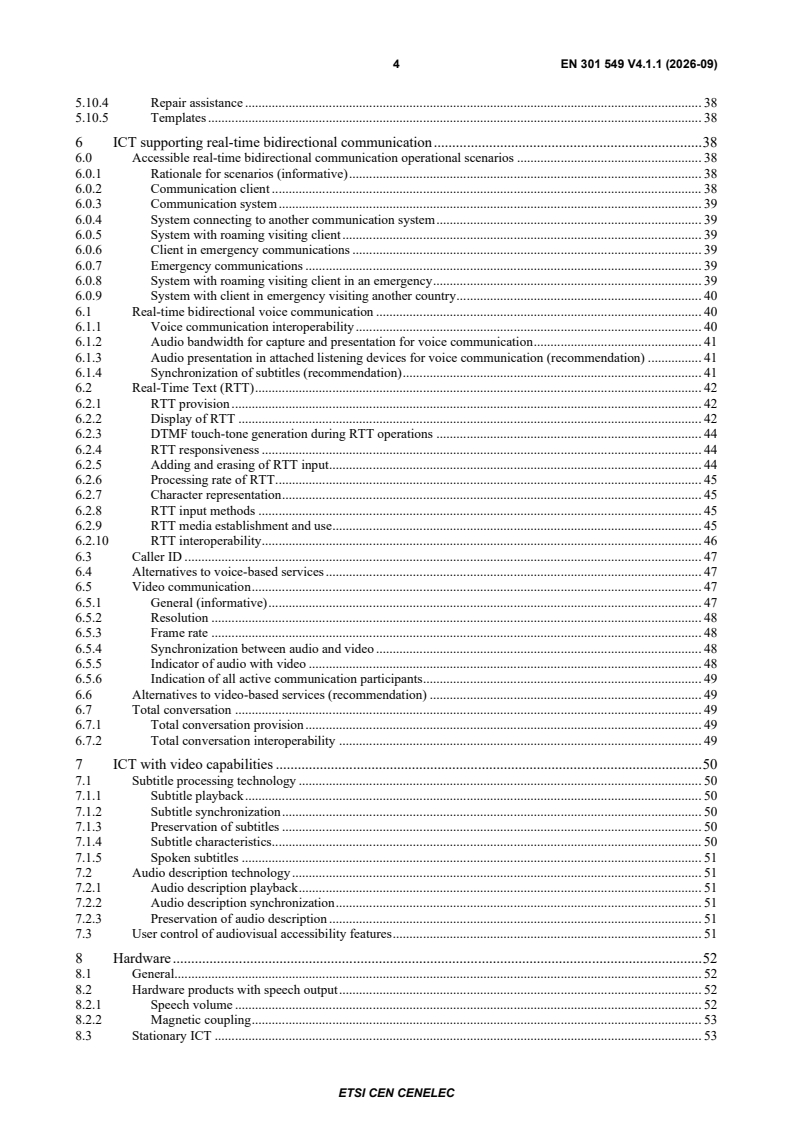
4 Draft EN 301 549 V4.1.0 (2025-11)
5.10.5 Templates . 37
6 ICT supporting real-time bidirectional communication . 37
6.0 Accessible real-time bidirectional communication operational scenarios . 37
6.0.1 Rationale for scenarios (informative) . 37
6.0.2 Communication client . 37
6.0.3 Communication system . 37
6.0.4 System connecting to another communication system . 38
6.0.5 System with roaming visiting client . 38
6.0.6 Client in emergency communications . 38
6.0.7 Emergency communications . 38
6.0.8 System with roaming visiting client in an emergency . 38
6.0.9 System with client in emergency visiting another country . 38
6.1 Real-time bidirection voice communication . 39
6.1.1 Voice communication interoperability . 39
6.1.2 Audio bandwidth for capture and presentation for voice communication . 40
6.1.3 Audio presentation in attached listening devices for voice communication (recommendation) . 40
6.1.4 Synchronization of subtitles (recommendation) . 40
6.2 Real-Time Text (RTT) . 40
6.2.1 RTT provision . 40
6.2.2 Display of RTT . 41
6.2.3 DTMF touch-tone generation during RTT operations . 42
6.2.4 RTT responsiveness . 42
6.2.5 Adding and erasing of RTT input . 43
6.2.6 Processing rate of RTT . 43
6.2.7 Character representation . 43
6.2.8 RTT input methods . 44
6.2.9 RTT media establishment and use . 44
6.2.10 RTT interoperability . 44
6.3 Caller ID . 45
6.4 Alternatives to voice-based services . 46
6.5 Video communication . 46
6.5.1 General (informative) . 46
6.5.2 Resolution . 46
6.5.3 Frame rate . 47
6.5.4 Synchronization between audio and video . 47
6.5.5 Indicator of audio with video . 47
6.5.6 Speaker identification with video (sign language) communication. 47
6.6 Alternatives to video-based services (recommendation) . 47
6.7 Total conversation . 48
6.7.1 Total conversation provision . 48
6.7.2 Total conversation interoperability . 48
7 ICT with video capabilities . 48
7.1 Subtitle processing technology . 48
7.1.1 Subtitle playback . 48
7.1.2 Subtitle synchronization . 48
7.1.3 Preservation of subtitles . 49
7.1.4 Subtitle characteristics. 49
7.1.5 Spoken subtitles . 49
7.2 Audio description technology . 49
7.2.1 Audio description playback . 49
7.2.2 Audio description synchronization . 49
7.2.3 Preservation of audio description . 50
7.3 User control of audiovisual accessibility features . 50
8 Hardware . 50
8.1 General . 50
8.2 Hardware products with speech output . 51
8.2.1 Speech volume . 51
8.2.2 Magnetic coupling . 51
8.3 Stationary hardware ICT . 51
8.3.1 General (informative) . 51
ETSI CEN CENELEC
5 Draft EN 301 549 V4.1.0 (2025-11)
8.3.2 Forward or side reach . 52
8.3.3 Forward reach. 52
8.3.4 Side reach . 55
8.3.5 Floor characteristics . 57
8.3.6 Approach . 58
8.3.7 Heights and visibility of displays screens . 60
8.3.8 Installation instructions . 60
8.4 Operable parts . 60
8.4.1 Numeric keys . 60
8.4.2 Operation of operable parts . 61
8.4.3 Keys, tickets and fare cards . 61
8.5 Tactile indication of speech mode . 61
8.6 Standard connections . 61
8.7 Colour on hardware . 61
8.8 Contrast on hardware . 61
9 Web . 62
9.0 General (informative) . 62
9.1 Perceivable . 63
9.1.1 Text alternatives . 63
9.1.2 Time-based media . 63
9.1.3 Adaptable . 64
9.1.4 Distinguishable . 64
9.2 Operable . 65
9.2.1 Keyboard accessible . 65
9.2.2 Enough time . 65
9.2.3 Seizures and physical reactions . 66
9.2.4 Navigable . 66
9.2.5 Input modalities . 67
9.3 Understandable . 67
9.3.1 Readable . 67
9.3.2 Predictable . 68
9.3.3 Input assistance . 68
9.4 Robust . 69
9.4.1 Compatible . 69
9.5 WCAG 2.2 AAA Success Criteria (informative) . 69
9.6 WCAG conformance requirements . 70
9.7 User preferences for web pages . 71
10 Non-web documents . 71
10.0 General (informative) . 71
10.1 Perceivable . 72
10.1.1 Text alternatives . 72
10.1.2 Time-based media . 72
10.1.3 Adaptable . 74
10.1.4 Distinguishable . 74
10.2 Operable . 77
10.2.1 Keyboard accessible . 77
10.2.2 Enough time . 78
10.2.3 Seizures and physical reactions . 79
10.2.4 Navigable . 79
10.2.5 Input modalities . 81
10.3 Understandable . 82
10.3.1 Readable . 82
10.3.2 Predictable . 83
10.3.3 Input assistance . 84
10.4 Robust . 85
10.4.1 Compatible . 85
10.5 Subtitle positioning (recommendation) . 86
10.6 Audio description timing (recommendation) . 86
10.7 User preferences for non-web documents . 86
11 Non-web software . 87
ETSI CEN CENELEC
6 Draft EN 301 549 V4.1.0 (2025-11)
11.0 General (informative) . 87
11.1 Perceivable . 88
11.1.1 Text alternatives . 88
11.1.2 Time-based media . 88
11.1.3 Adaptable . 89
11.1.4 Distinguishable . 90
11.2 Operable . 93
11.2.1 Keyboard accessible . 93
11.2.2 Enough time . 94
11.2.3 Seizures and physical reactions . 95
11.2.4 Navigable . 96
11.2.5 Input modalities . 97
11.3 Understandable . 99
11.3.1 Readable . 99
11.3.2 Predictable . 99
11.3.3 Input assistance . 100
11.4 Robust . 102
11.4.1 Compatible . 102
11.5 Interoperability with keyboards and assistive technology . 103
11.5.1 Closed functionality (informative) . 103
11.5.2 Accessibility services . 103
11.6 Documented accessibility features . 107
11.6.1 User control of accessibility features . 107
11.6.2 No disruption of accessibility features . 107
11.7 User preferences . 107
12 Information about products and services . 107
12.1 Accessible information about products . 107
12.2 Accessible information about services . 107
12.3 Accessibility and compatibility features . 108
12.4 Electronic program guides . 108
12.5 Electronic program guide display . 108
13 ICT providing relay or emergency service access . 108
13.1 Relay services requirements . 108
13.1.1 General (informative) . 108
13.1.2 Relay service access . 110
13.1.3 Relay service requirements . 111
13.2 Void . 112
13.3 Access to emergency services (informative). 112
14 Conformance . 112
14.1 Achieving conformance (informative) . 112
14.2 Special states . 112
14.3 One mode . 113
Annex A (informative): ICT conformance evaluation . 114
A.1 Conformance with Directive 2016/2102 on the accessibility of the websites and mobile applications of
public sector bodies . 114
A.2 Conformance with Directive 2019/882 on the accessibility requirements of products and services . 114
A.2.0 The meaning of conformance with Directive 2019/882 . 114
A.2.1 Where the ICT is, or includes, a web page . 115
A.2.2 Where the ICT is, or includes, a non-web document . 116
A.2.3 Where the ICT is, or includes, non-web software that provides a user interface . 118
A.2.4 Where the ICT is, or includes, hardware . 122
A.2.5 All ICT . 123
Annex B (informative): Relationship between requirements and functional performance criteria . 129
B.1 Relationships between clauses 5 to 13 and the functional performance criteria . 129
B.2 Interpretation of Table B.2 . 139
B.2.0 General . 139
B.2.1 Example . 139
Annex C (normative): Determination of conformance . 141
C.1 Introduction. 141
ETSI CEN CENELEC
7 Draft EN 301 549 V4.1.0 (2025-11)
C.2 Empty clause . 141
C.3 Empty clause . 141
C.4 Functional performance . 141
C.4.1 Meeting Functional Performance Criteria . 141
C.4.2 Functional Performance Criteria . 141
C.5 Generic requirements . 143
C.5.1 Closed functionality . 143
C.5.2 Activation of accessibility features . 149
C.5.3 Biometrics . 149
C.5.4 Preservation of accessibility information during conversion . 149
C.5.5 Tactilely discernible operable parts . 149
C.5.6 Locking or toggle controls . 149
C.5.7 Key repeat . 150
C.5.8 Double-strike key acceptance . 150
C.5.9 Simultaneous user actions . 150
C.5.10 Authoring tools. 150
C.6 ICT supporting real-time bidirectional communication . 152
C.6.0 Accessible real-time bidirectional communication operational scenarios . 152
C.6.1 Real-time bidirectional voice communication . 154
C.6.2 Real-Time Text (RTT) . 155
C.6.3 Caller ID . 164
C.6.4 Alternatives to voice-based services . 164
C.6.5 Video communication . 164
C.6.6 Alternatives to video-based services (recommendation) . 166
C.6.7 Total conversation . 167
C.7 ICT with video capabilities . 167
C.7.1 Subtitle processing technology . 167
C.7.2 Audio description technology .
...
Final draft EN 301 549 V4.1.0 (2026-06)
HARMONISED EUROPEAN STANDARD
Accessibility requirements for ICT products and services
2 Final draft EN 301 549 V4.1.0 (2026-06)
Reference
REN/HF-00301561
Keywords
accessibility, HF, ICT, product, service
CEN CENELEC ETSI
Rue de la science, 23 Rue de la science, 23 650 Route des Lucioles
B-1040 Brussels - BELGIUM B-1040 Brussels - BELGIUM F-06921 Sophia Antipolis Cedex - FRANCE
Tel: + 32 2 550 08 11 Tel.: +32 2 519 68 71 Tel.: +33 4 92 94 42 00
Fax: + 32 2 550 08 19 Fax: +32 2 519 69 19 Fax: +33 4 93 65 47 16
Siret N° 348 623 562 00017 - APE 7112B
Association à but non lucratif enregistrée à la
Sous-Préfecture de Grasse (06) N° w061004871
Important notice
The present document can be downloaded from the
ETSI Search & Browse Standards application.
The present document may be made available in electronic versions and/or in print. The content of any electronic and/or
print versions of the present document shall not be modified without the prior written authorization of ETSI. In case of any
existing or perceived difference in contents between such versions and/or in print, the prevailing version of an ETSI
deliverable is the one made publicly available in PDF format on ETSI deliver repository.
Users should be aware that the present document may be revised or have its status changed,
this information is available in the Milestones listing.
If you find errors in the present document, please send your comments to
the relevant service listed under Committee Support Staff.
If you find a security vulnerability in the present document, please report it through our
Coordinated Vulnerability Disclosure (CVD) program.
Notice of disclaimer & limitation of liability
The information provided in the present deliverable is directed solely to professionals who have the appropriate degree of
experience to understand and interpret its content in accordance with generally accepted engineering or
other professional standard and applicable regulations.
No recommendation as to products and services or vendors is made or should be implied.
In no event shall ETSI be held liable for loss of profits or any other incidental or consequential damages.
Any software contained in this deliverable is provided "AS IS" with no warranties, express or implied, including but not
limited to, the warranties of merchantability, fitness for a particular purpose and non-infringement of intellectual property
rights and ETSI shall not be held liable in any event for any damages whatsoever (including, without limitation, damages
for loss of profits, business interruption, loss of information, or any other pecuniary loss) arising out of or related to the use
of or inability to use the software.
Copyright Notification
No part may be reproduced or utilized in any form or by any means, electronic or mechanical, including photocopying and
microfilm except as authorized by written permission of ETSI.
The content of the PDF version shall not be modified without the written authorization of ETSI.
The copyright and the foregoing restriction extend to reproduction in all media.
© ETSI 2026.
© Comité Européen de Normalisation 2026.
© Comité Européen de Normalisation Electrotechnique 2026.
All rights reserved.
ETSI CEN CENELEC
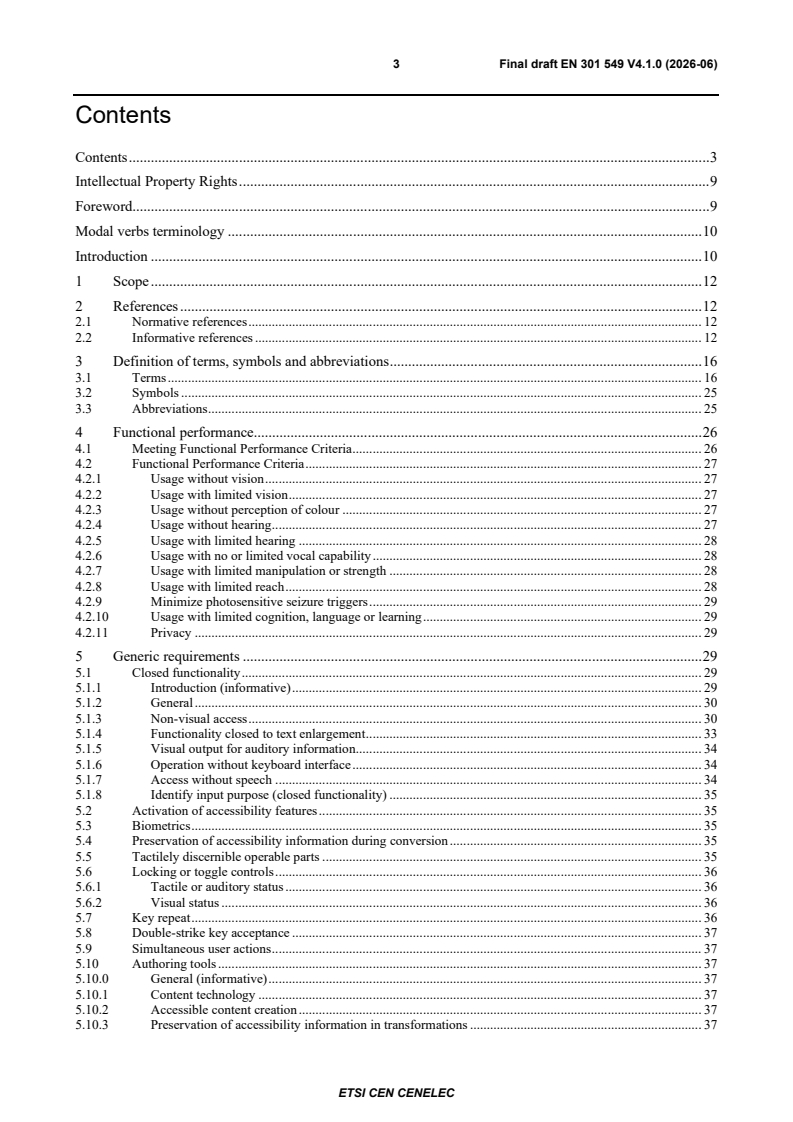
3 Final draft EN 301 549 V4.1.0 (2026-06)
Contents
Contents . 3
Intellectual Property Rights . 9
Foreword. 9
Modal verbs terminology . 10
Introduction . 10
1 Scope . 12
2 References . 12
2.1 Normative references . 12
2.2 Informative references . 12
3 Definition of terms, symbols and abbreviations . 16
3.1 Terms . 16
3.2 Symbols . 25
3.3 Abbreviations . 25
4 Functional performance . 26
4.1 Meeting Functional Performance Criteria . 26
4.2 Functional Performance Criteria . 27
4.2.1 Usage without vision . 27
4.2.2 Usage with limited vision . 27
4.2.3 Usage without perception of colour . 27
4.2.4 Usage without hearing . 27
4.2.5 Usage with limited hearing . 28
4.2.6 Usage with no or limited vocal capability . 28
4.2.7 Usage with limited manipulation or strength . 28
4.2.8 Usage with limited reach . 28
4.2.9 Minimize photosensitive seizure triggers . 29
4.2.10 Usage with limited cognition, language or learning . 29
4.2.11 Privacy . 29
5 Generic requirements . 29
5.1 Closed functionality . 29
5.1.1 Introduction (informative) . 29
5.1.2 General . 30
5.1.3 Non-visual access . 30
5.1.4 Functionality closed to text enlargement . 33
5.1.5 Visual output for auditory information. 34
5.1.6 Operation without keyboard interface . 34
5.1.7 Access without speech . 34
5.1.8 Identify input purpose (closed functionality) . 35
5.2 Activation of accessibility features . 35
5.3 Biometrics . 35
5.4 Preservation of accessibility information during conversion . 35
5.5 Tactilely discernible operable parts . 35
5.6 Locking or toggle controls . 36
5.6.1 Tactile or auditory status . 36
5.6.2 Visual status . 36
5.7 Key repeat . 36
5.8 Double-strike key acceptance . 37
5.9 Simultaneous user actions . 37
5.10 Authoring tools . 37
5.10.0 General (informative) . 37
5.10.1 Content technology . 37
5.10.2 Accessible content creation . 37
5.10.3 Preservation of accessibility information in transformations . 37
ETSI CEN CENELEC
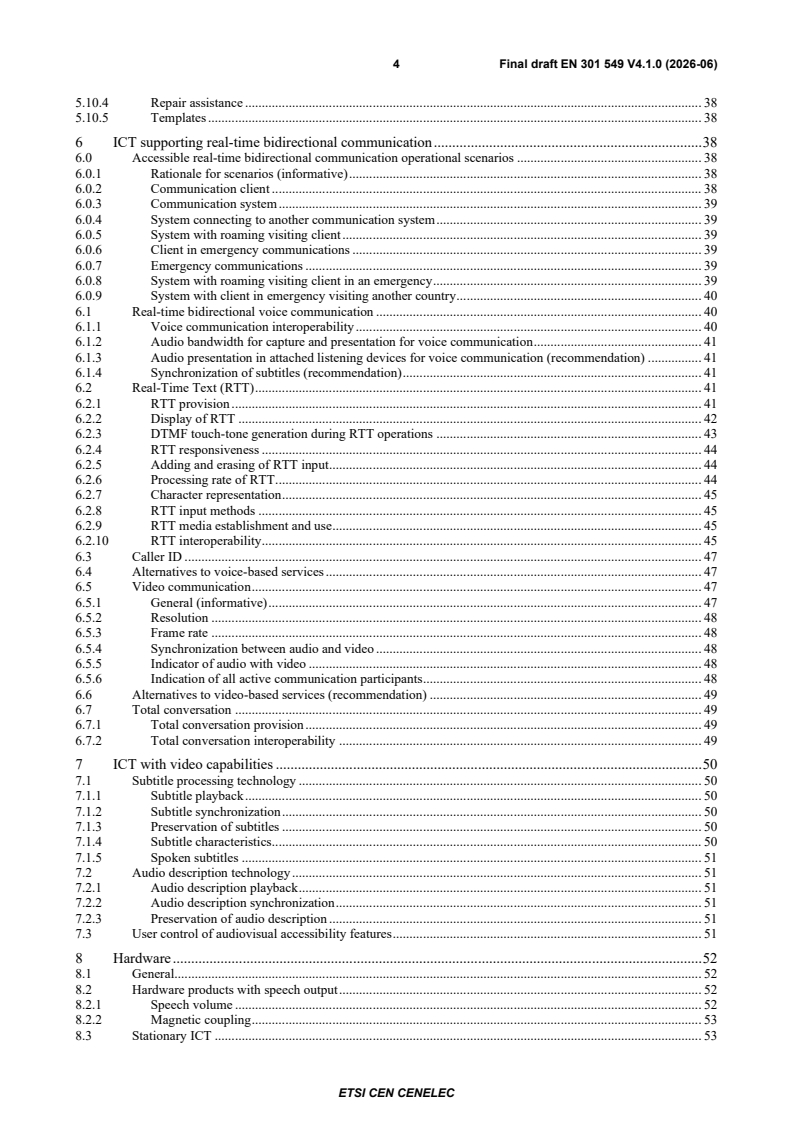
4 Final draft EN 301 549 V4.1.0 (2026-06)
5.10.4 Repair assistance . 38
5.10.5 Templates . 38
6 ICT supporting real-time bidirectional communication . 38
6.0 Accessible real-time bidirectional communication operational scenarios . 38
6.0.1 Rationale for scenarios (informative) . 38
6.0.2 Communication client . 38
6.0.3 Communication system . 39
6.0.4 System connecting to another communication system . 39
6.0.5 System with roaming visiting client . 39
6.0.6 Client in emergency communications . 39
6.0.7 Emergency communications . 39
6.0.8 System with roaming visiting client in an emergency . 39
6.0.9 System with client in emergency visiting another country . 40
6.1 Real-time bidirectional voice communication . 40
6.1.1 Voice communication interoperability . 40
6.1.2 Audio bandwidth for capture and presentation for voice communication . 41
6.1.3 Audio presentation in attached listening devices for voice communication (recommendation) . 41
6.1.4 Synchronization of subtitles (recommendation) . 41
6.2 Real-Time Text (RTT) . 41
6.2.1 RTT provision . 41
6.2.2 Display of RTT . 42
6.2.3 DTMF touch-tone generation during RTT operations . 43
6.2.4 RTT responsiveness . 44
6.2.5 Adding and erasing of RTT input . 44
6.2.6 Processing rate of RTT . 44
6.2.7 Character representation . 45
6.2.8 RTT input methods . 45
6.2.9 RTT media establishment and use . 45
6.2.10 RTT interoperability . 45
6.3 Caller ID . 47
6.4 Alternatives to voice-based services . 47
6.5 Video communication . 47
6.5.1 General (informative) . 47
6.5.2 Resolution . 48
6.5.3 Frame rate . 48
6.5.4 Synchronization between audio and video . 48
6.5.5 Indicator of audio with video . 48
6.5.6 Indication of all active communication participants . 48
6.6 Alternatives to video-based services (recommendation) . 49
6.7 Total conversation . 49
6.7.1 Total conversation provision . 49
6.7.2 Total conversation interoperability . 49
7 ICT with video capabilities . 50
7.1 Subtitle processing technology . 50
7.1.1 Subtitle playback . 50
7.1.2 Subtitle synchronization . 50
7.1.3 Preservation of subtitles . 50
7.1.4 Subtitle characteristics. 50
7.1.5 Spoken subtitles . 51
7.2 Audio description technology . 51
7.2.1 Audio description playback . 51
7.2.2 Audio description synchronization . 51
7.2.3 Preservation of audio description . 51
7.3 User control of audiovisual accessibility features . 51
8 Hardware . 52
8.1 General . 52
8.2 Hardware products with speech output . 52
8.2.1 Speech volume . 52
8.2.2 Magnetic coupling . 53
8.3 Stationary ICT . 53
ETSI CEN CENELEC
5 Final draft EN 301 549 V4.1.0 (2026-06)
8.3.1 General (informative) . 53
8.3.2 Display screen location . 54
8.3.3 Presentation of information necessary for the operation of stationary ICT . 54
8.3.4 Legibility of display screens (informative) . 54
8.3.5 Control location (vertical) . 54
8.3.6 Control location (horizontal) . 55
8.3.7 Reach depth . 55
8.3.8 Forward or side reach (informative) . 55
8.3.9 Forward reach. 56
8.3.10 Side reach . 56
8.3.11 Free space underneath stationary ICT with or without an obstruction . 58
8.3.12 Floor characteristics (informative) . 59
8.3.13 Approach (informative) . 59
8.3.14 Installation instructions . 59
8.4 Operable parts . 59
8.4.1 Numeric keys . 59
8.4.2 Operation of operable parts . 60
8.4.3 Keys, tickets and cards . 60
8.5 Tactile indication of speech mode . 60
8.6 Standard connections . 60
8.7 Colour on hardware . 60
8.8 Contrast on hardware . 61
9 Web . 61
9.0 General (informative) . 61
9.1 Perceivable . 62
9.1.1 Text alternatives . 62
9.1.2 Time-based media . 62
9.1.3 Adaptable . 63
9.1.4 Distinguishable . 63
9.2 Operable . 65
9.2.1 Keyboard accessible . 65
9.2.2 Enough time . 65
9.2.3 Seizures and physical reactions . 65
9.2.4 Navigable . 65
9.2.5 Input modalities . 66
9.3 Understandable . 67
9.3.1 Readable . 67
9.3.2 Predictable . 67
9.3.3 Input assistance . 68
9.4 Robust . 68
9.4.1 Compatible . 68
9.5 WCAG 2.2 AAA Success Criteria (informative) . 69
9.6 WCAG conformance requirements . 69
9.7 User preferences for web pages . 70
10 Non-web documents . 71
10.0 General (informative) . 71
10.1 Perceivable . 72
10.1.1 Text alternatives . 72
10.1.2 Time-based media . 72
10.1.3 Adaptable . 73
10.1.4 Distinguishable . 74
10.2 Operable . 76
10.2.1 Keyboard accessible . 76
10.2.2 Enough time . 77
10.2.3 Seizures and physical reactions . 78
10.2.4 Navigable . 78
10.2.5 Input modalities . 80
10.3 Understandable . 81
10.3.1 Readable . 81
10.3.2 Predictable . 82
ETSI CEN CENELEC
6 Final draft EN 301 549 V4.1.0 (2026-06)
10.3.3 Input assistance . 83
10.4 Robust . 85
10.4.1 Compatible . 85
10.5 Subtitle positioning (recommendation) . 85
10.6 Audio description timing (recommendation) . 85
10.7 User preferences for non-web documents . 85
11 Non-web software . 86
11.0 General (informative) . 86
11.1 Perceivable . 87
11.1.1 Text alternatives . 87
11.1.2 Time-based media . 87
11.1.3 Adaptable . 89
11.1.4 Distinguishable . 90
11.2 Operable . 92
11.2.1 Keyboard accessible . 92
11.2.2 Enough time . 94
11.2.3 Seizures and physical reactions . 95
11.2.4 Navigable . 95
11.2.5 Input modalities . 96
11.3 Understandable . 98
11.3.1 Readable . 98
11.3.2 Predictable . 98
11.3.3 Input assistance . 99
11.4 Robust . 101
11.4.1 Compatible . 101
11.5 Interoperability with keyboards and assistive technology . 102
11.5.1 Closed functionality (informative) . 102
11.5.2 Accessibility services . 102
11.6 Documented accessibility features . 106
11.6.1 User control of accessibility features . 106
11.6.2 No disruption of accessibility features . 106
11.7 User preferences . 106
12 Information about products and services . 106
12.1 Accessible information about products . 106
12.2 Accessible information about services . 107
12.3 Accessibility and compatibility features . 107
12.4 Electronic program guides . 107
12.5 Electronic program guide display . 107
13 ICT providing relay or emergency service access . 108
13.1 Relay services requirements . 108
13.1.1 General (informative) . 108
13.1.2 Relay service access . 109
13.1.3 Relay service requirements . 110
13.2 Void . 110
13.3 Access to emergency services (informative). 111
14 Conformance . 111
14.1 Achieving conformance (informative) . 111
14.2 Special states . 111
14.3 One mode . 112
Annex A (informative): ICT conformance evaluation . 113
A.1 Conformance with Directive (EU) 2016/2102 on the accessibility of the websites and mobile
applications of public sector bodies . 113
A.2 Conformance with Directive (EU) 2019/882 on the accessibility requirements of products and services . 113
A.2.0 The meaning of conformance with Directive (EU) 2019/882 . 113
A.2.1 Where the ICT is, or includes, a web page . 114
A.2.2 Where the ICT is, or includes, a non-web document . 115
A.2.3 Where the ICT is, or includes, non-web software that provides a user interface . 117
A.2.4 Where the ICT is, or includes, hardware . 121
A.2.5 All ICT . 123
ETSI CEN CENELEC
7 Final draft EN 301 549 V4.1.0 (2026-06)
Annex B (informative): Relationship between requirements and functional performance criteria . 129
B.1 Relationships between clauses 5 to 13 and the functional performance criteria . 129
B.2 Interpretation of Table B.2 . 139
B.2.0 General . 139
B.2.1 Example . 139
Annex C (normative): Determination of conformance . 141
C.1 Introduction. 141
C.2 Empty clause . 141
C.3 Empty clause . 141
C.4 Functional performance . 141
C.4.1 Meeting Functional Performance Criteria . 141
C.4.2 Functional Performance Criteria . 141
C.5 Generic requirements . 143
C.5.1 Closed functionality . 143
C.5.2 Activation of accessibility features . 149
C.5.3 Biometrics . 149
C.5.4 Preservation of accessibility information during conversion . 149
C.5.5 Tactilely discernible operable parts . 149
C.5.6 Locking or toggle controls . 149
C.5.7 Key repeat . 150
C.5.8 Double-strike key acceptance . 150
C.5.9 Simultaneous user actions . 150
C.5.10 Authoring tools. 150
C.6 ICT supporting real-time bidirectional communication . 152
C.6.0 Accessible real-time bidirectional communication operational scenarios . 152
C.6.1 Real-time bidirectional voice communication . 154
C.6.2 Real-Time Text (RTT) . 155
C.6.3 Caller ID .
...
EN 301 549 V4.1.1 (2026-09)
HARMONISED EUROPEAN STANDARD
Accessibility requirements for ICT products and services
2 EN 301 549 V4.1.1 (2026-09)
Reference
REN/HF-00301561
Keywords
accessibility, HF, ICT, product, service
CEN CENELEC ETSI
Rue de la science, 23 Rue de la science, 23 650 Route des Lucioles
B-1040 Brussels - BELGIUM B-1040 Brussels - BELGIUM F-06921 Sophia Antipolis Cedex - FRANCE
Tel: + 32 2 550 08 11 Tel.: +32 2 519 68 71 Tel.: +33 4 92 94 42 00
Fax: + 32 2 550 08 19 Fax: +32 2 519 69 19 Fax: +33 4 93 65 47 16
Siret N° 348 623 562 00017 - APE 7112B
Association à but non lucratif enregistrée à la
Sous-Préfecture de Grasse (06) N° w061004871
Important notice
The present document can be downloaded from the
ETSI Search & Browse Standards application.
The present document may be made available in electronic versions and/or in print. The content of any electronic and/or
print versions of the present document shall not be modified without the prior written authorization of ETSI. In case of any
existing or perceived difference in contents between such versions and/or in print, the prevailing version of an ETSI
deliverable is the one made publicly available in PDF format on ETSI deliver repository.
Users should be aware that the present document may be revised or have its status changed,
this information is available in the Milestones listing.
If you find errors in the present document, please send your comments to
the relevant service listed under Committee Support Staff.
If you find a security vulnerability in the present document, please report it through our
Coordinated Vulnerability Disclosure (CVD) program.
Notice of disclaimer & limitation of liability
The information provided in the present deliverable is directed solely to professionals who have the appropriate degree of
experience to understand and interpret its content in accordance with generally accepted engineering or
other professional standard and applicable regulations.
No recommendation as to products and services or vendors is made or should be implied.
In no event shall ETSI be held liable for loss of profits or any other incidental or consequential damages.
Any software contained in this deliverable is provided "AS IS" with no warranties, express or implied, including but not
limited to, the warranties of merchantability, fitness for a particular purpose and non-infringement of intellectual property
rights and ETSI shall not be held liable in any event for any damages whatsoever (including, without limitation, damages
for loss of profits, business interruption, loss of information, or any other pecuniary loss) arising out of or related to the use
of or inability to use the software.
Copyright Notification
No part of this document may be reproduced in any form, by any means and in any media, without the prior written
authorization of ETSI and except as expressly permitted below.
By way of exception and when the document is a normative deliverable (European Standard (EN),
Technical Specification (TS), Group Specification (GS) or ETSI Standard (ES)), ETSI authorizes to reproduce
and incorporate into products, services and technical documentation only those extracts (e.g. templates) that are strictly
necessary for the technical implementation of the normative deliverable, to ensure compliance with the latter.
Nothing in this notice shall be construed as limiting any mandatory exceptions to copyright provided by applicable law.
© ETSI 2026.
© Comité Européen de Normalisation 2026.
© Comité Européen de Normalisation Electrotechnique 2026.
All rights reserved.
ETSI CEN CENELEC
3 EN 301 549 V4.1.1 (2026-09)
Contents
Contents . 3
Intellectual Property Rights . 9
Foreword. 9
Modal verbs terminology . 10
Introduction . 10
1 Scope . 12
2 References . 12
2.1 Normative references . 12
2.2 Informative references . 12
3 Definition of terms, symbols and abbreviations . 16
3.1 Terms . 16
3.2 Symbols . 25
3.3 Abbreviations . 25
4 Functional performance . 26
4.1 Meeting Functional Performance Criteria . 26
4.2 Functional Performance Criteria . 27
4.2.1 Usage without vision . 27
4.2.2 Usage with limited vision . 27
4.2.3 Usage without perception of colour . 27
4.2.4 Usage without hearing . 27
4.2.5 Usage with limited hearing . 28
4.2.6 Usage with no or limited vocal capability . 28
4.2.7 Usage with limited manipulation or strength . 28
4.2.8 Usage with limited reach . 28
4.2.9 Minimize photosensitive seizure triggers . 29
4.2.10 Usage with limited cognition, language or learning . 29
4.2.11 Privacy . 29
5 Generic requirements . 29
5.1 Closed functionality . 29
5.1.1 Introduction (informative) . 29
5.1.2 General . 30
5.1.3 Non-visual access . 30
5.1.4 Functionality closed to text enlargement . 34
5.1.5 Visual output for auditory information. 34
5.1.6 Operation without keyboard interface . 34
5.1.7 Access without speech . 35
5.1.8 Identify input purpose (closed functionality) . 35
5.2 Activation of accessibility features . 35
5.3 Biometrics . 35
5.4 Preservation of accessibility information during conversion . 35
5.5 Tactilely discernible operable parts . 35
5.6 Locking or toggle controls . 36
5.6.1 Tactile or auditory status . 36
5.6.2 Visual status . 36
5.7 Key repeat . 36
5.8 Double-strike key acceptance . 37
5.9 Simultaneous user actions . 37
5.10 Authoring tools . 37
5.10.0 General (informative) . 37
5.10.1 Content technology . 37
5.10.2 Accessible content creation . 37
5.10.3 Preservation of accessibility information in transformations . 37
ETSI CEN CENELEC
4 EN 301 549 V4.1.1 (2026-09)
5.10.4 Repair assistance . 38
5.10.5 Templates . 38
6 ICT supporting real-time bidirectional communication . 38
6.0 Accessible real-time bidirectional communication operational scenarios . 38
6.0.1 Rationale for scenarios (informative) . 38
6.0.2 Communication client . 38
6.0.3 Communication system . 39
6.0.4 System connecting to another communication system . 39
6.0.5 System with roaming visiting client . 39
6.0.6 Client in emergency communications . 39
6.0.7 Emergency communications . 39
6.0.8 System with roaming visiting client in an emergency . 39
6.0.9 System with client in emergency visiting another country . 40
6.1 Real-time bidirectional voice communication . 40
6.1.1 Voice communication interoperability . 40
6.1.2 Audio bandwidth for capture and presentation for voice communication . 41
6.1.3 Audio presentation in attached listening devices for voice communication (recommendation) . 41
6.1.4 Synchronization of subtitles (recommendation) . 41
6.2 Real-Time Text (RTT) . 42
6.2.1 RTT provision . 42
6.2.2 Display of RTT . 42
6.2.3 DTMF touch-tone generation during RTT operations . 44
6.2.4 RTT responsiveness . 44
6.2.5 Adding and erasing of RTT input . 44
6.2.6 Processing rate of RTT . 45
6.2.7 Character representation . 45
6.2.8 RTT input methods . 45
6.2.9 RTT media establishment and use . 45
6.2.10 RTT interoperability . 46
6.3 Caller ID . 47
6.4 Alternatives to voice-based services . 47
6.5 Video communication . 47
6.5.1 General (informative) . 47
6.5.2 Resolution . 48
6.5.3 Frame rate . 48
6.5.4 Synchronization between audio and video . 48
6.5.5 Indicator of audio with video . 48
6.5.6 Indication of all active communication participants . 49
6.6 Alternatives to video-based services (recommendation) . 49
6.7 Total conversation . 49
6.7.1 Total conversation provision . 49
6.7.2 Total conversation interoperability . 49
7 ICT with video capabilities . 50
7.1 Subtitle processing technology . 50
7.1.1 Subtitle playback . 50
7.1.2 Subtitle synchronization . 50
7.1.3 Preservation of subtitles . 50
7.1.4 Subtitle characteristics. 50
7.1.5 Spoken subtitles . 51
7.2 Audio description technology . 51
7.2.1 Audio description playback . 51
7.2.2 Audio description synchronization . 51
7.2.3 Preservation of audio description . 51
7.3 User control of audiovisual accessibility features . 51
8 Hardware . 52
8.1 General . 52
8.2 Hardware products with speech output . 52
8.2.1 Speech volume . 52
8.2.2 Magnetic coupling . 53
8.3 Stationary ICT . 53
ETSI CEN CENELEC
5 EN 301 549 V4.1.1 (2026-09)
8.3.1 General (informative) . 53
8.3.2 Display screen location . 54
8.3.3 Presentation of information necessary for the operation of stationary ICT . 54
8.3.4 Legibility of display screens (informative) . 54
8.3.5 Control location (vertical) . 54
8.3.6 Control location (horizontal) . 55
8.3.7 Reach depth . 55
8.3.8 Forward or side reach (informative) . 55
8.3.9 Forward reach. 56
8.3.10 Side reach . 56
8.3.11 Free space underneath stationary ICT with or without an obstruction . 58
8.3.12 Floor characteristics (informative) . 59
8.3.13 Approach (informative) . 59
8.3.14 Installation instructions . 59
8.4 Operable parts . 59
8.4.1 Numeric keys . 59
8.4.2 Operation of operable parts . 60
8.4.3 Keys, tickets and cards . 60
8.5 Tactile indication of speech mode . 60
8.6 Standard connections . 60
8.7 Colour on hardware . 60
8.8 Contrast on hardware . 61
9 Web . 61
9.0 General (informative) . 61
9.1 Perceivable . 62
9.1.1 Text alternatives . 62
9.1.2 Time-based media . 62
9.1.3 Adaptable . 63
9.1.4 Distinguishable . 63
9.2 Operable . 65
9.2.1 Keyboard accessible . 65
9.2.2 Enough time . 65
9.2.3 Seizures and physical reactions . 65
9.2.4 Navigable . 65
9.2.5 Input modalities . 66
9.3 Understandable . 67
9.3.1 Readable . 67
9.3.2 Predictable . 67
9.3.3 Input assistance . 68
9.4 Robust . 68
9.4.1 Compatible . 68
9.5 WCAG 2.2 AAA Success Criteria (informative) . 69
9.6 WCAG conformance requirements . 69
9.7 User preferences for web pages . 70
10 Non-web documents . 71
10.0 General (informative) . 71
10.1 Perceivable . 72
10.1.1 Text alternatives . 72
10.1.2 Time-based media . 72
10.1.3 Adaptable . 73
10.1.4 Distinguishable . 74
10.2 Operable . 76
10.2.1 Keyboard accessible . 76
10.2.2 Enough time . 77
10.2.3 Seizures and physical reactions . 78
10.2.4 Navigable . 78
10.2.5 Input modalities . 80
10.3 Understandable . 81
10.3.1 Readable . 81
10.3.2 Predictable . 82
ETSI CEN CENELEC
6 EN 301 549 V4.1.1 (2026-09)
10.3.3 Input assistance . 83
10.4 Robust . 85
10.4.1 Compatible . 85
10.5 Subtitle positioning (recommendation) . 85
10.6 Audio description timing (recommendation) . 85
10.7 User preferences for non-web documents . 85
11 Non-web software . 86
11.0 General (informative) . 86
11.1 Perceivable . 87
11.1.1 Text alternatives . 87
11.1.2 Time-based media . 87
11.1.3 Adaptable . 89
11.1.4 Distinguishable . 90
11.2 Operable . 92
11.2.1 Keyboard accessible . 92
11.2.2 Enough time . 94
11.2.3 Seizures and physical reactions . 95
11.2.4 Navigable . 95
11.2.5 Input modalities . 96
11.3 Understandable . 98
11.3.1 Readable . 98
11.3.2 Predictable . 98
11.3.3 Input assistance . 99
11.4 Robust . 101
11.4.1 Compatible . 101
11.5 Interoperability with keyboards and assistive technology . 102
11.5.1 Closed functionality (informative) . 102
11.5.2 Accessibility services . 102
11.6 Documented accessibility features . 106
11.6.1 User control of accessibility features . 106
11.6.2 No disruption of accessibility features . 106
11.7 User preferences . 106
12 Information about products and services . 106
12.1 Accessible information about products . 106
12.2 Accessible information about services . 107
12.3 Accessibility and compatibility features . 107
12.4 Electronic program guides . 107
12.5 Electronic program guide display . 107
13 ICT providing relay or emergency service access . 108
13.1 Relay services requirements . 108
13.1.1 General (informative) . 108
13.1.2 Relay service access . 109
13.1.3 Relay service requirements . 110
13.2 Void . 110
13.3 Access to emergency services (informative). 111
14 Conformance . 111
14.1 Achieving conformance (informative) . 111
14.2 Special states . 111
14.3 One mode . 112
Annex A (informative): ICT conformance evaluation . 113
A.1 Conformance with Directive (EU) 2016/2102 on the accessibility of the websites and mobile
applications of public sector bodies . 113
A.2 Conformance with Directive (EU) 2019/882 on the accessibility requirements of products and services . 113
A.2.0 The meaning of conformance with Directive (EU) 2019/882 . 113
A.2.1 Where the ICT is, or includes, a web page . 114
A.2.2 Where the ICT is, or includes, a non-web document . 115
A.2.3 Where the ICT is, or includes, non-web software that provides a user interface . 117
A.2.4 Where the ICT is, or includes, hardware . 121
A.2.5 All ICT . 123
ETSI CEN CENELEC
7 EN 301 549 V4.1.1 (2026-09)
Annex B (informative): Relationship between requirements and functional performance criteria . 129
B.1 Relationships between clauses 5 to 13 and the functional performance criteria . 129
B.2 Interpretation of Table B.2 . 139
B.2.0 General . 139
B.2.1 Example . 139
Annex C (normative): Determination of conformance . 141
C.1 Introduction. 141
C.2 Empty clause . 141
C.3 Empty clause . 141
C.4 Functional performance . 141
C.4.1 Meeting Functional Performance Criteria . 141
C.4.2 Functional Performance Criteria . 141
C.5 Generic requirements . 143
C.5.1 Closed functionality . 143
C.5.2 Activation of accessibility features . 149
C.5.3 Biometrics . 149
C.5.4 Preservation of accessibility information during conversion . 149
C.5.5 Tactilely discernible operable parts . 149
C.5.6 Locking or toggle controls . 149
C.5.7 Key repeat . 150
C.5.8 Double-strike key acceptance . 150
C.5.9 Simultaneous user actions . 150
C.5.10 Authoring tools. 150
C.6 ICT supporting real-time bidirectional communication . 152
C.6.0 Accessible real-time bidirectional communication operational scenarios . 152
C.6.1 Real-time bidirectional voice communic
...
SLOVENSKI STANDARD
01-november-2026
Zahteve za dostopnost izdelkov in storitev IKT
Accessibility requirements for ICT products and services
Accessibility requirements for ICT products and services
Ta slovenski standard je istoveten z: ETSI EN 301 549 V4.1.1 (2026-09)
ICS:
35.020 Informacijska tehnika in Information technology (IT) in
tehnologija na splošno general
2003-01.Slovenski inštitut za standardizacijo. Razmnoževanje celote ali delov tega standarda ni dovoljeno.
EN 301 549 V4.1.1 (2026-09)
HARMONISED EUROPEAN STANDARD
Accessibility requirements for ICT products and services
2 EN 301 549 V4.1.1 (2026-09)
Reference
REN/HF-00301561
Keywords
accessibility, HF, ICT, product, service
CEN CENELEC ETSI
Rue de la science, 23 Rue de la science, 23 650 Route des Lucioles
B-1040 Brussels - BELGIUM B-1040 Brussels - BELGIUM F-06921 Sophia Antipolis Cedex - FRANCE
Tel: + 32 2 550 08 11 Tel.: +32 2 519 68 71 Tel.: +33 4 92 94 42 00
Fax: + 32 2 550 08 19 Fax: +32 2 519 69 19 Fax: +33 4 93 65 47 16
Siret N° 348 623 562 00017 - APE 7112B
Association à but non lucratif enregistrée à la
Sous-Préfecture de Grasse (06) N° w061004871
Important notice
The present document can be downloaded from the
ETSI Search & Browse Standards application.
The present document may be made available in electronic versions and/or in print. The content of any electronic and/or
print versions of the present document shall not be modified without the prior written authorization of ETSI. In case of any
existing or perceived difference in contents between such versions and/or in print, the prevailing version of an ETSI
deliverable is the one made publicly available in PDF format on ETSI deliver repository.
Users should be aware that the present document may be revised or have its status changed,
this information is available in the Milestones listing.
If you find errors in the present document, please send your comments to
the relevant service listed under Committee Support Staff.
If you find a security vulnerability in the present document, please report it through our
Coordinated Vulnerability Disclosure (CVD) program.
Notice of disclaimer & limitation of liability
The information provided in the present deliverable is directed solely to professionals who have the appropriate degree of
experience to understand and interpret its content in accordance with generally accepted engineering or
other professional standard and applicable regulations.
No recommendation as to products and services or vendors is made or should be implied.
In no event shall ETSI be held liable for loss of profits or any other incidental or consequential damages.
Any software contained in this deliverable is provided "AS IS" with no warranties, express or implied, including but not
limited to, the warranties of merchantability, fitness for a particular purpose and non-infringement of intellectual property
rights and ETSI shall not be held liable in any event for any damages whatsoever (including, without limitation, damages
for loss of profits, business interruption, loss of information, or any other pecuniary loss) arising out of or related to the use
of or inability to use the software.
Copyright Notification
No part of this document may be reproduced in any form, by any means and in any media, without the prior written
authorization of ETSI and except as expressly permitted below.
By way of exception and when the document is a normative deliverable (European Standard (EN),
Technical Specification (TS), Group Specification (GS) or ETSI Standard (ES)), ETSI authorizes to reproduce
and incorporate into products, services and technical documentation only those extracts (e.g. templates) that are strictly
necessary for the technical implementation of the normative deliverable, to ensure compliance with the latter.
Nothing in this notice shall be construed as limiting any mandatory exceptions to copyright provided by applicable law.
© ETSI 2026.
© Comité Européen de Normalisation 2026.
© Comité Européen de Normalisation Electrotechnique 2026.
All rights reserved.
ETSI CEN CENELEC
3 EN 301 549 V4.1.1 (2026-09)
Contents
Contents . 3
Intellectual Property Rights . 9
Foreword. 9
Modal verbs terminology . 10
Introduction . 10
1 Scope . 12
2 References . 12
2.1 Normative references . 12
2.2 Informative references . 12
3 Definition of terms, symbols and abbreviations . 16
3.1 Terms . 16
3.2 Symbols . 25
3.3 Abbreviations . 25
4 Functional performance . 26
4.1 Meeting Functional Performance Criteria . 26
4.2 Functional Performance Criteria . 27
4.2.1 Usage without vision . 27
4.2.2 Usage with limited vision . 27
4.2.3 Usage without perception of colour . 27
4.2.4 Usage without hearing . 27
4.2.5 Usage with limited hearing . 28
4.2.6 Usage with no or limited vocal capability . 28
4.2.7 Usage with limited manipulation or strength . 28
4.2.8 Usage with limited reach . 28
4.2.9 Minimize photosensitive seizure triggers . 29
4.2.10 Usage with limited cognition, language or learning . 29
4.2.11 Privacy . 29
5 Generic requirements . 29
5.1 Closed functionality . 29
5.1.1 Introduction (informative) . 29
5.1.2 General . 30
5.1.3 Non-visual access . 30
5.1.4 Functionality closed to text enlargement . 34
5.1.5 Visual output for auditory information. 34
5.1.6 Operation without keyboard interface . 34
5.1.7 Access without speech . 35
5.1.8 Identify input purpose (closed functionality) . 35
5.2 Activation of accessibility features . 35
5.3 Biometrics . 35
5.4 Preservation of accessibility information during conversion . 35
5.5 Tactilely discernible operable parts . 35
5.6 Locking or toggle controls . 36
5.6.1 Tactile or auditory status . 36
5.6.2 Visual status . 36
5.7 Key repeat . 36
5.8 Double-strike key acceptance . 37
5.9 Simultaneous user actions . 37
5.10 Authoring tools . 37
5.10.0 General (informative) . 37
5.10.1 Content technology . 37
5.10.2 Accessible content creation . 37
5.10.3 Preservation of accessibility information in transformations . 37
ETSI CEN CENELEC
4 EN 301 549 V4.1.1 (2026-09)
5.10.4 Repair assistance . 38
5.10.5 Templates . 38
6 ICT supporting real-time bidirectional communication . 38
6.0 Accessible real-time bidirectional communication operational scenarios . 38
6.0.1 Rationale for scenarios (informative) . 38
6.0.2 Communication client . 38
6.0.3 Communication system . 39
6.0.4 System connecting to another communication system . 39
6.0.5 System with roaming visiting client . 39
6.0.6 Client in emergency communications . 39
6.0.7 Emergency communications . 39
6.0.8 System with roaming visiting client in an emergency . 39
6.0.9 System with client in emergency visiting another country . 40
6.1 Real-time bidirectional voice communication . 40
6.1.1 Voice communication interoperability . 40
6.1.2 Audio bandwidth for capture and presentation for voice communication . 41
6.1.3 Audio presentation in attached listening devices for voice communication (recommendation) . 41
6.1.4 Synchronization of subtitles (recommendation) . 41
6.2 Real-Time Text (RTT) . 42
6.2.1 RTT provision . 42
6.2.2 Display of RTT . 42
6.2.3 DTMF touch-tone generation during RTT operations . 44
6.2.4 RTT responsiveness . 44
6.2.5 Adding and erasing of RTT input . 44
6.2.6 Processing rate of RTT . 45
6.2.7 Character representation . 45
6.2.8 RTT input methods . 45
6.2.9 RTT media establishment and use . 45
6.2.10 RTT interoperability . 46
6.3 Caller ID . 47
6.4 Alternatives to voice-based services . 47
6.5 Video communication . 47
6.5.1 General (informative) . 47
6.5.2 Resolution . 48
6.5.3 Frame rate . 48
6.5.4 Synchronization between audio and video . 48
6.5.5 Indicator of audio with video . 48
6.5.6 Indication of all active communication participants . 49
6.6 Alternatives to video-based services (recommendation) . 49
6.7 Total conversation . 49
6.7.1 Total conversation provision . 49
6.7.2 Total conversation interoperability . 49
7 ICT with video capabilities . 50
7.1 Subtitle processing technology . 50
7.1.1 Subtitle playback . 50
7.1.2 Subtitle synchronization . 50
7.1.3 Preservation of subtitles . 50
7.1.4 Subtitle characteristics. 50
7.1.5 Spoken subtitles . 51
7.2 Audio description technology . 51
7.2.1 Audio description playback . 51
7.2.2 Audio description synchronization . 51
7.2.3 Preservation of audio description . 51
7.3 User control of audiovisual accessibility features . 51
8 Hardware . 52
8.1 General . 52
8.2 Hardware products with speech output . 52
8.2.1 Speech volume . 52
8.2.2 Magnetic coupling . 53
8.3 Stationary ICT . 53
ETSI CEN CENELEC
5 EN 301 549 V4.1.1 (2026-09)
8.3.1 General (informative) . 53
8.3.2 Display screen location . 54
8.3.3 Presentation of information necessary for the operation of stationary ICT . 54
8.3.4 Legibility of display screens (informative) . 54
8.3.5 Control location (vertical) . 54
8.3.6 Control location (horizontal) . 55
8.3.7 Reach depth . 55
8.3.8 Forward or side reach (informative) . 55
8.3.9 Forward reach. 56
8.3.10 Side reach . 56
8.3.11 Free space underneath stationary ICT with or without an obstruction . 58
8.3.12 Floor characteristics (informative) . 59
8.3.13 Approach (informative) . 59
8.3.14 Installation instructions . 59
8.4 Operable parts . 59
8.4.1 Numeric keys . 59
8.4.2 Operation of operable parts . 60
8.4.3 Keys, tickets and cards . 60
8.5 Tactile indication of speech mode . 60
8.6 Standard connections . 60
8.7 Colour on hardware . 60
8.8 Contrast on hardware . 61
9 Web . 61
9.0 General (informative) . 61
9.1 Perceivable . 62
9.1.1 Text alternatives . 62
9.1.2 Time-based media . 62
9.1.3 Adaptable . 63
9.1.4 Distinguishable . 63
9.2 Operable . 65
9.2.1 Keyboard accessible . 65
9.2.2 Enough time . 65
9.2.3 Seizures and physical reactions . 65
9.2.4 Navigable . 65
9.2.5 Input modalities . 66
9.3 Understandable . 67
9.3.1 Readable . 67
9.3.2 Predictable . 67
9.3.3 Input assistance . 68
9.4 Robust . 68
9.4.1 Compatible . 68
9.5 WCAG 2.2 AAA Success Criteria (informative) . 69
9.6 WCAG conformance requirements . 69
9.7 User preferences for web pages . 70
10 Non-web documents . 71
10.0 General (informative) . 71
10.1 Perceivable . 72
10.1.1 Text alternatives . 72
10.1.2 Time-based media . 72
10.1.3 Adaptable . 73
10.1.4 Distinguishable . 74
10.2 Operable . 76
10.2.1 Keyboard accessible . 76
10.2.2 Enough time . 77
10.2.3 Seizures and physical reactions . 78
10.2.4 Navigable . 78
10.2.5 Input modalities . 80
10.3 Understandable . 81
10.3.1 Readable . 81
10.3.2 Predictable . 82
ETSI CEN CENELEC
6 EN 301 549 V4.1.1 (2026-09)
10.3.3 Input assistance . 83
10.4 Robust . 85
10.4.1 Compatible . 85
10.5 Subtitle positioning (recommendation) . 85
10.6 Audio description timing (recommendation) . 85
10.7 User preferences for non-web documents . 85
11 Non-web software . 86
11.0 General (informative) . 86
11.1 Perceivable . 87
11.1.1 Text alternatives . 87
11.1.2 Time-based media . 87
11.1.3 Adaptable . 89
11.1.4 Distinguishable . 90
11.2 Operable . 92
11.2.1 Keyboard accessible . 92
11.2.2 Enough time . 94
11.2.3 Seizures and physical reactions . 95
11.2.4 Navigable . 95
11.2.5 Input modalities . 96
11.3 Understandable . 98
11.3.1 Readable . 98
11.3.2 Predictable . 98
11.3.3 Input assistance . 99
11.4 Robust . 101
11.4.1 Compatible . 101
11.5 Interoperability with keyboards and assistive technology . 102
11.5.1 Closed functionality (informative) . 102
11.5.2 Accessibility services . 102
11.6 Documented accessibility features . 106
11.6.1 User control of accessibility features . 106
11.6.2 No disruption of accessibility features . 106
11.7 User preferences . 106
12 Information about products and services . 106
12.1 Accessible information about products . 106
12.2 Accessible information about services . 107
12.3 Accessibility and compatibility features . 107
12.4 Electronic program guides . 107
12.5 Electronic program guide display . 107
13 ICT providing relay or emergency service access . 108
13.1 Relay services requirements . 108
13.1.1 General (informative) . 108
13.1.2 Relay service access . 109
13.1.3 Relay service requirements . 110
13.2 Void . 110
13.3 Access to emergency services (informative). 111
14 Conformance . 111
14.1 Achieving conformance (informative) . 111
14.2 Special states . 111
14.3 One mode . 112
Annex A (informative): ICT conformance evaluation . 113
A.1 Conformance with Directive (EU) 2016/2102 on the accessibility of the websites and mobile
applications of public sector bodies . 113
A.2 Conformance with Directive (EU) 2019/882 on the accessibility requirements of products and services . 113
A.2.0 The meaning of conformance with Directive (EU) 2019/882 . 113
A.2.1 Where the ICT is, or includes, a web page . 114
A.2.2 Where the ICT is, or includes, a non-web document . 115
A.2.3 Where the ICT is, or includes, non-web software that provides a user interface . 117
A.2.4 Where the ICT is, or includes, hardware . 121
A.2.5 All ICT . 123
ETSI CEN CENELEC
7 EN 301 549 V4.1.1 (2026-09)
Annex B (informative): Relationship between requirements and functional performance criteria . 129
B.1 Relationships between clauses 5 to 13 and the functional performance criteria . 129
B.2 Interpretation of Table B.2 . 139
B.2.0 General . 139
B.2.1 Example . 139
Annex C (normative): Determination of conformance . 141
C.1 Introduction. 141
C.2 Empty clause . 141
C.3 Empty clause . 141
C.4 Functional performance . 141
C.4.1 Meeting Functional Performance Criteria . 141
C.4.2 Functional Performance Criteria . 141
C.5 Generic requirements . 143
C.5.1 Closed functionality . 143
C.5.2 Activation of accessibility features . 149
C.5.3 Biometrics . 149
C.5.4 Preservation of accessibility information during conversion . 149
C.5.5 Tactilely discernible operable parts . 149
C.5.6 Locking or toggle controls . 149
C.5.7 Key repeat .
...