


ETSI EN 304 636 V1.0.0 (2026-07)
Cyber Security (CYBER); CRA; Cybersecurity requirements for firewalls, intrusion detection and/or prevention systems
General Information
- Abstract
DEN/CYBER-EUS-0020
- Status
- Not Published
- Technical Committee
- CYBER EUSR - European Union Standardization Request
Buy Documents
ETSI EN 304 636 V1.0.0 (2026-07) - Cyber Security (CYBER); CRA; Cybersecurity requirements for firewalls, intrusion detection and/or prevention systems

Buy Documents
ETSI EN 304 636 V1.0.0 (2026-07) - Cyber Security (CYBER); CRA; Cybersecurity requirements for firewalls, intrusion detection and/or prevention systems
Frequently Asked Questions
ETSI EN 304 636 V1.0.0 (2026-07) is a standard published by the European Telecommunications Standards Institute (ETSI). Its full title is "Cyber Security (CYBER); CRA; Cybersecurity requirements for firewalls, intrusion detection and/or prevention systems". This standard covers: DEN/CYBER-EUS-0020
DEN/CYBER-EUS-0020
ETSI EN 304 636 V1.0.0 (2026-07) is available in PDF format for immediate download after purchase. The document can be added to your cart and obtained through the secure checkout process. Digital delivery ensures instant access to the complete standard document.
Standards Content (Sample)
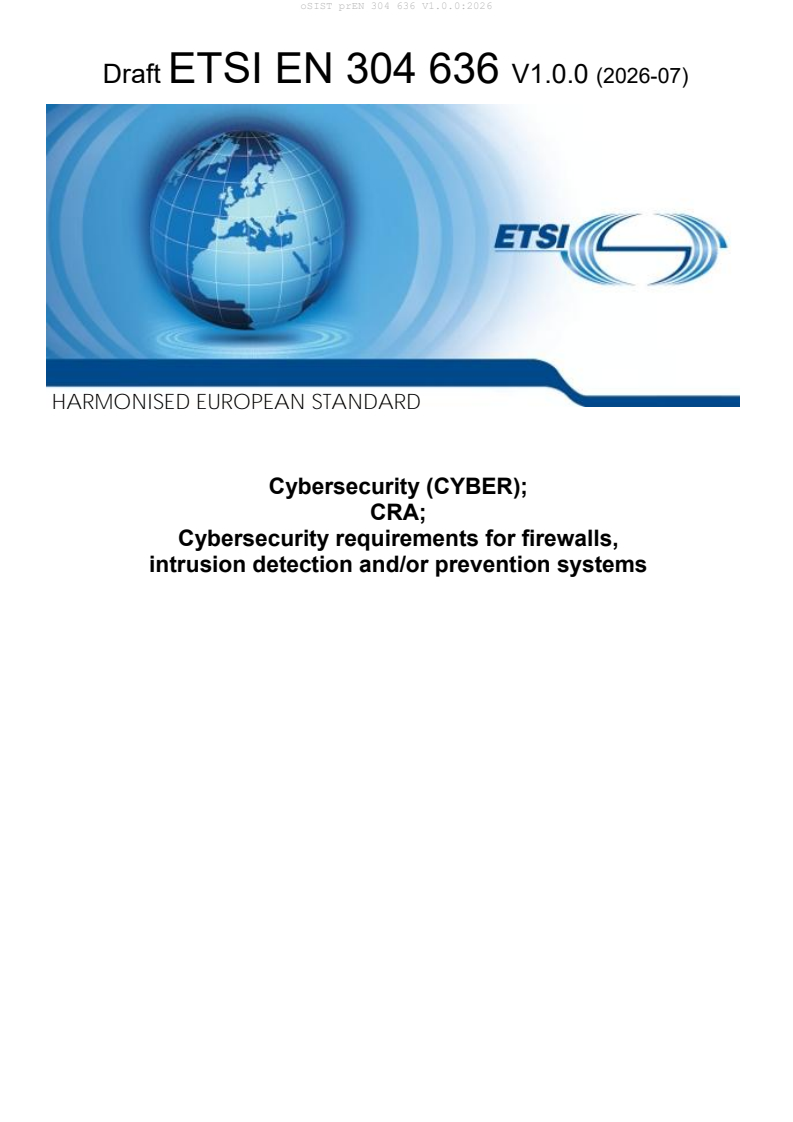
Draft ETSI EN 304 636 V1.0.0 (2026-07)
HARMONISED EUROPEAN STANDARD
Cybersecurity (CYBER);
CRA;
Cybersecurity requirements for firewalls,
intrusion detection and/or prevention systems
2 Draft ETSI EN 304 636 V1.0.0 (2026-07)
Reference
DEN/CYBER-EUS-0020
Keywords
CRA, cybersecurity, firewall
ETSI
650 Route des Lucioles
F-06921 Sophia Antipolis Cedex - FRANCE
Tel.: +33 4 92 94 42 00 Fax: +33 4 93 65 47 16
Siret N° 348 623 562 00017 - APE 7112B
Association à but non lucratif enregistrée à la
Sous-Préfecture de Grasse (06) N° w061004871
Important notice
The present document can be downloaded from the
ETSI Search & Browse Standards application.
The present document may be made available in electronic versions and/or in print. The content of any electronic and/or
print versions of the present document shall not be modified without the prior written authorization of ETSI. In case of any
existing or perceived difference in contents between such versions and/or in print, the prevailing version of an ETSI
deliverable is the one made publicly available in PDF format on ETSI deliver repository.
Users should be aware that the present document may be revised or have its status changed,
this information is available in the Milestones listing.
If you find errors in the present document, please send your comments to
the relevant service listed under Committee Support Staff.
If you find a security vulnerability in the present document, please report it through our
Coordinated Vulnerability Disclosure (CVD) program.
Notice of disclaimer & limitation of liability
The information provided in the present deliverable is directed solely to professionals who have the appropriate degree of
experience to understand and interpret its content in accordance with generally accepted engineering or
other professional standard and applicable regulations.
No recommendation as to products and services or vendors is made or should be implied.
In no event shall ETSI be held liable for loss of profits or any other incidental or consequential damages.
Any software contained in this deliverable is provided "AS IS" with no warranties, express or implied, including but not
limited to, the warranties of merchantability, fitness for a particular purpose and non-infringement of intellectual property
rights and ETSI shall not be held liable in any event for any damages whatsoever (including, without limitation, damages
for loss of profits, business interruption, loss of information, or any other pecuniary loss) arising out of or related to the use
of or inability to use the software.
Copyright Notification
No part of this document may be reproduced in any form, by any means and in any media, without the prior written
authorization of ETSI and except as expressly permitted below.
By way of exception and when the document is a normative deliverable (European Standard (EN),
Technical Specification (TS), Group Specification (GS) or ETSI Standard (ES)), ETSI authorizes to reproduce
and incorporate into products, services and technical documentation only those extracts (e.g. templates) that are strictly
necessary for the technical implementation of the normative deliverable, to ensure compliance with the latter.
Nothing in this notice shall be construed as limiting any mandatory exceptions to copyright provided by applicable law.
© ETSI 2026.
All rights reserved.
ETSI
3 Draft ETSI EN 304 636 V1.0.0 (2026-07)
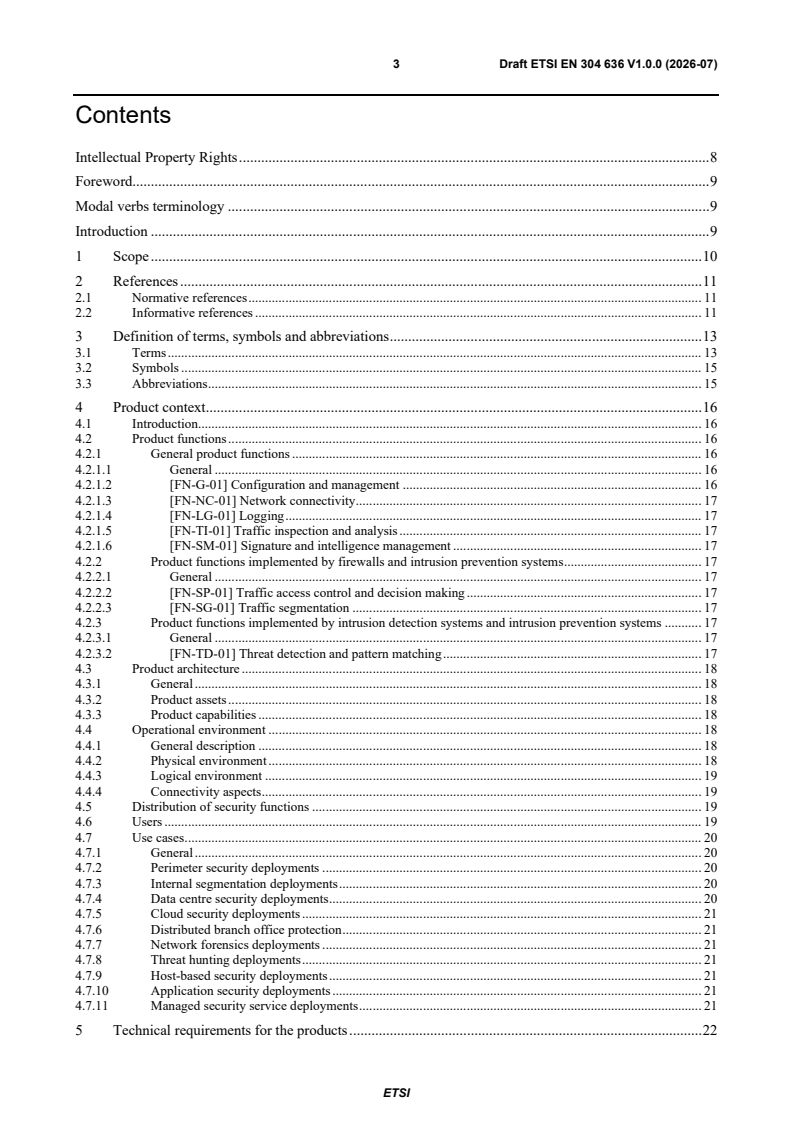
Contents
Intellectual Property Rights . 8
Foreword. 9
Modal verbs terminology . 9
Introduction . 9
1 Scope . 10
2 References . 11
2.1 Normative references . 11
2.2 Informative references . 11
3 Definition of terms, symbols and abbreviations . 13
3.1 Terms . 13
3.2 Symbols . 15
3.3 Abbreviations . 15
4 Product context . 16
4.1 Introduction. 16
4.2 Product functions . 16
4.2.1 General product functions . 16
4.2.1.1 General . 16
4.2.1.2 [FN-G-01] Configuration and management . 16
4.2.1.3 [FN-NC-01] Network connectivity . 17
4.2.1.4 [FN-LG-01] Logging . 17
4.2.1.5 [FN-TI-01] Traffic inspection and analysis . 17
4.2.1.6 [FN-SM-01] Signature and intelligence management . 17
4.2.2 Product functions implemented by firewalls and intrusion prevention systems. 17
4.2.2.1 General . 17
4.2.2.2 [FN-SP-01] Traffic access control and decision making . 17
4.2.2.3 [FN-SG-01] Traffic segmentation . 17
4.2.3 Product functions implemented by intrusion detection systems and intrusion prevention systems . 17
4.2.3.1 General . 17
4.2.3.2 [FN-TD-01] Threat detection and pattern matching . 17
4.3 Product architecture . 18
4.3.1 General . 18
4.3.2 Product assets . 18
4.3.3 Product capabilities . 18
4.4 Operational environment . 18
4.4.1 General description . 18
4.4.2 Physical environment . 18
4.4.3 Logical environment . 19
4.4.4 Connectivity aspects . 19
4.5 Distribution of security functions . 19
4.6 Users . 19
4.7 Use cases . 20
4.7.1 General . 20
4.7.2 Perimeter security deployments . 20
4.7.3 Internal segmentation deployments . 20
4.7.4 Data centre security deployments . 20
4.7.5 Cloud security deployments . 21
4.7.6 Distributed branch office protection . 21
4.7.7 Network forensics deployments . 21
4.7.8 Threat hunting deployments . 21
4.7.9 Host-based security deployments . 21
4.7.10 Application security deployments . 21
4.7.11 Managed security service deployments . 21
5 Technical requirements for the products . 22
ETSI
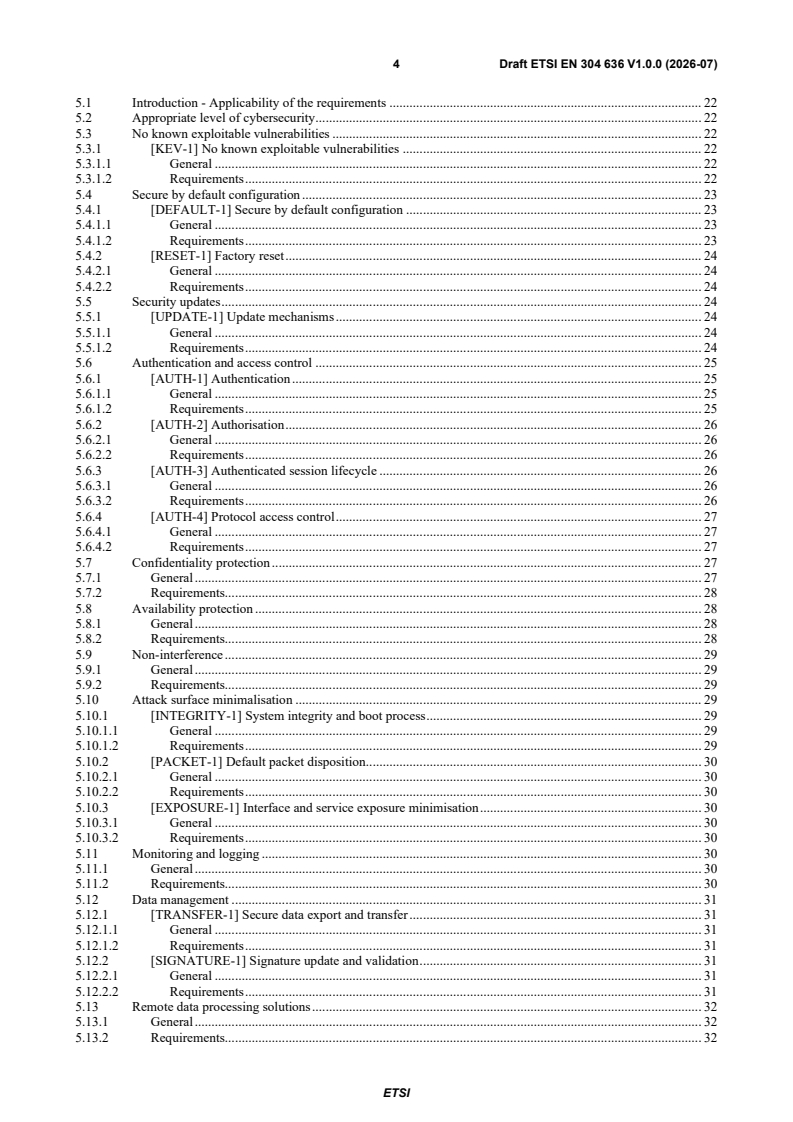
4 Draft ETSI EN 304 636 V1.0.0 (2026-07)
5.1 Introduction - Applicability of the requirements . 22
5.2 Appropriate level of cybersecurity . 22
5.3 No known exploitable vulnerabilities . 22
5.3.1 [KEV-1] No known exploitable vulnerabilities . 22
5.3.1.1 General . 22
5.3.1.2 Requirements . 22
5.4 Secure by default configuration . 23
5.4.1 [DEFAULT-1] Secure by default configuration . 23
5.4.1.1 General . 23
5.4.1.2 Requirements . 23
5.4.2 [RESET-1] Factory reset . 24
5.4.2.1 General . 24
5.4.2.2 Requirements . 24
5.5 Security updates . 24
5.5.1 [UPDATE-1] Update mechanisms . 24
5.5.1.1 General . 24
5.5.1.2 Requirements . 24
5.6 Authentication and access control . 25
5.6.1 [AUTH-1] Authentication . 25
5.6.1.1 General . 25
5.6.1.2 Requirements . 25
5.6.2 [AUTH-2] Authorisation . 26
5.6.2.1 General . 26
5.6.2.2 Requirements . 26
5.6.3 [AUTH-3] Authenticated session lifecycle . 26
5.6.3.1 General . 26
5.6.3.2 Requirements . 26
5.6.4 [AUTH-4] Protocol access control . 27
5.6.4.1 General . 27
5.6.4.2 Requirements . 27
5.7 Confidentiality protection . 27
5.7.1 General . 27
5.7.2 Requirements. 28
5.8 Availability protection . 28
5.8.1 General . 28
5.8.2 Requirements. 28
5.9 Non-interference . 29
5.9.1 General . 29
5.9.2 Requirements. 29
5.10 Attack surface minimalisation . 29
5.10.1 [INTEGRITY-1] System integrity and boot process . 29
5.10.1.1 General . 29
5.10.1.2 Requirements . 29
5.10.2 [PACKET-1] Default packet disposition. 30
5.10.2.1 General . 30
5.10.2.2 Requirements . 30
5.10.3 [EXPOSURE-1] Interface and service exposure minimisation . 30
5.10.3.1 General . 30
5.10.3.2 Requirements . 30
5.11 Monitoring and logging . 30
5.11.1 General . 30
5.11.2 Requirements. 30
5.12 Data management . 31
5.12.1 [TRANSFER-1] Secure data export and transfer . 31
5.12.1.1 General . 31
5.12.1.2 Requirements . 31
5.12.2 [SIGNATURE-1] Signature update and validation . 31
5.12.2.1 General . 31
5.12.2.2 Requirements . 31
5.13 Remote data processing solutions . 32
5.13.1 General . 32
5.13.2 Requirements. 32
ETSI
5 Draft ETSI EN 304 636 V1.0.0 (2026-07)
6 Assessment criteria for compliance with technical requirements . 33
6.1 Introduction to the assessment and compliance criteria . 33
6.2 Appropriate level of cybersecurity . 33
6.3 No known exploitable vulnerabilities . 33
6.3.1 [KEV-1] No known exploitable vulnerabilities . 33
6.3.1.1 Requirement assessments . 33
6.4 Secure by default configuration . 36
6.4.1 [DEFAULT-1] Secure by default configuration . 36
6.4.1.1 Requirement assessments . 36
6.4.2 [RESET-1] Factory reset . 48
6.4.2.1 Requirement assessments . 48
6.5 Security updates . 51
6.5.1 [UPDATE-1] Update mechanisms . 51
6.5.1.1 Requirement assessments . 51
6.6 Authentication and access control . 58
6.6.1 [AUTH-1] Authentication . 58
6.6.1.1 Requirement assessments . 58
6.6.2 [AUTH-2] Authorisation . 66
6.6.2.1 Requirement assessments . 66
6.6.3 [AUTH-3] Authenticated session lifecycle . 70
6.6.3.1 Requirement assessments . 70
6.6.4 [AUTH-4] Protocol access control . 74
6.6.4.1 Requirement assessments . 74
6.7 Confidentiality protection . 79
6.7.1 Requirement assessments . 79
6.8 Availability protection . 85
6.8.1 Requirement assessments . 85
6.9 Non-interference . 88
6.9.1 Requirement assessments . 88
6.10 Attack surface and mitigation . 90
6.10.1 [INTEGRITY-1] System integrity and boot process . 90
6.10.1.1 Requirement assessments . 90
6.10.2 [PACKET-1] Default packet disposition. 94
6.10.2.1 Requirement assessments . 94
6.10.3 [EXPOSURE-1] Interface and service exposure minimisation . 99
6.10.3.1 Requirement assessments . 99
6.11 Monitoring and logging . 102
6.11.1 Requirement assessments . 102
6.12 Data management . 105
6.12.1 [TRANSFER-1] Secure data export and transfer . 105
6.12.1.1 Requirement assessments . 105
6.12.2 [SIGNATURE-1] Signature update and validation . 109
6.12.2.1 Requirement assessments . 109
6.13 Remote data processing solutions . 115
6.13.1 Requirement assessments . 115
Annex A (informative): Relationship between the present document and the essential
cybersecurity requirements of EU Regulation (EU) 2024/2847 . 120
Annex B (informative): Security analysis. 122
B.1 General . 122
B.2 Threat landscape . 122
B.2.1 Threats related to vulnerability handling . 122
B.2.2 Threats related to access control and authentication . 123
B.2.3 Threats related to availability and inspection bypass . 123
B.2.4 Threats related to integrity and tampering . 124
B.2.5 Threats related to signature and intelligence integrity . 124
B.2.6 Threats related to data protection . 125
B.2.7 Threats related to monitoring and visibility . 125
B.2.8 Threats related to default configuration . 125
ETSI
6 Draft ETSI EN 304 636 V1.0.0 (2026-07)
B.2.9 Threats related to physical and deployment security . 126
B.2.10 Threats related to detection disruption . 126
B.3 Threat assessment framework . 126
B.3.1 Introduction. 126
B.3.2 Risk factors . 127
B.3.2.0 Introduction . 127
B.3.2.1 Baseline risk factors . 127
B.3.2.2 Traffic inspection risk factors. 128
B.3.2.3 Update and intelligence risk factors . 128
B.3.2.4 Deployment architecture risk factors . 128
B.3.2.5 Data operations risk factors . 128
B.3.2.6 Remote data processing risk factors . 129
B.3.3 Threat justification and mitigation . 129
Annexes C to J: Void . 133
Annex K (normative): Vertical specific state of the art cryptography . 134
K.0 General . 134
K.1 Classification of cryptographic algorithms as CRY-SOTA . 134
K.2 Assessment criteria for compliance with cryptographic requirements . 135
K.2.1 Assessment objective . 135
K.2.2 Assessment preparation . 135
K.2.3 Assessment activities . 135
K.2.4 Assessment evidence . 136
K.2.5 Assessment verdict . 137
K.3 Symmetric atomic primitives . 137
K.3.1 Block ciphers . 137
K.3.2 Stream ciphers . 138
K.3.3 Hash functions . 138
K.4 Symmetric constructions . 138
K.4.1 Confidentiality modes of operation: encryption/decryption modes . 138
K.4.2 Specific confidentiality modes: disk encryption . 138
K.4.3 Integrity modes: message authentication codes . 139
K.4.4 Symmetric entity authentication schemes . 139
K.4.5 Authenticated encryption . 139
K.4.6 Key protection . 139
K.4.7 Key derivation functions . 139
K.4.8 Password protection/password hashing mechanisms . 139
K.4.9 Key combiners . 140
K.5 Asymmetric atomic primitives . 140
K.5.1 RSA/Integer factorisation . 140
K.5.2 Discrete logarithm in finite fields . 140
K.5.3 Discrete logarithm in elliptic curves . 140
K.5.4 Learning with errors in (structured) lattices . 140
K.5.5 Hash function preimage resistance . 140
K.5.6 Other intractable problems . 140
K.6 Asymmetric constructions . 141
K.6.1 Asymmetric encryption scheme . 141
K.6.2 Digital signature . 141
K.6.3 Asymmetric entity authentication schemes . 141
K.6.4 Key establishment and key encapsulation . 141
K.7 Cryptographic protocols . 141
K.7.1 QUIC . 141
K.7.2 SNMP . 142
K.7.3 Secure device identity . 142
K.7.4 Time Protocols . 142
ETSI
7 Draft ETSI EN 304 636 V1.0.0 (2026-07)
K.8 Cryptographic industry standards . 143
K.9 Crypto agility . 143
K.9.1 Requirement . 143
K.9.2 Assessment of crypto-agility. 144
K.9.2.1 Assessment objective . 144
K.9.2.2 Assessment preparation . 144
K.9.2.3 Assessment activities. 144
K.9.2.4 Assessment evidence . 144
K.9.2.5 Assessment verdict . 145
History . 146
ETSI
8 Draft ETSI EN 304 636 V1.0.0 (2026-07)
Intellectual Property Rights
Essential patents
IPRs essential or potentially essential to normative deliverables (European Standard (EN), Technical Specification (TS),
Group Specification (GS) or ETSI Standard (ES)) may have been declared to ETSI. The declarations pertaining to these
essential IPRs, if any, are publicly available for ETSI members and non-members, and can be found in
ETSI SR 000 314: "Intellectual Property Rights (IPRs); Essential, or potentially Essential, IPRs notified to ETSI in
respect of ETSI standards", which is available from the ETSI Secretariat. Latest updates are available on the
ETSI IPR online database.
Pursuant to the ETSI Directives including the ETSI IPR Policy, no investigation regarding the essentiality of IPRs,
including IPR searches, has been carried out by ETSI. No guarantee can be given as to the existence of other IPRs not
referenced in ETSI SR 000 314 (or the updates on the ETSI Web server) which are, or may be, or may become,
essential to the present document.
Trademarks
The present document may include trademarks and/or tradenames which are asserted and/or registered by their owners.
ETSI claims no ownership of these except for any which are indicated as being the property of ETSI, and conveys no
right to use or reproduce any trademark and/or tradename. Mention of those trademarks in the present document does
not constitute an endorsement by ETSI of products, services or organizations associated with those trademarks.
DECT™, PLUGTESTS™, UMTS™ and the ETSI logo are trademarks of ETSI registered for the benefit of its
Members. 3GPP™, LTE™ and 5G™ logo are trademarks of ETSI registered for the benefit of its Members and of the
3GPP Organizational Partners. oneM2M™ logo is a trademark of ETSI registered for the benefit of its Members and of ®
the oneM2M Partners. GSM and the GSM logo are trademarks registered and owned by the GSM Association.
ETSI
9 Draft ETSI EN 304 636 V1.0.0 (2026-07)
Foreword
This draft Harmonised European Standard (EN) has been produced by ETSI Technical Committee Cyber Security
(CYBER), and is now submitted for the combined Public Enquiry and Vote phase of the ETSI Standardisation Request
deliverable Approval Procedure (SRdAP).
The present document has been prepared under the Commission's standardisation request C(2025)618 final [i.3] to
provide one voluntary means of conforming to the requirements of Regulation (EU) 2024/2847 of the European
Parliament and of the Council of 23 October 2024 on horizontal cybersecurity requirements for products with digital
elements and amending Regulations (EU) No 168/2013 and (EU) 2019/1020 and Directive (EU) 2020/1828 (Cyber
Resilience Act) (CRA) [i.1].
Once the present document is cited in the Official Journal of the European Union under that Regulation, compliance
with the normative clauses of the present document given in table A.1 confers, within the limits of the scope of the
present document, a presumption of conformity with the corresponding requirements of that Regulation and associated
EFTA regulations.
Proposed national transposition dates
Date of latest announcement of this EN (doa): 3 months after ETSI publication
Date of latest publication of new National Standard
or endorsement of this EN (dop/e): 6 months after doa
Date of withdrawal of any conflicting National Standard (dow): 18 months after doa
Modal verbs terminology
In the pre
...
SLOVENSKI STANDARD
01-september-2026
Kibernetska varnost (CYBER) - CRA - Zahteve za kibernetsko varnost za požarne
zidove, sisteme za odkrivanje in/ali preprečevanje vdorov
Cyber Security (CYBER) - CRA - Cybersecurity requirements for firewalls, intrusion
detection and/or prevention systems
Ta slovenski standard je istoveten z: ETSI EN 304 636 V1.0.0 (2026-07)
ICS:
35.030 Informacijska varnost IT Security
2003-01.Slovenski inštitut za standardizacijo. Razmnoževanje celote ali delov tega standarda ni dovoljeno.
Draft ETSI EN 304 636 V1.0.0 (2026-07)
HARMONISED EUROPEAN STANDARD
Cybersecurity (CYBER);
CRA;
Cybersecurity requirements for firewalls,
intrusion detection and/or prevention systems
2 Draft ETSI EN 304 636 V1.0.0 (2026-07)
Reference
DEN/CYBER-EUS-0020
Keywords
CRA, cybersecurity, firewall
ETSI
650 Route des Lucioles
F-06921 Sophia Antipolis Cedex - FRANCE
Tel.: +33 4 92 94 42 00 Fax: +33 4 93 65 47 16
Siret N° 348 623 562 00017 - APE 7112B
Association à but non lucratif enregistrée à la
Sous-Préfecture de Grasse (06) N° w061004871
Important notice
The present document can be downloaded from the
ETSI Search & Browse Standards application.
The present document may be made available in electronic versions and/or in print. The content of any electronic and/or
print versions of the present document shall not be modified without the prior written authorization of ETSI. In case of any
existing or perceived difference in contents between such versions and/or in print, the prevailing version of an ETSI
deliverable is the one made publicly available in PDF format on ETSI deliver repository.
Users should be aware that the present document may be revised or have its status changed,
this information is available in the Milestones listing.
If you find errors in the present document, please send your comments to
the relevant service listed under Committee Support Staff.
If you find a security vulnerability in the present document, please report it through our
Coordinated Vulnerability Disclosure (CVD) program.
Notice of disclaimer & limitation of liability
The information provided in the present deliverable is directed solely to professionals who have the appropriate degree of
experience to understand and interpret its content in accordance with generally accepted engineering or
other professional standard and applicable regulations.
No recommendation as to products and services or vendors is made or should be implied.
In no event shall ETSI be held liable for loss of profits or any other incidental or consequential damages.
Any software contained in this deliverable is provided "AS IS" with no warranties, express or implied, including but not
limited to, the warranties of merchantability, fitness for a particular purpose and non-infringement of intellectual property
rights and ETSI shall not be held liable in any event for any damages whatsoever (including, without limitation, damages
for loss of profits, business interruption, loss of information, or any other pecuniary loss) arising out of or related to the use
of or inability to use the software.
Copyright Notification
No part of this document may be reproduced in any form, by any means and in any media, without the prior written
authorization of ETSI and except as expressly permitted below.
By way of exception and when the document is a normative deliverable (European Standard (EN),
Technical Specification (TS), Group Specification (GS) or ETSI Standard (ES)), ETSI authorizes to reproduce
and incorporate into products, services and technical documentation only those extracts (e.g. templates) that are strictly
necessary for the technical implementation of the normative deliverable, to ensure compliance with the latter.
Nothing in this notice shall be construed as limiting any mandatory exceptions to copyright provided by applicable law.
© ETSI 2026.
All rights reserved.
ETSI
3 Draft ETSI EN 304 636 V1.0.0 (2026-07)
Contents
Intellectual Property Rights . 8
Foreword. 9
Modal verbs terminology . 9
Introduction . 9
1 Scope . 10
2 References . 11
2.1 Normative references . 11
2.2 Informative references . 11
3 Definition of terms, symbols and abbreviations . 13
3.1 Terms . 13
3.2 Symbols . 15
3.3 Abbreviations . 15
4 Product context . 16
4.1 Introduction. 16
4.2 Product functions . 16
4.2.1 General product functions . 16
4.2.1.1 General . 16
4.2.1.2 [FN-G-01] Configuration and management . 16
4.2.1.3 [FN-NC-01] Network connectivity . 17
4.2.1.4 [FN-LG-01] Logging . 17
4.2.1.5 [FN-TI-01] Traffic inspection and analysis . 17
4.2.1.6 [FN-SM-01] Signature and intelligence management . 17
4.2.2 Product functions implemented by firewalls and intrusion prevention systems. 17
4.2.2.1 General . 17
4.2.2.2 [FN-SP-01] Traffic access control and decision making . 17
4.2.2.3 [FN-SG-01] Traffic segmentation . 17
4.2.3 Product functions implemented by intrusion detection systems and intrusion prevention systems . 17
4.2.3.1 General . 17
4.2.3.2 [FN-TD-01] Threat detection and pattern matching . 17
4.3 Product architecture . 18
4.3.1 General . 18
4.3.2 Product assets . 18
4.3.3 Product capabilities . 18
4.4 Operational environment . 18
4.4.1 General description . 18
4.4.2 Physical environment . 18
4.4.3 Logical environment . 19
4.4.4 Connectivity aspects . 19
4.5 Distribution of security functions . 19
4.6 Users . 19
4.7 Use cases . 20
4.7.1 General . 20
4.7.2 Perimeter security deployments . 20
4.7.3 Internal segmentation deployments . 20
4.7.4 Data centre security deployments . 20
4.7.5 Cloud security deployments . 21
4.7.6 Distributed branch office protection . 21
4.7.7 Network forensics deployments . 21
4.7.8 Threat hunting deployments . 21
4.7.9 Host-based security deployments . 21
4.7.10 Application security deployments . 21
4.7.11 Managed security service deployments . 21
5 Technical requirements for the products . 22
ETSI
4 Draft ETSI EN 304 636 V1.0.0 (2026-07)
5.1 Introduction - Applicability of the requirements . 22
5.2 Appropriate level of cybersecurity . 22
5.3 No known exploitable vulnerabilities . 22
5.3.1 [KEV-1] No known exploitable vulnerabilities . 22
5.3.1.1 General . 22
5.3.1.2 Requirements . 22
5.4 Secure by default configuration . 23
5.4.1 [DEFAULT-1] Secure by default configuration . 23
5.4.1.1 General . 23
5.4.1.2 Requirements . 23
5.4.2 [RESET-1] Factory reset . 24
5.4.2.1 General . 24
5.4.2.2 Requirements . 24
5.5 Security updates . 24
5.5.1 [UPDATE-1] Update mechanisms . 24
5.5.1.1 General . 24
5.5.1.2 Requirements . 24
5.6 Authentication and access control . 25
5.6.1 [AUTH-1] Authentication . 25
5.6.1.1 General . 25
5.6.1.2 Requirements . 25
5.6.2 [AUTH-2] Authorisation . 26
5.6.2.1 General . 26
5.6.2.2 Requirements . 26
5.6.3 [AUTH-3] Authenticated session lifecycle . 26
5.6.3.1 General . 26
5.6.3.2 Requirements . 26
5.6.4 [AUTH-4] Protocol access control . 27
5.6.4.1 General . 27
5.6.4.2 Requirements . 27
5.7 Confidentiality protection . 27
5.7.1 General . 27
5.7.2 Requirements. 28
5.8 Availability protection . 28
5.8.1 General . 28
5.8.2 Requirements. 28
5.9 Non-interference . 29
5.9.1 General . 29
5.9.2 Requirements. 29
5.10 Attack surface minimalisation . 29
5.10.1 [INTEGRITY-1] System integrity and boot process . 29
5.10.1.1 General . 29
5.10.1.2 Requirements . 29
5.10.2 [PACKET-1] Default packet disposition. 30
5.10.2.1 General . 30
5.10.2.2 Requirements . 30
5.10.3 [EXPOSURE-1] Interface and service exposure minimisation . 30
5.10.3.1 General . 30
5.10.3.2 Requirements . 30
5.11 Monitoring and logging . 30
5.11.1 General . 30
5.11.2 Requirements. 30
5.12 Data management . 31
5.12.1 [TRANSFER-1] Secure data export and transfer . 31
5.12.1.1 General . 31
5.12.1.2 Requirements . 31
5.12.2 [SIGNATURE-1] Signature update and validation . 31
5.12.2.1 General . 31
5.12.2.2 Requirements . 31
5.13 Remote data processing solutions . 32
5.13.1 General . 32
5.13.2 Requirements. 32
ETSI
5 Draft ETSI EN 304 636 V1.0.0 (2026-07)
6 Assessment criteria for compliance with technical requirements . 33
6.1 Introduction to the assessment and compliance criteria . 33
6.2 Appropriate level of cybersecurity . 33
6.3 No known exploitable vulnerabilities . 33
6.3.1 [KEV-1] No known exploitable vulnerabilities . 33
6.3.1.1 Requirement assessments . 33
6.4 Secure by default configuration . 36
6.4.1 [DEFAULT-1] Secure by default configuration . 36
6.4.1.1 Requirement assessments . 36
6.4.2 [RESET-1] Factory reset . 48
6.4.2.1 Requirement assessments . 48
6.5 Security updates . 51
6.5.1 [UPDATE-1] Update mechanisms . 51
6.5.1.1 Requirement assessments . 51
6.6 Authentication and access control . 58
6.6.1 [AUTH-1] Authentication . 58
6.6.1.1 Requirement assessments . 58
6.6.2 [AUTH-2] Authorisation . 66
6.6.2.1 Requirement assessments . 66
6.6.3 [AUTH-3] Authenticated session lifecycle . 70
6.6.3.1 Requirement assessments . 70
6.6.4 [AUTH-4] Protocol access control . 74
6.6.4.1 Requirement assessments . 74
6.7 Confidentiality protection . 79
6.7.1 Requirement assessments . 79
6.8 Availability protection . 85
6.8.1 Requirement assessments . 85
6.9 Non-interference . 88
6.9.1 Requirement assessments . 88
6.10 Attack surface and mitigation . 90
6.10.1 [INTEGRITY-1] System integrity and boot process . 90
6.10.1.1 Requirement assessments . 90
6.10.2 [PACKET-1] Default packet disposition. 94
6.10.2.1 Requirement assessments . 94
6.10.3 [EXPOSURE-1] Interface and service exposure minimisation . 99
6.10.3.1 Requirement assessments . 99
6.11 Monitoring and logging . 102
6.11.1 Requirement assessments . 102
6.12 Data management . 105
6.12.1 [TRANSFER-1] Secure data export and transfer . 105
6.12.1.1 Requirement assessments . 105
6.12.2 [SIGNATURE-1] Signature update and validation . 109
6.12.2.1 Requirement assessments . 109
6.13 Remote data processing solutions . 115
6.13.1 Requirement assessments . 115
Annex A (informative): Relationship between the present document and the essential
cybersecurity requirements of EU Regulation (EU) 2024/2847 . 120
Annex B (informative): Security analysis. 122
B.1 General . 122
B.2 Threat landscape . 122
B.2.1 Threats related to vulnerability handling . 122
B.2.2 Threats related to access control and authentication . 123
B.2.3 Threats related to availability and inspection bypass . 123
B.2.4 Threats related to integrity and tampering . 124
B.2.5 Threats related to signature and intelligence integrity . 124
B.2.6 Threats related to data protection . 125
B.2.7 Threats related to monitoring and visibility . 125
B.2.8 Threats related to default configuration . 125
ETSI
6 Draft ETSI EN 304 636 V1.0.0 (2026-07)
B.2.9 Threats related to physical and deployment security . 126
B.2.10 Threats related to detection disruption . 126
B.3 Threat assessment framework . 126
B.3.1 Introduction. 126
B.3.2 Risk factors . 127
B.3.2.0 Introduction . 127
B.3.2.1 Baseline risk factors . 127
B.3.2.2 Traffic inspection risk factors. 128
B.3.2.3 Update and intelligence risk factors . 128
B.3.2.4 Deployment architecture risk factors . 128
B.3.2.5 Data operations risk factors . 128
B.3.2.6 Remote data processing risk factors . 129
B.3.3 Threat justification and mitigation . 129
Annexes C to J: Void . 133
Annex K (normative): Vertical specific state of the art cryptography . 134
K.0 General . 134
K.1 Classification of cryptographic algorithms as CRY-SOTA . 134
K.2 Assessment criteria for compliance with cryptographic requirements . 135
K.2.1 Assessment objective . 135
K.2.2 Assessment preparation . 135
K.2.3 Assessment activities . 135
K.2.4 Assessment evidence . 136
K.2.5 Assessment verdict . 137
K.3 Symmetric atomic primitives . 137
K.3.1 Block ciphers . 137
K.3.2 Stream ciphers . 138
K.3.3 Hash functions . 138
K.4 Symmetric constructions . 138
K.4.1 Confidentiality modes of operation: encryption/decryption modes . 138
K.4.2 Specific confidentiality modes: disk encryption . 138
K.4.3 Integrity modes: message authentication codes . 139
K.4.4 Symmetric entity authentication schemes . 139
K.4.5 Authenticated encryption . 139
K.4.6 Key protection . 139
K.4.7 Key derivation functions . 139
K.4.8 Password protection/password hashing mechanisms . 139
K.4.9 Key combiners . 140
K.5 Asymmetric atomic primitives . 140
K.5.1 RSA/Integer factorisation . 140
K.5.2 Discrete logarithm in finite fields . 140
K.5.3 Discrete logarithm in elliptic curves . 140
K.5.4 Learning with errors in (structured) lattices . 140
K.5.5 Hash function preimage resistance . 140
K.5.6 Other intractable problems . 140
K.6 Asymmetric constructions . 141
K.6.1 Asymmetric encryption scheme . 141
K.6.2 Digital signature . 141
K.6.3 Asymmetric entity authentication schemes . 141
K.6.4 Key establishment and key encapsulation . 141
K.7 Cryptographic protocols . 141
K.7.1 QUIC . 141
K.7.2 SNMP . 142
K.7.3 Secure device identity . 142
K.7.4 Time Protocols . 142
ETSI
7 Draft ETSI EN 304 636 V1.0.0 (2026-07)
K.8 Cryptographic industry standards . 143
K.9 Crypto agility . 143
K.9.1 Requirement . 143
K.9.2 Assessment of crypto-agility. 144
K.9.2.1 Assessment objective . 144
K.9.2.2 Assessment preparation . 144
K.9.2.3 Assessment activities. 144
K.9.2.4 Assessment evidence . 144
K.9.2.5 Assessment verdict . 145
History . 146
ETSI
8 Draft ETSI EN 304 636 V1.0.0 (2026-07)
Intellectual Property Rights
Essential patents
IPRs essential or potentially essential to normative deliverables (European Standard (EN), Technical Specification (TS),
Group Specification (GS) or ETSI Standard (ES)) may have been declared to ETSI. The declarations pertaining to these
essential IPRs, if any, are publicly available for ETSI members and non-members, and can be found in
ETSI SR 000 314: "Intellectual Property Rights (IPRs); Essential, or potentially Essential, IPRs notified to ETSI in
respect of ETSI standards", which is available from the ETSI Secretariat. Latest updates are available on the
ETSI IPR online database.
Pursuant to the ETSI Directives including the ETSI IPR Policy, no investigation regarding the essentiality of IPRs,
including IPR searches, has been carried out by ETSI. No guarantee can be given as to the existence of other IPRs not
referenced in ETSI SR 000 314 (or the updates on the ETSI Web server) which are, or may be, or may become,
essential to the present document.
Trademarks
The present document may include trademarks and/or tradenames which are asserted and/or registered by their owners.
ETSI claims no ownership of these except for any which are indicated as being the property of ETSI, and conveys no
right to use or reproduce any trademark and/or tradename. Mention of those trademarks in the present document does
not constitute an endorsement by ETSI of products, services or organizations associated with those trademarks.
DECT™, PLUGTESTS™, UMTS™ and the ETSI logo are trademarks of ETSI registered for the benefit of its
Members. 3GPP™, LTE™ and 5G™ logo are trademarks of ETSI registered for the benefit of its Members and of the
3GPP Organizational Partners. oneM2M™ logo is a trademark of ETSI registered for the benefit of its Members and of ®
the oneM2M Partners. GSM and the GSM logo are trademarks registered and owned by the GSM Association.
ETSI
9 Draft ETSI EN 304 636 V1.0.0 (2026-07)
Foreword
This draft Harmonised European Standard (EN) has been produced by ETSI Technical Committee Cyber Security
(CYBER), and is now submitted for the combined Public Enquiry and Vote phase of the ETSI Standardisation Request
deliverable Approval Procedure (SRdAP).
The present document has been prepared under the Commission's standardisation request C(2025)618 final [i.3] to
provide one voluntary means of conforming to the req
...