


ETSI EN 301 908-3 V5.2.1 (2011-07)
IMT cellular networks; Harmonized EN covering the essential requirements of article 3.2 of the R&TTE Directive; Part 3: CDMA Direct Spread (UTRA FDD) Base Stations (BS)
IMT cellular networks; Harmonized EN covering the essential requirements of article 3.2 of the R&TTE Directive; Part 3: CDMA Direct Spread (UTRA FDD) Base Stations (BS)
REN/MSG-TFES-006-3
Celična omrežja IMT - Harmonizirani EN, ki zajema bistvene zahteve člena 3.2 direktive R&TTE - 3. del: CDMA z neposrednim razprševanjem (“Direct Spread”) (UTRA FDD) bazne postaje (BS)
Ta dokument velja za naslednjo vrsto radijske opreme:
• bazne postaje za neposredno razprševanje IMT-2000 (UTRA FDD).
Ta vrsta radijske opreme je zmožna delovati v vseh ali katerem koli delu frekvenčnega pasu, kot so navedeni v preglednici 1-1.
Ta dokument zajema zahteve za bazne postaje UTRA FDD za izdaje 99, 4, 5, 6, 7, 8, in 9. Poleg tega ta dokument zajema zahteve za bazne postaje UTRA FDD v pasovih delovanja, določenih v TS 102 735 [i.4].
Ta dokument zajema določbe člena 3.2. Direktive 1999/5/ES [i.2] (direktive R&TTE), ki navaja, da » … radijska oprema je narejena tako, da učinkovito izrablja spekter, razporejen za prizemne/vesoljske radiokomunikacije in orbitalne vire, tako da ne pride do škodljivega motenja«.
Poleg tega dokumenta se preostali EN, ki določajo tehnične zahteve v skladu z bistvenimi zahtevami v drugih delih člena 3 direktive R&TTE [i.2], lahko uporabljajo za opremo v okviru uporabe tega dokumenta.
General Information
Standards Content (Sample)
Draft ETSI EN 301 908-3 V5.1.1 (2010-10)
Harmonized European Standard (Telecommunications series)
Base Stations (BS), Repeaters and User Equipment (UE)
for IMT-2000 Third-Generation cellular networks;
Part 3: Harmonized EN for IMT-2000,
CDMA Direct Spread (UTRA FDD and E-UTRA FDD) (BS)
covering the essential requirements
of article 3.2 of the R&TTE Directive
2 Draft ETSI EN 301 908-3 V5.1.1 (2010-10)
Reference
REN/MSG-TFES-006-3
Keywords
3G, 3GPP, cellular, digital, IMT-2000, mobile,
radio, regulation, UMTS, UTRA, WCDMA
ETSI
650 Route des Lucioles
F-06921 Sophia Antipolis Cedex - FRANCE
Tel.: +33 4 92 94 42 00 Fax: +33 4 93 65 47 16
Siret N° 348 623 562 00017 - NAF 742 C
Association à but non lucratif enregistrée à la
Sous-Préfecture de Grasse (06) N° 7803/88
Important notice
Individual copies of the present document can be downloaded from:
http://www.etsi.org
The present document may be made available in more than one electronic version or in print. In any case of existing or
perceived difference in contents between such versions, the reference version is the Portable Document Format (PDF).
In case of dispute, the reference shall be the printing on ETSI printers of the PDF version kept on a specific network drive
within ETSI Secretariat.
Users of the present document should be aware that the document may be subject to revision or change of status.
Information on the current status of this and other ETSI documents is available at
http://portal.etsi.org/tb/status/status.asp
If you find errors in the present document, please send your comment to one of the following services:
http://portal.etsi.org/chaircor/ETSI_support.asp
Copyright Notification
No part may be reproduced except as authorized by written permission.
The copyright and the foregoing restriction extend to reproduction in all media.
© European Telecommunications Standards Institute 2010.
All rights reserved.
TM TM TM TM
DECT , PLUGTESTS , UMTS , TIPHON , the TIPHON logo and the ETSI logo are Trade Marks of ETSI registered
for the benefit of its Members.
TM
3GPP is a Trade Mark of ETSI registered for the benefit of its Members and of the 3GPP Organizational Partners.
LTE™ is a Trade Mark of ETSI currently being registered
for the benefit of its Members and of the 3GPP Organizational Partners.
GSM® and the GSM logo are Trade Marks registered and owned by the GSM Association.
ETSI
3 Draft ETSI EN 301 908-3 V5.1.1 (2010-10)
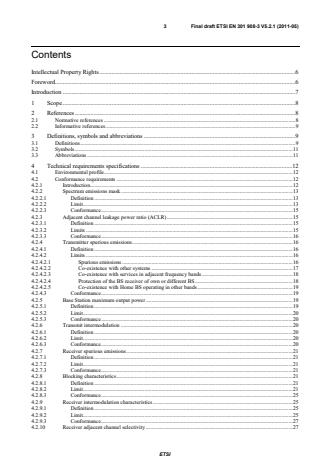
Contents
Intellectual Property Rights . 6
Foreword . 6
Introduction . 7
1 Scope . 8
2 References . 8
2.1 Normative references . 8
2.2 Informative references . 9
3 Definitions, symbols and abbreviations . 10
3.1 Definitions . 10
3.2 Symbols . 11
3.3 Abbreviations . 11
4 Technical requirements specifications . 12
4.1 Environmental profile . 12
4.2 Conformance requirements . 12
4.2.1 Introduction. 12
4.2.2 Spectrum emissions mask . 13
4.2.2.1 Definition . 13
4.2.2.2 Limit . 14
4.2.2.3 Conformance . 15
4.2.3 Adjacent channel leakage power ratio (ACLR) . 15
4.2.3.1 Definition . 15
4.2.3.2 Limits . 16
4.2.3.3 Conformance . 16
4.2.4 Transmitter spurious emis sions . 16
4.2.4.1 Definition . 16
4.2.4.2 Limits . 17
4.2.4.2.1 Spurious emissions . 17
4.2.4.2.2 Co-existence with other systems . 17
4.2.4.2.3 Co-existence with services in adjacent frequency bands . 18
4.2.4.2.4 Protection of the BS receiver of own or different BS . 19
4.2.4.2.5 Co-existence with Home BS operating in other bands . 19
4.2.4.3 Conformance . 20
4.2.5 Base Station maximum output power . 20
4.2.5.1 Definition . 20
4.2.5.2 Limit . 20
4.2.5.3 Conformance . 20
4.2.6 Transmit intermodulation . 20
4.2.6.1 Definition . 20
4.2.6.2 Limit . 21
4.2.6.3 Conformance . 21
4.2.7 Receiver spurious emissions . 21
4.2.7.1 Definition . 21
4.2.7.2 Limit . 21
4.2.7.3 Conformance . 21
4.2.8 Blocking characteristics . 22
4.2.8.1 Definition . 22
4.2.8.2 Limit . 22
4.2.8.3 Conformance . 26
4.2.9 Receiver intermodulation characteristics . 26
4.2.9.1 Definition . 26
4.2.9.2 Limit . 26
4.2.9.3 Conformance . 28
4.2.10 Receiver adjacent channel selectivity . 28
ETSI
4 Draft ETSI EN 301 908-3 V5.1.1 (2010-10)
4.2.10.1 Definition . 28
4.2.10.2 Limit . 28
4.2.10.3 Conformance . 29
4.2.11 Home BS output power for adjacent channel protection . 29
4.2.11.1 Definition . 29
4.2.11.2 Limit . 29
4.2.11.3 Conformance . 30
5 Testing for compliance with technical requirements . 30
5.1 Environmental conditions for testing . 30
5.2 Interpretation of the measurement results . 30
5.3 Essential radio test suites . 31
5.3.1 Spectrum emission mask . 31
5.3.1.1 Initial conditions . 32
5.3.1.2 Procedures . 32
5.3.2 Adjacent Channel Leakage power Ratio (ACLR) . 32
5.3.2.1 Initial conditions . 32
5.3.2.2 Procedure . 32
5.3.3 Transmitter spurious emis sions . 33
5.3.3.1 Initial conditions . 33
5.3.3.2 Procedure . 33
5.3.4 Base Station maximum output power . 33
5.3.4.1 Initial conditions . 33
5.3.4.2 Procedure . 33
5.3.5 Transmit intermodulation . 34
5.3.5.1 Initial conditions . 34
5.3.5.2 Procedures . 34
5.3.6 Receiver spurious emissions . 34
5.3.6.1 Initial conditions . 34
5.3.6.2 Procedure . 35
5.3.7 Blocking characteristics . 35
5.3.7.1 Initial conditions . 35
5.3.7.2 Procedure . 35
5.3.8 Receiver intermodulation characteristics . 36
5.3.8.1 Initial conditions . 36
5.3.8.2 Procedures . 36
5.3.9 Adjacent Channel Selectivity (ACS) . 36
5.3.9.1 Initial conditions . 36
5.3.9.2 Procedure . 37
5.3.10 Home BS output power for adjacent channel protection . 37
5.3.10.1 Initial conditions . 37
5.3.10.2 Procedure . 37
Annex A (normative): HS Requirements and conformance Test specifications Table
(HS-RTT) . 38
Annex B (normative): Base Station configurations . 40
B.1 Receiver diversity . 40
B.2 Duplexers . 40
B.3 Power supply options . 40
B.4 Ancillary RF amplifiers . 41
B.5 BS using antenna arrays . 41
B.5.1 Receiver tests . 42
B.5.2 Transmitter tests . 42
B.6 Transmit diversity and MIMO transmission . 42
B.7 BS with integrated Iuant BS modem . 43
Annex C (informative): Environmental profile specification . 44
ETSI
5 Draft ETSI EN 301 908-3 V5.1.1 (2010-10)
Annex D (informative): The EN title in the official languages . 45
Annex E (informative): Bibliography . 46
History . 47
ETSI
6 Draft ETSI EN 301 908-3 V5.1.1 (2010-10)
Intellectual Property Rights
IPRs essential or potentially essential to the present document may have been declared to ETSI. The information
pertaining to these essential IPRs, if any, is publicly available for ETSI members and non-members, and can be found
in ETSI SR 000 314: "Intellectual Property Rights (IPRs); Essential, or potentially Essential, IPRs notified to ETSI in
respect of ETSI standards", which is available from the ETSI Secretariat. Latest updates are available on the ETSI Web
server (http://webapp.etsi.org/IPR/home.asp).
Pursuant to the ETSI IPR Policy, no investigation, including IPR searches, has been carried out by ETSI. No guarantee
can be given as to the existence of other IPRs not referenced in ETSI SR 000 314 (or the updates on the ETSI Web
server) which are, or may be, or may become, essential to the present document.
Foreword
This Harmonized European Standard (Telecommunications series) has been produced by ETSI Technical Committee
Mobile Standards Group (MSG), and is now submitted for the Public Enquiry phase of the ETSI standards Two-step
Approval Procedure.
The present document has been produced by ETSI in response to mandate M/284 from the European Commission
issued under Council Directive 98/34/EC [i.1] (as amended) laying down a procedure for the provision of information
in the field of technical standards and regulations.
The present document is intended to become a Harmonized Standard, the reference of which will be published in the
Official Journal of the European Union referencing the Directive 1999/5/EC [i.2] of the European Parliament and of the
Council of 9 March 1999 on radio equipment and telecommunications terminal equipment and the mutual recognition
of their conformity ("the R&TTE Directive").
The requirements relevant to Directive 1999/5/EC [i.2] are summarised in annex A.
The present document is part 3 of a multi-part deliverable covering the Base Stations (BS), Repeaters and User
Equipment (UE) for IMT-2000 Third-Generation cellular networks, as identified below:
Part 1: "Harmonized EN for IMT-2000, introduction and common requirements, covering the essential
requirements of article 3.2 of the R&TTE Directive";
Part 2: "Harmonized EN for IMT-2000, CDMA Direct Spread (UTRA FDD and E-UTRA FDD) (UE) covering
the essential requirements of article 3.2 of the R&TTE Directive";
Part 3: "Harmonized EN for IMT-2000, CDMA Direct Spread (UTRA FDD and E-UTRA FDD) (BS)
covering the essential requirements of article 3.2 of the R&TTE Directive";
Part 4: "Harmonized EN for IMT-2000, CDMA Multi-Carrier (cdma2000) and Evolved CDMA Multi-Carrier
Ultra Mobile Broadband (UMB) (UE) covering the essential requirements of article 3.2 of the R&TTE
Directive";
Part 5: "Harmonized EN for IMT-2000, CDMA Multi-Carrier (cdma2000) and Evolved CDMA Multi-Carrier
Ultra Mobile Broadband (UMB) (BS) covering the essential requirements of article 3.2 of the R&TTE
Directive";
Part 6: "Harmonized EN for IMT-2000, CDMA TDD (UTRA TDD and E-UTRA TDD) (UE) covering the
essential requirements of article 3.2 of the R&TTE Directive";
Part 7: "Harmonized EN for IMT-2000, CDMA TDD (UTRA TDD and E-UTRA TDD) (BS) covering the
essential requirements of article 3.2 of the R&TTE Directive";
Part 8: "Harmonized EN for IMT-2000, TDMA Single-Carrier (UWC 136) (UE) covering essential requirements
of article 3.2 of the R&TTE Directive";
Part 9: "Harmonized EN for IMT-2000, TDMA Single-Carrier (UWC 136) (BS) covering essential requirements
of article 3.2 of the R&TTE Directive";
ETSI
7 Draft ETSI EN 301 908-3 V5.1.1 (2010-10)
Part 10: "Harmonized EN for IMT-2000, FDMA/TDMA (DECT) covering essential requirements of article 3.2 of
the R&TTE Directive";
Part 11: "Harmonized EN for IMT-2000, CDMA Direct Spread (UTRA FDD and E-UTRA FDD) (Repeaters)
covering the essential requirements of article 3.2 of the R&TTE Directive";
Part 12: "Harmonized EN for IMT-2000, CDMA Multi-Carrier (cdma2000) (Repeaters) covering the essential
requirements of article 3.2 of the R&TTE Directive";
Part 13: "Harmonized EN for IMT-2000, Evolved Universal Terrestrial Radio Access (E-UTRA) (UE) covering
the essential requirements of article 3.2 of the R&TTE Directive";
Part 14: "Harmonized EN for IMT-2000, Evolved Universal Terrestrial Radio Access (E-UTRA) (BS) covering
the essential requirements of article 3.2 of the R&TTE Directive";
Part 15: "Harmonized EN for IMT-2000, Evolved Universal Terrestrial Radio Access (E-UTRA) (FDD
Repeaters) covering the essential requirements of article 3.2 of the R&TTE Directive";
Part 16: "Harmonized EN for IMT-2000, Evolved CDMA Multi-Carrier Ultra Mobile Broadband (UMB) (UE)
covering the essential requirements of article 3.2 of the R&TTE Directive";
Part 17: "Harmonized EN for IMT-2000, Evolved CDMA Multi-Carrier Ultra Mobile Broadband (UMB) (BS)
covering the essential requirements of article 3.2 of the R&TTE Directive";
Part 18: "Harmonized EN for Multi-Standard Radio (UTRA, E-UTRA, GSM/EDGE) Base Stations (BS) covering
the essential requirements of article 3.2 of the R&TTE Directive";
Part 19: "Harmonized EN for IMT-2000 OFDMA TDD WMAN (Mobile WiMAX) TDD User Equipment (UE)
covering the essential requirements of article 3.2 of the R&TTE Directive";
Part 20: "Harmonized EN for IMT-2000, OFDMA TDD WMAN (Mobile WiMAX) TDD Base Station (BS)
covering the essential requirements of article 3.2 of the R&TTE Directive";
Part 21: "Harmonized EN for IMT-2000, OFDMA TDD WMAN (Mobile WiMAX) FDD User Equipment (UE)
covering the essential requirements of article 3.2 of the R&TTE Directive";
Part 22: "Harmonized EN for IMT-2000, OFDMA TDD WMAN (Mobile WiMAX) FDD Base Stations (BS)
covering the essential requirements of article 3.2 of the R&TTE Directive".
Proposed national transposition dates
Date of latest announcement of this EN (doa): 3 months after ETSI publication
Date of latest publication of new National Standard
or endorsement of this EN (dop/e): 6 months after doa
Date of withdrawal of any conflicting National Standard (dow): 18 months after doa
Introduction
The present document is part of a set of standards developed by ETSI and is designed to fit in a modular structure to
cover all radio and telecommunications terminal equipment within the scope of the R&TTE Directive [i.2]. The
modular structure is shown in EG 201 399 [i.3].
ETSI
8 Draft ETSI EN 301 908-3 V5.1.1 (2010-10)
1 Scope
The present document applies to the following radio equipment type:
• Base Stations for IMT-2000 CDMA Direct Spread (UTRA FDD and E-UTRA FDD).
This radio equipment type is capable of operating in all or any part of the frequency bands given in table 1-1.
Table 1-1: UTRA FDD Base Station operating bands
UTRA FDD Direction of transmission UTRA FDD Base Station operating bands
band
I Transmit 2 110 MHz to 2 170 MHz
Receive 1 920 MHz to 1 980 MHz
III Transmit 1 805 MHz to 1 880 MHz
Receive 1 710 MHz to 1 785 MHz
VII Transmit 2 620 MHz to 2 690 MHz
Receive 2 500 MHz to 2 570 MHz
VIII Transmit 925 MHz to 960 MHz
Receive 880 MHz to 915 MHz
XV Transmit 2 600 MHz to 2 620 MHz
Receive 1 900 MHz to 1 920 MHz
XVI Transmit 2 585 MHz to 2 600 MHz
Receive 2 010 MHz to 2 025 MHz
XX Transmit 791 MHz to 821 MHz
Receive 832 MHz to 862 MHz
The present document covers requirements for UTRA FDD Base Stations for Releases 99, 4, 5, 6, 7, 8 and 9 and
E-UTRA FDD Base Stations for Release 8 and 9. In addition, the present document covers requirements for UTRA
FDD Base Stations in the operating bands specified in TS 102 735 [i.4].
The present document is intended to cover the provisions of Directive 1999/5/EC [i.2] (R&TTE Directive), article 3.2,
which states that "… radio equipment shall be so constructed that it effectively uses the spectrum allocated to
terrestrial/space radio communications and orbital resources so as to avoid harmful interference".
In addition to the present document, other ENs that specify technical requirements in respect of essential requirements
under other parts of article 3 of the R&TTE Directive [i.2] may apply to equipment within the scope of the present
document.
NOTE: A list of such ENs is included on the web site http://www.newapproach.org/.
2 References
References are either specific (identified by date of publication and/or edition number or version number) or
non-specific. For specific references, only the cited version applies. For non-specific references, the latest version of the
reference document (including any amendments) applies.
Referenced documents which are not found to be publicly available in the expected location might be found at
http://docbox.etsi.org/Reference.
NOTE: While any hyperlinks included in this clause were valid at the time of publication ETSI cannot guarantee
their long term validity.
2.1 Normative references
The following referenced documents are necessary for the application of the present document.
[1] Void.
ETSI
9 Draft ETSI EN 301 908-3 V5.1.1 (2010-10)
[2] ETSI TS 125 141 (V9.5.0): "Universal Mobile Telecommunications System (UMTS); Base
Station (BS) conformance testing (FDD) (3GPP TS 25.141 version 9.5.0 Release 9)".
[3] ITU-R Recommendation SM.329-10 (2003): "Unwanted emissions in the spurious domain".
[4] ITU-T Recommendation O.153 (1992): "Basic parameters for the measurement of error
performance at bit rates below the primary rate".
[5] ETSI EN 301 908-1 (V5.1.1): "Electromagnetic compatibility and Radio spectrum Matters (ERM);
Base Stations (BS), Repeaters and User Equipment (UE) for IMT-2000 Third-Generation cellular
networks; Part 1: Harmonized EN for IMT-2000, introduction and common requirements,
covering the essential requirements of article 3.2 of the R&TTE Directive".
[6] ETSI TS 145 004 (V9.1.0): "Digital cellular telecommunications system (Phase 2+); Modulation
(3GPP TS 45.004 version 9.1.0 Release 9)".
[7] ETSI EN 301 908-14 (V5.1.1): "Electromagnetic compatibility and Radio spectrum Matters
(ERM); Base Stations (BS), Repeaters and User Equipment (UE) for IMT-2000 Third-Generation
cellular networks; Part 14: Harmonized EN for IMT-2000, Evolved Universal Terrestrial Radio
Access (E-UTRA) (BS) covering the essential requirements of article 3.2 of the R&TTE
Directive".
[8] ETSI EN 301 908-18 (V5.1.1): "Base Stations (BS), Repeaters and User Equipment (UE) for IMT-
2000 Third-Generation cellular networks; Part 18: Harmonized EN for E-UTRA, UTRA and
GSM/EDGE Multi-Standard Radio (MSR) Base Station (BS) covering the essential requirements
of article 3.2 of the R&TTE Directive".
[9] ETSI TS 125 104 (V9.5.0): "Universal Mobile Telecommunications System (UMTS); Base
Station (BS) radio transmission and reception (FDD) (3GPP TS 25.104 version 9.5.0 Release 9)".
2.2 Informative references
The following referenced documents are not necessary for the application of the present document but they assist the
user with regard to a particular subject area.
[i.1] Directive 98/34/EC of the European Parliament and of the Council of 22 June 1998 laying down a
procedure for the provision of information in the field of technical standards and regulations.
[i.2] Directive 1999/5/EC of the European Parliament and of the Council of 9 March 1999 on radio
equipment and telecommunications terminal equipment and the mutual recognition of their
conformity (R&TTE Directive).
[i.3] ETSI EG 201 399 (V2.2.1): "Electromagnetic compatibility and Radio spectrum Matters (ERM);
A guide to the production of Harmonized Standards for application under the R&TTE Directive".
[i.4] ETSI TS 102 735 (V7.1.0): "Universal Mobile Telecommunications System (UMTS);
Band-specific requirements for UMTS Frequency Division Duplex (FDD) operation in the bands
1 900 MHz to 1 920 MHz paired with 2 600 MHz to 2 620 MHz and 2 010 MHz to 2 025 MHz
paired with 2 585 MHz to 2 600 MHz".
[i.5] ETSI TR 102 215 (V1.3.1): "Electromagnetic compatibility and Radio spectrum Matters (ERM);
Recommended approach, and possible limits for measurement uncertainty for the measurement of
radiated electromagnetic fields above 1 GHz".
[i.6] ETSI TR 100 028 (all parts) (V1.4.1): "Electromagnetic compatibility and Radio spectrum Matters
(ERM); Uncertainties in the measurement of mobile radio equipment characteristics".
ETSI
10 Draft ETSI EN 301 908-3 V5.1.1 (2010-10)
3 Definitions, symbols and abbreviations
3.1 Definitions
For the purposes of the present document, the following terms and definitions apply:
ancillary equipment: equipment (apparatus) used in connection with a Base Station
NOTE: This is considered as an ancillary equipment (apparatus) if:
� the equipment is intended for use in conjunction with a BS to provide additional operational and/or
control features to the radio equipment, (e.g. to extend control to another position or location);
� the equipment cannot be used on a stand alone basis to provide user functions independently of a
BS; and
� the BS to which it is connected, is capable of providing some intended operation such as
transmitting and/or receiving without the ancillary equipment (i.e. it is not a sub-unit of the main
equipment essential to the main equipment basic functions).
Base Station class: wide area Base Station, medium range Base Station, local area Base Station or home Base Station,
as declared by the manufacturer
chip rate: rate of "chips" (modulated symbols after spreading) per second
NOTE: The UTRA FDD chip rate is 3,84 Mchip/s.
downlink operating band: part of the operating band designated for downlink (BS transmit)
environmental profile: range of environmental conditions under which equipment, within the scope of the present
document, is required to comply with the provisions of the present document
home Base Station: Base Stations characterized by requirements derived from femtocell scenarios
local area Base Station: Base Stations characterized by requirements derived from picocell scenarios with a BS to UE
minimum coupling loss equal to 45 dB
maximum output power: mean power level per carrier of the Base Station measured at the antenna connector in a
specified reference condition
mean power: power (transmitted or received) in a bandwidth of at least (1 + α) times the chip rate of the radio access
mod, when applied to a WCDMA-modulated signal. The period of measurement shall be at least one timeslot unless
otherwise stated
NOTE: α = 0,22 is the roll-off factor of the WCDMA signal.
medium range Base Station: Base Stations characterized by requirements derived from microcell scenarios with a BS
to UE minimum coupling loss equal to 53 dB
operating band: frequency range that is defined with a specific set of technical requirements, in which UTRA FDD
operates
NOTE: The operating band(s) for a UTRA FDD BS is declared by the manufacturer according to the designations
in table 1-1. Operating bands for UTRA are designated with Roman numerals, while the corresponding
operating bands for E-UTRA are designated with Arabic numerals.
output power: mean power of one carrier of the Base Station, delivered to a load with resistance equal to the nominal
load impedance of the transmitter
rated output power: rated output power of the Base Station is the mean power level per carrier that the manufacturer
has declared to be available at the antenna connector
ETSI
11 Draft ETSI EN 301 908-3 V5.1.1 (2010-10)
RRC filtered mean power: mean power as measured through a root raised cosine filter with roll-off factor α and a
bandwidth equal to the chip rate of the radio access mode
NOTE: The RRC filtered mean power of a perfectly modulated WCDMA signal is 0,246 dB lower than the mean
power of the same signal.
uplink operating band: part of the operating band designated for uplink (BS receive)
wide area Base Station: Base Stations characterized by requirements derived from Macro Cell scenarios with a BS to
UE minimum coupling loss equal to 70 dB
NOTE: This Base Station class has the same requirements as the general purpose Base Station in Releases 99,
4 and 5.
3.2 Symbols
For the purposes of the present document, the following symbols apply:
Δf Separation between the carrier centre frequency and the nominal -3 dB point of the measuring
filter closest to the carrier frequency
Δf The largest value of Δf used for defining the requirement
max
CPICH Êc Common Pilot Channel code power (on the adjacent channel)
F Filter centre frequency
filter
F The highest BS transmit frequency of the downlink operating band
high
F The lowest BS transmit frequency of the downlink operating band
low
F Frequency of unwanted signal
uw
Ioh Total received power density excluding own Home BS signal
P Declared emission level for channel N
EM,N
P Maximum output power
max
3.3 Abbreviations
For the purposes of the present document, the following abbreviations apply:
ACLR Adjacent Channel Leakage power Ratio
ACS Adjacent Channel Selectivity
ATT Attenuator
AWGN Additive White Gaussian Noise
B appropriate frequency in the Bottom of the operating band of the BS
BER Bit Error Ratio
BS Base Station
BSS Base Station Subsystem
BTS Base Transceiver Station
CDMA Code Division Multiple Access
CPICH Common Pilot Channel
CW Continuous Wave
DC Direct Current
DC-HSUPA Dual Cell HSUPA
DTT Digital Terrestrial Television
DUT Device Under Test
EMC ElectroMagnetic Compatibility
EUT Equipment Under Test
FDD Frequency Division Duplexing
GMSK Gaussian Minimum Shift Keying
GSM Global System for Mobile communications
HSUPA High Speed Uplink Packet Access
IMT-2000 International Mobile Telecommunications 2000
M appropriate frequency in the Middle of the operating band of the BS
MIMO Multiple Input Multiple Output
MS Mobile Station
ETSI
12 Draft ETSI EN 301 908-3 V5.1.1 (2010-10)
PCCPCH Primary Common Control Physical CHannel
R&TTE Radio and Telecommunications Terminal Equipment
RF Radio Frequency
RMS Root Mean Square
RRC Root-Raised Cosine
Rx Receiver
SCCPCH Secondary Common Control Physical CHannel
T appropriate frequency in the Top of the operating band of the BS
TDD Time Division Duplexing
Tx Transmitter
UARFCN UTRA Absolute Radio Frequency Channel Number
UE User Equipment
UL Up Link (reverse link)
UMTS Universal Mobile Telecommunications System
UTRA Universal Terrestrial Radio Access
WCDMA Wideband Code Division Multiple Access
4 Technical requirements specifications
4.1 Environmental profile
The technical requirements of the present document apply under the environmental profile for operation of the
equipment, which shall be declared by the supplier. The equipment shall comply with all the technical requirements of
the present document at all times when operating within the boundary limits of the declared operational environmental
profile.
For guidance on how a supplier can declare the environmental profile, see annex C.
4.2 Conformance requirements
The requirements in the present document are based on the assumption that the operating band (see table 1-1) is shared
between systems of the IMT-2000 family (for band III and VIII also GSM) or systems having compatible
characteristics. Requirements for E-UTRA FDD Base Stations are given in EN 301 908-14 [7].
4.2.1 Introduction
To meet the essential requirement under article 3.2 of Directive 1999/5/EC [i.2] (R&TTE Directive) for IMT-2000 Base
Stations (BS), seven essential parameters in addition to those in EN 301 908-1 [5] have been identified. Table 4.2.1-1
provides a cross reference between these seven essential parameters and the corresponding ten technical requirements
for equipment within the scope of the present document.
Table 4.2.1-1: Cross references
Essential parameter Corresponding technical requirements
Spectrum emissions mask 4.2.2 Spectrum emissions mask
4.2.3 Adjacent Channel Leakage power Ratio (ACLR)
4.2.11 Home BS output power for adjacent channel
protection
Conducted spurious emissions from the transmitter 4.2.4 Transmitter spurious emissions
antenna connector
Accuracy of maximum output power 4.2.5 Base Station maximum output power
Intermodulation attenuation of the transmitter 4.2.6 Transmit intermodulation
Conducted spurious emissions from the receiver 4.2.7 Receiver spurious emissions
antenna connector
Impact of interference on receiver performance 4.2.8 Blocking characteristics
4.2.9 Receiver intermodulation characteristics
Receiver adjacent channel selectivity 4.2.10 Receiver Adjacent Channel Selectivity (ACS)
ETSI
13 Draft ETSI EN 301 908-3 V5.1.1 (2010-10)
The supplier shall declare the Base Station class and operating band(s) for the Base Station. The technical requirements
in the present document apply for Base Stations supporting UTRA FDD, for the declared Base Station class and
operating band(s) as outlined for each requirement. For a Base Station supporting more than one operating band,
conformance testing for each technical requirement in clause 5 shall be performed for each operating band. Base
Stations supporting E-UTRA FDD shall fulfil requirements in EN 301 908-14 [7].
The technical requirements also apply to the BS configurations described in annex B.
For an UTRA FDD Wide Area BS additionally conforming to EN 301 908-18 [8], conformance with the technical
requirements listed in table 4.2.1-1 can equally be demonstrated through the corresponding technical requirements and
test suites in EN 301 908-18 [8], as listed in table 4.2.1-2.
When conformance is demonstrated through the test suites in EN 301 908-18 [8] for these technical requirements, the
corresponding test suites in the present document need not be performed.
Table 4.2.1-2: Alternative technical requirements and test suites in EN 301 908-18 [8] that can equally
be used for demonstrating conformance for UTRA FDD Wide Area BS
Technical requirement in Corresponding technical requirements Corresponding test suites
the present document in EN 301 908-18 [8] in EN 301 908-18 [8]
4.2.2 Spectrum emissions mask 4.2.2 Operating band unwanted 5.3.1 Operating band unwanted
emissions emissions
4.2.3 Adjacent Channel Leakage See note See note
power Ratio (ACLR)
4.2.4 Transmitter spurious 4.2.4 Transmitter spurious emissions 5.3.3 Transmitter spurious
emissions emissions
4.2.5 Base Station maximum output 4.2.5 Base station maximum output 5.3.4 Base station maximum output
power power power
4.2.6 Transmit intermodulation 4.2.6 Transmit intermodulation 5.3.5 Transmit intermodulation
4.2.7 Receiver spurious emissions 4.2.7 Receiver spurious emissions 5.3.6 Receiver spurious emissions
4.2.8 Blocking characteristics 4.2.8 In-band blocking 5.3.7 In-band blocking
4.2.9 Out-of-band blocking 5.3.8 Out-of-band blocking
4.2.9 Receiver intermodulation 4.2.10 Receiver intermodulation 5.3.9 Receiver intermodulation
characteristics characteristics characteristics
4.2.10 Receiver adjacent channel 4.2.11 Narrowband blocking 5.3.10 Narrowband blocking
selectivity
NOTE: Conformance with the UTRA ACLR requirement is for an MSR BS demonstrated through the requirement in
clause 4.2.3 of the present document and the corresponding test suite in clause 5.3.2.
For ACS, blocking and intermodulation characteristics, the negative offsets of the interfering signal apply relative to the
assigned channel frequency of the lowest carrier frequency received and positive offsets of the interfering signal apply
relative to the assigned channel frequency of the highest carrier frequency received.
A BS supporting DC-HSUPA receives two cells simultaneously on adjacent carrier frequencies.
For a BS declared to support Band XX, the manufacturer shall additionally declare the following quantities associated
with the applicable test conditions of table 4.2.2.2-7 and information in annex G of TS 125 104 [9]:
P Declared emission level for channel N.
EM,N
P Maximum output Power in 10 MHz.
10MHz
4.2.2 Spectrum emissions mask
For a UTRA FDD Wide Area BS additionally conforming to EN 301 908-18 [8], either the requirement of the present
clause or the Operating band unwanted emissions requirement in clause 4.2.2 of EN 301 908-18 [8] can be equally
applied, as list
...
Harmonized European Standard
IMT cellular networks;
Harmonized EN covering the essential requirements
of article 3.2 of the R&TTE Directive;
Part 3: CDMA Direct Spread (UTRA FDD) Base Stations (BS)
2 ETSI EN 301 908-3 V5.2.1 (2011-07)
Reference
REN/MSG-TFES-006-3
Keywords
3G, 3GPP, cellular, digital, IMT-2000, mobile,
radio, regulation, UMTS, UTRA, WCDMA
ETSI
650 Route des Lucioles
F-06921 Sophia Antipolis Cedex - FRANCE
Tel.: +33 4 92 94 42 00 Fax: +33 4 93 65 47 16
Siret N° 348 623 562 00017 - NAF 742 C
Association à but non lucratif enregistrée à la
Sous-Préfecture de Grasse (06) N° 7803/88
Important notice
Individual copies of the present document can be downloaded from:
http://www.etsi.org
The present document may be made available in more than one electronic version or in print. In any case of existing or
perceived difference in contents between such versions, the reference version is the Portable Document Format (PDF).
In case of dispute, the reference shall be the printing on ETSI printers of the PDF version kept on a specific network drive
within ETSI Secretariat.
Users of the present document should be aware that the document may be subject to revision or change of status.
Information on the current status of this and other ETSI documents is available at
http://portal.etsi.org/tb/status/status.asp
If you find errors in the present document, please send your comment to one of the following services:
http://portal.etsi.org/chaircor/ETSI_support.asp
Copyright Notification
No part may be reproduced except as authorized by written permission.
The copyright and the foregoing restriction extend to reproduction in all media.
© European Telecommunications Standards Institute 2011.
All rights reserved.
TM TM TM
DECT , PLUGTESTS , UMTS and the ETSI logo are Trade Marks of ETSI registered for the benefit of its Members.
TM
3GPP and LTE™ are Trade Marks of ETSI registered for the benefit of its Members and
of the 3GPP Organizational Partners.
GSM® and the GSM logo are Trade Marks registered and owned by the GSM Association.
ETSI
3 ETSI EN 301 908-3 V5.2.1 (2011-07)
Contents
Intellectual Property Rights . 6
Foreword . 6
Introduction . 7
1 Scope . 8
2 References . 8
2.1 Normative references . 8
2.2 Informative references . 9
3 Definitions, symbols and abbreviations . 9
3.1 Definitions . 9
3.2 Symbols . 11
3.3 Abbreviations . 11
4 Technical requirements specifications . 12
4.1 Environmental profile . 12
4.2 Conformance requirements . 12
4.2.1 Introduction. 12
4.2.2 Spectrum emissions mask . 13
4.2.2.1 Definition . 13
4.2.2.2 Limit . 13
4.2.2.3 Conformance . 15
4.2.3 Adjacent channel leakage power ratio (ACLR) . 15
4.2.3.1 Definition . 15
4.2.3.2 Limits . 15
4.2.3.3 Conformance . 16
4.2.4 Transmitter spurious emis sions . 16
4.2.4.1 Definition . 16
4.2.4.2 Limits . 16
4.2.4.2.1 Spurious emissions . 16
4.2.4.2.2 Co-existence with other systems . 17
4.2.4.2.3 Co-existence with services in adjacent frequency bands . 18
4.2.4.2.4 Protection of the BS receiver of own or different BS . 18
4.2.4.2.5 Co-existence with Home BS operating in other bands . 19
4.2.4.3 Conformance . 19
4.2.5 Base Station maximum output power . 19
4.2.5.1 Definition . 19
4.2.5.2 Limit . 20
4.2.5.3 Conformance . 20
4.2.6 Transmit intermodulation . 20
4.2.6.1 Definition . 20
4.2.6.2 Limit . 20
4.2.6.3 Conformance . 20
4.2.7 Receiver spurious emissions . 21
4.2.7.1 Definition . 21
4.2.7.2 Limit . 21
4.2.7.3 Conformance . 21
4.2.8 Blocking characteristics . 21
4.2.8.1 Definition . 21
4.2.8.2 Limit . 21
4.2.8.3 Conformance . 25
4.2.9 Receiver intermodulation characteristics . 25
4.2.9.1 Definition . 25
4.2.9.2 Limit . 25
4.2.9.3 Conformance . 27
4.2.10 Receiver adjacent channel selectivity . 27
ETSI
4 ETSI EN 301 908-3 V5.2.1 (2011-07)
4.2.10.1 Definition . 27
4.2.10.2 Limit . 27
4.2.10.3 Conformance . 28
4.2.11 Home BS output power for adjacent channel protection . 28
4.2.11.1 Definition . 28
4.2.11.2 Limit . 28
4.2.11.3 Conformance . 29
5 Testing for compliance with technical requirements . 29
5.1 Environmental conditions for testing . 29
5.2 Interpretation of the measurement results . 29
5.3 Essential radio test suites . 30
5.3.1 Spectrum emission mask . 30
5.3.1.1 Initial conditions . 31
5.3.1.2 Procedures . 31
5.3.2 Adjacent Channel Leakage power Ratio (ACLR) . 31
5.3.2.1 Initial conditions . 31
5.3.2.2 Procedure . 31
5.3.3 Transmitter spurious emis sions . 32
5.3.3.1 Initial conditions . 32
5.3.3.2 Procedure . 32
5.3.4 Base Station maximum output power . 32
5.3.4.1 Initial conditions . 32
5.3.4.2 Procedure . 32
5.3.5 Transmit intermodulation . 33
5.3.5.1 Initial conditions . 33
5.3.5.2 Procedures . 33
5.3.6 Receiver spurious emissions . 33
5.3.6.1 Initial conditions . 33
5.3.6.2 Procedure . 34
5.3.7 Blocking characteristics . 34
5.3.7.1 Initial conditions . 34
5.3.7.2 Procedure . 34
5.3.8 Receiver intermodulation characteristics . 35
5.3.8.1 Initial conditions . 35
5.3.8.2 Procedures . 35
5.3.9 Adjacent Channel Selectivity (ACS) . 35
5.3.9.1 Initial conditions . 35
5.3.9.2 Procedure . 36
5.3.10 Home BS output power for adjacent channel protection . 36
5.3.10.1 Initial conditions . 36
5.3.10.2 Procedure . 36
Annex A (normative): HS Requirements and conformance Test specifications Table
(HS-RTT) . 37
Annex B (normative): Base Station configurations . 39
B.1 Receiver diversity . 39
B.2 Duplexers . 39
B.3 Power supply options . 39
B.4 Ancillary RF amplifiers . 40
B.5 BS using antenna arrays . 40
B.5.1 Receiver tests . 41
B.5.2 Transmitter tests . 41
B.6 Transmit diversity and MIMO transmission . 41
B.7 BS with integrated Iuant BS modem . 42
Annex C (informative): Environmental profile specification . 43
ETSI
5 ETSI EN 301 908-3 V5.2.1 (2011-07)
Annex D (informative): The EN title in the official languages . 44
Annex E (informative): Bibliography . 45
History . 46
ETSI
6 ETSI EN 301 908-3 V5.2.1 (2011-07)
Intellectual Property Rights
IPRs essential or potentially essential to the present document may have been declared to ETSI. The information
pertaining to these essential IPRs, if any, is publicly available for ETSI members and non-members, and can be found
in ETSI SR 000 314: "Intellectual Property Rights (IPRs); Essential, or potentially Essential, IPRs notified to ETSI in
respect of ETSI standards", which is available from the ETSI Secretariat. Latest updates are available on the ETSI Web
server (http://ipr.etsi.org).
Pursuant to the ETSI IPR Policy, no investigation, including IPR searches, has been carried out by ETSI. No guarantee
can be given as to the existence of other IPRs not referenced in ETSI SR 000 314 (or the updates on the ETSI Web
server) which are, or may be, or may become, essential to the present document.
Foreword
This Harmonized European Standard (EN) has been produced by ETSI Technical Committee Mobile Standards Group
(MSG).
The present document has been produced by ETSI in response to mandate M/284 from the European Commission
issued under Council Directive 98/34/EC [i.1] (as amended) laying down a procedure for the provision of information
in the field of technical standards and regulations.
The title and reference to the present document are intended to included in the publication in the Official Journal of the
European Union of titles and references of Harmonized Standard under the Directive 1999/5/EC [i.2].
See article 5.1 of Directive 1999/5/EC [i.2] for information on presumption of conformity and Harmonised Standards or
parts thereof the references of which have been published in the Official Journal of the European Union.
The requirements relevant to Directive 1999/5/EC [i.2] are summarised in annex A.
The present document is part 3 of a multi-part deliverable covering the essential requirements under article 3.2 of
Directive 1999/5/EC [i.2] (R&TTE Directive) for Base Stations (BS), Repeaters and User Equipment (UE) for IMT
cellular networks, as identified below:
Part 1: "Introduction and common requirements";
Part 2: "CDMA Direct Spread (UTRA FDD) User Equipment (UE)";
Part 3: "CDMA Direct Spread (UTRA FDD) Base Stations (BS)";
Part 4: "CDMA Multi-Carrier (cdma2000) User Equipment (UE)";
Part 5: "CDMA Multi-Carrier (cdma2000) Base Stations (BS)";
Part 6: "CDMA TDD (UTRA TDD) User Equipment (UE)";
Part 7: "CDMA TDD (UTRA TDD) Base Stations (BS)";
Part 8: "Harmonized EN for IMT-2000, TDMA Single-Carrier (UWC 136) (UE) covering essential requirements
of article 3.2 of the R&TTE Directive";
Part 9: "Harmonized EN for IMT-2000, TDMA Single-Carrier (UWC 136) (BS) covering essential requirements
of article 3.2 of the R&TTE Directive";
Part 10: "Harmonized EN for IMT-2000, FDMA/TDMA (DECT) covering essential requirements of article 3.2 of
the R&TTE Directive";
Part 11: "CDMA Direct Spread (UTRA FDD) (Repeaters)";
Part 12: "Harmonized EN for IMT-2000, CDMA Multi-Carrier (cdma2000) (Repeaters) covering the essential
requirements of article 3.2 of the R&TTE Directive";
Part 13: "Evolved Universal Terrestrial Radio Access (E-UTRA) User Equipment (UE)";
ETSI
7 ETSI EN 301 908-3 V5.2.1 (2011-07)
Part 14: "Evolved Universal Terrestrial Radio Access (E-UTRA) Base Stations (BS)";
Part 15: "Evolved Universal Terrestrial Radio Access (E-UTRA FDD) (Repeaters)";
Part 16: "Harmonized EN for IMT-2000, Evolved CDMA Multi-Carrier Ultra Mobile Broadband (UMB) (UE)
covering the essential requirements of article 3.2 of the R&TTE Directive";
Part 17: "Harmonized EN for IMT-2000, Evolved CDMA Multi-Carrier Ultra Mobile Broadband (UMB) (BS)
covering the essential requirements of article 3.2 of the R&TTE Directive";
Part 18: "E-UTRA, UTRA and GSM/EDGE Multi-Standard Radio (MSR) Base Station (BS)";
Part 19: "OFDMA TDD WMAN (Mobile WiMAX) TDD User Equipment (UE)";
Part 20: "OFDMA TDD WMAN (Mobile WiMAX) TDD Base Stations (BS)";
Part 21: "OFDMA TDD WMAN (Mobile WiMAX) FDD User Equipment (UE)";
Part 22: "OFDMA TDD WMAN (Mobile WiMAX) FDD Base Stations (BS)".
National transposition dates
Date of adoption of this EN: 4 July 2011
Date of latest announcement of this EN (doa): 31 October 2011
Date of latest publication of new National Standard
or endorsement of this EN (dop/e): 30 April 2012
Date of withdrawal of any conflicting National Standard (dow): 30 April 2013
Introduction
The present document is part of a set of standards developed by ETSI and is designed to fit in a modular structure to
cover all radio and telecommunications terminal equipment within the scope of the R&TTE Directive [i.2]. The
modular structure is shown in EG 201 399 [i.3].
ETSI
8 ETSI EN 301 908-3 V5.2.1 (2011-07)
1 Scope
The present document applies to the following radio equipment type:
• Base Stations for IMT-2000 CDMA Direct Spread (UTRA FDD).
This radio equipment type is capable of operating in all or any part of the frequency bands given in table 1-1.
Table 1-1: UTRA FDD Base Station operating bands
UTRA FDD Direction of transmission UTRA FDD Base Station operating bands
band
I Transmit 2 110 MHz to 2 170 MHz
Receive 1 920 MHz to 1 980 MHz
III Transmit 1 805 MHz to 1 880 MHz
Receive 1 710 MHz to 1 785 MHz
VII Transmit 2 620 MHz to 2 690 MHz
Receive 2 500 MHz to 2 570 MHz
VIII Transmit 925 MHz to 960 MHz
Receive 880 MHz to 915 MHz
XV Transmit 2 600 MHz to 2 620 MHz
Receive 1 900 MHz to 1 920 MHz
XVI Transmit 2 585 MHz to 2 600 MHz
Receive 2 010 MHz to 2 025 MHz
XX Transmit 791 MHz to 821 MHz
Receive 832 MHz to 862 MHz
The present document covers requirements for UTRA FDD Base Stations for Releases 99, 4, 5, 6, 7, 8 and 9. In
addition, the present document covers requirements for UTRA FDD Base Stations in the operating bands specified in
TS 102 735 [i.4].
The present document is intended to cover the provisions of Directive 1999/5/EC [i.2] (R&TTE Directive), article 3.2,
which states that "… radio equipment shall be so constructed that it effectively uses the spectrum allocated to
terrestrial/space radio communications and orbital resources so as to avoid harmful interference".
In addition to the present document, other ENs that specify technical requirements in respect of essential requirements
under other parts of article 3 of the R&TTE Directive [i.2] may apply to equipment within the scope of the present
document.
NOTE: A list of such ENs is included on the web site http://www.newapproach.org/.
2 References
References are either specific (identified by date of publication and/or edition number or version number) or
non-specific. For specific references, only the cited version applies. For non-specific references, the latest version of the
reference document (including any amendments) applies.
Referenced documents which are not found to be publicly available in the expected location might be found at
http://docbox.etsi.org/Reference.
NOTE: While any hyperlinks included in this clause were valid at the time of publication ETSI cannot guarantee
their long term validity.
2.1 Normative references
The following referenced documents are necessary for the application of the present document.
[1] Void.
ETSI
9 ETSI EN 301 908-3 V5.2.1 (2011-07)
[2] ETSI TS 125 141 (V9.7.0): "Universal Mobile Telecommunications System (UMTS); Base
Station (BS) conformance testing (FDD) (3GPP TS 25.141 version 9.7.0 Release 9)".
[3] ITU-R Recommendation SM.329-11 (2011): "Unwanted emissions in the spurious domain".
[4] ITU-T Recommendation O.153 (1992): "Basic parameters for the measurement of error
performance at bit rates below the primary rate".
[5] ETSI EN 301 908-1 (V5.2.1): "IMT cellular networks; Harmonized EN covering the essential
requirements of article 3.2 of the R&TTE Directive; Part 1: Introduction and common
requirements".
[6] ETSI TS 145 004 (V9.1.0): "Digital cellular telecommunications system (Phase 2+); Modulation
(3GPP TS 45.004 version 9.1.0 Release 9)".
[7] Void.
[8] ETSI EN 301 908-18 (V5.2.1): "IMT cellular networks; Harmonized EN covering the essential
requirements of article 3.2 of the R&TTE Directive; Part 18: E-UTRA, UTRA and GSM/EDGE
Multi-Standard Radio (MSR) Base Station (BS)".
[9] ETSI TS 125 104 (V9.6.0): "Universal Mobile Telecommunications System (UMTS); Base
Station (BS) radio transmission and reception (FDD) (3GPP TS 25.104 version 9.6.0 Release 9)".
2.2 Informative references
The following referenced documents are not necessary for the application of the present document but they assist the
user with regard to a particular subject area.
[i.1] Directive 98/34/EC of the European Parliament and of the Council of 22 June 1998 laying down a
procedure for the provision of information in the field of technical standards and regulations.
[i.2] Directive 1999/5/EC of the European Parliament and of the Council of 9 March 1999 on radio
equipment and telecommunications terminal equipment and the mutual recognition of their
conformity (R&TTE Directive).
[i.3] ETSI EG 201 399 (V2.2.1): "Electromagnetic compatibility and Radio spectrum Matters (ERM);
A guide to the production of Harmonized Standards for application under the R&TTE Directive".
[i.4] ETSI TS 102 735 (V7.1.0): "Universal Mobile Telecommunications System (UMTS);
Band-specific requirements for UMTS Frequency Division Duplex (FDD) operation in the bands
1 900 MHz to 1 920 MHz paired with 2 600 MHz to 2 620 MHz and 2 010 MHz to 2 025 MHz
paired with 2 585 MHz to 2 600 MHz".
[i.5] ETSI TR 102 215 (V1.3.1): "Electromagnetic compatibility and Radio spectrum Matters (ERM);
Recommended approach, and possible limits for measurement uncertainty for the measurement of
radiated electromagnetic fields above 1 GHz".
[i.6] ETSI TR 100 028 (all parts) (V1.4.1): "Electromagnetic compatibility and Radio spectrum Matters
(ERM); Uncertainties in the measurement of mobile radio equipment characteristics".
3 Definitions, symbols and abbreviations
3.1 Definitions
For the purposes of the present document, the following terms and definitions apply:
ancillary equipment: equipment (apparatus) used in connection with a Base Station
ETSI
10 ETSI EN 301 908-3 V5.2.1 (2011-07)
NOTE: This is considered as an ancillary equipment (apparatus) if:
� the equipment is intended for use in conjunction with a BS to provide additional operational and/or
control features to the radio equipment, (e.g. to extend control to another position or location);
� the equipment cannot be used on a stand alone basis to provide user functions independently of a
BS; and
� the BS to which it is connected, is capable of providing some intended operation such as
transmitting and/or receiving without the ancillary equipment (i.e. it is not a sub-unit of the main
equipment essential to the main equipment basic functions).
Base Station class: wide area Base Station, medium range Base Station, local area Base Station or home Base Station,
as declared by the manufacturer
chip rate: rate of "chips" (modulated symbols after spreading) per second
NOTE: The UTRA FDD chip rate is 3,84 Mchip/s.
downlink operating band: part of the operating band designated for downlink (BS transmit)
environmental profile: range of environmental conditions under which equipment, within the scope of the present
document, is required to comply with the provisions of the present document
home Base Station: Base Stations characterized by requirements derived from femtocell scenarios
local area Base Station: Base Stations characterized by requirements derived from picocell scenarios with a BS to UE
minimum coupling loss equal to 45 dB
maximum output power: mean power level per carrier of the Base Station measured at the antenna connector in a
specified reference condition
mean power: power (transmitted or received) in a bandwidth of at least (1 + α) times the chip rate of the radio access
mod, when applied to a WCDMA-modulated signal. The period of measurement is at least one timeslot unless
otherwise stated
NOTE: α = 0,22 is the roll-off factor of the WCDMA signal.
medium range Base Station: Base Stations characterized by requirements derived from microcell scenarios with a BS
to UE minimum coupling loss equal to 53 dB
operating band: frequency range that is defined with a specific set of technical requirements, in which UTRA FDD
operates
NOTE: The operating band(s) for a UTRA FDD BS is declared by the manufacturer according to the designations
in table 1-1. Operating bands for UTRA are designated with Roman numerals, while the corresponding
operating bands for E-UTRA are designated with Arabic numerals.
output power: mean power of one carrier of the Base Station, delivered to a load with resistance equal to the nominal
load impedance of the transmitter
rated output power: rated output power of the Base Station is the mean power level per carrier that the manufacturer
has declared to be available at the antenna connector
RRC filtered mean power: mean power as measured through a root raised cosine filter with roll-off factor α and a
bandwidth equal to the chip rate of the radio access mode
NOTE: The RRC filtered mean power of a perfectly modulated WCDMA signal is 0,246 dB lower than the mean
power of the same signal.
uplink operating band: part of the operating band designated for uplink (BS receive)
wide area Base Station: Base Stations characterized by requirements derived from Macro Cell scenarios with a BS to
UE minimum coupling loss equal to 70 dB
NOTE: This Base Station class has the same requirements as the general purpose Base Station in Releases 99,
4 and 5.
ETSI
11 ETSI EN 301 908-3 V5.2.1 (2011-07)
3.2 Symbols
For the purposes of the present document, the following symbols apply:
Δf Separation between the carrier centre frequency and the nominal -3 dB point of the measuring
filter closest to the carrier frequency
Δf The largest value of Δf used for defining the requirement
max
CPICH Êc Common Pilot Channel code power (on the adjacent channel)
F Filter centre frequency
filter
F The highest BS transmit frequency of the downlink operating band
high
F The lowest BS transmit frequency of the downlink operating band
low
F Frequency of unwanted signal
uw
Ioh Total received power density excluding own Home BS signal
P Declared emission level for channel N
EM,N
P Maximum output power
max
3.3 Abbreviations
For the purposes of the present document, the following abbreviations apply:
ACLR Adjacent Channel Leakage power Ratio
ACS Adjacent Channel Selectivity
ATT Attenuator
AWGN Additive White Gaussian Noise
B appropriate frequency in the Bottom of the operating band of the BS
BER Bit Error Ratio
BS Base Station
BSS Base Station Subsystem
BTS Base Transceiver Station
CDMA Code Division Multiple Access
CPICH Common Pilot Channel
CW Continuous Wave
DC Direct Current
DC-HSUPA Dual Cell HSUPA
DTT Digital Terrestrial Television
DUT Device Under Test
EMC ElectroMagnetic Compatibility
EUT Equipment Under Test
FDD Frequency Division Duplexing
GMSK Gaussian Minimum Shift Keying
GSM Global System for Mobile communications
HSUPA High Speed Uplink Packet Access
IMT International Mobile Telecommunications
M appropriate frequency in the Middle of the operating band of the BS
MIMO Multiple Input Multiple Output
MS Mobile Station
PCCPCH Primary Common Control Physical CHannel
R&TTE Radio and Telecommunications Terminal Equipment
RF Radio Frequency
RMS Root Mean Square
RRC Root-Raised Cosine
Rx Receiver
SCCPCH Secondary Common Control Physical CHannel
T appropriate frequency in the Top of the operating band of the BS
TDD Time Division Duplexing
Tx Transmitter
UARFCN UTRA Absolute Radio Frequency Channel Number
UE User Equipment
UL Up Link (reverse link)
ETSI
12 ETSI EN 301 908-3 V5.2.1 (2011-07)
UMTS Universal Mobile Telecommunications System
UTRA Universal Terrestrial Radio Access
WCDMA Wideband Code Division Multiple Access
4 Technical requirements specifications
4.1 Environmental profile
The technical requirements of the present document apply under the environmental profile for operation of the
equipment, which shall be declared by the supplier. The equipment shall comply with all the technical requirements of
the present document at all times when operating within the boundary limits of the declared operational environmental
profile.
For guidance on how a supplier can declare the environmental profile, see annex C.
4.2 Conformance requirements
The requirements in the present document are based on the assumption that the operating band (see table 1-1) is shared
between systems of the IMT family (for band III and VIII also GSM) or systems having compatible characteristics.
4.2.1 Introduction
To meet the essential requirement under article 3.2 of Directive 1999/5/EC [i.2] (R&TTE Directive) for IMT Base
Stations (BS), seven essential parameters in addition to those in EN 301 908-1 [5] have been identified. Table 4.2.1-1
provides a cross reference between these seven essential parameters and the corresponding ten technical requirements
for equipment within the scope of the present document.
Table 4.2.1-1: Cross references
Essential parameter Corresponding technical requirements
Spectrum emissions mask 4.2.2 Spectrum emissions mask
4.2.3 Adjacent Channel Leakage power Ratio (ACLR)
4.2.11 Home BS output power for adjacent channel
protection
Conducted spurious emissions from the transmitter 4.2.4 Transmitter spurious emissions
antenna connector
Accuracy of maximum output power 4.2.5 Base Station maximum output power
Intermodulation attenuation of the transmitter 4.2.6 Transmit intermodulation
Conducted spurious emissions from the receiver 4.2.7 Receiver spurious emissions
antenna connector
Impact of interference on receiver performance 4.2.8 Blocking characteristics
4.2.9 Receiver intermodulation characteristics
Receiver adjacent channel selectivity 4.2.10 Receiver Adjacent Channel Selectivity (ACS)
The supplier shall declare the Base Station class and operating band(s) for the Base Station. The technical requirements
in the present document apply for Base Stations supporting UTRA FDD, for the declared Base Station class and
operating band(s) as outlined for each requirement. For a Base Station supporting more than one operating band,
conformance testing for each technical requirement in clause 5 shall be performed for each operating band.
The technical requirements also apply to the BS configurations described in annex B.
For an UTRA FDD Wide Area BS additionally conforming to EN 301 908-18 [8], conformance with the technical
requirements listed in table 4.2.1-1 can equally be demonstrated through the corresponding technical requirements and
test suites in EN 301 908-18 [8], as listed in table 4.2.1-2.
When conformance is demonstrated through the test suites in EN 301 908-18 [8] for these technical requirements, the
corresponding test suites in the present document need not be performed.
ETSI
13 ETSI EN 301 908-3 V5.2.1 (2011-07)
Table 4.2.1-2: Alternative technical requirements and test suites in EN 301 908-18 [8] that can equally
be used for demonstrating conformance for UTRA FDD Wide Area BS
Technical requirement in Corresponding technical requirements Corresponding test suites
the present document in EN 301 908-18 [8] in EN 301 908-18 [8]
4.2.2 Spectrum emissions mask 4.2.2 Operating band unwanted 5.3.1 Operating band unwanted
emissions emissions
4.2.3 Adjacent Channel Leakage See note See note
power Ratio (ACLR)
4.2.4 Transmitter spurious 4.2.4 Transmitter spurious emissions 5.3.3 Transmitter spurious
emissions emissions
4.2.5 Base Station maximum output 4.2.5 Base station maximum output 5.3.4 Base station maximum output
power power power
4.2.6 Transmit intermodulation 4.2.6 Transmit intermodulation 5.3.5 Transmit intermodulation
4.2.7 Receiver spurious emissions 4.2.7 Receiver spurious emissions 5.3.6 Receiver spurious emissions
4.2.8 Blocking characteristics 4.2.8 In-band blocking 5.3.7 In-band blocking
4.2.9 Out-of-band blocking 5.3.8 Out-of-band blocking
4.2.9 Receiver intermodulation 4.2.10 Receiver intermodulation 5.3.9 Receiver intermodulation
characteristics characteristics characteristics
4.2.10 Receiver adjacent channel 4.2.11 Narrowband blocking 5.3.10 Narrowband blocking
selectivity
NOTE: Conformance with the UTRA ACLR requirement is for an MSR BS demonstrated through the requirement in
clause 4.2.3 of the present document and the corresponding test suite in clause 5.3.2.
For ACS, blocking and intermodulation characteristics, the negative offsets of the interfering signal apply relative to the
assigned channel frequency of the lowest carrier frequency received and positive offsets of the interfering signal apply
relative to the assigned channel frequency of the highest carrier frequency received.
A BS supporting DC-HSUPA receives two cells simultaneously on adjacent carrier frequencies.
For a BS declared to support Band XX, the manufacturer shall additionally declare the following quantities associated
with the applicable test conditions of table 4.2.2.2-7 and information in annex G of TS 125 104 [9]:
P Declared emission level for channel N.
EM,N
P Maximum output Power in 10 MHz.
10MHz
4.2.2 Spectrum emissions mask
For a UTRA FDD Wide Area BS additionally conforming to EN 301 908-18 [8], either the requirement of the present
clause or the Operating band unwanted emissions requirement in clause 4.2.2 of EN 301 908-18 [8] can be equally
applied, as listed in table 4.2.1-2.
4.2.2.1 Definition
Out-of-band emissions are unwanted emissions immediately outside the channel bandwidth resulting from the
modulation process and non-linearity in the transmitter but excluding spurious emissions. This out-of-band emission
limit is specified in terms of a spectrum emission mask and adjacent channel leakage power ratio for the transmitter.
4.2.2.2 Limit
The requirement shall be met by a Base Station transmitting on a single RF carrier configured in accordance with the
manufacturer's specification. Emissions shall not exceed the maximum level specified in tables 4.2.2.2-1 to 4.2.2.2-4 for
the appropriate BS maximum output power, in the frequency range from Δf = 2,5 MHz to Δf from the carrier
max
frequency, where:
• Δf is the separation between the carrier frequency and the nominal -3 dB point of the measuring filter closest
to the carrier frequency;
• f_offset is the separation between the carrier frequency and the centre of the measurement filter;
ETSI
14 ETSI EN 301 908-3 V5.2.1 (2011-07)
• f_offset is either 12,5 MHz or the offset to the UMTS Tx band edge as defined in clause 1, whichever is the
max
greater;
• Δf is equal to f_offset minus half of the bandwidth of the measuring filter.
max max
Table 4.2.2.2-1: Spectrum emission mask values,
BS maximum output power P ≥ 43 dBm
Frequency offset of Frequency offset of Maximum level Measurement
measurement filter measurement filter centre bandwidth
- 3 dB point, Δf frequency, f_offset
-12,5 dBm 30 kHz
2,5 MHz ≤ Δf < 2,7 MHz 2,515 MHz ≤ f_offset < 2,715 MHz
2,7 MHz ≤ Δf < 3,5 MHz 2,715 MHz ≤ f_offset < 3,515 MHz 30 kHz
f_offset
-12,5 dBm - 15 × ( - 2,715) dB
MHz
-24,5 dBm 30 kHz
3,515 MHz ≤ f_offset < 4,0 MHz
3,5 MHz ≤ Δf ≤ Δf 4,0 MHz ≤ f_offset < f_offset -11,5 dBm 1 MHz
max max
Table 4.2.2.2-2: Spectrum emission mask values,
BS maximum output power 39 dBm ≤ P < 43 dBm
Frequency offset of Frequency offset of Maximum level Measurement
measurement filter measurement filter centre bandwidth
frequency, f_offset
- 3 dB point, Δf
2,5 MHz ≤ Δf < 2,7 MHz 2,515 MHz ≤ f_offset < 2,715 MHz -12,5 dBm 30 kHz
30 kHz
2,7 MHz ≤ Δf < 3,5 MHz 2,715 MHz ≤ f_offset < 3,515 MHz
f_offset
-12,5 dBm - 15 × ( - 2,715) dB
MHz
-24,5 dBm 30 kHz
3,515 MHz ≤ f_offset < 4,0 MHz
-11,5 dBm 1 MHz
3,5 MHz ≤ Δf < 7,5 MHz 4,0 MHz ≤ f_offset < 8,0 MHz
7,5 MHz ≤ Δf ≤ Δf 8,0 MHz ≤ f_offset < f_offset P - 54,5 dB 1 MHz
max max
Table 4.2.2.2-3: Spectrum emission mask values,
BS maximum output power 31 dBm ≤ P < 39 dBm
Frequency offset of Frequency offset of Maximum level Measurement
measurement filter measurement filter centre bandwidth
frequency, f_offset
- 3 dB point,Δf
P - 51,5 dB 30 kHz
2,5 MHz ≤ Δf < 2,7 MHz 2,515 MHz ≤ f_offset < 2,715 MHz
30 kHz
2,7 MHz ≤ Δf < 3,5 MHz 2,715 MH
...
Final draft ETSI EN 301 908-3 V5.2.1 (2011-05)
Harmonized European Standard
IMT cellular networks;
Harmonized EN covering the essential requirements
of article 3.2 of the R&TTE Directive;
Part 3: CDMA Direct Spread (UTRA FDD) Base Stations (BS)
2 Final draft ETSI EN 301 908-3 V5.2.1 (2011-05)
Reference
REN/MSG-TFES-006-3
Keywords
3G, 3GPP, cellular, digital, IMT-2000, mobile,
radio, regulation, UMTS, UTRA, WCDMA
ETSI
650 Route des Lucioles
F-06921 Sophia Antipolis Cedex - FRANCE
Tel.: +33 4 92 94 42 00 Fax: +33 4 93 65 47 16
Siret N° 348 623 562 00017 - NAF 742 C
Association à but non lucratif enregistrée à la
Sous-Préfecture de Grasse (06) N° 7803/88
Important notice
Individual copies of the present document can be downloaded from:
http://www.etsi.org
The present document may be made available in more than one electronic version or in print. In any case of existing or
perceived difference in contents between such versions, the reference version is the Portable Document Format (PDF).
In case of dispute, the reference shall be the printing on ETSI printers of the PDF version kept on a specific network drive
within ETSI Secretariat.
Users of the present document should be aware that the document may be subject to revision or change of status.
Information on the current status of this and other ETSI documents is available at
http://portal.etsi.org/tb/status/status.asp
If you find errors in the present document, please send your comment to one of the following services:
http://portal.etsi.org/chaircor/ETSI_support.asp
Copyright Notification
No part may be reproduced except as authorized by written permission.
The copyright and the foregoing restriction extend to reproduction in all media.
© European Telecommunications Standards Institute 2011.
All rights reserved.
TM TM TM TM
DECT , PLUGTESTS , UMTS , TIPHON , the TIPHON logo and the ETSI logo are Trade Marks of ETSI registered
for the benefit of its Members.
TM
3GPP is a Trade Mark of ETSI registered for the benefit of its Members and of the 3GPP Organizational Partners.
LTE™ is a Trade Mark of ETSI currently being registered
for the benefit of its Members and of the 3GPP Organizational Partners.
GSM® and the GSM logo are Trade Marks registered and owned by the GSM Association.
ETSI
3 Final draft ETSI EN 301 908-3 V5.2.1 (2011-05)
Contents
Intellectual Property Rights . 6
Foreword . 6
Introduction . 7
1 Scope . 8
2 References . 8
2.1 Normative references . 8
2.2 Informative references . 9
3 Definitions, symbols and abbreviations . 9
3.1 Definitions . 9
3.2 Symbols . 11
3.3 Abbreviations . 11
4 Technical requirements specifications . 12
4.1 Environmental profile . 12
4.2 Conformance requirements . 12
4.2.1 Introduction. 12
4.2.2 Spectrum emissions mask . 13
4.2.2.1 Definition . 13
4.2.2.2 Limit . 13
4.2.2.3 Conformance . 15
4.2.3 Adjacent channel leakage power ratio (ACLR) . 15
4.2.3.1 Definition . 15
4.2.3.2 Limits . 15
4.2.3.3 Conformance . 16
4.2.4 Transmitter spurious emis sions . 16
4.2.4.1 Definition . 16
4.2.4.2 Limits . 16
4.2.4.2.1 Spurious emissions . 16
4.2.4.2.2 Co-existence with other systems . 17
4.2.4.2.3 Co-existence with services in adjacent frequency bands . 18
4.2.4.2.4 Protection of the BS receiver of own or different BS . 18
4.2.4.2.5 Co-existence with Home BS operating in other bands . 19
4.2.4.3 Conformance . 19
4.2.5 Base Station maximum output power . 19
4.2.5.1 Definition . 19
4.2.5.2 Limit . 20
4.2.5.3 Conformance . 20
4.2.6 Transmit intermodulation . 20
4.2.6.1 Definition . 20
4.2.6.2 Limit . 20
4.2.6.3 Conformance . 20
4.2.7 Receiver spurious emissions . 21
4.2.7.1 Definition . 21
4.2.7.2 Limit . 21
4.2.7.3 Conformance . 21
4.2.8 Blocking characteristics . 21
4.2.8.1 Definition . 21
4.2.8.2 Limit . 21
4.2.8.3 Conformance . 25
4.2.9 Receiver intermodulation characteristics . 25
4.2.9.1 Definition . 25
4.2.9.2 Limit . 25
4.2.9.3 Conformance . 27
4.2.10 Receiver adjacent channel selectivity . 27
ETSI
4 Final draft ETSI EN 301 908-3 V5.2.1 (2011-05)
4.2.10.1 Definition . 27
4.2.10.2 Limit . 27
4.2.10.3 Conformance . 28
4.2.11 Home BS output power for adjacent channel protection . 28
4.2.11.1 Definition . 28
4.2.11.2 Limit . 28
4.2.11.3 Conformance . 29
5 Testing for compliance with technical requirements . 29
5.1 Environmental conditions for testing . 29
5.2 Interpretation of the measurement results . 29
5.3 Essential radio test suites . 30
5.3.1 Spectrum emission mask . 30
5.3.1.1 Initial conditions . 31
5.3.1.2 Procedures . 31
5.3.2 Adjacent Channel Leakage power Ratio (ACLR) . 31
5.3.2.1 Initial conditions . 31
5.3.2.2 Procedure . 31
5.3.3 Transmitter spurious emis sions . 32
5.3.3.1 Initial conditions . 32
5.3.3.2 Procedure . 32
5.3.4 Base Station maximum output power . 32
5.3.4.1 Initial conditions . 32
5.3.4.2 Procedure . 32
5.3.5 Transmit intermodulation . 33
5.3.5.1 Initial conditions . 33
5.3.5.2 Procedures . 33
5.3.6 Receiver spurious emissions . 33
5.3.6.1 Initial conditions . 33
5.3.6.2 Procedure . 34
5.3.7 Blocking characteristics . 34
5.3.7.1 Initial conditions . 34
5.3.7.2 Procedure . 34
5.3.8 Receiver intermodulation characteristics . 35
5.3.8.1 Initial conditions . 35
5.3.8.2 Procedures . 35
5.3.9 Adjacent Channel Selectivity (ACS) . 35
5.3.9.1 Initial conditions . 35
5.3.9.2 Procedure . 36
5.3.10 Home BS output power for adjacent channel protection . 36
5.3.10.1 Initial conditions . 36
5.3.10.2 Procedure . 36
Annex A (normative): HS Requirements and conformance Test specifications Table
(HS-RTT) . 37
Annex B (normative): Base Station configurations . 39
B.1 Receiver diversity . 39
B.2 Duplexers . 39
B.3 Power supply options . 39
B.4 Ancillary RF amplifiers . 40
B.5 BS using antenna arrays . 40
B.5.1 Receiver tests . 41
B.5.2 Transmitter tests . 41
B.6 Transmit diversity and MIMO transmission . 41
B.7 BS with integrated Iuant BS modem . 42
Annex C (informative): Environmental profile specification . 43
ETSI
5 Final draft ETSI EN 301 908-3 V5.2.1 (2011-05)
Annex D (informative): The EN title in the official languages . 44
Annex E (informative): Bibliography . 45
History . 46
ETSI
6 Final draft ETSI EN 301 908-3 V5.2.1 (2011-05)
Intellectual Property Rights
IPRs essential or potentially essential to the present document may have been declared to ETSI. The information
pertaining to these essential IPRs, if any, is publicly available for ETSI members and non-members, and can be found
in ETSI SR 000 314: "Intellectual Property Rights (IPRs); Essential, or potentially Essential, IPRs notified to ETSI in
respect of ETSI standards", which is available from the ETSI Secretariat. Latest updates are available on the ETSI Web
server (http://webapp.etsi.org/IPR/home.asp).
Pursuant to the ETSI IPR Policy, no investigation, including IPR searches, has been carried out by ETSI. No guarantee
can be given as to the existence of other IPRs not referenced in ETSI SR 000 314 (or the updates on the ETSI Web
server) which are, or may be, or may become, essential to the present document.
Foreword
This final draft Harmonized European Standard (EN) has been produced by ETSI Technical Committee Mobile
Standards Group (MSG), and is now submitted for the Vote phase of the ETSI standards Two-step Approval Procedure.
The present document has been produced by ETSI in response to mandate M/284 from the European Commission
issued under Council Directive 98/34/EC [i.1] (as amended) laying down a procedure for the provision of information
in the field of technical standards and regulations.
The title and reference to the present document are intended to included in the publication in the Official Journal of the
European Union of titles and references of Harmonized Standard under the Directive 1999/5/EC [i.2].
See article 5.1 of Directive 1999/5/EC for information on presumption of conformity and Harmonised Standards or
parts thereof the references of which have been published in the Official Journal of the European Union.
The requirements relevant to Directive 1999/5/EC [i.2] are summarised in annex A.
The present document is part 3 of a multi-part deliverable covering the essential requirements under article 3.2 of
Directive 1999/5/EC [i.2] (R&TTE Directive) for Base Stations (BS), Repeaters and User Equipment (UE) for IMT
cellular networks, as identified below:
Part 1: "Introduction and common requirements";
Part 2: "CDMA Direct Spread (UTRA FDD) User Equipment (UE)";
Part 3: "CDMA Direct Spread (UTRA FDD) Base Stations (BS)";
Part 4: "CDMA Multi-Carrier (cdma2000) User Equipment (UE)";
Part 5: "CDMA Multi-Carrier (cdma2000) Base Stations (BS)";
Part 6: "CDMA TDD (UTRA TDD) User Equipment (UE)";
Part 7: "CDMA TDD (UTRA TDD) Base Stations (BS)";
Part 8: "Harmonized EN for IMT-2000, TDMA Single-Carrier (UWC 136) (UE) covering essential requirements
of article 3.2 of the R&TTE Directive";
Part 9: "Harmonized EN for IMT-2000, TDMA Single-Carrier (UWC 136) (BS) covering essential requirements
of article 3.2 of the R&TTE Directive";
Part 10: "Harmonized EN for IMT-2000, FDMA/TDMA (DECT) covering essential requirements of article 3.2 of
the R&TTE Directive";
Part 11: "CDMA Direct Spread (UTRA FDD) (Repeaters)";
Part 12: "Harmonized EN for IMT-2000, CDMA Multi-Carrier (cdma2000) (Repeaters) covering the essential
requirements of article 3.2 of the R&TTE Directive";
Part 13: "Evolved Universal Terrestrial Radio Access (E-UTRA) User Equipment (UE)";
ETSI
7 Final draft ETSI EN 301 908-3 V5.2.1 (2011-05)
Part 14: "Evolved Universal Terrestrial Radio Access (E-UTRA) Base Stations (BS)";
Part 15: "Evolved Universal Terrestrial Radio Access (E-UTRA FDD) (Repeaters)";
Part 16: "Harmonized EN for IMT-2000, Evolved CDMA Multi-Carrier Ultra Mobile Broadband (UMB) (UE)
covering the essential requirements of article 3.2 of the R&TTE Directive";
Part 17: "Harmonized EN for IMT-2000, Evolved CDMA Multi-Carrier Ultra Mobile Broadband (UMB) (BS)
covering the essential requirements of article 3.2 of the R&TTE Directive";
Part 18: "E-UTRA, UTRA and GSM/EDGE Multi-Standard Radio (MSR) Base Station (BS)";
Part 19: "OFDMA TDD WMAN (Mobile WiMAX) TDD User Equipment (UE)";
Part 20: "OFDMA TDD WMAN (Mobile WiMAX) TDD Base Stations (BS)";
Part 21: "OFDMA TDD WMAN (Mobile WiMAX) FDD User Equipment (UE)";
Part 22: "OFDMA TDD WMAN (Mobile WiMAX) FDD Base Stations (BS)".
Proposed national transposition dates
Date of latest announcement of this EN (doa): 3 months after ETSI publication
Date of latest publication of new National Standard
or endorsement of this EN (dop/e): 6 months after doa
Date of withdrawal of any conflicting National Standard (dow): 18 months after doa
Introduction
The present document is part of a set of standards developed by ETSI and is designed to fit in a modular structure to
cover all radio and telecommunications terminal equipment within the scope of the R&TTE Directive [i.2]. The
modular structure is shown in EG 201 399 [i.3].
ETSI
8 Final draft ETSI EN 301 908-3 V5.2.1 (2011-05)
1 Scope
The present document applies to the following radio equipment type:
• Base Stations for IMT-2000 CDMA Direct Spread (UTRA FDD).
This radio equipment type is capable of operating in all or any part of the frequency bands given in table 1-1.
Table 1-1: UTRA FDD Base Station operating bands
UTRA FDD Direction of transmission UTRA FDD Base Station operating bands
band
I Transmit 2 110 MHz to 2 170 MHz
Receive 1 920 MHz to 1 980 MHz
III Transmit 1 805 MHz to 1 880 MHz
Receive 1 710 MHz to 1 785 MHz
VII Transmit 2 620 MHz to 2 690 MHz
Receive 2 500 MHz to 2 570 MHz
VIII Transmit 925 MHz to 960 MHz
Receive 880 MHz to 915 MHz
XV Transmit 2 600 MHz to 2 620 MHz
Receive 1 900 MHz to 1 920 MHz
XVI Transmit 2 585 MHz to 2 600 MHz
Receive 2 010 MHz to 2 025 MHz
XX Transmit 791 MHz to 821 MHz
Receive 832 MHz to 862 MHz
The present document covers requirements for UTRA FDD Base Stations for Releases 99, 4, 5, 6, 7, 8 and 9. In
addition, the present document covers requirements for UTRA FDD Base Stations in the operating bands specified in
TS 102 735 [i.4].
The present document is intended to cover the provisions of Directive 1999/5/EC [i.2] (R&TTE Directive), article 3.2,
which states that "… radio equipment shall be so constructed that it effectively uses the spectrum allocated to
terrestrial/space radio communications and orbital resources so as to avoid harmful interference".
In addition to the present document, other ENs that specify technical requirements in respect of essential requirements
under other parts of article 3 of the R&TTE Directive [i.2] may apply to equipment within the scope of the present
document.
NOTE: A list of such ENs is included on the web site http://www.newapproach.org/.
2 References
References are either specific (identified by date of publication and/or edition number or version number) or
non-specific. For specific references, only the cited version applies. For non-specific references, the latest version of the
reference document (including any amendments) applies.
Referenced documents which are not found to be publicly available in the expected location might be found at
http://docbox.etsi.org/Reference.
NOTE: While any hyperlinks included in this clause were valid at the time of publication ETSI cannot guarantee
their long term validity.
2.1 Normative references
The following referenced documents are necessary for the application of the present document.
[1] Void.
ETSI
9 Final draft ETSI EN 301 908-3 V5.2.1 (2011-05)
[2] ETSI TS 125 141 (V9.7.0): "Universal Mobile Telecommunications System (UMTS); Base
Station (BS) conformance testing (FDD) (3GPP TS 25.141 version 9.7.0 Release 9)".
[3] ITU-R Recommendation SM.329-11 (2011): "Unwanted emissions in the spurious domain".
[4] ITU-T Recommendation O.153 (1992): "Basic parameters for the measurement of error
performance at bit rates below the primary rate".
[5] ETSI EN 301 908-1 (V5.2.1): "IMT cellular networks; Harmonized EN covering the essential
requirements of article 3.2 of the R&TTE Directive; Part 1: Introduction and common
requirements".
[6] ETSI TS 145 004 (V9.1.0): "Digital cellular telecommunications system (Phase 2+); Modulation
(3GPP TS 45.004 version 9.1.0 Release 9)".
[7] Void.
[8] ETSI EN 301 908-18 (V5.2.1): "IMT cellular networks; Harmonized EN covering the essential
requirements of article 3.2 of the R&TTE Directive; Part 18: E-UTRA, UTRA and GSM/EDGE
Multi-Standard Radio (MSR) Base Station (BS)".
[9] ETSI TS 125 104 (V9.6.0): "Universal Mobile Telecommunications System (UMTS); Base
Station (BS) radio transmission and reception (FDD) (3GPP TS 25.104 version 9.6.0 Release 9)".
2.2 Informative references
The following referenced documents are not necessary for the application of the present document but they assist the
user with regard to a particular subject area.
[i.1] Directive 98/34/EC of the European Parliament and of the Council of 22 June 1998 laying down a
procedure for the provision of information in the field of technical standards and regulations.
[i.2] Directive 1999/5/EC of the European Parliament and of the Council of 9 March 1999 on radio
equipment and telecommunications terminal equipment and the mutual recognition of their
conformity (R&TTE Directive).
[i.3] ETSI EG 201 399 (V2.2.1): "Electromagnetic compatibility and Radio spectrum Matters (ERM);
A guide to the production of Harmonized Standards for application under the R&TTE Directive".
[i.4] ETSI TS 102 735 (V7.1.0): "Universal Mobile Telecommunications System (UMTS);
Band-specific requirements for UMTS Frequency Division Duplex (FDD) operation in the bands
1 900 MHz to 1 920 MHz paired with 2 600 MHz to 2 620 MHz and 2 010 MHz to 2 025 MHz
paired with 2 585 MHz to 2 600 MHz".
[i.5] ETSI TR 102 215 (V1.3.1): "Electromagnetic compatibility and Radio spectrum Matters (ERM);
Recommended approach, and possible limits for measurement uncertainty for the measurement of
radiated electromagnetic fields above 1 GHz".
[i.6] ETSI TR 100 028 (all parts) (V1.4.1): "Electromagnetic compatibility and Radio spectrum Matters
(ERM); Uncertainties in the measurement of mobile radio equipment characteristics".
3 Definitions, symbols and abbreviations
3.1 Definitions
For the purposes of the present document, the following terms and definitions apply:
ancillary equipment: equipment (apparatus) used in connection with a Base Station
ETSI
10 Final draft ETSI EN 301 908-3 V5.2.1 (2011-05)
NOTE: This is considered as an ancillary equipment (apparatus) if:
the equipment is intended for use in conjunction with a BS to provide additional operational and/or
control features to the radio equipment, (e.g. to extend control to another position or location);
the equipment cannot be used on a stand alone basis to provide user functions independently of a
BS; and
the BS to which it is connected, is capable of providing some intended operation such as
transmitting and/or receiving without the ancillary equipment (i.e. it is not a sub-unit of the main
equipment essential to the main equipment basic functions).
Base Station class: wide area Base Station, medium range Base Station, local area Base Station or home Base Station,
as declared by the manufacturer
chip rate: rate of "chips" (modulated symbols after spreading) per second
NOTE: The UTRA FDD chip rate is 3,84 Mchip/s.
downlink operating band: part of the operating band designated for downlink (BS transmit)
environmental profile: range of environmental conditions under which equipment, within the scope of the present
document, is required to comply with the provisions of the present document
home Base Station: Base Stations characterized by requirements derived from femtocell scenarios
local area Base Station: Base Stations characterized by requirements derived from picocell scenarios with a BS to UE
minimum coupling loss equal to 45 dB
maximum output power: mean power level per carrier of the Base Station measured at the antenna connector in a
specified reference condition
mean power: power (transmitted or received) in a bandwidth of at least (1 + α) times the chip rate of the radio access
mod, when applied to a WCDMA-modulated signal. The period of measurement is at least one timeslot unless
otherwise stated
NOTE: α = 0,22 is the roll-off factor of the WCDMA signal.
medium range Base Station: Base Stations characterized by requirements derived from microcell scenarios with a BS
to UE minimum coupling loss equal to 53 dB
operating band: frequency range that is defined with a specific set of technical requirements, in which UTRA FDD
operates
NOTE: The operating band(s) for a UTRA FDD BS is declared by the manufacturer according to the designations
in table 1-1. Operating bands for UTRA are designated with Roman numerals, while the corresponding
operating bands for E-UTRA are designated with Arabic numerals.
output power: mean power of one carrier of the Base Station, delivered to a load with resistance equal to the nominal
load impedance of the transmitter
rated output power: rated output power of the Base Station is the mean power level per carrier that the manufacturer
has declared to be available at the antenna connector
RRC filtered mean power: mean power as measured through a root raised cosine filter with roll-off factor α and a
bandwidth equal to the chip rate of the radio access mode
NOTE: The RRC filtered mean power of a perfectly modulated WCDMA signal is 0,246 dB lower than the mean
power of the same signal.
uplink operating band: part of the operating band designated for uplink (BS receive)
wide area Base Station: Base Stations characterized by requirements derived from Macro Cell scenarios with a BS to
UE minimum coupling loss equal to 70 dB
NOTE: This Base Station class has the same requirements as the general purpose Base Station in Releases 99,
4 and 5.
ETSI
11 Final draft ETSI EN 301 908-3 V5.2.1 (2011-05)
3.2 Symbols
For the purposes of the present document, the following symbols apply:
Δf Separation between the carrier centre frequency and the nominal -3 dB point of the measuring
filter closest to the carrier frequency
Δf The largest value of Δf used for defining the requirement
max
CPICH Êc Common Pilot Channel code power (on the adjacent channel)
F Filter centre frequency
filter
F The highest BS transmit frequency of the downlink operating band
high
F The lowest BS transmit frequency of the downlink operating band
low
F Frequency of unwanted signal
uw
Ioh Total received power density excluding own Home BS signal
P Declared emission level for channel N
EM,N
P Maximum output power
max
3.3 Abbreviations
For the purposes of the present document, the following abbreviations apply:
ACLR Adjacent Channel Leakage power Ratio
ACS Adjacent Channel Selectivity
ATT Attenuator
AWGN Additive White Gaussian Noise
B appropriate frequency in the Bottom of the operating band of the BS
BER Bit Error Ratio
BS Base Station
BSS Base Station Subsystem
BTS Base Transceiver Station
CDMA Code Division Multiple Access
CPICH Common Pilot Channel
CW Continuous Wave
DC Direct Current
DC-HSUPA Dual Cell HSUPA
DTT Digital Terrestrial Television
DUT Device Under Test
EMC ElectroMagnetic Compatibility
EUT Equipment Under Test
FDD Frequency Division Duplexing
GMSK Gaussian Minimum Shift Keying
GSM Global System for Mobile communications
HSUPA High Speed Uplink Packet Access
IMT International Mobile Telecommunications
M appropriate frequency in the Middle of the operating band of the BS
MIMO Multiple Input Multiple Output
MS Mobile Station
PCCPCH Primary Common Control Physical CHannel
R&TTE Radio and Telecommunications Terminal Equipment
RF Radio Frequency
RMS Root Mean Square
RRC Root-Raised Cosine
Rx Receiver
SCCPCH Secondary Common Control Physical CHannel
T appropriate frequency in the Top of the operating band of the BS
TDD Time Division Duplexing
Tx Transmitter
UARFCN UTRA Absolute Radio Frequency Channel Number
UE User Equipment
UL Up Link (reverse link)
ETSI
12 Final draft ETSI EN 301 908-3 V5.2.1 (2011-05)
UMTS Universal Mobile Telecommunications System
UTRA Universal Terrestrial Radio Access
WCDMA Wideband Code Division Multiple Access
4 Technical requirements specifications
4.1 Environmental profile
The technical requirements of the present document apply under the environmental profile for operation of the
equipment, which shall be declared by the supplier. The equipment shall comply with all the technical requirements of
the present document at all times when operating within the boundary limits of the declared operational environmental
profile.
For guidance on how a supplier can declare the environmental profile, see annex C.
4.2 Conformance requirements
The requirements in the present document are based on the assumption that the operating band (see table 1-1) is shared
between systems of the IMT family (for band III and VIII also GSM) or systems having compatible characteristics.
4.2.1 Introduction
To meet the essential requirement under article 3.2 of Directive 1999/5/EC [i.2] (R&TTE Directive) for IMT Base
Stations (BS), seven essential parameters in addition to those in EN 301 908-1 [5] have been identified. Table 4.2.1-1
provides a cross reference between these seven essential parameters and the corresponding ten technical requirements
for equipment within the scope of the present document.
Table 4.2.1-1: Cross references
Essential parameter Corresponding technical requirements
Spectrum emissions mask 4.2.2 Spectrum emissions mask
4.2.3 Adjacent Channel Leakage power Ratio (ACLR)
4.2.11 Home BS output power for adjacent channel
protection
Conducted spurious emissions from the transmitter 4.2.4 Transmitter spurious emissions
antenna connector
Accuracy of maximum output power 4.2.5 Base Station maximum output power
Intermodulation attenuation of the transmitter 4.2.6 Transmit intermodulation
Conducted spurious emissions from the receiver 4.2.7 Receiver spurious emissions
antenna connector
Impact of interference on receiver performance 4.2.8 Blocking characteristics
4.2.9 Receiver intermodulation characteristics
Receiver adjacent channel selectivity 4.2.10 Receiver Adjacent Channel Selectivity (ACS)
The supplier shall declare the Base Station class and operating band(s) for the Base Station. The technical requirements
in the present document apply for Base Stations supporting UTRA FDD, for the declared Base Station class and
operating band(s) as outlined for each requirement. For a Base Station supporting more than one operating band,
conformance testing for each technical requirement in clause 5 shall be performed for each operating band.
The technical requirements also apply to the BS configurations described in annex B.
For an UTRA FDD Wide Area BS additionally conforming to EN 301 908-18 [8], conformance with the technical
requirements listed in table 4.2.1-1 can equally be demonstrated through the corresponding technical requirements and
test suites in EN 301 908-18 [8], as listed in table 4.2.1-2.
When conformance is demonstrated through the test suites in EN 301 908-18 [8] for these technical requirements, the
corresponding test suites in the present document need not be performed.
ETSI
13 Final draft ETSI EN 301 908-3 V5.2.1 (2011-05)
Table 4.2.1-2: Alternative technical requirements and test suites in EN 301 908-18 [8] that can equally
be used for demonstrating conformance for UTRA FDD Wide Area BS
Technical requirement in Corresponding technical requirements Corresponding test suites
the present document in EN 301 908-18 [8] in EN 301 908-18 [8]
4.2.2 Spectrum emissions mask 4.2.2 Operating band unwanted 5.3.1 Operating band unwanted
emissions emissions
4.2.3 Adjacent Channel Leakage See note See note
power Ratio (ACLR)
4.2.4 Transmitter spurious 4.2.4 Transmitter spurious emissions 5.3.3 Transmitter spurious
emissions emissions
4.2.5 Base Station maximum output 4.2.5 Base station maximum output 5.3.4 Base station maximum output
power power power
4.2.6 Transmit intermodulation 4.2.6 Transmit intermodulation 5.3.5 Transmit intermodulation
4.2.7 Receiver spurious emissions 4.2.7 Receiver spurious emissions 5.3.6 Receiver spurious emissions
4.2.8 Blocking characteristics 4.2.8 In-band blocking 5.3.7 In-band blocking
4.2.9 Out-of-band blocking 5.3.8 Out-of-band blocking
4.2.9 Receiver intermodulation 4.2.10 Receiver intermodulation 5.3.9 Receiver intermodulation
characteristics characteristics characteristics
4.2.10 Receiver adjacent channel 4.2.11 Narrowband blocking 5.3.10 Narrowband blocking
selectivity
NOTE: Conformance with the UTRA ACLR requirement is for an MSR BS demonstrated through the requirement in
clause 4.2.3 of the present document and the corresponding test suite in clause 5.3.2.
For ACS, blocking and intermodulation characteristics, the negative offsets of the interfering signal apply relative to the
assigned channel frequency of the lowest carrier frequency received and positive offsets of the interfering signal apply
relative to the assigned channel frequency of the highest carrier frequency received.
A BS supporting DC-HSUPA receives two cells simultaneously on adjacent carrier frequencies.
For a BS declared to support Band XX, the manufacturer shall additionally declare the following quantities associated
with the applicable test conditions of table 4.2.2.2-7 and information in annex G of TS 125 104 [9]:
P Declared emission level for channel N.
EM,N
P Maximum output Power in 10 MHz.
10MHz
4.2.2 Spectrum emissions mask
For a UTRA FDD Wide Area BS additionally conforming to EN 301 908-18 [8], either the requirement of the present
clause or the Operating band unwanted emissions requirement in clause 4.2.2 of EN 301 908-18 [8] can be equally
applied, as listed in table 4.2.1-2.
4.2.2.1 Definition
Out-of-band emissions are unwanted emissions immediately outside the channel bandwidth resulting from the
modulation process and non-linearity in the transmitter but excluding spurious emissions. This out-of-band emission
limit is specified in terms of a spectrum emission mask and adjacent channel leakage power ratio for the transmitter.
4.2.2.2 Limit
The requirement shall be met by a Base Station transmitting on a single RF carrier configured in accordance with the
manufacturer's specification. Emissions shall not exceed the maximum level specified in tables 4.2.2.2-1 to 4.2.2.2-4 for
the appropriate BS maximum output power, in the frequency range from Δf = 2,5 MHz to Δf from the carrier
max
frequency, where:
• Δf is the separation between the carrier frequency and the nominal -3 dB point of the measuring filter closest
to the carrier frequency;
• f_offset is the separation between the carrier frequency and the centre of the measurement filter;
ETSI
14 Final draft ETSI EN 301 908-3 V5.2.1 (2011-05)
• f_offset is either 12,5 MHz or the offset to the UMTS Tx band edge as defined in clause 1, whichever is the
max
greater;
• Δf is equal to f_offset minus half of the bandwidth of the measuring filter.
max max
Table 4.2.2.2-1: Spectrum emission mask values,
BS maximum output power P ≥ 43 dBm
Frequency offset of Frequency offset of Maximum level Measurement
measurement filter measurement filter centre bandwidth
- 3 dB point, Δf frequency, f_offset
-12,5 dBm 30 kHz
2,5 MHz ≤ Δf < 2,7 MHz 2,515 MHz ≤ f_offset < 2,715 MHz
2,7 MHz ≤ Δf < 3,5 MHz 2,715 MHz ≤ f_offset < 3,515 MHz 30 kHz
f_offset
-12,5 dBm - 15 × ( - 2,715) dB
MHz
-24,5 dBm 30 kHz
3,515 MHz ≤ f_offset < 4,0 MHz
3,5 MHz ≤ Δf ≤ Δf 4,0 MHz ≤ f_offset < f_offset -11,5 dBm 1 MHz
max max
Table 4.2.2.2-2: Spectrum emission mask values,
BS maximum output power 39 dBm ≤ P < 43 dBm
Frequency offset of Frequency offset of Maximum level Measurement
measurement filter measurement filter centre bandwidth
frequency, f_offset
- 3 dB point, Δf
2,5 MHz ≤ Δf < 2,7 MHz 2,515 MHz ≤ f_offset < 2,715 MHz -12,5 dBm 30 kHz
30 kHz
2,7 MHz ≤ Δf < 3,5 MHz 2,715 MHz ≤ f_offset < 3,515 MHz
f_offset
-12,5 dBm - 15 × ( - 2,715) dB
MHz
-24,5 dBm 30 kHz
3,515 MHz ≤ f_offset < 4,0 MHz
-11,5 dBm 1 MHz
3,5 MHz ≤ Δf < 7,5 MHz 4,0 MHz ≤ f_offset < 8,0 MHz
7,5 MHz ≤ Δf ≤ Δf 8,0 MHz ≤
...
2003-01.Slovenski inštitut za standardizacijo. Razmnoževanje celote ali delov tega standarda ni dovoljeno.IMT cellular networks - Harmonized EN covering the essential requirements of article 3.2 of the R&TTE Directive - Part 3: CDMA Direct Spread (UTRA FDD) Base Stations (BS)33.060.99Druga oprema za radijske komunikacijeOther equipment for radiocommunicationsICS:Ta slovenski standard je istoveten z:EN 301 908-3 Version 5.2.1SIST EN 301 908-3 V5.2.1:2011en01-september-2011SIST EN 301 908-3 V5.2.1:2011SLOVENSKI
STANDARD
ETSI ETSI EN 301 908-3 V5.2.1 (2011-07) 2
Reference REN/MSG-TFES-006-3 Keywords 3G, 3GPP, cellular, digital, IMT-2000, mobile, radio, regulation, UMTS, UTRA, WCDMA ETSI 650 Route des Lucioles F-06921 Sophia Antipolis Cedex - FRANCE
Tel.: +33 4 92 94 42 00
Fax: +33 4 93 65 47 16
Siret N° 348 623 562 00017 - NAF 742 C Association à but non lucratif enregistrée à la Sous-Préfecture de Grasse (06) N° 7803/88
Important notice Individual copies of the present document can be downloaded from: http://www.etsi.org The present document may be made available in more than one electronic version or in print. In any case of existing or perceived difference in contents between such versions, the reference version is the Portable Document Format (PDF). In case of dispute, the reference shall be the printing on ETSI printers of the PDF version kept on a specific network drive within ETSI Secretariat. Users of the present document should be aware that the document may be subject to revision or change of status. Information on the current status of this and other ETSI documents is available at http://portal.etsi.org/tb/status/status.asp If you find errors in the present document, please send your comment to one of the following services: http://portal.etsi.org/chaircor/ETSI_support.asp Copyright Notification No part may be reproduced except as authorized by written permission. The copyright and the foregoing restriction extend to reproduction in all media.
© European Telecommunications Standards Institute 2011. All rights reserved.
DECTTM, PLUGTESTSTM, UMTSTM and the ETSI logo are Trade Marks of ETSI registered for the benefit of its Members. 3GPPTM and LTE™ are Trade Marks of ETSI registered for the benefit of its Members and of the 3GPP Organizational Partners. GSM® and the GSM logo are Trade Marks registered and owned by the GSM Association. SIST EN 301 908-3 V5.2.1:2011
ETSI ETSI EN 301 908-3 V5.2.1 (2011-07) 3 Contents Intellectual Property Rights . 6 Foreword . 6 Introduction . 7 1 Scope . 8 2 References . 8 2.1 Normative references . 8 2.2 Informative references . 9 3 Definitions, symbols and abbreviations . 9 3.1 Definitions . 9 3.2 Symbols . 11 3.3 Abbreviations . 11 4 Technical requirements specifications . 12 4.1 Environmental profile . 12 4.2 Conformance requirements . 12 4.2.1 Introduction. 12 4.2.2 Spectrum emissions mask . 13 4.2.2.1 Definition . 13 4.2.2.2 Limit . 13 4.2.2.3 Conformance . 15 4.2.3 Adjacent channel leakage power ratio (ACLR) . 15 4.2.3.1 Definition . 15 4.2.3.2 Limits . 15 4.2.3.3 Conformance . 16 4.2.4 Transmitter spurious emissions . 16 4.2.4.1 Definition . 16 4.2.4.2 Limits . 16 4.2.4.2.1 Spurious emissions . 16 4.2.4.2.2 Co-existence with other systems . 17 4.2.4.2.3 Co-existence with services in adjacent frequency bands . 18 4.2.4.2.4 Protection of the BS receiver of own or different BS . 18 4.2.4.2.5 Co-existence with Home BS operating in other bands . 19 4.2.4.3 Conformance . 19 4.2.5 Base Station maximum output power . 19 4.2.5.1 Definition . 19 4.2.5.2 Limit . 20 4.2.5.3 Conformance . 20 4.2.6 Transmit intermodulation . 20 4.2.6.1 Definition . 20 4.2.6.2 Limit . 20 4.2.6.3 Conformance . 20 4.2.7 Receiver spurious emissions . 21 4.2.7.1 Definition . 21 4.2.7.2 Limit . 21 4.2.7.3 Conformance . 21 4.2.8 Blocking characteristics . 21 4.2.8.1 Definition . 21 4.2.8.2 Limit . 21 4.2.8.3 Conformance . 25 4.2.9 Receiver intermodulation characteristics . 25 4.2.9.1 Definition . 25 4.2.9.2 Limit . 25 4.2.9.3 Conformance . 27 4.2.10 Receiver adjacent channel selectivity . 27 SIST EN 301 908-3 V5.2.1:2011
ETSI ETSI EN 301 908-3 V5.2.1 (2011-07) 4 4.2.10.1 Definition . 27 4.2.10.2 Limit . 27 4.2.10.3 Conformance . 28 4.2.11 Home BS output power for adjacent channel protection . 28 4.2.11.1 Definition . 28 4.2.11.2 Limit . 28 4.2.11.3 Conformance . 29 5 Testing for compliance with technical requirements . 29 5.1 Environmental conditions for testing . 29 5.2 Interpretation of the measurement results . 29 5.3 Essential radio test suites . 30 5.3.1 Spectrum emission mask . 30 5.3.1.1 Initial conditions . 31 5.3.1.2 Procedures . 31 5.3.2 Adjacent Channel Leakage power Ratio (ACLR) . 31 5.3.2.1 Initial conditions . 31 5.3.2.2 Procedure . 31 5.3.3 Transmitter spurious emissions . 32 5.3.3.1 Initial conditions . 32 5.3.3.2 Procedure . 32 5.3.4 Base Station maximum output power . 32 5.3.4.1 Initial conditions . 32 5.3.4.2 Procedure . 32 5.3.5 Transmit intermodulation . 33 5.3.5.1 Initial conditions . 33 5.3.5.2 Procedures . 33 5.3.6 Receiver spurious emissions . 33 5.3.6.1 Initial conditions . 33 5.3.6.2 Procedure . 34 5.3.7 Blocking characteristics . 34 5.3.7.1 Initial conditions . 34 5.3.7.2 Procedure . 34 5.3.8 Receiver intermodulation characteristics . 35 5.3.8.1 Initial conditions . 35 5.3.8.2 Procedures . 35 5.3.9 Adjacent Channel Selectivity (ACS) . 35 5.3.9.1 Initial conditions . 35 5.3.9.2 Procedure . 36 5.3.10 Home BS output power for adjacent channel protection . 36 5.3.10.1 Initial conditions . 36 5.3.10.2 Procedure . 36 Annex A (normative): HS Requirements and conformance Test specifications Table (HS-RTT) . 37 Annex B (normative): Base Station configurations . 39 B.1 Receiver diversity . 39 B.2 Duplexers . 39 B.3 Power supply options . 39 B.4 Ancillary RF amplifiers . 40 B.5 BS using antenna arrays . 40 B.5.1 Receiver tests . 41 B.5.2 Transmitter tests . 41 B.6 Transmit diversity and MIMO transmission . 41 B.7 BS with integrated Iuant BS modem . 42 Annex C (informative): Environmental profile specification . 43 SIST EN 301 908-3 V5.2.1:2011
ETSI ETSI EN 301 908-3 V5.2.1 (2011-07) 5 Annex D (informative): The EN title in the official languages . 44 Annex E (informative): Bibliography . 45 History . 46
ETSI ETSI EN 301 908-3 V5.2.1 (2011-07) 6 Intellectual Property Rights IPRs essential or potentially essential to the present document may have been declared to ETSI. The information pertaining to these essential IPRs, if any, is publicly available for ETSI members and non-members, and can be found in ETSI SR 000 314: "Intellectual Property Rights (IPRs); Essential, or potentially Essential, IPRs notified to ETSI in respect of ETSI standards", which is available from the ETSI Secretariat. Latest updates are available on the ETSI Web server (http://ipr.etsi.org). Pursuant to the ETSI IPR Policy, no investigation, including IPR searches, has been carried out by ETSI. No guarantee can be given as to the existence of other IPRs not referenced in ETSI SR 000 314 (or the updates on the ETSI Web server) which are, or may be, or may become, essential to the present document. Foreword This Harmonized European Standard (EN) has been produced by ETSI Technical Committee Mobile Standards Group (MSG). The present document has been produced by ETSI in response to mandate M/284 from the European Commission issued under Council Directive 98/34/EC [i.1] (as amended) laying down a procedure for the provision of information in the field of technical standards and regulations. The title and reference to the present document are intended to included in the publication in the Official Journal of the European Union of titles and references of Harmonized Standard under the Directive 1999/5/EC [i.2]. See article 5.1 of Directive 1999/5/EC [i.2] for information on presumption of conformity and Harmonised Standards or parts thereof the references of which have been published in the Official Journal of the European Union. The requirements relevant to Directive 1999/5/EC [i.2] are summarised in annex A. The present document is part 3 of a multi-part deliverable covering the essential requirements under article 3.2 of Directive 1999/5/EC [i.2] (R&TTE Directive) for Base Stations (BS), Repeaters and User Equipment (UE) for IMT cellular networks, as identified below: Part 1: "Introduction and common requirements"; Part 2: "CDMA Direct Spread (UTRA FDD) User Equipment (UE)"; Part 3: "CDMA Direct Spread (UTRA FDD) Base Stations (BS)"; Part 4: "CDMA Multi-Carrier (cdma2000) User Equipment (UE)"; Part 5: "CDMA Multi-Carrier (cdma2000) Base Stations (BS)"; Part 6: "CDMA TDD (UTRA TDD) User Equipment (UE)"; Part 7: "CDMA TDD (UTRA TDD) Base Stations (BS)"; Part 8: "Harmonized EN for IMT-2000, TDMA Single-Carrier (UWC 136) (UE) covering essential requirements of article 3.2 of the R&TTE Directive"; Part 9: "Harmonized EN for IMT-2000, TDMA Single-Carrier (UWC 136) (BS) covering essential requirements of article 3.2 of the R&TTE Directive"; Part 10: "Harmonized EN for IMT-2000, FDMA/TDMA (DECT) covering essential requirements of article 3.2 of the R&TTE Directive"; Part 11: "CDMA Direct Spread (UTRA FDD) (Repeaters)"; Part 12: "Harmonized EN for IMT-2000, CDMA Multi-Carrier (cdma2000) (Repeaters) covering the essential requirements of article 3.2 of the R&TTE Directive"; Part 13:
"Evolved Universal Terrestrial Radio Access (E-UTRA) User Equipment (UE)"; SIST EN 301 908-3 V5.2.1:2011
ETSI ETSI EN 301 908-3 V5.2.1 (2011-07) 7 Part 14:
"Evolved Universal Terrestrial Radio Access (E-UTRA) Base Stations (BS)"; Part 15:
"Evolved Universal Terrestrial Radio Access (E-UTRA FDD) (Repeaters)"; Part 16:
"Harmonized EN for IMT-2000, Evolved CDMA Multi-Carrier Ultra Mobile Broadband (UMB) (UE) covering the essential requirements of article 3.2 of the R&TTE Directive"; Part 17:
"Harmonized EN for IMT-2000, Evolved CDMA Multi-Carrier Ultra Mobile Broadband (UMB) (BS) covering the essential requirements of article 3.2 of the R&TTE Directive"; Part 18:
"E-UTRA, UTRA and GSM/EDGE Multi-Standard Radio (MSR) Base Station (BS)"; Part 19:
"OFDMA TDD WMAN (Mobile WiMAX) TDD User Equipment (UE)"; Part 20:
"OFDMA TDD WMAN (Mobile WiMAX) TDD Base Stations (BS)"; Part 21:
"OFDMA TDD WMAN (Mobile WiMAX) FDD User Equipment (UE)"; Part 22:
"OFDMA TDD WMAN (Mobile WiMAX) FDD Base Stations (BS)".
National transposition dates Date of adoption of this EN: 4 July 2011 Date of latest announcement of this EN (doa): 31 October 2011 Date of latest publication of new National Standard or endorsement of this EN (dop/e):
30 April 2012 Date of withdrawal of any conflicting National Standard (dow): 30 April 2013
Introduction The present document is part of a set of standards developed by ETSI and is designed to fit in a modular structure to cover all radio and telecommunications terminal equipment within the scope of the R&TTE Directive [i.2]. The modular structure is shown in EG 201 399 [i.3]. SIST EN 301 908-3 V5.2.1:2011
ETSI ETSI EN 301 908-3 V5.2.1 (2011-07) 8 1 Scope The present document applies to the following radio equipment type: • Base Stations for IMT-2000 CDMA Direct Spread (UTRA FDD). This radio equipment type is capable of operating in all or any part of the frequency bands given in table 1-1. Table 1-1: UTRA FDD Base Station operating bands UTRA FDD
band Direction of transmission UTRA FDD Base Station operating bands I Transmit 2 110 MHz to 2 170 MHz Receive 1 920 MHz to 1 980 MHz III Transmit 1 805 MHz to 1 880 MHz Receive 1 710 MHz to 1 785 MHz VII Transmit 2 620 MHz to 2 690 MHz Receive 2 500 MHz to 2 570 MHz VIII Transmit 925 MHz to 960 MHz Receive 880 MHz to 915 MHz XV Transmit 2 600 MHz to 2 620 MHz Receive 1 900 MHz to 1 920 MHz XVI Transmit 2 585 MHz to 2 600 MHz Receive 2 010 MHz to 2 025 MHz XX Transmit 791 MHz to 821 MHz Receive 832 MHz to 862 MHz
The present document covers requirements for UTRA FDD Base Stations for Releases 99, 4, 5, 6, 7, 8 and 9. In addition, the present document covers requirements for UTRA FDD Base Stations in the operating bands specified in TS 102 735 [i.4]. The present document is intended to cover the provisions of Directive 1999/5/EC [i.2] (R&TTE Directive), article 3.2, which states that "… radio equipment shall be so constructed that it effectively uses the spectrum allocated to terrestrial/space radio communications and orbital resources so as to avoid harmful interference". In addition to the present document, other ENs that specify technical requirements in respect of essential requirements under other parts of article 3 of the R&TTE Directive [i.2] may apply to equipment within the scope of the present document. NOTE: A list of such ENs is included on the web site http://www.newapproach.org/. 2 References References are either specific (identified by date of publication and/or edition number or version number) or non-specific. For specific references, only the cited version applies. For non-specific references, the latest version of the reference document (including any amendments) applies. Referenced documents which are not found to be publicly available in the expected location might be found at http://docbox.etsi.org/Reference. NOTE: While any hyperlinks included in this clause were valid at the time of publication ETSI cannot guarantee their long term validity. 2.1 Normative references The following referenced documents are necessary for the application of the present document. [1] Void. SIST EN 301 908-3 V5.2.1:2011
ETSI ETSI EN 301 908-3 V5.2.1 (2011-07) 9 [2] ETSI TS 125 141 (V9.7.0): "Universal Mobile Telecommunications System (UMTS); Base Station (BS) conformance testing (FDD) (3GPP TS 25.141 version 9.7.0 Release 9)". [3] ITU-R Recommendation SM.329-11 (2011): "Unwanted emissions in the spurious domain". [4] ITU-T Recommendation O.153 (1992): "Basic parameters for the measurement of error performance at bit rates below the primary rate". [5] ETSI EN 301 908-1 (V5.2.1): "IMT cellular networks; Harmonized EN covering the essential requirements of article 3.2 of the R&TTE Directive; Part 1: Introduction and common requirements". [6] ETSI TS 145 004 (V9.1.0): "Digital cellular telecommunications system (Phase 2+); Modulation (3GPP TS 45.004 version 9.1.0 Release 9)". [7] Void. [8] ETSI EN 301 908-18 (V5.2.1): "IMT cellular networks; Harmonized EN covering the essential requirements of article 3.2 of the R&TTE Directive; Part 18: E-UTRA, UTRA and GSM/EDGE Multi-Standard Radio (MSR) Base Station (BS)". [9] ETSI TS 125 104 (V9.6.0): "Universal Mobile Telecommunications System (UMTS); Base Station (BS) radio transmission and reception (FDD) (3GPP TS 25.104 version 9.6.0 Release 9)". 2.2 Informative references The following referenced documents are not necessary for the application of the present document but they assist the user with regard to a particular subject area. [i.1] Directive 98/34/EC of the European Parliament and of the Council of 22 June 1998 laying down a procedure for the provision of information in the field of technical standards and regulations. [i.2] Directive 1999/5/EC of the European Parliament and of the Council of 9 March 1999 on radio equipment and telecommunications terminal equipment and the mutual recognition of their conformity (R&TTE Directive). [i.3] ETSI EG 201 399 (V2.2.1): "Electromagnetic compatibility and Radio spectrum Matters (ERM); A guide to the production of Harmonized Standards for application under the R&TTE Directive". [i.4] ETSI TS 102 735 (V7.1.0): "Universal Mobile Telecommunications System (UMTS); Band-specific requirements for UMTS Frequency Division Duplex (FDD) operation in the bands 1 900 MHz to 1 920 MHz paired with 2 600 MHz to 2 620 MHz and 2 010 MHz to 2 025 MHz paired with 2 585 MHz to 2 600 MHz". [i.5] ETSI TR 102 215 (V1.3.1): "Electromagnetic compatibility and Radio spectrum Matters (ERM); Recommended approach, and possible limits for measurement uncertainty for the measurement of radiated electromagnetic fields above 1 GHz". [i.6] ETSI TR 100 028 (all parts) (V1.4.1): "Electromagnetic compatibility and Radio spectrum Matters (ERM); Uncertainties in the measurement of mobile radio equipment characteristics". 3 Definitions, symbols and abbreviations 3.1 Definitions For the purposes of the present document, the following terms and definitions apply: ancillary equipment: equipment (apparatus) used in connection with a Base Station SIST EN 301 908-3 V5.2.1:2011
ETSI ETSI EN 301 908-3 V5.2.1 (2011-07) 10 NOTE: This is considered as an ancillary equipment (apparatus) if:
the equipment is intended for use in conjunction with a BS to provide additional operational and/or control features to the radio equipment, (e.g. to extend control to another position or location);
the equipment cannot be used on a stand alone basis to provide user functions independently of a BS; and
the BS to which it is connected, is capable of providing some intended operation such as transmitting and/or receiving without the ancillary equipment (i.e. it is not a sub-unit of the main equipment essential to the main equipment basic functions). Base Station class: wide area Base Station, medium range Base Station, local area Base Station or home Base Station, as declared by the manufacturer chip rate: rate of "chips" (modulated symbols after spreading) per second NOTE: The UTRA FDD chip rate is 3,84 Mchip/s. downlink operating band: part of the operating band designated for downlink (BS transmit) environmental profile: range of environmental conditions under which equipment, within the scope of the present document, is required to comply with the provisions of the present document home Base Station: Base Stations characterized by requirements derived from femtocell scenarios local area Base Station: Base Stations characterized by requirements derived from picocell scenarios with a BS to UE minimum coupling loss equal to 45 dB maximum output power: mean power level per carrier of the Base Station measured at the antenna connector in a specified reference condition mean power: power (transmitted or received) in a bandwidth of at least (1 + α) times the chip rate of the radio access mod, when applied to a WCDMA-modulated signal. The period of measurement is at least one timeslot unless otherwise stated NOTE: α = 0,22 is the roll-off factor of the WCDMA signal. medium range Base Station: Base Stations characterized by requirements derived from microcell scenarios with a BS to UE minimum coupling loss equal to 53 dB operating band: frequency range that is defined with a specific set of technical requirements, in which UTRA FDD operates NOTE: The operating band(s) for a UTRA FDD BS is declared by the manufacturer according to the designations in table 1-1. Operating bands for UTRA are designated with Roman numerals, while the corresponding operating bands for E-UTRA are designated with Arabic numerals. output power: mean power of one carrier of the Base Station, delivered to a load with resistance equal to the nominal load impedance of the transmitter rated output power: rated output power of the Base Station is the mean power level per carrier that the manufacturer has declared to be available at the antenna connector RRC filtered mean power: mean power as measured through a root raised cosine filter with roll-off factor α and a bandwidth equal to the chip rate of the radio access mode NOTE: The RRC filtered mean power of a perfectly modulated WCDMA signal is 0,246 dB lower than the mean power of the same signal. uplink operating band: part of the operating band designated for uplink (BS receive) wide area Base Station: Base Stations characterized by requirements derived from Macro Cell scenarios with a BS to UE minimum coupling loss equal to 70 dB NOTE: This Base Station class has the same requirements as the general purpose Base Station in Releases 99, 4 and 5. SIST EN 301 908-3 V5.2.1:2011
ETSI ETSI EN 301 908-3 V5.2.1 (2011-07) 11 3.2 Symbols For the purposes of the present document, the following symbols apply: Δf Separation between the carrier centre frequency and the nominal -3 dB point of the measuring filter closest to the carrier frequency Δfmax The largest value of Δf used for defining the requirement CPICH Êc Common Pilot Channel code power (on the adjacent channel) Ffilter Filter centre frequency Fhigh The highest BS transmit frequency of the downlink operating band Flow The lowest BS transmit frequency of the downlink operating band Fuw Frequency of unwanted signal Ioh Total received power density excluding own Home BS signal PEM,N Declared emission level for channel N Pmax Maximum output power 3.3 Abbreviations For the purposes of the present document, the following abbreviations apply: ACLR Adjacent Channel Leakage power Ratio ACS Adjacent Channel Selectivity ATT Attenuator AWGN Additive White Gaussian Noise B appropriate frequency in the Bottom of the operating band of the BS BER Bit Error Ratio BS Base Station BSS Base Station Subsystem BTS Base Transceiver Station CDMA Code Division Multiple Access CPICH Common Pilot Channel CW Continuous Wave DC Direct Current DC-HSUPA Dual Cell HSUPA DTT Digital Terrestrial Television DUT Device Under Test EMC ElectroMagnetic Compatibility EUT Equipment Under Test FDD Frequency Division Duplexing GMSK Gaussian Minimum Shift Keying GSM Global System for Mobile communications HSUPA High Speed Uplink Packet Access IMT International Mobile Telecommunications M appropriate frequency in the Middle of the operating band of the BS MIMO Multiple Input Multiple Output MS Mobile Station PCCPCH Primary Common Control Physical CHannel R&TTE Radio and Telecommunications Terminal Equipment RF Radio Frequency RMS Root Mean Square RRC Root-Raised Cosine Rx Receiver SCCPCH Secondary Common Control Physical CHannel T appropriate frequency in the Top of the operating band of the BS TDD Time Division Duplexing Tx Transmitter UARFCN UTRA Absolute Radio Frequency Channel Number UE User Equipment UL Up Link (reverse link) SIST EN 301 908-3 V5.2.1:2011
ETSI ETSI EN 301 908-3 V5.2.1 (2011-07) 12 UMTS Universal Mobile Telecommunications System UTRA Universal Terrestrial Radio Access WCDMA Wideband Code Division Multiple Access 4 Technical requirements specifications 4.1 Environmental profile The technical requirements of the present document apply under the environmental profile for operation of the equipment, which shall be declared by the supplier. The equipment shall comply with all the technical requirements of the present document at all times when operating within the boundary limits of the declared operational environmental profile. For guidance on how a supplier can declare the environmental profile, see annex C. 4.2 Conformance requirements The requirements in the present document are based on the assumption that the operating band (see table 1-1) is shared between systems of the IMT family (for band III and VIII also GSM) or systems having compatible characteristics. 4.2.1 Introduction To meet the essential requirement under article 3.2 of Directive 1999/5/EC [i.2] (R&TTE Directive) for IMT Base Stations (BS), seven essential parameters in addition to those in EN 301 908-1 [5] have been identified. Table 4.2.1-1 provides a cross reference between these seven essential parameters and the corresponding ten technical requirements for equipment within the scope of the present document. Table 4.2.1-1: Cross references Essential parameter Corresponding technical requirements Spectrum emissions mask 4.2.2 Spectrum emissions mask 4.2.3 Adjacent Channel Leakage power Ratio (ACLR) 4.2.11 Home BS output power for adjacent channel protection Conducted spurious emissions from the transmitter antenna connector 4.2.4 Transmitter spurious emissions Accuracy of maximum output power 4.2.5 Base Station maximum output power Intermodulation attenuation of the transmitter 4.2.6 Transmit intermodulation Conducted spurious emissions from the receiver antenna connector 4.2.7 Receiver spurious emissions Impact of interference on receiver performance 4.2.8 Blocking characteristics 4.2.9 Receiver intermodulation characteristics Receiver adjacent channel selectivity 4.2.10 Receiver Adjacent Channel Selectivity (ACS)
The supplier shall declare the Base Station class and operating band(s) for the Base Station. The technical requirements in the present document apply for Base Stations supporting UTRA FDD, for the declared Base Station class and operating band(s) as outlined for each requirement. For a Base Station supporting more than one operating band, conformance testing for each technical requirement in clause 5 shall be performed for each operating band. The technical requirements also apply to the BS configurations described in annex B. For an UTRA FDD Wide Area BS additionally conforming to EN 301 908-18 [8], conformance with the technical requirements listed in table 4.2.1-1 can equally be demonstrated through the corresponding technical requirements and test suites in EN 301 908-18 [8], as listed in table 4.2.1-2. When conformance is demonstrated through the test suites in EN 301 908-18 [8] for these technical requirements, the corresponding test suites in the present document need not be performed. SIST EN 301 908-3 V5.2.1:2011
ETSI ETSI EN 301 908-3 V5.2.1 (2011-07) 13 Table 4.2.1-2: Alternative technical requirements and test suites in EN 301 908-18 [8] that can equally be used for demonstrating conformance for UTRA FDD Wide Area BS Technical requirement in
the present document Corresponding technical requirements
in EN 301 908-18 [8] Corresponding test suites
in EN 301 908-18 [8] 4.2.2 Spectrum emissions mask 4.2.2 Operating band unwanted emissions 5.3.1 Operating band unwanted emissions 4.2.3 Adjacent Channel Leakage power Ratio (ACLR) See note See note 4.2.4 Transmitter spurious emissions 4.2.4 Transmitter spurious emissions 5.3.3 Transmitter spurious emissions 4.2.5 Base Station maximum output power 4.2.5 Base station maximum output power 5.3.4 Base station maximum output power 4.2.6 Transmit intermodulation 4.2.6 Transmit intermodulation 5.3.5 Transmit intermodulation 4.2.7 Receiver spurious emissions 4.2.7 Receiver spurious emissions 5.3.6 Receiver spurious emissions 4.2.8 Blocking characteristics 4.2.8 In-band blocking 5.3.7 In-band blocking 4.2.9 Out-of-band blocking 5.3.8 Out-of-band blocking 4.2.9 Receiver intermodulation characteristics 4.2.10 Receiver intermodulation characteristics 5.3.9 Receiver intermodulation characteristics 4.2.10 Receiver adjacent channel selectivity 4.2.11 Narrowband blocking 5.3.10 Narrowband blocking NOTE: Conformance with the UTRA ACLR requirement is for an MSR BS demonstrated through the requirement in clause 4.2.3 of the present document and the corresponding test suite in clause 5.3.2.
For ACS, blocking and intermodulation characteristics, the negative offsets of the interfering signal apply relative to the assigned channel frequency of the lowest carrier frequency received and positive offsets of the interfering signal apply relative to the assigned channel frequency of the highest carrier frequency received. A BS supporting DC-HSUPA receives two cells simultaneously on adjacent carrier frequencies. For a BS declared to support Band XX, the manufacturer shall additionally declare the following quantities associated with the applicable test conditions of table 4.2.2.2-7 and information in annex G of TS 125 104 [9]: PEM,N Declared emission level for channel N. P10MHz Maximum output Power in 10 MHz. 4.2.2 Spectrum emissions mask For a UTRA FDD Wide Area BS additionally conforming to EN 301 908-18 [8], either the requirement of the present clause or the Operating band unwanted emissions requirement in clause 4.2.2 of EN 301 908-18 [8] can be equally applied, as listed in table 4.2.1-2. 4.2.2.1 Definition Out-of-band emissions are unwanted emissions immediately outside the channel bandwidth resulting from the modulation process and non-linearity in the transmitter but excluding spurious emissions. This out-of-band emission limit is specified in terms of a spectrum emission mask and adjacent channel leakage power ratio for the transmitter. 4.2.2.2 Limit The requirement shall be met by a Base Station transmitting on a single RF carrier configured in accordance with the manufacturer's specification. Emissions shall not exceed the maximum level specified in tables 4.2.2.2-1 to 4.2.2.2-4 for the appropriate BS maximum output power, in the frequency range from Δf = 2,5 MHz to Δfmax from the carrier frequency, where: • Δf is the separation between the carrier frequency and the nominal -3 dB point of the measuring filter closest to the carrier frequency; • f_offset is the separation between the carrier frequency and the centre of the measurement filter; SIST EN 301 908-3 V5.2.1:2011
ETSI ETSI EN 301 908-3 V5.2.1 (2011-07) 14 • f_offsetmax is either 12,5 MHz or the offset to the UMTS Tx band edge as defined in clause 1, whichever is the greater; • Δfmax is equal to f_offsetmax minus half of the bandwidth of the measuring filter. Table 4.2.2.2-1: Spectrum emission mask values, BS maximum output power P ≥ 43 dBm Frequency offset of measurement filter - 3 dB point, Δf Frequency offset of measurement filter centre frequency, f_offset Maximum level
Measurement bandwidth 2,5 MHz ≤ Δf < 2,7 MHz 2,515 MHz ≤ f_offset < 2,715 MHz -12,5 dBm 30 kHz 2,7 MHz ≤ Δf < 3,5 MHz 2,715 MHz ≤ f_offset < 3,515 MHz -12,5 dBm - 15 × (MHzf_offset - 2,715) dB 30 kHz 3,515 MHz ≤ f_offset < 4,0 MHz
-24,5 dBm 30 kHz 3,5 MHz ≤ Δf ≤ Δfmax 4,0 MHz ≤ f_offset < f_offsetmax
-11,5 dBm 1 MHz
Table 4.2.2.2-2: Spectrum emission mask values, BS maximum output power 39 dBm ≤ P < 43 dBm Frequency offset of measurement filter - 3 dB point, Δf Frequency offset of measurement filter centre frequency, f_offset Maximum level Measurement bandwidth 2,5 MHz ≤ Δf < 2,7 MHz 2,515 MHz ≤ f_offset < 2,715 MHz
-12,5 dBm 30 kHz
2,7 MHz ≤ Δf < 3,5 MHz 2,715 MHz ≤ f_offset < 3,515 MHz -12,5 dBm - 15 × (MHzf_offset - 2,715) dB 30 kHz
3,515 MHz ≤ f_offset < 4,0 MHz
-24,5 dBm 30 kHz
3,5 MHz ≤ Δf < 7,5 MHz 4,0 MHz ≤ f_offset < 8,0 MHz -11,5 dBm 1 MHz
7,5 MHz ≤ Δf ≤ Δfmax 8,0 MHz ≤ f_offset < f_offsetmax
P - 54,5 dB 1 MHz
Table 4.2.2.2-3: Spectrum emission mask values, BS maximum output power 31 dBm ≤ P < 39 dBm Frequency offset of measurement filter - 3 dB point,Δf Frequency offset of measurement filter centre frequency, f_offset Maximum level Measurement bandwidth 2,5 MHz ≤ Δf < 2,7 MHz 2,515 MHz ≤ f_offset < 2,715 MHz
P - 51,5 dB 30 kHz 2,7 MHz ≤ Δf < 3,5 MHz 2,715 MHz ≤ f_offset < 3,515 MHz P - 51,5 dB - 15 × (MHzf_offset - 2,715) dB 30 kHz 3,515 MHz ≤ f_offset < 4,0 MHz
P - 63,5 dB 30 kHz 3,5 MHz ≤ Δf < 7,5 MHz 4,0 MHz ≤ f_offset < 8,0 MHz P - 50,5 dB 1 MHz 7,5 MHz ≤ Δf ≤ Δfmax 8,0 MHz ≤ f_offset < f_offsetmax
P - 54,5 dB 1 MHz
Table 4.2.2.2-4: Spectrum emission mask values, BS maximum output power P < 31 dBm Frequency offset of measurement filter - 3 dB point,
...
Questions, Comments and Discussion
Ask us and Technical Secretary will try to provide an answer. You can facilitate discussion about the standard in here.
Loading comments...