


ETSI EN 300 392-3-2 V1.4.1 (2010-08)
Terrestrial Trunked Radio (TETRA); Voice plus Data (V+D); Part 3: Interworking at the Inter-System Interface (ISI); Sub-part 2: Additional Network Feature Individual Call (ANF-ISIIC)
Terrestrial Trunked Radio (TETRA); Voice plus Data (V+D); Part 3: Interworking at the Inter-System Interface (ISI); Sub-part 2: Additional Network Feature Individual Call (ANF-ISIIC)
REN/TETRA-03193
Prizemni snopovni radio (TETRA) - Govor in podatki (V+D) - 3. del: Medsebojno delovanje na medsistemskem vmesniku (ISI) - 2. poddel: Dodatna omrežna funkcija: posamezni klic (ANF-ISIIC)
Pričujoči dokument določa prizemni snopovni radijski (TETRA) sistem, ki podpira govor in podatke (V+D). Določa:
- splošne vidike pri načrtovanju (npr. referenčne točke, številčenje in naslavljanje ali arhitekturo protokola);
- sistemski nosilec in storitev nadzora mobilnosti ter ustrezne protokole radijskih vmesnikov;
- medsebojno delovanje med TETRA omrežji;
- medsebojno delovanje TETRA omrežij z drugimi omrežji, skozi prehodnike;
- povezavo periferne opreme z mobilnimi postajami;
- povezavo linijske postaje (LS) z TETRA omrežji;
- varnostne protokole in mehanizme, ki veljajo za TETRA omrežja in za TETRA opremo za terminale;
- dodatne storitve, ki veljajo za osnovne TETRA tele- ali nosilne storitve.
TETRA V+D medsebojno sodelovanje - del osnovnega delovanja določa medsebojno delovanje med TETRA omrežji preko odgovarjajočega vmesnika: povezavo medsistemskega vmesnika (ISI). Vključuje naslednje poddele:
- ISI splošni načrt;
- dodatne mrežne značilnosti – ISI posamezni klic (ANF-ISIIC);
- dodatne mrežne značilnosti – ISI skupinski klic (ANF-ISIGC);
- dodatne mrežne značilnosti - ISI kratke podatkovne storitve (ANF-ISISDS);
- dodatne mrežne značilnosti – ISI upravljanje mobilnosti (ANF-ISIMM);
- 8 kbit/s kodiranje uporabniških informacij pri ISI.
Pričujoč dokument je poddel ANF-ISIIC.
ANF-ISIIC omogoča vzpostavitev klicev s strani uporabnika, registriranega v enem TETRA omrežju, do drugega uporabnika, registriranega v drugem TERTA omrežju, ki deluje na ISI na obeh SwMI. Prav tako podpira obnovitev klica, kadar se je uporabnik prestavil v drugo TETRA omrežje med vzpostavljenim klicem. Poleg tega, ANF-ISIIC dopušča prenos TETRA signalne informacije iz enega TETRA SwMI do drugega TETRA SwMI in s tem podpira posamezne TETRA klicne procedure, kot določeno v členu 11 in 14 EN 300 392-2 [1]. Kot vse ostale specifikacije dodatnih omrežnih značilnosti, so tiste od ANF-ISIIC izdelane v treh stopnjah, v skladu z metodo, opisano v priporočilu ITU-T I.130 [i.5]. Pričujoči dokument vsebuje opise stopnje 1 in 2 ANF-ISIIC, in njegov delni opis stopnje 3. Opis stopnje 1 specificira ANF kot videno z strani njegovih uporabnikov, ki so predvsem entitete kontrole posameznega klica v obeh TETRA omrežjih. Opis stopnje 2 identificira funkcionalne entitete vpletene v ANF in informacijske tokove med njimi. Delni opis stopnje 3 ANF-ISIIC pa določa njegov protokol. OPOMBA: V skladu z ITU-T priporočilom I.130 [i.5], opis stopnje 3 nosilca ali telestoritve obravnava vidike mrežne izvedbe. Posledično je sestavljen iz dveh korakov: Specifikacije vseh protokolov na različnih referenčnih točkah, ki so vpletene v katere koli storitvene postopke (predvsem storitve delovanja), so prvi korak opisa stopnje 3, in specifikacije funkcij odgovarjajočih mrežnih entitet so drugi korak. Drugi korak ni bil zagotovljen, ker je lahko izpeljan iz specifikacije delujočih akcij entitet v opisu stopnje 2. Pričujoči dokument velja za TETRA omrežja, ki podpirajo medsebojne TETRA posamezne klice. Bolj določno, velja za njihove kontrolne entitete s krožnim načinom (CMCE), kot opredeljeno v členu 14.2 EN 300 392-2 [1], in njihove ANF-ISIIC entitet, opredeljenih v opisu stopnje 2.
General Information
Standards Content (Sample)
Final draft ETSI EN 300 392-3-2 V1.4.0 (2010-04)
European Standard (Telecommunications series)
Terrestrial Trunked Radio (TETRA);
Voice plus Data (V+D);
Part 3: Interworking at the Inter-System Interface (ISI);
Sub-part 2: Additional Network Feature
Individual Call (ANF-ISIIC)
2 Final draft ETSI EN 300 392-3-2 V1.4.0 (2010-04)
Reference
REN/TETRA-03193
Keywords
air interface, TETRA, V+D
ETSI
650 Route des Lucioles
F-06921 Sophia Antipolis Cedex - FRANCE
Tel.: +33 4 92 94 42 00 Fax: +33 4 93 65 47 16
Siret N° 348 623 562 00017 - NAF 742 C
Association à but non lucratif enregistrée à la
Sous-Préfecture de Grasse (06) N° 7803/88
Important notice
Individual copies of the present document can be downloaded from:
http://www.etsi.org
The present document may be made available in more than one electronic version or in print. In any case of existing or
perceived difference in contents between such versions, the reference version is the Portable Document Format (PDF).
In case of dispute, the reference shall be the printing on ETSI printers of the PDF version kept on a specific network drive
within ETSI Secretariat.
Users of the present document should be aware that the document may be subject to revision or change of status.
Information on the current status of this and other ETSI documents is available at
http://portal.etsi.org/tb/status/status.asp
If you find errors in the present document, please send your comment to one of the following services:
http://portal.etsi.org/chaircor/ETSI_support.asp
Copyright Notification
No part may be reproduced except as authorized by written permission.
The copyright and the foregoing restriction extend to reproduction in all media.
© European Telecommunications Standards Institute 2010.
All rights reserved.
TM TM TM TM
DECT , PLUGTESTS , UMTS , TIPHON , the TIPHON logo and the ETSI logo are Trade Marks of ETSI registered
for the benefit of its Members.
TM
3GPP is a Trade Mark of ETSI registered for the benefit of its Members and of the 3GPP Organizational Partners.
LTE™ is a Trade Mark of ETSI currently being registered
for the benefit of its Members and of the 3GPP Organizational Partners.
GSM® and the GSM logo are Trade Marks registered and owned by the GSM Association.
ETSI
3 Final draft ETSI EN 300 392-3-2 V1.4.0 (2010-04)
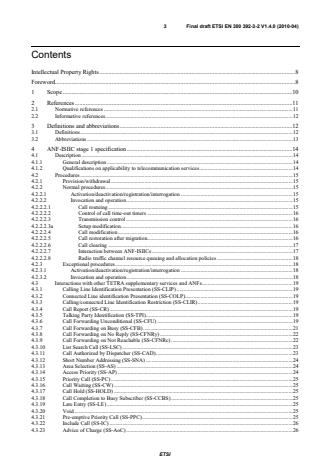
Contents
Intellectual Property Rights . 8
Foreword . 8
1 Scope . 10
2 References . 11
2.1 Normative references . 11
2.2 Informative references . 12
3 Definitions and abbreviations . 12
3.1 Definitions . 12
3.2 Abbreviations . 13
4 ANF-ISIIC stage 1 specification . 14
4.1 Description . 14
4.1.1 General description . 14
4.1.2 Qualifications on applicability to telecommunication services . 14
4.2 Procedures . 15
4.2.1 Provision/withdrawal . 15
4.2.2 Normal procedures . 15
4.2.2.1 Activation/deactivation/registration/interrogation . 15
4.2.2.2 Invocation and operation . 15
4.2.2.2.1 Call routeing . 15
4.2.2.2.2 Control of call time-out timers . 16
4.2.2.2.3 Transmission control . 16
4.2.2.2.3a Setup modification. 16
4.2.2.2.4 Call modification . 16
4.2.2.2.5 Call restoration after migration . 16
4.2.2.2.6 Call clearing . 17
4.2.2.2.7 Interaction between ANF-ISIICs . 17
4.2.2.2.8 Radio traffic channel resource queuing and allocation policies . 18
4.2.3 Exceptional procedures . 18
4.2.3.1 Activation/deactivation/registration/interrogation . 18
4.2.3.2 Invocation and operation . 18
4.3 Interactions with other TETRA supplementary services and ANFs . 19
4.3.1 Calling Line Identification Presentation (SS-CLIP) . 19
4.3.2 Connected Line identification Presentation (SS-COLP) . 19
4.3.3 Calling/connected Line Identification Restriction (SS-CLIR) . 19
4.3.4 Call Report (SS-CR) . 19
4.3.5 Talking Party Identification (SS-TPI) . 19
4.3.6 Call Forwarding Unconditional (SS-CFU) . 19
4.3.7 Call Forwarding on Busy (SS-CFB) . 21
4.3.8 Call Forwarding on No Reply (SS-CFNRy) . 22
4.3.9 Call Forwarding on Not Reachable (SS-CFNRc) . 22
4.3.10 List Search Call (SS-LSC) . 23
4.3.11 Call Authorized by Dispatcher (SS-CAD) . 23
4.3.12 Short Number Addressing (SS-SNA) . 24
4.3.13 Area Selection (SS-AS) . 24
4.3.14 Access Priority (SS-AP) . 24
4.3.15 Priority Call (SS-PC) . 25
4.3.16 Call Waiting (SS-CW) . 25
4.3.17 Call Hold (SS-HOLD) . 25
4.3.18 Call Completion to Busy Subscriber (SS-CCBS) . 25
4.3.19 Late Entry (SS-LE) . 25
4.3.20 Void . 25
4.3.21 Pre-emptive Priority Call (SS-PPC) . 25
4.3.22 Include Call (SS-IC) . 26
4.3.23 Advice of Charge (SS-AoC) . 26
ETSI
4 Final draft ETSI EN 300 392-3-2 V1.4.0 (2010-04)
4.3.24 Barring of Outgoing Calls (SS-BOC) . 26
4.3.25 Barring of Incoming Calls (SS-BIC) . 26
4.3.26 Discreet Listening (SS-DL) . 27
4.3.27 Ambience Listening (SS-AL) . 27
4.3.28 Dynamic Group Number Assignment (SS-DGNA) . 27
4.3.29 Call Completion on No Reply (SS-CCNR) . 27
4.3.30 Call Retention (SS-CRT) . 27
4.3.31 Additional Network Feature - Inter System Interface Group Call (ANF-ISIGC) . 28
4.3.32 Additional Network Feature - Inter System Interface Short Data Service (ANF-ISISDS) . 28
4.3.33 Additional Network Feature - Inter System Interface Mobility Management (ANF-ISIMM) . 28
4.3.34 Additional Network Feature - Inter System Interface Supplementary service (ANF-ISISS) . 28
4.4 Interworking considerations . 28
4.5 Static description of ANF-ISIIC using attributes . 30
4.6 Overall SDL . 32
5 ANF-ISIIC stage 2 specification . 37
5.1 Functional model . 37
5.1.1 Functional model description . 37
5.1.2 Description of functional entities . 38
5.1.2.1 SwMI A individual call control application functional entity, FE1 . 38
5.1.2.2 ISI individual call originating functional entity, FE2 . 39
5.1.2.3 ISI individual outgoing call route determining functional entity, FE3 . 39
5.1.2.4 ISI individual call migration handling functional entity, FE4 . 39
5.1.2.5 ISI information provision functional entity, FE5 . 40
5.1.2.6 ISI individual call migrated called user routeing functional entity, FE6 . 40
5.1.2.7 ISI individual call terminating functional entity, FE7 . 40
5.1.2.8 Terminating SwMI call control functional entity, FE8 . 41
5.1.3 Relationship of functional model to basic call functional model . 41
5.2 Information flow . 42
5.2.1 Examples of information flow sequences . 42
5.2.1.1 Successful call set-up when the called user is registered in SwMI B and uses on/off hook
signalling . 43
5.2.1.2 Successful call set-up when the called user is registered in SwMI B and uses direct set-up
signalling . 45
5.2.1.3 ANF-ISIIC set-up to a called user having migrated from SwMI B, using forward switching . 46
5.2.1.4 ANF-ISIIC set-up to a called user having migrated from SwMI B, using re-routeing . 46
5.2.1.5 Loop avoidance in case of intra-TETRA call . 49
5.2.1.6 Unsuccessful ANF-ISIIC call set-up . 50
5.2.1.7 Transmission control . 52
5.2.1.8 Call modify . 53
5.2.1.9 Call restoration after migration . 54
5.2.1.10 Call clearing . 56
5.2.1.11 Radio traffic channel resource queuing and allocation . 56
5.2.2 Definition of information flows . 57
5.2.2.1 CALL RESTORE . 57
5.2.2.2 CALL RESTORE PREPARE . 58
5.2.2.3 CHARACTERISTIC CHANGE . 59
5.2.2.4 COMPLETE. 59
5.2.2.5 INFORM 1 . 60
5.2.2.6 INFORM 2 . 60
5.2.2.7 INFORM 3 . 60
5.2.2.8 MIGRATION . 61
5.2.2.9 MODIFY . 61
5.2.2.10 RELEASE . 62
5.2.2.11 SETUP . 62
5.2.2.12 SETUP PROLONGATION . 63
5.2.2.13 TROMBONE . 64
5.2.2.14 TX-CEASED . 64
5.2.2.14.1 TX-CEASED 1 . 64
5.2.2.14.2 TX-CEASED 2 . 64
5.2.2.15 TX-CONTINUE 1 . 65
5.2.2.16 TX-CONTINUE 2 . 65
ETSI
5 Final draft ETSI EN 300 392-3-2 V1.4.0 (2010-04)
5.2.2.17 TX-DEMAND . 65
5.2.2.18 TX-GRANTED . 66
5.2.2.19 TX-INTERRUPT . 66
5.2.2.20 TX-WAIT. 66
5.2.3 Relationship of information flows to basic call information flows . 66
5.3 Functional entity actions . 67
5.4 Allocation of functional entities to physical equipment/SwMIs. 67
6 ANF-ISIIC stage 3 specification . 69
6.1 ANF-ISIIC description . 69
6.2 ANF-ISIIC operational requirements . 69
6.2.1 Requirements on the originating SwMI . 69
6.2.2 Requirements on the terminating SwMI . 70
6.2.3 Requirements on a called SwMI when it is different from the terminating SwMI . 70
6.2.4 Requirements on a routeing SwMI . 71
6.2.5 Requirements on a SwMI with PSTN/ISDN/PISN incoming gateway . 71
6.2.6 Requirements on a SwMI with PSTN/ISDN/PISN outgoing gateways . 72
6.3 ANF-ISIIC coding requirements . 73
6.3.1 TETRA PDUs . 73
6.3.1.1 TETRA PDU giving complementary information in the PSS1 SETUP message sent by the
originating or the incoming gateway SwMI . 74
6.3.1.2 TETRA PDU giving complementary information in a PSS1 PROGRESS message . 77
6.3.1.3 TETRA message sent by the called SwMI in a PSS1 FACILITY message when it is not the
terminating SwMI because of migration or SS-CF invocation . 77
6.3.1.4 TETRA message sent by the originating SwMI in a PSS1 FACILITY message to request
forward switching . 79
6.3.1.5 TETRA PDU giving complementary information in the PSS1 ALERTING message . 80
6.3.1.6 TETRA PDU giving complementary information in the PSS1 CONNECT message. 80
6.3.1.7 TETRA information sent by the terminating SwMI in PSS1 FACILITY messages before the
PSS1 ALERTING or CONNECT message . 82
6.3.1.8 TETRA information sent by the terminating SwMI in a PSS1 FACILITY message during call
establishment after the PSS1 ALERTING or CONNECT message . 83
6.3.1.9 TETRA information sent by the originating SwMI in a PSS1 FACILITY message before the call
has been established . 83
6.3.1.10 TETRA CONNECT ACKNOWLEDGE sent by the originating SwMI in a PSS1 FACILITY
message . 83
6.3.1.11 Other TETRA messages possibly sent by the originating SwMI in PSS1 FACILITY messages . 83
6.3.1.12 TETRA messages possibly sent by either the originating or the terminating SwMI in a PSS1
FACILITY message . 85
6.3.1.13 TETRA messages possibly sent by the terminating SwMI in PSS1 FACILITY messages . 86
6.3.1.14 TETRA PDUs giving complementary information in PSS1 messages to restore the call after the
calling or the connected user has migrated in a new SwMI . 87
6.3.1.14.1 Case where no connection between the old SwMI and the new SwMI already exists or has
been identified . 88
6.3.1.14.2 Cases where no new connection is needed between the old SwMI and the new SwMI . 89
6.3.1.15 TETRA PDUs giving complementary information in PSS1 DISCONNECT messages . 92
6.3.1.16 TETRA PDU giving complementary information in a PSS1 RELEASE message . 93
6.3.1.17 TETRA PDUs giving complementary information in a PSS1 RELEASE COMPLETE message . 93
6.3.1.18 TETRA PDUs specific for interaction with supplementary service protocol sent to the
originating SwMI in a PSS1 FACILITY message . 93
6.3.1.19 TETRA PDUs sent towards the Called or Visited SwMI in a PSS1 FACILITY after the PSS1
call has been connected . 94
6.3.1.20 TETRA PDUs sent towards the Called or Originating SwMI in a PSS1 FACILITY after the
PSS1 call has connected . 96
6.3.2 TETRA PDU information element coding . 97
6.3.2.1 Specific ISI definition of some information elements already defined for air interface messages . 97
6.3.2.1.1 Basic service information . 97
6.3.2.1.2 Call status . 97
6.3.2.1.3 Call time-out, set-up phase . 97
6.3.2.1.4 Disconnect cause information element . 98
6.3.2.1.5 PDU type . 99
6.3.2.2 New information elements used at the ISI . 100
ETSI
6 Final draft ETSI EN 300 392-3-2 V1.4.0 (2010-04)
6.3.2.2.1 Call diverted to a dispatcher . 100
6.3.2.2.2 Call has been forward switched . 100
6.3.2.2.3 Call identified as fleet call . 100
6.3.2.2.4 Called/forwarded-to external subscriber number. 100
6.3.2.2.5 Called/forwarded-to party extension . 100
6.3.2.2.6 Called/forwarded-to party SSI . 100
6.3.2.2.7 Called/forwarded-to party fleet number SSI . 100
6.3.2.2.8 Called/forwarded-to user having migrated . 101
6.3.2.2.9 Calling external subscriber number . 101
6.3.2.2.10 Calling external subscriber number parameters . 101
6.3.2.2.11 Calling party fleet number SSI . 101
6.3.2.2.12 Calling party presentation indicator. 101
6.3.2.2.13 Cause for PDU addressed to originating SwMI . 102
6.3.2.2.14 Connected external subscriber number . 102
6.3.2.2.15 Connected external subscriber number parameters . 102
6.3.2.2.16 Connected party presentation indicator . 102
6.3.2.2.17 Connected party extension. 102
6.3.2.2.18 Connected party SSI . 102
6.3.2.2.19 Connected party fleet number SSI . 103
6.3.2.2.20 Controlling SwMI . 103
6.3.2.2.21 Incoming call barring status . 103
6.3.2.2.22 Forwarded-to external subscriber number . 103
6.3.2.2.23 Forwarded-to user extension . 103
6.3.2.2.24 Forwarded-to user SSI . 103
6.3.2.2.25 Last Forwarding SwMI MNI . 103
6.3.2.2.26 Modify accepted . 103
6.3.2.2.27 Modify request . 104
6.3.2.2.28 MSISDN present as external subscriber number . 104
6.3.2.2.29 New SwMI MNI . 104
6.3.2.2.30 Number of digits in called/forwarded-to external subscriber number . 104
6.3.2.2.31 Number of digits in calling external subscriber number . 104
6.3.2.2.32 Number of digits in connected external subscriber number . 104
6.3.2.2.33 Number of digits in forwarded-to external subscriber number . 105
6.3.2.2.34 Number of digits in visited/forwarded-to SwMI PISN number . 105
6.3.2.2.35 Originating SwMI MNI . 105
6.3.2.2.36 Other end SwMI MNI . 105
6.3.2.2.37 Override SS-CAD invocation . 105
6.3.2.2.38 PDU addressed to originating SwMI . 105
6.3.2.2.39 Possible ISI trombone or loop connection detected . 105
6.3.2.2.40 Restoring party extension . 106
6.3.2.2.41 Restoring party SSI . 106
6.3.2.2.41a Radio traffic channel release permission . 106
6.3.2.2.41b Radio traffic channel release signalling supported . 107
6.3.2.2.41c Resource indicator . 107
6.3.2.2.42 Routeing method choice . 107
6.3.2.2.43 Routeing method response. 108
6.3.2.2.44 Security level at calling user air interface . 108
6.3.2.2.44a Setup resource allocation . 108
6.3.2.2.45 Speech service requested/chosen/used . 108
6.3.2.2.46 Speech services supported . 109
6.3.2.2.47 SS-CF invocation counter . 109
6.3.2.2.48 SS-CF invoked . 109
6.3.2.2.49 SS-CLIR invoked for other party . 109
6.3.2.2.50 Terminating SwMI MNI . 109
6.3.2.2.51 Visited/forwarded-to SwMI MNI . 109
6.3.2.2.52 Visited/forwarded-to SwMI PISN number . 109
6.3.3 PSS1 facility information element . 110
6.4 ANF-ISIIC state definitions . 111
6.5 ANF-ISIIC signalling procedures . 111
6.5.1 Call establishment . 111
6.5.1.1 Call request, information channel selection, PISN called number sending and call proceeding . 111
6.5.1.2 Called user migration . 111
ETSI
7 Final draft ETSI EN 300 392-3-2 V1.4.0 (2010-04)
6.5.1.2.1 Called user having migrated in SwMI C different from SwMI A . 112
6.5.1.2.2 Called user having migrated in SwMI C coinciding with SwMI A . 115
6.5.1.3 Call characteristics and set-up time negotiation by the terminating SwMI . 115
6.5.1.4 Call confirmation indication and call connected by the terminating SwMI . 116
6.5.1.5 Failure of call establishment . 117
6.5.2 Call maintenance procedures . 118
6.5.2.1 Transmission control procedures . 118
6.5.2.2 Call modification and/or continuation . 118
6.5.2.3 Call restoration . 118
6.5.2.3.1 General call restoration procedure . 118
6.5.2.3.2 Specific call restoration procedure in a SwMI already on the path of the call . 120
6.5.3 DTMF procedures . 123
6.5.4 ANF-ISIIC clearing . 123
6.5.5 Call collisions . 124
6.6 ANF-ISIIC impact of interworking with ISDN/PISN/PSTN . 125
6.7 Protocol interactions between ANF-ISIIC and supplementary services and other ANFs . 125
6.7.1 Interaction with SS-CLIR . 125
6.7.2 Interactions with SS-CF . 126
6.7.2.1 Interaction with SS-CF at call establishment . 126
6.7.2.2 Specific interaction with SS-CFNRy at call establishment . 126
6.7.2.3 Interaction with SS-CF at call restoration . 126
6.7.3 Interaction with SS-CAD . 127
6.7.3.1 Invocation of a specific ANF-ISIIC . 127
6.7.3.2 Interception of an already invoked ANF-ISIIC . 127
6.7.3.3 Call authorization by a distant dispatcher . 127
6.7.3.4 Completion of call establishment . 127
6.7.3.4.1 Call not diverted to dispatcher . 127
6.7.3.4.2 Call diverted to dispatcher . 128
6.7.4 Interactions with SS-PC, SS-PPC and SS-CRT . 128
6.7.5 Interaction with SS-CW . 129
6.7.6 Interaction with SS-HOLD . 129
6.7.7 Interaction with SS-CCBS and SS-CCNR . 129
6.7.8 Interaction with SS-BIC . 129
6.7.9 Interactions with SS-AoC . 129
6.7.10 Area Selection (SS-AS) and selected area number . 130
6.7.11 Interactions with other supplementary services . 130
6.8 ANF-ISIIC parameter values (timers) . 130
Annex A (informative): Static description of the TETRA individual call bearer service, using
attributes . 131
Annex B (informative): Definition of the ISI ROSE operation . 132
Annex C (informative): Interactions of SS-CFU with ANF-ISIIC . 133
C.1 Possible SS-CFU activation . 133
C.2 Invocation and operation . 133
C.2.1 Called user home SwMI being SwMI A . 133
C.2.2 Called user home SwMI being SwMI B . 133
C.2.2.1 Forwarded-to user with home SwMI being SwMI B, being registered in its home SwMI . 134
C.2.2.2 Forwarded-to user with home SwMI being SwMI B, having migrated . 135
C.2.2.3 Forwarded-to user with home SwMI different from SwMI B, being registered in its home SwMI . 135
C.2.2.4 Forwarded-to user with home SwMI different from SwMI B, having migrated . 135
Annex D (informative): Change Requests . . 138
History . 139
ETSI
8 Final draft ETSI EN 300 392-3-2 V1.4.0 (2010-04)
Intellectual Property Rights
IPRs essential or potentially essential to the present document may have been declared to ETSI. The information
pertaining to the
...
European Standard (Telecommunications series)
Terrestrial Trunked Radio (TETRA);
Voice plus Data (V+D);
Part 3: Interworking at the Inter-System Interface (ISI);
Sub-part 2: Additional Network Feature
Individual Call (ANF-ISIIC)
2 ETSI EN 300 392-3-2 V1.4.1 (2010-08)
Reference
REN/TETRA-03193
Keywords
air interface, TETRA, V+D
ETSI
650 Route des Lucioles
F-06921 Sophia Antipolis Cedex - FRANCE
Tel.: +33 4 92 94 42 00 Fax: +33 4 93 65 47 16
Siret N° 348 623 562 00017 - NAF 742 C
Association à but non lucratif enregistrée à la
Sous-Préfecture de Grasse (06) N° 7803/88
Important notice
Individual copies of the present document can be downloaded from:
http://www.etsi.org
The present document may be made available in more than one electronic version or in print. In any case of existing or
perceived difference in contents between such versions, the reference version is the Portable Document Format (PDF).
In case of dispute, the reference shall be the printing on ETSI printers of the PDF version kept on a specific network drive
within ETSI Secretariat.
Users of the present document should be aware that the document may be subject to revision or change of status.
Information on the current status of this and other ETSI documents is available at
http://portal.etsi.org/tb/status/status.asp
If you find errors in the present document, please send your comment to one of the following services:
http://portal.etsi.org/chaircor/ETSI_support.asp
Copyright Notification
No part may be reproduced except as authorized by written permission.
The copyright and the foregoing restriction extend to reproduction in all media.
© European Telecommunications Standards Institute 2010.
All rights reserved.
TM TM TM TM
DECT , PLUGTESTS , UMTS , TIPHON , the TIPHON logo and the ETSI logo are Trade Marks of ETSI registered
for the benefit of its Members.
TM
3GPP is a Trade Mark of ETSI registered for the benefit of its Members and of the 3GPP Organizational Partners.
LTE™ is a Trade Mark of ETSI currently being registered
for the benefit of its Members and of the 3GPP Organizational Partners.
GSM® and the GSM logo are Trade Marks registered and owned by the GSM Association.
ETSI
3 ETSI EN 300 392-3-2 V1.4.1 (2010-08)
Contents
Intellectual Property Rights . 8
Foreword . 8
1 Scope . 10
2 References . 11
2.1 Normative references . 11
2.2 Informative references . 12
3 Definitions and abbreviations . 12
3.1 Definitions . 12
3.2 Abbreviations . 13
4 ANF-ISIIC stage 1 specification . 14
4.1 Description . 14
4.1.1 General description . 14
4.1.2 Qualifications on applicability to telecommunication services . 14
4.2 Procedures . 15
4.2.1 Provision/withdrawal . 15
4.2.2 Normal procedures . 15
4.2.2.1 Activation/deactivation/registration/interrogation . 15
4.2.2.2 Invocation and operation . 15
4.2.2.2.1 Call routeing . 15
4.2.2.2.2 Control of call time-out timers . 16
4.2.2.2.3 Transmission control . 16
4.2.2.2.3a Setup modification. 16
4.2.2.2.4 Call modification . 16
4.2.2.2.5 Call restoration after migration . 16
4.2.2.2.6 Call clearing . 17
4.2.2.2.7 Interaction between ANF-ISIICs . 17
4.2.2.2.8 Radio traffic channel resource queuing and allocation policies . 18
4.2.3 Exceptional procedures . 18
4.2.3.1 Activation/deactivation/registration/interrogation . 18
4.2.3.2 Invocation and operation . 18
4.3 Interactions with other TETRA supplementary services and ANFs . 19
4.3.1 Calling Line Identification Presentation (SS-CLIP) . 19
4.3.2 Connected Line identification Presentation (SS-COLP) . 19
4.3.3 Calling/connected Line Identification Restriction (SS-CLIR) . 19
4.3.4 Call Report (SS-CR) . 19
4.3.5 Talking Party Identification (SS-TPI) . 19
4.3.6 Call Forwarding Unconditional (SS-CFU) . 19
4.3.7 Call Forwarding on Busy (SS-CFB) . 21
4.3.8 Call Forwarding on No Reply (SS-CFNRy) . 22
4.3.9 Call Forwarding on Not Reachable (SS-CFNRc) . 22
4.3.10 List Search Call (SS-LSC) . 23
4.3.11 Call Authorized by Dispatcher (SS-CAD) . 23
4.3.12 Short Number Addressing (SS-SNA) . 24
4.3.13 Area Selection (SS-AS) . 24
4.3.14 Access Priority (SS-AP) . 24
4.3.15 Priority Call (SS-PC) . 25
4.3.16 Call Waiting (SS-CW) . 25
4.3.17 Call Hold (SS-HOLD) . 25
4.3.18 Call Completion to Busy Subscriber (SS-CCBS) . 25
4.3.19 Late Entry (SS-LE) . 25
4.3.20 Void . 25
4.3.21 Pre-emptive Priority Call (SS-PPC) . 25
4.3.22 Include Call (SS-IC) . 26
4.3.23 Advice of Charge (SS-AoC) . 26
ETSI
4 ETSI EN 300 392-3-2 V1.4.1 (2010-08)
4.3.24 Barring of Outgoing Calls (SS-BOC) . 26
4.3.25 Barring of Incoming Calls (SS-BIC) . 26
4.3.26 Discreet Listening (SS-DL) . 27
4.3.27 Ambience Listening (SS-AL) . 27
4.3.28 Dynamic Group Number Assignment (SS-DGNA) . 27
4.3.29 Call Completion on No Reply (SS-CCNR) . 27
4.3.30 Call Retention (SS-CRT) . 27
4.3.31 Additional Network Feature - Inter System Interface Group Call (ANF-ISIGC) . 28
4.3.32 Additional Network Feature - Inter System Interface Short Data Service (ANF-ISISDS) . 28
4.3.33 Additional Network Feature - Inter System Interface Mobility Management (ANF-ISIMM) . 28
4.3.34 Additional Network Feature - Inter System Interface Supplementary service (ANF-ISISS) . 28
4.4 Interworking considerations . 28
4.5 Static description of ANF-ISIIC using attributes . 30
4.6 Overall SDL . 32
5 ANF-ISIIC stage 2 specification . 37
5.1 Functional model . 37
5.1.1 Functional model description . 37
5.1.2 Description of functional entities . 38
5.1.2.1 SwMI A individual call control application functional entity, FE1 . 38
5.1.2.2 ISI individual call originating functional entity, FE2 . 39
5.1.2.3 ISI individual outgoing call route determining functional entity, FE3 . 39
5.1.2.4 ISI individual call migration handling functional entity, FE4 . 39
5.1.2.5 ISI information provision functional entity, FE5 . 40
5.1.2.6 ISI individual call migrated called user routeing functional entity, FE6 . 40
5.1.2.7 ISI individual call terminating functional entity, FE7 . 40
5.1.2.8 Terminating SwMI call control functional entity, FE8 . 41
5.1.3 Relationship of functional model to basic call functional model . 41
5.2 Information flow . 42
5.2.1 Examples of information flow sequences . 42
5.2.1.1 Successful call set-up when the called user is registered in SwMI B and uses on/off hook
signalling . 43
5.2.1.2 Successful call set-up when the called user is registered in SwMI B and uses direct set-up
signalling . 45
5.2.1.3 ANF-ISIIC set-up to a called user having migrated from SwMI B, using forward switching . 46
5.2.1.4 ANF-ISIIC set-up to a called user having migrated from SwMI B, using re-routeing . 46
5.2.1.5 Loop avoidance in case of intra-TETRA call . 49
5.2.1.6 Unsuccessful ANF-ISIIC call set-up . 50
5.2.1.7 Transmission control . 52
5.2.1.8 Call modify . 53
5.2.1.9 Call restoration after migration . 54
5.2.1.10 Call clearing . 56
5.2.1.11 Radio traffic channel resource queuing and allocation . 56
5.2.2 Definition of information flows . 57
5.2.2.1 CALL RESTORE . 57
5.2.2.2 CALL RESTORE PREPARE . 58
5.2.2.3 CHARACTERISTIC CHANGE . 59
5.2.2.4 COMPLETE. 59
5.2.2.5 INFORM 1 . 60
5.2.2.6 INFORM 2 . 60
5.2.2.7 INFORM 3 . 60
5.2.2.8 MIGRATION . 61
5.2.2.9 MODIFY . 61
5.2.2.10 RELEASE . 62
5.2.2.11 SETUP . 62
5.2.2.12 SETUP PROLONGATION . 63
5.2.2.13 TROMBONE . 64
5.2.2.14 TX-CEASED . 64
5.2.2.14.1 TX-CEASED 1 . 64
5.2.2.14.2 TX-CEASED 2 . 64
5.2.2.15 TX-CONTINUE 1 . 65
5.2.2.16 TX-CONTINUE 2 . 65
ETSI
5 ETSI EN 300 392-3-2 V1.4.1 (2010-08)
5.2.2.17 TX-DEMAND . 65
5.2.2.18 TX-GRANTED . 66
5.2.2.19 TX-INTERRUPT . 66
5.2.2.20 TX-WAIT. 66
5.2.3 Relationship of information flows to basic call information flows . 66
5.3 Functional entity actions . 67
5.4 Allocation of functional entities to physical equipment/SwMIs. 67
6 ANF-ISIIC stage 3 specification . 69
6.1 ANF-ISIIC description . 69
6.2 ANF-ISIIC operational requirements . 69
6.2.1 Requirements on the originating SwMI . 69
6.2.2 Requirements on the terminating SwMI . 70
6.2.3 Requirements on a called SwMI when it is different from the terminating SwMI . 70
6.2.4 Requirements on a routeing SwMI . 71
6.2.5 Requirements on a SwMI with PSTN/ISDN/PISN incoming gateway . 71
6.2.6 Requirements on a SwMI with PSTN/ISDN/PISN outgoing gateways . 72
6.3 ANF-ISIIC coding requirements . 73
6.3.1 TETRA PDUs . 73
6.3.1.1 TETRA PDU giving complementary information in the PSS1 SETUP message sent by the
originating or the incoming gateway SwMI . 74
6.3.1.2 TETRA PDU giving complementary information in a PSS1 PROGRESS message . 77
6.3.1.3 TETRA message sent by the called SwMI in a PSS1 FACILITY message when it is not the
terminating SwMI because of migration or SS-CF invocation . 77
6.3.1.4 TETRA message sent by the originating SwMI in a PSS1 FACILITY message to request
forward switching . 79
6.3.1.5 TETRA PDU giving complementary information in the PSS1 ALERTING message . 80
6.3.1.6 TETRA PDU giving complementary information in the PSS1 CONNECT message. 80
6.3.1.7 TETRA information sent by the terminating SwMI in PSS1 FACILITY messages before the
PSS1 ALERTING or CONNECT message . 82
6.3.1.8 TETRA information sent by the terminating SwMI in a PSS1 FACILITY message during call
establishment after the PSS1 ALERTING or CONNECT message . 83
6.3.1.9 TETRA information sent by the originating SwMI in a PSS1 FACILITY message before the call
has been established . 83
6.3.1.10 TETRA CONNECT ACKNOWLEDGE sent by the originating SwMI in a PSS1 FACILITY
message . 83
6.3.1.11 Other TETRA messages possibly sent by the originating SwMI in PSS1 FACILITY messages . 83
6.3.1.12 TETRA messages possibly sent by either the originating or the terminating SwMI in a PSS1
FACILITY message . 85
6.3.1.13 TETRA messages possibly sent by the terminating SwMI in PSS1 FACILITY messages . 86
6.3.1.14 TETRA PDUs giving complementary information in PSS1 messages to restore the call after the
calling or the connected user has migrated in a new SwMI . 87
6.3.1.14.1 Case where no connection between the old SwMI and the new SwMI already exists or has
been identified . 88
6.3.1.14.2 Cases where no new connection is needed between the old SwMI and the new SwMI . 89
6.3.1.15 TETRA PDUs giving complementary information in PSS1 DISCONNECT messages . 92
6.3.1.16 TETRA PDU giving complementary information in a PSS1 RELEASE message . 93
6.3.1.17 TETRA PDUs giving complementary information in a PSS1 RELEASE COMPLETE message . 93
6.3.1.18 TETRA PDUs specific for interaction with supplementary service protocol sent to the
originating SwMI in a PSS1 FACILITY message . 93
6.3.1.19 TETRA PDUs sent towards the Called or Visited SwMI in a PSS1 FACILITY after the PSS1
call has been connected . 94
6.3.1.20 TETRA PDUs sent towards the Called or Originating SwMI in a PSS1 FACILITY after the
PSS1 call has connected . 96
6.3.2 TETRA PDU information element coding . 97
6.3.2.1 Specific ISI definition of some information elements already defined for air interface messages . 97
6.3.2.1.1 Basic service information . 97
6.3.2.1.2 Call status . 97
6.3.2.1.3 Call time-out, set-up phase . 97
6.3.2.1.4 Disconnect cause information element . 98
6.3.2.1.5 PDU type . 99
6.3.2.2 New information elements used at the ISI . 100
ETSI
6 ETSI EN 300 392-3-2 V1.4.1 (2010-08)
6.3.2.2.1 Call diverted to a dispatcher . 100
6.3.2.2.2 Call has been forward switched . 100
6.3.2.2.3 Call identified as fleet call . 100
6.3.2.2.4 Called/forwarded-to external subscriber number. 100
6.3.2.2.5 Called/forwarded-to party extension . 100
6.3.2.2.6 Called/forwarded-to party SSI . 100
6.3.2.2.7 Called/forwarded-to party fleet number SSI . 100
6.3.2.2.8 Called/forwarded-to user having migrated . 101
6.3.2.2.9 Calling external subscriber number . 101
6.3.2.2.10 Calling external subscriber number parameters . 101
6.3.2.2.11 Calling party fleet number SSI . 101
6.3.2.2.12 Calling party presentation indicator. 101
6.3.2.2.13 Cause for PDU addressed to originating SwMI . 102
6.3.2.2.14 Connected external subscriber number . 102
6.3.2.2.15 Connected external subscriber number parameters . 102
6.3.2.2.16 Connected party presentation indicator . 102
6.3.2.2.17 Connected party extension. 102
6.3.2.2.18 Connected party SSI . 102
6.3.2.2.19 Connected party fleet number SSI . 103
6.3.2.2.20 Controlling SwMI . 103
6.3.2.2.21 Incoming call barring status . 103
6.3.2.2.22 Forwarded-to external subscriber number . 103
6.3.2.2.23 Forwarded-to user extension . 103
6.3.2.2.24 Forwarded-to user SSI . 103
6.3.2.2.25 Last Forwarding SwMI MNI . 103
6.3.2.2.26 Modify accepted . 103
6.3.2.2.27 Modify request . 104
6.3.2.2.28 MSISDN present as external subscriber number . 104
6.3.2.2.29 New SwMI MNI . 104
6.3.2.2.30 Number of digits in called/forwarded-to external subscriber number . 104
6.3.2.2.31 Number of digits in calling external subscriber number . 104
6.3.2.2.32 Number of digits in connected external subscriber number . 104
6.3.2.2.33 Number of digits in forwarded-to external subscriber number . 105
6.3.2.2.34 Number of digits in visited/forwarded-to SwMI PISN number . 105
6.3.2.2.35 Originating SwMI MNI . 105
6.3.2.2.36 Other end SwMI MNI . 105
6.3.2.2.37 Override SS-CAD invocation . 105
6.3.2.2.38 PDU addressed to originating SwMI . 105
6.3.2.2.39 Possible ISI trombone or loop connection detected . 105
6.3.2.2.40 Restoring party extension . 106
6.3.2.2.41 Restoring party SSI . 106
6.3.2.2.41a Radio traffic channel release permission . 106
6.3.2.2.41b Radio traffic channel release signalling supported . 107
6.3.2.2.41c Resource indicator . 107
6.3.2.2.42 Routeing method choice . 107
6.3.2.2.43 Routeing method response. 108
6.3.2.2.44 Security level at calling user air interface . 108
6.3.2.2.44a Setup resource allocation . 108
6.3.2.2.45 Speech service requested/chosen/used . 108
6.3.2.2.46 Speech services supported . 109
6.3.2.2.47 SS-CF invocation counter . 109
6.3.2.2.48 SS-CF invoked . 109
6.3.2.2.49 SS-CLIR invoked for other party . 109
6.3.2.2.50 Terminating SwMI MNI . 109
6.3.2.2.51 Visited/forwarded-to SwMI MNI . 109
6.3.2.2.52 Visited/forwarded-to SwMI PISN number . 109
6.3.3 PSS1 facility information element . 110
6.4 ANF-ISIIC state definitions . 111
6.5 ANF-ISIIC signalling procedures . 111
6.5.1 Call establishment . 111
6.5.1.1 Call request, information channel selection, PISN called number sending and call proceeding . 111
6.5.1.2 Called user migration . 111
ETSI
7 ETSI EN 300 392-3-2 V1.4.1 (2010-08)
6.5.1.2.1 Called user having migrated in SwMI C different from SwMI A . 112
6.5.1.2.2 Called user having migrated in SwMI C coinciding with SwMI A . 115
6.5.1.3 Call characteristics and set-up time negotiation by the terminating SwMI . 115
6.5.1.4 Call confirmation indication and call connected by the terminating SwMI . 116
6.5.1.5 Failure of call establishment . 117
6.5.2 Call maintenance procedures . 118
6.5.2.1 Transmission control procedures . 118
6.5.2.2 Call modification and/or continuation . 118
6.5.2.3 Call restoration . 118
6.5.2.3.1 General call restoration procedure . 118
6.5.2.3.2 Specific call restoration procedure in a SwMI already on the path of the call . 120
6.5.3 DTMF procedures . 123
6.5.4 ANF-ISIIC clearing . 123
6.5.5 Call collisions . 124
6.6 ANF-ISIIC impact of interworking with ISDN/PISN/PSTN . 125
6.7 Protocol interactions between ANF-ISIIC and supplementary services and other ANFs . 125
6.7.1 Interaction with SS-CLIR . 125
6.7.2 Interactions with SS-CF . 126
6.7.2.1 Interaction with SS-CF at call establishment . 126
6.7.2.2 Specific interaction with SS-CFNRy at call establishment . 126
6.7.2.3 Interaction with SS-CF at call restoration . 126
6.7.3 Interaction with SS-CAD . 127
6.7.3.1 Invocation of a specific ANF-ISIIC . 127
6.7.3.2 Interception of an already invoked ANF-ISIIC . 127
6.7.3.3 Call authorization by a distant dispatcher . 127
6.7.3.4 Completion of call establishment . 127
6.7.3.4.1 Call not diverted to dispatcher . 127
6.7.3.4.2 Call diverted to dispatcher . 128
6.7.4 Interactions with SS-PC, SS-PPC and SS-CRT . 128
6.7.5 Interaction with SS-CW . 129
6.7.6 Interaction with SS-HOLD . 129
6.7.7 Interaction with SS-CCBS and SS-CCNR . 129
6.7.8 Interaction with SS-BIC . 129
6.7.9 Interactions with SS-AoC . 129
6.7.10 Area Selection (SS-AS) and selected area number . 130
6.7.11 Interactions with other supplementary services . 130
6.8 ANF-ISIIC parameter values (timers) . 130
Annex A (informative): Static description of the TETRA individual call bearer service, using
attributes . 131
Annex B (informative): Definition of the ISI ROSE operation . 132
Annex C (informative): Interactions of SS-CFU with ANF-ISIIC . 133
C.1 Possible SS-CFU activation . 133
C.2 Invocation and operation . 133
C.2.1 Called user home SwMI being SwMI A . 133
C.2.2 Called user home SwMI being SwMI B . 133
C.2.2.1 Forwarded-to user with home SwMI being SwMI B, being registered in its home SwMI . 134
C.2.2.2 Forwarded-to user with home SwMI being SwMI B, having migrated . 135
C.2.2.3 Forwarded-to user with home SwMI different from SwMI B, being registered in its home SwMI . 135
C.2.2.4 Forwarded-to user with home SwMI different from SwMI B, having migrated . 135
Annex D (informative): Change Requests . . 138
History . 139
ETSI
8 ETSI EN 300 392-3-2 V1.4.1 (2010-08)
Intellectual Property Rights
IPRs essential or potentially essential to the present document may have been declared to ETSI. The information
pertaining to these essential IPRs, if any, is publicly available for ETSI members and non-members, and can be found
in
...
2003-01.Slovenski inštitut za standardizacijo. Razmnoževanje celote ali delov tega standarda ni dovoljeno.Prizemni snopovni radio (TETRA) - Govor in podatki (V+D) - 3. del: Medsebojno delovanje na medsistemskem vmesniku (ISI) - 2. poddel: Dodatna omrežna funkcija: posamezni klic (ANF-ISIIC)Terrestrial Trunked Radio (TETRA) - Voice plus Data (V+D) - Part 3: Interworking at the Inter-System Interface (ISI) - Sub-part 2: Additional Network Feature Individual Call (ANF-ISIIC)33.070.10Prizemni snopovni radio (TETRA)Terrestrial Trunked Radio (TETRA)ICS:Ta slovenski standard je istoveten z:EN 300 392-3-2 Version 1.4.1SIST EN 300 392-3-2 V1.4.1:2010en01-oktober-2010SIST EN 300 392-3-2 V1.4.1:2010SLOVENSKI
STANDARD
ETSI ETSI EN 300 392-3-2 V1.4.1 (2010-08)2
Reference REN/TETRA-03193 Keywords air interface, TETRA, V+D ETSI 650 Route des Lucioles F-06921 Sophia Antipolis Cedex - FRANCE
Tel.: +33 4 92 94 42 00
Fax: +33 4 93 65 47 16
Siret N° 348 623 562 00017 - NAF 742 C Association à but non lucratif enregistrée à la Sous-Préfecture de Grasse (06) N° 7803/88
Important notice Individual copies of the present document can be downloaded from: http://www.etsi.org The present document may be made available in more than one electronic version or in print. In any case of existing or perceived difference in contents between such versions, the reference version is the Portable Document Format (PDF). In case of dispute, the reference shall be the printing on ETSI printers of the PDF version kept on a specific network drive within ETSI Secretariat. Users of the present document should be aware that the document may be subject to revision or change of status. Information on the current status of this and other ETSI documents is available at http://portal.etsi.org/tb/status/status.asp If you find errors in the present document, please send your comment to one of the following services: http://portal.etsi.org/chaircor/ETSI_support.asp Copyright Notification No part may be reproduced except as authorized by written permission. The copyright and the foregoing restriction extend to reproduction in all media.
© European Telecommunications Standards Institute 2010. All rights reserved.
DECTTM, PLUGTESTSTM, UMTSTM, TIPHONTM, the TIPHON logo and the ETSI logo are Trade Marks of ETSI registered for the benefit of its Members. 3GPPTM is a Trade Mark of ETSI registered for the benefit of its Members and of the 3GPP Organizational Partners. LTE™ is a Trade Mark of ETSI currently being registered for the benefit of its Members and of the 3GPP Organizational Partners. GSM® and the GSM logo are Trade Marks registered and owned by the GSM Association. SIST EN 300 392-3-2 V1.4.1:2010
ETSI ETSI EN 300 392-3-2 V1.4.1 (2010-08)3 Contents Intellectual Property Rights . 8 Foreword . 8 1 Scope . 10 2 References . 11 2.1 Normative references . 11 2.2 Informative references . 12 3 Definitions and abbreviations . 12 3.1 Definitions . 12 3.2 Abbreviations . 13 4 ANF-ISIIC stage 1 specification . 14 4.1 Description . 14 4.1.1 General description . 14 4.1.2 Qualifications on applicability to telecommunication services . 14 4.2 Procedures . 15 4.2.1 Provision/withdrawal . 15 4.2.2 Normal procedures . 15 4.2.2.1 Activation/deactivation/registration/interrogation . 15 4.2.2.2 Invocation and operation . 15 4.2.2.2.1 Call routeing . 15 4.2.2.2.2 Control of call time-out timers . 16 4.2.2.2.3 Transmission control . 16 4.2.2.2.3a Setup modification. 16 4.2.2.2.4 Call modification . 16 4.2.2.2.5 Call restoration after migration . 16 4.2.2.2.6 Call clearing . 17 4.2.2.2.7 Interaction between ANF-ISIICs . 17 4.2.2.2.8 Radio traffic channel resource queuing and allocation policies . 18 4.2.3 Exceptional procedures . 18 4.2.3.1 Activation/deactivation/registration/interrogation . 18 4.2.3.2 Invocation and operation . 18 4.3 Interactions with other TETRA supplementary services and ANFs . 19 4.3.1 Calling Line Identification Presentation (SS-CLIP) . 19 4.3.2 Connected Line identification Presentation (SS-COLP) . 19 4.3.3 Calling/connected Line Identification Restriction (SS-CLIR) . 19 4.3.4 Call Report (SS-CR) . 19 4.3.5 Talking Party Identification (SS-TPI) . 19 4.3.6 Call Forwarding Unconditional (SS-CFU) . 19 4.3.7 Call Forwarding on Busy (SS-CFB) . 21 4.3.8 Call Forwarding on No Reply (SS-CFNRy) . 22 4.3.9 Call Forwarding on Not Reachable (SS-CFNRc) . 22 4.3.10 List Search Call (SS-LSC) . 23 4.3.11 Call Authorized by Dispatcher (SS-CAD) . 23 4.3.12 Short Number Addressing (SS-SNA) . 24 4.3.13 Area Selection (SS-AS) . 24 4.3.14 Access Priority (SS-AP) . 24 4.3.15 Priority Call (SS-PC) . 25 4.3.16 Call Waiting (SS-CW) . 25 4.3.17 Call Hold (SS-HOLD) . 25 4.3.18 Call Completion to Busy Subscriber (SS-CCBS) . 25 4.3.19 Late Entry (SS-LE) . 25 4.3.20 Void . 25 4.3.21 Pre-emptive Priority Call (SS-PPC) . 25 4.3.22 Include Call (SS-IC) . 26 4.3.23 Advice of Charge (SS-AoC) . 26 SIST EN 300 392-3-2 V1.4.1:2010
ETSI ETSI EN 300 392-3-2 V1.4.1 (2010-08)4 4.3.24 Barring of Outgoing Calls (SS-BOC) . 26 4.3.25 Barring of Incoming Calls (SS-BIC) . 26 4.3.26 Discreet Listening (SS-DL) . 27 4.3.27 Ambience Listening (SS-AL) . 27 4.3.28 Dynamic Group Number Assignment (SS-DGNA) . 27 4.3.29 Call Completion on No Reply (SS-CCNR) . 27 4.3.30 Call Retention (SS-CRT) . 27 4.3.31 Additional Network Feature - Inter System Interface Group Call (ANF-ISIGC) . 28 4.3.32 Additional Network Feature - Inter System Interface Short Data Service (ANF-ISISDS) . 28 4.3.33 Additional Network Feature - Inter System Interface Mobility Management (ANF-ISIMM) . 28 4.3.34 Additional Network Feature - Inter System Interface Supplementary service (ANF-ISISS) . 28 4.4 Interworking considerations . 28 4.5 Static description of ANF-ISIIC using attributes . 30 4.6 Overall SDL . 32 5 ANF-ISIIC stage 2 specification . 37 5.1 Functional model . 37 5.1.1 Functional model description . 37 5.1.2 Description of functional entities . 38 5.1.2.1 SwMI A individual call control application functional entity, FE1 . 38 5.1.2.2 ISI individual call originating functional entity, FE2 . 39 5.1.2.3 ISI individual outgoing call route determining functional entity, FE3 . 39 5.1.2.4 ISI individual call migration handling functional entity, FE4 . 39 5.1.2.5 ISI information provision functional entity, FE5 . 40 5.1.2.6 ISI individual call migrated called user routeing functional entity, FE6 . 40 5.1.2.7 ISI individual call terminating functional entity, FE7 . 40 5.1.2.8 Terminating SwMI call control functional entity, FE8 . 41 5.1.3 Relationship of functional model to basic call functional model . 41 5.2 Information flow . 42 5.2.1 Examples of information flow sequences . 42 5.2.1.1 Successful call set-up when the called user is registered in SwMI B and uses on/off hook signalling . 43 5.2.1.2 Successful call set-up when the called user is registered in SwMI B and uses direct set-up signalling . 45 5.2.1.3 ANF-ISIIC set-up to a called user having migrated from SwMI B, using forward switching . 46 5.2.1.4 ANF-ISIIC set-up to a called user having migrated from SwMI B, using re-routeing . 46 5.2.1.5 Loop avoidance in case of intra-TETRA call . 49 5.2.1.6 Unsuccessful ANF-ISIIC call set-up . 50 5.2.1.7 Transmission control . 52 5.2.1.8 Call modify . 53 5.2.1.9 Call restoration after migration . 54 5.2.1.10 Call clearing . 56 5.2.1.11 Radio traffic channel resource queuing and allocation . 56 5.2.2 Definition of information flows . 57 5.2.2.1 CALL RESTORE . 57 5.2.2.2 CALL RESTORE PREPARE . 58 5.2.2.3 CHARACTERISTIC CHANGE . 59 5.2.2.4 COMPLETE. 59 5.2.2.5 INFORM 1 . 60 5.2.2.6 INFORM 2 . 60 5.2.2.7 INFORM 3 . 60 5.2.2.8 MIGRATION . 61 5.2.2.9 MODIFY . 61 5.2.2.10 RELEASE . 62 5.2.2.11 SETUP . 62 5.2.2.12 SETUP PROLONGATION . 63 5.2.2.13 TROMBONE . 64 5.2.2.14 TX-CEASED . 64 5.2.2.14.1 TX-CEASED 1 . 64 5.2.2.14.2 TX-CEASED 2 . 64 5.2.2.15 TX-CONTINUE 1 . 65 5.2.2.16 TX-CONTINUE 2 . 65 SIST EN 300 392-3-2 V1.4.1:2010
ETSI ETSI EN 300 392-3-2 V1.4.1 (2010-08)5 5.2.2.17 TX-DEMAND . 65 5.2.2.18 TX-GRANTED . 66 5.2.2.19 TX-INTERRUPT . 66 5.2.2.20 TX-WAIT. 66 5.2.3 Relationship of information flows to basic call information flows . 66 5.3 Functional entity actions . 67 5.4 Allocation of functional entities to physical equipment/SwMIs. 67 6 ANF-ISIIC stage 3 specification . 69 6.1 ANF-ISIIC description . 69 6.2 ANF-ISIIC operational requirements . 69 6.2.1 Requirements on the originating SwMI . 69 6.2.2 Requirements on the terminating SwMI . 70 6.2.3 Requirements on a called SwMI when it is different from the terminating SwMI . 70 6.2.4 Requirements on a routeing SwMI . 71 6.2.5 Requirements on a SwMI with PSTN/ISDN/PISN incoming gateway . 71 6.2.6 Requirements on a SwMI with PSTN/ISDN/PISN outgoing gateways . 72 6.3 ANF-ISIIC coding requirements . 73 6.3.1 TETRA PDUs . 73 6.3.1.1 TETRA PDU giving complementary information in the PSS1 SETUP message sent by the originating or the incoming gateway SwMI . 74 6.3.1.2 TETRA PDU giving complementary information in a PSS1 PROGRESS message . 77 6.3.1.3 TETRA message sent by the called SwMI in a PSS1 FACILITY message when it is not the terminating SwMI because of migration or SS-CF invocation . 77 6.3.1.4 TETRA message sent by the originating SwMI in a PSS1 FACILITY message to request forward switching . 79 6.3.1.5 TETRA PDU giving complementary information in the PSS1 ALERTING message . 80 6.3.1.6 TETRA PDU giving complementary information in the PSS1 CONNECT message. 80 6.3.1.7 TETRA information sent by the terminating SwMI in PSS1 FACILITY messages before the PSS1 ALERTING or CONNECT message . 82 6.3.1.8 TETRA information sent by the terminating SwMI in a PSS1 FACILITY message during call establishment after the PSS1 ALERTING or CONNECT message . 83 6.3.1.9 TETRA information sent by the originating SwMI in a PSS1 FACILITY message before the call has been established . 83 6.3.1.10 TETRA CONNECT ACKNOWLEDGE sent by the originating SwMI in a PSS1 FACILITY message . 83 6.3.1.11 Other TETRA messages possibly sent by the originating SwMI in PSS1 FACILITY messages . 83 6.3.1.12 TETRA messages possibly sent by either the originating or the terminating SwMI in a PSS1 FACILITY message . 85 6.3.1.13 TETRA messages possibly sent by the terminating SwMI in PSS1 FACILITY messages . 86 6.3.1.14 TETRA PDUs giving complementary information in PSS1 messages to restore the call after the calling or the connected user has migrated in a new SwMI . 87 6.3.1.14.1 Case where no connection between the old SwMI and the new SwMI already exists or has been identified . 88 6.3.1.14.2 Cases where no new connection is needed between the old SwMI and the new SwMI . 89 6.3.1.15 TETRA PDUs giving complementary information in PSS1 DISCONNECT messages . 92 6.3.1.16 TETRA PDU giving complementary information in a PSS1 RELEASE message . 93 6.3.1.17 TETRA PDUs giving complementary information in a PSS1 RELEASE COMPLETE message . 93 6.3.1.18 TETRA PDUs specific for interaction with supplementary service protocol sent to the originating SwMI in a PSS1 FACILITY message . 93 6.3.1.19 TETRA PDUs sent towards the Called or Visited SwMI in a PSS1 FACILITY after the PSS1 call has been connected . 94 6.3.1.20 TETRA PDUs sent towards the Called or Originating SwMI in a PSS1 FACILITY after the PSS1 call has connected . 96 6.3.2 TETRA PDU information element coding . 97 6.3.2.1 Specific ISI definition of some information elements already defined for air interface messages . 97 6.3.2.1.1 Basic service information . 97 6.3.2.1.2 Call status . 97 6.3.2.1.3 Call time-out, set-up phase . 97 6.3.2.1.4 Disconnect cause information element . 98 6.3.2.1.5 PDU type . 99 6.3.2.2 New information elements used at the ISI . 100 SIST EN 300 392-3-2 V1.4.1:2010
ETSI ETSI EN 300 392-3-2 V1.4.1 (2010-08)6 6.3.2.2.1 Call diverted to a dispatcher . 100 6.3.2.2.2 Call has been forward switched . 100 6.3.2.2.3 Call identified as fleet call . 100 6.3.2.2.4 Called/forwarded-to external subscriber number. 100 6.3.2.2.5 Called/forwarded-to party extension . 100 6.3.2.2.6 Called/forwarded-to party SSI . 100 6.3.2.2.7 Called/forwarded-to party fleet number SSI . 100 6.3.2.2.8 Called/forwarded-to user having migrated . 101 6.3.2.2.9 Calling external subscriber number . 101 6.3.2.2.10 Calling external subscriber number parameters . 101 6.3.2.2.11 Calling party fleet number SSI . 101 6.3.2.2.12 Calling party presentation indicator. 101 6.3.2.2.13 Cause for PDU addressed to originating SwMI . 102 6.3.2.2.14 Connected external subscriber number . 102 6.3.2.2.15 Connected external subscriber number parameters . 102 6.3.2.2.16 Connected party presentation indicator . 102 6.3.2.2.17 Connected party extension. 102 6.3.2.2.18 Connected party SSI . 102 6.3.2.2.19 Connected party fleet number SSI . 103 6.3.2.2.20 Controlling SwMI . 103 6.3.2.2.21 Incoming call barring status . 103 6.3.2.2.22 Forwarded-to external subscriber number . 103 6.3.2.2.23 Forwarded-to user extension . 103 6.3.2.2.24 Forwarded-to user SSI . 103 6.3.2.2.25 Last Forwarding SwMI MNI . 103 6.3.2.2.26 Modify accepted . 103 6.3.2.2.27 Modify request . 104 6.3.2.2.28 MSISDN present as external subscriber number . 104 6.3.2.2.29 New SwMI MNI . 104 6.3.2.2.30 Number of digits in called/forwarded-to external subscriber number . 104 6.3.2.2.31 Number of digits in calling external subscriber number . 104 6.3.2.2.32 Number of digits in connected external subscriber number . 104 6.3.2.2.33 Number of digits in forwarded-to external subscriber number . 105 6.3.2.2.34 Number of digits in visited/forwarded-to SwMI PISN number . 105 6.3.2.2.35 Originating SwMI MNI . 105 6.3.2.2.36 Other end SwMI MNI . 105 6.3.2.2.37 Override SS-CAD invocation . 105 6.3.2.2.38 PDU addressed to originating SwMI . 105 6.3.2.2.39 Possible ISI trombone or loop connection detected . 105 6.3.2.2.40 Restoring party extension . 106 6.3.2.2.41 Restoring party SSI . 106 6.3.2.2.41a Radio traffic channel release permission . 106 6.3.2.2.41b Radio traffic channel release signalling supported . 107 6.3.2.2.41c Resource indicator . 107 6.3.2.2.42 Routeing method choice . 107 6.3.2.2.43 Routeing method response. 108 6.3.2.2.44 Security level at calling user air interface . 108 6.3.2.2.44a Setup resource allocation . 108 6.3.2.2.45 Speech service requested/chosen/used . 108 6.3.2.2.46 Speech services supported . 109 6.3.2.2.47 SS-CF invocation counter . 109 6.3.2.2.48 SS-CF invoked . 109 6.3.2.2.49 SS-CLIR invoked for other party . 109 6.3.2.2.50 Terminating SwMI MNI . 109 6.3.2.2.51 Visited/forwarded-to SwMI MNI . 109 6.3.2.2.52 Visited/forwarded-to SwMI PISN number . 109 6.3.3 PSS1 facility information element . 110 6.4 ANF-ISIIC state definitions . 111 6.5 ANF-ISIIC signalling procedures . 111 6.5.1 Call establishment . 111 6.5.1.1 Call request, information channel selection, PISN called number sending and call proceeding . 111 6.5.1.2 Called user migration . 111 SIST EN 300 392-3-2 V1.4.1:2010
ETSI ETSI EN 300 392-3-2 V1.4.1 (2010-08)7 6.5.1.2.1 Called user having migrated in SwMI C different from SwMI A . 112 6.5.1.2.2 Called user having migrated in SwMI C coinciding with SwMI A . 115 6.5.1.3 Call characteristics and set-up time negotiation by the terminating SwMI . 115 6.5.1.4 Call confirmation indication and call connected by the terminating SwMI . 116 6.5.1.5 Failure of call establishment . 117 6.5.2 Call maintenance procedures . 118 6.5.2.1 Transmission control procedures . 118 6.5.2.2 Call modification and/or continuation . 118 6.5.2.3 Call restoration . 118 6.5.2.3.1 General call restoration procedure . 118 6.5.2.3.2 Specific call restoration procedure in a SwMI already on the path of the call . 120 6.5.3 DTMF procedures . 123 6.5.4 ANF-ISIIC clearing . 123 6.5.5 Call collisions . 124 6.6 ANF-ISIIC impact of interworking with ISDN/PISN/PSTN . 125 6.7 Protocol interactions between ANF-ISIIC and supplementary services and other ANFs . 125 6.7.1 Interaction with SS-CLIR . 125 6.7.2 Interactions with SS-CF . 126 6.7.2.1 Interaction with SS-CF at call establishment . 126 6.7.2.2 Specific interaction with SS-CFNRy at call establishment . 126 6.7.2.3 Interaction with SS-CF at call restoration . 126 6.7.3 Interaction with SS-CAD . 127 6.7.3.1 Invocation of a specific ANF-ISIIC . 127 6.7.3.2 Interception of an already invoked ANF-ISIIC . 127 6.7.3.3 Call authorization by a distant dispatcher . 127 6.7.3.4 Completion of call establishment . 127 6.7.3.4.1 Call not diverted to dispatcher . 127 6.7.3.4.2 Call diverted to dispatcher . 128 6.7.4 Interactions with SS-PC, SS-PPC and SS-CRT . 128 6.7.5 Interaction with SS-CW . 129 6.7.6 Interaction with SS-HOLD . 129 6.7.7 Interaction with SS-CCBS and SS-CCNR . 129 6.7.8 Interaction with SS-BIC . 129 6.7.9 Interactions with SS-AoC . 129 6.7.10 Area Selection (SS-AS) and selected area number . 130 6.7.11 Interactions with other supplementary services . 130 6.8 ANF-ISIIC parameter values (timers) . 130 Annex A (informative): Static description of the TETRA individual call bearer service, using attributes . 131 Annex B (informative): Definition of the ISI ROSE operation . 132 Annex C (informative): Interactions of SS-CFU with ANF-ISIIC . 133 C.1 Possible SS-CFU activation . 133 C.2 Invocation and operation . 133 C.2.1 Called user home SwMI being SwMI A . 133 C.2.2 Called user home SwMI being SwMI B . 133 C.2.2.1 Forwarded-to user with home SwMI being SwMI B, being registered in its home SwMI . 134 C.2.2.2 Forwarded-to user with home SwMI being SwMI B, having migrated . 135 C.2.2.3 Forwarded-to user with home SwMI different from SwMI B, being registered in its home SwMI . 135 C.2.2.4 Forwarded-to user with home SwMI different from SwMI B, having migrated . 135 Annex D (informative): Change Requests . 138 History . 139
ETSI ETSI EN 300 392-3-2 V1.4.1 (2010-08)8 Intellectual Property Rights IPRs ess
...
Questions, Comments and Discussion
Ask us and Technical Secretary will try to provide an answer. You can facilitate discussion about the standard in here.
Loading comments...