


ETSI TS 136 104 V16.17.0 (2026-02)
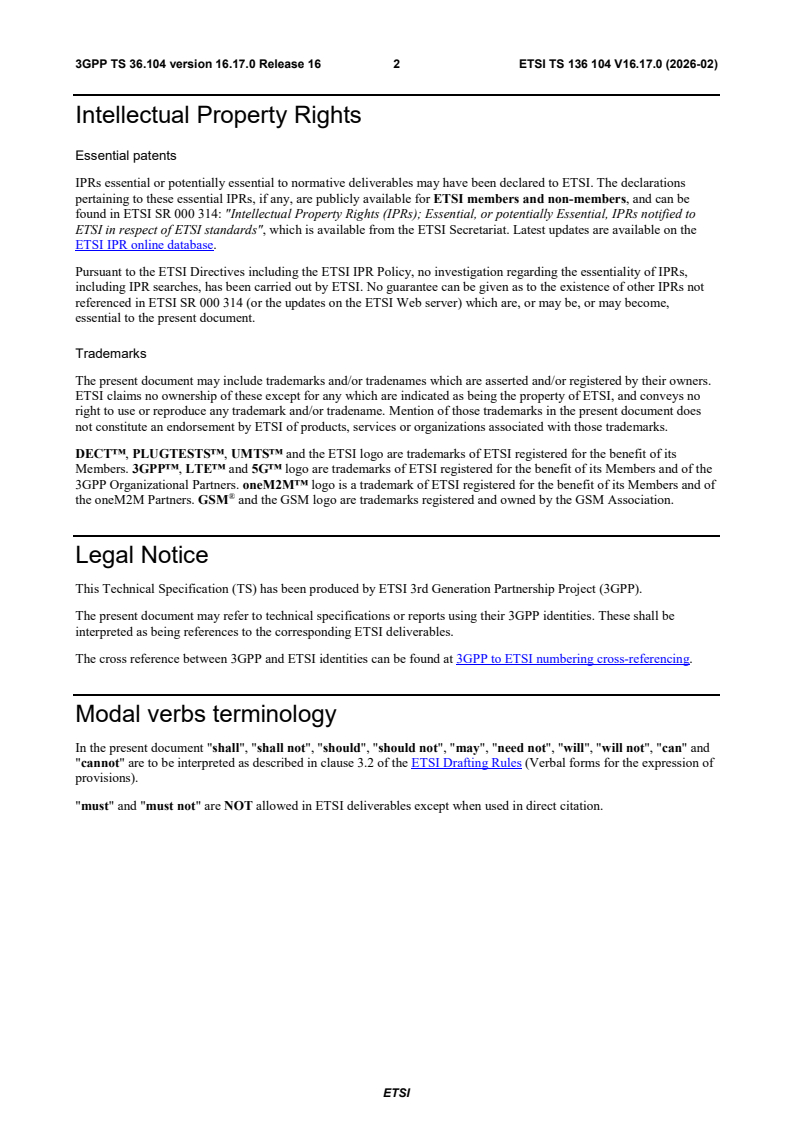
LTE; Evolved Universal Terrestrial Radio Access (E-UTRA); Base Station (BS) radio transmission and reception (3GPP TS 36.104 version 16.17.0 Release 16)
LTE; Evolved Universal Terrestrial Radio Access (E-UTRA); Base Station (BS) radio transmission and reception (3GPP TS 36.104 version 16.17.0 Release 16)
RTS/TSGR-0436104vgh0
General Information
- Status
- Not Published
- Technical Committee
- 3GPP RAN 4 - Specification for radio performance
- Current Stage
- 12 - Citation in the OJ (auto-insert)
- Completion Date
- 12-Feb-2026
Frequently Asked Questions
ETSI TS 136 104 V16.17.0 (2026-02) is a standard published by the European Telecommunications Standards Institute (ETSI). Its full title is "LTE; Evolved Universal Terrestrial Radio Access (E-UTRA); Base Station (BS) radio transmission and reception (3GPP TS 36.104 version 16.17.0 Release 16)". This standard covers: RTS/TSGR-0436104vgh0
RTS/TSGR-0436104vgh0
ETSI TS 136 104 V16.17.0 (2026-02) is available in PDF format for immediate download after purchase. The document can be added to your cart and obtained through the secure checkout process. Digital delivery ensures instant access to the complete standard document.
Standards Content (Sample)
TECHNICAL SPECIFICATION
LTE;
Evolved Universal Terrestrial Radio Access (E-UTRA);
Base Station (BS) radio transmission and reception
(3GPP TS 36.104 version 16.17.0 Release 16)
3GPP TS 36.104 version 16.17.0 Release 16 1 ETSI TS 136 104 V16.17.0 (2026-02)
Reference
RTS/TSGR-0436104vgh0
Keywords
LTE
ETSI
650 Route des Lucioles
F-06921 Sophia Antipolis Cedex - FRANCE
Tel.: +33 4 92 94 42 00 Fax: +33 4 93 65 47 16
Siret N° 348 623 562 00017 - APE 7112B
Association à but non lucratif enregistrée à la
Sous-Préfecture de Grasse (06) N° w061004871
Important notice
The present document can be downloaded from the
ETSI Search & Browse Standards application.
The present document may be made available in electronic versions and/or in print. The content of any electronic and/or
print versions of the present document shall not be modified without the prior written authorization of ETSI. In case of any
existing or perceived difference in contents between such versions and/or in print, the prevailing version of an ETSI
deliverable is the one made publicly available in PDF format on ETSI deliver repository.
Users should be aware that the present document may be revised or have its status changed,
this information is available in the Milestones listing.
If you find errors in the present document, please send your comments to
the relevant service listed under Committee Support Staff.
If you find a security vulnerability in the present document, please report it through our
Coordinated Vulnerability Disclosure (CVD) program.
Notice of disclaimer & limitation of liability
The information provided in the present deliverable is directed solely to professionals who have the appropriate degree of
experience to understand and interpret its content in accordance with generally accepted engineering or
other professional standard and applicable regulations.
No recommendation as to products and services or vendors is made or should be implied.
No representation or warranty is made that this deliverable is technically accurate or sufficient or conforms to any law
and/or governmental rule and/or regulation and further, no representation or warranty is made of merchantability or fitness
for any particular purpose or against infringement of intellectual property rights.
In no event shall ETSI be held liable for loss of profits or any other incidental or consequential damages.
Any software contained in this deliverable is provided "AS IS" with no warranties, express or implied, including but not
limited to, the warranties of merchantability, fitness for a particular purpose and non-infringement of intellectual property
rights and ETSI shall not be held liable in any event for any damages whatsoever (including, without limitation, damages
for loss of profits, business interruption, loss of information, or any other pecuniary loss) arising out of or related to the use
of or inability to use the software.
Copyright Notification
No part may be reproduced or utilized in any form or by any means, electronic or mechanical, including photocopying and
microfilm except as authorized by written permission of ETSI.
The content of the PDF version shall not be modified without the written authorization of ETSI.
The copyright and the foregoing restriction extend to reproduction in all media.
© ETSI 2026.
All rights reserved.
ETSI
3GPP TS 36.104 version 16.17.0 Release 16 2 ETSI TS 136 104 V16.17.0 (2026-02)
Intellectual Property Rights
Essential patents
IPRs essential or potentially essential to normative deliverables may have been declared to ETSI. The declarations
pertaining to these essential IPRs, if any, are publicly available for ETSI members and non-members, and can be
found in ETSI SR 000 314: "Intellectual Property Rights (IPRs); Essential, or potentially Essential, IPRs notified to
ETSI in respect of ETSI standards", which is available from the ETSI Secretariat. Latest updates are available on the
ETSI IPR online database.
Pursuant to the ETSI Directives including the ETSI IPR Policy, no investigation regarding the essentiality of IPRs,
including IPR searches, has been carried out by ETSI. No guarantee can be given as to the existence of other IPRs not
referenced in ETSI SR 000 314 (or the updates on the ETSI Web server) which are, or may be, or may become,
essential to the present document.
Trademarks
The present document may include trademarks and/or tradenames which are asserted and/or registered by their owners.
ETSI claims no ownership of these except for any which are indicated as being the property of ETSI, and conveys no
right to use or reproduce any trademark and/or tradename. Mention of those trademarks in the present document does
not constitute an endorsement by ETSI of products, services or organizations associated with those trademarks.
DECT™, PLUGTESTS™, UMTS™ and the ETSI logo are trademarks of ETSI registered for the benefit of its
Members. 3GPP™, LTE™ and 5G™ logo are trademarks of ETSI registered for the benefit of its Members and of the
3GPP Organizational Partners. oneM2M™ logo is a trademark of ETSI registered for the benefit of its Members and of ®
the oneM2M Partners. GSM and the GSM logo are trademarks registered and owned by the GSM Association.
Legal Notice
This Technical Specification (TS) has been produced by ETSI 3rd Generation Partnership Project (3GPP).
The present document may refer to technical specifications or reports using their 3GPP identities. These shall be
interpreted as being references to the corresponding ETSI deliverables.
The cross reference between 3GPP and ETSI identities can be found at 3GPP to ETSI numbering cross-referencing.
Modal verbs terminology
In the present document "shall", "shall not", "should", "should not", "may", "need not", "will", "will not", "can" and
"cannot" are to be interpreted as described in clause 3.2 of the ETSI Drafting Rules (Verbal forms for the expression of
provisions).
"must" and "must not" are NOT allowed in ETSI deliverables except when used in direct citation.
ETSI
3GPP TS 36.104 version 16.17.0 Release 16 3 ETSI TS 136 104 V16.17.0 (2026-02)
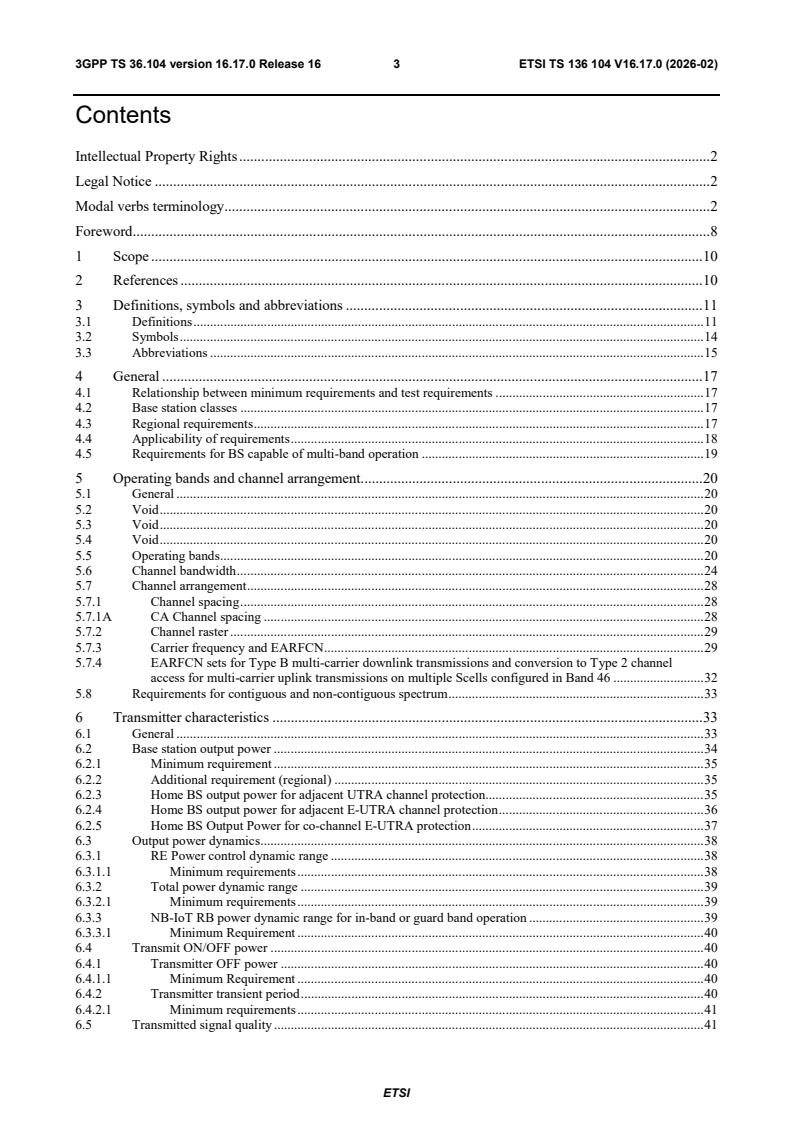
Contents
Intellectual Property Rights . 2
Legal Notice . 2
Modal verbs terminology . 2
Foreword . 8
1 Scope . 10
2 References . 10
3 Definitions, symbols and abbreviations . 11
3.1 Definitions . 11
3.2 Symbols . 14
3.3 Abbreviations . 15
4 General . 17
4.1 Relationship between minimum requirements and test requirements . 17
4.2 Base station classes . 17
4.3 Regional requirements . 17
4.4 Applicability of requirements . 18
4.5 Requirements for BS capable of multi-band operation . 19
5 Operating bands and channel arrangement . 20
5.1 General . 20
5.2 Void . 20
5.3 Void . 20
5.4 Void . 20
5.5 Operating bands . 20
5.6 Channel bandwidth . 24
5.7 Channel arrangement . 28
5.7.1 Channel spacing . 28
5.7.1A CA Channel spacing . 28
5.7.2 Channel raster . 29
5.7.3 Carrier frequency and EARFCN . 29
5.7.4 EARFCN sets for Type B multi-carrier downlink transmissions and conversion to Type 2 channel
access for multi-carrier uplink transmissions on multiple Scells configured in Band 46 . 32
5.8 Requirements for contiguous and non-contiguous spectrum . 33
6 Transmitter characteristics . 33
6.1 General . 33
6.2 Base station output power . 34
6.2.1 Minimum requirement . 35
6.2.2 Additional requirement (regional) . 35
6.2.3 Home BS output power for adjacent UTRA channel protection. 35
6.2.4 Home BS output power for adjacent E-UTRA channel protection . 36
6.2.5 Home BS Output Power for co-channel E-UTRA protection . 37
6.3 Output power dynamics . 38
6.3.1 RE Power control dynamic range . 38
6.3.1.1 Minimum requirements . 38
6.3.2 Total power dynamic range . 39
6.3.2.1 Minimum requirements . 39
6.3.3 NB-IoT RB power dynamic range for in-band or guard band operation . 39
6.3.3.1 Minimum Requirement . 40
6.4 Transmit ON/OFF power . 40
6.4.1 Transmitter OFF power . 40
6.4.1.1 Minimum Requirement . 40
6.4.2 Transmitter transient period . 40
6.4.2.1 Minimum requirements . 41
6.5 Transmitted signal quality . 41
ETSI
3GPP TS 36.104 version 16.17.0 Release 16 4 ETSI TS 136 104 V16.17.0 (2026-02)
6.5.1 Frequency error . 41
6.5.1.1 Minimum requirement . 41
6.5.2 Error Vector Magnitude . 42
6.5.3 Time alignment error . 42
6.5.3.1 Minimum Requirement . 42
6.5.4 DL RS power . 43
6.5.4.1 Minimum requirements . 43
6.6 Unwanted emissions . 43
6.6.1 Occupied bandwidth . 43
6.6.1.1 Minimum requirement . 44
6.6.2 Adjacent Channel Leakage power Ratio (ACLR) . 44
6.6.2.1 Minimum requirement . 44
6.6.2.2 Cumulative ACLR requirement in non-contiguous spectrum . 47
6.6.3 Operating band unwanted emissions . 48
6.6.3.1 Minimum requirements for Wide Area BS (Category A) . 50
6.6.3.2 Minimum requirements for Wide Area BS (Category B) . 53
6.6.3.2.1 Category B requirements (Option 1) . 53
6.6.3.2.2 Category B (Option 2) . 57
6.6.3.2A Minimum requirements for Local Area BS (Category A and B) . 59
6.6.3.2B Minimum requirements for Home BS (Category A and B) . 60
6.6.3.2C Minimum requirements for Medium Range BS (Category A and B) . 61
6.6.3.2D Minimum requirements for Local Area and Medium Range BS in Band 46 (Category A and B) . 64
6.6.3.2E Minimum requirements for standalone NB-IoT Wide Area BS . 65
6.6.3.2F Minimum requirements for standalone NB-IoT Local Area BS . 65
6.6.3.2G Minimum requirements for standalone NB-IoT Home BS (Category A and B) . 66
6.6.3.2H Minimum requirements for standalone NB-IoT Medium Range BS . 68
6.6.3.3 Additional requirements . 69
6.6.4 Transmitter spurious emis sions . 74
6.6.4.1 Mandatory Requirements . 75
6.6.4.1.1 Spurious emissions (Category A) . 75
6.6.4.1.2 Spurious emissions (Category B) . 75
6.6.4.2 Protection of the BS receiver of own or different BS . 75
6.6.4.2.1 Minimum Requirement . 76
6.6.4.3 Additional spurious emissions requirements . 76
6.6.4.3.1 Minimum Requirement . 76
6.6.4.4 Co-location with other base stations . 91
6.6.4.4.1 Minimum Requirement . 91
6.7 Transmitter intermodulation . 104
6.7.1 Minimum requirement . 104
6.7.2 Additional requirement for Band 41 . 105
7 Receiver characteristics . 106
7.1 General . 106
7.2 Reference sensitivity level . 106
7.2.1 Minimum requirement . 106
7.3 Dynamic range . 111
7.3.1 Minimum requirement . 112
7.4 In-channel selectivity . 118
7.4.1 Minimum requirement . 118
7.5 Adjacent Channel Selectivity (ACS) and narrow-band blocking . 125
7.5.1 Minimum requirement . 125
7.6 Blocking . 136
7.6.1 General blocking requirement. 136
7.6.1.1 Minimum requirement . 136
7.6.2 Co-location with other base stations . 152
7.6.2.1 Minimum requirement . 152
7.6.3 Additional requirement (regional) . 164
7.7 Receiver spurious emissions. 164
7.7.1 Minimum requirement . 164
7.8 Receiver intermodulation . 165
7.8.1 Minimum requirement . 165
ETSI
3GPP TS 36.104 version 16.17.0 Release 16 5 ETSI TS 136 104 V16.17.0 (2026-02)
8 Performance requirement . 180
8.1 General . 180
8.2 Performance requirements for PUSCH . 180
8.2.1 Requirements in multipath fading propagation conditions . 180
8.2.1.1 Minimum requirements . 181
8.2.2 Requirements for UL timing adjustment . 200
8.2.2.1 Minimum requirements . 201
8.2.3 Requirements for high speed train . 201
8.2.3.1 Minimum requirements . 202
8.2.4 Requirements for HARQ-ACK multiplexed on PUSCH . 205
8.2.4.1 Minimum requirement . 205
8.2.5 Requirements for PUSCH with TTI bundling and enhanced HARQ pattern . 206
8.2.5.1 Minimum requirements . 207
8.2.6 Enhanced performance requirement type A in multipath fading propagation conditions with
synchronous interference . 207
8.2.6.1 Minimum requirements . 208
8.2.6A Enhanced performance requirement type A in multipath fading propagation conditions with
asynchronous interference . 209
8.2.6A.1 Minimum requirements . 210
8.2.7 Requirements for PUSCH supporting coverage enhancement . 212
8.2.8 Requirements for PUSCH of Frame structure type 3 . 213
8.2.9 Enhanced performance requirement type B in multipath fading propagation conditions . 214
8.2.9.1 Minimum requirements . 216
8.2.10 Requirements for PUSCH supporting subPRB transmission . 218
8.3 Performance requirements for PUCCH . 220
8.3.1 DTX to ACK performance . 220
8.3.1.1 Minimum requirement . 220
8.3.2 ACK missed detection requirements for single user PUCCH format 1a . 220
8.3.2.1 Minimum requirements . 221
8.3.3 CQI performance requirements for PUCCH format 2 . 221
8.3.3.1 Minimum requirements . 221
8.3.4 ACK missed detection requirements for multi user PUCCH format 1a . 222
8.3.4.1 Minimum requirement . 222
8.3.5 ACK missed detection requirements for PUCCH format 1b with Channel Selection . 222
8.3.5.1 Minimum requirements . 223
8.3.6 ACK missed detection requirements for PUCCH format 3 . 223
8.3.6.1 Minimum requirements . 223
8.3.7 NACK to ACK requirements for PUCCH format 3 . 224
8.3.7.1 Minimum requirement . 224
8.3.8 CQI performance requirements for PUCCH format 2 with DTX detection . 224
8.3.8.1 Minimum requirements . 225
8.3.9 PUCCH performance requirements for coverage enhancement . 225
8.3.9.1 DTX to ACK performance . 225
8.3.9.1.1 Minimum requirement . 225
8.3.9.2 ACK missed detection requirements for single user PUCCH format 1a . 225
8.3.9.2.1 Minimum requirements . 226
8.3.9.3 CQI performance requirements for PUCCH format 2 . 226
8.3.9.3.1 Minimum requirements . 226
8.3.10 ACK missed detection requirements for PUCCH format 4 . 226
8.3.10.1 Minimum requirements . 227
8.3.11 ACK missed detection requirements for PUCCH format 5 . 227
8.3.11.1 Minimum requirements . 227
8.4 Performance requirements for PRACH . 228
8.4.1 PRACH False alarm probability . 228
8.4.1.1 Minimum requirement . 228
8.4.2 PRACH detection requirements . 228
8.4.2.1 Minimum requirements . 228
8.5 Performance requirements for Narrowband IoT . 230
8.5.1 Requirements for NPUSCH format 1 . 230
8.5.1.1 Requirements . 230
8.5.1.1.1 Minimum requirements . 231
8.5.2 Performance requirements for NPUSCH format 2 . 232
ETSI
3GPP TS 36.104 version 16.17.0 Release 16 6 ETSI TS 136 104 V16.17.0 (2026-02)
8.5.2.1 DTX to ACK performance . 232
8.5.2.1.1 Minimum requirement . 232
8.5.2.2 ACK missed detection requirements . 232
8.5.2.2.1 Minimum requirements . 232
8.5.3 Performance requirements for NPRACH . 233
8.5.3.1 NPRACH False alarm probability . 233
8.5.3.1.1 Minimum requirement . 233
8.5.3.2 NPRACH detection requirements . 233
8.5.3.2.1 Minimum requirements . 234
8.6 Performance requirements for subslot-PUSCH . 234
8.6.1 Requirements . 234
8.6.1.1 Minimum requirements . 234
8.7 Performance requirements for SPUCCH . 235
8.7.1 ACK missed detection requirements for single user SPUCCH format 1a . 235
8.7.1.1 Minimum requirements . 235
8.7.2 ACK missed detection requirements for SPUCCH format 4 . 236
8.7.2.1 Minimum requirements . 236
9 Void . 237
Annex A (normative): Reference measurement channels . 238
A.1 Fixed Reference Channels for reference sensitivity and in-channel selectivity (QPSK, R=1/3) . 239
A.2 Fixed Reference Channels for dynamic range (16QAM, R=2/3) . 240
A.3 Fixed Reference Channels for performance requirements (QPSK 1/3) . 240
A.4 Fixed Reference Channels for performance requirements (16QAM 3/4) . 241
A.5 Fixed Reference Channels for performance requirements (64QAM 5/6) . 241
A.6 PRACH Test preambles . 241
A.7 Fixed Reference Channels for UL timing adjustment (Scenario 1) . 242
A.8 Fixed Reference Channels for UL timing adjustment (Scenario 2) . 243
A.9 Multi user PUCCH test. 243
A.10 PUCCH transmission on two antenna ports test . 243
A.11 Fixed Reference Channel for PUSCH with TTI bundling and enhanced HARQ pattern . 244
A.12 Fixed Reference Channels for performance requirements (QPSK 0.36) . 244
A.13 Fixed Reference Channels for performance requirements (16QAM 1/2) . 245
A.14 Fixed Reference Channels for NB-IOT reference sensitivity (π/2 BPSK, R=1/3) . 245
A.15 Fixed Reference Channels for NB-IoT dynamic range (π/4 QPSK, R=2/3) . 245
A.16 Fixed Reference Channels for NB-IoT NPUSCH format 1 . 246
A.16.1 One PRB . 246
A.17 Fixed Reference Channels for performance requirements (256QAM 5/6) . 247
A.18 Fixed Reference Channels for PUSCH transmission in UpPTS (16QAM 0.65) . 247
A.19 Fixed Reference Channels for PUSCH transmission in UpPTS (256QAM 0.69) . 248
A.20 Fixed Reference Channels for PUSCH of Frame structure type 3 . 248
A.21 Fixed Reference Channels for performance requirements (QPSK 3/5) . 249
A.22 Fixed Reference Channels for performance requirements (64QAM 1/2) . 250
A.23 Fixed Reference Channels for SubPRB allocation reference sensitivity (π/2 BPSK, R=1/3) . 250
A.24 Fixed Reference Channel for subslot-PUSCH . 251
A.25 Fixed Reference Channels for PUSCH with SubPRB transmission . 251
ETSI
3GPP TS 36.104 version 16.17.0 Release 16 7 ETSI TS 136 104 V16.17.0 (2026-02)
Annex B (normative): Propagation conditions . 252
B.1 Static propagation condition . 252
B.2 Multi-path fading propagation conditions . 252
B.3 High speed train condition . 253
B.4 Moving propagation conditions . 257
B.5 Multi-Antenna channel models . 258
B.5.1 Definition of MIMO Correlation Matrices . 258
B.5.2 MIMO Correlation Matrices at High, Medium and Low Level . 259
B.5A Multi-Antenna channel models using cross polarized antennas . 261
B.5A.1 Definition of MIMO Correlation Matrices using cross polarized antennas. 262
B.5A.2 Spatial Correlation Matrices at UE and eNB sides . 262
B.5A.2.1 Spatial Correlation Matrices at UE side . 262
B.5A.2.2 Spatial Correlation Matrices at eNB side . 263
B.5A.3 MIMO Correlation Matrices using cross polarized antennas . 263
B.6 Interference model for enhanced performance requirements type A and type B . 263
B.6.1 Dominant interferer proportion . 263
B.6.2 Interference model for synchronous scenario . 264
B.6.3 Interference model for asynchronous scenario . 264
Annex C (normative): Characteristics of the interfering signals . 265
Annex D (normative): Environmental requirements for the BS equipment . 266
Annex E (normative): Error Vector Magnitude . 267
E.1 Reference point for measurement . 267
E.2 Basic unit of measurement . 267
E.3 Modified signal under test . 268
E.4 Estimation of frequency offset . 268
E.5 Estimation of time offset . 268
E.5.1 Window length . 269
E.6 Estimation of TX chain amplitude and frequency response parameters . 271
E.7 Averaged EVM . 272
Annex F (Informative): Unwanted emission requirements for multi-carrier BS . 274
F.1 General . 274
F.2 Multi-carrier BS of different E-UTRA channel bandwidths . 274
F.3 Multi-carrier BS of E-UTRA and UTRA . . 274
Annex G (Informative): Regional requirement for protection of DTT . 275
G.1 Regional requirement for protection of DTT . 275
G.2 Regional requirement for Public Safety LTE BS in Korea . 275
Annex H (Informative): Calculation of EIRP based on manufacturer declarations and site
specific conditions . 278
H.1 Calculation of EIRP based on manufacturer declarations and site specific conditions . 278
Annex I (Informative): Change history . 279
History . 294
ETSI
...
Questions, Comments and Discussion
Ask us and Technical Secretary will try to provide an answer. You can facilitate discussion about the standard in here.
Loading comments...