


ETSI EN 300 392-12-22 V1.7.1 (2026-07)
Terrestrial Trunked Radio (TETRA); Voice plus Data (V+D); Part 12: Supplementary services stage 3; Sub-part 22: Dynamic Group Number Assignment (DGNA)
General Information
- Abstract
REN/TCCE-03280
- Status
- Not Published
- Technical Committee
- TCCE 3 - TCCE Air Interface and Network Protocols
- Current Stage
- 12 - Citation in the OJ (auto-insert)
- Due Date
- 07-Jul-2026
- Completion Date
- 30-Jul-2026
Buy Documents
ETSI EN 300 392-12-22 V1.7.0 (2026-03) - Terrestrial Trunked Radio (TETRA); Voice plus Data (V+D); Part 12: Supplementary services stage 3; Sub-part 22: Dynamic Group Number Assignment (DGNA)
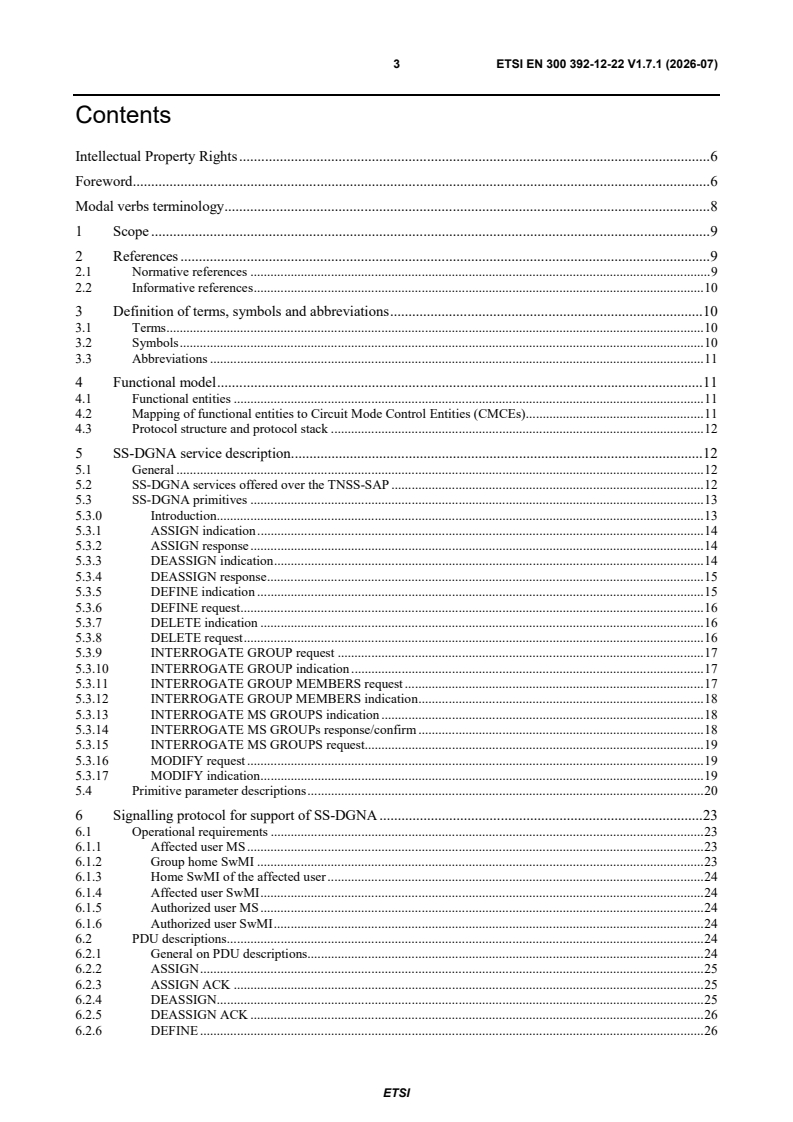
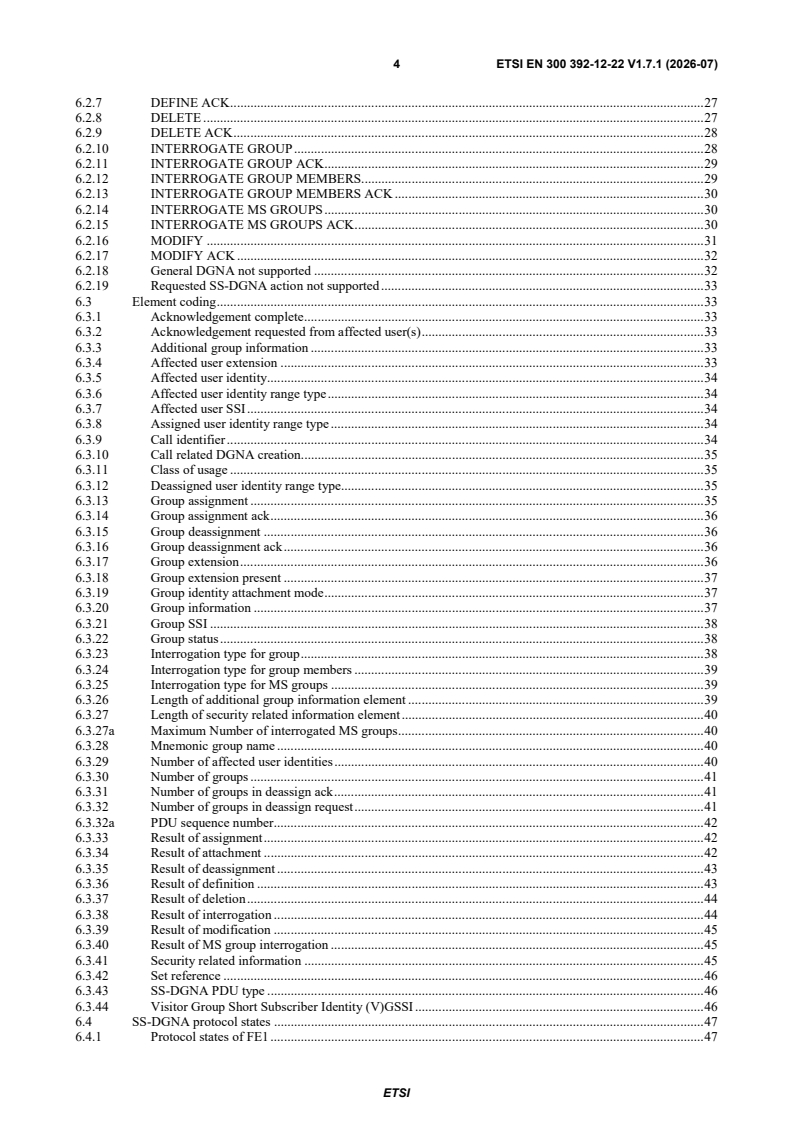
ETSI EN 300 392-12-22 V1.7.1 (2026-07) - Terrestrial Trunked Radio (TETRA); Voice plus Data (V+D); Part 12: Supplementary services stage 3; Sub-part 22: Dynamic Group Number Assignment (DGNA)

Buy Documents
ETSI EN 300 392-12-22 V1.7.0 (2026-03) - Terrestrial Trunked Radio (TETRA); Voice plus Data (V+D); Part 12: Supplementary services stage 3; Sub-part 22: Dynamic Group Number Assignment (DGNA)
ETSI EN 300 392-12-22 V1.7.1 (2026-07) - Terrestrial Trunked Radio (TETRA); Voice plus Data (V+D); Part 12: Supplementary services stage 3; Sub-part 22: Dynamic Group Number Assignment (DGNA)
Frequently Asked Questions
ETSI EN 300 392-12-22 V1.7.1 (2026-07) is a standard published by the European Telecommunications Standards Institute (ETSI). Its full title is "Terrestrial Trunked Radio (TETRA); Voice plus Data (V+D); Part 12: Supplementary services stage 3; Sub-part 22: Dynamic Group Number Assignment (DGNA)". This standard covers: REN/TCCE-03280
REN/TCCE-03280
ETSI EN 300 392-12-22 V1.7.1 (2026-07) is available in PDF format for immediate download after purchase. The document can be added to your cart and obtained through the secure checkout process. Digital delivery ensures instant access to the complete standard document.
Standards Content (Sample)
Draft ETSI EN 300 392-12-22 V1.7.0 (2026-03)
EUROPEAN STANDARD
Terrestrial Trunked Radio (TETRA);
Voice plus Data (V+D);
Part 12: Supplementary services stage 3;
Sub-part 22: Dynamic Group Number Assignment (DGNA)
2 Draft ETSI EN 300 392-12-22 V1.7.0 (2026-03)
Reference
REN/TCCE-03280
Keywords
data, radio, speech, stage 3, supplementary
service, TETRA, V+D
ETSI
650 Route des Lucioles
F-06921 Sophia Antipolis Cedex - FRANCE
Tel.: +33 4 92 94 42 00 Fax: +33 4 93 65 47 16
Siret N° 348 623 562 00017 - APE 7112B
Association à but non lucratif enregistrée à la
Sous-Préfecture de Grasse (06) N° w061004871
Important notice
The present document can be downloaded from the
ETSI Search & Browse Standards application.
The present document may be made available in electronic versions and/or in print. The content of any electronic and/or
print versions of the present document shall not be modified without the prior written authorization of ETSI. In case of any
existing or perceived difference in contents between such versions and/or in print, the prevailing version of an ETSI
deliverable is the one made publicly available in PDF format on ETSI deliver repository.
Users should be aware that the present document may be revised or have its status changed,
this information is available in the Milestones listing.
If you find errors in the present document, please send your comments to
the relevant service listed under Committee Support Staff.
If you find a security vulnerability in the present document, please report it through our
Coordinated Vulnerability Disclosure (CVD) program.
Notice of disclaimer & limitation of liability
The information provided in the present deliverable is directed solely to professionals who have the appropriate degree of
experience to understand and interpret its content in accordance with generally accepted engineering or
other professional standard and applicable regulations.
No recommendation as to products and services or vendors is made or should be implied.
In no event shall ETSI be held liable for loss of profits or any other incidental or consequential damages.
Any software contained in this deliverable is provided "AS IS" with no warranties, express or implied, including but not
limited to, the warranties of merchantability, fitness for a particular purpose and non-infringement of intellectual property
rights and ETSI shall not be held liable in any event for any damages whatsoever (including, without limitation, damages
for loss of profits, business interruption, loss of information, or any other pecuniary loss) arising out of or related to the use
of or inability to use the software.
Copyright Notification
No part may be reproduced or utilized in any form or by any means, electronic or mechanical, including photocopying and
microfilm except as authorized by written permission of ETSI.
The content of the PDF version shall not be modified without the written authorization of ETSI.
The copyright and the foregoing restriction extend to reproduction in all media.
© ETSI 2026.
All rights reserved.
ETSI
3 Draft ETSI EN 300 392-12-22 V1.7.0 (2026-03)
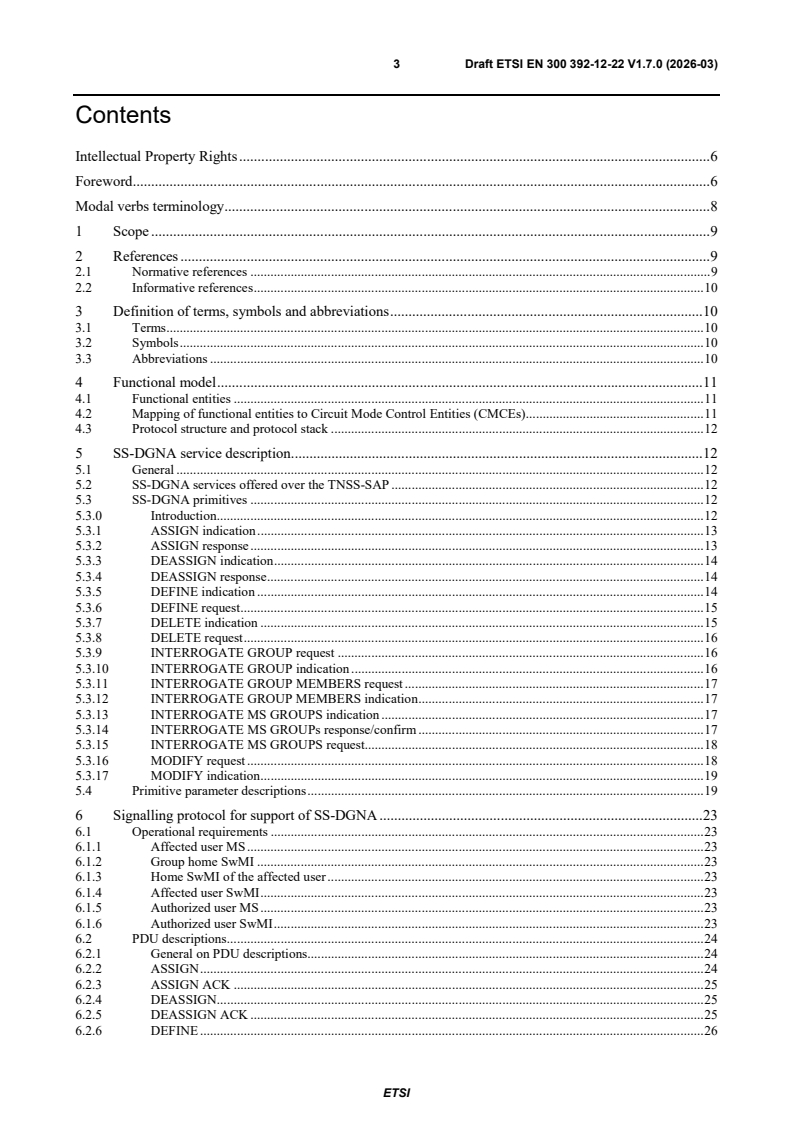
Contents
Intellectual Property Rights . 6
Foreword . 6
Modal verbs terminology . 8
1 Scope . 9
2 References . 9
2.1 Normative references . 9
2.2 Informative references . 10
3 Definition of terms, symbols and abbreviations . 10
3.1 Terms . 10
3.2 Symbols . 10
3.3 Abbreviations . 10
4 Functional model . 11
4.1 Functional entities . 11
4.2 Mapping of functional entities to Circuit Mode Control Entities (CMCEs). 11
4.3 Protocol structure and protocol stack . 12
5 SS-DGNA service description . 12
5.1 General . 12
5.2 SS-DGNA services offered over the TNSS-SAP . 12
5.3 SS-DGNA primitives . 12
5.3.0 Introduction. 12
5.3.1 ASSIGN indication . 13
5.3.2 ASSIGN response . 13
5.3.3 DEASSIGN indication . 14
5.3.4 DEASSIGN response . 14
5.3.5 DEFINE indication . 14
5.3.6 DEFINE request . 15
5.3.7 DELETE indication . 15
5.3.8 DELETE request . 16
5.3.9 INTERROGATE GROUP request . 16
5.3.10 INTERROGATE GROUP indication . 16
5.3.11 INTERROGATE GROUP MEMBERS request . 17
5.3.12 INTERROGATE GROUP MEMBERS indication . 17
5.3.13 INTERROGATE MS GROUPS indication . 17
5.3.14 INTERROGATE MS GROUPs response/confirm . 17
5.3.15 INTERROGATE MS GROUPS request. 18
5.3.16 MODIFY request . 18
5.3.17 MODIFY indication . 19
5.4 Primitive parameter descriptions . 19
6 Signalling protocol for support of SS-DGNA . 23
6.1 Operational requirements . 23
6.1.1 Affected user MS . 23
6.1.2 Group home SwMI . 23
6.1.3 Home SwMI of the affected user . 23
6.1.4 Affected user SwMI . 23
6.1.5 Authorized user MS . 23
6.1.6 Authorized user SwMI . 23
6.2 PDU descriptions . 24
6.2.1 General on PDU descriptions. 24
6.2.2 ASSIGN . 24
6.2.3 ASSIGN ACK . 25
6.2.4 DEASSIGN. 25
6.2.5 DEASSIGN ACK . 25
6.2.6 DEFINE . 26
ETSI
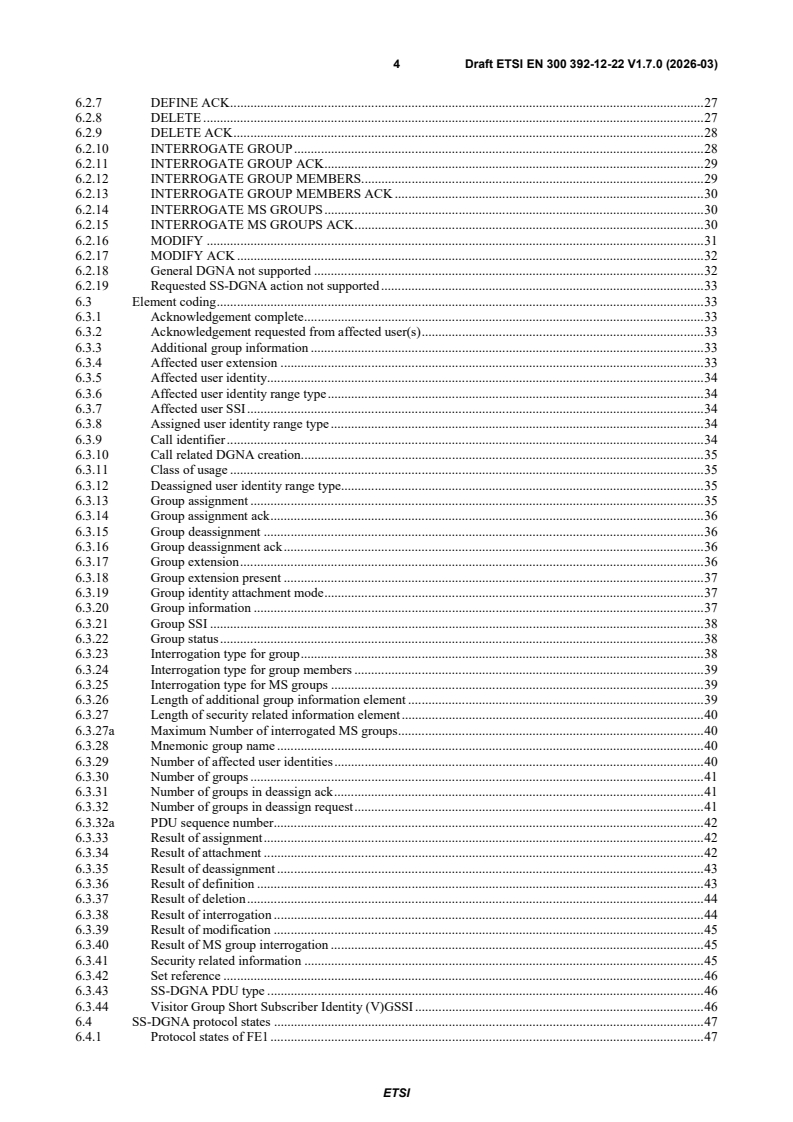
4 Draft ETSI EN 300 392-12-22 V1.7.0 (2026-03)
6.2.7 DEFINE ACK . 27
6.2.8 DELETE . 27
6.2.9 DELETE ACK . 28
6.2.10 INTERROGATE GROUP . 28
6.2.11 INTERROGATE GROUP ACK . 29
6.2.12 INTERROGATE GROUP MEMBERS. 29
6.2.13 INTERROGATE GROUP MEMBERS ACK . 30
6.2.14 INTERROGATE MS GROUPS . 30
6.2.15 INTERROGATE MS GROUPS ACK . 30
6.2.16 MODIFY . 31
6.2.17 MODIFY ACK . 32
6.2.18 General DGNA not supported . 32
6.2.19 Requested SS-DGNA action not supported . 33
6.3 Element coding . 33
6.3.1 Acknowledgement complete . 33
6.3.2 Acknowledgement requested from affected user(s) . 33
6.3.3 Additional group information . 33
6.3.4 Affected user extension . 33
6.3.5 Affected user identity. 34
6.3.6 Affected user identity range type . 34
6.3.7 Affected user SSI . 34
6.3.8 Assigned user identity range type . 34
6.3.9 Call identifier . 34
6.3.10 Call related DGNA creation. 35
6.3.11 Class of usage . 35
6.3.12 Deassigned user identity range type. 35
6.3.13 Group assignment . 35
6.3.14 Group assignment ack . 36
6.3.15 Group deassignment . 36
6.3.16 Group deassignment ack . 36
6.3.17 Group extension . 36
6.3.18 Group extension present . 37
6.3.19 Group identity attachment mode . 37
6.3.20 Group information . 37
6.3.21 Group SSI . 38
6.3.22 Group status . 38
6.3.23 Interrogation type for group . 38
6.3.24 Interrogation type for group members . 39
6.3.25 Interrogation type for MS groups . 39
6.3.26 Length of additional group information element . 39
6.3.27 Length of security related information element . 40
6.3.27a Maximum Number of interrogated MS groups . 40
6.3.28 Mnemonic group name . 40
6.3.29 Number of affected user identities . 40
6.3.30 Number of groups . 41
6.3.31 Number of groups in deassign ack . 41
6.3.32 Number of groups in deassign request . 41
6.3.32a PDU sequence number . 42
6.3.33 Result of assignment . 42
6.3.34 Result of attachment . 42
6.3.35 Result of deassignment . 43
6.3.36 Result of definition . 43
6.3.37 Result of deletion . 44
6.3.38 Result of interrogation . 44
6.3.39 Result of modification . 45
6.3.40 Result of MS group interrogation . 45
6.3.41 Security related information . 45
6.3.42 Set reference . 46
6.3.43 SS-DGNA PDU type . 46
6.3.44 Visitor Group Short Subscriber Identity (V)GSSI . 46
6.4 SS-DGNA protocol states . 47
6.4.1 Protocol states of FE1 . 47
ETSI
5 Draft ETSI EN 300 392-12-22 V1.7.0 (2026-03)
6.4.2 Protocol states of FE2 . 47
6.4.3 Protocol states of FE3 . 47
6.4.4 Protocol states of FE2 in visited SwMI . 47
6.5 SS-DGNA signalling procedures . 47
6.5.1 PDU addressing . 47
6.5.2 Signalling procedures of FE1 (affected user). 47
6.5.2.1 Assignment. 47
6.5.2.2 Deassignment . 48
6.5.2.3 Interrogation of group parameters . 49
6.5.2.4 Interrogation of MS groups by SwMI . 49
6.5.3 Signalling procedures of FE2 (SwMI) . 50
6.5.3.1 General on procedures for FE2 . 50
6.5.3.2 Definition . 50
6.5.3.3 Deletion . 51
6.5.3.4 Modification . 51
6.5.3.5 Assignment. 52
6.5.3.6 Deassignment . 52
6.5.3.7 Interrogation of group information . 52
6.5.3.8 Interrogation of group members . 52
6.5.3.9 Interrogation of MS groups from affected user . 53
6.5.3.10 Interrogation of MS groups request from authorized user . 53
6.5.4 Signalling procedures of FE3 (authorized user). 54
6.5.4.1 Definition . 54
6.5.4.2 Modification . 54
6.5.4.3 Deletion . 55
6.5.4.4 Interrogation of group members . 55
6.5.4.5 Interrogation of MS groups . 55
6.5.4.6 Interrogation of group information . 55
6.5.5 Signalling procedures of FE2 in a visited SwMI . 55
6.6 Protocol timers . 56
6.7 Inter-working considerations . 56
6.7.1 Inter system interface . 56
6.7.1.1 Basic requirements to ISI support . 56
6.7.1.2 Assignment. 56
6.7.1.3 Deassignment . 56
6.7.1.4 Definition, deletion, modification . 57
6.7.1.5 Interrogation . 57
6.7.2 Gateways . 57
Annex A (informative): Bibliography . 58
Annex B (informative): Change requests . 59
History . 60
ETSI
6 Draft ETSI EN 300 392-12-22 V1.7.0 (2026-03)
Intellectual Property Rights
Essential patents
IPRs essential or potentially essential to normative deliverables may have been declared to ETSI. The declarations
pertaining to these essential IPRs, if any, are publicly available for ETSI members and non-members, and can be
found in ETSI SR 000 314: "Intellectual Property Rights (IPRs); Essential, or potentially Essential, IPRs notified to
ETSI in respect of ETSI standards", which is available from the ETSI Secretariat. Latest updates are available on the
ETSI IPR online database.
Pursuant to the ETSI Directives including the ETSI IPR Policy, no investigation regarding the essentiality of IPRs,
including IPR searches, has been carried out by ETSI. No guarantee can be given as to the existence of other IPRs not
referenced in ETSI SR 000 314 (or the updates on the ETSI Web server) which are, or may be, or may become,
essential to the present document.
Trademarks
The present document may include trademarks and/or tradenames which are asserted and/or registered by their owners.
ETSI claims no ownership of these except for any which are indicated as being the property of ETSI, and conveys no
right to use or reproduce any trademark and/or tradename. Mention of those trademarks in the present document does
not constitute an endorsement by ETSI of products, services or organizations associated with those trademarks.
DECT™, PLUGTESTS™, UMTS™ and the ETSI logo are trademarks of ETSI registered for the benefit of its
Members. 3GPP™, LTE™ and 5G™ logo are trademarks of ETSI registered for the benefit of its Members and of the
3GPP Organizational Partners. oneM2M™ logo is a trademark of ETSI registered for the benefit of its Members and of ®
the oneM2M Partners. GSM and the GSM logo are trademarks registered and owned by the GSM Association.
Foreword
This draft European Standard (EN) has been produced by ETSI Technical Committee TETRA and Critical
Communications Evolution (TCCE), and is now submitted for the combined Public Enquiry and Vote phase of the
ETSI EN Approval Procedure (ENAP).
Proposed national transposition dates
Date of latest announcement of this EN (doa): 3 months after ETSI publication
Date of latest publication of new National Standard
or endorsement of this EN (dop/e): 6 months after doa
Date of withdrawal of any conflicting National Standard (dow): 6 months after doa
The present document is part 12, sub-part 22 of a multi-part deliverable covering Terrestrial Trunked Radio (TETRA);
Voice plus Data (V+D), as identified below:
Part 1: "General network design";
Part 2: "Air Interface (AI)";
Part 3: "Interworking at the Inter-System Interface (ISI)":
Part 4: "Gateways basic operation";
Part 5: "Peripheral Equipment Interface (PEI)";
Part 7: "Security";
Part 9: "General requirements for supplementary services";
ETSI
7 Draft ETSI EN 300 392-12-22 V1.7.0 (2026-03)
Part 10: "Supplementary services stage 1";
Part 11: "Supplementary services stage 2";
Part 12: "Supplementary services stage 3";
Sub-part 1: "Call Identification (CI)";
Sub-part 2: "Call Report (CR)";
Sub-part 3: "Talking Party Identification (TPI)";
Sub-part 4: "Call Forwarding (CF)";
Sub-part 5: "List Search Call (LSC)";
Sub-part 6: "Call Authorized by Dispatcher (CAD)";
Sub-part 7: "Short Number Addressing (SNA)";
Sub-part 8: "Area Selection (AS)";
Sub-part 9: "Access Priority (AP)";
Sub-part 10: "Priority Call (PC)";
Sub-part 11:"Call Waiting (CW)";
Sub-part 12: "Call Hold (HOLD)";
Sub-part 13: "Call Completion to Busy Subscriber (CCBS)";
Sub-part 14: "Late Entry (LE)";
Sub-part 16: "Pre-emptive Priority Call (PPC)";
Sub-part 17: "Include Call (IC)";
Sub-part 18: "Barring of Outgoing Calls (BOC)";
Sub-part 19: "Barring of Incoming Calls (BIC)";
Sub-part 20: "Discreet Listening (DL)";
Sub-part 21: "Ambience Listening (AL)";
Sub-part 22: "Dynamic Group Number Assignment (DGNA)";
Sub-part 23: "Call Completion on No Reply (CCNR)";
Sub-part 24:"Call Retention (CRT)";
Part 13: "SDL model of the Air Interface (AI)";
Part 14: "Protocol Implementation Conformance Statement (PICS) proforma specification";
Part 15: "TETRA frequency bands, duplex spacings and channel numbering";
Part 16: "Network Performance Metrics";
Part 17: "TETRA V+D and DMO specifications";
Part 18: "Air interface optimized applications";
Part 19: "Interworking between TETRA and Broadband systems".
NOTE 1: Part 3, sub-parts 6 and 7 (Speech format implementation), part 4, sub-part 3 (Data networks gateway),
part 10, sub-part 15 (Transfer of control), part 13 (SDL) and part 14 (PICS) of this multi-part deliverable
are in status "historical" and are not maintained.
ETSI
8 Draft ETSI EN 300 392-12-22 V1.7.0 (2026-03)
NOTE 2: Some parts are also published as Technical Specifications such as ETSI TS 100 392-2 and those may be
the latest version of the document.
Modal verbs terminology
In the present document "shall", "shall not", "should", "should not", "may", "need not", "will", "will not", "can" and
"cannot" are to be interpreted as described in clause 3.2 of the ETSI Drafting Rules (Verbal forms for the expression of
provisions).
"must" and "must not" are NOT allowed in ETSI deliverables except when used in direct citation.
ETSI
9 Draft ETSI EN 300 392-12-22 V1.7.0 (2026-03)
1 Scope
The present document defines the stage 3 specifications of the Supplementary Service Dynamic Group Number
Assignment (SS-DGNA) for the Terrestrial Trunked Radio (TETRA).
The SS-DGNA enables a user to dynamically define group identities and group related parameters to the TETRA
system and to the subscribers in the system. These definitions are used to enable group call invocations to dynamically
defined groups. The SS-DGNA specification defines the creation, modification, deletion and interrogation of group
definitions in the Switching and Management Infrastructure (SwMI), in the Mobile Station (MS).
The present document does not include the specification for access priority used for random access in uplink and call
priority used by SwMI for resource allocation in a group call. Access priority and call priority can be specified and
applied for groups using Supplementary Services Access Priority (SS-AP), Priority Call (SS-PC) and Pre-emptive
Priority Call (SS-PPC). Thus, the definition procedure of these priorities is outside the scope of the present document.
Man Machine Interface (MMI) and charging principles are also outside the scope of the present document.
Supplementary service stage 3 specification is preceded by the stage 1 and the stage 2 specifications of the service.
Stage 1 describes the functional capabilities from the user's point of view. Stage 2 defines the functional behaviour in
terms of functional entities and information flows. Stage 3 gives the precise description of the supplementary service
from the implementation point of view. It defines the protocols for the service and the encoding rules for the
information flows. It defines the processes for the functional entities and their behaviour. The described protocols and
their behaviour apply for the SwMI and for the MS and can be applied over the Inter-System Interface (ISI) between
TETRA systems.
2 References
2.1 Normative references
References are either specific (identified by date of publication and/or edition number or version number) or
non-specific. For specific references, only the cited version applies. For non-specific references, the latest version of the
referenced document (including any amendments) applies.
Referenced documents which are not found to be publicly available in the expected location might be found in the
ETSI docbox.
NOTE 1: While any hyperlinks included in this clause were valid at the time of publication, ETSI cannot guarantee
their long-term validity.
NOTE 2: Note that for the TETRA standards, the reference is always to a European Standard (ETSI EN 300 xxx) if
such has been published, but the latest version of that standard can be either an EN or a Technical
Specification (ETSI TS 100 xxx), even if this is not visible in the reference list.
The following referenced documents are necessary for the application of the present document.
[1] ISO/IEC 8859-1: "Information technology -- 8-bit single-byte coded graphic character sets --
Part 1: Latin alphabet No. 1".
[2] ETSI ETS 300 392-11-22: "Terrestrial Trunked Radio (TETRA); Voice plus Data (V+D);
Part 11: Supplementary services stage 2; Sub-part 22: Dynamic Group Number Assignment
(DGNA)".
[3] ETSI EN 300 392-2: "Terrestrial Trunked Radio (TETRA); Voice plus Data (V+D); Part 2: Air
Interface (AI)".
[4] ETSI EN 300 392-1: "Terrestrial Trunked Radio (TETRA); Voice plus Data (V+D);
Part 1: General network design".
[5] ETSI EN 300 392-7: "Terrestrial Trunked Radio (TETRA); Voice plus Data (V+D);
Part 7: Security".
ETSI
10 Draft ETSI EN 300 392-12-22 V1.7.0 (2026-03)
[6] ETSI EN 300 392-9: "Terrestrial Trunked Radio (TETRA); Voice plus Data (V+D);
Part 9: General requirements for supplementary services".
[7] ETSI EN 300 392-3-5: "Terrestrial Trunked Radio (TETRA); Voice plus Data (V+D);
Part 3: Interworking at the Inter-System Interface (ISI); Sub-part 5: Additional Network Feature
for Mobility Management (ANF-ISIMM)".
[8] ETSI EN 300 392-3-3: "Terrestrial Trunked Radio (TETRA); Voice plus Data (V+D);
Part 3: Interworking at the Inter-System Interface (ISI); Sub-part 3: Additional Network Feature
Group Call (ANF-ISIGC)".
2.2 Informative references
References are either specific (identified by date of publication and/or edition number or version number) or
non-specific. For specific references, only the cited version applies. For non-specific references, the latest version of the
referenced document (including any amendments) applies.
NOTE 1: While any hyperlinks included in this clause were valid at the time of publication, ETSI cannot guarantee
their long-term validity.
NOTE 2: Note that for the TETRA standards, the reference is always to a European Standard (ETSI EN 300 xxx) if
such has been published, but the latest version of that standard can be either an EN or a Technical
Specification (ETSI TS 100 xxx), even if this is not visible in the reference list.
The following referenced documents may be useful in implementing an ETSI deliverable or add to the reader's
understanding, but are not required for conformance to the present document.
Not applicable.
3 Definition of terms, symbols and abbreviations
3.1 Terms
For the purposes of the present document, the following terms apply:
affected user: identified MS user to whom the group is assigned (added to) or deassigned (removed from)
NOTE: Affected user can also interrogate group information based on group numbers. Also SwMI can interrogate
group information from affected user.
authorized user: user who is able to define, modify and delete a group and interrogate group information based on
group numbers/affected user identities
call related SS-DGNA: creation of a group whose members (affected users) are based on the participants of a
referenced call and possibly also based on given affected user identities
call unrelated SS-DGNA: creation of a group whose members (affected users) are solely based on given affected user
identities
3.2 Symbols
Void.
3.3 Abbreviations
For the purposes of the present document, the following abbreviations apply:
(V)GSSI Visiting Short Subscriber Group Identity or Visitor GSSI
ETSI
11 Draft ETSI EN 300 392-12-22 V1.7.0 (2026-03)
(V)GTSI Visiting TETRA Subscriber Group Identity or Visitor GTSI
ACK ACKnowledgement
CC Call Control
CMCE Circuit Mode Control Entity
DGNA Dynamic Group Number Assignment
DMO Direct Mode Operation
GCK Group Cipher Key
GSSI Group Short Subscriber Identity
GTSI Group TETRA Subscriber Identity
ISI Inter-System Interface
ITSI Individual TETRA Subscriber Identity
MLE Mobile Link Entity
MMI Man Machine Interface
MNI Mobile Network Identity
MS Mobile Station
PC Protocol Control
PDU Protocol Data Unit
PICS Protocol Implementation Conformance Statement
SDL Specification and Description Language
SS Supplementary Services
SS-AP Access Priority
SS-DGNA Dynamic Group Number Assignment
SSI Short Subscriber Identity
SS-PC Priority Call
SS-PDU Protocol Data Unit
SS-PPC Pre-emptive Priority Call
NOTE: The abbreviation SS is only used when referring to a specific supplementary service.
SwMI Switching and Management Infrastructure
TNSS-SAP Supplementary Services Service Access Point
TSI TETRA Subscriber Identity
4 Functional model
4.1 Functional entities
The functional model for SS-DGNA consists of Functional Entities FE1 to FE3 as defined in ETSI
ETS 300 392-11-22 [2], clause 4.1. Refer to ETSI EN 300 392-9 [6] for Inter-System Interface model (ISI).
These functional entities can, for one action, be located in different TETRA SwMIs as defined in ETSI
ETS 300 392-11-22 [2], clause 4.
4.2 Mapping of functional entities to Circuit Mode Control
Entities (CMCEs)
FEs, CCs and PCs correspond to sub-entities in the Circuit Mode Control Entity (CMCE) described in ETSI
EN 300 392-2-2 [3] according to the following definitions:
- FE1: Supplementary Service (SS) sub-entity in CMCE in affected user's MS.
- FE2: SS sub-entity in CMCE in SwMI.
- FE3: SS sub-entity in CMCE in authorized user's MS.
- CC: Call Control (CC) sub-entity in CMCE in SwMI or in MS.
- PC: Protocol Control (PC) sub-entity in CMCE in MS.
ETSI
12 Draft ETSI EN 300 392-12-22 V1.7.0 (2026-03)
4.3 Protocol structure and protocol stack
The MS protocol stack is defined in ETSI EN 300 392-2 [3].
SS-DGNA PDUs shall be routed as specified in ETSI EN 300 392-9 [6], at the air interface in U/D-FACILITY PDUs
and using ANF-ISISS for conveying SS-DGNA PDUs over the ISI.
5 SS-DGNA service description
5.1 General
Clauses 5.2 to 5.4 describe SS-DGNA specific services offered by the CMCE at the Supplementary Services Service
Access Point (TNSS-SAP) to application, or vice versa, of the TETRA Voice plus Data (V+D) layer 3 service
boundary.
NOTE: As the present document only deals with the SS-DGNA all the service primitives has been shown without
a TNSS-DGNA-prefix e.g. the TNSS-DGNA-DEFINE request is shortened into a DEFINE request.
Refer to ETSI EN 300 392-9 [6] for general information on supplementary services.
In this protocol model the application is considered to manage group information in the MS. The management
mechanisms and a detailed information exchange between MS protocol layers are outside the scope of the present
document.
5.2 SS-DGNA services offered over the TNSS-SAP
The services offered to users of SS-DGNA are defined as service primitives containing service parameters. The service
primitives are defined in clause 5.3 and the parameter in the service primitives are defined in clause 5.4.
In addition to the defined service primitives a SwMI/MS may response by a supplementary service not supported or an
action not supported primitives as appropriate, refer ETSI EN 300 392-9 [6] and clauses 6.2.18 and 6.2.19 of the present
document.
NOTE: As the Man Machine Interface or user application are outside the scope of the present document service
primitives are used to define information exchange to and from the standardized part of the MS. Those
primitives may be only indirectly accessible.
5.3 SS-DGNA primitives
5.3.0 Introduction
This clause lists the SS-DGNA primitives, which are then described in the following clauses.
The SS-DGNA service primitives at the Affected user MS (FE1) TNSS-SAP are:
a) ASSIGN indication.
b) ASSIGN response.
c) DEASSIGN indication.
d) DEASSIGN response.
e) INTERROGATE GROUP request.
f) INTERROGATE GROUP indication.
g) INTERROGATE MS GROUPS indication.
ETSI
13 Draft ETSI EN 300 392-12-22 V1.7.0 (2026-03)
h) INTERROGATE MS GROUPS response.
The SS-DGNA service primitives at the authorized user MS (FE3) TNSS-SAP are:
a) DEFINE request.
b) DEFINE indication.
c) DELETE request.
d) DELETE indication.
e) INTERROGATE GROUP request;
f) INTERROGATE GROUP indication.
g) INTERROGATE GROUP MEMBERS request.
h) INTERROGATE GROUP MEMBERS indication.
i) MODIFY request.
j) MODIFY indication.
k)
...
EUROPEAN STANDARD
Terrestrial Trunked Radio (TETRA);
Voice plus Data (V+D);
Part 12: Supplementary services stage 3;
Sub-part 22: Dynamic Group Number Assignment (DGNA)
2 ETSI EN 300 392-12-22 V1.7.1 (2026-07)
Reference
REN/TCCE-03280
Keywords
data, radio, speech, stage 3, supplementary
service, TETRA, V+D
ETSI
650 Route des Lucioles
F-06921 Sophia Antipolis Cedex - FRANCE
Tel.: +33 4 92 94 42 00 Fax: +33 4 93 65 47 16
Siret N° 348 623 562 00017 - APE 7112B
Association à but non lucratif enregistrée à la
Sous-Préfecture de Grasse (06) N° w061004871
Important notice
The present document can be downloaded from the
ETSI Search & Browse Standards application.
The present document may be made available in electronic versions and/or in print. The content of any electronic and/or
print versions of the present document shall not be modified without the prior written authorization of ETSI. In case of any
existing or perceived difference in contents between such versions and/or in print, the prevailing version of an ETSI
deliverable is the one made publicly available in PDF format on ETSI deliver repository.
Users should be aware that the present document may be revised or have its status changed,
this information is available in the Milestones listing.
If you find errors in the present document, please send your comments to
the relevant service listed under Committee Support Staff.
If you find a security vulnerability in the present document, please report it through our
Coordinated Vulnerability Disclosure (CVD) program.
Notice of disclaimer & limitation of liability
The information provided in the present deliverable is directed solely to professionals who have the appropriate degree of
experience to understand and interpret its content in accordance with generally accepted engineering or
other professional standard and applicable regulations.
No recommendation as to products and services or vendors is made or should be implied.
In no event shall ETSI be held liable for loss of profits or any other incidental or consequential damages.
Any software contained in this deliverable is provided "AS IS" with no warranties, express or implied, including but not
limited to, the warranties of merchantability, fitness for a particular purpose and non-infringement of intellectual property
rights and ETSI shall not be held liable in any event for any damages whatsoever (including, without limitation, damages
for loss of profits, business interruption, loss of information, or any other pecuniary loss) arising out of or related to the use
of or inability to use the software.
Copyright Notification
No part of this document may be reproduced in any form, by any means and in any media, without the prior written
authorization of ETSI and except as expressly permitted below.
By way of exception and when the document is a normative deliverable (European Standard (EN),
Technical Specification (TS), Group Specification (GS) or ETSI Standard (ES)), ETSI authorizes to reproduce
and incorporate into products, services and technical documentation only those extracts (e.g. templates) that are strictly
necessary for the technical implementation of the normative deliverable, to ensure compliance with the latter.
Nothing in this notice shall be construed as limiting any mandatory exceptions to copyright provided by applicable law.
© ETSI 2026.
All rights reserved.
ETSI
3 ETSI EN 300 392-12-22 V1.7.1 (2026-07)
Contents
Intellectual Property Rights . 6
Foreword . 6
Modal verbs terminology . 8
1 Scope . 9
2 References . 9
2.1 Normative references . 9
2.2 Informative references . 10
3 Definition of terms, symbols and abbreviations . 10
3.1 Terms . 10
3.2 Symbols . 10
3.3 Abbreviations . 11
4 Functional model . 11
4.1 Functional entities . 11
4.2 Mapping of functional entities to Circuit Mode Control Entities (CMCEs). 11
4.3 Protocol structure and protocol stack . 12
5 SS-DGNA service description . 12
5.1 General . 12
5.2 SS-DGNA services offered over the TNSS-SAP . 12
5.3 SS-DGNA primitives . 13
5.3.0 Introduction. 13
5.3.1 ASSIGN indication . 14
5.3.2 ASSIGN response . 14
5.3.3 DEASSIGN indication . 14
5.3.4 DEASSIGN response . 15
5.3.5 DEFINE indication . 15
5.3.6 DEFINE request . 16
5.3.7 DELETE indication . 16
5.3.8 DELETE request . 16
5.3.9 INTERROGATE GROUP request . 17
5.3.10 INTERROGATE GROUP indication . 17
5.3.11 INTERROGATE GROUP MEMBERS request . 17
5.3.12 INTERROGATE GROUP MEMBERS indication . 18
5.3.13 INTERROGATE MS GROUPS indication . 18
5.3.14 INTERROGATE MS GROUPs response/confirm . 18
5.3.15 INTERROGATE MS GROUPS request. 19
5.3.16 MODIFY request . 19
5.3.17 MODIFY indication . 19
5.4 Primitive parameter descriptions . 20
6 Signalling protocol for support of SS-DGNA . 23
6.1 Operational requirements . 23
6.1.1 Affected user MS . 23
6.1.2 Group home SwMI . 23
6.1.3 Home SwMI of the affected user . 24
6.1.4 Affected user SwMI . 24
6.1.5 Authorized user MS . 24
6.1.6 Authorized user SwMI . 24
6.2 PDU descriptions . 24
6.2.1 General on PDU descriptions. 24
6.2.2 ASSIGN . 25
6.2.3 ASSIGN ACK . 25
6.2.4 DEASSIGN. 25
6.2.5 DEASSIGN ACK . 26
6.2.6 DEFINE . 26
ETSI
4 ETSI EN 300 392-12-22 V1.7.1 (2026-07)
6.2.7 DEFINE ACK . 27
6.2.8 DELETE . 27
6.2.9 DELETE ACK . 28
6.2.10 INTERROGATE GROUP . 28
6.2.11 INTERROGATE GROUP ACK . 29
6.2.12 INTERROGATE GROUP MEMBERS. 29
6.2.13 INTERROGATE GROUP MEMBERS ACK . 30
6.2.14 INTERROGATE MS GROUPS . 30
6.2.15 INTERROGATE MS GROUPS ACK . 30
6.2.16 MODIFY . 31
6.2.17 MODIFY ACK . 32
6.2.18 General DGNA not supported . 32
6.2.19 Requested SS-DGNA action not supported . 33
6.3 Element coding . 33
6.3.1 Acknowledgement complete . 33
6.3.2 Acknowledgement requested from affected user(s) . 33
6.3.3 Additional group information . 33
6.3.4 Affected user extension . 33
6.3.5 Affected user identity. 34
6.3.6 Affected user identity range type . 34
6.3.7 Affected user SSI . 34
6.3.8 Assigned user identity range type . 34
6.3.9 Call identifier . 34
6.3.10 Call related DGNA creation. 35
6.3.11 Class of usage . 35
6.3.12 Deassigned user identity range type. 35
6.3.13 Group assignment . 35
6.3.14 Group assignment ack . 36
6.3.15 Group deassignment . 36
6.3.16 Group deassignment ack . 36
6.3.17 Group extension . 36
6.3.18 Group extension present . 37
6.3.19 Group identity attachment mode . 37
6.3.20 Group information . 37
6.3.21 Group SSI . 38
6.3.22 Group status . 38
6.3.23 Interrogation type for group . 38
6.3.24 Interrogation type for group members . 39
6.3.25 Interrogation type for MS groups . 39
6.3.26 Length of additional group information element . 39
6.3.27 Length of security related information element . 40
6.3.27a Maximum Number of interrogated MS groups . 40
6.3.28 Mnemonic group name . 40
6.3.29 Number of affected user identities . 40
6.3.30 Number of groups . 41
6.3.31 Number of groups in deassign ack . 41
6.3.32 Number of groups in deassign request . 41
6.3.32a PDU sequence number . 42
6.3.33 Result of assignment . 42
6.3.34 Result of attachment . 42
6.3.35 Result of deassignment . 43
6.3.36 Result of definition . 43
6.3.37 Result of deletion . 44
6.3.38 Result of interrogation . 44
6.3.39 Result of modification . 45
6.3.40 Result of MS group interrogation . 45
6.3.41 Security related information . 45
6.3.42 Set reference . 46
6.3.43 SS-DGNA PDU type . 46
6.3.44 Visitor Group Short Subscriber Identity (V)GSSI . 46
6.4 SS-DGNA protocol states . 47
6.4.1 Protocol states of FE1 . 47
ETSI
5 ETSI EN 300 392-12-22 V1.7.1 (2026-07)
6.4.2 Protocol states of FE2 . 47
6.4.3 Protocol states of FE3 . 47
6.4.4 Protocol states of FE2 in visited SwMI . 47
6.5 SS-DGNA signalling procedures . 47
6.5.1 PDU addressing . 47
6.5.2 Signalling procedures of FE1 (affected user). 47
6.5.2.1 Assignment. 47
6.5.2.2 Deassignment . 48
6.5.2.3 Interrogation of group parameters . 49
6.5.2.4 Interrogation of MS groups by SwMI . 49
6.5.3 Signalling procedures of FE2 (SwMI) . 50
6.5.3.1 General on procedures for FE2 . 50
6.5.3.2 Definition . 50
6.5.3.3 Deletion . 51
6.5.3.4 Modification . 51
6.5.3.5 Assignment. 52
6.5.3.6 Deassignment . 52
6.5.3.7 Interrogation of group information . 52
6.5.3.8 Interrogation of group members . 52
6.5.3.9 Interrogation of MS groups from affected user . 53
6.5.3.10 Interrogation of MS groups request from authorized user . 53
6.5.4 Signalling procedures of FE3 (authorized user). 54
6.5.4.1 Definition . 54
6.5.4.2 Modification . 54
6.5.4.3 Deletion . 55
6.5.4.4 Interrogation of group members . 55
6.5.4.5 Interrogation of MS groups . 55
6.5.4.6 Interrogation of group information . 55
6.5.5 Signalling procedures of FE2 in a visited SwMI . 55
6.6 Protocol timers . 56
6.7 Inter-working considerations . 56
6.7.1 Inter system interface . 56
6.7.1.1 Basic requirements to ISI support . 56
6.7.1.2 Assignment. 56
6.7.1.3 Deassignment . 56
6.7.1.4 Definition, deletion, modification . 57
6.7.1.5 Interrogation . 57
6.7.2 Gateways . 57
Annex A (informative): Bibliography . 58
Annex B (informative): Change requests . 59
History . 60
ETSI
6 ETSI EN 300 392-12-22 V1.7.1 (2026-07)
Intellectual Property Rights
Essential patents
IPRs essential or potentially essential to normative deliverables (European Standard (EN), Technical Specification (TS),
Group Specification (GS) or ETSI Standard (ES)) may have been declared to ETSI. The declarations pertaining to these
essential IPRs, if any, are publicly available for ETSI members and non-members, and can be found in
ETSI SR 000 314: "Intellectual Property Rights (IPRs); Essential, or potentially Essential, IPRs notified to ETSI in
respect of ETSI standards", which is available from the ETSI Secretariat. Latest updates are available on the
ETSI IPR online database.
Pursuant to the ETSI Directives including the ETSI IPR Policy, no investigation regarding the essentiality of IPRs,
including IPR searches, has been carried out by ETSI. No guarantee can be given as to the existence of other IPRs not
referenced in ETSI SR 000 314 (or the updates on the ETSI Web server) which are, or may be, or may become,
essential to the present document.
Trademarks
The present document may include trademarks and/or tradenames which are asserted and/or registered by their owners.
ETSI claims no ownership of these except for any which are indicated as being the property of ETSI, and conveys no
right to use or reproduce any trademark and/or tradename. Mention of those trademarks in the present document does
not constitute an endorsement by ETSI of products, services or organizations associated with those trademarks.
DECT™, PLUGTESTS™, UMTS™ and the ETSI logo are trademarks of ETSI registered for the benefit of its
Members. 3GPP™, LTE™ and 5G™ logo are trademarks of ETSI registered for the benefit of its Members and of the
3GPP Organizational Partners. oneM2M™ logo is a trademark of ETSI registered for the benefit of its Members and of ®
the oneM2M Partners. GSM and the GSM logo are trademarks registered and owned by the GSM Association.
Foreword
This European Standard (EN) has been produced by ETSI Technical Committee TETRA and Critical Communications
Evolution (TCCE).
National transposition dates
Date of adoption of this EN: 23 June 2026
Date of latest announcement of this EN (doa): 30 September 2026
Date of latest publication of new National Standard
or endorsement of this EN (dop/e): 31 March 2027
Date of withdrawal of any conflicting National Standard (dow): 31 March 2027
The present document is part 12, sub-part 22 of a multi-part deliverable covering Terrestrial Trunked Radio (TETRA);
Voice plus Data (V+D), as identified below:
Part 1: "General network design";
Part 2: "Air Interface (AI)";
Part 3: "Interworking at the Inter-System Interface (ISI)":
Part 4: "Gateways basic operation";
Part 5: "Peripheral Equipment Interface (PEI)";
Part 7: "Security";
ETSI
7 ETSI EN 300 392-12-22 V1.7.1 (2026-07)
Part 9: "General requirements for supplementary services";
Part 10: "Supplementary services stage 1";
Part 11: "Supplementary services stage 2";
Part 12: "Supplementary services stage 3";
Sub-part 1: "Call Identification (CI)";
Sub-part 2: "Call Report (CR)";
Sub-part 3: "Talking Party Identification (TPI)";
Sub-part 4: "Call Forwarding (CF)";
Sub-part 5: "List Search Call (LSC)";
Sub-part 6: "Call Authorized by Dispatcher (CAD)";
Sub-part 7: "Short Number Addressing (SNA)";
Sub-part 8: "Area Selection (AS)";
Sub-part 9: "Access Priority (AP)";
Sub-part 10: "Priority Call (PC)";
Sub-part 11:"Call Waiting (CW)";
Sub-part 12: "Call Hold (HOLD)";
Sub-part 13: "Call Completion to Busy Subscriber (CCBS)";
Sub-part 14: "Late Entry (LE)";
Sub-part 16: "Pre-emptive Priority Call (PPC)";
Sub-part 17: "Include Call (IC)";
Sub-part 18: "Barring of Outgoing Calls (BOC)";
Sub-part 19: "Barring of Incoming Calls (BIC)";
Sub-part 20: "Discreet Listening (DL)";
Sub-part 21: "Ambience Listening (AL)";
Sub-part 22: "Dynamic Group Number Assignment (DGNA)";
Sub-part 23: "Call Completion on No Reply (CCNR)";
Sub-part 24:"Call Retention (CRT)";
Part 13: "SDL model of the Air Interface (AI)";
Part 14: "Protocol Implementation Conformance Statement (PICS) proforma specification";
Part 15: "TETRA frequency bands, duplex spacings and channel numbering";
Part 16: "Network Performance Metrics";
Part 17: "TETRA V+D and DMO specifications";
Part 18: "Air interface optimized applications";
Part 19: "Interworking between TETRA and Broadband systems".
ETSI
8 ETSI EN 300 392-12-22 V1.7.1 (2026-07)
NOTE 1: Part 3, sub-parts 6 and 7 (Speech format implementation), part 4, sub-part 3 (Data networks gateway),
part 10, sub-part 15 (Transfer of control), part 13 (SDL) and part 14 (PICS) of this multi-part deliverable
are in status "historical" and are not maintained.
NOTE 2: Some parts are also published as Technical Specifications such as ETSI TS 100 392-2 and those may be
the latest version of the document.
Modal verbs terminology
In the present document "shall", "shall not", "should", "should not", "may", "need not", "will", "will not", "can" and
"cannot" are to be interpreted as described in clause 3.2 of the ETSI Drafting Rules (Verbal forms for the expression of
provisions).
"must" and "must not" are NOT allowed in ETSI deliverables except when used in direct citation.
ETSI
9 ETSI EN 300 392-12-22 V1.7.1 (2026-07)
1 Scope
The present document defines the stage 3 specifications of the Supplementary Service Dynamic Group Number
Assignment (SS-DGNA) for the Terrestrial Trunked Radio (TETRA).
The SS-DGNA enables a user to dynamically define group identities and group related parameters to the TETRA
system and to the subscribers in the system. These definitions are used to enable group call invocations to dynamically
defined groups. The SS-DGNA specification defines the creation, modification, deletion and interrogation of group
definitions in the Switching and Management Infrastructure (SwMI), in the Mobile Station (MS).
The present document does not include the specification for access priority used for random access in uplink and call
priority used by SwMI for resource allocation in a group call. Access priority and call priority can be specified and
applied for groups using Supplementary Services Access Priority (SS-AP), Priority Call (SS-PC) and Pre-emptive
Priority Call (SS-PPC). Thus, the definition procedure of these priorities is outside the scope of the present document.
Man Machine Interface (MMI) and charging principles are also outside the scope of the present document.
Supplementary service stage 3 specification is preceded by the stage 1 and the stage 2 specifications of the service.
Stage 1 describes the functional capabilities from the user's point of view. Stage 2 defines the functional behaviour in
terms of functional entities and information flows. Stage 3 gives the precise description of the supplementary service
from the implementation point of view. It defines the protocols for the service and the encoding rules for the
information flows. It defines the processes for the functional entities and their behaviour. The described protocols and
their behaviour apply for the SwMI and for the MS and can be applied over the Inter-System Interface (ISI) between
TETRA systems.
2 References
2.1 Normative references
References are either specific (identified by date of publication and/or edition number or version number) or
non-specific. For specific references, only the cited version applies. For non-specific references, the latest version of the
referenced document (including any amendments) applies.
Referenced documents which are not found to be publicly available in the expected location might be found in the
ETSI docbox.
NOTE 1: While any hyperlinks included in this clause were valid at the time of publication, ETSI cannot guarantee
their long-term validity.
NOTE 2: Note that for the TETRA standards, the reference is always to a European Standard (ETSI EN 300 xxx) if
such has been published, but the latest version of that standard can be either an EN or a Technical
Specification (ETSI TS 100 xxx), even if this is not visible in the reference list.
The following referenced documents are necessary for the application of the present document.
[1] ISO/IEC 8859-1: "Information technology -- 8-bit single-byte coded graphic character sets --
Part 1: Latin alphabet No. 1".
[2] ETSI ETS 300 392-11-22: "Terrestrial Trunked Radio (TETRA); Voice plus Data (V+D);
Part 11: Supplementary services stage 2; Sub-part 22: Dynamic Group Number Assignment
(DGNA)".
[3] ETSI EN 300 392-2: "Terrestrial Trunked Radio (TETRA); Voice plus Data (V+D); Part 2: Air
Interface (AI)".
[4] ETSI EN 300 392-1: "Terrestrial Trunked Radio (TETRA); Voice plus Data (V+D);
Part 1: General network design".
[5] ETSI EN 300 392-7: "Terrestrial Trunked Radio (TETRA); Voice plus Data (V+D);
Part 7: Security".
ETSI
10 ETSI EN 300 392-12-22 V1.7.1 (2026-07)
[6] ETSI EN 300 392-9: "Terrestrial Trunked Radio (TETRA); Voice plus Data (V+D);
Part 9: General requirements for supplementary services".
[7] ETSI EN 300 392-3-5: "Terrestrial Trunked Radio (TETRA); Voice plus Data (V+D);
Part 3: Interworking at the Inter-System Interface (ISI); Sub-part 5: Additional Network Feature
for Mobility Management (ANF-ISIMM)".
[8] ETSI EN 300 392-3-3: "Terrestrial Trunked Radio (TETRA); Voice plus Data (V+D);
Part 3: Interworking at the Inter-System Interface (ISI); Sub-part 3: Additional Network Feature
Group Call (ANF-ISIGC)".
2.2 Informative references
References are either specific (identified by date of publication and/or edition number or version number) or
non-specific. For specific references, only the cited version applies. For non-specific references, the latest version of the
referenced document (including any amendments) applies.
NOTE 1: While any hyperlinks included in this clause were valid at the time of publication, ETSI cannot guarantee
their long-term validity.
NOTE 2: Note that for the TETRA standards, the reference is always to a European Standard (ETSI EN 300 xxx) if
such has been published, but the latest version of that standard can be either an EN or a Technical
Specification (ETSI TS 100 xxx), even if this is not visible in the reference list.
The following referenced documents may be useful in implementing an ETSI deliverable or add to the reader's
understanding, but are not required for conformance to the present document.
Not applicable.
3 Definition of terms, symbols and abbreviations
3.1 Terms
For the purposes of the present document, the following terms apply:
affected user: identified MS user to whom the group is assigned (added to) or deassigned (removed from)
NOTE: Affected user can also interrogate group information based on group numbers. Also SwMI can interrogate
group information from affected user.
authorized user: user who is able to define, modify and delete a group and interrogate group information based on
group numbers/affected user identities
call related SS-DGNA: creation of a group whose members (affected users) are based on the participants of a
referenced call and possibly also based on given affected user identities
call unrelated SS-DGNA: creation of a group whose members (affected users) are solely based on given affected user
identities
3.2 Symbols
Void.
3.3 Abbreviations
For the purposes of the present document, the following abbreviations apply:
(V)GSSI Visiting Short Subscriber Group Identity or Visitor GSSI
ETSI
11 ETSI EN 300 392-12-22 V1.7.1 (2026-07)
(V)GTSI Visiting TETRA Subscriber Group Identity or Visitor GTSI
ACK ACKnowledgement
CC Call Control
CMCE Circuit Mode Control Entity
DGNA Dynamic Group Number Assignment
DMO Direct Mode Operation
FE Functional Entities
GCK Group Cipher Key
GSSI Group Short Subscriber Identity
GTSI Group TETRA Subscriber Identity
ISI Inter-System Interface
ITSI Individual TETRA Subscriber Identity
MLE Mobile Link Entity
MMI Man Machine Interface
MNI Mobile Network Identity
MS Mobile Station
PC Protocol Control
PDU Protocol Data Unit
PICS Protocol Implementation Conformance Statement
SDL Specification and Description Language
SS Supplementary Services
SS-AP Access Priority
SS-DGNA Dynamic Group Number Assignment
SSI Short Subscriber Identity
SS-PC Priority Call
SS-PDU Protocol Data Unit
SS-PPC Pre-emptive Priority Call
NOTE: The abbreviation SS is only used when referring to a specific supplementary service.
SwMI Switching and Management Infrastructure
TNSS-SAP Supplementary Services Service Access Point
TSI TETRA Subscriber Identity
4 Functional model
4.1 Functional entities
The functional model for SS-DGNA consists of Functional Entities FE1 to FE3 as defined in ETSI
ETS 300 392-11-22 [2], clause 4.1. Refer to ETSI EN 300 392-9 [6] for Inter-System Interface model (ISI).
These functional entities can, for one action, be located in different TETRA SwMIs as defined in ETSI
ETS 300 392-11-22 [2], clause 4.
4.2 Mapping of functional entities to Circuit Mode Control
Entities (CMCEs)
FEs, CCs and PCs correspond to sub-entities in the Circuit Mode Control Entity (CMCE) described in ETSI
EN 300 392-2-2 [3] according to the following definitions:
- FE1: Supplementary Service (SS) sub-entity in CMCE in affected user's MS.
- FE2: SS sub-entity in CMCE in SwMI.
- FE3: SS sub-entity in CMCE in authorized user's MS.
- CC: Call Control (CC) sub-entity in CMCE in SwMI or in MS.
- PC: Protocol Control (PC) sub-entity in CMCE in MS.
ETSI
12 ETSI EN 300 392-12-22 V1.7.1 (2026-07)
4.3 Protocol structure and protocol stack
The MS protocol stack is defined in ETSI EN 300 392-2 [3].
SS-DGNA PDUs shall be routed as specified in ETSI EN 300 392-9 [6], at the air interface in U/D-FACILITY PDUs
and using ANF-ISISS for conveying SS-DGNA PDUs over the ISI.
5 SS-DGNA service description
5.1 General
Clauses 5.2 to 5.4 describe SS-DGNA specific services offered by the CMCE at the Supplementary Services Service
Access Point (TNSS-SAP) to application, or vice versa, of the TETRA Voice plus Data (V+D) layer 3 service
boundary.
NOTE: As the present document only deals with the SS-DGNA all the service primitives has been shown without
a TNSS-DGNA-prefix e.g. the TNSS-DGNA-DEFINE request is shortened into a DEFINE request.
Refer to ETSI EN 300 392-9 [6] for general information on supplementary services.
In this protocol model the application is considered to manage group information in the MS. The management
mechanisms and a detailed information exchange between MS protocol layers are outside the scope of the present
document.
5.2 SS-DGNA services offered over the TNSS-SAP
The services offered to users of SS-DGNA are defined as service primitives containing service parameters. The service
primitives are defined in clause 5.3 and the parameter in the service primitives are defined in clause 5.4.
In addition to the defined service primitives a SwMI/MS may response by a supplementary service not supported or an
action not supported primitives as appropriate, refer ETSI EN 300 392-9 [6] and clauses 6.2.18 and 6.2.19 of the present
document.
NOTE: As the Man Machine Interface or user application are outside the scope of the present document service
primitives are used to define information exchange to and from the standardized part of the MS. Those
primitives may be only indirectly accessible.
5.3 SS-DGNA primitives
5.3.0 Introduction
This clause lists the SS-DGNA primitives, which are then described in the following clauses.
The SS-DGNA service primitives at the Affected user MS (FE1) TNSS-SAP are:
a) ASSIGN indication.
b) ASSIGN response.
c) DEASSIGN indication.
d) DEASSIGN response.
e) INTERROGATE GROUP request.
f) INTERROGATE GROUP indication.
g) INTERROGATE MS GROUPS indication.
ETSI
13 ETSI EN 300 392-12-22 V1.7.1 (2026-07)
h) INTERROGATE MS GROUPS response.
The SS-DGNA service pr
...
SLOVENSKI STANDARD
01-september-2026
Prizemni snopovni radio (TETRA) - Govor in podatki (V+D) - 12. del: Dopolnilne
storitve stopnje 3 - 22. poddel: Dinamično dodeljevanje skupinskih številk (DGNA)
Terrestrial Trunked Radio (TETRA) - Voice plus Data (V+D) - Part 12: Supplementary
services stage 3 - Sub-part 22: Dynamic Group Number Assignment (DGNA)
Ta slovenski standard je istoveten z: ETSI EN 300 392-12-22 V1.7.1 (2026-07)
ICS:
33.070.10 Prizemni snopovni radio Terrestrial Trunked Radio
(TETRA) (TETRA)
2003-01.Slovenski inštitut za standardizacijo. Razmnoževanje celote ali delov tega standarda ni dovoljeno.
EUROPEAN STANDARD
Terrestrial Trunked Radio (TETRA);
Voice plus Data (V+D);
Part 12: Supplementary services stage 3;
Sub-part 22: Dynamic Group Number Assignment (DGNA)
2 ETSI EN 300 392-12-22 V1.7.1 (2026-07)
Reference
REN/TCCE-03280
Keywords
data, radio, speech, stage 3, supplementary
service, TETRA, V+D
ETSI
650 Route des Lucioles
F-06921 Sophia Antipolis Cedex - FRANCE
Tel.: +33 4 92 94 42 00 Fax: +33 4 93 65 47 16
Siret N° 348 623 562 00017 - APE 7112B
Association à but non lucratif enregistrée à la
Sous-Préfecture de Grasse (06) N° w061004871
Important notice
The present document can be downloaded from the
ETSI Search & Browse Standards application.
The present document may be made available in electronic versions and/or in print. The content of any electronic and/or
print versions of the present document shall not be modified without the prior written authorization of ETSI. In case of any
existing or perceived difference in contents between such versions and/or in print, the prevailing version of an ETSI
deliverable is the one made publicly available in PDF format on ETSI deliver repository.
Users should be aware that the present document may be revised or have its status changed,
this information is available in the Milestones listing.
If you find errors in the present document, please send your comments to
the relevant service listed under Committee Support Staff.
If you find a security vulnerability in the present document, please report it through our
Coordinated Vulnerability Disclosure (CVD) program.
Notice of disclaimer & limitation of liability
The information provided in the present deliverable is directed solely to professionals who have the appropriate degree of
experience to understand and interpret its content in accordance with generally accepted engineering or
other professional standard and applicable regulations.
No recommendation as to products and services or vendors is made or should be implied.
In no event shall ETSI be held liable for loss of profits or any other incidental or consequential damages.
Any software contained in this deliverable is provided "AS IS" with no warranties, express or implied, including but not
limited to, the warranties of merchantability, fitness for a particular purpose and non-infringement of intellectual property
rights and ETSI shall not be held liable in any event for any damages whatsoever (including, without limitation, damages
for loss of profits, business interruption, loss of information, or any other pecuniary loss) arising out of or related to the use
of or inability to use the software.
Copyright Notification
No part of this document may be reproduced in any form, by any means and in any media, without the prior written
authorization of ETSI and except as expressly permitted below.
By way of exception and when the document is a normative deliverable (European Standard (EN),
Technical Specification (TS), Group Specification (GS) or ETSI Standard (ES)), ETSI authorizes to reproduce
and incorporate into products, services and technical documentation only those extracts (e.g. templates) that are strictly
necessary for the technical implementation of the normative deliverable, to ensure compliance with the latter.
Nothing in this notice shall be construed as limiting any mandatory exceptions to copyright provided by applicable law.
© ETSI 2026.
All rights reserved.
ETSI
3 ETSI EN 300 392-12-22 V1.7.1 (2026-07)
Contents
Intellectual Property Rights . 6
Foreword . 6
Modal verbs terminology . 8
1 Scope . 9
2 References . 9
2.1 Normative references . 9
2.2 Informative references . 10
3 Definition of terms, symbols and abbreviations . 10
3.1 Terms . 10
3.2 Symbols . 10
3.3 Abbreviations . 11
4 Functional model . 11
4.1 Functional entities . 11
4.2 Mapping of functional entities to Circuit Mode Control Entities (CMCEs). 11
4.3 Protocol structure and protocol stack . 12
5 SS-DGNA service description . 12
5.1 General . 12
5.2 SS-DGNA services offered over the TNSS-SAP . 12
5.3 SS-DGNA primitives . 13
5.3.0 Introduction. 13
5.3.1 ASSIGN indication . 14
5.3.2 ASSIGN response . 14
5.3.3 DEASSIGN indication . 14
5.3.4 DEASSIGN response . 15
5.3.5 DEFINE indication . 15
5.3.6 DEFINE request . 16
5.3.7 DELETE indication . 16
5.3.8 DELETE request . 16
5.3.9 INTERROGATE GROUP request . 17
5.3.10 INTERROGATE GROUP indication . 17
5.3.11 INTERROGATE GROUP MEMBERS request . 17
5.3.12 INTERROGATE GROUP MEMBERS indication . 18
5.3.13 INTERROGATE MS GROUPS indication . 18
5.3.14 INTERROGATE MS GROUPs response/confirm . 18
5.3.15 INTERROGATE MS GROUPS request. 19
5.3.16 MODIFY request . 19
5.3.17 MODIFY indication . 19
5.4 Primitive parameter descriptions . 20
6 Signalling protocol for support of SS-DGNA . 23
6.1 Operational requirements . 23
6.1.1 Affected user MS . 23
6.1.2 Group home SwMI . 23
6.1.3 Home SwMI of the affected user . 24
6.1.4 Affected user SwMI . 24
6.1.5 Authorized user MS . 24
6.1.6 Authorized user SwMI . 24
6.2 PDU descriptions . 24
6.2.1 General on PDU descriptions. 24
6.2.2 ASSIGN . 25
6.2.3 ASSIGN ACK . 25
6.2.4 DEASSIGN. 25
6.2.5 DEASSIGN ACK . 26
6.2.6 DEFINE . 26
ETSI
4 ETSI EN 300 392-12-22 V1.7.1 (2026-07)
6.2.7 DEFINE ACK . 27
6.2.8 DELETE . 27
6.2.9 DELETE ACK . 28
6.2.10 INTERROGATE GROUP . 28
6.2.11 INTERROGATE GROUP ACK . 29
6.2.12 INTERROGATE GROUP MEMBERS. 29
6.2.13 INTERROGATE GROUP MEMBERS ACK . 30
6.2.14 INTERROGATE MS GROUPS . 30
6.2.15 INTERROGATE MS GROUPS ACK . 30
6.2.16 MODIFY . 31
6.2.17 MODIFY ACK . 32
6.2.18 General DGNA not supported . 32
6.2.19 Requested SS-DGNA action not supported . 33
6.3 Element coding . 33
6.3.1 Acknowledgement complete . 33
6.3.2 Acknowledgement requested from affected user(s) . 33
6.3.3 Additional group information . 33
6.3.4 Affected user extension . 33
6.3.5 Affected user identity. 34
6.3.6 Affected user identity range type . 34
6.3.7 Affected user SSI . 34
6.3.8 Assigned user identity range type . 34
6.3.9 Call identifier . 34
6.3.10 Call related DGNA creation. 35
6.3.11 Class of usage . 35
6.3.12 Deassigned user identity range type. 35
6.3.13 Group assignment . 35
6.3.14 Group assignment ack . 36
6.3.15 Group deassignment . 36
6.3.16 Group deassignment ack . 36
6.3.17 Group extension . 36
6.3.18 Group extension present . 37
6.3.19 Group identity attachment mode . 37
6.3.20 Group information . 37
6.3.21 Group SSI . 38
6.3.22 Group status . 38
6.3.23 Interrogation type for group . 38
6.3.24 Interrogation type for group members . 39
6.3.25 Interrogation type for MS groups . 39
6.3.26 Length of additional group information element . 39
6.3.27 Length of security related information element . 40
6.3.27a Maximum Number of interrogated MS groups . 40
6.3.28 Mnemonic group name . 40
6.3.29 Number of affected user identities . 40
6.3.30 Number of groups . 41
6.3.31 Number of groups in deassign ack . 41
6.3.32 Number of groups in deassign request . 41
6.3.32a PDU sequence number . 42
6.3.33 Result of assignment . 42
6.3.34 Result of attachment . 42
6.3.35 Result of deassignment . 43
6.3.36 Result of definition . 43
6.3.37 Result of deletion . 44
6.3.38 Result of interrogation . 44
6.3.39 Result of modification . 45
6.3.40 Result of MS group interrogation . 45
6.3.41 Security related information . 45
6.3.42 Set reference . 46
6.3.43 SS-DGNA PDU type . 46
6.3.44 Visitor Group Short Subscriber Identity (V)GSSI . 46
6.4 SS-DGNA protocol states . 47
6.4.1 Protocol states of FE1 . 47
ETSI
5 ETSI EN 300 392-12-22 V1.7.1 (2026-07)
6.4.2 Protocol states of FE2 . 47
6.4.3 Protocol states of FE3 . 47
6.4.4 Protocol states of FE2 in visited SwMI . 47
6.5 SS-DGNA signalling procedures . 47
6.5.1 PDU addressing . 47
6.5.2 Signalling procedures of FE1 (affected user). 47
6.5.2.1 Assignment. 47
6.5.2.2 Deassignment . 48
6.5.2.3 Interrogation of group parameters . 49
6.5.2.4 Interrogation of MS groups by SwMI . 49
6.5.3 Signalling procedures of FE2 (SwMI) . 50
6.5.3.1 General on procedures for FE2 . 50
6.5.3.2 Definition . 50
6.5.3.3 Deletion . 51
6.5.3.4 Modification . 51
6.5.3.5 Assignment. 52
6.5.3.6 Deassignment . 52
6.5.3.7 Interrogation of group information . 52
6.5.3.8 Interrogation of group members . 52
6.5.3.9 Interrogation of MS groups from affected user . 53
6.5.3.10 Interrogation of MS groups request from authorized user . 53
6.5.4 Signalling procedures of FE3 (authorized user). 54
6.5.4.1 Definition . 54
6.5.4.2 Modification . 54
6.5.4.3 Deletion . 55
6.5.4.4 Interrogation of group members . 55
6.5.4.5 Interrogation of MS groups . 55
6.5.4.6 Interrogation of group information . 55
6.5.5 Signalling procedures of FE2 in a visited SwMI . 55
6.6 Protocol timers . 56
6.7 Inter-working considerations . 56
6.7.1 Inter system interface . 56
6.7.1.1 Basic requirements to ISI support . 56
6.7.1.2 Assignment. 56
6.7.1.3 Deassignment . 56
6.7.1.4 Definition, deletion, modification . 57
6.7.1.5 Interrogation . 57
6.7.2 Gateways . 57
Annex A (informative): Bibliography . 58
Annex B (informative): Change requests . 59
History . 60
ETSI
6 ETSI EN 300 392-12-22 V1.7.1 (2026-07)
Intellectual Property Rights
Essential patents
IPRs essential or potentially essential to normative deliverables (European Standard (EN), Technical Specification (TS),
Group Specification (GS) or ETSI Standard (ES)) may have been declared to ETSI. The declarations pertaining to these
essential IPRs, if any, are publicly available for ETSI members and non-members, and can be found in
ETSI SR 000 314: "Intellectual Property Rights (IPRs); Essential, or potentially Essential, IPRs notified to ETSI in
respect of ETSI standards", which is available from the ETSI Secretariat. Latest updates are available on the
ETSI IPR online database.
Pursuant to the ETSI Directives including the ETSI IPR Policy, no investigation regarding the essentiality of IPRs,
including IPR searches, has been carried out by ETSI. No guarantee can be given as to the existence of other IPRs not
referenced in ETSI SR 000 314 (or the updates on the ETSI Web server) which are, or may be, or may become,
essential to the present document.
Trademarks
The present document may include trademarks and/or tradenames which are asserted and/or registered by their owners.
ETSI claims no ownership of these except for any which are indicated as being the property of ETSI, and conveys no
right to use or reproduce any trademark and/or tradename. Mention of those trademarks in the present document does
not constitute an endorsement by ETSI of products, services or organizations associated with those trademarks.
DECT™, PLUGTESTS™, UMTS™ and the ETSI logo are trademarks of ETSI registered for the benefit of its
Members. 3GPP™, LTE™ and 5G™ logo are trademarks of ETSI registered for the benefit of its Members and of the
3GPP Organizational Partners. oneM2M™ logo is a trademark of ETSI registered for the benefit of its Members and of ®
the oneM2M Partners. GSM and the GSM logo are trademarks registered and owned by the GSM Association.
Foreword
This European Standard (EN) has been produced by ETSI Technical Committee TETRA and Critical Communications
Evolution (TCCE).
National transposition dates
Date of adoption of this EN: 23 June 2026
Date of latest announcement of this EN (doa): 30 September 2026
Date of latest publication of new National Standard
or endorsement of this EN (dop/e): 31 March 2027
Date of withdrawal of any conflicting National Standard (dow): 31 March 2027
The present document is part 12, sub-part 22 of a multi-part deliverable covering Terrestrial Trunked Radio (TETRA);
Voice plus Data (V+D), as identified below:
Part 1: "General network design";
Part 2: "Air Interface (AI)";
Part 3: "Interworking at the Inter-System Interface (ISI)":
Part 4: "Gateways basic operation";
Part 5: "Peripheral Equipment Interface (PEI)";
Part 7: "Security";
ETSI
7 ETSI EN 300 392-12-22 V1.7.1 (2026-07)
Part 9: "General requirements for supplementary services";
Part 10: "Supplementary services stage 1";
Part 11: "Supplementary services stage 2";
Part 12: "Supplementary services stage 3";
Sub-part 1: "Call Identification (CI)";
Sub-part 2: "Call Report (CR)";
Sub-part 3: "Talking Party Identification (TPI)";
Sub-part 4: "Call Forwarding (CF)";
Sub-part 5: "List Search Call (LSC)";
Sub-part 6: "Call Authorized by Dispatcher (CAD)";
Sub-part 7: "Short Number Addressing (SNA)";
Sub-part 8: "Area Selection (AS)";
Sub-part 9: "Access Priority (AP)";
Sub-part 10: "Priority Call (PC)";
Sub-part 11:"Call Waiting (CW)";
Sub-part 12: "Call Hold (HOLD)";
Sub-part 13: "Call Completion to Busy Subscriber (CCBS)";
Sub-part 14: "Late Entry (LE)";
Sub-part 16: "Pre-emptive Priority Call (PPC)";
Sub-part 17: "Include Call (IC)";
Sub-part 18: "Barring of Outgoing Calls (BOC)";
Sub-part 19: "Barring of Incoming Calls (BIC)";
Sub-part 20: "Discreet Listening (DL)";
Sub-part 21: "Ambience Listening (AL)";
Sub-part 22: "Dynamic Group Number Assignment (DGNA)";
Sub-part 23: "Call Completion on No Reply (CCNR)";
Sub-part 24:"Call Retention (CRT)";
Part 13: "SDL model of the Air Interface (AI)";
Part 14: "Protocol Implementation Conformance Statement (PICS) proforma specification";
Part 15: "TETRA frequency bands, duplex spacings and channel numbering";
Part 16: "Network Performance Metrics";
Part 17: "TETRA V+D and DMO specifications";
Part 18: "Air interface optimized applications";
Part 19: "Interworking between TETRA and Broadband systems".
ETSI
8 ETSI EN 300 392-12-22 V1.7.1 (2026-07)
NOTE 1: Part 3, sub-parts 6 and 7 (Speech format implementation), part 4, sub-part 3 (Data networks gateway),
part 10, sub-part 15 (Transfer of control), part 13 (SDL) and part 14 (PICS) of this multi-part deliverable
are in status "historical" and are not maintained.
NOTE 2: Some parts are also published as Technical Specifications such as ETSI TS 100 392-2 and those may be
the latest version of the document.
Modal verbs terminology
In the present document "shall", "shall not", "should", "should not", "may", "need not", "will", "will not", "can" and
"cannot" are to be interpreted as described in clause 3.2 of the ETSI Drafting Rules (Verbal forms for the expression of
provisions).
"must" and "must not" are NOT allowed in ETSI deliverables except when used in direct citation.
ETSI
9 ETSI EN 300 392-12-22 V1.7.1 (2026-07)
1 Scope
The present document defines the stage 3 specifications of the Supplementary Service Dynamic Group Number
Assignment (SS-DGNA) for the Terrestrial Trunked Radio (TETRA).
The SS-DGNA enables a user to dynamically define group identities and group related parameters to the TETRA
system and to the subscribers in the system. These definitions are used to enable group call invocations to dynamically
defined groups. The SS-DGNA specification defines the creation, modification, deletion and interrogation of group
definitions in the Switching and Management Infrastructure (SwMI), in the Mobile Station (MS).
The present document does not include the specification for access priority used for random access in uplink and call
priority used by SwMI for resource allocation in a group call. Access priority and call priority can be specified and
applied for groups using Supplementary Services Access Priority (SS-AP), Priority Call (SS-PC) and Pre-emptive
Priority Call (SS-PPC). Thus, the definition procedure of these priorities is outside the scope of the present document.
Man Machine Interface (MMI) and charging principles are also outside the scope of the present document.
Supplementary service stage 3 specification is preceded by the stage 1 and the stage 2 specifications of the service.
Stage 1 describes the functional capabilities from the user's point of view. Stage 2 defines the functional behaviour in
terms of functional entities and information flows. Stage 3 gives the precise description of the supplementary service
from the implementation point of view. It defines the protocols for the service and the encoding rules for the
information flows. It defines the processes for the functional entities and their behaviour. The described protocols and
their behaviour apply for the SwMI and for the MS and can be applied over the Inter-System Interface (ISI) between
TETRA systems.
2 References
2.1 Normative references
References are either specific (identified by date of publication and/or edition number or version number) or
non-specific. For specific references, only the cited version applies. For non-specific references, the latest version of the
referenced document (including any amendments) applies.
Referenced documents which are not found to be publicly available in the expected location might be found in the
ETSI docbox.
NOTE 1: While any hyperlinks included in this clause were valid at the time of publication, ETSI cannot guarantee
their long-term validity.
NOTE 2: Note that for the TETRA standards, the reference is always to a European Standard (ETSI EN 300 xxx) if
such has been published, but the latest version of that standard can be either an EN or a Technical
Specification (ETSI TS 100 xxx), even if this is not visible in the reference list.
The following referenced documents are necessary for the application of the present document.
[1] ISO/IEC 8859-1: "Information technology -- 8-bit single-byte coded graphic character sets --
Part 1: Latin alphabet No. 1".
[2] ETSI ETS 300 392-11-22: "Terrestrial Trunked Radio (TETRA); Voice plus Data (V+D);
Part 11: Supplementary services stage 2; Sub-part 22: Dynamic Group Number Assignment
(DGNA)".
[3] ETSI EN 300 392-2: "Terrestrial Trunked Radio (TETRA); Voice plus Data (V+D); Part 2: Air
Interface (AI)".
[4] ETSI EN 300 392-1: "Terrestrial Trunked Radio (TETRA); Voice plus Data (V+D);
Part 1: General network design".
[5] ETSI EN 300 392-7: "Terrestrial Trunked Radio (TETRA); Voice plus Data (V+D);
Part 7: Security".
ETSI
10 ETSI EN 300 392-12-22 V1.7.1 (2026-07)
[6] ETSI EN 300 392-9: "Terrestrial Trunked Radio (TETRA); Voice plus Data (V+D);
Part 9: General requirements for supplementary services".
[7] ETSI EN 300 392-3-5: "Terrestrial Trunked Radio (TETRA); Voice plus Data (V+D);
Part 3: Interworking at the Inter-System Interface (ISI); Sub-part 5: Additional Network Feature
for Mobility Management (ANF-ISIMM)".
[8] ETSI EN 300 392-3-3: "Terrestrial Trunked Radio (TETRA); Voice plus Data (V+D);
Part 3: Interworking at the Inter-System Interface (ISI); Sub-part 3: Additional Network Feature
Group Call (ANF-ISIGC)".
2.2 Informative references
References are either specific (identified by date of publication and/or edition number or version number) or
non-specific. For specific references, only the cited version applies. For non-specific references, the latest version of the
referenced document (including any amendments) applies.
NOTE 1: While any hyperlinks included in this clause were valid at the time of publication, ETSI cannot guarantee
their long-term validity.
NOTE 2: Note that for the TETRA standards, the reference is always to a European Standard (ETSI EN 300 xxx) if
such has been published, but the latest version of that standard can be either an EN or a Technical
Specification (ETSI TS 100 xxx), even if this is not visible in the reference list.
The following referenced documents may be useful in implementing an ETSI deliverable or add to the reader's
understanding, but are not required for conformance to the present document.
Not applicable.
3 Definition of terms, symbols and abbreviations
3.1 Terms
For the purposes of the present document, the following terms apply:
affected user: identified MS user to whom the group is assigned (added to) or deassigned (removed from)
NOTE: Affected user can also interrogate group information based on group numbers. Also SwMI can interrogate
group information from affected user.
authorized user: user who is able to define, modify and delete a group and interrogate group information based on
group numbers/affected user identities
call related SS-DGNA: creation of a group whose members (affected users) are based on the participants of a
referenced call and possibly also based on given affected user identities
call unrelated SS-DGNA: creation of a group whose members (affected users) are solely based on given affected user
identities
3.2 Symbols
Void.
3.3 Abbreviations
For the purposes of the present document, the following abbreviations apply:
(V)GSSI Visiting Short Subscriber Group Identity or Visitor GSSI
ETSI
11 ETSI EN 300 392-12-22 V1.7.1 (2026-07)
(V)GTSI Visiting TETRA Subscriber Group Identity or Visitor GTSI
ACK ACKnowledgement
CC Call Control
CMCE Circuit Mode Control Entity
DGNA Dynamic Group Number Assignment
DMO Direct Mode Operation
FE Functional Entities
GCK Group Cipher Key
GSSI Group Short Subscriber Identity
GTSI Group TETRA Subscriber Identity
ISI Inter-System Interface
ITSI Individual TETRA Subscriber Identity
MLE Mobile Link Entity
MMI Man Machine Interface
MNI Mobile Network Identity
MS Mobile Station
PC Protocol Control
PDU Protocol Data Unit
PICS Protocol Implementation Conformance Statement
SDL Specification and Description Language
SS Supplementary Services
SS-AP Access Priority
SS-DGNA Dynamic Group Number Assignment
SSI Short Subscriber Identity
SS-PC Priority Call
SS-PDU Protocol Data Unit
SS-PPC Pre-emptive Priority Call
NOTE: The abbreviation SS is only used when referring to a specific supplementary service.
SwMI Switching and Management Infrastructure
TNSS-SAP Supplementary Services Service Access Point
TSI TETRA Subscriber Identity
4 Functional model
4.1 Functional entities
The functional model for SS-DGNA consists of Functional Entities FE1 to FE3 as defined in ETSI
ETS 300 392-11-22 [2], clause 4.1. Refer to ETSI EN 300 392-9 [6] for Inter-System Interface model (ISI).
These functional entities can, for one action, be located in different TETRA SwMIs as defined in ETSI
ETS 300 392-11-22 [2], clause 4.
4.2 Mapping of functional entities to Circuit Mode Control
Entities (CMCEs)
FEs, CCs and PCs correspond to sub-entities in the Circuit Mode Control Entity (CMCE) described in ETSI
EN 300 392-2-2 [3] according to the following definitions:
- FE1: Supplementary Service (SS) sub-entity in CMCE in affected user's MS.
- FE2: SS sub-entity in CMCE in SwMI.
- FE3: SS sub-entity in CMCE in authorized user's MS.
- CC: Call Control (CC) sub-entity in CMCE in SwMI or in MS.
- PC: Protocol Control (PC) sub-entity in CMCE in MS.
ETSI
12 ETSI EN 300 392-12-22 V1.7.1 (2026-07)
4.3 Protocol structure and protocol stack
The MS protocol stack is defined in ETSI EN 300 392-2 [3].
SS-DGNA PDUs shall be routed as specified in ETSI EN 300 392-9 [6], at the air interface in U/D-FACILITY PDUs
and using ANF-ISISS for conveying SS-DGNA PDUs over the ISI.
5 SS-DGNA service description
5.1 General
Clauses 5.2 to 5.4 describe SS-DGNA specific services offered by the CMCE at the Supplementary Services Service
Access Point (TNSS-SAP) to application, or vice versa, of the TETRA Voice plus Data (V+D) layer 3 service
boundary.
NOTE: As the present document only deals with the SS-DGNA all the service primitives has been shown without
a TNSS-DGNA-prefix e.g. the TNSS-DGNA-DEFINE request is shortened into a DEFINE request.
Refer to ETSI EN 300 392-9 [6] for general information on supplementary services.
In this protocol model the application is considered to manage group information in the MS. The management
mechanisms and a detailed information exchange between MS protocol layers are outside the scope of the present
document.
5.2 SS-DGNA services offered over the TNSS-SAP
The services offered to users of SS-D
...