


ETSI TR 104 180 V1.1.1 (2026-05)
Data Solutions (DATA); Development and identification of Data Quality Metrics
Data Solutions (DATA); Development and identification of Data Quality Metrics
DTR/DATA-00104180
General Information
- Status
- Not Published
- Technical Committee
- DATA - Data Solutions
- Current Stage
- 12 - Citation in the OJ (auto-insert)
- Due Date
- 20-May-2026
- Completion Date
- 18-May-2026
Frequently Asked Questions
ETSI TR 104 180 V1.1.1 (2026-05) is a standard published by the European Telecommunications Standards Institute (ETSI). Its full title is "Data Solutions (DATA); Development and identification of Data Quality Metrics". This standard covers: DTR/DATA-00104180
DTR/DATA-00104180
ETSI TR 104 180 V1.1.1 (2026-05) is available in PDF format for immediate download after purchase. The document can be added to your cart and obtained through the secure checkout process. Digital delivery ensures instant access to the complete standard document.
Standards Content (Sample)
TECHNICAL REPORT
Data Solutions (DATA);
Development and identification of Data Quality Metrics
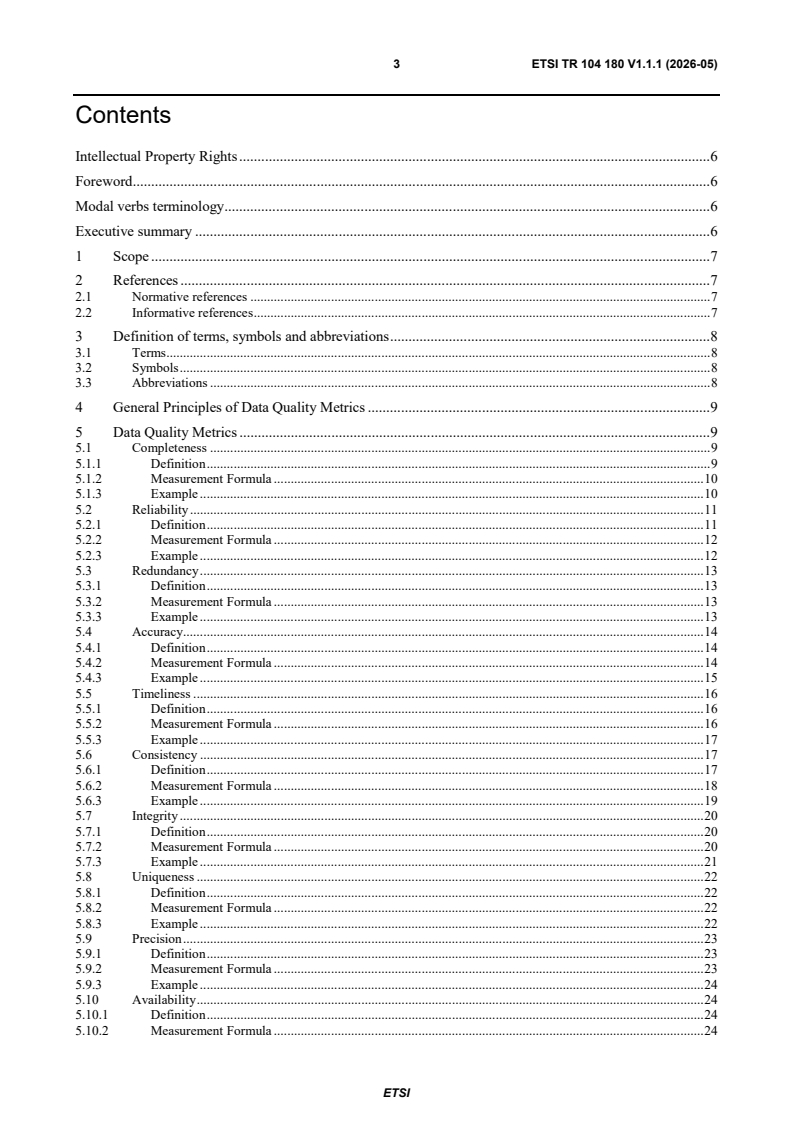
2 ETSI TR 104 180 V1.1.1 (2026-05)
Reference
DTR/DATA-00104180
Keywords
AI, data, quality, trust
ETSI
650 Route des Lucioles
F-06921 Sophia Antipolis Cedex - FRANCE
Tel.: +33 4 92 94 42 00 Fax: +33 4 93 65 47 16
Siret N° 348 623 562 00017 - APE 7112B
Association à but non lucratif enregistrée à la
Sous-Préfecture de Grasse (06) N° w061004871
Important notice
The present document can be downloaded from the
ETSI Search & Browse Standards application.
The present document may be made available in electronic versions and/or in print. The content of any electronic and/or
print versions of the present document shall not be modified without the prior written authorization of ETSI. In case of any
existing or perceived difference in contents between such versions and/or in print, the prevailing version of an ETSI
deliverable is the one made publicly available in PDF format on ETSI deliver repository.
Users should be aware that the present document may be revised or have its status changed,
this information is available in the Milestones listing.
If you find errors in the present document, please send your comments to
the relevant service listed under Committee Support Staff.
If you find a security vulnerability in the present document, please report it through our
Coordinated Vulnerability Disclosure (CVD) program.
Notice of disclaimer & limitation of liability
The information provided in the present deliverable is directed solely to professionals who have the appropriate degree of
experience to understand and interpret its content in accordance with generally accepted engineering or
other professional standard and applicable regulations.
No recommendation as to products and services or vendors is made or should be implied.
No representation or warranty is made that this deliverable is technically accurate or sufficient or conforms to any law
and/or governmental rule and/or regulation and further, no representation or warranty is made of merchantability or fitness
for any particular purpose or against infringement of intellectual property rights.
In no event shall ETSI be held liable for loss of profits or any other incidental or consequential damages.
Any software contained in this deliverable is provided "AS IS" with no warranties, express or implied, including but not
limited to, the warranties of merchantability, fitness for a particular purpose and non-infringement of intellectual property
rights and ETSI shall not be held liable in any event for any damages whatsoever (including, without limitation, damages
for loss of profits, business interruption, loss of information, or any other pecuniary loss) arising out of or related to the use
of or inability to use the software.
Copyright Notification
No part may be reproduced or utilized in any form or by any means, electronic or mechanical, including photocopying and
microfilm except as authorized by written permission of ETSI.
The content of the PDF version shall not be modified without the written authorization of ETSI.
The copyright and the foregoing restriction extend to reproduction in all media.
© ETSI 2026.
All rights reserved.
ETSI
3 ETSI TR 104 180 V1.1.1 (2026-05)
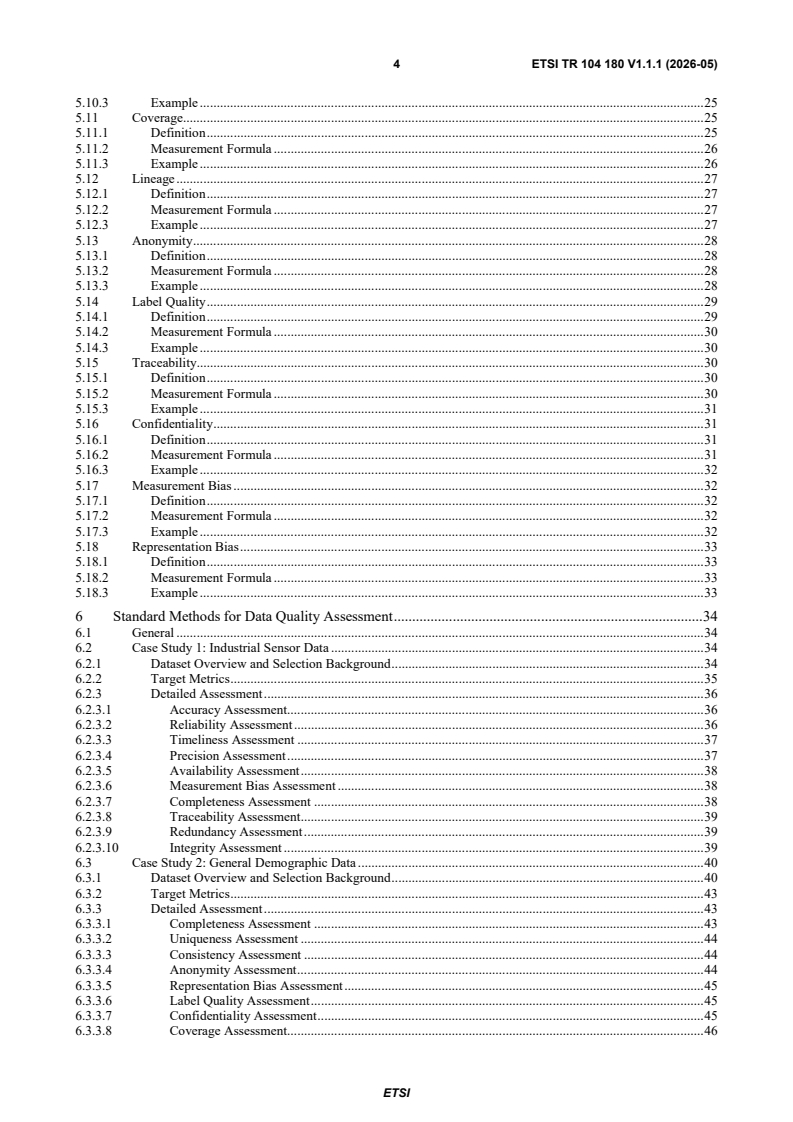
Contents
Intellectual Property Rights . 6
Foreword . 6
Modal verbs terminology . 6
Executive summary . 6
1 Scope . 7
2 References . 7
2.1 Normative references . 7
2.2 Informative references . 7
3 Definition of terms, symbols and abbreviations . 8
3.1 Terms . 8
3.2 Symbols . 8
3.3 Abbreviations . 8
4 General Principles of Data Quality Metrics . 9
5 Data Quality Metrics . 9
5.1 Completeness . 9
5.1.1 Definition . 9
5.1.2 Measurement Formula . 10
5.1.3 Example . 10
5.2 Reliability . 11
5.2.1 Definition . 11
5.2.2 Measurement Formula . 12
5.2.3 Example . 12
5.3 Redundancy . 13
5.3.1 Definition . 13
5.3.2 Measurement Formula . 13
5.3.3 Example . 13
5.4 Accuracy. 14
5.4.1 Definition . 14
5.4.2 Measurement Formula . 14
5.4.3 Example . 15
5.5 Timeliness . 16
5.5.1 Definition . 16
5.5.2 Measurement Formula . 16
5.5.3 Example . 17
5.6 Consistency . 17
5.6.1 Definition . 17
5.6.2 Measurement Formula . 18
5.6.3 Example . 19
5.7 Integrity . 20
5.7.1 Definition . 20
5.7.2 Measurement Formula . 20
5.7.3 Example . 21
5.8 Uniqueness . 22
5.8.1 Definition . 22
5.8.2 Measurement Formula . 22
5.8.3 Example . 22
5.9 Precision . 23
5.9.1 Definition . 23
5.9.2 Measurement Formula . 23
5.9.3 Example . 24
5.10 Availability . 24
5.10.1 Definition . 24
5.10.2 Measurement Formula . 24
ETSI
4 ETSI TR 104 180 V1.1.1 (2026-05)
5.10.3 Example . 25
5.11 Coverage. 25
5.11.1 Definition . 25
5.11.2 Measurement Formula . 26
5.11.3 Example . 26
5.12 Lineage . 27
5.12.1 Definition . 27
5.12.2 Measurement Formula . 27
5.12.3 Example . 27
5.13 Anonymity . 28
5.13.1 Definition . 28
5.13.2 Measurement Formula . 28
5.13.3 Example . 28
5.14 Label Quality . 29
5.14.1 Definition . 29
5.14.2 Measurement Formula . 30
5.14.3 Example . 30
5.15 Traceability. 30
5.15.1 Definition . 30
5.15.2 Measurement Formula . 30
5.15.3 Example . 31
5.16 Confidentiality . 31
5.16.1 Definition . 31
5.16.2 Measurement Formula . 31
5.16.3 Example . 32
5.17 Measurement Bias . 32
5.17.1 Definition . 32
5.17.2 Measurement Formula . 32
5.17.3 Example . 32
5.18 Representation Bias . 33
5.18.1 Definition . 33
5.18.2 Measurement Formula . 33
5.18.3 Example . 33
6 Standard Methods for Data Quality Assessment . 34
6.1 General . 34
6.2 Case Study 1: Industrial Sensor Data . 34
6.2.1 Dataset Overview and Selection Background . 34
6.2.2 Target Metrics . 35
6.2.3 Detailed Assessment . 36
6.2.3.1 Accuracy Assessment. 36
6.2.3.2 Reliability Assessment . 36
6.2.3.3 Timeliness Assessment . 37
6.2.3.4 Precision Assessment . 37
6.2.3.5 Availability Assessment . 38
6.2.3.6 Measurement Bias Assessment . 38
6.2.3.7 Completeness Assessment . 38
6.2.3.8 Traceability Assess me nt . 39
6.2.3.9 Redundancy Assessment . 39
6.2.3.10 Integrity Assessment . 39
6.3 Case Study 2: General Demographic Data . 40
6.3.1 Dataset Overview and Selection Background . 40
6.3.2 Target Metrics . 43
6.3.3 Detailed Assessment . 43
6.3.3.1 Completeness Assessment . 43
6.3.3.2 Uniqueness Assessment . 44
6.3.3.3 Consistency Assessment . 44
6.3.3.4 Anonymity Assessment . 44
6.3.3.5 Representation Bias Assessment . 45
6.3.3.6 Label Quality Assessment . 45
6.3.3.7 Confidentiality Assessment . 45
6.3.3.8 Coverage Assessment. 46
ETSI
5 ETSI TR 104 180 V1.1.1 (2026-05)
6.4 Comparative Analysis and Insights . 46
6.4.1 Feasibility of Quantitative Measurement . 46
6.4.2 Applicability and Constraints across Domains . 46
6.4.3 Dependency on External Information and Metadata . 47
6.4.4 Domain-Specific Weighting . 47
7 Conclusion . 47
History . 49
ETSI
6 ETSI TR 104 180 V1.1.1 (2026-05)
Intellectual Property Rights
Essential patents
IPRs essential or potentially essential to normative deliverables may have been declared to ETSI. The declarations
pertaining to these essential IPRs, if any, are publicly available for ETSI members and non-members, and can be
found in ETSI SR 000 314: "Intellectual Property Rights (IPRs); Essential, or potentially Essential, IPRs notified to
ETSI in respect of ETSI standards", which is available from the ETSI Secretariat. Latest updates are available on the
ETSI IPR online database.
Pursuant to the ETSI Directives including the ETSI IPR Policy, no investigation regarding the essentiality of IPRs,
including IPR searches, has been carried out by ETSI. No guarantee can be given as to the existence of other IPRs not
referenced in ETSI SR 000 314 (or the updates on the ETSI Web server) which are, or may be, or may become,
essential to the present document.
Trademarks
The present document may include trademarks and/or tradenames which are asserted and/or registered by their owners.
ETSI claims no ownership of these except for any which are indicated as being the property of ETSI, and conveys no
right to use or reproduce any trademark and/or tradename. Mention of those trademarks in the present document does
not constitute an endorsement by ETSI of products, services or organizations associated with those trademarks.
DECT™, PLUGTESTS™, UMTS™ and the ETSI logo are trademarks of ETSI registered for the benefit of its
Members. 3GPP™, LTE™ and 5G™ logo are trademarks of ETSI registered for the benefit of its Members and of the
3GPP Organizational Partners. oneM2M™ logo is a trademark of ETSI registered for the benefit of its Members and of ®
the oneM2M Partners. GSM and the GSM logo are trademarks registered and owned by the GSM Association.
Foreword
This Technical Report (TR) has been produced by ETSI Technical Committee Data Solutions (DATA).
Modal verbs terminology
In the present document "should", "should not", "may", "need not", "will", "will not", "can" and "cannot" are to be
interpreted as described in clause 3.2 of the ETSI Drafting Rules (Verbal forms for the expression of provisions).
"must" and "must not" are NOT allowed in ETSI deliverables except when used in direct citation.
Executive summary
The present document establishes a standardized framework for data quality assessment to ensure reliability in digital
and AI ecosystems. It defines 18 Data Quality Metrics, providing formal definitions and mathematical formulas for
quantitative measurement across intrinsic and contextual dimensions.
Through empirical case studies on Industrial IoT and Demographic data, the present document validates the
applicability of these metrics while demonstrating that effective assessment relies heavily on domain-specific contexts
and metadata availability.
Based on these findings, the present document recommends two key future standardization activities:
• Transitioning the definitions and descriptive examples into a normative TS to ensure interoperability.
• Developing standardized Test Methodologies and Test Formulas for automated and reproducible verification
of data.
ETSI
7 ETSI TR 104 180 V1.1.1 (2026-05)
1 Scope
The present document introduces quality metrics for data for future standardization. It focuses on identifying key
properties of data quality including trustworthiness (e.g. completeness, accuracy, bias, reliability, redundancy, source
reliability and integrity) and formulating standardized methods to assess these properties.
The present document refers to developed standard specifications related to data quality and collaborates with standards
bodies & groups working on data, security and AI trustworthiness (e.g. ETSI TC SAI, JTC 21).
2 References
2.1 Normative references
Normative references are not applicable in the present document.
2.2 Informative references
References are either specific (identified by date of publication and/or edition number or version number) or
non-specific. For specific references, only the cited version applies. For non-specific references, the latest version of the
referenced document (including any amendments) applies.
NOTE: While any hyperlinks included in this clause were valid at the time of publication, ETSI cannot guarantee
their long-term validity.
The following referenced documents may be useful in implementing an ETSI deliverable or add to the reader's
understanding, but are not required for conformance to the present document.
[i.1] ISO/IEC 25012:2008: "Software engineering — Software product Quality Requirements and
Evaluation (SQuaRE) — Data quality model".
[i.2] Hitzler P, Zaveri A, Rula A, et al.: "Quality assessment for Linked Data: A Survey: A systematic
literature review and conceptual framework". Semantic Web. 2015;7(1):63-93. doi:10.3233/SW-
150175.
[i.3] Recommendation ITU-T E.800: "Definitions of terms related to quality of service".
[i.4] ISO/IEC 23988:2007: "Information technology — A code of practice for the use of information
technology (IT) in the delivery of assessments".
[i.5] ISO/IEC 25010:2023: "Systems and software engineering — Systems and software Quality
Requirements and Evaluation (SQuaRE) — Product quality model".
[i.6] ISO/IEC 16350:2015: "Information technology — Systems and software engineering —
Application management".
[i.7] Recommendation ITU-T Y.3605: "Big data - Reference architecture".
[i.8] IEEE 610.12-1990™: "IEEE Standard Glossary of Software Engineering Terminology".
[i.9] ISO 19157-1:2023: "Geographic information — Data quality — Part 1: General requirements".
[i.10] IEEE 100™: "The Authoritative Dictionary of IEEE Standards Terms".
[i.11] Recommendation ITU-T X.1252: "Baseline identity management terms and definitions".
[i.12] ISO 8000-61:2016: "Data quality — Part 61: Data quality management: Process reference model".
[i.13] Recommendation ITU-T Y.3600: "Big data – Cloud computing based requirements and
capabilities".
ETSI
8 ETSI TR 104 180 V1.1.1 (2026-05)
[i.14] ISO/IEC 11179-1: "Information technology — Metadata registries (MDR) — Part 1: Framework".
[i.15] ISO/IEC 5259-4: "Artificial intelligence — Data quality for analytics and machine learning
(ML) — Part 4: Data quality process framework".
[i.16] Recommendation ITU-T X.1601: "Security framework for cloud computing".
[i.17] NIST SP 800-53: "Security and Privacy Controls for Information Systems and Organizations".
[i.18] ISO/IEC 20889:2018: "Privacy enhancing data de-identification terminology and classification of
techniques".
[i.19] ISO/IEC 29100:2024: "Information technology — Security techniques — Privacy framework".
[i.20] ISO/IEC TR 24027:2021: "Information technology — Artificial Intelligence (AI) — Bias in AI
Systems and AI aided decision making".
[i.21] ISO/IEC 27001:2022: "Information security, cybersecurity and privacy protection — Information
security management systems — Requirements".
[i.22] IEEE 7003:2024™: "IEEE Standard for Algorithmic Bias Considerations".
3 Definition of terms, symbols and abbreviations
3.1 Terms
Void.
3.2 Symbols
Void.
3.3 Abbreviations
For the purposes of the present document, the following abbreviations apply:
AI Artificial Intelligence
BRCR Business Rule Consistency Rate
CCR Calculation Consistency Rate
CDE Critical Data Element
CS Consistency Score
CV Coefficient of Variation
CVR Consistency Violation Rate
DC Duplicate Count
DIR Disparate Impact Ratio
DRR Duplicate Record Rate
DSR Data Synchronization Rate
FCR Format Consistency Rate
GDPR General Data Protection Regulation
HIPAA Health Insurance Portability and Accountability Act
IIoT Industrial Internet of Things
IoT Internet of Things
LCR Logical Consistency Rate
MAE Mean Absolute Error
MDAR Master Data Alignment Rate
ML Machine Learning
MSE Mean Squared Error
NIST National Institute of Standards and Technology
PII Personal Identifiable Information
ETSI
9 ETSI TR 104 180 V1.1.1 (2026-05)
PIPA Personal Information Protection Act
POS Point of Sale
RAID Redundant Array of Independent Disks
RICR Referential Integrity Consistency Rate
RMSE Root Mean Squared Error
RRR Record Redundancy Ratio
SCE Source Consistency Error
SLA Service Level Agreement
TCR Timeliness Compliance Rate
TS Temporal Stability
US Uniqueness Score
4 General Principles of Data Quality Metrics
This clause describes fundamental principles applicable to the definition and assessment of data quality metrics within
the scope of the present document. These principles guide the development and application of data quality metrics to
ensure they are meaningful, consistent, and actionable across different data contexts:
• Purpose: Metrics are defined and interpreted according to specific data usage scenarios, business needs or
regulatory requirements. Relevance is context-dependent.
• Measurable: Every metric is accompanied by a clear, repeatable measurement approach, preferably with a
quantitative formula or method to ensure objective assessment.
• Scalable: Metrics are applicable at various levels of granularity (attribute, record, dataset) and scalable to large
or high-velocity data environments.
• Interpretable: Results are understandable to both technical and non-technical stakeholders, and indicate not
only a score but also potential corrective actions.
• Metadata-aware: Many metrics rely on external information such as business rules, data definitions, and
lineage. Dependencies on metadata are explicitly acknowledged.
• Ethical: Metrics related to bias, privacy and fairness need to be considered in the present document.
• Evolvable: The set of metrics and their definitions are better to be periodically reviewed and refined based on
practical experience, technological changes, and evolving standards.
• AI/ML Training dataset: Metrics for data used in AI and ML can be considered with additional dimensions
such as label quality, representational bias, as these directly impact model performance and fairness.
5 Data Quality Metrics
5.1 Completeness
5.1.1 Definition
Completeness refers to the degree to which all required or expected data values are present and available for a given
purpose. It quantifies the absence of missing information, ensuring that a dataset contains all the necessary attributes
and records to adequately represent the phenomena it describes or to fulfil the requirements of a specific task
(e.g. model training, validation, or inference). In the context of a feature set for an AI/ML model, completeness ensures
that all relevant features for each observation are populated. For a time-series dataset, it pertains to the presence of data
points at expected intervals.
ETSI
10 ETSI TR 104 180 V1.1.1 (2026-05)
• ISO/IEC 25012:2008 [i.1]: Completeness refers to the degree to which subject data associated with an entity
has values for all expected attributes and related entity instances in a specific context of use.
• Hitzler P et al. [i.2]: Completeness refers to the degree to which all required information is present in a
particular dataset.
5.1.2 Measurement Formula
The completeness of a dataset can be measured at various granularities (e.g. attribute-level, record-level, or dataset-
level). A common approach to quantify completeness for an attribute or a set of required attributes within a dataset is as
follows:
• Let D be a dataset with N records (rows) and M attributes (columns).
th
• Let A be the j attribute in the dataset, where j ∈ {1,2,.,M}.
j
• Let I be an indicator variable such that:
ij
- I =1 if the value for record i and attribute j is present (not null/missing).
ij
- I =0 if the value for record i and attribute j is missing (null/empty).
ij
Attribute Completeness (CA): The completeness of a specific attribute A is given by the ratio of present values for that
j
attribute to the total number of records:
�
∑ �
��� ��
� =
��
�
Record Completeness (C ): The completeness of a specific record R (considering a set of K required attributes within
R i
that record) is given by the ratio of present values for the required attributes in that record to the total number of
required attributes:
∑ �
�∈��������_���������� ��
� =
�
�
�
Dataset Completeness (CD): The overall completeness of the dataset, considering all N records and M attributes (or a
subset of Mreq required attributes), can be defined as the average attribute completeness or the total proportion of
non-missing values:
�
���
�
∑∑ �
��� ��
���
� =
�
� × �
���
Where M is the number of attributes deemed "required" for the dataset's intended use.
req
5.1.3 Example
Consider a dataset collected for a predictive maintenance model for industrial machinery, specifically focusing on pump
performance. The dataset aims to predict potential failures based on operational parameters. Assume the following
attributes are deemed required for each operational log record: Timestamp, PumpID, Temperature_C,
Vibration_mm_s, Pressure_kPa.
A dataset snippet consisting of five operational log records for a single pump (PumpID: P001) is presented below.
Table 5.1.3-1: Example of a dataset for illustrating the Completeness property
Index Timestamp PumpID Temperature_C Vibration_mm_s Pressure_kPa
1 2024-06-25 10:00:00 P001 45,2 1,5 500
2024-06-25 10:05:00 P001 45,8 1,7 505
2024-06-25 10:10:00 P001 46,1 NaN 510
4 2024-06-25 10:15:00 P001 NaN 1,6 508
5 2024-06-25 10:20:00 P001 47,0 1,8 NaN
ETSI
11 ETSI TR 104 180 V1.1.1 (2026-05)
Here, N=5 records and M =5 required attributes.
req
Attribute Completeness Example:
1) Completeness of Vibration_mm_s:
- Missing in Record 3
- Present in 4 out of 5 records
- CVibration_mm_s = (4/5) × 100 % = 80 %
2) Completeness of Temperature_C:
- Missing in Record 4
- Present in 4 out of 5 records
- C = (4/5) × 100 % = 80 %
Temperature_C
Record Completeness Example:
1) Completeness of Record 3 (Required attributes: 5):
- Vibration_mm_s is missing
- Present values: 4 out of 5 records
- C = (4/5) × 100 % = 80 %
R3
2) Completeness of Record 4 (Required attributes: 5):
- Temperature_C: is missing
- Present values: 4 out of 5 records
- CR4 = (4/5) × 100 % = 80 %
Overall Dataset Completeness Example (overall for required attributes):
• Total expected values (N × M ) = 5 × 5 = 25
req
• Total missing values: 3 (one in Temperature_C, one in Vibration_mm_s and one in Pressure_kPa)
• Total present values = 25 - 3 = 22
= 22/25 × 100 % = 88 %
• CD
5.2 Reliability
5.2.1 Definition
Reliability refers to the degree to which data can be trusted to be consistent, stable, and free from unexpected variations
over time and across different sources. It measures the dependability of the data generation and collection processes,
ensuring that the data produced is accurate, reproducible, and fit for its intended use under stated conditions. In the
context of AI/ML systems, reliable data ensures that models are trained and evaluated on a consistent foundation,
reducing the risk of performance degradation due to data drift or source inconsistencies.
ETSI
12 ETSI TR 104 180 V1.1.1 (2026-05)
• Recommendation ITU-T E.800 [i.3]: Reliability refers to the probability that an item can perform a required
function under stated conditions for a given time interval.
• ISO/IEC 23988:2007 [i.4]: Consistency with which an assessment measures.
• ISO/IEC 25010:2023 [i.5]: Capability of a product to perform specified functions under specified conditions
for a specified period of time without interruptions and failures.
• ISO/IEC 16350:2015 [i.6]: Degree to which an object or an object's services provide agreed or expected
functionality during a defined time period under specified conditions.
5.2.2 Measurement Formula
Reliability can be assessed through various lenses, such as source consistency, temporal stability, and reproducibility. A
common approach involves measuring the variance or error rate from an expected baseline or across multiple sources.
Let S be a data source producing a stream of values for a specific attribute over time.
Let X be the value of the attribute at time i.
i
Let E be the expected or reference value for the attribute at time i (which could be a known ground truth, a value from a
i
trusted source, or a predicted value from a stable model).
Source Consistency Error (SCE) for a single source over N observations can be measured as the Mean Absolute Error
(MAE).
�
�
��� = ∑|� −�|
��� ��� � �
�
Temporal Stability (TS) can be measured for a source by calculating the Coefficient of Variation (CV) for a specific
attribute over a defined time window, indicating how much the data fluctuates relative to its average value:
��
�� = × 100 %
��
��
Where:
• �� is the standard deviation of the attribute values over the time period.
• �� is the mean of the attribute values over the time period.
A lower CV indicates higher temporal stability.
5.2.3 Example
Consider two sensors (Sensor A and Sensor B) measuring the temperature of a critical machine component every hour.
The expected temperature, based on a calibrated laboratory standard, is also recorded.
Table 5.2.3-1: Example of a dataset for illustrating the Reliability property
Index Time Expected Temp (°C) Sensor A (°C) Sensor B (°C)
1 10:00 75,0 75,2 74,8
2 11:00 75,0 76,1 75,0
3 12:00 76,0 76,0 75,5
4 13:00 76,0 77,0 76,0
5 14:00 75,5 75,4 75,8
Source Consistency for Sensor A:
�
�| | | | | | | | | |�
��� = 75,2 − 75,0 + 76,1 − 75,0 + 76,0 − 76,0 + 77,0 − 76,0 + 75,4 − 75,5 =0,48 (°C)
���
�
ETSI
13 ETSI TR 104 180 V1.1.1 (2026-05)
Temporal Stability for Sensor A:
• Mean �� = (75,2 + 76,1 + 76,0 + 77,0 + 75,4) / 5 = 75,94 °C
• Std Dev �� = 0,75 °C
• �� = (0,75/75,94) × 100 % = 0,99 %
��
5.3 Redundancy
5.3.1 Definition
Redundancy refers to the degree to which data is duplicated or unnecessarily repeated within a dataset or across a
system. While some redundancy can be intentional for fault tolerance (e.g. backup systems, RAID storage), excessive or
uncontrolled redundancy in operational datasets can lead to inefficiencies in storage, processing, and analysis. It can
also introduce inconsistencies if redundant copies are not properly synchronized and managed. This metric helps
identify opportunities for data deduplication and normalization.
• Recommendation ITU-T Y.3605 [i.7]: Data redundancy refers to the repeated occurrence of the same data in
the system.
• ISO 8000-61 [i.12]: Describes redundancy as "the presence of duplicate data elements that can be eliminated
without loss of information".
• ISO/IEC 11179-1 [i.14]: Defines data redundancy as "the representation of data more than once within a
specified scope".
5.3.2 Measurement Formula
Redundancy is often measured as the proportion of duplicate records or data elements within a defined context.
Let D be a dataset with N total records.
Let � be the number of unique records in D, determined by a defined set of key attributes.
������
Record Redundancy Ratio (RRR) is the proportion of the dataset that consists of duplicate records:
���
������
��� = × 100 %
�
Alternatively, Duplicate Count (DC) is the absolute number of duplicate records:
�� = � − �
������
For attribute-level redundancy, the focus is on the storage of derivable data. For example, storing both "Date of Birth"
and "Age" is redundant as one can be derived from the other. This is often identified through schema analysis and data
lineage rather than a single universal formula.
5.3.3 Example
Consider a customer contact list dataset where records are considered duplicates if they have the same EmailAddress.
ETSI
14 ETSI TR 104 180 V1.1.1 (2026-05)
Table 5.3.3-1: Example of a dataset for illustrating the Redundancy property
RecordID Name EmailAddress PhoneNumber
John Doe John.doe@email.com 555-0100
2 John Doe John.doe@email.com 555-0101
3 Jane Smith Jane.smith@email.com 555-0200
4 Alice Johnson alice@email.com 555-0300
5 John Doe John.doe@email.com 555-0100
• Total Records (N): 5
• Unique Records (� , based on EmailAddress): 3 (john.doe@email.com, jane.smith@email.com,
�����
alice@email.com)
(��!)
• Record Redundancy Ratio (RRR): × 100 % = 40 %
�
• Duplicate Count (DC): 5-3 = 2 records (RecordID 2 and 5 are duplicates of RecordID 1, though with slight
variations in PhoneNumber for RecordID 2).
5.4 Accuracy
5.4.1 Definition
Accuracy refers to the degree to which data matches the true, real-world values or states it is intended to represent. It
quantifies the absence of errors and deviations, ensuring that data values are correct and faithful to the actual entities or
events they model.
• Recommendation ITU-T Y.3605 [i.7]: Data redundancy refers to the repeated occurrence of the same data in
the sys
...