

IEC 61009-2-1:2024
(Main)Residual current operated circuit-breakers with integral overcurrent protection for household and similar uses (RCBOs) - Part 2-1: RCBOs according to classification 4.1.1
General Information
- Abstract
IEC 61009-2-1:2024 applies to residual current operated circuit-breakers with integral overcurrent protection for household and similar uses (hereafter referred to as RCBOs), classified according to IEC 61009-1:2024, 4.1.1. RCBOs according to this document are intended for voltages not exceeding 440 V AC with frequencies of 50 Hz, 60 Hz or 50/60 Hz and currents not exceeding 125 A and rated short‑circuit capacities not exceeding 25 000 A for operation at 50 Hz or 60 Hz.
This second edition cancels and replaces the first edition published in 1991. This edition constitutes a technical revision.
This edition includes the following significant technical changes with respect to the previous edition:
a) harmonization of all clauses between the IEC 61008, IEC 61009 and IEC 60755 series using blocks and modules approach;
b) harmonization of all tables and figures between the IEC 61008, IEC 61009 and IEC 60755 series;
c) terms and definitions are now referred to IEC 62873-2;
d) modification of Subclause 4.1 for classification according to supply conditions;
e) specific tests for operating characteristics (9.9) of RCBO according to classification 4.1.1;
f) specific test conditions for temperature-rise (9.8), verification of trip-free (9.15), surge current tests (9.19), reliability (9.20) and ageing (9.21).
- Status
- Published
- Publication Date
- 20-Nov-2024
- Technical Committee
- SC 23E - Circuit-breakers and similar equipment for household use
- Drafting Committee
- WG 2 - TC 23/SC 23E/WG 2
- Current Stage
- PPUB - Publication issued
- Start Date
- 21-Nov-2024
- Completion Date
- 06-Dec-2024
Buy Documents
IEC 61009-2-1:2024 - Residual current operated circuit-breakers with integral overcurrent protection for household and similar uses (RCBOs) - Part 2-1: RCBOs according to classification 4.1.1 Released:11/21/2024
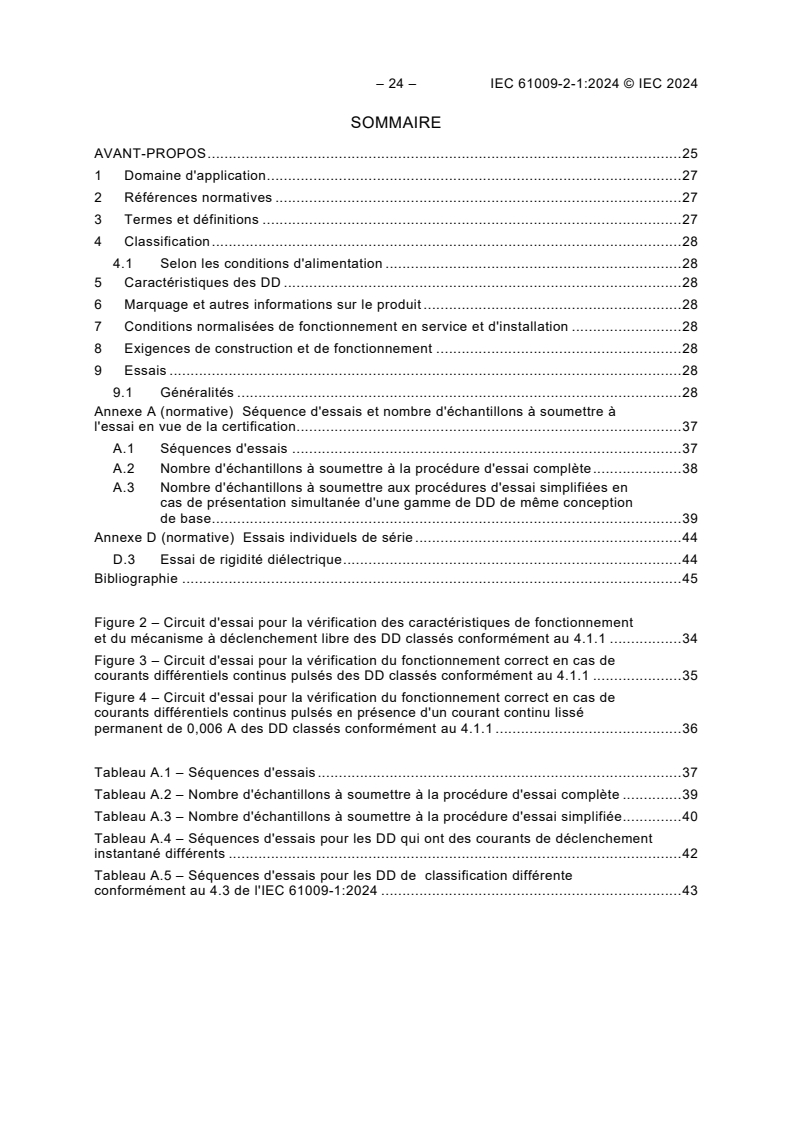
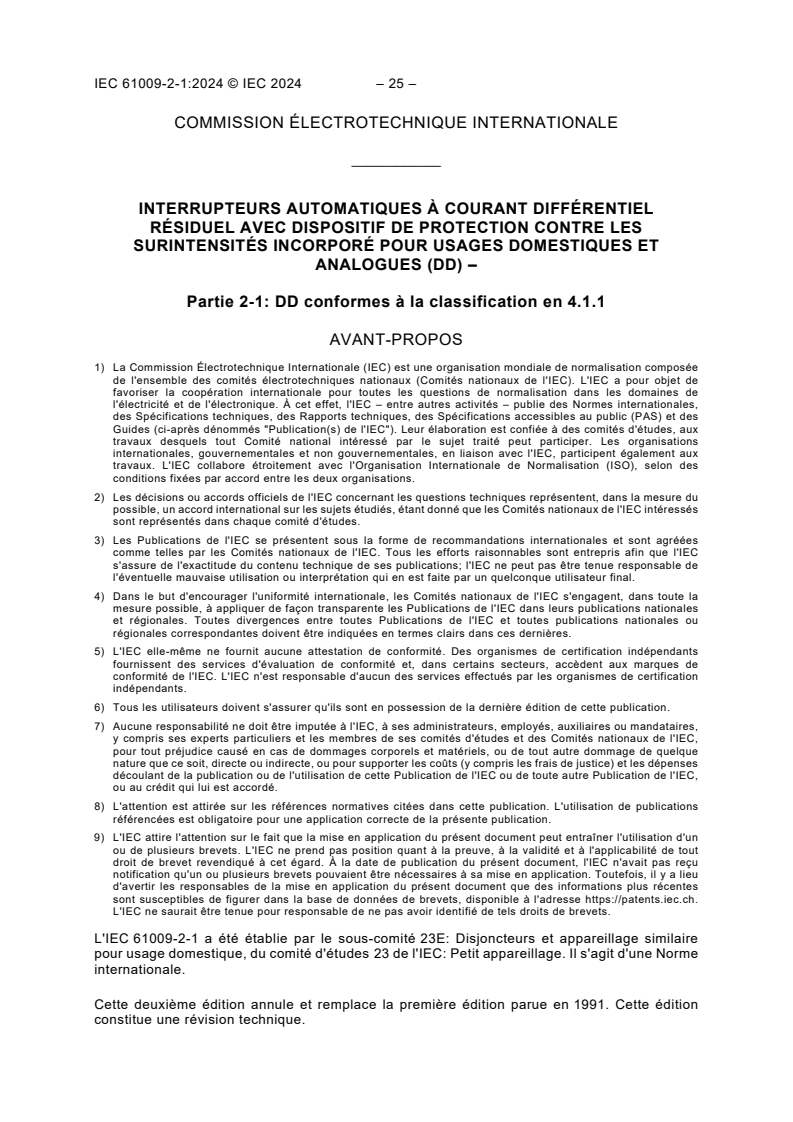
IEC 61009-2-1:2024 - Interrupteurs automatiques à courant différentiel résiduel avec dispositif de protection contre les surintensités incorporé pour usages domestiques et analogues (DD) - Partie 2-1: DD conformes à la classification en 4.1.1/21/2024
IEC 61009-2-1:2024 - Residual current operated circuit-breakers with integral overcurrent protection for household and similar uses (RCBOs) - Part 2-1: RCBOs according to classification 4.1.1/21/2024
Overview
IEC 61009-2-1:2024 is the 2nd edition international standard that specifies requirements and test procedures for residual current operated circuit‑breakers with integral overcurrent protection (RCBOs) classified under IEC 61009-1:2024, clause 4.1.1. It applies to RCBOs for household and similar uses for AC voltages up to 440 V, frequencies 50 Hz / 60 Hz / 50/60 Hz, rated currents up to 125 A, and rated short‑circuit capacities up to 25 000 A. This edition replaces the 1991 edition and constitutes a technical revision.
Key Topics and Requirements
- Scope & Classification
- Defines RCBO behaviour according to supply conditions (classification 4.1.1): operation on residual current across the voltage range (up to 1.1 U to 0 V) with any number of supply conductors connected; RCBOs do not open automatically on loss of supply.
- Harmonization
- Alignment of clauses, tables and figures with IEC 61008, IEC 61009 and IEC 60755 using a blocks-and-modules approach.
- Terminology
- Terms and definitions referenced from IEC 62873-2.
- Construction & Marking
- Requirements for construction, installation information and product marking are used in conjunction with IEC 61009-1:2024.
- Test Regime
- Detailed tests for: operating characteristics (9.9), temperature‑rise (9.8), verification of trip‑free mechanism (9.15), surge current tests (9.19), reliability (9.20) and ageing (9.21).
- Test sequences and sample numbers for certification are given in Annex A; routine tests (e.g., dielectric strength) are in Annex D.
- Test specifics: residual-current tests applied to one pole with five measurements; ambient test temperature normally 20 °C ±5 °C; for multi-frequency RCBOs tests at lowest and highest frequencies unless otherwise specified.
- Test Circuits
- Includes standard test circuits (Figures 2–4) for operating characteristic verification and tests involving pulsating or smooth DC components.
Applications and Who Uses It
- Manufacturers of RCBOs for design verification, type‑testing and product certification.
- Certification and testing laboratories performing conformity assessment to IEC requirements.
- Electrical specifiers, designers and contractors selecting RCBOs for household and similar installations.
- Regulators and compliance bodies referencing the standard for safety approvals and market surveillance.
Related Standards
- IEC 61009-1:2024 (Part 1: General rules) - to be used together with this document
- IEC 61008, IEC 60755 series - harmonized content
- IEC 61543:2022 - EMC for RCDs
- IEC 62873-2 - vocabulary for residual current devices
Keywords: IEC 61009-2-1:2024, RCBOs, residual current operated circuit-breaker, overcurrent protection, testing, temperature-rise, trip-free, surge current, household electrical safety.
Buy Documents
IEC 61009-2-1:2024 - Residual current operated circuit-breakers with integral overcurrent protection for household and similar uses (RCBOs) - Part 2-1: RCBOs according to classification 4.1.1 Released:11/21/2024
IEC 61009-2-1:2024 - Interrupteurs automatiques à courant différentiel résiduel avec dispositif de protection contre les surintensités incorporé pour usages domestiques et analogues (DD) - Partie 2-1: DD conformes à la classification en 4.1.1/21/2024
IEC 61009-2-1:2024 - Residual current operated circuit-breakers with integral overcurrent protection for household and similar uses (RCBOs) - Part 2-1: RCBOs according to classification 4.1.1/21/2024
Get Certified
Connect with accredited certification bodies for this standard

IMQ S.p.A. (Certification)
Italian electrical product certification.

SLG Prüf- und Zertifizierungs GmbH
German testing and certification body.

UL Solutions
Global safety science company with testing, inspection and certification.
Sponsored listings
Frequently Asked Questions
IEC 61009-2-1:2024 is a standard published by the International Electrotechnical Commission (IEC). Its full title is "Residual current operated circuit-breakers with integral overcurrent protection for household and similar uses (RCBOs) - Part 2-1: RCBOs according to classification 4.1.1". This standard covers: IEC 61009-2-1:2024 applies to residual current operated circuit-breakers with integral overcurrent protection for household and similar uses (hereafter referred to as RCBOs), classified according to IEC 61009-1:2024, 4.1.1. RCBOs according to this document are intended for voltages not exceeding 440 V AC with frequencies of 50 Hz, 60 Hz or 50/60 Hz and currents not exceeding 125 A and rated short‑circuit capacities not exceeding 25 000 A for operation at 50 Hz or 60 Hz. This second edition cancels and replaces the first edition published in 1991. This edition constitutes a technical revision. This edition includes the following significant technical changes with respect to the previous edition: a) harmonization of all clauses between the IEC 61008, IEC 61009 and IEC 60755 series using blocks and modules approach; b) harmonization of all tables and figures between the IEC 61008, IEC 61009 and IEC 60755 series; c) terms and definitions are now referred to IEC 62873-2; d) modification of Subclause 4.1 for classification according to supply conditions; e) specific tests for operating characteristics (9.9) of RCBO according to classification 4.1.1; f) specific test conditions for temperature-rise (9.8), verification of trip-free (9.15), surge current tests (9.19), reliability (9.20) and ageing (9.21).
IEC 61009-2-1:2024 applies to residual current operated circuit-breakers with integral overcurrent protection for household and similar uses (hereafter referred to as RCBOs), classified according to IEC 61009-1:2024, 4.1.1. RCBOs according to this document are intended for voltages not exceeding 440 V AC with frequencies of 50 Hz, 60 Hz or 50/60 Hz and currents not exceeding 125 A and rated short‑circuit capacities not exceeding 25 000 A for operation at 50 Hz or 60 Hz. This second edition cancels and replaces the first edition published in 1991. This edition constitutes a technical revision. This edition includes the following significant technical changes with respect to the previous edition: a) harmonization of all clauses between the IEC 61008, IEC 61009 and IEC 60755 series using blocks and modules approach; b) harmonization of all tables and figures between the IEC 61008, IEC 61009 and IEC 60755 series; c) terms and definitions are now referred to IEC 62873-2; d) modification of Subclause 4.1 for classification according to supply conditions; e) specific tests for operating characteristics (9.9) of RCBO according to classification 4.1.1; f) specific test conditions for temperature-rise (9.8), verification of trip-free (9.15), surge current tests (9.19), reliability (9.20) and ageing (9.21).
IEC 61009-2-1:2024 is classified under the following ICS (International Classification for Standards) categories: 29.120.50 - Fuses and other overcurrent protection devices. The ICS classification helps identify the subject area and facilitates finding related standards.
IEC 61009-2-1:2024 is available in PDF format for immediate download after purchase. The document can be added to your cart and obtained through the secure checkout process. Digital delivery ensures instant access to the complete standard document.
Standards Content (Sample)
IEC 61009-2-1 ®
Edition 2.0 2024-11
INTERNATIONAL
STANDARD
Residual current operated circuit-breakers with integral overcurrent protection
for household and similar uses (RCBOs) –
Part 2-1: RCBOs according to classification 4.1.1
All rights reserved. Unless otherwise specified, no part of this publication may be reproduced or utilized in any form
or by any means, electronic or mechanical, including photocopying and microfilm, without permission in writing from
either IEC or IEC's member National Committee in the country of the requester. If you have any questions about IEC
copyright or have an enquiry about obtaining additional rights to this publication, please contact the address below or
your local IEC member National Committee for further information.
IEC Secretariat Tel.: +41 22 919 02 11
3, rue de Varembé info@iec.ch
CH-1211 Geneva 20 www.iec.ch
Switzerland
About the IEC
The International Electrotechnical Commission (IEC) is the leading global organization that prepares and publishes
International Standards for all electrical, electronic and related technologies.
About IEC publications
The technical content of IEC publications is kept under constant review by the IEC. Please make sure that you have the
latest edition, a corrigendum or an amendment might have been published.
IEC publications search - webstore.iec.ch/advsearchform IEC Products & Services Portal - products.iec.ch
The advanced search enables to find IEC publications by a Discover our powerful search engine and read freely all the
variety of criteria (reference number, text, technical publications previews, graphical symbols and the glossary.
committee, …). It also gives information on projects, replaced With a subscription you will always have access to up to date
and withdrawn publications. content tailored to your needs.
IEC Just Published - webstore.iec.ch/justpublished
Electropedia - www.electropedia.org
Stay up to date on all new IEC publications. Just Published
The world's leading online dictionary on electrotechnology,
details all new publications released. Available online and once
containing more than 22 500 terminological entries in English
a month by email.
and French, with equivalent terms in 25 additional languages.
Also known as the International Electrotechnical Vocabulary
IEC Customer Service Centre - webstore.iec.ch/csc
(IEV) online.
If you wish to give us your feedback on this publication or need
further assistance, please contact the Customer Service
Centre: sales@iec.ch.
IEC 61009-2-1 ®
Edition 2.0 2024-11
INTERNATIONAL
STANDARD
Residual current operated circuit-breakers with integral overcurrent protection
for household and similar uses (RCBOs) –
Part 2-1: RCBOs according to classification 4.1.1
INTERNATIONAL
ELECTROTECHNICAL
COMMISSION
ICS 29.120.50 ISBN 978-2-8327-0012-9
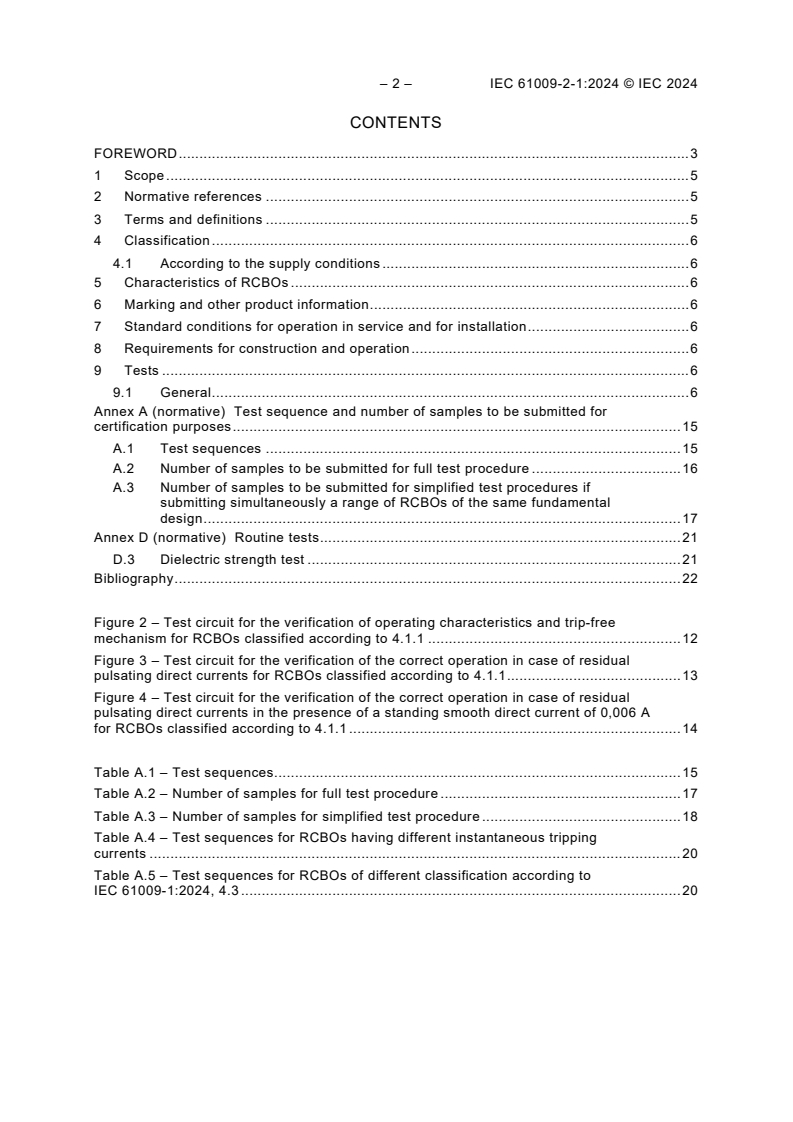
– 2 – IEC 61009-2-1:2024 © IEC 2024
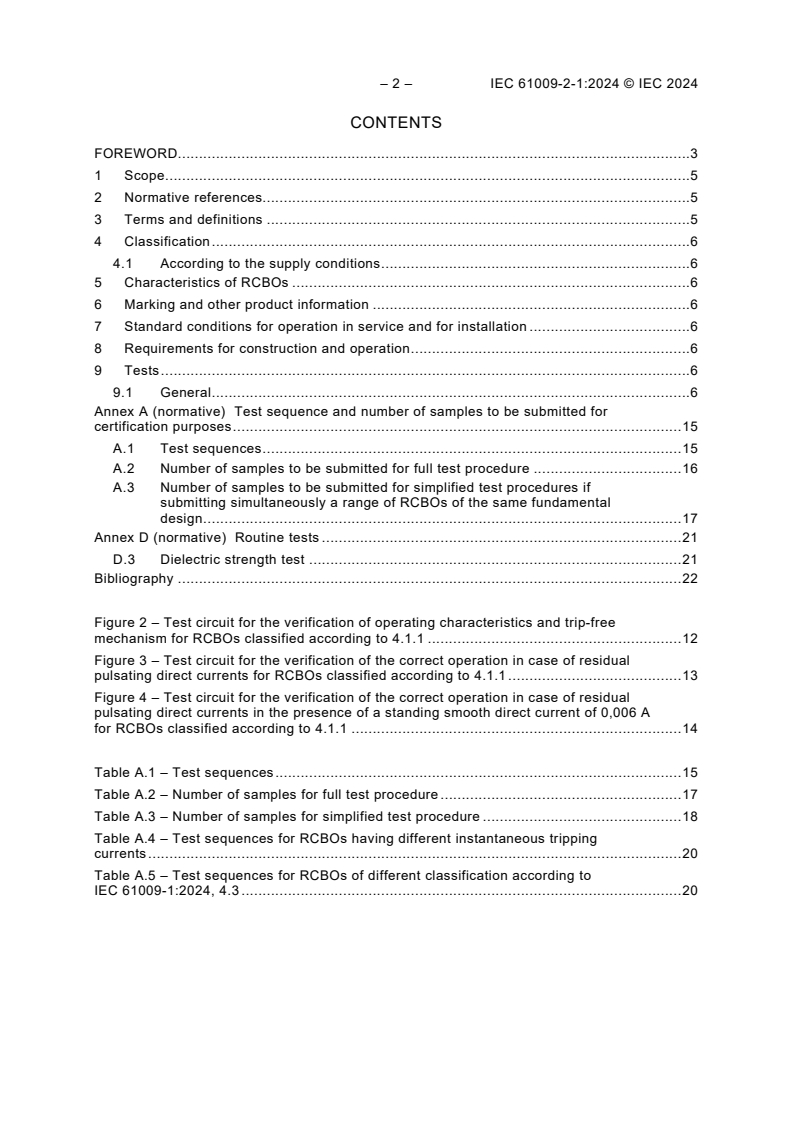
CONTENTS
FOREWORD . 3
1 Scope . 5
2 Normative references . 5
3 Terms and definitions . 5
4 Classification . 6
4.1 According to the supply conditions . 6
5 Characteristics of RCBOs . 6
6 Marking and other product information . 6
7 Standard conditions for operation in service and for installation . 6
8 Requirements for construction and operation . 6
9 Tests . 6
9.1 General . 6
Annex A (normative) Test sequence and number of samples to be submitted for
certification purposes . 15
A.1 Test sequences . 15
A.2 Number of samples to be submitted for full test procedure . 16
A.3 Number of samples to be submitted for simplified test procedures if
submitting simultaneously a range of RCBOs of the same fundamental
design . 17
Annex D (normative) Routine tests . 21
D.3 Dielectric strength test . 21
Bibliography . 22
Figure 2 – Test circuit for the verification of operating characteristics and trip-free
mechanism for RCBOs classified according to 4.1.1 . 12
Figure 3 – Test circuit for the verification of the correct operation in case of residual
pulsating direct currents for RCBOs classified according to 4.1.1 . 13
Figure 4 – Test circuit for the verification of the correct operation in case of residual
pulsating direct currents in the presence of a standing smooth direct current of 0,006 A
for RCBOs classified according to 4.1.1 . 14
Table A.1 – Test sequences . 15
Table A.2 – Number of samples for full test procedure . 17
Table A.3 – Number of samples for simplified test procedure . 18
Table A.4 – Test sequences for RCBOs having different instantaneous tripping
currents . 20
Table A.5 – Test sequences for RCBOs of different classification according to
IEC 61009-1:2024, 4.3 . 20
INTERNATIONAL ELECTROTECHNICAL COMMISSION
____________
RESIDUAL CURRENT OPERATED CIRCUIT-BREAKERS
WITH INTEGRAL OVERCURRENT PROTECTION
FOR HOUSEHOLD AND SIMILAR USES (RCBOs) –
Part 2-1: RCBOs according to classification 4.1.1
FOREWORD
1) The International Electrotechnical Commission (IEC) is a worldwide organization for standardization comprising
all national electrotechnical committees (IEC National Committees). The object of IEC is to promote international
co-operation on all questions concerning standardization in the electrical and electronic fields. To this end and
in addition to other activities, IEC publishes International Standards, Technical Specifications, Technical Reports,
Publicly Available Specifications (PAS) and Guides (hereafter referred to as “IEC Publication(s)”). Their
preparation is entrusted to technical committees; any IEC National Committee interested in the subject dealt with
may participate in this preparatory work. International, governmental and non-governmental organizations liaising
with the IEC also participate in this preparation. IEC collaborates closely with the International Organization for
Standardization (ISO) in accordance with conditions determined by agreement between the two organizations.
2) The formal decisions or agreements of IEC on technical matters express, as nearly as possible, an international
consensus of opinion on the relevant subjects since each technical committee has representation from all
interested IEC National Committees.
3) IEC Publications have the form of recommendations for international use and are accepted by IEC National
Committees in that sense. While all reasonable efforts are made to ensure that the technical content of IEC
Publications is accurate, IEC cannot be held responsible for the way in which they are used or for any
misinterpretation by any end user.
4) In order to promote international uniformity, IEC National Committees undertake to apply IEC Publications
transparently to the maximum extent possible in their national and regional publications. Any divergence between
any IEC Publication and the corresponding national or regional publication shall be clearly indicated in the latter.
5) IEC itself does not provide any attestation of conformity. Independent certification bodies provide conformity
assessment services and, in some areas, access to IEC marks of conformity. IEC is not responsible for any
services carried out by independent certification bodies.
6) All users should ensure that they have the latest edition of this publication.
7) No liability shall attach to IEC or its directors, employees, servants or agents including individual experts and
members of its technical committees and IEC National Committees for any personal injury, property damage or
other damage of any nature whatsoever, whether direct or indirect, or for costs (including legal fees) and
expenses arising out of the publication, use of, or reliance upon, this IEC Publication or any other IEC
Publications.
8) Attention is drawn to the Normative references cited in this publication. Use of the referenced publications is
indispensable for the correct application of this publication.
9) IEC draws attention to the possibility that the implementation of this document may involve the use of (a)
patent(s). IEC takes no position concerning the evidence, validity or applicability of any claimed patent rights in
respect thereof. As of the date of publication of this document, IEC had not received notice of (a) patent(s), which
may be required to implement this document. However, implementers are cautioned that this may not represent
the latest information, which may be obtained from the patent database available at https://patents.iec.ch. IEC
shall not be held responsible for identifying any or all such patent rights.
IEC 61009-2-1 has been prepared by subcommittee 23E: Circuit-breakers and similar
equipment for household use, of IEC technical committee 23: Electrical accessories. It is an
International Standard.
This second edition cancels and replaces the first edition published in 1991. This edition
constitutes a technical revision.
This edition includes the following significant technical changes with respect to the previous
edition:
a) harmonization of all clauses between the IEC 61008, IEC 61009 and IEC 60755 series using
blocks and modules approach;
– 4 – IEC 61009-2-1:2024 © IEC 2024
b) harmonization of all tables and figures between the IEC 61008, IEC 61009 and IEC 60755
series;
c) terms and definitions are now referred to IEC 62873-2;
d) modification of Subclause 4.1 for classification according to supply conditions;
e) specific tests for operating characteristics (9.9) of RCBO according to classification 4.1.1;
f) specific test conditions for temperature-rise (9.8), verification of trip-free (9.15), surge
current tests (9.19), reliability (9.20) and ageing (9.21).
The text of this International Standard is based on the following documents:
Draft Report on voting
23E/1371/FDIS 23E/1389/RVD
Full information on the voting for its approval can be found in the report on voting indicated in
the above table.
The language used for the development of this International Standard is English.
This International Standard is to be used in conjunction with IEC 61009-1:2024.
Where this document states "addition", "deletion" or "replacement", the corresponding
requirement, test specification or explanatory material in IEC 61009-1:2024 is adapted
accordingly.
Where this document defines a new subclause, this subclause number starts at 100 (for
example an additional definition in this document would read 3.100).
This document was drafted in accordance with ISO/IEC Directives, Part 2, and developed in
accordance with ISO/IEC Directives, Part 1 and ISO/IEC Directives, IEC Supplement, available
at www.iec.ch/members_experts/refdocs. The main document types developed by IEC are
described in greater detail at www.iec.ch/publications.
A list of all parts in the IEC 61009 series, published under the general title Residual current
operated circuit-breakers with integral overcurrent protection for household and similar uses
(RCBOs), can be found on the IEC website.
The committee has decided that the contents of this document will remain unchanged until the
stability date indicated on the IEC website under webstore.iec.ch in the data related to the
specific document. At this date, the document will be
• reconfirmed,
• withdrawn, or
• revised.
RESIDUAL CURRENT OPERATED CIRCUIT-BREAKERS
WITH INTEGRAL OVERCURRENT PROTECTION
FOR HOUSEHOLD AND SIMILAR USES (RCBOs) –
Part 2-1: RCBOs according to classification 4.1.1
1 Scope
IEC 61009-1:2024, Clause 1 is applicable except for the first paragraph and the last paragraph,
which are replaced by the following, respectively:
This document applies to residual current operated circuit-breakers with integral overcurrent
protection for household and similar uses (hereafter referred to as RCBOs), classified according
to IEC 61009-1:2024, 4.1.1. RCBOs according to this document are intended for voltages not
exceeding 440 V AC with frequencies of 50 Hz, 60 Hz or 50/60 Hz and currents not exceeding
125 A and rated short-circuit capacities not exceeding 25 000 A for operation at 50 Hz or 60 Hz.
This document applies in conjunction with IEC 61009-1:2024. It specifies requirements, tests
and test sequences to verify compliance and is used for certification purposes.
2 Normative references
The following documents are referred to in the text in such a way that some or all of their content
constitutes requirements of this document. For dated references, only the edition cited applies.
For undated references, the latest edition of the referenced document (including any
amendments) applies.
IEC 61009-1:2024, Residual current operated circuit-breakers with integral overcurrent
protection for household and similar uses (RCBOs) – Part 1: General rules
IEC 61543:2022, Residual current-operated protective devices (RCDs) for household and
similar use – Electromagnetic compatibility
IEC 62873-2, Residual current operated circuit-breakers for household and similar use – Part 2:
Residual current devices (RCDs) – Vocabulary
3 Terms and definitions
For the purposes of this document, the terms and definitions given in IEC 62873-2 and in
IEC 61009-1 apply.
ISO and IEC maintain terminology databases for use in standardization at the following
addresses:
• IEC Electropedia: available at https://www.electropedia.org/
• ISO Online browsing platform: available at https://www.iso.org/obp
– 6 – IEC 61009-2-1:2024 © IEC 2024
4 Classification
IEC 61009-1:2024, Clause 4 applies with the following modifications (deletion of 4.1.2, 4.1.3,
4.1.4, 4.1.5, and 4.1.6):
4.1 According to the supply conditions
4.1.1 RCBO operating correctly on the occurrence of residual current
– within the voltage range 1,1 U and zero volt; and
e
– with any number of supply conductors connected.
The RCBO does not open automatically in the event of loss of supply.
5 Characteristics of RCBOs
IEC 61009-1:2024, Clause 5 applies.
6 Marking and other product information
IEC 61009-1:2024, Clause 6 applies.
7 Standard conditions for operation in service and for installation
IEC 61009-1:2024, Clause 7 applies.
8 Requirements for construction and operation
IEC 61009-1:2024, Clause 8 applies.
9 Tests
IEC 61009-1:2024, Clause 9 applies with following modifications.
9.1 General
IEC 61009-1:2024, 9.1 applies with the following modification:
Replace the third paragraph with:
The test sequences and the number of samples to be submitted are stated in Annex A.
9.8 Test of temperature-rise
9.8.2 Test procedure
IEC 61009-1:2024, 9.8.2 applies with the following addition:
The test is performed at any convenient voltage.
9.9 Verification of the operating characteristics
9.9.1 Verification of the operating characteristics under residual current conditions
9.9.1.1 Test circuit and test procedure
The RCBO is installed as for normal use.
The test circuit shall be of negligible inductance. For tests according to 9.9.1.2, the test circuit
shall correspond to Figure 2. For tests according to 9.9.1.3, the test circuit shall correspond to
Figure 3 or Figure 4, as applicable.
The instruments for the measurement of the residual current shall display (or allow to determine)
the true RMS value.
Unless otherwise specified in this document, the tests are performed with no load at the ambient
air temperature of 20 °C ± 5 °C.
The RCBO shall perform the tests of 9.9.1.2 and 9.9.1.3, as applicable.
Each test is performed by applying the residual current to one pole only, taken at random, with
five measurements, unless otherwise specified in this document. The other poles shall not be
connected to the supply, unless otherwise specified in this document.
For RCBOs having more than one rated frequency, the tests shall be carried out at the lowest
and highest frequency, except for the test in 9.9.1.2.5 where verification is performed at one
frequency only.
For RCBOs having multiple settings of residual operating current, the tests shall be carried out
for each setting.
9.9.1.2 Tests for all RCBOs
9.9.1.2.1 Verification of correct operation in the case of a steady increase of the
residual current
The switch S and the RCBO being in the closed position, the residual current is steadily
increased, starting from a value not higher than 0,2 I , trying to attain the value of I within
Δn Δn
30 s. The test shall be performed five times, the tripping current being measured each time.
All five measured values shall be situated between I and I .
Δno Δn
9.9.1.2.2 Verification of correct operation on closing on a residual current
The test circuit being calibrated at the value of the rated residual operating current I and the
Δn
switch S being closed, the RCBO is closed to simulate service conditions as closely as
possible.
The break time is measured five times. No measurement shall exceed the limiting value
specified for I in IEC 61009-1:2024, Table 11, according to the type of RCBO.
Δn
– 8 – IEC 61009-2-1:2024 © IEC 2024
9.9.1.2.3 Verification of correct operation in the case of sudden appearance of
residual current
1) All types
The test circuit being successively calibrated at each of the values of residual current
specified in IEC 61009-1:2024, Table 11, the RCBO being in the closed position, the test
current is suddenly established by closing the switch S .
The RCBO shall trip during each test.
Five measurements of the break time are carried out at each value of residual current.
No value shall exceed the relevant specified limiting value given in IEC 61009-1:2024,
Table 11.
2) Additional test for type S
The test circuit being successively calibrated at each of the values of residual current
specified in IEC 61009-1:2024, Table 11, the RCBO being in the closed position, the
residual current is suddenly established by closing the switch S for periods corresponding
to the relevant minimum non-actuating times, with a tolerance of %.
-5
Each application of residual current shall be separated from the previous one by an interval
of at least 1 min.
The RCBO shall not trip during any of the tests.
9.9.1.2.4 Verification of correct operation in the case of sudden appearance of
residual currents between 5 I and 500 A
Δn
The test circuit is calibrated successively to the following values of the residual current:
5 A, 10 A, 20 A, 50 A, 100 A and 200 A.
The RCBO being in the closed position, the residual current is suddenly established by closing
the switch S .
The RCBO shall trip during each test. The break time shall not exceed the times given in
IEC 61009-1:2024, Table 11.
The test is carried out once for each value of residual current on one pole only, taken at random.
9.9.1.2.5 Verification of correct operation with load
The tests of 9.9.1.2.2 and 9.9.1.2.3 are repeated, the pole under test and one other pole of the
RCBO being loaded with rated current, at any convenient voltage.
This test is not intended to reach thermal steady-state conditions.
NOTE The loading with rated current is not shown in Figure 2.
9.9.1.2.6 Tests at the temperature limits
The RCBO shall perform the tests specified in 9.9.1.2.3 under the following conditions,
successively:
1) ambient air temperature: −5 °C, off-load, the residual current being connected to one current
path only.
2) ambient air temperature: +40 °C, the RCBO having been previously loaded with the rated
current, at any convenient voltage, until it attains thermal steady-state conditions.
Preheating may be carried out at any convenient voltage at either 50 Hz or 60 Hz but
auxiliary circuits shall be supplied at rated voltage, or loaded with rated current, as
applicable.
In practice, these conditions are reached when the variation of temperature-rise does not
exceed 1 K per hour.
For the tripping tests in 2), the flow of rated current may be interrupted, provided that the
total interruption period does not exceed 30 s. As soon as the sum of interruption periods
exceeds 30 s, the RCBO shall be loaded again with rated current for 5 min before the next
tripping time measurement.
9.9.1.3 Additional verification of correct operation for RCBOs of type A
9.9.1.3.1 Verification of correct operation in the case of a continuous rise of residual
pulsating direct current
The test shall be performed according to Figure 3.
The switch S and the RCBO shall be closed. The relevant thyristor shall be controlled in such
a manner that current delay angles α of 0, 90 and 135 are obtained. Each pole of the RCBO
shall be tested twice at each of the current delay angles, in position I as well as in position II of
the switch S .
For each test, the current shall be s
...
IEC 61009-2-1 ®
Edition 2.0 2024-11
NORME
INTERNATIONALE
Interrupteurs automatiques à courant différentiel résiduel avec dispositif de
protection contre les surintensités incorporé pour usages domestiques et
analogues (DD) -
Partie 2-1: DD conformes à la classification en 4.1.1
ICS 29.120.50 ISBN 978-2-8327-0659-6
Droits de reproduction réservés. Sauf indication contraire, aucune partie de cette publication ne peut être reproduite ni
utilisée sous quelque forme que ce soit et par aucun procédé, électronique ou mécanique, y compris la photocopie et
les microfilms, sans l'accord écrit de l'IEC ou du Comité national de l'IEC du pays du demandeur. Si vous avez des
questions sur le copyright de l'IEC ou si vous désirez obtenir des droits supplémentaires sur cette publication, utilisez
les coordonnées ci-après ou contactez le Comité national de l'IEC de votre pays de résidence.
IEC Secretariat Tel.: +41 22 919 02 11
3, rue de Varembé info@iec.ch
CH-1211 Geneva 20 www.iec.ch
Switzerland
A propos de l'IEC
La Commission Electrotechnique Internationale (IEC) est la première organisation mondiale qui élabore et publie des
Normes internationales pour tout ce qui a trait à l'électricité, à l'électronique et aux technologies apparentées.
A propos des publications IEC
Le contenu technique des publications IEC est constamment revu. Veuillez vous assurer que vous possédez l’édition la
plus récente, un corrigendum ou amendement peut avoir été publié.
Recherche de publications IEC - IEC Products & Services Portal - products.iec.ch
webstore.iec.ch/advsearchform Découvrez notre puissant moteur de recherche et consultez
La recherche avancée permet de trouver des publications gratuitement tous les aperçus des publications, symboles
IEC en utilisant différents critères (numéro de référence, graphiques et le glossaire. Avec un abonnement, vous aurez
texte, comité d’études, …). Elle donne aussi des toujours accès à un contenu à jour adapté à vos besoins.
informations sur les projets et les publications remplacées
ou retirées. Electropedia - www.electropedia.org
Le premier dictionnaire d'électrotechnologie en ligne au
IEC Just Published - webstore.iec.ch/justpublished monde, avec plus de 22 500 articles terminologiques en
Restez informé sur les nouvelles publications IEC. Just anglais et en français, ainsi que les termes équivalents
Published détaille les nouvelles publications parues. dans 25 langues additionnelles. Egalement appelé
Disponible en ligne et une fois par mois par email. Vocabulaire Electrotechnique International (IEV) en ligne.
Service Clients - webstore.iec.ch/csc
Si vous désirez nous donner des commentaires sur cette
publication ou si vous avez des questions contactez-
nous: sales@iec.ch.
– 24 – IEC 61009-2-1:2024 © IEC 2024
SOMMAIRE
AVANT-PROPOS . 25
1 Domaine d'application . 27
2 Références normatives . 27
3 Termes et définitions . 27
4 Classification . 28
4.1 Selon les conditions d'alimentation . 28
5 Caractéristiques des DD . 28
6 Marquage et autres informations sur le produit . 28
7 Conditions normalisées de fonctionnement en service et d'installation . 28
8 Exigences de construction et de fonctionnement . 28
9 Essais . 28
9.1 Généralités . 28
Annexe A (normative) Séquence d'essais et nombre d'échantillons à soumettre à
l'essai en vue de la certification . 37
A.1 Séquences d'essais . 37
A.2 Nombre d'échantillons à soumettre à la procédure d'essai complète . 38
A.3 Nombre d'échantillons à soumettre aux procédures d'essai simplifiées en
cas de présentation simultanée d'une gamme de DD de même conception
de base . 39
Annexe D (normative) Essais individuels de série . 44
D.3 Essai de rigidité diélectrique . 44
Bibliographie . 45
Figure 2 – Circuit d'essai pour la vérification des caractéristiques de fonctionnement
et du mécanisme à déclenchement libre des DD classés conformément au 4.1.1 . 34
Figure 3 – Circuit d'essai pour la vérification du fonctionnement correct en cas de
courants différentiels continus pulsés des DD classés conformément au 4.1.1 . 35
Figure 4 – Circuit d'essai pour la vérification du fonctionnement correct en cas de
courants différentiels continus pulsés en présence d'un courant continu lissé
permanent de 0,006 A des DD classés conformément au 4.1.1 . 36
Tableau A.1 – Séquences d'essais . 37
Tableau A.2 – Nombre d'échantillons à soumettre à la procédure d'essai complète . 39
Tableau A.3 – Nombre d'échantillons à soumettre à la procédure d'essai simplifiée . 40
Tableau A.4 – Séquences d'essais pour les DD qui ont des courants de déclenchement
instantané différents . 42
Tableau A.5 – Séquences d'essais pour les DD de classification différente
conformément au 4.3 de l'IEC 61009-1:2024 . 43
COMMISSION ÉLECTROTECHNIQUE INTERNATIONALE
____________
INTERRUPTEURS AUTOMATIQUES À COURANT DIFFÉRENTIEL
RÉSIDUEL AVEC DISPOSITIF DE PROTECTION CONTRE LES
SURINTENSITÉS INCORPORÉ POUR USAGES DOMESTIQUES ET
ANALOGUES (DD) –
Partie 2-1: DD conformes à la classification en 4.1.1
AVANT-PROPOS
1) La Commission Électrotechnique Internationale (IEC) est une organisation mondiale de normalisation composée
de l'ensemble des comités électrotechniques nationaux (Comités nationaux de l'IEC). L'IEC a pour objet de
favoriser la coopération internationale pour toutes les questions de normalisation dans les domaines de
l'électricité et de l'électronique. À cet effet, l'IEC – entre autres activités – publie des Normes internationales,
des Spécifications techniques, des Rapports techniques, des Spécifications accessibles au public (PAS) et des
Guides (ci-après dénommés "Publication(s) de l'IEC"). Leur élaboration est confiée à des comités d'études, aux
travaux desquels tout Comité national intéressé par le sujet traité peut participer. Les organisations
internationales, gouvernementales et non gouvernementales, en liaison avec l'IEC, participent également aux
travaux. L'IEC collabore étroitement avec l'Organisation Internationale de Normalisation (ISO), selon des
conditions fixées par accord entre les deux organisations.
2) Les décisions ou accords officiels de l'IEC concernant les questions techniques représentent, dans la mesure du
possible, un accord international sur les sujets étudiés, étant donné que les Comités nationaux de l'IEC intéressés
sont représentés dans chaque comité d'études.
3) Les Publications de l'IEC se présentent sous la forme de recommandations internationales et sont agréées
comme telles par les Comités nationaux de l'IEC. Tous les efforts raisonnables sont entrepris afin que l'IEC
s'assure de l'exactitude du contenu technique de ses publications; l'IEC ne peut pas être tenue responsable de
l'éventuelle mauvaise utilisation ou interprétation qui en est faite par un quelconque utilisateur final.
4) Dans le but d'encourager l'uniformité internationale, les Comités nationaux de l'IEC s'engagent, dans toute la
mesure possible, à appliquer de façon transparente les Publications de l'IEC dans leurs publications nationales
et régionales. Toutes divergences entre toutes Publications de l'IEC et toutes publications nationales ou
régionales correspondantes doivent être indiquées en termes clairs dans ces dernières.
5) L'IEC elle-même ne fournit aucune attestation de conformité. Des organismes de certification indépendants
fournissent des services d'évaluation de conformité et, dans certains secteurs, accèdent aux marques de
conformité de l'IEC. L'IEC n'est responsable d'aucun des services effectués par les organismes de certification
indépendants.
6) Tous les utilisateurs doivent s'assurer qu'ils sont en possession de la dernière édition de cette publication.
7) Aucune responsabilité ne doit être imputée à l'IEC, à ses administrateurs, employés, auxiliaires ou mandataires,
y compris ses experts particuliers et les membres de ses comités d'études et des Comités nationaux de l'IEC,
pour tout préjudice causé en cas de dommages corporels et matériels, ou de tout autre dommage de quelque
nature que ce soit, directe ou indirecte, ou pour supporter les coûts (y compris les frais de justice) et les dépenses
découlant de la publication ou de l'utilisation de cette Publication de l'IEC ou de toute autre Publication de l'IEC,
ou au crédit qui lui est accordé.
8) L'attention est attirée sur les références normatives citées dans cette publication. L'utilisation de publications
référencées est obligatoire pour une application correcte de la présente publication.
9) L'IEC attire l'attention sur le fait que la mise en application du présent document peut entraîner l'utilisation d'un
ou de plusieurs brevets. L'IEC ne prend pas position quant à la preuve, à la validité et à l'applicabilité de tout
droit de brevet revendiqué à cet égard. À la date de publication du présent document, l'IEC n'avait pas reçu
notification qu'un ou plusieurs brevets pouvaient être nécessaires à sa mise en application. Toutefois, il y a lieu
d'avertir les responsables de la mise en application du présent document que des informations plus récentes
sont susceptibles de figurer dans la base de données de brevets, disponible à l'adresse https://patents.iec.ch.
L'IEC ne saurait être tenue pour responsable de ne pas avoir identifié de tels droits de brevets.
L'IEC 61009-2-1 a été établie par le sous-comité 23E: Disjoncteurs et appareillage similaire
pour usage domestique, du comité d'études 23 de l'IEC: Petit appareillage. Il s'agit d'une Norme
internationale.
Cette deuxième édition annule et remplace la première édition parue en 1991. Cette édition
constitue une révision technique.
– 26 – IEC 61009-2-1:2024 © IEC 2024
Cette édition inclut les modifications techniques majeures suivantes par rapport à l'édition
précédente:
a) harmonisation de tous les articles entre les séries IEC 61008, IEC 61009 et IEC 60755 par
une approche fondée sur les blocs et les modules;
b) harmonisation de tous les tableaux et de toutes les figures entre les séries IEC 61008,
IEC 61009 et IEC 60755;
c) les termes et définitions renvoient désormais à l'IEC 62873-2;
d) modification du 4.1 relatif à la classification selon les conditions d'alimentation;
e) essais spécifiques pour les caractéristiques de fonctionnement (9.9) des DD conformes à
la classification en 4.1.1;
f) conditions d'essai spécifiques pour l'échauffement (9.8), vérification du déclenchement libre
(9.15), essais de courant de choc (9.19), fiabilité (9.20) et vieillissement (9.21).
La présente version bilingue (2025-08) correspond à la version anglaise monolingue publiée en
2024-11.
La version française de cet amendement n'a pas été soumise au vote.
La langue employée pour l'élaboration de cette Norme internationale est l'anglais.
La présente Norme internationale doit être utilisée conjointement avec l'IEC 61009-1:2024.
Lorsque le présent document mentionne "addition", "suppression" ou "remplacement",
l'exigence, la spécification d'essai ou le texte explicatif correspondant de l'IEC 61009-1:2024
est adapté en conséquence.
Lorsque le présent document définit un nouveau paragraphe, le numéro de ce paragraphe
commence à 100 (par exemple, une définition supplémentaire dans le présent document porte
le numéro 3.100).
Ce document a été rédigé selon les Directives ISO/IEC, Partie 2, il a été développé selon les
Directives ISO/IEC, Partie 1 et les Directives ISO/IEC, Supplément IEC, disponibles sous
www.iec.ch/members_experts/refdocs. Les principaux types de documents développés par
l'IEC sont décrits plus en détail sous www.iec.ch/standardsdev/publications.
Une liste de toutes les parties de la série IEC 61009, publiées sous le titre général Interrupteurs
automatiques à courant différentiel résiduel avec dispositif de protection contre les surintensités
incorporé pour usages domestiques et analogues (DD), se trouve sur le site web de l'IEC.
Le comité a décidé que le contenu de ce document ne sera pas modifié avant la date de stabilité
indiquée sur le site web de l'IEC sous webstore.iec.ch dans les données relatives au document
recherché. À cette date, le document sera
• reconduit,
• supprimé, ou
• révisé.
INTERRUPTEURS AUTOMATIQUES À COURANT DIFFÉRENTIEL
RÉSIDUEL AVEC DISPOSITIF DE PROTECTION CONTRE LES
SURINTENSITÉS INCORPORÉ POUR USAGES DOMESTIQUES ET
ANALOGUES (DD) –
Partie 2-1: DD conformes à la classification en 4.1.1
1 Domaine d'application
L'Article 1 de l'IEC 61009-1:2024 s'applique à l'exception du premier alinéa et du dernier alinéa,
qui sont respectivement remplacés par les alinéas suivants:
Le présent document s'applique aux interrupteurs automatiques à courant différentiel résiduel
avec dispositif de protection contre les surintensités incorporé pour usages domestiques et
analogues (ci-après appelés DD), classés conformément au 4.1.1 de l'IEC 61009-1:2024. Les
DD conformes à ce document sont conçus pour des tensions inférieures ou égales à 440 V en
courant alternatif avec une fréquence de 50 Hz, 60 Hz ou 50/60 Hz, des courants inférieurs ou
égaux à 125 A et des pouvoirs de fermeture et de coupure en court-circuit inférieurs ou égaux
à 25 000 A pour un fonctionnement à 50 Hz ou 60 Hz.
Le présent document s'applique conjointement avec l'IEC 61009-1:2024. Il spécifie les
exigences, les essais et les séquences d'essais destinés à vérifier la conformité et est utilisé à
des fins de certification.
2 Références normatives
Les documents suivants sont cités dans le texte de sorte qu'ils constituent, pour tout ou partie
de leur contenu, des exigences du présent document. Pour les références datées, seule
l'édition citée s'applique. Pour les références non datées, la dernière édition du document de
référence s'applique (y compris les éventuels amendements).
IEC 61009-1:2024, Interrupteurs automatiques à courant différentiel résiduel avec dispositif de
protection contre les surintensités incorporé pour usages domestiques et analogues (DD) –
Partie 1: Règles générales
IEC 61543:2022, Dispositifs différentiels résiduels (DDR) pour usages domestiques et
analogues – Compatibilité électromagnétique
IEC 62873-2, Residual current operated circuit-breakers for household and similar use – Part 2:
Residual current devices (RCDs) – Vocabulary (disponible en anglais seulement)
3 Termes et définitions
Pour les besoins du présent document, les termes et définitions de l'IEC 62873-2 et de
l'IEC 61009-1 s'appliquent.
L'ISO et l'IEC tiennent à jour des bases de données terminologiques destinées à être utilisées
en normalisation, consultables aux adresses suivantes:
• IEC Electropedia: disponible à l'adresse https://www.electropedia.org/
• ISO Online browsing platform: disponible à l'adresse https://www.iso.org/obp
– 28 – IEC 61009-2-1:2024 © IEC 2024
4 Classification
L'Article 4 de l'IEC 61009-1:2024 s'applique, avec les modifications suivantes (suppression des
4.1.2, 4.1.3, 4.1.4, 4.1.5 et 4.1.6):
4.1 Selon les conditions d'alimentation
4.1.1 DD qui fonctionne correctement en cas de courant différentiel résiduel
– compris dans la plage de tensions de 1,1 U à zéro volt; et
e
– quel que soit le nombre de conducteurs d'alimentation connectés.
Le DD ne s'ouvre pas automatiquement en cas de perte d'alimentation.
5 Caractéristiques des DD
L'Article 5 de l'IEC 61009-1:2024 s'applique.
6 Marquage et autres informations sur le produit
L'Article 6 de l'IEC 61009-1:2024 s'applique.
7 Conditions normalisées de fonctionnement en service et d'installation
L'Article 7 de l'IEC 61009-1:2024 s'applique.
8 Exigences de construction et de fonctionnement
L'Article 8 de l'IEC 61009-1:2024 s'applique.
9 Essais
L'Article 9 de l'IEC 61009-1:2024 s'applique, avec les modifications suivantes.
9.1 Généralités
Le 9.1 de l'IEC 61009-1:2024 s'applique, avec la modification suivante:
Remplacer le troisième alinéa par:
Les séquences d'essais et le nombre d'échantillons à soumettre sont indiqués à l'Annexe A.
9.8 Essai d'échauffement
9.8.2 Procédure d'essai
Le 9.8.2 de l'IEC 61009-1:2024 s'applique, avec l'ajout suivant:
L'essai est réalisé à une tension appropriée.
9.9 Vérification des caractéristiques de fonctionnement
9.9.1 Vérification des caractéristiques de fonctionnement dans des conditions de
courants différentiels résiduels
9.9.1.1 Circuit d'essai et procédure d'essai
Le DD est installé comme en usage normal.
Le circuit d'essai doit avoir une inductance négligeable. Pour les essais conformes au 9.9.1.2,
le circuit d'essai doit correspondre à la Figure 2. Pour les essais conformes au 9.9.1.3, le circuit
d'essai doit correspondre à la Figure 3 ou à la Figure 4, selon le cas.
Les appareils de mesure du courant différentiel résiduel doivent afficher (ou permettre de
déterminer) la valeur efficace vraie.
Sauf spécification contraire dans le présent document, les essais sont effectués à vide à une
température de l'air ambiant de 20 °C ± 5 °C.
Le DD doit être soumis aux essais du 9.9.1.2 et du 9.9.1.3, selon le cas.
Sauf spécification contraire dans le présent document, chaque essai est effectué en appliquant
le courant différentiel résiduel sur un seul pôle choisi au hasard, puis en procédant à cinq
mesurages. Les autres pôles ne doivent pas être connectés à l'alimentation, sauf spécification
contraire dans le présent document.
Dans le cas des DD qui ont plusieurs fréquences assignées, les essais doivent être effectués
à la fréquence la plus basse et à la fréquence la plus élevée, sauf pour l'essai au 9.9.1.2.5, où
la vérification est effectuée à une seule fréquence.
Dans le cas des DD qui ont plusieurs réglages de courant différentiel de fonctionnement, les
essais doivent être effectués pour chaque réglage.
9.9.1.2 Essais pour tous les DD
9.9.1.2.1 Vérification du fonctionnement correct en cas d'augmentation constante du
courant différentiel résiduel
L'interrupteur S et le DD étant en position fermée, le courant différentiel résiduel est augmenté
de manière constante à partir d'une valeur inférieure ou égale à 0,2 I pour tenter d'atteindre
Δn
la valeur de I en moins de 30 s. L'essai doit être effectué cinq fois, le courant de
Δn
déclenchement étant mesuré chaque fois.
Les cinq valeurs mesurées doivent être comprises entre I et I .
Δno Δn
9.9.1.2.2 Vérification du fonctionnement correct en cas de fermeture sur courant
différentiel
Le circuit d'essai étant étalonné à la valeur du courant différentiel de fonctionnement assigné
I et l'interrupteur S étant en position fermée, le DD est fermé de façon à reproduire aussi
Δn 1
fidèlement que possible les conditions de service.
Cinq mesurages du temps de fonctionnement sont effectués. Aucune mesure ne doit dépasser
la valeur limite de I spécifiée dans le Tableau 11 de l'IEC 61009-1:2024, conformément au
Δn
type de DD.
– 30 – IEC 61009-2-1:2024 © IEC 2024
9.9.1.2.3 Vérification du fonctionnement correct en cas d'apparition soudaine d'un
courant différentiel résiduel
1) Pour tous les types
Le circuit d'essai étant étalonné successivement à chacune des valeurs de courant
différentiel résiduel spécifiées dans le Tableau 11 de l'IEC 61009-1:2024, et le DD étant en
position fermée, le courant d'essai est brusquement établi en fermant l'interrupteur S .
Le DD doit se déclencher lors de chaque essai.
Cinq mesurages du temps de fonctionnement sont effectués à chaque valeur de courant
différentiel résiduel.
Aucune de ces valeurs ne doit dépasser les valeurs limites spécifiées dans le Tableau 11
de l'IEC 61009-1:2024.
2) Essai supplémentaire pour les DD de type S
Le circuit d'essai étant étalonné successivement à chacune des valeurs de courant
différentiel résiduel spécifiées dans le Tableau 11 de l'IEC 61009-1:2024, et le DD étant en
position fermée, le courant différentiel résiduel est brusquement établi en fermant
l'interrupteur S pendant des périodes qui correspondent aux temps de non-réponse
minimaux applicables, avec une tolérance de %.
-5
Chaque application du courant différentiel résiduel doit être séparée de la précédente par
un intervalle d'au moins 1 min.
Le DD ne doit pas se déclencher pendant les essais.
9.9.1.2.4 Vérification du fonctionnement correct en cas d'apparition soudaine de
courants différentiels résiduels compris entre 5 I et 500 A
Δn
Le circuit d'essai est successivement étalonné aux valeurs de courant différentiel résiduel
suivantes:
5 A, 10 A, 20 A, 50 A, 100 A et 200 A.
Le DD étant en position fermée, le courant différentiel résiduel est brusquement établi en
fermant l'interrupteur S .
Le DD doit se déclencher lors de chaque essai. Le temps de fonctionnement ne doit pas
dépasser les valeurs limites spécifiées dans le Tableau 11 de l'IEC 61009-1:2024.
L'essai est effectué une fois pour chaque valeur de courant différentiel résiduel sur un seul pôle
choisi au hasard.
9.9.1.2.5 Vérification du fonctionnement correct, en charge
Les essais du 9.9.1.2.2 et du 9.9.1.2.3 sont répétés, le pôle en essai et un autre pôle du DD
étant chargés au courant assigné, à une tension appropriée.
Il n'est pas prévu que l'équilibre thermique soit atteint dans cet essai.
NOTE La mise en charge sous le courant assigné n'est pas représentée sur la Figure 2.
9.9.1.2.6 Essais aux températures limites
Le DD doit satisfaire aux essais spécifiés au 9.9.1.2.3 effectués successivement dans les
conditions suivantes:
1) température de l'air ambiant: –5 °C, à vide, le courant différentiel résiduel étant relié à une
seule voie de courant;
2) température de l'air ambiant: +40 °C, le DD étant préalablement chargé au courant assigné,
à une tension appropriée, jusqu'à l'obtention de conditions de régime établi.
Il est admis que le préchauffage soit réalisé à une tension appropriée, à 50 Hz ou 60 Hz,
mais les circuits auxiliaires doivent être alimentés à la tension assignée ou chargés au
courant assigné, selon le cas.
En pratique, ces conditions sont atteintes lorsque la variation de l'échauffement ne dépasse
pas 1 K par heure.
Pour les essais de déclenchement spécifiés en 2), il est admis que le débit du courant
assigné soit interrompu, à condition que la période totale d'interruption ne dépasse pas les
30 s. Dès que le total des périodes d'interruption dépasse 30 s, le DD doit être de nouveau
chargé au courant assigné pendant 5 min avant le prochain mesurage du temps de
fonctionnement.
9.9.1.3 Vérification supplémentaire du fonctionnement correct des DD de type A
9.9.1.3.1 Vérification du fonctionnement correct en cas d'augmentation continue du
courant différentiel continu pulsé
L'essai doit être effectué conformément à la Figure 3.
et le DD doivent être fermés. Le thyristor approprié doit être commandé de
L'interrupteur S
manière à obtenir des angles de retard de conduction α de 0°, 90° et 135°. Chaque pôle du DD
doit être soumis à l'essai deux fois pour chacun des angles de retard de conduction, aussi bien
pour la position I que la position II de l'interrupteur S .
À chaque essai, le courant doit être augmenté de façon continue en partant de zéro à un taux
d'environ 1,4 I / 30 A par seconde pour les DD avec I > 0,01 A et à un taux d'environ
Δn Δn
2 I / 30 A par seconde pour les DD avec I ≤ 0,01 A. Le courant de déclenchement doit être
Δn Δn
conforme au Tableau 14 de l'IEC 61009-1:2024.
9.9.1.3.2 Vérification du fonctionnement correct en cas d'apparition soudaine de
courants différentiels continus pulsés
Le DD doit être soumis à l'essai conformément à la Figure 3.
Le circuit étant étalonné successivement aux valeurs spécifiées ci-après, et le DD étant en
position fermée, le courant différentiel résiduel est brusquement établi en fermant
l'interrupteur S .
L'essai est effectué à chaque valeur de courant différentiel résiduel spécifiée dans le
Tableau 12 de l'IEC 61009-1:2024, selon le type de DD.
Le temps de fonctionnement est mesuré deux fois pour chacune des valeurs de courant
différentiel résiduel avec un angle de retard de conduction α = 0°, l'interrupteur S étant en
position I pour le premier mesurage et en position II pour le second mesurage.
Aucune valeur ne doit dépasser les valeurs limites spécifiées.
– 32 – IEC
...
IEC 61009-2-1 ®
Edition 2.0 2024-11
INTERNATIONAL
STANDARD
NORME
INTERNATIONALE
Residual current operated circuit-breakers with integral overcurrent protection
for household and similar uses (RCBOs) -
Part 2-1: RCBOs according to classification 4.1.1
Interrupteurs automatiques à courant différentiel résiduel avec dispositif de
protection contre les surintensités incorporé pour usages domestiques et
analogues (DD) -
Partie 2-1: DD conformes à la classification en 4.1.1
ICS 29.120.50 ISBN 978-2-8327-0659-6
All rights reserved. Unless otherwise specified, no part of this publication may be reproduced or utilized in any form or
by any means, electronic or mechanical, including photocopying and microfilm, without permission in writing from either
IEC or IEC's member National Committee in the country of the requester. If you have any questions about IEC copyright
or have an enquiry about obtaining additional rights to this publication, please contact the address below or your local
IEC member National Committee for further information.
Droits de reproduction réservés. Sauf indication contraire, aucune partie de cette publication ne peut être reproduite ni
utilisée sous quelque forme que ce soit et par aucun procédé, électronique ou mécanique, y compris la photocopie et
les microfilms, sans l'accord écrit de l'IEC ou du Comité national de l'IEC du pays du demandeur. Si vous avez des
questions sur le copyright de l'IEC ou si vous désirez obtenir des droits supplémentaires sur cette publication, utilisez
les coordonnées ci-après ou contactez le Comité national de l'IEC de votre pays de résidence.
IEC Secretariat Tel.: +41 22 919 02 11
3, rue de Varembé info@iec.ch
CH-1211 Geneva 20 www.iec.ch
Switzerland
About the IEC
The International Electrotechnical Commission (IEC) is the leading global organization that prepares and publishes
International Standards for all electrical, electronic and related technologies.
About IEC publications
The technical content of IEC publications is kept under constant review by the IEC. Please make sure that you have the
latest edition, a corrigendum or an amendment might have been published.
IEC publications search - IEC Products & Services Portal - products.iec.ch
webstore.iec.ch/advsearchform Discover our powerful search engine and read freely all the
The advanced search enables to find IEC publications by a publications previews, graphical symbols and the glossary.
variety of criteria (reference number, text, technical With a subscription you will always have access to up to date
committee, …). It also gives information on projects, content tailored to your needs.
replaced and withdrawn publications.
Electropedia - www.electropedia.org
IEC Just Published - webstore.iec.ch/justpublished The world's leading online dictionary on electrotechnology,
Stay up to date on all new IEC publications. Just Published containing more than 22 500 terminological entries in English
details all new publications released. Available online and and French, with equivalent terms in 25 additional languages.
Also known as the International Electrotechnical Vocabulary
once a month by email.
(IEV) online.
IEC Customer Service Centre - webstore.iec.ch/csc
If you wish to give us your feedback on this publication or
need further assistance, please contact the Customer
Service Centre: sales@iec.ch.
A propos de l'IEC
La Commission Electrotechnique Internationale (IEC) est la première organisation mondiale qui élabore et publie des
Normes internationales pour tout ce qui a trait à l'électricité, à l'électronique et aux technologies apparentées.
A propos des publications IEC
Le contenu technique des publications IEC est constamment revu. Veuillez vous assurer que vous possédez l’édition la
plus récente, un corrigendum ou amendement peut avoir été publié.
Recherche de publications IEC - IEC Products & Services Portal - products.iec.ch
webstore.iec.ch/advsearchform Découvrez notre puissant moteur de recherche et consultez
La recherche avancée permet de trouver des publications gratuitement tous les aperçus des publications, symboles
IEC en utilisant différents critères (numéro de référence, graphiques et le glossaire. Avec un abonnement, vous aurez
texte, comité d’études, …). Elle donne aussi des toujours accès à un contenu à jour adapté à vos besoins.
informations sur les projets et les publications remplacées
ou retirées. Electropedia - www.electropedia.org
Le premier dictionnaire d'électrotechnologie en ligne au
IEC Just Published - webstore.iec.ch/justpublished monde, avec plus de 22 500 articles terminologiques en
Restez informé sur les nouvelles publications IEC. Just anglais et en français, ainsi que les termes équivalents
Published détaille les nouvelles publications parues. dans 25 langues additionnelles. Egalement appelé
Disponible en ligne et une fois par mois par email. Vocabulaire Electrotechnique International (IEV) en ligne.
Service Clients - webstore.iec.ch/csc
Si vous désirez nous donner des commentaires sur cette
publication ou si vous avez des questions contactez-
nous: sales@iec.ch.
– 2 – IEC 61009-2-1:2024 © IEC 2024
CONTENTS
FOREWORD . 3
1 Scope . 5
2 Normative references. 5
3 Terms and definitions . 5
4 Classification . 6
4.1 According to the supply conditions . 6
5 Characteristics of RCBOs . 6
6 Marking and other product information . 6
7 Standard conditions for operation in service and for installation . 6
8 Requirements for construction and operation . 6
9 Tests . 6
9.1 General . 6
Annex A (normative) Test sequence and number of samples to be submitted for
certification purposes . 15
A.1 Test sequences . 15
A.2 Number of samples to be submitted for full test procedure . 16
A.3 Number of samples to be submitted for simplified test procedures if
submitting simultaneously a range of RCBOs of the same fundamental
design . 17
Annex D (normative) Routine tests . 21
D.3 Dielectric strength test . 21
Bibliography . 22
Figure 2 – Test circuit for the verification of operating characteristics and trip-free
mechanism for RCBOs classified according to 4.1.1 . 12
Figure 3 – Test circuit for the verification of the correct operation in case of residual
pulsating direct currents for RCBOs classified according to 4.1.1 . 13
Figure 4 – Test circuit for the verification of the correct operation in case of residual
pulsating direct currents in the presence of a standing smooth direct current of 0,006 A
for RCBOs classified according to 4.1.1 . 14
Table A.1 – Test sequences . 15
Table A.2 – Number of samples for full test procedure . 17
Table A.3 – Number of samples for simplified test procedure . 18
Table A.4 – Test sequences for RCBOs having different instantaneous tripping
currents . 20
Table A.5 – Test sequences for RCBOs of different classification according to
IEC 61009-1:2024, 4.3 . 20
INTERNATIONAL ELECTROTECHNICAL COMMISSION
____________
RESIDUAL CURRENT OPERATED CIRCUIT-BREAKERS
WITH INTEGRAL OVERCURRENT PROTECTION
FOR HOUSEHOLD AND SIMILAR USES (RCBOs) –
Part 2-1: RCBOs according to classification 4.1.1
FOREWORD
1) The International Electrotechnical Commission (IEC) is a worldwide organization for standardization comprising
all national electrotechnical committees (IEC National Committees). The object of IEC is to promote international
co-operation on all questions concerning standardization in the electrical and electronic fields. To this end and
in addition to other activities, IEC publishes International Standards, Technical Specifications, Technical Reports,
Publicly Available Specifications (PAS) and Guides (hereafter referred to as “IEC Publication(s)”). Their
preparation is entrusted to technical committees; any IEC National Committee interested in the subject dealt with
may participate in this preparatory work. International, governmental and non-governmental organizations liaising
with the IEC also participate in this preparation. IEC collaborates closely with the International Organization for
Standardization (ISO) in accordance with conditions determined by agreement between the two organizations.
2) The formal decisions or agreements of IEC on technical matters express, as nearly as possible, an international
consensus of opinion on the relevant subjects since each technical committee has representation from all
interested IEC National Committees.
3) IEC Publications have the form of recommendations for international use and are accepted by IEC National
Committees in that sense. While all reasonable efforts are made to ensure that the technical content of IEC
Publications is accurate, IEC cannot be held responsible for the way in which they are used or for any
misinterpretation by any end user.
4) In order to promote international uniformity, IEC National Committees undertake to apply IEC Publications
transparently to the maximum extent possible in their national and regional publications. Any divergence between
any IEC Publication and the corresponding national or regional publication shall be clearly indicated in the latter.
5) IEC itself does not provide any attestation of conformity. Independent certification bodies provide conformity
assessment services and, in some areas, access to IEC marks of conformity. IEC is not responsible for any
services carried out by independent certification bodies.
6) All users should ensure that they have the latest edition of this publication.
7) No liability shall attach to IEC or its directors, employees, servants or agents including individual experts and
members of its technical committees and IEC National Committees for any personal injury, property damage or
other damage of any nature whatsoever, whether direct or indirect, or for costs (including legal fees) and
expenses arising out of the publication, use of, or reliance upon, this IEC Publication or any other IEC
Publications.
8) Attention is drawn to the Normative references cited in this publication. Use of the referenced publications is
indispensable for the correct application of this publication.
9) IEC draws attention to the possibility that the implementation of this document may involve the use of (a)
patent(s). IEC takes no position concerning the evidence, validity or applicability of any claimed patent rights in
respect thereof. As of the date of publication of this document, IEC had not received notice of (a) patent(s), which
may be required to implement this document. However, implementers are cautioned that this may not represent
the latest information, which may be obtained from the patent database available at https://patents.iec.ch. IEC
shall not be held responsible for identifying any or all such patent rights.
IEC 61009-2-1 has been prepared by subcommittee 23E: Circuit-breakers and similar
equipment for household use, of IEC technical committee 23: Electrical accessories. It is an
International Standard.
This second edition cancels and replaces the first edition published in 1991. This edition
constitutes a technical revision.
This edition includes the following significant technical changes with respect to the previous
edition:
a) harmonization of all clauses between the IEC 61008, IEC 61009 and IEC 60755 series using
blocks and modules approach;
– 4 – IEC 61009-2-1:2024 © IEC 2024
b) harmonization of all tables and figures between the IEC 61008, IEC 61009 and IEC 60755
series;
c) terms and definitions are now referred to IEC 62873-2;
d) modification of Subclause 4.1 for classification according to supply conditions;
e) specific tests for operating characteristics (9.9) of RCBO according to classification 4.1.1;
f) specific test conditions for temperature-rise (9.8), verification of trip-free (9.15), surge
current tests (9.19), reliability (9.20) and ageing (9.21).
The text of this International Standard is based on the following documents:
Draft Report on voting
23E/1371/FDIS 23E/1389/RVD
Full information on the voting for its approval can be found in the report on voting indicated in
the above table.
The language used for the development of this International Standard is English.
This International Standard is to be used in conjunction with IEC 61009-1:2024.
Where this document states "addition", "deletion" or "replacement", the corresponding
requirement, test specification or explanatory material in IEC 61009-1:2024 is adapted
accordingly.
Where this document defines a new subclause, this subclause number starts at 100 (for
example an additional definition in this document would read 3.100).
This document was drafted in accordance with ISO/IEC Directives, Part 2, and developed in
accordance with ISO/IEC Directives, Part 1 and ISO/IEC Directives, IEC Supplement, available
at www.iec.ch/members_experts/refdocs. The main document types developed by IEC are
described in greater detail at www.iec.ch/publications.
A list of all parts in the IEC 61009 series, published under the general title Residual current
operated circuit-breakers with integral overcurrent protection for household and similar uses
(RCBOs), can be found on the IEC website.
The committee has decided that the contents of this document will remain unchanged until the
stability date indicated on the IEC website under webstore.iec.ch in the data related to the
specific document. At this date, the document will be
• reconfirmed,
• withdrawn, or
• revised.
RESIDUAL CURRENT OPERATED CIRCUIT-BREAKERS
WITH INTEGRAL OVERCURRENT PROTECTION
FOR HOUSEHOLD AND SIMILAR USES (RCBOs) –
Part 2-1: RCBOs according to classification 4.1.1
1 Scope
IEC 61009-1:2024, Clause 1 is applicable except for the first paragraph and the last paragraph,
which are replaced by the following, respectively:
This document applies to residual current operated circuit-breakers with integral overcurrent
protection for household and similar uses (hereafter referred to as RCBOs), classified according
to IEC 61009-1:2024, 4.1.1. RCBOs according to this document are intended for voltages not
exceeding 440 V AC with frequencies of 50 Hz, 60 Hz or 50/60 Hz and currents not exceeding
125 A and rated short-circuit capacities not exceeding 25 000 A for operation at 50 Hz or 60 Hz.
This document applies in conjunction with IEC 61009-1:2024. It specifies requirements, tests
and test sequences to verify compliance and is used for certification purposes.
2 Normative references
The following documents are referred to in the text in such a way that some or all of their content
constitutes requirements of this document. For dated references, only the edition cited applies.
For undated references, the latest edition of the referenced document (including any
amendments) applies.
IEC 61009-1:2024, Residual current operated circuit-breakers with integral overcurrent
protection for household and similar uses (RCBOs) – Part 1: General rules
IEC 61543:2022, Residual current-operated protective devices (RCDs) for household and
similar use – Electromagnetic compatibility
IEC 62873-2, Residual current operated circuit-breakers for household and similar use – Part 2:
Residual current devices (RCDs) – Vocabulary
3 Terms and definitions
For the purposes of this document, the terms and definitions given in IEC 62873-2 and in
IEC 61009-1 apply.
ISO and IEC maintain terminology databases for use in standardization at the following
addresses:
• IEC Electropedia: available at https://www.electropedia.org/
• ISO Online browsing platform: available at https://www.iso.org/obp
– 6 – IEC 61009-2-1:2024 © IEC 2024
4 Classification
IEC 61009-1:2024, Clause 4 applies with the following modifications (deletion of 4.1.2, 4.1.3,
4.1.4, 4.1.5, and 4.1.6):
4.1 According to the supply conditions
4.1.1 RCBO operating correctly on the occurrence of residual current
– within the voltage range 1,1 U and zero volt; and
e
– with any number of supply conductors connected.
The RCBO does not open automatically in the event of loss of supply.
5 Characteristics of RCBOs
IEC 61009-1:2024, Clause 5 applies.
6 Marking and other product information
IEC 61009-1:2024, Clause 6 applies.
7 Standard conditions for operation in service and for installation
IEC 61009-1:2024, Clause 7 applies.
8 Requirements for construction and operation
IEC 61009-1:2024, Clause 8 applies.
9 Tests
IEC 61009-1:2024, Clause 9 applies with following modifications.
9.1 General
IEC 61009-1:2024, 9.1 applies with the following modification:
Replace the third paragraph with:
The test sequences and the number of samples to be submitted are stated in Annex A.
9.8 Test of temperature-rise
9.8.2 Test procedure
IEC 61009-1:2024, 9.8.2 applies with the following addition:
The test is performed at any convenient voltage.
9.9 Verification of the operating characteristics
9.9.1 Verification of the operating characteristics under residual current conditions
9.9.1.1 Test circuit and test procedure
The RCBO is installed as for normal use.
The test circuit shall be of negligible inductance. For tests according to 9.9.1.2, the test circuit
shall correspond to Figure 2. For tests according to 9.9.1.3, the test circuit shall correspond to
Figure 3 or Figure 4, as applicable.
The instruments for the measurement of the residual current shall display (or allow to determine)
the true RMS value.
Unless otherwise specified in this document, the tests are performed with no load at the ambient
air temperature of 20 °C ± 5 °C.
The RCBO shall perform the tests of 9.9.1.2 and 9.9.1.3, as applicable.
Each test is performed by applying the residual current to one pole only, taken at random, with
five measurements, unless otherwise specified in this document. The other poles shall not be
connected to the supply, unless otherwise specified in this document.
For RCBOs having more than one rated frequency, the tests shall be carried out at the lowest
and highest frequency, except for the test in 9.9.1.2.5 where verification is performed at one
frequency only.
For RCBOs having multiple settings of residual operating current, the tests shall be carried out
for each setting.
9.9.1.2 Tests for all RCBOs
9.9.1.2.1 Verification of correct operation in the case of a steady increase of the
residual current
and the RCBO being in the closed position, the residual current is steadily
The switch S
increased, starting from a value not higher than 0,2 I , trying to attain the value of I within
Δn Δn
30 s. The test shall be performed five times, the tripping current being measured each time.
All five measured values shall be situated between I and I .
Δno Δn
9.9.1.2.2 Verification of correct operation on closing on a residual current
The test circuit being calibrated at the value of the rated residual operating current I and the
Δn
switch S being closed, the RCBO is closed to simulate service conditions as closely as
possible.
The break time is measured five times. No measurement shall exceed the limiting value
specified for I in IEC 61009-1:2024, Table 11, according to the type of RCBO.
Δn
– 8 – IEC 61009-2-1:2024 © IEC 2024
9.9.1.2.3 Verification of correct operation in the case of sudden appearance of
residual current
1) All types
The test circuit being successively calibrated at each of the values of residual current
specified in IEC 61009-1:2024, Table 11, the RCBO being in the closed position, the test
current is suddenly established by closing the switch S .
The RCBO shall trip during each test.
Five measurements of the break time are carried out at each value of residual current.
No value shall exceed the relevant specified limiting value given in IEC 61009-1:2024,
Table 11.
2) Additional test for type S
The test circuit being successively calibrated at each of the values of residual current
specified in IEC 61009-1:2024, Table 11, the RCBO being in the closed position, the
residual current is suddenly established by closing the switch S for periods corresponding
to the relevant minimum non-actuating times, with a tolerance of %.
-5
Each application of residual current shall be separated from the previous one by an interval
of at least 1 min.
The RCBO shall not trip during any of the tests.
9.9.1.2.4 Verification of correct operation in the case of sudden appearance of
residual currents between 5 I and 500 A
Δn
The test circuit is calibrated successively to the following values of the residual current:
5 A, 10 A, 20 A, 50 A, 100 A and 200 A.
The RCBO being in the closed position, the residual current is suddenly established by closing
the switch S .
The RCBO shall trip during each test. The break time shall not exceed the times given in
IEC 61009-1:2024, Table 11.
The test is carried out once for each value of residual current on one pole only, taken at random.
9.9.1.2.5 Verification of correct operation with load
The tests of 9.9.1.2.2 and 9.9.1.2.3 are repeated, the pole under test and one other pole of the
RCBO being loaded with rated current, at any convenient voltage.
This test is not intended to reach thermal steady-state conditions.
NOTE The loading with rated current is not shown in Figure 2.
9.9.1.2.6 Tests at the temperature limits
The RCBO shall perform the tests specified in 9.9.1.2.3 under the following conditions,
successively:
1) ambient air temperature: −5 °C, off-load, the residual current being connected to one current
path only.
2) ambient air temperature: +40 °C, the RCBO having been previously loaded with the rated
current, at any convenient voltage, until it attains thermal steady-state conditions.
Preheating may be carried out at any convenient voltage at either 50 Hz or 60 Hz but
auxiliary circuits shall be supplied at rated voltage, or loaded with rated current, as
applicable.
In practice, these conditions are reached when the variation of temperature-rise does not
exceed 1 K per hour.
For the tripping tests in 2), the flow of rated current may be interrupted, provided that the
total interruption period does not exceed 30 s. As soon as the sum of interruption periods
exceeds 30 s, the RCBO shall be loaded again with rated current for 5 min before the next
tripping time measurement.
9.9.1.3 Additional verification of correct operation for RCBOs of type A
9.9.1.3.1 Verification of correct operation in the case of a continuous rise of residual
pulsating direct current
The test shall be performed according to Figure 3.
The switch S and the RCBO shall be closed. The relevant thyristor shall be controlled in such
a manner that current delay angles α of 0, 90 and 135 are obtained. Each pole of the RCBO
shall be tested twice at each of the current delay angles, in position I as well as in position II of
the switch S .
For each test, the current shall be steadily increased at an approximate rate of 1,4 I /
Δn
30 amperes per second for RCBOs with I > 0,01 A, and at an approximate rate of 2 I /
Δn Δn
30 amperes per second for RCBOs with I ≤ 0,01 A, starting from zero. The tripping current
Δn
shall be in accordance with IEC 61009-1:2024, Table 14.
9.9.1.3.2 Verification of correct operation in the case of suddenly appearing residual
pulsating direct currents
The RCBO shall be tested according to Figure 3.
The circuit being successively calibrated at the values specified hereafter and the RCBO being
in the closed position, the residual current is suddenly established by closing the switch S .
The test is carried out at each value of residual current specified in IEC 61009-1:2024, Table 12,
according to the type of RCBO.
Two measurements of the break time are made at each value of residual current, at a current
delay angle α = 0 with the switch S in position I for the first measurement and in position II for
the second measurement.
No value shall exceed the specified limiting values.
– 10 – IEC 61009-2-1:2024 © IEC 2024
9.9.1.3.3 Verification of correct operation with load
The tests of 9.9.1.3.1 are repeated, the pole under test and one other pole of the RCBO being
loaded with the rated current, at any convenient voltage.
For this test it is not intended to reach thermal steady-state conditions.
NOTE The loading with rated current is not shown in Figure 3.
9.9.1.3.4 Verification of correct operation in the case of residual pulsating direct
currents superimposed by a smooth direct current of 0,006 A
The RCBO shall be tested according to Figure 4 with a half-wave rectified residual current
(current delay angle α = 0) superimposed by a smooth direct current of 0,006 A of same polarity.
Each pole of the RCBO is tested in turn, twice at each of positions I and II.
For each test, the current shall be steadily increased at an approximate rate of 1,4 I /
Δn
30 amperes per second for RCBOs with I > 0,01 A, and at an approximate rate of 2 I /
Δn Δn
30 amperes per second for RCBOs with I ≤ 0,01 A, starting from zero. The tripping current
Δn
shall be in accordance with the upper limit of IEC 61009-1:2024, Table 14.
9.15 Verification of the trip-free mechanism
9.15.1 General test conditions
The RCBO is mounted and wired as in normal use and supplied under the conditions of 9.9.1.1.
It is tested in a substantially non-inductive circuit, the diagram of which is shown in Figure 2.
For RCBOs having multiple settings, the test is carried out for each setting.
If the RCBO is fitted with more than one operating means, the trip-free operation is verified for
all operating means.
9.15.2 Test procedure
is passed by closing the switch S , the RCBO having been
A residual current equal to 1,5 I
Δn 1
closed and the operating means being held in the closed position. The RCBO shall trip.
This test is then repeated by moving the operating means of the RCBO slowly over a period of
approximately 1 s to a position where the current starts to flow. Tripping shall occur without
further movement of the operating means.
Both tests are carried out three times, at least once on each pole intended to be connected to
a phase.
9.19 Verification of the behaviour of RCBOs in the event of current surges caused by
impulse voltages
9.19.1 Current surge test for all RCBOs (0,5 µs / 100 kHz ring wave test)
IEC 61009-1:2024, 9.19.1 applies with the following addition:
The test is performed without the RCBO being connected to the supply voltage.
9.19.2 Verification of the behaviour at surge currents up to 3 000 A (8/20 µs surge
current test)
9.19.2.1 Test conditions
IEC 61009-1:2024, 9.19.2.1 applies with the following addition:
The test is performed without the RCBO being connected to the supply voltage.
9.20 Verification of reliability
9.20.1.3 Test procedure
IEC 61009-1:2024, 9.20.1.3 applies with the following addition after b) 1):
The RCBOs shall be in the closed position and not supplied.
9.20.2 Test with temperature of 40 °C
IEC 61009-1:2024, 9.20.2 applies with the following addition:
The test is performed at any convenient voltage.
9.21 Verification of withstand against ageing
IEC 61009-1:2024, 9.21 applies with the following addition:
The test is performed at any convenient voltage.
9.22 Electromagnetic compatibility (EMC)
RCBOs shall be tested according to the test sequences H, I and J listed in Annex A.
The test T1 of IEC 61543 does not apply.
– 12 – IEC 61009-2-1:2024 © IEC 2024
Key
S Voltage source
A Ammeter
S Single-pole switch
D RCBO under test
R Variable resistor
Figure 2 – Test circuit for the verification of operating characteristics
and trip-free mechanism for RCBOs classified according to 4.1.1
Key
S Voltage source
A Ammeter (measuring RMS values)
D RCBO under test
D Thyristors
i
R Variable resistor
S Single-pole switch
S Two-way switch
Figure 3 – Test circuit for the verification of the correct operation in case of residual
pulsating direct currents for RCBOs classified according to 4.1.1
– 14 – IEC 61009-2-1:2024 © IEC 2024
Key
S Voltage source
A Ammeter (measuring RMS values)
D RCBO under test
D Thyristors
i
R R Variable resistors
1 2
S Single-pole switch
S Two-way switch
Figure 4 – Test circuit for the verification of the correct operation in case of residual
pulsating direct currents in the presence of a standing smooth direct current
of 0,006 A for RCBOs classified according to 4.1.1
Annex A
(normative)
Test sequence and number of samples to be submitted
for certification purposes
A.1 Test sequences
To verify compliance with the requirements of this document, the tests are carried out according
to Table A.1 where the tests in each sequence are carried out in the order indicated.
Table A.1 – Test sequences
a
Test Test (or inspection)
Clause or subclause
sequence
6 Marking and other product information
A
8.1.1 General
8.1.2 Mechanism
9.3 Indelibility of marking
8.1.3 Clearances, creepage distances and solid insulation (external parts
only)
8.1.6 Non-interchangeability
9.15 Verification of the trip-free mechanism
9.4 Test of reliability of screws, current-carrying parts and connections
9.5 Reliability of terminals for external conductors
9.6 Protection against electric shock
9.13 Resistance to heat
8.1.3 Clearances and creepage distances (internal parts)
9.23 Resistance to rusting
A 9.24 Verification of the behaviour of the RCBO under temporary overvoltage
(TOV) conditions
9.14 Resistance to abnormal heat and to fire
9.7.7.3 Verification of resistance of the insulation of open contacts against an
B
impulse voltage (suitability for isolation)
9.7.1 Resistance to humidity
9.7.2 Insulation resistance of the main circuit
9.7.3 Dielectric strength of the main circuit
9.7.4 Insulation resistance and dielectric strength of auxiliary circuits
9.7.7.2 Verification of clearances with the impulse withstand voltage
9.7.5 Secondary circuit of detection transformers
9.7.6 Capability of control circuits connected to the main circuits, etc.
9.8 Temperature-rise
9.20.2 Reliability at 40 °C
9.21 Verification of withstand against ageing
___________
1 The term "certification" denotes either a declaration of conformity by the manufacturer, or a third-party
certification, e.g., by an independent testing station.
– 16 – IEC 61009-2-1:2024 © IEC 2024
a
Test Test (or inspection)
Clause or subclause
sequence
C C 9.10 Mechanical and electrical endurance
9.11.11.2.1 Performance at reduced short-circuit currents (test on all RCBOs)
9.11.12 Verification of the RCBO after short-circuit test
C 9.11.11.2.2 Short-circuit test on RCBOs for verifying their suitability for use in IT
systems
9.11.12 Verification of the RCBO after short-circuit test
D D 9.9.1 Residual operating characteristics
D 9.19 Verification of the behaviour of RCBOs in the event of current surges
caused by impulse voltages
9.11.13 Performance at I
Δm
9.16 Test device
E E 9.9.2 Overcurrent operating characteristics
E 9.12 Resistance to mechanical shock and impact
9.11.11.3 Short-circuit performance at 1 500 A
9.11.12 Verification of the RCBO after short-circuit test
F 9.11.11.4 b) Performance at service short-circuit capacity
9.11.12 Verification of the RCBO after short-circuit test
F 9.11.11.4 c) Performance at rated short-circuit capacity
9.11.12 Verification of the RCBO after short-circuit test
G 9.20.1 Reliability (climatic test)
H IEC 61543:2022, Surges
Table 1, T 5a and T 5b
I IEC 61543:2022, Conducted disturbances induced by radio-frequency fields
Table 1, T 3
IEC 61543:2022, Radiated radio-frequency electromagnetic field
Table 1, T 6
IEC 61543:2022, Fast transients (bursts)
Table 1, T 4
J IEC 61543:2022, Conducted, common mode disturbances in the frequency range 0 Hz to
Table 1, T 7 150 kHz
IEC 61543:2022, Electrostatic discharges
Table 1, T 8
a
Unless otherwise specified, clauses and subclauses refer to IEC 61009-1:2024.
A.2 Number of samples to be submitted for full test procedure
If one current rating and one residual operating current rating of one type (number of poles,
instantaneous tripping) of RCBO only is submitted for test, the number of samples to be
submitted to the different test series are those indicated in Table A.2 where the minimum
performance criteria are also indicated.
If all samples submitted according to the second column of Table A.2 pass the tests the
compliance with this document is met. If only the minimum number given in the third column
pass the tests, additional samples as shown in the fourth column shall be tested and all shall
then satisfactorily complete the test sequence.
For RCBOs having only one rated current but more than one residual operating current, two
separate sets of samples shall be submitted to each test sequence, one adjusted to the highest
residual operating current, the other adjusted to the lowest residual operating current.
Table A.2 – Number of samples for full test procedure
Minimum number Number of samples for
Test sequence Number of samples
a, b c
of accepted samples repeated tests
A 1 1 –
A 3 2 3
B 3 2 3
d
C 3 3
d
C 3 3
d
D 3 3
d
E 3 3
d
F 3 3
d
F 3 3
G 3 2 3
e
H 3 2 3
e
3 2 3
I
e
J 3 2 3
a
In total a maximum of three test sequences may be repeated.
b
It is assumed that a sample which has not passed a test has not met the requirements due to workmanship or
assembly defects which are not representative of the design.
c
In the case of repeated tests, all samples are required to pass the tests.
d
Permanent arcing or flashover between poles or between poles and the frame shall not occur in any sample
during the tests of IEC 61009-1:2024, 9.11.11.2, 9.11.11.3, 9.11.11.4 and 9.11.13.
e
At the manufacturer's request, the same set of samples may be subjected to more than one of these test
sequences.
A.3 Number of samples to be submitted for simplified test procedures if
submitting simultaneously a range of RCBOs of the same fundamental
design
A.3.1 If a range of RCBOs of the same fundamental design or additions to such a range of
RCBOs are submitted for certification, the number of samples to be tested may be reduced
according to Table A.3, Table A.4, and Table A.5.
NOTE For the purposes of this Annex A, the term "same fundamental design" covers a range of RCBOs having a
series of rated currents (I ) a series of rated residual operating currents (I ) and/or different numbers of poles.
n Δn
RCBOs can be considered to be of the same fundamental design if all of the following
conditions are met:
1) they have the same basic design, in particular according to the supply conditions (4.1);
2) the residual current operating means have identical tripping mechanisms and identical
relays or solenoids except for the variations permitted in c) and d) below;
3) the materials, finish and dimensions of the internal current-carrying parts are identical other
than the variations detailed in a) below;
4) the terminals are of similar design (see b) below);
5) the contact size, material, configuration and method of attachment are identical;
6) the manual operating mechanism, materials and physical characteristics are identical;
7) the moulding and insulating materials are identical;
– 18 – IEC 61009-2-1:2024 © IEC 2024
8) the method, materials and construction of the extinction device are identical;
9) the basic design of the residual current sensing device is identical, for a given type of
characteristic, other than the variations permitted in c) below;
10) the basic design of the residual current tripping device is identical except for the variations
permitted in d) below;
11) the basic design of the test device is identical except for the variations permitted in e) below.
The following variations are permitted provided that the RCBOs comply in all other respects
with the requirements detailed in the numbered list above:
a) cross-sectional area of the internal current-carrying connections and lengths of the toroid
connections;
b) size of terminals;
c) number of turns and cross-sectional area of the windings and the size and material of the
core of the differential transformer;
d) the sensitivity of the relay and/or the associated electronic circuit, if any;
e) the ohmic value of the means to produce the maximum ampere-turns necessary to conform
to the tests of IEC 61009-1:2024, 9.16. The circuit may be connected across phases or
phase to neutral.
A.3.2 For RCBOs of the same classification according to the supply conditions (4.1), the
behaviour in the presence of DC components (IEC 61009-1:2024, 4.3) and the same
classification according to time-delay (IEC 61009-1:2024, 4.4), having different current rating
and rated residual operating current, the number of samples to be tested may be reduced,
according to Table A.3.
Table A.3 – Number of samples for simplified test procedure
a, g
Test
Number of samples according to number of poles
sequence
b, c d, f, j e
Two poles Three poles Four poles
A 1 max. rating I 1 max. rating I 1 max. rating I
1 n n n
min. rating I min. rating I min. rating I
Δn Δn Δn
A 3 max. rating I 3 max. rating I 3 max. rating I
2 n n n
min. rating I min. rating I min. rating I
Δn Δn Δn
B 3 max. rating I 3 max. rating I 3 max. rating I
n n n
min. rating I min. rating I min. rating I
Δn Δn Δn
C 3 max. rating I 3 max. rating I 3 max. rating I
n n n
min. rating I min. rating I min. rating I
Δn Δn Δn
D + D 3 max. rating I 3 max. rating I 3 max. rating I
0 1 n n n
min. rating I min. rating I min. rating I
Δn Δn Δn
D 1 for all other ratings of I
0 Δn
with max. I
n
E + E 3 max. rating I 3 max. rating I 3 max. rating I
0 1 n n n
min. rating I min. rating I min. rating I
Δn Δn Δn
i
E
for all other ratings of I
n
with min. I
Δn
a, g
Test
Number of samples according to number of poles
sequence
b, c d, f, j e
Two poles Three poles Four poles
F 3 max. rating I 3 max. rating I 3 max. rating I
0 n n n
min. rating I min. rating I min. rating I
Δn Δn Δn
3 min. rating I 3 min. rating I 3 min. rating I
n n n
max. rating I max. rating I max. rating I
Δn Δn Δn
F 3 max. rating I 3 max. rating I 3 max. rating I
1 n n n
min. rating I min. rating I min. rating I
Δn Δn Δn
3 min. rating I 3 min. rating I 3 min. rating I
n n n
max. rating I max. rating I max. rating I
Δn Δn Δn
G 3 max. rating I 3 max. rating I 3 max. rating I
n n n
min. rating I min. rating I min. rating I
Δn Δn Δn
k h
3 samples of the same rating
H
I chosen at random
n
min. rating I
Δn
h
I 3 samples of the same rating
chosen at random
I
n
min. rating I
Δn
h
J
3 samples of the same rating
I chosen at random
n
min. rating I
Δn
a
If a test is to be repeated according to the minimum performance criteria of Clause A.2, a new set of samples
is used for the relevant test. In the repeated test, all samples are required to pass the test.
b
If only three-pole or four-pole RCBOs are submitted to test, this column shall also apply to a set of samples
with the smallest number of poles.
c
Also applicable to one-pole RCBOs with uninterrupted neutral and to two-pole RCBOs with one protected pole.
d
Also applicable to three-pole RCBOs with two protected poles.
e
Also applicable to three-pole RCBOs with uninterrupted neutral and to four-pole RCBOs with three protected
poles.
f
This column is omitted when four-pole RCBOs have been tested.
g
If only one value of I is submitted, min. rating I and max. rating I are replaced by I .
Δn Δn Δn Δn
h
Only the highest number of current paths.
i
For this sequence only the test of 9.9.2 is required.
j
If a three-pole RCBO with four current paths and a four-pole RCBO are submitted, then only the four-pole
RCBO is tested, with exception of the test of 9.8 of test sequence B for which both types are submitted to the
test.
k
If the requirement to test max. rating I and minimum rating I does not cover all the possible range of RCBOs,
n Δn
the minimum I shall in any case be chosen for the test.
Δn
A.3.3 For a sub-range of RCBOs of the same fundamental design as those described in A.3.1
and tested according to A.3.2, but of a different instantaneous tripping class according to
IEC 61009-1:2024, 4.10 being subsequently submitted for tests, the additional sequences may
be reduced according to Table A.4, the number of samples being taken from Table A.3.
– 20 – IEC 61009-2-1:2024 © IEC 2024
Table A.4 – Test sequences for RCBOs having different
instantaneous tripping currents
RCBO type tested first Test sequences for other RCBO types
B-type C-type D-type
...