


ISO/IEC 14543-3-1:2006
(Main)Information technology - Home electronic system (HES) architecture - Part 3-1: Communication layers - Application layer for network based control of HES Class 1
Information technology - Home electronic system (HES) architecture - Part 3-1: Communication layers - Application layer for network based control of HES Class 1
Home Electronic System (HES) standards describe the architecture of home control systems including communication and interoperability aspects. This International Standard specifies the services and protocol of the application layer for use in HES.
General Information
- Status
- Published
- Publication Date
- 11-Sep-2006
- Technical Committee
- ISO/IEC JTC 1/SC 25 - Interconnection of information technology equipment
- Current Stage
- PPUB - Publication issued
- Start Date
- 12-Sep-2006
- Completion Date
- 30-Sep-2006
Relations
- Effective Date
- 05-Sep-2023
Overview
ISO/IEC 14543-3-1:2006 defines the application layer services and protocol for network-based control of Home Electronic System (HES) Class 1 devices. Published by IEC/ISO, this international standard is part of the ISO/IEC 14543 family that describes HES architecture, focusing on communication, interoperability and the application layer behaviour for smart home and home automation networks. The standard specifies service primitives, Application Protocol Data Unit (APDU) formats, conformance rules and parameters used by application-layer implementations.
Key Topics
- Application layer services and protocol: detailed service definitions and message flows for HES Class 1 (e.g., group, broadcast, point-to-point services).
- Communication modes: multicast (group), broadcast, point-to-point connectionless and connection-oriented modes.
- APDU structure: format and examples for application layer protocol data units used to exchange commands and responses.
- Service primitives & message flows: read/write, response and indication primitives and interaction patterns (remote-confirmed vs non-confirmed services).
- Service catalogue: named services shown in the standard include A_GroupValue_Read, A_GroupValue_Write, A_IndividualAddress_Read/Write, A_PropertyValue_Read/Write, A_DeviceDescriptor_Read, A_Memory_Read/Write, A_UserData, A_Restart, A_Authorize_Request and router-specific services.
- Parameters and tables: association table, verify flag, key association and access-level mappings.
- Conformance and terms: normative references, definitions and conformance requirements for implementations.
Applications
ISO/IEC 14543-3-1:2006 is intended for practical use in:
- Smart home device manufacturers implementing HES Class 1 application-layer protocols (sensors, actuators, gateways).
- System integrators and installers ensuring interoperable network control and predictable device behaviour.
- Protocol developers and firmware engineers who implement APDU handling, service primitives and security/access controls.
- Test labs and certification bodies verifying conformance to application-layer messaging, service behavior and parameter handling.
- Home automation solution architects designing HES networked control strategies (group control, addressing, device description and memory access patterns).
Keywords: ISO/IEC 14543-3-1:2006, Home electronic system, HES architecture, application layer, APDU, network based control, HES Class 1, smart home, home automation, interoperability.
Related Standards
- ISO/IEC 14543 family (other parts addressing lower/higher layers and architecture).
- IEC and ISO/IEC JTC 1 publications for related information technology and communication layer standards.
For implementation or compliance work, consult the full ISO/IEC 14543-3-1:2006 publication and its normative references to ensure up-to-date requirements and corrigenda.

Get Certified
Connect with accredited certification bodies for this standard

BSI Group
BSI (British Standards Institution) is the business standards company that helps organizations make excellence a habit.

NYCE
Mexican standards and certification body.
Sponsored listings
Frequently Asked Questions
ISO/IEC 14543-3-1:2006 is a standard published by the International Electrotechnical Commission (IEC). Its full title is "Information technology - Home electronic system (HES) architecture - Part 3-1: Communication layers - Application layer for network based control of HES Class 1". This standard covers: Home Electronic System (HES) standards describe the architecture of home control systems including communication and interoperability aspects. This International Standard specifies the services and protocol of the application layer for use in HES.
Home Electronic System (HES) standards describe the architecture of home control systems including communication and interoperability aspects. This International Standard specifies the services and protocol of the application layer for use in HES.
ISO/IEC 14543-3-1:2006 is classified under the following ICS (International Classification for Standards) categories: 35.240.67 - IT applications in building and construction industry. The ICS classification helps identify the subject area and facilitates finding related standards.
ISO/IEC 14543-3-1:2006 has the following relationships with other standards: It is inter standard links to ISO/IEC TR 14543-3:2000. Understanding these relationships helps ensure you are using the most current and applicable version of the standard.
ISO/IEC 14543-3-1:2006 is available in PDF format for immediate download after purchase. The document can be added to your cart and obtained through the secure checkout process. Digital delivery ensures instant access to the complete standard document.
Standards Content (Sample)
ISO/IEC 14543-3-1
Edition 1.0 2006-09
INTERNATIONAL
STANDARD
Information technology – Home electronic system (HES) architecture –
Part 3-1: Communication layers – Application layer for network based control
of HES Class 1
All rights reserved. Unless otherwise specified, no part of this publication may be reproduced or utilized in any form
or by any means, electronic or mechanical, including photocopying and microfilm, without permission in writing from
either IEC or IEC's member National Committee in the country of the requester. If you have any questions about IEC
copyright or have an enquiry about obtaining additional rights to this publication, please contact the address below or
your local IEC member National Committee for further information.
IEC Central Office Tel.: +41 22 919 02 11
3, rue de Varembé info@iec.ch
CH-1211 Geneva 20 www.iec.ch
Switzerland
About the IEC
The International Electrotechnical Commission (IEC) is the leading global organization that prepares and publishes
International Standards for all electrical, electronic and related technologies.
About IEC publications
The technical content of IEC publications is kept under constant review by the IEC. Please make sure that you have the
latest edition, a corrigendum or an amendment might have been published.
IEC publications search - webstore.iec.ch/advsearchform Electropedia - www.electropedia.org
The advanced search enables to find IEC publications by a The world's leading online dictionary on electrotechnology,
variety of criteria (reference number, text, technical containing more than 22 000 terminological entries in English
committee,…). It also gives information on projects, replaced and French, with equivalent terms in 16 additional languages.
and withdrawn publications. Also known as the International Electrotechnical Vocabulary
(IEV) online.
IEC Just Published - webstore.iec.ch/justpublished
Stay up to date on all new IEC publications. Just Published IEC Glossary - std.iec.ch/glossary
details all new publications released. Available online and 67 000 electrotechnical terminology entries in English and
once a month by email. French extracted from the Terms and definitions clause of
IEC publications issued between 2002 and 2015. Some
IEC Customer Service Centre - webstore.iec.ch/csc entries have been collected from earlier publications of IEC
If you wish to give us your feedback on this publication or TC 37, 77, 86 and CISPR.
need further assistance, please contact the Customer Service
Centre: sales@iec.ch.
ISO/IEC 14543-3-1
Edition 1.0 2006-09
INTERNATIONAL
STANDARD
Information technology – Home electronic system (HES) architecture –
Part 3-1: Communication layers – Application layer for network based control
of HES Class 1
INTERNATIONAL
ELECTROTECHNICAL
COMMISSION
ICS 35.240.67 ISBN 2-8318-8796-8
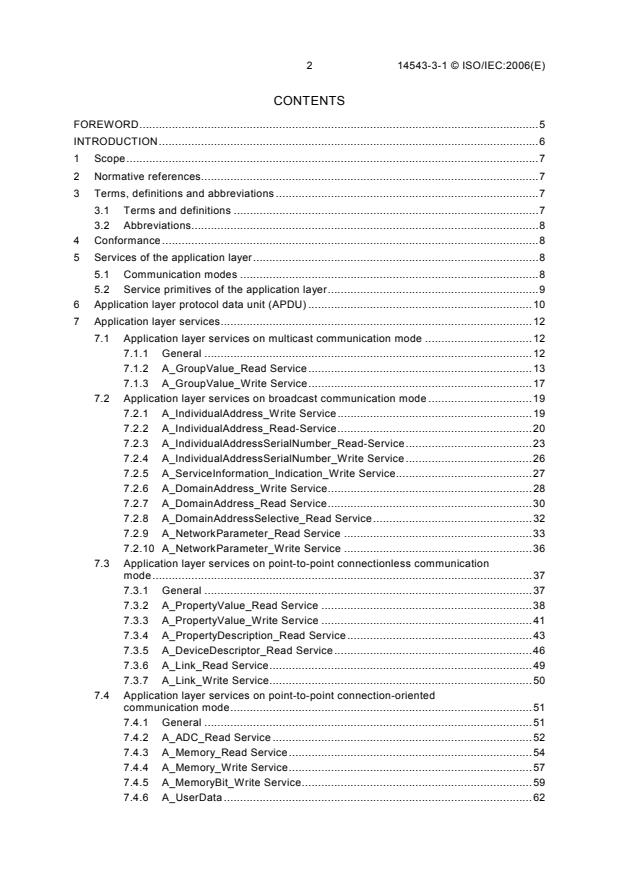
2 14543-3-1 © ISO/IEC:2006(E)
CONTENTS
FOREWORD.5
INTRODUCTION.6
1 Scope.7
2 Normative references.7
3 Terms, definitions and abbreviations .7
3.1 Terms and definitions .7
3.2 Abbreviations.8
4 Conformance.8
5 Services of the application layer.8
5.1 Communication modes .8
5.2 Service primitives of the application layer.9
6 Application layer protocol data unit (APDU) .10
7 Application layer services.12
7.1 Application layer services on multicast communication mode .12
7.1.1 General .12
7.1.2 A_GroupValue_Read Service.13
7.1.3 A_GroupValue_Write Service.17
7.2 Application layer services on broadcast communication mode .19
7.2.1 A_IndividualAddress_Write Service.19
7.2.2 A_IndividualAddress_Read-Service.20
7.2.3 A_IndividualAddressSerialNumber_Read-Service.23
7.2.4 A_IndividualAddressSerialNumber_Write Service.26
7.2.5 A_ServiceInformation_Indication_Write Service.27
7.2.6 A_DomainAddress_Write Service.28
7.2.7 A_DomainAddress_Read Service.30
7.2.8 A_DomainAddressSelective_Read Service.32
7.2.9 A_NetworkParameter_Read Service .33
7.2.10 A_NetworkParameter_Write Service .36
7.3 Application layer services on point-to-point connectionless communication
mode.37
7.3.1 General .37
7.3.2 A_PropertyValue_Read Service .38
7.3.3 A_PropertyValue_Write Service .41
7.3.4 A_PropertyDescription_Read Service.43
7.3.5 A_DeviceDescriptor_Read Service.46
7.3.6 A_Link_Read Service.49
7.3.7 A_Link_Write Service.50
7.4 Application layer services on point-to-point connection-oriented
communication mode.51
7.4.1 General .51
7.4.2 A_ADC_Read Service .52
7.4.3 A_Memory_Read Service.54
7.4.4 A_Memory_Write Service.57
7.4.5 A_MemoryBit_Write Service.59
7.4.6 A_UserData .62
14543-3-1 © ISO/IEC:2006(E) 3
7.4.7 A_Restart Service.73
7.4.8 A_Authorize_Request Service .74
7.4.9 A_Key_Write Service .76
7.5 Router-specific application layer services on point-to-point connection-
oriented communication mode .78
8 Parameters of application layer .79
8.1 Association table .79
8.2 Verify flag .79
Bibliography .80
Figure 1 – Interaction of the application layer for services that are not remote confirmed .9
Figure 2 – Interaction of the application layer for services that are remote confirmed .10
Figure 3 – APDU (Example) .10
Figure 4 – Mapping the ASAP to the TSAP (Example) .13
Figure 5 – Mapping a TSAP to an ASAP .13
Figure 6 – Handling requests and responses .13
Figure 7 – Message flow for the A_Group_Value_Read service .13
Figure 8 – A_GroupValue_Read-PDU (Example) .14
Figure 9 – A_GroupValue_Response-PDU (Example), length of ASAP data is more than
6 bit .14
Figure 10 – A_GroupValue_Response-PDU (Example) length of ASAP data is 6 bit or
less .15
Figure 11 – Message flow for the A_Group_Value_Write service .17
Figure 12 – A_GroupValue_Write-PDU (Example), length of ASAP data is more than 6
bit .17
Figure 13 – A_GroupValue_Write-PDU (Example), length of ASAP data is 6 bit or less .18
Figure 14 – A_IndividualAddress_Write-PDU (Example) .19
Figure 15 – A_IndividualAddress_Read-PDU (Example) .21
Figure 16 – A_IndividualAddress_Response-PDU (Example) .21
Figure 17 – Message flow for the A_IndividualAddressSerialNumber_Read service.23
Figure 18 – A_IndividualAddressSerialNumber_Read-PDU (Example) .23
Figure 19 – A_IndividualAddressSerialNumber_Response-PDU (Example) .24
Figure 20 – A_IndividualAddressSerialNumber_Write-PDU (Example) .26
Figure 21 – A_ServiceInformation_Indication_Write-PDU (Example) .27
Figure 22 – A_DomainAddress_Write-PDU.29
Figure 23 – A_DomainAddress_Read-PDU (Example) .30
Figure 24 – A_DomainAddress_Response-PDU (Example) .30
Figure 25 – A_DomainAddressSelective_Read-PDU (Example) .32
Figure 26 – A_NetworkParameter_Read-PDU (Example).34
Figure 27 – A_NetworkParameter_Response-PDU (Example).34
Figure 28 – A_NetworkParameter_Write-PDU (Example).36
Figure 29 – A_PropertyValue_Read-PDU (Example).38
Figure 30 – A_PropertyValue_Response-PDU (Example).39
Figure 31 – A_PropertyValue_Write-PDU (Example).41
Figure 32 – A_PropertyDescription_Read-PDU (Example) .44
4 14543-3-1 © ISO/IEC:2006(E)
Figure 33 – A_PropertyDescription_Response-PDU (Example) .44
Figure 34 – A_DeviceDescriptor_Read-PDU (Example) .47
Figure 35 – A_DeviceDescriptor_Response-PDU (Example) .47
Figure 36 – Message flow for A_Link_Read Service.49
Figure 37 – A_Link_Read-PDU (Example) .49
Figure 38 – A_Link_Response-PDU .49
Figure 39 – Message flow for A_Link_Write Service .50
Figure 40 – A_Link_Write-PDU.51
Figure 41 – A_ADC_Read-PDU (Example) .52
Figure 42 – A_ADC_Response-PDU (Example) .52
Figure 43 – A_Memory_Read-PDU (Example) .55
Figure 44 – A_Memory_Response-PDU (Example) .55
Figure 45 – A_Memory_Write-PDU (Example) .57
Figure 46 – A_MemoryBit_Write-PDU.61
Figure 47 – A_UserMemory_Read-PDU (Example) .63
Figure 48 – A_UserMemory_Response-PDU .63
Figure 49 – A_UserMemory_Write-PDU.66
Figure 50 – A_UserMemoryBit_Write-PDU (Example).69
Figure 51 – A_UserManufacturerInfo_Read-PDU (Example) .71
Figure 52 – A_UserManufacturerInfo_Response-PDU.72
Figure 53 – A_Restart-PDU (Example) .74
Figure 54 – A_Authorize_Request-PDU (Example) .75
Figure 55 – A_Authorize_Response-PDU (Example).75
Figure 56 – A_Key_Write-PDU (Example).77
Figure 57 – A_Key_Response-PDU (Example) .77
Table 1 – APCI overview .11
Table 2 – Function table for A_MemoryBit_Write-Services .60
Table 3 – Function table for A_UserMemoryBit_Write-Services.68
Table 4 – Association table of keys to access levels .76
14543-3-1 © ISO/IEC:2006(E) 5
INFORMATION TECHNOLOGY –
HOME ELECTRONIC SYSTEM (HES) ARCHITECTURE –
Part 3-1: Communication layers –
Application layer for network based control of HES Class 1
FOREWORD
1) ISO (International Organization for Standardization) and IEC (International Electrotechnical Commission) form
the specialized system for worldwide standardization. National bodies that are members of ISO or IEC
participate in the development of International Standards. Their preparation is entrusted to technical
committees; any ISO and IEC member body interested in the subject dealt with may participate in this
preparatory work. International governmental and non-governmental organizations liaising with ISO and IEC
also participate in this preparation.
2) In the field of information technology, ISO and IEC have established a joint technical committee,
ISO/IEC JTC 1. Draft International Standards adopted by the joint technical committee are circulated to
national bodies for voting. Publication as an International Standard requires approval by at least 75 % of the
national bodies casting a vote.
3) The formal decisions or agreements of IEC and ISO on technical matters express, as nearly as possible, an
international consensus of opinion on the relevant subjects since each technical committee has representation
from all interested IEC and ISO member bodies.
4) IEC, ISO and ISO/IEC Publications have the form of recommendations for international use and are accepted
by IEC and ISO member bodies in that sense. While all reasonable efforts are made to ensure that the
technical content of IEC, ISO and ISO/IEC Publications is accurate, IEC or ISO cannot be held responsible for
the way in which they are used or for any misinterpretation by any end user.
5) In order to promote international uniformity, IEC and ISO member bodies undertake to apply IEC, ISO and
ISO/IEC Publications transparently to the maximum extent possible in their national and regional publications.
Any divergence between any ISO/IEC Publication and the corresponding national or regional publication should
be clearly indicated in the latter.
6) ISO and IEC provide no marking procedure to indicate their approval and cannot be rendered responsible for
any equipment declared to be in conformity with an ISO/IEC Publication.
7) All users should ensure that they have the latest edition of this publication.
8) No liability shall attach to IEC or ISO or its directors, employees, servants or agents including individual
experts and members of their technical committees and IEC or ISO member bodies for any personal injury,
property damage or other damage of any nature whatsoever, whether direct or indirect, or for costs (including
legal fees) and expenses arising out of the publication of, use of, or reliance upon, this ISO/IEC publication or
any other IEC, ISO or ISO/IEC publications.
9) Attention is drawn to the normative references cited in this publication. Use of the referenced publications is
indispensable for the correct application of this publication.
10) Attention is drawn to the possibility that some of the elements of this International Standard may be the subject
of patent rights. ISO and IEC shall not be held responsible for identifying any or all such patent rights.
International Standard ISO/IEC 14543-3-1 was prepared by subcommittee 25: Interconnection
of information technology equipment, of ISO/IEC joint technical committee 1: Information
technology.
This International Standard together with ISO/IEC 14543-3-2 cancels and replaces
ISO/IEC TR 14543-3, published in 2000. It constitutes a complete revision of the principles
outlined in ISO/IEC TR 14543-3 and provides the specifications essential for an international
standard.
This publication has been drafted in accordance with the ISO/IEC Directives, Part 2.
This International Standard has been approved by vote of the member bodies, and the voting
results may be obtained from the address given on the title page.
6 14543-3-1 © ISO/IEC:2006(E)
INTRODUCTION
This part of ISO/IEC 14543 specifies the services and protocol of the application layer for
usage in Home Electronic Systems. Some services are targeted to field level communication
between devices. Other services are exclusively reserved for management purposes. Some
services can be used for both management and run-time communication.
Currently, ISO/IEC 14543, Information technology – Home Electronic System (HES)
architecture, consists of the following parts:
Part 2-1: Introduction and device modularity
Part 3-1: Communication layers – Application layer for network based control of HES Class 1
Part 3-2: Communication layers – Transport, network and general parts of data link layer for
network based control of HES Class 1
Part 3-3: User process for network based control of HES Class 1 (under consideration)
Part 3-4: System management – Management procedures for network based control of HES
Class 1 (under consideration)
Part 3-5: Media and media dependent layers – Power line for network based control of HES
Class 1 (under consideration)
Part 3-6: Media and media dependent layers – Twisted pair for network based control of
HES Class 1 (under consideration)
Part 3-7: Media and media dependent layers – Radio frequency for network based control of
HES Class 1 (under consideration)
Part 4: Home and building automation in a mixed-use building (technical report)
Additional parts may be added later.
14543-3-1 © ISO/IEC:2006(E) 7
INFORMATION TECHNOLOGY –
HOME ELECTRONIC SYSTEM (HES) ARCHITECTURE –
Part 3-1: Communication layers –
Application layer for network based control of HES Class 1
1 Scope
This part of the ISO/IEC 14543 specifies the services and protocol of the application layer for
usage in Home Electronic Systems. It provides the services and the interface to the user
process as defined in ISO/IEC 14543-3-3 (EN 50090-3-2). This procedure is based on the
services and the protocol as provided by the transport layer, the network layer and the data link
layer as specified in ISO/IEC 14543-3-2.
2 Normative references
The following referenced documents are indispensable for the application of this document. For
dated references, only the edition cited applies. For undated references, the latest edition of
the referenced document (including any amendments) applies.
ISO/IEC 11801, Information technology – Generic cabling for customer premises
ISO/IEC 14543-2-1, Information technology – Home electronic system (HES) architecture –
Part 2-1: Introduction and device modularity
ISO/IEC 14543-3-2, Information technology – Home electronic system (HES) – Part 3-2:
Communication layers – Transport, network and general parts of data link layer for network
based control of HES class 1
EN 50090-3-2:2003, Home and Building Electronic Systems (HBES) – Part 3-2: Aspects of
application – User process for HBES Class 1
NOTE 1 Reference to this standard will be replaced by reference to International Standard ISO/IEC 14543-3-3
which is currently under consideration. Please refer to bibliography.
EN 50090-7-1:2003, Home and Building Electronic Systems (HBES) – Part 7-1: System
Management – Management procedures
NOTE 2 Reference to this standard will be replaced by reference to International Standard ISO/IEC 14543-3-4
which is currently under consideration. Please refer to bibliography.
3 Terms, definitions and abbreviations
3.1 Terms and definitions
For the purposes of this document the terms and definitions given in ISO/IEC 14543-2-1 and
the following apply.
3.1.1
application (in the sense of network application)
system, including its associated transmission method, which is supported by telecommu-
nications cabling
[ISO/IEC 11801:2002, definition 3.1.2]
8 14543-3-1 © ISO/IEC:2006(E)
3.1.2
user application
software functionality, the control algorithm that runs in one single device
3.2 Abbreviations
AL Application Layer
AD-converter Analog-to-Digital-converter
APDU Application layer Protocol Data Unit
APCI Application layer Protocol Control Information
ASAP Application layer Service Access Point
Acon Application layer confirmation
con confirmation
CPU Central Processing Unit
HES Class 1 refers to simple control and command
HES Class 2 refers to Class 1 plus simple voice and stable picture
transmission
HES Class 3 refers to Class 2 plus complex video transfers
ind indication
Lcon Local confirmation
PDU Protocol Data Unit
Rcon Remote confirmation
req request
res response
TL Transport Layer
TPDU Transport layer Protocol Data Unit
TSAP Transport layer Service Access Point
USERMSG User Message
4 Conformance
An entity of operational exchange conforming to this International Standard shall meet the
requirements of 7.1, 7.2.1, 7.2.2, 7.3.5, 7.4.3, 7.4.4, 7.4.7 and clause 8.
All services shall be implemented according to the provisions of clauses 5 and 6.
5 Services of the application layer
5.1 Communication modes
The application layer shall provide a large variety of application services to the application
process. Application processes in different devices interoperate by using services of
application layer over communication modes. According to the transport layer, the following
different types of communication modes shall exist:
a) point-to-multipoint, connectionless (multicast);
b) point-to-domain, connectionless (broadcast);
14543-3-1 © ISO/IEC:2006(E) 9
c) point-to-all-points, connectionless (system broadcast);
d) point-to-point, connectionless;
e) point-to-point, connection-oriented.
The application layer services that are offered shall depend on the communication mode. An
application layer service shall not be applied on a communication mode for which it is not
specified.
Some services may be used on the point-to-point connection-oriented, as well as the point-to-
point connectionless communication mode, although application layer services shall always be
mapped to transport layer services depending on the type of the communication mode.
5.2 Service primitives of the application layer
Each specified application layer service shall be invoked by the transport layer primitives
request (req), indication (ind) and confirmation (con). For a remote confirmed service, the
remote device shall use the same transport layer primitives to respond to the service.
The transport layer confirmation primitive shall only be a confirmation from the transport layer
instance and shall include all data from the request plus the state which indicates whether the
service was sent successfully or not. The application layer shall map the transport layer
confirmation primitive to a local application layer confirmation (Lcon). See Figure 1 and Figure
2 for the interaction of the application layer.
Local Remote/Response
Application Process
User of AL User of AL
A_Service.Lcon A_Service.ind
A_Service.req
Application Layer
T_Service.req T_Service.ind
T_Service.con
(WRITE_PDU) (WRITE_PDU)
(WRITE_PDU)
Transport Layer
Figure 1 – Interaction of the application layer
for services that are not remote confirmed
In case of a remote confirmed service the remote device shall initiate the response (res)
primitive and the application layer shall map this service primitive to a transport layer request
primitive. The local application layer shall receive the transport layer indication primitive and
shall map it to an application layer confirmation (Acon). The transport layer confirmation in the
remote device shall be mapped by the remote application layer to a remote confirmation
(Rcon).
NOTE In the following service specifications the local application layer confirmation and the remote confirmation
(Rcon) are not always described.
10 14543-3-1 © ISO/IEC:2006(E)
Local Remote/Response
Application Process
User of AL User of AL
A_Service.req A_Service.Lcon A_Service.Acon A_Service.ind A_Service.Rcon A_Service.res
Application Layer
T_Service.con
T_Service.req T_Service.ind
T_Service.ind
T_Service.con
T_Service.req
(READ_PDU)
(READ_PDU) (RESPONSE_PDU)
(READ_PDU)
(RESPONSE_PDU)
RESPONSE_PDU
Transport Layer
Figure 2 – Interaction of the application layer
for services that are remote confirmed
6 Application layer protocol data unit (APDU)
An example of an APDU is shown in Figure 3.
Octet 21
Octet 6 Octet 7 Octet 8 .
APDU
L-4 L-7
Figure 3 – APDU (Example)
14543-3-1 © ISO/IEC:2006(E) 11
Table 1 – APCI overview
Application layer Service Allowed communication mode(s)
APCI
(bit position)
Octet n Octet n+1
8 7 6 5 4 3 2 1 8 7 6 5 4 3 2 1
0 0 0 0 0 0 0 0 0 0 A_GroupValue_Read X
0 0 0 1 A_GroupValue_Response X
0 0 1 0 A_GroupValue_Write X
0 0 1 1 0 0 0 0 0 0 A_IndividualAddress_Write X
0 1 0 0 0 0 0 0 0 0 A_IndividualAddress_Read X
0 1 0 1 0 0 0 0 0 0 A_IndividualAddress_Response X
1 1 1 1 0 1 1 1 0 0 A_IndividualAddressSerialNumber_Read X
1 1 1 1 0 1 1 1 0 1 A_IndividualAddressSerialNumber_Response X
1 1 1 1 0 1 1 1 1 0 A_IndividualAddressSerialNumber_Write X
1 1 1 1 0 1 1 1 1 1 A_ServiceInformation_Indication_Write X
1 1 1 1 0 1 1 0 1 0 A_NetworkParameter_Read X
1 1 1 1 0 1 1 0 1 1 A_NetworkParameter_Response X X
1 1 1 1 1 0 0 1 0 0 A_NetworkParameter_Write X X
1 1 1 1 0 1 0 1 0 1 A_PropertyValue_Read X X
1 1 1 1 0 1 0 1 1 0 A_PropertyValue_Response X X
1 1 1 1 0 1 0 1 1 1 A_PropertyValue_Write X X
1 1 1 1 0 1 1 0 0 0 A_PropertyDescription_Read X X
1 1 1 1 0 1 1 0 0 1 A_PropertyDescription_Response X X
1 1 1 1 1 0 0 1 0 1 A_Link_Read X X
1 1 1 1 1 0 0 1 1 0 A_Link_Response X X
1 1 1 1 1 0 0 1 1 1 A_Link_Write X X
0 1 1 0 A_ADC_Read X
0 1 1 1 A_ADC_Response X
1 0 0 0 0 0 A_Memory_Read X
1 0 0 1 0 0 A_Memory_Response X
1 0 1 0 0 0 A_Memory_Write X
1 0 1 1 0 0 0 0 0 0 A_UserMemory_Read X
1 0 1 1 0 0 0 0 0 1 A_UserMemory_Response X
1 0 1 1 0 0 0 0 1 0 A_UserMemory_Write X
1 0 1 1 0 0 0 1 0 0 A_UserMemoryBit_Write (not for future use) X
1 0 1 1 0 0 0 1 0 1 A_UserManufacturerInfo_Read X
1 0 1 1 0 0 0 1 1 0 A_UserManufacturerInfo_Response X
1 0 1 1 0 0 0 1 1 1 X
.. .. Reserved USERMSG
1 0 1 1 1 1 0 1 1 1 X
1 0 1 1 1 1 1 0 0 0 X
.. .. manufacturer specific area for USERMSG
1 0 1 1 1 1 1 1 1 0 X
APCI
APCI
data/APCI
data/APCI
data/APCI
data/APCI
data/APCI
data/APCI
data/APCI
data/APCI
Multicast
Broadcast
Point-to-all-points
connectionless
Point-to-point
connectionless
Point-to-point
connection-
oriented
12 14543-3-1 © ISO/IEC:2006(E)
Table 1 (continued)
APCI Application layer service Allowed communication mode(s)
(bit position)
Octet n
Octet n+1
8 7 6 5 4 3 2 1 8 7 6 5 4 3 2 1
1 1 0 0 0 0 0 0 00 A_DeviceDescriptor_Read X
1 1 0 1 0 0 0 0 00 A_DeviceDescriptor_Response X
1 1 1 0 0 0 0 0 00 A_Restart X
Coupler specific services
1 1 1 1 0 0 0 0 00 A_Open_Routing_Table_Req (not for future X
use)
1 1 1 1 0 0 0 0 01 A_Read_Routing_Table_Req (not for future X
use)
1 1 1 1 0 0 0 0 10 A_Read_Routing_Table__Res (not for future X
use)
1 1 1 1 0 0 0 0 11 A_Write_Routing_Table_Req (not for future X
use)
1 1 1 1 0 0 1 0 00 A_Read_Router_Memory_Res (not for future X
use)
1 1 1 1 0 0 1 0 01 A_Read_Router_Memory_Res (not for future X
use)
1 1 1 1 0 0 1 0 10 A_Write_Router_Memory_Req (not for future X
use)
1 1 1 1 0 0 1 1 01 A_Read_Router_Status_Req (not for future X
use)
1 1 1 1 0 0 1 1 10 A_Read_Router_Status_Res (not for future X
use)
1 1 1 1 0 0 1 1 11 A_Write_Router_Status_Req (not for future X
use)
1 1 1 1 0 1 0 0 00 A_MemoryBit_Write (not for future X
use)
1 1 1 1 0 1 0 0 01 A_Authorize_Request X
1 1 1 1 0 1 0 0 10 A_Authorize_Response X
1 1 1 1 0 1 0 0 11 A_Key_Write X
1 1 1 1 0 1 0 1 00 A_Key_Response X
Open Media Specific Services
1 1 1 1 1 0 0 0 00 A_DomainAddress_Write X
1 1 1 1 1 0 0 0 01 A_DomainAddress_Read X
1 1 1 1 1 0 0 0 10 A_DomainAddress_Response X
1 1 1 1 1 0 0 0 11 A_DomainAddressSelective_Read X
The APDU shall correspond to the transport layer protocol data unit (TPDU), but shall be
reduced by the transport control field. The application control field shall be encoded and
decoded by application layer and shall contain the application layer service codes (APCI). The
application control field shall have a length of either 4 bit or 10 bit, as specified for each
application layer service, in Clause 7.
The codes for the application control field are shown in Table 1. The complete protocol data
unit (PDU) for each service primitive is shown in the description of every service.
Not defined and not supported application layer services shall be ignored by the application
layer.
7 Application layer services
7.1 Application layer services on multicast communication mode
7.1.1 General
A multicast communication mode shall connect transport layer service access points (TSAP) to
application layer service access points (ASAP). When one device sends an
A_GroupValue-Service each device which is member of this group shall receive the
A_GroupValue_Service.
APCI
APCI
data/APCI
data/APCI
data/APCI
data/APCI
data/APCI
data/APCI
data/APCI
data/APCI
Multicast
Broadcast
Point-to-all-point
connectionless
Point-to-point
connectionless
Point-to-point
connection-
oriented
14543-3-1 © ISO/IEC:2006(E) 13
If the application layer of a device receives an A_GroupValue_Write-Service, it shall map the
contained ASAP to exactly one TSAP; it shall search for other associations between ASAPs
and the found TSAP informs all these associated ASAPs, as specified in 7.1.3, see Figure 4.
Association Table
transmit request
request on TSAP via ASAP 1
update on TSAP 1 ASAP 2
Figure 4 – Mapping the ASAP to the TSAP (example)
If the application layer of a device receives an A_GroupValue_Read-Service, it shall search for
all ASAPs associated to this TSAP and shall inform all the associated ASAPs. Only one read
response shall be generated by the user as specified in 7.1.2, see Figure 5.
read ASAP 1
Association Table
read disable
A_GroupValue_Read–Service
with TSAP = 1 20
transmit request response via ASAP 2
read enable
read ASAP 2
ASAP 3 is not informed if a
read response is already obtained
Figure 5 – Mapping a TSAP to an ASAP
If a transmission is requested (read response or write) via an ASAP, the application layer shall
take the associated TSAP, update all the ASAPs with the same TSAP and generate an
A_Group-Service-Request, see Figure 6.
Association Table
transmit request
write/response on TSAP 1
20 write/response via ASAP 1
write/response ASAP 2
update on TSAP 1
Figure 6 – Handling requests and responses
7.1.2 A_GroupValue_Read Service
Application layer user TL Application layer user
A_GroupValue_Read.req T_Data_Group.req T_Data_Group.ind A_GroupValue_Read.ind
A_GroupValue_Read-PDU A_GroupValue_Read-PDU
A_GroupValue_Read.Lcon T_Data_Group.con
A_GroupValue_Read-PDU
A_GroupValue_Read.Acon T_Data_Group.ind T_Data_Group.req A_GroupValue_Read.res
A_GroupValue_Response-PDU A_GroupValue_Response-PDU
T_Data_Group.con A_GroupValue_Response.Rcon
A_GroupValue_Response-PDU
Figure 7 – Message flow for the A_Group_Value_Read service
The A_GroupValue_Read.req primitive shall be applied by the user of application layer, to
receive an update of the value of its ASAP by making a communication partner respond with an
14 14543-3-1 © ISO/IEC:2006(E)
A_GroupValue_Read.res, i.e. the service shall be confirmed by the remote application process.
The ASAP shall be associated to the TSAP, i.e. with a group address, as specified in
ISO/IEC 14543-3-2. All other group members shall receive the A_GroupValue_Response-PDU
as well, see Figure 7.
The local application layer shall accept the service request, map the ASAP to the TSAP and
pass it with a T_Data_Group.req to the local transport layer. The parameters TSAP and priority
shall be mapped to the corresponding parameters of the T_Data_Group.req primitive, the
TSDU shall be an A_GroupValue_Read-PDU.
NOTE 1 During configuration the user of the HES system can decide about the mapping between ASAPs and
TSAPs.
The remote application layer shall map a T_Data_Group.ind primitive with
TSDU = A_GroupValue_Read-PDU to an A_GroupValue_Read.ind primitive. The arguments
TSAP and priority shall be mapped to the corresponding arguments ASAP and priority of the
A_GroupValue_Read.ind primitive. One A_GroupValue_Read.ind primitive shall be generated
per ASAP that is assigned to the corresponding TSAP.
The remote application process shall evaluate the received A_Group_Value_Read-PDU and
use the argument ASAP to obtain the response. It shall respond to the
A_GroupValue_Read.ind primitive with an A_GroupValue_Read.res primitive containing the
obtained response, see Figure 8.
NOTE 2 During configuration, the user of the HES system can decide whether or not the A_GroupValue_Read.res
primitive is generated, although one ASAP should generate the A_GroupValue_Read.res primitive.
NOTE 3 It is left to the user application programmer to decide whether an A_GroupValue_Read.Acon time-out
supervision is necessary.
Two different formats of the A_GroupValue_Response-PDU are used depending on the length
of the value. The maximum length of the value shall be 14 octets. Unused data bits shall be set
to zero, see Figure 9.
Octet 6 Octet 7
APCI
7 6 54 321076543210
000 0 0 00000
Figure 8 – A_GroupValue_Read-PDU (Example)
Octet 6 Octet 7 Octet 8.Octet 21
Value (up to 14
APCI
octets)
7 6 5 4 3 2 107654321076543210
000 1 0 00000 DDDDDDDD
Figure 9 – A_GroupValue_Response-PDU (Example),
length of ASAP data is more than 6 bit
APCI
APCI
APCI
APCI
APCI
APCI
APCI
APCI
14543-3-1 © ISO/IEC:2006(E) 15
Values that only consist of 6 bits or less shall have the following optimized
A_GroupValue_Response-PDU format, see Figure 10.
Octet 6 Octet 7
APCI
7 6 5 4 321076543210
0001 DDDDDD Data
Figure 10 – A_GroupValue_Response-PDU (Example)
length of ASAP data is 6 bit or less
The remote application layer shall accept the service response, map the ASAP to the TSAP
and pass it with a T_Data_Group.req to the local transport layer. The parameters ack_request,
TSAP, hop_count_type and priority shall be mapped to the corresponding parameters of the
T_Data_Group.req primitive, the TSDU shall be a A_GroupValue_Response-PDU.
The local application layer shall map a T_Data_Group.ind primitive with
TSDU = A_GroupValue_Response-PDU to an A_GroupValue_Read.Acon primitive. The
arguments TSAP and priority shall be mapped to the corresponding arguments ASAP and
priority of the A_GroupValue_Read. Acon primitive. More than one A_GroupValue_Read.Acon
primitive may occur depending on the number of group members that have been configured to
respond.
A_GroupValue_Read.req(ack_request, ASAP, priority, hop_count_type)
ack_request: this parameter shall be used to indicate whether a layer-2 acknowledge
is mandatory or optional
ASAP: this parameter shall be used to contain the service access point
hop_count_type: this parameter shall be used to indicate whether the hop_count shall be
set to 7 or if the network layer parameter shall be used
priority: this parameter shall be used to contain the priority that shall be used to
transmit the requested service; it shall be “system”, “urgent”, “normal”
or “low”
A_GroupValue_Read.Lcon(ack_request, ASAP, priority, hop_count_type, a_status)
ack_request: this parameter shall be used to indicate whether a layer-2 acknowledge
has been indicated as mandatory or optional in the transmitted frame
ASAP: this parameter shall be used to contain the service access point
hop_count_type: this parameter shall be used to indicate whether the hop_count of the
transmitted frame has been set to 7 or if the network layer parameter
has been used
priority: this parameter shall be used to indicate the priority that has been used
to the transmit the requested frame; it shall be “system”, “urgent”,
“normal” or “low”
a_status: ok: this value of this parameter shall be used to indicate that the
transmission of the A_GroupValue_Read.req has been successful
not_ok: this value of this parameter shall be used to indicate that the
transmission of the A_GroupValue_Read.req did not succeed
APCI
APCI
APCI
APCI
16 14543-3-1 © ISO/IEC:2006(E)
A_GroupValue_Read.ind(ASAP, priority, hop_count_type)
ASAP: this parameter shall be used to contain the service access point
hop_count_type: this parameter shall be used to indicate whether the hop count of the
received frame equals 7 or not
priority: this parameter shall be used to indicate the priority of the received
frame; it shall be “system”, “urgent”, “normal” or “low”
A_GroupValue_Read.res(ack_request, ASAP, priority, hop_count_type, data)
ack_request: this parameter shall be used to indicate whether a layer-2 acknowledge
is mandatory or optional
ASAP: this parameter shall be used to contain the service access point
hop_count_type: this parameter shall be used to indicate whether the hop_count shall be
set to 7 or if the network layer parameter shall be used
priority: this parameter shall be used to contain the priority that shall be used to
transmit the requested service; it shall be “system”, “urgent”, “normal”
or “low”
data: the parameter shall be used to contain the value of the associated
service access point
A_GroupValue_Read.Rcon(ack_request, ASAP, priority, hop_count_type, data, a_status)
ack_request: this parameter shall be used to indicate whether a layer-2 acknowledge
has been indicated as mandatory or optional in the transmitted frame
ASAP: this parameter shall be used to contain the service access point
hop_count_type: this parameter shall be used to indicate whether the hop_count of the
transmitted frame has been set to 7 or if the network layer parameter
has been used
priority: this parameter shall be used to indicate the priority that has been used
to transmit the requested frame; it shall be “system”, “urgent”, “normal”
or “low”
data: this parameter shall be used to contain the value of the associated
service access point
a_status: ok: the value of this parameter shall be used to indicate that the
transmission of the A_GroupValue_
...
Questions, Comments and Discussion
Ask us and Technical Secretary will try to provide an answer. You can facilitate discussion about the standard in here.
Loading comments...