

IEC 60794-6:2020
(Main)Optical fibre cables - Part 6: Indoor-outdoor cables - Sectional specification for indoor-outdoor cables
General Information
- Abstract
IEC 60794-6:2020 is a sectional specification covering general features of optical fibre cables applicable to outdoor as well as indoor environments, called "indoor-outdoor cables". Indoor-outdoor cables are deployed in outside plant environments as well as in premises thus fulfilling outdoor as well as indoor requirements. Typical application spaces are, for example, extension of a duct cable into a building or using this design for centralized cabling in the central office, the premises or local area network where the same cable is used for the entire length of the cabling link including both the indoor as well as the outdoor portions. Cables which generally possess the characteristics associated with outdoor cable designs having the thermal and mechanical robustness that makes them suitable for use in the outside plant, while simultaneously being relatively flexible, compact and lightweight and exhibiting the fire performance required in indoor premises are specified in IEC 60794-6-10. Flame retardant outdoor cables as specified in IEC 60794-6-20 are used when most of the cable length is deployed as an outdoor cable with a part of its length deployed indoors. The cable design can be derived from a typical outdoor cable design according to the product specifications described in IEC 60794-3. The specific performance related to bend radii according to the installation situation and fire performance according to the regional legislation mainly requires the appropriate selection of the jacket material in combination with other material and/or design considerations. Because of the use in buildings with tighter space restrictions, higher flexibility of the cable is often required for the installation. Often, smaller diameter cables are preferred. Indoor cables which are weatherised as specified in (IEC 60794-6-30) are used when an indoor cable is used outdoors over a short distance (few meters), for example when the network access point (NAP) is very close to the building. The indoor-outdoor fibre optical cable design can be derived from an indoor design (see IEC 60794-2 and IEC TR 62901 for typical applications) with specific outdoor performance features added. Critical parameters are UV stability, and resistance against exposure to humidity.
- Status
- Published
- Publication Date
- 24-Sep-2020
- Technical Committee
- SC 86A - Fibres and cables
- Current Stage
- PPUB - Publication issued
- Start Date
- 25-Sep-2020
- Completion Date
- 30-Oct-2020
Overview
IEC 60794-6:2020 is an international standard published by the International Electrotechnical Commission (IEC) that specifies the sectional requirements for optical fibre indoor-outdoor cables. These cables are uniquely designed to operate both in outdoor environments and within indoor premises, meeting the demanding criteria necessary for installation in diverse conditions. Indoor-outdoor cables bridge the gap between outdoor plant environments and indoor telecommunications infrastructure, enabling seamless connectivity with a single cable solution.
This standard addresses the design, materials, mechanical robustness, thermal stability, fire safety, and environmental resistance parameters critical to cables used in mixed indoor and outdoor deployments. By ensuring compatibility with established IEC product and family specifications, IEC 60794-6:2020 facilitates reliable, flexible, compact, and lightweight cable solutions for modern fiber optic networks.
Key Topics
Scope and Application
IEC 60794-6 covers optical fibre cables that must perform reliably in both outdoor and indoor settings-so called indoor-outdoor cables. Typical uses include extending duct cables into buildings, centralized cabling in offices or local area networks, and connections where the entire link traverses from outside plant into indoor infrastructure.Cable Design Characteristics
- High mechanical robustness and thermal endurance suited for outdoor conditions
- Fire performance compliant with indoor building regulations
- Flexibility and smaller diameters to meet space constraints inside premises
- UV stability and humidity resistance for weather exposure on short outdoor runs
Variants Covered Under the Standard
- Universal indoor-outdoor cables with balanced outdoor and indoor performance qualities (IEC 60794-6-10)
- Flame retardant outdoor cables with indoor portions (IEC 60794-6-20)
- Weatherised indoor cables suitable for limited outdoor exposure (IEC 60794-6-30)
Materials and Component Compatibility
Selection of jacket materials and other elements must ensure compatibility, mechanical testing, and resistance characteristics as specified in related IEC documents like IEC 60794-1-21 and IEC 60794-1-219.Testing and Quality Assurance
The standard prescribes detailed test methods for attenuation, mechanical strength, fire performance, and environmental resistance to guarantee cable reliability and safety in mixed installation scenarios.
Applications
Indoor-outdoor fibre optic cables conforming to IEC 60794-6:2020 are widely used in:
Telecommunication Networks
Extending backbone or distribution cables from underground ducts or outdoor poles directly into building premises without the need for fiber splicing or transition points.Central Offices and Data Centers
Providing streamlined cabling solutions that traverse outside and inside environments with consistent fire safety and durability features.Local Area Networks (LANs) in Commercial Buildings
Installing compact, flexible cables that reduce space consumption while maintaining outdoor ruggedness near network access points (NAPs).Fiber to the Home (FTTH) and Access Networks
Connecting outdoor fiber infrastructure to indoor optical network terminals (ONTs) with cables that withstand environmental stress and indoor fire codes.
These cables ensure minimal installation complexity, reduced maintenance, and enhanced operational reliability by complying with both indoor and outdoor performance demands.
Related Standards
IEC 60794-6:2020 integrates and references complementary standards in the IEC 60794 series and other IEC publications:
- IEC 60794-2: Indoor cables – Sectional specification for cables intended exclusively for indoor use
- IEC 60794-3: Outdoor cables – Sectional specification for cables designed solely for outdoor deployment
- IEC 60794-6-10: Universal indoor-outdoor cables family specification
- IEC 60794-6-20: Flame retardant outdoor cables with indoor use sections
- IEC 60794-6-30: Weatherised indoor cables used briefly outdoors
- IEC 60793-1-40: Optical fibre attenuation measurement methods
- IEC 60794-1-1 and IEC 60794-1-21: Generic cable specifications and mechanical test methodologies
Complementary use of these standards supports comprehensive product design, testing, and performance validation frameworks.
By adhering to IEC 60794-6:2020, manufacturers and network designers ensure that indoor-outdoor optical fibre cables are robust, flexible, fire-safe, and environmentally resilient-suitable for seamless integration across complex network environments. This standard plays a crucial role in advancing next-generation fiber optic infrastructure with reliable, multi-environment cable solutions.
Get Certified
Connect with accredited certification bodies for this standard

ANCE
Mexican certification and testing association.

Intertek Slovenia
Intertek testing, inspection, and certification services in Slovenia.

LNE (Laboratoire National de Métrologie et d'Essais)
French national laboratory for metrology and testing.
Sponsored listings
Frequently Asked Questions
IEC 60794-6:2020 is a standard published by the International Electrotechnical Commission (IEC). Its full title is "Optical fibre cables - Part 6: Indoor-outdoor cables - Sectional specification for indoor-outdoor cables". This standard covers: IEC 60794-6:2020 is a sectional specification covering general features of optical fibre cables applicable to outdoor as well as indoor environments, called "indoor-outdoor cables". Indoor-outdoor cables are deployed in outside plant environments as well as in premises thus fulfilling outdoor as well as indoor requirements. Typical application spaces are, for example, extension of a duct cable into a building or using this design for centralized cabling in the central office, the premises or local area network where the same cable is used for the entire length of the cabling link including both the indoor as well as the outdoor portions. Cables which generally possess the characteristics associated with outdoor cable designs having the thermal and mechanical robustness that makes them suitable for use in the outside plant, while simultaneously being relatively flexible, compact and lightweight and exhibiting the fire performance required in indoor premises are specified in IEC 60794-6-10. Flame retardant outdoor cables as specified in IEC 60794-6-20 are used when most of the cable length is deployed as an outdoor cable with a part of its length deployed indoors. The cable design can be derived from a typical outdoor cable design according to the product specifications described in IEC 60794-3. The specific performance related to bend radii according to the installation situation and fire performance according to the regional legislation mainly requires the appropriate selection of the jacket material in combination with other material and/or design considerations. Because of the use in buildings with tighter space restrictions, higher flexibility of the cable is often required for the installation. Often, smaller diameter cables are preferred. Indoor cables which are weatherised as specified in (IEC 60794-6-30) are used when an indoor cable is used outdoors over a short distance (few meters), for example when the network access point (NAP) is very close to the building. The indoor-outdoor fibre optical cable design can be derived from an indoor design (see IEC 60794-2 and IEC TR 62901 for typical applications) with specific outdoor performance features added. Critical parameters are UV stability, and resistance against exposure to humidity.
IEC 60794-6:2020 is a sectional specification covering general features of optical fibre cables applicable to outdoor as well as indoor environments, called "indoor-outdoor cables". Indoor-outdoor cables are deployed in outside plant environments as well as in premises thus fulfilling outdoor as well as indoor requirements. Typical application spaces are, for example, extension of a duct cable into a building or using this design for centralized cabling in the central office, the premises or local area network where the same cable is used for the entire length of the cabling link including both the indoor as well as the outdoor portions. Cables which generally possess the characteristics associated with outdoor cable designs having the thermal and mechanical robustness that makes them suitable for use in the outside plant, while simultaneously being relatively flexible, compact and lightweight and exhibiting the fire performance required in indoor premises are specified in IEC 60794-6-10. Flame retardant outdoor cables as specified in IEC 60794-6-20 are used when most of the cable length is deployed as an outdoor cable with a part of its length deployed indoors. The cable design can be derived from a typical outdoor cable design according to the product specifications described in IEC 60794-3. The specific performance related to bend radii according to the installation situation and fire performance according to the regional legislation mainly requires the appropriate selection of the jacket material in combination with other material and/or design considerations. Because of the use in buildings with tighter space restrictions, higher flexibility of the cable is often required for the installation. Often, smaller diameter cables are preferred. Indoor cables which are weatherised as specified in (IEC 60794-6-30) are used when an indoor cable is used outdoors over a short distance (few meters), for example when the network access point (NAP) is very close to the building. The indoor-outdoor fibre optical cable design can be derived from an indoor design (see IEC 60794-2 and IEC TR 62901 for typical applications) with specific outdoor performance features added. Critical parameters are UV stability, and resistance against exposure to humidity.
IEC 60794-6:2020 is classified under the following ICS (International Classification for Standards) categories: 33.180.10 - Fibres and cables. The ICS classification helps identify the subject area and facilitates finding related standards.
IEC 60794-6:2020 is available in PDF format for immediate download after purchase. The document can be added to your cart and obtained through the secure checkout process. Digital delivery ensures instant access to the complete standard document.
Standards Content (Sample)
IEC 60794-6 ®
Edition 1.0 2020-09
INTERNATIONAL
STANDARD
NORME
INTERNATIONALE
Optical fibre cables –
Part 6: Indoor-outdoor cables – Sectional specification for indoor-outdoor
cables
Câbles à fibres optiques –
Partie 6: Câbles intérieurs/extérieurs – Spécification intermédiaire pour
les câbles intérieurs/extérieurs
All rights reserved. Unless otherwise specified, no part of this publication may be reproduced or utilized in any form
or by any means, electronic or mechanical, including photocopying and microfilm, without permission in writing from
either IEC or IEC's member National Committee in the country of the requester. If you have any questions about IEC
copyright or have an enquiry about obtaining additional rights to this publication, please contact the address below or
your local IEC member National Committee for further information.
Droits de reproduction réservés. Sauf indication contraire, aucune partie de cette publication ne peut être reproduite
ni utilisée sous quelque forme que ce soit et par aucun procédé, électronique ou mécanique, y compris la photocopie
et les microfilms, sans l'accord écrit de l'IEC ou du Comité national de l'IEC du pays du demandeur. Si vous avez des
questions sur le copyright de l'IEC ou si vous désirez obtenir des droits supplémentaires sur cette publication, utilisez
les coordonnées ci-après ou contactez le Comité national de l'IEC de votre pays de résidence.
IEC Central Office Tel.: +41 22 919 02 11
3, rue de Varembé info@iec.ch
CH-1211 Geneva 20 www.iec.ch
Switzerland
About the IEC
The International Electrotechnical Commission (IEC) is the leading global organization that prepares and publishes
International Standards for all electrical, electronic and related technologies.
About IEC publications
The technical content of IEC publications is kept under constant review by the IEC. Please make sure that you have the
latest edition, a corrigendum or an amendment might have been published.
IEC publications search - webstore.iec.ch/advsearchform Electropedia - www.electropedia.org
The advanced search enables to find IEC publications by a The world's leading online dictionary on electrotechnology,
variety of criteria (reference number, text, technical containing more than 22 000 terminological entries in English
committee,…). It also gives information on projects, replaced and French, with equivalent terms in 16 additional languages.
and withdrawn publications. Also known as the International Electrotechnical Vocabulary
(IEV) online.
IEC Just Published - webstore.iec.ch/justpublished
Stay up to date on all new IEC publications. Just Published IEC Glossary - std.iec.ch/glossary
details all new publications released. Available online and 67 000 electrotechnical terminology entries in English and
once a month by email. French extracted from the Terms and Definitions clause of
IEC publications issued since 2002. Some entries have been
IEC Customer Service Centre - webstore.iec.ch/csc collected from earlier publications of IEC TC 37, 77, 86 and
If you wish to give us your feedback on this publication or CISPR.
need further assistance, please contact the Customer Service
Centre: sales@iec.ch.
A propos de l'IEC
La Commission Electrotechnique Internationale (IEC) est la première organisation mondiale qui élabore et publie des
Normes internationales pour tout ce qui a trait à l'électricité, à l'électronique et aux technologies apparentées.
A propos des publications IEC
Le contenu technique des publications IEC est constamment revu. Veuillez vous assurer que vous possédez l’édition la
plus récente, un corrigendum ou amendement peut avoir été publié.
Recherche de publications IEC - Electropedia - www.electropedia.org
webstore.iec.ch/advsearchform Le premier dictionnaire d'électrotechnologie en ligne au
La recherche avancée permet de trouver des publications IEC monde, avec plus de 22 000 articles terminologiques en
en utilisant différents critères (numéro de référence, texte, anglais et en français, ainsi que les termes équivalents dans
comité d’études,…). Elle donne aussi des informations sur les 16 langues additionnelles. Egalement appelé Vocabulaire
projets et les publications remplacées ou retirées. Electrotechnique International (IEV) en ligne.
IEC Just Published - webstore.iec.ch/justpublished Glossaire IEC - std.iec.ch/glossary
Restez informé sur les nouvelles publications IEC. Just 67 000 entrées terminologiques électrotechniques, en anglais
Published détaille les nouvelles publications parues. et en français, extraites des articles Termes et Définitions des
Disponible en ligne et une fois par mois par email. publications IEC parues depuis 2002. Plus certaines entrées
antérieures extraites des publications des CE 37, 77, 86 et
Service Clients - webstore.iec.ch/csc CISPR de l'IEC.
Si vous désirez nous donner des commentaires sur cette
publication ou si vous avez des questions contactez-nous:
sales@iec.ch.
IEC 60794-6 ®
Edition 1.0 2020-09
INTERNATIONAL
STANDARD
NORME
INTERNATIONALE
Optical fibre cables –
Part 6: Indoor-outdoor cables – Sectional specification for indoor-outdoor
cables
Câbles à fibres optiques –
Partie 6: Câbles intérieurs/extérieurs – Spécification intermédiaire pour
les câbles intérieurs/extérieurs
INTERNATIONAL
ELECTROTECHNICAL
COMMISSION
COMMISSION
ELECTROTECHNIQUE
INTERNATIONALE
ICS 33.180.10 ISBN 978-2-8322-8902-0
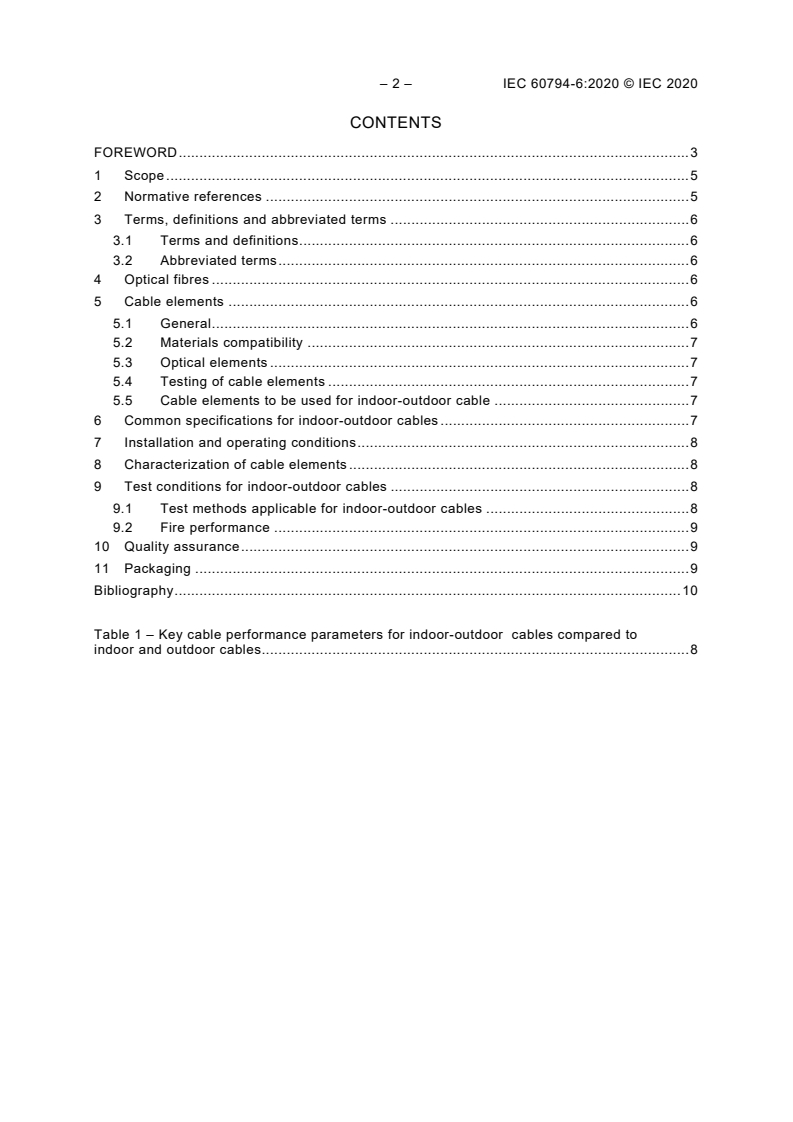
– 2 – IEC 60794-6:2020 © IEC 2020
CONTENTS
FOREWORD . 3
1 Scope . 5
2 Normative references . 5
3 Terms, definitions and abbreviated terms . 6
3.1 Terms and definitions . 6
3.2 Abbreviated terms . 6
4 Optical fibres . 6
5 Cable elements . 6
5.1 General . 6
5.2 Materials compatibility . 7
5.3 Optical elements . 7
5.4 Testing of cable elements . 7
5.5 Cable elements to be used for indoor-outdoor cable . 7
6 Common specifications for indoor-outdoor cables . 7
7 Installation and operating conditions . 8
8 Characterization of cable elements . 8
9 Test conditions for indoor-outdoor cables . 8
9.1 Test methods applicable for indoor-outdoor cables . 8
9.2 Fire performance . 9
10 Quality assurance . 9
11 Packaging . 9
Bibliography . 10
Table 1 – Key cable performance parameters for indoor-outdoor cables compared to
indoor and outdoor cables . 8
INTERNATIONAL ELECTROTECHNICAL COMMISSION
____________
OPTICAL FIBRE CABLES –
Part 6: Indoor-outdoor cables –
Sectional specification for indoor-outdoor cables
FOREWORD
1) The International Electrotechnical Commission (IEC) is a worldwide organization for standardization comprising
all national electrotechnical committees (IEC National Committees). The object of IEC is to promote international
co-operation on all questions concerning standardization in the electrical and electronic fields. To this end and
in addition to other activities, IEC publishes International Standards, Technical Specifications, Technical Reports,
Publicly Available Specifications (PAS) and Guides (hereafter referred to as “IEC Publication(s)”). Their
preparation is entrusted to technical committees; any IEC National Committee interested in the subject dealt with
may participate in this preparatory work. International, governmental and non-governmental organizations liaising
with the IEC also participate in this preparation. IEC collaborates closely with the International Organization for
Standardization (ISO) in accordance with conditions determined by agreement between the two organizations.
2) The formal decisions or agreements of IEC on technical matters express, as nearly as possible, an international
consensus of opinion on the relevant subjects since each technical committee has representation from all
interested IEC National Committees.
3) IEC Publications have the form of recommendations for international use and are accepted by IEC National
Committees in that sense. While all reasonable efforts are made to ensure that the technical content of IEC
Publications is accurate, IEC cannot be held responsible for the way in which they are used or for any
misinterpretation by any end user.
4) In order to promote international uniformity, IEC National Committees undertake to apply IEC Publications
transparently to the maximum extent possible in their national and regional publications. Any divergence between
any IEC Publication and the corresponding national or regional publication shall be clearly indicated in the latter.
5) IEC itself does not provide any attestation of conformity. Independent certification bodies provide conformity
assessment services and, in some areas, access to IEC marks of conformity. IEC is not responsible for any
services carried out by independent certification bodies.
6) All users should ensure that they have the latest edition of this publication.
7) No liability shall attach to IEC or its directors, employees, servants or agents including individual experts and
members of its technical committees and IEC National Committees for any personal injury, property damage or
other damage of any nature whatsoever, whether direct or indirect, or for costs (including legal fees) and
expenses arising out of the publication, use of, or reliance upon, this IEC Publication or any other IEC Publications.
8) Attention is drawn to the Normative references cited in this publication. Use of the referenced publications is
indispensable for the correct application of this publication.
9) Attention is drawn to the possibility that some of the elements of this IEC Publication may be the subject of patent
rights. IEC shall not be held responsible for identifying any or all such patent rights.
International Standard IEC 60794-6 has been prepared by subcommittee SC 86A: Fibres and
cables, of IEC technical committee 86: Fibre optics.
The text of this International Standard is based on the following documents:
FDIS Report on voting
86A/2042/FDIS 86A/2052/RVD
Full information on the voting for the approval of this International Standard can be found in the
report on voting indicated in the above table.
This document has been drafted in accordance with the ISO/IEC Directives, Part 2.
A list of all parts in the IEC 60794 series, published under the general title Optical fibre cables,
can be found on the IEC website.
– 4 – IEC 60794-6:2020 © IEC 2020
The committee has decided that the contents of this document will remain unchanged until the
stability date indicated on the IEC website under "http://webstore.iec.ch" in the data related to
the specific document. At this date, the document will be
• reconfirmed,
• withdrawn,
• replaced by a revised edition, or
• amended.
OPTICAL FIBRE CABLES –
Part 6: Indoor-outdoor cables –
Sectional specification for indoor-outdoor cables
1 Scope
This part of IEC 60794 is a sectional specification covering general features of optical fibre
cables applicable to outdoor as well as indoor environments, called "indoor-outdoor cables".
Indoor-outdoor cables are deployed in outside plant environments as well as in premises thus
fulfilling outdoor as well as indoor requirements. Typical application spaces are, for example,
extension of a duct cable into a building or using this design for centralized cabling in the central
office, the premises or local area network where the same cable is used for the entire length of
the cabling link including both the indoor as well as the outdoor portions.
Cables which generally possess the characteristics associated with outdoor cable designs
having the thermal and mechanical robustness that makes them suitable for use in the outside
plant, while simultaneously being relatively flexible, compact and lightweight and exhibiting the
fire performance required in indoor premises are specified in IEC 60794-6-10.
Flame retardant outdoor cables as specified in IEC 60794-6-20 are used when most of the cable
length is deployed as an outdoor cable with a part of its length deployed indoors. The cable
design can be derived from a typical outdoor cable design according to the product
specifications described in IEC 60794-3. The specific performance related to bend radii
according to the installation situation and fire performance according to the regional legislation
mainly requires the appropriate selection of the jacket material in combination with other
material and/or design considerations. Because of the use in buildings with tighter space
restrictions, higher flexibility of the cable is often required for the installation. Often, smaller
diameter cables are preferred.
Indoor cables which are weatherised as specified in (IEC 60794-6-30) are used when an indoor
cable is used outdoors over a short distance (few meters), for example when the network access
point (NAP) is very close to the building. The indoor-outdoor fibre optical cable design can be
derived from an indoor design (see IEC 60794-2 and IEC TR 62901 for typical applications)
with specific outdoor performance features added. Critical parameters are UV stability, and
resistance against exposure to humidity.
2 Normative references
The following documents are referred to in the text in such a way that some or all of their content
constitutes requirements of this document. For dated references, only the edition cited applies.
For undated references, the latest edition of the referenced document (including any
amendments) applies.
IEC 60793-1-40, Optical fibres – Part 1-40: Attenuation measurement methods
IEC 60793-2, Optical fibres – Part 2: Product specifications – General
IEC 60794-1-1, Optical fibre cables – Part 1-1: Generic specification – General
IEC 60794-1-21, Optical fibre cables – Part 1-21: Generic specification – Basic optical cable
test procedures – Mechanical test methods
– 6 – IEC 60794-6:2020 © IEC 2020
IEC 60794-2:2017, Optical fibre cables – Part 2: Indoor cables – Sectional specification
IEC 60794-3:2014, Optical fibre cables – Part 3: Outdoor cables – Sectional specification
IEC 60794-6-10, Optical fibre cables – Part 6-10: Indoor-outdoor cables – Family specification
for universal indoor-outdoor cables
IEC 60794-6-20, Optical fibre cables – Part 6-20: Indoor-outdoor cables – Family specification
for flame retardant outdoor cables
IEC 60794-6-30, Optical fibre cables – Part 6-30: Indoor-outdoor cables – Family specification
for weatherised indoor cables
3 Terms, definitions and abbreviated terms
For the purposes of this document, the terms, definitions and abbreviated terms given in
IEC 60794-1-1 and the following apply.
ISO and IEC maintain terminological databases for use in standardization at the following
addresses:
• IEC Electropedia: available at http://www.electropedia.org/
• ISO Online browsing platform: available at http://www.iso.org/obp
3.1 Terms and definitions
3.1.1
indoor-outdoor cable
cable used indoors as well as outdoors
3.2 Abbreviated terms
CB carbon black
FR flame retardant
NAP network access point
4 Optical fibres
Optical fibre shall be used which meets the requirements of IEC 60793-2. The fibre type shall
be agreed between the customer and supplier.
The attenuation, attenuation continuity, cut-off wavelength and PMD should conform with the
appropriate sectional, family, detailed or product specification of IEC 60794 (all parts).
The attenuation coefficient shall be measured in accordance with IEC 60793-1-40 and
IEC 60794-1-1.
5 Cable elements
5.1 General
Generally, optical cables comprise several elements (see IEC 60794-1-3) or individual
constituents, depending on the cable design which takes into account the cable application,
operating environment and manufacturing processes, as well as the need to protect the fibre
during handling and cabling.
5.2 Materials compatibility
The material(s) used for a cable element shall be selected to be compatible with the other
elements in contact with it. Compatibility testing should be in accordance with IEC 60794-1-219.
Alternative ageing conditions and tests may be agreed between the customer and supplier.
5.3 Optical elements
Optical elements are cable elements containing optical fibres and are designed to be a primary
functional unit of the cable core. Optical elements and each fibre within a cable element shall
be uniquely identified as described in IEC 60794-2 and IEC 60794-3.
5.4 Testing of cable elements
Tests may be performed on cable elements either in non-cabled form or in finished cables.
Unless otherwise specified, testing shall be performed on cable elements in a finished cable.
This means that testing shall be performed only on a finished cable if the cable element
manufacturing operation is done by the same manufacturer as the cabling operation. Testing
shall be performed on cable elements only if the cable element is supplied by a third party; this
does not exclude testing of the finished cable. Testing of elements as defined in
IEC 60794-1-23 can, of course, be used as a guide for internal verification by a manufacturer.
5.5 Cable elements to be used for indoor-outdoor cable
All relevant cable elements to be used for indoor-outdoor cables are described in IEC 60794-2
and IEC 60794-3.
6 Common specifications for indoor-outdoor cables
Indoor-outdoor cables are defined as cables which fulfill the following common specifications:
– resistance against humidity;
– UV resistance according to IEC 60794-3:2014, 6.6.3, IEC 60794-1-22, method F14, and the
following Table 1;
– flame retardance according to IEC 60794-2:2017, 7.4, and the following Table 1.
– 8 – IEC 60794-6:2020 © IEC 2020
Table 1 – Key cable performance parameters for indoor-outdoor
cables compared to indoor and outdoor cables
Reference Water UV Resistance Other Temperature Small bend Flame
c
blocking against environm- of operation performance retardancy
resistance
humidity ental
a
exposure
IEC 60794-6-10 X X X X X X X
universal
IEC 60794-6-20 X X X X X Not required X
outdoor FR
IEC 60794-6-30 Optional X X Not required X X X
b
weatherised
indoor
IEC 60794-2-xx Not required Not required Not required Not required X X X
b
indoor
IEC 60794-3-xx X X X X X Not required Not required
outdoor
Key
X: required
NOTE Cables which consist of a typical indoor cable surrounded by a removable humidity/UV resistant jacket are
considered as outdoor FR (and thus compliant to IEC 60794-6-20); however, only the part of the cable design which
is installed indoors need to fulfil FR requirements.
a
Examples are exposure to various fluids (e.g. long term storage in water, acids, basis, strong solvents), exposure
to mould growth, exposure to rodents, birds or insects, exposure to freezing water (ice), etc.
b
Short-term storage in water, as well as use of cleaning agents, is required.
c
However, other methods of UV stabilization might be needed as a consequence of the use of FR jacket which
might consist of a different polymer than PE and have a colour other than black so CB cannot be used;
7 Installation and operating conditions
Installation and operating conditions shall be as required by the indoor-outdoor family
specifications:
– IEC 60794-6-10 for universal cables;
– IEC 60794-6-20 for flame retardant outdoor cables;
– IEC 60794-6-30 for weatherised indoor cables.
8 Characterization of cable elements
Cable elements as described in 5.5 can be tested as described in IEC 60794-2:2017, 7.2, and
IEC 60794-3:2014, Clause 8.
9 Test conditions for indoor-outdoor cables
9.1 Test methods applicable for indoor-outdoor cables
Compliance with the specification requirements shall be verified by carrying out tests detailed
in the relevant family specification. It is not intended that all tests be carried out in all cases.
The tests to be applied and the frequency of testing shall be agreed between the customer and
supplier.
9.2 Fire performance
All cables according to this document shall pass fire performance specifications. The
requirements may differ in different regions (e.g. North America, EU ). But they also can differ
from country to country.
NOTE 1 IEC TR 62222 provides guidance and recommendations for the requirements and test methods for the fire
performance of communication cables when installed in buildings. The recommendations relate to typical applications
and installation practices, and an assessment of the fire hazards presented. Account is also taken of applicable
legislation and regulation.
IEC TR 62222 references several IEC fire performance test methods and also other test methods that can be required
by local or national legislation and regulation. It is important that the tests to be applied fulfil the national legislation
and regulation and the specific requirements by its intended use.
NOTE 2 Flame retardant cables, including flame retardant indoor-outdoor cables for European applications, require
CE marking according to the so-called CPR (construction product regulation – see CLCEN 50575 and subordinate
standards) when permanently installed in buildings. Without the appropriate marking of the product and the supply
of a declaration of performance, the use is not allowed in the European Union.
10 Quality assurance
It is the responsibility of the manufacturer to establish quality assurance by quality control
procedures which ensure that the product meets the requirements of this specification. When
the customer wishes to specify acceptance tests to other quality procedures, it is essential that
an agreement is reached between the customer and supplier at the time of ordering.
11 Packaging
Cable shall be supplied on reels or in coils suitably protected for transport and the cable ends
shall be sealed, if necessary, to prevent the ingress of moisture.
– 10 – IEC 60794-6:2020 © IEC 2020
Bibliography
IEC 60794 (all parts), Optical fibre cables
IEC 60794-1-2, Optical fibre cables – Part 1-2: Generic specification – Basic optical cable test
procedures – General guidance
IEC 60794-1-3, Optical fibre cables – Part 1-3: Generic specification – Optical cable elements
IEC 60794-1-22, Optical fibre cables – Part 1-22: Generic specification – Basic optical cable
test procedures – Environmental test methods
IEC 60794-1-23, Optical fibre cables – Part 1-23: Generic specification – Basic optical cable
test procedures – Cable element test methods
IEC 60794-1-24, Optical fibre cables – Part 1-24: Generic specification – Basic optical cable
test procedures – Electrical test methods
IEC 60794-1-219, Optical fibre cables – Part 1-219: Generic specification – Basic optical cable
test procedures – Material compatibility test, Method F19
IEC 60794-3-10, Optical fibre cables – Part 3-10: Outdoor cables – Family s
...