

IEC 60401-1:2020
(Main)Terms and nomenclature for cores made of magnetically soft ferrites - Part 1: Terms used for physical irregularities and reference of dimensions
General Information
- Abstract
IEC 60401-1:2020 provides a nomenclature of the most frequent surface, bulk and shape irregularities relevant to cores made of soft ferrites (magnetic oxides). Most irregularities are graphically exemplified as visual aids. A general recommendation is also given in Annex A for a consistent scheme for specifying the exact location of the irregularity, combining a general name for the location with more detailed qualifiers of the specified location. This document can also be useful as a terminology reference when preparing technical documentation, irregularity inspection specifications, etc. This document also presents a method for defining the designation nomenclature for the major physical attributes of soft ferrite core shapes. The purpose of this document is to facilitate uniform usage of dimensional characters by manufacturers, specifiers, and users when describing core dimensions on drawings, in tables, and on catalogue specification sheets. This second edition cancels and replaces the first edition of IEC 60401-1 published in 2002 and the second edition of IEC 60401-2 published in 2009. This edition constitutes a technical revision. This edition includes the following significant technical changes with respect to the previous editions of IEC 60401-1 and IEC 60401-2:
- added the surface irregularity term “pores” in 4.3.1.6;
- added the surface irregularity term “scratch” in 4.3.6.3;
- removed the surface irregularity term “crater” in 4.1.5 of IEC 60401-1: 2002;
- removed the bulk irregularity terms “superpores” in 5.1, “inclusions” in 5.2, “internal stratification” in 5.3 and “internal crack” in 5.4 of IEC 60401-1: 2002;
- removed the contents related to “yoke ring cores” in 7.1.3 and 7.4 of IEC 60401-1:2002;
- replaced the surface irregularity term “stratification” with “lamination” in 4.3.4.7;
- replaced the location related terms “upper surface of back” with “bottom surface” and “lower surface of back” with “back surface” in Figure A.1;
- changed Clause 7 of IEC 60401-1:2002 into Annex A.
- Status
- Published
- Publication Date
- 13-Apr-2020
- Technical Committee
- TC 51 - Magnetic components, ferrite and magnetic powder materials
- Drafting Committee
- WG 1 - TC 51/WG 1
- Current Stage
- PPUB - Publication issued
- Start Date
- 14-Apr-2020
- Completion Date
- 30-Apr-2020
Buy Documents
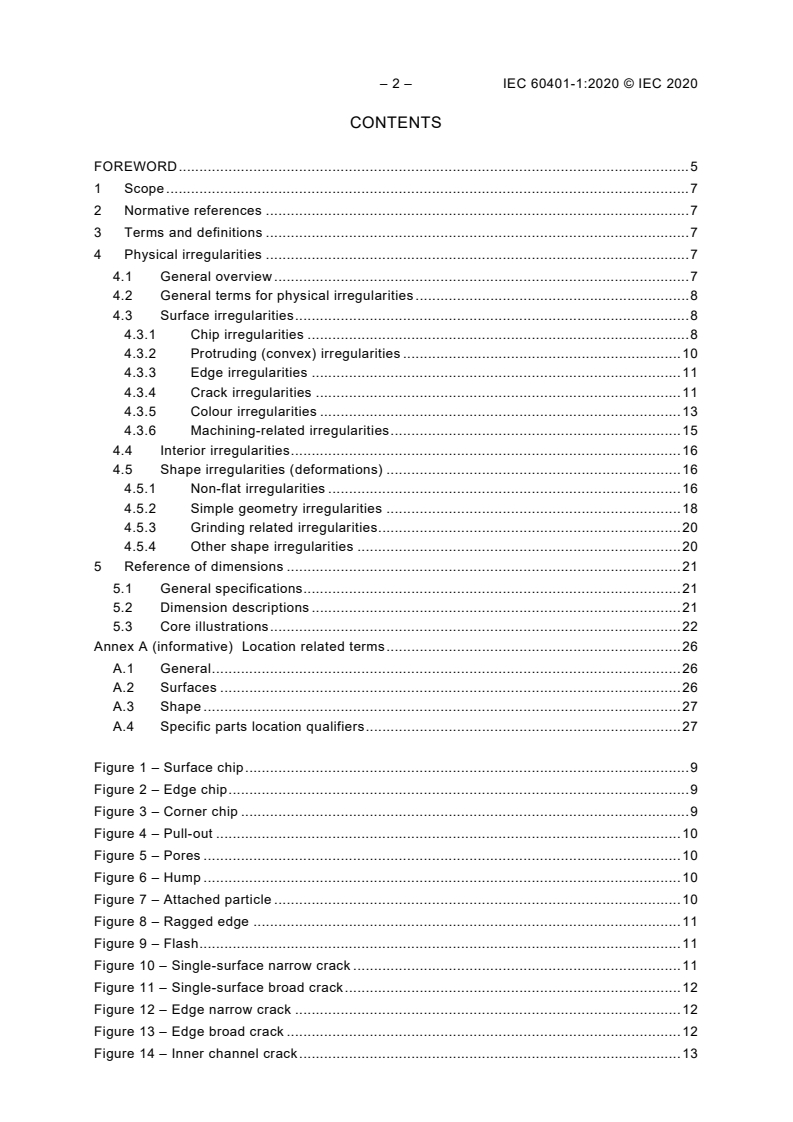
IEC 60401-1:2020 - Terms and nomenclature for cores made of magnetically soft ferrites - Part 1: Terms used for physical irregularities and reference of dimensions Released:4/14/2020
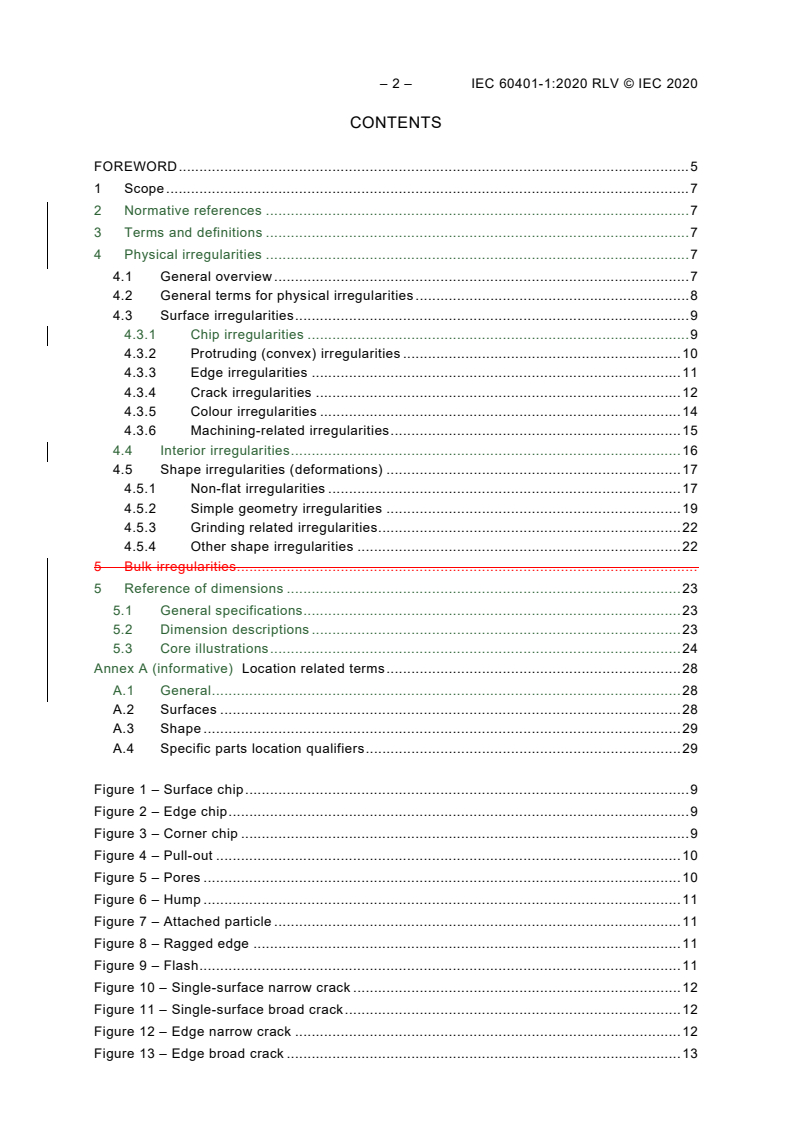
IEC 60401-1:2020 RLV - Terms and nomenclature for cores made of magnetically soft ferrites - Part 1: Terms used for physical irregularities and reference of dimensions Released:4/14/2020
IEC 60401-1:2020 - Terms and nomenclature for cores made of magnetically soft ferrites - Part 1: Terms used for physical irregularities and reference of dimensions Released:4/14/2020
Overview - IEC 60401-1:2020 (soft ferrite cores nomenclature)
IEC 60401-1:2020 is an international standard that defines terms and a consistent nomenclature for physical irregularities and dimensional references of magnetically soft ferrite cores. It provides a uniform vocabulary and graphical examples for common surface, bulk and shape irregularities (chips, pores, cracks, laminations, etc.), plus a method for designating the principal dimensional characters of ferrite core shapes. The edition replaces earlier IEC 60401-1 (2002) and IEC 60401-2 (2009) material and includes technical changes such as adding the terms “pores” and “scratch”, replacing “stratification” with “lamination”, and relocating clause content into Annex A.
Key topics and requirements
- Terminology for physical irregularities: standardized names and illustrated examples for surface, interior and shape defects (chips, protrusions, cracks, colour irregularities, machining-related marks, warping, non-flatness, non-circularity, etc.).
- Reference of dimensions: a consistent scheme for describing core dimensions on drawings, tables and catalogue sheets so manufacturers and users share the same dimensional characters.
- Location qualifiers: Annex A provides recommendations for combining general location names with more detailed qualifiers to specify exact irregularity positions.
- Designation method: rules for defining nomenclature of major physical attributes of ferrite core shapes (ring, E-core, ETD, PQ, pot, etc.), illustrated with core shape drawings and dimension tables.
- Graphical aids: many figures showing visual examples of irregularities and shape designations to reduce ambiguity in inspection and documentation.
Practical applications
- Creating clear, unambiguous technical drawings, specification sheets and product catalogues for ferrite cores.
- Writing inspection procedures and acceptance criteria for quality control of ferrite cores (visual inspection, dimensional checks).
- Improving supplier–buyer communication by using a common vocabulary for defects and dimensions.
- Supporting design and procurement of magnetic components used in power transformers, inductors, EMI filters and sensors where ferrite core geometry and surface integrity affect performance.
Who uses this standard
- Ferrite core manufacturers and mill operators
- Component design engineers and magnetic component specifiers
- Quality and inspection engineers
- Technical authors who prepare datasheets, drawings and acceptance criteria
- Purchasing and compliance teams working with magnetic materials
Related standards and resources
- IEC 60401 series and publications by IEC TC 51 (Magnetic components, ferrite and magnetic powder materials)
- Electropedia and IEC webstore for the latest editions and related normative references
Keywords: IEC 60401-1, soft ferrite cores, ferrite core irregularities, nomenclature, dimensional reference, magnetic cores, IEC standard.
Relations
- Effective Date
- 05-Sep-2023
- Effective Date
- 10-Feb-2026
- Effective Date
- 05-Sep-2023
Buy Documents
IEC 60401-1:2020 - Terms and nomenclature for cores made of magnetically soft ferrites - Part 1: Terms used for physical irregularities and reference of dimensions Released:4/14/2020
IEC 60401-1:2020 RLV - Terms and nomenclature for cores made of magnetically soft ferrites - Part 1: Terms used for physical irregularities and reference of dimensions Released:4/14/2020
IEC 60401-1:2020 - Terms and nomenclature for cores made of magnetically soft ferrites - Part 1: Terms used for physical irregularities and reference of dimensions Released:4/14/2020
Get Certified
Connect with accredited certification bodies for this standard

IMQ S.p.A. (Certification)
Italian electrical product certification.

SLG Prüf- und Zertifizierungs GmbH
German testing and certification body.

UL Solutions
Global safety science company with testing, inspection and certification.
Sponsored listings
Frequently Asked Questions
IEC 60401-1:2020 is a standard published by the International Electrotechnical Commission (IEC). Its full title is "Terms and nomenclature for cores made of magnetically soft ferrites - Part 1: Terms used for physical irregularities and reference of dimensions". This standard covers: IEC 60401-1:2020 provides a nomenclature of the most frequent surface, bulk and shape irregularities relevant to cores made of soft ferrites (magnetic oxides). Most irregularities are graphically exemplified as visual aids. A general recommendation is also given in Annex A for a consistent scheme for specifying the exact location of the irregularity, combining a general name for the location with more detailed qualifiers of the specified location. This document can also be useful as a terminology reference when preparing technical documentation, irregularity inspection specifications, etc. This document also presents a method for defining the designation nomenclature for the major physical attributes of soft ferrite core shapes. The purpose of this document is to facilitate uniform usage of dimensional characters by manufacturers, specifiers, and users when describing core dimensions on drawings, in tables, and on catalogue specification sheets. This second edition cancels and replaces the first edition of IEC 60401-1 published in 2002 and the second edition of IEC 60401-2 published in 2009. This edition constitutes a technical revision. This edition includes the following significant technical changes with respect to the previous editions of IEC 60401-1 and IEC 60401-2: - added the surface irregularity term “pores” in 4.3.1.6; - added the surface irregularity term “scratch” in 4.3.6.3; - removed the surface irregularity term “crater” in 4.1.5 of IEC 60401-1: 2002; - removed the bulk irregularity terms “superpores” in 5.1, “inclusions” in 5.2, “internal stratification” in 5.3 and “internal crack” in 5.4 of IEC 60401-1: 2002; - removed the contents related to “yoke ring cores” in 7.1.3 and 7.4 of IEC 60401-1:2002; - replaced the surface irregularity term “stratification” with “lamination” in 4.3.4.7; - replaced the location related terms “upper surface of back” with “bottom surface” and “lower surface of back” with “back surface” in Figure A.1; - changed Clause 7 of IEC 60401-1:2002 into Annex A.
IEC 60401-1:2020 provides a nomenclature of the most frequent surface, bulk and shape irregularities relevant to cores made of soft ferrites (magnetic oxides). Most irregularities are graphically exemplified as visual aids. A general recommendation is also given in Annex A for a consistent scheme for specifying the exact location of the irregularity, combining a general name for the location with more detailed qualifiers of the specified location. This document can also be useful as a terminology reference when preparing technical documentation, irregularity inspection specifications, etc. This document also presents a method for defining the designation nomenclature for the major physical attributes of soft ferrite core shapes. The purpose of this document is to facilitate uniform usage of dimensional characters by manufacturers, specifiers, and users when describing core dimensions on drawings, in tables, and on catalogue specification sheets. This second edition cancels and replaces the first edition of IEC 60401-1 published in 2002 and the second edition of IEC 60401-2 published in 2009. This edition constitutes a technical revision. This edition includes the following significant technical changes with respect to the previous editions of IEC 60401-1 and IEC 60401-2: - added the surface irregularity term “pores” in 4.3.1.6; - added the surface irregularity term “scratch” in 4.3.6.3; - removed the surface irregularity term “crater” in 4.1.5 of IEC 60401-1: 2002; - removed the bulk irregularity terms “superpores” in 5.1, “inclusions” in 5.2, “internal stratification” in 5.3 and “internal crack” in 5.4 of IEC 60401-1: 2002; - removed the contents related to “yoke ring cores” in 7.1.3 and 7.4 of IEC 60401-1:2002; - replaced the surface irregularity term “stratification” with “lamination” in 4.3.4.7; - replaced the location related terms “upper surface of back” with “bottom surface” and “lower surface of back” with “back surface” in Figure A.1; - changed Clause 7 of IEC 60401-1:2002 into Annex A.
IEC 60401-1:2020 is classified under the following ICS (International Classification for Standards) categories: 29.100.10 - Magnetic components. The ICS classification helps identify the subject area and facilitates finding related standards.
IEC 60401-1:2020 has the following relationships with other standards: It is inter standard links to IEC 60401-2:2009, EN IEC 63093-1:2020, IEC 60401-1:2002. Understanding these relationships helps ensure you are using the most current and applicable version of the standard.
IEC 60401-1:2020 is available in PDF format for immediate download after purchase. The document can be added to your cart and obtained through the secure checkout process. Digital delivery ensures instant access to the complete standard document.
Standards Content (Sample)
IEC 60401-1 ®
Edition 2.0 2020-04
INTERNATIONAL
STANDARD
Terms and nomenclature for cores made of magnetically soft ferrites –
Part 1: Terms used for physical irregularities and reference of dimensions
All rights reserved. Unless otherwise specified, no part of this publication may be reproduced or utilized in any form
or by any means, electronic or mechanical, including photocopying and microfilm, without permission in writing from
either IEC or IEC's member National Committee in the country of the requester. If you have any questions about IEC
copyright or have an enquiry about obtaining additional rights to this publication, please contact the address below or
your local IEC member National Committee for further information.
IEC Central Office Tel.: +41 22 919 02 11
3, rue de Varembé info@iec.ch
CH-1211 Geneva 20 www.iec.ch
Switzerland
About the IEC
The International Electrotechnical Commission (IEC) is the leading global organization that prepares and publishes
International Standards for all electrical, electronic and related technologies.
About IEC publications
The technical content of IEC publications is kept under constant review by the IEC. Please make sure that you have the
latest edition, a corrigendum or an amendment might have been published.
IEC publications search - webstore.iec.ch/advsearchform Electropedia - www.electropedia.org
The advanced search enables to find IEC publications by a The world's leading online dictionary on electrotechnology,
variety of criteria (reference number, text, technical containing more than 22 000 terminological entries in English
committee,…). It also gives information on projects, replaced and French, with equivalent terms in 16 additional languages.
and withdrawn publications. Also known as the International Electrotechnical Vocabulary
(IEV) online.
IEC Just Published - webstore.iec.ch/justpublished
Stay up to date on all new IEC publications. Just Published IEC Glossary - std.iec.ch/glossary
details all new publications released. Available online and 67 000 electrotechnical terminology entries in English and
once a month by email. French extracted from the Terms and Definitions clause of
IEC publications issued since 2002. Some entries have been
IEC Customer Service Centre - webstore.iec.ch/csc collected from earlier publications of IEC TC 37, 77, 86 and
If you wish to give us your feedback on this publication or CISPR.
need further assistance, please contact the Customer Service
Centre: sales@iec.ch.
IEC 60401-1 ®
Edition 2.0 2020-04
INTERNATIONAL
STANDARD
Terms and nomenclature for cores made of magnetically soft ferrites –
Part 1: Terms used for physical irregularities and reference of dimensions
INTERNATIONAL
ELECTROTECHNICAL
COMMISSION
ICS 29.100.10 ISBN 978-2-8322-8081-2
– 2 – IEC 60401-1:2020 © IEC 2020
CONTENTS
FOREWORD . 5
1 Scope . 7
2 Normative references . 7
3 Terms and definitions . 7
4 Physical irregularities . 7
4.1 General overview . 7
4.2 General terms for physical irregularities . 8
4.3 Surface irregularities . 8
4.3.1 Chip irregularities . 8
4.3.2 Protruding (convex) irregularities . 10
4.3.3 Edge irregularities . 11
4.3.4 Crack irregularities . 11
4.3.5 Colour irregularities . 13
4.3.6 Machining-related irregularities . 15
4.4 Interior irregularities . 16
4.5 Shape irregularities (deformations) . 16
4.5.1 Non-flat irregularities . 16
4.5.2 Simple geometry irregularities . 18
4.5.3 Grinding related irregularities. 20
4.5.4 Other shape irregularities . 20
5 Reference of dimensions . 21
5.1 General specifications . 21
5.2 Dimension descriptions . 21
5.3 Core illustrations . 22
Annex A (informative) Location related terms . 26
A.1 General . 26
A.2 Surfaces . 26
A.3 Shape . 27
A.4 Specific parts location qualifiers . 27
Figure 1 – Surface chip . 9
Figure 2 – Edge chip . 9
Figure 3 – Corner chip . 9
Figure 4 – Pull-out . 10
Figure 5 – Pores . 10
Figure 6 – Hump . 10
Figure 7 – Attached particle . 10
Figure 8 – Ragged edge . 11
Figure 9 – Flash . 11
Figure 10 – Single-surface narrow crack . 11
Figure 11 – Single-surface broad crack . 12
Figure 12 – Edge narrow crack . 12
Figure 13 – Edge broad crack . 12
Figure 14 – Inner channel crack . 13
Figure 15 – Lamination . 13
Figure 16 – Crazing . 13
Figure 17 – Difference in colour tones. 14
Figure 18 – Discoloration . 14
Figure 19 – Stain . 14
Figure 20 – Crystallite . 14
Figure 21 – Roughness . 15
Figure 22 – Short-ground surface. 15
Figure 23 – Scratch . 15
Figure 24 – Convexity . 16
Figure 25 – Concavity . 16
Figure 26 – Warping . 16
Figure 27 – Deflection-out . 17
Figure 28 – Deflection-in . 17
Figure 29 – Transverse deflection . 17
Figure 30 – Undulation . 18
Figure 31 – Non-parallelism . 18
Figure 32 – Non-perpendicularity . 18
Figure 33 – Non-coplanarity . 18
Figure 34 – Non-circularity . 19
Figure 35 – Ovality . 19
Figure 36 – Non-concentricity of co-planar circles . 19
Figure 37 – Non-concentricity of circles lying on two planes . 20
Figure 38 – Steplike ground surface . 20
Figure 39 – Uneven grinding slant. 20
Figure 40 – Un-matching . 21
Figure 41 – Profile deformation . 21
Figure 42 – Ring-cores . 22
Figure 43 – E-core . 22
Figure 44 – ETD- or EER-core . 23
Figure 45 – EC-core. 23
Figure 46 – Planar E-core . 23
Figure 47 – Planar EL-core . 23
Figure 48 – Planar ER-core . 23
Figure 49 – Plate-core mating planar cores . 23
Figure 50 – EFD-core . 24
Figure 51 – Drum-core . 24
Figure 52 – EP-core . 24
Figure 53 – PQ-core . 24
Figure 54 – Pot-core and half pot-core for inductive proximity switches . 24
Figure 55 – PM-core . 24
Figure 56 – RM-core . 25
Figure 57 – U-core . 25
– 4 – IEC 60401-1:2020 © IEC 2020
Figure 58 – UR-core . 25
Figure 59 – Balun-core . 25
Figure 60 – Multi hole bead. 25
Figure A.1 – E-core . 28
Figure A.2 – RM-core . 28
Table 1 – Ring-core dimension designations . 21
Table 2 – Other ferrite shape dimension designations . 22
INTERNATIONAL ELECTROTECHNICAL COMMISSION
____________
TERMS AND NOMENCLATURE FOR CORES MADE
OF MAGNETICALLY SOFT FERRITES –
Part 1: Terms used for physical irregularities
and reference of dimensions
FOREWORD
1) The International Electrotechnical Commission (IEC) is a worldwide organization for standardization comprising
all national electrotechnical committees (IEC National Committees). The object of IEC is to promote
international co-operation on all questions concerning standardization in the electrical and electronic fields. To
this end and in addition to other activities, IEC publishes International Standards, Technical Specifications,
Technical Reports, Publicly Available Specifications (PAS) and Guides (hereafter referred to as “IEC
Publication(s)”). Their preparation is entrusted to technical committees; any IEC National Committee interested
in the subject dealt with may participate in this preparatory work. International, governmental and non-
governmental organizations liaising with the IEC also participate in this preparation. IEC collaborates closely
with the International Organization for Standardization (ISO) in accordance with conditions determined by
agreement between the two organizations.
2) The formal decisions or agreements of IEC on technical matters express, as nearly as possible, an international
consensus of opinion on the relevant subjects since each technical committee has representation from all
interested IEC National Committees.
3) IEC Publications have the form of recommendations for international use and are accepted by IEC National
Committees in that sense. While all reasonable efforts are made to ensure that the technical content of IEC
Publications is accurate, IEC cannot be held responsible for the way in which they are used or for any
misinterpretation by any end user.
4) In order to promote international uniformity, IEC National Committees undertake to apply IEC Publications
transparently to the maximum extent possible in their national and regional publications. Any divergence
between any IEC Publication and the corresponding national or regional publication shall be clearly indicated in
the latter.
5) IEC itself does not provide any attestation of conformity. Independent certification bodies provide conformity
assessment services and, in some areas, access to IEC marks of conformity. IEC is not responsible for any
services carried out by independent certification bodies.
6) All users should ensure that they have the latest edition of this publication.
7) No liability shall attach to IEC or its directors, employees, servants or agents including individual experts and
members of its technical committees and IEC National Committees for any personal injury, property damage or
other damage of any nature whatsoever, whether direct or indirect, or for costs (including legal fees) and
expenses arising out of the publication, use of, or reliance upon, this IEC Publication or any other IEC
Publications.
8) Attention is drawn to the Normative references cited in this publication. Use of the referenced publications is
indispensable for the correct application of this publication.
9) Attention is drawn to the possibility that some of the elements of this IEC Publication may be the subject of
patent rights. IEC shall not be held responsible for identifying any or all such patent rights.
International Standard IEC 60401-1 has been prepared by IEC technical committee 51:
Magnetic components, ferrite and magnetic powder materials.
This second edition cancels and replaces the first edition of IEC 60401-1 published in 2002
and the second edition of IEC 60401-2 published in 2009. This edition constitutes a technical
revision.
This edition includes the following significant technical changes with respect to the previous
editions of IEC 60401-1 and IEC 60401-2:
a) added the surface irregularity term “pores” in 4.3.1.6;
b) added the surface irregularity term “scratch” in 4.3.6.3;
c) removed the surface irregularity term “crater” in 4.1.5 of IEC 60401-1: 2002;
– 6 – IEC 60401-1:2020 © IEC 2020
d) removed the bulk irregularity terms “superpores” in 5.1, “inclusions” in 5.2, “internal
stratification” in 5.3 and “internal crack” in 5.4 of IEC 60401-1: 2002;
e) removed the contents related to “yoke ring cores” in 7.1.3 and 7.4 of IEC 60401-1:2002;
f) replaced the surface irregularity term “stratification” with “lamination” in 4.3.4.7;
g) replaced the location related terms “upper surface of back” with “bottom surface” and
“lower surface of back” with “back surface” in Figure A.1;
h) changed Clause 7 of IEC 60401-1:2002 into Annex A.
The text of this International Standard is based on the following documents:
CDV Report on voting
51/1313/CDV 51/1332/RVC
Full information on the voting for the approval of this International Standard can be found in
the report on voting indicated in the above table.
This document has been drafted in accordance with the ISO/IEC Directives, Part 2.
A list of all parts in the IEC 60401 series, published under the general title Terms and
nomenclature for cores made of magnetically soft ferrites can be found on the IEC website.
The committee has decided that the contents of this document will remain unchanged until the
stability date indicated on the IEC website under "http://webstore.iec.ch" in the data related to
the specific document. At this date, the document will be
• reconfirmed,
• withdrawn,
• replaced by a revised edition, or
• amended.
TERMS AND NOMENCLATURE FOR CORES MADE
OF MAGNETICALLY SOFT FERRITES –
Part 1: Terms used for physical irregularities
and reference of dimensions
1 Scope
This part of IEC 60401 provides a nomenclature of the most frequent surface, bulk and shape
...
IEC 60401-1 ®
Edition 2.0 2020-04
REDLINE VERSION
INTERNATIONAL
STANDARD
colour
inside
Terms and nomenclature for cores made of magnetically soft ferrites –
Part 1: Terms used for physical irregularities and reference of dimensions
All rights reserved. Unless otherwise specified, no part of this publication may be reproduced or utilized in any form
or by any means, electronic or mechanical, including photocopying and microfilm, without permission in writing from
either IEC or IEC's member National Committee in the country of the requester. If you have any questions about IEC
copyright or have an enquiry about obtaining additional rights to this publication, please contact the address below or
your local IEC member National Committee for further information.
IEC Central Office Tel.: +41 22 919 02 11
3, rue de Varembé info@iec.ch
CH-1211 Geneva 20 www.iec.ch
Switzerland
About the IEC
The International Electrotechnical Commission (IEC) is the leading global organization that prepares and publishes
International Standards for all electrical, electronic and related technologies.
About IEC publications
The technical content of IEC publications is kept under constant review by the IEC. Please make sure that you have the
latest edition, a corrigendum or an amendment might have been published.
IEC publications search - webstore.iec.ch/advsearchform Electropedia - www.electropedia.org
The advanced search enables to find IEC publications by a The world's leading online dictionary on electrotechnology,
variety of criteria (reference number, text, technical containing more than 22 000 terminological entries in English
committee,…). It also gives information on projects, replaced and French, with equivalent terms in 16 additional languages.
and withdrawn publications. Also known as the International Electrotechnical Vocabulary
(IEV) online.
IEC Just Published - webstore.iec.ch/justpublished
Stay up to date on all new IEC publications. Just Published IEC Glossary - std.iec.ch/glossary
details all new publications released. Available online and 67 000 electrotechnical terminology entries in English and
once a month by email. French extracted from the Terms and Definitions clause of
IEC publications issued since 2002. Some entries have been
IEC Customer Service Centre - webstore.iec.ch/csc collected from earlier publications of IEC TC 37, 77, 86 and
If you wish to give us your feedback on this publication or CISPR.
need further assistance, please contact the Customer Service
Centre: sales@iec.ch.
IEC 60401-1 ®
Edition 2.0 2020-04
REDLINE VERSION
INTERNATIONAL
STANDARD
colour
inside
Terms and nomenclature for cores made of magnetically soft ferrites –
Part 1: Terms used for physical irregularities and reference of dimensions
INTERNATIONAL
ELECTROTECHNICAL
COMMISSION
ICS 29.100.10 ISBN 978-2-8322-8218-2
– 2 – IEC 60401-1:2020 RLV © IEC 2020
CONTENTS
FOREWORD . 5
1 Scope . 7
2 Normative references . 7
3 Terms and definitions . 7
4 Physical irregularities . 7
4.1 General overview . 7
4.2 General terms for physical irregularities . 8
4.3 Surface irregularities . 9
4.3.1 Chip irregularities . 9
4.3.2 Protruding (convex) irregularities . 10
4.3.3 Edge irregularities . 11
4.3.4 Crack irregularities . 12
4.3.5 Colour irregularities . 14
4.3.6 Machining-related irregularities . 15
4.4 Interior irregularities . 16
4.5 Shape irregularities (deformations) . 17
4.5.1 Non-flat irregularities . 17
4.5.2 Simple geometry irregularities . 19
4.5.3 Grinding related irregularities. 22
4.5.4 Other shape irregularities . 22
5 Bulk irregularities .
5 Reference of dimensions . 23
5.1 General specifications . 23
5.2 Dimension descriptions . 23
5.3 Core illustrations . 24
Annex A (informative) Location related terms . 28
A.1 General . 28
A.2 Surfaces . 28
A.3 Shape . 29
A.4 Specific parts location qualifiers . 29
Figure 1 – Surface chip . 9
Figure 2 – Edge chip . 9
Figure 3 – Corner chip . 9
Figure 4 – Pull-out . 10
Figure 5 – Pores . 10
Figure 6 – Hump . 11
Figure 7 – Attached particle . 11
Figure 8 – Ragged edge . 11
Figure 9 – Flash . 11
Figure 10 – Single-surface narrow crack . 12
Figure 11 – Single-surface broad crack . 12
Figure 12 – Edge narrow crack . 12
Figure 13 – Edge broad crack . 13
Figure 14 – Inner channel crack . 13
Figure 15 – Lamination . 13
Figure 16 – Crazing . 14
Figure 17 – Difference in colour tones. 14
Figure 18 – Discoloration . 14
Figure 19 – Stain . 15
Figure 20 – Crystallite . 15
Figure 21 – Roughness . 15
Figure 22 – Short-ground surface. 16
Figure 23 – Scratch . 16
Figure 24 – Convexity . 17
Figure 25 – Concavity . 18
Figure 26 – Warping . 18
Figure 27 – Deflection-out . 18
Figure 28 – Deflection-in . 19
Figure 29 – Transverse deflection . 19
Figure 30 – Undulation . 19
Figure 31 – Non-parallelism . 19
Figure 32 – Non-perpendicularity . 20
Figure 33 – Non-coplanarity . 20
Figure 34 – Non-circularity . 20
Figure 35 – Ovality . 21
Figure 36 – Non-concentricity of co-planar circles . 21
Figure 37 – Non-concentricity of circles lying on two planes . 21
Figure 38 – Steplike ground surface . 22
Figure 39 – Uneven grinding slant. 22
Figure 40 – Un-matching . 22
Figure 41 – Profile deformation . 23
Figure 42 – Ring-cores . 24
Figure 43 – E-core . 24
Figure 44 – ETD- or EER-core . 25
Figure 45 – EC-core. 25
Figure 46 – Planar E-core . 25
Figure 47 – Planar EL-core . 25
Figure 48 – Planar ER-core . 25
Figure 49 – Plate-core mating planar cores . 25
Figure 50 – EFD-core . 26
Figure 51 – Drum-core . 26
Figure 52 – EP-core . 26
Figure 53 – PQ-core . 26
Figure 54 – Pot-core and half pot-core for inductive proximity switches . 26
Figure 55 – PM-core . 26
Figure 56 – RM-core . 27
– 4 – IEC 60401-1:2020 RLV © IEC 2020
Figure 57 – U-core . 27
Figure 58 – UR-core . 27
Figure 59 – Balun-core . 27
Figure 60 – Multi hole bead. 27
Figure A.1 – E-core . 33
Figure A.2 – RM-core . 33
Table 1 – Ring-core dimension designations . 23
Table 2 – Other ferrite shape dimension designations . 24
INTERNATIONAL ELECTROTECHNICAL COMMISSION
____________
TERMS AND NOMENCLATURE FOR CORES MADE
OF MAGNETICALLY SOFT FERRITES –
Part 1: Terms used for physical irregularities
and reference of dimensions
FOREWORD
1) The International Electrotechnical Commission (IEC) is a worldwide organization for standardization comprising
all national electrotechnical committees (IEC National Committees). The object of IEC is to promote
international co-operation on all questions concerning standardization in the electrical and electronic fields. To
this end and in addition to other activities, IEC publishes International Standards, Technical Specifications,
Technical Reports, Publicly Available Specifications (PAS) and Guides (hereafter referred to as “IEC
Publication(s)”). Their preparation is entrusted to technical committees; any IEC National Committee interested
in the subject dealt with may participate in this preparatory work. International, governmental and non-
governmental organizations liaising with the IEC also participate in this preparation. IEC collaborates closely
with the International Organization for Standardization (ISO) in accordance with conditions determined by
agreement between the two organizations.
2) The formal decisions or agreements of IEC on technical matters express, as nearly as possible, an international
consensus of opinion on the relevant subjects since each technical committee has representation from all
interested IEC National Committees.
3) IEC Publications have the form of recommendations for international use and are accepted by IEC National
Committees in that sense. While all reasonable efforts are made to ensure that the technical content of IEC
Publications is accurate, IEC cannot be held responsible for the way in which they are used or for any
misinterpretation by any end user.
4) In order to promote international uniformity, IEC National Committees undertake to apply IEC Publications
transparently to the maximum extent possible in their national and regional publications. Any divergence
between any IEC Publication and the corresponding national or regional publication shall be clearly indicated in
the latter.
5) IEC itself does not provide any attestation of conformity. Independent certification bodies provide conformity
assessment services and, in some areas, access to IEC marks of conformity. IEC is not responsible for any
services carried out by independent certification bodies.
6) All users should ensure that they have the latest edition of this publication.
7) No liability shall attach to IEC or its directors, employees, servants or agents including individual experts and
members of its technical committees and IEC National Committees for any personal injury, property damage or
other damage of any nature whatsoever, whether direct or indirect, or for costs (including legal fees) and
expenses arising out of the publication, use of, or reliance upon, this IEC Publication or any other IEC
Publications.
8) Attention is drawn to the Normative references cited in this publication. Use of the referenced publications is
indispensable for the correct application of this publication.
9) Attention is drawn to the possibility that some of the elements of this IEC Publication may be the subject of
patent rights. IEC shall not be held responsible for identifying any or all such patent rights.
This redline version of the official IEC Standard allows the user to identify the changes
made to the previous edition. A vertical bar appears in the margin wherever a change
has been made. Additions are in green text, deletions are in strikethrough red text.
– 6 – IEC 60401-1:2020 RLV © IEC 2020
International Standard IEC 60401-1 has been prepared by IEC technical committee 51:
Magnetic components, ferrite and magnetic powder materials.
This second edition cancels and replaces the first edition of IEC 60401-1 published in 2002
and the second edition of IEC 60401-2 published in 2009. This edition constitutes a technical
revision.
This edition includes the following significant technical changes with respect to the previous
editions of IEC 60401-1 and IEC 60401-2:
a) added the surface irregularity term “pores” in 4.3.1.6;
b) added the surface irregularity term “scratch” in 4.3.6.3;
c) removed the surface irregularity term “crater” in 4.1.5 of IEC 60401-1: 2002;
d) removed the bulk irregularity terms “superpores” in 5.1, “inclusions” in 5.2, “internal
stratification” in 5.3 and “internal crack” in 5.4 of IEC 60401-1: 2002;
e) removed the contents related to “yoke ring cores” in 7.1.3 and 7.4 of IEC 60401-1:2002;
f) replaced the surface irregularity term “stratification” with “lamination” in 4.3.4.7;
g) replaced the location related terms “upper surface of back” with “bottom surface” and
“lower surface of back” with “back surface” in Figure A.1;
h) changed Clause 7 of IEC 60401-1:2002 into Annex A.
The text of this International Standard is based on the following documents:
CDV Report on voting
51/1313/CDV 51/1332/RVC
Full information on the voting for the approval of this International Standard can be found in
the report on voting indicated in the above table.
This document has been drafted in accordance with the ISO/IEC Directives, Part 2.
A list of all parts in the IEC 60401 series, published under the general title Terms and
nomenclature for cores made of magnetically soft ferrites can be found on the IEC website.
The committee has decided that the contents of this document will remain unchanged until the
stability date indicated on the IEC website under "http://webstore.iec.ch" in the data related to
the specific document. At this date, the document will be
• reconfirmed,
• withdrawn,
• replaced by a revised edition, or
• amended.
IMPORTANT – The 'colour inside' logo on the cover page of this publication indicates
that it contains colours which are considered to be useful for the correct
understanding of its contents. Users should therefore print this document using a
colour printer.
TERMS AND NOMENCLATURE FOR CORES MADE
OF MAGNETICALLY SOFT FERRITES –
Part 1: Terms used for physical irregularities
and reference of dimensions
1 Scope
This part of IEC 60401 provides a nomenclature of the most frequent surface, bulk and shape
irregularities relevant to cores made of soft ferrites (magnetic oxides). Most irregularities are
graphically exemplified as visual aids. A general recommendation is also given in Annex A for
a consistent scheme for specifying the exact location of the irregularity, combining a general
name for the location with more detailed qualifiers of the specified location. This document
can also be useful as a terminology reference when preparing technical documentation,
irregularity inspection specifications, etc.
This document also presents a method for defining the designation nomenclature for the
major physical attributes of soft ferrite core shapes. The purpose of this document is to
facilitate uniform usage of dimensional characters by manufacturers, specifiers, and users
when describing core dimensions on drawings, in tables, and on catalogue specification
sheets.
2 Normative references
There are no normative references in this document.
3 Terms and definitions
For the purposes of this document, the terms and definitions given in 4.2, 4.3, 4.5 and
Annex A apply.
ISO and IEC maintain terminological databases for use in standardization at the following
addresses:
• IEC Electropedia: available at http://www.electropedia.org/
• ISO Online browsing platform: available at http://www.iso.org/obp
4 Physical irregularities
4.1 General overview
Physical irregularities mean here the surface irregularities, bulk irregularities and shape
irregularities. The irregularity here stands for inconsistency of the state or quality of the part’s
surface, bulk or shape with its intended regularity. These irregularities are considered here in
the macroscopic scale, i.e. within the range of linear dimensions of irregularities from one
micrometre to tens of millimetres.
There is a great variety of surface, bulk and shape irregularities degrading the quality of parts
made of ferrites. Different types of these irregularities may can often occur together and
overlap one another.
– 8 – IEC 60401-1:2020 RLV © IEC 2020
Each type of irregularity is, in general, produced by one or more of the following: an
incorrectly or inaccurately performed process variability in a manufacturing step, or improper
handling, grinding, packing or transportation.
The extent of the quality degradation is dependent on the type, scale, and combination of
irregularities being present as well as on their locations on the part. There are locations
particularly sensitive to the degrading effect of the specific types of irregularities.
The irregularities may can in extreme cases give have a detrimental or critical effect to on
magnetic, electric and mechanical performances of the part. Operations performed on the part,
such as marking, winding, assembling and mounting, can also be adversely affected by the
irregularities.
An ongoing tendency to upgrade the overall quality of the parts results in more stringent
restrictions being imposed on the quantity of irregularities in these parts.
This brings about a need for a set of definitions, or nomenclature, which would be a primary
basis for approaches to irregularities and their location issues.
Therefore, this nomenclature is intended to be used as a uniform reference when formulating
more detailed descriptions of irregularities at specified locations, requirements and
procedures related to the inspection and assessment of irregularities. This nomenclature can
also be useful with regard to methods and tools used for detection, recognition and
classification of irregularities.
4.2 General terms for physical irregularities
4.2.1
surface irregularity
unintentional state or appearance of the surfaces, edges and corners of the part
Note 1 to entry: Some surface irregularities, if excessive, can so deform contours and surfaces of the part, that
they may also be classified as shape irregularities.
4.2.2
interior irregularity
unintentional inhomogeneity inside the part
4.2.3
shape irregularity
unintentional deformation of the contour lines or surfaces delimiting the shape of the part
Note 1 to entry: In some cases, shape irregularities smaller than quoted tolerances may can still disqualify the
part.
3.3
bulk irregularity
unintentional inhomogeneity inside the part
4.2.4
tolerance
allowable difference between the nominal and permissible limit dimensions of
the contour lines defining the part’s shape
4.2.5
location
position on or within the part where the irregularity is present
4.3 Surface irregularities
4.3.1 Chip irregularities
4.3.1.1
chip
lack of surface material generally caused by mechanical impact during handling or grinding
transportation
Note 1 to entry: In almost all cases, chips are located on the edges of surfaces.
According to specific locations, the chips are sub-classified:
4.3.1.2
surface chip
chip located only on the core surface
SEE: Figure 1.
Figure 1 – Surface chip
4.3.1.3
edge chip
chip located only on the core edge
SEE: Figure 2.
Figure 2 – Edge chip
4.3.1.4
corner chip
chip located only in a corner
SEE: Figure 3.
Figure 3 – Corner chip
– 10 – IEC 60401-1:2020 RLV © IEC 2020
4.3.1.5
pull-out
consequence of the removal of the surface layer of the core due to die “sticking”, which
occurs on surfaces perpendicular to the direction of the pressing action
Note 1 to entry: A pull-out with a depth greater than 1 mm should be considered as a chip.
SEE: Figure 4.
Figure 4 – Pull-out
4.1.5
crater
blind hole with depth comparable to or greater than its diameter
x
x-x
x
IEC 3149/02
4.3.1.6
pore
hole left on the surface of cores after sintering and surface finishing
SEE: Figure 5.
Figure 5 – Pores
4.3.2 Protruding (convex) irregularities
4.3.2.1
hump
elevation of a rounded contour on the relevant surface
SEE: Figure 6.
Figure 6 – Hump
4.3.2.2
attached particle
any particle on the surface which cannot be removed by compressed-air, cleaning, washing or
wiping
SEE: Figure 7.
Figure 7 – Attached particle
4.3.2.3
inclusion
millimetre or sub-millimetre-sized foreign body located in the surface of the part (refer to 5.2)
4.3.3 Edge irregularities
4.3.3.1
ragged edge
edge affected by a series of small chips
SEE: Figure 8.
Figure 8 – Ragged edge
4.3.3.2
flash
sharp feather-edge wall extending beyond the intended contour surface of the core
SEE: Figure 9.
Figure 9 – Flash
– 12 – IEC 60401-1:2020 RLV © IEC 2020
4.3.4 Crack irregularities
4.3.4.1
crack
surface irregularity which has a width much smaller than its length and penetrates into the
core
Specific types of ‘cracks’ can be sub-classified:
4.3.4.2
single-surface narrow crack
crack located on a single surface, not going beyond its edges, and with a width not exceeding
a specified limit (e.g. 0,1 mm) anywhere along the crack path on the surface
SEE. Figure 10.
Figure 10 – Single-surface narrow crack
4.3.4.3
single-surface broad crack
crack located on a single surface, not going beyond its edges, and with a width equal to or
exceeding the limit specified for the narrow crack anywhere along the crack path on the
surface
SEE. Figure 11.
Figure 11 – Single-surface broad crack
4.3.4.4
edge narrow crack
crack located on two adjacent surfaces and crossing their common edge, with a width not
exceeding a specified limit (e.g. 0,1 mm) anywhere along the crack path on these surfaces
SEE: Figure 12.
Figure 12 – Edge narrow crack
4.3.4.5
edge broad crack
crack located on two adjacent surfaces and crossing their common edge, with a width equal to
or exceeding the limit specified for the narrow crack anywhere along the crack path on these
surfaces
SEE: Figure 13.
Figure 13 – Edge broad crack
4.3.4.6
inner channel crack
narrow or broad crack along an inner edge of the core
SEE. Figure 14.
Figure 14 – Inner channel crack
4.3.4.7
stratification lamination
series of cracks located side by side which are more or less parallel, or single crack, which
runs along a significant portion (e.g. 20 %) of the periphery of the part
Note 1 to entry: Stratification Lamination is usually positioned transversely to the direction of the pressing of the
core.
SEE: Figure 15.
Figure 15 – Lamination
4.3.4.8
crazing
grid-like pattern of superficial cracks of a depth not exceeding a specified limit (e.g. 0,3 mm)
SEE: Figure 16.
– 14 – IEC 60401-1:2020 RLV © IEC 2020
Figure 16 – Crazing
4.3.5 Colour irregularities
4.3.5.1
difference in colour tone
slight but visible local change(s) in the tint of the natural colour or shading of an area of a
surface from the surrounding background
SEE: Figure 17.
Figure 17 – Difference in colour tones
4.3.5.2
discoloration
visible difference in the colours of an area of a surface from the normal uniform colour
background
SEE: Figure 18.
Figure 18 – Discoloration
4.3.5.3
stain
smear of oil, grease, or other substance etc. or deposit (e.g. whitish or water marks) on the
surface
SEE: Figure 19.
Figure 19 – Stain
4.3.5.4
crystallite
grain of abnormal size distinguishable on the surface, often with sparkling facets
SEE: Figure 20.
Figure 20 – Crystallite
4.5.5
oxidation of split surfaces
part of split (detached, crashed, etc.) surface which is oxidized
Oxidation
IEC 3165/02
4.3.6 Machining-related irregularities
4.3.6.1
roughness
uneven, not smooth rough surface including which includes traces from grinding, abrasives,
etc.
SEE: Figure 21.
Figure 21 – Roughness
– 16 – IEC 60401-1:2020 RLV © IEC 2020
4.3.6.2
short-ground surface
part of surface which unintentionally remains un-ground after grinding, with no steplike
surface irregularities
Note 1 to entry: See 4.5.3.1.
SEE: Figure 22.
Figure 22 – Short-ground surface
4.3.6.3
scratch
one or more scrapes caused by the handling process
SEE: Figure 23.
Figure 23 – Scratch
4.4 Interior irregularities
Since inclusions, cracks or lamination that is confined to the inside of a part cannot be
detected by direct inspection except with destructive or expensive procedures, control of bulk
irregularities is maintained through break strength testing. Small sample sizes from production
batches are destructively broken with M testing, W testing, or tensile pull testing. The yield
strength is recorded and compared with specification limits or control limits. Further, internal
irregularities that cause electrical performance to be impaired are detected by means of
testing against the electrical specifications.
5 Bulk irregularities
5.1
superpores
pores being millimetre-sized voids
5.2
inclusions
millimetre or sub-millimetre-sized foreign bodies located inside cores
Superpores
Inclusions
IEC 3168/02
NOTE An inclusion, if it appears on the surface of the part, is also considered as the surface irregularity (see 4.2.3).
5.3
internal stratification
stratum shaped material discontinuity located inside the core and not always extending to the
surface; usually narrow but sometimes of an extensive area
NOTE The internal stratification caused by the improper press of the material is usually positioned transversely to
the direction of pressing.
5.4
internal crack
crack shaped material discontinuity inside the core not always extending to the surface;
usually narrow but sometimes of an extensive length
Internal cracks
Internal stratification
IEC 3169/02
4.5 Shape irregularities (deformations)
4.5.1 Non-flat irregularities
4.5.1.1
convexity
outwards outwardly curved outline or surface
SEE: Figure 24.
Figure 24 – Convexity
4.5.1.2
concavity
inwards inwardly curved outline or surface
SEE: Figure 25.
– 18 – IEC 60401-1:2020 RLV © IEC 2020
Figure 25 – Concavity
4.5.1.3
warping
state of a shape with twisted surface(s)
SEE: Figure 26.
Figure 26 – Warping
4.5.1.4
bending
deflection, curved or angular, from any direction that is regarded as the intended one
deflection
Three different kind of deflections as follows:
4.5.1.4.1
deflection-out
state of being more or less inclined to the outside from the perpendicular or from another
intended inclination
Note 1 to entry: This is also called "toe-out".
SEE: Figure 27.
Figure 27 – Deflection-out
4.5.1.4.2
deflection-in
state of being more or less inclined to the inside from the perpendicular or from another
intended inclination
Note 1 to entry: This is also called "toe-in".
SEE: Figure 28.
Figure 28 – Deflection-in
4.5.1.4.3
transverse deflection
state of being more or less inclined or twisted transversely to the reference surface
SEE: Figure 29.
Figure 29 – Transverse deflection
4.5.1.5
undulation
upwards and downwards bending of the outline or surface
SEE: Figure 30.
Figure 30 – Undulation
4.5.2 Simple geometry irregularities
4.5.2.1
non-parallelism
deviation from being parallel of two or more lines, planes or surfaces including the deviation
from their intended equidistance
SEE: Figure 31.
Figure 31 – Non-parallelism
4.5.2.2
non-perpendicularity
deviation from the right angle
– 20 – IEC 60401-1:2020 RLV © IEC 2020
SEE: Figure 32.
Figure 32 – Non-perpendicularity
4.5.2.3
non-coplanarity
deviation from belonging to the same plane
SEE: Figure 33.
Figure 33 – Non-coplanarity
4.5.2.4
non-circularity
deviation from the shape of a circle
SEE: Figure 34.
Figure 34 – Non-circularity
4.5.2.5
ovality
deviation from the shape of a circle to an oval or egg-shape
SEE: Figure 35.
Figure 35 – Ovality
4.5.2.6
non-concentricity
shift between the centres of circles, arcs, or sectors, etc. intended which are supposed to
have a common centre
One distinguishes the following:
4.5.2.6.1
non-concentricity of co-planar circles
non-concentricity of circles lying on the same plane
Note 1 to entry: In such a case, the axes of circles are parallel.
SEE: Figure 36.
Figure 36 – Non-concentricity of co-planar circles
4.5.2.6.2
non-concentricity of circles lying on two planes
non-concentricity of circles lying on two planes situated one above the other
SEE: Figure 37.
NOTE Planes A and B may can be non-parallel (see 4.5.2.1). In such a case, the axes of the circles are mutually
twisted.
Figure 37 – Non-concentricity of circles lying on two planes
– 22 – IEC 60401-1:2020 RLV © IEC 2020
4.5.3 Grinding related irregularities
4.5.3.1
steplike ground surface
step caused by a partial grinding of the surface intended to be ground with no step remainder
SEE: Figure 38.
Figure 38 – Steplike ground surface
4.5.3.2
uneven grinding slant
non-coplanar ground surface
SEE: Figure 39.
Figure 39 – Uneven grinding slant
4.5.4 Other shape irregularities
4.5.4.1
un-matching
incomplete overlap or misalignment of mating parts, surfaces, dimensions, etc., in parts which
have to be joined or paired
SEE: Figure 40.
Figure 40 – Un-matching
4.5.4.2
profile deformation
deformation from the intended profile outline
SEE: Figure 41.
Figure 41 – Profile deformation
5 Reference of dimensions
5.1 General specifications
Only upper case alphabetic character assignments shall be used.
Only one character per dimension and per ferrite piece shall be used.
Characters 2B and 2D shall be used for core sets such as EP, PQ, pot and RM.
Subscripts (e.g. F and F for planar EL- and EFD-cores) may be used.
1 2
5.2 Dimension descriptions
Table 1 and Table 2 describe the alphabetic character assignments for the major dimensions
of ring-cores and other ferrite shapes, respectively. All other minor core dimensions
designations are left to the discretion of the specifier.
Table 1 – Ring-core dimension designations
Letter Dimension description
A Ring outside diameter
B Ring inside diameter
C Ring height
– 24 – IEC 60401-1:2020 RLV © IEC 2020
Table 2 – Other ferrite shape dimension designations
Letter Dimension description
A Overall length of the core back or diameter
B Outside leg length or height of core
C Core width or floor width at wire aperture
D Inside leg length or available bobbin depth
E Window width or available bobbin width
F Centre post thickness or diameter
G Wire aperture or slot width
H Centre post hole diameter
J RM-core side-to-side parallel width or PQ floor angle opening
K Centre post offset dimension
L PQ floor angle separation
S Slot width in outside legs
T Distance between slot depths in outside legs
5.3 Core illustrations
Figure 42 through Figure 60 represent typical core geometries with the standard dimension
nomenclature applied.
Figure 42 – Ring-core Figure 43 – E-core
Figure 44 – ETD- or EER-core Figure 45 – EC-core
Figure 46 – Planar E-core Figure 47 – Planar EL-core
Figure 49 – Plate-core mating planar
Figure 48 – Planar ER-core
cores
– 26 – IEC 60401-1:2020 RLV © IEC 2020
Figure 50 – EFD-core Figure 51 – Drum-core
Figure 52 – EP-core Figure 53 – PQ-core
Figure 54 – Pot-core and half pot-core for
Figure 55 – PM-core
inductive proximity switches
Figure 56 – RM-core Figure 57 – U-core
Figure 58 – UR-core Figure 59 – Balun-core
Figure 60 – Multi hole bead
– 28 – IEC 60401-1:2020 RLV © IEC 2020
Annex A
(informative)
Location related terms
A.1 General
Location is directly related to the shape geometry of the part by such shape determiners as
surfaces, contours, edges, etc. However, a specific state or function (additional attributes) of
some locations means that their names, in practical use, are not only related to the shape
geometry but also to the additional attribute such as, for example, ground or un-ground
(surface).
A.2 Surfaces
A.2.1
ground surface
surface which has been made smoother by grinding, polishing or lapping
A.2.2
un-ground surface
surface not subjected to any smoothing process(es)
A.2.3
mating surface
surface intended to be crossed by the main magnetic flux (leakage flux excluded) guided by
the magnetic core
location where part halves meet (or nearly meet except for an intentional air gap) to form a
part set (e.g. EI-core, E-core, U-core, pot-core), and where the main magnetic flux (leakage
flux excluded) is guided by the magnetic core to cross the surfaces that so meet
Note 1 to entry: The mating surface is the magnetically active surface.
Note 2 to entry: The quality of the magnetically active surface is one of the crucial factors affecting locally the
direction and value of the magnetic flux crossing that surface.
Note 23 to entry: Mating surfaces are usually ground, especially in cases where it is essential that the magnetic
flux crossing these surfaces runs as intended.
Note 34 to entry: Magnetic cores forming a closed magnetic circuit with no air-gap (i.e. non-cut cores such as ring
cores, non-cut E- or U-cores), being magnetized along that circuit, have no magnetically active surfaces.
Nevertheless, irregularities may can also affect the performance of such cores (e.g. cracks may can extend the
main magnetic flux beyond the core surface, contributing to flux leakage).
NOTE 4 Mating surfaces are adjacent parts or halves of a part which meet to form a part set (e.g. EI-core, pot-
core, E-core, U-core, split halves of a yoke ring core, surfaces of air-gap).
A.2.4
magnetically passive surfaces
other surfaces than active surfaces
Within the passive surfaces one distinguishes the following ones:
A.2.4.1
wall
more or less vertical inner or outer surface, with sides from the top and bottom, back and front,
between two ends
7.1.4.2
upper and lower, back and front surfaces
usually horizontal surfaces of a part
A.2.4.2
bottom surface
interior plane of the back wall, facing the coil
A.2.4.3
back surface
lower base surface which serves as a reference plane for grinding the mating surface
Note 1 to entry: Irregularities on magnetically passive surfaces can also affect performance of the magnetic cores.
A.3 Shape
A.3.1
profile
line or surface outlining the shape, usually projected on a plane, if not specified otherwise
A.3.2
edge
line between two adjacent surfaces (outer or inner) where a sudden change of slope occurs
A.3.3
corner
point at which three or more surfaces (outer or inner) meet
A.3.4
ridge
elevation on a surface of a recess groove (used to fix a clip) etc.
7.3 Inside
7.3.1
inside
the bulk within the interior of the part
NOTE Term related only to the bulk irregularities.
A.4 Specific parts location qualifiers
As a rule, the shape determiners such as the surfaces, contours, edges, etc., are further
qualified by adding more precise qualifying words, usually related to a specific geometry
(sh
...
IEC 60401-1 ®
Edition 2.0 2020-04
INTERNATIONAL
STANDARD
NORME
INTERNATIONALE
Terms and nomenclature for cores made of magnetically soft ferrites –
Part 1: Terms used for physical irregularities and reference of dimensions
Termes et nomenclature pour noyaux en matériaux ferrites magnétiquement
doux –
Partie 1: Termes utilisés pour les irrégularités physiques et références
dimensionnelles
All rights reserved. Unless otherwise specified, no part of this publication may be reproduced or utilized in any form
or by any means, electronic or mechanical, including photocopying and microfilm, without permission in writing from
either IEC or IEC's member National Committee in the country of the requester. If you have any questions about IEC
copyright or have an enquiry about obtaining additional rights to this publication, please contact the address below or
your local IEC member National Committee for further information.
Droits de reproduction réservés. Sauf indication contraire, aucune partie de cette publication ne peut être reproduite
ni utilisée sous quelque forme que ce soit et par aucun procédé, électronique ou mécanique, y compris la photocopie
et les microfilms, sans l'accord écrit de l'IEC ou du Comité national de l'IEC du pays du demandeur. Si vous avez des
questions sur le copyright de l'IEC ou si vous désirez obtenir des droits supplémentaires sur cette publication, utilisez
les coordonnées ci-après ou contactez le Comité national de l'IEC de votre pays de résidence.
IEC Central Office Tel.: +41 22 919 02 11
3, rue de Varembé info@iec.ch
CH-1211 Geneva 20 www.iec.ch
Switzerland
About the IEC
The International Electrotechnical Commission (IEC) is the leading global organization that prepares and publishes
International Standards for all electrical, electronic and related technologies.
About IEC publications
The technical content of IEC publications is kept under constant review by the IEC. Please make sure that you have the
latest edition, a corrigendum or an amendment might have been published.
IEC publications search - webstore.iec.ch/advsearchform Electropedia - www.electropedia.org
The advanced search enables to find IEC publications by a The world's leading online dictionary on electrotechnology,
variety of criteria (reference number, text, technical containing more than 22 000 terminological entries in English
committee,…). It also gives information on projects, replaced and French, with equivalent terms in 16 additional languages.
and withdrawn publications. Also known as the International Electrotechnical Vocabulary
(IEV) online.
IEC Just Published - webstore.iec.ch/justpublished
Stay up to date on all new IEC publications. Just Published IEC Glossary - std.iec.ch/glossary
details all new publications released. Available online and 67 000 electrotechnical terminology entries in English and
once a month by email. French extracted from the Terms and Definitions clause of
IEC publications issued since 2002. Some entries have been
IEC Customer Service Centre - webstore.iec.ch/csc collected from earlier publications of IEC TC 37, 77, 86 and
If you wish to give us your feedback on this publication or CISPR.
need further assistance, please contact the Customer Service
Centre: sales@iec.ch.
A propos de l'IEC
La Commission Electrotechnique Internationale (IEC) est la première organisation mondiale qui élabore et publie des
Normes internationales pour tout ce qui a trait à l'électricité, à l'électronique et aux technologies apparentées.
A propos des publications IEC
Le contenu technique des publications IEC est constamment revu. Veuillez vous assurer que vous possédez l’édition la
plus récente, un corrigendum ou amendement peut avoir été publié.
Recherche de publications IEC - Electropedia - www.electropedia.org
webstore.iec.ch/advsearchform Le premier dictionnaire d'électrotechnologie en ligne au
La recherche avancée permet de trouver des publications IEC monde, avec plus de 22 000 articles terminologiques en
en utilisant différents critères (numéro de référence, texte, anglais et en français, ainsi que les termes équivalents dans
comité d’études,…). Elle donne aussi des informations sur les 16 langues additionnelles. Egalement appelé Vocabulaire
projets et les publications remplacées ou retirées. Electrotechnique International (IEV) en ligne.
IEC Just Published - webstore.iec.ch/justpublished Glossaire IEC - std.iec.ch/glossary
Restez informé sur les nouvelles publications IEC. Just 67 000 entrées terminologiques électrotechniques, en anglais
Published détaille les nouvelles publications parues. et en français, extraites des articles Termes et Définitions des
Disponible en ligne et une fois par mois par email. publications IEC parues depuis 2002. Plus certaines entrées
antérieures extraites des publications des CE 37, 77, 86 et
Service Clients - webstore.iec.ch/csc CISPR de l'IEC.
Si vous désirez nous donner des commentaires sur cette
publication ou si vous avez des questions contactez-nous:
sales@iec.ch.
IEC 60401-1 ®
Edition 2.0 2020-04
INTERNATIONAL
STANDARD
NORME
INTERNATIONALE
Terms and nomenclature for cores made of magnetically soft ferrites –
Part 1: Terms used for physical irregularities and reference of dimensions
Termes et nomenclature pour noyaux en matériaux ferrites magnétiquement
doux –
Partie 1: Termes utilisés pour les irrégularités physiques et références
dimensionnelles
INTERNATIONAL
ELECTROTECHNICAL
COMMISSION
COMMISSION
ELECTROTECHNIQUE
INTERNATIONALE
ICS 29.100.10 ISBN 978-2-8322-8539-8
– 2 – IEC 60401-1:2020 © IEC 2020
CONTENTS
FOREWORD . 5
1 Scope . 7
2 Normative references . 7
3 Terms and definitions . 7
4 Physical irregularities . 7
4.1 General overview . 7
4.2 General terms for physical irregularities . 8
4.3 Surface irregularities . 8
4.3.1 Chip irregularities . 8
4.3.2 Protruding (convex) irregularities . 10
4.3.3 Edge irregularities . 11
4.3.4 Crack irregularities . 11
4.3.5 Colour irregularities . 13
4.3.6 Machining-related irregularities . 15
4.4 Interior irregularities . 16
4.5 Shape irregularities (deformations) . 16
4.5.1 Non-flat irregularities . 16
4.5.2 Simple geometry irregularities . 18
4.5.3 Grinding related irregularities. 20
4.5.4 Other shape irregularities . 20
5 Reference of dimensions . 21
5.1 General specifications . 21
5.2 Dimension descriptions . 21
5.3 Core illustrations . 22
Annex A (informative) Location related terms . 26
A.1 General . 26
A.2 Surfaces . 26
A.3 Shape . 27
A.4 Specific parts location qualifiers . 27
Figure 1 – Surface chip . 9
Figure 2 – Edge chip . 9
Figure 3 – Corner chip . 9
Figure 4 – Pull-out . 10
Figure 5 – Pores . 10
Figure 6 – Hump . 10
Figure 7 – Attached particle . 10
Figure 8 – Ragged edge . 11
Figure 9 – Flash . 11
Figure 10 – Single-surface narrow crack . 11
Figure 11 – Single-surface broad crack . 12
Figure 12 – Edge narrow crack . 12
Figure 13 – Edge broad crack . 12
Figure 14 – Inner channel crack . 13
Figure 15 – Lamination . 13
Figure 16 – Crazing . 13
Figure 17 – Difference in colour tones. 14
Figure 18 – Discoloration . 14
Figure 19 – Stain . 14
Figure 20 – Crystallite . 14
Figure 21 – Roughness . 15
Figure 22 – Short-ground surface. 15
Figure 23 – Scratch . 15
Figure 24 – Convexity . 16
Figure 25 – Concavity . 16
Figure 26 – Warping . 16
Figure 27 – Deflection-out . 17
Figure 28 – Deflection-in . 17
Figure 29 – Transverse deflection . 17
Figure 30 – Undulation . 18
Figure 31 – Non-parallelism . 18
Figure 32 – Non-perpendicularity . 18
Figure 33 – Non-coplanarity . 18
Figure 34 – Non-circularity . 19
Figure 35 – Ovality . 19
Figure 36 – Non-concentricity of co-planar circles . 19
Figure 37 – Non-concentricity of circles lying on two planes . 20
Figure 38 – Steplike ground surface . 20
Figure 39 – Uneven grinding slant. 20
Figure 40 – Un-matching . 21
Figure 41 – Profile deformation . 21
Figure 42 – Ring-cores . 22
Figure 43 – E-core . 22
Figure 44 – ETD- or EER-core . 23
Figure 45 – EC-core. 23
Figure 46 – Planar E-core . 23
Figure 47 – Planar EL-core . 23
Figure 48 – Planar ER-core . 23
Figure 49 – Plate-core mating planar cores . 23
Figure 50 – EFD-core . 24
Figure 51 – Drum-core . 24
Figure 52 – EP-core . 24
Figure 53 – PQ-core . 24
Figure 54 – Pot-core and half pot-core for inductive proximity switches . 24
Figure 55 – PM-core . 24
Figure 56 – RM-core . 25
Figure 57 – U-core . 25
– 4 – IEC 60401-1:2020 © IEC 2020
Figure 58 – UR-core . 25
Figure 59 – Balun-core . 25
Figure 60 – Multi hole bead. 25
Figure A.1 – E-core . 28
Figure A.2 – RM-core . 28
Table 1 – Ring-core dimension designations . 21
Table 2 – Other ferrite shape dimension designations . 22
INTERNATIONAL ELECTROTECHNICAL COMMISSION
____________
TERMS AND NOMENCLATURE FOR CORES MADE
OF MAGNETICALLY SOFT FERRITES –
Part 1: Terms used for physical irregularities
and reference of dimensions
FOREWORD
1) The International Electrotechnical Commission (IEC) is a worldwide organization for standardization comprising
all national electrotechnical committees (IEC National Committees). The object of IEC is to promote
international co-operation on all questions concerning standardization in the electrical and electronic fields. To
this end and in addition to other activities, IEC publishes International Standards, Technical Specifications,
Technical Reports, Publicly Available Specifications (PAS) and Guides (hereafter referred to as “IEC
Publication(s)”). Their preparation is entrusted to technical committees; any IEC National Committee interested
in the subject dealt with may participate in this preparatory work. International, governmental and non-
governmental organizations liaising with the IEC also participate in this preparation. IEC collaborates closely
with the International Organization for Standardization (ISO) in accordance with conditions determined by
agreement between the two organizations.
2) The formal decisions or agreements of IEC on technical matters express, as nearly as possible, an international
consensus of opinion on the relevant subjects since each technical committee has representation from all
interested IEC National Committees.
3) IEC Publications have the form of recommendations for international use and are accepted by IEC National
Committees in that sense. While all reasonable efforts are made to ensure that the technical content of IEC
Publications is accurate, IEC cannot be held responsible for the way in which they are used or for any
misinterpretation by any end user.
4) In order to promote international uniformity, IEC National Committees undertake to apply IEC Publications
transparently to the maximum extent possible in their national and regional publications. Any divergence
between any IEC Publication and the corresponding national or regional publication shall be clearly indicated in
the latter.
5) IEC itself does not provide any attestation of conformity. Independent certification bodies provide conformity
assessment services and, in some areas, access to IEC marks of conformity. IEC is not responsible for any
services carried out by independent certification bodies.
6) All users should ensure that they have the latest edition of this publication.
7) No liability shall attach to IEC or its directors, employees, servants or agents including individual experts and
members of its technical committees and IEC National Committees for any personal injury, property damage or
other damage of any nature whatsoever, whether direct or indirect, or for costs (including legal fees) and
expenses arising out of the publication, use of, or reliance upon, this IEC Publication or any other IEC
Publications.
8) Attention is drawn to the Normative references cited in this publication. Use of the referenced publications is
indispensable for the correct application of this publication.
9) Attention is drawn to the possibility that some of the elements of this IEC Publication may be the subject of
patent rights. IEC shall not be held responsible for identifying any or all such patent rights.
International Standard IEC 60401-1 has been prepared by IEC technical committee 51:
Magnetic components, ferrite and magnetic powder materials.
This second edition cancels and replaces the first edition of IEC 60401-1 published in 2002
and the second edition of IEC 60401-2 published in 2009. This edition constitutes a technical
revision.
This edition includes the following significant technical changes with respect to the previous
editions of IEC 60401-1 and IEC 60401-2:
a) added the surface irregularity term “pores” in 4.3.1.6;
b) added the surface irregularity term “scratch” in 4.3.6.3;
c) removed the surface irregularity term “crater” in 4.1.5 of IEC 60401-1: 2002;
– 6 – IEC 60401-1:2020 © IEC 2020
d) removed the bulk irregularity terms “superpores” in 5.1, “inclusions” in 5.2, “internal
stratification” in 5.3 and “internal crack” in 5.4 of IEC 60401-1: 2002;
e) removed the contents related to “yoke ring cores” in 7.1.3 and 7.4 of IEC 60401-1:2002;
f) replaced the surface irregularity term “stratification” with “lamination” in 4.3.4.7;
g) replaced the location related terms “upper surface of back” with “bottom surface” and
“lower surface of back” with “back surface” in Figure A.1;
h) changed Clause 7 of IEC 60401-1:2002 into Annex A.
The text of this International Standard is based on the following documents:
CDV Report on voting
51/1313/CDV 51/1332/RVC
Full information on the voting for the approval of this International Standard can be found in
the report on voting indicated in the above table.
This document has been drafted in accordance with the ISO/IEC Directives, Part 2.
A list of all parts in the IEC 60401 series, published under the general title Terms and
nomenclature for cores made of magnetically soft ferrites can be found on the IEC website.
The committee has decided that the contents of this document will remain unchanged until the
stability date indicated on the IEC website under "http://webstore.iec.ch" in the data related to
the specific document. At this date, the document will be
• reconfirmed,
• withdrawn,
• replaced by a revised edition, or
• amended.
TERMS AND NOMENCLATURE FOR CORES MADE
OF MAGNETICALLY SOFT FERRITES –
Part 1: Terms used for physical irregularities
and reference of dimensions
1 Scope
This part of IEC 60401 provides a nomenclature of the most frequent surface, bulk and shape
irregularities relevant to cores made of soft ferrites (magnetic oxides). Most irregularities are
graphically exemplified as visual aids. A general recommendation is also given in Annex A for
a consistent scheme for specifying the exact location of the irregularity, combining a general
name for the location with more detailed qualifiers of the specified location. This document
can also be useful as a terminology reference when preparing technical documentation,
irregularity inspection specifications, etc.
This document also presents a method for defining the designation nomenclature for the
major physical attributes of soft ferrite core shapes. The purpose of this document is to
facilitate uniform usage of dimensional characters by manufacturers, specifiers, and users
when describing core dimensions on drawings, in tables, and on catalogue specification
sheets.
2 Normative references
There are no normative references in this document.
3 Terms and definitions
For the purposes of this document, the terms and definitions given in 4.2, 4.3, 4.5 and
Annex A apply.
ISO and IEC maintain terminological databases for use in standardization at the following
addresses:
• IEC Electropedia: available at http://www.electropedia.org/
• ISO Online browsing platform: available at http://www.iso.org/obp
4 Physical irregularities
4.1 General overview
Physical irregularities mean here the surface irregularities, bulk irregularities and shape
irregularities. The irregularity here stands for inconsistency of the state or quality of the part’s
surface, bulk or shape with its intended regularity. These irregularities are considered here in
the macroscopic scale, i.e. within the range of linear dimensions of irregularities from one
micrometre to tens of millimetres.
There is a great variety of surface, bulk and shape irregularities degrading the quality of parts
made of ferrites. Different types of these irregularities can often occur together and overlap
one another.
– 8 – IEC 60401-1:2020 © IEC 2020
Each type of irregularity is, in general, produced by one or more of the following: process
variability in a manufacturing step, handling, grinding, packing or transportation.
The extent of the quality degradation is dependent on the type, scale, and combination of
irregularities being present as well as on their locations on the part. There are locations
particularly sensitive to the degrading effect of the specific types of irregularities.
The irregularities can in extreme cases have a detrimental or critical effect on magnetic,
electric and mechanical performances of the part. Operations performed on the part, such as
marking, winding, assembling and mounting, can also be adversely affected by the
irregularities.
An ongoing tendency to upgrade the overall quality of the parts results in more stringent
restrictions being imposed on the quantity of irregularities in these parts.
This brings about a need for a set of definitions, or nomenclature, which would be a primary
basis for approaches to irregularities and their location issues.
Therefore, this nomenclature is intended to be used as a uniform reference when formulating
more detailed descriptions of irregularities at specified locations, requirements and
procedures related to the inspection and assessment of irregularities. This nomenclature can
also be useful with regard to methods and tools used for detection, recognition and
classification of irregularities.
4.2 General terms for physical irregularities
4.2.1
surface irregularity
unintentional state or appearance of the surfaces, edges and corners of the part
Note 1 to entry: Some surface irregularities, if excessive, can so deform contours and surfaces of the part, that
they may also be classified as shape irregularities.
4.2.2
interior irregularity
unintentional inhomogeneity inside the part
4.2.3
shape irregularity
unintentional deformation of the contour lines or surfaces delimiting the shape of the part
Note 1 to entry: In some cases, shape irregularities smaller than quoted tolerances can still disqualify the part.
4.2.4
tolerance
allowable difference between the nominal and permissible limit dimensions of
the contour lines defining the part’s shape
4.2.5
location
position on or within the part where the irregularity is present
4.3 Surface irregularities
4.3.1 Chip irregularities
4.3.1.1
chip
lack of surface material generally caused by mechanical impact during handling or
transportation
Note 1 to entry: In almost all cases, chips are located on the edges of surfaces.
4.3.1.2
surface chip
chip located only on the core surface
SEE: Figure 1.
Figure 1 – Surface chip
4.3.1.3
edge chip
chip located only on the core edge
SEE: Figure 2.
Figure 2 – Edge chip
4.3.1.4
corner chip
chip located only in a corner
SEE: Figure 3.
Figure 3 – Corner chip
4.3.1.5
pull-out
consequence of the removal of the surface layer of the core due to die “sticking”, which
occurs on surfaces perpendicular to the direction of the pressing action
Note 1 to entry: A pull-out with a depth greater than 1 mm should be considered as a chip.
SEE: Figure 4.
– 10 – IEC 60401-1:2020 © IEC 2020
Figure 4 – Pull-out
4.3.1.6
pore
hole left on the surface of cores after sintering and surface finishing
SEE: Figure 5.
Figure 5 – Pores
4.3.2 Protruding (convex) irregularities
4.3.2.1
hump
elevation of a rounded contour on the relevant surface
SEE: Figure 6.
Figure 6 – Hump
4.3.2.2
attached particle
any particle on the surface which cannot be removed by compressed-air, cleaning, washing or
wiping
SEE: Figure 7.
Figure 7 – Attached particle
4.3.2.3
inclusion
millimetre or sub-millimetre-sized foreign body located in the surface of the part
4.3.3 Edge irregularities
4.3.3.1
ragged edge
edge affected by a series of small chips
SEE: Figure 8.
Figure 8 – Ragged edge
4.3.3.2
flash
sharp feather-edge wall extending beyond the intended contour surface of the core
SEE: Figure 9.
Figure 9 – Flash
4.3.4 Crack irregularities
4.3.4.1
crack
surface irregularity which has a width much smaller than its length and penetrates into the
core
4.3.4.2
single-surface narrow crack
crack located on a single surface, not going beyond its edges, and with a width not exceeding
a specified limit (e.g. 0,1 mm) anywhere along the crack path on the surface
SEE. Figure 10.
Figure 10 – Single-surface narrow crack
– 12 – IEC 60401-1:2020 © IEC 2020
4.3.4.3
single-surface broad crack
crack located on a single surface, not going beyond its edges, and with a width equal to or
exceeding the limit specified for the narrow crack anywhere along the crack path on the
surface
SEE. Figure 11.
Figure 11 – Single-surface broad crack
4.3.4.4
edge narrow crack
crack located on two adjacent surfaces and crossing their common edge, with a width not
exceeding a specified limit (e.g. 0,1 mm) anywhere along the crack path on these surfaces
SEE: Figure 12.
Figure 12 – Edge narrow crack
4.3.4.5
edge broad crack
crack located on two adjacent surfaces and crossing their common edge, with a width equal to
or exceeding the limit specified for the narrow crack anywhere along the crack path on these
surfaces
SEE: Figure 13.
Figure 13 – Edge broad crack
4.3.4.6
inner channel crack
narrow or broad crack along an inner edge of the core
SEE: Figure 14.
Figure 14 – Inner channel crack
4.3.4.7
lamination
series of cracks located side by side which are more or less parallel, or single crack, which
runs along a significant portion (e.g. 20 %) of the periphery of the part
Note 1 to entry: Lamination is usually positioned transversely to the direction of the pressing of the core.
SEE: Figure 15.
Figure 15 – Lamination
4.3.4.8
crazing
grid-like pattern of superficial cracks of a depth not exceeding a specified limit (e.g. 0,3 mm)
SEE: Figure 16.
Figure 16 – Crazing
4.3.5 Colour irregularities
4.3.5.1
difference in colour tone
slight but visible local change(s) in the tint of the natural colour or shading of an area of a
surface from the surrounding background
SEE: Figure 17.
– 14 – IEC 60401-1:2020 © IEC 2020
Figure 17 – Difference in colour tones
4.3.5.2
discoloration
visible difference in the colours of an area of a surface from the normal uniform colour
background
SEE: Figure 18.
Figure 18 – Discoloration
4.3.5.3
stain
smear of oil, grease, or other substance, or deposit (e.g. whitish or water marks) on the
surface
SEE: Figure 19.
Figure 19 – Stain
4.3.5.4
crystallite
grain of abnormal size distinguishable on the surface, often with sparkling facets
SEE: Figure 20.
Figure 20 – Crystallite
4.3.6 Machining-related irregularities
4.3.6.1
roughness
uneven, rough surface which includes traces from grinding, abrasives, etc.
SEE: Figure 21.
Figure 21 – Roughness
4.3.6.2
short-ground surface
part of surface which unintentionally remains un-ground after grinding, with no steplike
surface irregularities
Note 1 to entry: See 4.5.3.1.
SEE: Figure 22.
Figure 22 – Short-ground surface
4.3.6.3
scratch
one or more scrapes caused by the handling process
SEE: Figure 23.
Figure 23 – Scratch
– 16 – IEC 60401-1:2020 © IEC 2020
4.4 Interior irregularities
Since inclusions, cracks or lamination that is confined to the inside of a part cannot be
detected by direct inspection except with destructive or expensive procedures, control of bulk
irregularities is maintained through break strength testing. Small sample sizes from production
batches are destructively broken with M testing, W testing, or tensile pull testing. The yield
strength is recorded and compared with specification limits or control limits. Further, internal
irregularities that cause electrical performance to be impaired are detected by means of
testing against the electrical specifications.
4.5 Shape irregularities (deformations)
4.5.1 Non-flat irregularities
4.5.1.1
convexity
outwardly curved outline or surface
SEE: Figure 24.
Figure 24 – Convexity
4.5.1.2
concavity
inwardly curved outline or surface
SEE: Figure 25.
Figure 25 – Concavity
4.5.1.3
warping
state of a shape with twisted surface(s)
SEE: Figure 26.
Figure 26 – Warping
4.5.1.4
bending
deflection, curved or angular, from any direction that is regarded as the intended deflection
4.5.1.4.1
deflection-out
state of being more or less inclined to the outside from the perpendicular or from another
intended inclination
Note 1 to entry: This is also called "toe-out".
SEE: Figure 27.
Figure 27 – Deflection-out
4.5.1.4.2
deflection-in
state of being more or less inclined to the inside from the perpendicular or from another
intended inclination
Note 1 to entry: This is also called "toe-in".
SEE: Figure 28.
Figure 28 – Deflection-in
4.5.1.4.3
transverse deflection
state of being more or less inclined or twisted transversely to the reference surface
SEE: Figure 29.
Figure 29 – Transverse deflection
4.5.1.5
undulation
upwards and downwards bending of the outline or surface
SEE: Figure 30.
– 18 – IEC 60401-1:2020 © IEC 2020
Figure 30 – Undulation
4.5.2 Simple geometry irregularities
4.5.2.1
non-parallelism
deviation from being parallel of two or more lines, planes or surfaces including the deviation
from their intended equidistance
SEE: Figure 31.
Figure 31 – Non-parallelism
4.5.2.2
non-perpendicularity
deviation from the right angle
SEE: Figure 32.
Figure 32 – Non-perpendicularity
4.5.2.3
non-coplanarity
deviation from belonging to the same plane
SEE: Figure 33.
Figure 33 – Non-coplanarity
4.5.2.4
non-circularity
deviation from the shape of a circle
SEE: Figure 34.
Figure 34 – Non-circularity
4.5.2.5
ovality
deviation from the shape of a circle to an oval or egg-shape
SEE: Figure 35.
Figure 35 – Ovality
4.5.2.6
non-concentricity
shift between the centres of circles, arcs, or sectors which are supposed to have a common
centre
4.5.2.6.1
non-concentricity of co-planar circles
non-concentricity of circles lying on the same plane
Note 1 to entry: In such a case, the axes of circles are parallel.
SEE: Figure 36.
Figure 36 – Non-concentricity of co-planar circles
4.5.2.6.2
non-concentricity of circles lying on two planes
non-concentricity of circles lying on two planes situated one above the other
– 20 – IEC 60401-1:2020 © IEC 2020
SEE: Figure 37.
NOTE Planes A and B can be non-parallel (see 4.5.2.1). In such a case, the axes of the circles are mutually
twisted.
Figure 37 – Non-concentricity of circles lying on two planes
4.5.3 Grinding related irregularities
4.5.3.1
steplike ground surface
step caused by a partial grinding of the surface intended to be ground with no step remainder
SEE: Figure 38.
Figure 38 – Steplike ground surface
4.5.3.2
uneven grinding slant
non-coplanar ground surface
SEE: Figure 39.
Figure 39 – Uneven grinding slant
4.5.4 Other shape irregularities
4.5.4.1
un-matching
incomplete overlap or misalignment of mating parts, surfaces, dimensions, etc., in parts which
have to be joined or paired
SEE: Figure 40.
Figure 40 – Un-matching
4.5.4.2
profile deformation
deformation from the intended profile outline
SEE: Figure 41.
Figure 41 – Profile deformation
5 Reference of dimensions
5.1 General specifications
Only upper case alphabetic character assignments shall be used.
Only one character per dimension and per ferrite piece shall be used.
Characters 2B and 2D shall be used for core sets such as EP, PQ, pot and RM.
Subscripts (e.g. F and F for planar EL- and EFD-cores) may be used.
1 2
5.2 Dimension descriptions
Table 1 and Table 2 describe the alphabetic character assignments for the major dimensions
of ring-cores and other ferrite shapes, respectively. All other minor core dimensions
designations are left to the discretion of the specifier.
Table 1 – Ring-core dimension designations
Letter Dimension description
A Ring outside diameter
B Ring inside diameter
C Ring height
– 22 – IEC 60401-1:2020 © IEC 2020
Table 2 – Other ferrite shape dimension designations
Letter Dimension description
A Overall length of the core back or diameter
B Outside leg length or height of core
C Core width or floor width at wire aperture
D Inside leg length or available bobbin depth
E Window width or available bobbin width
F Centre post thickness or diameter
G Wire aperture or slot width
H Centre post hole diameter
J RM-core side-to-side parallel width or PQ floor angle opening
K Centre post offset dimension
L PQ floor angle separation
S Slot width in outside legs
T Distance between slot depths in outside legs
5.3 Core illustrations
Figure 42 through Figure 60 represent typical core geometries with the standard dimension
nomenclature applied.
Figure 42 – Ring-core Figure 43 – E-core
Figure 44 – ETD- or EER-core Figure 45 – EC-core
Figure 46 – Planar E-core Figure 47 – Planar EL-core
Figure 49 – Plate-core mating planar
Figure 48 – Planar ER-core
cores
– 24 – IEC 60401-1:2020 © IEC 2020
Figure 50 – EFD-core Figure 51 – Drum-core
Figure 52 – EP-core Figure 53 – PQ-core
Figure 54 – Pot-core and half pot-core for
Figure 55 – PM-core
inductive proximity switches
Figure 56 – RM-core Figure 57 – U-core
Figure 58 – UR-core Figure 59 – Balun-core
Figure 60 – Multi hole bead
– 26 – IEC 60401-1:2020 © IEC 2020
Annex A
(informative)
Location related terms
A.1 General
Location is directly related to the shape geometry of the part by such shape determiners as
surfaces, contours, edges, etc. However, a specific state or function (additional attributes) of
some locations means that their names, in practical use, are not only related to the shape
geometry but also to the additional attribute such as, for example, ground or un-ground
(surface).
A.2 Surfaces
A.2.1
ground surface
surface which has been made smoother by grinding, polishing or lapping
A.2.2
un-ground surface
surface not subjected to any smoothing process(es)
A.2.3
mating surface
location where part halves meet (or nearly meet except for an intentional air gap) to form a
part set (e.g. EI-core, E-core, U-core, pot-core), and where the main magnetic flux (leakage
flux excluded) is guided by the magnetic core to cross the surfaces that so meet
Note 1 to entry: The mating surface is the magnetically active surface.
Note 2 to entry: The quality of the magnetically active surface is one of the crucial factors affecting locally the
direction and value of the magnetic flux crossing that surface.
Note 3 to entry: Mating surfaces are usually ground, especially in cases where it is essential that the magnetic
flux crossing these surfaces runs as intended.
Note 4 to entry: Magnetic cores forming a closed magnetic circuit with no air-gap (i.e. non-cut cores such as ring
cores, non-cut E- or U-cores), being magnetized along that circuit, have no magnetically active surfaces.
Nevertheless, irregularities can also affect the performance of such cores (e.g. cracks can extend the main
magnetic flux beyond the core surface, contributing to flux leakage).
A.2.4
magnetically passive surfaces
other surfaces than active surfaces
A.2.4.1
wall
more or less vertical inner or outer surface, with sides from the top and bottom, back and front,
between two ends
A.2.4.2
bottom surface
interior plane of the back wall, facing the coil
A.2.4.3
back surface
lower base surface which serves as a reference plane for grinding the mating surface
Note 1 to entry: Irregularities on magnetically passive surfaces can also affect performance of the magnetic cores.
A.3 Shape
A.3.1
profile
line or surface outlining the shape, usually projected on a plane, if not specified otherwise
A.3.2
edge
line between two adjacent surfaces (outer or inner) where a sudden change of slope occurs
A.3.3
corner
point at which three or more surfaces (outer or inner) meet
A.3.4
ridge
elevation on a surface of a recess groove (used to fix a clip)
A.4 Specific parts location qualifiers
As a rule, the shape determiners such as the surfaces, contours, edges, etc., are further
qualified by adding more precise qualifying words, usually related to a specific geometry
(shape) of the part and/or with the location where the specified irregularity has to be
examined. Often these surfaces, walls and their qualifiers are termed according to custom.
Nevertheless, it is recommended to follow, as far as possible, the terminology propos
...