


IEC 62494-1:2008
(Main)Medical electrical equipment - Exposure index of digital X-ray imaging systems - Part 1: Definitions and requirements for general radiography
General Information
- Abstract
IEC 62494-1:2008 specifies definitions and requirements for the exposure index of images acquired with digital X-ray imaging systems. IEC 62494-1:2008 is applicable to digital X-ray imaging systems used in general radiography for producing projection X-ray images for general applications, such as, but not exclusively:
- computed radiography (CR) systems based on stimulable phosphors;
- flat-panel detector based systems;
- charge-coupled device (CCD) based systems.
Image intensifier based systems and systems for mammographic or dental application are not covered in this first edition. IEC 62494-1:2008 defines the exposure index only for images generated with a single irradiation event. Images generated from multiple irradiations (e.g., tomosynthetic or dual-energy images, multiple views on a single CR plate) are not covered.
- Status
- Published
- Publication Date
- 12-Aug-2008
- Technical Committee
- SC 62B - Medical imaging equipment, software, and systems
- Drafting Committee
- WG 43 - TC 62/SC 62B/WG 43
- Current Stage
- PPUB - Publication issued
- Start Date
- 13-Aug-2008
- Completion Date
- 31-Oct-2008

Overview
IEC 62494-1:2008 is an international standard developed by the International Electrotechnical Commission (IEC) that defines the Exposure Index (EI) for digital X-ray imaging systems used in general radiography. This standard establishes consistent definitions and performance requirements for the EI, a quantitative measure indicating the exposure level of digital X-ray detectors during image acquisition from a single irradiation event. Its goal is to harmonize how exposure information is reported across different digital radiography technologies and manufacturers, enhancing radiation safety, image quality optimization, and dose monitoring in clinical environments.
This standard specifically applies to general radiography systems including:
- Computed Radiography (CR) systems using stimulable phosphors
- Flat-panel detector-based systems
- Charge-coupled device (CCD)-based systems
It excludes image intensifier-based systems, mammographic, and dental X-ray devices. It also does not cover images created from multiple irradiation events such as tomosynthesis or dual-energy exposures.
Key Topics
Exposure Index (EI) Definition: IEC 62494-1 standardizes the EI as a detector exposure metric derived from original image data, reflecting the absorbed energy at the detector level rather than directly measuring air kerma. This supports objective assessment of image quality and exposure appropriateness.
Exposure Index Calibration: The standard specifies calibration procedures using defined beam conditions and calibration functions, ensuring consistent accuracy and reproducibility of the EI across different systems.
Deviation Index (DI): A complementary parameter measuring the deviation of the actual EI from a predetermined target EI. The DI provides an easy-to-interpret value for operators to quickly assess if exposure is too high or too low relative to desired imaging conditions.
Relevant Image Region & Value of Interest: Requirements describe how to identify relevant portions of the image and calculate meaningful EI values by analyzing the original, unprocessed image data.
Storage and Communication: The standard encourages embedding EI and DI values within image metadata (e.g., DICOM tags) facilitating dose documentation, verification, and quality assurance in clinical workflows.
Limitations: The EI is not intended as a direct patient dose indicator and should not replace existing dose metrics such as reference air kerma or kerma-area product. It does not control compliance with diagnostic reference levels as it is detector dose-centric.
Applications
Radiation Dose Optimization: EI and DI monitoring help technologists adjust exposure parameters to optimize image quality while minimizing radiation dose.
Multi-vendor Environments: Provides a unified approach to interpreting exposure information, simplifying training and improving consistency of dose management across systems from different manufacturers.
Quality Control: Facilitates routine checks and acceptance testing by standardizing exposure-related metrics used in digital radiography systems.
Clinical Documentation: Capturing exposure indices alongside images assists radiologists and medical physicists in auditing and reporting radiation doses linked to diagnostic imaging.
Regulatory Compliance: Supports integration with hospital information systems and aids compliance with radiation safety guidelines requiring dose monitoring and recording.
Related Standards
IEC 60601-1: General requirements for basic safety and essential performance of medical electrical equipment.
IEC 62220-1-2: Specific standard detailing the characteristics of digital X-ray detectors, referenced for detector surface definitions.
ISO 9236-1: Defines beam quality conditions relevant for calibration and standardization of X-ray equipment.
DICOM Standard: For embedding exposure index data within medical imaging file metadata to ensure interoperability.
Radiation Protection Guidelines: Various international recommendations on diagnostic reference levels and patient dose management complement the application of the exposure index.
By adhering to IEC 62494-1:2008, healthcare providers and equipment manufacturers can improve radiation safety practices and achieve more standardized, reliable exposure assessments within digital radiography, ultimately enhancing patient care and diagnostic confidence.
Get Certified
Connect with accredited certification bodies for this standard

BSI Group
BSI (British Standards Institution) is the business standards company that helps organizations make excellence a habit.

TÜV Rheinland
TÜV Rheinland is a leading international provider of technical services.

TÜV SÜD
TÜV SÜD is a trusted partner of choice for safety, security and sustainability solutions.
Sponsored listings
Frequently Asked Questions
IEC 62494-1:2008 is a standard published by the International Electrotechnical Commission (IEC). Its full title is "Medical electrical equipment - Exposure index of digital X-ray imaging systems - Part 1: Definitions and requirements for general radiography". This standard covers: IEC 62494-1:2008 specifies definitions and requirements for the exposure index of images acquired with digital X-ray imaging systems. IEC 62494-1:2008 is applicable to digital X-ray imaging systems used in general radiography for producing projection X-ray images for general applications, such as, but not exclusively: - computed radiography (CR) systems based on stimulable phosphors; - flat-panel detector based systems; - charge-coupled device (CCD) based systems. Image intensifier based systems and systems for mammographic or dental application are not covered in this first edition. IEC 62494-1:2008 defines the exposure index only for images generated with a single irradiation event. Images generated from multiple irradiations (e.g., tomosynthetic or dual-energy images, multiple views on a single CR plate) are not covered.
IEC 62494-1:2008 specifies definitions and requirements for the exposure index of images acquired with digital X-ray imaging systems. IEC 62494-1:2008 is applicable to digital X-ray imaging systems used in general radiography for producing projection X-ray images for general applications, such as, but not exclusively: - computed radiography (CR) systems based on stimulable phosphors; - flat-panel detector based systems; - charge-coupled device (CCD) based systems. Image intensifier based systems and systems for mammographic or dental application are not covered in this first edition. IEC 62494-1:2008 defines the exposure index only for images generated with a single irradiation event. Images generated from multiple irradiations (e.g., tomosynthetic or dual-energy images, multiple views on a single CR plate) are not covered.
IEC 62494-1:2008 is classified under the following ICS (International Classification for Standards) categories: 11.040.50 - Radiographic equipment. The ICS classification helps identify the subject area and facilitates finding related standards.
IEC 62494-1:2008 is available in PDF format for immediate download after purchase. The document can be added to your cart and obtained through the secure checkout process. Digital delivery ensures instant access to the complete standard document.
Standards Content (Sample)
IEC 62494-1
Edition 1.0 2008-08
INTERNATIONAL
STANDARD
NORME
INTERNATIONALE
Medical electrical equipment – Exposure index of digital X-ray imaging
systems –
Part 1: Definitions and requirements for general radiography
Appareils électromédicaux – Indice d'exposition des systèmes d’imagerie
numérique à rayonnement X –
Partie 1: Définitions et exigences pour la radiographie générale
All rights reserved. Unless otherwise specified, no part of this publication may be reproduced or utilized in any form or by
any means, electronic or mechanical, including photocopying and microfilm, without permission in writing from either IEC or
IEC's member National Committee in the country of the requester.
If you have any questions about IEC copyright or have an enquiry about obtaining additional rights to this publication,
please contact the address below or your local IEC member National Committee for further information.
Droits de reproduction réservés. Sauf indication contraire, aucune partie de cette publication ne peut être reproduite
ni utilisée sous quelque forme que ce soit et par aucun procédé, électronique ou mécanique, y compris la photocopie
et les microfilms, sans l'accord écrit de la CEI ou du Comité national de la CEI du pays du demandeur.
Si vous avez des questions sur le copyright de la CEI ou si vous désirez obtenir des droits supplémentaires sur cette
publication, utilisez les coordonnées ci-après ou contactez le Comité national de la CEI de votre pays de résidence.
IEC Central Office
3, rue de Varembé
CH-1211 Geneva 20
Switzerland
Email: inmail@iec.ch
Web: www.iec.ch
About the IEC
The International Electrotechnical Commission (IEC) is the leading global organization that prepares and publishes
International Standards for all electrical, electronic and related technologies.
About IEC publications
The technical content of IEC publications is kept under constant review by the IEC. Please make sure that you have the
latest edition, a corrigenda or an amendment might have been published.
ƒ Catalogue of IEC publications: www.iec.ch/searchpub
The IEC on-line Catalogue enables you to search by a variety of criteria (reference number, text, technical committee,…).
It also gives information on projects, withdrawn and replaced publications.
ƒ IEC Just Published: www.iec.ch/online_news/justpub
Stay up to date on all new IEC publications. Just Published details twice a month all new publications released. Available
on-line and also by email.
ƒ Electropedia: www.electropedia.org
The world's leading online dictionary of electronic and electrical terms containing more than 20 000 terms and definitions
in English and French, with equivalent terms in additional languages. Also known as the International Electrotechnical
Vocabulary online.
ƒ Customer Service Centre: www.iec.ch/webstore/custserv
If you wish to give us your feedback on this publication or need further assistance, please visit the Customer Service
Centre FAQ or contact us:
Email: csc@iec.ch
Tel.: +41 22 919 02 11
Fax: +41 22 919 03 00
A propos de la CEI
La Commission Electrotechnique Internationale (CEI) est la première organisation mondiale qui élabore et publie des
normes internationales pour tout ce qui a trait à l'électricité, à l'électronique et aux technologies apparentées.
A propos des publications CEI
Le contenu technique des publications de la CEI est constamment revu. Veuillez vous assurer que vous possédez
l’édition la plus récente, un corrigendum ou amendement peut avoir été publié.
ƒ Catalogue des publications de la CEI: www.iec.ch/searchpub/cur_fut-f.htm
Le Catalogue en-ligne de la CEI vous permet d’effectuer des recherches en utilisant différents critères (numéro de référence,
texte, comité d’études,…). Il donne aussi des informations sur les projets et les publications retirées ou remplacées.
ƒ Just Published CEI: www.iec.ch/online_news/justpub
Restez informé sur les nouvelles publications de la CEI. Just Published détaille deux fois par mois les nouvelles
publications parues. Disponible en-ligne et aussi par email.
ƒ Electropedia: www.electropedia.org
Le premier dictionnaire en ligne au monde de termes électroniques et électriques. Il contient plus de 20 000 termes et
définitions en anglais et en français, ainsi que les termes équivalents dans les langues additionnelles. Egalement appelé
Vocabulaire Electrotechnique International en ligne.
ƒ Service Clients: www.iec.ch/webstore/custserv/custserv_entry-f.htm
Si vous désirez nous donner des commentaires sur cette publication ou si vous avez des questions, visitez le FAQ du
Service clients ou contactez-nous:
Email: csc@iec.ch
Tél.: +41 22 919 02 11
Fax: +41 22 919 03 00
IEC 62494-1
Edition 1.0 2008-08
INTERNATIONAL
STANDARD
NORME
INTERNATIONALE
Medical electrical equipment – Exposure index of digital X-ray imaging
systems –
Part 1: Definitions and requirements for general radiography
Appareils électromédicaux – Indice d'exposition des systèmes d’imagerie
numérique à rayonnement X –
Partie 1: Définitions et exigences pour la radiographie générale
INTERNATIONAL
ELECTROTECHNICAL
COMMISSION
COMMISSION
ELECTROTECHNIQUE
PRICE CODE
INTERNATIONALE
R
CODE PRIX
ICS 11.040.50 ISBN 2-8318-9944-3
– 2 – 62494-1 © IEC:2008
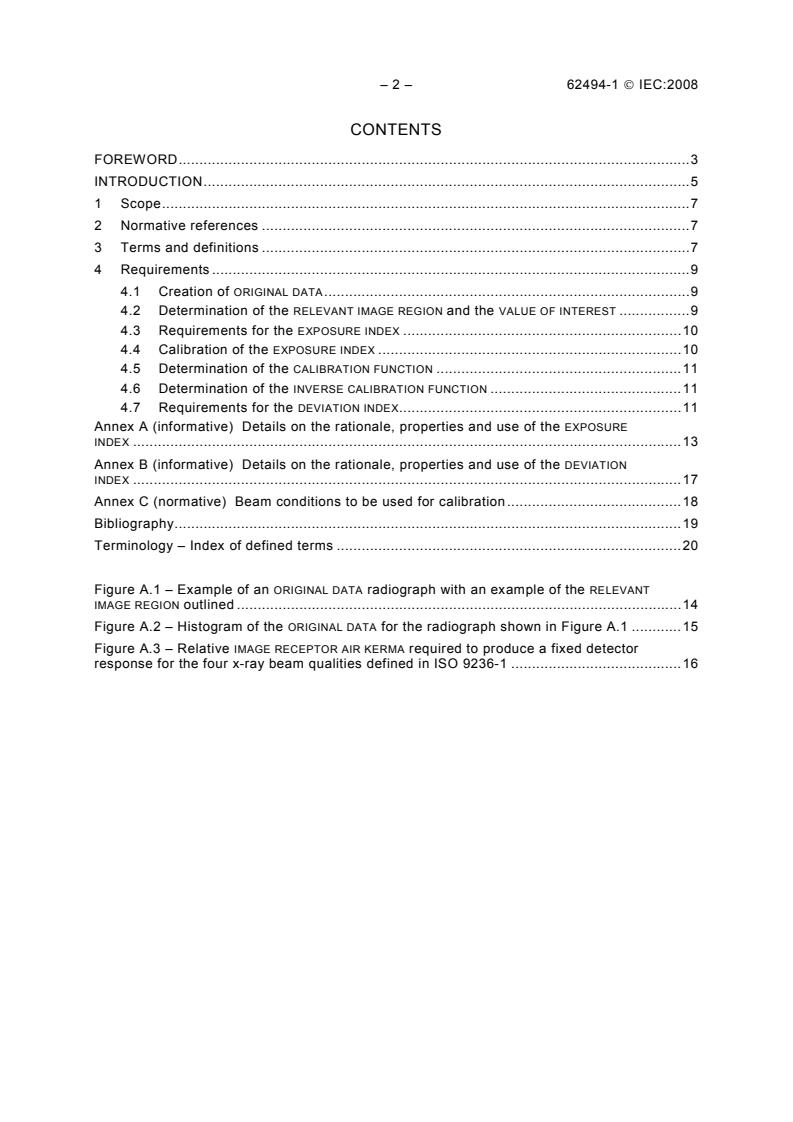
CONTENTS
FOREWORD.3
INTRODUCTION.5
1 Scope.7
2 Normative references .7
3 Terms and definitions .7
4 Requirements .9
4.1 Creation of ORIGINAL DATA.9
4.2 Determination of the RELEVANT IMAGE REGION and the VALUE OF INTEREST .9
4.3 Requirements for the EXPOSURE INDEX .10
4.4 Calibration of the EXPOSURE INDEX .10
4.5 Determination of the CALIBRATION FUNCTION .11
4.6 Determination of the INVERSE CALIBRATION FUNCTION .11
4.7 Requirements for the DEVIATION INDEX.11
Annex A (informative) Details on the rationale, properties and use of the EXPOSURE
INDEX .13
Annex B (informative) Details on the rationale, properties and use of the DEVIATION
INDEX .17
Annex C (normative) Beam conditions to be used for calibration.18
Bibliography.19
Terminology – Index of defined terms .20
Figure A.1 – Example of an ORIGINAL DATA radiograph with an example of the RELEVANT
IMAGE REGION outlined .14
Figure A.2 – Histogram of the ORIGINAL DATA for the radiograph shown in Figure A.1 .15
Figure A.3 – Relative IMAGE RECEPTOR AIR KERMA required to produce a fixed detector
response for the four x-ray beam qualities defined in ISO 9236-1 .16
62494-1 © IEC:2008 – 3 –
INTERNATIONAL ELECTROTECHNICAL COMMISSION
____________
MEDICAL ELECTRICAL EQUIPMENT –
EXPOSURE INDEX OF DIGITAL X-RAY IMAGING SYSTEMS –
Part 1: Definitions and requirements for general radiography
FOREWORD
1) The International Electrotechnical Commission (IEC) is a worldwide organization for standardization comprising
all national electrotechnical committees (IEC National Committees). The object of IEC is to promote
international co-operation on all questions concerning standardization in the electrical and electronic fields. To
this end and in addition to other activities, IEC publishes International Standards, Technical Specifications,
Technical Reports, Publicly Available Specifications (PAS) and Guides (hereafter referred to as “IEC
Publication(s)”). Their preparation is entrusted to technical committees; any IEC National Committee interested
in the subject dealt with may participate in this preparatory work. International, governmental and non-
governmental organizations liaising with the IEC also participate in this preparation. IEC collaborates closely
with the International Organization for Standardization (ISO) in accordance with conditions determined by
agreement between the two organizations.
2) The formal decisions or agreements of IEC on technical matters express, as nearly as possible, an international
consensus of opinion on the relevant subjects since each technical committee has representation from all
interested IEC National Committees.
3) IEC Publications have the form of recommendations for international use and are accepted by IEC National
Committees in that sense. While all reasonable efforts are made to ensure that the technical content of IEC
Publications is accurate, IEC cannot be held responsible for the way in which they are used or for any
misinterpretation by any end user.
4) In order to promote international uniformity, IEC National Committees undertake to apply IEC Publications
transparently to the maximum extent possible in their national and regional publications. Any divergence
between any IEC Publication and the corresponding national or regional publication shall be clearly indicated in
the latter.
5) IEC provides no marking procedure to indicate its approval and cannot be rendered responsible for any
equipment declared to be in conformity with an IEC Publication.
6) All users should ensure that they have the latest edition of this publication.
7) No liability shall attach to IEC or its directors, employees, servants or agents including individual experts and
members of its technical committees and IEC National Committees for any personal injury, property damage or
other damage of any nature whatsoever, whether direct or indirect, or for costs (including legal fees) and
expenses arising out of the publication, use of, or reliance upon, this IEC Publication or any other IEC
Publications.
8) Attention is drawn to the Normative references cited in this publication. Use of the referenced publications is
indispensable for the correct application of this publication.
9) Attention is drawn to the possibility that some of the elements of this IEC Publication may be the subject of
patent rights. IEC shall not be held responsible for identifying any or all such patent rights.
International Standard IEC 62494-1 has been prepared by subcommittee 62B: Diagnostic
imaging equipment, of IEC technical committee 62: Electrical equipment in medical practice.
The text of this standard is based on the following documents:
Enquiry draft Report on voting
62B/680/CDV 62B/703/RVC
Full information on the voting for the approval of this standard can be found in the report on
voting indicated in the above table.
This publication has been drafted in accordance with the ISO/IEC Directives, Part 2.
– 4 – 62494-1 © IEC:2008
In this standard, the following print types are used:
– requirements, compliance with which can be tested, and definitions: in roman type;
– explanations, advice, notes, general statements, exceptions and references: in smaller type;
– TERMS DEFINED IN CLAUSE 3 OF THIS STANDARD, IN IEC 60601-1 OR IN IEC 60788, AS
REFERENCED IN THE INDEX OF DEFINED TERMS: SMALL CAPITALS.
A list of all parts of the IEC 62494 series, published under the general title Medical electrical
equipment – Exposure index of digital X-ray imaging systems, can be found on the IEC
website.
The committee has decided that the contents of this publication will remain unchanged until
the maintenance result date indicated on the IEC web site under "http://webstore.iec.ch" in
the data related to the specific publication. At this date, the publication will be
• reconfirmed,
• withdrawn,
• replaced by a revised edition, or
• amended.
62494-1 © IEC:2008 – 5 –
INTRODUCTION
The direct connection between the level of detector exposure and optical density is well
established in film-screen radiology. This is not the case in digital radiography, where almost
always a constant image characteristic is achieved using automatic image processing.
Consequently, deviations from the intended exposure, i.e., over- and underexposure, are not
noticeable by a corresponding deviation in image brightness. While considerable
underexposure results in an increased level of noise, the more alarming aspect (from a
radiation protection point of view) is that overexposure cannot be recognized easily in the
displayed image.
Therefore, various manufacturers of digital radiography systems have introduced so-called
exposure indicators for their equipment. These are numbers, determined from the original
image data of each image taken, which allow conclusions about the level of the exposure at
the image receptor. However, the exposure indicators are manufacturer or system specific,
i.e. they differ for the systems of different manufacturers in their definition and scaling. A
unified EXPOSURE INDEX for all digital radiography systems is needed to simplify its usage, e.g.
for the establishment of exposure guidelines, particularly when systems of different
manufacturers are used within the same department.
This standard defines such a concept of the EXPOSURE INDEX. What is laid down here refers to
the definition, the scale and the general requirements for the EXPOSURE INDEX. The process of
its calculation in detail (software algorithm) is excluded from this standard as to not obstruct
technical progress.
The EXPOSURE INDEX allows the OPERATOR to judge if an image was taken at a detector
exposure level suitable for the intended level of image quality. It is important to note that the
EXPOSURE INDEX, as defined in this standard, is derived from the image signal, which in turn is
usually related to the energy absorbed in the detector, i.e. the detector dose, but not directly
to the air kerma at the image receptor. The relation to IMAGE RECEPTOR AIR KERMA (air kerma
at the detector surface) is introduced only at one radiation quality through calibration.
However, this definition is appropriate as the image quality in digital radiography is
determined mainly by the signal-to-noise level, which in turn is determined by the absorbed
energy. Annex A provides more details on the rationale, properties and use of the EXPOSURE
INDEX.
The level of detector exposure needed to obtain a suitable level of image quality may vary
depending on body part, view, or the x-ray imaging system used, as may the appropriate
EXPOSURE INDEX. This standard introduces a second parameter, called DEVIATION INDEX, which
quantifies the deviation of an actual EXPOSURE INDEX from the appropriate EXPOSURE INDEX
(called TARGET EXPOSURE INDEX). While this parameter does not relate to the image receptor
dose on an absolute scale, it allows the operator an easy check whether the exposure is
considered acceptable for the specific imaging task. Annex B provides more details on the
rationale, properties and use of the DEVIATION INDEX.
The storage of the EXPOSURE INDEX (and the DEVIATION INDEX) together with the image data,
e.g., in a DICOM tag field, allows the documentation and communication of the image
receptor dose level in clinical practice.
The EXPOSURE INDEX does not obviate the use of dose parameters that describe the patient’s
REFERENCE AIR KERMA or the kerma-area
exposure to radiation, such as, for example, the
product. Because the relation between patient exposure and detector exposure is influenced
by a number of factors that are generally not known under clinical conditions, the EXPOSURE
INDEX should not be used to calculate or estimate patient dose.
– 6 – 62494-1 © IEC:2008
The EXPOSURE INDEX cannot be used to control the compliance with diagnostic reference
1)
levels, which refer to patient dose [1] .
___________
1)
Figures in square brackets refer to the Bibliography.
62494-1 © IEC:2008 – 7 –
MEDICAL ELECTRICAL EQUIPMENT –
EXPOSURE INDEX OF DIGITAL X-RAY IMAGING SYSTEMS –
Part 1: Definitions and requirements for general radiography
1 Scope
This part of IEC 62494 specifies definitions and requirements for the EXPOSURE INDEX of
images acquired with DIGITAL X-RAY IMAGING SYSTEMS.
This standard is applicable to DIGITAL X-RAY IMAGING SYSTEMS used in general radiography for
producing PROJECTION X-ray images for general applications, such as, but not exclusively:
• computed radiography (CR) systems based on stimulable phosphors;
• flat-panel detector based systems;
• charge-coupled device (CCD) based systems.
Image intensifier based systems and systems for mammographic or dental application are not
covered in this first edition.
This standard defines the EXPOSURE INDEX only for images generated with a single
IRRADIATION event. Images generated from multiple IRRADIATIONS (e.g., tomosynthetic or dual-
energy images, multiple views on a single CR plate) are not covered.
2 Normative references
The following referenced documents are indispensable for the application of this document.
For dated references, only the edition cited applies. For undated references, the latest edition
of the referenced document (including any amendments) applies.
IEC/TR 60788:2004, Medical electrical equipment – Glossary of defined terms
3 Terms and definitions
For the purposes of this document, the terms and definitions given in IEC TR 60788 and the
following apply.
3.1
CALIBRATION CONDITIONS
set of conditions under which EXPOSURE INDEX calibration is done
3.2
CALIBRATION FUNCTION
function expressing the VALUE OF INTEREST as a function of the IMAGE RECEPTOR AIR KERMA that
is valid under CALIBRATION CONDITIONS
3.3
DETECTOR SURFACE
accessible area which is closest to the IMAGE RECEPTOR PLANE
NOTE After removal of all parts (including the ANTI-SCATTER GRID and components for AUTOMATIC EXPOSURE
CONTROL, if applicable) that can be safely removed from the RADIATION BEAM without damaging the digital X-ray
detector.
[IEC 62220-1-2:2007, definition 3.3]
– 8 – 62494-1 © IEC:2008
3.4
DEVIATION INDEX
DI
number quantifying the deviation of the actual EXPOSURE INDEX from a TARGET EXPOSURE INDEX
3.5
DIGITAL X-RAY IMAGING DEVICE
device consisting of a digital X-ray detector including the protective layers installed for use in
practice, the amplifying and digitizing electronics, and a computer providing the ORIGINAL DATA
(DN) of the image
[IEC 62220-1:2003, definition 3.5]
NOTE This may include protecting parts, such as anti-scatter grids or AEC components
3.6
DIGITAL X-RAY IMAGING SYSTEM
X-ray equipment using a DIGITAL X-RAY IMAGING DEVICE, providing PROJECTION images in digital
format, comprising subsystems allowing to process, display, print or store the images
3.7
EXPOSURE INDEX
EI
measure of the detector response to radiation in the RELEVANT IMAGE REGION of an image
acquired with a DIGITAL X-RAY IMAGING SYSTEM
NOTE For a fixed RADIATION QUALITY, the signal generated in the detector is proportional to the IMAGE RECEPTOR
AIR KERMA (or exposure).
3.8
IMAGE RECEPTOR AIR KERMA
K
AIR KERMA at the position of the DETECTOR SURFACE, free-in-air (excluding backscatter)
3.9
INVERSE CALIBRATION FUNCTION
function expressing the IMAGE RECEPTOR AIR KERMA as a function of the VALUE OF INTEREST that
CALIBRATION CONDITIONS
is valid under
3.10
ORIGINAL DATA
DN
RAW DATA to which the corrections allowed in this standard have been applied
[IEC 62220-1:2003, definition 3.12]
NOTE The relation of the ORIGINAL DATA to the IMAGE RECEPTOR AIR KERMA may include a non-linear, e.g.,
logarithmic or square-root characteristic.
3.11
RAW DATA
pixel values read directly after the analogue-digital-conversion from the DIGITAL X-RAY IMAGING
DEVICE without any software corrections
[IEC 62220-1:2003, definition 3.14]]
3.12
RELEVANT IMAGE REGION
examination-specific sub-area or sub-areas of the image containing the diagnostically relevant
information
NOTE This is typically the region for which the exposure parameters should be optimized.
62494-1 © IEC:2008 – 9 –
3.13
TARGET EXPOSURE INDEX
EI
T
expected value of the EXPOSURE INDEX when exposing the X-RAY IMAGE RECEPTOR properly
NOTE The TARGET EXPOSURE INDEX may depend on the type of detector, on the type of examination, on the
diagnostic question and on other parameters.
3.14
VALUE OF INTEREST
V
central tendency of the original data in the relevant image region
NOTE Central tendency is a statistical term depicting generally the centre of a distribution. It may refer to a
variety of measures such as the mean, the median or the mode.
4 Requirements
4.1 Creation of ORIGINAL DATA
The following image-independent corrections of the RAW DATA are allowed for the creation of
ORIGINAL DATA in advance of the processing of the data for the determination of the
CALIBRATION FUNCTION and the EXPOSURE INDEX.
All the following corrections if used shall be made as in normal clinical use:
– replacement of the RAW DATA of bad or defective pixels by appropriate data;
– a flat-field correction comprising for example:
• correction of the non-uniformity of the RADIATION FIELD;
• correction for the offset of the individual pixels;
• gain correction for the individual pixels;
• a correction for velocity variation during a scan;
– a correction for geometrical distortion.
NOTE 1 Some detectors execute linear image processing due to their physical concept. As long as this image
processing is linear and image-independent, these operations are allowed as an exception.
NOTE 2 Image correction is considered image-independent if the same correction is applied to all images
independent of the image contents.
NOTE 3 Processes that are used to enhance individual images for presentation, such as edge enhancement,
noise smoothing, and histogram equalization, are not considered correction even if they are linear and are applied
to all images independent of image content.
4.2 Determination of the RELEVANT IMAGE REGION and the VALUE OF INTEREST
The determination of the RELEVANT IMAGE REGION should be done by methods that identify the
attenuated regions of the beam that are relevant to the diagnostic purpose of the acquired
image.
The selection of the RELEVANT IMAGE REGION can be done by image segmentation, histogram
based, or other appropriate methods. The method used shall be documented.
NOTE 1 Several methods to determine the RELEVANT IMAGE REGION exist. These may be based on image
histogram evaluation, on image segmentation or a combination of both. The RELEVANT IMAGE REGION need not be a
contiguous area of the image
NOTE 2 While it is understood that the selection of the RELEVANT IMAGE REGION is an important step in the
generation of the EXPOSURE INDEX and that a single unified method may be desirable, it is not feasible at this time.
Future versions of the standard may address this issue.
– 10 – 62494-1 © IEC:2008
The VALUE OF INTEREST shall be calculated using the mean, median, mode, trimmed mean,
trimean, or other recognized statistical method for the description of central tendency of the
ORIGINAL DATA in the RELEVANT IMAGE REGION. The method used shall be documented.
NOTE 3 Care should be taken in the selection of the method used to calculate the central tendency in a manner
not influenced by outlying values. Methods such as trimmed mean or trimean reduce the influence of extreme
values.
NOTE 4 Background information on the influence of the selection of the RELEVANT IMAGE REGION and the VALUE OF
INTEREST is described in Annex A.
4.3 Requirements for the EXPOSURE INDEX
The EXPOSURE INDEX EI shall be related to the VALUE OF INTEREST V according to the formula:
EI = c ⋅ g(V ) (1)
where g(V) is an equipment-specific INVERSE CALIBRATION FUNCTION that is defined in
–1
subclause 4.6 and c = 100 μGy is a constant.
NOTE 1 The INVERSE CALIBRATION FUNCTION accounts for different scalings of the ORIGINAL DATA in different
DIGITAL X-RAY IMAGING DEVICES.
The EXPOSURE INDEX shall be calculated directly after image acquisition and after any manual
adjustments of the automatic image processing (e.g., when the automatic segmentation or
histogram evaluation algorithm failed to correctly identify the RELEVANT IMAGE REGION) so that
it is available to the OPERATOR prior to image confirmation.
NOTE 2 Image confirmation is the step concluding the image acquisition process. It may happen either by a user
action or automatically. It asserts that the image has been processed properly. This is usually done by examining
the image on the display of the acquisition workstation.
If the EXPOSURE INDEX is outside the valid range of the INVERSE CALIBRATION FUNCTION (see
subclause 4.6) that effect shall be indicated.
4.4 Calibration of the EXPOSURE INDEX
The EXPOSURE INDEX EI shall be calibrated for the DIGITAL X-RAY IMAGING SYSTEM over the
specified operating range of IMAGE RECEPTOR AIR KERMA such that
EI = c ⋅ K (2)
0 CAL
where K is the IMAGE RECEPTOR AIR KERMA in μGy under the CALIBRATION CONDITIONS and
CAL
–1
c = 100 μGy is a constant.
CALIBRATION CONDITIONS shall be:
– homogeneous IRRADIATION of the EFFECTIVE IMAGE RECEPTION AREA;
– IMAGE RECEPTOR AIR KERMA covering the specified operating range of the DIGITAL X-RAY
IMAGING DEVICE;
– measurement of the IMAGE RECEPTOR AIR KERMA free-in-air without backscattered radiation
as specified in Annex C;
– a single fixed RADIATION QUALITY as specified in Annex C;
– VALUE OF INTEREST computed from a RELEVANT IMAGE REGION that shall be the central 10 %
of the area of the homogeneously exposed EFFECTIVE IMAGE RECEPTION AREA.
Conditions needed to verify the CALIBRATION FUNCTION, such as the time interval between
exposure and processing in the CR reader, should be supplied by the manufacturer.
62494-1 © IEC:2008 – 11 –
NOTE For radiographic techniques other than the one used for calibration, the relation between the EXPOSURE
INDEX EI and the IMAGE RECEPTOR AIR KERMA K will deviate from Eq. (2) because of the energy dependence of x-ray
response of the detector, scattered radiation and possibly other effects.
4.5 Determination of the CALIBRATION FUNCTION
The CALIBRATION FUNCTION f(K) shall be determined from the relationship between the IMAGE
RECEPTOR AIR KERMA K and the VALUE OF INTEREST V for the calibration RADIATION
CAL CAL
QUALITY from a series of homogenously exposed images. The CALIBRATION FUNCTION f(K) is
defined by
V = f (K ) (3)
CAL CAL
where V is the VALUE OF INTEREST with a RELEVANT IMAGE REGION that is taken to be the
CAL
central 10 % of the homogeneously exposed EFFECTIVE IMAGE RECEPTION AREA. This
relationship shall be measured over the range of IMAGE RECEPTOR AIR KERMA for which the
DIGITAL X-RAY IMAGING DEVICE is specified to operate. Intermediate values of f(K) are to be
interpolated from the measured values.
ADDED FILTER and X-RAY TUBE VOLTAGE used to obtain the RADIATION QUALITY described in
Annex C shall be documented.
4.6 Determination of the INVERSE CALIBRATION FUNCTION
The INVERSE CALIBRATION FUNCTION, g(V ) is defined as
CAL
−1
K = g(V ) = f (V ) . (4)
CAL CAL CAL
This function expresses the IMAGE RECEPTOR AIR KERMA K as a function of the VALUE OF
INTEREST for the CALIBRATION CONDITIONS.
The INVERSE CALIBRATION FUNCTION g(V) shall be used for the calculation of the EXPOSURE
INDEX according to Eq. (1) for all radiographic techniques
If EXPOSURE INDEX values are provided by a DIGITAL X-RAY IMAGING SYSTEM, the manufacturer
or supplier shall specify the INVERSE CALIBRATION FUNCTION and the range of IMAGE RECEPTOR
AIR KERMA for which the INVERSE CALIBRATION FUNCTION can be used to calculate the IMAGE
RECEPTOR AIR KERMA from the VALUE OF INTEREST under CALIBRATION CONDITIONS. The specified
INVERSE CALIBRATION FUNCTION shall have an uncertainty of less than 20 % (coverage
factor 2).
NOTE “Uncertainty” and “coverage factor” are terms defined in the Guide to the expression of uncertainty in
measurement [2].
4.7 Requirements for the DEVIATION INDEX
The DEVIATION INDEX is a number quantifying the deviation of the actual EXPOSURE INDEX from
the TARGET EXPOSURE INDEX that is intended for the type of examination in question on that
DIGITAL X-RAY IMAGING SYSTEM.
If TARGET EXPOSURE INDEX values are provided by the DIGITAL X-RAY IMAGING SYSTEM, the
DEVIATION INDEX shall be automatically calculated according to:
⎛ ⎞
EI
DI = 10 ⋅ log ⎜ ⎟ (5)
⎜ ⎟
EI
⎝ T⎠
– 12 – 62494-1 © IEC:2008
where EI is the EXPOSURE INDEX of the actual image and EI is the TARGET EXPOSURE INDEX for
T
this examination type on the DIGITAL X-RAY IMAGING SYSTEM.
NOTE 1 For this purpose, the TARGET EXPOSURE INDEX values for different examinations/applications need to be
available on the DIGITAL X-RAY IMAGING SYSTEM, e.g., in a data base. Such values may be established by
professional societies or by the RESPONSIBLE ORGANIZATION.
NOTE 2 This definition results in a DEVIATION INDEX of 0 when the actual EXPOSURE INDEX equals the TARGET
EXPOSURE INDEX; the DEVIATION INDEX changes by ±1 for each +25 %/-20 % change of the EXPOSURE INDEX.
The DEVIATION INDEX shall be calculated directly after image acquisition and after any manual
adjustments of the automatic image processing (e.g., when the automatic segmentation or
histogram evaluation algorithm failed to correctly identify the RELEVANT IMAGE REGION) so that
it is available to the OPERATOR prior to image confirmation.
62494-1 © IEC:2008 – 13 –
Annex A
(informative)
Details on the rationale, properties and use of the EXPOSURE INDEX
The EXPOSURE INDEX and the DEVIATION INDEX serve to provide the user with feedback in the
form of standardized indices. The EXPOSURE INDEX is a relative measure of the detector dose
level for an X-ray image acquired by a particular DIGITAL X-RAY IMAGING SYSTEM. In conjunction
with clinical experience, the EXPOSURE INDEX is expected to quantify detector dose, which will
facilitate the development of useful EXPOSURE INDEX guidelines.
The EXPOSURE INDEX described in this standard has a number of useful properties. The
purpose of this annex is to describe these along with known limitations to facilitate the
appropriate use of the EXPOSURE INDEX as well as the DEVIATION INDEX.
With otherwise identical technical factors (kV, filtration, SID, grid) and subject, the EXPOSURE
INDEX of a particular DIGITAL X-RAY IMAGING SYSTEM is linearly proportional to the IMAGE
RECEPTOR AIR KERMA. For example, doubling the mAs will result in a doubling of the EXPOSURE
INDEX.
Under CALIBRATION CONDITIONS (uniform, flat-field exposure of the specified x-ray quality) the
IMAGE RECEPTOR AIR KERMA will be directly related to the EXPOSURE INDEX computed from a
RELEVANT IMAGE REGION corresponding to the central 10 % of the DIGITAL X-RAY IMAGING
DEVICE. This relationship is expected to be useful for many aspects of technical quality control
appropriate for DIGITAL X-RAY IMAGING SYSTEMS (for example, medical physicist’s acceptance or
constancy testing).
The EXPOSURE INDEX also has limitations. It is important to understand these to avoid
misinterpretation and misuse of EXPOSURE INDEX values. This is particularly true if EXPOSURE
INDEX values from different DIGITAL X-RAY IMAGING SYSTEMS or for images acquired with
significantly different technical factors are to be compared.
The EXPOSURE INDEX depends critically on the RELEVANT IMAGE REGION. Therefore, the value of
the EXPOSURE INDEX will be directly affected by differences in selection of the RELEVANT IMAGE
REGION intrinsic to different DIGITAL X-RAY IMAGING SYSTEMS. Such differences are to be
expected because this standard does not specify a method for selecting the RELEVANT IMAGE
REGION. To appreciate the potential impact of differences in RELEVANT IMAGE REGION selection,
it is only necessary to recall that typical radiographic images span a large range of relative
IMAGE RECPTOR AIR KERMA. A representative ORIGINAL DATA radiograph is shown in
Figure A.1.
– 14 – 62494-1 © IEC:2008
IEC 1303/08
Figure A.1 – Example of an ORIGINAL DATA radiograph with an example of the RELEVANT
outlined
IMAGE REGION
The histogram for this radiograph is shown in Figure A.2. In this example, pixel values
represent 1 000 × log(E), where E is the relative dose incident upon the DIGITAL X-RAY IMAGING
DEVICE. The gray histogram in Figure A.2 is computed from pixel values from the entire image.
This includes areas containing anatomy, collimated areas and areas receiving direct
(unattenuated) x-ray exposure. The range of pixel values is more than 2 000, corresponding
to more than a factor of 100 in relative receptor dose. This is typical of many radiographic
examinations. The black histogram is computed from pixel values in the anatomical area
outlined in red in Figure A.1. This selection is one possible candidate for the RELEVANT IMAGE
REGION. The range of pixel values in this histogram is more than 1 000, corresponding to more
than a factor of 10 in relative receptor dose [4]. Different plausible selections of the RELEVANT
IMAGE REGION can easily lead to EXPOSURE INDEX differences spanning a substantial fraction of
that range.
NOTE For testing purposes, a possibility to interactively select the RELEVANT IMAGE REGION may be useful.
62494-1 © IEC:2008 – 15 –
4x10
16 000
4 × 10
3x10
3 × 10 12 000
2x10 8 000
2 × 10
1x10
4 000
1 × 10
0 0 0
1000 1500 2000 2500 3000
1 000 1 500 2 000 2 500 3 000
Pixel Value
Pixel value
IEC 1304/08
Gray histogram is for the entire image and the black histogram is for only the anatomical area (excluding collimated
and direct exposure areas).This is one possible candidate for the RELEVANT IMAGE REGION.
Figure A.2 – Histogram of the ORIGINAL DATA for the radiograph shown in Figure A.1
A subtler, but still important factor affecting the EXPOSURE INDEX is the freedom to select any
measure of central tendency to compute the VALUE OF INTEREST. The choice of central
tendency is not defined or limited by this standard and is therefore open to different
interpretation for each DIGITAL X-RAY IMAGING SYSTEM. Depending on the histogram of the
image, plausible choices like mean, median or mode may lead to different VALUES OF
INTEREST. It is important to recognize that the impact of such differences on the EXPOSURE
INDEX is not mitigated by proper calibration. The range of choices will have very little impact
on the uniform CALIBRATION CONDITION images because the range of pixel values in the
RELEVANT IMAGE REGION is very small, while this is not the case for clinical images.
The result is that even though the same EXPOSURE INDEX may be reported by different
systems, the exposure reaching the DIGITAL X-RAY IMAGING DEVICE may be very different.
Likewise, significantly different EXPOSURE INDEX values do not necessarily indicate a
substantially different dose to the DIGITAL X-RAY IMAGING DEVICES of different DIGITAL X-RAY
IMAGING SYSTEMS.
DIGITAL X-RAY IMAGING
Another important limitation is related to the observation that each
DEVICE responds differently to x-rays of different energies and angles of incidence. However,
this standard uses a single x-ray beam quality for calibration. The use of a single calibration
condition results in a unique dependence of the EXPOSURE INDEX on technical factors (kV,
filtration, SID, grid) for each DIGITAL X-RAY IMAGING DEVICE. Therefore, even though two
different DIGITAL X-RAY IMAGING DEVICES may be calibrated to this standard, they may give
different EXPOSURE INDEX values for otherwise identical image acquisitions, solely because of
differences in x-ray energy response. The energy dependences of detector response have
recently been reported for several common detector technologies for four clinically relevant
beam conditions (for details see [5]). These data are shown in Figure A.3.
– 16 – 62494-1 © IEC:2008
GOS-SF
GOS-DR
Csl-DR
αSe-DR
BaFBrl-CR
I II III IV
ISO 9236-1 Beam quality number
IEC 1305/08
Figure A.3 – Relative IMAGE RECEPTOR AIR KERMA required to produce a fixed detector
response for the four x-ray beam qualities defined in ISO 9236-1
ISO Standard 9236-1 specifies four beam conditions that are intended to approximate the
X-ray spectrum and scatter conditions commonly used for extremity (I), skull (II), lumbar spine
(III), and chest (IV) film/screen imaging. Figure A.3 shows the relative IMAGE RECEPTOR AIR
KERMA that is needed for fixed constant response for each of five common imaging detector
technologies. For each detector, the IMAGE RECEPTOR AIR KERMA has been normalized by that
required for the scatter-free calibration condition (80 kVp with 0,50 mm Cu and 1 mm Al at the
tube) [5]. Figure A.3 shows that DIGITAL X-RAY IMAGING DEVICES exhibit a substantial
dependence on x-ray beam quality corresponding to widely practiced examinations. The full
range of normalized detector responses varies by a factor of 2,78. As a result, the energy
dependence of imaging detectors will introduce corresponding detector dependent energy
dependences of EXPOSURE INDEX. Therefore, great care must be taken when comparing
EXPOSURE INDEX values of images from different DIGITAL X-RAY IMAGING DEVICES or for images
acquired with different technical factors (kV, filtration, SID, grid).
This informative annex describing the properties and limitations of the EXPOSURE INDEX is not
intended to be exhaustive, but rather to guide the user toward a more complete understanding
that will facilitate the correct use and interpretation of the EXPOSURE INDEX.
Relative IMAGE RECEPTOR AIR KERMA
62494-1 © IEC:2008 – 17 –
Annex B
(informative)
Details on the rationale, properties and use of the DEVIATION INDEX
For radiographs of different body parts and views, the EXPOSURE INDEX required to obtain
acceptable image quality may vary according to the purpose and clinical diagnostic
indications expected for a particular procedure as well as depending on the specific type of
detector used. The DEVIATION INDEX is intended to be an indication to the OPERATOR
performing or interpreting radiographic examinations whether the signal-to-noise ratio in the
RELEVANT IMAGE REGION resulting from the selected radiographic technique is considered
acceptable for the specific body part and view imaged.
For that purpose, a database of TARGET EXPOSURE INDEX values needs to be available in the
DIGITAL X-RAY IMAGING SYSTEM and the OPERATOR must specify the body part and view to be
imaged prior to image acquisition. This allows the DIGITAL X-RAY IMAGING SYSTEM to select the
appropriate TARGET EXPOSURE INDEX VALUE from the database to be used in the determination
of the DEVIATION INDEX. If no body part and view is selected or if there is no EI entry in the
T
table for the selected body part and view, the system reports a value of “N/A” for the
DEVIATION INDEX.
For a properly exposed X-ray image the DEVIATION INDEX will be close to zero.
Over- and underexposure compared to the target level of exposure for a specific examination
result in positive or negative values of the DEVIATION INDEX, respectively.
Deviations from proper positioning and collimation, which would lead to over- or
underexposure in conventional screen-film imaging, lead to positive or negative values of the
DEVIATION INDEX.
– 18 – 62494-1 © IEC:2008
Annex C
(normative)
Beam conditions to be used for calibration
The RADIATION QUALITY used for the CALIBRATION CONDITIONS shall be characterized by:
– a HALF-VALUE LAYER of (6,8 ± 0,3) mm aluminium,
– an ADDED FILTER of either 21 mm aluminum or 0,5 mm copper and 2 mm aluminum,
– an X-RAY TUBE VOLTAGE in the range of 66 kV – 74 kV.
Adjustment of the X-RAY TUBE VOLTAGE in the range specified above is permitted to achieve
the target HALF-VALUE LAYER.
ADDED FILTER and X-RAY TUBE VOLTAGE used for calibration shall be documented.
NOTE 1 This RADIATION QUALITY is close to RQA5 as specified in IEC 61267. For the purpose of this standard, the
procedure to realize the RADIATION QUALITY is simplified compared to IEC 61267.
NOTE 2 The use of copper as a component of the ADDED FILTER is allowed in order to reduce the overall thickness
of added material. In a prior publication, 0,5 mm of copper was found to minimize the variability in the response of
a computed radiography system as the X-RAY TUBE VOLTAGE was varied within 80 kV ± 10% [3]. The additional
aluminium material achieves a HALF-VALUE LAYER near the desired nominal value, while keeping the thickness of
the copper filter at a value that is readily available. The added aluminium material should be on the beam exit
surface of the copper filter so that any characteristic radiation originating from the copper filter is absorbed.
The measurement of the IMAGE RECEPTOR AIR KERMA K , to be used for calibration of the
CAL
EXPOSURE INDEX (section 4.3) shall be done such that K reflect the primary beam AIR KERMA
CAL
at the position of the detector, free in air. If the image receptor cannot be removed from the
beam, the AIR KERMA should be measured at a position midway between the collimator and the
detector and adjusted using multiplication by the square of the distance from the focal spot to
the exposure meter divided by the distance from the focal spot to the active layer of the image
receptor.
NOTE 3 To account for variability, the AIR KERMA may be monitored at the edge of the beam and a correction
made for the AIR KERMA measured in the centre of the field relative to that measured at the edge of the field.
NOTE 4 While additional beam collimation is not required here, the remaining specification corresponds to the
geometry described in IEC 62220-1.
62494-1 © IEC:2008 – 19 –
Bibliography
[1] Radiological protection and safety in medicine: a report of the International Commission
on Radiological Protection. Ann ICRP 1996;26(2):p.1–47. [Published correction appears
in Ann ICRP 1997;27(2):61.]
[2] ISO/IEC GUIDE 98, Guide to the expression of uncertainty in measurement (GUM)
[3] SAMEI, E., SEIBERT, JA., WILLIS, C.,
...