

IEC TS 63394:2023
(Main)Safety of machinery - Guidelines on functional safety of safety-related control systems
General Information
- Abstract
IEC TS 63394:2023 In the context of the safety of machinery, the sector standard IEC 62061, along with ISO 13849 1, provides requirements to manufacturers of machines for the design, development and integration of safety-related control systems (SCS) or safety-related parts of control systems (SRP/CS), depending on technology used (mechanical, pneumatic, hydraulic or electrical technologies) to perform safety function(s). This document does not replace ISO 13849-1 and IEC 62061. This document gives additional guidance to the application of IEC 62061 or ISO 13849-1.
This document:
– gives guidelines and specifies additional requirements for specific safety functions based on the methodology of ISO 12100, which are relevant in machinery and respecting typical boundary conditions of machinery;
– considers safety functions which are designed for high demand mode of operation yet are rarely operated, called rarely activated safety functions;
– gives additional information for the calculation of failure rates using other (non-electronic) technologies based e.g. on Weibull distribution, because all the formula defined in IEC 62061 and ISO 13849-1 are based on exponential distribution.
Therefore, the basis for these guidelines and additional requirements is
– a typical classification of safety functions;
– a consideration of typical architectures used for designing safety functions;
– a consideration of modes of operation of safety functions;
– the derivation and evaluation of PFH formulas for subsystems considering the used technology.
This document does not address low demand mode of operation according to IEC 61508.
This document does not take into account either layer of protection analysis (LOPA) or basic process control system (BPCS), according to IEC 61511 as a risk reduction measure.
This document considers all lifecycle phases of the machine regarding functional safety, and SCS or SRP/CS.
- Status
- Published
- Publication Date
- 21-Feb-2023
- Technical Committee
- TC 44 - Safety of machinery - Electrotechnical aspects
- Drafting Committee
- PT 63394 - TC 44/PT 63394
- Current Stage
- PPUB - Publication issued
- Start Date
- 22-Feb-2023
- Completion Date
- 30-Mar-2023
Overview
IEC TS 63394:2023 - "Safety of machinery - Guidelines on functional safety of safety-related control system" is a technical specification that provides additional guidance for the application of IEC 62061 and ISO 13849-1 in machinery safety. It does not replace those standards but supplements them with practical guidelines for classifying safety functions, designing safety-related control systems (SCS) and safety-related parts of control systems (SRP/CS), and for evaluating performance and failure measures across typical machine technologies (mechanical, pneumatic, hydraulic, electrical).
Key topics and technical requirements
- Risk assessment alignment with ISO 12100: guidance on deriving safety functions from risk reduction measures and typical boundary conditions found in machinery.
- Classification of safety functions: typical categories and functional decomposition to map risk-reduction measures to SCS/SRP‑CS architectures.
- Demand mode considerations: emphasis on high-demand/continuous modes and specific treatment of rarely activated safety functions (functions used rarely but designed for high-demand operation).
- PFH and reliability evaluation: methods for deriving and evaluating probability of dangerous failure per hour (PFH) for subsystems, including guidance for non-electronic technologies using distributions such as the Weibull distribution where exponential assumptions in IEC 62061 / ISO 13849‑1 are not adequate.
- Design and verification lifecycle: top‑down decomposition, subsystem architectures, fault accumulation, diagnostic coverage (DC), MTTF examples, verification procedures, initial and periodic testing, and documentation requirements.
- Practical design constraints: electromagnetic immunity, software guidelines, manual parameterization, and cybersecurity aspects relevant to SCS/SRP‑CS integration.
- Scope limitations: does not address low‑demand mode per IEC 61508 and does not incorporate Layer of Protection Analysis (LOPA) or Basic Process Control System (BPCS) per IEC 61511.
Applications and who should use it
IEC TS 63394:2023 is intended for:
- Machine manufacturers and OEMs designing safety-related control systems.
- Safety engineers and system integrators implementing SIL/PLe-equivalent solutions for machinery.
- Functional safety assessors and certification bodies seeking interpreted guidance for IEC 62061 / ISO 13849‑1 applications.
- Maintenance and verification teams responsible for periodic testing, documentation and lifecycle activities. Use cases include design of guard interlocks, emergency stop functions, safety PLC subsystems, rarely-used protective functions, and reliability analyses for non-electronic actuators.
Related standards
- IEC 62061 (machinery - electrical/electronic/programmable electronic SCS)
- ISO 13849‑1 (safety-related parts of control systems)
- ISO 12100 (risk assessment and reduction)
- IEC 61508 / IEC 61511 (noted where modes and process safety analyses are excluded)
Keywords: IEC TS 63394:2023, functional safety, safety-related control systems, SCS, SRP/CS, IEC 62061, ISO 13849-1, PFH, Weibull distribution, machinery safety.
Get Certified
Connect with accredited certification bodies for this standard

DVS-ZERT GmbH
German welding certification society.

IMQ S.p.A. (Certification)
Italian electrical product certification.

SLG Prüf- und Zertifizierungs GmbH
German testing and certification body.
Sponsored listings
Frequently Asked Questions
IEC TS 63394:2023 is a technical specification published by the International Electrotechnical Commission (IEC). Its full title is "Safety of machinery - Guidelines on functional safety of safety-related control systems". This standard covers: IEC TS 63394:2023 In the context of the safety of machinery, the sector standard IEC 62061, along with ISO 13849 1, provides requirements to manufacturers of machines for the design, development and integration of safety-related control systems (SCS) or safety-related parts of control systems (SRP/CS), depending on technology used (mechanical, pneumatic, hydraulic or electrical technologies) to perform safety function(s). This document does not replace ISO 13849-1 and IEC 62061. This document gives additional guidance to the application of IEC 62061 or ISO 13849-1. This document: – gives guidelines and specifies additional requirements for specific safety functions based on the methodology of ISO 12100, which are relevant in machinery and respecting typical boundary conditions of machinery; – considers safety functions which are designed for high demand mode of operation yet are rarely operated, called rarely activated safety functions; – gives additional information for the calculation of failure rates using other (non-electronic) technologies based e.g. on Weibull distribution, because all the formula defined in IEC 62061 and ISO 13849-1 are based on exponential distribution. Therefore, the basis for these guidelines and additional requirements is – a typical classification of safety functions; – a consideration of typical architectures used for designing safety functions; – a consideration of modes of operation of safety functions; – the derivation and evaluation of PFH formulas for subsystems considering the used technology. This document does not address low demand mode of operation according to IEC 61508. This document does not take into account either layer of protection analysis (LOPA) or basic process control system (BPCS), according to IEC 61511 as a risk reduction measure. This document considers all lifecycle phases of the machine regarding functional safety, and SCS or SRP/CS.
IEC TS 63394:2023 In the context of the safety of machinery, the sector standard IEC 62061, along with ISO 13849 1, provides requirements to manufacturers of machines for the design, development and integration of safety-related control systems (SCS) or safety-related parts of control systems (SRP/CS), depending on technology used (mechanical, pneumatic, hydraulic or electrical technologies) to perform safety function(s). This document does not replace ISO 13849-1 and IEC 62061. This document gives additional guidance to the application of IEC 62061 or ISO 13849-1. This document: – gives guidelines and specifies additional requirements for specific safety functions based on the methodology of ISO 12100, which are relevant in machinery and respecting typical boundary conditions of machinery; – considers safety functions which are designed for high demand mode of operation yet are rarely operated, called rarely activated safety functions; – gives additional information for the calculation of failure rates using other (non-electronic) technologies based e.g. on Weibull distribution, because all the formula defined in IEC 62061 and ISO 13849-1 are based on exponential distribution. Therefore, the basis for these guidelines and additional requirements is – a typical classification of safety functions; – a consideration of typical architectures used for designing safety functions; – a consideration of modes of operation of safety functions; – the derivation and evaluation of PFH formulas for subsystems considering the used technology. This document does not address low demand mode of operation according to IEC 61508. This document does not take into account either layer of protection analysis (LOPA) or basic process control system (BPCS), according to IEC 61511 as a risk reduction measure. This document considers all lifecycle phases of the machine regarding functional safety, and SCS or SRP/CS.
IEC TS 63394:2023 is classified under the following ICS (International Classification for Standards) categories: 13.110 - Safety of machinery; 25.040.99 - Other industrial automation systems; 29.020 - Electrical engineering in general. The ICS classification helps identify the subject area and facilitates finding related standards.
IEC TS 63394:2023 is available in PDF format for immediate download after purchase. The document can be added to your cart and obtained through the secure checkout process. Digital delivery ensures instant access to the complete standard document.
Standards Content (Sample)
IEC TS 63394 ®
Edition 1.0 2023-02
TECHNICAL
SPECIFICATION
colour
inside
Safety of machinery – Guidelines on functional safety of safety-related control
system
All rights reserved. Unless otherwise specified, no part of this publication may be reproduced or utilized in any form
or by any means, electronic or mechanical, including photocopying and microfilm, without permission in writing from
either IEC or IEC's member National Committee in the country of the requester. If you have any questions about IEC
copyright or have an enquiry about obtaining additional rights to this publication, please contact the address below or
your local IEC member National Committee for further information.
IEC Secretariat Tel.: +41 22 919 02 11
3, rue de Varembé info@iec.ch
CH-1211 Geneva 20 www.iec.ch
Switzerland
About the IEC
The International Electrotechnical Commission (IEC) is the leading global organization that prepares and publishes
International Standards for all electrical, electronic and related technologies.
About IEC publications
The technical content of IEC publications is kept under constant review by the IEC. Please make sure that you have the
latest edition, a corrigendum or an amendment might have been published.
IEC publications search - webstore.iec.ch/advsearchform IEC Products & Services Portal - products.iec.ch
The advanced search enables to find IEC publications by a Discover our powerful search engine and read freely all the
variety of criteria (reference number, text, technical publications previews. With a subscription you will always have
committee, …). It also gives information on projects, replaced access to up to date content tailored to your needs.
and withdrawn publications.
Electropedia - www.electropedia.org
IEC Just Published - webstore.iec.ch/justpublished
The world's leading online dictionary on electrotechnology,
Stay up to date on all new IEC publications. Just Published
containing more than 22 300 terminological entries in English
details all new publications released. Available online and once
and French, with equivalent terms in 19 additional languages.
a month by email.
Also known as the International Electrotechnical Vocabulary
(IEV) online.
IEC Customer Service Centre - webstore.iec.ch/csc
If you wish to give us your feedback on this publication or need
further assistance, please contact the Customer Service
Centre: sales@iec.ch.
IEC TS 63394 ®
Edition 1.0 2023-02
TECHNICAL
SPECIFICATION
colour
inside
Safety of machinery – Guidelines on functional safety of safety-related control
system
INTERNATIONAL
ELECTROTECHNICAL
COMMISSION
ICS 13.110; 29.020; 25.040.99 ISBN 978-2-8322-6533-8
– 2 – IEC TS 63394:2023 © IEC 2023
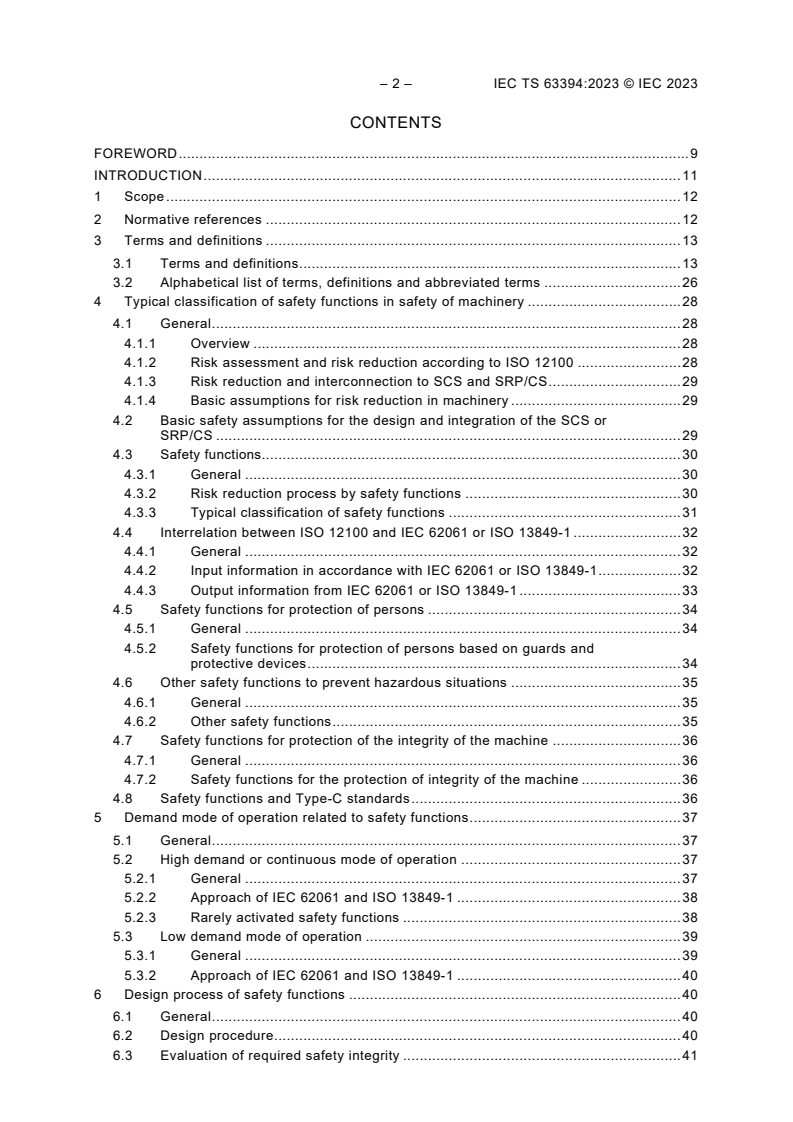
CONTENTS
FOREWORD . 9
INTRODUCTION . 11
1 Scope . 12
2 Normative references . 12
3 Terms and definitions . 13
3.1 Terms and definitions . 13
3.2 Alphabetical list of terms, definitions and abbreviated terms . 26
4 Typical classification of safety functions in safety of machinery . 28
4.1 General . 28
4.1.1 Overview . 28
4.1.2 Risk assessment and risk reduction according to ISO 12100 . 28
4.1.3 Risk reduction and interconnection to SCS and SRP/CS . 29
4.1.4 Basic assumptions for risk reduction in machinery . 29
4.2 Basic safety assumptions for the design and integration of the SCS or
SRP/CS . 29
4.3 Safety functions . 30
4.3.1 General . 30
4.3.2 Risk reduction process by safety functions . 30
4.3.3 Typical classification of safety functions . 31
4.4 Interrelation between ISO 12100 and IEC 62061 or ISO 13849-1 . 32
4.4.1 General . 32
4.4.2 Input information in accordance with IEC 62061 or ISO 13849-1 . 32
4.4.3 Output information from IEC 62061 or ISO 13849-1 . 33
4.5 Safety functions for protection of persons . 34
4.5.1 General . 34
4.5.2 Safety functions for protection of persons based on guards and
protective devices . 34
4.6 Other safety functions to prevent hazardous situations . 35
4.6.1 General . 35
4.6.2 Other safety functions . 35
4.7 Safety functions for protection of the integrity of the machine . 36
4.7.1 General . 36
4.7.2 Safety functions for the protection of integrity of the machine . 36
4.8 Safety functions and Type-C standards . 36
5 Demand mode of operation related to safety functions . 37
5.1 General . 37
5.2 High demand or continuous mode of operation . 37
5.2.1 General . 37
5.2.2 Approach of IEC 62061 and ISO 13849-1 . 38
5.2.3 Rarely activated safety functions . 38
5.3 Low demand mode of operation . 39
5.3.1 General . 39
5.3.2 Approach of IEC 62061 and ISO 13849-1 . 40
6 Design process of safety functions . 40
6.1 General . 40
6.2 Design procedure . 40
6.3 Evaluation of required safety integrity . 41
6.4 Decomposition of a safety function . 41
6.5 Subsystem design . 41
6.5.1 Architectural constraints . 41
6.5.2 Fault accumulation and undetected faults . 43
6.5.3 Evaluation of PFH . 43
6.6 Examples of safety functions. 45
7 Verification procedures for safety functions . 45
7.1 General . 45
7.2 Verification of the test interval of a safety function . 45
7.3 Verification procedures . 46
7.4 Initial verification . 46
7.5 Periodic verification . 47
7.5.1 General . 47
7.5.2 Frequency of periodic verification . 48
7.6 Verification reporting . 49
Annex A (informative) Risk assessment and risk reduction according to ISO 12100 . 50
A.1 General . 50
A.2 Risk assessment principles . 50
A.2.1 General . 50
A.2.2 Basic information to be available (as input to risk assessment) . 50
A.2.3 Risk analysis . 51
A.3 Risk reduction by means of safeguarding and complementary protective
measures . 55
A.3.1 General . 55
A.3.2 Inherently safe design measures . 56
A.3.3 Selection of safeguarding and complementary protective measures . 56
A.4 Other protective measures (procedure based) . 58
A.4.1 General . 58
A.4.2 Procedures for maintenance . 58
A.4.3 Organizational work procedures. 58
A.5 Guards and protective devices according to ISO 12100 . 59
A.5.1 General . 59
A.5.2 Interlocking guard with a start function, with manual reset function . 59
A.5.3 Protective device according to ISO 12100. 60
A.5.4 Manual local control device (and procedure) . 60
A.5.5 Manual parameter selection device (and procedure) . 61
A.5.6 Manual operating mode selection device (and procedure) . 61
A.5.7 Energy control device (and procedure) . 61
A.6 Matrix assignment approach . 61
A.6.1 Overview . 61
A.6.2 General . 62
A.6.3 Methodology of IEC 62061:2021, Annex A . 62
A.7 Risk graph approach . 63
A.7.1 General . 63
A.7.2 Methodology of ISO 13849-1:2015, Annex A with assigned SIL . 63
Annex B (informative) Methodology of SCS or SRP/CS design . 65
B.1 General . 65
B.2 Functional safety plan . 65
B.3 Safety requirements specification . 66
– 4 – IEC TS 63394:2023 © IEC 2023
B.3.1 General . 66
B.3.2 Functional requirements . 66
B.3.3 Safety integrity requirements . 66
B.4 Protection against unexpected start-up . 67
B.5 Decomposition of the safety function . 67
B.5.1 General . 67
B.5.2 Subsystem architecture based on top-down decomposition. 67
B.6 Design of the SCS by using subsystems . 67
B.7 Requirements for systematic safety integrity . 68
B.7.1 General . 68
B.7.2 SCS level . 68
B.7.3 Subsystem level . 70
B.8 Electromagnetic immunity . 71
B.9 Software-based manual parameterization . 71
B.10 Security aspects . 73
B.11 Aspects of testing . 73
B.12 Design and development of a subsystem . 74
B.12.1 General . 74
B.12.2 Subsystem architecture design . 74
B.12.3 Fault consideration and fault exclusion . 76
B.12.4 Architectural constraints of a subsystem . 76
B.12.5 Subsystem design architectures . 78
B.12.6 PFH value of subsystems . 78
B.13 Validation . 78
B.14 Documentation . 80
Annex C (informative) Examples of MTTF values for single components . 83
D
Annex D (informative) Examples for diagnostic coverage (DC) . 84
D.1 General . 84
D.2 Influence of cabling, wiring and interconnections . 85
D.2.1 General . 85
D.2.2 "Serial wiring" . 85
D.3 Use of manufacturing process information . 86
D.3.1 General . 86
D.3.2 Use of expected timing or awaiting of signal status . 86
D.4 Typical DC measures . 86
Annex E (informative) Measures for the achievement of functional safety with regards
to electromagnetic phenomena . 88
E.1 General . 88
E.2 Measures . 88
E.2.1 General . 88
E.2.2 Recommendation for electrical/electronic items of equipment (devices
or apparatus) . 88
E.2.3 Recommendation for the integration of an SCS or SRP/CS into the
electrical equipment of the machine . 89
Annex F (informative) Guidelines for software . 90
F.1 General . 90
F.2 Documentation . 90
F.3 Activities . 92
Annex G (informative) Examples of safety functions. 97
G.1 General . 97
G.2 Safety functions . 97
G.2.1 Basic information . 97
G.2.2 Detailed description of safety requirements . 98
G.2.3 Example of interlocking guard . 99
Annex H (informative) Evaluation of PFH value of a subsystem . 101
H.1 General . 101
H.2 Table allocation approach (IEC 62061) . 101
H.3 Simplified formulas for the estimation of PFH value (IEC 62061) . 101
H.4 Approaches of IEC 61508, IEC 62061 and ISO 13849-1 . 101
H.4.1 General . 101
H.4.2 Approach of IEC 61508 . 102
H.4.3 Approach of IEC 62061 . 103
H.4.4 Approach of ISO 13849-1:2015, Annex K . 103
H.5 Basic considerations regarding exponential and Weibull distributions . 107
H.5.1 Exponential distribution . 107
H.5.2 Weibull distribution . 107
H.6 T and B . 109
10 10
H.6.1 General . 109
H.6.2 T with exponential distribution . 109
H.6.3 T with Weibull distribution . 110
H.7 Overview of PFH formulas . 112
H.7.1 Definitions . 112
H.7.2 Formulas . 112
H.7.3 Examples. 114
H.8 Methodology for the estimation of CCF . 116
H.9 Basic subsystem architecture A (1oo1) . 117
H.9.1 General . 117
H.9.2 PFH . 118
H.9.3 Simplified Weibull approach . 118
H.10 Basic subsystem architecture C (1oo1D) . 119
H.10.1 General . 119
H.10.2 Fault reaction performed by another subsystem . 119
H.10.3 Fault reaction to be considered in the subsystem. 120
H.10.4 PFH . 122
H.10.5 Influence of CCF. 122
H.11 Basic subsystem architecture B (1oo2) . 123
H.11.1 General . 123
H.11.2 PFH . 124
H.11.3 Influence of CCF. 124
H.12 Basic subsystem architecture D (1oo2D) . 124
H.12.1 General . 124
H.12.2 PFH evaluation of Term A . 126
H.12.3 PFH evaluation of Term B . 126
H.12.4 PFH evaluation of Term C and Term D . 126
H.12.5 PFH . 127
H.12.6 Influence of CCF. 127
– 6 – IEC TS 63394:2023 © IEC 2023
H.13 Basic subsystem architecture D (1oo2D) with two periods of time
consideration . 127
H.13.1 General . 127
H.13.2 PFH evaluation of Term A . 128
H.13.3 PFH evaluation of Term B . 128
H.13.4 PFH evaluation of Term C and Term D . 128
H.13.5 PFH . 129
H.13.6 Influence of CCF. 129
Annex I (informative) Commented examples of current regulations . 130
I.1 General . 130
I.2 European Union . 130
I.2.1 General European legislation . 130
I.2.2 New proposed machinery regulation (under preparation) . 130
I.2.3 Relevant legislation . 131
I.2.4 Duties of the manufacturer of the machine . 131
I.3 North America – USA . 132
I.4 North America – Canada . 132
I.5 South America – Brazil . 132
I.6 China . 133
I.7 Japan. 133
Annex J (informative) Combination of modes of operation . 134
J.1 General . 134
J.2 Basic approaches with different modes of operation . 134
J.2.1 General . 134
J.2.2 Risk reduction measures on low demand mode of operation . 135
J.3 Use of subsystems in different modes of operation . 136
J.3.1 General . 136
J.3.2 Example with different modes of operation. 136
J.3.3 Subsystem(s) used for different modes of operation . 138
Bibliography . 141
Figure 1 – Integration within the risk reduction process of ISO 12100 . 29
Figure 2 – Decomposition of an SCS or SRP/CS . 30
Figure 3 – Risk reduction process by safety functions . 31
Figure 4 – High demand mode of operation . 38
Figure 5 – Process for determining high demand mode of operation . 39
Figure 6 – Low demand mode of operation . 40
Figure A.1 – SIL assignment approach . 63
Figure A.2 – Risk graph approach of ISO 13849-1:2015, Figure A.1 with assigned SIL . 64
Figure B.1 – Example of decomposition of a safety function . 68
Figure B.2 – Possible effects of security risk(s) to a SCS
(IEC TR 63074:2019, Figure 2) . 73
Figure B.3 – Rarely activated safety functions and mode of operation of subsystems . 76
Figure H.1 – Cumulative distribution functions (CDF) . 111
Figure H.2 – Common cause failure . 117
Figure H.3 – Basic subsystem architecture A (1oo1) reliability block diagram . 117
Figure H.4 – Unavailability function of basic subsystem architecture A (1oo1) . 117
Figure H.5 – 1oo1 reliability block diagram, simplified Weibull approach . 118
Figure H.6 – Basic subsystem architecture C (1oo1D) logical view with safe state
initiation using another subsystem . 119
Figure H.7 – Basic subsystem architecture C (1oo1D) reliability block diagram with
safe state initiation using another subsystem . 119
Figure H.8 – Unavailability functions of basic subsystem architecture C (1oo1D) . 120
Figure H.9 – Basic subsystem architecture C (1oo1D) logical view with fault reaction . 120
Figure H.10 – Basic subsystem architecture C (1oo1D) reliability block diagram with
fault reaction . 121
Figure H.11 – Unavailability functions of basic subsystem architecture C (1oo1D) . 121
Figure H.12 – Basic subsystem architecture B (1oo2) reliability block diagram . 123
Figure H.13 – Unavailability functions of basic subsystem architecture B (1oo2) . 123
Figure H.14 – Basic subsystem architecture D (1oo2D) reliability block diagram . 125
Figure H.15 – Unavailability functions of basic subsystem architecture D (1oo2D) . 125
Figure J.1 – Basic approach in high demand or continuous mode of operation based on
IEC 61508 (and IEC 62061) . 134
Figure J.2 – Basic approach in low demand mode of operation based on IEC 61508
(and IEC 61511) . 135
Figure J.3 – Functional view . 137
Figure J.4 – Logical view . 137
Figure J.5 – Decomposition view. 138
Figure J.6 – Quantitative SIL evaluation using the approach of ratio of probability of
failures of each subsystem. 139
Figure J.7 – Example of quantitative SIL evaluation using the approach of ratio of
probability of failures of each subsystem . 140
Table 1 – Terms used in this document . 26
Table 2 – Input information for the safety requirements specification (SRS) . 33
Table 3 – Output information from SCS or SRP/CS design on overall risk assessment . 33
Table 4 – Safety functions for protection of persons . 34
Table 5 – Other safety functions . 35
Table 6 – Safety functions for the protection of integrity of the machine . 36
Table 7 – Architectural constraints for high demand mode of operation . 42
Table A.1 – Basic information for risk assessment according to ISO 12100 . 51
Table A.2 – Determination of limits of machinery according to ISO 12100 . 52
Table A.3 – Principles of hazard identification according to ISO 12100 . 53
Table A.4 – Risk estimation according to ISO 12100 . 54
Table A.5 – Additional considered aspects during risk estimation according to
ISO 12100 . 54
Table A.6 – Guards according to ISO 12100 . 59
Table A.7 – Examples of protective devices according to ISO 12100 . 60
Table B.1 – Overview functional safety plan . 65
Table B.2 – Overview of basic functional requirements . 66
Table B.3 – SIL and limits of PFH values . 67
Table B.4 – Avoidance of systematic failures (SCS or SRP/CS level) . 69
Table B.5 – Control of systematic failures (SCS or SRP/CS level). 69
– 8 – IEC TS 63394:2023 © IEC 2023
Table B.6 – Avoidance of systematic failures (subsystem level) . 70
Table B.7 – Control of systematic failures (subsystem level) . 71
Table B.8 – Software-based manual parameterization . 72
Table B.9 – Cause and effects of rarely activated safety functions . 76
Table B.10 – Architectural constraints and basic requirements on a subsystem . 77
Table B.11 – Overview of validation process with required information . 79
Table B.12 – Technical documentation based on the design process (Table 9 of
IEC 62061:2021, modified) . 81
Table B.13 – Overview of documentation . 82
Table C.1 – MTTF or B values for components (derived from ISO 13849-1:2015) . 83
D 10D
Table C.2 – Relationship of λ , MTTF and B . 83
D D 10D
Table D.1 – Measures to prevent of short circuit . 85
Table D.2 – DC values and recommended measures . 87
Table E.1 – Non-exhaustive list of recommendations regarding EMI measures for
integration of devices or equipment into the electrical equipment of the machine . 89
Table F.1 – Documents for SW level 1 and SW level 2 . 90
Table F.2 – Coding guidelines. 91
Table F.3 – Overview of protocols . 92
Table F.4 – SW level 1 – Overview of basic activities . 93
Table F.5 – SW level 2 – Overview of basic activities (1/2) . 94
Table F.5 – SW level 2 – Overview of basic activities (1/2) (continued) . 95
Table F.6 – SW level 2 – Overview of basic activities (2/2) . 96
Table G.1 – Examples of safety functions and associated safety-related devices . 97
Table G.2 – Basic information related to the safety requirements specification . 98
Table G.3 – Example of safety-related parameters for a safety function with required
SIL 1 . 100
Table G.4 – Example of safety-related parameters for a safety function with required
SIL 3 . 100
Table H.1 – Formulas for basic subsystem architecture A (1oo1) . 112
Table H.2 – Formulas for basic subsystem architecture C (1oo1D) . 113
Table H.3 – Formulas for basic subsystem architecture B (1oo2) . 113
Table H.4 – Formulas for basic subsystem architecture D (1oo2D) . 114
Table H.5 – Examples of PFH values based on B . 115
10D
Table H.6 – Examples of PFH values based on T and B . 116
10D 10D
Table J.1 – PFD and PFH for respective target SIL . 140
avg max max
INTERNATIONAL ELECTROTECHNICAL COMMISSION
____________
SAFETY OF MACHINERY – GUIDELINES ON FUNCTIONAL
SAFETY OF SAFETY-RELATED CONTROL SYSTEMS
FOREWORD
1) The International Electrotechnical Commission (IEC) is a worldwide organization for standardization comprising
all national electrotechnical committees (IEC National Committees). The object of IEC is to promote international
co-operation on all questions concerning standardization in the electrical and electronic fields. To this end and
in addition to other activities, IEC publishes International Standards, Technical Specifications, Technical Reports,
Publicly Available Specifications (PAS) and Guides (hereafter referred to as "IEC Publication(s)"). Their
preparation is entrusted to technical committees; any IEC National Committee interested in the subject dealt with
may participate in this preparatory work. International, governmental and non-governmental organizations liaising
with the IEC also participate in this preparation. IEC collaborates closely with the International Organization for
Standardization (ISO) in accordance with conditions determined by agreement between the two organizations.
2) The formal decisions or agreements of IEC on technical matters express, as nearly as possible, an international
consensus of opinion on the relevant subjects since each technical committee has representation from all
interested IEC National Committees.
3) IEC Publications have the form of recommendations for international use and are accepted by IEC National
Committees in that sense. While all reasonable efforts are made to ensure that the technical content of IEC
Publications is accurate, IEC cannot be held responsible for the way in which they are used or for any
misinterpretation by any end user.
4) In order to promote international uniformity, IEC National Committees undertake to apply IEC Publications
transparently to the maximum extent possible in their national and regional publications. Any divergence between
any IEC Publication and the corresponding national or regional publication shall be clearly indicated in the latter.
5) IEC itself does not provide any attestation of conformity. Independent certification bodies provide conformity
assessment services and, in some areas, access to IEC marks of conformity. IEC is not responsible for any
services carried out by independent certification bodies.
6) All users should ensure that they have the latest edition of this publication.
7) No liability shall attach to IEC or its directors, employees, servants or agents including individual experts and
members of its technical committees and IEC National Committees for any personal injury, property damage or
other damage of any nature whatsoever, whether direct or indirect, or for costs (including legal fees) and
expenses arising out of the publication, use of, or reliance upon, this IEC Publication or any other IEC
Publications.
8) Attention is drawn to the Normative references cited in this publication. Use of the referenced publications is
indispensable for the correct application of this publication.
9) Attention is drawn to the possibility that some of the elements of this IEC Publication may be the subject of patent
rights. IEC shall not be held responsible for identifying any or all such patent rights.
IEC TS 63394 has been prepared by IEC technical committee 44: Safety of machinery –
Electrotechnical aspects. It is a Technical Specification.
The text of this Technical Specification is based on the following documents:
Draft Report on voting
44/980/DTS 44/989/RVDTS
Full information on the voting for its approval can be found in the report on voting indicated in
the above table.
The language used for the development of this Technical Specification is English.
This document was drafted in accordance with ISO/IEC Directives, Part 2, and developed in
accordance with ISO/IEC Directives, Part 1 and ISO/IEC Directives, IEC Supplement, available
at www.iec.ch/members_experts/refdocs. The main document types developed by IEC are
described in greater detail at www.iec.ch/standardsdev/publications.
– 10 – IEC TS 63394:2023 © IEC 2023
The committee has decided that the contents of this document will remain unchanged until the
stability date indicated on the IEC website under "http://webstore.iec.ch" in the data related to
the specific document. At this date, the document will be
• reconfirmed,
• withdrawn,
• replaced by a revised edition, or
• amended.
IMPORTANT – The "colour inside" logo on the cover page of this document indicates
that it contains colours which are considered to be useful for the correct understanding
of its contents. Users should therefore print this document using a colour printer.
---------------------- Pag
...