


IEC 61158-6-11:2007
(Main)Industrial communication networks - Fieldbus specifications - Part 6-11: Application layer protocol specification - Type 11 elements
Industrial communication networks - Fieldbus specifications - Part 6-11: Application layer protocol specification - Type 11 elements
IEC 61158-6-11:2007 describes the fieldbus application layer (FAL) which provides user programs with a means to access the fieldbus communication environment. In this respect, the FAL can be viewed as a "window between corresponding application programs". It specifies the protocol of the Type 11 fieldbus application layer, in conformance with the OSI Basic Reference Model (ISO/IEC 7498) and the OSI application layer structure (ISO/IEC 9545). This first edition and its companion parts of the IEC 61158-6 subseries cancel and replace IEC 61158-6:2003. This part and its Type 11 companion parts also cancel and replace IEC/PAS 62406, published in 2005. It includes the following changes:
- deletion of the former Type 6 fieldbus for lack of market relevance;
- addition of new types of fieldbuses;
- partition of part 6 of the third edition into multiple parts numbered -6 2, -6 3, .... This bilingual version (2013-09) corresponds to the monolingual English version, published in 2007-12.
Réseaux de communication industriels - Spécifications de bus de terrain - Partie 6-11: Spécification du protocole de la couche d'application - Éléments de Type 11
La CEI 61158-6-11:2007 décrit la couche d'application de bus de terrain (FAL, "Fieldbus Application Layer") qui fournit aux programmes utilisateur un moyen d'accès à l'environnement de communication des bus de terrain. À cet égard, la FAL peut être considérée comme une "fenêtre entre les programmes d'application correspondants". Elle spécifie le protocole de la couche application de bus de terrain de Type 11, conformément au modèle de référence de base OSI (ISO/CEI 7498) et à la structure de la couche application OSI (ISO/CEI 9545). Cette première édition et ses parties d'accompagnement de la série CEI 61158-6 annulent et remplacent la CEI 61158-6:2003. La présente partie et les parties de Type 11 associées annulent et remplacent également la CEI/PAS 62406 publiée en 2005. Elle inclut les modifications suivantes:
- suppression de l'ancien bus de terrain de Type 6 du fait d'un manque de pertinence pour le marché;
- addition de nouveaux types de bus de terrain;
- répartition de la partie 6 de la troisième édition en plusieurs parties numérotées -6 2, -6 3,.... La présente version bilingue (2013-09) correspond à la version anglaise monolingue publiée en 2007-12.
General Information
- Status
- Published
- Publication Date
- 13-Dec-2007
- Technical Committee
- SC 65C - Industrial networks
- Drafting Committee
- WG 9 - TC 65/SC 65C/WG 9
- Current Stage
- PPUB - Publication issued
- Start Date
- 14-Dec-2007
- Completion Date
- 30-Nov-2007
Relations
- Effective Date
- 05-Sep-2023
- Effective Date
- 05-Sep-2023
- Effective Date
- 05-Sep-2023
Overview
IEC 61158-6-11:2007 is an international standard that specifies the Fieldbus Application Layer (FAL) protocol for Type 11 fieldbus systems. It defines the application-layer protocol that gives user programs a standardized “window” to access the fieldbus communication environment, conforming to the OSI Basic Reference Model (ISO/IEC 7498) and the OSI application layer structure (ISO/IEC 9545). This 2007 first edition replaces earlier Part 6 editions (including IEC 61158-6:2003) and IEC/PAS 62406:2005 and is part of the IEC 61158 fieldbus specifications series.
Key Topics
- FAL syntax and semantics: Abstract syntax of FAL-AR PDUs and APDU body structures used by application entities.
- Transfer syntax and encoding rules: Specification of FAL headers, encoding of primitive and structured types, and APDU layout.
- Protocol state machines: Definition of the FAL Service Protocol Machine (FSPM), Application Relationship Protocol Machine (ARPM) and DLL Mapping Protocol Machine (DMPM) including state tables, transitions and conventions.
- Service primitives and parameters: Primitives exchanged between FAL user, FSPM, ARPM and DMPM; parameter definitions for transactions and message handling.
- Data-link layer mapping: Rules for mapping application-layer services onto lower-layer data-link services and selection of DLL mappings (BNU-PEC examples included).
- Normative references and conformance: References to related ISO/IEC/IEC documents and conformance guidance.
- Editorial and IP notes: Edition, copyright, and patent declarations (e.g., Toshiba patent notices as listed in the standard).
Applications
IEC 61158-6-11 is intended for:
- Fieldbus stack implementers developing or validating Type 11 application-layer software.
- Device manufacturers (sensors, actuators, controllers) requiring interoperable application-layer behavior.
- System integrators and automation engineers who need predictable, time-critical communications between automation components.
- Test laboratories and procurement teams using the standard as a reference for conformance testing and specification of interoperable equipment.
- Standards managers and product architects aligning designs with OSI-conformant fieldbus application-layer protocols.
Using this standard helps ensure interoperability in industrial communication networks, supports reliable control and monitoring, and clarifies application-layer behavior in Type 11 fieldbus implementations.
Related Standards
- IEC 61158 series (other parts for different Type fieldbuses)
- IEC/TR 61158-1 (fieldbus reference model)
- ISO/IEC 7498 (OSI Basic Reference Model)
- ISO/IEC 9545 (OSI application layer structure)
- IEC 61784 (fieldbus profiles and allowed type combinations)
Keywords: IEC 61158-6-11, fieldbus, application layer, FAL, Type 11, industrial communication networks, OSI, FSPM, ARPM, DMPM, encoding, state machines, automation.
IEC 61158-6-11:2007 - Industrial communication networks - Fieldbus specifications - Part 6-11: Application layer protocol specification - Type 11 elements Released:12/14/2007 Isbn:2831894867
IEC 61158-6-11:2007 - Industrial communication networks - Fieldbus specifications - Part 6-11: Application layer protocol specification - Type 11 elements
Frequently Asked Questions
IEC 61158-6-11:2007 is a standard published by the International Electrotechnical Commission (IEC). Its full title is "Industrial communication networks - Fieldbus specifications - Part 6-11: Application layer protocol specification - Type 11 elements". This standard covers: IEC 61158-6-11:2007 describes the fieldbus application layer (FAL) which provides user programs with a means to access the fieldbus communication environment. In this respect, the FAL can be viewed as a "window between corresponding application programs". It specifies the protocol of the Type 11 fieldbus application layer, in conformance with the OSI Basic Reference Model (ISO/IEC 7498) and the OSI application layer structure (ISO/IEC 9545). This first edition and its companion parts of the IEC 61158-6 subseries cancel and replace IEC 61158-6:2003. This part and its Type 11 companion parts also cancel and replace IEC/PAS 62406, published in 2005. It includes the following changes: - deletion of the former Type 6 fieldbus for lack of market relevance; - addition of new types of fieldbuses; - partition of part 6 of the third edition into multiple parts numbered -6 2, -6 3, .... This bilingual version (2013-09) corresponds to the monolingual English version, published in 2007-12.
IEC 61158-6-11:2007 describes the fieldbus application layer (FAL) which provides user programs with a means to access the fieldbus communication environment. In this respect, the FAL can be viewed as a "window between corresponding application programs". It specifies the protocol of the Type 11 fieldbus application layer, in conformance with the OSI Basic Reference Model (ISO/IEC 7498) and the OSI application layer structure (ISO/IEC 9545). This first edition and its companion parts of the IEC 61158-6 subseries cancel and replace IEC 61158-6:2003. This part and its Type 11 companion parts also cancel and replace IEC/PAS 62406, published in 2005. It includes the following changes: - deletion of the former Type 6 fieldbus for lack of market relevance; - addition of new types of fieldbuses; - partition of part 6 of the third edition into multiple parts numbered -6 2, -6 3, .... This bilingual version (2013-09) corresponds to the monolingual English version, published in 2007-12.
IEC 61158-6-11:2007 is classified under the following ICS (International Classification for Standards) categories: 25.040.40 - Industrial process measurement and control; 35.100.70 - Application layer. The ICS classification helps identify the subject area and facilitates finding related standards.
IEC 61158-6-11:2007 has the following relationships with other standards: It is inter standard links to IEC 61158-6:2003, IEC 61158-6:2003/COR1:2004, IEC PAS 62406:2005. Understanding these relationships helps ensure you are using the most current and applicable version of the standard.
You can purchase IEC 61158-6-11:2007 directly from iTeh Standards. The document is available in PDF format and is delivered instantly after payment. Add the standard to your cart and complete the secure checkout process. iTeh Standards is an authorized distributor of IEC standards.
Standards Content (Sample)
IEC 61158-6-11
Edition 1.0 2007-12
INTERNATIONAL
STANDARD
Industrial communication networks – Fieldbus specifications –
Part 6-11: Application layer protocol specification – Type 11 elements
All rights reserved. Unless otherwise specified, no part of this publication may be reproduced or utilized in any form
or by any means, electronic or mechanical, including photocopying and microfilm, without permission in writing from
either IEC or IEC's member National Committee in the country of the requester.
If you have any questions about IEC copyright or have an enquiry about obtaining additional rights to this publication,
please contact the address below or your local IEC member National Committee for further information.
IEC Central Office
3, rue de Varembé
CH-1211 Geneva 20
Switzerland
Email: inmail@iec.ch
Web: www.iec.ch
About the IEC
The International Electrotechnical Commission (IEC) is the leading global organization that prepares and publishes
International Standards for all electrical, electronic and related technologies.
About IEC publications
The technical content of IEC publications is kept under constant review by the IEC. Please make sure that you have the
latest edition, a corrigenda or an amendment might have been published.
ƒ Catalogue of IEC publications: www.iec.ch/searchpub
The IEC on-line Catalogue enables you to search by a variety of criteria (reference number, text, technical committee,…).
It also gives information on projects, withdrawn and replaced publications.
ƒ IEC Just Published: www.iec.ch/online_news/justpub
Stay up to date on all new IEC publications. Just Published details twice a month all new publications released. Available
on-line and also by email.
ƒ Electropedia: www.electropedia.org
The world's leading online dictionary of electronic and electrical terms containing more than 20 000 terms and definitions
in English and French, with equivalent terms in additional languages. Also known as the International Electrotechnical
Vocabulary online.
ƒ Customer Service Centre: www.iec.ch/webstore/custserv
If you wish to give us your feedback on this publication or need further assistance, please visit the Customer Service
Centre FAQ or contact us:
Email: csc@iec.ch
Tel.: +41 22 919 02 11
Fax: +41 22 919 03 00
IEC 61158-6-11
Edition 1.0 2007-12
INTERNATIONAL
STANDARD
Industrial communication networks – Fieldbus specifications –
Part 6-11: Application layer protocol specification – Type 11 elements
INTERNATIONAL
ELECTROTECHNICAL
COMMISSION
PRICE CODE
V
ICS 35.100.70; 25.040.40 ISBN 2-8318-9486-7
– 2 – 61158-6-11 © IEC:2007(E)
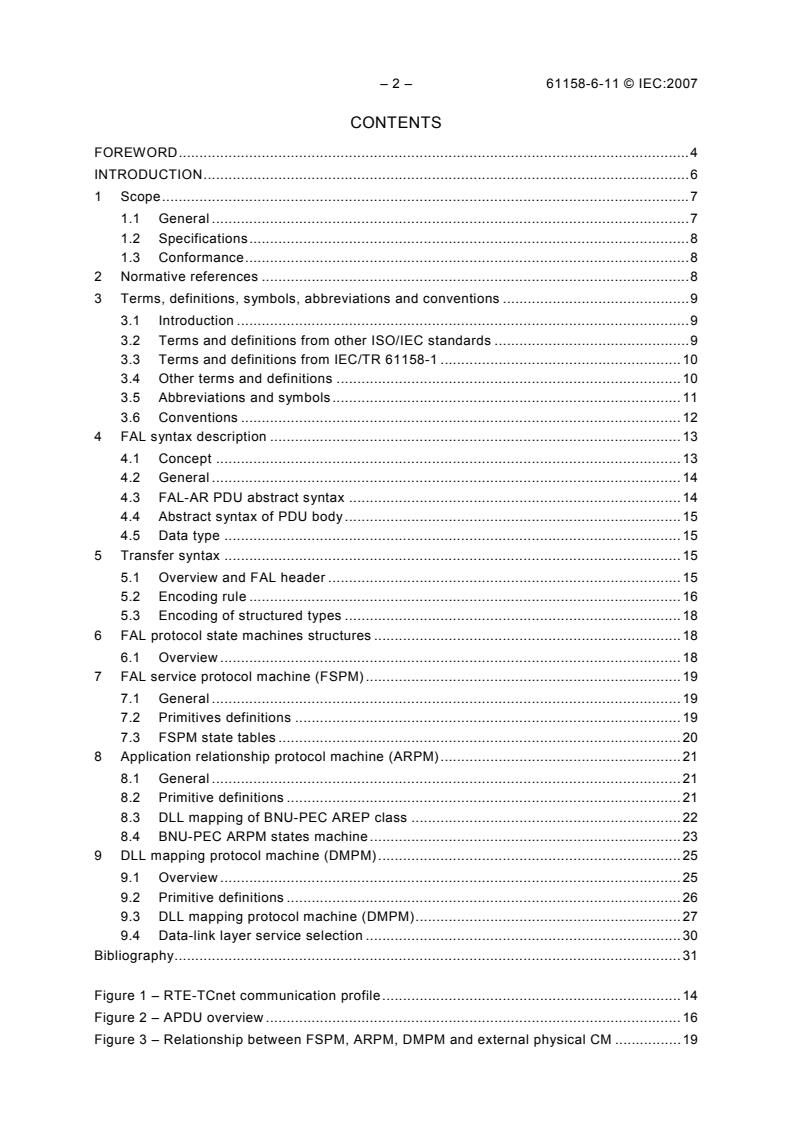
CONTENTS
FOREWORD.4
INTRODUCTION.6
1 Scope.7
1.1 General .7
1.2 Specifications.8
1.3 Conformance.8
2 Normative references .8
3 Terms, definitions, symbols, abbreviations and conventions .9
3.1 Introduction .9
3.2 Terms and definitions from other ISO/IEC standards .9
3.3 Terms and definitions from IEC/TR 61158-1 .10
3.4 Other terms and definitions .10
3.5 Abbreviations and symbols.11
3.6 Conventions .12
4 FAL syntax description .13
4.1 Concept .13
4.2 General .14
4.3 FAL-AR PDU abstract syntax .14
4.4 Abstract syntax of PDU body.15
4.5 Data type .15
5 Transfer syntax .15
5.1 Overview and FAL header .15
5.2 Encoding rule .16
5.3 Encoding of structured types .18
6 FAL protocol state machines structures .18
6.1 Overview .18
7 FAL service protocol machine (FSPM).19
7.1 General .19
7.2 Primitives definitions .19
7.3 FSPM state tables .20
8 Application relationship protocol machine (ARPM).21
8.1 General .21
8.2 Primitive definitions .21
8.3 DLL mapping of BNU-PEC AREP class .22
8.4 BNU-PEC ARPM states machine.23
9 DLL mapping protocol machine (DMPM).25
9.1 Overview .25
9.2 Primitive definitions .26
9.3 DLL mapping protocol machine (DMPM).27
9.4 Data-link layer service selection .30
Bibliography.31
Figure 1 – RTE-TCnet communication profile.14
Figure 2 – APDU overview .16
Figure 3 – Relationship between FSPM, ARPM, DMPM and external physical CM .19
61158-6-11 © IEC:2007(E) – 3 –
Figure 4 – State transition diagram of FSPM.20
Figure 5 – State transition diagram of the BNU-PEC .23
Figure 6 – State transition diagram of DMPM.27
Table 1 – Conventions used for state machines .12
Table 2 – FAL header .16
Table 3 – Primitives issued by FAL user to FSPM .20
Table 4 – Primitives issued by FSPM to FAL user .20
Table 5 – FSPM state table – sender transactions .20
Table 6 – FSPM state table – receiver transactions .21
Table 7 – Function SelectArep .21
Table 8 – Primitives issued by FSPM to ARPM .22
Table 9 – Primitives issued by ARPM to FSPM .22
Table 10 – Parameters used with primitives exchanged between FSPM and ARPM .22
Table 11 – BNU-PEC state descriptions.23
Table 12 – BNU-PEC ARPM state table – sender transactions.24
Table 13 – BNU-PEC ARPM state table – receiver transactions.24
Table 14 – Function GetArepId ().25
Table 15 – Function BuildFAL-PDU.25
Table 16 – Function FAL_Pdu_Type .25
Table 17 – Primitives issued by ARPM to DMPM .26
Table 18 – Primitives issued by DMPM to ARPM .26
Table 19 – Parameters used with primitives exchanged between ARPM and DMPM .26
Table 20 – Primitives exchanged between data-link layer and DMPM .27
Table 21 – DMPM state descriptions.27
Table 22 – DMPM state table – sender transactions .28
Table 23 – DMPM state table – receiver transactions.29
Table 24 – Function PickArep .29
Table 25 – Function FindAREP .29
– 4 – 61158-6-11 © IEC:2007(E)
INTERNATIONAL ELECTROTECHNICAL COMMISSION
____________
INDUSTRIAL COMMUNICATION NETWORKS –
FIELDBUS SPECIFICATIONS –
Part 6-11: Application layer protocol specification – Type 11 elements
FOREWORD
1) The International Electrotechnical Commission (IEC) is a worldwide organization for standardization comprising
all national electrotechnical committees (IEC National Committees). The object of IEC is to promote
international co-operation on all questions concerning standardization in the electrical and electronic fields. To
this end and in addition to other activities, IEC publishes International Standards, Technical Specifications,
Technical Reports, Publicly Available Specifications (PAS) and Guides (hereafter referred to as “IEC
Publication(s)”). Their preparation is entrusted to technical committees; any IEC National Committee interested
in the subject dealt with may participate in this preparatory work. International, governmental and non-
governmental organizations liaising with the IEC also participate in this preparation. IEC collaborates closely
with the International Organization for Standardization (ISO) in accordance with conditions determined by
agreement between the two organizations.
2) The formal decisions or agreements of IEC on technical matters express, as nearly as possible, an international
consensus of opinion on the relevant subjects since each technical committee has representation from all
interested IEC National Committees.
3) IEC Publications have the form of recommendations for international use and are accepted by IEC National
Committees in that sense. While all reasonable efforts are made to ensure that the technical content of IEC
Publications is accurate, IEC cannot be held responsible for the way in which they are used or for any
misinterpretation by any end user.
4) In order to promote international uniformity, IEC National Committees undertake to apply IEC Publications
transparently to the maximum extent possible in their national and regional publications. Any divergence
between any IEC Publication and the corresponding national or regional publication shall be clearly indicated in
the latter.
5) IEC provides no marking procedure to indicate its approval and cannot be rendered responsible for any
equipment declared to be in conformity with an IEC Publication.
6) All users should ensure that they have the latest edition of this publication.
7) No liability shall attach to IEC or its directors, employees, servants or agents including individual experts and
members of its technical committees and IEC National Committees for any personal injury, property damage or
other damage of any nature whatsoever, whether direct or indirect, or for costs (including legal fees) and
expenses arising out of the publication, use of, or reliance upon, this IEC Publication or any other IEC
Publications.
8) Attention is drawn to the Normative references cited in this publication. Use of the referenced publications is
indispensable for the correct application of this publication.
NOTE Use of some of the associated protocol types is restricted by their intellectual-property-right holders. In all
cases, the commitment to limited release of intellectual-property-rights made by the holders of those rights permits
a particular data-link layer protocol type to be used with physical layer and application layer protocols in Type
combinations as specified explicitly in the IEC 61784 series. Use of the various protocol types in other
combinations may require permission from their respective intellectual-property-right holders.
The International Electrotechnical Commission (IEC) draws attention to the fact that it is claimed that compliance
with this standard may involve the use of patents concerning as follows:
TOSHIBA has the patent applications listed below:
– US Publication Number 6711131 and its counterpart patents in other countries
– US Publication Number 5414813 and its counterpart patents in other countries
– US Publication Number 4930121 and its counterpart patents in other countries
IEC takes no position concerning the evidence, validity and scope of this patent right.
The holder of this patent right has assured the IEC that he is willing to negotiate licences under reasonable and
non-discriminatory terms and conditions with applicants throughout the world. In this respect, the statement of the
holder of this patent right is registered with IEC. Information may be obtained from:
61158-6-11 © IEC:2007(E) – 5 –
Toshiba Corporation
1-1, Shibaura 1-Chome
Minato-ku Tokyo 105-8001, Japan
Attention is drawn to the possibility that some of the elements of this International Standard may be the subject of
patent rights other than those identified above. IEC shall not be held responsible for identifying any or all such
patent rights.
International standard IEC 61158-6-11 has been prepared by subcommittee 65C: Industrial
networks, of IEC technical committee 65: Industrial-process measurement, control and
automation.
This first edition and its companion parts of the IEC 61158-6 subseries cancel and replace
IEC 61158-6:2003. This edition of this part constitutes a technical addition. This part and its
Type 11 companion parts also cancel and replace IEC/PAS 62406, published in 2005.
The text of this standard is based on the following documents:
FDIS Report on voting
65C/476/FDIS 65C/487/RVD
Full information on the voting for the approval of this standard can be found in the report on
voting indicated in the above table.
This edition of IEC 61158-6 includes the following significant changes from the previous
edition:
a) deletion of the former Type 6 fieldbus for lack of market relevance;
b) addition of new types of fieldbuses;
c) partition of part 6 of the third edition into multiple parts numbered -6-2, -6-3, …
This publication has been drafted in accordance with ISO/IEC Directives, Part 2.
The committee has decided that the contents of this publication will remain unchanged until
the maintenance result date indicated on the IEC web site under http://webstore.iec.ch in the
data related to the specific publication. At this date, the publication will be:
• reconfirmed;
• withdrawn;
• replaced by a revised edition, or
• amended.
NOTE The revision of this standard will be synchronized with the other parts of the IEC 61158 series.
The list of all the parts of the IEC 61158 series, under the general title Industrial
communication networks – Fieldbus specifications, can be found on the IEC web site.
– 6 – 61158-6-11 © IEC:2007(E)
INTRODUCTION
This part of IEC 61158 is one of a series produced to facilitate the interconnection of
automation system components. It is related to other standards in the set as defined by the
“three-layer” fieldbus reference model described in IEC/TR 61158-1.
The application protocol provides the application service by making use of the services
available from the data-link or other immediately lower layer. The primary aim of this standard
is to provide a set of rules for communication expressed in terms of the procedures to be
carried out by peer application entities (AEs) at the time of communication. These rules for
communication are intended to provide a sound basis for development in order to serve a
variety of purposes:
• as a guide for implementors and designers;
• for use in the testing and procurement of equipment;
• as part of an agreement for the admittance of systems into the open systems environment;
• as a refinement to the understanding of time-critical communications within OSI.
This standard is concerned, in particular, with the communication and interworking of sensors,
effectors and other automation devices. By using this standard together with other standards
positioned within the OSI or fieldbus reference models, otherwise incompatible systems may
work together in any combination.
61158-6-11 © IEC:2007(E) – 7 –
INDUSTRIAL COMMUNICATION NETWORKS –
FIELDBUS SPECIFICATIONS –
Part 6-11: Application layer protocol specification – Type 11 elements
1 Scope
1.1 General
The fieldbus Application Layer (FAL) provides user programs with a means to access the
fieldbus communication environment. In this respect, the FAL can be viewed as a “window
between corresponding application programs.”
This standard provides common elements for basic time-critical and non-time-critical
messaging communications between application programs in an automation environment and
material specific to Type 11 fieldbus. The term “time-critical” is used to represent the
presence of a time-window, within which one or more specified actions are required to be
completed with some defined level of certainty. Failure to complete specified actions within
the time window risks failure of the applications requesting the actions, with attendant risk to
equipment, plant and possibly human life.
This standard defines in an abstract way the externally visible behavior provided by the
different Types of the fieldbus Application Layer in terms of
a) the abstract syntax defining the application layer protocol data units conveyed between
communicating application entities,
b) the transfer syntax defining the application layer protocol data units conveyed between
communicating application entities,
c) the application context state machine defining the application service behavior visible
between communicating application entities; and
d) the application relationship state machines defining the communication behavior visible
between communicating application entities; and.
The purpose of this standard is to define the protocol provided to
1) define the wire-representation of the service primitives defined in IEC 61158-5-11, and
2) define the externally visible behavior associated with their transfer.
This standard specify the protocol of the IEC fieldbus Application Layer, in conformance with
the OSI Basic Reference Model (ISO/IEC 7498) and the OSI Application Layer Structure
(ISO/IEC 9545).
FAL services and protocols are provided by FAL application-entities (AE) contained within the
application processes. The FAL AE is composed of a set of object-oriented Application
Service Elements (ASEs) and a Layer Management Entity (LME) that manages the AE. The
ASEs provide communication services that operate on a set of related application process
object (APO) classes. One of the FAL ASEs is a management ASE that provides a common
set of services for the management of the instances of FAL classes.
Although these services specify, from the perspective of applications, how request and
responses are issued and delivered, they do not include a specification of what the requesting
and responding applications are to do with them. That is, the behavioral aspects of the
applications are not specified; only a definition of what requests and responses they can
send/receive is specified. This permits greater flexibility to the FAL users in standardizing
– 8 – 61158-6-11 © IEC:2007(E)
such object behavior. In addition to these services, some supporting services are also defined
in this standard to provide access to the FAL to control certain aspects of its operation.
1.2 Specifications
The principal objective of this standard is to specify the syntax and behavior of the application
layer protocol that conveys the application layer services defined in IEC 61158-5-11.
A secondary objective is to provide migration paths from previously-existing industrial
communications protocols. It is this latter objective which gives rise to the diversity of
protocols standardized in parts of the IEC 61158-6 series.
1.3 Conformance
This standard does not specify individual implementations or products, nor does it constrain
the implementations of application layer entities within industrial automation systems.
There is no conformance of equipment to the application layer service definition standard.
Instead, conformance is achieved through implementation of this application layer protocol
specification.
2 Normative references
The following referenced documents are indispensable for the application of this document.
For dated references, only the edition cited applies. For undated references, the latest edition
of the referenced document (including any amendments) applies.
IEC 60559, Binary floating-point arithmetic for microprocessor systems
IEC 61158-3-11, Industrial communication networks – Fieldbus specifications – Part 3-11:
Data-link layer service definition – Type 11 elements
IEC 61158-5-11, Industrial communication networks – Fieldbus specifications – Part 5-11:
Application layer service definition – Type 11 elements
IEC 61784-2, Industrial communication networks – Profiles – Part 2: Additional fieldbus
profiles for real-time networks based on ISO/IEC 8802-3
ISO/IEC 7498-1, Information technology – Open Systems Interconnection – Basic Reference
Model — Part 1: The Basic Model
ISO/IEC 8822, Information technology – Open Systems Interconnection – Presentation
service definition
ISO/IEC 8824, Information technology – Open Systems Interconnection – Specification of
Abstract Syntax Notation One (ASN.1)
ISO/IEC 8825, Information technology – ASN.1 encoding rules: Specification of Basic
Encoding Rules (BER), Canonical Encoding Rules (CER) and Distinguished Encoding Rules
(DER)
ISO/IEC 9545, Information technology – Open Systems Interconnection – Application Layer
structure
61158-6-11 © IEC:2007(E) – 9 –
3 Terms, definitions, symbols, abbreviations and conventions
3.1 Introduction
For the purposes of this documents, the followings apply.
3.2 Terms and definitions from other ISO/IEC standards
3.2.1 Terms and definitions from ISO/IEC 7498-1
a) application entity
b) application process
c) application protocol data unit
d) application service element
e) application entity invocation
f) application process invocation
g) application transaction
h) real open system
i) transfer syntax
3.2.2 Terms and definitions from ISO/IEC 8822
a) abstract syntax
b) presentation context
3.2.3 Terms and definitions from ISO/IEC 9545
a) application-association
b) application-context
c) application context name
d) application-entity-invocation
e) application-entity-type
f) application-process-invocation
g) application-process-type
h) application-service-element
i) application control service element
3.2.4 Terms and definitions from ISO/IEC 8824
a) object identifier
b) type
c) value
d) simple type
e) structured type
f) component type
g) tag
h) Boolean type
i) true
j) false
k) integer type
l) bitstring type
m) octetstring type
n) null type
o) sequence type
p) sequence of type
q) choice type
r) tagged type
s) any type
t) module
u) production
– 10 – 61158-6-11 © IEC:2007(E)
3.2.5 Terms and definitions from ISO/IEC 8825
a) encoding (of a data value)
b) data value
c) identifier octets (the singular form is used in this standard)
d) length octet(s) (both singular and plural forms are used in this standard)
e) contents octets
3.3 Terms and definitions from IEC/TR 61158-1
a) application relationship
b) conveyance path
c) client
d) dedicated AR
e) dynamic AR
f) error class
g) error code
h) name
i) numeric identifier
j) peer
k) pre-defined AR endpoint
l) pre-established AR endpoint
m) publisher
n) subscriber
o) server
3.4 Other terms and definitions
NOTE The following definitions may apply to all the types except if the same item is used with different definitions
in a specific type. In this case the latter has precedence.
The following terms and definitions are used in this series of standards.
3.4.1
called
service user or a service provider that receives an indication primitive or a request APDU
3.4.2
calling
service user or a service provider that initiates a request primitive or a request APDU
3.4.3
common memory
virtual common memory over the Type 11 fieldbus, which is shared with the nodes
participating in the Type 11 fieldbus and is primarily used for the real-time communications by
the TCC data service
3.4.4
interoperability
capability of User Layer entities to perform coordinated and cooperative operations using the
services of the FAL
3.4.5
management information
network accessible information that supports the management of the Fieldbus environment
3.4.6
receiving
service user that receives a confirmed primitive or an unconfirmed primitive, or a service
provider that receives a confirmed APDU or an unconfirmed APDU
61158-6-11 © IEC:2007(E) – 11 –
3.4.7
resource
resource is a processing or information capability of a subsystem
3.4.8
sending
service user that sends a confirmed primitive or an unconfirmed primitive, or a service
provider that sends a confirmed APDU or an unconfirmed APDU
3.5 Abbreviations and symbols
AE Application Entity
AE-I Application Entity Invocation
AL Application Layer
AP Application Process
Ap_ Prefix for Data types defined for AP ASE
Ar_ Prefix for Data types defined for AR ASE
APDU Application Protocol Data Unit
AR Application Relationship
AREP Application Relationship End Point
ASE Application Service Element
ASN.1 Abstract Syntax Notation One
BCD Binary Coded Decimal
BER Basic Encoding Rule
BNU-PEC Buffered Network-Scheduled Uni-directional Pre-Established Connection
CM Common Memory
cnf confirmation primitive
Dl_ Prefix for Data types defined for data-link layer types
DL Data-link
DLC Data-link Connection
DLCEP Data-link Connection End Point
DLPDU Data-link Protocol Data Unit
DLSAP Data-link Service Access Point
DLSDU Data-link Service Data Unit
Dt_ Prefix for Data types defined for Data type ASE
Err Error (used to indicate an APDU type)
Er_ Prefix for Error types defined
Ev_ Prefix for Data types defined for Event ASE
FAL Fieldbus Application Layer
Fi_ Prefix for Data types defined for Function Invocation ASE
FIFO First In First Out
Gn_ Prefix for Data types defined for general use
ID Identifier
IEC International Electrotechnical Commission
in input primitive
ind indication primitive
ISO International Organization for Standardization
LAS Link Active Scheduler
Lr_ Prefix for Data types defined for Load Region ASE
lsb least significant bit
Mn_ Prefix for Data types defined for Management ASE
msb most significant bit
out output primitive
OSI Open Systems Interconnection
PDU Protocol Data Unit
PICS Protocol Implementation Conformance Statement
QoS Quality Of Service
Req Request (used to indicate an APDU type)
req request primitive
Rsp Response (used to indicate an APDU type)
rsp response primitive
– 12 – 61158-6-11 © IEC:2007(E)
SAP Service Access Point
SDU Service Data Unit
TCC Time-critical cyclic
ToS Type Of Service
Vr_ Prefix for Data types defined for Variable ASE
3.6 Conventions
3.6.1 Conventions for class definitions
The data-link layer mapping definitions are described using templates. Each template consists
of a list of attributes for the class. The general form of the template is defined in IEC 61158-5.
3.6.2 Abstract syntax conventions
When the "optionalParametersMap" parameter is used, a bit number which corresponds to
each OPTIONAL or DEFAULT production is given as a comment.
3.6.3 Conventions used in state machines
The state machines are described in Table 1.
Table 1 – Conventions used for state machines
Event
# Current state / condition Next state
=> action
Name of this The current Events or conditions that trigger this state transaction. The next state after the
transition state to which actions in this transition
=>
this state is taken
The actions that are taken when the above events or conditions are
transition
met. The actions are always indented below events or conditions
applies
The conventions used in the state machines are as follows:
:= Value of an item on the left is replaced by value of an item on the right. If an item on the right is a parameter, it
comes from the primitive shown as an input event.
xxx A parameter name.
Example:
Identifier := reason
means value of a 'reason' parameter is assigned to a parameter called 'Identifier.'
"xxx" Indicates fixed value.
Example:
Identifier := "abc"
means value "abc" is assigned to a parameter named 'Identifier.'
= A logical condition to indicate an item on the left is equal to an item on the right.
< A logical condition to indicate an item on the left is less than the item on the right.
> A logical condition to indicate an item on the left is greater than the item on the right.
<> A logical condition to indicate an item on the left is not equal to an item on the right.
&& Logical "AND"
|| Logical "OR"
This construct allows the execution of a sequence of actions in a loop within one transition.
The loop is executed for all values from start_value to end_value.
61158-6-11 © IEC:2007(E) – 13 –
Example:
for (Identifier := start_value to end_value)
actions
endfor
This construct allows the execution of alternative actions depending on some condition (which
might be the value of some identifier or the outcome of a previous action) within one transition.
Example:
If (condition)
actions
else
actions
endif
Readers are strongly recommended to refer to the subclauses for the AREP attribute
definitions, the local functions, and the FAL-PDU definitions to understand protocol machines.
It is assumed that readers have sufficient knowledge of these definitions, and they are used
without further explanations.
4 FAL syntax description
4.1 Concept
This standard specifies the Application layer protocol of the Type 11 essential for the
ISO/IEC 8802-3-based Time-critical control network (TCnet), which is one of the
communication networks for the Real-Time Ethernet(RTE) defined in IEC 61784-2 and is
referred to as RTE-TCnet hereafter.
This standard meets the industrial automation market objective of providing predictable time
deterministic and reliable time-critical data transfer and means, which allow co-existence with
non-time-critical data transfer over the ISO/IEC 8802-3 series communications medium, for
support of cooperation and synchronization between automation processes on field devices in
a real-time application system. The term “time-critical” is used to represent the presence of a
time-window, within which one or more specified actions are required to be completed with
some defined level of certainty.
This standard specifies the part of the protocol set of the RTE-TCnet communication profile
and/or of one or more communication profiles related to a common family of the RTE-TCnet.
The RTE-TCnet communication profile, shown in Figure 1 as one of the profile sets, is based
on the 7 layer OSI Basic Reference model. For regular ISO/IEC 8802-3 based applications the
upper layers mapped over the data-link layer is in the ordinary way; on the other hand, for
time-critical applications with Common Memory running in parallel, the specific application
layer for RTE-TCnet is specified. The data-link layer for RTE-TCnet has the extension, but is
compliant to the ISO/IEC 8802-3 MAC protocol in order to provide both services for time-
critical communications and common memory applications respectively.
– 14 – 61158-6-11 © IEC:2007(E)
Time-critical applications
Regular ISO/IEC 8802-3-based
with common memory
applications
TELNET, FTP, HTTP Common memory
Application layer
OPC XML-DA etc
Transport layer RFC 768(UDP)
RFC 793 (TCP)
null
Network layer
RFC 791 (IP)
ISO/IEC 8802-3
Data Link layer
Specific scheduling extension
Physical layer
ISO/IEC 8802-3 (Redundant)
Figure 1 – RTE-TCnet communication profile
This standard specifies the data-link protocol as the essential parts of the RTE-TCnet profile,
which are the extension part of the ISO/IEC 8802-3 based data-link layer and the Application
layer exploiting the services of the data-link layer immediately below, in terms of the “three-
layer” Fieldbus Reference Model which is based in part on the OSI Basic Reference Model.
Other part of the RTE-TCnet profile is not in the scope of this document.
4.1.1 Field of applications
In industrial control systems, several kinds of field devices such as drives, sensors and
actuators, programmable controllers, distributed control systems and human-machine
interface devices are required to be connected with control networks. The process control
data and the state data is transferred among these field devices in the system and the
communications between these field devices requires simplicity in application programming
and to be executed with adequate response time. In most industrial automation systems such
as food, water, sewage, paper and steel, including a rolling mill, the control network is
required to provide time-critical response capability for their application, as required in
ISO/TR 13283 for time-critical communications architectures.
Plant production may be compromised due to errors, which could be introduced to the control
system if the network does not provide a time-critical response. Therefore the following
characteristics are required for a time-critical control network.
– A deterministic response time between the control device nodes.
– Ability to share process data seamlessly across the control system.
The RTE-TCnet is applicable to such industrial automation environment, in which time-critical
communications is primarily required. The term “time-critical” is used to represent the
presence of a time window, within which one or more specified actions are required to be
completed with some defined level of certainty. Failure to complete specified actions within
the time-window risks failure of the applications requesting the actions, with attendant risk to
equipment, plant and possibly human life.
4.2 General
FAL Syntax description of the RTE-TCnet defines unconfirmed send service and consists of the
three parts as follows, FalArHeader, InvokeID and Unconfirmed Service Request.
4.3 FAL-AR PDU abstract syntax
4.3.1 Top level definition
FalArPDU ::= UnconfirmedSend-CommandPDU
61158-6-11 © IEC:2007(E) – 15 –
4.3.2 Unconfirmed send service
UnconfirmedSend-CommandPDU ::= SEQUENCE {
FalArHeader,
InvokeID OPTIONAL,
UnconfirmedServiceRequest
}
4.4 Abstract syntax of PDU body
4.4.1 FalArHeader
FalArHeader ::= Unsigned8 {
-- bit 8 FAL Protocol Specifier (Always 1)
-- bit 7-4 Protocol Identifier (Identifiers abstract syntax revision, and encoding rules)
-- bit 3 Protocol Specific bit (Reserved for each protocol to use)
-- bit 2-1 PDU Identifier (Identifies a PDU type within a Protocol Identifier)
}
4.4.2 InvokeID
InvokeID ::= Unsigned8
4.4.3 Unconfirmed PDUs
UnconfirmedServiceRequest ::= SEQUENCE {
CMArep, -- Block number
CMData -- content of CM segment
}
4.4.4 CMArep
CMArep ::= Unsigned16 -- DLCEP address
4.4.5 CMData
CMData ::= SEQUENCE {
wlen Unsigned16, -- CM word length
data SEQUENCE { ANY { -- CM content
BitString8, BitString16, BitString32,
Integer16, Integer32,
Unsigned16, Unsigned32,
Floating32,
OctetString2, OctetString4,
VisibleString2, VisibleString4,
BinaryTime0, BinaryTime1, BinaryTime2, BinaryTime3, BinaryTime4, BinaryTime5,
BinaryTime6, BinaryTime7
}
}
}
4.5 Data type
BitString8, BitString16, BitString32, Integer16, Integer32, Unsigned16, Unsigned32,
Floating32, OctetString2, OctetString4, VisibleString2, VisibleString4, BinaryTime0,
BinaryTime1, BinaryTime2, BinaryTime3, BinaryTime4, BinaryTime5, BinaryTime6.
5 Transfer syntax
5.1 Overview and FAL header
All the FAL PDUs shall have the common PDU-header called FalArHeader. The FalArHeader
identifies abstract syntax, transfer syntax, and each of the PDUs. Table 2 defines how this
header shall be used.
– 16 – 61158-6-11 © IEC:2007(E)
Table 2 – FAL header
Bit position of the
Abstract Encoding
FalArHeader
PDU type Revision
syntax rule
8 7 6 5 4 3 2 1
1 1 1 1 1 1 10 ASN.1 RTE-TCnet UnconfirmedSendPDU Revision1
NOTE All other definitions are reserved.
5.2 Encoding rule
5.2.1 Overview
The Encoding Rule of the RTE-TCnet is a preferable encoding rule that is compatible with
existing standards. The FAL-PDUs encoded with the TER(Traditional Encoding Rule) shall
have a uniform format. The FAL-PDUs shall consist of two major parts, the “APDU Header”
part and the “APDU Body” part as shown in Figure 2.
(1) (n) --- Octets
FalArHeader field Data
APDU Header APDU Body
Figure 2 – APDU overview
5.2.2 APDU header encoding
The APDU Header part is always present in all APDUs which conform to this specification. It
consists of one field: the FalArHeader Field. Refer to 4.4.1 for the encoding rule of the
FalArHeader field.
5.2.3 APDU body encoding
The Encoding Rule of FAL is based on the terms and definitions of the ISO/IEC 8825, and consists of
the three encoding components given below. For time-critical and using fixed length data,
Identifier octet and Length octets like TER (Traditional Encoding Rule) do not exist.
• Identifier octet
• Length octets
• Contents octets
NOTE Identification Octet and Content Length Octets do not exist in RTE-TCnet.
5.2.4 Encoding of simple variable
5.2.4.1 Encoding of a Boolean value
a) The encoding of a Boolean value shall be primitive;
b) the Identifier octet and Length octet(s) shall not be present;
c) the Contents octets shall consist of a single octet;
d) if the Boolean value is FALSE, the Contents octets shall be 0 (zero);
e) if the Boolean value is TRUE, the Contents octets shall be 0xFF.
5.2.4.2 Encoding of a fixed length Integer value
a) The encoding of a fixed-length Integer value of Integer8, Integer16 and Integer32 types
shall be primitive;
61158-6-11 © IEC:2007(E) – 17 –
b) the Contents octets shall consist of exactly one, two or four octets, respectively;
c) the Identifier octet and the Length octet(s) shall not be present;
d) the Contents octets shall be a two's complement binary number equal to the integer
value, and consist of bits 8 to 1 of the first octet, followed by bits 8 to 1 of the second
octet, followed by bits 8 to 1 of each octet in turn up to and including the last octet of
the Contents octets;
1) the value of a two's complement binary number is derived by numbering the bits in
the Content octets, starting with bit 1 of the first octet and ending the numbering
with bit 8 of the last octet;
2) each bit is assigned a numerical value of 2N-1, where N is its position in the above
numbering sequence;
3) the value of the two's complement binary number is obtained by adding the
numerical values assigned to each bit for those bits which are set to one, excluding
bit 8 of the last octet, and then reducing the value by the numerical value assigned
to bit 8 of the last octet if that bit is set to one.
5.2.5 Encoding of a fixed length Unsigned value
a) The encoding of a fixed-length Integer value of Unsigned8, Unsigned16 and
Unsigned32 types shall be primitive, and the Contents octets shall consist of exactly
one, two or four octets, respectively;
b) the Identifier octet and Length octet(s) shall not be present;
c) the Contents octets shall be a binary number equal to the Unsigned value, and consist
of bits 8 to 1 of the first octet, followed by bits 8 to 1 of the second octet, followed by
bits 8 to 1 of each octet in turn up to and including the last octet of the Contents
octets;
1) the value of binary number is derived by numbering the bits in the Content octets,
starting with bit 1 of the first octet as bit zero and ending the numbering with bit 8 of
the last octet;
N-1
2) each bit is assigned a numerical value of 2 , where N is its position in the above
numbering sequence;
3) the value of the binary number is obtained by adding the numerical values assigned
to each bit for those bits which are set to one.
5.2.6 Encoding of a Floating Point value
a) The encoding of a Floating32 value shall be primitive, and the Contents octets shall
consist of exactl
...
IEC 61158-6-11 ®
Edition 1.0 2007-12
INTERNATIONAL
STANDARD
NORME
INTERNATIONALE
Industrial communication networks – Fieldbus specifications –
Part 6-11: Application layer protocol specification – Type 11 elements
Réseaux de communication industriels – Spécifications des bus de terrain –
Partie 6-11: Spécification du protocole de la couche d’application – Éléments
de Type 11
All rights reserved. Unless otherwise specified, no part of this publication may be reproduced or utilized in any form
or by any means, electronic or mechanical, including photocopying and microfilm, without permission in writing from
either IEC or IEC's member National Committee in the country of the requester.
If you have any questions about IEC copyright or have an enquiry about obtaining additional rights to this publication,
please contact the address below or your local IEC member National Committee for further information.
Droits de reproduction réservés. Sauf indication contraire, aucune partie de cette publication ne peut être reproduite ni
utilisée sous quelque forme que ce soit et par aucun procédé, électronique ou mécanique, y compris la photocopie et les
microfilms, sans l'accord écrit de la CEI ou du Comité national de la CEI du pays du demandeur.
Si vous avez des questions sur le copyright de la CEI ou si vous désirez obtenir des droits supplémentaires sur cette
publication, utilisez les coordonnées ci-après ou contactez le Comité national de la CEI de votre pays de résidence.
IEC Central Office Tel.: +41 22 919 02 11
3, rue de Varembé Fax: +41 22 919 03 00
CH-1211 Geneva 20 info@iec.ch
Switzerland www.iec.ch
About the IEC
The International Electrotechnical Commission (IEC) is the leading global organization that prepares and publishes
International Standards for all electrical, electronic and related technologies.
About IEC publications
The technical content of IEC publications is kept under constant review by the IEC. Please make sure that you have the
latest edition, a corrigenda or an amendment might have been published.
Useful links:
IEC publications search - www.iec.ch/searchpub Electropedia - www.electropedia.org
The advanced search enables you to find IEC publications The world's leading online dictionary of electronic and
by a variety of criteria (reference number, text, technical electrical terms containing more than 30 000 terms and
committee,…). definitions in English and French, with equivalent terms in
It also gives information on projects, replaced and additional languages. Also known as the International
withdrawn publications. Electrotechnical Vocabulary (IEV) on-line.
IEC Just Published - webstore.iec.ch/justpublished Customer Service Centre - webstore.iec.ch/csc
Stay up to date on all new IEC publications. Just Published If you wish to give us your feedback on this publication
details all new publications released. Available on-line and or need further assistance, please contact the
also once a month by email. Customer Service Centre: csc@iec.ch.
A propos de la CEI
La Commission Electrotechnique Internationale (CEI) est la première organisation mondiale qui élabore et publie des
Normes internationales pour tout ce qui a trait à l'électricité, à l'électronique et aux technologies apparentées.
A propos des publications CEI
Le contenu technique des publications de la CEI est constamment revu. Veuillez vous assurer que vous possédez
l’édition la plus récente, un corrigendum ou amendement peut avoir été publié.
Liens utiles:
Recherche de publications CEI - www.iec.ch/searchpub Electropedia - www.electropedia.org
La recherche avancée vous permet de trouver des Le premier dictionnaire en ligne au monde de termes
publications CEI en utilisant différents critères (numéro de électroniques et électriques. Il contient plus de 30 000
référence, texte, comité d’études,…). termes et définitions en anglais et en français, ainsi que
Elle donne aussi des informations sur les projets et les les termes équivalents dans les langues additionnelles.
publications remplacées ou retirées. Egalement appelé Vocabulaire Electrotechnique
International (VEI) en ligne.
Just Published CEI - webstore.iec.ch/justpublished
Service Clients - webstore.iec.ch/csc
Restez informé sur les nouvelles publications de la CEI.
Just Published détaille les nouvelles publications parues. Si vous désirez nous donner des commentaires sur
Disponible en ligne et aussi une fois par mois par email. cette publication ou si vous avez des questions
contactez-nous: csc@iec.ch.
IEC 61158-6-11 ®
Edition 1.0 2007-12
INTERNATIONAL
STANDARD
NORME
INTERNATIONALE
Industrial communication networks – Fieldbus specifications –
Part 6-11: Application layer protocol specification – Type 11 elements
Réseaux de communication industriels – Spécifications des bus de terrain –
Partie 6-11: Spécification du protocole de la couche d’application – Éléments
de Type 11
INTERNATIONAL
ELECTROTECHNICAL
COMMISSION
COMMISSION
ELECTROTECHNIQUE
PRICE CODE
INTERNATIONALE
CODE PRIX V
ICS 25.040.40; 35.100.70 ISBN 978-2-8322-1023-9
– 2 – 61158-6-11 © IEC:2007
CONTENTS
FOREWORD . 4
INTRODUCTION . 6
1 Scope . 7
1.1 General . 7
1.2 Specifications . 8
1.3 Conformance . 8
2 Normative references . 8
3 Terms, definitions, symbols, abbreviations and conventions . 9
3.1 Introduction . 9
3.2 Terms and definitions from other ISO/IEC standards . 9
3.3 Terms and definitions from IEC/TR 61158-1 . 10
3.4 Other terms and definitions . 10
3.5 Abbreviations and symbols . 11
3.6 Conventions . 12
4 FAL syntax description . 13
4.1 Concept . 13
4.2 General . 14
4.3 FAL-AR PDU abstract syntax . 14
4.4 Abstract syntax of PDU body . 15
4.5 Data type . 15
5 Transfer syntax . 15
5.1 Overview and FAL header . 15
5.2 Encoding rule . 16
5.3 Encoding of structured types . 18
6 FAL protocol state machines structures . 18
6.1 Overview . 18
7 FAL service protocol machine (FSPM) . 19
7.1 General . 19
7.2 Primitives definitions . 19
7.3 FSPM state tables . 20
8 Application relationship protocol machine (ARPM) . 21
8.1 General . 21
8.2 Primitive definitions . 21
8.3 DLL mapping of BNU-PEC AREP class . 22
8.4 BNU-PEC ARPM states machine . 23
9 DLL mapping protocol machine (DMPM) . 25
9.1 Overview . 25
9.2 Primitive definitions . 26
9.3 DLL mapping protocol machine (DMPM) . 27
9.4 Data-link layer service selection . 30
Bibliography . 31
Figure 1 – RTE-TCnet communication profile . 14
Figure 2 – APDU overview . 16
Figure 3 – Relationship between FSPM, ARPM, DMPM and external physical CM . 19
61158-6-11 © IEC:2007 – 3 –
Figure 4 – State transition diagram of FSPM . 20
Figure 5 – State transition diagram of the BNU-PEC . 23
Figure 6 – State transition diagram of DMPM . 27
Table 1 – Conventions used for state machines . 12
Table 2 – FAL header . 16
Table 3 – Primitives issued by FAL user to FSPM . 20
Table 4 – Primitives issued by FSPM to FAL user . 20
Table 5 – FSPM state table – sender transactions . 20
Table 6 – FSPM state table – receiver transactions . 21
Table 7 – Function SelectArep . 21
Table 8 – Primitives issued by FSPM to ARPM . 22
Table 9 – Primitives issued by ARPM to FSPM . 22
Table 10 – Parameters used with primitives exchanged between FSPM and ARPM . 22
Table 11 – BNU-PEC state descriptions . 23
Table 12 – BNU-PEC ARPM state table – sender transactions . 24
Table 13 – BNU-PEC ARPM state table – receiver transactions . 24
Table 14 – Function GetArepId () . 25
Table 15 – Function BuildFAL-PDU . 25
Table 16 – Function FAL_Pdu_Type . 25
Table 17 – Primitives issued by ARPM to DMPM . 26
Table 18 – Primitives issued by DMPM to ARPM . 26
Table 19 – Parameters used with primitives exchanged between ARPM and DMPM . 26
Table 20 – Primitives exchanged between data-link layer and DMPM . 27
Table 21 – DMPM state descriptions . 27
Table 22 – DMPM state table – sender transactions . 28
Table 23 – DMPM state table – receiver transactions . 29
Table 24 – Function PickArep . 29
Table 25 – Function FindAREP . 29
– 4 – 61158-6-11 © IEC:2007
INTERNATIONAL ELECTROTECHNICAL COMMISSION
____________
INDUSTRIAL COMMUNICATION NETWORKS –
FIELDBUS SPECIFICATIONS –
Part 6-11: Application layer protocol specification – Type 11 elements
FOREWORD
1) The International Electrotechnical Commission (IEC) is a worldwide organization for standardization comprising
all national electrotechnical committees (IEC National Committees). The object of IEC is to promote
international co-operation on all questions concerning standardization in the electrical and electronic fields. To
this end and in addition to other activities, IEC publishes International Standards, Technical Specifications,
Technical Reports, Publicly Available Specifications (PAS) and Guides (hereafter referred to as “IEC
Publication(s)”). Their preparation is entrusted to technical committees; any IEC National Committee interested
in the subject dealt with may participate in this preparatory work. International, governmental and non-
governmental organizations liaising with the IEC also participate in this preparation. IEC collaborates closely
with the International Organization for Standardization (ISO) in accordance with conditions determined by
agreement between the two organizations.
2) The formal decisions or agreements of IEC on technical matters express, as nearly as possible, an international
consensus of opinion on the relevant subjects since each technical committee has representation from all
interested IEC National Committees.
3) IEC Publications have the form of recommendations for international use and are accepted by IEC National
Committees in that sense. While all reasonable efforts are made to ensure that the technical content of IEC
Publications is accurate, IEC cannot be held responsible for the way in which they are used or for any
misinterpretation by any end user.
4) In order to promote international uniformity, IEC National Committees undertake to apply IEC Publications
transparently to the maximum extent possible in their national and regional publications. Any divergence
between any IEC Publication and the corresponding national or regional publication shall be clearly indicated in
the latter.
5) IEC provides no marking procedure to indicate its approval and cannot be rendered responsible for any
equipment declared to be in conformity with an IEC Publication.
6) All users should ensure that they have the latest edition of this publication.
7) No liability shall attach to IEC or its directors, employees, servants or agents including individual experts and
members of its technical committees and IEC National Committees for any personal injury, property damage or
other damage of any nature whatsoever, whether direct or indirect, or for costs (including legal fees) and
expenses arising out of the publication, use of, or reliance upon, this IEC Publication or any other IEC
Publications.
8) Attention is drawn to the Normative references cited in this publication. Use of the referenced publications is
indispensable for the correct application of this publication.
NOTE Use of some of the associated protocol types is restricted by their intellectual-property-right holders. In all
cases, the commitment to limited release of intellectual-property-rights made by the holders of those rights permits
a particular data-link layer protocol type to be used with physical layer and application layer protocols in Type
combinations as specified explicitly in the IEC 61784 series. Use of the various protocol types in other
combinations may require permission from their respective intellectual-property-right holders.
The International Electrotechnical Commission (IEC) draws attention to the fact that it is claimed that compliance
with this standard may involve the use of patents concerning as follows:
TOSHIBA has the patent applications listed below:
– US Publication Number 6711131 and its counterpart patents in other countries
– US Publication Number 5414813 and its counterpart patents in other countries
– US Publication Number 4930121 and its counterpart patents in other countries
IEC takes no position concerning the evidence, validity and scope of this patent right.
The holder of this patent right has assured the IEC that he is willing to negotiate licences under reasonable and
non-discriminatory terms and conditions with applicants throughout the world. In this respect, the statement of the
holder of this patent right is registered with IEC. Information may be obtained from:
Toshiba Corporation
1-1, Shibaura 1-Chome
Minato-ku Tokyo 105-8001, Japan
61158-6-11 © IEC:2007 – 5 –
Attention is drawn to the possibility that some of the elements of this International Standard may be the subject of
patent rights other than those identified above. IEC shall not be held responsible for identifying any or all such
patent rights.
International standard IEC 61158-6-11 has been prepared by subcommittee 65C: Industrial
networks, of IEC technical committee 65: Industrial-process measurement, control and
automation.
This first edition and its companion parts of the IEC 61158-6 subseries cancel and replace
IEC 61158-6:2003. This edition of this part constitutes a technical addition. This part and its
Type 11 companion parts also cancel and replace IEC/PAS 62406, published in 2005.
This bilingual version (2013-09) corresponds to the monolingual English version, published in
2007-12.
The text of this standard is based on the following documents:
FDIS Report on voting
65C/476/FDIS 65C/487/RVD
Full information on the voting for the approval of this standard can be found in the report on
voting indicated in the above table.
This edition of IEC 61158-6 includes the following significant changes from the previous
edition:
a) deletion of the former Type 6 fieldbus for lack of market relevance;
b) addition of new types of fieldbuses;
c) partition of part 6 of the third edition into multiple parts numbered -6-2, -6-3, …
The French version of this standard has not been voted upon.
This publication has been drafted in accordance with ISO/IEC Directives, Part 2.
The committee has decided that the contents of this publication will remain unchanged until
the maintenance result date indicated on the IEC web site under http://webstore.iec.ch in the
data related to the specific publication. At this date, the publication will be:
• reconfirmed;
• withdrawn;
• replaced by a revised edition, or
• amended.
NOTE The revision of this standard will be synchronized with the other parts of the IEC 61158 series.
The list of all the parts of the IEC 61158 series, under the general title Industrial
communication networks – Fieldbus specifications, can be found on the IEC web site.
– 6 – 61158-6-11 © IEC:2007
INTRODUCTION
This part of IEC 61158 is one of a series produced to facilitate the interconnection of
automation system components. It is related to other standards in the set as defined by the
“three-layer” fieldbus reference model described in IEC/TR 61158-1.
The application protocol provides the application service by making use of the services
available from the data-link or other immediately lower layer. The primary aim of this standard
is to provide a set of rules for communication expressed in terms of the procedures to be
carried out by peer application entities (AEs) at the time of communication. These rules for
communication are intended to provide a sound basis for development in order to serve a
variety of purposes:
• as a guide for implementors and designers;
• for use in the testing and procurement of equipment;
• as part of an agreement for the admittance of systems into the open systems environment;
• as a refinement to the understanding of time-critical communications within OSI.
This standard is concerned, in particular, with the communication and interworking of sensors,
effectors and other automation devices. By using this standard together with other standards
positioned within the OSI or fieldbus reference models, otherwise incompatible systems may
work together in any combination.
61158-6-11 © IEC:2007 – 7 –
INDUSTRIAL COMMUNICATION NETWORKS –
FIELDBUS SPECIFICATIONS –
Part 6-11: Application layer protocol specification – Type 11 elements
1 Scope
1.1 General
The fieldbus Application Layer (FAL) provides user programs with a means to access the
fieldbus communication environment. In this respect, the FAL can be viewed as a “window
between corresponding application programs.”
This standard provides common elements for basic time-critical and non-time-critical
messaging communications between application programs in an automation environment and
material specific to Type 11 fieldbus. The term “time-critical” is used to represent the
presence of a time-window, within which one or more specified actions are required to be
completed with some defined level of certainty. Failure to complete specified actions within
the time window risks failure of the applications requesting the actions, with attendant risk to
equipment, plant and possibly human life.
This standard defines in an abstract way the externally visible behavior provided by the
different Types of the fieldbus Application Layer in terms of
a) the abstract syntax defining the application layer protocol data units conveyed between
communicating application entities,
b) the transfer syntax defining the application layer protocol data units conveyed between
communicating application entities,
c) the application context state machine defining the application service behavior visible
between communicating application entities; and
d) the application relationship state machines defining the communication behavior visible
between communicating application entities; and.
The purpose of this standard is to define the protocol provided to
1) define the wire-representation of the service primitives defined in IEC 61158-5-11, and
2) define the externally visible behavior associated with their transfer.
This standard specify the protocol of the IEC fieldbus Application Layer, in conformance with
the OSI Basic Reference Model (ISO/IEC 7498) and the OSI Application Layer Structure
(ISO/IEC 9545).
FAL services and protocols are provided by FAL application-entities (AE) contained within the
application processes. The FAL AE is composed of a set of object-oriented Application
Service Elements (ASEs) and a Layer Management Entity (LME) that manages the AE. The
ASEs provide communication services that operate on a set of related application process
object (APO) classes. One of the FAL ASEs is a management ASE that provides a common
set of services for the management of the instances of FAL classes.
Although these services specify, from the perspective of applications, how request and
responses are issued and delivered, they do not include a specification of what the requesting
and responding applications are to do with them. That is, the behavioral aspects of the
applications are not specified; only a definition of what requests and responses they can
send/receive is specified. This permits greater flexibility to the FAL users in standardizing
– 8 – 61158-6-11 © IEC:2007
such object behavior. In addition to these services, some supporting services are also defined
in this standard to provide access to the FAL to control certain aspects of its operation.
1.2 Specifications
The principal objective of this standard is to specify the syntax and behavior of the application
layer protocol that conveys the application layer services defined in IEC 61158-5-11.
A secondary objective is to provide migration paths from previously-existing industrial
communications protocols. It is this latter objective which gives rise to the diversity of
protocols standardized in parts of the IEC 61158-6 series.
1.3 Conformance
This standard does not specify individual implementations or products, nor does it constrain
the implementations of application layer entities within industrial automation systems.
There is no conformance of equipment to the application layer service definition standard.
Instead, conformance is achieved through implementation of this application layer protocol
specification.
2 Normative references
The following referenced documents are indispensable for the application of this document.
For dated references, only the edition cited applies. For undated references, the latest edition
of the referenced document (including any amendments) applies.
IEC 60559, Binary floating-point arithmetic for microprocessor systems
IEC 61158-3-11, Industrial communication networks – Fieldbus specifications – Part 3-11:
Data-link layer service definition – Type 11 elements
IEC 61158-5-11, Industrial communication networks – Fieldbus specifications – Part 5-11:
Application layer service definition – Type 11 elements
IEC 61784-2, Industrial communication networks – Profiles – Part 2: Additional fieldbus
profiles for real-time networks based on ISO/IEC 8802-3
ISO/IEC 7498-1, Information technology – Open Systems Interconnection – Basic Reference
Model — Part 1: The Basic Model
ISO/IEC 8822, Information technology – Open Systems Interconnection – Presentation
service definition
ISO/IEC 8824, Information technology – Open Systems Interconnection – Specification of
Abstract Syntax Notation One (ASN.1)
ISO/IEC 8825, Information technology – ASN.1 encoding rules: Specification of Basic
Encoding Rules (BER), Canonical Encoding Rules (CER) and Distinguished Encoding Rules
(DER)
ISO/IEC 9545, Information technology – Open Systems Interconnection – Application Layer
structure
61158-6-11 © IEC:2007 – 9 –
3 Terms, definitions, symbols, abbreviations and conventions
3.1 Introduction
For the purposes of this documents, the followings apply.
3.2 Terms and definitions from other ISO/IEC standards
3.2.1 Terms and definitions from ISO/IEC 7498-1
a) application entity
b) application process
c) application protocol data unit
d) application service element
e) application entity invocation
f) application process invocation
g) application transaction
h) real open system
i) transfer syntax
3.2.2 Terms and definitions from ISO/IEC 8822
a) abstract syntax
b) presentation context
3.2.3 Terms and definitions from ISO/IEC 9545
a) application-association
b) application-context
c) application context name
d) application-entity-invocation
e) application-entity-type
f) application-process-invocation
g) application-process-type
h) application-service-element
i) application control service element
3.2.4 Terms and definitions from ISO/IEC 8824
a) object identifier
b) type
c) value
d) simple type
e) structured type
f) component type
g) tag
h) Boolean type
i) true
j) false
k) integer type
l) bitstring type
m) octetstring type
n) null type
o) sequence type
p) sequence of type
q) choice type
r) tagged type
s) any type
t) module
u) production
– 10 – 61158-6-11 © IEC:2007
3.2.5 Terms and definitions from ISO/IEC 8825
a) encoding (of a data value)
b) data value
c) identifier octets (the singular form is used in this standard)
d) length octet(s) (both singular and plural forms are used in this standard)
e) contents octets
3.3 Terms and definitions from IEC/TR 61158-1
a) application relationship
b) conveyance path
c) client
d) dedicated AR
e) dynamic AR
f) error class
g) error code
h) name
i) numeric identifier
j) peer
k) pre-defined AR endpoint
l) pre-established AR endpoint
m) publisher
n) subscriber
o) server
3.4 Other terms and definitions
NOTE The following definitions may apply to all the types except if the same item is used with different definitions
in a specific type. In this case the latter has precedence.
The following terms and definitions are used in this series of standards.
3.4.1
called
service user or a service provider that receives an indication primitive or a request APDU
3.4.2
calling
service user or a service provider that initiates a request primitive or a request APDU
3.4.3
common memory
virtual common memory over the Type 11 fieldbus, which is shared with the nodes
participating in the Type 11 fieldbus and is primarily used for the real-time communications by
the TCC data service
3.4.4
interoperability
capability of User Layer entities to perform coordinated and cooperative operations using the
services of the FAL
3.4.5
management information
network accessible information that supports the management of the Fieldbus environment
3.4.6
receiving
service user that receives a confirmed primitive or an unconfirmed primitive, or a service
provider that receives a confirmed APDU or an unconfirmed APDU
61158-6-11 © IEC:2007 – 11 –
3.4.7
resource
resource is a processing or information capability of a subsystem
3.4.8
sending
service user that sends a confirmed primitive or an unconfirmed primitive, or a service
provider that sends a confirmed APDU or an unconfirmed APDU
3.5 Abbreviations and symbols
AE Application Entity
AE-I Application Entity Invocation
AL Application Layer
AP Application Process
Ap_ Prefix for Data types defined for AP ASE
Ar_ Prefix for Data types defined for AR ASE
APDU Application Protocol Data Unit
AR Application Relationship
AREP Application Relationship End Point
ASE Application Service Element
ASN.1 Abstract Syntax Notation One
BCD Binary Coded Decimal
BER Basic Encoding Rule
BNU-PEC Buffered Network-Scheduled Uni-directional Pre-Established Connection
CM Common Memory
cnf confirmation primitive
Dl_ Prefix for Data types defined for data-link layer types
DL Data-link
DLC Data-link Connection
DLCEP Data-link Connection End Point
DLPDU Data-link Protocol Data Unit
DLSAP Data-link Service Access Point
DLSDU Data-link Service Data Unit
Dt_ Prefix for Data types defined for Data type ASE
Err Error (used to indicate an APDU type)
Er_ Prefix for Error types defined
Ev_ Prefix for Data types defined for Event ASE
FAL Fieldbus Application Layer
Fi_ Prefix for Data types defined for Function Invocation ASE
FIFO First In First Out
Gn_ Prefix for Data types defined for general use
ID Identifier
IEC International Electrotechnical Commission
in input primitive
ind indication primitive
ISO International Organization for Standardization
LAS Link Active Scheduler
Lr_ Prefix for Data types defined for Load Region ASE
lsb least significant bit
Mn_ Prefix for Data types defined for Management ASE
msb most significant bit
out output primitive
OSI Open Systems Interconnection
PDU Protocol Data Unit
PICS Protocol Implementation Conformance Statement
QoS Quality Of Service
Req Request (used to indicate an APDU type)
req request primitive
Rsp Response (used to indicate an APDU type)
rsp response primitive
– 12 – 61158-6-11 © IEC:2007
SAP Service Access Point
SDU Service Data Unit
TCC Time-critical cyclic
ToS Type Of Service
Vr_ Prefix for Data types defined for Variable ASE
3.6 Conventions
3.6.1 Conventions for class definitions
The data-link layer mapping definitions are described using templates. Each template consists
of a list of attributes for the class. The general form of the template is defined in IEC 61158-5.
3.6.2 Abstract syntax conventions
When the "optionalParametersMap" parameter is used, a bit number which corresponds to
each OPTIONAL or DEFAULT production is given as a comment.
3.6.3 Conventions used in state machines
The state machines are described in Table 1.
Table 1 – Conventions used for state machines
Event
# Current state / condition Next state
=> action
Name of this The current Events or conditions that trigger this state transaction. The next state after the
transition state to which actions in this transition
=>
this state is taken
The actions that are taken when the above events or conditions are
transition
met. The actions are always indented below events or conditions
applies
The conventions used in the state machines are as follows:
:= Value of an item on the left is replaced by value of an item on the right. If an item on the right is a parameter, it
comes from the primitive shown as an input event.
xxx A parameter name.
Example:
Identifier := reason
means value of a 'reason' parameter is assigned to a parameter called 'Identifier.'
"xxx" Indicates fixed value.
Example:
Identifier := "abc"
means value "abc" is assigned to a parameter named 'Identifier.'
= A logical condition to indicate an item on the left is equal to an item on the right.
< A logical condition to indicate an item on the left is less than the item on the right.
> A logical condition to indicate an item on the left is greater than the item on the right.
<> A logical condition to indicate an item on the left is not equal to an item on the right.
&& Logical "AND"
|| Logical "OR"
This construct allows the execution of a sequence of actions in a loop within one transition.
The loop is executed for all values from start_value to end_value.
61158-6-11 © IEC:2007 – 13 –
Example:
for (Identifier := start_value to end_value)
actions
endfor
This construct allows the execution of alternative actions depending on some condition (which
might be the value of some identifier or the outcome of a previous action) within one transition.
Example:
If (condition)
actions
else
actions
endif
Readers are strongly recommended to refer to the subclauses for the AREP attribute
definitions, the local functions, and the FAL-PDU definitions to understand protocol machines.
It is assumed that readers have sufficient knowledge of these definitions, and they are used
without further explanations.
4 FAL syntax description
4.1 Concept
This standard specifies the Application layer protocol of the Type 11 essential for the
ISO/IEC 8802-3-based Time-critical control network (TCnet), which is one of the
communication networks for the Real-Time Ethernet(RTE) defined in IEC 61784-2 and is
referred to as RTE-TCnet hereafter.
This standard meets the industrial automation market objective of providing predictable time
deterministic and reliable time-critical data transfer and means, which allow co-existence with
non-time-critical data transfer over the ISO/IEC 8802-3 series communications medium, for
support of cooperation and synchronization between automation processes on field devices in
a real-time application system. The term “time-critical” is used to represent the presence of a
time-window, within which one or more specified actions are required to be completed with
some defined level of certainty.
This standard specifies the part of the protocol set of the RTE-TCnet communication profile
and/or of one or more communication profiles related to a common family of the RTE-TCnet.
The RTE-TCnet communication profile, shown in Figure 1 as one of the profile sets, is based
on the 7 layer OSI Basic Reference model. For regular ISO/IEC 8802-3 based applications the
upper layers mapped over the data-link layer is in the ordinary way; on the other hand, for
time-critical applications with Common Memory running in parallel, the specific application
layer for RTE-TCnet is specified. The data-link layer for RTE-TCnet has the extension, but is
compliant to the ISO/IEC 8802-3 MAC protocol in order to provide both services for time-
critical communications and common memory applications respectively.
– 14 – 61158-6-11 © IEC:2007
Time-critical applications
Regular ISO/IEC 8802-3-based
with common memory
applications
TELNET, FTP, HTTP Common memory
Application layer
OPC XML-DA etc
Transport layer RFC 768(UDP)
RFC 793 (TCP)
null
Network layer
RFC 791 (IP)
ISO/IEC 8802-3
Data Link layer
Specific scheduling extension
Physical layer
ISO/IEC 8802-3 (Redundant)
Figure 1 – RTE-TCnet communication profile
This standard specifies the data-link protocol as the essential parts of the RTE-TCnet profile,
which are the extension part of the ISO/IEC 8802-3 based data-link layer and the Application
layer exploiting the services of the data-link layer immediately below, in terms of the “three-
layer” Fieldbus Reference Model which is based in part on the OSI Basic Reference Model.
Other part of the RTE-TCnet profile is not in the scope of this document.
4.1.1 Field of applications
In industrial control systems, several kinds of field devices such as drives, sensors and
actuators, programmable controllers, distributed control systems and human-machine
interface devices are required to be connected with control networks. The process control
data and the state data is transferred among these field devices in the system and the
communications between these field devices requires simplicity in application programming
and to be executed with adequate response time. In most industrial automation systems such
as food, water, sewage, paper and steel, including a rolling mill, the control network is
required to provide time-critical response capability for their application, as required in
ISO/TR 13283 for time-critical communications architectures.
Plant production may be compromised due to errors, which could be introduced to the control
system if the network does not provide a time-critical response. Therefore the following
characteristics are required for a time-critical control network.
– A deterministic response time between the control device nodes.
– Ability to share process data seamlessly across the control system.
The RTE-TCnet is applicable to such industrial automation environment, in which time-critical
communications is primarily required. The term “time-critical” is used to represent the
presence of a time window, within which one or more specified actions are required to be
completed with some defined level of certainty. Failure to complete specified actions within
the time-window risks failure of the applications requesting the actions, with attendant risk to
equipment, plant and possibly human life.
4.2 General
FAL Syntax description of the RTE-TCnet defines unconfirmed send service and consists of the
three parts as follows, FalArHeader, InvokeID and Unconfirmed Service Request.
4.3 FAL-AR PDU abstract syntax
4.3.1 Top level definition
FalArPDU ::= UnconfirmedSend-CommandPDU
61158-6-11 © IEC:2007 – 15 –
4.3.2 Unconfirmed send service
UnconfirmedSend-CommandPDU ::= SEQUENCE {
FalArHeader,
InvokeID OPTIONAL,
UnconfirmedServiceRequest
}
4.4 Abstract syntax of PDU body
4.4.1 FalArHeader
FalArHeader ::= Unsigned8 {
-- bit 8 FAL Protocol Specifier (Always 1)
-- bit 7-4 Protocol Identifier (Identifiers abstract syntax revision, and encoding rules)
-- bit 3 Protocol Specific bit (Reserved for each protocol to use)
-- bit 2-1 PDU Identifier (Identifies a PDU type within a Protocol Identifier)
}
4.4.2 InvokeID
InvokeID ::= Unsigned8
4.4.3 Unconfirmed PDUs
UnconfirmedServiceRequest ::= SEQUENCE {
CMArep, -- Block number
CMData -- content of CM segment
}
4.4.4 CMArep
CMArep ::= Unsigned16 -- DLCEP address
4.4.5 CMData
CMData ::= SEQUENCE {
wlen Unsigned16, -- CM word length
data SEQUENCE { ANY { -- CM content
BitString8, BitString16, BitString32,
Integer16, Integer32,
Unsigned16, Unsigned32,
Floating32,
OctetString2, OctetString4,
VisibleString2, VisibleString4,
BinaryTime0, BinaryTime1, BinaryTime2, BinaryTime3, BinaryTime4, BinaryTime5,
BinaryTime6, BinaryTime7
}
}
}
4.5 Data type
BitString8, BitString16, BitString32, Integer16, Integer32, Unsigned16, Unsigned32,
Floating32, OctetString2, OctetString4, VisibleString2, VisibleString4, BinaryTime0,
BinaryTime1, BinaryTime2, BinaryTime3, BinaryTime4, BinaryTime5, BinaryTime6.
5 Transfer syntax
5.1 Overview and FAL header
All the FAL PDUs shall have the common PDU-header called FalArHeader. The FalArHeader
identifies abstract syntax, transfer syntax, and each of the PDUs. Table 2 defines how this
header shall be used.
– 16 – 61158-6-11 © IEC:2007
Table 2 – FAL header
Bit position of the
Abstract Encoding
FalArHeader
PDU type Revision
syntax rule
8 7 6 5 4 3 2 1
1 1 1 1 1 1 10 ASN.1 RTE-TCnet UnconfirmedSendPDU Revision1
NOTE All other definitions are reserved.
5.2 Encoding rule
5.2.1 Overview
The Encoding Rule of the RTE-TCnet is a preferable encoding rule that is compatible with
existing standards. The FAL-PDUs encoded with the TER(Traditional Encoding Rule) shall
have a uniform format. The FAL-PDUs shall consist of two major parts, the “APDU Header”
part and the “APDU Body” part as shown in Figure 2.
(1) (n) --- Octets
FalArHeader field Data
APDU Header APDU Body
Figure 2 – APDU overview
5.2.2 APDU header encoding
The APDU Header part is always present in all APDUs which conform to this specification. It
consists of one field: the FalArHeader Field. Refer to 4.4.1 for the encoding rule of the
FalArHeader field.
5.2.3 APDU body encoding
The Encoding Rule of FAL is based on the terms and definitions of the ISO/IEC 8825, and consists of
the t
...
IEC 61158-6-11:2007은 산업용 통신망의 필드버스 사양에 대한 내용을 다루는데, 이는 사용자 프로그램이 필드버스 통신 환경에 접근하는 수단을 제공하는 필드버스 응용 계층(FAL)에 대한 설명이다. 이 측면에서 FAL은 "해당 응용 프로그램 간의 창구"로 볼 수 있다. 이는 ISO/IEC 7498의 OSI 기본 참조 모델과 OSI 응용 계층 구조 (ISO/IEC 9545)에 따라 Type 11 필드버스 응용 계층 프로토콜을 지정한다. 이 첫 번째 판과 그와 함께 나오는 IEC 61158-6 하위 시리즈 부분은 이전에 발행된 IEC 61158-6:2003을 대체한다. 이 부분과 그 Type 11 동반 부분은 또한 2005년에 발행된 IEC/PAS 62406을 대체한다. 변경점은 다음과 같다: - 이전에는 시장의 중요성이 부족해 이전타입인 Type 6 필드버스를 삭제함 - 새로운 유형의 필드버스 추가 - 제3판의 part 6을 -6 2, -6 3 등으로 여러 부분으로 분할함. 이 이중 언어 버전(2013-09)은 2007-12에 발행된 단일 언어로 된 영어 버전과 일치한다.
IEC 61158-6-11:2007は、産業用通信ネットワークのフィールドバス仕様について説明しています。これはユーザープログラムがフィールドバス通信環境にアクセスする手段を提供するフィールドバスアプリケーション層(FAL)を定義しています。したがって、FALは「対応するアプリケーションプログラム間の窓口」と見なすことができます。これは、OSI基本参照モデル(ISO/IEC 7498)とOSIアプリケーション層構造(ISO/IEC 9545)に準拠したType 11フィールドバスアプリケーション層のプロトコルを指定しています。この第1版とその関連部分は、IEC 61158-6:2003を置き換えるものです。この部分とそのType 11関連部分は、2005年に発行されたIEC/PAS 62406も置き換えます。変更点は以下の通りです: - 市場の関連性の欠如により、以前のType 6フィールドバスを削除 - 新しいタイプのフィールドバスの追加 - 第3版のPart 6を複数の部分に分割(-6 2、-6 3などの番号) この2013年9月のバイリンガルバージョンは、2007年12月に発行された英語単一言語バージョンと対応しています。
The article discusses IEC 61158-6-11:2007, which is a specification for the fieldbus application layer (FAL) in industrial communication networks. The FAL allows user programs to access the fieldbus communication environment. It defines the protocol for the Type 11 fieldbus application layer, following the OSI Basic Reference Model and OSI application layer structure. This edition of the specification replaces previous versions and includes changes such as removing the Type 6 fieldbus, adding new types of fieldbuses, and dividing part 6 into multiple parts. The bilingual version from 2013 corresponds to the monolingual English version published in 2007.
Questions, Comments and Discussion
Ask us and Technical Secretary will try to provide an answer. You can facilitate discussion about the standard in here.
Loading comments...