

IEC 63522-48:2024
(Main)Electrical relays - Tests and measurements - Part 48: Contact failure rate test
General Information
- Abstract
IEC 63522-48:2024 is used for for testing electromechanical elementary relays (electromechanical relays, reed relays, reed contacts, reed switches and technology combinations of these) and for evaluating their ability to perform under expected conditions of transportation, storage and all aspects of operational use.
This document defines a standard test method for contact failure rate test of electromechanical elementary relays applied to low-load applications (e.g., CC 0, CC 1) and failure rates and failure rate levels at low loads under specified conditions.
The content of the corrigendum 1 (2025-04) has been included in this copy.
- Status
- Published
- Publication Date
- 04-Dec-2024
- Technical Committee
- TC 94 - Electrical relays
- Drafting Committee
- WG 3 - TC 94/WG 3
- Current Stage
- PPUB - Publication issued
- Start Date
- 05-Dec-2024
- Completion Date
- 06-Dec-2024
Overview
IEC 63522-48:2024 is an international standard developed by the International Electrotechnical Commission (IEC) that specifies test methods for evaluating the contact failure rate of electromechanical elementary relays. This standard applies to various relay technologies including electromechanical relays, reed relays, reed contacts, reed switches, and their technology combinations. Its primary focus is to assess relay performance under realistic conditions such as transportation, storage, and operational use, especially for low-load applications (e.g., CC 0, CC 1).
The standard establishes a consistent testing framework that helps manufacturers, testing laboratories, and users determine the reliability and failure rates of relay contacts over time. It supports quality assurance in industries relying on reliable switching functions and long product life.
Key Topics
Scope and Application: The standard targets low-load electromechanical elementary relays, emphasizing their behavior under specified test conditions simulating operational environments.
Test Procedures: Detailed methodologies for performing contact failure rate tests, including:
- Continuous and intermediate monitoring techniques for detecting contact failures.
- Definition of contact load characteristics such as current, voltage, and resistance.
- Required number of testing cycles to ensure statistical relevance.
Evaluation Criteria:
- Quantitative failure rate calculations based on statistical methods.
- Defined acceptance criteria and failure rate levels.
- Visual inspections and final tests to confirm relay integrity.
Test Circuits: Guidance on test circuit configurations for monitoring failure rates effectively, including:
- Relay-based monitoring setups.
- Devices capable of storing measurement data for test result analysis.
Supporting Annexes: Additional procedures and examples addressing specific relay types and detailed calculations for failure rate estimations.
Applications
IEC 63522-48:2024 is crucial for industries and applications where the reliability of electromechanical relays is critical under low-load conditions. Common practical applications include:
- Industrial Automation: Ensuring dependable relay operations in control systems subject to frequent switching with low electrical load.
- Transportation and Storage Assessment: Evaluating relay durability during logistics processes to avoid failures in deployed devices.
- Consumer and Commercial Electronics: Validating reed relays and similar components used in low-power devices, such as sensing and signal switching.
- Quality Assurance Programs: Assisting manufacturers and certification bodies to achieve and demonstrate compliance with international reliability standards.
- R&D and Product Development: Providing standardized test methods for new relay designs to benchmark contact reliability.
Related Standards
IEC 63522-48:2024 builds upon and complements other IEC standards relevant to electromechanical relay testing and reliability, including:
- IEC 61810 Series – Covers general and safety requirements and reliability aspects for electromechanical and reed relays.
- IEC 62246-1 / IEC 62246-1-1 – Specifications for reed switches, relevant for reed relay testing procedures.
- IEC 60605-4:2001 – Statistical methods for reliability testing supporting failure rate analysis.
These standards collectively ensure comprehensive testing coverage from general safety to detailed reliability assessments, fostering harmonized global practices for relay evaluation.
By adhering to IEC 63522-48:2024, stakeholders can ensure reliable performance and failure rate predictability of electromechanical elementary relays in low-load conditions, supporting the broader electrotechnical ecosystem with quality testing and measurement guidelines. This helps reduce operational downtime, enhance safety, and improve product life cycle management.
Relations
- Effective Date
- 26-Oct-2025
Get Certified
Connect with accredited certification bodies for this standard

IMQ S.p.A. (Certification)
Italian electrical product certification.

SLG Prüf- und Zertifizierungs GmbH
German testing and certification body.

UL Solutions
Global safety science company with testing, inspection and certification.
Sponsored listings
Frequently Asked Questions
IEC 63522-48:2024 is a standard published by the International Electrotechnical Commission (IEC). Its full title is "Electrical relays - Tests and measurements - Part 48: Contact failure rate test". This standard covers: IEC 63522-48:2024 is used for for testing electromechanical elementary relays (electromechanical relays, reed relays, reed contacts, reed switches and technology combinations of these) and for evaluating their ability to perform under expected conditions of transportation, storage and all aspects of operational use. This document defines a standard test method for contact failure rate test of electromechanical elementary relays applied to low-load applications (e.g., CC 0, CC 1) and failure rates and failure rate levels at low loads under specified conditions. The content of the corrigendum 1 (2025-04) has been included in this copy.
IEC 63522-48:2024 is used for for testing electromechanical elementary relays (electromechanical relays, reed relays, reed contacts, reed switches and technology combinations of these) and for evaluating their ability to perform under expected conditions of transportation, storage and all aspects of operational use. This document defines a standard test method for contact failure rate test of electromechanical elementary relays applied to low-load applications (e.g., CC 0, CC 1) and failure rates and failure rate levels at low loads under specified conditions. The content of the corrigendum 1 (2025-04) has been included in this copy.
IEC 63522-48:2024 is classified under the following ICS (International Classification for Standards) categories: 29.120.70 - Relays. The ICS classification helps identify the subject area and facilitates finding related standards.
IEC 63522-48:2024 has the following relationships with other standards: It is inter standard links to IEC 63522-48:2024/COR1:2025. Understanding these relationships helps ensure you are using the most current and applicable version of the standard.
IEC 63522-48:2024 is available in PDF format for immediate download after purchase. The document can be added to your cart and obtained through the secure checkout process. Digital delivery ensures instant access to the complete standard document.
Standards Content (Sample)
IEC 63522-48 ®
Edition 1.0 2024-12
INTERNATIONAL
STANDARD
NORME
INTERNATIONALE
Electrical relays – Tests and measurements –
Part 48: Contact failure rate test
Relais électriques – Essais et mesurages –
Partie 48 : Essai de taux de défaillance des contacts
All rights reserved. Unless otherwise specified, no part of this publication may be reproduced or utilized in any form
or by any means, electronic or mechanical, including photocopying and microfilm, without permission in writing from
either IEC or IEC's member National Committee in the country of the requester. If you have any questions about IEC
copyright or have an enquiry about obtaining additional rights to this publication, please contact the address below or
your local IEC member National Committee for further information.
Droits de reproduction réservés. Sauf indication contraire, aucune partie de cette publication ne peut être reproduite ni
utilisée sous quelque forme que ce soit et par aucun procédé, électronique ou mécanique, y compris la photocopie et
les microfilms, sans l'accord écrit de l'IEC ou du Comité national de l'IEC du pays du demandeur. Si vous avez des
questions sur le copyright de l'IEC ou si vous désirez obtenir des droits supplémentaires sur cette publication, utilisez
les coordonnées ci-après ou contactez le Comité national de l'IEC de votre pays de résidence.
IEC Secretariat Tel.: +41 22 919 02 11
3, rue de Varembé info@iec.ch
CH-1211 Geneva 20 www.iec.ch
Switzerland
About the IEC
The International Electrotechnical Commission (IEC) is the leading global organization that prepares and publishes
International Standards for all electrical, electronic and related technologies.
About IEC publications
The technical content of IEC publications is kept under constant review by the IEC. Please make sure that you have the
latest edition, a corrigendum or an amendment might have been published.
IEC publications search - webstore.iec.ch/advsearchform IEC Products & Services Portal - products.iec.ch
The advanced search enables to find IEC publications by a Discover our powerful search engine and read freely all the
variety of criteria (reference number, text, technical publications previews, graphical symbols and the glossary.
committee, …). It also gives information on projects, replaced With a subscription you will always have access to up to date
and withdrawn publications. content tailored to your needs.
IEC Just Published - webstore.iec.ch/justpublished
Electropedia - www.electropedia.org
Stay up to date on all new IEC publications. Just Published
The world's leading online dictionary on electrotechnology,
details all new publications released. Available online and once
containing more than 22 500 terminological entries in English
a month by email.
and French, with equivalent terms in 25 additional languages.
Also known as the International Electrotechnical Vocabulary
IEC Customer Service Centre - webstore.iec.ch/csc
(IEV) online.
If you wish to give us your feedback on this publication or need
further assistance, please contact the Customer Service
Centre: sales@iec.ch.
A propos de l'IEC
La Commission Electrotechnique Internationale (IEC) est la première organisation mondiale qui élabore et publie des
Normes internationales pour tout ce qui a trait à l'électricité, à l'électronique et aux technologies apparentées.
A propos des publications IEC
Le contenu technique des publications IEC est constamment revu. Veuillez vous assurer que vous possédez l’édition la
plus récente, un corrigendum ou amendement peut avoir été publié.
Recherche de publications IEC - IEC Products & Services Portal - products.iec.ch
webstore.iec.ch/advsearchform Découvrez notre puissant moteur de recherche et consultez
La recherche avancée permet de trouver des publications IEC gratuitement tous les aperçus des publications, symboles
en utilisant différents critères (numéro de référence, texte, graphiques et le glossaire. Avec un abonnement, vous aurez
comité d’études, …). Elle donne aussi des informations sur les toujours accès à un contenu à jour adapté à vos besoins.
projets et les publications remplacées ou retirées.
Electropedia - www.electropedia.org
IEC Just Published - webstore.iec.ch/justpublished
Le premier dictionnaire d'électrotechnologie en ligne au monde,
Restez informé sur les nouvelles publications IEC. Just
avec plus de 22 500 articles terminologiques en anglais et en
Published détaille les nouvelles publications parues.
français, ainsi que les termes équivalents dans 25 langues
Disponible en ligne et une fois par mois par email.
additionnelles. Egalement appelé Vocabulaire
Electrotechnique International (IEV) en ligne.
Service Clients - webstore.iec.ch/csc
Si vous désirez nous donner des commentaires sur cette
publication ou si vous avez des questions contactez-nous:
sales@iec.ch.
IEC 63522-48 ®
Edition 1.0 2024-12
INTERNATIONAL
STANDARD
NORME
INTERNATIONALE
Electrical relays – Tests and measurements –
Part 48: Contact failure rate test
Relais électriques – Essais et mesurages –
Partie 48 : Essai de taux de défaillance des contacts
INTERNATIONAL
ELECTROTECHNICAL
COMMISSION
COMMISSION
ELECTROTECHNIQUE
INTERNATIONALE
ICS 29.120.70 ISBN 978-2-8327-0061-7
– 2 – IEC 63522-48:2024 © IEC 2024
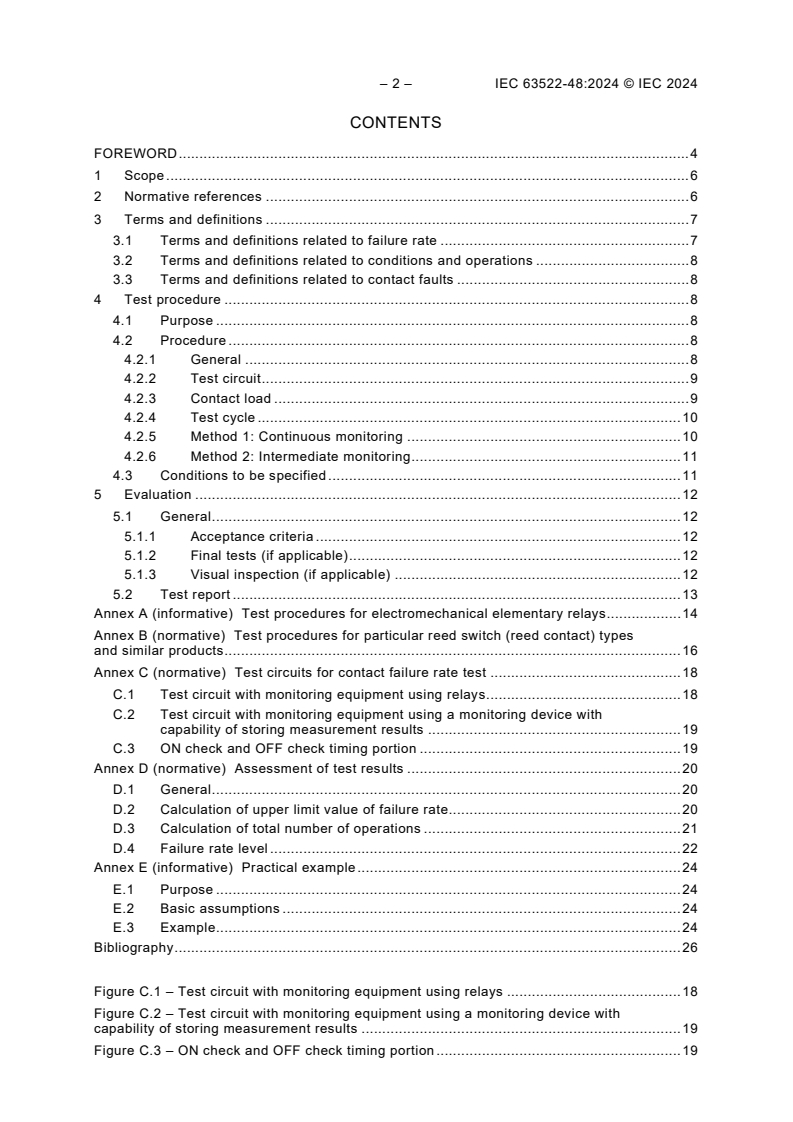
CONTENTS
FOREWORD . 4
1 Scope . 6
2 Normative references . 6
3 Terms and definitions . 7
3.1 Terms and definitions related to failure rate . 7
3.2 Terms and definitions related to conditions and operations . 8
3.3 Terms and definitions related to contact faults . 8
4 Test procedure . 8
4.1 Purpose . 8
4.2 Procedure . 8
4.2.1 General . 8
4.2.2 Test circuit . 9
4.2.3 Contact load . 9
4.2.4 Test cycle . 10
4.2.5 Method 1: Continuous monitoring . 10
4.2.6 Method 2: Intermediate monitoring . 11
4.3 Conditions to be specified . 11
5 Evaluation . 12
5.1 General . 12
5.1.1 Acceptance criteria . 12
5.1.2 Final tests (if applicable) . 12
5.1.3 Visual inspection (if applicable) . 12
5.2 Test report . 13
Annex A (informative) Test procedures for electromechanical elementary relays . 14
Annex B (normative) Test procedures for particular reed switch (reed contact) types
and similar products . 16
Annex C (normative) Test circuits for contact failure rate test . 18
C.1 Test circuit with monitoring equipment using relays . 18
C.2 Test circuit with monitoring equipment using a monitoring device with
capability of storing measurement results . 19
C.3 ON check and OFF check timing portion . 19
Annex D (normative) Assessment of test results . 20
D.1 General . 20
D.2 Calculation of upper limit value of failure rate. 20
D.3 Calculation of total number of operations . 21
D.4 Failure rate level . 22
Annex E (informative) Practical example . 24
E.1 Purpose . 24
E.2 Basic assumptions . 24
E.3 Example. 24
Bibliography . 26
Figure C.1 – Test circuit with monitoring equipment using relays . 18
Figure C.2 – Test circuit with monitoring equipment using a monitoring device with
capability of storing measurement results . 19
Figure C.3 – ON check and OFF check timing portion . 19
Figure D.1 – Example of test results in the case of fixed number testing plan . 22
Table 1 – Contact load characteristics . 9
Table 2 – Recommended test current . 9
Table 3 – Recommended test voltage . 10
Table 4 – Recommended number of testing cycles . 10
Table 5 – Recommended value of contact-circuit resistance . 11
Table A.1 – Test procedures for electromechanical elementary relays . 15
Table B.1 – Test procedures for particular reed switch (reed contact) types and similar
products. 17
Table D.1 – Coefficient k for calculating failure rate . 21
Table D.2 – Failure rate level . 22
Table D.3 – Acceptable number and total testing cycles (number of testing cycles) . 23
Table E.1 – Example with number of cycles at which ON failures have been recorded . 24
– 4 – IEC 63522-48:2024 © IEC 2024
INTERNATIONAL ELECTROTECHNICAL COMMISSION
____________
ELECTRICAL RELAYS –
TESTS AND MEASUREMENTS –
Part 48: Contact failure rate test
FOREWORD
1) The International Electrotechnical Commission (IEC) is a worldwide organization for standardization comprising
all national electrotechnical committees (IEC National Committees). The object of IEC is to promote international
co-operation on all questions concerning standardization in the electrical and electronic fields. To this end and
in addition to other activities, IEC publishes International Standards, Technical Specifications, Technical Reports,
Publicly Available Specifications (PAS) and Guides (hereafter referred to as "IEC Publication(s)"). Their
preparation is entrusted to technical committees; any IEC National Committee interested in the subject dealt with
may participate in this preparatory work. International, governmental and non-governmental organizations liaising
with the IEC also participate in this preparation. IEC collaborates closely with the International Organization for
Standardization (ISO) in accordance with conditions determined by agreement between the two organizations.
2) The formal decisions or agreements of IEC on technical matters express, as nearly as possible, an international
consensus of opinion on the relevant subjects since each technical committee has representation from all
interested IEC National Committees.
3) IEC Publications have the form of recommendations for international use and are accepted by IEC National
Committees in that sense. While all reasonable efforts are made to ensure that the technical content of IEC
Publications is accurate, IEC cannot be held responsible for the way in which they are used or for any
misinterpretation by any end user.
4) In order to promote international uniformity, IEC National Committees undertake to apply IEC Publications
transparently to the maximum extent possible in their national and regional publications. Any divergence between
any IEC Publication and the corresponding national or regional publication shall be clearly indicated in the latter.
5) IEC itself does not provide any attestation of conformity. Independent certification bodies provide conformity
assessment services and, in some areas, access to IEC marks of conformity. IEC is not responsible for any
services carried out by independent certification bodies.
6) All users should ensure that they have the latest edition of this publication.
7) No liability shall attach to IEC or its directors, employees, servants or agents including individual experts and
members of its technical committees and IEC National Committees for any personal injury, property damage or
other damage of any nature whatsoever, whether direct or indirect, or for costs (including legal fees) and
expenses arising out of the publication, use of, or reliance upon, this IEC Publication or any other IEC
Publications.
8) Attention is drawn to the Normative references cited in this publication. Use of the referenced publications is
indispensable for the correct application of this publication.
9) IEC draws attention to the possibility that the implementation of this document may involve the use of (a)
patent(s). IEC takes no position concerning the evidence, validity or applicability of any claimed patent rights in
respect thereof. As of the date of publication of this document, IEC had not received notice of (a) patent(s), which
may be required to implement this document. However, implementers are cautioned that this may not represent
the latest information, which may be obtained from the patent database available at https://patents.iec.ch. IEC
shall not be held responsible for identifying any or all such patent rights.
IEC 63522-48 has been prepared by IEC technical committee 94: Electrical relays. It is an
International Standard.
The text of this International Standard is based on the following documents:
Draft Report on voting
94/1039/FDIS 94/1084/RVD
Full information on the voting for its approval can be found in the report on voting indicated in
the above table.
The language used for the development of this International Standard is English.
This document was drafted in accordance with ISO/IEC Directives, Part 2, and developed in
accordance with ISO/IEC Directives, Part 1 and ISO/IEC Directives, IEC Supplement, available
at www.iec.ch/members_experts/refdocs. The main document types developed by IEC are
described in greater detail at www.iec.ch/publications.
A list of all parts of IEC 63522 series, published under the general title Electrical relays ─ Tests
and measurements, can be found on the IEC website.
The committee has decided that the contents of this document will remain unchanged until the
stability date indicated on the IEC website under webstore.iec.ch in the data related to the
specific document. At this date, the document will be
• reconfirmed,
• withdrawn, or
• revised.
– 6 – IEC 63522-48:2024 © IEC 2024
ELECTRICAL RELAYS –
TESTS AND MEASUREMENTS –
Part 48: Contact failure rate test
1 Scope
This part of IEC 63522 is used for testing electromechanical elementary relays
(electromechanical relays, reed relays, reed contacts, reed switches and technology
combinations of these) and for evaluating their ability to perform under expected conditions of
transportation, storage and all aspects of operational use.
This document defines a standard test method for contact failure rate test of electromechanical
elementary relays applied to low-load applications (for example, CC 0, CC 1) and failure rates
and failure rate levels at low loads under specified conditions.
2 Normative references
The following documents are referred to in the text in such a way that some or all of their content
constitutes requirements of this document. For dated references, only the edition cited applies.
For undated references, the latest edition of the referenced document (including any
amendments) applies.
IEC 60605-4:2001, Equipment reliability testing – Part 4: Statistical procedures for exponential
distribution – Point estimates, confidence intervals, prediction intervals and tolerance intervals
IEC 61810-1, Electromechanical elementary relays – Part 1: General and safety requirements
IEC 61810-2, Electromechanical elementary relays – Part 2: Reliability
IEC 61810-4, Electromechanical elementary relays – Part 4: General and safety requirements
for reed relays
IEC 62246-1, Reed switches – Part 1: Generic specification
IEC 62246-1-1:2018, Reed switches – Part 1-1: Generic specification – Blank detail
specification
IEC 62246-4:2023, Reed switches – Part 4: Application in conjunction with magnetic actuator
used for magnetic sensing devices
IEC 63522-0:–, Electrical relays – Tests and measurements – Part 0: General and guidance
IEC 63522-6, Electrical relays – Tests and measurements – Part 6: Contact-circuit resistance
(or voltage drop)
___________
Under preparation. Stage at the time of publication: IEC CDV 63522-0:2024.
Under preparation. Stage at the time of publication: IEC FDIS 63522-6:2024.
IEC 63522-7, Electrical relays – Tests and measurements – Part 7: Functional tests
IEC 63522-45:–, Electrical relays – Tests and measurements – Part 45: Maximum frequency of
operation
3 Terms and definitions
For the purposes of this document, the terms and definitions given in IEC 61810-1, IEC 61810-2,
IEC 63522-0, IEC 62246-1 and the following apply.
ISO and IEC maintain terminology databases for use in standardization at the following
addresses:
• IEC Electropedia: available at https://www.electropedia.org/
• ISO Online browsing platform: available at https://www.iso.org/obp
3.1 Terms and definitions related to failure rate
3.1.1
failure rate
number of failures relative to the number of cycles of service of the relay
Note 1 to entry: λ is the reciprocal of MTBF
c c.
[SOURCE: IEC 60050-444:2002, 444-07-09]
3.1.2
failure rate level
accumulated number of non-conforming units under specified operating conditions and
specified accumulated time (cycles), evaluated for a given confidence level
Note 1 to entry: Higher (lower) failure rate level: This term describes a failure rate level associated with a higher
(lower) number of failures per unit time (cycle).
3.1.3
confidence level
probability expressed in percentage (%) that a lot with a failure rate in the failure rate level of
will be rejected
3.1.4
total testing cycles
total number of operations
sum of test cycles or of numbers of operations spent or done on all DUTs
Note 1 to entry: Total test cycles is called component hour, sometimes.
___________
Under preparation. Stage at the time of publication: IEC BPUB 63522-7:2024.
Under preparation. Stage at the time of publication: IEC FDIS 63522-45:2024.
– 8 – IEC 63522-48:2024 © IEC 2024
3.2 Terms and definitions related to conditions and operations
3.2.1
internal impedance
impedance that exists between the output terminal of the power supply and the internal power
supply circuit
Note 1 to entry: Z < 0,02 Z (AC), R < 0,02 R (DC) at Contact category 0 and 1 (see Figure A.1 of
s M,B s M,B
IEC 63522-0:─ ).
[SOURCE: IEC 60050-312:2001, 312-06-19, modified – modified output impedance of the term
to internal impedance, rewording of the definition and addition of Note 1 to entry.]
3.3 Terms and definitions related to contact faults
3.3.1
contact fault due to increased contact-circuit resistance
occurrence of a contact-circuit resistance of a closed contact exceeding the maximum value
specified
[SOURCE: IEC 60050-444:2002, 444-07-13]
3.3.2
contact fault due to non-opening of the contact circuit
occurrence of a resistance across an open contact falling below the minimum value specified
[SOURCE: IEC 60050-444:2002, 444-07-14]
4 Test procedure
4.1 Purpose
This test is intended to investigate the failure rates or failure rate levels of the DUTs at low
loads under specified conditions.
NOTE 1 The failure data typically shows an exponential distribution.
NOTE 2 With respect to the establishment and assessment for relays of reliability data which typically show a
Weibull distribution, reference is made to IEC 61810-2.
The contact failure rate test evaluates random failures including those occurring in the range of
minimum operational voltage and current to clarify low-load application limits.
NOTE 3 For example, the intended use of low-level current switching and measurement signals in telecom and
network devices, test and measurement equipment, security devices, communications, security, automotive devices,
railway signalling system, etc.
4.2 Procedure
4.2.1 General
The test circuit, contact load, test current and test voltage, test cycle, monitoring methods
(according to 4.2.2 to 4.2.6), sample size and acceptable number of failures during the test
shall be specified by the manufacturer, if not otherwise specified by the detail specification or
the manufacturer.
Examples of test procedures for electromechanical elementary relays are given in Annex A.
___________
Under preparation. Stage at the time of publication: IEC CDV 63522-0:2024.
Additional and/or alternative contact failure rate test procedures for the particular types of relays
are stated in Annex B. Particular reed switch (reed contact) types and similar products are given
in Annex B.
The number of DUTs shall be at least 10, unless otherwise specified by a detail specification.
4.2.2 Test circuit
Test circuits with monitoring equipment using relays and a monitoring device with capability of
storing measurement results are given in Figure C.1 and Figure C.2, respectively, in Annex C
based on IEC 63522-0:– , Figure A.1.
The wiring of the control, the measuring and indicating devices shall not effectively influence
the current through and the voltage across the contacts during operation.
The source for input energization shall be a voltage source with low internal impedance.
The mounted relay coils shall be energized individually or in parallel, with precautions against
interactions. When coil suppression (electrical components to suppress or reduce unwanted
transients) is used, it shall be described in the test report.
4.2.3 Contact load
The contact load shall be as shown in Table 1. Contact categories CC 0 and CC 1 apply.
The values of test current and test voltage shall be selected from Table 2 and Table 3
respectively, and the making current and breaking current shall have the same value. The detail
specification shall specify the test voltage and test current.
Table 1 – Contact load characteristics
Contact load
AC Resistive load (cos φ 0,95 to 1,0)
–7
DC Resistive load (L/R is ≤ 10 s)
Table 2 – Recommended test current
a
Test current
1 μA; 5 μA; 10 μA; 50 μA; 100 μA; 500 μA; 1 mA; 5 mA; 10 mA; 50 mA; 100 mA
a
The tolerances are ±5 %.
___________
Under preparation. Stage at the time of publication: IEC CDV 63522-0:2024.
– 10 – IEC 63522-48:2024 © IEC 2024
Table 3 – Recommended test voltage
a
Classification
Test voltage
AC 1 μV; 5 μV; 10 μV; 50 μV; 100 μV; 500 μV; 1 mV; 10 mV; 30 mV; 50 mV
0,1 V; 0,5 V; 1 V; 1,5 V; 4,5 V; 5 V; 6 V; 9 V; 12 V; 24 V; 36 V; 42 V; 48 V
b
1 μV; 5 μV; 10 μV; 50 μV; 100 μV; 500 μV; 1 mV; 10 mV; 30 mV; 50 mV
DC
0,1 V; 0,5 V; 1 V; 1,5 V; 3,3 V; 4,5 V; 5 V; 6 V; 9 V; 10 V; 12 V; 24 V; 48 V; 60 V
a
The tolerances are ±10 %.
b
The ripple rate is less than 2 %.
4.2.4 Test cycle
The DUTs shall be energized with the rated coil voltage or an appropriate value within the rated
coil voltage range or operative range or as otherwise specified, and the test shall be conducted
at ambient room temperature or as otherwise specified.
The switching action shall not be synchronous with the source of the load circuit, if this is AC.
The frequency of operation shall be as specified; the relay shall, however, attain both the
operate and release/reset condition within one cycle.
The frequency of operation shall be either one of those given in Table 2 of IEC 63522-45:– .
The pulse pattern shall be a rectangular waveform with a duty cycle of 50 %
(see IEC 63522-0:– , C.1.3 Duty type S3), unless otherwise specified in the detail specification.
The number of testing cycles shall be either one of those given in Table 4, as specified in the
detail specification.
Table 4 – Recommended number of testing cycles
Number of testing cycles
5 5 5 5 6 6 6
10 000; 20 000; 30 000; 50 000; 1 × 10 ; 2 × 10 ; 3 × 10 ; 5 × 10 ; 1 × 10 ; 2 × 10 ; 3 × 10 ;
6 7 7 7 7 8 8 8 8 9
5 × 10 ; 1 × 10 ; 2 × 10 ; 3 × 10 ; 5 × 10 ; 1 × 10 ; 2 × 10 ; 3 × 10 ; 5 × 10 ; 1 × 10
4.2.5 Method 1: Continuous monitoring
The DUTs shall be monitored electrically, using a contact load as specified. The selected
contact load shall ensure reliable monitoring of the performed cycles to clarify the limits of
application to digital circuits.
Each contact shall be tested for malfunction to make and malfunction to break at each operation
by measuring the voltage across the contacts and/or the load according to Figure C.1 or
Figure C.2: timing portion of the ON check and OFF check and the comparators is given in
Figure C.3.
By comparing the voltage between contacts with the fault level voltage of the comparator, it is
determined whether the contact is malfunction to make or malfunction to break.
___________
Under preparation. Stage at the time of publication: IEC FDIS 63522-45:2024.
Under preparation. Stage at the time of publication: IEC CDV 63522-0:2024.
The maximum value of contact-circuit resistance shall be selected from Table 5 by the
manufacturer to set the fault level voltage(s).
The failure criteria shall be as follows:
• If the voltage across contacts exceeds the fault level voltage when the coil is energized, it
is judged as a failure;
• If the contact is not opened when the coil is not energized, it is judged as a failure;
• The first detected malfunction is defined as a failure.
Table 5 – Recommended value of contact-circuit resistance
Contact-circuit resistance
1 Ω; 5 Ω; 10 Ω; 20 Ω; 50 Ω; 100 Ω; 500 Ω; 1 kΩ; 1,2 kΩ; 5 kΩ; 10 kΩ; 50 kΩ; 100 kΩ; 500 kΩ; 1 MΩ
The fault level voltage(s) is based on the following principles:
• The ON-check pulse is applied after the complete closing of the contact, when the voltage
between contacts is above 5 % of the test voltage, it can be considered as the contact fault
due to increased contact-circuit resistance and the sequence is stopped at the ON state,
unless otherwise specified;
• When the contact completes its breaking operation and the cut-off time has passed
sufficiently, then the OFF-check pulse is applied. When the voltage between contacts is less
than 95 % of the test voltage, it can be considered as the contact fault due to non-opening
of the contact circuit and the sequence is stopped at the OFF state, unless otherwise
specified.
4.2.6 Method 2: Intermediate monitoring
The intermediate monitoring (periodic test) shall be performed in regular intervals as specified
by the manufacturer.
The measured intermediate parameters shall be in accordance with IEC 63522-6 and
IEC 63522-7 within the limits defined by the manufacturer product specification at any time
during the contact failure rate test:
• If the measured parameters exceed the limits, the DUT shall be rejected;
• If not otherwise specified, the 1 kΩ contact-circuit resistance shall be selected for contact
category.
4.3 Conditions to be specified
The conditions to be specified are the following:
a) test circuit (see Figure C.1 and Figure C.2);
b) contact load, test current and test voltage (see Table 1, Table 2 and Table 3);
c) ambient conditions (if deviating from 4.4 of IEC 63522-0:– );
d) sample size;
e) total number of operations or test cycles for each contact (see Table 4);
___________
Under preparation. Stage at the time of publication: IEC FDIS 63522-6:2024.
Under preparation. Stage at the time of publication: IEC BPUB 63522-7:2024.
Under preparation. Stage at the time of publication: IEC CDV 63522-0:2024.
– 12 – IEC 63522-48:2024 © IEC 2024
f) number of cycles per hour and duty factor (refer to IEC 63522-45);
g) maximum reference value of contact-circuit resistance (see Table 5);
h) acceptable number of failures;
i) monitoring times (see Figure C.3);
j) periodic measurements (see 4.2.6);
k) final tests;
l) any other measurement, if required.
5 Evaluation
5.1 General
5.1.1 Acceptance criteria
The DUTs are decided acceptable for the established failure rate level if the total number of
failures observed does not exceed the established acceptance number of failures during the
test (see D.4).
The DUTs shall operate and release, and the contact-circuit resistance and operating functions
shall be within specified limits.
Assessment of test results is given in Annex D.
A practical example is given in Annex E.
5.1.2 Final tests (if applicable)
Immediately after the contact failure rate test, the DUTs shall pass the following tests:
• Contact-circuit resistance in accordance with IEC 63522-6 shall be measured;
• Functional test in accordance with IEC 63522-7 shall be measured;
• Any other measurement, if required.
5.1.3 Visual inspection (if applicable)
Subsequently for all DUTs a visual inspection shall verify the contact surfaces of the DUTs. For
this purpose, it is necessary to open the DUTs.
The visual inspection shall show absence of:
– mechanical defects
– insulating material.
NOTE SEM-EDX (Scanning Electron Microscope – Energy Dispersive Spectroscopy) and EPMA (Electron Probe
Micro Analyzer) photographs are effective for investigating the contact surfaces.
5.2 Test report
If this part of the IEC 63522 series is executed as a part of a test record of another standard,
then the results shall be reported as required in the other standard.
Otherwise, it is recommended to issue a dedicated test report according to this document.
The test report should contain all the information necessary to reproduce the test. In particular,
the following should be recorded:
a) identification of the device, e.g., brand name, product type, serial number;
b) reference value of cycle-related failure rate based on a confidence level of 60 % or failure
rate level;
c) test circuit;
d) contact load, test voltage and test current;
e) sample size;
f) energizing voltage;
g) number of cycles per hour and duty factor;
h) total number of failures;
i) total number of operations;
j) maximum reference value of contact-circuit resistance;
k) monitoring times;
l) periodic measurements and final tests;
m) ambient conditions.
– 14 – IEC 63522-48:2024 © IEC 2024
Annex A
(informative)
Test procedures for electromechanical elementary relays
For electromechanical elementary relays, examples of the test procedures are given in
Table A.1.
Table A.1 – Test procedures for electromechanical elementary relays
Type of relays Electromechanical elementary relays
Test circuit Figure C.2
Switching load Resistive load
Test current 50 μA 0,1 mA 10 mA
Test voltage 50 mV 1 VDC 10 VDC
Sample size 10
Energizing voltage Test coil voltage: 100 % of rated-operate value
Switching frequency of operation per h Not more than 45 000 Not more than 18 000
≥ 5 mV DC ≥ 0,1 V DC ≥ 0,5 V DC
Limit for malfunction to make
a a a
(1 kΩ max.) (50 Ω max.)
(100 Ω max.)
Limit for malfunction to break ≤ 45 mV DC ≤ 0,9 V DC ≤ 9,5 V DC
Test cycles
Min. 1 × 10
t = 16 ms t = 40 ms
1 1
τ = 20 ms τ = 50 ms
1 1
b
Monitoring times
t = 16 ms t = 40 ms
2 2
τ = 20 ms τ = 50 ms
2 2
Contact-circuit
≤1 000 ≤200
c
resistance (mΩ)
c
Periodic
≤80 % rated coil voltage
Must-operate value
measurements
≥10 % (DC coil) / 15 % (AC coil) rated coil voltage (monostable relay)
c
Must-release value
≤80 % rated coil voltage (bistable relay)
a
Contact-circuit resistance value conversion (Monitoring contact resistance or contact voltage drop is considered acceptable).
b
Monitoring shall start after the contact has reached stable closed condition, or after at least 40 % of the closed part of each cycle has elapsed, whichever is later.
c
The relevant limits can be specified by the manufacturer.
– 16 – IEC 63522-48:2024 © IEC 2024
Annex B
(normative)
Test procedures for particular reed switch (reed contact)
types and similar products
For particular reed switch (reed contact) types and similar products, the test procedures
specified in Table B.1 shall be applied.
Table B.1 – Test procedures for particular reed switch (reed contact) types and similar products
Type of reed switch
High-voltage
Reed switches Reed switches Heavy-duty reed switches
vacuum
(Contact arrangement)
(1 NO) (1 NO) (1 C/O) (1 NO)
Test circuit Figure C.1
Switching load Resistive load
Test current 0,1 mA 1 mA 1 mA
Test voltage 5 VDC 1 VDC 24 VDC
Sample size 20
Energizing voltage Test coil voltage: 150 % of must-operate value
Switching frequency of operation per h Not more than 360 000 Not more than 180 000 Not more than 36 000
≥ 0,5 V DC ≥ 0,05 V DC ≥ 1,2 V DC
Limit for failure to make
a a a
(5 kΩ max.) (50 Ω max.) (1,2 kΩ max.)
Limit for failure to break ≤ 4,5 V DC ≤ 0,95 V DC ≤ 22,8 VDC
7 6
Test cycles
Min. 1 × 10 Min. 5 × 10
t = 2 ms t = 5 ms t = 25 ms
1 1 1
τ = 0,1 ms τ = 0,1 ms τ = 20 ms
1 1 1
Monitoring times
t = 2 ms t = 5 ms t = 25 ms
2 2 2
τ = 0,2ms τ = 0,1ms τ = 20 ms
2 2 2
Contact-circuit ≤100 ≤100 ≤500
resistance (mΩ)
Periodic Must-operate value 10 to 50 15 to 60 10 to 30 180 to 230
measurements (AT)
Must-release value ≥ 5 ≥ 7 ≥ 4 ≥ 60
(AT)
a
Contact-circuit resistance value conversion.
SOURCE: Tables 2, 3, 4, 5, 6 and 7 of IEC 62246-1-1:2018.
– 18 – IEC 63522-48:2024 © IEC 2024
Annex C
(normative)
Test circuits for contact failure rate test
C.1 Test circuit with monitoring equipment using relays
NOTE All symbols that are not defined in this figure can be found in the key of Figure C.2.
Figure C.1 – Test circuit with monitoring equipment using relays
C.2 Test circuit with monitoring equipment using a monitoring device with
capability of storing measurement results
Key
R Fixed resistor
F
R Resistor
Figure C.2 – Test circuit with monitoring equipment using a monitoring device
with capability of storing measurement results
C.3 ON check and OFF check timing portion
Figure C.3 – ON check and OFF check timing portion
The measuring period τ , for malfunction to make, starts at a time t after the start of the coil
1 1
energization.
The measuring period τ , for malfunction to break, starts at a time t after the end of the coil
2 2
energization.
The times t , t , τ and τ shall be given in the detail specification.
1 2 1 2
NOTE The integration time is the time required by the monitoring device to register the mean value of a signal. In
the case of an input step voltage at the failure criteria level, it is the time required to register a failure.
– 20 – IEC 63522-48:2024 © IEC 2024
Annex D
(normative)
Assessment of test results
D.1 General
Manufacturers often indicate cycle-related failure rates and failure rate levels when used in low-
load applications as reference values.
Reliability data for particular reed relays, reed switches (reed contacts) and similar devices are
specified in IEC 61810-4, IEC 62246-1-1 and IEC 62246-4.
As a rule, the assessment of test results is applied subject to random failures on the exponential
distribution. For the basic assessment of the test results obtained, the statistical procedures
specified in IEC 60605-4:2001 shall be applied.
D.2 Calculation of upper limit value of failure rate
If no failures are observed during the test, a point estimate for MTBF cannot be obtained.
However, estimates can be made of the upper one-side confidence limit on failure rate in
accordance with 5.1 of IEC 60605-4:2001.
From a knowledge of the desired confidence level and the values of failures r and the total
testing cycles T, compute the upper 100 (1-α) % confidence limit of the failure rate λ using
u
χr22+
( )
1−α
(D.1)
λ =
u
2T
where
(1-α) denotes the confidence level to be used (e.g., 0,90 or 90 %) and χr22+ is obtained
( )
1−α
from tables of the fractiles of the X distribution (see Annex D of IEC 60605-4:2001).
The default value for the confidence level shall be 60 % unless otherwise specified. Alternatively,
a confidence level of 90 % can be used.
The upper limit value of cycle-related failure rate can be calculated from the test results of 5.1.1
as follows:
rr
λκ k
u
(D.2)
n
T
t
∑ i
==
where
λ is the upper limit value of failure rate;
u
T is the total testing cycles (sum of number of testing cycles on all DUTs);
r is the number of failures observed during the test;
k is the coefficient, values are shown in Table D.1.
The upper limit value of failure rate λ when number of failures r = 0, shall be obtained from
u
the following formulae:
0,917
λ = (D.3)
when reliability level is 60 %
u
T
2,3
λ = when reliability level is 90 % (D.4)
u
T
Table D.1 – Coefficient k for calculating failure rate
Number of failures 1 2 3 4 5 6 7 8 9 10
(r)
Reliability 60 % 2,02 1,55 1,39 1,31 1,26 1,22 1,20 1,18 1,16 1,15
level
90 % 3,89 2,66 2,23 2,00 1,85 1,76 1,68 1,62 1,58 1,54
SOURCE: Appendix Table 1 of JIS C5003:1974, General test procedure of failure rate for electronic components
D.3 Calculation of total number of operations
The test results are sorted in the order in which the failure was detected (see Figure D.1). The
total number of operations shall be calculated by the following formula in accordance with
Annex C of IEC 60605-4:2001.
T t+ t +….+ t + (n− rt) (D.5)
12 rr
=
– 22 – IEC 63522-48:2024 © IEC 2024
where
st
t is the number of testing cycles of the 1 sample that detected a failure;
nd
t is the number of testing cycles of the 2 sample that detected a failure;
th
t is the number of testing cycles of the r sample that detected a failure;
r
n is the number of DUTs.
Figure D.1 – Example of test results in the case of fixed number testing plan
D.4 Failure rate level
Unless otherwise specified in the detail specification, the failure rate level is expressed in the
unit of the failure rate in percentage (%) per 10 h or the number of failures per total testing
cycles of 10 and shall be selected from Table D.2.
M, P, R, S and T shall be used and the others are applied as needed.
Table D.2 – Failure rate level
Symbol Failure rate Symbol Failure rate
3 -6 3 -6
(%/10 h or pieces/10 cycles) (%/10 h or pieces/10 cycles)
L 5 R 0,01
M 1 E 0,005
N 0,5 S 0,001
P 0,1 H 0,000 5
Q 0,05 T 0,000 1
SOURCE: Table 1 of JIS C5003:1974, General test procedure of failure rate for electronic components
The judgment of failure rate level shall be decided as the following procedure:
The test is carried out while the acceptable number C and total testing cycles is established as
shown in Table D.3 in relation with the maximum failure rate level and confidence level specified
for the DUT, if the observed total number of failures r does not exceed the established
acceptable number C, then the DUT shall be judged as accepted by the established failure rate
level.
Provided that, the previously established acceptable number C and total testing cycles shall not
be varied at will according to the test result.
3 5
The values in Table D.3 shall be the ones for the failure rate level M (1 %/10 h = 1/10 h), and
for level other than M, when the failure rate is 1/x times, the value of x times the total testing
cycles for M shall be used.
Table D.3 – Acceptable number and total testing cycles (number of testing cycles)
Total testing cycles or number of testing cycles
Acceptable number
5 6
(10 or 10 cycles)
C
Confidence level 60 % Confidence level 90 %
0 0,917 2,30
1 2,02 3,89
2 3,11 5,32
3 4,18 6,68
4 5,24 7,99
5 6,29 9,27
6 7,34 10,5
7 8,39 11,8
8 9,43 13,0
9 10,5 14,2
10 11,5 15,4
SOURCE: Table 6 of JIS C5003:19
...