


IEC 61811-51:1997
(Main)Electromechanical all-or-nothing relays - Part 51: Blank detail specification - Electromechanical all-or-nothing telecom relays of assessed quality - Non-standardized types and construction
General Information
- Abstract
- Status
- Published
- Publication Date
- 08-Oct-1997
- Technical Committee
- TC 94 - Electrical relays
- Current Stage
- DELPUB - Deleted Publication
- Start Date
- 28-Feb-2002
- Completion Date
- 28-Aug-2026
Buy Documents
IEC 61811-51:1997 - Electromechanical all-or-nothing relays - Part 51: Blank detail specification - Electromechanical all-or-nothing telecom relays of assessed quality - Non-standardized types and construction Released:10/9/1997
Overview
IEC 61811-51:1997 is an international standard published by the International Electrotechnical Commission (IEC) that defines a blank detail specification framework for electromechanical all-or-nothing telecom relays of assessed quality. This part 51 standard specifically addresses non-standardized types and constructions of electromechanical all-or-nothing relays used in telecommunications, ensuring quality assurance regimes are met. Although it provides a structural format rather than specific relay designs, it supports manufacturers and users with requirements for relay characteristic values, quality control, testing procedures, and ordering information.
Key Topics
- Scope: Focuses on non-standardized, custom types of electromechanical all-or-nothing relays for telecom applications, subjected to assessed quality assurance.
- Characteristic Values: Defines critical relay parameters such as coil characteristics, contacts, mounting types, and environmental resistance to support reliable specification and integration.
- Quality Assurance: Includes guidelines for qualification approval procedures, conformity inspections, and formation of inspection lots to maintain consistency and reliability in relay manufacturing.
- Testing Requirements: Specifies standard testing conditions, including dielectric strength tests, endurance and overload tests, and environmental exposure assessments essential for assuring relay performance.
- Marking and Documentation: Establishes marking protocols for relays and packaging alongside mandatory documentation practices for traceability and user reference.
- Ordering Information: Provides a systematic code designation pattern (IECQ related) for ordering non-standard relay types, facilitating clear communication between suppliers and purchasers.
Applications
IEC 61811-51:1997 serves as a crucial reference for:
- Telecommunication Equipment Manufacturers: Ensuring their relay components conform to quality-assessed, non-standard designs required for specialized telecom switching, signaling, and control functions.
- Quality Assurance Departments: Implementing standardized inspection and testing regimes for bespoke electromechanical relays to maintain product reliability and performance in telecom systems.
- Relay Designers and Engineers: Developing all-or-nothing relays tailored for specific telecom environments, using the blank detail specification to guide design elements and quality benchmarks.
- Suppliers and Distributors: Enhancing ordering accuracy through detailed type designation and quality assurance documentation, reducing risks of miscommunication or product mismatch.
- Telecommunications Network Operators: Ensuring network components meet assessed quality standards, improving system uptime and operational safety by deploying compliant relay devices.
Related Standards
For comprehensive understanding and compliance, IEC 61811-51 references and complements several other IEC standards:
- IEC 60050 (International Electrotechnical Vocabulary): Provides precise definitions for electrotechnical terms used within relay standards.
- IEC 60027 (Letter Symbols to be Used in Electrical Technology): Covers letter and symbol representation for electrical components.
- IEC 60417 (Graphical Symbols for Use on Equipment) and IEC 60617 (Graphical Symbols for Diagrams): Standardize symbols for clear communication in technical documentation and schematics.
- IEC 61811 Series: Other parts within the IEC 61811 family cover standardized relay types and specific application details, serving as companion documents to Part 51.
Adhering to IEC 61811-51 helps ensure telecom electromechanical all-or-nothing relays meet global standards for assessed quality, enabling secure, efficient, and reliable telecommunication system operation.
Relations
- Effective Date
- 05-Sep-2023
Buy Documents
IEC 61811-51:1997 - Electromechanical all-or-nothing relays - Part 51: Blank detail specification - Electromechanical all-or-nothing telecom relays of assessed quality - Non-standardized types and construction Released:10/9/1997
Get Certified
Connect with accredited certification bodies for this standard

IMQ S.p.A. (Certification)
Italian electrical product certification.

SLG Prüf- und Zertifizierungs GmbH
German testing and certification body.

UL Solutions
Global safety science company with testing, inspection and certification.
Sponsored listings
Frequently Asked Questions
IEC 61811-51:1997 is a standard published by the International Electrotechnical Commission (IEC). Its full title is "Electromechanical all-or-nothing relays - Part 51: Blank detail specification - Electromechanical all-or-nothing telecom relays of assessed quality - Non-standardized types and construction". This standard covers: Electromechanical all-or-nothing relays - Part 51: Blank detail specification - Electromechanical all-or-nothing telecom relays of assessed quality - Non-standardized types and construction
Electromechanical all-or-nothing relays - Part 51: Blank detail specification - Electromechanical all-or-nothing telecom relays of assessed quality - Non-standardized types and construction
IEC 61811-51:1997 is classified under the following ICS (International Classification for Standards) categories: 29.120.70 - Relays. The ICS classification helps identify the subject area and facilitates finding related standards.
IEC 61811-51:1997 has the following relationships with other standards: It is inter standard links to IEC 61811-51:2002. Understanding these relationships helps ensure you are using the most current and applicable version of the standard.
IEC 61811-51:1997 is available in PDF format for immediate download after purchase. The document can be added to your cart and obtained through the secure checkout process. Digital delivery ensures instant access to the complete standard document.
Standards Content (Sample)
NORME
CEI
INTERNATIONALE
IEC
61811-51
INTERNATIONAL
QC 160501
STANDARD
Première édition
First edition
1997-10
Relais électromécaniques de tout-ou-rien –
Partie 51:
Spécification particulière cadre –
Relais électromécaniques de tout-ou-rien
télécom soumis au régime d’assurance
de la qualité –
Types et construction non normalisés
Electromechanical all-or-nothing relays –
Part 51:
Blank detail specification –
Electromechanical all-or-nothing
telecom relays of assessed quality –
Non-standardized types and construction
Numéro de référence
Reference number
CEI/IEC 61811-51: 1997
Numéros des publications Numbering
Depuis le 1er janvier 1997, les publications de la CEI As from the 1st January 1997 all IEC publications are
sont numérotées à partir de 60000. issued with a designation in the 60000 series.
Publications consolidées Consolidated publications
Les versions consolidées de certaines publications de Consolidated versions of some IEC publications
la CEI incorporant les amendements sont disponibles. including amendments are available. For example,
Par exemple, les numéros d’édition 1.0, 1.1 et 1.2 edition numbers 1.0, 1.1 and 1.2 refer, respectively, to
indiquent respectivement la publication de base, la the base publication, the base publication
publication de base incorporant l’amendement 1, et la incorporating amendment 1 and the base publication
publication de base incorporant les amendements 1 incorporating amendments 1 and 2.
et 2.
Validité de la présente publication Validity of this publication
Le contenu technique des publications de la CEI est The technical content of IEC publications is kept under
constamment revu par la CEI afin qu'il reflète l'état constant review by the IEC, thus ensuring that the
actuel de la technique. content reflects current technology.
Des renseignements relatifs à la date de Information relating to the date of the reconfirmation of
reconfirmation de la publication sont disponibles dans the publication is available in the IEC catalogue.
le Catalogue de la CEI.
Les renseignements relatifs à ces révisions, à l'établis- Information on the revision work, the issue of revised
sement des éditions révisées et aux amendements editions and amendments may be obtained from
peuvent être obtenus auprès des Comités nationaux de IEC National Committees and from the following
la CEI et dans les documents ci-dessous: IEC sources:
• Bulletin de la CEI • IEC Bulletin
• Annuaire de la CEI • IEC Yearbook
Accès en ligne* On-line access*
• Catalogue des publications de la CEI • Catalogue of IEC publications
Publié annuellement et mis à jour régulièrement Published yearly with regular updates
(Accès en ligne)* (On-line access)*
Terminologie, symboles graphiques Terminology, graphical and letter
et littéraux symbols
En ce qui concerne la terminologie générale, le lecteur For general terminology, readers are referred to
se reportera à la CEI 60050: Vocabulaire Electro- IEC 60050: International Electrotechnical Vocabulary
technique International (VEI). (IEV).
Pour les symboles graphiques, les symboles littéraux For graphical symbols, and letter symbols and signs
et les signes d'usage général approuvés par la CEI, le approved by the IEC for general use, readers are
lecteur consultera la CEI 60027: Symboles littéraux à referred to publications IEC 60027: Letter symbols to
utiliser en électrotechnique, la CEI 60417: Symboles be used in electrical technology, IEC 60417: Graphical
symbols for use on equipment. Index, survey and
graphiques utilisables sur le matériel. Index, relevé et
compilation des feuilles individuelles, et la CEI 60617: compilation of the single sheets and IEC 60617:
Symboles graphiques pour schémas. Graphical symbols for diagrams.
Publications de la CEI établies par IEC publications prepared by the same
le même comité d'études technical committee
L'attention du lecteur est attirée sur les listes figurant The attention of readers is drawn to the end pages of
à la fin de cette publication, qui énumèrent les this publication which list the IEC publications issued
publications de la CEI préparées par le comité by the technical committee which has prepared the
d'études qui a établi la présente publication. present publication.
* Voir adresse «site web» sur la page de titre. * See web site address on title page.
NORME
CEI
INTERNATIONALE
IEC
61811-51
INTERNATIONAL
QC 160501
STANDARD
Première édition
First edition
1997-10
Relais électromécaniques de tout-ou-rien –
Partie 51:
Spécification particulière cadre –
Relais électromécaniques de tout-ou-rien
télécom soumis au régime d’assurance
de la qualité –
Types et construction non normalisés
Electromechanical all-or-nothing relays –
Part 51:
Blank detail specification –
Electromechanical all-or-nothing
telecom relays of assessed quality –
Non-standardized types and construction
IEC 1997 Droits de reproduction réservés Copyright - all rights reserved
Aucune partie de cette publication ne peut être reproduite ni No part of this publication may be reproduced or utilized in
utilisée sous quelque forme que ce soit et par aucun any form or by any means, electronic or mechanical,
procédé, électronique ou mécanique, y compris la photo- including photocopying and microfilm, without permission in
copie et les microfilms, sans l'accord écrit de l'éditeur. writing from the publisher.
International Electrotechnical Commission 3, rue de Varembé Geneva, Switzerland
Telefax: +41 22 919 0300 e-mail: inmail@iec.ch IEC web site http: //www.iec.ch
CODE PRIX
Commission Electrotechnique Internationale
T
PRICE CODE
International Electrotechnical Commission
Pour prix, voir catalogue en vigueur
For price, see current catalogue
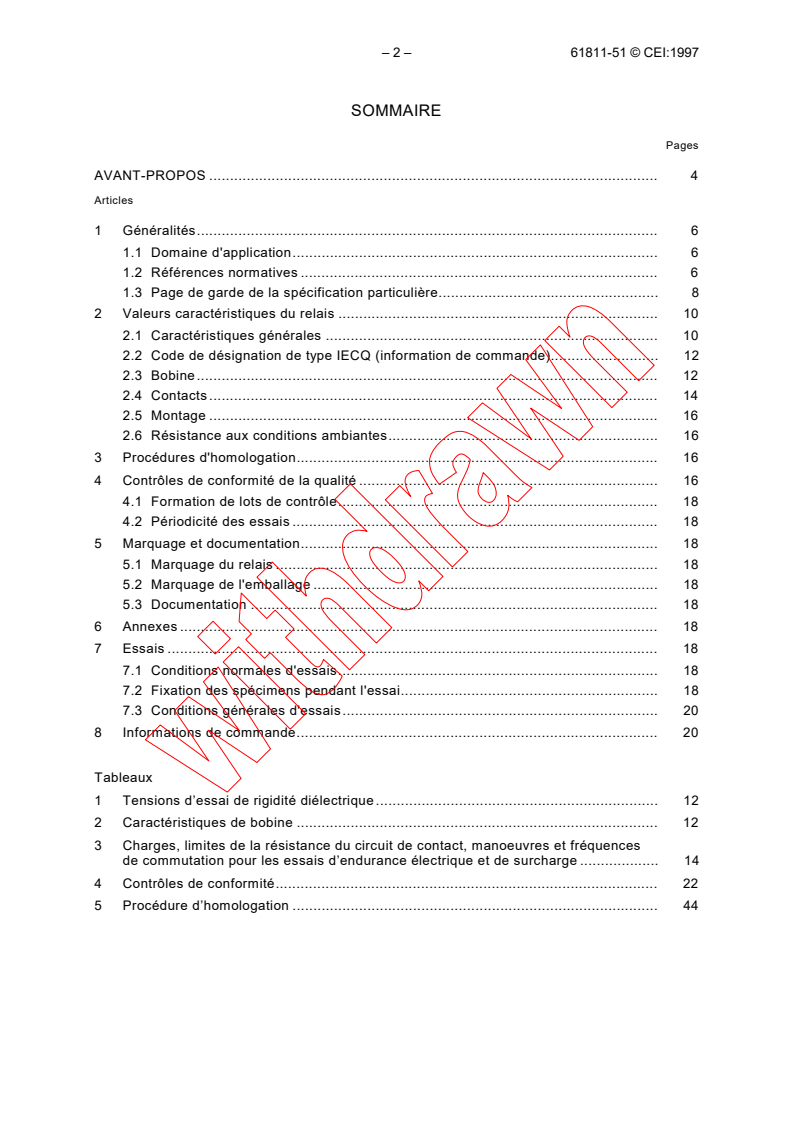
– 2 – 61811-51 © CEI:1997
SOMMAIRE
Pages
AVANT-PROPOS . 4
Articles
1 Généralités. 6
1.1 Domaine d'application. 6
1.2 Références normatives . 6
1.3 Page de garde de la spécification particulière. 8
2 Valeurs caractéristiques du relais . 10
2.1 Caractéristiques générales . 10
2.2 Code de désignation de type IECQ (information de commande). 12
2.3 Bobine. 12
2.4 Contacts . 14
2.5 Montage . 16
2.6 Résistance aux conditions ambiantes. 16
3 Procédures d'homologation. 16
4 Contrôles de conformité de la qualité . 16
4.1 Formation de lots de contrôle. 18
4.2 Périodicité des essais . 18
5 Marquage et documentation. 18
5.1 Marquage du relais . 18
5.2 Marquage de l'emballage . 18
5.3 Documentation . 18
6 Annexes . 18
7 Essais . 18
7.1 Conditions normales d'essais. 18
7.2 Fixation des spécimens pendant l'essai. 18
7.3 Conditions générales d'essais. 20
8 Informations de commande. 20
Tableaux
1 Tensions d’essai de rigidité diélectrique . 12
2 Caractéristiques de bobine . 12
3 Charges, limites de la résistance du circuit de contact, manoeuvres et fréquences
de commutation pour les essais d’endurance électrique et de surcharge . 14
4 Contrôles de conformité. 22
5 Procédure d’homologation . 44
61811-51 © IEC:1997 – 3 –
CONTENTS
Page
FOREWORD . 5
Clause
1 General . 7
1.1 Scope. 7
1.2 Normative references. 7
1.3 Front page of detail specification. 9
2 Characteristic values of the relay . 11
2.1 General data. 11
2.2 Construction of IECQ type designation (ordering information) . 13
2.3 Coil data. 13
2.4 Contact data . 15
2.5 Mounting . 17
2.6 Environmental data. 17
3 Qualification approval procedures . 17
4 Quality conformance inspection . 17
4.1 Formation of inspection lots . 19
4.2 Intervals between tests . 19
5 Marking and documentation . 19
5.1 Marking of the relay . 19
5.2 Marking of the package. 19
5.3 Documentation . 19
6 Annexes . 19
7 Tests. 19
7.1 Standard conditions for testing. 19
7.2 Mounting of test specimens during the test. 19
7.3 General conditions for testing . 21
8 Ordering information. 21
Tables
1 Dielectric test voltages. 13
2 Coil data. 13
3 Loads, contact-circuit resistance limits, switching cycles and frequencies for
electrical endurance and overload tests . 15
4 Quality conformance inspection . 23
5 Qualification approval . 45
– 4 – 61811-51 © CEI:1997
COMMISSION ÉLECTROTECHNIQUE INTERNATIONALE
––––––––––
RELAIS ÉLECTROMÉCANIQUES DE TOUT-OU-RIEN –
Partie 51: Spécification particulière cadre –
Relais électromécaniques de tout-ou-rien télécom
soumis au régime d’assurance de la qualité –
Types et construction non normalisés
AVANT-PROPOS
1) La CEI (Commission Electrotechnique Internationale) est une organisation mondiale de normalisation composée
de l'ensemble des comités électrotechniques nationaux (Comités nationaux de la CEI). La CEI a pour objet de
favoriser la coopération internationale pour toutes les questions de normalisation dans les domaines de
l'électricité et de l'électronique. A cet effet, la CEI, entre autres activités, publie des Normes internationales.
Leur élaboration est confiée à des comités d'études, aux travaux desquels tout Comité national intéressé par le
sujet traité peut participer. Les organisations internationales, gouvernementales et non gouvernementales, en
liaison avec la CEI, participent également aux travaux. La CEI collabore étroitement avec l'Organisation
Internationale de Normalisation (ISO), selon des conditions fixées par accord entre les deux organisations.
2) Les décisions ou accords officiels de la CEI concernant les questions techniques représentent, dans la mesure
du possible un accord international sur les sujets étudiés, étant donné que les Comités nationaux intéressés
sont représentés dans chaque comité d’études.
3) Les documents produits se présentent sous la forme de recommandations internationales. Ils sont publiés
comme normes, rapports techniques ou guides et agréés comme tels par les Comités nationaux.
4) Dans le but d'encourager l'unification internationale, les Comités nationaux de la CEI s'engagent à appliquer de
façon transparente, dans toute la mesure possible, les Normes internationales de la CEI dans leurs normes
nationales et régionales. Toute divergence entre la norme de la CEI et la norme nationale ou régionale
correspondante doit être indiquée en termes clairs dans cette dernière.
5) La CEI n’a fixé aucune procédure concernant le marquage comme indication d’approbation et sa responsabilité
n’est pas engagée quand un matériel est déclaré conforme à l’une de ses normes.
6) L’attention est attirée sur le fait que certains des éléments de la présente Norme internationale peuvent faire
l’objet de droits de propriété intellectuelle ou de droits analogues. La CEI ne saurait être tenue pour
responsable de ne pas avoir identifié de tels droits de propriété et de ne pas avoir signalé leur existence.
La Norme internationale CEI 61811-51 a été établie par le comité d'études 94 de la CEI: Relais
électriques de tout-ou-rien.
Le texte de cette norme est issu des documents suivants:
FDIS Rapport de vote
94/56/FDIS 94/67/RVD
Le rapport de vote indiqué dans le tableau ci-dessus donne toute information sur le vote ayant
abouti à l'approbation de cette norme.
Le numéro QC qui figure sur la page de couverture de la présente publication est le numéro de
spécification dans le système CEI d’assurance de la qualité des composants électroniques
(IECQ).
61811-51 © IEC:1997 – 5 –
INTERNATIONAL ELECTROTECHNICAL COMMISSION
–––––––––––
ELECTROMECHANICAL ALL-OR-NOTHING RELAYS –
Part 51: Blank detail specification –
Electromechanical all-or-nothing telecom relays
of assessed quality –
Non-standardized types and construction
FOREWORD
1) The IEC (International Electrotechnical Commission) is a worldwide organization for standardization comprising
all national electrotechnical committees (IEC National Committees). The object of the IEC is to promote
international co-operation on all questions concerning standardization in the electrical and electronic fields. To
this end and in addition to other activities, the IEC publishes International Standards. Their preparation is
entrusted to technical committees; any IEC National Committee interested in the subject dealt with may
participate in this preparatory work. International, governmental and non-governmental organizations liaising
with the IEC also participate in this preparation. The IEC collaborates closely with the International Organization
for Standardization (ISO) in accordance with conditions determined by agreement between the two
organizations.
2) The formal decisions or agreements of the IEC on technical matters express, as nearly as possible, an
international consensus of opinion on the relevant subjects since each technical committee has representation
from all interested National Committees.
3) The documents produced have the form of recommendations for international use and are published in the form
of standards, technical reports or guides and they are accepted by the National Committees in that sense.
4) In order to promote international unification, IEC National Committees undertake to apply IEC International
Standards transparently to the maximum extent possible in their national and regional standards. Any
divergence between the IEC Standard and the corresponding national or regional standard shall be clearly
indicated in the latter.
5) The IEC provides no marking procedure to indicate its approval and cannot be rendered responsible for any
equipment declared to be in conformity with one of its standards.
6) Attention is drawn to the possibility that some of the elements of this International Standard may be the subject
of patent rights. The IEC shall not be held responsible for identifying any or all such patent rights.
International Standard IEC 61811-51 has been prepared by IEC technical committee 94: All-or-
nothing electrical relays.
The text of this standard is based on the following documents:
FDIS Report on voting
94/56/FDIS 94/67/RVD
Full information on the voting for the approval of this standard can be found in the report on
voting indicated in the above table.
The QC number that appears on the front cover of this publication is the specification number
in the IEC Quality Assessment System for Electronic Components (IECQ).
– 6 – 61811-51 © CEI:1997
RELAIS ÉLECTROMÉCANIQUES DE TOUT-OU-RIEN –
Partie 51: Spécification particulière cadre –
Relais électromécaniques de tout-ou-rien télécom
soumis au régime d’assurance de la qualité –
Types et construction non normalisés
1 Généralités
1.1 Domaine d'application
La présente partie de la CEI 61811 est une spécification particulière cadre applicable aux
relais électromécaniques de tout-ou-rien télécom soumis au régime d'assurance de la qualité.
Les relais conformes à cette norme sont mis en oeuvre dans des applications de
télécommunication. Cependant, en tant que relais sur circuits imprimés, ils conviennent
également pour d'autres types d'applications, par exemple industrielles.
Cette norme sélectionne parmi les méthodes d'essais de la CEI 61810-7 et d'autres
documents, celles appropriées à l'utilisation dans les spécifications particulières dérivées de la
présente spécification et contient les programmes d'essais de base qui sont à utiliser lors de la
préparation de ces spécifications conformément à la CEI 60255-10.
Les programmes d'essais détaillés sont contenus dans les spécifications particulières cadres
qui viennent compléter la présente spécification.
1.2 Références normatives
Les documents normatifs suivants contiennent des dispositions qui, par suite de la référence
qui y est faite, constituent des dispositions valables pour la présente partie de la CEI 61811.
Au moment de la publication, les éditions indiquées étaient en vigueur. Tout document normatif
est sujet à révision et les parties prenantes aux accords fondés sur la présente partie de la
CEI 61811 sont invitées à rechercher la possibilité d'appliquer les éditions les plus récentes
des documents normatifs indiqués ci-après. Les membres de la CEI et de l'ISO possèdent le
registre des Normes internationales en vigueur.
CEI 60068-1:1988, Essais d'environnement – Partie 1: Généralités et guide
CEI 60068-2-17:1994, Essais d'environnement – Partie 2: Essais: Essai Q: Etanchéité
CEI 60068-2-20:1979, Essais d'environnement – Partie 2: Essais: Essai T: Soudure
CEI 60068-2-47:1982, Essais d'environnement – Partie 2: Essais: Fixation de composants,
matériels et autres articles pour essais dynamiques tels que chocs (Ea), secousses (Eb),
vibrations (Fc et Fd) et accélération constante (Ga) et guide
CEI 60255-10:1979, Relais électriques – Partie 10: Application du système d'assurance de la
qualité des composants électroniques de la CEI aux relais de tout-ou-rien
CEI 60255-14:1981, Relais électriques – Partie 14: Essais d'endurance des contacts des relais
électriques – Valeurs préférentielles pour les charges de contact
CEI 60695-2-2:1991, Essais relatifs aux risques du feu – Partie 2: Méthodes d'essai – Section 2:
Essai au brûleur-aiguille
61811-51 © IEC:1997 – 7 –
ELECTROMECHANICAL ALL-OR-NOTHING RELAYS –
Part 51: Blank detail specification –
Electromechanical all-or-nothing telecom relays
of assessed quality –
Non-standardized types and construction
1 General
1.1 Scope
This part of IEC 61811 is a blank detail specification applicable to electromechanical all-or-
nothing telecom relays of assessed quality. Relays according to this standard are provided for
operation in telecommunication applications. However, as electromechanical all-or-nothing
relays they are also suitable for particular industrial and other applications.
This standard selects from IEC 61810-7 and other sources the appropriate methods of tests
to be used in detail specifications derived from this specification, and contains basic test
schedules to be used in the preparation of such specifications in accordance with IEC 60255-10.
Detailed test schedules are contained in the blank detail specifications supplementary to this
specification.
1.2 Normative references
The following normative documents contain provisions which, through reference in this text,
constitute provisions of this part of IEC 61811. At the time of publication, the editions indicated
were valid. All normative documents are subject to revision, and parties to agreements based
on this part of IEC 61811 are encouraged to investigate the possibility of applying the most
recent editions of the normative documents indicated below. Members of IEC and ISO maintain
registers of currently valid International Standards.
IEC 60068-1:1988, Environmental testing – Part 1: General and guidance
IEC 60068-2-17:1994, Environmental testing – Part 2: Tests: Test Q: Sealing
IEC 60068-2-20:1979, Environmental testing – Part 2: Tests: Test T: Soldering
IEC 60068-2-47:1982, Environmental testing – Part 2: Tests: Test: Mounting of components,
equipment and other articles for dynamic tests including shock (Ea), bump (Eb), vibration (Fc
and Fd) and steady-state acceleration (Ga) and guidance
IEC 60255-10:1979, Electrical relays – Part 10: Application of the IEC Quality Assessment
System for Electronic Components to all-or-nothing relays
IEC 60255-14:1981, Electrical relays – Part 14: Endurance test for electrical relay contacts –
Preferred values for contact loads
IEC 60695-2-2:1991, Fire hazard testing – Part 2: Test methods – Section 2: Needle-flame test
– 8 – 61811-51 © CEI:1997
CEI 61810-7:1997, Relais électromécaniques de tout-ou-rien – Partie 7: Méthodes d'essai et de
mesure
CEI 61811-50:1997, Relais électromécaniques de tout-ou-rien – Partie 50: Spécification
intermédiaire – Relais électromécaniques de tout-ou-rien télécom soumis au régime
d'assurance de la qualité
QC 001002:1986, Règles de procédure du Système CEI d'assurance de la qualité des
composants électroniques (IECQ)
QC 001005:1996, Registre des firmes, produits et services agréés dans l'IECQ, avec
maintenant ISO 9001
(Ce paragraphe est rédigé par l'ONH qui y mentionne tous les documents ou spécifications
auxquels il est fait directement référence dans le document national équivalent à la présente
norme.)
1.3 Page de garde de la spécification particulière
La présentation de la page de garde de la spécification particulière est donnée ci-après.
(1) QC xxxxxx (2)
Edition: 199x
Page 1 de x
Composants électroniques de qualité (3) (4)
contrôlée en conformité avec:
CEI 61810-7: 1997
CEI 61811-50: 1997
Spécification particulière pour relais électromécaniques de tout-ou-rien télécom, soumis au
régime d'assurance de la qualité
Type: (5)
Construction: (6)
Dessin d'encombrement ou schéma (7) Application: (8)
du relais
Dimensions en millimètres
Caractéristiques de la bobine (9)
Tensions assignées: V tension continue
Puissance assignée: mW
Caractéristiques des contacts (10)
Nombre et types de contacts
Tension assignée de contact:
Courant assigné de contact:
Puissance assignée de contact:
Catégorie climatique selon la CEI 60068-1: (11)
Gamme de température – température de service: °C à °C
– température de stockage: °C à °C
Se reporter à la QC 001005 en vigueur pour connaître les fabricants dont les composants
conformes à cette spécification particulière sont homologués.
61811-51 © IEC:1997 – 9 –
IEC 61810-7:1997, Electromechanical all-or-nothing relays – Part 7: Test and measurement
procedures
IEC 61811-50:1997, Electromechanical all-or-nothing relays – Part 50: Sectional specification –
Electromechanical all-or-nothing telecom relays of assessed quality
QC 001002:1986, Rules of Procedure of the IEC Quality Assessment System for Electronic
Components (IECQ)
QC 001005:1996, Register of Firms, Products and Services approved under the IECQ System,
including ISO 9001
(National authorized institutions will complete this clause by making reference to any
documents or specifications directly referred to in their national equivalent of this standard.)
1.3 Front page of detail specification
The layout of the front page of detail specification is as follows.
(1) QC xxxxxx (2)
Edition: 199x
Page 1 of x
Electronic components of assessed (3) (4)
quality in accordance with:
IEC 61810-7: 1997
IEC 61811-50: 1997
Detail specification for electromechanical all-or-nothing telecom relays of assessed quality
Type: (5)
Construction: (6)
Outline drawing resp. wiring diagram (7) Application: (8)
Dimensions in millimetres
Coil data (9)
Rated voltages: V d.c.
Rated power: mW
Contact data (10)
Number(s) and type(s) of contacts
Rated contact voltage:
Rated contact current:
Rated contact power:
Component climatic category according to IEC 60068-1: (11)
Temperature range – operating ambient temperature: °C to °C
– storage temperature: °C to °C
Information about manufacturers who have components qualified according to this detail
specification is available in the current QC 001005.
– 10 – 61811-51 © CEI:1997
Clés de code de la page de garde:
Les chiffres indiqués entre parenthèses dans la page de garde du document correspondent
aux indications suivantes qu'il convient de donner.
Identification de la spécification particulière
(1) Nom de l'organisme national de normalisation responsable de la rédaction de la
spécification particulière et, si applicable, de l'organisme auprès duquel la spécification
particulière est disponible.
(2) Le symbole de l'IECQ et le numéro assigné par le secrétariat de l'IECQ à la
spécification particulière.
(3) Numéro et année de disponibilité de la norme CEI concernant les méthodes d'essai et
de mesure pour les relais électromécaniques de tout-ou-rien et/ou intermédiaires
correspondantes, ainsi que la mention des spécifications nationales si celles-ci en
diffèrent.
(4) En cas de différence par rapport au numéro IECQ, numéro national de la spécification
particulière, date d'édition et autres informations exigées par le système national, ainsi
que les numéros des amendements, s'il y a lieu.
Identification du relais
(5) Type: monostable ou bistable, neutre ou polarisé, nombre et type(s) de contacts.
(6) Construction: dimensions caractéristiques, par exemple dual-in-line, surface d'encombrement,
hauteur, type de protection pour relais (RT I à RT IV), variantes de montage et autres
caractéristiques typiques de construction.
(7) Dessins avec les cotes principales requises pour l'interchangeabilité et/ou référence
du document national ou international applicable pour les dessins. Ce dessin peut
figurer en annexe à la spécification particulière; il convient cependant que
l'identification (7) comporte toujours une vue extérieure générale du composant.
(8) Domaine typique d'application.
(9) Tensions assignées et puissance assignée disponibles des bobines.
(10) Arrangement des contacts disponibles, matériaux spéciaux définis pour les contacts,
ainsi que tension, courant et puissance de contact. S'il y a lieu, le code de désignation
du matériau de contact doit être mentionné dans l'annexe du document.
(11) Catégorie climatique et domaine de température en fonction de l'article 8 et de
l'annexe A de la CEI 60068-1.
2 Valeurs caractéristiques du relais
2.1 Caractéristiques générales
– Résistance thermique: max. K/W
– Catégories d'application
de contact: CA 0, CA 1, CA 2 et/ou CA 3
– Masse du relais: max. g
– Surface des bornes: brasure préliminaire et la partie admise non brasée au
préliminaire, par exemple l'écartement de la surface
d'encombrement du relais, si applicable
– Résistance d'isolement: min. MΩ à une tension continue de 500 V
– Essai de rigidité diélectrique: voir tableau 1.
61811-51 © IEC:1997 – 11 –
Key to front page:
The numbers between brackets on the front page correspond to the following indications which
should be given.
Identification of the detail specification
(1) The name of the national standards organization under whose authority the detail
specification is published and, if applicable, the organization from whom the detail
specification is available.
(2) The IECQ symbol and the number allotted to the completed detail specification by the
IECQ secretariat.
(3) The number and the year of availability of the IEC standard concerning test and
measurement procedures for electromechanical all-or-nothing relays and/or sectional
specification; also national reference, if different.
(4) If different from the IECQ number, the national number of the detail specification, date
of issue and any further information required by the national system, together with any
amendment numbers.
Identification of the relay
(5) Type: monostable or bistable, non-polarized or polarized, number and types of
contacts.
(6) Construction: sizes, e.g. dual-in-line, base and overall height, type of relay, based
upon environmental protection (RT I.RT IV), mounting variants and other typical
construction details.
(7) An outline drawing with main dimensions which are of importance for
interchangeability, and/or reference to the appropriate national or international
document for outlines. Alternatively, this drawing may be given in an annex to the
detail specification, but (7) should always contain an illustration of the general outer
appearance of the component.
(8) Typical field of applications.
(9) Available rated coil voltages and rated power.
(10) Available contact arrangements, defined special contact materials and contact
voltage, current and power. The respective code digit for contact materials shall be
listed in an annex, if applicable.
(11) Component climatic category according to clause 8 and annex A of IEC 60068-1, and
temperature range.
2 Characteristic values of the relay
2.1 General data
– Thermal resistance: max. K/W
– Contact application: CA 0, CA 1, CA 2 and/or CA 3
– Relay mass: max. g
– Finish of the terminals: presoldering and the admissible non-presoldered part, e.g. the
distance to the relay body, if applicable
– Insulation resistance: MΩ min. at 500 V d.c.
– Dielectric strength: see table 1.
– 12 – 61811-51 © CEI:1997
Tableau 1 – Tensions d'essai de rigidité diélectrique
Essai de rigidité diélectrique Essai à la tension de
tension alternative choc électrique
min. V
10 μs/700 μs
min. V
Entre circuits de contact ouverts
Entre circuits de contact séparés
Entre bobine et circuits de contact
Entre tous les éléments et le boîtier
2.2 Code de désignation de type IECQ (information de commande)
Relais IECQ xxxxx X Y 9 9 Z
-
Désignation
Numéro IECQ de la spécification particulière
Tension assignée de bobine (première lettre du code d'identification selon le tableau 2)
Puissance assignée (deuxième lettre du code d'identification selon le tableau 2)
Montage (selon 2.5)
Matériau spécial défini pour les contacts (selon l'annexe)
Attributs particuliers (selon l'annexe)
Le code des relais de type monostable ou bistable doit être combiné avec la valeur assignée
de puissance de la bobine, si applicable. Toute référence au nombre et aux types des contacts
doit être indiquée dans la page de garde de la spécification.
Le chiffre 0 s'utilise à la fin du code dans l'éventualité où il n'existe aucun attribut. Si l'un des
attributs ne doit pas être pris en considération dans une spécification particulière, le chiffre ou
le caractère correspondant doit être omis dans ce cas; on ne doit pas employer un symbole
spécial ou laisser un espace vide pour des attributs non applicables (voir également 2.5).
2.3 Bobine
Tableau 2 – Caractéristiques de bobine
Code Tension Résistance Tension de Tension Tension de Tension de Puissance
d'identification assignée de la bobine à fonctionnement maximale de non- relâchement assignée
V (23 ± 2)°C V bobine relâchement V mW
à la température V V
Ω ± %
de la bobine à
23 °C °C °C
61811-51 © IEC:1997 – 13 –
Table 1 – Dielectric test voltages
Dielectric test Impulse voltage test
V a.c. min.
10 μs/700 μs
V min.
Opened contact circuits
Between separate contact circuits
Coil to contact circuits
All parts to case
2.2 Construction of IECQ type designation (ordering information)
Relay IECQ xxxxx X Y 9 9 Z
–
Denomination
IECQ detail specification number
Rated coil voltage (first letter of identification code of table 2)
Rated power (second letter of identification code of table 2)
Mounting (according to 2.5)
Defined, special contact material (according to annex)
Special attributes (according to annex)
The coding of the monostable or bistable relay type shall be combined with the rated power of
the coil, if applicable. The reference to the number and types of contacts shall be given on the
front page of the specification.
Use code 0 as the last digit if no special attributes apply. If one of the attributes in the example
for a detail specification shall not be considered, the corresponding code number or letter shall
be deleted; there shall be no special marks or open space for non-applicable attributes (see
also 2.5).
2.3 Coil data
Table 2 – Coil data
Identification Rated Coil Must operate Maximum Must not Must Rated power
code voltage resistance voltage coil release release mW
V at (23 ± 2) °C V voltage voltage voltage
at coil temperature V V V
Ω ± %
of at
23 °C °C °C
– 14 – 61811-51 © CEI:1997
2.4 Contacts
2.4.1 Endurance électrique et fréquence de manoeuvre
Défaillance des contacts: valeur de la résistance d'un circuit de contact fermé supérieure
à celle indiquée en 2.4.2 ou valeur de la résistance d'un circuit de contact ouvert inférieure à
100 kΩ. Dans les deux cas, on parle de défaillance si elle survient plus d'une fois au cours
de 10 manoeuvres ou d'un nombre défini minimal de manoeuvres (si ce nombre est inférieur
à 10 ); cette valeur est calculée individuellement pour chaque contact.
Exemple: si l'endurance indiquée s'élève à 10 manoeuvres, le nombre admissible
d'erreurs, comme décrit ci-dessous, ne doit pas dépasser 10.
Tableau 3 – Charges, limites de la résistance du circuit de contact, manoeuvres
et fréquences de commutation pour les essais d'endurance électrique
et de surcharge
Charges Résistance max. du Nombre min. de Fréquence max. de
circuit de contact manoeuvres commutation par s
[Ω]
Catégorie d'utilisation des contacts 0
Tension/puissance de contact max. en
charge ohmique
Courant/puissance de contact max. en
charge ohmique
Câble en circuit ouvert, tension continue
Surcharge
2.4.2 Résistance du circuit de contact statique
Max. mΩ valeur à l'état neuf à la tension assignée
Max. mΩ différence de la résistance du circuit de contact entre plusieurs circuits de
contact sur le même relais (valeur à l'état neuf) à la tension assignée
Max. Ω pendant/après les essais d'endurance électrique et d'environnement à la
tension assignée.
2.4.3 Endurance mécanique
Min. manoeuvres.
2.4.4 Contrôle des temps (sans dispositif de suppression)
– Temps de fonctionnement: max. ms
– Temps de relâchement: max. ms
– Temps de rebondissement à la fermeture des contacts: max. ms
– Temps de rebondissement à l'ouverture des contacts: max. ms
– Temps de transfert au fonctionnement ou au relâchement
(le dernier contact de repos s'ouvre avant que le premier
contact de travail ne se ferme, ou, inversement, le dernier
contact de travail s'ouvre avant que le premier contact de
repos ne se ferme – chaque contact contrôlé) ou temps de
chevauchement au fonctionnement ou au relâchement
(le dernier contact de travail se ferme avant que le premier
contact de repos ne s'ouvre, ou, inversement, le dernier contact
de repos se ferme avant que le premier contact de travail ne
s'ouvre – chaque contact contrôlé): min. ms
61811-51 © IEC:1997 – 15 –
2.4 Contact data
2.4.1 Electrical endurance and switching frequency
Contact failure: contact-circuit resistance of a closed contact higher than the value stated
in 2.4.2, or resistance of an open contact circuit lower than 100 kΩ, both more than once
6 6
per 10 cycles or for the minimum number of switching cycles stated (if lower than 10 ),
calculated for each single contact.
Example: at a given endurance of 10 operations the total number of faults, as described
above, shall not exceed 10.
Table 3 – Loads, contact-circuit resistance limits, switching cycles and frequencies
for electrical endurance and overload tests
Loads Contact-circuit Number of switching Switching
resistance cycles min. frequencies
cycles per s max.
[Ω max.]
Contact application 0
Resistive max. contact voltage/max. power
Resistive max. contact current/max. power
DC open-ended cable
Overload
2.4.2 Static contact-circuit resistance
mΩ max. initial condition at rated voltage
mΩ max. difference of contact-circuit resistance between different contact circuits in
the same relay at rated voltage (initial condition)
Ω max. during/after electrical endurance and environmental tests at rated voltage.
2.4.3 Mechanical endurance
Min. switching cycles.
2.4.4 Timing (without suppression device)
– Operate time: max. ms
– Release time: max. ms
– Bounce time when the contacts are closing: max. ms
– Bounce time when the contacts are opening: max. ms
– Transfer time on operation and release (last break
contact opens before first make contact closes respectively
last make contact opens before first break contact closes –
each contact monitored) or bridging time on operation and
release (last make contact closes before first break contact
opens respectively last break contact closes before first make
contact opens – each contact monitored): min. ms
– 16 – 61811-51 © CEI:1997
2.5 Montage
Les variantes de montage, ainsi que les numéros de code correspondants doivent être spécifiés.
Le code avec le numéro 1 doit être employé pour des relais dont le soudage s'effectue
directement sur les circuits imprimés au moyen de techniques de montage conventionnelles.
Le code avec le numéro 2 doit être employé pour des relais conçus pour la technique
d'assemblage en surface.
2.6 Résistance aux conditions ambiantes
Le relais doit être capable de résister au minimum aux sollicitations extérieures suivantes:
– chocs, aptitude à la fonction pendant les chocs: m/s (g) accélération demi-sinusoïde,
durée ms;
– chocs, aptitude à la fonction après l'application
des chocs: m/s
(g) accélération demi-sinusoïde,
durée ms;
– vibrations (sinusoïdales): amplitude mm ou m/s (g), jusqu'à Hz;
– robustesse des bornes
• poussée: N;
• pliage: pliages;
– soudage:
• si une procédure de vieillissement particulière est demandée, celle-ci doit être sélectionnée
parmi les méthodes 1a, 1b, 2 ou 3 en 4.2 de la CEI 60068-2-20 et de l'annexe B de la
CEI 61810-7, et indiquée dans la spécification particulière;
• soudabilité à 235 °C: 2 s;
• résistance à la chaleur de soudage,
durée d'immersion des bornes à 260 °C: 10 s;
.
– herméticité (si prévue): débit de fuite: max. 100 Pa cm /s;
– résistance aux solvants de nettoyage avec du
papier soie: eau déminéralisée ou distillée à 55 °C: 5 min;
– risque de feu, brûleur-aiguille: s;
– niveau de bruit acoustique (caractéristique
optionnelle, doit être spécifiée dans
la spécification particulière) max. dB.
3 Procédures d'homologation
– Conformément à 11.3.1 a) de la QC 001002, échantillon fixe.
– Les plans d'essais et d'échantillonnage sont décrits dans le tableau 5.
– Les essais et leur ordre d'exécution sont obligatoires.
4 Contrôles de conformité de la qualité
Les contrôles de conformité de la qualité comportent les essais mentionnés dans le tableau 4:
– groupes A et B: contrôle effectué lot par lot;
– groupe C: contrôles périodiques.
Sauf indication contraire dans la présente spécification particulière cadre, tous les essais du
tableau 4 sont obligatoires. Si l'un des sous-groupes comporte des essais cumulatifs, l'ordre
d'exécution des essais est obligatoire. Les relais soumis à un essai destructif (D) ne doivent
pas être livrés ultérieurement.
61811-51 © IEC:1997 – 17 –
2.5 Mounting
The mounting variants and the respective code numbers shall be specified.
The code number 1 shall be used for relays designed to be soldered directly onto the printed
circuit boards using conventional assembling techniques, the code number 2 for relays
designed for surface mounting technology.
2.6 Environmental data
The relays shall withstand at least the following environmental stresses:
– shock, functional: m/s (g) half-sine acceleration, ms duration;
– shock, survival: m/s (g) half-sine acceleration, ms duration;
– vibration (sinusoidal): amplitude mm or m/s (g), to Hz;
– mechanical robustness of terminals
• thrust: N;
• bending: bends;
– soldering:
• if particular ageing is required, this shall be selected from procedures 1a, 1b, 2 or 3
of 4.2 of IEC 60068-
...