

IEC 60947-7-4:2013
(Main)Low-voltage switchgear and controlgear - Part 7-4: Ancillary equipment - PCB terminal blocks for copper conductors
General Information
- Abstract
IEC 60947-7-4:2013 specifies requirements for PCB terminal blocks primarily intended for industrial or similar use. Mounting and fixing on the printed circuit board is made by soldering, press-in or equivalent methods to provide electrical and mechanical connection between copper conductors and the printed circuit board. This standard applies to PCB terminal blocks intended to connect copper conductors, with or without special preparation, having a cross-section between 0,05 mm2 and 300 mm2 (AWG 30/600 kcmil), intended to be used in circuits of a rated voltage not exceeding 1 000 V a.c. up to 1 000 Hz or 1 500 V d.c.
- Status
- Published
- Publication Date
- 05-Aug-2013
- Technical Committee
- SC 121A - Low-voltage switchgear and controlgear
- Drafting Committee
- MT 8 - TC 121/SC 121A/MT 8
- Current Stage
- DELPUB - Deleted Publication
- Start Date
- 18-Jan-2019
- Completion Date
- 22-Mar-2017
Overview
IEC 60947-7-4:2013 is an international standard developed by the International Electrotechnical Commission (IEC) focusing on low-voltage switchgear and controlgear, specifically addressing ancillary equipment in the form of PCB terminal blocks for copper conductors. This standard establishes the requirements for terminal blocks designed to be mounted on printed circuit boards (PCBs) through methods such as soldering or press-in technology. These terminal blocks ensure robust electrical and mechanical connections between copper conductors and PCBs in industrial or similar applications.
The standard applies to PCB terminal blocks intended for copper conductors with cross-sections ranging from 0.05 mm² to 300 mm² (AWG 30 to 600 kcmil), suitable for circuits with rated voltages up to 1000 V alternating current (AC) up to 1000 Hz or up to 1500 V direct current (DC). It ensures safety, performance reliability, and standardization across components used in low-voltage electrical installations.
Key Topics
Scope and Application
Defines the range of conductor sizes and rated voltages for which the standard is relevant, reinforcing its industrial applicability.Classification and Characteristics
Details the types of PCB terminal blocks covered, including their rated voltage, current capacity, and mechanical mounting methods such as soldering or press-fit.Constructional Requirements
Specifies essential design criteria like clamping units, terminal identification, installation practices, clearances, creepage distances, and fire resistance to guarantee operational safety.Performance Standards
Includes temperature rise limits, dielectric properties, contact resistance, short-time withstand current, and ageing tests to validate durability and electromagnetic compatibility (EMC).Testing and Verification
Describes mechanical, electrical, thermal, and EMC test methods to ensure that terminal blocks meet specified performance metrics consistently.Product Information and Marking
Stipulates marking requirements to enable easy identification, traceability, and compliance confirmation for manufacturers and users.
Applications
IEC 60947-7-4:2013 serves as a critical guideline for manufacturers, designers, and engineers involved in the development and implementation of low-voltage switchgear solutions. The standard is highly relevant in industries including:
- Industrial automation and control systems
- Electrical panel and switchboard manufacturing
- Renewable energy systems (e.g., solar inverters)
- Transportation and railways electrical systems
- Building automation and infrastructure
By adhering to this standard, stakeholders can ensure that PCB terminal blocks provide reliable and safe connection points for copper conductors under varying electrical loads and environmental conditions. This translates into enhanced system integrity, reduced risk of electrical faults, and easier maintenance.
Related Standards
IEC 60947-7-4:2013 forms part of the broader IEC 60947 series, which addresses low-voltage switchgear and controlgear comprehensively. Related standards include:
- IEC 60947-1: General rules for low-voltage switchgear and controlgear
- IEC 60947-7-1: Ancillary equipment - Terminal blocks for copper conductors
- IEC 60947-7-2: Ancillary equipment - Protective conductor terminal blocks
- IEC 60947-7-3: Ancillary equipment - Connector blocks and jumper terminals
These complementary standards provide further guidance on various types of electrical connectors and ancillary components used in low-voltage systems, enhancing the interoperability and safety of electrical installations worldwide.
Keywords: IEC 60947-7-4, PCB terminal blocks, copper conductors, low-voltage switchgear, controlgear standards, industrial electrical connections, printed circuit board terminals, low-voltage terminal blocks, electrical safety standards, IEC low-voltage ancillary equipment.
Relations
- Effective Date
- 05-Sep-2023
Get Certified
Connect with accredited certification bodies for this standard

IMQ S.p.A. (Certification)
Italian electrical product certification.

SLG Prüf- und Zertifizierungs GmbH
German testing and certification body.

UL Solutions
Global safety science company with testing, inspection and certification.
Sponsored listings
Frequently Asked Questions
IEC 60947-7-4:2013 is a standard published by the International Electrotechnical Commission (IEC). Its full title is "Low-voltage switchgear and controlgear - Part 7-4: Ancillary equipment - PCB terminal blocks for copper conductors". This standard covers: IEC 60947-7-4:2013 specifies requirements for PCB terminal blocks primarily intended for industrial or similar use. Mounting and fixing on the printed circuit board is made by soldering, press-in or equivalent methods to provide electrical and mechanical connection between copper conductors and the printed circuit board. This standard applies to PCB terminal blocks intended to connect copper conductors, with or without special preparation, having a cross-section between 0,05 mm2 and 300 mm2 (AWG 30/600 kcmil), intended to be used in circuits of a rated voltage not exceeding 1 000 V a.c. up to 1 000 Hz or 1 500 V d.c.
IEC 60947-7-4:2013 specifies requirements for PCB terminal blocks primarily intended for industrial or similar use. Mounting and fixing on the printed circuit board is made by soldering, press-in or equivalent methods to provide electrical and mechanical connection between copper conductors and the printed circuit board. This standard applies to PCB terminal blocks intended to connect copper conductors, with or without special preparation, having a cross-section between 0,05 mm2 and 300 mm2 (AWG 30/600 kcmil), intended to be used in circuits of a rated voltage not exceeding 1 000 V a.c. up to 1 000 Hz or 1 500 V d.c.
IEC 60947-7-4:2013 is classified under the following ICS (International Classification for Standards) categories: 29.130.20 - Low voltage switchgear and controlgear. The ICS classification helps identify the subject area and facilitates finding related standards.
IEC 60947-7-4:2013 has the following relationships with other standards: It is inter standard links to IEC 60947-7-4:2019. Understanding these relationships helps ensure you are using the most current and applicable version of the standard.
IEC 60947-7-4:2013 is available in PDF format for immediate download after purchase. The document can be added to your cart and obtained through the secure checkout process. Digital delivery ensures instant access to the complete standard document.
Standards Content (Sample)
IEC 60947-7-4 ®
Edition 1.0 2013-08
INTERNATIONAL
STANDARD
NORME
INTERNATIONALE
colour
inside
Low-voltage switchgear and controlgear –
Part 7-4: Ancillary equipment – PCB terminal blocks for copper conductors
Appareillage à basse tension –
Partie 7-4: Matériels accessoires – Blocs de jonction pour cartes de circuits
imprimés pour conducteurs en cuivre
All rights reserved. Unless otherwise specified, no part of this publication may be reproduced or utilized in any form
or by any means, electronic or mechanical, including photocopying and microfilm, without permission in writing from
either IEC or IEC's member National Committee in the country of the requester.
If you have any questions about IEC copyright or have an enquiry about obtaining additional rights to this publication,
please contact the address below or your local IEC member National Committee for further information.
Droits de reproduction réservés. Sauf indication contraire, aucune partie de cette publication ne peut être reproduite ni
utilisée sous quelque forme que ce soit et par aucun procédé, électronique ou mécanique, y compris la photocopie et les
microfilms, sans l'accord écrit de la CEI ou du Comité national de la CEI du pays du demandeur.
Si vous avez des questions sur le copyright de la CEI ou si vous désirez obtenir des droits supplémentaires sur cette
publication, utilisez les coordonnées ci-après ou contactez le Comité national de la CEI de votre pays de résidence.
IEC Central Office Tel.: +41 22 919 02 11
3, rue de Varembé Fax: +41 22 919 03 00
CH-1211 Geneva 20 info@iec.ch
Switzerland www.iec.ch
About the IEC
The International Electrotechnical Commission (IEC) is the leading global organization that prepares and publishes
International Standards for all electrical, electronic and related technologies.
About IEC publications
The technical content of IEC publications is kept under constant review by the IEC. Please make sure that you have the
latest edition, a corrigenda or an amendment might have been published.
Useful links:
IEC publications search - www.iec.ch/searchpub Electropedia - www.electropedia.org
The advanced search enables you to find IEC publications The world's leading online dictionary of electronic and
by a variety of criteria (reference number, text, technical electrical terms containing more than 30 000 terms and
committee,…). definitions in English and French, with equivalent terms in
It also gives information on projects, replaced and additional languages. Also known as the International
withdrawn publications. Electrotechnical Vocabulary (IEV) on-line.
IEC Just Published - webstore.iec.ch/justpublished Customer Service Centre - webstore.iec.ch/csc
Stay up to date on all new IEC publications. Just Published If you wish to give us your feedback on this publication
details all new publications released. Available on-line and or need further assistance, please contact the
also once a month by email. Customer Service Centre: csc@iec.ch.
A propos de la CEI
La Commission Electrotechnique Internationale (CEI) est la première organisation mondiale qui élabore et publie des
Normes internationales pour tout ce qui a trait à l'électricité, à l'électronique et aux technologies apparentées.
A propos des publications CEI
Le contenu technique des publications de la CEI est constamment revu. Veuillez vous assurer que vous possédez
l’édition la plus récente, un corrigendum ou amendement peut avoir été publié.
Liens utiles:
Recherche de publications CEI - www.iec.ch/searchpub Electropedia - www.electropedia.org
La recherche avancée vous permet de trouver des Le premier dictionnaire en ligne au monde de termes
publications CEI en utilisant différents critères (numéro de électroniques et électriques. Il contient plus de 30 000
référence, texte, comité d’études,…). termes et définitions en anglais et en français, ainsi que
Elle donne aussi des informations sur les projets et les les termes équivalents dans les langues additionnelles.
publications remplacées ou retirées. Egalement appelé Vocabulaire Electrotechnique
International (VEI) en ligne.
Just Published CEI - webstore.iec.ch/justpublished
Service Clients - webstore.iec.ch/csc
Restez informé sur les nouvelles publications de la CEI.
Just Published détaille les nouvelles publications parues. Si vous désirez nous donner des commentaires sur
Disponible en ligne et aussi une fois par mois par email. cette publication ou si vous avez des questions
contactez-nous: csc@iec.ch.
IEC 60947-7-4 ®
Edition 1.0 2013-08
INTERNATIONAL
STANDARD
NORME
INTERNATIONALE
colour
inside
Low-voltage switchgear and controlgear –
Part 7-4: Ancillary equipment – PCB terminal blocks for copper conductors
Appareillage à basse tension –
Partie 7-4: Matériels accessoires – Blocs de jonction pour cartes de circuits
imprimés pour conducteurs en cuivre
INTERNATIONAL
ELECTROTECHNICAL
COMMISSION
COMMISSION
ELECTROTECHNIQUE
PRICE CODE
INTERNATIONALE
CODE PRIX U
ICS 29.130.20 ISBN 978-2-8322-1029-1
– 2 – 60947-7-4 © IEC:2013
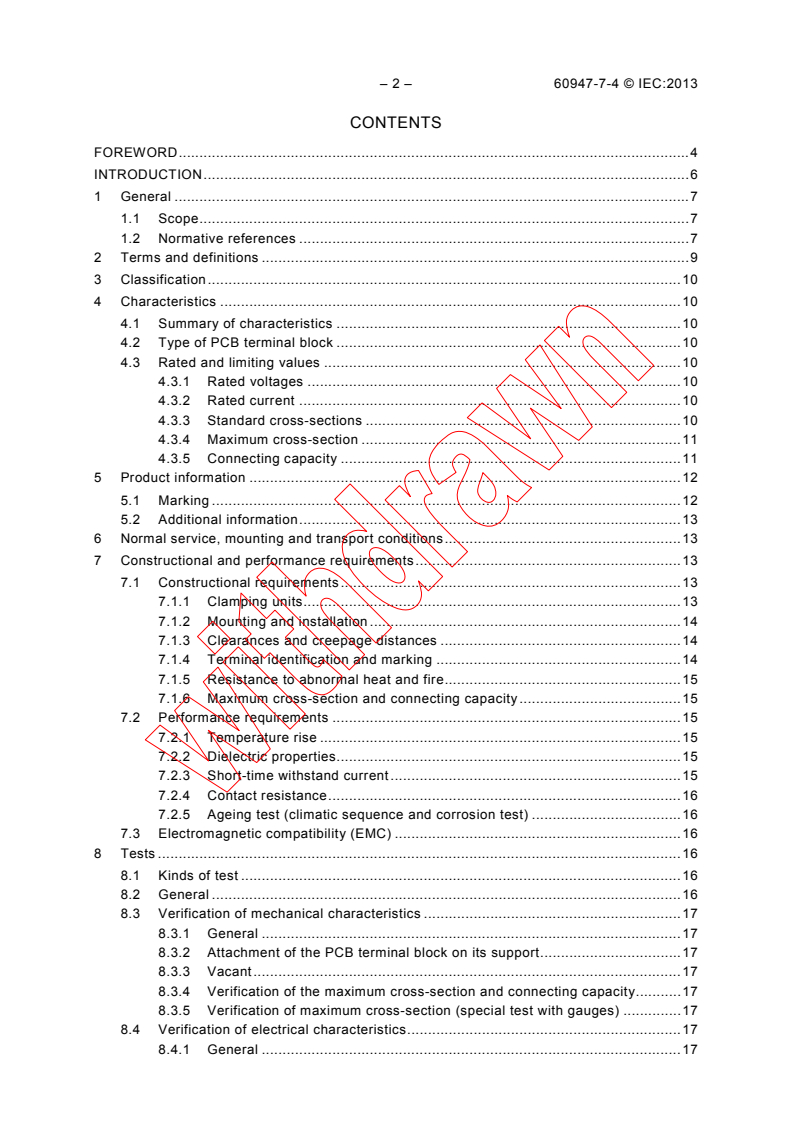
CONTENTS
FOREWORD . 4
INTRODUCTION . 6
1 General . 7
1.1 Scope . 7
1.2 Normative references . 7
2 Terms and definitions . 9
3 Classification . 10
4 Characteristics . 10
4.1 Summary of characteristics . 10
4.2 Type of PCB terminal block . 10
4.3 Rated and limiting values . 10
4.3.1 Rated voltages . 10
4.3.2 Rated current . 10
4.3.3 Standard cross-sections . 10
4.3.4 Maximum cross-section . 11
4.3.5 Connecting capacity . 11
5 Product information . 12
5.1 Marking . 12
5.2 Additional information . 13
6 Normal service, mounting and transport conditions . 13
7 Constructional and performance requirements . 13
7.1 Constructional requirements . 13
7.1.1 Clamping units . 13
7.1.2 Mounting and installation . 14
7.1.3 Clearances and creepage distances . 14
7.1.4 Terminal identification and marking . 14
7.1.5 Resistance to abnormal heat and fire . 15
7.1.6 Maximum cross-section and connecting capacity . 15
7.2 Performance requirements . 15
7.2.1 Temperature rise . 15
7.2.2 Dielectric properties . 15
7.2.3 Short-time withstand current . 15
7.2.4 Contact resistance . 16
7.2.5 Ageing test (climatic sequence and corrosion test) . 16
7.3 Electromagnetic compatibility (EMC) . 16
8 Tests . 16
8.1 Kinds of test . 16
8.2 General . 16
8.3 Verification of mechanical characteristics . 17
8.3.1 General . 17
8.3.2 Attachment of the PCB terminal block on its support . 17
8.3.3 Vacant . 17
8.3.4 Verification of the maximum cross-section and connecting capacity . 17
8.3.5 Verification of maximum cross-section (special test with gauges) . 17
8.4 Verification of electrical characteristics . 17
8.4.1 General . 17
60947-7-4 © IEC:2013 – 3 –
8.4.2 Verification of clearances and creepage distances. 18
8.4.3 Dielectric tests . 18
8.4.4 Verification of contact resistance . 19
8.4.5 Temperature rise test . 20
8.4.6 Short-time withstand current test . 22
8.4.7 Ageing test (climatic sequence and corrosion test) . 23
8.5 Verification of thermal characteristics . 24
8.6 Verification of EMC characteristics . 25
8.6.1 General . 25
8.6.2 Immunity. 25
8.6.3 Emission. 25
Annex A (informative) Structure of a PCB terminal block . 26
Annex B (informative) Additional Information to be specified between manufacturer
and user . 27
Annex C (informative) Examples of PCBs and PCB terminal blocks for high current
application . 28
Bibliography . 30
Figure 1 – Test assembly for the measurement of contact resistance and temperature
rise . 20
Figure 2 – Example of wiring structure of a multi-tier PCB terminal block . 21
Figure 3 – Test assembly for the measurement of short-time withstand current . 23
Figure 4 – Test sequence . 24
Figure A.1 – Structure of a PCB terminal block . 26
Figure C.1 – Structure of a high current PCB . 28
Figure C.2 – PCB terminal block with soldered connection to the PCB . 28
Figure C.3 – PCB terminal block with screwed connection to the PCB . 29
Table 1 – Standard cross-sections of copper conductors . 11
Table 2 – Relationship between maximum cross-section and connecting capacity of
PCB terminal blocks. 12
Table 3 – Standards for clamping units and connecting methods . 14
Table 4 – Impulse withstand test voltages . 19
Table 5 – Dielectric test voltages corresponding to the rated insulation voltage . 19
Table 6 – Length of connectable conductors and conductor loops . 21
Table 7 – Examples of cross-sectional distribution of interconnections on printed
circuit boards . 22
– 4 – 60947-7-4 © IEC:2013
INTERNATIONAL ELECTROTECHNICAL COMMISSION
____________
LOW-VOLTAGE SWITCHGEAR AND CONTROLGEAR –
Part 7-4: Ancillary equipment –
PCB terminal blocks for copper conductors
FOREWORD
1) The International Electrotechnical Commission (IEC) is a worldwide organization for standardization comprising
all national electrotechnical committees (IEC National Committees). The object of IEC is to promote
international co-operation on all questions concerning standardization in the electrical and electronic fields. To
this end and in addition to other activities, IEC publishes International Standards, Technical Specifications,
Technical Reports, Publicly Available Specifications (PAS) and Guides (hereafter referred to as “IEC
Publication(s)”). Their preparation is entrusted to technical committees; any IEC National Committee interested
in the subject dealt with may participate in this preparatory work. International, governmental and non-
governmental organizations liaising with the IEC also participate in this preparation. IEC collaborates closely
with the International Organization for Standardization (ISO) in accordance with conditions determined by
agreement between the two organizations.
2) The formal decisions or agreements of IEC on technical matters express, as nearly as possible, an international
consensus of opinion on the relevant subjects since each technical committee has representation from all
interested IEC National Committees.
3) IEC Publications have the form of recommendations for international use and are accepted by IEC National
Committees in that sense. While all reasonable efforts are made to ensure that the technical content of IEC
Publications is accurate, IEC cannot be held responsible for the way in which they are used or for any
misinterpretation by any end user.
4) In order to promote international uniformity, IEC National Committees undertake to apply IEC Publications
transparently to the maximum extent possible in their national and regional publications. Any divergence
between any IEC Publication and the corresponding national or regional publication shall be clearly indicated in
the latter.
5) IEC itself does not provide any attestation of conformity. Independent certification bodies provide conformity
assessment services and, in some areas, access to IEC marks of conformity. IEC is not responsible for any
services carried out by independent certification bodies.
6) All users should ensure that they have the latest edition of this publication.
7) No liability shall attach to IEC or its directors, employees, servants or agents including individual experts and
members of its technical committees and IEC National Committees for any personal injury, property damage or
other damage of any nature whatsoever, whether direct or indirect, or for costs (including legal fees) and
expenses arising out of the publication, use of, or reliance upon, this IEC Publication or any other IEC
Publications.
8) Attention is drawn to the Normative references cited in this publication. Use of the referenced publications is
indispensable for the correct application of this publication.
9) Attention is drawn to the possibility that some of the elements of this IEC Publication may be the subject of
patent rights. IEC shall not be held responsible for identifying any or all such patent rights.
International Standard IEC 60947-7-4 has been prepared by subcommittee 17B: Low-voltage
switchgear and controlgear, of IEC technical committee 17: Switchgear and controlgear.
The text of this standard is based on the following documents:
FDIS Report on voting
17B/1822/FDIS 17B/1827/RVD
Full information on the voting for the approval of this standard can be found in the report on
voting indicated in the above table.
This publication has been drafted in accordance with the ISO/IEC Directives, Part 2.
A list of all parts in the IEC 60947 series, published under the general title Low-voltage
switchgear and controlgear, can be found on the IEC website.
60947-7-4 © IEC:2013 – 5 –
The committee has decided that the contents of this publication will remain unchanged until
the stability date indicated on the IEC web site under "http://webstore.iec.ch" in the data
related to the specific publication. At this date, the publication will be
• reconfirmed,
• withdrawn,
• replaced by a revised edition, or
• amended.
IMPORTANT – The 'colour inside' logo on the cover page of this publication indicates
that it contains colours which are considered to be useful for the correct
understanding of its contents. Users should therefore print this document using a
colour printer.
– 6 – 60947-7-4 © IEC:2013
INTRODUCTION
This standard IEC 60947-7-4 for PCB terminal blocks covers not only the terminal block
requirements according to IEC 60947-7 series but also takes into account the specifications of
connectors according to IEC 61984 as the requirements for both components are highly
similar due to equivalent applications.
60947-7-4 © IEC:2013 – 7 –
LOW-VOLTAGE SWITCHGEAR AND CONTROLGEAR –
Part 7-4: Ancillary equipment –
PCB terminal blocks for copper conductors
1 General
1.1 Scope
This part of IEC 60947 specifies requirements for PCB terminal blocks primarily intended for
industrial or similar use.
Mounting and fixing on the printed circuit board is made by soldering, press-in or equivalent
methods to provide electrical and mechanical connection between copper conductors and the
printed circuit board.
This standard applies to PCB terminal blocks intended to connect copper conductors, with or
2 2
without special preparation, having a cross-section between 0,05 mm and 300 mm (AWG
30/600 kcmil), intended to be used in circuits of a rated voltage not exceeding 1 000 V a.c. up
to 1 000 Hz or 1 500 V d.c.
NOTE 1 Large cross section terminal blocks are dedicated to specific design of high current PCBs. The range up
to 300 mm² is kept to cover any possible application. Examples of high current PCBs and PCB terminal blocks are
shown in Annex C.
NOTE 2 AWG is the abbreviation of “American Wire Gage” (Gage (US) = Gauge (UK));
kcmil = 1 000 cmil;
1 cmil = 1 circular mil = surface of a circle having a diameter of 1 mil;
1 mil = 1/1 000 inch.
This standard may be used as a guide for special types of PCB terminal blocks with
components, such as disconnect units, integrated cartridge fuse-links and the like.
If applicable, in this standard the term “clamping unit” is used instead of “terminal”. This is
taken into account in case of references to IEC 60947-1.
1.2 Normative references
The following documents, in whole or in part, are normatively referenced in this document and
are indispensable for its application. For dated references, only the edition cited applies. For
undated references, the latest edition of the referenced document (including any
amendments) applies.
IEC 60068-2-20, Environmental testing – Part 2-20: Tests – Test T: Test methods for
solderability and resistance to soldering heat of devices with leads
IEC 60352-1, Solderless connections – Part 1: Wrapped connections – General requirements,
test methods and practical guidance
IEC 60352-2, Solderless connections – Part 2: Crimped connections – General requirements,
test methods and practical guidance
IEC 60352-3, Solderless connections – Part 3: Solderless accessible insulation displacement
connections – General requirements, test methods and practical guidance
– 8 – 60947-7-4 © IEC:2013
IEC 60352-4, Solderless connections – Part 4: Solderless non-accessible insulation
displacement connections – General requirements, test methods and practical guidance
IEC 60352-5, Solderless connections – Part 5: Press-in connections – General requirements,
test methods and practical guidance
IEC 60352-6, Solderless connections – Part 6: Insulation piercing connections – General
requirements, test methods and practical guidance
IEC 60352-7, Solderless connections – Part 7: Spring clamp connections – General
requirements, test methods and practical guidance
IEC 60512-2-1, Connectors for electronic equipment – Tests and measurements – Part 2-1:
Electrical continuity and contact resistance tests – Test 2a: Contact resistance – Millivolt level
method
IEC 60512-4-1, Connectors for electronic equipment – Tests and measurements – Part 4-1:
Voltage stress tests – Test 4a: Voltage proof
IEC 60512-5-2, Connectors for electronic equipment – Tests and measurements – Part 5-2:
Current-carrying capacity tests – Test 5b: Current-temperature derating
IEC 60512-11-7, Connectors for electronic equipment – Tests and measurements – Part 11-7:
Climatic tests – Test 11g: Flowing mixed gas corrosion test
IEC 60512-11-9, Connectors for electronic equipment – Tests and measurements – Part 11-9:
Climatic tests – Test 11i: Dry heat
IEC 60512-11-10, Connectors for electronic equipment – Tests and measurements – Part 11-
10: Climatic tests – Test 11j: Cold
IEC 60695-2-11, Fire hazard testing – Part 2-11: Glowing/hot-wire based test methods –
Glow-wire flammability test method for end-products
IEC 60695-2-12, Fire hazard testing - Part 2-12: Glowing/hot-wire based test methods - Glow-
wire flammability index (GWFI) test method for materials
IEC 60695-2-13, Fire hazard testing – Part 2-13: Glowing/hot-wire based test methods –
Glow-wire ignition temperature (GWIT) test method for materials
IEC 60947-1:2007, Low-voltage switchgear and controlgear – Part 1: General rules
Amendment 1: 2010
IEC 60998-2-3, Connecting devices for low-voltage circuits for household and similar
purposes – Part 2-3: Particular requirements for connecting devices as separate entities with
insulation-piercing clamping units
IEC 60999-1, Connecting devices – Electrical copper conductors – Safety requirements for
screw-type and screwless-type clamping units – Part 1: General requirements and particular
2 2
requirements for clamping units for conductors from 0,2 mm up to 35 mm (included)
IEC 60999-2, Connecting devices – Electrical copper conductors – Safety requirements for
screw-type and screwless-type clamping units – Part 2: Particular requirements for clamping
2 2
units for conductors above 35 mm up to 300 mm (included)
60947-7-4 © IEC:2013 – 9 –
IEC 61210, Connecting devices – Flat quick-connect terminations for electrical copper
conductors – Safety requirements
ISO 6988, Metallic and other non-organic coatings – Sulfur dioxide test with general
condensation of moisture
2 Terms and definitions
For the purposes of this document, the terms and definitions given in IEC 60947-1, as well as
the following, apply.
2.1
printed circuit board
PCB
piece of insulating material with fixed metal traces to connect electronic components
Note 1 to entry: Printed circuit boards are typically subdivided according to:
– their structure (e.g. single- and double-sided, multilayers);
– the nature of the base material (e.g. rigid, flexible).
2.2
PCB terminal block
part intended to be mounted on a printed circuit board and carrying one or more mutually
insulated contact units and which provides an electrical and mechanical connection between
copper conductor and printed circuit board
2.3
rated current
current value assigned by the manufacturer which the PCB terminal block can carry
continuously (without interruption) and simultaneously through all its poles connected with the
maximum cross-section, preferably at an ambient temperature of 40 °C, without the upper
limiting temperature being exceeded
2.4
contact unit
conductive part establishing the connection between printed circuit board and connectable
conductor(s)
Note 1 to entry: See Annex A.
2.5
upper limiting temperature
ULT
maximum temperature in the PCB terminal block as outcome (sum) of the ambient
temperature and the temperature rise due to current flow, at which the PCB terminal block is
intended to be still operable
Note 1 to entry: At ambient temperature = ULT the available temperature rise due to current flow is zero, thus the
current carrying capacity of the PCB terminal block is zero.
2.6
lower limiting temperature
LLT
minimum temperature of a PCB terminal block assigned by the manufacturer, at which a PCB
terminal block is intended to operate
– 10 – 60947-7-4 © IEC:2013
3 Classification
A distinction is made between various types of PCB terminal blocks, if applicable, as follows:
a) type of clamping unit (see 7.1.1);
b) ability to accept prepared conductors (see 2.3.28 of IEC 60947-1:2007,
Amendment 1 (2010));
c) type of electrical contact to the printed circuit board;
d) type of mechanical fastening to the printed circuit board;
e) number of poles;
f) pitch (center to center pin spacing);
g) contact unit with identical or dissimilar clamping units;
h) number of clamping units on each contact unit;
i) service conditions.
4 Characteristics
4.1 Summary of characteristics
The characteristics of a PCB terminal block are as follows:
– type of PCB terminal block (see 4.2);
– rated and limiting values (see 4.3).
4.2 Type of PCB terminal block
The following shall be stated:
– type of clamping units (see 7.1.1);
– type of contacting on the printed circuit board;
– number of clamping units.
4.3 Rated and limiting values
4.3.1 Rated voltages
Subclauses 4.3.1.2 and 4.3.1.3 of IEC 60947-1:2007 apply.
4.3.2 Rated current
Verification of the rated current specified by the manufacturer is made according to 8.4.5.
If an ambient temperature other than 40 °C is used for the definition of the rated current, the
manufacturer should state, in the technical documentation, the ambient temperature on which
the rating is based, with reference, if appropriate, to the derating curve defined in
IEC 60512-5-2, Test 5b.
The derating curve is obtained by applying a reduction factor of 0,8 according to
IEC 60512-5-2, Test 5b. If another reduction factor is used, this shall be stated in the
technical documentation.
4.3.3 Standard cross-sections
The standard values for cross-sections of copper conductors to be used are given in Table 1.
60947-7-4 © IEC:2013 – 11 –
Table 1 – Standard cross-sections of copper conductors
Comparison between AWG/kcmil and metric sizes
Metric size ISO
Size Equivalent metric area
2 2
mm AWG/kcmil mm
0,05 30 0,05
0,08 28 0,08
0,14 26 0,13
0,2 24 0,205
0,34 22 0,324
0,5 20 0,519
0,75 18 0,82
1 – –
1,5 16 1,3
2,5 14 2,1
4 12 3,3
6 10 5,3
10 8 8,4
16 6 13,3
25 4 21,2
35 2 33,6
50 0 53,5
70 00 67,4
95 000 85
– 0000 107,2
120 250 (kcmil) 127
150 300 (kcmil) 152
185 350 (kcmil) 177
240 500 (kcmil) 253
300 600 (kcmil) 304
4.3.4 Maximum cross-section
The maximum cross-section shall be selected from the standard cross-sections given in
Table 1.
4.3.5 Connecting capacity
For PCB terminal blocks with a maximum cross-section between 0,05 mm and 35 mm
inclusive, the minimum range contained in Table 2 applies. The conductors may be rigid (solid
or stranded) or flexible. The manufacturer shall state the types and the maximum and
minimum cross-sections of conductors that can be connected and, if applicable, the number of
conductors simultaneously connectable to each clamping unit. The manufacturer shall also
state any necessary preparation of the end of the conductor.
– 12 – 60947-7-4 © IEC:2013
Table 2 – Relationship between maximum cross-section
and connecting capacity of PCB terminal blocks
Maximum cross-section Connecting capacity
2 2
mm AWG/kcmil mm AWG
0,05 30 0,05 30
0,08 28 0,05 – 0,08 30 – 28
0,14 26 0,05 – 0,08 – 0,14 30 – 28 – 26
0,2 24 0,08 – 0,14 – 0,2 28 – 26 – 24
0,34 22 0,14 – 0,2 – 0,34 26 – 24 – 22
0,5 20 0,2 – 0,34 – 0,5 24 – 22 – 20
0,75 18 0,34 – 0,5 – 0,75 22 – 20 – 18
1 – 0,5 – 0,75 – 1 –
1,5 16 0,75 – 1 – 1,5 20 – 18 – 16
2,5 14 1 – 1,5 – 2,5 18 – 16 – 14
4 12 1,5 – 2,5 – 4 16 – 14 – 12
6 10 2,5 – 4 – 6 14 – 12 – 10
10 8 4 – 6 – 10 12 – 10 – 8
16 6 6 – 10 – 16 10 – 8 – 6
25 4 10 – 16 – 25 8 – 6 – 4
35 2 16 – 25 – 35 6 – 4 – 2
50 0 25 – 35 – 50 4 – 2 – 0
70 00 35 – 50 – 70 2 – 0 – 00
95 000 50 – 70 – 95 0 – 00 – 000
– 0000 – 00 – 000 – 0000
120 250 70 – 95 – 120 000 – 0000 – 250
150 300 95 – 120 – 150 0000 – 250 – 300
185 350 120 – 150 – 185 250 – 300 – 350
– 400 – 300 – 350 – 400
240 500 150 – 185 – 240 350 – 400 – 500
300 600 185 – 240 – 300 400 – 500 – 600
5 Product information
5.1 Marking
A PCB terminal block shall be marked in a durable and legible manner with the following:
a) the name of the manufacturer or a trade mark by which the manufacturer can be readily
identified;
b) a type reference permitting its identification in order to obtain relevant information from the
manufacturer or his catalogue.
Very small PCB terminal blocks with a surface which cannot be marked shall be marked only
according to a). In those cases all specified information shall be marked on the smallest
packing unit.
60947-7-4 © IEC:2013 – 13 –
5.2 Additional information
The following information shall be stated by the manufacturer, if applicable, e.g. in the
manufacturer's data sheet or his catalogue or on the packing unit:
a) IEC 60947-7-4, if the manufacturer claims compliance with this standard;
b) the maximum cross-section;
c) the connecting capacity, if different from Table 2, including the number of conductors
simultaneously connectable;
d) the rated current and the reduction factor to determine the derating curve if different from
0,8;
NOTE Unless otherwise specified, the rated current is preferably determined on four-pole contact units.
e) the rated insulation voltage (U );
i
f) the rated impulse withstand voltage (U ), when determined;
imp
g) service conditions, if different from those in Clause 6;
h) special preparation of the end of the conductor.
6 Normal service, mounting and transport conditions
Clause 6 of IEC 60947-1:2007 applies.
7 Constructional and performance requirements
7.1 Constructional requirements
7.1.1 Clamping units
The clamping units shall allow the conductors to be connected by means ensuring that a
reliable mechanical linkage and electrical contact is properly maintained.
No contact pressure shall be transmitted through insulating materials other than ceramic, or
other material with characteristics not less suitable, unless there is sufficient resiliency in the
metallic parts to compensate for any possible shrinkage of the insulating material.
The corresponding test is under consideration.
Clamping units and connecting methods listed in Table 3 fulfil the requirements of this
standard.
– 14 – 60947-7-4 © IEC:2013
Table 3 – Standards for clamping units and connecting methods
Ref. Clamping units and connecting methods Reference standards
a) Screw-type clamping unit IEC 60999-1 or IEC 60999-2
b) Screwless-type clamping unit IEC 60999-1 or IEC 60999-2 or IEC 60352-7
c) Wrapped connection IEC 60352-1
d) Crimped connection IEC 60352-2
e) Insulation displacement connection (accessible) IEC 60352-3 or IEC 60998-2-3
f) Insulation displacement connection IEC 60352-4 or IEC 60998-2-3
(non accessible)
g) Press-in connection IEC 60352-5
h) Insulation piercing connection IEC 60352-6 or IEC 60998-2-3
i) Flat quick-connect termination IEC 61210
a
j) Soldered connection IEC 60068-2-20
a
The test method selected shall be stated in the test report.
NOTE The relevant standard applies for the preconditioning of prepared conductors.
7.1.2 Mounting and installation
PCB terminal blocks shall be so designed that safe mounting on a printed circuit board is
possible by means of soldering, pressing-in, screwing, etc. The connection to the printed
circuit board shall not be damaged by connecting the conductors.
Tests shall be made in accordance with 8.3.2.
7.1.3 Clearances and creepage distances
For PCB terminal blocks for which the manufacturer has stated values of rated impulse
withstand voltage (U ) and rated insulation voltage (U ), minimum values of clearances and
imp i
creepage distances are given in Tables 13 and 15 of IEC 60947-1:2007,
Amendment 1 (2010).
For PCB terminal blocks for which the manufacturer has not declared a value of rated impulse
withstand voltage (U ), guidance for minimum values is given in Annex H of
imp
IEC 60947-1:2007.
Electrical requirements are given in 7.2.2.
7.1.4 Terminal identification and marking
Subclause 7.1.8.4 of IEC 60947-1:2007 applies with the following addition.
A PCB terminal block shall have provision, or at least space, for identification marks or
numbers for each clamping unit or contact unit related to the circuit of which it forms a part
except when such marking is not physically possible.
If such marking is not possible the information shall be stated by the manufacturer, e.g. in the
manufacturer's data sheet or his catalogue or on the packing unit.
Such provision may consist of separate marking items, such as marking tags, identification
labels, etc.
60947-7-4 © IEC:2013 – 15 –
7.1.5 Resistance to abnormal heat and fire
The insulation materials of PCB terminal blocks shall not be adversely affected by abnormal
heat and fire.
Compliance is checked by:
a) the glow-wire test on the complete product according to 8.5 or
b) verification of the insulating material in accordance with
1) IEC 60695-2-12, method GWFI at a temperature of 850 °C or
2) IEC 60695-2-13, method GWIT at a temperature of 775 °C.
This verification is not necessary for small parts (see IEC 60695-2-11).
NOTE 1 The relevant test method is specified by the manufacturer.
NOTE 2 For some applications it may be mandatory to check compliance by the glow-wire test on the complete
product according to 8.5 only. The need is either defined in the end-product standard or by agreement between
manufacturer and users. See B.1.
7.1.6 Maximum cross-section and connecting capacity
PCB terminal blocks shall be so designed that conductors of the maximum cross-section and
the connecting capacity, if applicable, can be accepted.
Compliance is checked by the test described in 8.3.4.
The verification of the maximum cross-section may be performed by the special test according
to 8.3.5.
7.2 Performance requirements
7.2.1 Temperature rise
PCB terminal blocks shall be tested in accordance with 8.4.5. The sum of ambient
temperature and temperature rise of the PCB terminal block shall not exceed the upper
limiting temperature (ULT).
7.2.2 Dielectric properties
If the manufacturer has declared a value of the rated impulse withstand voltage (U ) (see
imp
4.3.1.3 of IEC 60947-1:2007), the requirements of 7.2.3 and 7.2.3.1 of IEC 60947-1:2007,
Amendment 1 (2010) apply. If applicable, the impulse withstand voltage test shall be carried
out in accordance with 8.4.3 a).
For the verification of solid insulation the power-frequency withstand voltage test shall be
carried out in accordance with 8.4.3 b).
The verification of sufficient clearances and creepage distances shall be made in accordance
with 8.4.2. For PCB terminal blocks for which the manufacturer has not declared a value of
rated impulse withstand voltage (U ), guidance for minimum values is given in Annex H of
imp
IEC 60947-1:2007.
7.2.3 Short-time withstand current
A PCB terminal block shall be capable of withstanding the short-time withstand current which
corresponds to 120 A/mm² for 1 s, in accordance with 8.4.6.
– 16 – 60947-7-4 © IEC:2013
The test shall be performed using the smallest cross-section in the current path of the contact
unit as declared by the manufacturer.
7.2.4 Contact resistance
When measured according to 8.4.4, the change in contact resistance of a PCB terminal block
caused by the conductor connection and the mounting on the printed circuit board shall not
exceed the permissible deviations.
7.2.5 Ageing test (climatic sequence and corrosion test)
For the verification of the resistance of connections against the influence of temperatures and
corrosive atmospheres the climatic sequence test shall be carried out.
Compliance is checked by the test described in 8.4.7.
7.3 Electromagnetic compatibility (EMC)
Subclause 7.3 of IEC 60947-1:2007, Amendment 1 (2010) applies.
8 Tests
8.1 Kinds of test
Subclause 8.1.1 of IEC 60947-1:2007 applies with the following addition.
No routine tests are specified. The verification of the maximum cross-section according to
8.3.5 is a special test. All other tests are type tests.
8.2 General
Unless otherwise specified, PCB terminal blocks are tested in new and in clean condition, and
installed as for normal use (see 6.3 of IEC 60947-1:2007) at an ambient temperature of
(25 ± 10) °C.
The tests are carried out in the order described in the subclauses.
Each test is carried out on new individual specimens with at least four contact units (one set)
where each multipole PCB terminal block may contain the required number of contact units.
For a PCB terminal block family with the same design and comparable form, tests need only
be performed on specimens representing the most unfavourable case.
The surface of the conductors shall be free of contamination and corrosion which degrades
performance.
Care shall be taken when stripping conductors to avoid cutting, nicking, scraping or otherwise
damaging the conductors.
In cases where the manufacturer has stated that special preparation of the end of the
conductor is necessary, the test report shall indicate the method of preparation used.
The tests are carried out with the type of conductors (rigid or flexible) as stated by the
manufacturer.
If one of the PCB terminal blocks does not withstand one of the tests, this test shall be
repeated on a second set of PCB terminal blocks, all of which shall then comply with the
60947-7-4 © IEC:2013 – 17 –
repeated test. If this test is part of a test sequence, the complete test sequence shall be
repeated.
8.3 Verification of mechanical characteristics
8.3.1 General
The verification of mechanical characteristics includes the following test:
– attachment of the PCB terminal block on its support (see 8.3.2);
– verification of the maximum cross-section and connecting capacity (see 8.3.4);
– verification of maximum cross-section (special test with gauges) (see 8.3.5).
8.3.2 Attachment of the PCB terminal block on its support
The tests shall be carried out on the smallest number of poles, preferably two poles, of a PCB
terminal block, which is mounted on an appropriate support (printed circuit board) as in
normal use according to the manufacturer’s instructions. For PCB terminal blocks to be
soldered on printed circuit boards, this test shall be carried out on printed circuit boards with
plated-through holes.
The wiring of the PCB terminal blocks for this test shall be carried out as shown in Figure 1
with the maximum cross-section as specified by the manufacturer.
After the verification of the contact resistance according to 8.4.4 this conductor shall be
connected and disconnected five times according to the manufacturer’s instructions. For each
connection a new end of the conductor shall be used.
The tightening torque for PCB terminal blocks with screw-type clamping units shall be in
accordance with Table 4 of IEC 60947-1:2007 or alternatively with a higher value as specified
by the manufacturer.
At the end of the test the PCB terminal blocks shall comply with the contact resistance test
according to 8.4.4. After the test the terminal assembly shall be free from damage which may
impair further use.
8.3.3 Vacant
8.3.4 Verification of the maximum cross-section and connecting capacity
The verification of the maximum cross-section and connecting capacity shall be carried out
according to the standard for clamping units to be used (see 7.1.1).
NOTE The mechanical properties of clamping units are tested according to the applicable connecting methods
listed in Table 3.
8.3.5 Verification of maximum cross-section (special test with gauges)
Subclause 8.2.4.5 of IEC 60947-1:2007, Amendment 1 (2010) applies with the following
addition.
The test shall be carried out on each clamping unit of one PCB terminal block.
8.4 V
...