


ISO/IEC 14543-3-5:2007
(Main)Information technology - Home electronic system (HES) architecture - Part 3-5: Media and media dependent layers - Powerline for network based control of HES Class 1
Information technology - Home electronic system (HES) architecture - Part 3-5: Media and media dependent layers - Powerline for network based control of HES Class 1
Home Electronic System (HES) standards describe the architecture of home control systems including communication and interoperability aspects. This International Standard defines the mandatory and optional requirements for medium specific physical and data link layer of power line Class 1.
General Information
- Status
- Published
- Publication Date
- 15-May-2007
- Technical Committee
- ISO/IEC JTC 1/SC 25 - Interconnection of information technology equipment
- Current Stage
- PPUB - Publication issued
- Start Date
- 16-May-2007
- Completion Date
- 31-Dec-2006
Overview
ISO/IEC 14543-3-5:2007 specifies the media‑dependent layers for powerline communication within the Home Electronic System (HES) architecture for HES Class 1. It defines the mandatory and optional physical layer and data link layer requirements for powerline media (notably PL110 and PL132 types) used for network‑based control of home and building automation systems. This part is intended to be used together with other parts of the ISO/IEC 14543 family.
Key topics and requirements
- Scope and conformance: Normative references, terms and definitions, and conformance rules to ensure interoperability across HES devices.
- Physical layer (PL110 / PL132):
- Medium properties and mains/transmission characteristics.
- Medium Attachment Unit (MAU) structure and power supply requirements.
- Installation topology, coupling methods and installation requirements.
- Surge protection and electromagnetic compatibility considerations.
- Signal encoding, synchronization and error control mechanisms.
- Data link layer (powerline):
- Addressing schemes: domain, individual and group addresses.
- Frame formats (standard and extended), control fields and check octets.
- Medium Access Control (MAC) algorithms and priority handling.
- Link services (L_Data, L_PollData, L_Busmon, L_Service_Information) and layer‑2 protocol behavior.
- Repeater and multi‑phase handling, parameters and service classes.
- Testing and parameters: Tables and figures specifying timing, frame encapsulation, encoding, and error‑handling (including Galois field operations referenced for error checking).
- IP / patent notes: The standard records patent claims related to synchronization and notch configurations and notes the patent holders’ statements regarding licensing.
Applications and who uses it
This standard is directly applicable to:
- Device manufacturers designing HES Class 1 powerline products (controllers, actuators, gateways, MAUs).
- System integrators and installers implementing powerline‑based home/building automation networks.
- Test laboratories and certification bodies verifying compliance with HES powerline media requirements.
- Standards developers and product managers aligning multi‑vendor interoperability for smart home lighting, HVAC control, energy management and other networked home control services.
Practical use cases include robust, low‑cost networking over existing mains wiring for lighting control, alarm/notification links and other HES control applications where wireless or dedicated wiring is undesirable.
Related standards
Use in conjunction with other parts of the ISO/IEC 14543 series (examples cited in the standard):
- ISO/IEC 14543-2-1 (Introduction and device modularity)
- ISO/IEC 14543-3-1, -3-2, -3-3, -3-4, -3-6, -3-7 (communication layers, transport, network and application layers)
Keywords: ISO/IEC 14543-3-5:2007, HES Class 1, Home Electronic System, powerline, PL110, PL132, physical layer, data link layer, MAU, powerline communications, home automation.
Get Certified
Connect with accredited certification bodies for this standard

BSI Group
BSI (British Standards Institution) is the business standards company that helps organizations make excellence a habit.

NYCE
Mexican standards and certification body.
Sponsored listings
Frequently Asked Questions
ISO/IEC 14543-3-5:2007 is a standard published by the International Electrotechnical Commission (IEC). Its full title is "Information technology - Home electronic system (HES) architecture - Part 3-5: Media and media dependent layers - Powerline for network based control of HES Class 1". This standard covers: Home Electronic System (HES) standards describe the architecture of home control systems including communication and interoperability aspects. This International Standard defines the mandatory and optional requirements for medium specific physical and data link layer of power line Class 1.
Home Electronic System (HES) standards describe the architecture of home control systems including communication and interoperability aspects. This International Standard defines the mandatory and optional requirements for medium specific physical and data link layer of power line Class 1.
ISO/IEC 14543-3-5:2007 is classified under the following ICS (International Classification for Standards) categories: 35.240.67 - IT applications in building and construction industry. The ICS classification helps identify the subject area and facilitates finding related standards.
ISO/IEC 14543-3-5:2007 is available in PDF format for immediate download after purchase. The document can be added to your cart and obtained through the secure checkout process. Digital delivery ensures instant access to the complete standard document.
Standards Content (Sample)
ISO/IEC 14543-3-5
Edition 1.0 2007-05
INTERNATIONAL
STANDARD
Information technology – Home electronic system (HES) architecture –
Part 3-5: Media and media dependent layers – Powerline for network based
control of HES Class 1
All rights reserved. Unless otherwise specified, no part of this publication may be reproduced or utilized in any form
or by any means, electronic or mechanical, including photocopying and microfilm, without permission in writing from
either IEC or IEC's member National Committee in the country of the requester. If you have any questions about IEC
copyright or have an enquiry about obtaining additional rights to this publication, please contact the address below or
your local IEC member National Committee for further information.
IEC Central Office Tel.: +41 22 919 02 11
3, rue de Varembé info@iec.ch
CH-1211 Geneva 20 www.iec.ch
Switzerland
About the IEC
The International Electrotechnical Commission (IEC) is the leading global organization that prepares and publishes
International Standards for all electrical, electronic and related technologies.
About IEC publications
The technical content of IEC publications is kept under constant review by the IEC. Please make sure that you have the
latest edition, a corrigendum or an amendment might have been published.
IEC publications search - webstore.iec.ch/advsearchform Electropedia - www.electropedia.org
The advanced search enables to find IEC publications by a The world's leading online dictionary on electrotechnology,
variety of criteria (reference number, text, technical containing more than 22 000 terminological entries in English
committee,…). It also gives information on projects, replaced and French, with equivalent terms in 16 additional languages.
and withdrawn publications. Also known as the International Electrotechnical Vocabulary
(IEV) online.
IEC Just Published - webstore.iec.ch/justpublished
Stay up to date on all new IEC publications. Just Published IEC Glossary - std.iec.ch/glossary
details all new publications released. Available online and 67 000 electrotechnical terminology entries in English and
once a month by email. French extracted from the Terms and definitions clause of
IEC publications issued between 2002 and 2015. Some
IEC Customer Service Centre - webstore.iec.ch/csc entries have been collected from earlier publications of IEC
If you wish to give us your feedback on this publication or TC 37, 77, 86 and CISPR.
need further assistance, please contact the Customer Service
Centre: sales@iec.ch.
ISO/IEC 14543-3-5
Edition 1.0 2007-05
INTERNATIONAL
STANDARD
Information technology – Home electronic system (HES) architecture –
Part 3-5: Media and media dependent layers – Powerline for network based
control of HES Class 1
INTERNATIONAL
ELECTROTECHNICAL
COMMISSION
ICS 35.240.67 ISBN 2-8318-9139-6
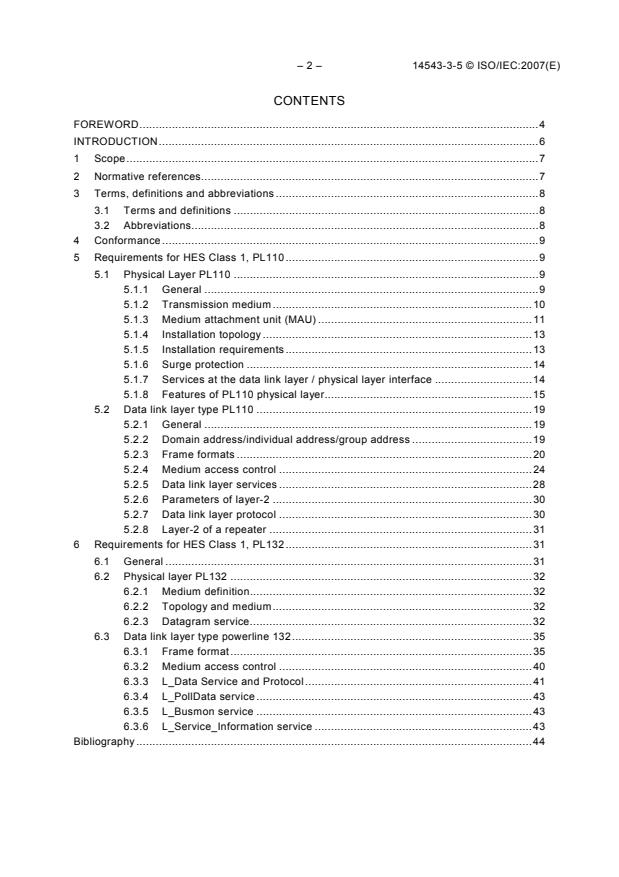
– 2 – 14543-3-5 © ISO/IEC:2007(E)
CONTENTS
FOREWORD.4
INTRODUCTION.6
1 Scope.7
2 Normative references.7
3 Terms, definitions and abbreviations .8
3.1 Terms and definitions .8
3.2 Abbreviations.8
4 Conformance.9
5 Requirements for HES Class 1, PL110.9
5.1 Physical Layer PL110 .9
5.1.1 General .9
5.1.2 Transmission medium .10
5.1.3 Medium attachment unit (MAU) .11
5.1.4 Installation topology .13
5.1.5 Installation requirements.13
5.1.6 Surge protection .14
5.1.7 Services at the data link layer / physical layer interface .14
5.1.8 Features of PL110 physical layer.15
5.2 Data link layer type PL110 .19
5.2.1 General .19
5.2.2 Domain address/individual address/group address .19
5.2.3 Frame formats .20
5.2.4 Medium access control .24
5.2.5 Data link layer services .28
5.2.6 Parameters of layer-2 .30
5.2.7 Data link layer protocol .30
5.2.8 Layer-2 of a repeater .31
6 Requirements for HES Class 1, PL132.31
6.1 General .31
6.2 Physical layer PL132 .32
6.2.1 Medium definition.32
6.2.2 Topology and medium.32
6.2.3 Datagram service.32
6.3 Data link layer type powerline 132.35
6.3.1 Frame format.35
6.3.2 Medium access control .40
6.3.3 L_Data Service and Protocol.41
6.3.4 L_PollData service.43
6.3.5 L_Busmon service .43
6.3.6 L_Service_Information service .43
Bibliography .44
14543-3-5 © ISO/IEC:2007(E) – 3 –
Figure 1 – Structure of the MAU (example).10
Figure 2 – Signal encoding .11
Figure 3 – Idealised overlapping of 105,6 kHz and 115,2 kHz .12
Figure 4 – Example of a PL inductive coupling circuit.13
Figure 5 – Example of a typical PL topology.13
Figure 6 – Character .15
Figure 7 – Structure of a datagram .15
Figure 8 – Structure of an acknowledgement frame .16
Figure 9 – Generation matrix of PL110 .16
Figure 10 – Operations of Galois Field GF2 .17
Figure 11 – Three phase system (example for 50 Hz) .18
Figure 12 – Domain Address .19
Figure 13 – Individual Address .19
Figure 14 – Group Address .20
Figure 15 – Format 1s, frame fields with standard fieldname abbreviations .20
Figure 16 – Format 1s, L_Data_Standard request frame format .21
Figure 17 – Control field.21
Figure 18 – Check octet .22
Figure 19 – Frame fields with standard fieldname abbreviations.22
Figure 20 – Format 1e, L_Data_Extended request frame format .23
Figure 21 – Extended control field .23
Figure 22 – Format 2, short acknowledgement frame format.24
Figure 23 – Timing diagram of an L_Data-request frame.27
Figure 24 – Complete frame encapsulation (Datagram) .34
Figure 25 – Overview of primitives.34
Figure 26 – Frame fields with standard fieldname abbreviations.36
Figure 27 – L_Data request standard frame format .36
Figure 28 – Control field.36
Figure 29 – NPCI field.37
Figure 30 – Frame fields with standard fieldname abbreviations.38
Figure 31 – L_Data_ Extended request frame format .38
Figure 32 – Extended control field .39
Figure 33 – Data field in positive Acknowledgement Frame (ACK) .40
Figure 34 – Complete Acknowledgement Frame Encapsulation (ACK) .40
Table 1 – General requirements for physical layer PL110.9
Table 2 – Power supply of the MAU .11
Table 3 – Requirements for the impedance of the MAU .12
Table 4 – Table of syndromes related to errors.17
Table 5 – L_Data-request priorities.26
Table 6 – Parameters for Ph-Data service .34
Table 7 – Ph-Service class parameters .35
Table 8 – Ph-Result values.35
– 4 – 14543-3-5 © ISO/IEC:2007(E)
INFORMATION TECHNOLOGY –
HOME ELECTRONIC SYSTEM (HES) ARCHITECTURE –
Part 3-5: Media and media dependent layers –
Powerline for network based control of HES Class 1
FOREWORD
1) ISO (International Organization for Standardization) and IEC (International Electrotechnical Commission) form
the specialized system for worldwide standardization. National bodies that are members of ISO or IEC
participate in the development of International Standards. Their preparation is entrusted to technical
committees; any ISO and IEC member body interested in the subject dealt with may participate in this
preparatory work. International governmental and non-governmental organizations liaising with ISO and IEC
also participate in this preparation.
2) In the field of information technology, ISO and IEC have established a joint technical committee,
ISO/IEC JTC 1. Draft International Standards adopted by the joint technical committee are circulated to
national bodies for voting. Publication as an International Standard requires approval by at least 75 % of the
national bodies casting a vote.
3) The formal decisions or agreements of IEC and ISO on technical matters express, as nearly as possible, an
international consensus of opinion on the relevant subjects since each technical committee has representation
from all interested IEC and ISO member bodies.
4) IEC, ISO and ISO/IEC Publications have the form of recommendations for international use and are accepted
by IEC and ISO member bodies in that sense. While all reasonable efforts are made to ensure that the
technical content of IEC, ISO and ISO/IEC Publications is accurate, IEC or ISO cannot be held responsible for
the way in which they are used or for any misinterpretation by any end user.
5) In order to promote international uniformity, IEC and ISO member bodies undertake to apply IEC, ISO and
ISO/IEC Publications transparently to the maximum extent possible in their national and regional publications.
Any divergence between any ISO/IEC Publication and the corresponding national or regional publication should
be clearly indicated in the latter.
6) ISO and IEC provide no marking procedure to indicate their approval and cannot be rendered responsible for
any equipment declared to be in conformity with an ISO/IEC Publication.
7) All users should ensure that they have the latest edition of this publication.
8) No liability shall attach to IEC or ISO or its directors, employees, servants or agents including individual
experts and members of their technical committees and IEC or ISO member bodies for any personal injury,
property damage or other damage of any nature whatsoever, whether direct or indirect, or for costs (including
legal fees) and expenses arising out of the publication of, use of, or reliance upon, this ISO/IEC publication or
any other IEC, ISO or ISO/IEC publications.
9) Attention is drawn to the normative references cited in this publication. Use of the referenced publications is
indispensable for the correct application of this publication.
IEC and ISO draw attention to the fact that it is claimed that compliance with this document may involve the use of
a patent concerning an efficient implementation of synchronization, see 5.1.8.7.
Busch-Jaeger has informed IEC and ISO that they have the granted patent EP 0856954.
IEC and ISO draw attention to the fact that it is claimed that compliance with this document may involve the use of
a patent in case specific notch configurations are implemented.
Zumtobel has informed IEC and ISO that they have the granted patent DE 29701412.
ISO and IEC take no position concerning the evidence, validity and scope of these putative patent rights. The
holders of these putative patent rights have assured IEC and ISO that they are willing to negotiate free licences or
licences under reasonable and non-discriminatory terms and conditions with applicants throughout the world. In this
respect, the statements of the holders of these putative patent rights are registered with IEC and ISO. Information
may be obtained from:
Busch-Jaeger Zumtobel Staff GmbH
Freisenbergstraße 2 Schweizerstrasse 30
D-58513 Lüdenscheid A-6850 Dornbirn
Germany Austria
14543-3-5 © ISO/IEC:2007(E) – 5 –
Attention is drawn to the possibility that some of the elements of this document may be the subject of patent rights
other than those identified above. IEC and ISO shall not be held responsible for identifying any or all such patent
rights.
International Standard ISO/IEC 14543-3-5 was prepared by subcommittee 25: Interconnection
of information technology equipment, of ISO/IEC joint technical committee 1: Information
technology.
This International Standard is a product family standard. It shall be used in conjunction with
ISO/IEC 14543-2-1, 14543-3-1, 14543-3-2, 14543-3-3, 14543-3-4, 14543-3-6 and 14543-3-7.
The list of all currently available parts of the ISO/IEC 14543 series, under the general title
Information technology – Home electronic system (HES) architecture, can be found on the IEC
web site.
This International Standard has been approved by vote of the member bodies, and the voting
results may be obtained from the address given on the second title page.
This publication has been drafted in accordance with the ISO/IEC Directives, Part 2.
– 6 – 14543-3-5 © ISO/IEC:2007(E)
INTRODUCTION
The Reference model for Open System Interconnection (OSI), specified in ISO/IEC 7498,
assigns the functions that are needed for communications between two entities that are
connected by a medium to seven logical layers. This International Standard specifies
interconnection of entities used for home and building control via the medium powerline. It
specifies the medium dependent functions, that is the mains characteristics and the
transmission technology in terms of the Physical Layer and the Data Link Layer, according to
ISO/IEC 7498.
Currently, ISO/IEC 14543, Information technology – Home Electronic System (HES)
architecture, consists of the following parts:
Part 2-1: Introduction and device modularity
Part 3-1: Communication layers – Application layer for network based control of HES Class 1
Part 3-2: Communication layers – Transport, network and general parts of data link layer for
network based control of HES Class 1
Part 3-3: User process for network based control of HES Class 1
Part 3-4: System management – Management procedures for network based control of HES
Class 1
Part 3-5: Media and media dependent layers – Powerline for network based control of HES
Class 1
Part 3-6: Media and media dependent layers – Twisted pair for network based control of
HES Class 1
Part 3-7: Media and media dependent layers – Radio frequency for network based control of
HES Class 1
Part 4: Home and building automation in a mixed-use building (technical report)
Part 5-1: Intelligent grouping and resource sharing for HES Class 2 and Class 3 – Core
protocol (under consideration)
Part 5-2: Intelligent grouping and resource sharing for HES Class 2 and Class 3 – Device
certification (under consideration)
Additional parts may be added at a later date.
14543-3-5 © ISO/IEC:2007(E) – 7 –
INFORMATION TECHNOLOGY –
HOME ELECTRONIC SYSTEM (HES) ARCHITECTURE –
Part 3-5: Media and media dependent layers –
Powerline for network based control of HES Class 1
1 Scope
This part of ISO/IEC 14543 defines the mandatory and optional requirements for the medium
specific Physical and Data Link Layer of Powerline Class 1 in its two variations PL110 and
PL132.
NOTE Data Link Layer interface and general definitions, which are medium independent, are given in
ISO/IEC 14543-3-1.
2 Normative references
The following referenced documents are indispensable for the application of this document. For
dated references, only the edition cited applies. For undated references, the latest edition of
the referenced document (including any amendments) applies.
ISO/IEC 14543-2-1, Information technology – Home Electronic System (HES) architecture –
Part 2-1: Introduction and device modularity
ISO/IEC 14543-3-1, Information technology – Home Electronic System (HES) architecture –
Part 3-1: Communication layers – Application layer for network based control of HES Class 1
ISO/IEC 14543-3-2, Information technology – Home Electronic System (HES) architecture –
Part 3-2: Communication layers – Transport, network and general parts of data link layer for
network based control of HES Class 1
ISO/IEC 14543-3-3, Information technology – Home Electronic System (HES) architecture –
Part 3-3: User process for network based control of HES Class 1
ISO/IEC 14543-3-4, Information technology – Home Electronic System (HES) architecture –
Part 3-4: System management – Management procedures for network based control of HES
Class 1
ISO/IEC 14543-3-6, Information technology – Home Electronic System (HES) architecture –
Part 3-6: Media and media dependent layers – Twisted pair for network based control of HES
Class 1
ISO/IEC 14543-3-7, Information technology – Home Electronic System (HES) architecture –
Part 3-6: Media and media dependent layers – Radio frequency for network based control of
HES Class 1
CISPR 16-1-1, Specification for radio disturbance and immunity measuring apparatus and
methods – Part 1-1: Radio disturbance and immunity measuring apparatus – Measuring
apparatus
EN 50065-1, Signalling on low-voltage electrical installations in the frequency range 3 kHz to
148,5 kHz – Part 1: General requirements, frequency bands and electromagnetic disturbances
EN 50065-7, Signalling on low-voltage electrical installations in the frequency range 3 kHz to
148,5 kHz – Part 7: Equipment impedance
– 8 – 14543-3-5 © ISO/IEC:2007(E)
3 Terms, definitions and abbreviations
3.1 Terms and definitions
For the purposes of this International Standard the definitions given in ISO/IEC 14543-2-1
(some of which are repeated below for convenience) and the following apply.
3.1.1
differential mode
PL signals are injected between phase and neutral
3.1.2
router
connects one sub-network to another sub-network
3.1.3
PL110
powerline signalling operating in a frequency band of 95 kHz to 125 kHz according to
EN 50065-1
3.1.4
PL132
powerline signalling operating in a frequency band of 125 kHz to 140 kHz according to
EN 50065-1
3.2 Abbreviations
ACK acknowledgement
APDU Application Layer Protocol Data Unit
CS Check Sequence
CSMA Carrier Sense Multiple Access protocol
CTRL Control field
DAF Destination Address Flag
DOA Domain Address
FCS Frame Check Sequence
FEC Forward Error Correction
FSK Frequency Shift Keying
HES Class 1 refers to simple control and command
HES Class 2 refers to Class 1 plus simple voice and stable picture transmission
HES Class 3 refers to Class 2 plus complex video transfers
LPDU Link Layer Protocol Data Unit
MAU Medium Attachment Unit
MSK Minimum Shift Keying
NACK Not acknowledge
NPCI Network Protocol Control Information
NRZ No Return to Zero
PL Powerline
SPD Surge Protection Devices
TPDU Transport Layer Protocol Data Unit
SFSK Spread Frequency Shift Keying
14543-3-5 © ISO/IEC:2007(E) – 9 –
4 Conformance
A device conforming to this International Standard shall support the physical medium as
specified in clause 5 or clause 7, and it shall provide transmission capability as specified in
clause 6.
5 Requirements for HES Class 1, PL110
5.1 Physical Layer PL110
5.1.1 General
This clause describes the physical layer characteristics of the PL110 powerline signalling which
operates in the frequency band (95 to 125) kHz band as described in EN 50065-1 and which
has a nominal centre frequency of 110 kHz.
The main characteristics of PL110 physical layer are:
• a spread frequency shift keying signalling;
• asynchronous transmission of data packets;
• symbols globally synchronised to the mains frequency;
• half duplex bi-directional communication.
Electrical wiring in the building/home shall be in compliance with the current national
regulations. Powerline communication is described in EN 50065-1.
The electric power distribution network normally determines the physical topology of the
powerline network. The structure of this network may be single phase or three phase. The
rated voltage between one phase and neutral shall be 110 V and 230 V, respectively. PL110
signals are injected between phase and neutral.
General requirements for the physical layer type PL110 are given in Table 1.
Table 1 – General requirements for physical layer PL110
Characteristics Description
Medium Electrical power distribution network
Topology Installation dependant (e.g., linear, star, tree)
Bit rate 1 200 bit/s
Mains frequency 50 Hz and 60 Hz, respectively
Number of Domain Addresses 255
Number of Individual Addresses 32 767
Modulation type Spread frequency shift keying (SFSK)
Frequency for logical 0
105,6 kHz ± 0,1%
Frequency for logical 1
115,2 kHz ± 0,1%
Bit duration 833,3 µs
a
Maximum output level 122 dB µV
b
Input sensitivity ≤60 dB µV
c
Device class Class 122
Compliance to standards EN 50065-1
a
Measurement according to EN 50065-1.
b
With artificial network according to CISPR 16-1-1 [(50 µH + 5 Ω) / 50 Ω].
c
Equipment manufactured in accordance with class 116 according to EN 50065-1 will now meet the
requirements of Class 122 and may be marked Class 116 provided that its output complies with the
previous standard.
– 10 – 14543-3-5 © ISO/IEC:2007(E)
The logical structure of the physical layer PL110 entity is shown in Figure 1. Each PL110-
device includes one physical layer PL110 entity.
The PL110 entity shall consist of three blocks:
• connector;
• medium attachment unit (MAU);
• error correction.
Local Layer -1 User
Ph_Data.req Ph_Data.ind
octets
Error correction
Synchroni
-sation
character character
octets + error
encoding evaluation
correction
Txd Dump SCLK C_Data
bit stream
Bit to signal Correlator
Optional
encoding power-
signal at
supply
MAU
Transmitter Receiver
Connector
medium with
analog signal
Figure 1 – Structure of the MAU (example)
5.1.2 Transmission medium
5.1.2.1 Requirements for protection against electric shocks and connectors
The PL110 devices are connected to the mains installation network. The requirements for
protection against electric shocks for human beings (and animals) and connectors shall be
considered within the assembled device. They are not subject to the physical layer description.
These requirements are specified in the installation and equipment standards (safety
standards).
5.1.2.2 Powerline cables
The requirements for powerline cables are defined by the use as installation wires according to
national regulations. Normally, the type of cable, the connected loads and the topology of the
network is not known. In contrast to the theoretical values of typical cable characteristics, for
example as specified in IEC 60227-4 and IEC 60502-1, the impedance at one network access
point is determined more by the connected load than by the cabling.
Typical cables for fixed electrical installation are “thermoplastic-insulated and sheathed cable”,
“PC insulated flat cable, overall covering vulcanised rubber” or “sheathed metal-clad wiring
cable with PVC insulated cores sheet-zinc cover with additional PVC jacket”.
NOTE The use of shielded power cables and of cables with cross-sections greater than 35 mm can influence
PL110 signalling significantly!
14543-3-5 © ISO/IEC:2007(E) – 11 –
5.1.3 Medium attachment unit (MAU)
The Medium Attachment Unit converts the frequency-coded signals into values representing
logical ones and zeroes and vice versa. In parallel, a power supply circuit may be connected to
the medium. Signal converter and power supply shall be independent from each other. The
power supply shall meet the requirements specified in Table 2.
Table 2 – Power supply of the MAU
Power supply Nominal values
Receiving
5 V at 30 mA / 24 V at 1 mA
mode
Transmitting 5 V at 30 mA / 24 V at 10 mA – 50 mA (dependent on
mode impedance)
Compliance is checked by measurement.
The power supply of the MAU may be internal or external.
5.1.3.1 Signal encoding
A signal of 105,6 kHz for a period of 833,3 µs shall correspond to a logical 0, a signal of
115,2 kHz for a period of 833,3 µs to a logical 1. See Figure 2.
Symbolic: 105,6 kHz Symbolic: 115,2 kHz
1,8 V
0 Time
– 1,8 V
833,3 μs 833,3 μs
Logical "0" Logical "1"
Figure 2 – Signal encoding
These NRZ signals are superimposed on the AC voltage of the mains at 50 Hz and 60 Hz,
respectively. The maximum amplitude of the signal shall be limited to 122 dBμV, measured
according to EN 50065-1 by using an artificial mains network as specified in CISPR 16-1-1.
The sensitivity of the receiver shall exceed 60 dBµV.
For minimal disturbance, the change between adjacent symbols shall be phase continuous, as
shown in Figure 2.
Compliance is checked by measurement.
5.1.3.2 Overlapping of logical 0 or 1
Overlapping of logical 0 or 1 symbols, for example, the simultaneous transmission of equal
information at the same time from several MAUs (e.g., common ACK), results in fade-in / fade-
out effects. Due to slight frequency deviations between several MAUs, the signal fades
Amplitude
– 12 – 14543-3-5 © ISO/IEC:2007(E)
periodically with the difference of the MAU frequencies. In PL110 powerline communication this
case can be avoided by setting a unique group response flag to each assigned group address.
5.1.3.3 Overlapping of logical 0 and 1
Overlapping of logical 0 and 1 symbols, for example, the simultaneous transmission of different
information at the same time from several MAUs, results in a collision. While there is no
indication of collision for any MAU, the probability of this state is minimised by a special bus
access mechanism.
2,0
1,5
1,0
0,5
0,0
1 12 23 34 45 56 67 78 89 100 111 122 133144155166177188199210221 232243254265276287298309320 331 342 353 364 375 386397408
-0,5
-1,0
-1,5
-2,0
t [µs]
Figure 3 – Idealised overlapping of 105,6 kHz and 115,2 kHz
5.1.3.4 Impedance of the MAU
To limit the influence of connected MAUs on the characteristic of the powerline bus the
impedance in receiving mode shall be high. For signal injection with minimum losses, the
impedance in transmitting mode shall be low. When tested according to EN 50065-7, the limits
for PL110 shall be:
Table 3 – Requirements for the impedance of the MAU
Impedance on Requirements
Receiving mode ⎜Z ⎜ ≥ 80 Ω at 100 kHz to 125 kHz
in
Transmitting mode ⎜Z ⎜ ≤ 20 Ω at 100 kHz to 125 kHz
out
Amplitude [V]
14543-3-5 © ISO/IEC:2007(E) – 13 –
5.1.3.5 PL bus coupling
Fuse C
K
Phase
T
r
a
n
T
1 s
c
R e
I
D
v
e
r
Neutral
Legend:
C : coupling capacitor, X2-type
k
T : coupling transformer
D : transient voltage protection diode
R : resistor for discharging C (optional)
1 k
Figure 4 – Example of a PL inductive coupling circuit
Electrical coupling of signals to the powerline is done by special circuits. In general, capacitive
or inductive coupling may be used. Inductive coupling may be or may not be combined with
electrical insulation.
5.1.4 Installation topology
The structure of an electrical installation is either linear, star, ring, tree, or any combination
thereof. Referring to the electrical distribution board as the centre, the topology normally has a
star structure. Each branch of the electrical distribution network may have its own different
structure.
distribution panel
circuit
breaker
optional
.
branches
leakage
.
.
meter fuse
of free
circuit
topology
protector
circuit
breaker
Figure 5 – Example of a typical PL topology
5.1.5 Installation requirements
The installation of the powerline network is subject to national and international regulations and
standards. Additional instructions about the communication aspects of the network may be
given in the manufacturer’s instruction sheet.
– 14 – 14543-3-5 © ISO/IEC:2007(E)
5.1.6 Surge protection
The electrical installation may or may not be provided with external surge protection. Where
external SPD is provided it shall comply with type 1 (for primary protection) or type 2 (for
secondary protection).
NOTE Type 1 and type 2 protection will be specified in forthcoming IEC 61643-11 (see bibliography).
5.1.7 Services at the data link layer / physical layer interface
Two services Ph_Data.req (p_class, p_data) and Ph_Data.ind (p_class, p_data) shall be
implemented at the data link / physical layer interface.
Ph_Data.req shall be called by the data link layer. Each Ph_Data.req() service primitive shall
transfer a single octet to the physical layer. The class parameter shall contain timing
information.
p_class: start_of_sys.prio_frame: This parameter value shall be used to transmit
training sequence, preamble I, preamble II and
character after at least 58 bit times idle line since the
last bit of the preceding data link message cycle.
start_of_prio_frame: This parameter value shall be used to transmit
training sequence, preamble I, preamble II and
character after at least 74 + (n-16) ⎪ 0 ≤ n ≤ 7 bit
times idle line since the last bit of the preceding data
link message cycle.
start_of_repeated_frame: This parameter value shall be used to transmit
training sequence, preamble I, preamble II and
character after exactly 40 bit times since the last bit of
the preceding L_Data request.
inner_frame_char: This parameter value shall be used to transmit a
character without any time gap after the last bit of the
preceding character.
ack_char: This parameter value shall be used to transmit
training sequence, preamble I, preamble II and
character after exactly 4 bit times after the last bit of
the preceding L_Data request.
nack_char: This parameter value shall be used to transmit
training sequence, preamble I, preamble II and
character after exactly 22 bit times after the last bit of
the preceding L_Data request.
p_data: octet: This parameter value shall contain the octet to be
expanded by forward error correction to a character to
be transmitted. Due to the fact that no collision-
detection is carried out during transmission the return
value of a Ph_Data.con shall always be "OK".
Ph_Data.ind shall be called by the physical layer. Each Ph_Data.ind() service primitive shall
transfer a single octet to the data link layer.
14543-3-5 © ISO/IEC:2007(E) – 15 –
Ph_Data.ind (p_class, p_data)
p_class: start_of_frame: This parameter value shall be used to indicate that
after detection of preamble I and preamble II a
character was received.
inner_frame_char: This parameter value shall be used to indicate that a
character was received immediately after the
preceding bit.
ack_char: This parameter value shall be used to indicate that
after detection of preamble I and preamble II a
character was received.
bit_error: This parameter value shall be used to indicate that an
uncorrectable bit error was detected in the received
character and that reception was terminated.
p_data: octet: This parameter value shall be used to indicate that
the data octet error was corrected and extracted from
the received character.
5.1.8 Features of PL110 physical layer
5.1.8.1 General
This subclause describes the frame format, error correction and synchronization of PL110
medium. Compliance to the requirements of this subclause are subject to transient and logical
measurement equipment.
5.1.8.2 PL110 character overview
Each PL110 frame shall start with a training sequence and a preamble. Training sequence and
preamble shall not be coded. Each Data Link layer octet shall be coded to a 12 bit character (8
bits data + 4 bits error correction).
Transmission direction
7 6 5 4 3 2 1 0 E 3 E 2 E 1 E 0
Octet Error Correction
Figure 6 – Character
During transmission and reception no time gaps are allowed between the bits of a character.
5.1.8.3 Frame structure
The datagram shall consist of training sequence, preamble I and preamble II, LPDU, and
Check Sequence (CS) and the Domain Address. Frame Check Sequence shall be calculated
with respect to Twisted Pair type 1 LPDU (see ISO/IEC 14543-3-6), which itself shall be
identical to the Twisted Pair type 1 LPDU. The CS for physical layer Twisted Pair Type 1 and
PL110 shall therefore be identical.
Training Domain
Preamble I
Preamble II LPDU
CS
sequence
Address
4 bit 2 x 8 Only the checksum CS is calculated 8 + 4 bit
bit
Figure 7 – Structure of a datagram
– 16 – 14543-3-5 © ISO/IEC:2007(E)
Training
ACK / NACK
Preamble I Preamble II
sequence character
8 + 4 bit
4 bit 2 x 8 bit
Figure 8 – Structure of an acknowledgement frame
5.1.8.4 Training sequence
After switching into the status start_of_pdu the physical layer shall transmit a training sequence
of 4 bit duration. The bit sequence is fixed to [0 1 0 1].
5.1.8.5 Preamble transmission start
The next 16 bit shall consist of preamble I and preamble II. This preamble shall allow the
receiver to start. The sequence of each preamble is fixed to B0h.
5.1.8.6 Faulty transmission detection
The error correction of the PL110 physical layer shall be done by powerline (12,8) block-
coding. Generation shall be calculated with the following matrix:
⎡1 0 0 0 0 0 0 0⎤
⎢ ⎥
0 1 0 0 0 0 0 0
⎢ ⎥
⎢ ⎥
0 0 1 0 0 0 0 0
⎢ ⎥
⎢ ⎥
0 0 0 1 0 0 0 0
⎢ ⎥
⎢ ⎥
0 0 0 0 1 0 0 0
⎢ ⎥
⎢ ⎥
0 0 0 0 0 1 0 0 ⎡E⎤
= =
G ⎢ ⎥
⎢ ⎥
⎢0 0 0 0 0 0 1 0⎥ ⎢T⎥
⎣ ⎦
⎢ ⎥
0 0 0 0 0 0 0 1
⎢ ⎥
⎢ ⎥
0 0 0 0 1 1 1 1
⎢ ⎥
⎢ ⎥
0 1 1 1 0 0 0 1
⎢ ⎥
⎢ ⎥
1 0 1 1 0 1 1 0
⎢ ⎥
⎢ ⎥
1 1 0 1 1 0 1 0
⎣ ⎦
Figure 9 – Generation matrix of PL110
Coding shall result in an overhead of 4 bit referring to one octet. The hamming distance of this
coding shall be a minimum of 3 characters per bit. With this (12,8) block-coding, it shall be
possible to correct every single bit error in a 12 bit character and identify some multiple errors.
The code shall be calculated by determining redundancy r as the function of the transformation
matrix T and the octet x:
r=⋅T x
To decode an estimated r’ of the redundancy that depends on the incoming data, d shall be
performed. The estimated redundancy shall be subtracted by the received redundancy d . The
u
result shall be a syndrome with the value of s indicating the column of the error. Correction
14543-3-5 © ISO/IEC:2007(E) – 17 –
shall be done by inverting this bit. For an error-free transmission the difference of r´ and d
u
shall be 0.
T
=
dd d
0 u
′= ⋅
r T d
= − ′
s d r
u
where
T is the transformation matrix,
r is the redundancy,
x is the octet,
d is the data,
d is the received redundancy,
u
s is the value of the syndrome.
Table 4 – Table of syndromes related to errors
Value of the
3 5 6 7 9 10 11 12 8 4 2 1 13 14 15 0
syndrome
Error-
Error location 1 2 3 4 5 6 7 8 9 10 11 12 error
free
For all calculations, GF2 arithmetic shall be used:
a
a b a+ b a× b a− b
b
1 1 0 1 0 1
0 1 1 0 1 0
1 0 1 0 1 −
0 0 0 0 0 −
Figure 10 – Operations of Galois Field GF2
EXAMPLE 1
T
x :=[]1 0 1 0 1 0 1 0 octet to be transmitted
00 00 1 11 1 0
⎡ ⎤ ⎡ ⎤
⎢ ⎥ ⎢ ⎥
0 1 11 00 0 1 1
⎢ ⎥ ⎢ ⎥
rT=⋅x= ⋅=x redundancy
⎢1 011 0 11 0⎥ ⎢1⎥
⎢ ⎥ ⎢ ⎥
1 10 1 10 10 1
⎣ ⎦ ⎣ ⎦
T
c=[] x , r =[]1 0 1 0 1 0 1 0 0 1 1 1 character to be transmitted
↓ Transmission error
– 18 – 14543-3-5 © ISO/IEC:2007(E)
T
d=[] d ,d =[]1 0 0 0 1 0 1 0 0 1 1 1 received character
o u
T
r=′ T ⋅ d = . = 0 0 0 1 estimated redundancy
[ ]
o
T
s =−d r′==0 1 1 0 6
[]
u 10
Referring to Figure 12 a syndrome value of 6 shall correspond to an error in column 3.
Inverting bit number 3 shall lead to the corrected frame.
5.1.8.7 Synchronization
The mains zero crossing period shall be:
• 10 ms in single phase systems and 3,3 ms in triple phase systems for a nominal
mains frequency of 50 Hz and
• 8,3 ms in single phase systems and 2,7 ms in triple phase systems for a nominal
mains frequency of 60 Hz.
By dividing the time base of 3,3 ms and 2,7 ms respectively, by an integer the set of possible
bit widths (and bit rates respectively) in triple phase systems shall be calculated:
bitrate= n⋅300bit / s n∈ N
350,000
250,000
150,000
50,000
Volt 0 1234 56 789 10 11 12 13 14 15 16 17 18 19 20
-50,000
-150,000
Delay T
d
T
bit
-250,000
-350,000
Time [ms]
time [msec]
Figure 11 – Three phase system (example for 50 Hz)
The start of a transmission shall not be placed exactly at the mains zero crossing due to
internal delays of the coupling circuit. The delay shall, however, not exceed the value shown
below.
T ≤ 40 µs
d
14543-3-5 © ISO/IEC:2007(E) – 19 –
In order to compensate deviations of mains frequencies PL110 MAUs shall detect the zero
crossing of the mains voltage and measure the actual mains frequency. If the mains frequency
(received in the described way) is placed within the permissible tolerance, the bit width shall be
calculated by the following formula:
actual mains frequency
actual bit width=
*1200
nominal mains frequency
With the help of the first transmitted bit the transmitter shall fix its bit width to the nominal bit
width of 833,3 μs. On receiving the first preamble the receiver shall also fix its bit width to the
nominal bit width of 833,3 μs and correct the beginning of the following bit by:
12 × (actual bit width − nominal bit width) for 50 Hz and
10 × (actual bit width − nominal bit width) for 60 Hz respectively.
5.2 Data link layer type PL110
5.2.1 General
This subclause describes the addressing, frame formats and access control of PL110 medium.
Compliance with requirements of this subclause is subject to transient and logical
measurement equipment.
5.2.2 Domain address/individual address/group address
Every PL110 device shall have a Domain Address. The Domain Address shall be a two octet
number. The most significant octet shall be set to zero, the lower significant octet shall contain
the number of the Domain Address.
Request frames with Domain Address zero shall be interpreted as system broadcasts.
Domain Address
Octet 0 Octet 1
b B b b b b b b b b b B b b B b
7 6 5 4 3 2 1 0 7 6 5 4 3 2 1 0
0 0 0 0 0 0 0 0 Number
Figure 12 – Domain Address
Every PL110 device (even a router) shall have a unique Individual Address in a network. The
Individual Address shall b
...
Questions, Comments and Discussion
Ask us and Technical Secretary will try to provide an answer. You can facilitate discussion about the standard in here.
Loading comments...