

ISO/TR 23244:2020
(Main)Blockchain and distributed ledger technologies — Privacy and personally identifiable information protection considerations
General Information
- Abstract
This document provides an overview of privacy and personally identifiable information (PII) protection as applied to blockchain and distributed ledger technologies (DLT) systems.
- Status
- Published
- Publication Date
- 06-May-2020
- Technical Committee
- ISO/TC 307 - Blockchain and distributed ledger technologies
- Current Stage
- 6060 - International Standard published
- Start Date
- 07-May-2020
- Due Date
- 21-Nov-2020
- Completion Date
- 07-May-2020
Buy Documents
ISO/TR 23244:2020 - Blockchain and distributed ledger technologies — Privacy and personally identifiable information protection considerations Released:5/7/2020
ISO/TR 23244:2020 - Blockchain and distributed ledger technologies — Privacy and personally identifiable information protection considerations/7/2020
Overview
ISO/TR 23244:2020 provides a practical overview of privacy and personally identifiable information (PII) protection in blockchain and distributed ledger technologies (DLT). It explains privacy risks, applicable safeguards and how traditional privacy principles (consent, data minimization, accountability, etc.) apply in immutable, distributed systems. The report is intended as guidance - not prescriptive requirements - to help organizations assess and manage privacy in DLT solutions.
Key topics and technical focus
- Privacy framework for blockchain/DLT: components include actors and roles, interactions, recognizing PII, safeguarding requirements, privacy policies and controls.
- Actors and responsibilities: clarification of PII principal, PII controller and PII processor roles in distributed systems, and the legal complexity (for example, nodes or validators potentially being treated as joint controllers).
- PII recognition and rights: guidance on identifying PII in ledger data and reconciling ledger immutability with rights such as amendment or erasure (e.g., GDPR “right to be forgotten”).
- Privacy safeguarding requirements: considerations for legal/regulatory factors, contractual and business factors, and storage decisions (on‑chain vs off‑chain).
- Privacy controls and PETs: overview of privacy-enhancing technologies applicable to blockchain/DLT, including references to techniques such as ZKSNARK (zero-knowledge proofs) and other cryptographic approaches.
- Privacy impact assessment (PIA) and risk management: integrating PIAs into overall risk programs, identifying privacy threats, vulnerabilities, consequences and mitigation strategies.
- Operational lifecycle: personal information management, change management, monitoring, complaint handling, decommissioning and regulatory compliance.
Practical applications
- Designing privacy-aware blockchain applications (financial services, identity, supply chain) that must comply with data protection laws.
- Evaluating whether to store data on-chain or off-chain, and implementing appropriate technical and contractual safeguards.
- Conducting privacy impact assessments for DLT projects to identify PII exposure and mitigation options.
- Selecting and integrating privacy-enhancing technologies (e.g., encryption, anonymization, zero-knowledge proofs) to reduce PII exposure.
- Drafting privacy policies, data processing contracts and governance that address distributed control and accountability.
Who should use this standard
- Solution architects, blockchain developers and security/privacy engineers designing DLT systems.
- Data protection officers, compliance teams and legal counsel assessing regulatory exposure (e.g., GDPR).
- Project managers, auditors and risk teams running PIAs and privacy risk mitigation for DLT deployments.
- Organizations considering public, consortium or private blockchains with PII implications.
Related standards
- ISO 22739 (blockchain terminology)
- ISO/IEC 27000 (information security management)
- ISO/IEC 29100 (privacy framework)
- ISO/IEC 29134 (privacy impact assessment guidance)
Keywords: blockchain privacy, DLT privacy, PII protection, GDPR, privacy impact assessment, privacy-enhancing technologies, ZKSNARK, on-chain off-chain, data minimization, PII controller.
Relations
- Consolidated By
ISO 3262-13:2023 - Extenders — Specifications and methods of test — Part 13: Natural quartz (ground) - Effective Date
- 06-Jun-2022
Buy Documents
ISO/TR 23244:2020 - Blockchain and distributed ledger technologies — Privacy and personally identifiable information protection considerations Released:5/7/2020
ISO/TR 23244:2020 - Blockchain and distributed ledger technologies — Privacy and personally identifiable information protection considerations/7/2020
Get Certified
Connect with accredited certification bodies for this standard

BSI Group
BSI (British Standards Institution) is the business standards company that helps organizations make excellence a habit.

Bureau Veritas
Bureau Veritas is a world leader in laboratory testing, inspection and certification services.

DNV
DNV is an independent assurance and risk management provider.
Sponsored listings
Frequently Asked Questions
ISO/TR 23244:2020 is a technical report published by the International Organization for Standardization (ISO). Its full title is "Blockchain and distributed ledger technologies — Privacy and personally identifiable information protection considerations". This standard covers: This document provides an overview of privacy and personally identifiable information (PII) protection as applied to blockchain and distributed ledger technologies (DLT) systems.
This document provides an overview of privacy and personally identifiable information (PII) protection as applied to blockchain and distributed ledger technologies (DLT) systems.
ISO/TR 23244:2020 is classified under the following ICS (International Classification for Standards) categories: 35.030 - IT Security; 35.240.40 - IT applications in banking; 35.240.99 - IT applications in other fields. The ICS classification helps identify the subject area and facilitates finding related standards.
ISO/TR 23244:2020 has the following relationships with other standards: It is inter standard links to ISO 3262-13:2023. Understanding these relationships helps ensure you are using the most current and applicable version of the standard.
ISO/TR 23244:2020 is available in PDF format for immediate download after purchase. The document can be added to your cart and obtained through the secure checkout process. Digital delivery ensures instant access to the complete standard document.
Standards Content (Sample)
TECHNICAL ISO/TR
REPORT 23244
First edition
2020-05
Blockchain and distributed ledger
technologies — Privacy and personally
identifiable information protection
considerations
Reference number
©
ISO 2020
© ISO 2020
All rights reserved. Unless otherwise specified, or required in the context of its implementation, no part of this publication may
be reproduced or utilized otherwise in any form or by any means, electronic or mechanical, including photocopying, or posting
on the internet or an intranet, without prior written permission. Permission can be requested from either ISO at the address
below or ISO’s member body in the country of the requester.
ISO copyright office
CP 401 • Ch. de Blandonnet 8
CH-1214 Vernier, Geneva
Phone: +41 22 749 01 11
Fax: +41 22 749 09 47
Email: copyright@iso.org
Website: www.iso.org
Published in Switzerland
ii © ISO 2020 – All rights reserved
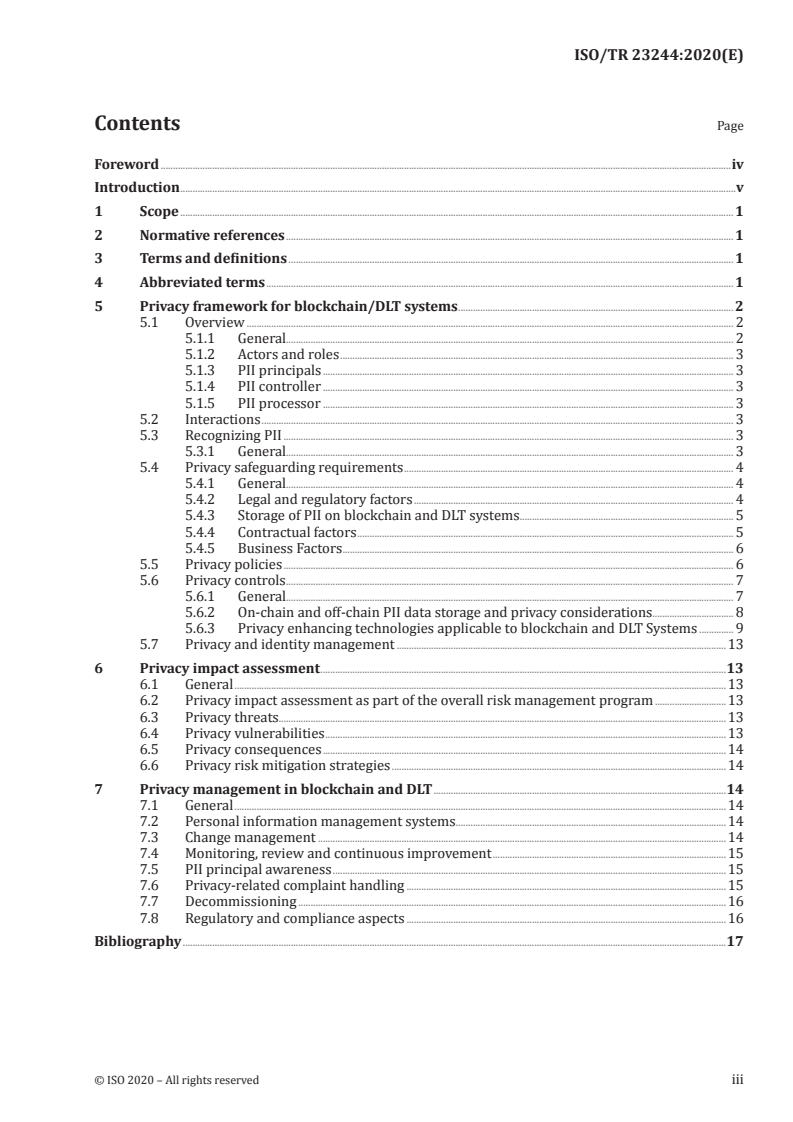
Contents Page
Foreword .iv
Introduction .v
1 Scope . 1
2 Normative references . 1
3 Terms and definitions . 1
4 Abbreviated terms . 1
5 Privacy framework for blockchain/DLT systems . 2
5.1 Overview . 2
5.1.1 General. 2
5.1.2 Actors and roles . 3
5.1.3 PII principals . 3
5.1.4 PII controller . 3
5.1.5 PII processor . 3
5.2 Interactions . 3
5.3 Recognizing PII . 3
5.3.1 General. 3
5.4 Privacy safeguarding requirements . 4
5.4.1 General. 4
5.4.2 Legal and regulatory factors . 4
5.4.3 Storage of PII on blockchain and DLT systems . 5
5.4.4 Contractual factors . 5
5.4.5 Business Factors . 6
5.5 Privacy policies . 6
5.6 Privacy controls . 7
5.6.1 General. 7
5.6.2 On-chain and off-chain PII data storage and privacy considerations . . 8
5.6.3 Privacy enhancing technologies applicable to blockchain and DLT Systems . 9
5.7 Privacy and identity management .13
6 Privacy impact assessment .13
6.1 General .13
6.2 Privacy impact assessment as part of the overall risk management program .13
6.3 Privacy threats.13
6.4 Privacy vulnerabilities .13
6.5 Privacy consequences .14
6.6 Privacy risk mitigation strategies .14
7 Privacy management in blockchain and DLT .14
7.1 General .14
7.2 Personal information management systems .14
7.3 Change management .14
7.4 Monitoring, review and continuous improvement .15
7.5 PII principal awareness .15
7.6 Privacy-related complaint handling .15
7.7 Decommissioning .16
7.8 Regulatory and compliance aspects .16
Bibliography .17
Foreword
ISO (the International Organization for Standardization) is a worldwide federation of national standards
bodies (ISO member bodies). The work of preparing International Standards is normally carried out
through ISO technical committees. Each member body interested in a subject for which a technical
committee has been established has the right to be represented on that committee. International
organizations, governmental and non-governmental, in liaison with ISO, also take part in the work.
ISO collaborates closely with the International Electrotechnical Commission (IEC) on all matters of
electrotechnical standardization.
The procedures used to develop this document and those intended for its further maintenance are
described in the ISO/IEC Directives, Part 1. In particular, the different approval criteria needed for the
different types of ISO documents should be noted. This document was drafted in accordance with the
editorial rules of the ISO/IEC Directives, Part 2 (see www .iso .org/ directives).
Attention is drawn to the possibility that some of the elements of this document may be the subject of
patent rights. ISO shall not be held responsible for identifying any or all such patent rights. Details of
any patent rights identified during the development of the document will be in the Introduction and/or
on the ISO list of patent declarations received (see www .iso .org/ patents).
Any trade name used in this document is information given for the convenience of users and does not
constitute an endorsement.
For an explanation of the voluntary nature of standards, the meaning of ISO specific terms and
expressions related to conformity assessment, as well as information about ISO's adherence to the
World Trade Organization (WTO) principles in the Technical Barriers to Trade (TBT) see www .iso .org/
iso/ foreword .html.
This document was prepared by Technical Committee ISO/TC 307, Blockchain and distributed ledger
technologies, in collaboration with Joint Technical Committee ISO/IEC JTC 1, Information security,
Subcommittee SC 27, cybersecurity and privacy protection.
Any feedback or questions on this document should be directed to the user’s national standards body. A
complete listing of these bodies can be found at www .iso .org/ members .html.
iv © ISO 2020 – All rights reserved
Introduction
This document provides an overview of the issues and practical concerns related to privacy and
personally identifiable information (PII) protection in the context of blockchain and distributed ledger
technologies (DLT) and their applications.
Privacy and PII protection issues are widely considered as a major barrier for the adoption of DLT-based
solutions. This document identifies and assesses known privacy-related risks and the way to mitigate
them, as well as the privacy-enhancing potential of blockchain and distributed ledger technology.
TECHNICAL REPORT ISO/TR 23244:2020(E)
Blockchain and distributed ledger technologies — Privacy
and personally identifiable information protection
considerations
1 Scope
This document provides an overview of privacy and personally identifiable information (PII) protection
as applied to blockchain and distributed ledger technologies (DLT) systems.
2 Normative references
The following documents are referred to in the text in such a way that some or all of their content
constitutes requirements of this document. For dated references, only the edition cited applies. For
undated references, the latest edition of the referenced document (including any amendments) applies.
1)
ISO 22739 , Blockchain and distributed ledger technologies — Terminology
ISO/IEC 27000, Information technology — Security techniques — Information security management
systems — Overview and vocabulary
ISO/IEC 29100, Information technology — Security technique — Privacy framework is referred to in the
text in order to provide terms and definitions
3 Terms and definitions
For the purposes of this document, the terms and definitions given in ISO 22739, ISO/IEC 27000 and
ISO/IEC 29100 apply.
ISO and IEC maintain terminological databases for use in standardization at the following addresses:
— ISO Online browsing platform: available at https:// www .iso .org/ obp
— IEC Electropedia: available at http:// www .electropedia .org/
4 Abbreviated terms
The following abbreviations are used in this document:
DLT distributed ledger technology
EU European Union
ICT information and communication technology
IoT internet of things
PET privacy enhancing technology
PII personally identifiable information
ZKSNARK zero-knowledge succinct non-interactive argument of knowledge
1) Under preparation. Stage at the time of publication: ISO/FDIS 22739:2020.
5 Privacy framework for blockchain/DLT systems
5.1 Overview
5.1.1 General
The following components relate to privacy and the processing of PII in blockchain and DLT systems
and make up the privacy framework described in this document: These components are identified in
ISO/IEC 29100:2011/Amd 1:2018, Clause 4, where they are further described.
— actors and roles;
— interactions;
— recognizing PII;
— privacy safeguarding requirements;
— privacy policies; and
— privacy controls.
In this document, respecting privacy means adhering to the privacy principles of
ISO/IEC 29100:2011/Amd 1:2018, Clause 5. They are:
1) consent and choice;
2) purpose legitimacy and specification;
3) collection limitation;
4) data minimization;
5) use, retention and disclosure limitation;
6) accuracy and quality;
7) openness, transparency and notice;
8) individual participation and notice;
9) accountability;
10) information security;
11) privacy compliance.
These privacy principles apply to any ICT system containing or processing PII, including blockchain and
DLT systems. Guidance on what constitutes PII can be found in ISO/IEC 29100:2011/Amd 1:2018, 4.4.
Even if a blockchain and DLT system appears to process no PII, the system and any processing, storage,
transmission and disclosure can still have an impact on a PII principal. To evaluate whether PII is stored,
transmitted or processed by a blockchain and DLT system, a PIA using the guidelines in ISO/IEC 29134,
can be carried out. If the privacy impact assessment indicates that PII is stored, transmitted or
processed, then the guidance provided in ISO/IEC 29100:2011/Amd 1:2018 can be followed.
There are multiple factors that affect the privacy safeguarding objectives.
ISO/IEC 29100:2011/Amd 1:2018, 4.5 provides corresponding guidance and identifies the following
factors:
a) legal and regulatory factors;
b) contractual factors;
2 © ISO 2020 – All rights reserved
c) business factors; and
d) other factors such as privacy preferences of PII principal.
It is advisable to carefully evaluate and identify the relevant factors. For example, privacy is a
fundamental human right according to the Universal Declaration of Human Rights of the United
Nations and according to the laws of some jurisdictions, like the General Data Protection Regulation in
the EU and under Article 21 of the Constitution of India, and thus needs to be treated accordingly if it is
identified as applicable.
5.1.2 Actors and roles
There is guidance in ISO/IEC 29100:2011/Amd 1:2018, 4.2. In the case of blockchain and DLT systems,
ISO/IEC 29100:2011/Amd 1:2018, 5.5.
5.1.3 PII principals
PII principals can have rights included in laws or regulations, such as the right to withdraw PII
processing consent, to inquire about their PII on blockchain (and then require amendments) and
the right to be forgotten. The situation is likely to become more challenging in the future. In certain
jurisdictions, such as the EU, privacy is considered a fundamental human right which a PII principal
essentially may not sell or give away, which makes agreements such as “PII in exchange for services”
difficult to enforce.
In a blockchain or DLT system, the ability of a PII principal to withdraw consent, make amendments and
delete information can conflict with the immutability of the ledger.
5.1.4 PII controller
With a distributed system, shared and used by multiple parties, legal questions arise about who is
responsible for the system, particularly with respect to PII collection and PII processing. It is typical in
many jurisdictions to describe the role of PII controller, responsible for the collection and processing
of PII – and for notifying and obtaining consent from the PII principals about the collection and use of
PII. Within public blockchain and DLT systems it can be difficult to identify the PII controller and can be
unclear even for private blockchain and DLT systems.
Some jurisdictions are beginning to treat the nodes on a blockchain/DLT that validate transactions and
generate blocks as joint PII controllers.
5.1.5 PII processor
A PII processor processes PII on behalf of a PII controller. This relationship can be contractual. A
PII processor in turn can also subcontract processing activities to a “subprocessor”. Within public
and private blockchain and DLT systems it can be difficult to identify the PII processor(-s) and/or
subprocessor(-s).
5.2 Interactions
There is guidance given in ISO/IEC 29100:2011/Amd 1:2018, 4.3. There are no special considerations in
the case of blockchain and DLT systems.
5.3 Recognizing PII
5.3.1 General
There is guidance given in ISO/IEC 29100:2011/Amd 1:2018, 4.4. There are no special considerations in
the case of blockchain and DLT systems.
5.4 Privacy safeguarding requirements
5.4.1 General
There is guidance given in ISO/IEC 29100:2011/Amd 1:2018, 4.5. For blockchain and DLT systems, 5.4.2
to 5.6.1 can apply.
5.4.2 Legal and regulatory factors
5.4.2.1 General
There is guidance given ISO/IEC 29100:2011/Amd 1:2018, 4.5.1. For blockchain and DLT systems,
ISO/IEC 29100:2011/Amd 1:2018, 5.5, 5.6, 5.7, 5.8 can apply.
5.4.2.2 Legal and regulatory environment
Blockchain and DLT systems can involve many stakeholders living and working in different countries
and different legal and regulatory environments. The challenge for a blockchain and DLT system and
its stakeholders is to provide legal certainty through enforceable agreements, contracts and associated
mechanisms, under an agreed and recognised legal jurisdiction.
A further challenge is that as some blockchain and DLT systems could not have a clearly defined “owner”
or be a clearly identified legal entity, it can be difficult to apply the accountability principle as laid out
in ISO/IEC 29100:2011/Amd 1:2018 and some jurisdictions can have difficulty in interacting with a
system without clearly defined legal status.
5.4.2.3 Legal requirements to disclose
Courts and authorities can require disclosure, deletion, modification or addition of certain information
or transactions. Complying with such legal requirements can be difficult for blockchain and DLT
systems and their users, operators and administrators. A disclosure request and the disclosed data can
identify a PII principal and/or provide relevant search attributes which can result in non-PII becoming
PII, or allow a PII principal to be indirectly identified.
Modifying, deleting or adding information or transactions can be difficult on a blockchain or DLT
system as this can destroy the integrity and immutability of the ledger; also, it can be difficult to gain
agreement between users, operators and administrators to modify, alter or add to the ledger; and
finally, the system may not have the capabilities to perform such activities.
If the legally required activities cannot be carried out, then users, operators and administrators can be
subject to legal remedies such as the penalties stipulated in the EU General Data Protection Regulation.
The ability to modify, delete or add information is a serious risk for any organization or individual who
have to comply with a legal request. In blockchain and DLT systems, the decryption of data could not be
possible by users or operators.
5.4.2.4 Jurisdictional differences
A blockchain and DLT system can operate across multiple jurisdictions which can result in the need to
comply with conflicting legal and regulatory requirements.
Possible jurisdictional differences include but are not limited to:
a) Definition of PII;
b) Application of the “right to remember” or the “right to be forgotten”;
c) Legislation and legal process;
4 © ISO 2020 – All rights reserved
d) Legislation covering ICT, ICT-related or enabled crimes, fraud, and human rights;
e) Legislation covering PII storage and location requirements; and
f) Legislation covering the definition of PII controller and processor.
These jurisdictional differences can affect what is possible for an extra-national blockchain and DLT
system and can be a significant problem if the nodes of a blockchain and DLT system reside in multiple
different jurisdictions where different laws and regulations apply, but also when they store and process
PII of citizens from different countries or jurisdictions.
5.4.2.5 Intra-jurisdictional conflicts
There are conflicts between privacy laws and other laws in the same jurisdiction. It can be difficult
to understand which laws take precedence and thus overrule any privacy statute. Examples where
privacy statutes could be overruled include: laws relating to national security requiring the collection
and storage of PII of individuals; national registries (such as land and real estate) where PII relating to
ownership is publicly published.
Such conflicts could make compliance with some of the privacy principles problematic.
5.4.2.6 Impact of changing legislation & public expectations.
Changing legislation and public expectations could tighten the requirements and penalties associated
with privacy. The decentralised nature of blockchain and DLT systems make adapting to changing
regulations more challenging.
At the same time, recognition of the benefits of blockchain and DLT by society as well as better
awareness of decision-makers and the public in general can result in changes in the legislation and
regulation in various jurisdictions aimed at dismantling unreasonable barriers to blockchain adoption,
including relaxing some privacy-related requirements.
5.4.3 Storage of PII on blockchain and DLT systems
Placing PII on a blockchain and DLT system can result in any user, operator or administrator being
able to view that PII. Such public access, unless directly authorized by relevant legislation or legally
permitted by a data subject’s informed consent, violates the purpose, legitimacy and specification
principle; the minimization principle; the use, retention and disclosure principle; and the consent
principle.
The application of the privacy principles listed in ISO/IEC 29100:2011/Amd 1:2018 implies that it is
unwise to store PII in the ledger, unless laws and regulations applying to that PII permit the storage
of that data in an immutable form. In addition, any PII stored in the ledger would have to be organized
in such a way as to limit access to that data to a known and authorized set of users and to limit the
logging thereof. This almost certainly excludes public blockchain and DLT systems from storing PII in
the ledger.
A blockchain and DLT system can contain the PII of DLT system users, other DLT system stakeholders;
there can be PII of other individuals who are entirely unconnected to the DLT system. To determine
what PII is stored, a PIA using the guidelines in ISO/IEC 29134, can be carried out.
5.4.4 Contractual factors
5.4.4.1 General
There is guidance given in ISO/IEC 29100:2011/Amd 1:2018, 4.5.2. In blockchain and DLT systems, 5.5
through 5.7 could apply.
5.4.4.2 Agreements
User agreements, service level agreements, contracts, terms of service, by-laws and rules relating to
blockchain and DLT systems can contain privacy-related clauses, which can provide legal certainty
for stakeholders of a particular system. However, as blockchain and DLT systems can be decentralised
and operate across multiple jurisdictions, setting the governing jurisdictions for the privacy-related
clauses of user agreements, service level agreements, contract, terms of service, by-laws and rules can
be difficult.
Additionally, any user agreements, service level agreements, contracts, terms of service, by-laws and
rules need to balance the privacy rights given to individual users against the rights and needs of the
community and the technical capability of the blockchain and DLT system.
5.4.4.3 Smart contracts
Smart contracts can, in the course of execution, reveal PII or reveal information allowing the
identification of a PII principal indirectly. In some cases, the PII principals could not be aware that their
PII has been revealed. Protection of PII can be included and agreed by the contracting parties when
creating such smart contracts.
Further, a smart contract that does not count as a legal contract can perform automated processing of
PII. Such automatic processing is prohibited in some jurisdictions.
Should PII be revealed, there can be difficulties in deciding who has to notify the PII principals, as the
PII controller can be difficult to identify (see 5.1.3) and there can be difficulties in deciding how to
notify the PII principals.
5.4.5 Business Factors
5.4.5.1 System lifetime and lifecycle
Blockchain and DLT systems can have a very long lifetime (e.g. land registers, which could be hundreds
of years). With the privacy legislation becoming increasingly rigorous and providing more rights
to data subjects including the deceased, and with the advances in methods and techniques for data
analytics and profiling, there is a risk that a system conceived as containing no PII or designed to be
fully compliant with the current privacy legislation can, in time, become non-compliant.
The life cycle of any information system is about 10 years with industrial IoT systems commonly having
planned lifecycles of up to 30 years, so blockchain and DLT systems with long-term goals could need to
migrate. Any migration can present risk, including the risk to PII. Migrating blockchain and DLT ledger
records and maintenance are areas that could benefit from further study and practical experimentation.
5.4.5.2 IoT and blockchain.
As the internet of things continues to grow, it is being used in conjunction with blockchain and DLT
systems.
IoT systems could collect and process PII, and this could bring about the issue of profiling and
surveillance on individuals.
A challenge is to understand what IoT-related data could be safely placed onto a blockchain or DLT
system while respecting privacy principles and complying with legal and regulatory requirements of
relevant jurisdictions.
5.5 Privacy policies
There is guidance given in ISO/IEC 29100:2011/Amd 1:2018, 4.6. In blockchain and DLT systems, 5.6
through 5.7 could apply.
6 © ISO 2020 – All rights reserved
The privacy policy and notices associated with a blockchain and DLT system can be used to state how
the system implements privacy principles, such as those stated in ISO/IEC 29100:2011/Amd 1:2018 and
legal and regulatory documents.
The policy can state how the blockchain and DLT system can:
a) minimize the number of people/organizations who can access PII
...
TECHNICAL ISO/TR
REPORT 23244
First edition
2020-05
Blockchain and distributed ledger
technologies — Privacy and personally
identifiable information protection
considerations
Reference number
©
ISO 2020
© ISO 2020
All rights reserved. Unless otherwise specified, or required in the context of its implementation, no part of this publication may
be reproduced or utilized otherwise in any form or by any means, electronic or mechanical, including photocopying, or posting
on the internet or an intranet, without prior written permission. Permission can be requested from either ISO at the address
below or ISO’s member body in the country of the requester.
ISO copyright office
CP 401 • Ch. de Blandonnet 8
CH-1214 Vernier, Geneva
Phone: +41 22 749 01 11
Fax: +41 22 749 09 47
Email: copyright@iso.org
Website: www.iso.org
Published in Switzerland
ii © ISO 2020 – All rights reserved
Contents Page
Foreword .iv
Introduction .v
1 Scope . 1
2 Normative references . 1
3 Terms and definitions . 1
4 Abbreviated terms . 1
5 Privacy framework for blockchain/DLT systems . 2
5.1 Overview . 2
5.1.1 General. 2
5.1.2 Actors and roles . 3
5.1.3 PII principals . 3
5.1.4 PII controller . 3
5.1.5 PII processor . 3
5.2 Interactions . 3
5.3 Recognizing PII . 3
5.3.1 General. 3
5.4 Privacy safeguarding requirements . 4
5.4.1 General. 4
5.4.2 Legal and regulatory factors . 4
5.4.3 Storage of PII on blockchain and DLT systems . 5
5.4.4 Contractual factors . 5
5.4.5 Business Factors . 6
5.5 Privacy policies . 6
5.6 Privacy controls . 7
5.6.1 General. 7
5.6.2 On-chain and off-chain PII data storage and privacy considerations . . 8
5.6.3 Privacy enhancing technologies applicable to blockchain and DLT Systems . 9
5.7 Privacy and identity management .13
6 Privacy impact assessment .13
6.1 General .13
6.2 Privacy impact assessment as part of the overall risk management program .13
6.3 Privacy threats.13
6.4 Privacy vulnerabilities .13
6.5 Privacy consequences .14
6.6 Privacy risk mitigation strategies .14
7 Privacy management in blockchain and DLT .14
7.1 General .14
7.2 Personal information management systems .14
7.3 Change management .14
7.4 Monitoring, review and continuous improvement .15
7.5 PII principal awareness .15
7.6 Privacy-related complaint handling .15
7.7 Decommissioning .16
7.8 Regulatory and compliance aspects .16
Bibliography .17
Foreword
ISO (the International Organization for Standardization) is a worldwide federation of national standards
bodies (ISO member bodies). The work of preparing International Standards is normally carried out
through ISO technical committees. Each member body interested in a subject for which a technical
committee has been established has the right to be represented on that committee. International
organizations, governmental and non-governmental, in liaison with ISO, also take part in the work.
ISO collaborates closely with the International Electrotechnical Commission (IEC) on all matters of
electrotechnical standardization.
The procedures used to develop this document and those intended for its further maintenance are
described in the ISO/IEC Directives, Part 1. In particular, the different approval criteria needed for the
different types of ISO documents should be noted. This document was drafted in accordance with the
editorial rules of the ISO/IEC Directives, Part 2 (see www .iso .org/ directives).
Attention is drawn to the possibility that some of the elements of this document may be the subject of
patent rights. ISO shall not be held responsible for identifying any or all such patent rights. Details of
any patent rights identified during the development of the document will be in the Introduction and/or
on the ISO list of patent declarations received (see www .iso .org/ patents).
Any trade name used in this document is information given for the convenience of users and does not
constitute an endorsement.
For an explanation of the voluntary nature of standards, the meaning of ISO specific terms and
expressions related to conformity assessment, as well as information about ISO's adherence to the
World Trade Organization (WTO) principles in the Technical Barriers to Trade (TBT) see www .iso .org/
iso/ foreword .html.
This document was prepared by Technical Committee ISO/TC 307, Blockchain and distributed ledger
technologies, in collaboration with Joint Technical Committee ISO/IEC JTC 1, Information security,
Subcommittee SC 27, cybersecurity and privacy protection.
Any feedback or questions on this document should be directed to the user’s national standards body. A
complete listing of these bodies can be found at www .iso .org/ members .html.
iv © ISO 2020 – All rights reserved
Introduction
This document provides an overview of the issues and practical concerns related to privacy and
personally identifiable information (PII) protection in the context of blockchain and distributed ledger
technologies (DLT) and their applications.
Privacy and PII protection issues are widely considered as a major barrier for the adoption of DLT-based
solutions. This document identifies and assesses known privacy-related risks and the way to mitigate
them, as well as the privacy-enhancing potential of blockchain and distributed ledger technology.
TECHNICAL REPORT ISO/TR 23244:2020(E)
Blockchain and distributed ledger technologies — Privacy
and personally identifiable information protection
considerations
1 Scope
This document provides an overview of privacy and personally identifiable information (PII) protection
as applied to blockchain and distributed ledger technologies (DLT) systems.
2 Normative references
The following documents are referred to in the text in such a way that some or all of their content
constitutes requirements of this document. For dated references, only the edition cited applies. For
undated references, the latest edition of the referenced document (including any amendments) applies.
1)
ISO 22739 , Blockchain and distributed ledger technologies — Terminology
ISO/IEC 27000, Information technology — Security techniques — Information security management
systems — Overview and vocabulary
ISO/IEC 29100, Information technology — Security technique — Privacy framework is referred to in the
text in order to provide terms and definitions
3 Terms and definitions
For the purposes of this document, the terms and definitions given in ISO 22739, ISO/IEC 27000 and
ISO/IEC 29100 apply.
ISO and IEC maintain terminological databases for use in standardization at the following addresses:
— ISO Online browsing platform: available at https:// www .iso .org/ obp
— IEC Electropedia: available at http:// www .electropedia .org/
4 Abbreviated terms
The following abbreviations are used in this document:
DLT distributed ledger technology
EU European Union
ICT information and communication technology
IoT internet of things
PET privacy enhancing technology
PII personally identifiable information
ZKSNARK zero-knowledge succinct non-interactive argument of knowledge
1) Under preparation. Stage at the time of publication: ISO/FDIS 22739:2020.
5 Privacy framework for blockchain/DLT systems
5.1 Overview
5.1.1 General
The following components relate to privacy and the processing of PII in blockchain and DLT systems
and make up the privacy framework described in this document: These components are identified in
ISO/IEC 29100:2011/Amd 1:2018, Clause 4, where they are further described.
— actors and roles;
— interactions;
— recognizing PII;
— privacy safeguarding requirements;
— privacy policies; and
— privacy controls.
In this document, respecting privacy means adhering to the privacy principles of
ISO/IEC 29100:2011/Amd 1:2018, Clause 5. They are:
1) consent and choice;
2) purpose legitimacy and specification;
3) collection limitation;
4) data minimization;
5) use, retention and disclosure limitation;
6) accuracy and quality;
7) openness, transparency and notice;
8) individual participation and notice;
9) accountability;
10) information security;
11) privacy compliance.
These privacy principles apply to any ICT system containing or processing PII, including blockchain and
DLT systems. Guidance on what constitutes PII can be found in ISO/IEC 29100:2011/Amd 1:2018, 4.4.
Even if a blockchain and DLT system appears to process no PII, the system and any processing, storage,
transmission and disclosure can still have an impact on a PII principal. To evaluate whether PII is stored,
transmitted or processed by a blockchain and DLT system, a PIA using the guidelines in ISO/IEC 29134,
can be carried out. If the privacy impact assessment indicates that PII is stored, transmitted or
processed, then the guidance provided in ISO/IEC 29100:2011/Amd 1:2018 can be followed.
There are multiple factors that affect the privacy safeguarding objectives.
ISO/IEC 29100:2011/Amd 1:2018, 4.5 provides corresponding guidance and identifies the following
factors:
a) legal and regulatory factors;
b) contractual factors;
2 © ISO 2020 – All rights reserved
c) business factors; and
d) other factors such as privacy preferences of PII principal.
It is advisable to carefully evaluate and identify the relevant factors. For example, privacy is a
fundamental human right according to the Universal Declaration of Human Rights of the United
Nations and according to the laws of some jurisdictions, like the General Data Protection Regulation in
the EU and under Article 21 of the Constitution of India, and thus needs to be treated accordingly if it is
identified as applicable.
5.1.2 Actors and roles
There is guidance in ISO/IEC 29100:2011/Amd 1:2018, 4.2. In the case of blockchain and DLT systems,
ISO/IEC 29100:2011/Amd 1:2018, 5.5.
5.1.3 PII principals
PII principals can have rights included in laws or regulations, such as the right to withdraw PII
processing consent, to inquire about their PII on blockchain (and then require amendments) and
the right to be forgotten. The situation is likely to become more challenging in the future. In certain
jurisdictions, such as the EU, privacy is considered a fundamental human right which a PII principal
essentially may not sell or give away, which makes agreements such as “PII in exchange for services”
difficult to enforce.
In a blockchain or DLT system, the ability of a PII principal to withdraw consent, make amendments and
delete information can conflict with the immutability of the ledger.
5.1.4 PII controller
With a distributed system, shared and used by multiple parties, legal questions arise about who is
responsible for the system, particularly with respect to PII collection and PII processing. It is typical in
many jurisdictions to describe the role of PII controller, responsible for the collection and processing
of PII – and for notifying and obtaining consent from the PII principals about the collection and use of
PII. Within public blockchain and DLT systems it can be difficult to identify the PII controller and can be
unclear even for private blockchain and DLT systems.
Some jurisdictions are beginning to treat the nodes on a blockchain/DLT that validate transactions and
generate blocks as joint PII controllers.
5.1.5 PII processor
A PII processor processes PII on behalf of a PII controller. This relationship can be contractual. A
PII processor in turn can also subcontract processing activities to a “subprocessor”. Within public
and private blockchain and DLT systems it can be difficult to identify the PII processor(-s) and/or
subprocessor(-s).
5.2 Interactions
There is guidance given in ISO/IEC 29100:2011/Amd 1:2018, 4.3. There are no special considerations in
the case of blockchain and DLT systems.
5.3 Recognizing PII
5.3.1 General
There is guidance given in ISO/IEC 29100:2011/Amd 1:2018, 4.4. There are no special considerations in
the case of blockchain and DLT systems.
5.4 Privacy safeguarding requirements
5.4.1 General
There is guidance given in ISO/IEC 29100:2011/Amd 1:2018, 4.5. For blockchain and DLT systems, 5.4.2
to 5.6.1 can apply.
5.4.2 Legal and regulatory factors
5.4.2.1 General
There is guidance given ISO/IEC 29100:2011/Amd 1:2018, 4.5.1. For blockchain and DLT systems,
ISO/IEC 29100:2011/Amd 1:2018, 5.5, 5.6, 5.7, 5.8 can apply.
5.4.2.2 Legal and regulatory environment
Blockchain and DLT systems can involve many stakeholders living and working in different countries
and different legal and regulatory environments. The challenge for a blockchain and DLT system and
its stakeholders is to provide legal certainty through enforceable agreements, contracts and associated
mechanisms, under an agreed and recognised legal jurisdiction.
A further challenge is that as some blockchain and DLT systems could not have a clearly defined “owner”
or be a clearly identified legal entity, it can be difficult to apply the accountability principle as laid out
in ISO/IEC 29100:2011/Amd 1:2018 and some jurisdictions can have difficulty in interacting with a
system without clearly defined legal status.
5.4.2.3 Legal requirements to disclose
Courts and authorities can require disclosure, deletion, modification or addition of certain information
or transactions. Complying with such legal requirements can be difficult for blockchain and DLT
systems and their users, operators and administrators. A disclosure request and the disclosed data can
identify a PII principal and/or provide relevant search attributes which can result in non-PII becoming
PII, or allow a PII principal to be indirectly identified.
Modifying, deleting or adding information or transactions can be difficult on a blockchain or DLT
system as this can destroy the integrity and immutability of the ledger; also, it can be difficult to gain
agreement between users, operators and administrators to modify, alter or add to the ledger; and
finally, the system may not have the capabilities to perform such activities.
If the legally required activities cannot be carried out, then users, operators and administrators can be
subject to legal remedies such as the penalties stipulated in the EU General Data Protection Regulation.
The ability to modify, delete or add information is a serious risk for any organization or individual who
have to comply with a legal request. In blockchain and DLT systems, the decryption of data could not be
possible by users or operators.
5.4.2.4 Jurisdictional differences
A blockchain and DLT system can operate across multiple jurisdictions which can result in the need to
comply with conflicting legal and regulatory requirements.
Possible jurisdictional differences include but are not limited to:
a) Definition of PII;
b) Application of the “right to remember” or the “right to be forgotten”;
c) Legislation and legal process;
4 © ISO 2020 – All rights reserved
d) Legislation covering ICT, ICT-related or enabled crimes, fraud, and human rights;
e) Legislation covering PII storage and location requirements; and
f) Legislation covering the definition of PII controller and processor.
These jurisdictional differences can affect what is possible for an extra-national blockchain and DLT
system and can be a significant problem if the nodes of a blockchain and DLT system reside in multiple
different jurisdictions where different laws and regulations apply, but also when they store and process
PII of citizens from different countries or jurisdictions.
5.4.2.5 Intra-jurisdictional conflicts
There are conflicts between privacy laws and other laws in the same jurisdiction. It can be difficult
to understand which laws take precedence and thus overrule any privacy statute. Examples where
privacy statutes could be overruled include: laws relating to national security requiring the collection
and storage of PII of individuals; national registries (such as land and real estate) where PII relating to
ownership is publicly published.
Such conflicts could make compliance with some of the privacy principles problematic.
5.4.2.6 Impact of changing legislation & public expectations.
Changing legislation and public expectations could tighten the requirements and penalties associated
with privacy. The decentralised nature of blockchain and DLT systems make adapting to changing
regulations more challenging.
At the same time, recognition of the benefits of blockchain and DLT by society as well as better
awareness of decision-makers and the public in general can result in changes in the legislation and
regulation in various jurisdictions aimed at dismantling unreasonable barriers to blockchain adoption,
including relaxing some privacy-related requirements.
5.4.3 Storage of PII on blockchain and DLT systems
Placing PII on a blockchain and DLT system can result in any user, operator or administrator being
able to view that PII. Such public access, unless directly authorized by relevant legislation or legally
permitted by a data subject’s informed consent, violates the purpose, legitimacy and specification
principle; the minimization principle; the use, retention and disclosure principle; and the consent
principle.
The application of the privacy principles listed in ISO/IEC 29100:2011/Amd 1:2018 implies that it is
unwise to store PII in the ledger, unless laws and regulations applying to that PII permit the storage
of that data in an immutable form. In addition, any PII stored in the ledger would have to be organized
in such a way as to limit access to that data to a known and authorized set of users and to limit the
logging thereof. This almost certainly excludes public blockchain and DLT systems from storing PII in
the ledger.
A blockchain and DLT system can contain the PII of DLT system users, other DLT system stakeholders;
there can be PII of other individuals who are entirely unconnected to the DLT system. To determine
what PII is stored, a PIA using the guidelines in ISO/IEC 29134, can be carried out.
5.4.4 Contractual factors
5.4.4.1 General
There is guidance given in ISO/IEC 29100:2011/Amd 1:2018, 4.5.2. In blockchain and DLT systems, 5.5
through 5.7 could apply.
5.4.4.2 Agreements
User agreements, service level agreements, contracts, terms of service, by-laws and rules relating to
blockchain and DLT systems can contain privacy-related clauses, which can provide legal certainty
for stakeholders of a particular system. However, as blockchain and DLT systems can be decentralised
and operate across multiple jurisdictions, setting the governing jurisdictions for the privacy-related
clauses of user agreements, service level agreements, contract, terms of service, by-laws and rules can
be difficult.
Additionally, any user agreements, service level agreements, contracts, terms of service, by-laws and
rules need to balance the privacy rights given to individual users against the rights and needs of the
community and the technical capability of the blockchain and DLT system.
5.4.4.3 Smart contracts
Smart contracts can, in the course of execution, reveal PII or reveal information allowing the
identification of a PII principal indirectly. In some cases, the PII principals could not be aware that their
PII has been revealed. Protection of PII can be included and agreed by the contracting parties when
creating such smart contracts.
Further, a smart contract that does not count as a legal contract can perform automated processing of
PII. Such automatic processing is prohibited in some jurisdictions.
Should PII be revealed, there can be difficulties in deciding who has to notify the PII principals, as the
PII controller can be difficult to identify (see 5.1.3) and there can be difficulties in deciding how to
notify the PII principals.
5.4.5 Business Factors
5.4.5.1 System lifetime and lifecycle
Blockchain and DLT systems can have a very long lifetime (e.g. land registers, which could be hundreds
of years). With the privacy legislation becoming increasingly rigorous and providing more rights
to data subjects including the deceased, and with the advances in methods and techniques for data
analytics and profiling, there is a risk that a system conceived as containing no PII or designed to be
fully compliant with the current privacy legislation can, in time, become non-compliant.
The life cycle of any information system is about 10 years with industrial IoT systems commonly having
planned lifecycles of up to 30 years, so blockchain and DLT systems with long-term goals could need to
migrate. Any migration can present risk, including the risk to PII. Migrating blockchain and DLT ledger
records and maintenance are areas that could benefit from further study and practical experimentation.
5.4.5.2 IoT and blockchain.
As the internet of things continues to grow, it is being used in conjunction with blockchain and DLT
systems.
IoT systems could collect and process PII, and this could bring about the issue of profiling and
surveillance on individuals.
A challenge is to understand what IoT-related data could be safely placed onto a blockchain or DLT
system while respecting privacy principles and complying with legal and regulatory requirements of
relevant jurisdictions.
5.5 Privacy policies
There is guidance given in ISO/IEC 29100:2011/Amd 1:2018, 4.6. In blockchain and DLT systems, 5.6
through 5.7 could apply.
6 © ISO 2020 – All rights reserved
The privacy policy and notices associated with a blockchain and DLT system can be used to state how
the system implements privacy principles, such as those stated in ISO/IEC 29100:2011/Amd 1:2018 and
legal and regulatory documents.
The policy can state how the blockchain and DLT system can:
a) minimize the number of people/organizations who can access PII
...