


ISO 53:1998
(Main)Cylindrical gears for general and heavy engineering — Standard basic rack tooth profile
General Information
- Abstract
- Status
- Published
- Publication Date
- 19-Aug-1998
- Technical Committee
- ISO/TC 60 - Gears
- Drafting Committee
- ISO/TC 60 - Gears
- Current Stage
- 9093 - International Standard confirmed
- Start Date
- 23-Jul-2026
- Completion Date
- 29-Aug-2026
Buy Documents
ISO 53:1998 - Cylindrical gears for general and heavy engineering -- Standard basic rack tooth profile
ISO 53:1998 - Cylindrical gears for general and heavy engineering — Standard basic rack tooth profile/20/1998
ISO 53:1998 - Engrenages cylindriques de mécanique générale et de grosse mécanique -- Tracé de référence
ISO 53:1998 - Engrenages cylindriques de mécanique générale et de grosse mécanique — Tracé de référence/20/1998
Overview
ISO 53:1998 - "Cylindrical gears for general and heavy engineering - Standard basic rack tooth profile" defines a geometrical reference rack tooth profile for involute cylindrical gears (external and internal) used in general and heavy engineering. The standard fixes the basic proportions of the rack tooth (addendum, dedendum, fillet radius, clearance and pressure angle) as multiples of the module (m). It provides a reference geometry for gear design, tooling definition and interchangeability, but does not itself define a cutter - a cutter may be derived from the basic rack profile.
Key topics and technical requirements
- Profile type: Standard basic rack tooth profile for involute cylindrical gears; a mating rack profile is defined displaced by half a pitch.
- Module and pitch: The standard applies to modules specified in ISO 54; pitch p = π·m.
- Standard proportions (per m = 1):
- Pressure angle α = 20°
- Addendum = 1.0 · m
- Dedendum = 1.25 · m
- Bottom clearance c = 0.25 · m
- Fillet radius r = 0.38 · m
- Tooth geometry: Tooth flanks are straight through the defined sections and inclined at the pressure angle; tooth thickness at the datum equals the space width (half the pitch). Active tooth depth is defined from the basic rack dimensions.
- Fillet and clearance: The fillet radius is determined from the bottom clearance and pressure angle; the standard gives rules and formulae for computing the maximum root fillet consistent with clearance limits. Internal tooth height cut-off is not covered and must be computed case-by-case.
- Informative annex: Annex A recommends alternative basic rack types (A–D) and discusses undercut options and practical finishing considerations (grinding, shaving, hob selection).
Applications and users
ISO 53:1998 is used by:
- Gear designers and mechanical engineers for dimensioning involute cylindrical gears and racks.
- Toolmakers and hob designers to derive cutter geometries consistent with the reference profile.
- Manufacturing engineers and quality/control specialists to verify profile conformity and interchangeability.
- Heavy-equipment and machine builders specifying standard gear geometry for high-torque, precision, or mass-produced gearing.
Practical uses:
- Establishing standard tooth sizes for gearboxes, conveyors, heavy machinery, and power transmission systems.
- Guiding selection of basic rack forms for different service conditions (high torque, normal service, precision ground gears).
- Ensuring compatibility across mating gears and standard tooling.
Related standards
- ISO 54:1996 - Cylindrical gears for general and heavy engineering - Modules (defines permissible modules).
- ISO 1122-1:1998 - Vocabulary of gear terms (geometry definitions).
Relations
- Effective Date
- 15-Apr-2008
Buy Documents
ISO 53:1998 - Cylindrical gears for general and heavy engineering -- Standard basic rack tooth profile
ISO 53:1998 - Cylindrical gears for general and heavy engineering — Standard basic rack tooth profile/20/1998
ISO 53:1998 - Engrenages cylindriques de mécanique générale et de grosse mécanique -- Tracé de référence
ISO 53:1998 - Engrenages cylindriques de mécanique générale et de grosse mécanique — Tracé de référence/20/1998
Frequently Asked Questions
ISO 53:1998 is a standard published by the International Organization for Standardization (ISO). Its full title is "Cylindrical gears for general and heavy engineering — Standard basic rack tooth profile". This standard covers: Cylindrical gears for general and heavy engineering — Standard basic rack tooth profile
Cylindrical gears for general and heavy engineering — Standard basic rack tooth profile
ISO 53:1998 is classified under the following ICS (International Classification for Standards) categories: 21.200 - Gears. The ICS classification helps identify the subject area and facilitates finding related standards.
ISO 53:1998 has the following relationships with other standards: It is inter standard links to ISO 53:1974. Understanding these relationships helps ensure you are using the most current and applicable version of the standard.
ISO 53:1998 is available in PDF format for immediate download after purchase. The document can be added to your cart and obtained through the secure checkout process. Digital delivery ensures instant access to the complete standard document.
Standards Content (Sample)
INTERNATIONAL ISO
STANDARD 53
Second edition
1998-08-15
Cylindrical gears for general and heavy
engineering — Standard basic rack tooth
profile
Engrenages cylindriques de mécanique générale et de grosse
mécanique — Tracé de référence
A
Reference number
Foreword
ISO (the International Organization for Standardization) is a worldwide federation of national standards bodies (ISO
member bodies). The work of preparing International Standards is normally carried out through ISO technical
committees. Each member body interested in a subject for which a technical committee has been established has
the right to be represented on that committee. International organizations, governmental and non-governmental, in
liaison with ISO, also take part in the work. ISO collaborates closely with the International Electrotechnical
Commission (IEC) on all matters of electrotechnical standardization.
Draft International Standards adopted by the technical committees are circulated to the member bodies for voting.
Publication as an International Standard requires approval by at least 75 % of the member bodies casting a vote.
International Standard ISO 53 was prepared by Technical Committee ISO/TC 60, Gears.
This second edition cancels and replaces the first edition (ISO 53:1974), which has been technically revised.
Annex A of this International Standard is for information only.
© ISO 1998
All rights reserved. Unless otherwise specified, no part of this publication may be reproduced or utilized in any form or by any means, electronic
or mechanical, including photocopying and microfilm, without permission in writing from the publisher.
International Organization for Standardization
Case postale 56 • CH-1211 Genève 20 • Switzerland
Internet iso@iso.ch
Printed in Switzerland
ii
©
INTERNATIONAL STANDARD ISO ISO 53:1998(E)
Cylindrical gears for general and heavy engineering —
Standard basic rack tooth profile
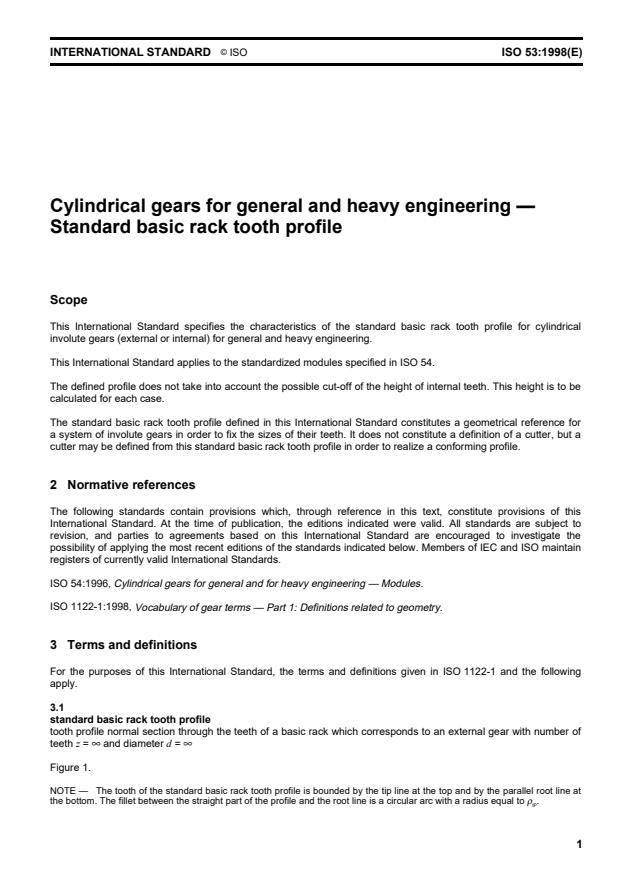
Scope
This International Standard specifies the characteristics of the standard basic rack tooth profile for cylindrical
involute gears (external or internal) for general and heavy engineering.
This International Standard applies to the standardized modules specified in ISO 54.
The defined profile does not take into account the possible cut-off of the height of internal teeth. This height is to be
calculated for each case.
The standard basic rack tooth profile defined in this International Standard constitutes a geometrical reference for
a system of involute gears in order to fix the sizes of their teeth. It does not constitute a definition of a cutter, but a
cutter may be defined from this standard basic rack tooth profile in order to realize a conforming profile.
2 Normative references
The following standards contain provisions which, through reference in this text, constitute provisions of this
International Standard. At the time of publication, the editions indicated were valid. All standards are subject to
revision, and parties to agreements based on this International Standard are encouraged to investigate the
possibility of applying the most recent editions of the standards indicated below. Members of IEC and ISO maintain
registers of currently valid International Standards.
ISO 54:1996, Cylindrical gears for general and for heavy engineering — Modules.
ISO 1122-1:1998, Vocabulary of gear terms — Part 1: Definitions related to geometry.
3 Terms and definitions
For the purposes of this International Standard, the terms and definitions given in ISO 1122-1 and the following
apply.
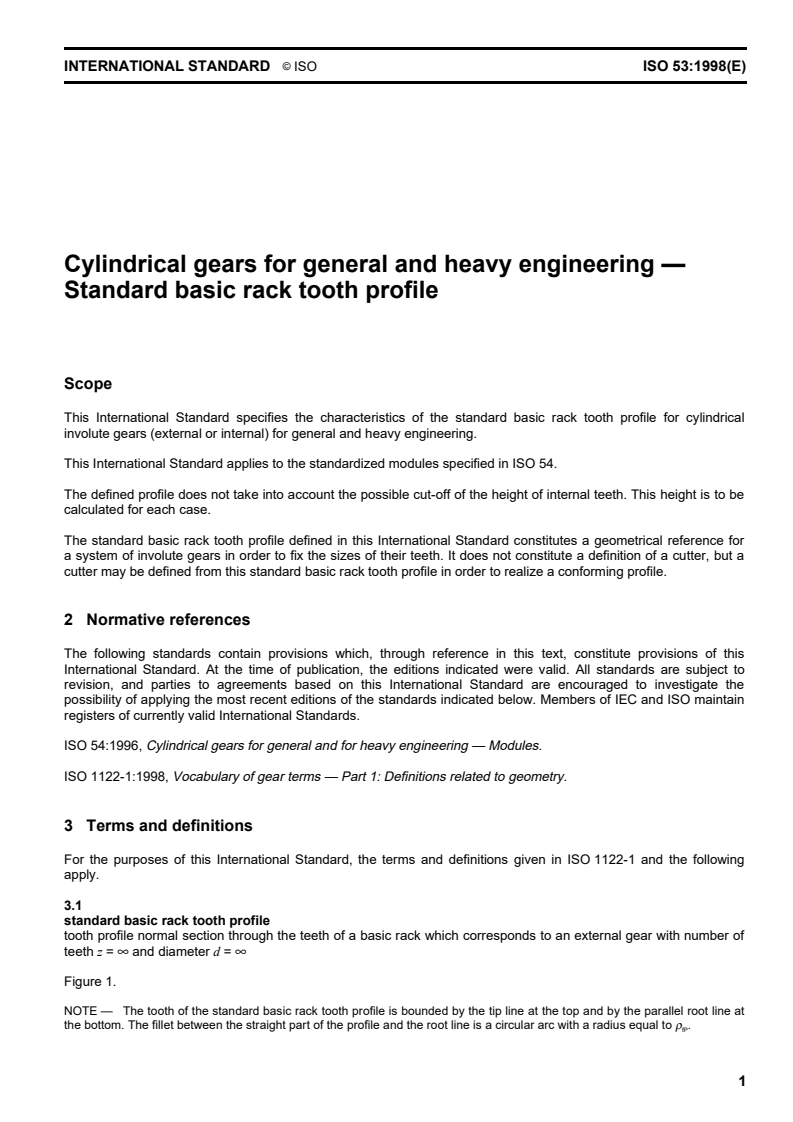
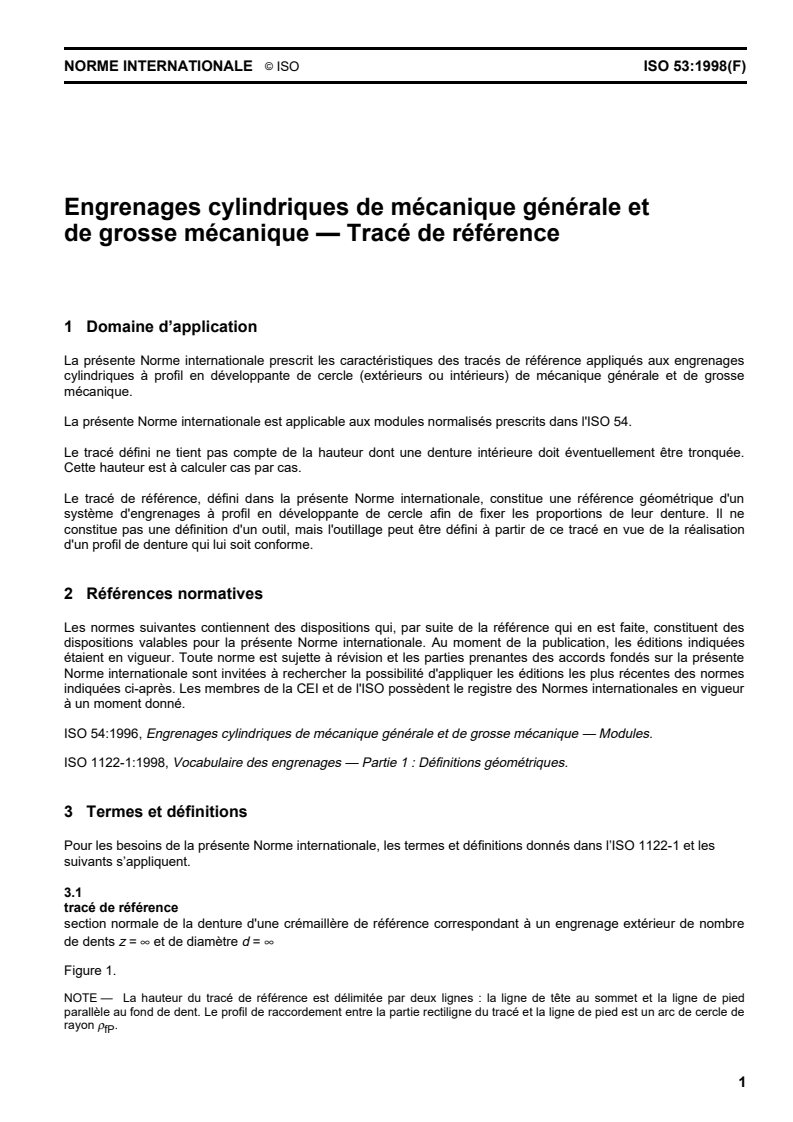
3.1
standard basic rack tooth profile
tooth profile normal section through the teeth of a basic rack which corresponds to an external gear with number of
teeth z = ¥ and diameter d = ¥
Figure 1.
NOTE — The tooth of the standard basic rack tooth profile is bounded by the tip line at the top and by the parallel root line at
the bottom. The fillet between the straight part of the profile and the root line is a circular arc with a radius equal to .
r
fP
©
3.2
mating standard rack tooth profile
rack tooth profile symmetrical to the standard basic rack tooth profile about the datum line P-P and displaced by half
a pitch relative to it
Figure 1.
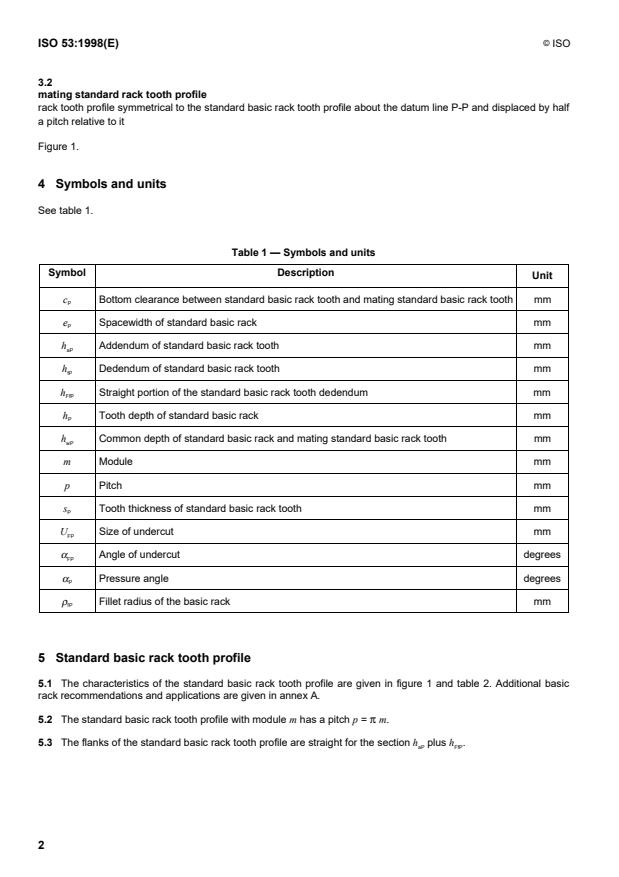
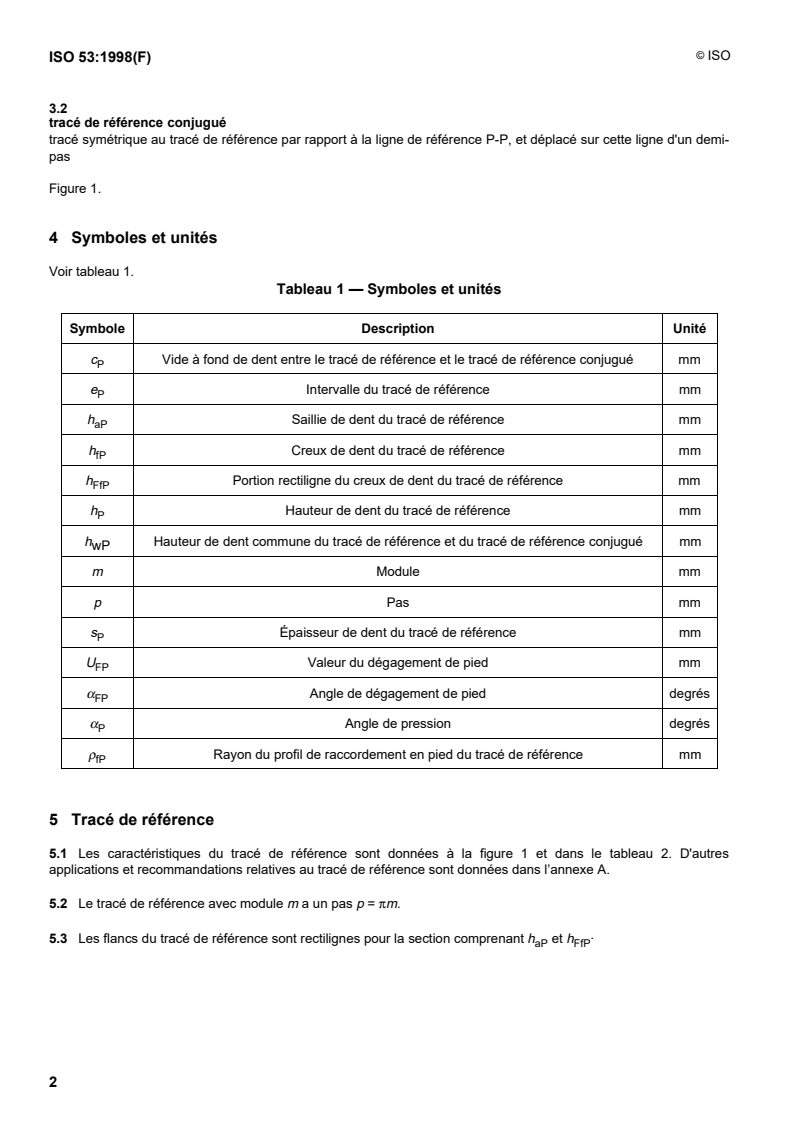
4 Symbols and units
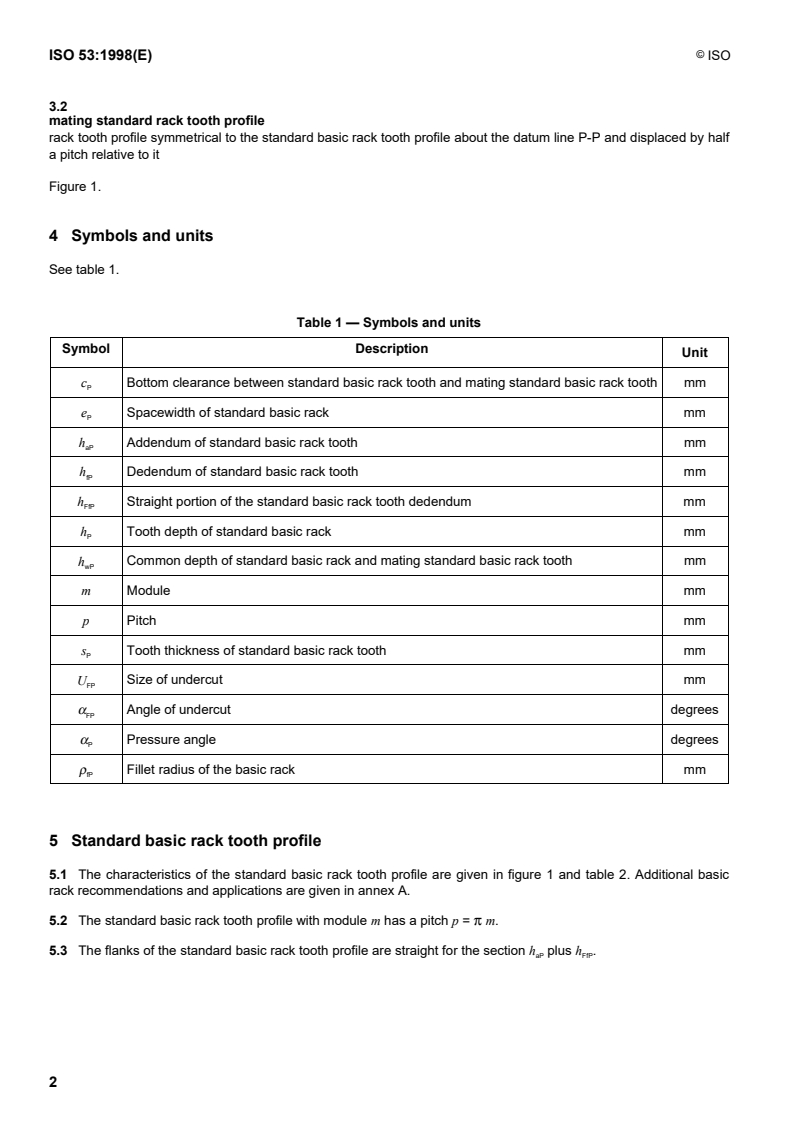
See table 1.
Table 1 — Symbols and units
Symbol Description
Unit
c Bottom clearance between standard basic rack tooth and mating standard basic rack tooth mm
P
e Spacewidth of standard basic rack mm
P
h Addendum of standard basic rack tooth mm
aP
h Dedendum of standard basic rack tooth mm
fP
h Straight portion of the standard basic rack tooth dedendum mm
FfP
h Tooth depth of standard basic rack mm
P
h Common depth of standard basic rack and mating standard basic rack tooth mm
wP
m Module mm
p Pitch mm
s Tooth thickness of standard basic rack tooth mm
P
...
INTERNATIONAL ISO
STANDARD 53
Second edition
1998-08-15
Cylindrical gears for general and heavy
engineering — Standard basic rack tooth
profile
Engrenages cylindriques de mécanique générale et de grosse
mécanique — Tracé de référence
A
Reference number
Foreword
ISO (the International Organization for Standardization) is a worldwide federation of national standards bodies (ISO
member bodies). The work of preparing International Standards is normally carried out through ISO technical
committees. Each member body interested in a subject for which a technical committee has been established has
the right to be represented on that committee. International organizations, governmental and non-governmental, in
liaison with ISO, also take part in the work. ISO collaborates closely with the International Electrotechnical
Commission (IEC) on all matters of electrotechnical standardization.
Draft International Standards adopted by the technical committees are circulated to the member bodies for voting.
Publication as an International Standard requires approval by at least 75 % of the member bodies casting a vote.
International Standard ISO 53 was prepared by Technical Committee ISO/TC 60, Gears.
This second edition cancels and replaces the first edition (ISO 53:1974), which has been technically revised.
Annex A of this International Standard is for information only.
© ISO 1998
All rights reserved. Unless otherwise specified, no part of this publication may be reproduced or utilized in any form or by any means, electronic
or mechanical, including photocopying and microfilm, without permission in writing from the publisher.
International Organization for Standardization
Case postale 56 • CH-1211 Genève 20 • Switzerland
Internet iso@iso.ch
Printed in Switzerland
ii
©
INTERNATIONAL STANDARD ISO ISO 53:1998(E)
Cylindrical gears for general and heavy engineering —
Standard basic rack tooth profile
Scope
This International Standard specifies the characteristics of the standard basic rack tooth profile for cylindrical
involute gears (external or internal) for general and heavy engineering.
This International Standard applies to the standardized modules specified in ISO 54.
The defined profile does not take into account the possible cut-off of the height of internal teeth. This height is to be
calculated for each case.
The standard basic rack tooth profile defined in this International Standard constitutes a geometrical reference for
a system of involute gears in order to fix the sizes of their teeth. It does not constitute a definition of a cutter, but a
cutter may be defined from this standard basic rack tooth profile in order to realize a conforming profile.
2 Normative references
The following standards contain provisions which, through reference in this text, constitute provisions of this
International Standard. At the time of publication, the editions indicated were valid. All standards are subject to
revision, and parties to agreements based on this International Standard are encouraged to investigate the
possibility of applying the most recent editions of the standards indicated below. Members of IEC and ISO maintain
registers of currently valid International Standards.
ISO 54:1996, Cylindrical gears for general and for heavy engineering — Modules.
ISO 1122-1:1998, Vocabulary of gear terms — Part 1: Definitions related to geometry.
3 Terms and definitions
For the purposes of this International Standard, the terms and definitions given in ISO 1122-1 and the following
apply.
3.1
standard basic rack tooth profile
tooth profile normal section through the teeth of a basic rack which corresponds to an external gear with number of
teeth z = ¥ and diameter d = ¥
Figure 1.
NOTE — The tooth of the standard basic rack tooth profile is bounded by the tip line at the top and by the parallel root line at
the bottom. The fillet between the straight part of the profile and the root line is a circular arc with a radius equal to .
r
fP
©
3.2
mating standard rack tooth profile
rack tooth profile symmetrical to the standard basic rack tooth profile about the datum line P-P and displaced by half
a pitch relative to it
Figure 1.
4 Symbols and units
See table 1.
Table 1 — Symbols and units
Symbol Description
Unit
c Bottom clearance between standard basic rack tooth and mating standard basic rack tooth mm
P
e Spacewidth of standard basic rack mm
P
h Addendum of standard basic rack tooth mm
aP
h Dedendum of standard basic rack tooth mm
fP
h Straight portion of the standard basic rack tooth dedendum mm
FfP
h Tooth depth of standard basic rack mm
P
h Common depth of standard basic rack and mating standard basic rack tooth mm
wP
m Module mm
p Pitch mm
s Tooth thickness of standard basic rack tooth mm
P
...
NORME ISO
INTERNATIONALE 53
Deuxième édition
1998-08-15
Engrenages cylindriques de mécanique
générale et de grosse mécanique — Tracé
de référence
Cylindrical gears for general and heavy engineering — Standard basic rack
tooth profile
A
Numéro de référence
Avant-propos
L'ISO (Organisation internationale de normalisation) est une fédération mondiale d'organismes nationaux de
normalisation (comités membres de l'ISO). L'élaboration des Normes internationales est en général confiée aux
comités techniques de l'ISO. Chaque comité membre intéressé par une étude a le droit de faire partie du comité
technique créé à cet effet. Les organisations internationales, gouvernementales et non gouvernementales, en
liaison avec l'ISO, participent également aux travaux. L'ISO collabore étroitement avec la Commission
électrotechnique internationale (CEI) en ce qui concerne la normalisation électrotechnique.
Les projets de Normes internationales adoptés par les comités techniques sont soumis aux comités membres pour
vote. Leur publication comme Normes internationales requiert l'approbation de 75 % au moins des comités
membres votants.
La Norme internationale ISO 53 a été élaborée par le comité technique ISO/TC 60, Engrenages.
Cette deuxième édition annule et remplace la première édition (ISO 53:1974), dont elle constitue une révision
technique.
L'annexe A de la présente Norme internationale est donnée uniquement à titre d'information.
© ISO 1998
Droits de reproduction réservés. Sauf prescription différente, aucune partie de cette publication ne peut être reproduite ni utilisée sous quelque
forme que ce soit et par aucun procédé, électronique ou mécanique, y compris la photocopie et les microfilms, sans l'accord écrit de l'éditeur.
Organisation internationale de normalisation
Case postale 56 • CH-1211 Genève 20 • Suisse
Internet iso@iso.ch
Imprimé en Suisse
ii
©
NORME INTERNATIONALE ISO ISO 53:1998(F)
Engrenages cylindriques de mécanique générale et
de grosse mécanique — Tracé de référence
1 Domaine d’application
La présente Norme internationale prescrit les caractéristiques des tracés de référence appliqués aux engrenages
cylindriques à profil en développante de cercle (extérieurs ou intérieurs) de mécanique générale et de grosse
mécanique.
La présente Norme internationale est applicable aux modules normalisés prescrits dans l'ISO 54.
Le tracé défini ne tient pas compte de la hauteur dont une denture intérieure doit éventuellement être tronquée.
Cette hauteur est à calculer cas par cas.
Le tracé de référence, défini dans la présente Norme internationale, constitue une référence géométrique d'un
système d'engrenages à profil en développante de cercle afin de fixer les proportions de leur denture. Il ne
constitue pas une définition d'un outil, mais l'outillage peut être défini à partir de ce tracé en vue de la réalisation
d'un profil de denture qui lui soit conforme.
2 Références normatives
Les normes suivantes contiennent des dispositions qui, par suite de la référence qui en est faite, constituent des
dispositions valables pour la présente Norme internationale. Au moment de la publication, les éditions indiquées
étaient en vigueur. Toute norme est sujette à révision et les parties prenantes des accords fondés sur la présente
Norme internationale sont invitées à rechercher la possibilité d'appliquer les éditions les plus récentes des normes
indiquées ci-après. Les membres de la CEI et de l'ISO possèdent le registre des Normes internationales en vigueur
à un moment donné.
ISO 54:1996, Engrenages cylindriques de mécanique générale et de grosse mécanique — Modules.
ISO 1122-1:1998, Vocabulaire des engrenages — Partie 1 : Définitions géométriques.
3 Termes et définitions
Pour les besoins de la présente Norme internationale, les termes et définitions donnés dans l’ISO 1122-1 et les
suivants s’appliquent.
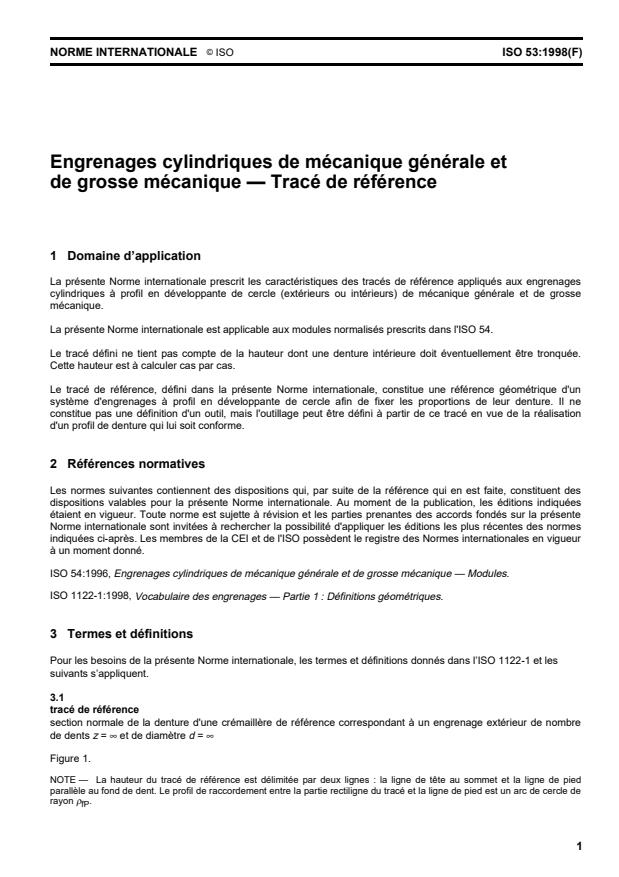
3.1
tracé de référence
section normale de la denture d'une crémaillère de référence correspondant à un engrenage extérieur de nombre
de dents z = ∞ et de diamètre d = ∞
Figure 1.
NOTE — La hauteur du tracé de référence est délimitée par deux lignes : la ligne de tête au sommet et la ligne de pied
parallèle au fond de dent. Le profil de raccordement entre la partie rectiligne du tracé et la ligne de pied est un arc de cercle de
rayon r .
fP
©
ISO
3.2
tracé de référence conjugué
tracé symétrique au tracé de référence par rapport à la ligne de référence P-P, et déplacé sur cette ligne d'un demi-
pas
Figure 1.
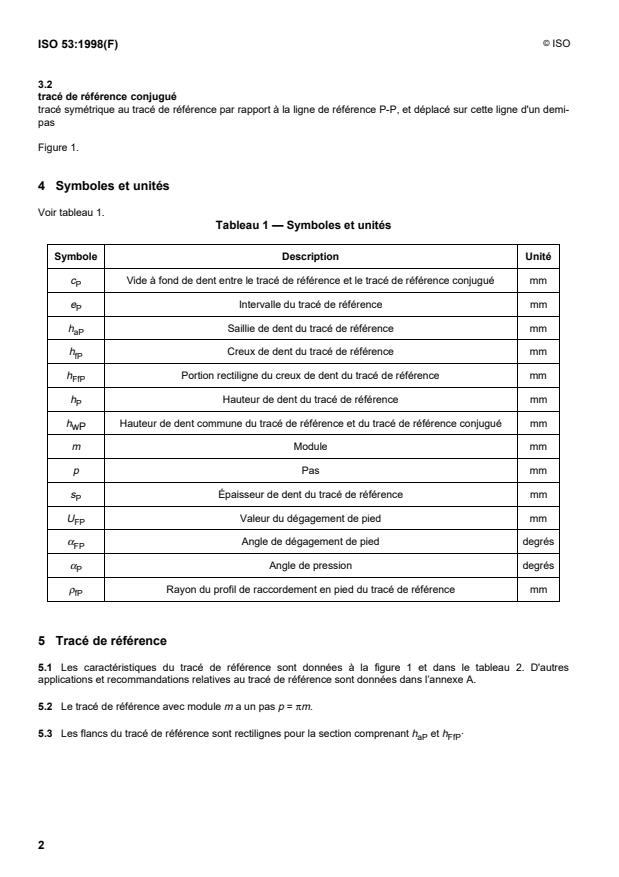
4 Symboles et unités
Voir tableau 1.
Tableau 1 — Symboles et unités
Symbole Description Unité
c Vide à fond de dent entre le tracé de référence et le tracé de référence conjugué mm
P
e Intervalle du tracé de référence mm
P
h Saillie de dent du tracé de référence mm
aP
h Creux de dent du tracé de référence mm
fP
h Portion rectiligne du creux de dent du tracé de référence mm
FfP
h Hauteur de dent du tracé de référence mm
P
h Hauteur de dent commune du tracé de référence et du tracé de référence conjugué mm
wP
m Module mm
p Pas mm
s Épaisseur de dent du tracé de référence mm
P
U Valeur du dégage
...
NORME ISO
INTERNATIONALE 53
Deuxième édition
1998-08-15
Engrenages cylindriques de mécanique
générale et de grosse mécanique — Tracé
de référence
Cylindrical gears for general and heavy engineering — Standard basic rack
tooth profile
A
Numéro de référence
Avant-propos
L'ISO (Organisation internationale de normalisation) est une fédération mondiale d'organismes nationaux de
normalisation (comités membres de l'ISO). L'élaboration des Normes internationales est en général confiée aux
comités techniques de l'ISO. Chaque comité membre intéressé par une étude a le droit de faire partie du comité
technique créé à cet effet. Les organisations internationales, gouvernementales et non gouvernementales, en
liaison avec l'ISO, participent également aux travaux. L'ISO collabore étroitement avec la Commission
électrotechnique internationale (CEI) en ce qui concerne la normalisation électrotechnique.
Les projets de Normes internationales adoptés par les comités techniques sont soumis aux comités membres pour
vote. Leur publication comme Normes internationales requiert l'approbation de 75 % au moins des comités
membres votants.
La Norme internationale ISO 53 a été élaborée par le comité technique ISO/TC 60, Engrenages.
Cette deuxième édition annule et remplace la première édition (ISO 53:1974), dont elle constitue une révision
technique.
L'annexe A de la présente Norme internationale est donnée uniquement à titre d'information.
© ISO 1998
Droits de reproduction réservés. Sauf prescription différente, aucune partie de cette publication ne peut être reproduite ni utilisée sous quelque
forme que ce soit et par aucun procédé, électronique ou mécanique, y compris la photocopie et les microfilms, sans l'accord écrit de l'éditeur.
Organisation internationale de normalisation
Case postale 56 • CH-1211 Genève 20 • Suisse
Internet iso@iso.ch
Imprimé en Suisse
ii
©
NORME INTERNATIONALE ISO ISO 53:1998(F)
Engrenages cylindriques de mécanique générale et
de grosse mécanique — Tracé de référence
1 Domaine d’application
La présente Norme internationale prescrit les caractéristiques des tracés de référence appliqués aux engrenages
cylindriques à profil en développante de cercle (extérieurs ou intérieurs) de mécanique générale et de grosse
mécanique.
La présente Norme internationale est applicable aux modules normalisés prescrits dans l'ISO 54.
Le tracé défini ne tient pas compte de la hauteur dont une denture intérieure doit éventuellement être tronquée.
Cette hauteur est à calculer cas par cas.
Le tracé de référence, défini dans la présente Norme internationale, constitue une référence géométrique d'un
système d'engrenages à profil en développante de cercle afin de fixer les proportions de leur denture. Il ne
constitue pas une définition d'un outil, mais l'outillage peut être défini à partir de ce tracé en vue de la réalisation
d'un profil de denture qui lui soit conforme.
2 Références normatives
Les normes suivantes contiennent des dispositions qui, par suite de la référence qui en est faite, constituent des
dispositions valables pour la présente Norme internationale. Au moment de la publication, les éditions indiquées
étaient en vigueur. Toute norme est sujette à révision et les parties prenantes des accords fondés sur la présente
Norme internationale sont invitées à rechercher la possibilité d'appliquer les éditions les plus récentes des normes
indiquées ci-après. Les membres de la CEI et de l'ISO possèdent le registre des Normes internationales en vigueur
à un moment donné.
ISO 54:1996, Engrenages cylindriques de mécanique générale et de grosse mécanique — Modules.
ISO 1122-1:1998, Vocabulaire des engrenages — Partie 1 : Définitions géométriques.
3 Termes et définitions
Pour les besoins de la présente Norme internationale, les termes et définitions donnés dans l’ISO 1122-1 et les
suivants s’appliquent.
3.1
tracé de référence
section normale de la denture d'une crémaillère de référence correspondant à un engrenage extérieur de nombre
de dents z = ∞ et de diamètre d = ∞
Figure 1.
NOTE — La hauteur du tracé de référence est délimitée par deux lignes : la ligne de tête au sommet et la ligne de pied
parallèle au fond de dent. Le profil de raccordement entre la partie rectiligne du tracé et la ligne de pied est un arc de cercle de
rayon r .
fP
©
ISO
3.2
tracé de référence conjugué
tracé symétrique au tracé de référence par rapport à la ligne de référence P-P, et déplacé sur cette ligne d'un demi-
pas
Figure 1.
4 Symboles et unités
Voir tableau 1.
Tableau 1 — Symboles et unités
Symbole Description Unité
c Vide à fond de dent entre le tracé de référence et le tracé de référence conjugué mm
P
e Intervalle du tracé de référence mm
P
h Saillie de dent du tracé de référence mm
aP
h Creux de dent du tracé de référence mm
fP
h Portion rectiligne du creux de dent du tracé de référence mm
FfP
h Hauteur de dent du tracé de référence mm
P
h Hauteur de dent commune du tracé de référence et du tracé de référence conjugué mm
wP
m Module mm
p Pas mm
s Épaisseur de dent du tracé de référence mm
P
U Valeur du dégage
...