

ISO/IEC 21838-3:2023
(Main)Information technology — Top-level ontologies (TLO) — Part 3: Descriptive ontology for linguistic and cognitive engineering (DOLCE)
General Information
- Abstract
This document describes descriptive ontology for finguistic and cognitive engineering (DOLCE) as an ontology that is conformant to the requirements specified for top-level ontologies in ISO/IEC 21838-1. This document describes DOLCE as a resource designed to support ontology design, ontology integration, and semantic integration of heterogeneous information systems. The following are within the scope of this document: — definitions of classes and relations in the signature of DOLCE; — axiomatizations of DOLCE in OWL 2 and CL; — documentation of the conformity of DOLCE to the requirements specified for top-level ontologies in ISO/IEC 21838-1; — documentation of the methodology for specifying domain ontologies that conform to DOLCE. The following are outside the scope of this document: — specification of ontology languages, including the languages RDF, OWL, and CL standardly used in ontology development; — specification of methods for reasoning with ontologies; — specification of translators between the notations of ontologies developed in different ontology languages.
- Status
- Published
- Publication Date
- 18-Sep-2023
- Technical Committee
- ISO/IEC JTC 1/SC 32 - Data management and interchange
- Drafting Committee
- ISO/IEC JTC 1/SC 32/WG 2 - MetaData
- Current Stage
- 6060 - International Standard published
- Start Date
- 19-Sep-2023
- Due Date
- 03-Jul-2023
- Completion Date
- 19-Sep-2023
Overview
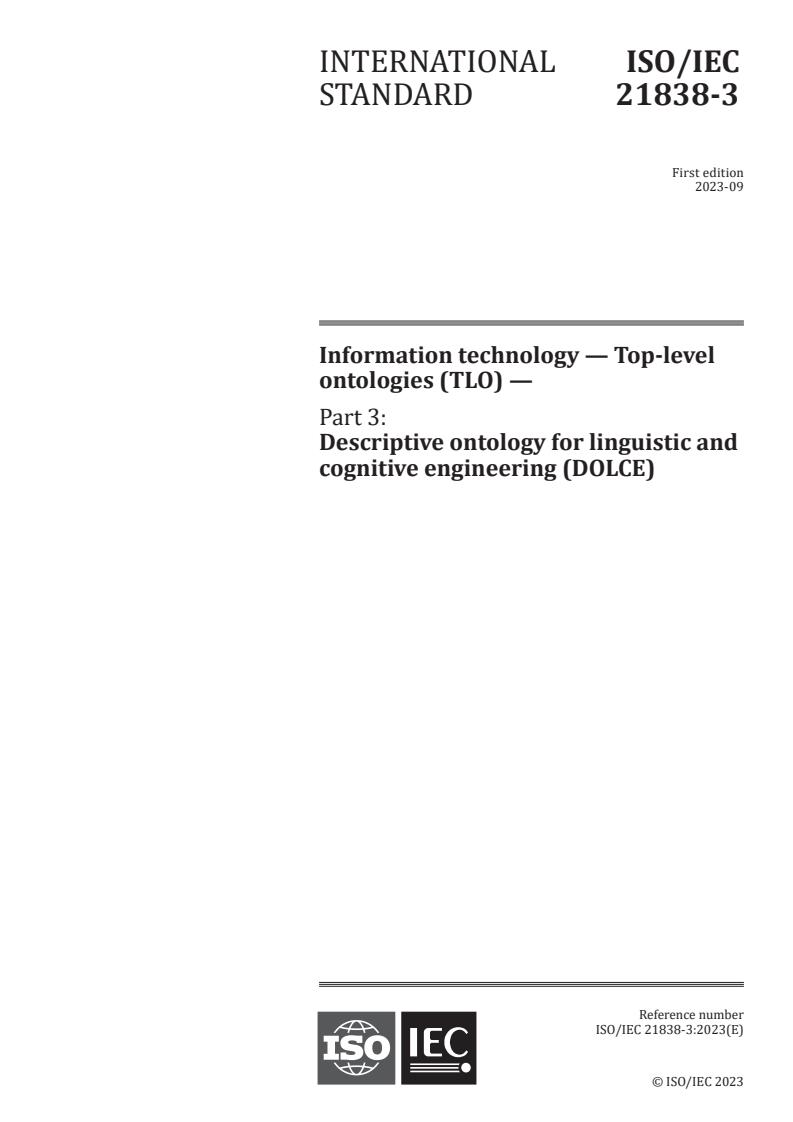
ISO/IEC 21838-3:2023 - "Information technology - Top-level ontologies (TLO) - Part 3: Descriptive ontology for linguistic and cognitive engineering (DOLCE)" standardizes the DOLCE top-level ontology as a resource for ontology design, ontology integration, and semantic integration of heterogeneous information systems. The standard documents DOLCE’s natural-language signature, formal axiomatizations in OWL 2 and Common Logic (CL), its modular structure, and the methodology for developing domain ontologies that conform to DOLCE. It also demonstrates conformance to the top-level ontology requirements in ISO/IEC 21838-1:2021.
Key topics and technical requirements
- Scope and purpose: DOLCE is aimed at making commonsense, linguistic and cognitive categories explicit for interoperable ontology engineering.
- Conformance: Domain ontologies conform if they are consistent extensions of the DOLCE axiomatization in the same formalism (OWL‑2 or CL).
- Representations provided:
- Natural language documentation of DOLCE terms and relations for human maintenance.
- OWL 2 formalization to support Semantic Web applications and OWL reasoners.
- Common Logic (CL/CLIF) axiomatization to capture expressive axioms and intended models.
- Modularity: The CL axiomatization is modular (e.g., Taxonomy, Mereology, Present, Dependence, Participation, Temporary Parthood, Constitution, Qualities), supporting reuse and conservative extensions.
- Verification: The document provides evidence of logical consistency of the CL axiomatization and interpretability of the OWL 2 axiomatization in CL.
- Breadth of coverage: DOLCE addresses core ontological themes such as space and time (endurants vs. perdurants), parts/wholes, change, qualities, processes, causality, information and social artefacts, and mental/fictional entities.
- Out of scope: The standard does not specify ontology languages themselves (RDF/OWL/CL), reasoning methods, or translation tools between ontology notations.
Applications and users
- Who uses it: Ontology engineers, knowledge architects, semantic integrators, data modelers, AI and NLP researchers, GIS and robotics engineers, and enterprises building interoperable semantic systems.
- Practical uses:
- Designing domain ontologies that align with a shared TLO for consistent semantics.
- Integrating ontologies across domains to enable semantic interoperability.
- Supporting ontology quality control through OWL reasoners and formal CL analysis.
- Aligning enterprise data models, process models, and knowledge graphs with common upper-level categories.
Related standards
- ISO/IEC 21838-1:2021 - TLO requirements (conformance baseline)
- ISO/IEC 24707 - Common Logic framework (CL)
- OWL 2 (W3C) - Web Ontology Language (used for DOLCE OWL formalization)
Keywords: ISO/IEC 21838-3:2023, DOLCE, top-level ontology, TLO, OWL 2, Common Logic, ontology design, semantic integration, ontology integration.
Get Certified
Connect with accredited certification bodies for this standard

BSI Group
BSI (British Standards Institution) is the business standards company that helps organizations make excellence a habit.

NYCE
Mexican standards and certification body.
Sponsored listings
Frequently Asked Questions
ISO/IEC 21838-3:2023 is a standard published by the International Organization for Standardization (ISO). Its full title is "Information technology — Top-level ontologies (TLO) — Part 3: Descriptive ontology for linguistic and cognitive engineering (DOLCE)". This standard covers: This document describes descriptive ontology for finguistic and cognitive engineering (DOLCE) as an ontology that is conformant to the requirements specified for top-level ontologies in ISO/IEC 21838-1. This document describes DOLCE as a resource designed to support ontology design, ontology integration, and semantic integration of heterogeneous information systems. The following are within the scope of this document: — definitions of classes and relations in the signature of DOLCE; — axiomatizations of DOLCE in OWL 2 and CL; — documentation of the conformity of DOLCE to the requirements specified for top-level ontologies in ISO/IEC 21838-1; — documentation of the methodology for specifying domain ontologies that conform to DOLCE. The following are outside the scope of this document: — specification of ontology languages, including the languages RDF, OWL, and CL standardly used in ontology development; — specification of methods for reasoning with ontologies; — specification of translators between the notations of ontologies developed in different ontology languages.
This document describes descriptive ontology for finguistic and cognitive engineering (DOLCE) as an ontology that is conformant to the requirements specified for top-level ontologies in ISO/IEC 21838-1. This document describes DOLCE as a resource designed to support ontology design, ontology integration, and semantic integration of heterogeneous information systems. The following are within the scope of this document: — definitions of classes and relations in the signature of DOLCE; — axiomatizations of DOLCE in OWL 2 and CL; — documentation of the conformity of DOLCE to the requirements specified for top-level ontologies in ISO/IEC 21838-1; — documentation of the methodology for specifying domain ontologies that conform to DOLCE. The following are outside the scope of this document: — specification of ontology languages, including the languages RDF, OWL, and CL standardly used in ontology development; — specification of methods for reasoning with ontologies; — specification of translators between the notations of ontologies developed in different ontology languages.
ISO/IEC 21838-3:2023 is classified under the following ICS (International Classification for Standards) categories: 01.040.35 - Information technology (Vocabularies); 35.060 - Languages used in information technology. The ICS classification helps identify the subject area and facilitates finding related standards.
ISO/IEC 21838-3:2023 is available in PDF format for immediate download after purchase. The document can be added to your cart and obtained through the secure checkout process. Digital delivery ensures instant access to the complete standard document.
Standards Content (Sample)
INTERNATIONAL ISO/IEC
STANDARD 21838-3
First edition
2023-09
Information technology — Top-level
ontologies (TLO) —
Part 3:
Descriptive ontology for linguistic and
cognitive engineering (DOLCE)
Reference number
© ISO/IEC 2023
© ISO/IEC 2023
All rights reserved. Unless otherwise specified, or required in the context of its implementation, no part of this publication may
be reproduced or utilized otherwise in any form or by any means, electronic or mechanical, including photocopying, or posting on
the internet or an intranet, without prior written permission. Permission can be requested from either ISO at the address below
or ISO’s member body in the country of the requester.
ISO copyright office
CP 401 • Ch. de Blandonnet 8
CH-1214 Vernier, Geneva
Phone: +41 22 749 01 11
Email: copyright@iso.org
Website: www.iso.org
Published in Switzerland
ii
© ISO/IEC 2023 – All rights reserved
Contents Page
Foreword .iv
Introduction .v
1 Scope . 1
2 Normative references . 1
3 Terms and definitions . 1
4 Conformance of DOLCE to ISO/IEC 21838-1. 2
4.1 Overview . 2
4.2 Natural language representation of DOLCE . 2
4.3 OWL 2 formalization of DOLCE . 2
4.4 Common Logic axiomatization of DOLCE . 2
4.4.1 General . 2
4.4.2 Modularity . 2
4.5 Specification of the purpose of DOLCE (in conformance to ISO/IEC 21838-1:2021,
4.4.2) . 3
4.6 Description of how conformance of a domain ontology to DOLCE is established (in
conformance to ISO/IEC 21838-1:2021, 4.4.3) . 3
4.7 Demonstration of the consistency of the CL axiomatization of DOLCE (in
conformance to ISO/IEC 21838-1:2021, 4.4.4) . 3
4.8 Interpretability of the OWL 2 axiomatization of DOLCE in CL (in conformance to
ISO/IEC 21838-1:2021, 4.4.5) . . 3
4.9 Demonstration of breadth of coverage of DOLCE (in conformance to ISO/IEC
21838-1:2021, 4.4.6) . 3
4.9.1 General . 3
4.9.2 Space and time . . 3
4.9.3 Actuality and possibility . 4
4.9.4 Classes and types . 4
4.9.5 Change over time . 4
4.9.6 Parts, wholes, unity and boundaries . 4
4.9.7 Space and place . 4
4.9.8 Scale and granularity . 5
4.9.9 Qualities and other attributes . 5
4.9.10 Quantities and mathematical entities . 5
4.9.11 Processes and events . 5
4.9.12 Constitution . 6
4.9.13 Causality . 6
4.9.14 Information and reference. 6
4.9.15 Artefacts and socially constructed entities . 6
4.9.16 Mental entities, imagined entities, fiction, mythology, religion . 6
4.10 Documentation of ontology management principles (in conformance to ISO/
IEC 21838-1:2021, 4.4.8) . 6
Bibliography . 7
iii
© ISO/IEC 2023 – All rights reserved
Foreword
ISO (the International Organization for Standardization) and IEC (the International Electrotechnical
Commission) form the specialized system for worldwide standardization. National bodies that are
members of ISO or IEC participate in the development of International Standards through technical
committees established by the respective organization to deal with particular fields of technical
activity. ISO and IEC technical committees collaborate in fields of mutual interest. Other international
organizations, governmental and non-governmental, in liaison with ISO and IEC, also take part in the
work.
The procedures used to develop this document and those intended for its further maintenance
are described in the ISO/IEC Directives, Part 1. In particular, the different approval criteria
needed for the different types of document should be noted. This document was drafted in
accordance with the editorial rules of the ISO/IEC Directives, Part 2 (see www.iso.org/directives or
www.iec.ch/members_experts/refdocs).
ISO and IEC draw attention to the possibility that the implementation of this document may involve the
use of (a) patent(s). ISO and IEC take no position concerning the evidence, validity or applicability of
any claimed patent rights in respect thereof. As of the date of publication of this document, ISO and IEC
had not received notice of (a) patent(s) which may be required to implement this document. However,
implementers are cautioned that this may not represent the latest information, which may be obtained
from the patent database available at www.iso.org/patents and https://patents.iec.ch. ISO and IEC shall
not be held responsible for identifying any or all such patent rights.
Any trade name used in this document is information given for the convenience of users and does not
constitute an endorsement.
For an explanation of the voluntary nature of standards, the meaning of ISO specific terms and
expressions related to conformity assessment, as well as information about ISO's adherence to
the World Trade Organization (WTO) principles in the Technical Barriers to Trade (TBT) see
www.iso.org/iso/foreword.html. In the IEC, see www.iec.ch/understanding-standards.
This document was prepared by Joint Technical Committee ISO/IEC JTC 1, Information technology,
Subcommittee SC 32, Data management and interchange.
A list of all parts in the ISO/IEC 21838 series can be found on the ISO and IEC websites.
Any feedback or questions on this document should be directed to the user’s national standards
body. A complete listing of these bodies can be found at www.iso.org/members.html and
www.iec.ch/national-committees.
iv
© ISO/IEC 2023 – All rights reserved
Introduction
The descriptive ontology for linguistic and cognitive engineering (DOLCE) (see References [1] and [3])
is a top-level ontology (TLO) conforming to ISO/IEC 21838-1:2021. It contains definitions of its terms
and relational expressions and formal representations in OWL 2 and in Common Logic (CL).
DOLCE is a top-level ontology aimed at making people’s assumptions about the nature and structure
of the world explicit, as reflected by natural language, cognition and human common sense (see its
backbone taxonomy in Figure 1). DOLCE is widely used by a diverse array of domain ontologies in areas
like enterprise and process modeling, engineering, robotics, geographical information systems, socio-
technical systems and digital humanities.
The natural language specification of the DOLCE signature supports human maintenance and use of the
ontology, including use in development of conformant domain ontologies.
The adoption of the Web Ontology Language (OWL) as a W3C standard was motivated by the need
to have a decidable ontology representation language as the basis for the Semantic Web. The OWL 2
formalization of DOLCE supports use of the ontology in computing, including enabling DOLCE to be used
in tandem with other ontologies expressed in OWL and in related languages, and in allowing ontology
quality control through use of OWL reasoners.
The CL formalization of DOLCE provides the expressivity needed to provide an axiomatization whose
models are the intended models of DOLCE. This axiomatization has a modular structure (see Figure 2
where the arrows represent the relation of extension of theories).
Figure 1 — DOLCE taxonomy
v
© ISO/IEC 2023 – All rights reserved
Figure 2 — DOLCE modules
vi
© ISO/IEC 2023 – All rights reserved
INTERNATIONAL STANDARD ISO/IEC 21838-3:2023(E)
Information technology — Top-level ontologies (TLO) —
Part 3:
Descriptive ontology for linguistic and cognitive
engineering (DOLCE)
1 Scope
This document describes descriptive ontology for finguistic and cognitive engineering (DOLCE) as an
ontology that is conformant to the requirements specified for top-level ontologies in ISO/IEC 21838-1.
This document describes DOLCE as a resource designed to support ontology design, ontology
integration, and semantic integration of heterogeneous information systems.
The following are within the scope of this document:
— definitions of classes and relations in the signature of DOLCE;
— axiomatizations of DOLCE in OWL 2 and CL;
— documentation of the conformity of DOLCE to the requirements specified for top-level ontologies
in ISO/IEC 21838-1;
— documentation of the methodology for specifying domain ontologies that conform to DOLCE.
The following are outside the scope of this document:
— specification of ontology languages, including the languages RDF, OWL, and CL standardly used in
ontology development;
— specification of methods for reasoning with ontologies;
— specification of translators between the notations of ontologies developed in different ontology
languages.
2 Normative references
The following documents are referred to in the text in such a way that their content constitutes
requirements of this document. The latest edition of the referenced documents (including any
amendments) applies.
ISO/IEC 21838-1:2021, Information technology — Top-level ontologies (TLO) — Part 1: Requirements
ISO/IEC 24707, Information technology — Common Logic (CL) — A framework for a family of logic-based
languages
3 Terms and definitions
For the purposes of this document, the terms and definitions in ISO/IEC 21838-1 and the following
apply.
ISO and IEC maintain terminological databases for use in standardization at the following addresses:
— ISO Online browsing platform: available at https:// www .iso .org/ obp
© ISO/IEC 2023 – All rights reserved
— IEC Electropedia: availa
...