

ISO/IEC 15457-2:2007
(Main)Identification cards — Thin flexible cards — Part 2: Magnetic recording technique
General Information
- Abstract
Thin flexible cards are used to automate the controls for access to goods or services such as mass transit, highway toll systems, car parks, vouchers and stored value. For these applications, data can be written and/or read by machines using various recording techniques: magnetic stripe, optical character recognition, bar code, etc. ISO/IEC 15457-2:2007 specifies the magnetic stripe and encoding characteristics of thin flexible cards at two points in the card's life cycle: at the point of loading into the card-issuing equipment; at the point of issue to the public.
- Status
- Published
- Publication Date
- 11-Jun-2007
- Technical Committee
- ISO/IEC JTC 1/SC 17 - Cards and security devices for personal identification
- Current Stage
- 9093 - International Standard confirmed
- Start Date
- 19-Mar-2024
- Completion Date
- 29-Aug-2026
Overview - ISO/IEC 15457-2:2007 (Magnetic recording technique)
ISO/IEC 15457-2:2007 is the part of the ISO/IEC 15457 series that specifies the magnetic stripe and encoding characteristics for thin flexible cards (TFCs). It applies to the three card sizes defined in Part 1 (TFC.0, TFC.1, TFC.5) and addresses the magnetic recording technique at two lifecycle points:
- when cards are loaded into card‑issuing equipment, and
- when cards are issued to the public.
The standard targets automated applications such as mass transit, highway tolling, car parks, vouchers and stored‑value cards where data is written/read by machines using magnetic stripes.
Key topics and technical requirements
- Card formats: TFC.0, TFC.1 and TFC.5 magnetic track and encoding characteristics are given in separate clauses.
- Magnetic stripe physical characteristics:
- Two protrusion classes (max 12 μm or 25 μm) to accommodate stripe tape application.
- Surface roughness and profile deviation limits to ensure reliable read/write.
- Stripe area warpage limit (max perpendicular deformation 80 μm under specified load) and curl limit (≤ 1 mm under test force).
- Adherence: stripes must remain firmly fixed throughout card life and not contaminate adjacent cards.
- Magnetic properties and encoding:
- Magnetic characteristics, coercivity and track definitions are specified, with encoding classes and magnetics classes detailed in normative annexes.
- Track-specific requirements for TFC.0, TFC.1 and TFC.5 include nominal bit densities, test currents/densities and readback signal criteria (e.g., modulation, average signal amplitude).
- Environmental and lifecycle considerations: references to Part 1 (physical characteristics) and Part 3 (test methods) for storage, usage and testing environments.
Applications and practical value
- Ensures reliable read/write performance for magnetic stripe thin flexible cards used in:
- public transport ticketing and stored‑value media,
- automated toll and parking systems,
- voucher and access control cards.
- Helps card manufacturers, card‑issuers, system integrators and testing laboratories define production tolerances, quality control limits and acceptance criteria for magnetic stripe encoding and durability.
- Facilitates interoperability between card‑issuing equipment and reader/writer devices by standardizing stripe geometry, magnetic classes and encoding characteristics.
Who should use this standard
- Card manufacturers and converters applying magnetic stripes
- Card‑issuing bureaus and personalization houses
- Transit agencies, toll operators and payment system designers
- Test laboratories and quality assurance teams ensuring compliance
Related standards
- ISO/IEC 15457-1 - Thin flexible cards: Physical characteristics
- ISO/IEC 15457-3 - Thin flexible cards: Test methods
- ISO/IEC 7811-2 / 7811-6 - Magnetic stripe recording techniques (low/high coercivity)
Keywords: ISO/IEC 15457-2:2007, thin flexible cards, magnetic stripe, magnetic recording technique, encoding, TFC.0, TFC.1, TFC.5, card issuing, transit tickets, stored value.
Relations
- Effective Date
- 15-Apr-2008
- Effective Date
- 06-Jun-2022
- Effective Date
- 15-Apr-2008
Get Certified
Connect with accredited certification bodies for this standard

BSI Group
BSI (British Standards Institution) is the business standards company that helps organizations make excellence a habit.

NYCE
Mexican standards and certification body.
Sponsored listings
Frequently Asked Questions
ISO/IEC 15457-2:2007 is a standard published by the International Organization for Standardization (ISO). Its full title is "Identification cards — Thin flexible cards — Part 2: Magnetic recording technique". This standard covers: Thin flexible cards are used to automate the controls for access to goods or services such as mass transit, highway toll systems, car parks, vouchers and stored value. For these applications, data can be written and/or read by machines using various recording techniques: magnetic stripe, optical character recognition, bar code, etc. ISO/IEC 15457-2:2007 specifies the magnetic stripe and encoding characteristics of thin flexible cards at two points in the card's life cycle: at the point of loading into the card-issuing equipment; at the point of issue to the public.
Thin flexible cards are used to automate the controls for access to goods or services such as mass transit, highway toll systems, car parks, vouchers and stored value. For these applications, data can be written and/or read by machines using various recording techniques: magnetic stripe, optical character recognition, bar code, etc. ISO/IEC 15457-2:2007 specifies the magnetic stripe and encoding characteristics of thin flexible cards at two points in the card's life cycle: at the point of loading into the card-issuing equipment; at the point of issue to the public.
ISO/IEC 15457-2:2007 is classified under the following ICS (International Classification for Standards) categories: 35.240.15 - Identification cards. Chip cards. Biometrics. The ICS classification helps identify the subject area and facilitates finding related standards.
ISO/IEC 15457-2:2007 has the following relationships with other standards: It is inter standard links to ISO/IEC PRF 15457-2, ISO 28721-2:2015, ISO/IEC 15457-2:2001. Understanding these relationships helps ensure you are using the most current and applicable version of the standard.
ISO/IEC 15457-2:2007 is available in PDF format for immediate download after purchase. The document can be added to your cart and obtained through the secure checkout process. Digital delivery ensures instant access to the complete standard document.
Standards Content (Sample)
INTERNATIONAL ISO/IEC
STANDARD 15457-2
Second edition
2007-06-15
Identification cards — Thin flexible
cards —
Part 2:
Magnetic recording technique
Cartes d'identification — Cartes flexibles fines —
Partie 2: Techniques d'enregistrement magnétique
Reference number
©
ISO/IEC 2007
PDF disclaimer
This PDF file may contain embedded typefaces. In accordance with Adobe's licensing policy, this file may be printed or viewed but
shall not be edited unless the typefaces which are embedded are licensed to and installed on the computer performing the editing. In
downloading this file, parties accept therein the responsibility of not infringing Adobe's licensing policy. The ISO Central Secretariat
accepts no liability in this area.
Adobe is a trademark of Adobe Systems Incorporated.
Details of the software products used to create this PDF file can be found in the General Info relative to the file; the PDF-creation
parameters were optimized for printing. Every care has been taken to ensure that the file is suitable for use by ISO member bodies. In
the unlikely event that a problem relating to it is found, please inform the Central Secretariat at the address given below.
© ISO/IEC 2007
All rights reserved. Unless otherwise specified, no part of this publication may be reproduced or utilized in any form or by any means,
electronic or mechanical, including photocopying and microfilm, without permission in writing from either ISO at the address below or
ISO's member body in the country of the requester.
ISO copyright office
Case postale 56 • CH-1211 Geneva 20
Tel. + 41 22 749 01 11
Fax + 41 22 749 09 47
E-mail copyright@iso.org
Web www.iso.org
Published in Switzerland
ii © ISO/IEC 2007 – All rights reserved
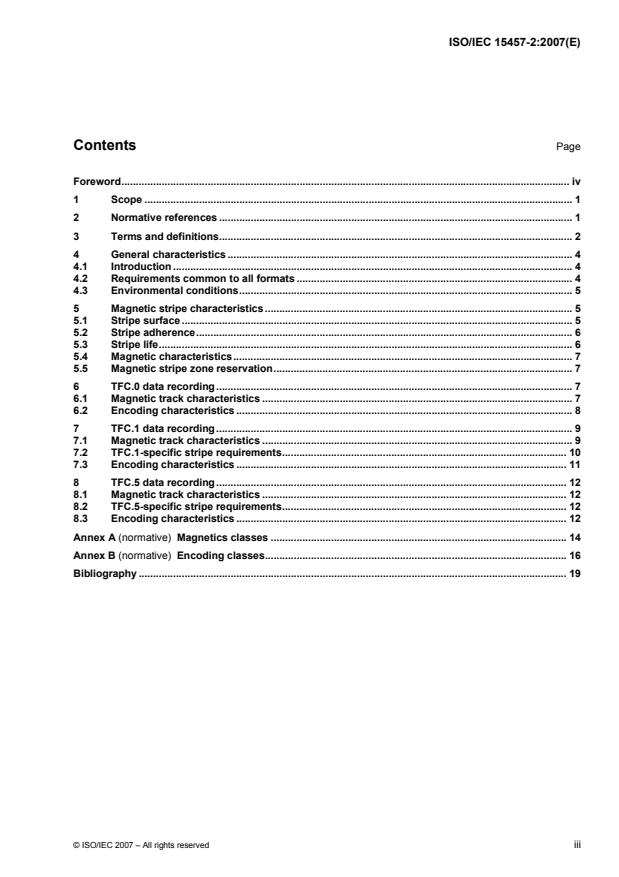
Contents Page
Foreword. iv
1 Scope . 1
2 Normative references . 1
3 Terms and definitions. 2
4 General characteristics . 4
4.1 Introduction . 4
4.2 Requirements common to all formats . 4
4.3 Environmental conditions. 5
5 Magnetic stripe characteristics . 5
5.1 Stripe surface. 5
5.2 Stripe adherence. 6
5.3 Stripe life. 6
5.4 Magnetic characteristics. 7
5.5 Magnetic stripe zone reservation. 7
6 TFC.0 data recording. 7
6.1 Magnetic track characteristics . 7
6.2 Encoding characteristics . 8
7 TFC.1 data recording. 9
7.1 Magnetic track characteristics . 9
7.2 TFC.1-specific stripe requirements. 10
7.3 Encoding characteristics . 11
8 TFC.5 data recording. 12
8.1 Magnetic track characteristics . 12
8.2 TFC.5-specific stripe requirements. 12
8.3 Encoding characteristics . 12
Annex A (normative) Magnetics classes . 14
Annex B (normative) Encoding classes. 16
Bibliography . 19
© ISO/IEC 2007 – All rights reserved iii
Foreword
ISO (the International Organization for Standardization) and IEC (the International Electrotechnical
Commission) form the specialized system for worldwide standardization. National bodies that are members of
ISO or IEC participate in the development of International Standards through technical committees
established by the respective organization to deal with particular fields of technical activity. ISO and IEC
technical committees collaborate in fields of mutual interest. Other international organizations, governmental
and non-governmental, in liaison with ISO and IEC, also take part in the work. In the field of information
technology, ISO and IEC have established a joint technical committee, ISO/IEC JTC 1.
International Standards are drafted in accordance with the rules given in the ISO/IEC Directives, Part 2.
The main task of the joint technical committee is to prepare International Standards. Draft International
Standards adopted by the joint technical committee are circulated to national bodies for voting. Publication as
an International Standard requires approval by at least 75 % of the national bodies casting a vote.
Attention is drawn to the possibility that some of the elements of this document may be the subject of patent
rights. ISO and IEC shall not be held responsible for identifying any or all such patent rights.
ISO/IEC 15457-2 was prepared by Joint Technical Committee ISO/IEC JTC 1, Information technology,
Subcommittee SC 17, Cards and personal identification.
This second edition cancels and replaces the first edition (ISO/IEC 15457-2:2001), Annex A of which has
been technically revised.
ISO/IEC 15457 consists of the following parts, under the general title Identification cards — Thin flexible
cards:
⎯ Part 1: Physical characteristics
⎯ Part 2: Magnetic recording technique
⎯ Part 3: Test methods
iv © ISO/IEC 2007 – All rights reserved
INTERNATIONAL STANDARD ISO/IEC 15457-2:2007(E)
Identification cards — Thin flexible cards —
Part 2:
Magnetic recording technique
1 Scope
Thin flexible cards (TFCs) are used to automate the controls for access to goods or services such as mass
transit, highway toll systems, car parks, vouchers and stored value.
For these applications, data can be written and/or read by machines using various recording techniques:
magnetic stripe, optical character recognition (OCR), bar code, etc.
This part of ISO/IEC 15457 specifies the magnetic stripe and encoding characteristics of thin flexible cards at
two points in the card’s life cycle:
⎯ at the point of loading into the card-issuing equipment;
⎯ at the point of issue to the public.
Guidance concerning the storage and usage of finished cards (including magnetic stripe cards) under various
environmental conditions is given in ISO/IEC 15457-1.
2 Normative references
The following referenced documents are indispensable for the application of this document. For dated
references, only the edition cited applies. For undated references, the latest edition of the referenced
document (including any amendments) applies.
ISO 4287, Geometrical Product Specifications (GPS) — Surface texture: Profile method — Terms, definitions
and surface texture parameters
ISO/IEC 7811-2, Identification cards — Recording technique — Magnetic stripe — Low coercivity
ISO/IEC 7811-6, Identification cards — Recording technique — Magnetic stripe — High coercivity
ISO/IEC 15457-1, Identification cards — Thin flexible cards — Part 1: Physical characteristics
ISO/IEC 15457-3, Identification cards — Thin flexible cards — Part 3: Test methods
© ISO/IEC 2007 – All rights reserved 1
3 Terms and definitions
For the purposes of this document, the terms and definitions given in ISO/IEC 15457-1 and the following apply.
3.1
track
area of stripe surface occupied by the data encoded by a single channel of the magnetic recording write/read
interface
3.2
central stripe
stripe centred on the widthwise axis of the card
3.3
lateral stripe
any widthwise stripe which is not centred on the widthwise axis of the card
3.4
re-usable card
durable card able to be recovered from the field (generally by automatic equipment operation) and re-issued
3.5
unused unencoded card
card possessing all the components required for its intended purpose, which has not been subjected to any
personalisation or testing operation and which has been stored in a clean environment with no more than a
48 h exposure to daylight at temperatures between 5 °C and 30 °C and a humidity between 10 % and 90 %
without experiencing thermal shock
3.6
unused encoded card
card according to 3.5 that has only been encoded with all the data required for its intended purpose
1)
(e.g. magnetic encoding, printing, etc.)
3.7
returned card
card according to 3.6 after it has been issued to the card holder and returned for the purpose of testing
2)
(e.g. re-usable card returned for possible re-issue)
3.8
R , R
a z
measures of surface irregularity as defined in ISO 4287
3.9
maximum field, H
max
maximum absolute magnetic field strength applied as described by the test method
3.10
coercivity, H = H
cM cJ
continuously applied magnetic field which reduces the magnetisation to zero from a previous maximum
magnetisation state in the opposite direction, the quantity of interest being that which is measured parallel to
the longitudinal axis of the stripe
1) The definitions used in ISO/IEC 7811 refer to embossing and electronic encoding, which are not defined in
ISO/IEC 15457. However, printing on issue (as opposed to pre-printing) frequently accompanies magnetic encoding in
applications of thin flexible cards.
2) In certain applications of thin flexible cards, the purpose of testing returned cards is to establish their suitability to be
re-issued for re-use. Such testing is generally done automatically by bulk sorter/encoder equipment.
2 © ISO/IEC 2007 – All rights reserved
3.11
longitudinal squareness, SQ = M /M (at H )
r max
ratio of the value of magnetisation (M ) at zero magnetic field (H=0) after the application and removal of the
r
maximum field (H ) to the magnetisation (M) at the maximum field applied (H ) measured along the
max max
longitudinal axis of the stripe
3.12
switching field by derivative, SF
D
the width at half height of the differentiated static magnetisation curve M(H) divided by the coercivity from the
same curve
3.13
switching field by slope, SF
S
( /H /-/H /)/ H′ , where M(-/H /) = 0,5M and M(-/H /) = -0,5 M ; the difference between the field values at the
r
2 1 cM 1 2 r
intercept of the static magnetisation M(H) loop with M(H) = 0,5M and M(H) = -0,5M , divided by the coercivity
r r
3.14
recording technique
technique, such as magnetic or optical encoding, used to store data on the card
3.15
nominal bit density, D
R
encoding density specified for a track
3.16
maximum test current, I
max
upper of two test write currents used for testing TFC magnetic stripes
3.17
maximum test density, D
max
upper of two test recording densities used for testing TFC magnetic stripes
3.18
minimum test current, I
min
lower of two test write currents used for testing TFC magnetic stripes
3.19
minimum test density, D
min
lower of two test recording densities used for testing TFC magnetic stripes
3.20
individual signal amplitude, U
i
base-to-peak amplitude of a single readback signal pulse
3.21
average signal amplitude, U
A
arithmetic mean of the absolute values of the individual signal amplitudes found in a readback waveform:
n
U
∑ ik
k=1
Un = (where is the number of individual signal amplitudes)
A
n
© ISO/IEC 2007 – All rights reserved 3
3.22
modulation, m
range of variation of a readback signal defined by
U − U
imax imin
m=
2×U
A
where U is the individual readback signal amplitude and U is the average readback signal amplitude
i A
recorded at D and I
max max
4 General characteristics
4.1 Introduction
Three card sizes, TFC.0, TFC.1 and TFC.5, are defined in ISO/IEC 15457-1.
Common physical characteristics and the geometrical and topographical characteristics of each card size are
specified in ISO/IEC 15457-1.
In this part of ISO/IEC 15457, the magnetic stripe and track characteristics specific to each size of card are
given in separate clauses. Common characteristics are specified in Clause 4. Specifications for the permitted
magnetic and encoding characteristics are given in the annexes.
All clauses in all parts of ISO/IEC 15457 apply to finished cards or to the reels/packs from which such cards
are taken. Certain clauses however, such as durability, concern the characteristics of the card throughout its
life. As a matter of convenience and practicality, certain tests can be carried out on unfinished cards where it
can be demonstrated that no significant change in that property can arise during subsequent processing.
4.2 Requirements common to all formats
4.2.1 General requirements
Thin flexible cards may be finished in a variety of ways, according to the requirements of the system in which
they are to be used. This part of the standard deals with those which are equipped with a magnetic stripe.
Stripes may be magnetically encoded, in accordance with this part of ISO/IEC 15457.
The addition of a magnetic stripe and the encoding of that stripe shall not affect the continued conformance of
the finished cards to the other applicable parts of ISO/IEC 15457.
Magnetic stripes, however presented, shall be free from defects which could interfere with usage, such as
joins, discontinuities, loose particles, embedded debris, creases, indentations and high spots. They shall not
adhere to, or leave an impression on, the adjacent cards in a reel or pack.
4.2.2 Reference edges
Once identified in accordance with the criteria defined in ISO/IEC 15457-1, the same front and reference
edges shall be used exclusively and consistently in applying all relevant parts of ISO/IEC 15457, including this.
NOTE 1 In the case of a central stripe, this constraint results in a unique relationship between reference edges and the
beginning of the encoded message.
NOTE 2 For example, in the case of a lateral stripe, this constraint results in the unique relationship between reference
edges and stripe shown in Figure 1.
4 © ISO/IEC 2007 – All rights reserved
Back
Reference edges are indicated by the black triangles.
Figure 1 — Reference edges for lateral stripe
4.3 Environmental conditions
4.3.1 Testing environment
The environmental conditions under which the characteristics specified in this part of ISO/IEC 15457 are to be
measured are specified in ISO/IEC 15457-3.
4.3.2 Storage environment and packaging
Magnetic stripes shall continue to comply with the requirements of this part of ISO 15457 after storage under
the storage environment and packaging conditions specified in ISO/IEC 15457-1.
4.3.3 Usage environment
Magnetic stripes shall remain structurally reliable and usable within the usage environment specified in
ISO/IEC 15457-1.
5 Magnetic stripe characteristics
5.1 Stripe surface
5.1.1 Protrusion
In order to accommodate manufacturing processes which apply the magnetic stripe as tape, this part of
ISO/IEC 15457 defines two classes of protrusion, as follows.
Class 1: The maximum protrusion of the magnetic stripe surface above the surface of the base material shall
not be less than 0 µm and shall not be greater than 12 µm.
Class 2: The maximum protrusion of the magnetic stripe surface above the surface of the base material shall
not be less than 0 µm and shall not be greater than 25 µm.
Class 2 protrusion is permited on TFC.1 cards with paper or composite substrates only.
5.1.2 Profile deviation
The straight line deviation of the profile across stripes greater than 3 mm shall be less than 8 µm.
5.1.3 Roughness
The roughness of the magnetic stripe surface, measured along lines parallel to the height and width
dimensions, shall be in accordance with Table 1.
© ISO/IEC 2007 – All rights reserved 5
...