


ISO 5803:2023
(Main)Fine ceramics (advanced ceramics, advanced technical ceramics) — Test method for determination of monoclinic phase in zirconia
Fine ceramics (advanced ceramics, advanced technical ceramics) — Test method for determination of monoclinic phase in zirconia
This document specifies a method for the qualitative and quantitative determination of the monoclinic phase present in yttria tetragonal zirconia polycrystal (Y-TZP) powders with an yttria content ≤ 6 mol% using X-ray powder diffraction. This method is also applicable for determining the monoclinic phase content in monolithic Y-TZP ceramics with an yttria content of ≤ 6 mol%. NOTE For quantitative determination of the monoclinic phase present in zirconia with a higher content of yttria or another stabilizer (e.g. MgO, CaO), this document can be referenced.
Titre manque
General Information
Overview
ISO 5803:2023 specifies a standardized X‑ray powder diffraction (XRD) test method for the qualitative and quantitative determination of the monoclinic phase in zirconia. The method applies to yttria‑stabilized tetragonal zirconia polycrystal (Y‑TZP) powders and monolithic Y‑TZP ceramics with yttria content ≤ 6 mol%. The standard describes sample preparation, recommended XRD instrumentation and scan parameters, calculation of integrated intensity ratios, and conversion to volume/mass fractions using prescribed P values.
Key topics and technical requirements
- Scope: Focus on monoclinic vs tetragonal (and cubic) phase analysis in Y‑TZP (yttria ≤ 6 mol%); guidance for higher stabilizer contents is referenced.
- Principle: Phase identification via XRD; quantitative analysis using the polymorph (integrated‑intensity) method. Full‑pattern/Rietveld methods are recommended for complete multiphase analysis.
- Apparatus & settings:
- Copper X‑ray tube with monochromator/filter and precise goniometer (2θ error ≤ 0.5°).
- Suggested excitation ≥ 40 kV and current ≥ 35 mA.
- Qualitative scan: 2θ = 10°–80°, continuous ≤ 2°/min.
- Quantitative scan: 2θ = 26.5°–33.5°, step scanning ≤ 0.05°/step.
- Sample preparation:
- Homogeneous grain size (recommended < 40 µm).
- Packing per ISO 20203; use backfill pressing to reduce preferred orientation and obtain a flat surface.
- Calculation & P values:
- Integrated intensity ratio (monoclinic reflections vs tetragonal/cubic) converted to volume fraction using a P intensity factor.
- For Y‑TZP (yttria ≤ 6 mol%), P = 1.311 is recommended. Annex A lists alternative P values for monoclinic–cubic (mean 1.219) and multiphase systems (1.265).
- Limitations:
- Results invalid if strong preferred orientation or peak overlap with other phases occurs.
- Reporting: Test reports shall conform to ISO/IEC 17025 and include apparatus, scan parameters, identified ICDD PDF numbers, integrated intensities, P values, and calculated phase fractions.
Applications and users
ISO 5803:2023 is relevant to:
- Quality control and acceptance testing in advanced ceramics manufacturing (Y‑TZP powders and components).
- Materials characterization labs performing XRD phase analysis and quantification.
- R&D teams evaluating phase stability, low‑temperature degradation, or processing effects on zirconia microstructure.
- Suppliers and end‑users needing traceable, comparable monoclinic phase measurements for specification compliance.
Keywords: ISO 5803:2023, monoclinic phase, zirconia, Y‑TZP, X‑ray powder diffraction, XRD, quantitative phase analysis, P value, ceramics testing.
Related standards
- ISO/IEC 17025 (laboratory competence and reporting)
- ISO 20203 (sample packing and crystallite size by XRD)
- CEN ENV 14237 / EVN 14273 (related zirconia phase analysis references)
- Rietveld/full‑pattern XRD methods (for complete multiphase quantification)

Standards Content (Sample)
INTERNATIONAL ISO
STANDARD 5803
First edition
2023-01
Fine ceramics (advanced ceramics,
advanced technical ceramics) —
Test method for determination of
monoclinic phase in zirconia
Reference number
© ISO 2023
All rights reserved. Unless otherwise specified, or required in the context of its implementation, no part of this publication may
be reproduced or utilized otherwise in any form or by any means, electronic or mechanical, including photocopying, or posting on
the internet or an intranet, without prior written permission. Permission can be requested from either ISO at the address below
or ISO’s member body in the country of the requester.
ISO copyright office
CP 401 • Ch. de Blandonnet 8
CH-1214 Vernier, Geneva
Phone: +41 22 749 01 11
Email: copyright@iso.org
Website: www.iso.org
Published in Switzerland
ii
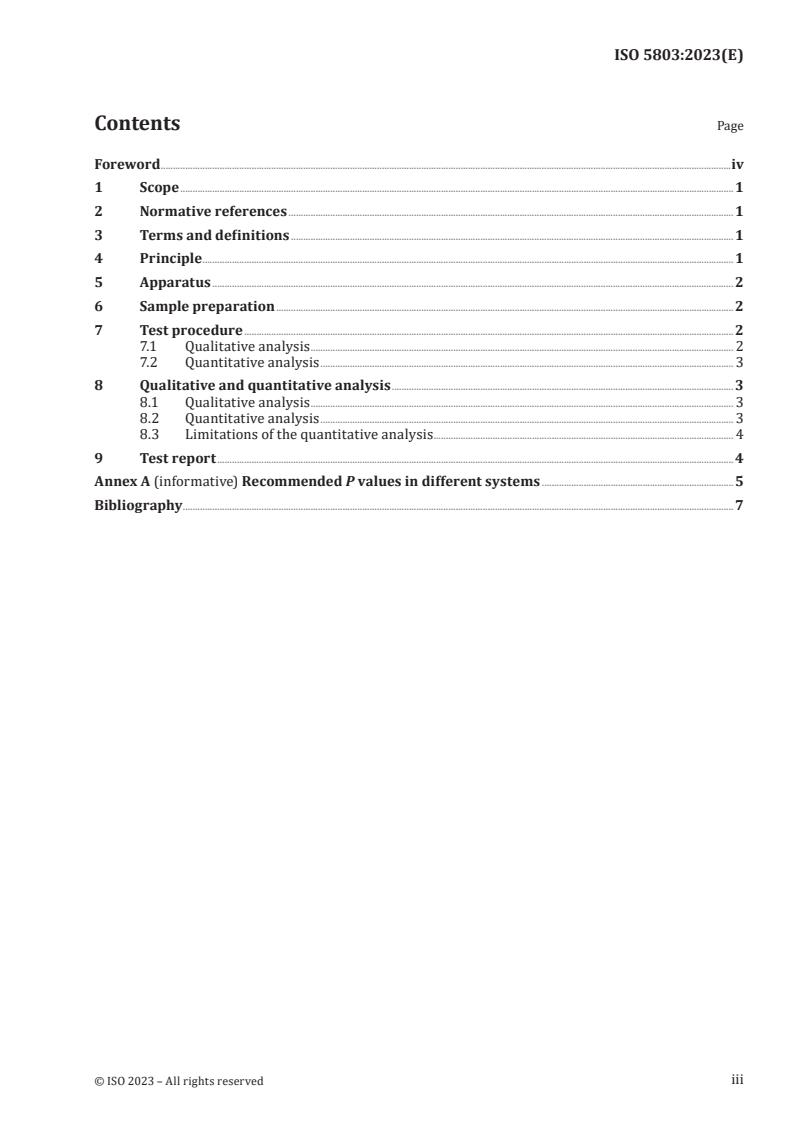
Contents Page
Foreword .iv
1 Scope . 1
2 Normative references . 1
3 Terms and definitions . 1
4 Principle . 1
5 Apparatus . 2
6 Sample preparation .2
7 Test procedure .2
7.1 Qualitative analysis . 2
7.2 Quantitative analysis . 3
8 Qualitative and quantitative analysis . 3
8.1 Qualitative analysis . 3
8.2 Quantitative analysis . 3
8.3 Limitations of the quantitative analysis . 4
9 Test report . 4
Annex A (informative) Recommended P values in different systems . 5
Bibliography . 7
iii
Foreword
ISO (the International Organization for Standardization) is a worldwide federation of national standards
bodies (ISO member bodies). The work of preparing International Standards is normally carried out
through ISO technical committees. Each member body interested in a subject for which a technical
committee has been established has the right to be represented on that committee. International
organizations, governmental and non-governmental, in liaison with ISO, also take part in the work.
ISO collaborates closely with the International Electrotechnical Commission (IEC) on all matters of
electrotechnical standardization.
The procedures used to develop this document and those intended for its further maintenance are
described in the ISO/IEC Directives, Part 1. In particular, the different approval criteria needed for the
different types of ISO documents should be noted. This document was drafted in accordance with the
editorial rules of the ISO/IEC Directives, Part 2 (see www.iso.org/directives).
Attention is drawn to the possibility that some of the elements of this document may be the subject of
patent rights. ISO shall not be held responsible for identifying any or all such patent rights. Details of
any patent rights identified during the development of the document will be in the Introduction and/or
on the ISO list of patent declarations received (see www.iso.org/patents).
Any trade name used in this document is information given for the convenience of users and does not
constitute an endorsement.
For an explanation of the voluntary nature of standards, the meaning of ISO specific terms and
expressions related to conformity assessment, as well as information about ISO's adherence to
the World Trade Organization (WTO) principles in the Technical Barriers to Trade (TBT), see
www.iso.org/iso/foreword.html.
This document was prepared by Technical Committee ISO/TC 206, Fine ceramics.
Any feedback or questions on this document should be directed to the user’s national standards body. A
complete listing of these bodies can be found at www.iso.org/members.html.
iv
INTERNATIONAL STANDARD ISO 5803:2023(E)
Fine ceramics (advanced ceramics, advanced technical
ceramics) — Test method for determination of monoclinic
phase in zirconia
1 Scope
This document specifies a method for the qualitative and quantitative determination of the monoclinic
phase present in yttria tetragonal zirconia polycrystal (Y-TZP) powders with an yttria content ≤ 6 mol%
using X-ray powder diffraction. This method is also applicable for determining the monoclinic phase
content in monolithic Y-TZP ceramics with an yttria content of ≤ 6 mol%.
NOTE For quantitative determination of the monoclinic phase present in zirconia with a higher content of
yttria or another stabilizer (e.g. MgO, CaO), this document can be referenced.
2 Normative references
The following documents are referred to in the text in such a way that some or all of their content
constitutes requirements of this document. For dated references, only the edition cited applies. For
undated references, the latest edition of the referenced document (including any amendments) applies.
ISO/IEC 17025, General requirements for the competence of testing and calibration laboratories
ISO 20203, Carbonaceous materials used in the production of aluminium — Calcined coke — Determination
of crystallite size of calcined petroleum coke by X-ray diffraction
3 Terms and definitions
No terms and definitions are listed in this document.
ISO and IEC maintain terminology databases for use in standardization at the following addresses:
— ISO Online browsing platform: available at https:// www .iso .org/ obp
— IEC Electropedia: available at https:// www .electropedia .org/
4 Principle
The qualitative and quantitative determination of the monoclinic phase in Y-TZP powders or Y-TZP
ceramics is derived from the X-ray diffraction analysis of a representative sample of this powder or
ceramic.
The qualitative analysis is based on a comparison of the recorded spectrum with available reference
data (ICDD PDF database).
[1–4]
The quantitative analysis is based on the polymorph method. The polymorph method provides
phase analysis from a small number of integrated intensities in an X-ray diffraction scan. It is adapted
[2,5–7]
for the determination of the monoclinic phase in zirconia powders or zirconia ceramics. For
a full analysis, including the quantitative determination of all the phases, the full pattern method as
[1]
mentioned in EVN 14273:2002 or the Rietveld method are recommended.
5 Apparatus
The usual laboratory apparatus and, in particular, the following shall be used:
5.1 X-ray diffractometer, equipped with a copper X-ray tube, a monochromator or filter for
restricting the wavelength range, a sample holder, a radiation detector, a signal processor and readout.
The following experimental settings are recommended:
— precise goniometer (2θ error ≤ 0,5°);
— primary soller slit with a divergence ≤ 2,5°;
— divergence slit ≤ 1°;
— receiving slit ≤ 2 mm;
— scatter slit ≤ 1°;
— continuous scanning rate at ≤ 2°/min or step scanning at ≤ 0,05°/step.
5.2 Sample h
...
Frequently Asked Questions
ISO 5803:2023 is a standard published by the International Organization for Standardization (ISO). Its full title is "Fine ceramics (advanced ceramics, advanced technical ceramics) — Test method for determination of monoclinic phase in zirconia". This standard covers: This document specifies a method for the qualitative and quantitative determination of the monoclinic phase present in yttria tetragonal zirconia polycrystal (Y-TZP) powders with an yttria content ≤ 6 mol% using X-ray powder diffraction. This method is also applicable for determining the monoclinic phase content in monolithic Y-TZP ceramics with an yttria content of ≤ 6 mol%. NOTE For quantitative determination of the monoclinic phase present in zirconia with a higher content of yttria or another stabilizer (e.g. MgO, CaO), this document can be referenced.
This document specifies a method for the qualitative and quantitative determination of the monoclinic phase present in yttria tetragonal zirconia polycrystal (Y-TZP) powders with an yttria content ≤ 6 mol% using X-ray powder diffraction. This method is also applicable for determining the monoclinic phase content in monolithic Y-TZP ceramics with an yttria content of ≤ 6 mol%. NOTE For quantitative determination of the monoclinic phase present in zirconia with a higher content of yttria or another stabilizer (e.g. MgO, CaO), this document can be referenced.
ISO 5803:2023 is classified under the following ICS (International Classification for Standards) categories: 81.060.30 - Advanced ceramics. The ICS classification helps identify the subject area and facilitates finding related standards.
You can purchase ISO 5803:2023 directly from iTeh Standards. The document is available in PDF format and is delivered instantly after payment. Add the standard to your cart and complete the secure checkout process. iTeh Standards is an authorized distributor of ISO standards.
Questions, Comments and Discussion
Ask us and Technical Secretary will try to provide an answer. You can facilitate discussion about the standard in here.
Loading comments...