


ISO 21756
(Main)Traditional Chinese medicine — Salvia miltiorrhiza root and rhizome aqueous extract granules
Traditional Chinese medicine — Salvia miltiorrhiza root and rhizome aqueous extract granules
This document specifies the technical requirements for the industrial manufacturing procedures and quality of Salvia miltiorrhiza formula granules, covering the terms and definitions, general requirements, manufacturing, quality and safety, storage and transportation. It is intended to assure the quality of Salvia miltiorrhiza formula granules products for consumers.
Médecine traditionnelle chinoise — Granulés d'extrait aqueux de racine et de rhizome de Salvia miltiorrhiza
General Information
- Status
- Not Published
- Technical Committee
- ISO/TC 249 - Traditional Chinese medicine
- Drafting Committee
- ISO/TC 249 - Traditional Chinese medicine
- Current Stage
- 6000 - International Standard under publication
- Start Date
- 28-Apr-2026
- Completion Date
- 02-May-2026
Overview
ISO/FDIS 21756: Traditional Chinese medicine - Salvia miltiorrhiza root and rhizome aqueous extract granules is an international standard developed by ISO/TC 249. This document specifies comprehensive technical requirements for the industrial production, quality, and safety of Salvia miltiorrhiza root and rhizome aqueous extract granules-commonly used herbal products in Traditional Chinese Medicine (TCM), often referred to as Danshen.
Designed for manufacturers, quality assurance professionals, and regulatory bodies, ISO 21756 establishes uniform criteria to assure the quality and safety of Salvia miltiorrhiza extract granules in international trade. The standard covers terminology, general manufacturing procedures, quality control, testing methods, and guidelines for storage and transportation.
Key Topics
The standard addresses several critical areas for Salvia miltiorrhiza root and rhizome aqueous extract granules:
Terms and Definitions
- Provides clear terminology relevant to extract granules, extraction processes, and quality parameters.
Manufacturing Requirements
- Specifies that raw materials must meet the criteria outlined in ISO 21314.
- Details production steps: extraction, concentration, drying, granulation, and addition of excipients.
- Emphasizes accurate dosage, consistent quality, and hygienic processing.
Quality Control & Safety Assurance
- Identification: Utilizes advanced chromatographic methods for component verification.
- Marker Compounds: Requires quantification of salvianolic acid B within defined limits.
- Ethanol-Soluble Extractives & Moisture: Sets minimum extractive yield and maximum water content to ensure efficacy and stability.
- Dosage Uniformity & Particle Size: Mandates uniform dosage and controlled granule size distribution.
- Safety Testing: Includes detection and limitation of heavy metals, pesticide residues, and microbial contamination in line with international pharmacopoeias.
Testing Methods
- Provides or references validated, standardized test methods for all quality and safety parameters, such as TLC, HPLC, and assays for heavy metals and microbes.
Storage & Transportation
- Outlines best practices for protecting products from moisture, contamination, and damage throughout storage and shipping, with reference to ISO 22217.
Applications
The practical value of ISO 21756 lies in its comprehensive approach to ensuring the quality and safety of Salvia miltiorrhiza extract granules along the entire supply chain. Applications include:
- Manufacturers: Establishes best practices for raw material selection, production processes, and quality assurance, supporting GMP compliance and international market access.
- Regulatory Bodies: Provides a harmonized framework for safety and quality evaluation, helping align national regulations with international standards.
- Quality Assurance Professionals: Offers standardized methods for testing and documenting critical quality and safety metrics.
- Distributors & End-Users: Ensures confidence in product quality, consistency, and safety for consumers and healthcare providers using Danshen granules.
- International Trade: Facilitates the import and export of TCM products by harmonizing criteria for quality and safety globally.
Related Standards
For an integrated approach to quality assurance of herbal granules and Traditional Chinese Medicine, the following standards are referenced:
- ISO 21314: Salvia miltiorrhiza root and rhizome
- ISO 18664: Determination of heavy metals in herbal medicines
- ISO 18668-4: Coding system for granule forms of Chinese medicines
- ISO 19609-1: Quality and safety of raw materials and finished products
- ISO 19617: General requirements for manufacturing natural products
- ISO 21371: Labelling requirements for TCM products
- ISO 22217: Storage requirements for raw materials and decoction pieces
- ISO 22258: Determination of pesticide residues
- ISO 22467: Determination of microorganisms in natural products
- ISO 23419: General requirements for manufacturing procedures and quality assurance of granules
ISO/FDIS 21756 ensures that Salvia miltiorrhiza root and rhizome aqueous extract granules meet the high standards expected for herbal medicines, thereby supporting consistency, consumer safety, and regulatory compliance across global markets.
Buy Documents
ISO/FDIS 21756 - Traditional Chinese medicine — Salvia miltiorrhiza root and rhizome aqueous extract granules/17/2025
ISO/FDIS 21756 - Traditional Chinese medicine — Salvia miltiorrhiza root and rhizome aqueous extract granules
REDLINE ISO/FDIS 21756 - Traditional Chinese medicine — Salvia miltiorrhiza root and rhizome aqueous extract granules
Get Certified
Connect with accredited certification bodies for this standard

BSI Group
BSI (British Standards Institution) is the business standards company that helps organizations make excellence a habit.

TÜV Rheinland
TÜV Rheinland is a leading international provider of technical services.

TÜV SÜD
TÜV SÜD is a trusted partner of choice for safety, security and sustainability solutions.
Sponsored listings
Frequently Asked Questions
ISO 21756 is a draft published by the International Organization for Standardization (ISO). Its full title is "Traditional Chinese medicine — Salvia miltiorrhiza root and rhizome aqueous extract granules". This standard covers: This document specifies the technical requirements for the industrial manufacturing procedures and quality of Salvia miltiorrhiza formula granules, covering the terms and definitions, general requirements, manufacturing, quality and safety, storage and transportation. It is intended to assure the quality of Salvia miltiorrhiza formula granules products for consumers.
This document specifies the technical requirements for the industrial manufacturing procedures and quality of Salvia miltiorrhiza formula granules, covering the terms and definitions, general requirements, manufacturing, quality and safety, storage and transportation. It is intended to assure the quality of Salvia miltiorrhiza formula granules products for consumers.
ISO 21756 is classified under the following ICS (International Classification for Standards) categories: 11.120.10 - Medicaments. The ICS classification helps identify the subject area and facilitates finding related standards.
ISO 21756 is available in PDF format for immediate download after purchase. The document can be added to your cart and obtained through the secure checkout process. Digital delivery ensures instant access to the complete standard document.
Standards Content (Sample)
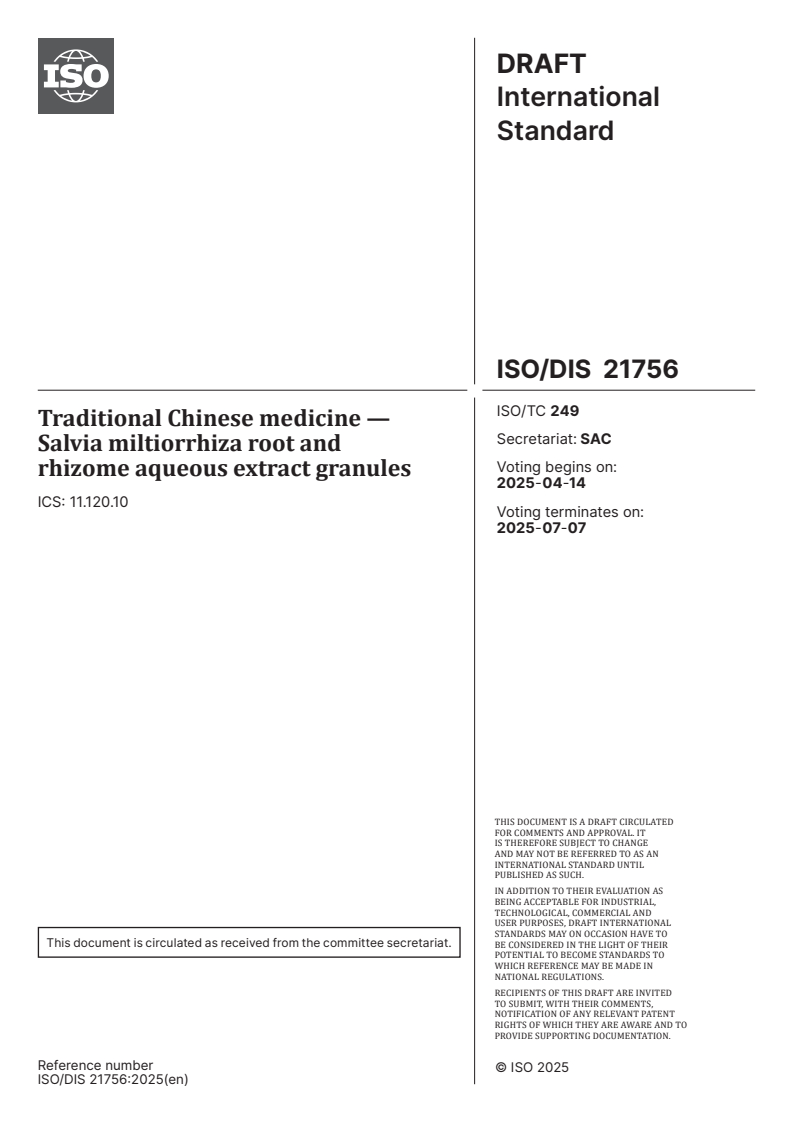
DRAFT
International
Standard
ISO/DIS 21756
ISO/TC 249
Traditional Chinese medicine —
Secretariat: SAC
Salvia miltiorrhiza root and
Voting begins on:
rhizome aqueous extract granules
2025-04-14
ICS: 11.120.10
Voting terminates on:
2025-07-07
THIS DOCUMENT IS A DRAFT CIRCULATED
FOR COMMENTS AND APPROVAL. IT
IS THEREFORE SUBJECT TO CHANGE
AND MAY NOT BE REFERRED TO AS AN
INTERNATIONAL STANDARD UNTIL
PUBLISHED AS SUCH.
IN ADDITION TO THEIR EVALUATION AS
BEING ACCEPTABLE FOR INDUSTRIAL,
TECHNOLOGICAL, COMMERCIAL AND
USER PURPOSES, DRAFT INTERNATIONAL
STANDARDS MAY ON OCCASION HAVE TO
This document is circulated as received from the committee secretariat.
BE CONSIDERED IN THE LIGHT OF THEIR
POTENTIAL TO BECOME STANDARDS TO
WHICH REFERENCE MAY BE MADE IN
NATIONAL REGULATIONS.
RECIPIENTS OF THIS DRAFT ARE INVITED
TO SUBMIT, WITH THEIR COMMENTS,
NOTIFICATION OF ANY RELEVANT PATENT
RIGHTS OF WHICH THEY ARE AWARE AND TO
PROVIDE SUPPORTING DOCUMENTATION.
Reference number
ISO/DIS 21756:2025(en)
DRAFT
ISO/DIS 21756:2025(en)
International
Standard
ISO/DIS 21756
ISO/TC 249
Traditional Chinese medicine —
Secretariat: SAC
Salvia miltiorrhiza root and
Voting begins on:
rhizome aqueous extract granules
ICS: 11.120.10
Voting terminates on:
THIS DOCUMENT IS A DRAFT CIRCULATED
FOR COMMENTS AND APPROVAL. IT
IS THEREFORE SUBJECT TO CHANGE
AND MAY NOT BE REFERRED TO AS AN
INTERNATIONAL STANDARD UNTIL
PUBLISHED AS SUCH.
IN ADDITION TO THEIR EVALUATION AS
BEING ACCEPTABLE FOR INDUSTRIAL,
© ISO 2025
TECHNOLOGICAL, COMMERCIAL AND
USER PURPOSES, DRAFT INTERNATIONAL
All rights reserved. Unless otherwise specified, or required in the context of its implementation, no part of this publication may
STANDARDS MAY ON OCCASION HAVE TO
be reproduced or utilized otherwise in any form or by any means, electronic or mechanical, including photocopying, or posting on
This document is circulated as received from the committee secretariat. BE CONSIDERED IN THE LIGHT OF THEIR
the internet or an intranet, without prior written permission. Permission can be requested from either ISO at the address below
POTENTIAL TO BECOME STANDARDS TO
WHICH REFERENCE MAY BE MADE IN
or ISO’s member body in the country of the requester.
NATIONAL REGULATIONS.
ISO copyright office
RECIPIENTS OF THIS DRAFT ARE INVITED
CP 401 • Ch. de Blandonnet 8
TO SUBMIT, WITH THEIR COMMENTS,
CH-1214 Vernier, Geneva
NOTIFICATION OF ANY RELEVANT PATENT
Phone: +41 22 749 01 11
RIGHTS OF WHICH THEY ARE AWARE AND TO
PROVIDE SUPPORTING DOCUMENTATION.
Email: copyright@iso.org
Website: www.iso.org
Published in Switzerland Reference number
ISO/DIS 21756:2025(en)
ii
ISO/DIS 21756:2025(en)
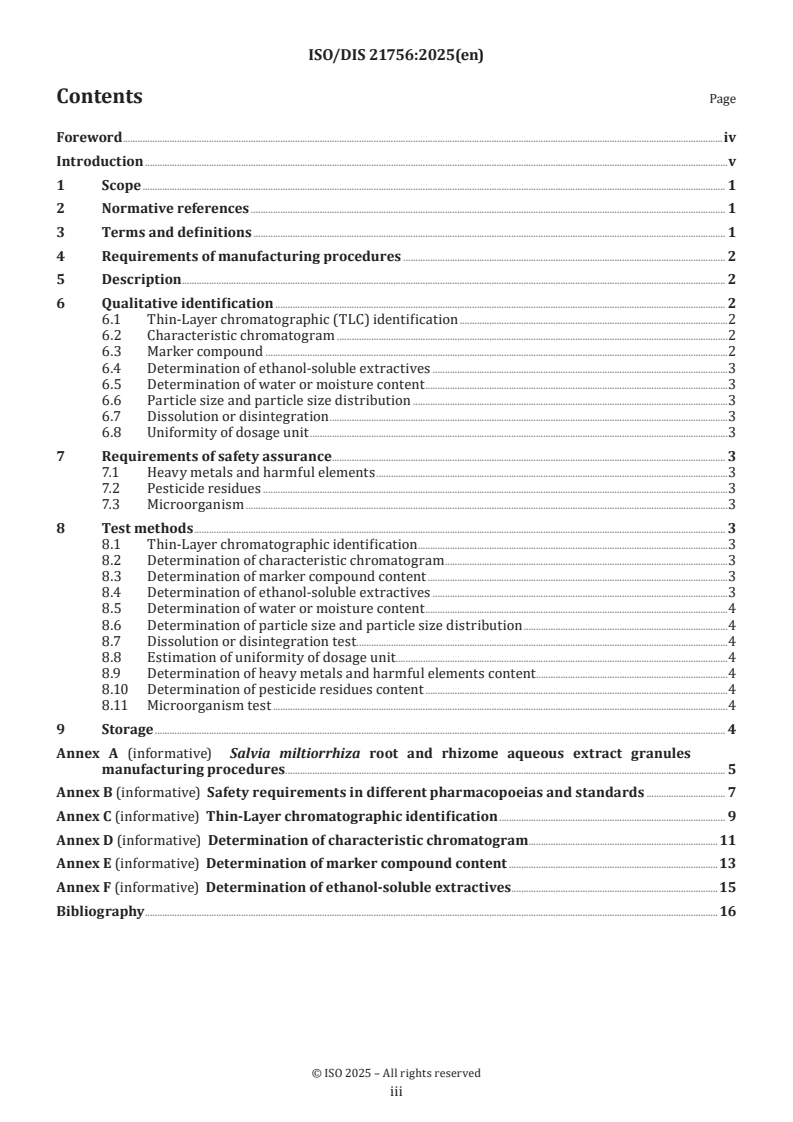
Contents Page
Foreword .iv
Introduction .v
1 Scope . 1
2 Normative references . 1
3 Terms and definitions . 1
4 Requirements of manufacturing procedures . 2
5 Description . . 2
6 Qualitative identification . 2
6.1 Thin-Layer chromatographic (TLC) identification .2
6.2 Characteristic chromatogram .2
6.3 Marker compound .2
6.4 Determination of ethanol-soluble extractives .3
6.5 Determination of water or moisture content .3
6.6 Particle size and particle size distribution .3
6.7 Dissolution or disintegration .3
6.8 Uniformity of dosage unit .3
7 Requirements of safety assurance . 3
7.1 Heavy metals and harmful elements .3
7.2 Pesticide residues .3
7.3 Microorganism .3
8 Test methods . 3
8.1 Thin-Layer chromatographic identification .3
8.2 Determination of characteristic chromatogram .3
8.3 Determination of marker compound content .3
8.4 Determination of ethanol-soluble extractives .3
8.5 Determination of water or moisture content .4
8.6 Determination of particle size and particle size distribution .4
8.7 Dissolution or disintegration test .4
8.8 Estimation of uniformity of dosage unit .4
8.9 Determination of heavy metals and harmful elements content .4
8.10 Determination of pesticide residues content .4
8.11 Microorganism test .4
9 Storage . 4
Annex A (informative) Salvia miltiorrhiza root and rhizome aqueous extract granules
manufacturing procedures . . 5
Annex B (informative) Safety requirements in different pharmacopoeias and standards . 7
Annex C (informative) Thin-Layer chromatographic identification . 9
Annex D (informative) Determination of characteristic chromatogram .11
Annex E (informative) Determination of marker compound content .13
Annex F (informative) Determination of ethanol-soluble extractives .15
Bibliography .16
iii
ISO/DIS 21756:2025(en)
Foreword
ISO (the International Organization for Standardization) is a worldwide federation of national standards
bodies (ISO member bodies). The work of preparing International Standards is normally carried out through
ISO technical committees. Each member body interested in a subject for which a technical committee
has been established has the right to be represented on that committee. International organizations,
governmental and non-governmental, in liaison with ISO, also take part in the work. ISO collaborates closely
with the International Electrotechnical Commission (IEC) on all matters of electrotechnical standardization.
The procedures used to develop this document and those intended for its further maintenance are described
in the ISO/IEC Directives, Part 1. In particular, the different approval criteria needed for the different types
of ISO documents should be noted. This document was drafted in accordance with the editorial rules of the
ISO/IEC Directives, Part 2 (see www.iso.org/directives).
ISO draws attention to the possibility that the implementation of this document may involve the use of (a)
patent(s). ISO takes no position concerning the evidence, validity or applicability of any claimed patent
rights in respect thereof. As of the date of publication of this document, ISO had not received notice of (a)
patent(s) which may be required to implement this document. However, implementers are cautioned that
this may not represent the latest information, which may be obtained from the patent database available at
www.iso.org/patents. ISO shall not be held responsible for identifying any or all such patent rights.
Any trade name used in this document is information given for the convenience of users and does not
constitute an endorsement.
For an explanation of the voluntary nature of standards, the meaning of ISO specific terms and expressions
related to conformity assessment, as well as information about ISO's adherence to the World Trade
Organization (WTO) principles in the Technical Barriers to Trade (TBT), see www.iso.org/iso/foreword.html.
This document was prepared by Technical Committee ISO/TC 249, Traditional Chinese medicine.
Any feedback or questions on this document should be directed to the user’s national standards body. A
complete listing of these bodies can be found at www.iso.org/members.html.
iv
ISO/DIS 21756:2025(en)
Introduction
Salvia miltiorrhiza root and rhizome (the Chinese Pinyin name: Danshen) has been used as traditional Chinese
medicines for over 2 500 years and has been developed into various herbal medicinal products in many
countries. Salvia miltiorrhiza root and rhizome aqueous extract granules are alternative forms of dosage
for Salvia miltiorrhiza decoction pieces, which are obtained through modern pharmaceutical technology
of extraction, concentration, drying and granulation. Salvia miltiorrhiza root and rhizome aqueous extract
granules are well-suited for modern technological applications because they can be dosed accurately, quality
controllable, ready-to-take, and easy to store, thereby replacing difficult dose calculation, poor portability,
and longer decoction for Salvia miltiorrhiza decoction pieces.
ISO 21314 "Traditional Chinese medicine — Salvia miltiorrhiza root and rhizome" and ISO 23419 "Traditional
Chinese medicine — General requirements for manufacturing procedures and quality assurance of
granules", issued by ISO/TC 249, provide references for the quality assurance of Salvia miltiorrhiza root and
rhizome aqueous extract granules. However, the manufacturing technology and quality control of Salvia
miltiorrhiza root and rhizome aqueous extract granules have unique characteristics and requirements.
Therefore, it is important to establish technical specifications for manufacturing technology and quality
requirements of Salvia miltiorrhiza root and rhizome aqueous extract granules, to ensure their quality and
safety, in accordance with international standards.
v
DRAFT International Standard ISO/DIS 21756:2025(en)
Traditional Chinese medicine — Salvia miltiorrhiza root and
rhizome aqueous extract granules
1 Scope
This document specifies the technical requirements for the quality and safety of industrial manufacturing
procedures and quality of Salvia miltiorrhiza root and rhizome aqueous extract granules. It is applicable to
Salvia miltiorrhiza root and rhizome aqueous extract granules that is sold and used in the international trade.
2 Normative references
The following documents are referred to in the text in such a way that some or all of their content constitutes
requirements of this document. For dated references, only the edition cited applies. For undated references,
the latest edition of the referenced document (including any amendments) applies.
ISO 18664, Traditional Chinese Medicine — Determination of heavy metals in herbal medicines used in
Traditional Chinese Medicine
ISO 18668-4, Traditional Chinese medicine — Coding system for Chinese medicines — Part 4: Codes for granule
forms of individual medicinals for prescriptions
ISO 19609-1, Traditional Chinese medicine — Quality and safety of raw materials and finished products made
with raw materials — Part 1: General requirements
ISO 19617:2018, Traditional Chinese medicine — General requirements for the manufacturing process of natural
products
ISO 21314, Traditional Chinese medicine — Salvia miltiorrhiza root and rhizome
ISO 21371, Traditional Chinese medicine — Labelling requirements of products intended for oral or topical use
ISO 22217, Traditional Chinese medicine —Storage requirements for raw materials and decoction pieces
ISO 22258, Traditional Chinese medicine — Determination of pesticide residues in natural products by gas
chromatography
ISO 22467, Traditional Chinese medicine — Determination of microorganisms in natural products
ISO 23419, Traditional Chinese medicine — General requirements for manufacturing procedures and quality
assurance of granules
3 Terms and definitions
For the purposes of this document, the following terms and definitions apply.
ISO and IEC maintain terminology databases for use in standardization at the following addresses:
— ISO Online browsing platform: available at https:// www .iso .org/ obp
— IEC Electropedia: available at https:// www .electropedia .org/
ISO/DIS 21756:2025(en)
3.1
granules
coated or uncoated small grains which range from approximately 0,2 mm to 4 mm in diameter, made from a
uniform mixture of powdered extract and excipients
[SOURCE: ISO 23419: 2021, 3.3, modified.]
3.2
extract
liquid preparation obtained by using water as a solvent for medicinal plants
[SOURCE: ISO 19617: 2018, 3.10, modified.]
3.3
solid extract paste
a concentrated medicated preparation obtained by concentrating extract (3.2) to a specified concentration
3.4
dry powder
fine particles obtained by drying solid extract paste (3.3)
3.5
dry paste rate
the ratio of the amount of dry powder obtained by extracting, concentrating, and drying to the amount of
decoction pieces as starting materials
4 Requirements of manufacturing procedures
a) The specification of the Salvia miltiorrhiza root and rhizome raw materials should conform to the
requirements of ISO 21314.
b) One gram of Salvia miltiorrhiza root and rhizome aqueous extract granules is equivalent to 2 g of Salvia
miltiorrhiza decoction pieces.
NOTE Salvia miltiorrhiza root and rhizome aqueous extract granules manufacturing procedures see Annex A for
additional information.
5 Description
Yellowish-brown to brown granules with a slight odour, and slightly bitter and astringent taste.
6 Qualitative identification
6.1 Thin-Layer chromatographic (TLC) identification
The spot in the TLC with the test solution corresponds in position and colour to the spot obtained with the
reference herbal solution of Salvia miltiorrhiza and the reference standard solution of salvianolic acid B.
6.2 Characteristic chromatogram
The characteristic chromatogram of the test sample should present 8 characteristic peaks, and the
corresponding peak of reference salvianolic acid B is S-peak. The relative retention time of characteristic
peaks 1 to 8 calculated should be within ±10 % of the specified value.
6.3 Marker compound
The content of salvianolic acid B (C H O ) should be between 28,0 mg/g and 59,0 mg/g.
36 30 16
© ISO
...
FINAL DRAFT
International
Standard
ISO/FDIS 21756
ISO/TC 249/SC 1
Traditional Chinese medicine —
Secretariat: SAC
Salvia miltiorrhiza root and
Voting begins on:
rhizome aqueous extract granules
2026-03-02
Médecine traditionnelle chinoise — Granulés d'extrait aqueux de
Voting terminates on:
racine et de rhizome de Salvia miltiorrhiza
2026-04-27
RECIPIENTS OF THIS DRAFT ARE INVITED TO SUBMIT,
WITH THEIR COMMENTS, NOTIFICATION OF ANY
RELEVANT PATENT RIGHTS OF WHICH THEY ARE AWARE
AND TO PROVIDE SUPPOR TING DOCUMENTATION.
IN ADDITION TO THEIR EVALUATION AS
BEING ACCEPTABLE FOR INDUSTRIAL, TECHNO
LOGICAL, COMMERCIAL AND USER PURPOSES, DRAFT
INTERNATIONAL STANDARDS MAY ON OCCASION HAVE
TO BE CONSIDERED IN THE LIGHT OF THEIR POTENTIAL
TO BECOME STAN DARDS TO WHICH REFERENCE MAY BE
MADE IN NATIONAL REGULATIONS.
Reference number
ISO/FDIS 21756:2026(en) © ISO 2026
FINAL DRAFT
ISO/FDIS 21756:2026(en)
International
Standard
ISO/FDIS 21756
ISO/TC 249/SC 1
Traditional Chinese medicine —
Secretariat: SAC
Salvia miltiorrhiza root and
Voting begins on:
rhizome aqueous extract granules
Médecine traditionnelle chinoise — Granulés d'extrait aqueux de
Voting terminates on:
racine et de rhizome de Salvia miltiorrhiza
RECIPIENTS OF THIS DRAFT ARE INVITED TO SUBMIT,
WITH THEIR COMMENTS, NOTIFICATION OF ANY
RELEVANT PATENT RIGHTS OF WHICH THEY ARE AWARE
AND TO PROVIDE SUPPOR TING DOCUMENTATION.
© ISO 2026
IN ADDITION TO THEIR EVALUATION AS
All rights reserved. Unless otherwise specified, or required in the context of its implementation, no part of this publication may
BEING ACCEPTABLE FOR INDUSTRIAL, TECHNO
LOGICAL, COMMERCIAL AND USER PURPOSES, DRAFT
be reproduced or utilized otherwise in any form or by any means, electronic or mechanical, including photocopying, or posting on
INTERNATIONAL STANDARDS MAY ON OCCASION HAVE
the internet or an intranet, without prior written permission. Permission can be requested from either ISO at the address below
TO BE CONSIDERED IN THE LIGHT OF THEIR POTENTIAL
or ISO’s member body in the country of the requester.
TO BECOME STAN DARDS TO WHICH REFERENCE MAY BE
MADE IN NATIONAL REGULATIONS.
ISO copyright office
CP 401 • Ch. de Blandonnet 8
CH-1214 Vernier, Geneva
Phone: +41 22 749 01 11
Email: copyright@iso.org
Website: www.iso.org
Published in Switzerland Reference number
ISO/FDIS 21756:2026(en) © ISO 2026
ii
ISO/FDIS 21756:2026(en)
Contents Page
Foreword .iv
Introduction .v
1 Scope . 1
2 Normative references . 1
3 Terms and definitions . 1
4 Requirements of manufacturing procedures . 2
5 Description . . 2
6 Qualitative identification . 2
6.1 Thin-Layer chromatographic (TLC) identification .2
6.2 Characteristic chromatogram .2
6.3 Marker compound .2
6.4 Determination of ethanol-soluble extractives .2
6.5 Determination of water or moisture content .2
6.6 Particle size and particle size distribution .2
6.7 Dissolution or disintegration .3
6.8 Uniformity of dosage unit .3
7 Requirements of safety assurance . 3
7.1 Heavy metals and harmful elements .3
7.2 Pesticide residues .3
7.3 Microorganism .3
8 Test methods . 3
8.1 Thin-Layer chromatographic identification .3
8.2 Determination of characteristic chromatogram .3
8.3 Determination of marker compound content .3
8.4 Determination of ethanol-soluble extractives .3
8.5 Determination of water or moisture content .3
8.6 Determination of particle size and particle size distribution .3
8.7 Dissolution or disintegration test .4
8.8 Estimation of uniformity of dosage unit .4
8.9 Determination of heavy metals and harmful elements content .4
8.10 Determination of pesticide residues content .4
8.11 Microorganism test .4
9 Storage . 4
Annex A (informative) Salvia miltiorrhiza root and rhizome aqueous extract granules
manufacturing procedures . . 5
Annex B (informative) Safety requirements in different pharmacopoeias and standards . 7
Annex C (informative) Thin-Layer chromatographic identification . 9
Annex D (informative) Determination of characteristic chromatogram .11
Annex E (informative) Determination of marker compound content .13
Annex F (informative) Determination of ethanol-soluble extractives .15
Bibliography .16
iii
ISO/FDIS 21756:2026(en)
Foreword
ISO (the International Organization for Standardization) is a worldwide federation of national standards
bodies (ISO member bodies). The work of preparing International Standards is normally carried out through
ISO technical committees. Each member body interested in a subject for which a technical committee
has been established has the right to be represented on that committee. International organizations,
governmental and non-governmental, in liaison with ISO, also take part in the work. ISO collaborates closely
with the International Electrotechnical Commission (IEC) on all matters of electrotechnical standardization.
The procedures used to develop this document and those intended for its further maintenance are described
in the ISO/IEC Directives, Part 1. In particular, the different approval criteria needed for the different types
of ISO document should be noted. This document was drafted in accordance with the editorial rules of the
ISO/IEC Directives, Part 2 (see www.iso.org/directives).
ISO draws attention to the possibility that the implementation of this document may involve the use of (a)
patent(s). ISO takes no position concerning the evidence, validity or applicability of any claimed patent
rights in respect thereof. As of the date of publication of this document, ISO had not received notice of (a)
patent(s) which may be required to implement this document. However, implementers are cautioned that
this may not represent the latest information, which may be obtained from the patent database available at
www.iso.org/patents. ISO shall not be held responsible for identifying any or all such patent rights.
Any trade name used in this document is information given for the convenience of users and does not
constitute an endorsement.
For an explanation of the voluntary nature of standards, the meaning of ISO specific terms and expressions
related to conformity assessment, as well as information about ISO's adherence to the World Trade
Organization (WTO) principles in the Technical Barriers to Trade (TBT), see www.iso.org/iso/foreword.html.
This document was prepared by Technical Committee ISO/TC 249, Traditional medicine, Subcommittee SC 1,
Traditional Chinese medicine.
Any feedback or questions on this document should be directed to the user’s national standards body. A
complete listing of these bodies can be found at www.iso.org/members.html.
iv
ISO/FDIS 21756:2026(en)
Introduction
Salvia miltiorrhiza root and rhizome (the Chinese Pinyin name: Danshen) has been used as traditional Chinese
medicine for over 2 500 years and has been developed into various herbal medicinal products in many
countries. Salvia miltiorrhiza root and rhizome aqueous extract granules are alternative forms of dosage
for Salvia miltiorrhiza decoction pieces, which are obtained through modern pharmaceutical technology
of extraction, concentration, drying and granulation. Salvia miltiorrhiza root and rhizome aqueous extract
granules are well-suited for modern technological applications because they can be dosed accurately, quality
controllable, ready-to-take, and easy to store, thereby replacing difficult dose calculation, poor portability,
and longer decoction for Salvia miltiorrhiza decoction pieces.
ISO 21314 and ISO 23419 provide references for the quality assurance of Salvia miltiorrhiza root and rhizome
aqueous extract granules. However, the manufacturing technology and quality control of Salvia miltiorrhiza
root and rhizome aqueous extract granules have unique characteristics and requirements. Therefore, it is
important to establish technical specifications for manufacturing technology and quality requirements
of Salvia miltiorrhiza root and rhizome aqueous extract granules, to ensure their quality and safety, in
accordance with international standards.
v
FINAL DRAFT International Standard ISO/FDIS 21756:2026(en)
Traditional Chinese medicine — Salvia miltiorrhiza root and
rhizome aqueous extract granules
1 Scope
This document specifies the technical requirements for the quality and safety of industrial manufacturing
procedures and quality of Salvia miltiorrhiza root and rhizome aqueous extract granules. It is applicable to
Salvia miltiorrhiza root and rhizome aqueous extract granules that are sold and used in international trade.
2 Normative references
The following documents are referred to in the text in such a way that some or all of their content constitutes
requirements of this document. For dated references, only the edition cited applies. For undated references,
the latest edition of the referenced document (including any amendments) applies.
ISO 18664, Traditional Chinese Medicine — Determination of heavy metals in herbal medicines used in
Traditional Chinese Medicine
ISO 19609-1, Traditional Chinese medicine — Quality and safety of raw materials and finished products made
with raw materials — Part 1: General requirements
ISO 21314, Traditional Chinese medicine — Salvia miltiorrhiza root and rhizome
ISO 22258, Traditional Chinese medicine — Determination of pesticide residues in natural products by gas
chromatography
ISO 22467, Traditional Chinese medicine — Determination of microorganisms in natural products
ISO 23419, Traditional Chinese medicine — General requirements for manufacturing procedures and quality
assurance of granules
3 Terms and definitions
For the purposes of this document, the following terms and definitions apply.
ISO and IEC maintain terminology databases for use in standardization at the following addresses:
— ISO Online browsing platform: available at https:// www .iso .org/ obp
— IEC Electropedia: available at https:// www .electropedia .org/
3.1
granules
coated or uncoated small grains which range from approximately 0,2 mm to 4 mm in diameter, made from a
uniform mixture of powdered extract and excipients
[SOURCE: ISO 23419: 2021, 3.3, modified — Notes to entry removed.]
3.2
extract
liquid preparation obtained by using water as a solvent for medicinal plants
[SOURCE: ISO 19617: 2018, 3.10, modified — The definition of "preparation" has been specified.]
ISO/FDIS 21756:2026(en)
3.3
dry powder
fine particles obtained by drying concentrated extract (3.2)
3.4
dry paste rate
ratio of the amount of dry powder (3.3) obtained by extracting, concentrating, and drying to the amount of
decoction pieces as starting materials
4 Requirements of manufacturing procedures
a) The specification of the Salvia miltiorrhiza root and rhizome raw materials shall conform to the
requirements of ISO 21314.
b) One gram of Salvia miltiorrhiza root and rhizome aqueous extract granules is equivalent to 2 g of Salvia
miltiorrhiza decoction pieces.
NOTE For Salvia miltiorrhiza root and rhizome aqueous extract granules manufacturing procedures, see Annex A.
5 Description
Yellowish-brown to brown granules with a slight odour, and slightly bitter and astringent taste.
6 Qualitative identification
6.1 Thin-Layer chromatographic (TLC) identification
The spot in the TLC with the test solution corresponds in position and colour to the spot obtained with
the reference herbal solution of Salvia miltiorrhiza and the reference standard solution of salvianolic acid B
(C H O ).
36 30 16
6.2 Characteristic chromatogram
The characteristic chromatogram of the test sample should present 8 characteristic peaks, and the
corresponding peak of reference salvianolic acid B is S-peak. The relative retention time of characteristic
peaks 1 to 8 calculated should be within ±10 % of the specified value.
6.3 Marker compound
The content of salvianolic acid B (C H O ) should be between 28,0 mg/g and 59,0 mg/g.
36 30 16
6.4 Determination of ethanol-soluble extractives
Ethanol-soluble extractives should not be less than 9,3 %.
6.5 Determination of water or moisture content
Water or moisture content in percentage mass should not be more than 8,0 %.
6.6 Particle size and particle size distribution
The particle size distributions are specified in ISO 23419.
ISO/FDIS 21756:2026(en)
6.7 Dissolution or disintegration
The dissolution or disintegration test shall be determined and shall meet the requirements specified in
ISO 23419.
6.8 Uniformity of dosage unit
The uniformity of dosage units should meet the requirements of ISO 19609-1.
7 Requirements of safety assurance
The safety requirements of Salvia miltiorrhiza root and rhizome and Salvia miltiorrhiza root and rhizome
aque
...
ISO/FDIS 21756:2026(en)
ISO/TC 249/SC1/WG 2SC 1
Secretariat: SAC
Date: 2026-01-0902-16
Traditional Chinese medicine — Salvia miltiorrhiza root and rhizome
aqueous extract granules
Médecine traditionnelle chinoise — Granulés d'extrait aqueux de racine et de rhizome de Salvia miltiorrhiza
FDIS stage
ISO/FDIS 21756:2026(en)
All rights reserved. Unless otherwise specified, or required in the context of its implementation, no part of this publication
may be reproduced or utilized otherwise in any form or by any means, electronic or mechanical, including photocopying,
or posting on the internet or an intranet, without prior written permission. Permission can be requested from either ISO
at the address below or ISO’s member body in the country of the requester.
ISO copyright office
CP 401 • Ch. de Blandonnet 8
CH-1214 Vernier, Geneva
Phone: + 41 22 749 01 11
EmailE-mail: copyright@iso.org
Website: www.iso.org
Published in Switzerland
© ISO #### 2026 – All rights reserved
ii
ISO/FDIS 21756:2026(en)
Contents
Foreword . iv
Introduction . v
1 Scope . 1
2 Normative references . 1
3 Terms and definitions . 1
4 Requirements of manufacturing procedures . 2
5 Description . 2
6 Qualitative identification . 2
6.1 Thin-Layer chromatographic (TLC) identification . 2
6.2 Characteristic chromatogram . 2
6.3 Marker compound . 2
6.4 Determination of ethanol-soluble extractives . 2
6.5 Determination of water or moisture content . 2
6.6 Particle size and particle size distribution . 3
6.7 Dissolution or disintegration . 3
6.8 Uniformity of dosage unit . 3
7 Requirements of safety assurance . 3
7.1 Heavy metals and harmful elements . 3
7.2 Pesticide residues . 3
7.3 Microorganism . 3
8 Test methods . 3
8.1 Thin-Layer chromatographic identification . 3
8.2 Determination of characteristic chromatogram . 3
8.3 Determination of marker compound content . 3
8.4 Determination of ethanol-soluble extractives . 3
8.5 Determination of water or moisture content . 3
8.6 Determination of particle size and particle size distribution . 4
8.7 Dissolution or disintegration test . 4
8.8 Estimation of uniformity of dosage unit . 4
8.9 Determination of heavy metals and harmful elements content . 4
8.10 Determination of pesticide residues content . 4
8.11 Microorganism test . 4
9 Storage . 4
Annex A (informative) Salvia miltiorrhiza root and rhizome aqueous extract granules
manufacturing procedures . 5
Annex B (informative) Safety requirements in different pharmacopoeias and standards . 7
Annex C (informative) Thin-Layer chromatographic identification . 9
Annex D (informative) Determination of characteristic chromatogram . 11
Annex E (informative) Determination of marker compound content . 14
Annex F (informative) Determination of ethanol-soluble extractives . 17
Bibliography . 18
iii
ISO/FDIS 21756:2026(en)
Foreword
ISO (the International Organization for Standardization) is a worldwide federation of national standards
bodies (ISO member bodies). The work of preparing International Standards is normally carried out through
ISO technical committees. Each member body interested in a subject for which a technical committee has been
established has the right to be represented on that committee. International organizations, governmental and
non-governmental, in liaison with ISO, also take part in the work. ISO collaborates closely with the
International Electrotechnical Commission (IEC) on all matters of electrotechnical standardization.
The procedures used to develop this document and those intended for its further maintenance are described
in the ISO/IEC Directives, Part 1. In particular, the different approval criteria needed for the different types of
ISO document should be noted. This document was drafted in accordance with the editorial rules of the
ISO/IEC Directives, Part 2 (see www.iso.org/directives).
ISO draws attention to the possibility that the implementation of this document may involve the use of (a)
patent(s). ISO takes no position concerning the evidence, validity or applicability of any claimed patent rights
in respect thereof. As of the date of publication of this document, ISO had not received notice of (a) patent(s)
which may be required to implement this document. However, implementers are cautioned that this may not
represent the latest information, which may be obtained from the patent database available at
www.iso.org/patents. ISO shall not be held responsible for identifying any or all such patent rights.
Any trade name used in this document is information given for the convenience of users and does not
constitute an endorsement.
For an explanation of the voluntary nature of standards, the meaning of ISO specific terms and expressions
related to conformity assessment, as well as information about ISO's adherence to the World Trade
Organization (WTO) principles in the Technical Barriers to Trade (TBT), see www.iso.org/iso/foreword.html.
This document was prepared by Technical Committee ISO/TC 249, Traditional medicine, Subcommittee SC 1,
Traditional Chinese medicine.
Any feedback or questions on this document should be directed to the user’s national standards body. A
complete listing of these bodies can be found at www.iso.org/members.html.
© ISO #### 2026 – All rights reserved
iv
ISO/FDIS 21756:2026(en)
Introduction
Salvia miltiorrhiza root and rhizome (the Chinese Pinyin name: Danshen) has been used as traditional Chinese
medicine for over 2 500 years and has been developed into various herbal medicinal products in many
countries. Salvia miltiorrhiza root and rhizome aqueous extract granules are alternative forms of dosage for
Salvia miltiorrhiza decoction pieces, which are obtained through modern pharmaceutical technology of
extraction, concentration, drying and granulation. Salvia miltiorrhiza root and rhizome aqueous extract
granules are well-suited for modern technological applications because they can be dosed accurately, quality
controllable, ready-to-take, and easy to store, thereby replacing difficult dose calculation, poor portability, and
longer decoction for Salvia miltiorrhiza decoction pieces.
ISO 21314 and ISO 23419 provide references for the quality assurance of Salvia miltiorrhiza root and rhizome
aqueous extract granules. However, the manufacturing technology and quality control of Salvia miltiorrhiza
root and rhizome aqueous extract granules have unique characteristics and requirements. Therefore, it is
important to establish technical specifications for manufacturing technology and quality requirements of
Salvia miltiorrhiza root and rhizome aqueous extract granules, to ensure their quality and safety, in
accordance with international standards.
v
DRAFT International Standard ISO/FDIS 21756:2026(en)
Traditional Chinese medicine — Salvia miltiorrhiza root and rhizome
aqueous extract granules
1 Scope
This document specifies the technical requirements for the quality and safety of industrial manufacturing
procedures and quality of Salvia miltiorrhiza root and rhizome aqueous extract granules. It is applicable to
Salvia miltiorrhiza root and rhizome aqueous extract granules that are sold and used in international trade.
2 Normative references
The following documents are referred to in the text in such a way that some or all of their content constitutes
requirements of this document. For dated references, only the edition cited applies. For undated references,
the latest edition of the referenced document (including any amendments) applies.
ISO 18664, Traditional Chinese Medicine — Determination of heavy metals in herbal medicines used in
Traditional Chinese Medicine
ISO 19609--1, Traditional Chinese medicine — Quality and safety of raw materials and finished products made
with raw materials — Part 1: General requirements
ISO 21314, Traditional Chinese medicine — Salvia miltiorrhiza root and rhizome
ISO 22258, Traditional Chinese medicine — Determination of pesticide residues in natural products by gas
chromatography
ISO 22467, Traditional Chinese medicine — Determination of microorganisms in natural products
ISO 23419, Traditional Chinese medicine — General requirements for manufacturing procedures and quality
assurance of granules
3 Terms and definitions
For the purposes of this document, the following terms and definitions apply.
ISO and IEC maintain terminology databases for use in standardization at the following addresses:
— — ISO Online browsing platform: available at https://www.iso.org/obp
— — IEC Electropedia: available at https://www.electropedia.org/
3.1 3.1
granules
coated or uncoated small grains which range from approximately 0,2 mm to 4 mm in diameter, made from a
uniform mixture of powdered extract and excipients
[SOURCE: ISO 23419: 2021, 3.3, modified –— Notes to entry removed.]
ISO/FDIS 21756:2026(en)
3.2 3.2
extract
liquid preparation obtained by using water as a solvent for medicinal plants
[SOURCE: ISO 19617: 2018, 3.10, modified –— The definition of "preparation" has been specified.]
3.3 3.3
dry powder
fine particles obtained by drying concentrated extract (3.2(3.2))
3.4 3.4
dry paste rate
ratio of the amount of dry powder (3.3(3.3)) obtained by extracting, concentrating, and drying to the amount
of decoction pieces as starting materials
4 Requirements of manufacturing procedures
a) a) The specification of the Salvia miltiorrhiza root and rhizome raw materials shall conform to the
requirements of ISO 21314.
b) b) One gram of Salvia miltiorrhiza root and rhizome aqueous extract granules is equivalent to 2 g
of Salvia miltiorrhiza decoction pieces.
NOTE For Salvia miltiorrhiza root and rhizome aqueous extract granules manufacturing procedures, see
Annex AAnnex A.
5 Description
Yellowish-brown to brown granules with a slight odour, and slightly bitter and astringent taste.
6 Qualitative identification
6.1 Thin-Layer chromatographic (TLC) identification
The spot in the TLC with the test solution corresponds in position and colour to the spot obtained with the
reference herbal solution of Salvia miltiorrhiza and the reference standard solution of salvianolic acid B
(C H O ).
36 30 16
6.2 Characteristic chromatogram
The characteristic chromatogram of the test sample should present 8 characteristic peaks, and the
corresponding peak of reference salvianolic acid B is S-peak. The relative retention time of characteristic peaks
1 to 8 calculated should be within ±10 % of the specified value.
6.3 Marker compound
The content of salvianolic acid B (C H O ) should be between 28,0 mg/g and 59,0 mg/g.
36 30 16
6.4 Determination of ethanol-soluble extractives
Ethanol-soluble extractives should not be less than 9,3 %.
6.5 Determination of water or moisture content
Water or moisture content in percentage mass should not be more than 8,0 %.
© ISO #### 2026 – All rights reserved
ISO/FDIS 21756:2026(en)
6.6 Particle size and particle size distribution
The particle size distributions are specified in ISO 23419.
6.7 Dissolution or disintegration
The dissolution or disintegration test shall be determined and shall meet the requirements specified in ISO
23419.
6.8 Uniformity of dosage unit
The uniformity of dosage units should meet the requirements of ISO 19609-1.
7 Requirements of safety assurance
The safety requirements of Salvia miltiorrhiza root and rhizome and Salvia miltiorrhiza root and rhizome
aqueous extract granules in different pharmacopoeias and standards are shown in Annex BAnnex B.
7.1 Heavy metals and harmful elements
The content of lead, cadmium, arsenic, mercury and copper shall be determined.
7.2 Pesticide residues
The content of pesticide residues such as DDT (dichloro-diphenyl-trichloroethane), BHC (benzene
hexachloride) should be determined.
7.3 Microorganism
The total number of aerobic bacteria, molds and yeasts shall be determined, and Escherichia coli shall not be
detected.
8 Test methods
8.1 Thin-Layer chromatographic identification
See Annex CAnnex C for additional information.
8.2 Determination of characteristic chromatogram
See Annex DAnnex D for additional information.
8.3 Determination of marker compound content
See Annex EAnnex E for additional information.
8.4 Determination of ethanol-soluble extractives
See Annex FAnnex F for additional information.
8.5 Determination of water or moisture content
The testing method specified in ISO 19609-1 shall apply.
ISO/FDIS 21756:2026(en)
8.6 Determination of particle size and particle size distribution
The testing method specified in ISO 19609-1 shall apply.
8.7 Dissolution or disintegration test
The testing method specified in ISO 19609-1 shall apply.
8.8 Estimation of uniformity of dosage unit
The testing method specified in ISO 19609-1 shall apply.
8.9 Determination of heavy metals and harmful elements content
The testing method specified in ISO 18664 shall apply.
8.10 Determination of pesticide residues content
The testing method specified in ISO 22258 shall apply.
8.11 Microorganism test
The testing method specified in ISO 22467 shall apply.
9 Storage
The storage conditions of Salvia miltiorrhiza root and rhizome aqueous extract granules should refer to ISO
22217. The storage area should be well-organized, tidy, and free of the risk of cross-contamination with other
materials. Appropriate methods should be adopted in the storage to ensure optimum humidity and
temperature, and moisture-proof.
The transportation conditions of Salvia miltiorrhiza root and rhizome aqueous extract granules should
conform with the following requirements:
a) a) the products should be protected from light, moisture, pollution and entry of for
...
Questions, Comments and Discussion
Ask us and Technical Secretary will try to provide an answer. You can facilitate discussion about the standard in here.
Loading comments...