

ISO/TR 12845:2010
(Main)Selected illustrations of fractional factorial screening experiments
General Information
- Abstract
ISO/TR 12845:2010 describes the steps necessary to use and to analyse two-level fractional factorial designs through illustration with six distinct applications of this methodology.
- Status
- Published
- Publication Date
- 19-Jul-2010
- Current Stage
- 9093 - International Standard confirmed
- Start Date
- 30-Jun-2017
- Completion Date
- 29-Aug-2026
Buy Documents

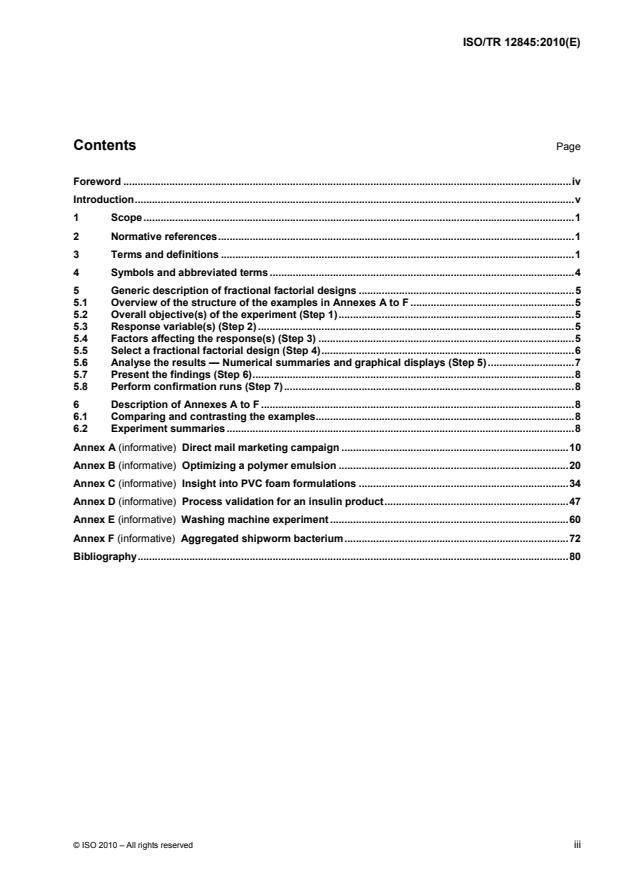

ISO/TR 12845:2010 - Selected illustrations of fractional factorial screening experiments Released:7/20/2010


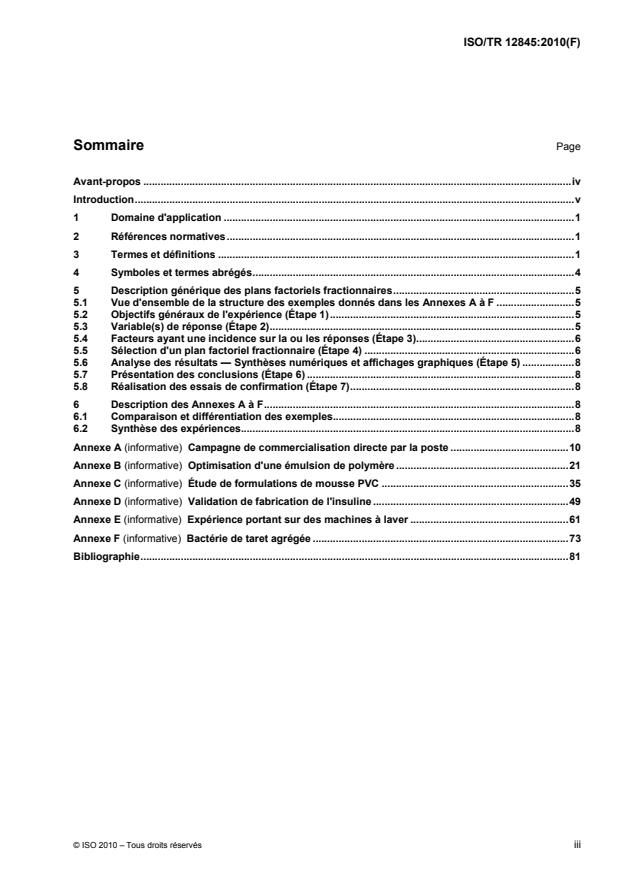

ISO/TR 12845:2010 - Illustrations choisies de plans d'expériences factoriels fractionnaires Released:7/20/2010
Overview
ISO/TR 12845:2010 - Selected illustrations of fractional factorial screening experiments is an informative Technical Report from ISO that describes the practical steps to design, run and analyse two‑level fractional factorial designs. Rather than prescribing new rules, it illustrates methodology through six detailed, real‑world examples, showing how fractional factorial screening experiments can identify important factors efficiently when full factorial designs are impractical.
Key topics
- Step‑wise experimental workflow: the report presents a seven‑step framework (define objectives; choose response variable(s); identify factors; select an appropriate fractional factorial design; analyse results with numerical summaries and graphical displays; present findings; run confirmation experiments).
- Two‑level fractional factorial designs: practical guidance on selecting and using fractional designs for screening important main effects and low‑order interactions.
- Design resolution and aliasing: explanation of resolution (III, IV, V) and how aliasing affects interpretation of main effects and interactions.
- Analysis methods: use of ANOVA, graphical diagnostics and software‑based analysis to summarise and interpret experimental outcomes.
- Experiment structure and terminology: definitions (factors, levels, blocks, replication, randomization, split‑plot), symbols and abbreviated terms consistent with ISO/3534 series.
- Practical nuances: discussion of issues such as blocking, centre points, replication, and confirmation runs that commonly arise in applied experiments.
- Worked examples: six annexes (A–F) offering applications across diverse domains to illustrate methodological choices and interpretation.
Applications
ISO/TR 12845:2010 is focused on screening experiments where resource constraints make full factorial testing impractical. Typical applications include:
- Rapid factor screening in product development and process optimization
- Early‑stage Six Sigma improvement projects (Black Belts / Green Belts)
- Process validation and formulation optimization in pharmaceuticals and polymers
- Experimental designs in marketing, manufacturing, materials science and biological studies
Representative example topics from the report include direct mail marketing, polymer emulsion optimization, PVC foam formulations, insulin process validation, washing machine testing and a bacterium aggregation study.
Who should use it
- Statisticians and experiment designers applying Design of Experiments (DoE)
- Quality engineers, process engineers and R&D scientists conducting screening studies
- Six Sigma practitioners seeking rigorous, software‑oriented examples
- Regulators and auditors wanting an authoritative reference for experimental practice
Related standards
ISO/TR 12845:2010 references ISO 3534 parts 1–3 (statistics vocabulary and design of experiments terminology) and aligns with international statistical terminology. Note: as a Technical Report, ISO/TR 12845 is informative and illustrative rather than a prescriptive normative standard.
Keywords: ISO/TR 12845:2010, fractional factorial designs, two‑level designs, screening experiments, design of experiments, DoE, ANOVA, design resolution, Six Sigma.
Buy Documents
ISO/TR 12845:2010 - Selected illustrations of fractional factorial screening experiments Released:7/20/2010
ISO/TR 12845:2010 - Illustrations choisies de plans d'expériences factoriels fractionnaires Released:7/20/2010
Get Certified
Connect with accredited certification bodies for this standard

BSI Group
BSI (British Standards Institution) is the business standards company that helps organizations make excellence a habit.

Bureau Veritas
Bureau Veritas is a world leader in laboratory testing, inspection and certification services.

DNV
DNV is an independent assurance and risk management provider.
Sponsored listings
Frequently Asked Questions
ISO/TR 12845:2010 is a technical report published by the International Organization for Standardization (ISO). Its full title is "Selected illustrations of fractional factorial screening experiments". This standard covers: ISO/TR 12845:2010 describes the steps necessary to use and to analyse two-level fractional factorial designs through illustration with six distinct applications of this methodology.
ISO/TR 12845:2010 describes the steps necessary to use and to analyse two-level fractional factorial designs through illustration with six distinct applications of this methodology.
ISO/TR 12845:2010 is classified under the following ICS (International Classification for Standards) categories: 03.120.30 - Application of statistical methods. The ICS classification helps identify the subject area and facilitates finding related standards.
ISO/TR 12845:2010 is available in PDF format for immediate download after purchase. The document can be added to your cart and obtained through the secure checkout process. Digital delivery ensures instant access to the complete standard document.
Standards Content (Sample)
TECHNICAL ISO/TR
REPORT 12845
First edition
2010-08-01
Selected illustrations of fractional
factorial screening experiments
Illustrations choisies de plans d'expériences factoriels fractionnaires
Reference number
©
ISO 2010
PDF disclaimer
This PDF file may contain embedded typefaces. In accordance with Adobe's licensing policy, this file may be printed or viewed but
shall not be edited unless the typefaces which are embedded are licensed to and installed on the computer performing the editing. In
downloading this file, parties accept therein the responsibility of not infringing Adobe's licensing policy. The ISO Central Secretariat
accepts no liability in this area.
Adobe is a trademark of Adobe Systems Incorporated.
Details of the software products used to create this PDF file can be found in the General Info relative to the file; the PDF-creation
parameters were optimized for printing. Every care has been taken to ensure that the file is suitable for use by ISO member bodies. In
the unlikely event that a problem relating to it is found, please inform the Central Secretariat at the address given below.
© ISO 2010
All rights reserved. Unless otherwise specified, no part of this publication may be reproduced or utilized in any form or by any means,
electronic or mechanical, including photocopying and microfilm, without permission in writing from either ISO at the address below or
ISO's member body in the country of the requester.
ISO copyright office
Case postale 56 • CH-1211 Geneva 20
Tel. + 41 22 749 01 11
Fax + 41 22 749 09 47
E-mail copyright@iso.org
Web www.iso.org
Published in Switzerland
ii © ISO 2010 – All rights reserved
Contents Page
Foreword .iv
Introduction.v
1 Scope.1
2 Normative references.1
3 Terms and definitions .1
4 Symbols and abbreviated terms .4
5 Generic description of fractional factorial designs .5
5.1 Overview of the structure of the examples in Annexes A to F .5
5.2 Overall objective(s) of the experiment (Step 1).5
5.3 Response variable(s) (Step 2) .5
5.4 Factors affecting the response(s) (Step 3) .5
5.5 Select a fractional factorial design (Step 4).6
5.6 Analyse the results — Numerical summaries and graphical displays (Step 5).7
5.7 Present the findings (Step 6).8
5.8 Perform confirmation runs (Step 7).8
6 Description of Annexes A to F .8
6.1 Comparing and contrasting the examples.8
6.2 Experiment summaries.8
Annex A (informative) Direct mail marketing campaign .10
Annex B (informative) Optimizing a polymer emulsion .20
Annex C (informative) Insight into PVC foam formulations .34
Annex D (informative) Process validation for an insulin product.47
Annex E (informative) Washing machine experiment .60
Annex F (informative) Aggregated shipworm bacterium.72
Bibliography.80
Foreword
ISO (the International Organization for Standardization) is a worldwide federation of national standards bodies
(ISO member bodies). The work of preparing International Standards is normally carried out through ISO
technical committees. Each member body interested in a subject for which a technical committee has been
established has the right to be represented on that committee. International organizations, governmental and
non-governmental, in liaison with ISO, also take part in the work. ISO collaborates closely with the
International Electrotechnical Commission (IEC) on all matters of electrotechnical standardization.
International Standards are drafted in accordance with the rules given in the ISO/IEC Directives, Part 2.
The main task of technical committees is to prepare International Standards. Draft International Standards
adopted by the technical committees are circulated to the member bodies for voting. Publication as an
International Standard requires approval by at least 75 % of the member bodies casting a vote.
In exceptional circumstances, when a technical committee has collected data of a different kind from that
which is normally published as an International Standard (“state of the art”, for example), it may decide by a
simple majority vote of its participating members to publish a Technical Report. A Technical Report is entirely
informative in nature and does not have to be reviewed until the data it provides are considered to be no
longer valid or useful.
Attention is drawn to the possibility that some of the elements of this document may be the subject of patent
rights. ISO shall not be held responsible for identifying any or all such patent rights.
ISO/TR 12845 was prepared by Technical Committee ISO/TC 69, Applications of statistical methods,
Subcommittee SC 7, Applications of statistical and related techniques for the implementation of Six Sigma.
iv © ISO 2010 – All rights reserved
Introduction
1)
The Six Sigma and international statistical standards communities share a philosophy of continuous
improvement and many analytical tools. The Six Sigma community tends to adopt a pragmatic approach
driven by time and resource constraints. The statistical standards community arrives at rigorous documents
through long-term international consensus. The disparities in time pressures, mathematical rigor, and
statistical software usage have inhibited exchanges, synergy and mutual appreciation between the two groups.
The present document takes one specific statistical tool (two-level fractional factorial design) and develops the
topic somewhat generically (in the spirit of International Standards) but then illustrates it through the use of six
detailed and distinct applications. The generic description focuses on the commonalities across the designs.
The annexes containing the six illustrations follow the basic framework but also identify the nuances and
peculiarities in the specific applications. Each example offers at least one “wrinkle” to the problem, which is
generally the case for real Six Sigma applications. It is thus hoped that practitioners can identify with at least
one of the six examples, if only to remind them of the basic material on fractional factorial designs that was
encountered during their Six Sigma training. Each of the six examples is developed and analysed using
statistical software of current vintage. The explanations throughout are devoid of mathematical detail – such
material can be readily obtained from the many design and analysis of experiments textbooks (such as those
given in the Bibliography).
1) Six Sigma is a trade mark of Motorola, Inc.
TECHNICAL REPORT ISO/TR 12845:2010(E)
Selected illustrations of fractional factorial screening
experiments
1 Scope
This Technical Report describes the steps necessary to use and to analyse two-level fractional factorial
designs through illustration with six distinct applications of this methodology.
NOTE 1 Each of these six illustrations is similar in that resource constraints precluded the possibility of naively running
full factorial designs. Other commonalities among the six examples are noted [e.g. study objective, two levels for factors,
response variable(s), factors affecting the response]. On the other hand, the individual illustrations have some salient
features that are distinct.
NOTE 2 The examples suggest the spectrum of possibilities both in application area and in choice of fractional factorial
designs. Fractional factorial designs can be used to identify important factors for subsequent investigation (screening
design) and can in some cases provide a viable understanding of the process under study. Fractional factorial designs
include screening designs and designs that have been popularized by Genichi Taguchi.
NOTE 3 Fractional factorial experiments are sometimes employed by individuals (so-called “black belts” or “green
belts”) associated with Six Sigma methods. Six Sigma methods are concerned with problem solving and continuous
improvement. A fractional factorial experiment can be a cost-effective tool for obtaining timely improvements of processes
and products. Detailed discussions and treatment of other tools employed by Six Sigma practitioners can be identified in
various ISO/TC 69/SC 7 documents.
2 Normative references
The following referenced documents are indispensable for the application of this document. For dated
references, only the edition cited applies. For undated references, the latest edition of the referenced
document (including any amendments) applies.
ISO 3534-1, Statistics — Vocabulary and symbols — Part 1: General statistical terms and terms used in
probability
ISO 3534-2, Statistics — Vocabulary and symbols — Part 2: Applied statistics
ISO 3534-3, Statistics — Vocabulary and symbols — Part 3: Design of experiments
3 Terms and definitions
For the purposes of this document, the terms and definitions given in ISO 3534-1, ISO 3534-2, ISO 3534-3
and the following apply.
3.1
analysis of variance
ANOVA
technique which subdivides the total variation of a response variable into components associated with defined
sources of variation
2)
NOTE Adapted from ISO 3534-3:— , definition 3.3.8. (The notes and example are not included here.)
2) To be published. (Revision of ISO 3534-3:1999)
3.2
binomial distribution
discrete distribution having the probability mass function
n!
x nx−
PX()==x p(1−p)
xn!( −x)!
where x = 0, 1, …, n and with indexing parameters n = 1, 2, …, and 0 < p < 1.
NOTE Adapted from ISO 3534-1:2006, definition 2.46. (The example and notes are not included here.)
3.3
block
collection of experimental units
NOTE Adapted from ISO 3534-3:—, 3.1.23. (The notes are not included here.)
3.4
centre point
vector of factor level settings of the form (a , a , ., a ), where all a equal 0, as notation for the coded levels of
1 2 k i
the factors
NOTE Adapted from ISO 3534-3:—, 3.1.38. (The note and example are not included here.)
3.5
design matrix
matrix with rows representing individual treatments (possibly transformed according to the assumed model)
which can be extended by deduced levels of other functions of factor levels (interactions, quadratic terms,
etc.) but are dependent upon the assumed model
NOTE Adapted from ISO 3534-3:—, definition 3.2.24. (The notes are not included here.)
3.6
full factorial experiment
factorial experiment
designed experiment consisting of all possible treatments formed from two or more factors, each being
studied at two or more levels
NOTE Adapted from ISO 3534-3:—, 3.2.1. (The notes are not included here.)
3.7
interaction
combination of two or more factors
NOTE Adapted from ISO 3534-3:—, 3.1.15. (The notes are not included here.)
3.8
factor level
setting, value or assignment of a factor in accordance with the design region
NOTE Adapted from ISO 3534-3:—, definition 3.1.10. (The notes and examples are not included here.)
3.9
normal distribution
Gaussian distribution
continuous distribution having the probability density function
2 © ISO 2010 – All rights reserved
(µx−)
−
1 2
2σ
fx() = e
σ 2π
where −∞ < x < ∞ and with parameters −∞ < µ < ∞ and σ > 0
NOTE Adapted from ISO 3534-1:2006, definition 2.50. (The notes are not included here.)
3.10
predictor variable
factor
variable that can contribute to the explanation of the outcome of an experiment
NOTE 1 The extent to which a given predictor variable can be controlled dictates its potential role in a designed
experiment. Predictor variables can be controllable (fixed), modifiable (controllable only for short duration or at
considerable expense) or uncontrollable (random).
NOTE 2 A predictor variable can include a random element in it or it can, for example, be from a set of qualitative
classes which can be observed or assigned without random error.
NOTE 3 The term predictor variable is typically used in contexts involving the mathematical relationship among the
response variable and predictor variable(s) or functions of predictor variables. The term “factor” tends to be used
operationally as a means to assess the response variable as particular factors vary.
NOTE 4 A factor may be associated with the creation of blocks.
NOTE 5 “Independent variable” is not recommended as a synonym due to potential confusion with “independence”
(see ISO 3534-1:2006, 2.4). Other terms sometimes substituted for predictor variable include “input variable”, “descriptor
variable” and “explanatory variable”.
[ISO 3534-3:—, definition 3.1.4]
3.11
randomization
strategy in which each experimental unit has an equal chance of being assigned a particular treatment
NOTE Adapted from ISO 3534-3:—, definition 3.1.26. (The notes are not included here.)
3.12
replication
〈experiment〉 multiple occurrences of a given treatment combination or setting of predictor variables
NOTE Adapted from ISO 3534-3:—, definition 3.1.35. (The notes are not included here.)
3.13
repetition
performance of an experiment more than once for a given set of predictor variables not necessarily with a
complete set-up of the predictor variables
3.14
split-plot design
experimental design in which the group of experimental units (“plot”) to which the same factor level assigned
to the principal factor is subdivided (“split”) so as to study one or more additional principal factors within each
level of that factor
NOTE Adapted from ISO 3534-3:—, definition 3.2.16. (The example and notes have not been included here.)
3.15
design resolution
〈design of experiments; fractional factorials〉 length of the shortest word in the defining relation
NOTE 1 Design resolution indicates the extent of aliasing among main effects and two-way and higher-order
interactions.
NOTE 2 The design resolution describes the aliasing in a particular experimental design. The numerical length is
generally given by upper case Roman numerals. The three most common practical situations are resolutions III, IV and V.
⎯ For a resolution III design, main effects are not aliased with other main effects. This observation can be made by
examining the expressions in the defining relation. For example, I = ABD = BCE = ACDE includes the expressions I,
ABD, BCE and ACDE and counting the number of letters for each term (1, 3, 3 and 4, respectively for this example).
The shortest length of these aside from 1 (corresponding to I) is 3, which is known as the length of the shortest
“character string”. At least one main effect is aliased with a two-way interaction. For example, for I = ABD it would be
the case that A is confounded with BD, B is confounded with AD and D is confounded with AB.
⎯ For a resolution IV design, main effects are not aliased with other main effects or with any two-way interactions. At
least one two-way interaction is aliased with another two-way interaction. For example, for the defining relation
I = ABCE = BCDF = ADEF includes the expressions I, ABCE, BCDF and ADEF and counting the number of letters for
each term (1, 4, 4 and 4, respectively). The smallest value aside from 1 (corresponding to I) is 4, which is known as
the length of the shortest “character string” for this design. For example, for I = ABCE, it would be the case that AB is
confounded with CE, AC with BE, AE with BC, while A is confounded with BCE, B is confounded with ACE, C is
confounded with ABE and E is confounded with ABC.
⎯ For a resolution V design, main effects and two-way interactions are not aliased with any other main effects or with
any other two-way interactions. For example, with I = ABCDE, it is clear that each main effect is confounded with a
four-way interaction (A is confounded with BCDE) and each two-way interaction is confounded with a three-way
interaction (AB is confounded with CDE).
NOTE 3 The higher the resolution, the more effects (main or interactions) can be estimated unambiguously, provided
the higher-order interactions are negligible. Given a choice of two potential designs involving the same number of factors
and experimental units, the design with the higher resolution should be selected. Fortunately, for most cases of k and p of
practical interest, the most appropriate defining relations are recorded.
NOTE 4 Full factorial designs have no confounding. For most practical purposes, a resolution V is excellent and a
resolution IV design may be adequate. Resolution III designs are useful as economical screening designs.
[ISO 3534-3:—, definition 3.2.6]
4 Symbols and abbreviated terms
The main symbols and abbreviated terms used in this Technical Report are given below.
Y Response variable
A, B, C, D Factors
AB, AC, AD, BC, BD, CD Two-way interactions
ABC, ACD, BCD Three-way interactions
ABCD Four-way interactions
+1, −1 High and low settings
2 Four factors each at two levels
σ Standard deviation
4 © ISO 2010 – All rights reserved
5 Generic description of fractional factorial designs
5.1 Overview of the structure of the examples in Annexes A to F
This Technical Report provides general guidelines on the design, conduct and analyses of two-level fractional
factorial designs and illustrates the steps with six distinct applications given in the annexes. Each of the six
examples in Annexes A to F follows the basic structure as given in Table 1.
The steps given in Table 1 apply to design and analysis of screening experiments in general. Each of the
seven steps is explained below.
Table 1 — Basic steps in experimental design
Step 1 State the overall objective(s) of the experiment
Step 2 Describe the response variable(s)
Step 3 List the factors that might affect the response(s)
Step 4 Select a fractional factorial design
Step 5 Analyse the results – numerical summaries and graphical displays
Step 6 Present the findings
Step 7 Perform a confirmation run
5.2 Overall objective(s) of the experiment (Step 1)
Experiments are conducted for a variety of reasons. The primary motivation for the experiment should be
clearly stated and agreed to by all parties involved in the design, conduct, analysis and implications of the
experimental effort. There may be secondary objectives that could be addressed with this experiment but, in
general, the focus is on identifying a subset of the factors that impact the response variable.
The ultimate outcome of the experiment might be to take immediate action on factor levels or to obtain a
predictive model, both of which dictate some elements of the analyses. Further, the experiment could be
recognized as the first step in an ongoing sequence of experiments to determine improvements to the product
or process.
5.3 Response variable(s) (Step 2)
Associated with the objective of an experiment is a measurable outcome or performance measure. A
response of interest could involve maximization (larger is better), minimization (smaller is better) or meet a
target value (be close to a specified value). The response variable (denoted here by the variable Y) should be
intimately (if not directly) related to the objective of the experiment. For some situations, there may be multiple
characteristics of interest to be considered, although there is typically a primary response variable associated
with the experiment. In other cases, multiple responses must be considered.
5.4 Factors affecting the response(s) (Step 3)
The response variable very likely depends in some unknown way on a variety of conditions. These could be
set in the course of generating a response variable outcome such as a temperature or a time setting. These
conditions are presumed to relate to controllable factors that may be continuous (temperature, concentration)
or discrete (two assembly lines A or B, two vendors, two packaging styles, and so forth). For the fractional
factorial experiments considered in this Technical Report, the experimental design process is simplified by
selecting two levels for each factor to be varied in the experiment.
⎯ For discrete factors, with only two possible settings, the levels are just these two settings.
⎯ For continuous factors, discretion can be used in choosing the two specific values. In some cases, one
setting could be the historical value and the other a proposed value. In other cases, the two settings could
be nominal adjustments from the historical setting. In any event, the settings should be sufficiently far
removed to have an opportunity to reveal an impact subject to the inherent uncertainty, while not being so
disparate that the settings are unreasonable from a practical, safety or sensibility standpoint. The setting
of levels of continuous factors benefits from an expert collaborating in the experiment.
There may be additional factors that could impact that response variable but may be deemed much less
important than the chosen factors or are too difficult or expensive to control. Finally, it is the case that the
factors are to be set independently from each other. It could, however, be discovered that the factors interact
(the setting of one factor impacts how a second factor affects the response).
5.5 Select a fractional factorial design (Step 4)
It is usual that the number of factors thought to be important to experiment with is large, e.g. 10 or more.
Designing an experiment to investigate all possible factors and their combinations would lead to excessively
large experiments. For example, in studying only eight factors at two levels each, the number of experimental
runs is 256. For three levels, this would be 6 561 runs! For most organizations, this would be a very
extravagant use of resources. Thus, the need is there to design experiments using fewer runs but still giving
the experimenter all of the important experimental results. Although this gives full information about the effects
of the factors, it also delivers information about higher-order factor combinations that are of minimal practical
utility. Consequently, a balance is sought to reduce the experimental effort without foregoing the information
about main factors of interest by designing a fractional experiment.
The examples provided in the annexes use 6 to 15 factors with a maximum of only 40 runs to identify the
critical factors.
A classical design consists of 16 runs obtained by considering all combinations of four factors with two
possible levels. See ISO/TR 29901 for a description. Table 3 provides the basic layout in a standard order for
ease of understanding. Each row of the table represents one set of experimental conditions that when run will
produce a value of the response variable Y. The four factors are designated as A, B, C and D. For an
individual factor, the level “−1” is the “low” setting, or one of the two levels if the factor is categorical. The level
“+1” is the “high” setting, or the other level of the categorical factor. The column “Y ” is a placeholder for the
response value once a run has occurred.
This will provide unambiguous information about the following factors and their interactions, namely:
A, B, C, D, AB, AC, AD, BC, BD, CD, ABC, ABD, ACD, BCD and ABCD
For most practical applications, the higher-order interactions, e.g. ABC, are often taken as unimportant and
can therefore, in a design, be discounted. This, therefore, becomes the way in which larger numbers of factors
can be incorporated into designs that are intended for full factor combinations, albeit for a smaller number of
factors.
It is imperative that the experimenter be aware of the exact pattern of main effects and the associated two-
way interactions created by this discounting of higher-order interactions. A careless selection may inhibit the
clear identification of the effects (be they main or two-way interactions). These aspects can be seen in the six
different examples contained in the annexes.
Table 2 provides a useful summary of the shortcomings of certain designs. The table describes the three most
common design resolutions. The examples in the annexes (see Table 4) refer to these resolutions.
6 © ISO 2010 – All rights reserved
Table 2 — Selected design resolutions
Resolution Description
No main effects are aliased with any other main effect, but at least one main effect is aliased
III
with two-factor interactions.
No main effects are aliased with any other main effect or two-factor interactions, but at least
IV one two-factor interaction is aliased with other two-factor interactions and at least one main
effect is aliased with three-factor interactions.
No main effects or two-factor interactions are aliased with any other main effect or two-factor
V interactions, but at least one two-factor interaction is aliased with three-factor interactions
and at least one main effect is aliased with four-factor interactions.
The design choice ultimately rests with the aforementioned considerations as well as resource constraints.
Guidance of a general nature can be gleaned from the reference texts in the Bibliography. Increasingly,
software packages contain useful guides to design selection and algorithms for optimal design where the
problem is well defined.
Table 3 — Layout of a generic 2 full factorial design
Row
A B C D Y Run order
number
1 −1 −1 −1 −1 y 6
2 +1 −1 −1 −1 y 14
3 −1 +1 −1 −1 y 4
4 +1 +1 −1 −1 y 11
5 −1 −1 +1 −1 y 9
6 +1 −1 +1 −1 y 2
7 −1 +1 +1 −1 y 3
8 +1 +1 +1 −1 y 1
9 −1 −1 −1 +1 y 8
10 +1 −1 −1 +1 y 13
11 −1 +1 −1 +1 y 7
12 +1 +1 −1 +1 y 10
13 −1 −1 +1 +1 y 15
14 +1 −1 +1 +1 y 16
15 −1 +1 +1 +1 y 5
16 +1 +1 +1 +1 y 12
5.6 Analyse the results — Numerical summaries and graphical displays (Step 5)
At the completion of the conduct of the experiment, the y values would be replaced by the actual observed
i
responses. Many statistical software packages exist to produce output to aid in the understanding of the
results of the experiment. Of immediate concern is the determination of the impact of the factors individually
on the response variable. By the nature of fractional factorial designs, it is hoped, if not presumed, that the
main effects that are estimated are indeed attributable to the main factor although it is recognized that aliasing
could be taking place.
Much of the analysis that is conducted for 2 full factorials (see ISO/TR 29901) is applicable here with the
proviso that aliasing patterns must be recognized and properly evaluated. In particular, main effects plots,
interaction plots, Pareto diagrams, normal and/or half-normal probability plots are relevant instruments of
analysis. Although the emphasis of the analysis is likely to be graphical in its nature, additional supporting
documentation, e.g. effects table, should be given.
5.7 Present the findings (Step 6)
Almost certainly, the conclusions from a screening experiment will constitute a description of the next phase of
experimentation. Design of experiments is inherently sequential in nature and a screening experiment is
frequently the first phase of investigation and is often followed by subsequent experiments with fewer factors
and, sometimes, more levels. In some cases, the screening experiment supports a predictive model that can
suggest alternative settings for the important factors. Although the process has not been fully optimized,
superior settings may, in the meantime, have been identified.
Further, the experiment may reveal important interactions which may be, unfortunately, aliased with others. An
example of this can be found in Annex C.
5.8 Perform confirmation runs (Step 7)
Confirming experiments are considered to be good “practice” in that they should provide the experimenter
assurance that
a) the original experiment was correctly conducted,
b) the findings still hold true at a later point in time, and
c) there were no apparent “lurking” variables that were ignored in the original experimental design.
This being said, there are circumstances that preclude a confirmation run, e.g. time pressures due to
commercial issues or matters of cost (resources) or management acceptance of the risk of a faulty screening
experiment.
6 Description of Annexes A to F
6.1 Comparing and contrasting the examples
Six distinct examples of fractional factorial designs are illustrated in Annexes A to F. Each example follows the
general template given in Table 1.
6.2 Experiment summaries
Table 4 summarizes the six examples detailed in the annexes and indicates aspects of the analyses that were
unique to that experiment.
8 © ISO 2010 – All rights reserved
Table 4 — Experiment summaries found in annexes
Annex Experiment Business area Resolution Problem-specific aspects
A Direct mail campaign Marketing IV Proportion response variable, standard errors
based on binomial distribution.
B Polymer emulsion Chemical IV Blocking, response transformation, two
optimization engineering responses.
C PVC foam formulation Chemical III Analysis of three responses with different levels
engineering of success, due to severe confounding of
effects.
D Insulin process Pharmaceuticals IV Eight responses, blocking, factor levels
validation expressed as a range, interest in no effect as a
result.
E Washing machine Mechanical Not Taguchi orthogonal arrays, inner/outer arrays.
robustness engineering applicable
F Aggregated shipworm Bioengineering III, IV Plackett-Burman design.
bacterium
Annex A
(informative)
Direct mail marketing campaign
A.1 General
Mail material for a direct marketing campaign can be sent in a variety of packaging styles and with various
textual and graphical cues to encourage a high response rate. Historically, the company had experimented
with a small subset of their campaigns in which one aspect of the package would be varied. The company was
receptive to a more sophisticated approach than their previous “one factor at a time” style. Management and
the marketing firm that implemented the mailings in consultation with a statistician identified seven items that
could be varied in the package sent to potential customers and decided on the specific fractional factorial
design as described in the next subclauses.
A.2 Overall objective for the experiment
The objective of the experiment was to maximize magazine subscription response rate based on a direct
3)
mailing campaign .
A.3 Description of the process
A typical mailing involves solicitations to 400 000 potential subscribers. The actual package mailed can be
varied regarding outer envelope design and other features that had previously enhanced response rate. For
this study, the parent company opted to devote 40 000 packages to the experiment. The mailing itself is
subcontracted to a third party that specializes in assembling these packages.
A.4 Response variable
A.4.1 Choice of variable
The response variable is the number of people who subscribed and paid (either by credit card or cheque).
A.4.2 Measurement of the response variable
Exactly 2 500 mailings went out for each combination of package contents. Subscribers were tracked to
determine which package of materials they had been sent.
3) This example has been adapted from the article “Using a Fractional Factorial Design to Increase Direct Mail
Response,” by J. Ledolter and A. J. Swersey (2006), Quality Engineering, 18, pp. 469-475. Used with permission from the
publisher, the American Society of Quality, Milwaukee, Wisconsin.
10 © ISO 2010 – All rights reserved
A.4.3 Relationship of the response variable to the objective of the experiment
A.4.3.1 General
The publisher expected a response rate of about 2 %. Further, the publisher wanted to be fairly certain to be
able to recognize a 0,5 % increase and at least a decent chance of detecting a 0,25 % increase in response
rate. The response rate is the critical factor in addressing the objective of the experiment as the package
variations have roughly the same preparation cost. Of secondary interest is the proportion of positive
responders who pay immediately as well, which avoids a later billing expense.
A.4.3.2 Description of each factor (continuous/discrete) to be varied
The factors chosen to be varied within the experiment were determined jointly by the publisher, the marketing
firm involved in preparing the mailing and the statistical consultant. The factors are described as follows:
⎯ presence/absence of an “Act now to respond/pay today” insert, a separate colour enclosure with the
encouragement presented in a bold font, a copy of the cover of the next issue and a description of its
contents; this insert also encourages prospective subscribers to pay at the same time as responding, to
preclude a follow-up mailing requesting payment for those who indeed “acted now”;
⎯ additional option of paying by credit card (rather than only by personal cheque);
⎯ offer wording strength; an additional phrase encouraging the potential subscriber to send in the reply card
and payment immediately in order to receive the next issue “hot off the press”;
⎯ inclusion or non-inclusion of a bumper sticker;
⎯ a guarantee that provides the opportunity to cancel the subscription and recuperate money for the issues
not yet received (one option) or for the full subscription price (other option);
⎯ testimonials that are inserts consisting of positive quotes from subscribers and possibly some celebrities;
⎯ presence/absence of a phrase on the outer envelope with mild profanity (“ballsy” versus “gutsy”).
Each of these factors is categorical with two levels. Some incremental costs to the mailing are incurred with
the variables that involve inserts.
A.4.3.3 Selection of levels (related to size of effect to be determined)
The factors used in the experiment and their associated levels are given in Table A.1.
Table A.1 — Factors
Factor Level 1 (−1) Level 2 (+1)
A: Act now No “Act now” insert “Act now” insert
B: Credit card No credit card Credit card
C: Offer hardness Hard offer Harder offer
D: Bumper sticker No bumper sticker Bumper sticker
E: Guarantee Guarantee partial refund Guarantee full refund
F: Testimonial No “Testimonial” insert “Testimonial” insert
G: Profanity “Gutsy” “Ballsy”
A.4.3.4 Other factors noted but not incorporated due to issues with controllability or relevance
No other factors were identified for the experiment.
A.4.4 Fractional factorial design
A.4.4.1 Choice of specific design
There are a multitude of possible designs that allow the investigation of the seven factors, each having two
levels. The possibilities depend on the number of combinations to be considered which in turn impacts the
number of runs considered. The publisher was willing to allocate a total of 40 000 mailings for the entire
experiment. The designs considered are given in Table A.2.
Table A.2 — Design choices
Number Fraction
Resolution Confounding patterns Comments
of runs size
None – All effects can be estimated Benefits from estimating higher-order
128 Full factorial Full
interactions are minimal
Main effects confounded with Less costly than a full factorial but
six-way interactions the additional benefits are minimal
64 Half fraction VII
Two-way interactions not
confounded with other two-way
interactions
Main effects confounded with Slightly better confounding structure
three-way interactions than the 16-run case but at twice the
Quarter
level of effort
32 IV
Some two-way interactions
fraction
confounded with other two-way
interactions
Main effects confounded with three- Excellent trade off between level of
way interactions effort and capability to estimate main
One-eighth
effects free of two-way interactions
16 IV
Some two-way interactions
fraction
confounded with other two-way
interactions
Main effects confounded with two- Requires a follow-up experiment to
way interactions separate main effects from
One-
confounding with two-way
8 sixteenth III
Two-way interactions confounded
interactions
fraction
with several other two-way
interactions
The two most viable designs were the 32-run one-quarter fraction and the 16-run one-eighth fraction, both of
which are resolution IV (namely, main effects can be estimated to be free of two-way interactions, but there
are some two-way interactions confounded with other two-way interactions). The larger experiments are
simply too big for the benefits accrued (ability to estimate higher-order interactions which are unlikely to be
significant). The small 8-run experiment would require a follow up experiment in order to resolve the two-way
interactions. The 16-run experiment was chosen since it was felt that, with appropriate labelling of factors, the
confounding structure could be accommodated. In particular, the factors A, B, C and D are set as if they would
constitute a 2 full factorial design, in which all 16 combinations of the two levels of these factors are
considered. The levels of the three additional factors are set according to E = ABC, F = BCD and G = ACD.
12 © ISO 2010 – All rights reserved
Based on subject matter expertise in direct mailing, the experimenters believed that factors E and F were
unrelated to each other and to the other factors (i.e. there should be no two-way interactions involving E and
F). Factor G conceivably could entice the recipient to open the envelope, but once the contents were in hand,
interaction between the slang expression on the envelope would not interact with the contents. In short, it was
assumed, at the design stage, that all of the following two-way interactions would be negligible: AE, AF, AG,
BE, BF, BG, CE, CF, CG, DE, DF, DG, EF, EG, FG.
The full confounding (alias) structure is given in Table A.3. Each of the main effects and plausible two-way
interactions (in bold typeface in Table A.3) can be unambiguously estimated under the assumptions given in
the previous paragraph.
Table A.3 — Confounding structure for the fractional factorial design
Generators: E = ABC, F = BCD, G = ACD
Defining relation: I = ABCE = BCDF = ACDG = ADEF = BDEG = ABFG = CEFG
Complete alias structure:
A = BCE = ABCDF = CDG = DEF = ABDEG = BFG = ACEFG
B = ACE = CDF = ABCDG = ABDEF = DEG = AFG = BCEFG
C = ABE = BDF = ADG = ACDEF = BCDEG = ABCFG = EFG
D = ABCDE = BCF = ACG = AEF = BEG = ABDFG = CDEFG
E = ABC = BCDEF = ACDEG = ADF = BDG = ABEFG = CFG
F = ABCEF = BCD = ACDFG = ADE = BDEFG = ABG = CEG
G = ABCEG = BCDFG = ACD = ADEFG = BDE = ABF = CEF
AB = CE = ACDF = BCDG = BDEF = ADEG = FG = ABCEFG
AC = BE = ABDF = DG = CDEF = ABCDEG = BCFG = AEFG
AD = BCDE = ABCF = CG = EF = ABEG = BDFG = ACDEFG
AE = BC = ABCDEF = CDEG = DF = ABDG = BEFG = ACFG
AF = BCEF = ABCD = CDFG = DE = ABDEFG = BG = ACEG
AG = BCEG = ABCDFG = CD =DEFG = ABDE = BF = ACEF
BD = ACDE = CF = ABCG = ABEF = EG = ADFG = BCDEFG
ABD = CDE = ACF = BCG = BEF = AEG = DFG = ABCDEFG
Alias structure restricted to two-way interactions (main effects are clear of two-way interactions):
AB = CE == FG
AC = BE = DG
AD = CG = EF
AE = BC = DF
AF = DE = BG
AG = CD = BF
BD = CF = EG
As can be seen from Table A.3, each main effect and those two-way interactions likely to be of interest are
confounded only with non-interesting two-way or higher interactions.
A.4.4.2 Design matrix (standard order and run order)
The design selected was the 16-run, one-eighth fractional factorial design, with seven factors (A, B, C, D, E, F
and G). Table A.4 shows the design.
Table A.4 — Design matrix
Row
A B C D E (= ABC) F (= BCD) G (= ACD)
number
1 −1 −1 −1 −1 −1 −1 −1
2 1 1 1
−1 −1 −1 −1
3 −1 1 −1 −1 1 1 −1
4 1 1 −1 −1 −1 1 1
5 −1 −1 1 −1 1 1 1
6 1 −1 1 −1 −1 1 −1
7 1 1 1
−1 −1 −1 −1
8 1 1 1 −1 1 −1 −1
9 −1 −1 −1 1 −1 1 1
10 1 −1 −1 1 1 1 −1
11 1 1 1 1
−1 −1 −1
12 1 1 1
−1 −1 −1 −1
13 −1 −1 1 1 1 −1 −1
14 1 −1 1 1 −1 −1 1
15 −1 1 1 1 −1 1 −1
16 1 1 1 1 1 1 1
Randomization was used in selecting 2 500 addresses out of the 40 000 addresses constituting the sampling
frame. Considerable effort was expended to ensure that the third-party provider correctly assembled the
mailed packages. There was no need to randomize the order with respect to the design matrix.
A.4.4.3 Centre points
Centre points were not selected for this experiment because the variables are categorical. Moreover, the
response rate can be assessed as a binomial random variable with a nominal response rate of 2 % so that an
independent estimate of the uncertainty can be calculated.
A.4.4.4 Replication and repetition
As mentioned in A.4.4.2, the mailings were sent to 2 500 potential subscribers.
...
RAPPORT ISO/TR
TECHNIQUE 12845
Première édition
2010-08-01
Illustrations choisies de plans
d'expériences factoriels fractionnaires
Selected illustrations of fractional factorial screening experiments
Numéro de référence
©
ISO 2010
PDF – Exonération de responsabilité
Le présent fichier PDF peut contenir des polices de caractères intégrées. Conformément aux conditions de licence d'Adobe, ce fichier
peut être imprimé ou visualisé, mais ne doit pas être modifié à moins que l'ordinateur employé à cet effet ne bénéficie d'une licence
autorisant l'utilisation de ces polices et que celles-ci y soient installées. Lors du téléchargement de ce fichier, les parties concernées
acceptent de fait la responsabilité de ne pas enfreindre les conditions de licence d'Adobe. Le Secrétariat central de l'ISO décline toute
responsabilité en la matière.
Adobe est une marque déposée d'Adobe Systems Incorporated.
Les détails relatifs aux produits logiciels utilisés pour la création du présent fichier PDF sont disponibles dans la rubrique General Info
du fichier; les paramètres de création PDF ont été optimisés pour l'impression. Toutes les mesures ont été prises pour garantir
l'exploitation de ce fichier par les comités membres de l'ISO. Dans le cas peu probable où surviendrait un problème d'utilisation,
veuillez en informer le Secrétariat central à l'adresse donnée ci-dessous.
DOCUMENT PROTÉGÉ PAR COPYRIGHT
© ISO 2010
Droits de reproduction réservés. Sauf prescription différente, aucune partie de cette publication ne peut être reproduite ni utilisée sous
quelque forme que ce soit et par aucun procédé, électronique ou mécanique, y compris la photocopie et les microfilms, sans l'accord écrit
de l'ISO à l'adresse ci-après ou du comité membre de l'ISO dans le pays du demandeur.
ISO copyright office
Case postale 56 • CH-1211 Geneva 20
Tel. + 41 22 749 01 11
Fax + 41 22 749 09 47
E-mail copyright@iso.org
Web www.iso.org
Publié en Suisse
ii © ISO 2010 – Tous droits réservés
Sommaire Page
Avant-propos .iv
Introduction.v
1 Domaine d'application .1
2 Références normatives.1
3 Termes et définitions .1
4 Symboles et termes abrégés.4
5 Description générique des plans factoriels fractionnaires.5
5.1 Vue d'ensemble de la structure des exemples donnés dans les Annexes A à F .5
5.2 Objectifs généraux de l'expérience (Étape 1).5
5.3 Variable(s) de réponse (Étape 2).5
5.4 Facteurs ayant une incidence sur la ou les réponses (Étape 3).6
5.5 Sélection d'un plan factoriel fractionnaire (Étape 4) .6
5.6 Analyse des résultats — Synthèses numériques et affichages graphiques (Étape 5) .8
5.7 Présentation des conclusions (Étape 6) .8
5.8 Réalisation des essais de confirmation (Étape 7).8
6 Description des Annexes A à F.8
6.1 Comparaison et différentiation des exemples.8
6.2 Synthèse des expériences.8
Annexe A (informative) Campagne de commercialisation directe par la poste .10
Annexe B (informative) Optimisation d'une émulsion de polymère .21
Annexe C (informative) Étude de formulations de mousse PVC .35
Annexe D (informative) Validation de fabrication de l'insuline .49
Annexe E (informative) Expérience portant sur des machines à laver .61
Annexe F (informative) Bactérie de taret agrégée .73
Bibliographie.81
Avant-propos
L'ISO (Organisation internationale de normalisation) est une fédération mondiale d'organismes nationaux de
normalisation (comités membres de l'ISO). L'élaboration des Normes internationales est en général confiée
aux comités techniques de l'ISO. Chaque comité membre intéressé par une étude a le droit de faire partie du
comité technique créé à cet effet. Les organisations internationales, gouvernementales et non
gouvernementales, en liaison avec l'ISO participent également aux travaux. L'ISO collabore étroitement avec
la Commission électrotechnique internationale (CEI) en ce qui concerne la normalisation électrotechnique.
Les Normes internationales sont rédigées conformément aux règles données dans les Directives ISO/CEI,
Partie 2.
La tâche principale des comités techniques est d'élaborer les Normes internationales. Les projets de Normes
internationales adoptés par les comités techniques sont soumis aux comités membres pour vote. Leur
publication comme Normes internationales requiert l'approbation de 75 % au moins des comités membres
votants.
Exceptionnellement, lorsqu'un comité technique a réuni des données de nature différente de celles qui sont
normalement publiées comme Normes internationales (ceci pouvant comprendre des informations sur l'état
de la technique par exemple), il peut décider, à la majorité simple de ses membres, de publier un Rapport
technique. Les Rapports techniques sont de nature purement informative et ne doivent pas nécessairement
être révisés avant que les données fournies ne soient plus jugées valables ou utiles.
L'attention est appelée sur le fait que certains des éléments du présent document peuvent faire l'objet de
droits de propriété intellectuelle ou de droits analogues. L'ISO ne saurait être tenue pour responsable de ne
pas avoir identifié de tels droits de propriété et averti de leur existence.
L'ISO/TR 12845 a été élaboré par le comité technique ISO/TC 69, Applications des méthodes statistiques,
sous-comité SC 7, Applications de techniques statistiques ou de techniques associées pour la mise en œuvre
de Six Sigma.
iv © ISO 2010 – Tous droits réservés
Introduction
1)
La communauté Six Sigma et la communauté des concepteurs de normes statistiques internationales ont en
commun une philosophie d'amélioration continue et partagent bon nombre d'outils d'analyse. La communauté
Six Sigma privilégie une démarche pragmatique régie par les contraintes de temps et de ressources. La
communauté des concepteurs de normes statistiques internationales élabore des documents rigoureux sur la
base d'un consensus international de long terme. Les disparités en termes de contraintes de temps, de
rigueur mathématique et de logiciels statistiques utilisés ont fini par bloquer les échanges, la synergie et
l'appréciation mutuelle entre les deux groupes.
Le présent document s'intéresse à un outil statistique particulier (le plan factoriel fractionnaire à deux niveaux)
et développe le sujet de manière relativement générique (dans l'esprit des Normes internationales) pour
ensuite le caractériser dans des exemples d'utilisation de six applications détaillées et distinctes. La
description générique se fonde sur les points communs existant entre les plans. Les annexes comprenant les
six illustrations suivent le cadre de base mais identifient également les nuances et les écarts que l'on observe
dans les applications spécifiques. Chaque exemple présente au moins une «facette» du problème qui se pose
généralement aux applications Six Sigma réelles. Cela devrait permettre aux intervenants intéressés de se
reconnaître dans au moins l'un des six exemples, ne serait-ce que pour leur rappeler les éléments de base
applicables aux plans factoriels fractionnaires qu'ils ont étudiés au cours de leur formation Six Sigma. Chacun
des six exemples est développé et analysé à l'aide d'un logiciel statistique d'utilisation courante. Les
explications données tout au long du document sont dépourvues de détails mathématiques; ces détails
peuvent être obtenus sans difficultés dans bon nombre d'ouvrages sur les plans d'expériences et leur analyse
(tels que ceux indiqués dans la Bibliographie).
1) Six Sigma est une marque commerciale de Motorola, Inc.
RAPPORT TECHNIQUE ISO/TR 12845:2010(F)
Illustrations choisies de plans d'expériences factoriels
fractionnaires
1 Domaine d'application
Le présent Rapport technique décrit les étapes nécessaires à l'utilisation et à l'analyse des plans factoriels
fractionnaires à deux niveaux en les caractérisant par six applications distinctes de cette méthodologie.
NOTE 1 Chacune de ces six illustrations est fondée sur le fait similaire que des contraintes de ressource ne permettent
pas d'exécuter tout simplement les plans factoriels complets. D'autres éléments communs parmi les six exemples sont
relevés [par exemple objectif de l'étude, deux niveaux pour les facteurs, variable(s) de réponse, facteurs ayant une
incidence sur la réponse]. Par ailleurs, les illustrations présentent chacune des caractéristiques notables qui les
distinguent.
NOTE 2 Les exemples illustrent le spectre des possibilités que proposent tant le domaine d'application que le choix
des plans factoriels fractionnaires. Les plans factoriels fractionnaires peuvent être utilisés pour identifier les facteurs
importants à appliquer pour un examen ultérieur (plan de criblage) et peuvent dans certains cas permettre une
compréhension pratique du processus étudié. Les plans factoriels fractionnaires comprennent les plans de criblage et les
plans vulgarisés par Genichi Taguchi.
NOTE 3 Les plans d'expériences factoriels fractionnaires sont parfois utilisés par des personnes (désignées «ceintures
noires» ou «ceintures vertes») associés aux méthodes Six Sigma. Les méthodes Six Sigma concernent la résolution de
problème et l'amélioration continue. Un plan d'expériences factoriel fractionnaire peut constituer un outil économique pour
obtenir une amélioration régulière des processus ou des produits. Des discussions détaillées concernant d'autres outils, et
leur traitement, utilisés par les opérateurs Six Sigma peuvent être trouvés dans divers documents de l'ISO TC 69/SC 7.
2 Références normatives
Les documents de référence suivants sont indispensables pour l'application du présent document.
ISO 3534-1, Statistique — Vocabulaire et symboles — Partie 1: Termes statistiques généraux et termes
utilisés en calcul des probabilités
ISO 3534-2, Statistique — Vocabulaire et symboles — Partie 2: Statistique appliquée
ISO 3534-3, Statistique — Vocabulaire et symboles — Partie 3: Plans d'expériences
3 Termes et définitions
Pour les besoins du présent document, les termes et définitions donnés dans l'ISO 3534-1, l'ISO 3534-2,
l'ISO 3534-3 ainsi que les suivants s'appliquent.
3.1
analyse de la variance
ANOVA
méthode consistant à séparer la variation totale d'une variable de réponse en composantes associées à des
sources spécifiques de variation
2)
NOTE Adaptée de l'ISO 3534-3:— , définition 3.3.8. (Les notes et les exemples ne sont pas inclus ici.)
2) À publier. (Révision de l'ISO 3534-3:1999)
3.2
loi binomiale
distribution discrète avec pour fonction de masse de probabilité
n!
x nx−
PX()==x p(1−p)
xn!( −x)!
où x = 0, 1, …, n et avec les paramètres d'indexation n = 1, 2, …, et 0 < p <1
NOTE Adaptée de l'ISO 3534-1:2006, définition 2.46. (L'exemple et les notes ne sont pas inclus ici.)
3.3
bloc
groupement d'unités expérimentales
NOTE Adaptée de l'ISO 3534-3:—, définition 3.1.23. (Les notes ne sont pas incluses ici.)
3.4
point central
vecteur des valeurs de niveau des facteurs de la forme (a , a , …, a ), où tous les éléments a sont nuls,
1 2 k i
comme notation des niveaux codés des facteurs
NOTE Adaptée de l'ISO 3534-3:—, définition 3.1.38. (La note et l'exemple ne sont pas inclus ici.)
3.5
matrice de plan
matrice dotée de lignes représentant les traitements individuels (potentiellement transformés selon le modèle
présumé), éventuellement étendus par les niveaux déduits des autres fonctions des niveaux de facteur
(interactions, termes quadratiques, etc.), mais qui dépendent du modèle présumé
NOTE Adaptée de l'ISO 3534-3:—, définition 3.2.24. (Les notes ne sont pas incluses ici.)
3.6
plan factoriel complet
plan factoriel
expérience planifiée composée de tous les traitements potentiels formés de deux facteurs ou plus, chacun
étant étudié à deux niveaux ou plus
NOTE Adaptée de l'ISO 3534-3:—, définition 3.2.1. (Les notes ne sont pas incluses ici.)
3.7
interaction
combinaison de deux facteurs ou plus
NOTE Adaptée de l'ISO 3534-3:—, définition 3.1.15. (Les notes ne sont pas incluses ici.)
3.8
niveau de facteur
mise en œuvre, valeur ou affectation d'un facteur conformément au domaine expérimental
NOTE Adaptée de l'ISO 3534-3:—, définition 3.1.10. (Les notes ne sont pas incluses ici.)
2 © ISO 2010 – Tous droits réservés
3.9
loi normale
loi de Gauss
distribution continue avec pour fonction de densité de probabilité:
()x−µ
−
1 2
2σ
fx() = e
σπ2
où −∞ < x < ∞ et avec les paramètres −∞ < µ < ∞ et σ > 0
NOTE Adaptée de l'ISO 3534-1:2006, définition 2.50. (Les notes ne sont pas incluses ici.)
3.10
variable de prédiction
facteur
variable susceptible de contribuer à l'explication du résultat d'une expérience
NOTE 1 Le degré auquel une variable de prédiction donnée peut être maîtrisée détermine son rôle potentiel dans une
expérience planifiée. Les variables de prédiction sont susceptibles d'être maîtrisées (fixes), modifiables (maîtrisées
uniquement pendant une courte période ou à un coût considérable) ou non maîtrisées (aléatoires).
NOTE 2 Une variable de prédiction peut comporter un élément aléatoire ou peut être, par exemple, un ensemble de
classes de qualité qui peuvent être observées ou affectées sans erreur aléatoire.
NOTE 3 Le terme variable de prédiction est généralement utilisé dans des contextes impliquant une relation
mathématique entre la variable de réponse et une (des) variable(s) de prédiction ou des fonctions de variables de
prédiction. Le terme facteur a tendance à être utilisé dans la pratique comme un moyen d'évaluer la variable de réponse
lorsque des facteurs particuliers varient.
NOTE 4 Un facteur peut être associé à la création de blocs.
NOTE 5 Le terme «variable indépendante» n'est pas recommandé comme synonyme en raison de la confusion
possible avec «indépendance» (voir l'ISO 3534-1:2006, 2.4). Les autres termes parfois utilisés en remplacement de
variable de prédiction comprennent «variable d'entrée», «variable descriptive» et «variable explicative».
[ISO 3534-3:—, définition 3.1.4]
3.11
randomisation
stratégie dans laquelle chaque unité expérimentale a une chance égale de se voir affecter un traitement
particulier
NOTE Adaptée de l'ISO 3534-3:—, définition 3.1.26. (Les notes ne sont pas incluses ici.)
3.12
réplique
〈expérience〉 occurrences multiples d'une combinaison de traitements donnée ou de valeurs de variables de
prédiction
NOTE Adaptée de l'ISO 3534-3:—, définition 3.1.35. (Les notes ne sont pas incluses ici.)
3.13
répétition
réalisation répétée d'une expérience pour un ensemble donné de variables de prédiction mais pas
nécessairement avec une configuration complète des variables de prédiction
3.14
plan en parcelles subdivisées
plan d'expériences dans lequel le groupe des unités expérimentales (parcelles) auquel le même niveau de
facteur que celui affecté au facteur principal est subdivisé de telle sorte qu'un ou plusieurs facteurs principaux
supplémentaires puissent être étudiés à l'intérieur de chaque niveau de ce facteur
NOTE Adaptée de l'ISO 3534-3:—, définition 3.2.16. (L'exemple et les notes ne sont pas inclus ici.)
3.15
résolution de plan
〈plans d'expériences; factoriels fractionnaires〉 longueur du terme le plus court de la relation de définition
NOTE 1 La résolution de plan indique l'étendue de l'aliase entre les effets principaux et les interactions doubles et
d'ordre supérieur.
NOTE 2 La résolution de plan décrit l'aliase dans un plan d'expériences particulier. La longueur numérique est
généralement donnée par des chiffres romains en majuscule. Les trois situations pratiques les plus courantes sont les
résolutions III, IV et V.
⎯ Pour un plan de résolution III, les effets principaux ne sont pas confondus avec d'autres effets principaux. Cette
observation peut être faite en examinant les expressions de la relation de définition. Par exemple,
I = ABD = BCE = ACDE inclut les expressions I, ABD, BCE et ACDE et le décompte du nombre de lettres pour chaque
terme (respectivement 1, 3, 3 et 4 pour cet exemple). La plus courte longueur, à part 1 (correspondant à I), est 3, qui
est connu comme la longueur de la plus courte «chaîne de caractères». Au moins un effet principal est confondu
avec une interaction double. Par exemple, dans le cas où I = ABD, A est confondu avec BD, B est confondu avec AD
et D est confondu avec AB.
⎯ Pour un plan de résolution IV, les effets principaux ne sont pas confondus avec d'autres effets principaux ou
interactions doubles. Au moins une interaction double est confondue avec une autre interaction double. Par exemple,
la relation de définition I = ABCE = BCDF = ADEF inclut les expressions I, ABCE, BCDF et ADEF et le décompte du
nombre de lettres pour chaque terme (respectivement 1, 4, 4 et 4). La plus petite valeur, à part 1 (correspondant à I),
est 4, qui est connue comme la longueur de la plus courte «chaîne de caractères» pour ce plan. Par exemple, dans
le cas où I = ABCE, AB est confondu avec CE, AC avec BE, AE avec BC, alors que A est confondu avec BCE, B est
confondu avec ACE, C est confondu avec ABE et E est confondu avec ABC.
⎯ Pour un plan de résolution V, les effets principaux et les interactions doubles ne sont pas confondus avec d'autres
effets principaux ou interactions doubles. Par exemple, avec I = ABCDE, il est clair que chaque effet principal est
confondu avec une interaction quadruple (A est confondu avec BCDE) et chaque interaction double est confondue
avec une interaction triple (AB est confondu avec CDE).
NOTE 3 Plus la résolution est élevée, plus les effets (principaux ou interactions) peuvent être estimés sans ambiguïté
à condition que les interactions d'ordre élevé soient négligeables. En présence d'un choix entre deux plans potentiels
faisant intervenir le même nombre de facteurs et d'unités expérimentales, il convient de choisir le plan ayant la résolution
la plus élevée. Heureusement, pour la plupart des cas de k et de p ayant un intérêt pratique, les relations de définition les
mieux appropriées sont disponibles.
NOTE 4 Les plans factoriels complets n'ont pas de concomitance. Pour la plupart des applications pratiques, un plan
de résolution V est excellent et un plan de résolution IV peut être adéquat. Les plans de résolution III sont utilisés comme
plans de criblage économiques.
[ISO 3534-3:—, définition 3.2.6]
4 Symboles et termes abrégés
Les symboles et abréviations utilisés dans le présent Rapport technique sont les suivants:
Y Variable de réponse
A, B, C, D Facteurs
AB, AC, AD, BC, BD, CD Interactions doubles
4 © ISO 2010 – Tous droits réservés
ABC, ACD, BCD Interactions triples
ABCD Interactions quadruples
Niveaux haut et bas des facteurs
+1, −1
2 Plan factoriel complet à quatre facteurs, chacun à deux niveaux
σ Écart-type
5 Description générique des plans factoriels fractionnaires
5.1 Vue d'ensemble de la structure des exemples donnés dans les Annexes A à F
Le présent Rapport technique donne des lignes directrices générales sur la conception, l'exécution et les
analyses des plans factoriels fractionnaires à deux niveaux et en illustre les étapes avec six applications
distinctes données dans les annexes. Chacun des six exemples donnés dans les Annexes A à F suit la
structure de base définie dans le Tableau 1.
Les étapes données dans le Tableau 1 s'appliquent à la conception et à l'analyse des plans de criblage de
manière générale. Chacune des sept étapes est expliquée ci-dessous.
Tableau 1 — Étapes de base d'un plan d'expérience
Étape 1 Détermination du ou des objectifs généraux de l'expérience
Étape 2 Description de la ou des variables de réponse
Étape 3 Énumération des facteurs susceptibles d'avoir une incidence sur la ou les réponses
Étape 4 Sélection d'un plan factoriel fractionnaire
Étape 5 Analyse des résultats - synthèses numériques et affichages graphiques
Étape 6 Présentation des conclusions
Étape 7 Réalisation d'un essai de validation
5.2 Objectifs généraux de l'expérience (Étape 1)
Les expériences sont réalisées pour de nombreuses raisons. Il convient de clairement déterminer la raison
principale motivant l'expérience et d'en convenir avec toutes les parties impliquées dans la conception,
l'exécution, l'analyse et les implications du travail expérimental. Des objectifs secondaires peuvent être traités
par cette expérience mais en règle générale le centre d'intérêt porte sur l'identification d'un sous-ensemble
des facteurs ayant une incidence sur la variable de réponse.
Le résultat final de l'expérience peut donner lieu à une action immédiate sur les niveaux des facteurs ou
permettre d'établir un modèle de prédiction, mesures qui dans les deux cas régissent certains éléments des
analyses. L'expérience peut ultérieurement être considérée comme la première étape d'une séquence
continue d'expériences réalisées pour déterminer les améliorations à apporter au produit ou au processus.
5.3 Variable(s) de réponse (Étape 2)
L'objectif associé à celui de l'expérience réalisée est de parvenir à un résultat mesurable ou une mesure de
performance. On peut souhaiter maximiser une réponse, la minimiser ou atteindre une valeur cible. Il convient
que la variable de réponse (exprimée ici par la variable Y) soit étroitement (si elle ne l'est pas directement) liée
à l'objectif de l'expérience. Dans certaines situations, il peut exister plusieurs caractéristiques d'intérêt à
prendre en compte, bien que de manière générale une variable de réponse principale soit associée à
l'expérience. Dans d'autres cas, il faut considérer plusieurs réponses.
5.4 Facteurs ayant une incidence sur la ou les réponses (Étape 3)
La variable de réponse dépend très probablement et de façon inconnue d'un grand nombre de conditions.
Ces conditions peuvent être établies lors de la génération d'un résultat de variable de réponse tel qu'un
paramètre de température ou de temps. Ces conditions sont supposées liées à des facteurs contrôlables qui
peuvent être continus (température, concentration) ou discrets (deux lignes d'ensemble A ou B, deux
vendeurs, deux modèles d'emballage, etc.). Pour les plans d'expériences factoriels fractionnaires considérés
dans le présent Rapport technique, le processus du plan d'expériences est simplifié en sélectionnant deux
niveaux pour chaque facteur qui varient au cours de l'expérience.
⎯ Pour les facteurs discrets ayant uniquement deux modalités possibles, les niveaux correspondent à ces
deux modalités.
⎯ Pour les facteurs continus, le choix des deux valeurs spécifiques est laissé à l'appréciation des
personnes connaissant le mieux le phénomène à étudier. Dans certains cas, l'un des paramètres peut
être constitué de la valeur historique, l'autre étant une valeur proposée. Dans d'autres cas, les deux
niveaux peuvent être des ajustements nominaux issus des valeurs historiques. Dans tous les cas, il
convient que les niveaux soient suffisamment séparés pour pouvoir détecter une incidence liée à
l'incertitude propre sans pour autant être trop éloignés au risque de devenir inacceptables du point de
vue pratique ou en termes de sécurité ou de sensibilité. Les niveaux des facteurs continus sont d'autant
plus fiables qu'ils sont établis en collaboration avec un expert participant à l'expérience.
Des facteurs supplémentaires peuvent avoir une incidence sur la variable de réponse mais ils peuvent être
considérés comme beaucoup moins importants que les facteurs choisis ou se révéler trop difficiles ou
onéreux à contrôler. Enfin, les facteurs doivent varier indépendamment les uns des autres. Il est cependant
possible de constater une interaction entre les facteurs (le paramètre d'un facteur a une incidence sur la
manière dont un deuxième facteur affecte la réponse).
5.5 Sélection d'un plan factoriel fractionnaire (Étape 4)
Le nombre de facteurs considérés comme importants pour l'expérience est généralement important, par
exemple 10 ou davantage. Un plan d'expériences conçu pour étudier tous les facteurs possibles ainsi que
leurs interactions impliquerait un nombre d'expériences trop élevé. Par exemple, pour l'étude de seulement
huit facteurs à deux niveaux chacun, le nombre d'essais nécessaire est de 256. Pour trois niveaux, le nombre
d'essais atteindrait 6 561! Pour la plupart des organismes, cela représente un gaspillage de ressources. Il
s'agit par conséquent de planifier les expériences sur la base d'un nombre moins important d'essais
permettant cependant à l'expérimentateur d'obtenir tous les résultats expérimentaux importants. Tout en
donnant des informations complètes sur les effets des facteurs, cela fournit également des informations sur
des combinaisons de facteurs d'ordre supérieur présentant une utilité pratique mineure. Il s'agit par
conséquent de parvenir à un équilibre permettant de réduire la tâche expérimentale sans sacrifier les
informations sur les principaux facteurs d'intérêt lors de la réalisation d'un plan d'expériences factoriel
fractionnaire.
Les exemples donnés dans les annexes considèrent de 6 à 15 facteurs en utilisant au maximum 40 essais
pour identifier les facteurs critiques.
Un plan classique comprend 16 essais obtenus en considérant toutes les combinaisons de quatre facteurs
avec deux niveaux potentiels. Voir l'ISO/TR 29901 pour une description. Le Tableau 3 ci-après fournit la
configuration de base dans un ordre de construction standard afin d'en faciliter la compréhension. Chaque
ligne du tableau représente un ensemble de conditions expérimentales qui, lorsqu'elles sont appliquées,
fournissent une valeur de la variable de réponse Y. Les quatre facteurs sont respectivement désignés A, B, C
et D. Pour un facteur individuel, la valeur «−1» est le niveau «bas», ou l'un des deux niveaux si le facteur est
catégoriel (codé). La valeur «+1» est le niveau «haut», ou l'autre niveau du facteur catégoriel. La colonne «Y»
est un paramètre fictif pour la valeur de la réponse après réalisation de l'essai.
Cela fournit des informations non ambiguës sur les facteurs suivants et leurs interactions, à savoir:
A, B, C, D, AB, AC, AD, BC, BD, CD, ABC, ABD, ACD, BCD et ABCD.
6 © ISO 2010 – Tous droits réservés
Pour la plupart des applications pratiques, les interactions d'ordre supérieur, par exemple ABC, sont souvent
considérées comme négligeables et on peut, de ce fait, ne pas les prendre en compte dans le modèle. Par
conséquent, cela favorise l'intégration possible d'un plus grand nombre de facteurs dans les plans factoriels
complets, bien que pour un nombre réduit de facteurs.
L'expérimentateur doit être parfaitement conscient des aliases créés par la diminution du nombre d'essais, et
des interactions doubles associées, en fractionnant le plan factoriel à deux niveaux. Une sélection imprudente
peut annuler l'identification claire des effets (principaux ou interactions doubles). Ces aspects peuvent être
observés dans les six différents exemples donnés dans les annexes.
Le Tableau 2 fournit une synthèse utile des lacunes de certains plans. Le tableau décrit les trois types de
résolutions de plan les plus courants. Les exemples donnés dans les annexes (voir Tableau 4) font référence
à ces résolutions.
Tableau 2 — Résolutions de plan sélectionnées
Résolution Description
Les effets principaux ne sont pas aliasés à d'autres effets principaux, mais au moins un effet
III
principal est aliasé à une ou des interactions doubles.
Les effets principaux ne sont pas aliasés aux autres effets principaux ou autres interactions
IV doubles, mais au moins une interaction double est aliasée à au moins une autre interaction
double et au moins un effet principal est aliasé à au moins une interaction triple.
Les effets principaux et les interactions doubles sont tous identifiables sans ambiguïté, mais au
V moins une interaction double est aliasée à au moins une interaction triple et au moins un effet
principal est aliasé à au moins une interaction quadruple.
En dernier lieu, le choix du plan dépend des considérations susmentionnées ainsi que des contraintes de
ressource. Des recommandations d'ordre général peuvent être obtenues dans les ouvrages de référence
indiqués dans la Bibliographie. De plus en plus de progiciels contiennent des aides utiles pour la sélection de
plan et des algorithmes permettant d'optimiser le plan lorsque le problème est bien défini.
Tableau 3 — Configuration d'un plan factoriel complet 2 générique
Numéro
A B C D Y Ordre d'exécution
de ligne
1 −1 −1 −1 −1 y 6
2 +1 −1 −1 −1 y 14
3 −1 +1 −1 −1 y 4
4 +1 +1 −1 −1 y 11
5 −1 −1 +1 −1 y 9
6 +1 −1 +1 −1 y 2
7 −1 +1 +1 −1 y 3
8 +1 +1 +1 −1 y 1
9 −1 −1 −1 +1 y 8
10 +1 −1 −1 +1 y 13
11 −1 +1 −1 +1 y 7
12 +1 +1 −1 +1 y 10
13 −1 −1 +1 +1 y 15
14 +1 −1 +1 +1 y 16
15 −1 +1 +1 +1 y 5
16 +1 +1 +1 +1 y 12
5.6 Analyse des résultats — Synthèses numériques et affichages graphiques (Étape 5)
À l'issue de l'expérience, les valeurs y peuvent être remplacées par les réponses réelles observées. De
i
nombreux progiciels statistiques permettent d'obtenir des informations pour mieux comprendre les résultats
de l'expérience. Il s'agit en premier lieu de déterminer l'effet de chacun des facteurs sur la variable de réponse.
La nature des plans factoriels fractionnaires laisse espérer, voire supposer, que les effets principaux estimés
sont bien liés au facteur principal bien qu'il puisse exister un aliase avec des interactions.
La plus grande part de l'analyse réalisée pour des plans factoriels complets 2 (voir l'ISO/TR 29901) se fonde
dans le cas présent sur les dispositions selon lesquelles les modèles d'aliase doivent être pris en compte et
correctement évalués. En particulier, les tracés des effets principaux, les tracés d'interaction, les graphiques
de Pareto, les tracés de loi normale et/ou semi-normale constituent des instruments d'analyse appropriés.
Bien que la nature même de l'analyse spécifie de la représenter de manière graphique, il convient de
l'accompagner d'une documentation supplémentaire, par exemple un tableau des effets.
5.7 Présentation des conclusions (Étape 6)
Les conclusions tirées d'un plan de criblage constituent de toute évidence une description de la phase
suivante de l'expérimentation. Le plan d'expériences est, par nature, essentiellement séquentiel et un plan de
criblage constitue fréquemment la première phase de l'étude, le plus souvent suivie d'expériences
complémentaires réalisées avec un nombre réduit de facteurs et parfois avec plus de niveaux. Dans certains
cas, le plan de criblage prend en charge un modèle de prédiction qui peut proposer d'autres paramètres pour
les facteurs importants. Bien que le processus n'ait pas été totalement optimisé, des paramètres d'ordre
supérieur peuvent entre-temps avoir été identifiés.
Par ailleurs, le plan d'expériences peut révéler d'importantes interactions qui peuvent, malheureusement, être
inséparables des autres. Un exemple de ce cas est donné à l'Annexe C.
5.8 Réalisation des essais de confirmation (Étape 7)
Les expériences de confirmation sont considérées comme étant une règle de bonne pratique dans la mesure
où elles devraient garantir à l'expérimentateur:
a) que le plan d'expériences initial a été correctement réalisé;
b) que les conclusions sont toujours applicables dans le temps;
c) qu'il n'existe aucune variable «masquée» qui aurait été ignorée dans le plan d'expériences initial.
Cela étant dit, il existe des circonstances qui empêchent de réaliser un essai de confirmation, par exemple
des contraintes de temps dues à des problèmes commerciaux, à des questions de coût (ressources) ou
d'acceptation par la direction du risque d'un plan de criblage erroné.
6 Description des Annexes A à F
6.1 Comparaison et différentiation des exemples
Les Annexes A à F illustrent six exemples distincts de plans factoriels fractionnaires. Chaque exemple suit le
modèle général donné dans le Tableau 1.
6.2 Synthèse des expériences
Le Tableau 4 résume les six exemples détaillés dans les annexes et indique les aspects relatifs aux analyses
qui sont uniques pour l'expérience considérée.
8 © ISO 2010 – Tous droits réservés
Tableau 4 — Synthèse des expériences décrites dans les Annexes
Annexe Expérience Domaine d'activité Résolution Aspects spécifiques au problème
A Campagne de Commercialisation IV La variable de réponse est une proportion,
publicité directe par erreurs-types basées sur une loi binomiale.
la poste
B Optimisation Génie chimique IV Effet de bloc, transformation de réponse, deux
d'émulsion de réponses.
polymère
C Formulation de Génie chimique III Analyse de trois réponses avec différents
mousse PVC niveaux de réussite du fait d'une importante
confusion des effets.
D Validation de Médication IV Huit réponses, effet de bloc, niveaux des
fabrication de facteurs exprimés par une étendue de mesure,
l'insuline intérêt d'aucun effet significatif.
E Robustesse de Génie mécanique — Tableaux orthogonaux de Taguchi, tableaux
machine à laver intérieur/extérieur.
F Bactérie de taret Génie biologique III, IV Plan de Plackett-Burman.
agrégée
Annexe A
(informative)
Campagne de commercialisation directe par la poste
A.1 Généralités
L'objet postal d'une campagne de commercialisation directe peut être envoyé sous diverses formes
d'emballage et avec différentes marques textuelles et graphiques pour favoriser un taux de réponse rapide.
Compte tenu de son évolution, la société a étudié dans le cadre d'un sous-ensemble réduit de sa campagne
la forme d'emballage qui pourrait être diversifiée. La société désirait adopter une démarche plus complexe
que la forme précédemment utilisée de «un facteur à la fois». La direction et l'entreprise de commercialisation
ayant mis en place le publipostage en collaboration avec un statisticien ont identifié sept éléments
susceptibles d'être diversifiés dans l'emballage posté aux clients potentiels. Ils ont opté pour le plan factoriel
fractionnaire spécifique décrit dans les paragraphes ci-après.
A.2 Objectif général de l'expérience
L'objectif de l'expérience était d'optimiser le taux de réponse d'abonnement au magazine sur la base d'une
3)
campagne de publicité directe par la poste .
A.3 Description du processus
Un publipostage type implique l'envoi d'offres à 400 000 abonnés potentiels. L'emballage postal réel peut être
diversifié en modifiant le format de l'enveloppe extérieure et d'autres caractéristiques ayant précédemment
amélioré le taux de réponse. Pour cette étude, la société mère a décidé de consacrer 40 000 emballages à
l'expérience. Le publipostage proprement dit est sous-traité à une tierce partie spécialisée dans la confection
de ces emballages.
A.4 Variable de réponse
A.4.1 Choix de variable
La variable de réponse est le nombre de personnes s'étant abonnées et ayant payé (par carte de crédit ou
par chèque).
A.4.2 Mesure de la variable de réponse
2 500 courriers exactement ont été envoyés pour chaque combinaison d'expédition. Les abonnés ont été
suivis pour déterminer l'emballage postal qu'ils avaient reçu.
3) Cet exemple a été adapté de l'article «Using a Fractional Factorial Design to Increase Direct Mail Response» de
J. Ledolter et A. J. Swersey (2006), Quality Engineering, 18, pp. 469-475. Reproduit avec l'autorisation de l'éditeur,
l'American Society of Quality, Milwaukee, Wisconsin.
10 © ISO 2010 – Tous droits réservés
A.4.3 Relation entre la variable de réponse et l'objectif de l'expérience
A.4.3.1 Généralités
L'éditeur escomptait un taux de réponse d'environ 2 %. Il désirait de plus avoir une certitude raisonnable de
pouvoir reconnaître une augmentation de 0,5 % et au moins une chance honnête de détecter un
accroissement de 0,25 % du taux de réponse. S'agissant de l'objectif de l'expérience, le taux de réponse
constitue le facteur critique dans la mesure où les variations apportées à l'emballage représentent à peu près
le même coût de préparation. En second lieu, l'intérêt porte sur la proportion de réponses positives avec
paiement immédiat, ce qui évite des frais de facturation ultérieurs.
A.4.3.2 Description de chaque facteur (continu/discret) dont on souhaite étudier l'impact
Les facteurs choisis dans le cadre de l'expérience ont été déterminés conjointement avec l'éditeur, l'entreprise
de commercialisation chargée de la préparation du publipostage et le consultant statisticien. Les facteurs sont
décrits comme suit:
⎯ présence/absence d'un encart indiquant «Répondre maintenant/Payer ce jour», d'un encadré séparé en
couleur mettant en évidence le texte de l'offre présentée en caractère gras, un exemplaire de la première
de couverture de la prochaine publication et une description de son contenu; cet encart encourage
également les éventuels abonnés à joindre leur règlement avec leur réponse, ce qui évite l'envoi d'un
courrier de suivi réclamant le paiement aux personnes ayant effectivement «répondu maintenant»;
⎯ option supplémentaire de paiement par carte de crédit (plutôt que la seule possibilité de payer par
chèque);
⎯ efficacité du libellé de l'offre; une phrase supplémentaire encourageant l'abonné potentiel à retourner
immédiatement la carte réponse avec le paiement afin de recevoir la prochaine publication «information
de dernière heure»;
⎯ inclusion ou non d'une affichette;
⎯ la garantie de pouvoir annuler l'abonnement et d'être remboursé des publications non encore reçues (une
option) ou du montant total de l'abonnement (autre option);
⎯ témoignages illustrés dans des encarts attestant de bonnes appréciations de la part d'abonnés et si
possible de certaines personnes célèbres;
⎯ présence/absence d'une phrase figurant sur l'enveloppe extérieure avec des injonctions modérées
(«provocante» par rapport à «percutante»).
Chacun de ces facteurs est catégoriel avec deux modalités. Certains coûts marginaux au publipostage sont
dus aux variables liées aux encarts.
A.4.3.3 Sélection des niveaux (associés à l'importance de l'effet à déterminer)
Les facteurs utilisés pour l'expérience et leurs modalités associées sont donnés dans le Tableau A.1.
Tableau A.1 — Facteurs
Facteur Niveau 1 (−1) Niveau 2 (+1)
A: Répondre maintenant Pas d'encart «répondre maintenant» Encart «répondre maintenant»
B: Carte de crédit Pas de carte de crédit Carte de crédit
C: Efficacité de l'offre Offre efficace Offre plus efficace
D: Affichette Pas d'affichette Affichette
E: Garantie Garantie de remboursement partiel Garantie de remboursement total
F: Témoignage Pas d'encart de «témoignage» Encart de «témoignage»
G: Injonction «Percutante» «Provocante»
A.4.3.4 Autres facteurs relevés mais non intégrés du fait de problèmes de contrôle ou de pertinence
Aucun autre facteur n'a été identifié pour l'expérience.
A.4.4 Plan factoriel fractionnaire
A.4.4.1 Choix du plan spécifique
Il existe un très grand nombre de plans potentiels permettant d'étudier les sept facteurs ayant chacun deux
niveaux. Les possibilités dépendent du nombre de combinaisons à considérer, qui à leur tour ont une
incidence sur le nombre d'essais considérés. L'éditeur était d'accord d'affecter un total de 40 000 courriers
postaux pour l'expérience dans son ensemble. Les plans considérés sont indiqués dans le Tableau A.2.
Tableau A.2 — Choix de plans
Nombre Taille de
Résolution Modèles de confusion Commentaires
d'essais fraction
Les avantages d'une estimation
Factoriel Aucun – Tous les effets peuvent être
128 Complète d'interactions d'ordre supérieur sont
complet estimés.
minimes.
Effets principaux confondus avec des Moins onéreux qu'un plan factoriel
interactions sextuples. complet mais les avantages
64 1/2 VII
supplémentaires sont minimes.
Interactions doubles non confondues
avec d'autres interactions doubles.
Effets principaux confondus avec des Structure de confusion légèrement
interactions triples. meilleure que le cas de 16 essais
mais égale au double du niveau de la
32 1/4 IV
Certaines interactions doubles
tâche.
confondues avec d'autres interactions
doubles.
Effets principaux confondus avec des Excellent compromis entre le niveau
interactions triples. de la tâche et l'aptitude à estimer les
effets principaux sans confusion avec
16 1/8 IV
Certaines interactions doubles
des interactions doubles.
confondues avec d'autres interactions
doubles.
Effets principaux confondus avec des Nécessite une expérience de suivi
interactions doubles. pour différencier les effets principaux
8 1/16 III
de la confusion avec des interactions
Interactions doubles confondues avec
doubles.
plusieurs autres interactions doubles.
12 © ISO 2010 – Tous droits réservés
Les deux plans les plus viables ont été le plan fractionnaire 1/4 à 32 essais et le plan fractionnaire 1/8 à
16 essais, tous deux de résolution IV (à savoir, les effets principaux peuvent être estimés être sans confusion
avec des interactions doubles m
...