

ISO/TR 12112:2018
(Main)Metallic materials — Principles and designs for multiaxial fatigue testing
General Information
- Abstract
ISO/TR 12112:2018 discusses the general principles of multiaxial fatigue testing and the design recommendations for specific classes of multiaxial testing machines and test specimens.
- Status
- Published
- Publication Date
- 24-Apr-2018
- Technical Committee
- ISO/TC 164/SC 4 - Fatigue, fracture and toughness testing
- Drafting Committee
- ISO/TC 164/SC 4/WG 4 - Advanced apparatus and analysis
- Current Stage
- 6060 - International Standard published
- Start Date
- 25-Apr-2018
- Due Date
- 24-Sep-2018
- Completion Date
- 24-Sep-2018
Buy Documents
ISO/TR 12112:2018 - Metallic materials — Principles and designs for multiaxial fatigue testing Released:4/25/2018
ISO/TR 12112:2018 - Metallic materials — Principles and designs for multiaxial fatigue testing/25/2018
Overview
ISO/TR 12112:2018 - Metallic materials - Principles and designs for multiaxial fatigue testing - is a Technical Report from ISO that provides guidance on the general principles of multiaxial fatigue testing and practical design recommendations for classes of multiaxial testing machines and test specimens. Published in 2018 by ISO/TC 164/SC 4, the document synthesizes around 80 years of multiaxial fatigue research to support laboratories, researchers and engineers in reproducing realistic multiaxial stress–strain states in metallic components.
Key topics and technical content
The report focuses on methodology, machine and specimen design, and analysis approaches for multiaxial fatigue testing:
- Methodology and objectives: simulating realistic dynamic stress–strain conditions, controlling stress or strain depending on constraint and low-cycle fatigue (LCF) vs high-cycle regimes.
- Historical development: evolution of specimen and machine designs and lessons learned, including limitations of early approaches.
- Specific multiaxial test methods: descriptions and guidance for common loading combinations such as:
- Bending + torsion
- Axial + torsion
- Axial + internal / external pressure and combined loadings
- Cruciform specimens for LCF and crack-growth studies
- Specimen design guidance: design considerations, recommended geometries and comparison with existing practices (e.g., ASTM E2207 is referenced).
- Machine design and instrumentation: guidance on frames, load cells, pressure systems, strain measurement, control systems, data acquisition and software.
- Multiaxial fatigue analysis and failure criteria: use of computer-aided design, fatigue life prediction approaches, and criteria to interpret multiaxial failure modes.
- Crack growth monitoring and measurement for cruciform and fracture-oriented tests.
Note: ISO/TR 12112 is a Technical Report (guidance) and contains no normative references; it is intended to inform rather than prescribe mandatory requirements.
Practical applications and users
ISO/TR 12112 is useful for:
- Materials and fatigue researchers developing multiaxial test programs
- Test-house managers selecting or designing multiaxial testing machines and specimens
- Automotive, aerospace, energy and pressure-vessel engineers validating component behavior under realistic multiaxial loading (shafts, turbine disks, pressurized vessels)
- Engineers performing fatigue life prediction, crack-initiation and crack-growth studies
- Standards developers and academics seeking a consolidated historical and practical reference on multiaxial fatigue testing.
Related standards
- ASTM E2207 (referenced in the report for specimen comparisons)
- Other ISO mechanical testing standards developed by ISO/TC 164 (see ISO catalog for related fatigue and mechanical test standards).
Keywords: ISO/TR 12112:2018, multiaxial fatigue testing, metallic materials, specimen design, axial + torsion, cruciform, fatigue life prediction, machine design, biaxial stress.
Buy Documents
ISO/TR 12112:2018 - Metallic materials — Principles and designs for multiaxial fatigue testing Released:4/25/2018
ISO/TR 12112:2018 - Metallic materials — Principles and designs for multiaxial fatigue testing/25/2018
Get Certified
Connect with accredited certification bodies for this standard

Element Materials Technology
Materials testing and product certification.

Inštitut za kovinske materiale in tehnologije
Institute of Metals and Technology. Materials testing, metallurgical analysis, NDT.
Sponsored listings
Frequently Asked Questions
ISO/TR 12112:2018 is a technical report published by the International Organization for Standardization (ISO). Its full title is "Metallic materials — Principles and designs for multiaxial fatigue testing". This standard covers: ISO/TR 12112:2018 discusses the general principles of multiaxial fatigue testing and the design recommendations for specific classes of multiaxial testing machines and test specimens.
ISO/TR 12112:2018 discusses the general principles of multiaxial fatigue testing and the design recommendations for specific classes of multiaxial testing machines and test specimens.
ISO/TR 12112:2018 is classified under the following ICS (International Classification for Standards) categories: 77.040.10 - Mechanical testing of metals. The ICS classification helps identify the subject area and facilitates finding related standards.
ISO/TR 12112:2018 is available in PDF format for immediate download after purchase. The document can be added to your cart and obtained through the secure checkout process. Digital delivery ensures instant access to the complete standard document.
Standards Content (Sample)
TECHNICAL ISO/TR
REPORT 12112
First edition
2018-04
Metallic materials — Principles and
designs for multiaxial fatigue testing
Matériaux métalliques — Principes et conceptions associés aux essais
de fatigue multiaxiale
Reference number
©
ISO 2018
© ISO 2018
All rights reserved. Unless otherwise specified, or required in the context of its implementation, no part of this publication may
be reproduced or utilized otherwise in any form or by any means, electronic or mechanical, including photocopying, or posting
on the internet or an intranet, without prior written permission. Permission can be requested from either ISO at the address
below or ISO’s member body in the country of the requester.
ISO copyright office
CP 401 • Ch. de Blandonnet 8
CH-1214 Vernier, Geneva
Phone: +41 22 749 01 11
Fax: +41 22 749 09 47
Email: copyright@iso.org
Website: www.iso.org
Published in Switzerland
ii © ISO 2018 – All rights reserved
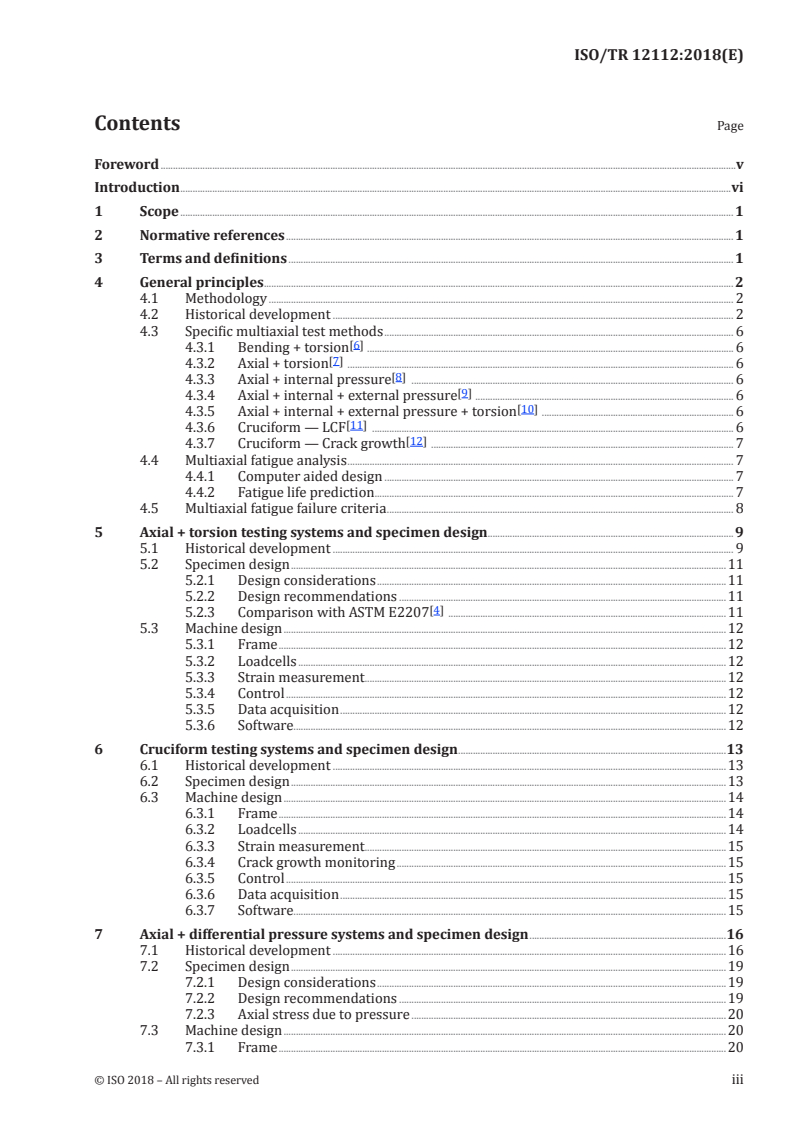
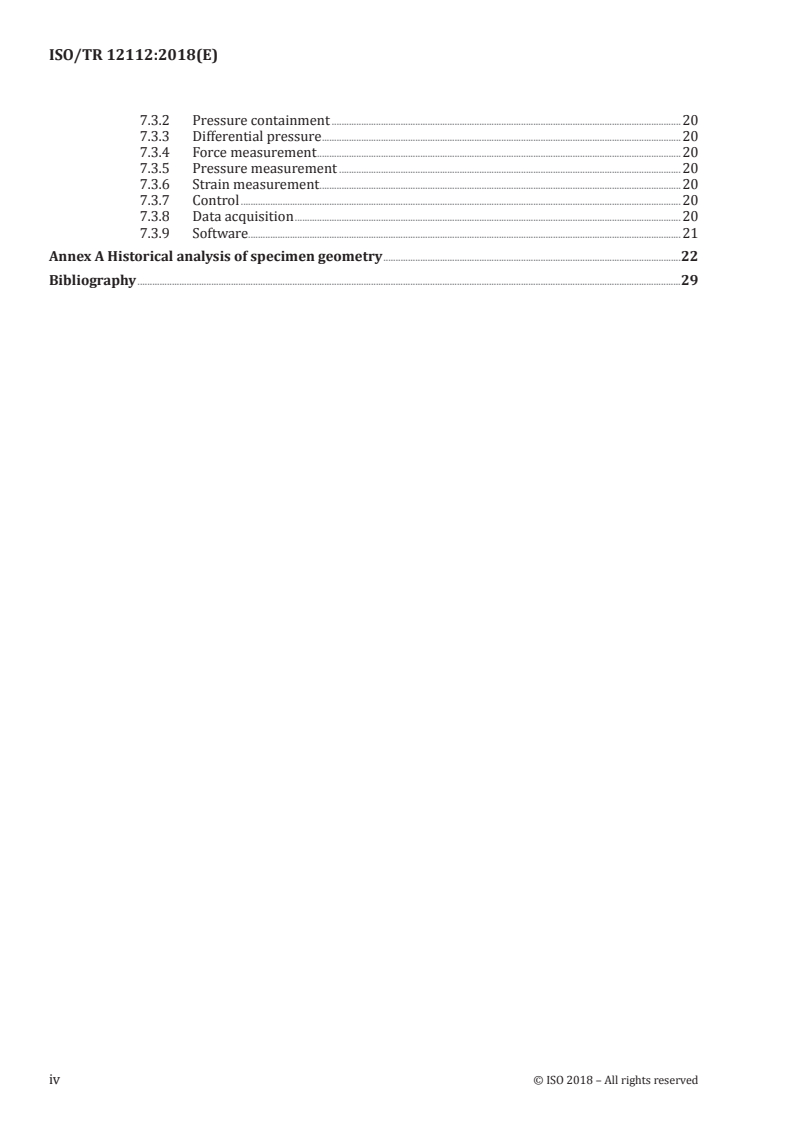
Contents Page
Foreword .v
Introduction .vi
1 Scope . 1
2 Normative references . 1
3 Terms and definitions . 1
4 General principles . 2
4.1 Methodology . 2
4.2 Historical development . 2
4.3 Specific multiaxial test methods . 6
[6]
4.3.1 Bending + torsion . . 6
[7]
4.3.2 Axial + torsion . 6
[8]
4.3.3 Axial + internal pressure . 6
[9]
4.3.4 Axial + internal + external pressure . 6
[10]
4.3.5 Axial + internal + external pressure + torsion . 6
[11]
4.3.6 Cruciform — LCF . 6
[12]
4.3.7 Cruciform — Crack growth . 7
4.4 Multiaxial fatigue analysis . 7
4.4.1 Computer aided design . 7
4.4.2 Fatigue life prediction . . 7
4.5 Multiaxial fatigue failure criteria . 8
5 Axial + torsion testing systems and specimen design. 9
5.1 Historical development . 9
5.2 Specimen design .11
5.2.1 Design considerations .11
5.2.2 Design recommendations .11
[4]
5.2.3 Comparison with ASTM E2207 .11
5.3 Machine design .12
5.3.1 Frame .12
5.3.2 Loadcells .12
5.3.3 Strain measurement.12
5.3.4 Control .12
5.3.5 Data acquisition .12
5.3.6 Software.12
6 Cruciform testing systems and specimen design .13
6.1 Historical development .13
6.2 Specimen design .13
6.3 Machine design .14
6.3.1 Frame .14
6.3.2 Loadcells .14
6.3.3 Strain measurement.15
6.3.4 Crack growth monitoring .15
6.3.5 Control .15
6.3.6 Data acquisition .15
6.3.7 Software.15
7 Axial + differential pressure systems and specimen design .16
7.1 Historical development .16
7.2 Specimen design .19
7.2.1 Design considerations .19
7.2.2 Design recommendations .19
7.2.3 Axial stress due to pressure .20
7.3 Machine design .20
7.3.1 Frame .20
7.3.2 Pressure containment .20
7.3.3 Differential pressure .20
7.3.4 Force measurement .20
7.3.5 Pressure measurement .20
7.3.6 Strain measurement.20
7.3.7 Control .20
7.3.8 Data acquisition .20
7.3.9 Software.21
Annex A Historical analysis of specimen geometry .22
Bibliography .29
iv © ISO 2018 – All rights reserved
Foreword
ISO (the International Organization for Standardization) is a worldwide federation of national standards
bodies (ISO member bodies). The work of preparing International Standards is normally carried out
through ISO technical committees. Each member body interested in a subject for which a technical
committee has been established has the right to be represented on that committee. International
organizations, governmental and non-governmental, in liaison with ISO, also take part in the work.
ISO collaborates closely with the International Electrotechnical Commission (IEC) on all matters of
electrotechnical standardization.
The procedures used to develop this document and those intended for its further maintenance are
described in the ISO/IEC Directives, Part 1. In particular the different approval criteria needed for the
different types of ISO documents should be noted. This document was drafted in accordance with the
editorial rules of the ISO/IEC Directives, Part 2 (see www .iso .org/directives).
Attention is drawn to the possibility that some of the elements of this document may be the subject of
patent rights. ISO shall not be held responsible for identifying any or all such patent rights. Details of
any patent rights identified during the development of the document will be in the Introduction and/or
on the ISO list of patent declarations received (see www .iso .org/patents).
Any trade name used in this document is information given for the convenience of users and does not
constitute an endorsement.
For an explanation on the voluntary nature of standards, the meaning of ISO specific terms and
expressions related to conformity assessment, as well as information about ISO's adherence to the
World Trade Organization (WTO) principles in the Technical Barriers to Trade (TBT) see the following
URL: www .iso .org/iso/foreword .html.
This document was prepared by Technical Committee ISO/TC 164, Mechanical testing of metals,
Subcommittee SC 4, Fatigue, fracture and toughness testing.
Introduction
Structural components in industry are frequently subject to some form of multiaxial stressing. Fatigue
cracks generally initiate from surface defects or discontinuities and are thus primarily influenced by
the surface biaxial stress system. This can vary from equibiaxial, where surface principal stresses are
equal in magnitude and sign (present under conditions of pressurization, rotation and thermal loading)
to pure shear where surface stresses are equal in magnitude, opposite in sign (as in shafts and shear
panels).
The majority of fatigue test data gathered worldwide have been and will continue to be under uniaxial
conditions for reasons of simplicity and cost. A secondary goal of multiaxial testing is therefore to
develop behavioural models which relate failure under specified multiaxial conditions to established
uniaxial cases.
This document utilizes data gathered from the past 80 years spanning most multiaxial fatigue research.
It can be of interest to new researchers in the field and form a basis for full International Standards as
the need arises.
vi © ISO 2018 – All rights reserved
TECHNICAL REPORT ISO/TR 12112:2018(E)
Metallic materials — Principles and designs for multiaxial
fatigue testing
1 Scope
This document discusses the general principles of multiaxial fatigue testing and the design
recommendations for specific classes of multiaxial testing machines and test specimens.
2 Normative references
There are no normative references in this document.
3 Terms and definitions
For the purposes of this document, the following terms and definitions apply.
ISO and IEC maintain terminological databases for use in standardization at the following addresses:
— ISO Online browsing platform: available at https: //www .iso .org/obp
— IEC Electropedia: available at http: //www .electropedia .org/
3.1
biaxial strain ratio
ϕ
ratio of the surface principal strains, smaller/larger
3.2
biaxial stress ratio
ψ
ratio of the surface principal stresses, smaller/larger
3.3
principal strains
ε > ε > ε
1 2 3
principal direct strains at a point in a multiaxial strain field
3.4
principal stresses
σ > σ > σ
1 2 3
principal direct stresses at a point in a multiaxial strain field
3.5
Poisson’s ratio
ν
negative ratio of transverse to longitudinal strain under uniaxial tensile stressing
3.6
specimen diameter
d
diameter of a cylindrical tubular specimen
Note 1 to entry: The symbols d , d and d are used to express outside, inside and mean diameters, respectively.
0 i m
3.7
parallel length
l
p
parallel length of a cylindrical tubular specimen
3.8
fillet radius
r
fillet radius of a cylindrical tubular specimen
3.9
directional suffix
suffix identifying a direction in a cylindrical tubular specimen
Note 1 to entry: The suffixes z, r and θ are used to express axial, radial and circumferential directions,
respectively.
3.10
strain component suffix
suffix identifying a strain component
Note 1 to entry: The suffixes e, p and t are used for elastic, plastic and total strain components, respectively.
3.11
internal pressure
P
internal pressure within a cylindrical tubular specimen
4 General principles
4.1 Methodology
Multi-axial fatigue testing sets out to simulate the dynamic stress-strain conditions at key locations on
components, on test specimens of constant geometry for a given test series, and to determine the cyclic
stress-strain history, crack initiation and propagation behaviour, fatigue life and failure mode.
Dependent on the level of geometric constraint in the real component, it can be more useful to
test specimens under stress or strain control, e.g. a test specimen representative of a relatively
unconstrained gas turbine blade can be tested in stress control whereas it can be more relevant to
utilize strain control for a test specimen simulating part of a steam turbine disc subject to thermal
straining during start-up.
Further, where stress amplitudes are sufficient to take test specimen materials well into the region
of cyclic plasticity (LCF), it can be preferable to employ strain control in order to better control cyclic
amplitude during the test and failure at end of test.
4.2 Historical development
Multiaxial fatigue has been addressed since the 1930s. Initially, testing machine and specimen designs
were created to address specific biaxial stress conditions, e.g. torsion, bending + torsion, cantilever
bending, anticlastic bending and plate pressurization. However, a criticism of much of the early research
was that specimen design had to change in order to change the biaxial stress or strain ratio, leading to
uncertainty in the interpretation of results.
The benefit of being able to test a single specimen design over a wide range of biaxiality led to the
choice of two generic specimen types, tubular and cruciform, together with associated multi-axis
testing machine designs.
2 © ISO 2018 – All rights reserved
[5]
Table 1 summarizes the attributes of the different test methods applicable to tubular and plate
specimens.
Biaxiality is shown in terms of the range of surface strains with ε held constant. Only cruciforms
and systems employing axial force plus internal and external pressure are capable of applying fully
reversed fatigue cycles over the full range of biaxiality (−1 ≤ ϕ ≤ +1) to test specimens.
Buckling is a key concern in the design of effective LCF specimens.
A reasonable gauge area of essentially constant strain is beneficial.
Ideally, strain should be constant through the thickness.
If all the applied forces are carried by the gauge area, then all stresses and strains can be determined;
otherwise, only total (not plastic) strains can be measured.
The ability to visually observe the specimen is useful especially for surface crack monitoring.
Some designs are suitable for high temperature and thermo-mechanical fatigue (TMF) testing.
Systems involving torsion cause the principal axes to rotate up to 45°.
System cost can be scaled by the number of actuators, and therefore closed servo-loops, in the design.
4 © ISO 2018 – All rights reserved
Table 1 — Multiaxial test methods for tubular and plate specimens
Biaxial Range of Single Immune Invariant Min. Moni- Speci- Crack High tem- TMF Rota- No. of
specimen surface geome- to buck- σ and ε ε-gra- toring men ob- growth perature studies tion of actuators
schemat- principal try ling on gauge dient biaxial σ servation studies capability principal propor-
ics and strains area through and ε stresses tional to
P
modes of thickness cost
loading
Bending
√ √ √ √ √ 1
+ torsion
Axial
√ √ √ √ √ √ √ √ √ 2
+ torsion
Axial
√ √ √ √ √ √ 2
+ P
int
Axial
+ P
int
+ con- √ √ √ √ √ 2
stant
+ P
ext
Axial
+ P
int
√ √ √ √ √ 4
+ P
ext
+ torsion
Table 1 (continued)
Biaxial Range of Single Immune Invariant Min. Moni- Speci- Crack High tem- TMF Rota- No. of
specimen surface geome- to buck- σ and ε ε-gra- toring men ob- growth perature studies tion of actuators
schemat- principal try ling on gauge dient biaxial σ servation studies capability principal propor-
ics and strains area through and ε stresses tional to
P
modes of thickness cost
loading
Cantile-
√ √ √ √ 1
ver bend
Anticlas-
√ √ √ √ √ 1
tic bend
Plate
pressuri- √ √ 1
zation
Cruci-
√ √ √ √ √ 4
form LCF
Cruci-
form
√ √ √ √ √ √ √ √ 4
crack
growth
4.3 Specific multiaxial test methods
[6]
4.3.1 Bending + torsion
This was the first technique used to apply combined stresses in high cycle fatigue (HCF) at room
temperature. Oscillating vertical forces were applied to a horizontally clamped cylindrical specimen
which could be rotated by up to 90° in the horizontal plane so as to introduce bending, bending
+ torsion, or torsion in the waisted centre section. Specimens were either solid or hollow. A number of
these electro-mechanical testing machines were built between 1930 and 1950 to investigate fatigue of
aero-engine steels, especially for crankshaft applications.
[7]
4.3.2 Axial + torsion
This popular technique employs a single tubular specimen design with a gauge length over which stress
and strain are substantially invariant and access for strain measurement and crack monitoring. The
principal stress and strain directions progressively rotate through 45° as the test moves from uniaxial
to torsion. Elevated temperature testing and thermo-mechanical fatigue (TMF) are achievable with
relevant accessories and control software. Despite a limited range of strain biaxiality (–ν ≥ ϕ ≥ −1),
this approach is widespread and standard testing machines with dual servo-hydraulic actuators are
available from commercial manufacturers.
[8]
4.3.3 Axial + internal pressure
This approach permits a single tubular specimen design with essentially invariant stress and strain
over the gauge length. Crack studies are difficult as maximum stress occurs at the bore, so cracks can
only be visible after penetration of the wall shortly prior to failure. In addition, cyclic plasticity results
in strain ratchetting as external radial compression cannot be applied to fully reverse the stress —
strain cycle. Hence this approach is essentially restricted to elastic HCF studies. The testing machine
typically utilizes a dual actuator servo-hydraulic design.
[9]
4.3.4 Axial + internal + external pressure
This design enables fully reversed cycling without ratchetting because radial compression can be
applied. Axial and circumferential stresses and strains are measurable, enabling LCF hysteresis loops
on both surface axes, which makes the approach suitable for fundamental behavioural studies. Because
a pressure vessel is located around the specimen, visual observations are difficult. Also elevated
temperature testing above about 200 °C requires gas pressurization which presents safety issues. By
employing variable internal pressure and fixed external pressure, a design with just 2 servo-hydraulic
actuators is achievable.
[10]
4.3.5 Axial + internal + external pressure + torsion
The addition of torsion introduces rotation of principal stress or strain axes which allows, in principle,
material anisotropy and the effects of the different symmetries (in the axial and circumferential
directions) to be investigated. The mechanical design is complex with 4 servo-hydraulic actuators, but
has been successfully achieved.
NOTE Multiaxial testing machines featuring axial force and differential pressure are typically used for
,
academic research or specific R&D applications and are usually designed and manufactured to order.
[11]
4.3.6 Cruciform — LCF
Four orthogonal loading arms apply biaxial strain to a central circular gauge area on the specimen. This
area is usually spherically recessed on both sides in order to resist buckling and ensure that cracks
initiate near the centre. In consequence, the gauge area does not support all the applied forces, i.e.
some of the force is shunted around the outside. As a result, stresses and plastic strains are not readily
6 © ISO 2018 – All rights reserved
determinable. However, visual observation of developing fatigue cracks is straightforward and elevated
temperature testing, including TMF, is readily achievable.
[12]
4.3.7 Cruciform — Crack growth
The four orthogonal arms are slotted to minimize grip constraint. A central square, constant thickness,
gauge area typically features a central hole stress raiser to initiate fatigue cracks. There is a large
region of essentially constant biaxial strain ideal for crack initiation and propagation studies. Elevated
temperature testing, including TMF, is achievable. Maximum compressive strains are limited to avoid
buckling in the gauge area and arms.
NOTE Cruciform designs provide the opportunity for testing single geometry plate specimens with dual
symmetry over the range of surface biaxiality. Testing systems employ 4 servo-hydraulic actuators within an
annular frame and are typically specified according to application and manufactured to order.
4.4 Multiaxial fatigue analysis
4.4.1 Computer aided design
In the design of structural components subject to multiaxial fatigue, it is common to use finite element
analysis (FEA) to determine stresses and strains. For elastic behaviour, such analyses are useful to
predict stress concentrations and local yield in order to evolve specimen designs.
4.4.2 Fatigue life prediction
Yield criteria such as Tresca (maximum shear), Von Mises or octahedral shear strain, coupled with the
Palmgren-Miner linear damage hypothesis, are frequently employed to predict “multiaxial fatigue life”.
However, research evidence does not necessarily support this approach.
[13][14]
Multiaxial LCF fatigue studies on specimens capable of being tested over the full biaxial range
showed that Tresca and Von Mises did not correlate all the fatigue life data, especially over the range
between uniaxial and torsion, i.e. (0 ≥ ψ ≥ −1) and (−ν ≥ ϕ ≥ −1).
For example, in Figure 1, Mohr’s strain circles drawn with principal strain (ε ) constant and Poisson’s
ratio = 0,5, show that the maximum shear strain (γ ) is the lowest in the uniaxial stress (ϕ = −ν) case.
max
However, ranking these biaxial fatigue cases from most to least damaging, the order was equibiaxial
strain (ϕ = +1), plane strain (ϕ = 0), uniaxial stress (ϕ = −ν) and pure shear (ϕ = −1).
[15]
Current consensus indicates that a critical shear plane analysis including, as a modifier, the direct
stress or strain acting normal to that plane, offers the best approach to correlating multiaxial fatigue
behaviour across the complete range of applied biaxial surface stresses or strains.
a) Pure shear (ϕ = −1) b) Uniaxial stress (ϕ = −ν)
c) Equibiaxial strain (ϕ = +1) d) Plane strain (ϕ = 0)
Figure 1 — Mohr’s strain circles, ε constant, for Poisson’s Ratio (ν) = 0,5
4.5 Multiaxial fatigue failure criteria
The definition of fatigue failure criteria can have a significant effect on attempts to correlate theoretical
analysis with experimental results.
Axial force + torsion (without pressurization) results in the gauge area seeing all the applied stresses.
The maximum shear strain is always in the surface, except in the uniaxial stress case when there is an
equal through-thickness shear strain. Fatigue lives according to stress drop can be readily determined.
Stress drop, after any cyclic hardening or softening, is generally considered to be the result of a
reduction in load bearing cross sectional area due to cracking.
In the case of cruciform specimens, where actuator forces are partially shunted around the gauge area,
a calculated stress drop criterion is sometimes not easy to apply. Fatigue lives are typically determined
by the achievement of a specified surface crack length. Through-thickness cracks can still extend in a
stable fashion. The relationship between crack length and crack area depends on the biaxial strain ratio.
When internal/external pressurization is used in conjunction with axial force, the gauge area
experiences all the applied stresses. However, stress drop is not usually helpful as a failure criterion
since, when the crack penetrates the thickness of the specimen (allowing internal and external
pressures to interact), the test should be rapidly terminated or unstable rupture can ensue. As a
consequence, crack lengths in the surface are relatively short and of different length according to the
biaxial strain ratio.
8 © ISO 2018 – All rights reserved
5 Axial + torsion testing systems and specimen design
5.1 Historical development
Axial + torsion enables a single tubular specimen geometry to be tested over a biaxial range
(–ν ≥ ϕ ≥ −1) with convenient access for strain measurement and crack monitoring. Notably, the principal
stress and strain directions rotate through 45° as the test moves from uniaxial to torsion.
[16]
At Tohoku University, in 1965, data was reported for torsional and uniaxial LCF, derived from
separate machines but with identical gauge length geometry, to investigate multiaxial behaviour.
At Kyoto University, the first combined axial + torsional fatigue testing at ambient and elevated
[17]
temperatures for in-phase and subsequently, in 1968, for out-of-phase cycling was described.
From the 1970s onwards, axial + torsion, closed loop servo-hydraulic, testing machines have been
provided by materials testing machine manufacturers and widely used in academia and industrial R&D
[18]
for HCF, LCF and creep-fatigue testing .
[19]
TMF using axial + torsion systems has been reported from the 1990s.
Figure 2 below depicts an axial + torsion TMF system at the CRIEPI (Central Research Institute of
Electrical Power Industry) laboratory near Tokyo.
Figure 2 — Axial + torsion TMF system at CRIEPI, Japan
10 © ISO 2018 – All rights reserved
5.2 Specimen design
5.2.1 Design considerations
A single specimen geometry should be maintained for a given test series to validate data intercomparison.
Bending is minimized by ensuring that specimen ends are square to the axis and parallel to each other.
It is preferable to locate just one end concentrically, which avoids “S type” bending due to any slight
misalignment of the machine grips.
Buckling can occur under axial and torsional conditions. Both elastic and plastic buckling should be
considered. Buckling is predominantly influenced by the parallel length (l ), mean diameter (d ) and
p m
wall thickness (t) together with (for LCF) the plastic strain range and strain hardening characteristics
of the specimen material.
Fatigue strength and life are enhanced by minimizing the stress concentration at the run-out of the
fillet radius (r) on to the parallel length.
5.2.2 Design recommendations
By considering the geometric ratios l /d r/d and d /t, it is possible to compare the designs of
p m, m m
research specimens over the past 50 years. See Annex A, where data has been separately analysed for
HCF and LCF.
The ranges for l /d and r/d substantially overlap for LCF and HCF whereas the range for d /t is 2 to
p m m m
3 times lower for LCF, which is significant and reflects plastic buckling resistance.
As a result, recommended ranges for these ratios are indicated below with the lower values providing
best resistance to plastic buckling and the higher values best elastic strain uniformity.
2 > l /d > 1 3 > r/d > 1 30 > d /t > 10
p m m m
Figure 3 shows an LCF specimen design with mid value geometric ratios for l /d and r/d and low
p m m
value ratio for d /t.
m
Figure 3 — Axial-torsion LCF fatigue specimen
[4]
5.2.3 Comparison with ASTM E2207
1)
ASTM E2207 was first published in 2002 and re-approved in 2008 and 2013 .
Specimen design is covered in Clause 7 and is expressed in terms of geometric ratios to the gauge length
outside diameter (d ).
o
1) ASTM E2207-08(2013)e1 has been superseded by ASTM E2207-15.
Annex A includes the ASTM specimen geometry recommendations and their conversion to the form
expressed in this document for the indicated typical wall thickness of 2 mm, to enable comparison.
Generally the ratios are similar except for fillet radius which is large in relation to the historic mean.
Moreover, the ASTM typical specimen is quite large with a billet requirement of circa 50 mm diameter
by 230 mm long.
5.3 Machine design
5.3.1 Frame
Axial and torsional stiffness should be maximized to minimize frame deflections. Lateral stiffness
should be maximized to minimize axial buckling tendency. Two column frames are typical for LCF and
TMF applications. Alignment should be to ISO 23788.
5.3.2 Loadcells
Axial force and torque cells may be individual or combined. Force and torque ratings, stiffnesses and
accuracy class 1 to ISO 7500-1 should be specified.
5.3.3 Strain measurement
Extensometers may be separate or integrated. Operating force, clamping force, crosstalk and accuracy
class 0,5 to ISO 9513 should be specified. Compatibility with furnaces and environmental chambers
should be considered.
5.3.4 Control
Closed loop control should permit bumpless starts and mode transfers between position, force and
strain control modes. The control bandwidth should be high enough to accommodate the highest
frequency components within the anticipated demand waveforms. Synchronisation of applied
waveforms should be better than 0,2°.
5.3.5 Data acquisition
Sampling rate should be sufficiently high to avoid aliasing at the highest anticipated frequency
components of measured signals. Data skew between measured signals should be less than 5 μs.
5.3.6 Software
Results of data analysis should permit independent verification.
12 © ISO 2018 – All rights reserved
6 Cruciform testing systems and specimen design
6.1 Historical development
A specimen design lending itself directly to biaxial testing is a cross-shaped plate, or cruciform, loaded
in-plane by four orthogonal actuators.
[20]
In the early 1960s, at the Chance Vought Corporation , a rig that was capable of applying biaxial
tensile loads to a cruciform specimen was developed.
[21]
At Cambridge University , the development of an open loop cruciform testing system based on
a stiff octagonal frame carrying four 200 kN double acting actuators was reported in 1967. Further
[11]
development to provide full closed loop control was reported in 1975.
[12]
In 1985, a new specimen, developed at Sheffield University , was reported featuring a recessed flat-
bottomed square gauge area connected to the loading arms by sets of fingers (Figure 2). This decoupling
geometry enables a substantially uniform strain field ideal for crack growth studies.
Using induction heating, ceramic composite plate samples were tested in a cruciform system at
[22]
temperatures up to 1 800 °C at JUTEM (Japanese Ultra high Temperature Materials Research Centre).
Current research on cruciform systems includes elevated temperature TMF of single crystal super alloys.
6.2 Specimen design
Cruciform specimens are especially suitable for plate materials.
A single specimen geometry should be maintained for a given test series to validate data intercomparison.
The LCF specimen type (see Table 1) is potentially capable of fully reversed elastic-plastic straining
over the full range of biaxiality (+1 ≥ ϕ ≥ −1).
Buckling is a significant risk for LCF specimens. Spherical radii are needed on both surfaces to combat
it, with smaller radii for higher cyclic plastic strains which reduce the effective size of the central gauge
area. A small flat central zone is sometimes introduced to provide a region of relatively uniform strain.
The crack growth specimen (Figure 4), developed at Sheffield University, can be viewed as a quasi-
standard approach. It features a recessed, flat-bottomed, square gauge area connected to the four
loading arms by sets of fingers. This decoupling geometry enables a substantially uniform strain field
ideal for crack growth studies.
The crack growth specimen does not permit significant plastic compressive stressing due to buckling
of the fingers. This is not a serious problem as crack growth studies are usually carried out in tension-
tension stress fields.
Figure 4 — Sheffield cruciform specimen
6.3 Machine design
6.3.1 Frame
An annular frame with four servo-hydraulic actuators is typical for all cruciform applications. In-
plane stiffness should be maximized to minimize frame deflections. Out-of-plane stiffness should be
maximized to minimize buckling.
Alignment should be to ISO 23788 for each axis and a mutual orthogonality of ±0,05° should be ensured.
6.3.2 Loadcells
Axial force cells are needed for each actuator. Force rating, stiffness and accuracy class 1 to ISO 7500-1
should be addressed in their specification.
14 © ISO 2018 – All rights reserved
6.3.3 Strain measurement
Extensometers are not easy to design for cruciform specimens. They should be classified in accordance
with ISO 9513 if supplied. Strain gauges may be applied; however, zero drift with increasing LCF cycles
[21]
is an issue. A reported research technique is to use strain gauges to establish force or position limits
on the two axes, then cycle to failure in force or position control.
6.3.4 Crack growth monitoring
Non-contact methods such as long focal length (confocal) microscopy are recommended.
6.3.5 Control
Closed loop control should permit bumpless starts and mode transfers between position and force
control modes. The control bandwidth should be high enough to accommodate the highest frequency
components within the anticipated demand waveforms. Synchronisation of applied waveforms should
be better than 0,2°.
[23]
Control of centre position, which is a key aspect for cruciform (see Figure 5) should be specified at
±2,5 microns.
Key
1 Centre position demand (D ) = Half-difference of LVDT readings
c
or for zero side force = Difference of Loadcell readings
2 Deformation demand (D ) = Sum of LVDT readings, or
d
= Average of loadcell readings, or
= Extensometer reading
Figure 5 — Control of centre position and deformation – one axis of cruciform rig
6.3.6 Data acquisition
Sampling rate should be sufficiently high to avoid aliasing at the highest anticipated frequency
components of measured signals. Data skew between measured signals should be less than 5 μs.
6.3.7 Software
Results of data analysis should permit independent verification.
7 Axial + differential pressure systems and specimen design
7.1 Historical development
The combination of cyclic axial force + differential pressure, acting in-phase or in anti-phase, on a thin
walled tubular specimen enables the full range of surface biaxiality to be achieved in principle.
In the late 1960s, the application of cyclic axial force + repeated internal pressure on thin walled
[8]
aluminium alloy tubes was reported . Absence of external pressure to fully reverse the stress cycle
means that hardening and ratchetting takes place and cycles became elastic. Nevertheless this system
has been used extensively from the 1970s onwards, latterly with added torsion, especially in Germany
in support of the automotive industry.
At the University of Waterloo, a system was developed in which axial force was coupled to internal
or external pressure, enabling cycle reversal. However, since the pressure was derived from the axial
[24]
actuator hydraulics, the specimen design had to be changed to alter the biaxial stress ratio .
At Bristol University in the 1970s, dual closed loop servo hydraulic systems were used to independently
control axial force and differential pressure. The development of extensometry permitted axial and
[25]
hoop strain to be measured and hysteresis loops generated for both axes . See Figures 6 and 7.
At Sheffield University, a more complex servo-hydraulic system was successfully developed with four
independent control loops for axial force, internal and external pressure and torsion, thereby providing
[10]
the additional ability to investigate rotation of principal stress axes .
16 © ISO 2018 – All rights reserved
Figure 6 — Bristol biaxial specimen + diametral extensometry
Figure 7 — Bristol biaxial loadstring + pressure vessel
18 © ISO 2018 – All rights reserved
7.2 Specimen design
7.2.1 Design considerations
Thin walled tubular specimens enable a potentially large volume of material to be subjected to a
constant state of biaxial surface stress and relatively constant radial stress.
A single specimen geometry should be maintained for a given test series to validate data intercomparison.
Bending will be minimized by ensuring that specimen ends are square to the axis and parallel to each
other. It is preferable to locate just one end concentrically, which avoids “S type” bending due to any
slight misalignment of the machine grips.
Buckling can occur both elastically and plastically. It is strongly influenced by specimen geometry, i.e.
parallel length (l ), mean diameter (d ) and wall thickness (t). In addition, the stress or strain ratio is
p m
relevant, e.g. equibiaxial stressing w
...
TECHNICAL ISO/TR
REPORT 12112
First edition
2018-04
Metallic materials — Principles and
designs for multiaxial fatigue testing
Matériaux métalliques — Principes et conceptions associés aux essais
de fatigue multiaxiale
Reference number
©
ISO 2018
© ISO 2018
All rights reserved. Unless otherwise specified, or required in the context of its implementation, no part of this publication may
be reproduced or utilized otherwise in any form or by any means, electronic or mechanical, including photocopying, or posting
on the internet or an intranet, without prior written permission. Permission can be requested from either ISO at the address
below or ISO’s member body in the country of the requester.
ISO copyright office
CP 401 • Ch. de Blandonnet 8
CH-1214 Vernier, Geneva
Phone: +41 22 749 01 11
Fax: +41 22 749 09 47
Email: copyright@iso.org
Website: www.iso.org
Published in Switzerland
ii © ISO 2018 – All rights reserved
Contents Page
Foreword .v
Introduction .vi
1 Scope . 1
2 Normative references . 1
3 Terms and definitions . 1
4 General principles . 2
4.1 Methodology . 2
4.2 Historical development . 2
4.3 Specific multiaxial test methods . 6
[6]
4.3.1 Bending + torsion . . 6
[7]
4.3.2 Axial + torsion . 6
[8]
4.3.3 Axial + internal pressure . 6
[9]
4.3.4 Axial + internal + external pressure . 6
[10]
4.3.5 Axial + internal + external pressure + torsion . 6
[11]
4.3.6 Cruciform — LCF . 6
[12]
4.3.7 Cruciform — Crack growth . 7
4.4 Multiaxial fatigue analysis . 7
4.4.1 Computer aided design . 7
4.4.2 Fatigue life prediction . . 7
4.5 Multiaxial fatigue failure criteria . 8
5 Axial + torsion testing systems and specimen design. 9
5.1 Historical development . 9
5.2 Specimen design .11
5.2.1 Design considerations .11
5.2.2 Design recommendations .11
[4]
5.2.3 Comparison with ASTM E2207 .11
5.3 Machine design .12
5.3.1 Frame .12
5.3.2 Loadcells .12
5.3.3 Strain measurement.12
5.3.4 Control .12
5.3.5 Data acquisition .12
5.3.6 Software.12
6 Cruciform testing systems and specimen design .13
6.1 Historical development .13
6.2 Specimen design .13
6.3 Machine design .14
6.3.1 Frame .14
6.3.2 Loadcells .14
6.3.3 Strain measurement.15
6.3.4 Crack growth monitoring .15
6.3.5 Control .15
6.3.6 Data acquisition .15
6.3.7 Software.15
7 Axial + differential pressure systems and specimen design .16
7.1 Historical development .16
7.2 Specimen design .19
7.2.1 Design considerations .19
7.2.2 Design recommendations .19
7.2.3 Axial stress due to pressure .20
7.3 Machine design .20
7.3.1 Frame .20
7.3.2 Pressure containment .20
7.3.3 Differential pressure .20
7.3.4 Force measurement .20
7.3.5 Pressure measurement .20
7.3.6 Strain measurement.20
7.3.7 Control .20
7.3.8 Data acquisition .20
7.3.9 Software.21
Annex A Historical analysis of specimen geometry .22
Bibliography .29
iv © ISO 2018 – All rights reserved
Foreword
ISO (the International Organization for Standardization) is a worldwide federation of national standards
bodies (ISO member bodies). The work of preparing International Standards is normally carried out
through ISO technical committees. Each member body interested in a subject for which a technical
committee has been established has the right to be represented on that committee. International
organizations, governmental and non-governmental, in liaison with ISO, also take part in the work.
ISO collaborates closely with the International Electrotechnical Commission (IEC) on all matters of
electrotechnical standardization.
The procedures used to develop this document and those intended for its further maintenance are
described in the ISO/IEC Directives, Part 1. In particular the different approval criteria needed for the
different types of ISO documents should be noted. This document was drafted in accordance with the
editorial rules of the ISO/IEC Directives, Part 2 (see www .iso .org/directives).
Attention is drawn to the possibility that some of the elements of this document may be the subject of
patent rights. ISO shall not be held responsible for identifying any or all such patent rights. Details of
any patent rights identified during the development of the document will be in the Introduction and/or
on the ISO list of patent declarations received (see www .iso .org/patents).
Any trade name used in this document is information given for the convenience of users and does not
constitute an endorsement.
For an explanation on the voluntary nature of standards, the meaning of ISO specific terms and
expressions related to conformity assessment, as well as information about ISO's adherence to the
World Trade Organization (WTO) principles in the Technical Barriers to Trade (TBT) see the following
URL: www .iso .org/iso/foreword .html.
This document was prepared by Technical Committee ISO/TC 164, Mechanical testing of metals,
Subcommittee SC 4, Fatigue, fracture and toughness testing.
Introduction
Structural components in industry are frequently subject to some form of multiaxial stressing. Fatigue
cracks generally initiate from surface defects or discontinuities and are thus primarily influenced by
the surface biaxial stress system. This can vary from equibiaxial, where surface principal stresses are
equal in magnitude and sign (present under conditions of pressurization, rotation and thermal loading)
to pure shear where surface stresses are equal in magnitude, opposite in sign (as in shafts and shear
panels).
The majority of fatigue test data gathered worldwide have been and will continue to be under uniaxial
conditions for reasons of simplicity and cost. A secondary goal of multiaxial testing is therefore to
develop behavioural models which relate failure under specified multiaxial conditions to established
uniaxial cases.
This document utilizes data gathered from the past 80 years spanning most multiaxial fatigue research.
It can be of interest to new researchers in the field and form a basis for full International Standards as
the need arises.
vi © ISO 2018 – All rights reserved
TECHNICAL REPORT ISO/TR 12112:2018(E)
Metallic materials — Principles and designs for multiaxial
fatigue testing
1 Scope
This document discusses the general principles of multiaxial fatigue testing and the design
recommendations for specific classes of multiaxial testing machines and test specimens.
2 Normative references
There are no normative references in this document.
3 Terms and definitions
For the purposes of this document, the following terms and definitions apply.
ISO and IEC maintain terminological databases for use in standardization at the following addresses:
— ISO Online browsing platform: available at https: //www .iso .org/obp
— IEC Electropedia: available at http: //www .electropedia .org/
3.1
biaxial strain ratio
ϕ
ratio of the surface principal strains, smaller/larger
3.2
biaxial stress ratio
ψ
ratio of the surface principal stresses, smaller/larger
3.3
principal strains
ε > ε > ε
1 2 3
principal direct strains at a point in a multiaxial strain field
3.4
principal stresses
σ > σ > σ
1 2 3
principal direct stresses at a point in a multiaxial strain field
3.5
Poisson’s ratio
ν
negative ratio of transverse to longitudinal strain under uniaxial tensile stressing
3.6
specimen diameter
d
diameter of a cylindrical tubular specimen
Note 1 to entry: The symbols d , d and d are used to express outside, inside and mean diameters, respectively.
0 i m
3.7
parallel length
l
p
parallel length of a cylindrical tubular specimen
3.8
fillet radius
r
fillet radius of a cylindrical tubular specimen
3.9
directional suffix
suffix identifying a direction in a cylindrical tubular specimen
Note 1 to entry: The suffixes z, r and θ are used to express axial, radial and circumferential directions,
respectively.
3.10
strain component suffix
suffix identifying a strain component
Note 1 to entry: The suffixes e, p and t are used for elastic, plastic and total strain components, respectively.
3.11
internal pressure
P
internal pressure within a cylindrical tubular specimen
4 General principles
4.1 Methodology
Multi-axial fatigue testing sets out to simulate the dynamic stress-strain conditions at key locations on
components, on test specimens of constant geometry for a given test series, and to determine the cyclic
stress-strain history, crack initiation and propagation behaviour, fatigue life and failure mode.
Dependent on the level of geometric constraint in the real component, it can be more useful to
test specimens under stress or strain control, e.g. a test specimen representative of a relatively
unconstrained gas turbine blade can be tested in stress control whereas it can be more relevant to
utilize strain control for a test specimen simulating part of a steam turbine disc subject to thermal
straining during start-up.
Further, where stress amplitudes are sufficient to take test specimen materials well into the region
of cyclic plasticity (LCF), it can be preferable to employ strain control in order to better control cyclic
amplitude during the test and failure at end of test.
4.2 Historical development
Multiaxial fatigue has been addressed since the 1930s. Initially, testing machine and specimen designs
were created to address specific biaxial stress conditions, e.g. torsion, bending + torsion, cantilever
bending, anticlastic bending and plate pressurization. However, a criticism of much of the early research
was that specimen design had to change in order to change the biaxial stress or strain ratio, leading to
uncertainty in the interpretation of results.
The benefit of being able to test a single specimen design over a wide range of biaxiality led to the
choice of two generic specimen types, tubular and cruciform, together with associated multi-axis
testing machine designs.
2 © ISO 2018 – All rights reserved
[5]
Table 1 summarizes the attributes of the different test methods applicable to tubular and plate
specimens.
Biaxiality is shown in terms of the range of surface strains with ε held constant. Only cruciforms
and systems employing axial force plus internal and external pressure are capable of applying fully
reversed fatigue cycles over the full range of biaxiality (−1 ≤ ϕ ≤ +1) to test specimens.
Buckling is a key concern in the design of effective LCF specimens.
A reasonable gauge area of essentially constant strain is beneficial.
Ideally, strain should be constant through the thickness.
If all the applied forces are carried by the gauge area, then all stresses and strains can be determined;
otherwise, only total (not plastic) strains can be measured.
The ability to visually observe the specimen is useful especially for surface crack monitoring.
Some designs are suitable for high temperature and thermo-mechanical fatigue (TMF) testing.
Systems involving torsion cause the principal axes to rotate up to 45°.
System cost can be scaled by the number of actuators, and therefore closed servo-loops, in the design.
4 © ISO 2018 – All rights reserved
Table 1 — Multiaxial test methods for tubular and plate specimens
Biaxial Range of Single Immune Invariant Min. Moni- Speci- Crack High tem- TMF Rota- No. of
specimen surface geome- to buck- σ and ε ε-gra- toring men ob- growth perature studies tion of actuators
schemat- principal try ling on gauge dient biaxial σ servation studies capability principal propor-
ics and strains area through and ε stresses tional to
P
modes of thickness cost
loading
Bending
√ √ √ √ √ 1
+ torsion
Axial
√ √ √ √ √ √ √ √ √ 2
+ torsion
Axial
√ √ √ √ √ √ 2
+ P
int
Axial
+ P
int
+ con- √ √ √ √ √ 2
stant
+ P
ext
Axial
+ P
int
√ √ √ √ √ 4
+ P
ext
+ torsion
Table 1 (continued)
Biaxial Range of Single Immune Invariant Min. Moni- Speci- Crack High tem- TMF Rota- No. of
specimen surface geome- to buck- σ and ε ε-gra- toring men ob- growth perature studies tion of actuators
schemat- principal try ling on gauge dient biaxial σ servation studies capability principal propor-
ics and strains area through and ε stresses tional to
P
modes of thickness cost
loading
Cantile-
√ √ √ √ 1
ver bend
Anticlas-
√ √ √ √ √ 1
tic bend
Plate
pressuri- √ √ 1
zation
Cruci-
√ √ √ √ √ 4
form LCF
Cruci-
form
√ √ √ √ √ √ √ √ 4
crack
growth
4.3 Specific multiaxial test methods
[6]
4.3.1 Bending + torsion
This was the first technique used to apply combined stresses in high cycle fatigue (HCF) at room
temperature. Oscillating vertical forces were applied to a horizontally clamped cylindrical specimen
which could be rotated by up to 90° in the horizontal plane so as to introduce bending, bending
+ torsion, or torsion in the waisted centre section. Specimens were either solid or hollow. A number of
these electro-mechanical testing machines were built between 1930 and 1950 to investigate fatigue of
aero-engine steels, especially for crankshaft applications.
[7]
4.3.2 Axial + torsion
This popular technique employs a single tubular specimen design with a gauge length over which stress
and strain are substantially invariant and access for strain measurement and crack monitoring. The
principal stress and strain directions progressively rotate through 45° as the test moves from uniaxial
to torsion. Elevated temperature testing and thermo-mechanical fatigue (TMF) are achievable with
relevant accessories and control software. Despite a limited range of strain biaxiality (–ν ≥ ϕ ≥ −1),
this approach is widespread and standard testing machines with dual servo-hydraulic actuators are
available from commercial manufacturers.
[8]
4.3.3 Axial + internal pressure
This approach permits a single tubular specimen design with essentially invariant stress and strain
over the gauge length. Crack studies are difficult as maximum stress occurs at the bore, so cracks can
only be visible after penetration of the wall shortly prior to failure. In addition, cyclic plasticity results
in strain ratchetting as external radial compression cannot be applied to fully reverse the stress —
strain cycle. Hence this approach is essentially restricted to elastic HCF studies. The testing machine
typically utilizes a dual actuator servo-hydraulic design.
[9]
4.3.4 Axial + internal + external pressure
This design enables fully reversed cycling without ratchetting because radial compression can be
applied. Axial and circumferential stresses and strains are measurable, enabling LCF hysteresis loops
on both surface axes, which makes the approach suitable for fundamental behavioural studies. Because
a pressure vessel is located around the specimen, visual observations are difficult. Also elevated
temperature testing above about 200 °C requires gas pressurization which presents safety issues. By
employing variable internal pressure and fixed external pressure, a design with just 2 servo-hydraulic
actuators is achievable.
[10]
4.3.5 Axial + internal + external pressure + torsion
The addition of torsion introduces rotation of principal stress or strain axes which allows, in principle,
material anisotropy and the effects of the different symmetries (in the axial and circumferential
directions) to be investigated. The mechanical design is complex with 4 servo-hydraulic actuators, but
has been successfully achieved.
NOTE Multiaxial testing machines featuring axial force and differential pressure are typically used for
,
academic research or specific R&D applications and are usually designed and manufactured to order.
[11]
4.3.6 Cruciform — LCF
Four orthogonal loading arms apply biaxial strain to a central circular gauge area on the specimen. This
area is usually spherically recessed on both sides in order to resist buckling and ensure that cracks
initiate near the centre. In consequence, the gauge area does not support all the applied forces, i.e.
some of the force is shunted around the outside. As a result, stresses and plastic strains are not readily
6 © ISO 2018 – All rights reserved
determinable. However, visual observation of developing fatigue cracks is straightforward and elevated
temperature testing, including TMF, is readily achievable.
[12]
4.3.7 Cruciform — Crack growth
The four orthogonal arms are slotted to minimize grip constraint. A central square, constant thickness,
gauge area typically features a central hole stress raiser to initiate fatigue cracks. There is a large
region of essentially constant biaxial strain ideal for crack initiation and propagation studies. Elevated
temperature testing, including TMF, is achievable. Maximum compressive strains are limited to avoid
buckling in the gauge area and arms.
NOTE Cruciform designs provide the opportunity for testing single geometry plate specimens with dual
symmetry over the range of surface biaxiality. Testing systems employ 4 servo-hydraulic actuators within an
annular frame and are typically specified according to application and manufactured to order.
4.4 Multiaxial fatigue analysis
4.4.1 Computer aided design
In the design of structural components subject to multiaxial fatigue, it is common to use finite element
analysis (FEA) to determine stresses and strains. For elastic behaviour, such analyses are useful to
predict stress concentrations and local yield in order to evolve specimen designs.
4.4.2 Fatigue life prediction
Yield criteria such as Tresca (maximum shear), Von Mises or octahedral shear strain, coupled with the
Palmgren-Miner linear damage hypothesis, are frequently employed to predict “multiaxial fatigue life”.
However, research evidence does not necessarily support this approach.
[13][14]
Multiaxial LCF fatigue studies on specimens capable of being tested over the full biaxial range
showed that Tresca and Von Mises did not correlate all the fatigue life data, especially over the range
between uniaxial and torsion, i.e. (0 ≥ ψ ≥ −1) and (−ν ≥ ϕ ≥ −1).
For example, in Figure 1, Mohr’s strain circles drawn with principal strain (ε ) constant and Poisson’s
ratio = 0,5, show that the maximum shear strain (γ ) is the lowest in the uniaxial stress (ϕ = −ν) case.
max
However, ranking these biaxial fatigue cases from most to least damaging, the order was equibiaxial
strain (ϕ = +1), plane strain (ϕ = 0), uniaxial stress (ϕ = −ν) and pure shear (ϕ = −1).
[15]
Current consensus indicates that a critical shear plane analysis including, as a modifier, the direct
stress or strain acting normal to that plane, offers the best approach to correlating multiaxial fatigue
behaviour across the complete range of applied biaxial surface stresses or strains.
a) Pure shear (ϕ = −1) b) Uniaxial stress (ϕ = −ν)
c) Equibiaxial strain (ϕ = +1) d) Plane strain (ϕ = 0)
Figure 1 — Mohr’s strain circles, ε constant, for Poisson’s Ratio (ν) = 0,5
4.5 Multiaxial fatigue failure criteria
The definition of fatigue failure criteria can have a significant effect on attempts to correlate theoretical
analysis with experimental results.
Axial force + torsion (without pressurization) results in the gauge area seeing all the applied stresses.
The maximum shear strain is always in the surface, except in the uniaxial stress case when there is an
equal through-thickness shear strain. Fatigue lives according to stress drop can be readily determined.
Stress drop, after any cyclic hardening or softening, is generally considered to be the result of a
reduction in load bearing cross sectional area due to cracking.
In the case of cruciform specimens, where actuator forces are partially shunted around the gauge area,
a calculated stress drop criterion is sometimes not easy to apply. Fatigue lives are typically determined
by the achievement of a specified surface crack length. Through-thickness cracks can still extend in a
stable fashion. The relationship between crack length and crack area depends on the biaxial strain ratio.
When internal/external pressurization is used in conjunction with axial force, the gauge area
experiences all the applied stresses. However, stress drop is not usually helpful as a failure criterion
since, when the crack penetrates the thickness of the specimen (allowing internal and external
pressures to interact), the test should be rapidly terminated or unstable rupture can ensue. As a
consequence, crack lengths in the surface are relatively short and of different length according to the
biaxial strain ratio.
8 © ISO 2018 – All rights reserved
5 Axial + torsion testing systems and specimen design
5.1 Historical development
Axial + torsion enables a single tubular specimen geometry to be tested over a biaxial range
(–ν ≥ ϕ ≥ −1) with convenient access for strain measurement and crack monitoring. Notably, the principal
stress and strain directions rotate through 45° as the test moves from uniaxial to torsion.
[16]
At Tohoku University, in 1965, data was reported for torsional and uniaxial LCF, derived from
separate machines but with identical gauge length geometry, to investigate multiaxial behaviour.
At Kyoto University, the first combined axial + torsional fatigue testing at ambient and elevated
[17]
temperatures for in-phase and subsequently, in 1968, for out-of-phase cycling was described.
From the 1970s onwards, axial + torsion, closed loop servo-hydraulic, testing machines have been
provided by materials testing machine manufacturers and widely used in academia and industrial R&D
[18]
for HCF, LCF and creep-fatigue testing .
[19]
TMF using axial + torsion systems has been reported from the 1990s.
Figure 2 below depicts an axial + torsion TMF system at the CRIEPI (Central Research Institute of
Electrical Power Industry) laboratory near Tokyo.
Figure 2 — Axial + torsion TMF system at CRIEPI, Japan
10 © ISO 2018 – All rights reserved
5.2 Specimen design
5.2.1 Design considerations
A single specimen geometry should be maintained for a given test series to validate data intercomparison.
Bending is minimized by ensuring that specimen ends are square to the axis and parallel to each other.
It is preferable to locate just one end concentrically, which avoids “S type” bending due to any slight
misalignment of the machine grips.
Buckling can occur under axial and torsional conditions. Both elastic and plastic buckling should be
considered. Buckling is predominantly influenced by the parallel length (l ), mean diameter (d ) and
p m
wall thickness (t) together with (for LCF) the plastic strain range and strain hardening characteristics
of the specimen material.
Fatigue strength and life are enhanced by minimizing the stress concentration at the run-out of the
fillet radius (r) on to the parallel length.
5.2.2 Design recommendations
By considering the geometric ratios l /d r/d and d /t, it is possible to compare the designs of
p m, m m
research specimens over the past 50 years. See Annex A, where data has been separately analysed for
HCF and LCF.
The ranges for l /d and r/d substantially overlap for LCF and HCF whereas the range for d /t is 2 to
p m m m
3 times lower for LCF, which is significant and reflects plastic buckling resistance.
As a result, recommended ranges for these ratios are indicated below with the lower values providing
best resistance to plastic buckling and the higher values best elastic strain uniformity.
2 > l /d > 1 3 > r/d > 1 30 > d /t > 10
p m m m
Figure 3 shows an LCF specimen design with mid value geometric ratios for l /d and r/d and low
p m m
value ratio for d /t.
m
Figure 3 — Axial-torsion LCF fatigue specimen
[4]
5.2.3 Comparison with ASTM E2207
1)
ASTM E2207 was first published in 2002 and re-approved in 2008 and 2013 .
Specimen design is covered in Clause 7 and is expressed in terms of geometric ratios to the gauge length
outside diameter (d ).
o
1) ASTM E2207-08(2013)e1 has been superseded by ASTM E2207-15.
Annex A includes the ASTM specimen geometry recommendations and their conversion to the form
expressed in this document for the indicated typical wall thickness of 2 mm, to enable comparison.
Generally the ratios are similar except for fillet radius which is large in relation to the historic mean.
Moreover, the ASTM typical specimen is quite large with a billet requirement of circa 50 mm diameter
by 230 mm long.
5.3 Machine design
5.3.1 Frame
Axial and torsional stiffness should be maximized to minimize frame deflections. Lateral stiffness
should be maximized to minimize axial buckling tendency. Two column frames are typical for LCF and
TMF applications. Alignment should be to ISO 23788.
5.3.2 Loadcells
Axial force and torque cells may be individual or combined. Force and torque ratings, stiffnesses and
accuracy class 1 to ISO 7500-1 should be specified.
5.3.3 Strain measurement
Extensometers may be separate or integrated. Operating force, clamping force, crosstalk and accuracy
class 0,5 to ISO 9513 should be specified. Compatibility with furnaces and environmental chambers
should be considered.
5.3.4 Control
Closed loop control should permit bumpless starts and mode transfers between position, force and
strain control modes. The control bandwidth should be high enough to accommodate the highest
frequency components within the anticipated demand waveforms. Synchronisation of applied
waveforms should be better than 0,2°.
5.3.5 Data acquisition
Sampling rate should be sufficiently high to avoid aliasing at the highest anticipated frequency
components of measured signals. Data skew between measured signals should be less than 5 μs.
5.3.6 Software
Results of data analysis should permit independent verification.
12 © ISO 2018 – All rights reserved
6 Cruciform testing systems and specimen design
6.1 Historical development
A specimen design lending itself directly to biaxial testing is a cross-shaped plate, or cruciform, loaded
in-plane by four orthogonal actuators.
[20]
In the early 1960s, at the Chance Vought Corporation , a rig that was capable of applying biaxial
tensile loads to a cruciform specimen was developed.
[21]
At Cambridge University , the development of an open loop cruciform testing system based on
a stiff octagonal frame carrying four 200 kN double acting actuators was reported in 1967. Further
[11]
development to provide full closed loop control was reported in 1975.
[12]
In 1985, a new specimen, developed at Sheffield University , was reported featuring a recessed flat-
bottomed square gauge area connected to the loading arms by sets of fingers (Figure 2). This decoupling
geometry enables a substantially uniform strain field ideal for crack growth studies.
Using induction heating, ceramic composite plate samples were tested in a cruciform system at
[22]
temperatures up to 1 800 °C at JUTEM (Japanese Ultra high Temperature Materials Research Centre).
Current research on cruciform systems includes elevated temperature TMF of single crystal super alloys.
6.2 Specimen design
Cruciform specimens are especially suitable for plate materials.
A single specimen geometry should be maintained for a given test series to validate data intercomparison.
The LCF specimen type (see Table 1) is potentially capable of fully reversed elastic-plastic straining
over the full range of biaxiality (+1 ≥ ϕ ≥ −1).
Buckling is a significant risk for LCF specimens. Spherical radii are needed on both surfaces to combat
it, with smaller radii for higher cyclic plastic strains which reduce the effective size of the central gauge
area. A small flat central zone is sometimes introduced to provide a region of relatively uniform strain.
The crack growth specimen (Figure 4), developed at Sheffield University, can be viewed as a quasi-
standard approach. It features a recessed, flat-bottomed, square gauge area connected to the four
loading arms by sets of fingers. This decoupling geometry enables a substantially uniform strain field
ideal for crack growth studies.
The crack growth specimen does not permit significant plastic compressive stressing due to buckling
of the fingers. This is not a serious problem as crack growth studies are usually carried out in tension-
tension stress fields.
Figure 4 — Sheffield cruciform specimen
6.3 Machine design
6.3.1 Frame
An annular frame with four servo-hydraulic actuators is typical for all cruciform applications. In-
plane stiffness should be maximized to minimize frame deflections. Out-of-plane stiffness should be
maximized to minimize buckling.
Alignment should be to ISO 23788 for each axis and a mutual orthogonality of ±0,05° should be ensured.
6.3.2 Loadcells
Axial force cells are needed for each actuator. Force rating, stiffness and accuracy class 1 to ISO 7500-1
should be addressed in their specification.
14 © ISO 2018 – All rights reserved
6.3.3 Strain measurement
Extensometers are not easy to design for cruciform specimens. They should be classified in accordance
with ISO 9513 if supplied. Strain gauges may be applied; however, zero drift with increasing LCF cycles
[21]
is an issue. A reported research technique is to use strain gauges to establish force or position limits
on the two axes, then cycle to failure in force or position control.
6.3.4 Crack growth monitoring
Non-contact methods such as long focal length (confocal) microscopy are recommended.
6.3.5 Control
Closed loop control should permit bumpless starts and mode transfers between position and force
control modes. The control bandwidth should be high enough to accommodate the highest frequency
components within the anticipated demand waveforms. Synchronisation of applied waveforms should
be better than 0,2°.
[23]
Control of centre position, which is a key aspect for cruciform (see Figure 5) should be specified at
±2,5 microns.
Key
1 Centre position demand (D ) = Half-difference of LVDT readings
c
or for zero side force = Difference of Loadcell readings
2 Deformation demand (D ) = Sum of LVDT readings, or
d
= Average of loadcell readings, or
= Extensometer reading
Figure 5 — Control of centre position and deformation – one axis of cruciform rig
6.3.6 Data acquisition
Sampling rate should be sufficiently high to avoid aliasing at the highest anticipated frequency
components of measured signals. Data skew between measured signals should be less than 5 μs.
6.3.7 Software
Results of data analysis should permit independent verification.
7 Axial + differential pressure systems and specimen design
7.1 Historical development
The combination of cyclic axial force + differential pressure, acting in-phase or in anti-phase, on a thin
walled tubular specimen enables the full range of surface biaxiality to be achieved in principle.
In the late 1960s, the application of cyclic axial force + repeated internal pressure on thin walled
[8]
aluminium alloy tubes was reported . Absence of external pressure to fully reverse the stress cycle
means that hardening and ratchetting takes place and cycles became elastic. Nevertheless this system
has been used extensively from the 1970s onwards, latterly with added torsion, especially in Germany
in support of the automotive industry.
At the University of Waterloo, a system was developed in which axial force was coupled to internal
or external pressure, enabling cycle reversal. However, since the pressure was derived from the axial
[24]
actuator hydraulics, the specimen design had to be changed to alter the biaxial stress ratio .
At Bristol University in the 1970s, dual closed loop servo hydraulic systems were used to independently
control axial force and differential pressure. The development of extensometry permitted axial and
[25]
hoop strain to be measured and hysteresis loops generated for both axes . See Figures 6 and 7.
At Sheffield University, a more complex servo-hydraulic system was successfully developed with four
independent control loops for axial force, internal and external pressure and torsion, thereby providing
[10]
the additional ability to investigate rotation of principal stress axes .
16 © ISO 2018 – All rights reserved
Figure 6 — Bristol biaxial specimen + diametral extensometry
Figure 7 — Bristol biaxial loadstring + pressure vessel
18 © ISO 2018 – All rights reserved
7.2 Specimen design
7.2.1 Design considerations
Thin walled tubular specimens enable a potentially large volume of material to be subjected to a
constant state of biaxial surface stress and relatively constant radial stress.
A single specimen geometry should be maintained for a given test series to validate data intercomparison.
Bending will be minimized by ensuring that specimen ends are square to the axis and parallel to each
other. It is preferable to locate just one end concentrically, which avoids “S type” bending due to any
slight misalignment of the machine grips.
Buckling can occur both elastically and plastically. It is strongly influenced by specimen geometry, i.e.
parallel length (l ), mean diameter (d ) and wall thickness (t). In addition, the stress or strain ratio is
p m
relevant, e.g. equibiaxial stressing w
...