

ISO 15016:2025
(Main)Ships and marine technology — Specifications for the assessment of speed and power performance by analysis of speed trial data
General Information
- Abstract
This document specifies requirements for the preparation, execution and reporting of speed trials of ships of the displacement type with a length between perpendiculars (Lpp) from 50 metres to 500 metres. It provides a procedure for the analysis, evaluation and correction of the gathered speed trial data covering all influences that can be relevant to the individual trial runs reporting on speed trials for ships, including effects that can influence the speed, power and propeller shaft speed relationship.
- Status
- Published
- Publication Date
- 02-Feb-2025
- Technical Committee
- ISO/TC 8/SC 6 - Navigation and ship operations
- Drafting Committee
- ISO/TC 8/SC 6 - Navigation and ship operations
- Current Stage
- 6060 - International Standard published
- Start Date
- 03-Feb-2025
- Due Date
- 09-Aug-2024
- Completion Date
- 03-Feb-2025

Overview
ISO 15016:2025 - Ships and marine technology - Specifications for the assessment of speed and power performance by analysis of speed trial data - defines requirements for preparing, executing and reporting ship speed trials for displacement-type vessels with a length between perpendiculars (Lpp) of 50 m to 500 m. The standard provides a structured procedure to analyse, evaluate and correct speed trial data so that the relationship between speed, delivered power and propeller shaft speed can be assessed reliably under varying environmental and ship-condition influences.
Key topics and technical requirements
ISO 15016:2025 covers the full trial lifecycle and technical topics including:
- Trial preparation and responsibilities - roles of shipbuilders and the trial team; instrument installation and calibration; pre-trial meetings and agendas.
- Ship condition control - trim, displacement, hull/propeller/shaft condition and documentation.
- Trial boundary conditions - recommended criteria for location, wind, sea state, water depth and current measurement and limits.
- Trial procedure and conduct - run trajectories, run duration, steering, power settings, number and sequencing of speed runs (including iterative and mean-of-means methods).
- Data acquisition - system requirements, sensor locations, manual data collection and sign conventions.
- Analysis procedure - data processing steps, derivation of resistance and power curves, current analysis, and conversion to full-load or stipulated conditions.
- Corrections and annexes - normative methods for corrections and effects such as wind, waves, water temperature/density, current, shallow water, and displacement deviations; conversion and derivation of S/P (speed/power) curves; direct power method.
- Reporting and examples - required reporting content and an example analysis; trial log sheet and supporting informative scales (Beaufort/sea state).
Practical applications and users
ISO 15016:2025 is intended for:
- Shipbuilders and shipyards performing acceptance trials.
- Classification societies and flag administrations assessing compliance.
- Shipowners and operators verifying contractual speed and fuel-performance claims.
- Naval architects, performance analysts and trial teams conducting data acquisition and post-trial analysis. The standard supports reliable verification of speed-power performance, contractual dispute resolution, fuel-efficiency studies and validation of model/tank test predictions.
Related standards
ISO 15016:2025 is part of the ISO suite for ships and marine technology and aligns with ISO/IEC editorial directives on document development. Users should apply it alongside other relevant ship performance, measurement and regulatory guidance (classification society rules, model test standards and national/IMO guidance) when planning and reporting sea trials.
Keywords: ISO 15016:2025, speed trials, speed-power performance, speed trial data, S/P curve, ship trials, displacement ships, trial corrections, data acquisition, marine technology.
Relations
- Effective Date
- 06-Jun-2022
Get Certified
Connect with accredited certification bodies for this standard

DNV
DNV is an independent assurance and risk management provider.

Lloyd's Register
Lloyd's Register is a global professional services organisation specialising in engineering and technology.

FSC International
Forest Stewardship Council certification.
Sponsored listings
Frequently Asked Questions
ISO 15016:2025 is a standard published by the International Organization for Standardization (ISO). Its full title is "Ships and marine technology — Specifications for the assessment of speed and power performance by analysis of speed trial data". This standard covers: This document specifies requirements for the preparation, execution and reporting of speed trials of ships of the displacement type with a length between perpendiculars (Lpp) from 50 metres to 500 metres. It provides a procedure for the analysis, evaluation and correction of the gathered speed trial data covering all influences that can be relevant to the individual trial runs reporting on speed trials for ships, including effects that can influence the speed, power and propeller shaft speed relationship.
This document specifies requirements for the preparation, execution and reporting of speed trials of ships of the displacement type with a length between perpendiculars (Lpp) from 50 metres to 500 metres. It provides a procedure for the analysis, evaluation and correction of the gathered speed trial data covering all influences that can be relevant to the individual trial runs reporting on speed trials for ships, including effects that can influence the speed, power and propeller shaft speed relationship.
ISO 15016:2025 is classified under the following ICS (International Classification for Standards) categories: 47.020.01 - General standards related to shipbuilding and marine structures. The ICS classification helps identify the subject area and facilitates finding related standards.
ISO 15016:2025 has the following relationships with other standards: It is inter standard links to ISO 15016:2015. Understanding these relationships helps ensure you are using the most current and applicable version of the standard.
ISO 15016:2025 is available in PDF format for immediate download after purchase. The document can be added to your cart and obtained through the secure checkout process. Digital delivery ensures instant access to the complete standard document.
Standards Content (Sample)
International
Standard
ISO 15016
Third edition
Ships and marine technology —
2025-02
Specifications for the assessment of
speed and power performance by
analysis of speed trial data
Reference number
© ISO 2025
All rights reserved. Unless otherwise specified, or required in the context of its implementation, no part of this publication may
be reproduced or utilized otherwise in any form or by any means, electronic or mechanical, including photocopying, or posting on
the internet or an intranet, without prior written permission. Permission can be requested from either ISO at the address below
or ISO’s member body in the country of the requester.
ISO copyright office
CP 401 • Ch. de Blandonnet 8
CH-1214 Vernier, Geneva
Phone: +41 22 749 01 11
Email: copyright@iso.org
Website: www.iso.org
Published in Switzerland
ii
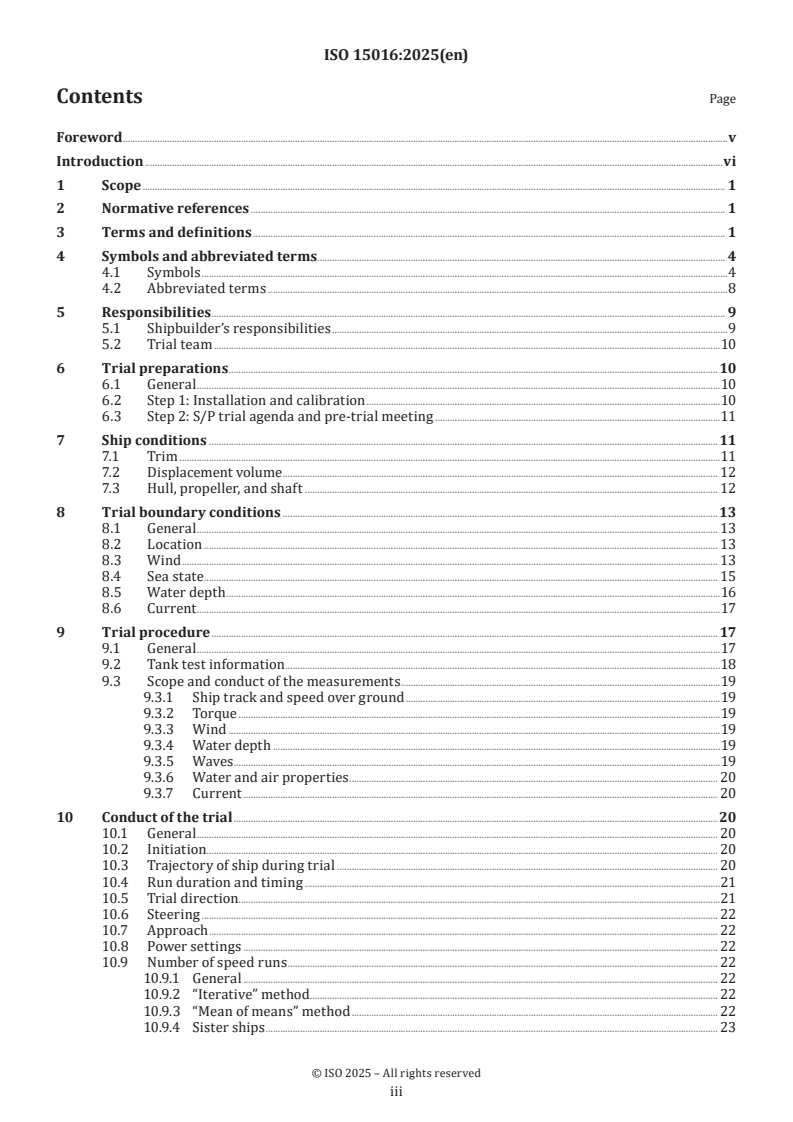
Contents Page
Foreword .v
Introduction .vi
1 Scope . 1
2 Normative references . 1
3 Terms and definitions . 1
4 Symbols and abbreviated terms. 4
4.1 Symbols .4
4.2 Abbreviated terms .8
5 Responsibilities . . 9
5.1 Shipbuilder’s responsibilities .9
5.2 Trial team .10
6 Trial preparations .10
6.1 General .10
6.2 Step 1: Installation and calibration .10
6.3 Step 2: S/P trial agenda and pre-trial meeting .11
7 Ship conditions .11
7.1 Trim .11
7.2 Displacement volume . 12
7.3 Hull, propeller, and shaft . 12
8 Trial boundary conditions .13
8.1 General . 13
8.2 Location . 13
8.3 Wind . 13
8.4 Sea state . 15
8.5 Water depth .16
8.6 Current .17
9 Trial procedure . 17
9.1 General .17
9.2 Tank test information .18
9.3 Scope and conduct of the measurements .19
9.3.1 Ship track and speed over ground .19
9.3.2 Torque .19
9.3.3 Wind .19
9.3.4 Water depth .19
9.3.5 Waves .19
9.3.6 Water and air properties . 20
9.3.7 Current . 20
10 Conduct of the trial .20
10.1 General . 20
10.2 Initiation . . 20
10.3 Trajectory of ship during trial . 20
10.4 Run duration and timing .21
10.5 Trial direction.21
10.6 Steering . 22
10.7 Approach . 22
10.8 Power settings . 22
10.9 Number of speed runs . 22
10.9.1 General . 22
10.9.2 “Iterative” method. 22
10.9.3 “Mean of means” method . 22
10.9.4 Sister ships . 23
iii
10.9.5 Power settings in case of non-availability of tank test data . 23
10.9.6 Additional runs due to limiting wave height . 23
10.10 S/P Trial test sequence . 23
11 Data acquisition .24
11.1 General .24
11.2 Acquisition system .24
11.2.1 General .24
11.2.2 System requirements .24
11.2.3 Location . 25
11.3 Manual data collection . 25
11.4 Sign convention . 25
12 Analysis procedure .27
12.1 General .27
12.2 Description of the analysis procedure .27
12.2.1 General .27
12.2.2 Resistance data derived from the acquired data . 29
12.2.3 Evaluation of the acquired resistance data . 30
12.2.4 E valuation of resistance data based on direct power method . 30
12.2.5 Analysis of the measured ship speed due to the effect of current . 30
12.2.6 Analysis of the power curve from trial condition to full load/stipulated condition . 30
13 Processing of the results .31
14 Reporting .32
15 Example of speed trial data analysis .34
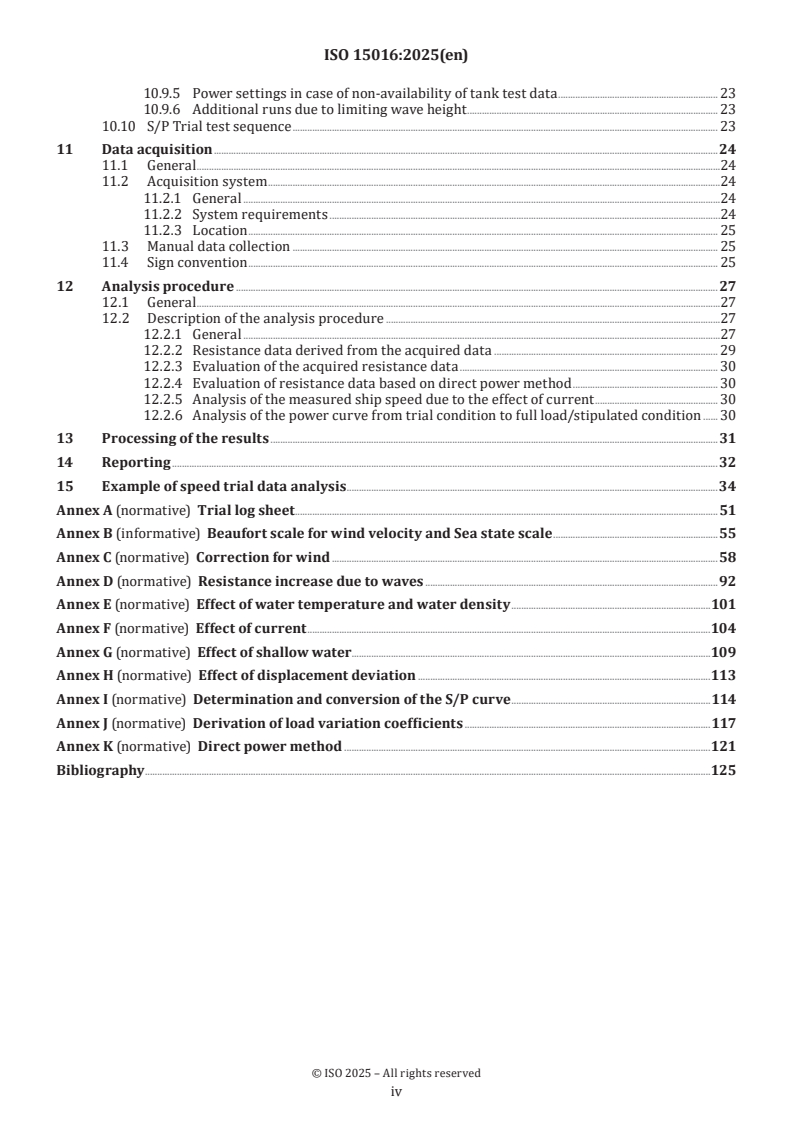
Annex A (normative) Trial log sheet . .51
Annex B (informative) Beaufort scale for wind velocity and Sea state scale .55
Annex C (normative) Correction for wind .58
Annex D (normative) Resistance increase due to waves .92
Annex E (normative) Effect of water temperature and water density .101
Annex F (normative) Effect of current .104
Annex G (normative) Effect of shallow water . .109
Annex H (normative) Effect of displacement deviation .113
Annex I (normative) Determination and conversion of the S/P curve .114
Annex J (normative) Derivation of load variation coefficients .117
Annex K (normative) Direct power method .121
Bibliography .125
iv
Foreword
ISO (the International Organization for Standardization) is a worldwide federation of national standards
bodies (ISO member bodies). The work of preparing International Standards is normally carried out through
ISO technical committees. Each member body interested in a subject for which a technical committee
has been established has the right to be represented on that committee. International organizations,
governmental and non-governmental, in liaison with ISO, also take part in the work. ISO collaborates closely
with the International Electrotechnical Commission (IEC) on all matters of electrotechnical standardization.
The procedures used to develop this document and those intended for its further maintenance are described
in the ISO/IEC Directives, Part 1. In particular, the different approval criteria needed for the different types
of ISO document should be noted. This document was drafted in accordance with the editorial rules of the
ISO/IEC Directives, Part 2 (see www.iso.org/directives).
ISO draws attention to the possibility that the implementation of this document may involve the use of (a)
patent(s). ISO takes no position concerning the evidence, validity or applicability of any claimed patent
rights in respect thereof. As of the date of publication of this document, ISO had not received notice of (a)
patent(s) which may be required to implement this document. However, implementers are cautioned that
this may not represent the latest information, which may be obtained from the patent database available at
www.iso.org/patents. ISO shall not be held responsible for identifying any or all such patent rights.
Any trade name used in this document is information given for the convenience of users and does not
constitute an endorsement.
For an explanation of the voluntary nature of standards, the meaning of ISO specific terms and expressions
related to conformity assessment, as well as information about ISO's adherence to the World Trade
Organization (WTO) principles in the Technical Barriers to Trade (TBT), see www.iso.org/iso/foreword.html.
This document was prepared by Technical Committee ISO/TC 8, Ships and marine technology, Subcommittee
SC 6, Navigation and ship operations.
This third edition cancels and replaces the second edition (ISO 15016:2015), which has been technically
revised.
The main changes are as follows:
— the status of Annex K has been changed to normative;
— the requirements for the wind sensor have been updated;
— the wind limits have been made more specific;
— new wind coefficient reference data has been added;
— wave correction methods have been updated (SNNM method has been added; “STAWAVE-2” and
“Theoretical method with simplified tank tests in short waves” have been deleted);
— the application of wave correction methods has been clearly defined;
— with regard to shallow water correction, the Lackenby method has been replaced by the modern
Raven method.
Any feedback or questions on this document should be directed to the user’s national standards body. A
complete listing of these bodies can be found at www.iso.org/members.html.
v
Introduction
This document concerns the procedure of analysing the results obtained from ship speed-power trials.
The primary purpose of speed and power trials is to determine a ship’s performance in terms of its speed,
power and propeller shaft speed under the ship's prescribed conditions, and thereby verify the satisfactory
attainment of a ship speed stipulated by the Energy Efficiency Design Index (EEDI) regulations and the
shipbuilding contract. To determine the contracted ship speed and the ship speed for EEDI, the same
procedure is followed. The EEDI forms an integral part of the sea trial conduct and analysis.
The contracted ship speed and the ship speed for EEDI are determined at specific draughts (either contract
draught or EEDI draught, or both). For EEDI, the environmental conditions are: no wind, no waves, no current
and deep water of 15 °C.
Normally, such stipulated conditions are unlikely to be experienced in part or in full during the actual trials.
In practice, certain corrections for the environmental conditions such as water depth, surface wind, waves,
[1][2]
current and deviating ship draught, should be considered. For this reason, during the speed and power
trials, not only shaft power and ship speed are measured, but also relevant ship data and environmental
conditions.
The purpose of this document is to define the basic requirements for the performance of speed trials and to
provide methods for the evaluation and correction of speed trial data, covering all influences which can be
relevant to the individual trial runs based on sound scientific grounds, thereby enabling owners and others
to have confidence in the validity of the final results.
This document is intended to help the interested parties to achieve the desired target accuracy of within
1) [1]
2 % in shaft power and 0,1 knot in speed.
The procedure specified in this document has been developed largely based on published data on speed
trials and on ship’s performance, including the International Towing Tank Conference (ITTC) documents
listed in Clause 2.
The basic development of sea trial procedures using the Direct Power Method has been initiated by the STA-
[3]
Group and later by ITTC. This document takes into account the work of the STA-Group and the guidelines
of ITTC which are approved by the Maritime Environmental Protection Committee (MEPC) MEPC 65 for
[1]
EEDI.
In 2002, the first edition of this document was published. ISO 15016:2002 was based on the evaluation of
resistance increase and propeller characteristics.
The second edition (ISO 15016:2015) enabled this document to be used for EEDI regulations as well as for
the shipbuilding contract. This new procedure was based on the direct power method. The "mean of means"
and the "iterative" method were selected for the correction of current effects. For wave correction, several
methods were offered as options in combination with observed wave conditions.
This third edition takes into account methods for the correction of wind, waves and shallow water which
have been recently developed and validated. The application of these methods has been made consistent
and ambiguities are avoided. This document includes modern accurate measurement methods of wind and
waves. It has been updated to achieve the specified target accuracy of speed and power.
This document generally applies to ships for which survey and certification of EEDI and Energy Efficiency
[4][7][8]
Existing Ship Index (EEXI) is required under the International Maritime Organization Resolutions. For
other ships, to which the above International Maritime Organization (IMO) resolutions are not applicable,
the terms or phrases of this document are deemed to be replaced as necessary (e.g. “agreement between the
shipbuilder, the owner and the verifier” can be read as “agreement between the shipbuilder and the owner” etc.)
In this document, the unit used to express the amount of an angle is “rad” (radian) and the unit of speed
is “m/s” (metres per second). Nevertheless, “degree” as a unit for an angle and “knots” as a unit for speed
1) 1 kn = 1 852/3 600 m/s.
vi
are used wherever indicated. Moreover, for the convenience of the users of this document, numerical values
using the units of degree and knots are stated together, where appropriate.
vii
International Standard ISO 15016:2025(en)
Ships and marine technology — Specifications for the
assessment of speed and power performance by analysis of
speed trial data
1 Scope
This document specifies requirements for the preparation, execution and reporting of speed trials of ships
of the displacement type with a length between perpendiculars (L ) from 50 metres to 500 metres. It
pp
provides a procedure for the analysis, evaluation and correction of the gathered speed trial data covering
all influences that can be relevant to the individual trial runs reporting on speed trials for ships, including
effects that can influence the speed, power and propeller shaft speed relationship.
2 Normative references
The following documents are referred to in the text in such a way that some or all of their content constitutes
requirements of this document. For dated references, only the edition cited applies. For undated references,
the latest edition of the referenced document (including any amendments) applies.
ITTC 7.5-02-03-01.4, ITTC Recommended Procedures and Guidelines, 1978 ITTC Performance Prediction Method
ITTC 7.5-02-07-02.2, ITTC Recommended Procedures and Guidelines, Prediction of Power Increase in Irregular
Waves from Model Tests.
3 Terms and definitions
For the purposes of this document, the following terms and definitions apply.
ISO and IEC maintain terminology databases for use in standardization at the following addresses:
— ISO Online browsing platform: available at https:// www .iso .org/ obp
— IEC Electropedia: available at https:// www .electropedia .org/
3.1
brake power
power, in watts, delivered by the output coupling of the propulsion machinery before passing through any
speed-reducing and transmission devices
3.2
contract power
brake power (3.1) or shaft power (3.20), in watts, that is stipulated in the new build or conversion contract
between the shipbuilder (3.21) and the owner (3.14)
3.3
contract speed
ship speed (3.23) to be achieved as agreed within the terms of the new build/conversion contract
3.4
direct power method
procedure where the measured power is directly corrected by the power increase due to added resistance
in the trial conditions
3.5
double run
two consecutive speed runs (3.27) at the same power setting (3.16) on reciprocal headings (3.8)
3.6
Energy Efficiency Design Index power
EEDI power
brake power (3.1), in watts, that is stipulated by the Energy Efficiency Design Index (EEDI) regulations
3.7
Energy Efficiency Design Index speed
EEDI speed
ship speed (3.23) achieved under the conditions specified by the IMO Resolution MEPC.245(66) (as amended)
3.8
heading
compass direction (based on true North) in which the vessel’s bow is pointed, measured over the centreline
of the vessel
3.9
headway distance
length travelled during the speed run (3.27) in the direction of the compass heading (3.8) (based on true North)
Note 1 to entry: The compass direction (based on true North) shall be the one at the start of the speed run (3.27); see
also Figure 1.
Key
the ship compass heading (3.8) (based on true north)
Ψ
A the Global Navigation Satellite System (GNSS) position at start of the speed run (3.27)
B the GNSS position at end of the speed run
AC the headway distance between start and end position of the speed run, expressed in metres
Figure 1 — Determination of headway distance
3.10
ideal conditions
trial situation without wind, without waves, without current, in deep water, with a water temperature of
15 °C, a specific water density of 1 026,0 kg/m , an air temperature of 15 °C and an air specific density of
1,225 kg/m (unless specified otherwise in the shipbuilding contract)
3.11
load variation test
procedure conducted during tank-testing to find out the variation of performance (in terms of efficiency,
revolutions, torque and thrust) according to the variation of load on the ship resistance
3.12
maximum continuous rating
maximum power output that the prime mover(s) can produce while running continuously at safe limits and
conditions as specified on the nameplate and in the technical file of the prime mover(s)
Note 1 to entry: In case a prime mover power limitation (EPL) or a shaft power limitation (Shapoli) system is installed,
the limited installed power is as specified in the Energy Efficiency Existing Ship Index (EEXI) Technical File.
3.13
measured ship speed
vessel velocity during a speed run (3.27) derived from the headway distance (3.9) between the start and end
position and the elapsed time of the speed run (3.27)
3.14
owner
party that signed the new building or conversion contract with the shipbuilder (3.21)
3.15
owner’s master
person in command after delivery of the vessel
3.16
power setting
selection of the throttle of the prime mover(s) and the propeller shaft speed and, in case of controllable pitch
propellers (CPP), the selection of the pitch angle (3.19)
3.17
propeller
driving screw propulsor or alternative propulsion system of the ship
3.18
propeller pitch
design pitch at 0,7 R for a fixed pitch propeller
3.19
pitch angle
operating blade angle of a controllable pitch propeller (CPP)
3.20
shaft power
net power, in watts, supplied by the machinery of the prime mover(s) to the propulsion shafting after passing
through all speed-reducing and other devices, and after power for all attached auxiliaries has been taken off,
and accounting for losses in the shaft between the propeller (3.17) and the location of power measurement
at the shaft
3.21
shipbuilder
shipbuilding company that signed the new building or conversion contract with the owner (3.14)
3.22
shipyard
shipbuilding production facility where the subject ship is constructed
3.23
ship speed
forward velocity of the ship that is realised under the stipulated conditions
Note 1 to entry: See also, contract speed (3.3), Energy Efficiency Design Index speed (3.7) and measured ship speed (3.13).
3.24
sister ship
ship with identical main dimensions, body lines, appendages and propulsion system built in a series by the
same shipyard (3.22)
3.25
S/P trial
speed and power trial
trial to establish the relationship between power and speed for a particular ship
3.26
S/P trial agenda
speed and power trial agenda
document outlining the scope of a particular S/P trial (3.25)
3.27
speed run
track of the ship with specified heading (3.8), distance and duration for which the measured ship speed (3.13)
and shaft power (3.20) of the ship are calculated
3.28
tank test
model basin measurement for the prediction of the speed-power relation for the stipulated conditions
3.29
trial leader
duly authorized person [representative of the shipbuilder (3.21)] responsible for the execution of all phases
of the speed and power (S/P) trials (3.25) including the pre-trial preparation
3.30
trial log
data recorded before, during and after the speed and power (S/P) trial (3.25)
3.31
trial team
team that consists of the trial leader (3.29), the owner’s representative, the appointed persons responsible
for the speed and power trial (S/P) (3.25) measurements and, if the ship requires the Energy Efficiency
Design Index, the verifier (3.32)
3.32
verifier
third party responsible for verification of the Energy Efficiency Design Index
3.33
zero pitch
blade angle of a controllable pitch propeller (CPP) at which the propeller generates zero thrust
4 Symbols and abbreviated terms
4.1 Symbols
For the purposes of this document, the following symbols and abbreviated terms apply.
1+k the ship form factor
A the direction of the bow for SNNM method
A the lateral projected area above the waterline including superstructures
LV
A the midship section area under water
M
A the lateral projected area of superstructures above upper deck
OD
A the water plane area at the trial draught
W
A the transverse projected area above the waterline including superstructures
XV
B the moulded ship breadth
C the wind resistance coefficient; C (0) means the wind resistance coefficient in head wind
AA AA
C the block coefficient
B
C the flat plate viscous resistance coefficient for the actual water temperature and water density
Fact
C the flat plate viscous resistance coefficient for the reference water temperature and water
Fref
density
C the horizontal distance from midship section to centre of lateral projected area A , where
MC LV
+ means forward from midship
C ’ the viscous resistance coefficient in deep water
V
d the increase of the ship dynamic sinkage in shallow water
(sinkage)
E the directional spectrum
E the angle of entrance on the waterline
E the angle of the run on the waterline
F the skin friction correction force, which is the same as in the normal self-propulsion tests
D
Fr the Froude number
Fr the Froude number based on water depth
h
Fr the Froude number based on a water depth of 0,3 L
hd PP
Fr the relative Froude number
rel
F the external tow force measured during load variation test
X
g the acceleration of gravity
h the water depth at S/P run
H the total significant wave height
1/3
H the height of top of superstructure (bridge etc.)
BR
H the height from waterline to centre of lateral projected area A
C LV
H the significant height of local swell
S1/3
H the significant height of local wind driven waves
W1/3
(i) the run number
k the hull roughness
s
k the non-dimensional radius of gyration in the lateral direction (k /L )
yy yy pp
L the distance of the bow to 95 % of maximum breadth on the waterline
BWL
L the length of entrance of the waterline
E
L the overall length of the ship
OA
L the length of the ship between perpendiculars
PP
L the length of run of the waterline
R
n the corrected propeller shaft speed
id
n the measured propeller shaft speed
ms
n the shaft speed at Maximum Continuous Rating (MCR) power of the main prime mover(s)
MCR
n the shaft speed at Normal Continuous Rating (NCR) power of the main prime mover(s)
NCR
n the contracted shaft speed at P
Contract SContract
p the air pressure at S/P run
A
P the power after all corrections on power have been applied, corresponding to the moulded
act
actual displacement volume
P the measured brake power in the trial condition
Bms
P the delivered power in the ideal condition
Did
P the initial power values for the iterative method
Dim
P the power to propel the vessel in deep water after shallow water correction
Ddeep
P the delivered power in the trial condition
Dms
P the delivered power in trial condition after correction of wind, waves and water
Dmsc
temperature and water density
P the power at the trial condition at V predicted by the tank tests
Model-1 S1
P the power at the trial condition at V predicted by the tank tests
Model-2 S2
P the power at the trial condition at V predicted by the tank tests
Model-3 S3
P the power corresponding to the moulded reference displacement volume used in the tank tests
ref
P the shaft power in ideal condition predicted by the tank tests
Sid
P the measured shaft power in the in the trial condition
Sms
P the shaft power at MCR power setting of the prime mover(s)
SMCR
P the shaft power at Normal Continuous Rating (NCR) power setting of the prime mover(s)
SNCR
P the contracted shaft power of the prime movers(s)
SContract
P the power at the first power setting in trial condition obtained by the S/P trials
Trial-1
P the power at the second power setting in trial condition obtained by the S/P trials
Trial-2
P the power at the third power setting in trial condition obtained by the S/P trials
Trial-3
P the brake power at the trial condition predicted by the tank tests at V
Trial,P s
r the sinkage displacement effect
sink
R the resistance increase due to relative wind
AA
R the resistance increase due to deviation of water temperature and water density
AS
R the mean resistance increase in short crested irregular waves
AW
R the mean resistance increase in long crested irregular waves, as substitute for R
AWL AW
R the motion induced wave resistance
AWM
R the wave resistance resulting from wave reflection
AWR
Re the Reynolds number for the subject water temperature and water density
R the frictional resistance for the actual water temperature and water density
Fact
R the frictional resistance for the reference water temperature and water density
Fref
R the full-scale resistance in the ideal condition
id
R the increase of viscous resistance in shallow water
SHV
R the total resistance for the reference water temperature and water density
Tref
R the ship viscous resistance of the ship in deep water
Vdeep
R the mean resistance increase in regular waves
wave
S the wetted surface area at zero speed condition
S the frequency spectrum
η
t the mid time of the steady recording for each run
t the elapsed time of the S/P run
e
t the air temperature
A
t the start time of the first speed run of a power setting
s
t the temperature of the subject water
W
T the mean centroid wave period in seconds
T the moulded draught at the aft perpendicular
A
T the moulded draught at the aft perpendicular during tank test
A-Tanktest
T the draught at the aft perpendicular (extreme)
AE
T the period of variation of current speed
C
T the average draught (extreme)
E
T the moulded draught at the forward perpendicular
F
T the moulded draught at the forward perpendicular during tank test
F-Tanktest
T the draught at the forward perpendicular (extreme)
FE
T the deepest moulded draught for a trimmed condition
deep
T the moulded draught at midships
M
T the draught at midships (extreme)
ME
T the mean observed wave period in seconds
Z
V’ the corrected relative wind velocity at anemometer height
WR
V’ the averaged true wind velocity at anemometer height
WT
V the current speed
C
V the measured ship speed over ground
G
V the measured ship speed over ground on the first of four runs
G1
V the measured ship speed over ground on the second of four runs
G2
V the measured ship speed over ground on the third of four runs
G3
V the measured ship speed over ground on the fourth of four runs
G4
V the group velocity of the incident wave
group
V the ship speed through the water
S
V the speed through the water at the first power setting in trial condition at the S/P
S1
V the speed through the water at the second power setting in trial condition at the S/P
S2
V the speed through the water at the third power setting in trial condition at the S/P
S3
V the service speed in contract condition at P and n
S, service Contract SContract Contract
V the mean value of the measured relative wind velocity at anemometer height
WR
V the relative wind velocity at the reference height
WRref
V the true wind velocity at anemometer height
WT
V the true wind velocity at the reference height
WTref
Z the vertical position of the anemometer
a
Z the reference height for the wind resistance coefficients
ref
δ∇∇ the ship additional displacement volume due to sinkage as fraction of the total displacement
α the relative wave or wind direction, relative to the bow in degrees. Zero (0) degrees on the
bow and positive to starboard (clockwise)
α the power factor
p
α the power factor at the first power setting
p1
α the power factor at the second power setting
p2
α the power factor at the third power setting
p3
ΔC the roughness allowance associated with Reynolds number for the actual water temperature
Fact
and water density with a minimum of 0,00
ΔC the roughness allowance associated with Reynolds number for the reference water temper-
Fref
ature and water density with a minimum of 0,00
Δn the required correction for propeller shaft speed
ΔP the required correction for power
ΔP the power increase caused by shallow water effects
SH
ΔR the total resistance increase
Δt half of the elapsed time between two successive runs
γ the compass bearing of the incoming waves in degrees
ζ the wave amplitude
A
η the propulsive efficiency coefficient in ideal condition predicted by the tank tests
Did
η the propulsive efficiency coefficient in trial condition
Dms
η the transmission efficiency
T
η the shaft efficiency
S
λ the scale factor
μ the smoothing range
ξ the load variation coefficient of the shaft speed
n
ξ the load variation coefficient of the delivered power
P
ρ the mass density of air
A
ρ the water density of the actual water temperature and salt content
act
ρ the water density in the tank tests
M
ρ the water density of the reference water temperature and salt content
ref
ψ the compass heading of the ship
ψ’ the corrected relative wind direction at anemometer height
WR
ψ’ the averaged true wind direction at anemometer height
WT
ψ the mean value of the relative wind direction at anemometer height; 0 means head winds
WR
ψ the relative wind direction at the reference height
WRref
ψ the true wind direction at anemometer height in Earth system
WT
v the kinematic viscosity at the subject water temperature and water density
ω the circular frequency of regular waves
the actual moulded displacement volume during the S/P trial
∇∇
act
the reference moulded displacement volume used in the tank tests
∇∇
ref
4.2 Abbreviated terms
COMEX Point of starting data collection (US Navy abbreviation)
CFD computational fluid dynamics
CPP controllable pitch propeller
EEDI Energy Efficiency Design Index
EEXI Energy Efficiency Existing ships Index
FINEX Point of ending data collection (US Navy abbreviation)
FPP fixed pitch propeller
GNSS Global Navigation Satellite System
IMO International Maritime Organization
ITTC International Towing Tank Conference
kDWT 1 000 deadweight tons
3 3
k-m 1 000 m
LC loading condition
LIDAR light detection and ranging
LNG liquified natural gas
ms
...