

ISO/IEC 19794-8:2011/Cor 1:2012
(Corrigendum)Information technology — Biometric data interchange formats — Part 8: Finger pattern skeletal data — Technical Corrigendum 1
General Information
- Abstract
- Status
- Published
- Publication Date
- 27-Mar-2012
- Technical Committee
- ISO/IEC JTC 1/SC 37 - Biometrics
- Drafting Committee
- ISO/IEC JTC 1/SC 37 - Biometrics
- Current Stage
- 6060 - International Standard published
- Start Date
- 28-Mar-2012
- Due Date
- 22-Feb-2015
- Completion Date
- 22-Feb-2015


Overview
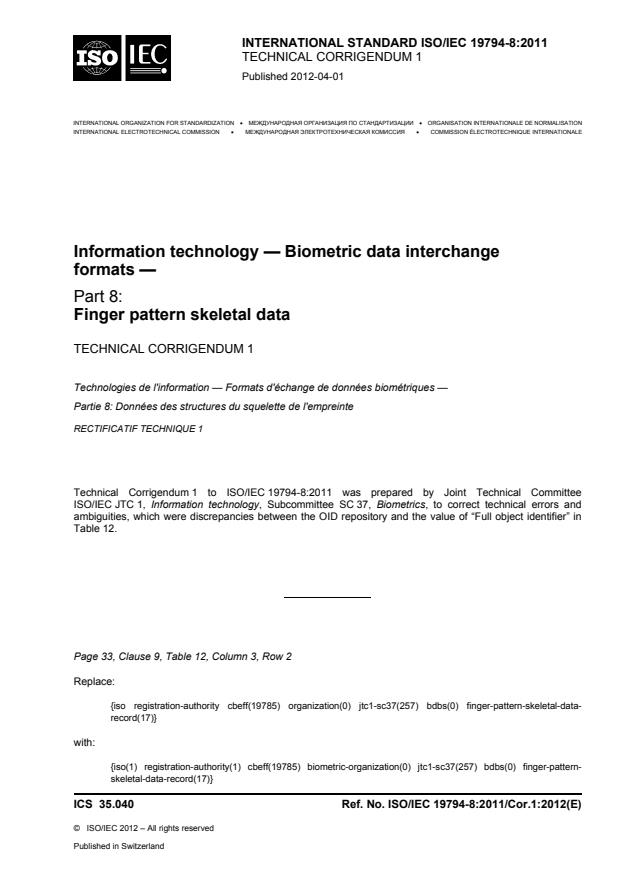
ISO/IEC 19794-8:2011/Cor 1:2012 is a technical corrigendum to the ISO/IEC 19794-8:2011 standard, part of the ISO/IEC 19794 family that addresses biometric data interchange formats. Part 8 covers finger pattern skeletal data; this corrigendum (published 2012-04-01) corrects technical errors and ambiguities related to object identifier (OID) values used in the standard’s metadata tables to align the standard with the CBEFF OID repository.
Key topics
- Scope of the corrigendum: Corrections to the “Full object identifier” entries in Table 12 (Clause 9, Page 33) to resolve discrepancies between the OID repository and the published values.
- Specific corrections made:
- Finger-pattern-skeletal-data-record OID changed from: {iso registration-authority cbeff(19785) organization(0) jtc1-sc37(257) bdbs(0) finger-pattern-skeletal-data-record(17)} to: {iso(1) registration-authority(1) cbeff(19785) biometric-organization(0) jtc1-sc37(257) bdbs(0) finger-pattern-skeletal-data-record(17)}
- Similar replacements applied to the finger-pattern-skeletal-data-card-normal(18) and finger-pattern-skeletal-data-card-compact(19) OIDs, introducing the canonical iso(1) and registration-authority(1) labels and replacing “organization(0)” with “biometric-organization(0)”.
- Standards governance: Prepared by ISO/IEC JTC 1/SC 37 (Biometrics) to ensure consistent OID usage across biometric data interchange specifications.
- Interoperability focus: Ensures consistent identification of biometric data structures in CBEFF (Common Biometric Exchange Formats Framework) contexts.
Applications
- Biometric system implementers and vendors use the corrigendum to ensure their finger-pattern skeletal data records and card encodings reference the correct OIDs, maintaining compatibility with other systems and databases.
- System integrators and software developers rely on the corrected identifiers when building or parsing CBEFF-compliant biometric containers and templates.
- Certification bodies and procurement teams reference the corrected standard when validating compliance and interoperability of fingerprint-skeletal-data solutions.
- Researchers and standards specialists use the document to track stable, authoritative OID assignments for biometric data exchange.
Related standards
- ISO/IEC 19794 series - biometric data interchange formats (other parts address facial, iris, fingerprint minutiae, etc.)
- CBEFF (Common Biometric Exchange Formats Framework) - OID and container conventions referenced by this corrigendum
This corrigendum is essential for anyone implementing or certifying ISO/IEC 19794-8-based finger pattern skeletal data to ensure accurate OID mapping and reliable interoperability in biometric ecosystems. Keywords: ISO/IEC 19794-8, biometric data interchange, finger pattern skeletal data, CBEFF, OID, technical corrigendum, JTC 1 SC 37, interoperability.
Relations
- Effective Date
- 11-Dec-2021
Get Certified
Connect with accredited certification bodies for this standard

BSI Group
BSI (British Standards Institution) is the business standards company that helps organizations make excellence a habit.

NYCE
Mexican standards and certification body.
Sponsored listings
Frequently Asked Questions
ISO/IEC 19794-8:2011/Cor 1:2012 is a standard published by the International Organization for Standardization (ISO). Its full title is "Information technology — Biometric data interchange formats — Part 8: Finger pattern skeletal data — Technical Corrigendum 1". This standard covers: Information technology — Biometric data interchange formats — Part 8: Finger pattern skeletal data — Technical Corrigendum 1
Information technology — Biometric data interchange formats — Part 8: Finger pattern skeletal data — Technical Corrigendum 1
ISO/IEC 19794-8:2011/Cor 1:2012 is classified under the following ICS (International Classification for Standards) categories: 35.040 - Information coding; 35.240.15 - Identification cards. Chip cards. Biometrics. The ICS classification helps identify the subject area and facilitates finding related standards.
ISO/IEC 19794-8:2011/Cor 1:2012 has the following relationships with other standards: It is inter standard links to ISO/IEC 19794-8:2011. Understanding these relationships helps ensure you are using the most current and applicable version of the standard.
ISO/IEC 19794-8:2011/Cor 1:2012 is available in PDF format for immediate download after purchase. The document can be added to your cart and obtained through the secure checkout process. Digital delivery ensures instant access to the complete standard document.
Standards Content (Sample)
INTERNATIONAL STANDARD ISO/IEC 19794-8:2011
TECHNICAL CORRIGENDUM 1
Published 2012-04-01
INTERNATIONAL ORGANIZATION FOR STANDARDIZATION МЕЖДУНАРОДНАЯ ОРГАНИЗАЦИЯ ПО СТАНДАРТИЗАЦИИ ORGANISATION INTERNATIONALE DE NORMALISATION
INTERNATIONAL ELECTROTECHNICAL COMMISSION МЕЖДУНАРОДНАЯ ЭЛЕКТРОТЕХНИЧЕСКАЯ КОМИССИЯ COMMISSION ÉLECTROTECHNIQUE INTERNATIONALE
Information technology — Biometric data interchange
formats —
Part 8:
Finger pattern skeletal data
TECHNICAL CORRIGENDUM 1
Technologies de l'information — Formats d'échange de données biométriques —
Partie 8: Données des structures du squelette de l'empreinte
RECTIFICATIF TECHNIQUE 1
Technical Corrigendum 1 to ISO/IEC 19794-8:2011 was prepared by Joint Technical Committee
ISO/IEC JTC 1, Information technology, Subcommittee SC 37, Biometrics, to correct technical errors and
ambiguities, which were discrepancies between the OID repository and the value of “Full object identifier” in
Table 12.
Page 33, Clause 9, Table 12, Column 3, Row 2
Replace:
{iso registration-authority cbeff(19785) organization(0) jtc1-sc37(257) bdbs(0) finger-pattern-s
...