

ISO 6964:2019
(Main)Polyolefin pipes and fittings — Determination of carbon black content by calcination and pyrolysis — Test method
General Information
- Abstract
This document specifies test methods for the determination of the carbon black content of polyolefin compositions used in particular for the manufacture of pipes and fittings, and provides a basic specification for polyethylene pipes and fittings. This document applies equally to the material for manufacture and to any material taken from a pipe or fitting.
- Status
- Published
- Publication Date
- 26-Feb-2019
- Technical Committee
- ISO/TC 138/SC 5 - General properties of pipes, fittings and valves of plastic materials and their accessories -- Test methods and basic specifications
- Drafting Committee
- ISO/TC 138/SC 5/WG 5 - Polyolefin pipes
- Current Stage
- 9092 - International Standard to be revised
- Start Date
- 24-Oct-2024
- Completion Date
- 29-Aug-2026
Buy Documents



ISO 6964:2019 - Polyolefin pipes and fittings -- Determination of carbon black content by calcination and pyrolysis -- Test method
ISO 6964:2019 - Polyolefin pipes and fittings — Determination of carbon black content by calcination and pyrolysis — Test method/27/2019
Overview
ISO 6964:2019 specifies standardized test methods for determining carbon black content in polyolefin compositions used for pipes and fittings, and provides a basic specification framework for polyethylene pipes and fittings. The standard applies both to raw material intended for manufacture and to samples taken from finished pipes or fittings. Carbon black content is measured by a combination of pyrolysis and calcination and reported as a percentage by mass.
Key topics and technical requirements
- Test principles: Carbon black content is calculated from the difference in mass before and after pyrolysis (inert atmosphere) and calcination (oxidizing atmosphere).
- Three validated methods:
- Method A - Electrical tube furnace: Pyrolysis at (550 ± 50) °C in nitrogen for 45 min followed by calcination at (900 ± 25) °C.
- Method B - Muffle furnace:
- B1 (conventional): Pyrolysis ramp from (325 ± 25) °C to (550 ± 25) °C at 15 °C/min, hold at 550 °C for (10 ± 0,5) min, then calcination at 900 °C.
- B2 (microwave): Pyrolysis at (520 ± 25) °C for (10 ± 0,5) min, then calcination at 900 °C.
- Method C - Thermogravimetric analyzer (TGA): Controlled-rate pyrolysis under inert gas up to 800 °C followed by oxidation at 900 °C.
- Sampling and repeatability: Three test portions are taken, and the arithmetic mean is reported rounded to two significant figures.
- Important notes:
- Carbon black decomposes in air/oxygen from about 500 °C - loss between 500 °C and 700 °C corresponds to carbon black decomposition.
- Presence of inorganic additives (e.g., calcium carbonate) can increase ash and lead to overestimation of carbon black; ash yields >1% may require further investigation.
- Reference standard: ISO 11358-1 (Thermogravimetry of polymers) is cited for TGA principles.
Applications
- Quality control and incoming material inspection for polyolefin and polyethylene pipe manufacturers.
- Product specification and certification to demonstrate compliance with material composition requirements.
- Failure analysis and forensic testing where carbon black content affects UV protection, thermal properties, or mechanical performance.
- R&D and formulation control for compounding and additive optimization in pipe grades.
Who uses this standard
- Pipe and fitting manufacturers, compounders, and converters
- Accredited testing laboratories and QA/QC personnel
- Materials engineers and polymer technologists
- Regulatory and standards bodies involved in plastic pipe safety and performance
Related standards
- ISO 11358-1 - Plastics - Thermogravimetry (TG) of polymers - Part 1: General principles
Keywords: ISO 6964:2019, carbon black content, polyolefin pipes, polyethylene pipes, calcination, pyrolysis, TGA, test method, pipe fittings, quality control.
Relations
- Effective Date
- 25-Aug-2026
- Effective Date
- 25-Aug-2026
- Effective Date
- 25-Aug-2026
- Effective Date
- 25-Aug-2026
- Effective Date
- 25-Aug-2026
- Effective Date
- 22-Jul-2026
- Referred By
EN 18035:2025 - Prestressing steels - Waxed and sheathed strands for construction applications - Effective Date
- 08-Jul-2026
- Effective Date
- 08-Apr-2026
- Effective Date
- 08-Apr-2026
- Effective Date
- 08-Apr-2026
- Effective Date
- 11-Mar-2026
- Effective Date
- 11-Mar-2026
- Effective Date
- 10-Nov-2012
Buy Documents
ISO 6964:2019 - Polyolefin pipes and fittings -- Determination of carbon black content by calcination and pyrolysis -- Test method
ISO 6964:2019 - Polyolefin pipes and fittings — Determination of carbon black content by calcination and pyrolysis — Test method/27/2019
Get Certified
Connect with accredited certification bodies for this standard

Institut za varilstvo d.o.o. (Welding Institute)
Slovenia's leading welding institute since 1952. ISO 3834, EN 1090, pressure equipment certification, NDT personnel, welder qualification. Only IIW Au
Sponsored listings
Frequently Asked Questions
ISO 6964:2019 is a standard published by the International Organization for Standardization (ISO). Its full title is "Polyolefin pipes and fittings — Determination of carbon black content by calcination and pyrolysis — Test method". This standard covers: This document specifies test methods for the determination of the carbon black content of polyolefin compositions used in particular for the manufacture of pipes and fittings, and provides a basic specification for polyethylene pipes and fittings. This document applies equally to the material for manufacture and to any material taken from a pipe or fitting.
This document specifies test methods for the determination of the carbon black content of polyolefin compositions used in particular for the manufacture of pipes and fittings, and provides a basic specification for polyethylene pipes and fittings. This document applies equally to the material for manufacture and to any material taken from a pipe or fitting.
ISO 6964:2019 is classified under the following ICS (International Classification for Standards) categories: 23.040.20 - Plastics pipes. The ICS classification helps identify the subject area and facilitates finding related standards.
ISO 6964:2019 has the following relationships with other standards: It is inter standard links to EN ISO 16486-1:2020, EN 15632-1:2022, EN ISO 18797-2:2021, EN ISO 16486-1:2023, EN 253:2019, EN 17878-1:2024, EN 18035:2025, EN 1555-1:2021, EN 12201-1:2024, EN 1555-1:2025, EN 17415-1:2020, EN 17414-1:2020, ISO 6964:1986. Understanding these relationships helps ensure you are using the most current and applicable version of the standard.
ISO 6964:2019 is available in PDF format for immediate download after purchase. The document can be added to your cart and obtained through the secure checkout process. Digital delivery ensures instant access to the complete standard document.
Standards Content (Sample)
SLOVENSKI STANDARD
01-julij-2021
Nadomešča:
SIST ISO 6964:1996
Poliolefinske cevi in fitingi - Določanje vsebnosti saj s kalcinacijo in pirolizo -
Preskusna metoda
Polyolefin pipes and fittings -- Determination of carbon black content by calcination and
pyrolysis -- Test method
Tubes et raccords en polyoléfines -- Détermination de la teneur en noir de carbone par
calcination et pyrolyse -- Méthode d'essai
Ta slovenski standard je istoveten z: ISO 6964:2019
ICS:
23.040.20 Cevi iz polimernih materialov Plastics pipes
2003-01.Slovenski inštitut za standardizacijo. Razmnoževanje celote ali delov tega standarda ni dovoljeno.
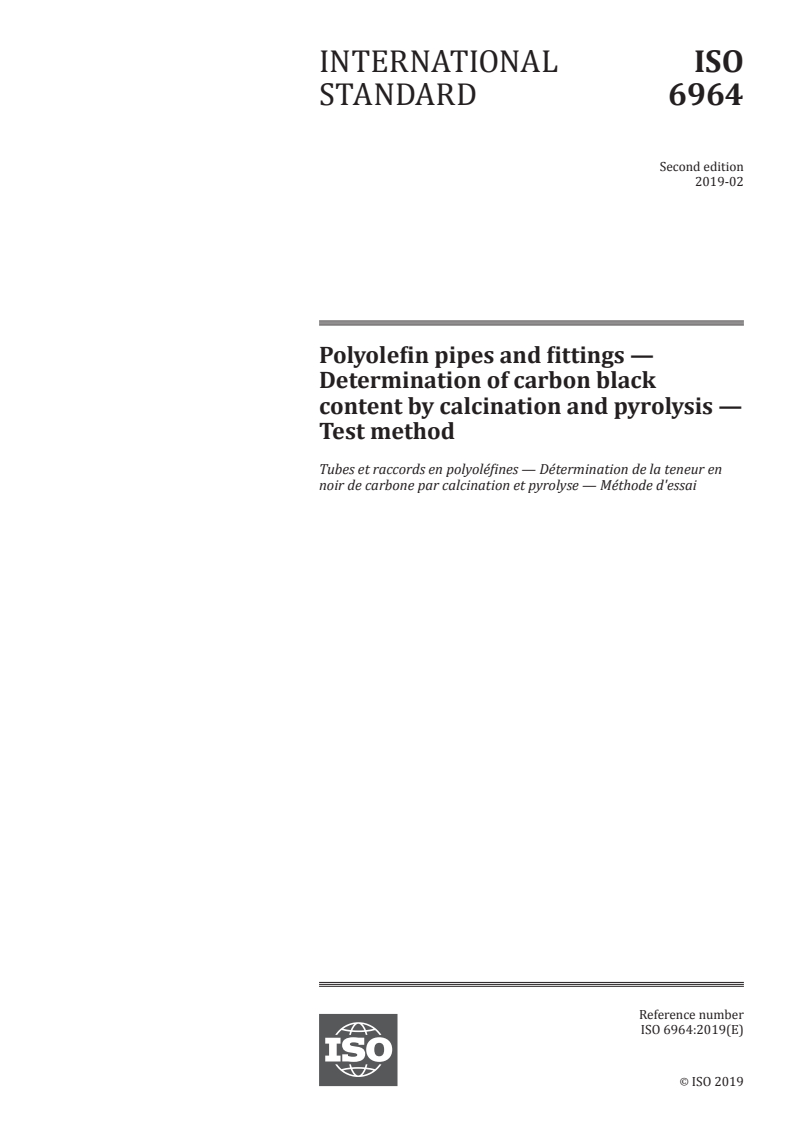
INTERNATIONAL ISO
STANDARD 6964
Second edition
2019-02
Polyolefin pipes and fittings —
Determination of carbon black
content by calcination and pyrolysis —
Test method
Tubes et raccords en polyoléfines — Détermination de la teneur en
noir de carbone par calcination et pyrolyse — Méthode d'essai
Reference number
©
ISO 2019
© ISO 2019
All rights reserved. Unless otherwise specified, or required in the context of its implementation, no part of this publication may
be reproduced or utilized otherwise in any form or by any means, electronic or mechanical, including photocopying, or posting
on the internet or an intranet, without prior written permission. Permission can be requested from either ISO at the address
below or ISO’s member body in the country of the requester.
ISO copyright office
CP 401 • Ch. de Blandonnet 8
CH-1214 Vernier, Geneva
Phone: +41 22 749 01 11
Fax: +41 22 749 09 47
Email: copyright@iso.org
Website: www.iso.org
Published in Switzerland
ii © ISO 2019 – All rights reserved
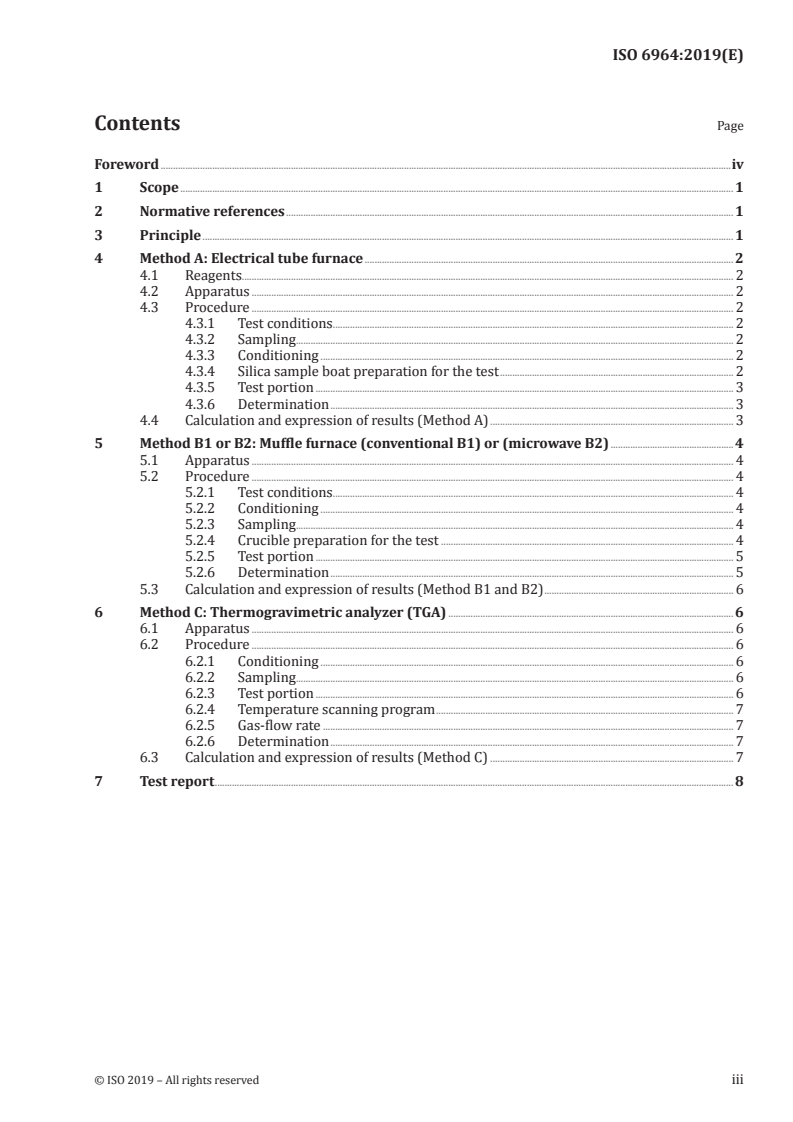
Contents Page
Foreword .iv
1 Scope . 1
2 Normative references . 1
3 Principle . 1
4 Method A: Electrical tube furnace . 2
4.1 Reagents. 2
4.2 Apparatus . 2
4.3 Procedure . 2
4.3.1 Test conditions. 2
4.3.2 Sampling. 2
4.3.3 Conditioning . 2
4.3.4 Silica sample boat preparation for the test . 2
4.3.5 Test portion . 3
4.3.6 Determination . 3
4.4 Calculation and expression of results (Method A) . 3
5 Method B1 or B2: Muffle furnace (conventional B1) or (microwave B2) .4
5.1 Apparatus . 4
5.2 Procedure . 4
5.2.1 Test conditions. 4
5.2.2 Conditioning . 4
5.2.3 Sampling. 4
5.2.4 Crucible preparation for the test . 4
5.2.5 Test portion . 5
5.2.6 Determination . 5
5.3 Calculation and expression of results (Method B1 and B2) . 6
6 Method C: Thermogravimetric analyzer (TGA) .6
6.1 Apparatus . 6
6.2 Procedure . 6
6.2.1 Conditioning . 6
6.2.2 Sampling. 6
6.2.3 Test portion . 6
6.2.4 Temperature scanning program . 7
6.2.5 Gas-flow rate . 7
6.2.6 Determination . 7
6.3 Calculation and expression of results (Method C) . 7
7 Test report .8
Foreword
ISO (the International Organization for Standardization) is a worldwide federation of national standards
bodies (ISO member bodies). The work of preparing International Standards is normally carried out
through ISO technical committees. Each member body interested in a subject for which a technical
committee has been established has the right to be represented on that committee. International
organizations, governmental and non-governmental, in liaison with ISO, also take part in the work.
ISO collaborates closely with the International Electrotechnical Commission (IEC) on all matters of
electrotechnical standardization.
The procedures used to develop this document and those intended for its further maintenance are
described in the ISO/IEC Directives, Part 1. In particular, the different approval criteria needed for the
different types of ISO documents should be noted. This document was drafted in accordance with the
editorial rules of the ISO/IEC Directives, Part 2 (see www .iso .org/directives).
Attention is drawn to the possibility that some of the elements of this document may be the subject of
patent rights. ISO shall not be held responsible for identifying any or all such patent rights. Details of
any patent rights identified during the development of the document will be in the Introduction and/or
on the ISO list of patent declarations received (see www .iso .org/patents).
Any trade name used in this document is information given for the convenience of users and does not
constitute an endorsement.
For an explanation of the voluntary nature of standards, the meaning of ISO specific terms and
expressions related to conformity assessment, as well as information about ISO's adherence to the
World Trade Organization (WTO) principles in the Technical Barriers to Trade (TBT) see www .iso
.org/iso/foreword .html.
This document was prepared by Technical Committee ISO/TC 138, Plastics pipes, fittings and valves
for the transport of fluids, Subcommittee SC 5, General properties of pipes, fittings and valves of plastic
materials and their accessories — Test methods and basic specifications.
This second edition cancels and replaces the first edition (ISO 6964:1986), which has been technically
revised. The main changes compared with the last edition are the following:
— Conventional and microwave muffle furnace test methods, and a thermogravimetric analyzer (TGA)
test method have been added.
Any feedback or questions on this document should be directed to the user’s national standards body. A
complete listing of these bodies can be found at www .iso .org/members .html.
iv © ISO 2019 – All rights reserved
INTERNATIONAL STANDARD ISO 6964:2019(E)
Polyolefin pipes and fittings — Determination of carbon
black content by calcination and pyrolysis — Test method
1 Scope
This document specifies test methods for the determination of the carbon black content of polyolefin
compositions used in particular for the manufacture of pipes and fittings, and provides a basic
specification for polyethylene pipes and fittings.
This document applies equally to the material for manufacture and to any material taken from a pipe or
fitting.
2 Normative references
The following documents are referred to in the text in such a way that some or all of their content
constitutes requirements of this document. For dated references, only the edition cited applies. For
undated references, the latest edition of the referenced document (including any amendments) applies.
ISO 11358-1, Plastics — Thermogravimetry (TG) of polymers — Part 1: General principles
3 Principle
It is possible to determine the carbon black content of polyolefin compositions by one of the following
three methods:
a) Pyrolysis of the sample at (550 ± 50) °C in a stream of nitrogen for 45 min followed by calcination at
(900 ± 25) °C, by using an electrical tube furnace (Method A).
b) Pyrolysis of the sample in a quartz crystal crucible with lid, by using a muffle furnace. According to
the type of muffle furnace used there are two different procedures:
1) Conventional muffle furnace (Method B1): pyrolysis from (325 ± 25) °C to (550 ± 25) °C at
15 °C/min and at (550 ± 25) °C for (10 ± 0,5) min followed by calcination at (900 ± 25) °C.
2) Microwave muffle furnace (Method B2): pyrolysis at (520 ± 25) °C for (10 ± 0,5) min followed
by calcination at (900 ± 25) °C.
c) Pyrolysis of the sample at a constant rate in a thermogravimetric analyzer (TGA) under inert
atmosphere at 800 °C followed by calcination under oxidizing atmosphere at 900 °C (Method C).
NOTE 1 Carbon black is decomposed from 500 °C in air or oxygen. Therefore, the loss observed between
500 °C and 700 °C in air or oxygen corresponds to the overall decomposition of the carbon black.
NOTE 2 If the composition contains, in addition to the carbon black, additives likely to decompose at 900 °C,
for example ingredients such as calcium carbonate, the calculation can lead to an over-estimation of the carbon
black content. If the ash yield is more than 1 %, further investigation can be required.
Calculate the carbon black content from the difference in mass before and after calcination and
pyrolysis.
4 Method A: Electrical tube furnace
4.1 Reagents
4.1.1 Dry nitrogen, having an oxygen content less than 20 ppm, under pressure in a steel cylinder
provided with a pressure-reducing valve and flow meter.
NOTE If required, the nitrogen can be purified by bubbling the gas through a pyrogallol solution or by
passing it over heated copper tinsel, foil, wire or turnings or by passing it through a gas purifier prior to passing
into the furnace.
4.2 Apparatus
4.2.1 Silica combustion sample boat, with a sleeve of 50 mm to 60 mm long.
4.2.2 Electric tube furnace, fitted with a device to allow the sample boat to be inserted and
withdrawn. The tube is fitted with nozzles to admit the nitrogen and to evacuate the fumes. A diaphragm
closed by means of a glass-wool bung placed behind the entry nozzle ensures that the nitrogen stream is
distributed uniformly.
The minimum length of the electric tube furnace should be ≥ 3 times the length of the sample boat, and
the minimum length of the quartz tube should be ≥ 7 times the length of the sample boat.
4.2.3 Desiccator, capable of holding the silica sample boat (4.2.1).
4.2.4 Balance, with an accuracy of ± 0,1 mg.
4.2.5 Timer, with an accuracy of
...
INTERNATIONAL ISO
STANDARD 6964
Second edition
2019-02
Polyolefin pipes and fittings —
Determination of carbon black
content by calcination and pyrolysis —
Test method
Tubes et raccords en polyoléfines — Détermination de la teneur en
noir de carbone par calcination et pyrolyse — Méthode d'essai
Reference number
©
ISO 2019
© ISO 2019
All rights reserved. Unless otherwise specified, or required in the context of its implementation, no part of this publication may
be reproduced or utilized otherwise in any form or by any means, electronic or mechanical, including photocopying, or posting
on the internet or an intranet, without prior written permission. Permission can be requested from either ISO at the address
below or ISO’s member body in the country of the requester.
ISO copyright office
CP 401 • Ch. de Blandonnet 8
CH-1214 Vernier, Geneva
Phone: +41 22 749 01 11
Fax: +41 22 749 09 47
Email: copyright@iso.org
Website: www.iso.org
Published in Switzerland
ii © ISO 2019 – All rights reserved
Contents Page
Foreword .iv
1 Scope . 1
2 Normative references . 1
3 Principle . 1
4 Method A: Electrical tube furnace . 2
4.1 Reagents. 2
4.2 Apparatus . 2
4.3 Procedure . 2
4.3.1 Test conditions. 2
4.3.2 Sampling. 2
4.3.3 Conditioning . 2
4.3.4 Silica sample boat preparation for the test . 2
4.3.5 Test portion . 3
4.3.6 Determination . 3
4.4 Calculation and expression of results (Method A) . 3
5 Method B1 or B2: Muffle furnace (conventional B1) or (microwave B2) .4
5.1 Apparatus . 4
5.2 Procedure . 4
5.2.1 Test conditions. 4
5.2.2 Conditioning . 4
5.2.3 Sampling. 4
5.2.4 Crucible preparation for the test . 4
5.2.5 Test portion . 5
5.2.6 Determination . 5
5.3 Calculation and expression of results (Method B1 and B2) . 6
6 Method C: Thermogravimetric analyzer (TGA) .6
6.1 Apparatus . 6
6.2 Procedure . 6
6.2.1 Conditioning . 6
6.2.2 Sampling. 6
6.2.3 Test portion . 6
6.2.4 Temperature scanning program . 7
6.2.5 Gas-flow rate . 7
6.2.6 Determination . 7
6.3 Calculation and expression of results (Method C) . 7
7 Test report .8
Foreword
ISO (the International Organization for Standardization) is a worldwide federation of national standards
bodies (ISO member bodies). The work of preparing International Standards is normally carried out
through ISO technical committees. Each member body interested in a subject for which a technical
committee has been established has the right to be represented on that committee. International
organizations, governmental and non-governmental, in liaison with ISO, also take part in the work.
ISO collaborates closely with the International Electrotechnical Commission (IEC) on all matters of
electrotechnical standardization.
The procedures used to develop this document and those intended for its further maintenance are
described in the ISO/IEC Directives, Part 1. In particular, the different approval criteria needed for the
different types of ISO documents should be noted. This document was drafted in accordance with the
editorial rules of the ISO/IEC Directives, Part 2 (see www .iso .org/directives).
Attention is drawn to the possibility that some of the elements of this document may be the subject of
patent rights. ISO shall not be held responsible for identifying any or all such patent rights. Details of
any patent rights identified during the development of the document will be in the Introduction and/or
on the ISO list of patent declarations received (see www .iso .org/patents).
Any trade name used in this document is information given for the convenience of users and does not
constitute an endorsement.
For an explanation of the voluntary nature of standards, the meaning of ISO specific terms and
expressions related to conformity assessment, as well as information about ISO's adherence to the
World Trade Organization (WTO) principles in the Technical Barriers to Trade (TBT) see www .iso
.org/iso/foreword .html.
This document was prepared by Technical Committee ISO/TC 138, Plastics pipes, fittings and valves
for the transport of fluids, Subcommittee SC 5, General properties of pipes, fittings and valves of plastic
materials and their accessories — Test methods and basic specifications.
This second edition cancels and replaces the first edition (ISO 6964:1986), which has been technically
revised. The main changes compared with the last edition are the following:
— Conventional and microwave muffle furnace test methods, and a thermogravimetric analyzer (TGA)
test method have been added.
Any feedback or questions on this document should be directed to the user’s national standards body. A
complete listing of these bodies can be found at www .iso .org/members .html.
iv © ISO 2019 – All rights reserved
INTERNATIONAL STANDARD ISO 6964:2019(E)
Polyolefin pipes and fittings — Determination of carbon
black content by calcination and pyrolysis — Test method
1 Scope
This document specifies test methods for the determination of the carbon black content of polyolefin
compositions used in particular for the manufacture of pipes and fittings, and provides a basic
specification for polyethylene pipes and fittings.
This document applies equally to the material for manufacture and to any material taken from a pipe or
fitting.
2 Normative references
The following documents are referred to in the text in such a way that some or all of their content
constitutes requirements of this document. For dated references, only the edition cited applies. For
undated references, the latest edition of the referenced document (including any amendments) applies.
ISO 11358-1, Plastics — Thermogravimetry (TG) of polymers — Part 1: General principles
3 Principle
It is possible to determine the carbon black content of polyolefin compositions by one of the following
three methods:
a) Pyrolysis of the sample at (550 ± 50) °C in a stream of nitrogen for 45 min followed by calcination at
(900 ± 25) °C, by using an electrical tube furnace (Method A).
b) Pyrolysis of the sample in a quartz crystal crucible with lid, by using a muffle furnace. According to
the type of muffle furnace used there are two different procedures:
1) Conventional muffle furnace (Method B1): pyrolysis from (325 ± 25) °C to (550 ± 25) °C at
15 °C/min and at (550 ± 25) °C for (10 ± 0,5) min followed by calcination at (900 ± 25) °C.
2) Microwave muffle furnace (Method B2): pyrolysis at (520 ± 25) °C for (10 ± 0,5) min followed
by calcination at (900 ± 25) °C.
c) Pyrolysis of the sample at a constant rate in a thermogravimetric analyzer (TGA) under inert
atmosphere at 800 °C followed by calcination under oxidizing atmosphere at 900 °C (Method C).
NOTE 1 Carbon black is decomposed from 500 °C in air or oxygen. Therefore, the loss observed between
500 °C and 700 °C in air or oxygen corresponds to the overall decomposition of the carbon black.
NOTE 2 If the composition contains, in addition to the carbon black, additives likely to decompose at 900 °C,
for example ingredients such as calcium carbonate, the calculation can lead to an over-estimation of the carbon
black content. If the ash yield is more than 1 %, further investigation can be required.
Calculate the carbon black content from the difference in mass before and after calcination and
pyrolysis.
4 Method A: Electrical tube furnace
4.1 Reagents
4.1.1 Dry nitrogen, having an oxygen content less than 20 ppm, under pressure in a steel cylinder
provided with a pressure-reducing valve and flow meter.
NOTE If required, the nitrogen can be purified by bubbling the gas through a pyrogallol solution or by
passing it over heated copper tinsel, foil, wire or turnings or by passing it through a gas purifier prior to passing
into the furnace.
4.2 Apparatus
4.2.1 Silica combustion sample boat, with a sleeve of 50 mm to 60 mm long.
4.2.2 Electric tube furnace, fitted with a device to allow the sample boat to be inserted and
withdrawn. The tube is fitted with nozzles to admit the nitrogen and to evacuate the fumes. A diaphragm
closed by means of a glass-wool bung placed behind the entry nozzle ensures that the nitrogen stream is
distributed uniformly.
The minimum length of the electric tube furnace should be ≥ 3 times the length of the sample boat, and
the minimum length of the quartz tube should be ≥ 7 times the length of the sample boat.
4.2.3 Desiccator, capable of holding the silica sample boat (4.2.1).
4.2.4 Balance, with an accuracy of ± 0,1 mg.
4.2.5 Timer, with an accuracy of ± 1 s.
4.3 Procedure
4.3.1 Test conditions
Determination of mass shall be carried out in a room at standard temperature (23 ± 2) °C.
4.3.2 Sampling
Test specimen may be in the form of pellet or finished product. In the last case, the specimen shall be
reduced to small fragments.
4.3.3 Conditioning
The test sample shall be conditioned for 24 h at (23 ± 2) °C before preparation.
4.3.4 Silica sample boat preparation for the test
Take the silica sample boat which s
...
INTERNATIONAL ISO
STANDARD 6964
Second edition
2019-02
Polyolefin pipes and fittings —
Determination of carbon black
content by calcination and pyrolysis —
Test method
Tubes et raccords en polyoléfines — Détermination de la teneur en
noir de carbone par calcination et pyrolyse — Méthode d'essai
Reference number
©
ISO 2019
© ISO 2019
All rights reserved. Unless otherwise specified, or required in the context of its implementation, no part of this publication may
be reproduced or utilized otherwise in any form or by any means, electronic or mechanical, including photocopying, or posting
on the internet or an intranet, without prior written permission. Permission can be requested from either ISO at the address
below or ISO’s member body in the country of the requester.
ISO copyright office
CP 401 • Ch. de Blandonnet 8
CH-1214 Vernier, Geneva
Phone: +41 22 749 01 11
Fax: +41 22 749 09 47
Email: copyright@iso.org
Website: www.iso.org
Published in Switzerland
ii © ISO 2019 – All rights reserved
Contents Page
Foreword .iv
1 Scope . 1
2 Normative references . 1
3 Principle . 1
4 Method A: Electrical tube furnace . 2
4.1 Reagents. 2
4.2 Apparatus . 2
4.3 Procedure . 2
4.3.1 Test conditions. 2
4.3.2 Sampling. 2
4.3.3 Conditioning . 2
4.3.4 Silica sample boat preparation for the test . 2
4.3.5 Test portion . 3
4.3.6 Determination . 3
4.4 Calculation and expression of results (Method A) . 3
5 Method B1 or B2: Muffle furnace (conventional B1) or (microwave B2) .4
5.1 Apparatus . 4
5.2 Procedure . 4
5.2.1 Test conditions. 4
5.2.2 Conditioning . 4
5.2.3 Sampling. 4
5.2.4 Crucible preparation for the test . 4
5.2.5 Test portion . 5
5.2.6 Determination . 5
5.3 Calculation and expression of results (Method B1 and B2) . 6
6 Method C: Thermogravimetric analyzer (TGA) .6
6.1 Apparatus . 6
6.2 Procedure . 6
6.2.1 Conditioning . 6
6.2.2 Sampling. 6
6.2.3 Test portion . 6
6.2.4 Temperature scanning program . 7
6.2.5 Gas-flow rate . 7
6.2.6 Determination . 7
6.3 Calculation and expression of results (Method C) . 7
7 Test report .8
Foreword
ISO (the International Organization for Standardization) is a worldwide federation of national standards
bodies (ISO member bodies). The work of preparing International Standards is normally carried out
through ISO technical committees. Each member body interested in a subject for which a technical
committee has been established has the right to be represented on that committee. International
organizations, governmental and non-governmental, in liaison with ISO, also take part in the work.
ISO collaborates closely with the International Electrotechnical Commission (IEC) on all matters of
electrotechnical standardization.
The procedures used to develop this document and those intended for its further maintenance are
described in the ISO/IEC Directives, Part 1. In particular, the different approval criteria needed for the
different types of ISO documents should be noted. This document was drafted in accordance with the
editorial rules of the ISO/IEC Directives, Part 2 (see www .iso .org/directives).
Attention is drawn to the possibility that some of the elements of this document may be the subject of
patent rights. ISO shall not be held responsible for identifying any or all such patent rights. Details of
any patent rights identified during the development of the document will be in the Introduction and/or
on the ISO list of patent declarations received (see www .iso .org/patents).
Any trade name used in this document is information given for the convenience of users and does not
constitute an endorsement.
For an explanation of the voluntary nature of standards, the meaning of ISO specific terms and
expressions related to conformity assessment, as well as information about ISO's adherence to the
World Trade Organization (WTO) principles in the Technical Barriers to Trade (TBT) see www .iso
.org/iso/foreword .html.
This document was prepared by Technical Committee ISO/TC 138, Plastics pipes, fittings and valves
for the transport of fluids, Subcommittee SC 5, General properties of pipes, fittings and valves of plastic
materials and their accessories — Test methods and basic specifications.
This second edition cancels and replaces the first edition (ISO 6964:1986), which has been technically
revised. The main changes compared with the last edition are the following:
— Conventional and microwave muffle furnace test methods, and a thermogravimetric analyzer (TGA)
test method have been added.
Any feedback or questions on this document should be directed to the user’s national standards body. A
complete listing of these bodies can be found at www .iso .org/members .html.
iv © ISO 2019 – All rights reserved
INTERNATIONAL STANDARD ISO 6964:2019(E)
Polyolefin pipes and fittings — Determination of carbon
black content by calcination and pyrolysis — Test method
1 Scope
This document specifies test methods for the determination of the carbon black content of polyolefin
compositions used in particular for the manufacture of pipes and fittings, and provides a basic
specification for polyethylene pipes and fittings.
This document applies equally to the material for manufacture and to any material taken from a pipe or
fitting.
2 Normative references
The following documents are referred to in the text in such a way that some or all of their content
constitutes requirements of this document. For dated references, only the edition cited applies. For
undated references, the latest edition of the referenced document (including any amendments) applies.
ISO 11358-1, Plastics — Thermogravimetry (TG) of polymers — Part 1: General principles
3 Principle
It is possible to determine the carbon black content of polyolefin compositions by one of the following
three methods:
a) Pyrolysis of the sample at (550 ± 50) °C in a stream of nitrogen for 45 min followed by calcination at
(900 ± 25) °C, by using an electrical tube furnace (Method A).
b) Pyrolysis of the sample in a quartz crystal crucible with lid, by using a muffle furnace. According to
the type of muffle furnace used there are two different procedures:
1) Conventional muffle furnace (Method B1): pyrolysis from (325 ± 25) °C to (550 ± 25) °C at
15 °C/min and at (550 ± 25) °C for (10 ± 0,5) min followed by calcination at (900 ± 25) °C.
2) Microwave muffle furnace (Method B2): pyrolysis at (520 ± 25) °C for (10 ± 0,5) min followed
by calcination at (900 ± 25) °C.
c) Pyrolysis of the sample at a constant rate in a thermogravimetric analyzer (TGA) under inert
atmosphere at 800 °C followed by calcination under oxidizing atmosphere at 900 °C (Method C).
NOTE 1 Carbon black is decomposed from 500 °C in air or oxygen. Therefore, the loss observed between
500 °C and 700 °C in air or oxygen corresponds to the overall decomposition of the carbon black.
NOTE 2 If the composition contains, in addition to the carbon black, additives likely to decompose at 900 °C,
for example ingredients such as calcium carbonate, the calculation can lead to an over-estimation of the carbon
black content. If the ash yield is more than 1 %, further investigation can be required.
Calculate the carbon black content from the difference in mass before and after calcination and
pyrolysis.
4 Method A: Electrical tube furnace
4.1 Reagents
4.1.1 Dry nitrogen, having an oxygen content less than 20 ppm, under pressure in a steel cylinder
provided with a pressure-reducing valve and flow meter.
NOTE If required, the nitrogen can be purified by bubbling the gas through a pyrogallol solution or by
passing it over heated copper tinsel, foil, wire or turnings or by passing it through a gas purifier prior to passing
into the furnace.
4.2 Apparatus
4.2.1 Silica combustion sample boat, with a sleeve of 50 mm to 60 mm long.
4.2.2 Electric tube furnace, fitted with a device to allow the sample boat to be inserted and
withdrawn. The tube is fitted with nozzles to admit the nitrogen and to evacuate the fumes. A diaphragm
closed by means of a glass-wool bung placed behind the entry nozzle ensures that the nitrogen stream is
distributed uniformly.
The minimum length of the electric tube furnace should be ≥ 3 times the length of the sample boat, and
the minimum length of the quartz tube should be ≥ 7 times the length of the sample boat.
4.2.3 Desiccator, capable of holding the silica sample boat (4.2.1).
4.2.4 Balance, with an accuracy of ± 0,1 mg.
4.2.5 Timer, with an accuracy of ± 1 s.
4.3 Procedure
4.3.1 Test conditions
Determination of mass shall be carried out in a room at standard temperature (23 ± 2) °C.
4.3.2 Sampling
Test specimen may be in the form of pellet or finished product. In the last case, the specimen shall be
reduced to small fragments.
4.3.3 Conditioning
The test sample shall be conditioned for 24 h at (23 ± 2) °C before preparation.
4.3.4 Silica sample boat preparation for the test
Take the silica sample boat which s
...