

ISO 62:2008
(Main)Plastics — Determination of water absorption
General Information
- Abstract
ISO 62:2008 describes a procedure for determining the moisture absorption properties in the “through-the-thickness” direction of flat or curved-form solid plastics. It also describes procedures for determining the amount of water absorbed by plastic specimens of defined dimensions, when immersed in water or when subjected to humid air under controlled conditions. The “through-the-thickness” moisture diffusion coefficient can be determined for single-phase material by assuming Fickian diffusion behaviour with constant moisture absorption properties through the thickness of the test specimen. This model is valid for homogeneous materials and for reinforced polymer-matrix composites tested below their glass transition temperature. However, some two-phase matrices such as hardened epoxies may require a multi-phase absorption model which is not covered by this International Standard. The results obtained using the methods described in this International Standard are applicable to most plastics but are not applicable to cellular plastics, granulates or powders, which can show additional absorption and capillary effects. Plastics exposed to moisture under controlled conditions for defined periods of time provide relative comparisons between them.
- Status
- Published
- Publication Date
- 31-Jan-2008
- Technical Committee
- ISO/TC 61/SC 6 - Ageing, chemical and environmental resistance
- Drafting Committee
- ISO/TC 61/SC 6/WG 7 - Basic standards
- Current Stage
- 9060 - Close of review
- Completion Date
- 02-Sep-2031
Buy Documents

ISO 62:2008 - Plastics -- Determination of water absorption
ISO 62:2008 - Plastics — Determination of water absorption/1/2008

ISO 62:2008 - Plastiques -- Détermination de l'absorption d'eau
ISO 62:2008 - Plastiques — Détermination de l'absorption d'eau/1/2008
ISO 62:2008 - Plastics — Determination of water absorption/20/2010
Overview
ISO 62:2008 - Plastics - Determination of water absorption describes standardized test methods to measure how much water solid plastics absorb through their thickness. The standard covers procedures for immersion in water (ambient and boiling), exposure to controlled humidity, and measurement of water‑soluble matter lost. Results are reported as mass change (percentage) and, for homogeneous materials, can be used to calculate the through‑thickness moisture diffusion coefficient assuming Fickian diffusion.
Key topics and technical requirements
- Test principle: Water uptake determined by change in mass of defined test specimens after exposure; results expressed as percentage of initial mass.
- Test methods:
- Method 1 - immersion in distilled water at 23 °C (equilibrium moisture content).
- Method 2 - immersion in boiling distilled water.
- Method 3 - determination of water‑soluble matter lost.
- Method 4 - exposure to controlled humidity (50 % RH) at specified temperatures.
- Diffusion analysis: For single‑phase homogeneous plastics (and reinforced polymer‑matrix composites below Tg), the standard permits calculation of diffusion coefficient using Fick’s laws. Multi‑phase absorption behaviour (e.g., some hardened epoxies) is not covered.
- Specimens and preparation: Square plates (typically 1.0 mm thick), tubular sections, rod sections or cut specimens from finished products; at least three specimens per material. Surface cleaning, dimensional control and machining per ISO guidance are required.
- Apparatus & accuracy: Precision balance (±0.1 mg), ovens (50 ±2 °C or agreed temp), controlled humidity chambers and distilled water baths.
- Limitations: Not applicable to cellular plastics, granulates or powders (capillary effects). Results are comparative unless equilibrium moisture content is used for cross‑material comparisons.
Applications and users
- Quality control and batch comparison of thermoplastics and thermosets.
- Material selection for applications where moisture exposure affects dimensional stability, mechanical properties or electrical performance (automotive, aerospace, consumer goods, electronics).
- Research and development for diffusion modelling and lifetime prediction of polymer components.
- Typical users: materials engineers, polymer scientists, testing laboratories, product designers, and compliance teams requiring standardized water absorption testing.
Related standards
- ISO 175:1999 - Effects of immersion in liquid chemicals
- ISO 294‑3 - Injection moulding of test specimens (small plates)
- ISO 2818 - Preparation of test specimens by machining
ISO 62:2008 is essential when you need reproducible, comparable data on water uptake, moisture diffusion, and the effect of humidity on plastics performance.
Relations
- Effective Date
- 25-Aug-2026
- Effective Date
- 25-Aug-2026
- Effective Date
- 25-Aug-2026
- Effective Date
- 25-Aug-2026
- Effective Date
- 25-Aug-2026
- Effective Date
- 25-Aug-2026
- Effective Date
- 25-Aug-2026
- Effective Date
- 25-Aug-2026
- Effective Date
- 25-Aug-2026
- Effective Date
- 25-Aug-2026
- Effective Date
- 25-Aug-2026
- Effective Date
- 25-Aug-2026
- Effective Date
- 25-Aug-2026
- Effective Date
- 25-Aug-2026
- Referred By
EN ISO 291:2008 - Plastics - Standard atmospheres for conditioning and testing (ISO 291:2008) - Effective Date
- 25-Aug-2026
Buy Documents
ISO 62:2008 - Plastics -- Determination of water absorption
ISO 62:2008 - Plastics — Determination of water absorption/1/2008
ISO 62:2008 - Plastiques -- Détermination de l'absorption d'eau
ISO 62:2008 - Plastiques — Détermination de l'absorption d'eau/1/2008
ISO 62:2008 - Plastics — Determination of water absorption/20/2010
Get Certified
Connect with accredited certification bodies for this standard

DIN CERTCO
DIN Group product certification.

Smithers Quality Assessments
US management systems and product certification.
Sponsored listings
Frequently Asked Questions
ISO 62:2008 is a standard published by the International Organization for Standardization (ISO). Its full title is "Plastics — Determination of water absorption". This standard covers: ISO 62:2008 describes a procedure for determining the moisture absorption properties in the “through-the-thickness” direction of flat or curved-form solid plastics. It also describes procedures for determining the amount of water absorbed by plastic specimens of defined dimensions, when immersed in water or when subjected to humid air under controlled conditions. The “through-the-thickness” moisture diffusion coefficient can be determined for single-phase material by assuming Fickian diffusion behaviour with constant moisture absorption properties through the thickness of the test specimen. This model is valid for homogeneous materials and for reinforced polymer-matrix composites tested below their glass transition temperature. However, some two-phase matrices such as hardened epoxies may require a multi-phase absorption model which is not covered by this International Standard. The results obtained using the methods described in this International Standard are applicable to most plastics but are not applicable to cellular plastics, granulates or powders, which can show additional absorption and capillary effects. Plastics exposed to moisture under controlled conditions for defined periods of time provide relative comparisons between them.
ISO 62:2008 describes a procedure for determining the moisture absorption properties in the “through-the-thickness” direction of flat or curved-form solid plastics. It also describes procedures for determining the amount of water absorbed by plastic specimens of defined dimensions, when immersed in water or when subjected to humid air under controlled conditions. The “through-the-thickness” moisture diffusion coefficient can be determined for single-phase material by assuming Fickian diffusion behaviour with constant moisture absorption properties through the thickness of the test specimen. This model is valid for homogeneous materials and for reinforced polymer-matrix composites tested below their glass transition temperature. However, some two-phase matrices such as hardened epoxies may require a multi-phase absorption model which is not covered by this International Standard. The results obtained using the methods described in this International Standard are applicable to most plastics but are not applicable to cellular plastics, granulates or powders, which can show additional absorption and capillary effects. Plastics exposed to moisture under controlled conditions for defined periods of time provide relative comparisons between them.
ISO 62:2008 is classified under the following ICS (International Classification for Standards) categories: 83.080.01 - Plastics in general. The ICS classification helps identify the subject area and facilitates finding related standards.
ISO 62:2008 has the following relationships with other standards: It is inter standard links to EN ISO 8986-2:2009, EN ISO 7823-3:2021, EN ISO 24025-2:2020, EN ISO 17855-2:2024, EN ISO 16396-2:2022, EN ISO 16396-2:2017, EN ISO 10350-1:2017, EN ISO 3673-2:2012, EN ISO 10350-1:2008, EN ISO 11963:2012, EN ISO 20028-2:2017, EN ISO 19063-2:2020, EN ISO 10350-2:2011, EN ISO 20558-2:2019, EN ISO 291:2008. Understanding these relationships helps ensure you are using the most current and applicable version of the standard.
ISO 62:2008 is available in PDF format for immediate download after purchase. The document can be added to your cart and obtained through the secure checkout process. Digital delivery ensures instant access to the complete standard document.
Standards Content (Sample)
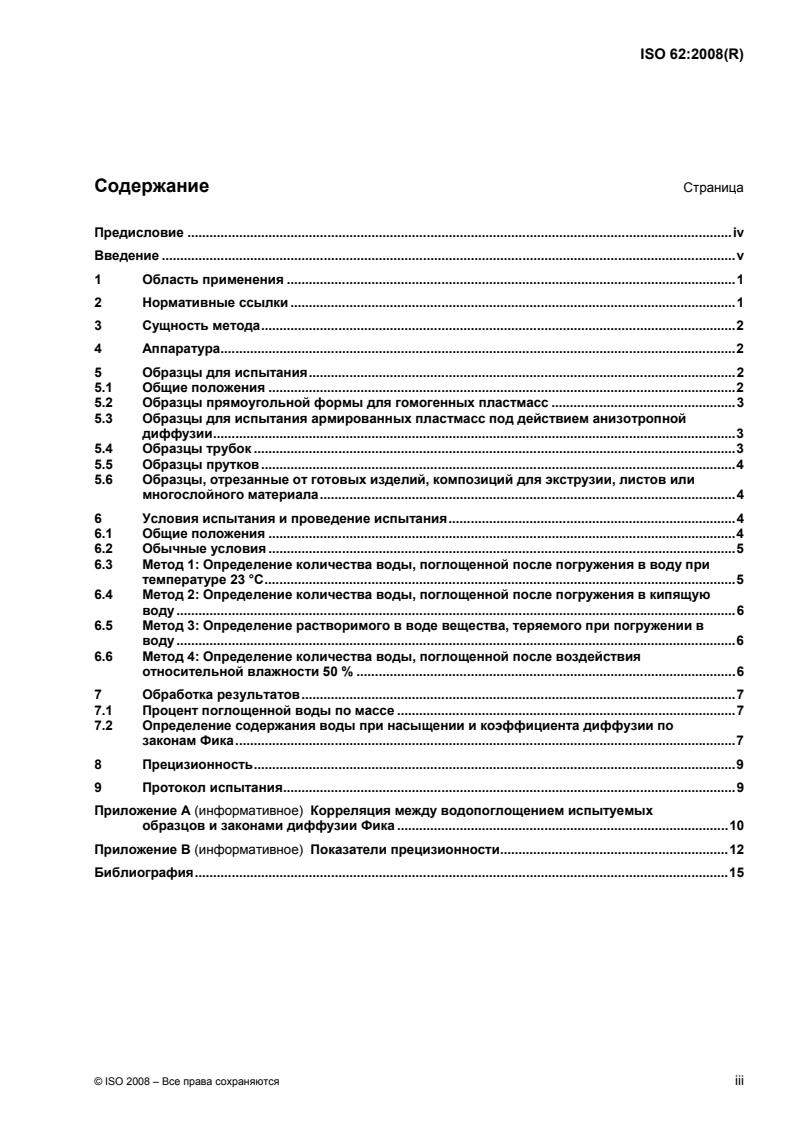
INTERNATIONAL ISO
STANDARD 62
Third edition
2008-02-15
Plastics — Determination of water
absorption
Plastiques — Détermination de l'absorption d'eau
Reference number
©
ISO 2008
PDF disclaimer
This PDF file may contain embedded typefaces. In accordance with Adobe's licensing policy, this file may be printed or viewed but
shall not be edited unless the typefaces which are embedded are licensed to and installed on the computer performing the editing. In
downloading this file, parties accept therein the responsibility of not infringing Adobe's licensing policy. The ISO Central Secretariat
accepts no liability in this area.
Adobe is a trademark of Adobe Systems Incorporated.
Details of the software products used to create this PDF file can be found in the General Info relative to the file; the PDF-creation
parameters were optimized for printing. Every care has been taken to ensure that the file is suitable for use by ISO member bodies. In
the unlikely event that a problem relating to it is found, please inform the Central Secretariat at the address given below.
© ISO 2008
All rights reserved. Unless otherwise specified, no part of this publication may be reproduced or utilized in any form or by any means,
electronic or mechanical, including photocopying and microfilm, without permission in writing from either ISO at the address below or
ISO's member body in the country of the requester.
ISO copyright office
Case postale 56 • CH-1211 Geneva 20
Tel. + 41 22 749 01 11
Fax + 41 22 749 09 47
E-mail copyright@iso.org
Web www.iso.org
Published in Switzerland
ii © ISO 2008 – All rights reserved
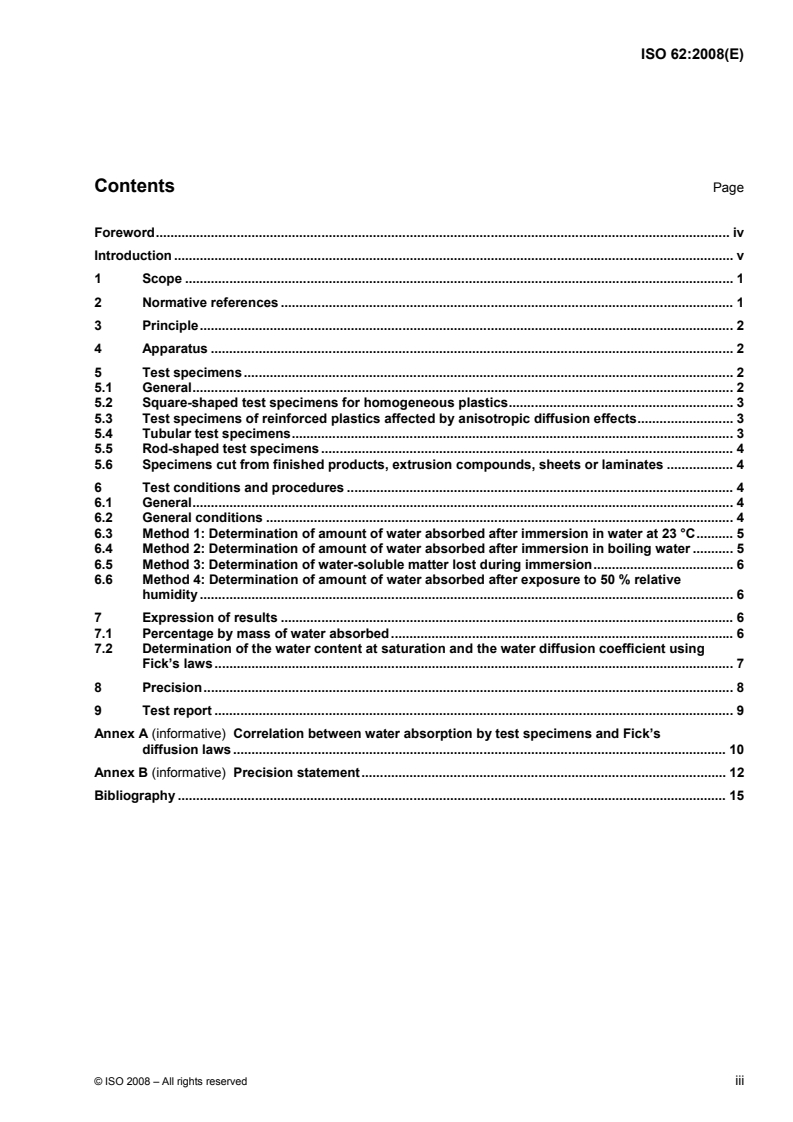
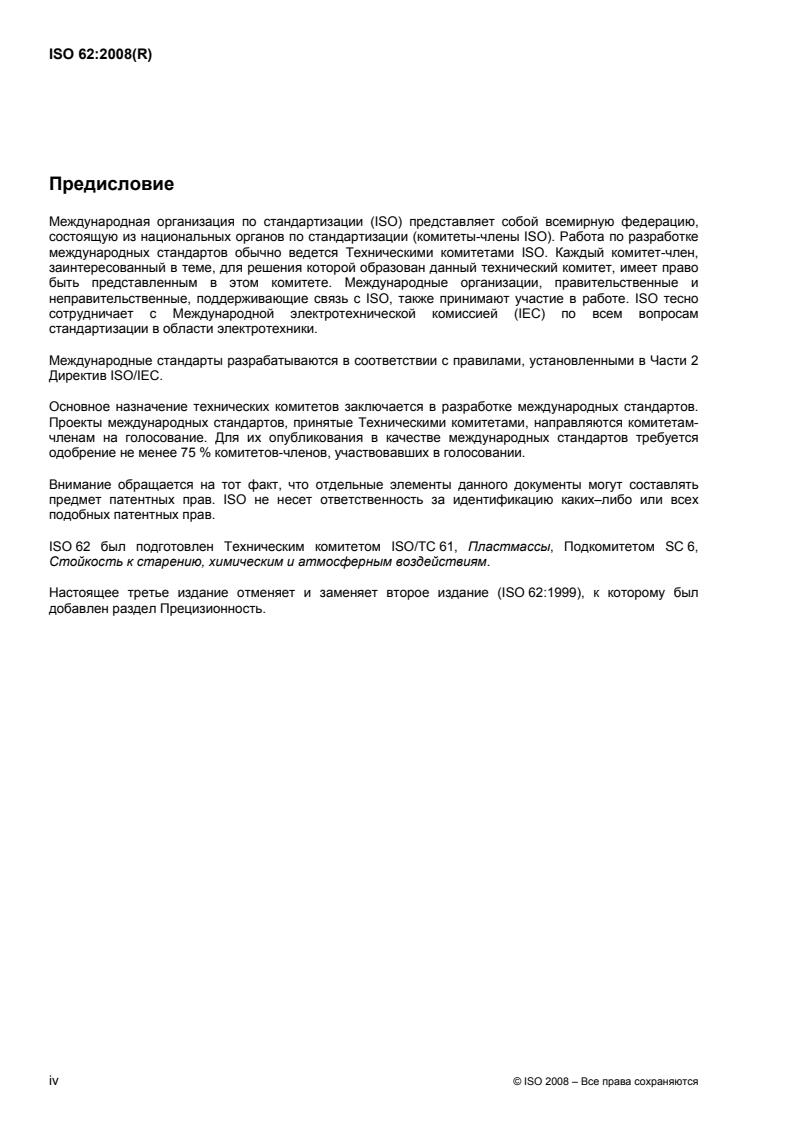
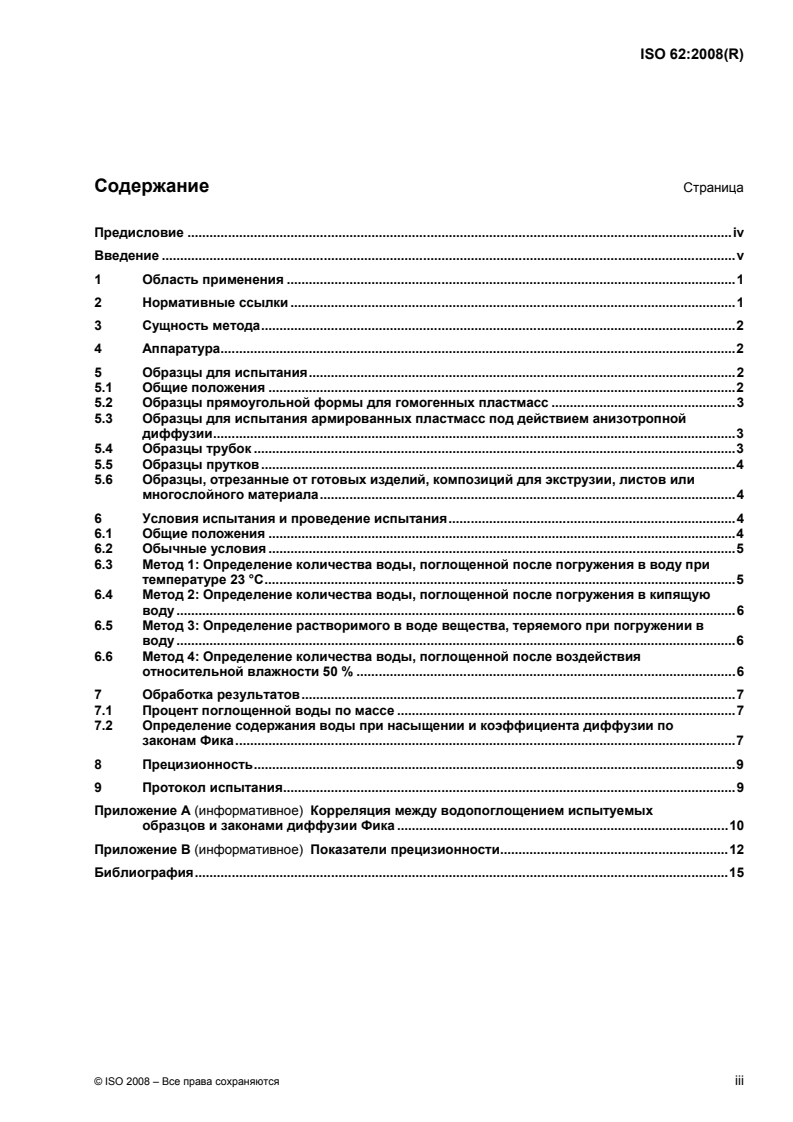
Contents Page
Foreword. iv
Introduction . v
1 Scope . 1
2 Normative references . 1
3 Principle. 2
4 Apparatus . 2
5 Test specimens . 2
5.1 General. 2
5.2 Square-shaped test specimens for homogeneous plastics. 3
5.3 Test specimens of reinforced plastics affected by anisotropic diffusion effects. 3
5.4 Tubular test specimens. 3
5.5 Rod-shaped test specimens . 4
5.6 Specimens cut from finished products, extrusion compounds, sheets or laminates . 4
6 Test conditions and procedures . 4
6.1 General. 4
6.2 General conditions . 4
6.3 Method 1: Determination of amount of water absorbed after immersion in water at 23 °C. 5
6.4 Method 2: Determination of amount of water absorbed after immersion in boiling water . 5
6.5 Method 3: Determination of water-soluble matter lost during immersion. 6
6.6 Method 4: Determination of amount of water absorbed after exposure to 50 % relative
humidity . 6
7 Expression of results . 6
7.1 Percentage by mass of water absorbed. 6
7.2 Determination of the water content at saturation and the water diffusion coefficient using
Fick’s laws. 7
8 Precision. 8
9 Test report . 9
Annex A (informative) Correlation between water absorption by test specimens and Fick’s
diffusion laws. 10
Annex B (informative) Precision statement. 12
Bibliography . 15
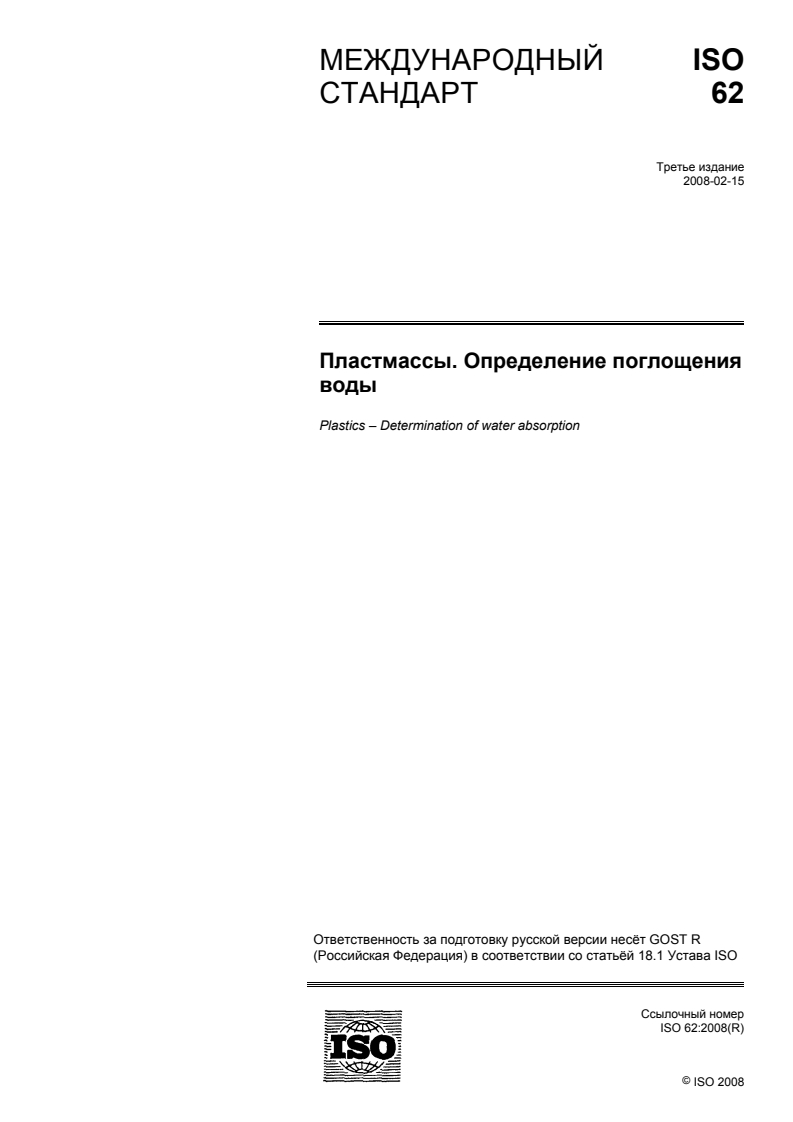
Foreword
ISO (the International Organization for Standardization) is a worldwide federation of national standards bodies
(ISO member bodies). The work of preparing International Standards is normally carried out through ISO
technical committees. Each member body interested in a subject for which a technical committee has been
established has the right to be represented on that committee. International organizations, governmental and
non-governmental, in liaison with ISO, also take part in the work. ISO collaborates closely with the
International Electrotechnical Commission (IEC) on all matters of electrotechnical standardization.
International Standards are drafted in accordance with the rules given in the ISO/IEC Directives, Part 2.
The main task of technical committees is to prepare International Standards. Draft International Standards
adopted by the technical committees are circulated to the member bodies for voting. Publication as an
International Standard requires approval by at least 75 % of the member bodies casting a vote.
Attention is drawn to the possibility that some of the elements of this document may be the subject of patent
rights. ISO shall not be held responsible for identifying any or all such patent rights.
ISO 62 was prepared by Technical Committee ISO/TC 61, Plastics, Subcommittee SC 6, Ageing, chemical
and environmental resistance.
This third edition cancels and replaces the second edition (ISO 62:1999), to which a precision statement has
been added.
iv © ISO 2008 – All rights reserved
Introduction
Plastics exposed to water are subject to several different effects:
a) dimensional changes (e.g. swelling) caused by absorption of water;
b) extraction of water-soluble components;
c) changes in other properties.
However, exposure to humidity, immersion and exposure to boiling water can result in distinctly different
material responses. The equilibrium moisture content can be used to compare the amount of water absorbed
by different types of plastics when they are exposed to moisture. Moisture content determined under non-
equilibrium conditions can be used to compare different batches of the same material and to determine the
diffusion constant of the material when determined under carefully controlled non-equilibrium conditions of
exposure to moisture and when using plastic specimens of defined dimensions.
INTERNATIONAL STANDARD ISO 62:2008(E)
Plastics — Determination of water absorption
1 Scope
1.1 This International Standard describes a procedure for determining the moisture absorption properties in
the “through-the-thickness” direction of flat or curved-form solid plastics. This International Standard also
describes procedures for determining the amount of water absorbed by plastic specimens of defined
dimensions, when immersed in water or when subjected to humid air under controlled conditions. The
“through-the-thickness” moisture diffusion coefficient can be determined for single-phase material by
assuming Fickian diffusion behaviour with constant moisture absorption properties through the thickness of
the test specimen. This model is valid for homogeneous materials and for reinforced polymer-matrix
composites tested below their glass transition temperature. However, some two-phase matrices such as
hardened epoxies may require a multi-phase absorption model which is not covered by this International
Standard.
1.2 Ideally, the best comparison of the water absorption properties and/or diffusion coefficients of materials
should be carried out only using the equilibrium moisture content of plastics exposed to identical conditions.
The comparison of materials using properties at moisture equilibrium does not assume, and is therefore not
limited to, single-phase Fickian diffusion behaviour.
1.3 Alternatively, water absorption of plastic specimens of defined dimensions exposed to immersion or
humidity under controlled conditions but for an arbitrary time period can be used to compare different batches
of the same material or for quality control tests of a given material. For this type of comparison, it is essential
that all test specimens be of identical dimensions and, as nearly as possible, have the same physical
attributes, e.g. surface smoothness, internal stresses, etc. However, moisture equilibrium is not reached under
these conditions. Therefore, results from this type of test cannot be used to compare the water absorption
properties of different types of plastics. For more reliable results, simultaneous tests are recommended.
1.4 The results obtained using the methods described in this International Standard are applicable to most
plastics but are not applicable to cellular plastics, granulates or powders, which can show additional
absorption and capillary effects. Plastics exposed to moisture under controlled conditions for defined periods
of time provide relative comparisons between them. The tests described for the determination of the diffusion
coefficient may not be applicable to all plastics. Plastics that do not retain their shape when immersed in
boiling water should not be compared using method 2 (see 6.4).
2 Normative references
The following referenced documents are indispensable for the application of this document. For dated
references, only the edition cited applies. For undated references, the latest edition of the referenced
document (including any amendments) applies.
ISO 175:1999, Plastics — Methods of test for the determination of the effects of immersion in liquid chemicals
ISO 294-3, Plastics — Injection moulding of test specimens of thermoplastic materials — Part 3: Small plates
ISO 2818, Plastics — Preparation of test specimens by machining
3 Principle
Test specimens are immersed in distilled water at 23 °C or in boiling distilled water, or exposed to 50 %
relative humidity at given temperatures, for prescribed periods. The amount of water absorbed by each test
specimen is determined by measuring its change in mass, i.e. the difference between its initial mass and that
after exposure to water, the change being expressed as a percentage of the initial mass. If required, the
amount of water lost after drying the test specimens can also be determined.
In some applications, 70 % to 90 % relative humidity and temperatures of 70 °C to 90 °C may be necessary.
Relative humidities and temperatures higher than those recommended in this International Standard may be
used by agreement between the interested parties. When relative humidity and temperature conditions other
than those recommended are used, a complete description of these conditions (with appropriate tolerances)
shall be included in the test report.
4 Apparatus
4.1 Balance, with an accuracy of ± 0,1 mg (see also 6.1.3).
4.2 Oven, with forced-air convection or vacuum, maintained at (50,0 ± 2,0) °C or at any other agreed
temperature (see also 6.1.2).
4.3 Containers, containing distilled water or water of equivalent purity, equipped with a means of heating
capable of maintaining the temperature specified.
4.4 Desiccator, with a desiccant (e.g. P O ).
2 5
4.5 Means of measuring the dimensions of the test specimens to an accuracy of ± 0,1 mm, if required.
5 Test specimens
5.1 General
For each material evaluated, test at least three test specimens. Test specimens of the required dimensions
may be prepared by moulding or extrusion. The methods used for preparation of all test specimens shall be
included in the test report.
NOTE The results of this method may be influenced by surface effects. For some materials, different results can be
obtained between moulded specimens and specimens cut from a larger sheet.
Any contaminant on the test specimen surface which could influence water absorption shall be removed by a
cleaning agent which does not attack the plastic, the degree of attack being determined in accordance with
ISO 175 — for example, the notation “none” (no change in appearance) in ISO 175:1999, Table 1. Allow
specimens to dry at 23 °C and 50 % relative humidity for at least 2 h after cleaning and before beginning the
test. Wear clean gloves when handling test specimens to prevent contamination.
The cleaning agent shall have no effect on the the water absorption. When determining the moisture
equilibrium content in accordance with 6.3 (method 1) and 6.6 (method 4), the effects of the cleaning agent
can be ignored.
2 © ISO 2008 – All rights reserved
5.2 Square-shaped test specimens for homogeneous plastics
Unless otherwise specified or agreed by all interested parties, the dimensions and dimensional tolerances of
the square-shaped specimens shall be the same as those given in ISO 294-3, with a thickness of
(1,0 ± 0,1) mm. They can be prepared by moulding in accordance with ISO 294-3, using conditions given in
standards applicable to the material being tested (or using conditions recommended by the material supplier).
For some materials, such as polyamides, polycarbonates and some reinforced plastics, use of a 1 mm thick
specimen may not give meaningful results. Furthermore, some product specifications require the use of
thicker test specimens for the determination of water absorption. In these cases, test specimens of
(2,05 ± 0,05) mm thickness may be used. If specimens of thickness other than 1 mm are used, the specimen
thickness shall be indicated in the test report. There are no requirements for the radii of the edges and corners.
However, they shall be smooth and clean to prevent material from the edges and corners from being lost
during the test.
Some materials may exhibit mould shrinkage. If specimens of these materials are prepared using a mould
with dimensions at the lower limits specified in ISO 294-3, the final dimensions of the specimens may be
beyond the tolerances given in this International Standard, in which case they shall be noted in the test report.
5.3 Test specimens of reinforced plastics affected by anisotropic diffusion effects
For some reinforced plastic materials, such as carbon-fibre-reinforced epoxies, anisotropic diffusion effects
caused by the reinforcing material may produce erroneous results when small specimens are used. Where
this is of concern, test specimens that meet one of the following types of specimen shall be used and the
specific dimensions and methods of test specimen preparation shall be included in the test report:
a) A nominally square-shaped plate or curved panel with dimensions that satisfy the relation:
w u 100d
where
w is the nominal length of one side, in millimetres;
d is the nominal thickness, in millimetres.
b) A 100 mm × 100 mm square-shaped plate with stainless steel or aluminium foil bonded to the edges so
that moisture absorption through the edges is minimized. When this specimen is prepared, care shall be
taken to weigh the specimen before and after bonding of the foil in order to obtain the mass increase due
to the foil and the adhesive. Use only poorly absorbing adhesive which will not affect the results.
5.4 Tubular test specimens
Unless specifically required by other International Standards, tubular test specimens shall have the following
dimensions:
a) For tubes having an internal diameter of 76 mm or less, cut sections of tube that are (25 ± 1) mm in
length from a longer tube of the material being evaluated. The cut shall be made perpendicular to the
longitudinal axis of the tube. The cut can be made by machining, sawing or shearing and shall produce
smooth edges free from cracks.
b) For tubes having an internal diameter larger than 76 mm, cut out rectangular specimens (76 ± 1) mm in
length (measured along the outside surface of the tube) by (25 ± 1) mm in width. The cut edges shall be
smooth and free from cracks.
5.5 Rod-shaped test specimens
Rod-shaped test specimens shall have the following dimensions:
a) For rods 26 mm in diameter or less, cut off a section of (25 ± 1) mm in length. The cut shall be made
perpendicular to the longitudinal axis of the rod. The diameter of the test specimen shall be the diameter
of the rod.
b) For rods larger than 26 mm in diameter, cut off a section of (13 ± 1) mm in length. The cut shall be made
perpendicular to the longitudinal axis of the rod. The diameter of the test specimen shall be the diameter
of the rod.
5.6 Specimens cut from finished products, extrusion compounds, sheets or laminates
Unless required by another International Standard, cut a piece from the product that
⎯ meets the requirements for the square-shaped test specimen
or
⎯ has a length and width of (61 ± 1) mm and has the same shape (thickness and curvature) as the material
being tested.
The machining conditions used to prepare the test specimens shall be agreed by all interested parties. They
shall also be in accordance with ISO 2818 and shall be included in the test report.
If the nominal thickness is greater than 1,1 mm and in the absence of special provisions concerning the
relevant application, the thickness of the test specimens shall be reduced to 1,0 mm to 1,1 mm by machining
on one surface only.
When the surface of a laminate is machined, the water absorption properties will be influenced to such an
extent that the test results will not be valid. Therefore, the specimens shall be tested at their original thickness
and the dimensions shall be indicated in the test report.
6 Test condi
...
INTERNATIONAL ISO
STANDARD 62
Third edition
2008-02-15
Plastics — Determination of water
absorption
Plastiques — Détermination de l'absorption d'eau
Reference number
©
ISO 2008
PDF disclaimer
This PDF file may contain embedded typefaces. In accordance with Adobe's licensing policy, this file may be printed or viewed but
shall not be edited unless the typefaces which are embedded are licensed to and installed on the computer performing the editing. In
downloading this file, parties accept therein the responsibility of not infringing Adobe's licensing policy. The ISO Central Secretariat
accepts no liability in this area.
Adobe is a trademark of Adobe Systems Incorporated.
Details of the software products used to create this PDF file can be found in the General Info relative to the file; the PDF-creation
parameters were optimized for printing. Every care has been taken to ensure that the file is suitable for use by ISO member bodies. In
the unlikely event that a problem relating to it is found, please inform the Central Secretariat at the address given below.
© ISO 2008
All rights reserved. Unless otherwise specified, no part of this publication may be reproduced or utilized in any form or by any means,
electronic or mechanical, including photocopying and microfilm, without permission in writing from either ISO at the address below or
ISO's member body in the country of the requester.
ISO copyright office
Case postale 56 • CH-1211 Geneva 20
Tel. + 41 22 749 01 11
Fax + 41 22 749 09 47
E-mail copyright@iso.org
Web www.iso.org
Published in Switzerland
ii © ISO 2008 – All rights reserved
Contents Page
Foreword. iv
Introduction . v
1 Scope . 1
2 Normative references . 1
3 Principle. 2
4 Apparatus . 2
5 Test specimens . 2
5.1 General. 2
5.2 Square-shaped test specimens for homogeneous plastics. 3
5.3 Test specimens of reinforced plastics affected by anisotropic diffusion effects. 3
5.4 Tubular test specimens. 3
5.5 Rod-shaped test specimens . 4
5.6 Specimens cut from finished products, extrusion compounds, sheets or laminates . 4
6 Test conditions and procedures . 4
6.1 General. 4
6.2 General conditions . 4
6.3 Method 1: Determination of amount of water absorbed after immersion in water at 23 °C. 5
6.4 Method 2: Determination of amount of water absorbed after immersion in boiling water . 5
6.5 Method 3: Determination of water-soluble matter lost during immersion. 6
6.6 Method 4: Determination of amount of water absorbed after exposure to 50 % relative
humidity . 6
7 Expression of results . 6
7.1 Percentage by mass of water absorbed. 6
7.2 Determination of the water content at saturation and the water diffusion coefficient using
Fick’s laws. 7
8 Precision. 8
9 Test report . 9
Annex A (informative) Correlation between water absorption by test specimens and Fick’s
diffusion laws. 10
Annex B (informative) Precision statement. 12
Bibliography . 15
Foreword
ISO (the International Organization for Standardization) is a worldwide federation of national standards bodies
(ISO member bodies). The work of preparing International Standards is normally carried out through ISO
technical committees. Each member body interested in a subject for which a technical committee has been
established has the right to be represented on that committee. International organizations, governmental and
non-governmental, in liaison with ISO, also take part in the work. ISO collaborates closely with the
International Electrotechnical Commission (IEC) on all matters of electrotechnical standardization.
International Standards are drafted in accordance with the rules given in the ISO/IEC Directives, Part 2.
The main task of technical committees is to prepare International Standards. Draft International Standards
adopted by the technical committees are circulated to the member bodies for voting. Publication as an
International Standard requires approval by at least 75 % of the member bodies casting a vote.
Attention is drawn to the possibility that some of the elements of this document may be the subject of patent
rights. ISO shall not be held responsible for identifying any or all such patent rights.
ISO 62 was prepared by Technical Committee ISO/TC 61, Plastics, Subcommittee SC 6, Ageing, chemical
and environmental resistance.
This third edition cancels and replaces the second edition (ISO 62:1999), to which a precision statement has
been added.
iv © ISO 2008 – All rights reserved
Introduction
Plastics exposed to water are subject to several different effects:
a) dimensional changes (e.g. swelling) caused by absorption of water;
b) extraction of water-soluble components;
c) changes in other properties.
However, exposure to humidity, immersion and exposure to boiling water can result in distinctly different
material responses. The equilibrium moisture content can be used to compare the amount of water absorbed
by different types of plastics when they are exposed to moisture. Moisture content determined under non-
equilibrium conditions can be used to compare different batches of the same material and to determine the
diffusion constant of the material when determined under carefully controlled non-equilibrium conditions of
exposure to moisture and when using plastic specimens of defined dimensions.
INTERNATIONAL STANDARD ISO 62:2008(E)
Plastics — Determination of water absorption
1 Scope
1.1 This International Standard describes a procedure for determining the moisture absorption properties in
the “through-the-thickness” direction of flat or curved-form solid plastics. This International Standard also
describes procedures for determining the amount of water absorbed by plastic specimens of defined
dimensions, when immersed in water or when subjected to humid air under controlled conditions. The
“through-the-thickness” moisture diffusion coefficient can be determined for single-phase material by
assuming Fickian diffusion behaviour with constant moisture absorption properties through the thickness of
the test specimen. This model is valid for homogeneous materials and for reinforced polymer-matrix
composites tested below their glass transition temperature. However, some two-phase matrices such as
hardened epoxies may require a multi-phase absorption model which is not covered by this International
Standard.
1.2 Ideally, the best comparison of the water absorption properties and/or diffusion coefficients of materials
should be carried out only using the equilibrium moisture content of plastics exposed to identical conditions.
The comparison of materials using properties at moisture equilibrium does not assume, and is therefore not
limited to, single-phase Fickian diffusion behaviour.
1.3 Alternatively, water absorption of plastic specimens of defined dimensions exposed to immersion or
humidity under controlled conditions but for an arbitrary time period can be used to compare different batches
of the same material or for quality control tests of a given material. For this type of comparison, it is essential
that all test specimens be of identical dimensions and, as nearly as possible, have the same physical
attributes, e.g. surface smoothness, internal stresses, etc. However, moisture equilibrium is not reached under
these conditions. Therefore, results from this type of test cannot be used to compare the water absorption
properties of different types of plastics. For more reliable results, simultaneous tests are recommended.
1.4 The results obtained using the methods described in this International Standard are applicable to most
plastics but are not applicable to cellular plastics, granulates or powders, which can show additional
absorption and capillary effects. Plastics exposed to moisture under controlled conditions for defined periods
of time provide relative comparisons between them. The tests described for the determination of the diffusion
coefficient may not be applicable to all plastics. Plastics that do not retain their shape when immersed in
boiling water should not be compared using method 2 (see 6.4).
2 Normative references
The following referenced documents are indispensable for the application of this document. For dated
references, only the edition cited applies. For undated references, the latest edition of the referenced
document (including any amendments) applies.
ISO 175:1999, Plastics — Methods of test for the determination of the effects of immersion in liquid chemicals
ISO 294-3, Plastics — Injection moulding of test specimens of thermoplastic materials — Part 3: Small plates
ISO 2818, Plastics — Preparation of test specimens by machining
3 Principle
Test specimens are immersed in distilled water at 23 °C or in boiling distilled water, or exposed to 50 %
relative humidity at given temperatures, for prescribed periods. The amount of water absorbed by each test
specimen is determined by measuring its change in mass, i.e. the difference between its initial mass and that
after exposure to water, the change being expressed as a percentage of the initial mass. If required, the
amount of water lost after drying the test specimens can also be determined.
In some applications, 70 % to 90 % relative humidity and temperatures of 70 °C to 90 °C may be necessary.
Relative humidities and temperatures higher than those recommended in this International Standard may be
used by agreement between the interested parties. When relative humidity and temperature conditions other
than those recommended are used, a complete description of these conditions (with appropriate tolerances)
shall be included in the test report.
4 Apparatus
4.1 Balance, with an accuracy of ± 0,1 mg (see also 6.1.3).
4.2 Oven, with forced-air convection or vacuum, maintained at (50,0 ± 2,0) °C or at any other agreed
temperature (see also 6.1.2).
4.3 Containers, containing distilled water or water of equivalent purity, equipped with a means of heating
capable of maintaining the temperature specified.
4.4 Desiccator, with a desiccant (e.g. P O ).
2 5
4.5 Means of measuring the dimensions of the test specimens to an accuracy of ± 0,1 mm, if required.
5 Test specimens
5.1 General
For each material evaluated, test at least three test specimens. Test specimens of the required dimensions
may be prepared by moulding or extrusion. The methods used for preparation of all test specimens shall be
included in the test report.
NOTE The results of this method may be influenced by surface effects. For some materials, different results can be
obtained between moulded specimens and specimens cut from a larger sheet.
Any contaminant on the test specimen surface which could influence water absorption shall be removed by a
cleaning agent which does not attack the plastic, the degree of attack being determined in accordance with
ISO 175 — for example, the notation “none” (no change in appearance) in ISO 175:1999, Table 1. Allow
specimens to dry at 23 °C and 50 % relative humidity for at least 2 h after cleaning and before beginning the
test. Wear clean gloves when handling test specimens to prevent contamination.
The cleaning agent shall have no effect on the the water absorption. When determining the moisture
equilibrium content in accordance with 6.3 (method 1) and 6.6 (method 4), the effects of the cleaning agent
can be ignored.
2 © ISO 2008 – All rights reserved
5.2 Square-shaped test specimens for homogeneous plastics
Unless otherwise specified or agreed by all interested parties, the dimensions and dimensional tolerances of
the square-shaped specimens shall be the same as those given in ISO 294-3, with a thickness of
(1,0 ± 0,1) mm. They can be prepared by moulding in accordance with ISO 294-3, using conditions given in
standards applicable to the material being tested (or using conditions recommended by the material supplier).
For some materials, such as polyamides, polycarbonates and some reinforced plastics, use of a 1 mm thick
specimen may not give meaningful results. Furthermore, some product specifications require the use of
thicker test specimens for the determination of water absorption. In these cases, test specimens of
(2,05 ± 0,05) mm thickness may be used. If specimens of thickness other than 1 mm are used, the specimen
thickness shall be indicated in the test report. There are no requirements for the radii of the edges and corners.
However, they shall be smooth and clean to prevent material from the edges and corners from being lost
during the test.
Some materials may exhibit mould shrinkage. If specimens of these materials are prepared using a mould
with dimensions at the lower limits specified in ISO 294-3, the final dimensions of the specimens may be
beyond the tolerances given in this International Standard, in which case they shall be noted in the test report.
5.3 Test specimens of reinforced plastics affected by anisotropic diffusion effects
For some reinforced plastic materials, such as carbon-fibre-reinforced epoxies, anisotropic diffusion effects
caused by the reinforcing material may produce erroneous results when small specimens are used. Where
this is of concern, test specimens that meet one of the following types of specimen shall be used and the
specific dimensions and methods of test specimen preparation shall be included in the test report:
a) A nominally square-shaped plate or curved panel with dimensions that satisfy the relation:
w u 100d
where
w is the nominal length of one side, in millimetres;
d is the nominal thickness, in millimetres.
b) A 100 mm × 100 mm square-shaped plate with stainless steel or aluminium foil bonded to the edges so
that moisture absorption through the edges is minimized. When this specimen is prepared, care shall be
taken to weigh the specimen before and after bonding of the foil in order to obtain the mass increase due
to the foil and the adhesive. Use only poorly absorbing adhesive which will not affect the results.
5.4 Tubular test specimens
Unless specifically required by other International Standards, tubular test specimens shall have the following
dimensions:
a) For tubes having an internal diameter of 76 mm or less, cut sections of tube that are (25 ± 1) mm in
length from a longer tube of the material being evaluated. The cut shall be made perpendicular to the
longitudinal axis of the tube. The cut can be made by machining, sawing or shearing and shall produce
smooth edges free from cracks.
b) For tubes having an internal diameter larger than 76 mm, cut out rectangular specimens (76 ± 1) mm in
length (measured along the outside surface of the tube) by (25 ± 1) mm in width. The cut edges shall be
smooth and free from cracks.
5.5 Rod-shaped test specimens
Rod-shaped test specimens shall have the following dimensions:
a) For rods 26 mm in diameter or less, cut off a section of (25 ± 1) mm in length. The cut shall be made
perpendicular to the longitudinal axis of the rod. The diameter of the test specimen shall be the diameter
of the rod.
b) For rods larger than 26 mm in diameter, cut off a section of (13 ± 1) mm in length. The cut shall be made
perpendicular to the longitudinal axis of the rod. The diameter of the test specimen shall be the diameter
of the rod.
5.6 Specimens cut from finished products, extrusion compounds, sheets or laminates
Unless required by another International Standard, cut a piece from the product that
⎯ meets the requirements for the square-shaped test specimen
or
⎯ has a length and width of (61 ± 1) mm and has the same shape (thickness and curvature) as the material
being tested.
The machining conditions used to prepare the test specimens shall be agreed by all interested parties. They
shall also be in accordance with ISO 2818 and shall be included in the test report.
If the nominal thickness is greater than 1,1 mm and in the absence of special provisions concerning the
relevant application, the thickness of the test specimens shall be reduced to 1,0 mm to 1,1 mm by machining
on one surface only.
When the surface of a laminate is machined, the water absorption properties will be influenced to such an
extent that the test results will not be valid. Therefore, the specimens shall be tested at their original thickness
and the dimensions shall be indicated in the test report.
6 Test condi
...
NORME ISO
INTERNATIONALE 62
Troisième édition
2008-02-15
Plastiques — Détermination de
l'absorption d'eau
Plastics — Determination of water absorption
Numéro de référence
©
ISO 2008
PDF – Exonération de responsabilité
Le présent fichier PDF peut contenir des polices de caractères intégrées. Conformément aux conditions de licence d'Adobe, ce fichier
peut être imprimé ou visualisé, mais ne doit pas être modifié à moins que l'ordinateur employé à cet effet ne bénéficie d'une licence
autorisant l'utilisation de ces polices et que celles-ci y soient installées. Lors du téléchargement de ce fichier, les parties concernées
acceptent de fait la responsabilité de ne pas enfreindre les conditions de licence d'Adobe. Le Secrétariat central de l'ISO décline toute
responsabilité en la matière.
Adobe est une marque déposée d'Adobe Systems Incorporated.
Les détails relatifs aux produits logiciels utilisés pour la création du présent fichier PDF sont disponibles dans la rubrique General Info
du fichier; les paramètres de création PDF ont été optimisés pour l'impression. Toutes les mesures ont été prises pour garantir
l'exploitation de ce fichier par les comités membres de l'ISO. Dans le cas peu probable où surviendrait un problème d'utilisation,
veuillez en informer le Secrétariat central à l'adresse donnée ci-dessous.
DOCUMENT PROTÉGÉ PAR COPYRIGHT
© ISO 2008
Droits de reproduction réservés. Sauf prescription différente, aucune partie de cette publication ne peut être reproduite ni utilisée sous
quelque forme que ce soit et par aucun procédé, électronique ou mécanique, y compris la photocopie et les microfilms, sans l'accord écrit
de l'ISO à l'adresse ci-après ou du comité membre de l'ISO dans le pays du demandeur.
ISO copyright office
Case postale 56 • CH-1211 Geneva 20
Tel. + 41 22 749 01 11
Fax. + 41 22 749 09 47
E-mail copyright@iso.org
Web www.iso.org
Publié en Suisse
ii © ISO 2008 – Tous droits réservés
Sommaire Page
Avant-propos. iv
Introduction . v
1 Domaine d'application. 1
2 Références normatives . 1
3 Principe. 2
4 Appareillage . 2
5 Éprouvettes . 2
5.1 Généralités . 2
5.2 Éprouvettes carrées de plastiques homogènes. 3
5.3 Éprouvettes de plastiques renforcés affectés par des effets de diffusion anisotrope . 3
5.4 Éprouvettes tubulaires. 3
5.5 Éprouvettes en forme de jonc . 4
5.6 Éprouvettes découpées dans des profilés finis, des mélanges pour extrusion,
des feuilles ou des stratifiés. 4
6 Conditions d'essai et modes opératoires . 4
6.1 Généralités . 4
6.2 Conditions générales . 4
6.3 Méthode 1: Détermination de l'absorption d'eau après immersion dans l'eau à 23 °C. 5
6.4 Méthode 2: Détermination de l'absorption d'eau après immersion dans l'eau bouillante. 5
6.5 Méthode 3: Détermination de la perte de matières solubles dans l'eau au cours
de l'immersion. 6
6.6 Méthode 4: Détermination de l'absorption d'eau après exposition à une humidité relative
de 50 %. 6
7 Expression des résultats . 6
7.1 Pourcentage en masse d'eau absorbée .6
7.2 Détermination de l'absorption d'eau à saturation et du coefficient de diffusion
selon la théorie de Fick . 7
8 Fidélité . 9
9 Rapport d'essai . 9
Annexe A (informative) Corrélation entre l'absorption d'eau par les éprouvettes et la théorie
de Fick. 10
Annexe B (informative) Énoncé concernant la fidélité . 12
Bibliographie . 15
Avant-propos
L'ISO (Organisation internationale de normalisation) est une fédération mondiale d'organismes nationaux de
normalisation (comités membres de l'ISO). L'élaboration des Normes internationales est en général confiée
aux comités techniques de l'ISO. Chaque comité membre intéressé par une étude a le droit de faire partie du
comité technique créé à cet effet. Les organisations internationales, gouvernementales et non
gouvernementales, en liaison avec l'ISO participent également aux travaux. L'ISO collabore étroitement avec
la Commission électrotechnique internationale (CEI) en ce qui concerne la normalisation électrotechnique.
Les Normes internationales sont rédigées conformément aux règles données dans les Directives ISO/CEI,
Partie 2.
La tâche principale des comités techniques est d'élaborer les Normes internationales. Les projets de Normes
internationales adoptés par les comités techniques sont soumis aux comités membres pour vote. Leur
publication comme Normes internationales requiert l'approbation de 75 % au moins des comités membres
votants.
L'attention est appelée sur le fait que certains des éléments du présent document peuvent faire l'objet de
droits de propriété intellectuelle ou de droits analogues. L'ISO ne saurait être tenue pour responsable de ne
pas avoir identifié de tels droits de propriété et averti de leur existence.
L'ISO 62 a été élaborée par le comité technique ISO/TC 61, Plastiques, sous-comité SC 6, Vieillissement et
résistance aux agents chimiques et environnants.
Cette troisième édition annule et remplace la deuxième édition (ISO 62:1999), à laquelle a été ajouté un
énoncé concernant la fidélité.
iv © ISO 2008 – Tous droits réservés
Introduction
Les plastiques exposés à l'eau sont soumis à plusieurs actions différentes:
a) des modifications dimensionnelles (par exemple gonflement) provoquées par l'absorption d'eau;
b) l'extraction des éléments solubles dans l'eau;
c) des modifications d'autres propriétés.
Toutefois, l'exposition à l'humidité, l'immersion et l'exposition à de l'eau bouillante peuvent entraîner des
réponses nettement différentes du matériau. La teneur en eau à l'équilibre peut permettre de comparer la
quantité d'eau absorbée par différents types de plastiques exposés à l'humidité. Une exposition
soigneusement contrôlée, mais non équilibrée, d'éprouvettes de plastique ayant des dimensions définies peut
être utilisée pour comparer différents lots d'un même matériau et déterminer la constante de diffusion du
matériau soumis à essai.
NORME INTERNATIONALE ISO 62:2008(F)
Plastiques — Détermination de l'absorption d'eau
1 Domaine d'application
1.1 La présente Norme internationale spécifie un mode opératoire permettant de déterminer les propriétés
d'absorption de l'humidité dans l'épaisseur de matériaux plastiques solides plats ou courbes. La présente
norme décrit également des modes opératoires permettant de déterminer la quantité d'eau absorbée par des
éprouvettes de dimensions définies, immergées dans l'eau ou exposées à de l'air humide dans des conditions
définies. Le calcul du coefficient de diffusion de l'humidité dans l'épaisseur suppose un matériau fickien
monophasé ayant des propriétés constantes d'absorption d'humidité dans l'épaisseur de l'éprouvette. Ce
modèle est valable pour les matériaux homogènes et pour les composites renforcés à matrice polymère
soumis à essai au-dessous de leur température de transition vitreuse. Toutefois, certaines matrices à deux
phases, telles que les époxydes durcis, peuvent nécessiter un modèle d'absorption multiphase qui n'est pas
couvert par la présente Norme internationale.
1.2 Idéalement, la meilleure comparaison des propriétés d'absorption d'eau et/ou des coefficients de
diffusion des matériaux ne devrait être faite qu'en utilisant la teneur en humidité à l'équilibre de plastiques
exposés exactement aux mêmes conditions. La comparaison de matériaux utilisant la teneur en humidité à
l'équilibre ne suppose pas de comportement monophasé de diffusion fickien et n'y est donc pas limitée.
1.3 En variante, l'absorption d'eau d'éprouvettes de plastique ayant une géométrie définie et faisant l'objet
d'une immersion ou de mises en présence d'humidité dans des conditions définies, pendant un laps de temps
arbitraire, peut permettre de comparer différents lots du même matériau ou de servir d'essai de contrôle
qualité d'un matériau. Pour ces types de comparaisons, il est indispensable que toutes les éprouvettes aient
des dimensions identiques et soient, autant que possible, dans le même état physique (poli de surface,
tensions internes, etc.). Néanmoins, ces expositions ne provoquant pas une humidité d'équilibre, les résultats
de ce type d'essai ne peuvent pas être utilisés pour comparer les propriétés d'absorption d'eau de types de
plastiques différents. Il est recommandé de soumettre simultanément à essai les différents lots du même
matériau afin d'obtenir les résultats les plus fiables.
1.4 Les résultats obtenus en utilisant les méthodes spécifiées dans la présente Norme internationale
s'appliquent à la plupart des plastiques, à l'exception des plastiques alvéolaires, des granulés ou des poudres
qui peuvent avoir d'autres effets capillaires et d'absorption. Des expositions pendant un laps de temps fixe
permettent des comparaisons relatives des plastiques. Les essais décrits pour la détermination du coefficient
de diffusion peuvent ne pas être applicables à tous les plastiques. Les plastiques ne pouvant pas garder leur
forme lors de leur exposition à l'eau bouillante ne peuvent pas être comparés en utilisant la méthode 2
(voir 6.4).
2 Références normatives
Les documents de référence suivants sont indispensables pour l'application du présent document. Pour les
références datées, seule l'édition citée s'applique. Pour les références non datées, la dernière édition du
document de référence s'applique (y compris les éventuels amendements).
ISO 175:1999, Plastiques — Méthodes d'essai pour la détermination des effets de l'immersion dans des
produits chimiques liquides
ISO 294-3, Plastiques — Moulage par injection des éprouvettes de matériaux thermoplastiques —
Partie 3: Plaques de petites dimensions
ISO 2818, Plastiques — Préparation des éprouvettes par usinage
3 Principe
Les éprouvettes sont immergées dans de l'eau distillée à 23 °C ou dans de l'eau distillée bouillante, ou encore
exposées à des atmosphères à 50 % d'humidité relative, à des températures définies et pendant des laps de
temps spécifiés. La quantité d'eau absorbée par l'éprouvette est déterminée par mesurage de sa variation de
masse, c'est-à-dire la différence entre sa masse après exposition à l'eau et sa masse initiale, et elle est
exprimée en pourcentage de la masse initiale. Si besoin est, il est également possible de déterminer la
quantité d'eau perdue après séchage des éprouvettes.
Certaines applications peuvent nécessiter des atmosphères ayant une humidité relative comprise entre 70 %
et 90 % et une température située entre 70 °C et 90 °C. Il est possible d'utiliser des atmosphères ayant une
humidité relative et une température supérieures à celles recommandées dans la présente Norme
internationale, si ces conditions ont fait l'objet d'un accord entre les parties intéressées. Si des conditions
d'humidité relative et de température autres que celles recommandées sont utilisées, elles doivent faire l'objet
d'une description complète (avec les tolérances appropriées) dans le rapport d'essai.
4 Appareillage
4.1 Balance, précise à ± 0,1 mg (voir aussi 6.1.3).
4.2 Étuve, à ventilation forcée ou à vide, réglable à (50,0 ± 2,0) °C ou à toute autre température convenue
(voir aussi 6.1.2).
4.3 Récipients, contenant de l'eau distillée, ou de l'eau de pureté équivalente, équipés d'un dispositif de
chauffage réglable à la température spécifiée.
4.4 Dessiccateur, avec déshydratant (par exemple P O ).
2 5
4.5 Équipement de mesurage des dimensions des éprouvettes (si nécessaire), ayant une précision
de ± 0,1 mm.
5 Éprouvettes
5.1 Généralités
Soumettre à essai au moins trois éprouvettes de chaque matériau à évaluer. Les éprouvettes ayant les
dimensions requises peuvent être préparées par moulage ou par extrusion. Les méthodes utilisées pour la
préparation de toutes les éprouvettes doivent figurer dans le rapport d'essai.
NOTE Les résultats de cette méthode peuvent être influencés par les effets de surface. Pour certains matériaux,
différents résultats peuvent être obtenus avec des éprouvettes ayant été moulées ou découpées dans une feuille plus
grande.
Tout contaminant à la surface de l'éprouvette susceptible d'influer sur l'absorption d'eau doit être éliminé au
moyen d'un agent de nettoyage non agressif pour le plastique, conformément à l'ISO 175, par exemple la
notation «aucune» (aucune modification apparente) dans l'ISO 175:1999, Tableau 1. À l'issue du nettoyage et
avant de commencer l'essai, laisser les éprouvettes sécher pendant au moins 2 h à une température de 23 °C
et à une humidité relative de 50 %. Porter des gants propres lors de la manipulation des éprouvettes afin
d'éviter toute contamination.
L'agent de nettoyage ne doit avoir aucun effet sur l'absorption de l'eau. En cas de détermination de l'humidité
à l'équilibre conformément à 6.3 (méthode 1) et à 6.6 (méthode 4), les effets de l'agent de nettoyage peuvent
être négligés.
2 © ISO 2008 – Tous droits réservés
5.2 Éprouvettes carrées de plastiques homogènes
Sauf spécification contraire ou accord entre les parties intéressées, les dimensions et tolérances des
éprouvettes carrées doivent être identiques à celle indiquées dans l'ISO 294-3 avec une épaisseur de
(1,0 ± 0,1) mm. Elles peuvent être préparées par moulage, conformément à l'ISO 294-3, dans les conditions
indiquées dans les normes applicables au matériau soumis à essai (ou dans les conditions recommandées
par le fournisseur du matériau). Pour certaines matières telles que polyamides, polycarbonates et certains
plastiques renforcés, l'utilisation d'une éprouvette de 1 mm d'épaisseur peut ne pas donner de résultats
pertinents. En outre, certaines spécifications de produit exigent l'utilisation d'éprouvettes plus épaisses pour la
caractérisation de l'absorption d'eau. Dans ce cas, il est permis d'utiliser des éprouvettes de (2,05 ± 0,05) mm.
Si des éprouvettes de 1 mm d'épaisseur ne sont pas utilisées, l'épaisseur des éprouvettes doit être consignée
dans le rapport d'essai. Il n'existe aucune exigence quant au rayon des bords et des angles. Néanmoins,
ceux-ci doivent être lisses et propres afin d'éviter que de la matière issue des bords ou des angles ne se
perde ou ne se détache au cours de l'essai.
Certains matériaux peuvent présenter un retrait au moulage. Si certaines éprouvettes de ces matériaux sont
préparées en utilisant un moulage ayant des dimensions correspondant aux limites inférieures fixées dans
l'ISO 294-3, les dimensions finales de ces éprouvettes peuvent se trouver hors des tolérances données dans
la présente Norme internationale, auquel cas elles doivent être consignées dans le rapport d'essai.
5.3 Éprouvettes de plastiques renforcés affectés par des effets de diffusion anisotrope
Dans le cas de certaines matières plastiques renforcées, tels que les époxydes renforcés de fibres de
carbone, les effets de la diffusion anisotrope dus au matériau renforçant peuvent donner des résultats erronés
en cas d'utilisation de petites éprouvettes. Lorsque ce problème se pose, utiliser des éprouvettes satisfaisant
à l'une des exigences suivantes et consigner dans le rapport d'essai les dimensions et les méthodes de
préparation des éprouvettes spécifiques.
a) Une plaque carrée de dimensions nominales ou panneau courbe dont les dimensions satisfont à la
relation:
w u 100 d
où
w est la longueur nominale d'un côté, en millimètres;
d est l'épaisseur nominale, en millimètres.
b) Une plaque carrée de 100 mm × 100 mm, un film en acier inoxydable ou en aluminium étant collé sur les
bords de manière à éliminer principalement l'absorption d'humidité par les bords. Lors de la préparation
de cette éprouvette, veiller à la peser avant et après avoir collé le film afin d'obtenir l'augmentation de
masse due au film et à l'adhésif. Utiliser un adhésif peu absorbant qui n'aura aucune répercussion sur les
résultats.
5.4 Éprouvettes tubulaires
Sauf exigences spécifiques dans d'autres Normes internationales, les éprouvettes tubulaires doivent avoir les
dimensions suivantes.
a) Pour les tubes de diamètre intérieur inférieur ou égal à 76 mm, découper une section de tube de
(25 ± 1) mm de longueur dans un tube plus long du matériau évalué. La saignée doit être perpendiculaire
à l'axe longitudinal du tube. Elle doit être réalisée par usinage, sciage ou cisaillement et donner des bords
lisses sans fissures.
b) Pour les tubes de diamètre intérieur supérieur à 76 mm, découper une éprouvette rectangulaire de
(76 ± 1) mm de long (mesurée le long de la surface extérieure du tube) sur (25 ± 1) mm de largeur. Les
bords coupés doivent être lisses et ne pas présenter de fissures.
5.5 Éprouvettes en forme de jonc
Les éprouvettes en forme de jonc doivent avoir les dimensions suivantes.
a) Pour les joncs ayant un diamètre inférieur ou égal à 26 mm, découper une section de (25 ± 1) mm de
longueur. La coupe doit être perpendiculaire à l'axe longitudinal du jonc. Le diamètre de l'éprouvette doit
être le même que celui du jonc.
b) Pour les joncs ayant un diamètre supérieur à 26 mm, découper une section de (13 ± 1) mm de longueur.
La coupe doit être perpendiculaire à l'axe longitudinal du jonc. Le diamètre de l'éprouvette doit être le
même que celui du jonc.
5.6 Éprouvettes découpées dans des profilés finis, des mélanges pour extrusion,
des feuilles ou des stratifiés
Sauf exigences contraires dans une autre Norme internationale, découper dans le profilé un morceau qui
⎯ satisfasse aux exigences relatives à l'éprouvette carrée,
ou
⎯ ait une longueur et une largeur de (61 ± 1) mm et la forme (épaisseur et courbes) du profilé soumis à
essai.
Les conditions d'usinage permettant de préparer les éprouvettes doivent faire l'objet d'un accord entre toutes
les parties intéressées, conformément à l'ISO 2818, et figurer dans le rapport d'essai.
En cas d'épaisseur nominale supérieure à 1,1 mm et en l'absence de dispositions particulières dans
l'application correspondante, l'épaisseur de l'éprouvette doit être réduite à 1,0 mm à 1,1 mm en usinant une
seule surface.
Lorsque la surface d'un stratifié est usinée, l'absorption d'eau sera influencée au point que les résultats
obtenus ne seront pas réalistes. L'éprouvette doit être soumise à essai à son épaisseur initiale et les
dimensions doivent être consignées dans le rapport d'essai.
6 Conditions d'essai e
...
NORME ISO
INTERNATIONALE 62
Troisième édition
2008-02-15
Plastiques — Détermination de
l'absorption d'eau
Plastics — Determination of water absorption
Numéro de référence
©
ISO 2008
PDF – Exonération de responsabilité
Le présent fichier PDF peut contenir des polices de caractères intégrées. Conformément aux conditions de licence d'Adobe, ce fichier
peut être imprimé ou visualisé, mais ne doit pas être modifié à moins que l'ordinateur employé à cet effet ne bénéficie d'une licence
autorisant l'utilisation de ces polices et que celles-ci y soient installées. Lors du téléchargement de ce fichier, les parties concernées
acceptent de fait la responsabilité de ne pas enfreindre les conditions de licence d'Adobe. Le Secrétariat central de l'ISO décline toute
responsabilité en la matière.
Adobe est une marque déposée d'Adobe Systems Incorporated.
Les détails relatifs aux produits logiciels utilisés pour la création du présent fichier PDF sont disponibles dans la rubrique General Info
du fichier; les paramètres de création PDF ont été optimisés pour l'impression. Toutes les mesures ont été prises pour garantir
l'exploitation de ce fichier par les comités membres de l'ISO. Dans le cas peu probable où surviendrait un problème d'utilisation,
veuillez en informer le Secrétariat central à l'adresse donnée ci-dessous.
DOCUMENT PROTÉGÉ PAR COPYRIGHT
© ISO 2008
Droits de reproduction réservés. Sauf prescription différente, aucune partie de cette publication ne peut être reproduite ni utilisée sous
quelque forme que ce soit et par aucun procédé, électronique ou mécanique, y compris la photocopie et les microfilms, sans l'accord écrit
de l'ISO à l'adresse ci-après ou du comité membre de l'ISO dans le pays du demandeur.
ISO copyright office
Case postale 56 • CH-1211 Geneva 20
Tel. + 41 22 749 01 11
Fax. + 41 22 749 09 47
E-mail copyright@iso.org
Web www.iso.org
Publié en Suisse
ii © ISO 2008 – Tous droits réservés
Sommaire Page
Avant-propos. iv
Introduction . v
1 Domaine d'application. 1
2 Références normatives . 1
3 Principe. 2
4 Appareillage . 2
5 Éprouvettes . 2
5.1 Généralités . 2
5.2 Éprouvettes carrées de plastiques homogènes. 3
5.3 Éprouvettes de plastiques renforcés affectés par des effets de diffusion anisotrope . 3
5.4 Éprouvettes tubulaires. 3
5.5 Éprouvettes en forme de jonc . 4
5.6 Éprouvettes découpées dans des profilés finis, des mélanges pour extrusion,
des feuilles ou des stratifiés. 4
6 Conditions d'essai et modes opératoires . 4
6.1 Généralités . 4
6.2 Conditions générales . 4
6.3 Méthode 1: Détermination de l'absorption d'eau après immersion dans l'eau à 23 °C. 5
6.4 Méthode 2: Détermination de l'absorption d'eau après immersion dans l'eau bouillante. 5
6.5 Méthode 3: Détermination de la perte de matières solubles dans l'eau au cours
de l'immersion. 6
6.6 Méthode 4: Détermination de l'absorption d'eau après exposition à une humidité relative
de 50 %. 6
7 Expression des résultats . 6
7.1 Pourcentage en masse d'eau absorbée .6
7.2 Détermination de l'absorption d'eau à saturation et du coefficient de diffusion
selon la théorie de Fick . 7
8 Fidélité . 9
9 Rapport d'essai . 9
Annexe A (informative) Corrélation entre l'absorption d'eau par les éprouvettes et la théorie
de Fick. 10
Annexe B (informative) Énoncé concernant la fidélité . 12
Bibliographie . 15
Avant-propos
L'ISO (Organisation internationale de normalisation) est une fédération mondiale d'organismes nationaux de
normalisation (comités membres de l'ISO). L'élaboration des Normes internationales est en général confiée
aux comités techniques de l'ISO. Chaque comité membre intéressé par une étude a le droit de faire partie du
comité technique créé à cet effet. Les organisations internationales, gouvernementales et non
gouvernementales, en liaison avec l'ISO participent également aux travaux. L'ISO collabore étroitement avec
la Commission électrotechnique internationale (CEI) en ce qui concerne la normalisation électrotechnique.
Les Normes internationales sont rédigées conformément aux règles données dans les Directives ISO/CEI,
Partie 2.
La tâche principale des comités techniques est d'élaborer les Normes internationales. Les projets de Normes
internationales adoptés par les comités techniques sont soumis aux comités membres pour vote. Leur
publication comme Normes internationales requiert l'approbation de 75 % au moins des comités membres
votants.
L'attention est appelée sur le fait que certains des éléments du présent document peuvent faire l'objet de
droits de propriété intellectuelle ou de droits analogues. L'ISO ne saurait être tenue pour responsable de ne
pas avoir identifié de tels droits de propriété et averti de leur existence.
L'ISO 62 a été élaborée par le comité technique ISO/TC 61, Plastiques, sous-comité SC 6, Vieillissement et
résistance aux agents chimiques et environnants.
Cette troisième édition annule et remplace la deuxième édition (ISO 62:1999), à laquelle a été ajouté un
énoncé concernant la fidélité.
iv © ISO 2008 – Tous droits réservés
Introduction
Les plastiques exposés à l'eau sont soumis à plusieurs actions différentes:
a) des modifications dimensionnelles (par exemple gonflement) provoquées par l'absorption d'eau;
b) l'extraction des éléments solubles dans l'eau;
c) des modifications d'autres propriétés.
Toutefois, l'exposition à l'humidité, l'immersion et l'exposition à de l'eau bouillante peuvent entraîner des
réponses nettement différentes du matériau. La teneur en eau à l'équilibre peut permettre de comparer la
quantité d'eau absorbée par différents types de plastiques exposés à l'humidité. Une exposition
soigneusement contrôlée, mais non équilibrée, d'éprouvettes de plastique ayant des dimensions définies peut
être utilisée pour comparer différents lots d'un même matériau et déterminer la constante de diffusion du
matériau soumis à essai.
NORME INTERNATIONALE ISO 62:2008(F)
Plastiques — Détermination de l'absorption d'eau
1 Domaine d'application
1.1 La présente Norme internationale spécifie un mode opératoire permettant de déterminer les propriétés
d'absorption de l'humidité dans l'épaisseur de matériaux plastiques solides plats ou courbes. La présente
norme décrit également des modes opératoires permettant de déterminer la quantité d'eau absorbée par des
éprouvettes de dimensions définies, immergées dans l'eau ou exposées à de l'air humide dans des conditions
définies. Le calcul du coefficient de diffusion de l'humidité dans l'épaisseur suppose un matériau fickien
monophasé ayant des propriétés constantes d'absorption d'humidité dans l'épaisseur de l'éprouvette. Ce
modèle est valable pour les matériaux homogènes et pour les composites renforcés à matrice polymère
soumis à essai au-dessous de leur température de transition vitreuse. Toutefois, certaines matrices à deux
phases, telles que les époxydes durcis, peuvent nécessiter un modèle d'absorption multiphase qui n'est pas
couvert par la présente Norme internationale.
1.2 Idéalement, la meilleure comparaison des propriétés d'absorption d'eau et/ou des coefficients de
diffusion des matériaux ne devrait être faite qu'en utilisant la teneur en humidité à l'équilibre de plastiques
exposés exactement aux mêmes conditions. La comparaison de matériaux utilisant la teneur en humidité à
l'équilibre ne suppose pas de comportement monophasé de diffusion fickien et n'y est donc pas limitée.
1.3 En variante, l'absorption d'eau d'éprouvettes de plastique ayant une géométrie définie et faisant l'objet
d'une immersion ou de mises en présence d'humidité dans des conditions définies, pendant un laps de temps
arbitraire, peut permettre de comparer différents lots du même matériau ou de servir d'essai de contrôle
qualité d'un matériau. Pour ces types de comparaisons, il est indispensable que toutes les éprouvettes aient
des dimensions identiques et soient, autant que possible, dans le même état physique (poli de surface,
tensions internes, etc.). Néanmoins, ces expositions ne provoquant pas une humidité d'équilibre, les résultats
de ce type d'essai ne peuvent pas être utilisés pour comparer les propriétés d'absorption d'eau de types de
plastiques différents. Il est recommandé de soumettre simultanément à essai les différents lots du même
matériau afin d'obtenir les résultats les plus fiables.
1.4 Les résultats obtenus en utilisant les méthodes spécifiées dans la présente Norme internationale
s'appliquent à la plupart des plastiques, à l'exception des plastiques alvéolaires, des granulés ou des poudres
qui peuvent avoir d'autres effets capillaires et d'absorption. Des expositions pendant un laps de temps fixe
permettent des comparaisons relatives des plastiques. Les essais décrits pour la détermination du coefficient
de diffusion peuvent ne pas être applicables à tous les plastiques. Les plastiques ne pouvant pas garder leur
forme lors de leur exposition à l'eau bouillante ne peuvent pas être comparés en utilisant la méthode 2
(voir 6.4).
2 Références normatives
Les documents de référence suivants sont indispensables pour l'application du présent document. Pour les
références datées, seule l'édition citée s'applique. Pour les références non datées, la dernière édition du
document de référence s'applique (y compris les éventuels amendements).
ISO 175:1999, Plastiques — Méthodes d'essai pour la détermination des effets de l'immersion dans des
produits chimiques liquides
ISO 294-3, Plastiques — Moulage par injection des éprouvettes de matériaux thermoplastiques —
Partie 3: Plaques de petites dimensions
ISO 2818, Plastiques — Préparation des éprouvettes par usinage
3 Principe
Les éprouvettes sont immergées dans de l'eau distillée à 23 °C ou dans de l'eau distillée bouillante, ou encore
exposées à des atmosphères à 50 % d'humidité relative, à des températures définies et pendant des laps de
temps spécifiés. La quantité d'eau absorbée par l'éprouvette est déterminée par mesurage de sa variation de
masse, c'est-à-dire la différence entre sa masse après exposition à l'eau et sa masse initiale, et elle est
exprimée en pourcentage de la masse initiale. Si besoin est, il est également possible de déterminer la
quantité d'eau perdue après séchage des éprouvettes.
Certaines applications peuvent nécessiter des atmosphères ayant une humidité relative comprise entre 70 %
et 90 % et une température située entre 70 °C et 90 °C. Il est possible d'utiliser des atmosphères ayant une
humidité relative et une température supérieures à celles recommandées dans la présente Norme
internationale, si ces conditions ont fait l'objet d'un accord entre les parties intéressées. Si des conditions
d'humidité relative et de température autres que celles recommandées sont utilisées, elles doivent faire l'objet
d'une description complète (avec les tolérances appropriées) dans le rapport d'essai.
4 Appareillage
4.1 Balance, précise à ± 0,1 mg (voir aussi 6.1.3).
4.2 Étuve, à ventilation forcée ou à vide, réglable à (50,0 ± 2,0) °C ou à toute autre température convenue
(voir aussi 6.1.2).
4.3 Récipients, contenant de l'eau distillée, ou de l'eau de pureté équivalente, équipés d'un dispositif de
chauffage réglable à la température spécifiée.
4.4 Dessiccateur, avec déshydratant (par exemple P O ).
2 5
4.5 Équipement de mesurage des dimensions des éprouvettes (si nécessaire), ayant une précision
de ± 0,1 mm.
5 Éprouvettes
5.1 Généralités
Soumettre à essai au moins trois éprouvettes de chaque matériau à évaluer. Les éprouvettes ayant les
dimensions requises peuvent être préparées par moulage ou par extrusion. Les méthodes utilisées pour la
préparation de toutes les éprouvettes doivent figurer dans le rapport d'essai.
NOTE Les résultats de cette méthode peuvent être influencés par les effets de surface. Pour certains matériaux,
différents résultats peuvent être obtenus avec des éprouvettes ayant été moulées ou découpées dans une feuille plus
grande.
Tout contaminant à la surface de l'éprouvette susceptible d'influer sur l'absorption d'eau doit être éliminé au
moyen d'un agent de nettoyage non agressif pour le plastique, conformément à l'ISO 175, par exemple la
notation «aucune» (aucune modification apparente) dans l'ISO 175:1999, Tableau 1. À l'issue du nettoyage et
avant de commencer l'essai, laisser les éprouvettes sécher pendant au moins 2 h à une température de 23 °C
et à une humidité relative de 50 %. Porter des gants propres lors de la manipulation des éprouvettes afin
d'éviter toute contamination.
L'agent de nettoyage ne doit avoir aucun effet sur l'absorption de l'eau. En cas de détermination de l'humidité
à l'équilibre conformément à 6.3 (méthode 1) et à 6.6 (méthode 4), les effets de l'agent de nettoyage peuvent
être négligés.
2 © ISO 2008 – Tous droits réservés
5.2 Éprouvettes carrées de plastiques homogènes
Sauf spécification contraire ou accord entre les parties intéressées, les dimensions et tolérances des
éprouvettes carrées doivent être identiques à celle indiquées dans l'ISO 294-3 avec une épaisseur de
(1,0 ± 0,1) mm. Elles peuvent être préparées par moulage, conformément à l'ISO 294-3, dans les conditions
indiquées dans les normes applicables au matériau soumis à essai (ou dans les conditions recommandées
par le fournisseur du matériau). Pour certaines matières telles que polyamides, polycarbonates et certains
plastiques renforcés, l'utilisation d'une éprouvette de 1 mm d'épaisseur peut ne pas donner de résultats
pertinents. En outre, certaines spécifications de produit exigent l'utilisation d'éprouvettes plus épaisses pour la
caractérisation de l'absorption d'eau. Dans ce cas, il est permis d'utiliser des éprouvettes de (2,05 ± 0,05) mm.
Si des éprouvettes de 1 mm d'épaisseur ne sont pas utilisées, l'épaisseur des éprouvettes doit être consignée
dans le rapport d'essai. Il n'existe aucune exigence quant au rayon des bords et des angles. Néanmoins,
ceux-ci doivent être lisses et propres afin d'éviter que de la matière issue des bords ou des angles ne se
perde ou ne se détache au cours de l'essai.
Certains matériaux peuvent présenter un retrait au moulage. Si certaines éprouvettes de ces matériaux sont
préparées en utilisant un moulage ayant des dimensions correspondant aux limites inférieures fixées dans
l'ISO 294-3, les dimensions finales de ces éprouvettes peuvent se trouver hors des tolérances données dans
la présente Norme internationale, auquel cas elles doivent être consignées dans le rapport d'essai.
5.3 Éprouvettes de plastiques renforcés affectés par des effets de diffusion anisotrope
Dans le cas de certaines matières plastiques renforcées, tels que les époxydes renforcés de fibres de
carbone, les effets de la diffusion anisotrope dus au matériau renforçant peuvent donner des résultats erronés
en cas d'utilisation de petites éprouvettes. Lorsque ce problème se pose, utiliser des éprouvettes satisfaisant
à l'une des exigences suivantes et consigner dans le rapport d'essai les dimensions et les méthodes de
préparation des éprouvettes spécifiques.
a) Une plaque carrée de dimensions nominales ou panneau courbe dont les dimensions satisfont à la
relation:
w u 100 d
où
w est la longueur nominale d'un côté, en millimètres;
d est l'épaisseur nominale, en millimètres.
b) Une plaque carrée de 100 mm × 100 mm, un film en acier inoxydable ou en aluminium étant collé sur les
bords de manière à éliminer principalement l'absorption d'humidité par les bords. Lors de la préparation
de cette éprouvette, veiller à la peser avant et après avoir collé le film afin d'obtenir l'augmentation de
masse due au film et à l'adhésif. Utiliser un adhésif peu absorbant qui n'aura aucune répercussion sur les
résultats.
5.4 Éprouvettes tubulaires
Sauf exigences spécifiques dans d'autres Normes internationales, les éprouvettes tubulaires doivent avoir les
dimensions suivantes.
a) Pour les tubes de diamètre intérieur inférieur ou égal à 76 mm, découper une section de tube de
(25 ± 1) mm de longueur dans un tube plus long du matériau évalué. La saignée doit être perpendiculaire
à l'axe longitudinal du tube. Elle doit être réalisée par usinage, sciage ou cisaillement et donner des bords
lisses sans fissures.
b) Pour les tubes de diamètre intérieur supérieur à 76 mm, découper une éprouvette rectangulaire de
(76 ± 1) mm de long (mesurée le long de la surface extérieure du tube) sur (25 ± 1) mm de largeur. Les
bords coupés doivent être lisses et ne pas présenter de fissures.
5.5 Éprouvettes en forme de jonc
Les éprouvettes en forme de jonc doivent avoir les dimensions suivantes.
a) Pour les joncs ayant un diamètre inférieur ou égal à 26 mm, découper une section de (25 ± 1) mm de
longueur. La coupe doit être perpendiculaire à l'axe longitudinal du jonc. Le diamètre de l'éprouvette doit
être le même que celui du jonc.
b) Pour les joncs ayant un diamètre supérieur à 26 mm, découper une section de (13 ± 1) mm de longueur.
La coupe doit être perpendiculaire à l'axe longitudinal du jonc. Le diamètre de l'éprouvette doit être le
même que celui du jonc.
5.6 Éprouvettes découpées dans des profilés finis, des mélanges pour extrusion,
des feuilles ou des stratifiés
Sauf exigences contraires dans une autre Norme internationale, découper dans le profilé un morceau qui
⎯ satisfasse aux exigences relatives à l'éprouvette carrée,
ou
⎯ ait une longueur et une largeur de (61 ± 1) mm et la forme (épaisseur et courbes) du profilé soumis à
essai.
Les conditions d'usinage permettant de préparer les éprouvettes doivent faire l'objet d'un accord entre toutes
les parties intéressées, conformément à l'ISO 2818, et figurer dans le rapport d'essai.
En cas d'épaisseur nominale supérieure à 1,1 mm et en l'absence de dispositions particulières dans
l'application correspondante, l'épaisseur de l'éprouvette doit être réduite à 1,0 mm à 1,1 mm en usinant une
seule surface.
Lorsque la surface d'un stratifié est usinée, l'absorption d'eau sera influencée au point que les résultats
obtenus ne seront pas réalistes. L'éprouvette doit être soumise à essai à son épaisseur initiale et les
dimensions doivent être consignées dans le rapport d'essai.
6 Conditions d'essai e
...
МЕЖДУНАРОДНЫЙ ISO
СТАНДАРТ 62
Третье издание
2008-02-15
Пластмассы. Определение поглощения
воды
Plastics – Determination of water absorption
Ответственность за подготовку русской версии несёт GOST R
(Российская Федерация) в соответствии со статьёй 18.1 Устава ISO
Ссылочный номер
©
ISO 2008
Отказ от ответственности при работе в PDF
Настоящий файл PDF может содержать интегрированные шрифты. В соответствии с условиями лицензирования, принятыми
фирмой Adobe, этот файл можно распечатать или смотреть на экране, но его нельзя изменить, пока не будет получена
лицензия на интегрированные шрифты и они не будут установлены на компьютере, на котором ведется редактирование. В
случае загрузки настоящего файла заинтересованные стороны принимают на себя ответственность за соблюдение
лицензионных условий фирмы Adobe. Центральный секретариат ISO не несет никакой ответственности в этом отношении.
Adobe - торговый знак фирмы Adobe Systems Incorporated.
Подробности, относящиеся к программным продуктам, использованные для создания настоящего файла PDF, можно найти в
рубрике General Info файла; параметры создания PDF были оптимизированы для печати. Были приняты во внимание все
меры предосторожности с тем, чтобы обеспечить пригодность настоящего файла для использования комитетами-членами
ISO. В редких случаях возникновения проблемы, связанной со сказанным выше, просьба проинформировать Центральный
секретариат по адресу, приведенному ниже.
ДОКУМЕНТ ОХРАНЯЕТСЯ АВТОРСКИМ ПРАВОМ
© ISO 2008
Все права сохраняются. Если не указано иное, никакую часть настоящей публикации нельзя копировать или использовать в
какой-либо форме или каким-либо электронным или механическим способом, включая фотокопии и микрофильмы, без
предварительного письменного согласия ISO, которое должно быть получено после запроса о разрешении, направленного по
адресу, приведенному ниже, или в комитет-член ISO в стране запрашивающей стороны.
ISO copyright office
Case postale 56 • CH-1211 Geneva 20
Tel. + 41 22 749 01 11
Fax + 41 22 734 09 47
E-mail copyright @ iso.org
Web www.iso.org
Опубликовано в Швейцарии
ii © ISO 2008 – Все права сохраняются
Содержание Страница
Предисловие .iv
Введение .v
1 Область применения .1
2 Нормативные ссылки .1
3 Сущность метода.2
4 Аппаратура.2
5 Образцы для испытания.2
5.1 Общие положения .2
5.2 Образцы прямоугольной формы для гомогенных пластмасс .3
5.3 Образцы для испытания армированных пластмасс под действием анизотропной
диффузии.3
5.4 Образцы трубок .3
5.5 Образцы прутков.4
5.6 Образцы, отрезанные от готовых изделий, композиций для экструзии, листов или
многослойного материала.4
6 Условия испытания и проведение испытания.4
6.1 Общие положения .4
6.2 Обычные условия .5
6.3 Метод 1: Определение количества воды, поглощенной после погружения в воду при
температуре 23 °C.5
6.4 Метод 2: Определение количества воды, поглощенной после погружения в кипящую
воду.6
6.5 Метод 3: Определение растворимого в воде вещества, теряемого при погружении в
воду.6
6.6 Метод 4: Определение количества воды, поглощенной после воздействия
относительной влажности 50 % .6
7 Обработка результатов.7
7.1 Процент поглощенной воды по массе .7
7.2 Определение содержания воды при насыщении и коэффициента диффузии по
законам Фика.7
8 Прецизионность.9
9 Протокол испытания.9
Приложение A (информативное) Корреляция между водопоглощением испытуемых
образцов и законами диффузии Фика .10
Приложение B (информативное) Показатели прецизионности.12
Библиография.15
Предисловие
Международная организация по стандартизации (ISO) представляет собой всемирную федерацию,
состоящую из национальных органов по стандартизации (комитеты-члены ISO). Работа по разработке
международных стандартов обычно ведется Техническими комитетами ISO. Каждый комитет-член,
заинтересованный в теме, для решения которой образован данный технический комитет, имеет право
быть представленным в этом комитете. Международные организации, правительственные и
неправительственные, поддерживающие связь с ISO, также принимают участие в работе. ISO тесно
сотрудничает с Международной электротехнической комиссией (IEC) по всем вопросам
стандартизации в области электротехники.
Международные стандарты разрабатываются в соответствии с правилами, установленными в Части 2
Директив ISO/IEC.
Основное назначение технических комитетов заключается в разработке международных стандартов.
Проекты международных стандартов, принятые Техническими комитетами, направляются комитетам-
членам на голосование. Для их опубликования в качестве международных стандартов требуется
одобрение не менее 75 % комитетов-членов, участвовавших в голосовании.
Внимание обращается на тот факт, что отдельные элементы данного документы могут составлять
предмет патентных прав. ISO не несет ответственность за идентификацию каких–либо или всех
подобных патентных прав.
ISO 62 был подготовлен Техническим комитетом ISO/TC 61, Пластмассы, Подкомитетом SC 6,
Стойкость к старению, химическим и атмосферным воздействиям.
Настоящее третье издание отменяет и заменяет второе издание (ISO 62:1999), к которому был
добавлен раздел Прецизионность.
iv © ISO 2008 – Все права сохраняются
Введение
Пластмассы, подвергающиеся воздействию воды, демонстрируют три типа реакции:
a) изменения размеров (например, разбухание), вызванные поглощением воды;
b) экстракция растворимых в воде компонентов;
c) изменение других свойств.
Однако, только воздействие влажности, погружение и выдерживание в кипящей воде может привести к
различным реакциям материала. Равновесное содержание влаги можно использовать для сравнения
количества воды, поглощенной различными типами пластмасс под воздействием влаги. Содержание
влаги, определенное в неравновесных состояниях, можно использовать для сравнения разных партий
одного и того же материала и для определения коэффициента диффузии материала при определении
в тщательно контролируемых неравновесных условиях воздействия влаги и при использовании
образцов пластмассы определенных размеров.
МЕЖДУНАРОДНЫЙ СТАНДАРТ ISO 62:2008(R)
Пластмассы. Определение поглощения воды
1 Область применения
1.1 В данном международном стандарте описывается метод определения свойств влагопоглощения
в направлении «сквозь толщину» твердых пластмасс плоской или искривленной формы. Настоящий
международный стандарт также описывает методы определения количества воды, поглощенной
образцами пластмассы определенных размеров, при погружении в воду или под воздействием
влажного воздуха в контролируемых условиях. Коэффициент диффузии влаги “сквозь толщину” можно
определить для однофазного материала, предположив поведение образцов по закону диффузии Фика
с постоянными параметрами абсорбции по толщине образца. Такая модель действительна для
гомогенных материалов и для армированных композитов с пластмассовой матрицей, испытанных при
температуре ниже температуры стеклования. Однако некоторые двухфазные матрицы, такие как
отвержденные эпоксидные смолы, могут потребовать модели многофазной абсорбции, которая не
подпадает под данный международный стандарт.
1.2 В идеальном случае наилучшее сопоставление свойств поглощения воды и/или коэффициентов
диффузии материалов следует выполнять только, используя равновесное содержание влаги в
пластмассах, подвергаемых воздействию в идентичных состояниях. Сопоставление материалов,
используя свойства при влажном равновесии, не предполагает, и поэтому не ставит ограничения до
однофазной диффузии по закону Фика.
1.3 Альтернативно поглощение воды образцами пластмасс определенных размеров, погружаемых в
воду или подвергающихся влиянию влажности в контролируемых условиях, но в течение
произвольного периода времени, можно использовать для сравнения различных партий одного и того
же материала или для контроля качества данного материала. Для сравнения такого типа важно, чтобы
все испытуемые образцы были идентичных размеров и, имели максимально близкие физические
свойства, например, гладкость поверхности, внутренние напряжения, и т.д. Однако, влажное
равновесие в этих условиях не достигается. Поэтому результаты данного типа испытания нельзя
использовать для сравнения свойств влагопоглощения различных типов пластмасс. Для получения
более надежных результатов рекомендуется проводить испытания одновременно.
1.4 Результаты, полученные с использованием методов, описанных в данном международном
стандарте, применимы к большинству пластмасс на не применимы к ячеистым пластмассам,
гранулированным материалам или порошкам, которые могут продемонстрировать дополнительное
поглощение и капиллярные эффекты. Пластмассы, подвергаемые воздействию влаги в
контролируемых условиях в течение определенных периодов времени, обеспечивают относительные
аналогии между собой. Испытания, описанные для определения коэффициента диффузии, не могут
применяться ко всем пластмассам. Пластмассы, которые не держат форму при погружении в кипящую
воду, не рекомендуется сравнивать по методу 2 (см. 6.4).
2 Нормативные ссылки
Нижеследующие документы являются обязательными для применения данного документа. Для
датированных ссылок действительно только указанное издание. В случае недатированных ссылок
используется последняя редакция документа, на который дается ссылка (включая все изменения).
ISO 175:1999, Пластмассы. Методы определения эффектов от погружения в жидкие химические
соединения
ISO 294-3, Пластмассы. Формование под давлением образцов для испытания термореактивных
материалов. Часть3. Мелкие пластинки
ISO 2818, Пластмассы. Подготовка образцов для испытания с помощью механической обработки
3 Сущность метода
Образцы для испытания погружают в дистиллированную воду при температуре 23 °C или в кипящую
дистиллированную воду или выдерживают в атмосфере с относительной влажностью 50 % при
заданных температурах в течение установленных промежутков времени. Количество воды,
поглощенной каждым испытуемым образцом, определяют путем измерения изменения его массы, т.е.
разность между начальной массой и массой, измеренной после воздействия воды, изменение,
выраженное в процентах от начальной массы. Если требуется, количество воды, потерянной после
просушивания испытуемых образцов, также можно определить.
В некоторых задачах может потребоваться относительная влажность от 70 % до 90 % и температуры
от 70 °C до 90 °C. Относительная влажность и температуры выше рекомендованных данным
международным стандартом значений можно использовать по соглашению между заинтересованными
сторонами. Если используются условия относительной влажности и температуры отличаются от
рекомендованных, полное описание этих условий (с соответствующими допусками), необходимо
отразить это в протоколе испытания.
4 Аппаратура
4.1 Весы, точностью ± 0,1 мг (см. также 6.1.3).
4.2 Печь, с принудительной циркуляцией воздуха или вакуумная печь, поддерживаемая при
температуре (50,0 ± 2,0) °C или другой согласованной температуре (см. также 6.1.2).
4.3 Контейнеры, содержащие дистиллированную воду или воду эквивалентной чистоты,
оснащенные средствами нагревания, обеспечивающего достижение заданной температуры.
4.4 Эксикатор, с осушителем (например, P O ).
2 5
4.5 Средства измерения размеров испытуемых образцов с точностью до ± 0,1 мм, если
требуется.
5 Образцы для испытания
5.1 Общие положения
Для каждого оцениваемого материала испытывают не менее трех образцов. Образцы для испытания
требуемых размеров можно приготовить формованием или экструзией. Методы, используемые для
подготовки образцов для испытания, должны быть указаны в протоколе испытания.
ПРИМЕЧАНИЕ На результаты, полученные этим методом, могут повлиять поверхностные эффекты. Для
некоторых материалов отличающиеся результаты могут быть получены для формованных образцов и образцов,
отрезанных от большого листа.
Любой загрязнитель поверхности образца для испытания, который мог повлиять на поглощение воды,
необходимо удалить с помощью очищающего вещества, которое не воздействует на пластмассу,
определив степень воздействия в соответствии с ISO 175 — например, отметка “нет” (не наблюдается
изменения внешнего вида в ISO 175:1999, Таблице 1. Дают образцам высохнуть при температуре
23 °C и относительной влажности 50 % в течение не менее 2 ч после очистки перед началом
испытания. Надевают чистые перчатки при обращении с образцами, чтобы предотвратить загрязнение.
2 © ISO 2008 – Все права сохраняются
Моющее вещество не должно влиять на влагопоглощение. При определении равновесного
содержания влаги в соответствии с 6.3 (метод 1) и 6.6 (метод 4), влиянием моющего средства можно
пренебречь.
5.2 Образцы прямоугольной формы для гомогенных пластмасс
Если нет иных указаний или соглашений всех заинтересованных сторон, размеры или допуски на
размеры образцов в форме прямоугольника должны соответствовать размерам и допускам по
ISO 294-3, толщиной (1,0 ± 0,1) мм. Они могут быть приготовлены формованием в соответствии с
ISO 294-3, используя условия, приведенные в стандартах, применяемых к испытуемому материалу
(или используя условия, рекомендованные поставщиком материала). Для некоторых материалов,
таких как полиамиды, поликарбонаты и некоторые другие армированные пластмассы, применение
образцов толщиной 1 мм не даст значимых результатов. Кроме того, некоторые спецификации на
продукты требуют использования более толстых образцов для определения поглощения влаги. В
таких случаях можно использовать образцы для испытания толщиной (2,05 ± 0,05) мм. Если
используют образцы толщиной, отличной от 1 мм, толщина образца должна быть указана в протоколе
испытания. Не предъявляется требований к радиусам кромки и углов. Однако они должны быть
гладкими чистыми, чтобы предотвратить потери материала из кромок и углов в процессе испытания.
Некоторые материалы могут демонстрировать усадку при формовании. Если образцы этих материалов
готовят с использованием формы размерами, соответствующими нижним пределам, установленным в
ISO 294-3, конечные размеры образцов могут быть ниже допустимых, приведенных в настоящем
международном стандарте что необходимо отметить в протоколе испытания.
5.3 Образцы для испытания армированных пластмасс под действием анизотропной
диффузии
Для некоторых армированных пластмасс, таких как эпоксидные смолы, армированные углеродным
волокном, эффекты анизотропной диффузии, вызванные армированным материалом, могут привести к
ошибочным результатам при использовании образцов небольших размеров. Там где это важно,
должны использоваться образцы для испытания, которые совпадают с одним из следующих типов
образцов, а конкретные размеры и методы подготовки образцов необходимо включить в протокол
испытания:
a) Плитка номинально квадратной формы или изогнутая пластинка размерами, которые
удовлетворяют соотношению:
w u 100d
где
w номинальная длина одной стороны, в миллиметрах;
d номинальная толщина, в миллиметрах.
b) Плитка квадратной формы размерами 100 мм × 100 мм с алюминиевой фольгой или фольгой из
нержавеющей стали, приклеенной по краям, так чтобы поглощение влаги кромками было сведено
к минимуму. Когда готовят такой образец, Необходимо следить за тем, чтобы образец был
взвешен до того, как фольга приклеена к краям плитки, и после приклеивания, чтобы получить
увеличение массы за счет фольги и клея. Используют только плохо поглощающий клей, который
не повлияет на результаты испытания.
5.4 Образцы трубок
Если не требуется специальных размеров другими международными стандартами, образцы для
испытания трубок должны иметь следующие размеры:
a) Для трубок внутренним диаметром 76 мм или меньше, отрезают образцы длиной (25 ± 1) мм от
более длинной трубки испытываемого материала. Разрез выполняют перпендикулярно
продольной оси трубки. Разрез выполняют либо на станке, либо пилой или ножницами.
Необходимо получить гладкие кромки без трещин.
b) Для трубок внутренним диаметром больше 76 мм вырезают прямоугольные образцы (76 ± 1) мм в
длину (измеренную вдоль наружной поверхности трубки) на (25 ± 1) мм в ширину. Отрезанные
кромки должны быть гладкими и без трещин.
5.5 Образцы прутков
Прутковые образцы для испытания должны иметь следующие размеры:
a) Для прутков диаметром 26 мм или меньше отрезают образцы длиной (25 ± 1) мм. Разрез
выполняют перпендикулярно продольной оси прутка. Диаметр испытуемого образца должен быть
диаметром прутка.
b) Для прутков диаметром больше чем 26 мм отрезают образец длиной (13 ± 1) мм. Разрез
выполняют перпендикулярно продольной оси прутка. Диаметр испытуемого образца должен быть
диаметром прутка.
5.6 Образцы, отрезанные от готовых изделий, композиций для экструзии, листов или
многослойного материала
Если не противоречит другому международному стандарту, отрезают образец от изделия, так чтобы он
⎯ соответствовал требованиям к образцу для испытания в форме прямоугольника
или
⎯ имел длину и ширину (61 ± 1) мм и такую же форму (толщину и кривизну) как подлежащий
испытанию материал.
Условия механической обработки, используемые для приготовления испытуемых образцов, должны
быть согласованы между всеми заинтересованными сторонами. Они также должны соответствовать
требованиям ISO 2818 и включены в протокол испытания.
Если номинальная толщина превышает 1,1 мм и в отсутствии специальных положений относительно
предполагаемого применения, толщину образцов для испытания необходимо уменьшать до 1,0 -1,1 мм
с помощью механической обработки
...
МЕЖДУНАРОДНЫЙ ISO
СТАНДАРТ 62
Третье издание
2008-02-15
Пластмассы. Определение поглощения
воды
Plastics – Determination of water absorption
Ответственность за подготовку русской версии несёт GOST R
(Российская Федерация) в соответствии со статьёй 18.1 Устава ISO
Ссылочный номер
©
ISO 2008
Отказ от ответственности при работе в PDF
Настоящий файл PDF может содержать интегрированные шрифты. В соответствии с условиями лицензирования, принятыми
фирмой Adobe, этот файл можно распечатать или смотреть на экране, но его нельзя изменить, пока не будет получена
лицензия на интегрированные шрифты и они не будут установлены на компьютере, на котором ведется редактирование. В
случае загрузки настоящего файла заинтересованные стороны принимают на себя ответственность за соблюдение
лицензионных условий фирмы Adobe. Центральный секретариат ISO не несет никакой ответственности в этом отношении.
Adobe - торговый знак фирмы Adobe Systems Incorporated.
Подробности, относящиеся к программным продуктам, использованные для создания настоящего файла PDF, можно найти в
рубрике General Info файла; параметры создания PDF были оптимизированы для печати. Были приняты во внимание все
меры предосторожности с тем, чтобы обеспечить пригодность настоящего файла для использования комитетами-членами
ISO. В редких случаях возникновения проблемы, связанной со сказанным выше, просьба проинформировать Центральный
секретариат по адресу, приведенному ниже.
ДОКУМЕНТ ОХРАНЯЕТСЯ АВТОРСКИМ ПРАВОМ
© ISO 2008
Все права сохраняются. Если не указано иное, никакую часть настоящей публикации нельзя копировать или использовать в
какой-либо форме или каким-либо электронным или механическим способом, включая фотокопии и микрофильмы, без
предварительного письменного согласия ISO, которое должно быть получено после запроса о разрешении, направленного по
адресу, приведенному ниже, или в комитет-член ISO в стране запрашивающей стороны.
ISO copyright office
Case postale 56 • CH-1211 Geneva 20
Tel. + 41 22 749 01 11
Fax + 41 22 734 09 47
E-mail copyright @ iso.org
Web www.iso.org
Опубликовано в Швейцарии
ii © ISO 2008 – Все права сохраняются
Содержание Страница
Предисловие .iv
Введение .v
1 Область применения .1
2 Нормативные ссылки .1
3 Сущность метода.2
4 Аппаратура.2
5 Образцы для испытания.2
5.1 Общие положения .2
5.2 Образцы прямоугольной формы для гомогенных пластмасс .3
5.3 Образцы для испытания армированных пластмасс под действием анизотропной
диффузии.3
5.4 Образцы трубок .3
5.5 Образцы прутков.4
5.6 Образцы, отрезанные от готовых изделий, композиций для экструзии, листов или
многослойного материала.4
6 Условия испытания и проведение испытания.4
6.1 Общие положения .4
6.2 Обычные условия .5
6.3 Метод 1: Определение количества воды, поглощенной после погружения в воду при
температуре 23 °C.5
6.4 Метод 2: Определение количества воды, поглощенной после погружения в кипящую
воду.6
6.5 Метод 3: Определение растворимого в воде вещества, теряемого при погружении в
воду.6
6.6 Метод 4: Определение количества воды, поглощенной после воздействия
относительной влажности 50 % .6
7 Обработка результатов.7
7.1 Процент поглощенной воды по массе .7
7.2 Определение содержания воды при насыщении и коэффициента диффузии по
законам Фика.7
8 Прецизионность.9
9 Протокол испытания.9
Приложение A (информативное) Корреляция между водопоглощением испытуемых
образцов и законами диффузии Фика .10
Приложение B (информативное) Показатели прецизионности.12
Библиография.15
Предисловие
Международная организация по стандартизации (ISO) представляет собой всемирную федерацию,
состоящую из национальных органов по стандартизации (комитеты-члены ISO). Работа по разработке
международных стандартов обычно ведется Техническими комитетами ISO. Каждый комитет-член,
заинтересованный в теме, для решения которой образован данный технический комитет, имеет право
быть представленным в этом комитете. Международные организации, правительственные и
неправительственные, поддерживающие связь с ISO, также принимают участие в работе. ISO тесно
сотрудничает с Международной электротехнической комиссией (IEC) по всем вопросам
стандартизации в области электротехники.
Международные стандарты разрабатываются в соответствии с правилами, установленными в Части 2
Директив ISO/IEC.
Основное назначение технических комитетов заключается в разработке международных стандартов.
Проекты международных стандартов, принятые Техническими комитетами, направляются комитетам-
членам на голосование. Для их опубликования в качестве международных стандартов требуется
одобрение не менее 75 % комитетов-членов, участвовавших в голосовании.
Внимание обращается на тот факт, что отдельные элементы данного документы могут составлять
предмет патентных прав. ISO не несет ответственность за идентификацию каких–либо или всех
подобных патентных прав.
ISO 62 был подготовлен Техническим комитетом ISO/TC 61, Пластмассы, Подкомитетом SC 6,
Стойкость к старению, химическим и атмосферным воздействиям.
Настоящее третье издание отменяет и заменяет второе издание (ISO 62:1999), к которому был
добавлен раздел Прецизионность.
iv © ISO 2008 – Все права сохраняются
Введение
Пластмассы, подвергающиеся воздействию воды, демонстрируют три типа реакции:
a) изменения размеров (например, разбухание), вызванные поглощением воды;
b) экстракция растворимых в воде компонентов;
c) изменение других свойств.
Однако, только воздействие влажности, погружение и выдерживание в кипящей воде может привести к
различным реакциям материала. Равновесное содержание влаги можно использовать для сравнения
количества воды, поглощенной различными типами пластмасс под воздействием влаги. Содержание
влаги, определенное в неравновесных состояниях, можно использовать для сравнения разных партий
одного и того же материала и для определения коэффициента диффузии материала при определении
в тщательно контролируемых неравновесных условиях воздействия влаги и при использовании
образцов пластмассы определенных размеров.
МЕЖДУНАРОДНЫЙ СТАНДАРТ ISO 62:2008(R)
Пластмассы. Определение поглощения воды
1 Область применения
1.1 В данном международном стандарте описывается метод определения свойств влагопоглощения
в направлении «сквозь толщину» твердых пластмасс плоской или искривленной формы. Настоящий
международный стандарт также описывает методы определения количества воды, поглощенной
образцами пластмассы определенных размеров, при погружении в воду или под воздействием
влажного воздуха в контролируемых условиях. Коэффициент диффузии влаги “сквозь толщину” можно
определить для однофазного материала, предположив поведение образцов по закону диффузии Фика
с постоянными параметрами абсорбции по толщине образца. Такая модель действительна для
гомогенных материалов и для армированных композитов с пластмассовой матрицей, испытанных при
температуре ниже температуры стеклования. Однако некоторые двухфазные матрицы, такие как
отвержденные эпоксидные смолы, могут потребовать модели многофазной абсорбции, которая не
подпадает под данный международный стандарт.
1.2 В идеальном случае наилучшее сопоставление свойств поглощения воды и/или коэффициентов
диффузии материалов следует выполнять только, используя равновесное содержание влаги в
пластмассах, подвергаемых воздействию в идентичных состояниях. Сопоставление материалов,
используя свойства при влажном равновесии, не предполагает, и поэтому не ставит ограничения до
однофазной диффузии по закону Фика.
1.3 Альтернативно поглощение воды образцами пластмасс определенных размеров, погружаемых в
воду или подвергающихся влиянию влажности в контролируемых условиях, но в течение
произвольного периода времени, можно использовать для сравнения различных партий одного и того
же материала или для контроля качества данного материала. Для сравнения такого типа важно, чтобы
все испытуемые образцы были идентичных размеров и, имели максимально близкие физические
свойства, например, гладкость поверхности, внутренние напряжения, и т.д. Однако, влажное
равновесие в этих условиях не достигается. Поэтому результаты данного типа испытания нельзя
использовать для сравнения свойств влагопоглощения различных типов пластмасс. Для получения
более надежных результатов рекомендуется проводить испытания одновременно.
1.4 Результаты, полученные с использованием методов, описанных в данном международном
стандарте, применимы к большинству пластмасс на не применимы к ячеистым пластмассам,
гранулированным материалам или порошкам, которые могут продемонстрировать дополнительное
поглощение и капиллярные эффекты. Пластмассы, подвергаемые воздействию влаги в
контролируемых условиях в течение определенных периодов времени, обеспечивают относительные
аналогии между собой. Испытания, описанные для определения коэффициента диффузии, не могут
применяться ко всем пластмассам. Пластмассы, которые не держат форму при погружении в кипящую
воду, не рекомендуется сравнивать по методу 2 (см. 6.4).
2 Нормативные ссылки
Нижеследующие документы являются обязательными для применения данного документа. Для
датированных ссылок действительно только указанное издание. В случае недатированных ссылок
используется последняя редакция документа, на который дается ссылка (включая все изменения).
ISO 175:1999, Пластмассы. Методы определения эффектов от погружения в жидкие химические
соединения
ISO 294-3, Пластмассы. Формование под давлением образцов для испытания термореактивных
материалов. Часть3. Мелкие пластинки
ISO 2818, Пластмассы. Подготовка образцов для испытания с помощью механической обработки
3 Сущность метода
Образцы для испытания погружают в дистиллированную воду при температуре 23 °C или в кипящую
дистиллированную воду или выдерживают в атмосфере с относительной влажностью 50 % при
заданных температурах в течение установленных промежутков времени. Количество воды,
поглощенной каждым испытуемым образцом, определяют путем измерения изменения его массы, т.е.
разность между начальной массой и массой, измеренной после воздействия воды, изменение,
выраженное в процентах от начальной массы. Если требуется, количество воды, потерянной после
просушивания испытуемых образцов, также можно определить.
В некоторых задачах может потребоваться относительная влажность от 70 % до 90 % и температуры
от 70 °C до 90 °C. Относительная влажность и температуры выше рекомендованных данным
международным стандартом значений можно использовать по соглашению между заинтересованными
сторонами. Если используются условия относительной влажности и температуры отличаются от
рекомендованных, полное описание этих условий (с соответствующими допусками), необходимо
отразить это в протоколе испытания.
4 Аппаратура
4.1 Весы, точностью ± 0,1 мг (см. также 6.1.3).
4.2 Печь, с принудительной циркуляцией воздуха или вакуумная печь, поддерживаемая при
температуре (50,0 ± 2,0) °C или другой согласованной температуре (см. также 6.1.2).
4.3 Контейнеры, содержащие дистиллированную воду или воду эквивалентной чистоты,
оснащенные средствами нагревания, обеспечивающего достижение заданной температуры.
4.4 Эксикатор, с осушителем (например, P O ).
2 5
4.5 Средства измерения размеров испытуемых образцов с точностью до ± 0,1 мм, если
требуется.
5 Образцы для испытания
5.1 Общие положения
Для каждого оцениваемого материала испытывают не менее трех образцов. Образцы для испытания
требуемых размеров можно приготовить формованием или экструзией. Методы, используемые для
подготовки образцов для испытания, должны быть указаны в протоколе испытания.
ПРИМЕЧАНИЕ На результаты, полученные этим методом, могут повлиять поверхностные эффекты. Для
некоторых материалов отличающиеся результаты могут быть получены для формованных образцов и образцов,
отрезанных от большого листа.
Любой загрязнитель поверхности образца для испытания, который мог повлиять на поглощение воды,
необходимо удалить с помощью очищающего вещества, которое не воздействует на пластмассу,
определив степень воздействия в соответствии с ISO 175 — например, отметка “нет” (не наблюдается
изменения внешнего вида в ISO 175:1999, Таблице 1. Дают образцам высохнуть при температуре
23 °C и относительной влажности 50 % в течение не менее 2 ч после очистки перед началом
испытания. Надевают чистые перчатки при обращении с образцами, чтобы предотвратить загрязнение.
2 © ISO 2008 – Все права сохраняются
Моющее вещество не должно влиять на влагопоглощение. При определении равновесного
содержания влаги в соответствии с 6.3 (метод 1) и 6.6 (метод 4), влиянием моющего средства можно
пренебречь.
5.2 Образцы прямоугольной формы для гомогенных пластмасс
Если нет иных указаний или соглашений всех заинтересованных сторон, размеры или допуски на
размеры образцов в форме прямоугольника должны соответствовать размерам и допускам по
ISO 294-3, толщиной (1,0 ± 0,1) мм. Они могут быть приготовлены формованием в соответствии с
ISO 294-3, используя условия, приведенные в стандартах, применяемых к испытуемому материалу
(или используя условия, рекомендованные поставщиком материала). Для некоторых материалов,
таких как полиамиды, поликарбонаты и некоторые другие армированные пластмассы, применение
образцов толщиной 1 мм не даст значимых результатов. Кроме того, некоторые спецификации на
продукты требуют использования более толстых образцов для определения поглощения влаги. В
таких случаях можно использовать образцы для испытания толщиной (2,05 ± 0,05) мм. Если
используют образцы толщиной, отличной от 1 мм, толщина образца должна быть указана в протоколе
испытания. Не предъявляется требований к радиусам кромки и углов. Однако они должны быть
гладкими чистыми, чтобы предотвратить потери материала из кромок и углов в процессе испытания.
Некоторые материалы могут демонстрировать усадку при формовании. Если образцы этих материалов
готовят с использованием формы размерами, соответствующими нижним пределам, установленным в
ISO 294-3, конечные размеры образцов могут быть ниже допустимых, приведенных в настоящем
международном стандарте что необходимо отметить в протоколе испытания.
5.3 Образцы для испытания армированных пластмасс под действием анизотропной
диффузии
Для некоторых армированных пластмасс, таких как эпоксидные смолы, армированные углеродным
волокном, эффекты анизотропной диффузии, вызванные армированным материалом, могут привести к
ошибочным результатам при использовании образцов небольших размеров. Там где это важно,
должны использоваться образцы для испытания, которые совпадают с одним из следующих типов
образцов, а конкретные размеры и методы подготовки образцов необходимо включить в протокол
испытания:
a) Плитка номинально квадратной формы или изогнутая пластинка размерами, которые
удовлетворяют соотношению:
w u 100d
где
w номинальная длина одной стороны, в миллиметрах;
d номинальная толщина, в миллиметрах.
b) Плитка квадратной формы размерами 100 мм × 100 мм с алюминиевой фольгой или фольгой из
нержавеющей стали, приклеенной по краям, так чтобы поглощение влаги кромками было сведено
к минимуму. Когда готовят такой образец, Необходимо следить за тем, чтобы образец был
взвешен до того, как фольга приклеена к краям плитки, и после приклеивания, чтобы получить
увеличение массы за счет фольги и клея. Используют только плохо поглощающий клей, который
не повлияет на результаты испытания.
5.4 Образцы трубок
Если не требуется специальных размеров другими международными стандартами, образцы для
испытания трубок должны иметь следующие размеры:
a) Для трубок внутренним диаметром 76 мм или меньше, отрезают образцы длиной (25 ± 1) мм от
более длинной трубки испытываемого материала. Разрез выполняют перпендикулярно
продольной оси трубки. Разрез выполняют либо на станке, либо пилой или ножницами.
Необходимо получить гладкие кромки без трещин.
b) Для трубок внутренним диаметром больше 76 мм вырезают прямоугольные образцы (76 ± 1) мм в
длину (измеренную вдоль наружной поверхности трубки) на (25 ± 1) мм в ширину. Отрезанные
кромки должны быть гладкими и без трещин.
5.5 Образцы прутков
Прутковые образцы для испытания должны иметь следующие размеры:
a) Для прутков диаметром 26 мм или меньше отрезают образцы длиной (25 ± 1) мм. Разрез
выполняют перпендикулярно продольной оси прутка. Диаметр испытуемого образца должен быть
диаметром прутка.
b) Для прутков диаметром больше чем 26 мм отрезают образец длиной (13 ± 1) мм. Разрез
выполняют перпендикулярно продольной оси прутка. Диаметр испытуемого образца должен быть
диаметром прутка.
5.6 Образцы, отрезанные от готовых изделий, композиций для экструзии, листов или
многослойного материала
Если не противоречит другому международному стандарту, отрезают образец от изделия, так чтобы он
⎯ соответствовал требованиям к образцу для испытания в форме прямоугольника
или
⎯ имел длину и ширину (61 ± 1) мм и такую же форму (толщину и кривизну) как подлежащий
испытанию материал.
Условия механической обработки, используемые для приготовления испытуемых образцов, должны
быть согласованы между всеми заинтересованными сторонами. Они также должны соответствовать
требованиям ISO 2818 и включены в протокол испытания.
Если номинальная толщина превышает 1,1 мм и в отсутствии специальных положений относительно
предполагаемого применения, толщину образцов для испытания необходимо уменьшать до 1,0 -1,1 мм
с помощью механической обработки
...