


ISO 6673:2025
(Main)Green coffee — Determination of loss in mass at 105 °C
Green coffee — Determination of loss in mass at 105 °C
This document specifies a method for the determination of the loss in mass at 105 °C of green coffee. This document is applicable to decaffeinated and non-decaffeinated green coffee as defined in ISO 3509. This method of determining the loss in mass can be considered, by convention, as a method for determining the water content and can be used as such by agreement between the interested parties. This method serves as a reference method for calibrating methods of determining the water content.
Café vert — Détermination de la perte de masse à 105 °C
L'ISO 6673 spécifie une méthode de détermination de la perte de masse du café vert à 105 °C. Elle est applicable aux cafés verts décaféinés et non décaféinés, tels qu'ils sont définis dans l'ISO 3509. La présente méthode de détermination de la perte de masse peut être considérée par convention comme une méthode de détermination de la teneur en eau et peut être utilisée comme telle par accord entre les parties intéressées, mais elle donne des résultats inférieurs, d'environ 1,0 %, à ceux qui sont obtenus avec la méthode spécifiée dans l'ISO 1446 (cette dernière méthode faisant uniquement office de méthode de référence pour l'étalonnage des méthodes de détermination de la teneur en eau).
General Information
Relations
Standards Content (Sample)
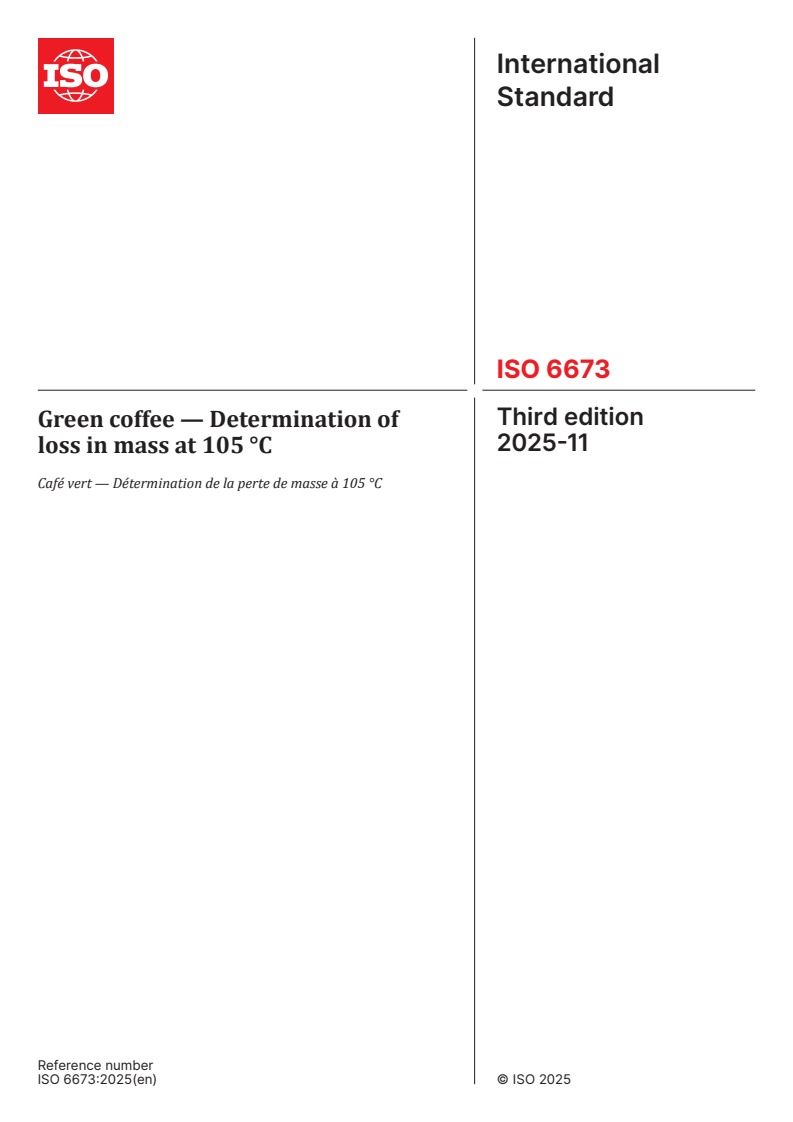
International
Standard
ISO 6673
Third edition
Green coffee — Determination of
2025-11
loss in mass at 105 °C
Café vert — Détermination de la perte de masse à 105 °C
Reference number
© ISO 2025
All rights reserved. Unless otherwise specified, or required in the context of its implementation, no part of this publication may
be reproduced or utilized otherwise in any form or by any means, electronic or mechanical, including photocopying, or posting on
the internet or an intranet, without prior written permission. Permission can be requested from either ISO at the address below
or ISO’s member body in the country of the requester.
ISO copyright office
CP 401 • Ch. de Blandonnet 8
CH-1214 Vernier, Geneva
Phone: +41 22 749 01 11
Email: copyright@iso.org
Website: www.iso.org
Published in Switzerland
ii
Contents Page
Foreword .iv
1 Scope . 1
2 Normative references . 1
3 Terms and definitions . 1
4 Principle . 1
5 Apparatus . 1
6 Sampling . 2
7 Procedure . 2
7.1 Preparation of the dish.2
7.2 Test portion .2
7.3 Determination .2
7.4 Number of determinations .3
8 Expression of results . 3
9 Uncertainty . 3
10 Precision . 3
11 Test report . 4
Bibliography . 5
iii
Foreword
ISO (the International Organization for Standardization) is a worldwide federation of national standards
bodies (ISO member bodies). The work of preparing International Standards is normally carried out through
ISO technical committees. Each member body interested in a subject for which a technical committee
has been established has the right to be represented on that committee. International organizations,
governmental and non-governmental, in liaison with ISO, also take part in the work. ISO collaborates closely
with the International Electrotechnical Commission (IEC) on all matters of electrotechnical standardization.
The procedures used to develop this document and those intended for its further maintenance are described
in the ISO/IEC Directives, Part 1. In particular, the different approval criteria needed for the different types
of ISO document should be noted. This document was drafted in accordance with the editorial rules of the
ISO/IEC Directives, Part 2 (see www.iso.org/directives).
ISO draws attention to the possibility that the implementation of this document may involve the use of (a)
patent(s). ISO takes no position concerning the evidence, validity or applicability of any claimed patent
rights in respect thereof. As of the date of publication of this document, ISO had not received notice of (a)
patent(s) which may be required to implement this document. However, implementers are cautioned that
this may not represent the latest information, which may be obtained from the patent database available at
www.iso.org/patents. ISO shall not be held responsible for identifying any or all such patent rights.
Any trade name used in this document is information given for the convenience of users and does not
constitute an endorsement.
For an explanation of the voluntary nature of standards, the meaning of ISO specific terms and expressions
related to conformity assessment, as well as information about ISO’s adherence to the World Trade
Organization (WTO) principles in the Technical Barriers to Trade (TBT), see www.iso.org/iso/foreword.html.
This document was prepared by Technical Committee ISO/TC 34, Food products, Subcommittee SC 15, Coffee.
This third edition cancels and replaces the second edition (ISO 6673:2003), which has been technically
revised.
The main changes are as follows:
— the number of determinations to be carried out on the same test sample has been changed;
— Clause 9 on uncertainty been added;
— the renumbered Clause 11 for the test report has been updated.
Any feedback or questions on this document should be directed to the user’s national standards body. A
complete listing of these bodies can be found at www.iso.org/members.html.
iv
...
Questions, Comments and Discussion
Ask us and Technical Secretary will try to provide an answer. You can facilitate discussion about the standard in here.